Personal, Professional and Financial Satisfaction among
American Women Urologists
Ciara S. Marley, Lori B. Lerner, Georgia Panagopoulos, Elizabeth Kavaler
Department of Urology (CSM, GP, EK), Lenox Hill Hospital, New York, USA and VA Boston
Healthcare System (LBL), West Roxbury, USA
ABSTRACT
Purpose: Although nearly half of American medical school classes are comprised of women, less than 5% of female medi-cal students enter the surgimedi-cal subspecialties compared to nearly 20% of male students. Many women are concerned that
a career in a surgical ield will limit their personal choices. In an effort to evaluate if urology is conducive to a satisfying lifestyle, we surveyed all 365 board certiied women urologists in the United States in 2007 to ind out how satisied they
are with their choice of urology.
Materials and Methods: A 114 item anonymous survey was mailed to all 365 American Board Certiied female urologists
in 2007. Results were analyzed.
Results: Of the 244 women (69%) who responded, 86.8% (211) reported being satisied with their decision to enter urology.
Given the choice to repeat the decision, 81% (198) said that they would remain in medicine and 91.4% (222) would choose
a surgical subspecialty again. The majority of respondents who stated they would choose a career outside of medicine also
stated their family life had been signiicantly compromised by their career. Those who did not think their family life was compromised reported they would remain in medicine. There was a positive correlation between the level of satisfaction with the work itself and with income level (p = 0.006).
Conclusions: Despite the small number of women who choose a career in urology, the number of satisied women indicates
urology is a career conducive to having a balanced and fulilling life; professionally, personally and inancially.
Key words: urology; urologists; women; clinical practice
Int Braz J Urol. 2011; 37: 187-94
INTRODUCTION
The surgical subspecialties continue to re-main desirable and competitive residencies among American medical students of both genders (1). Over the last 3 decades, female medical students have entered the surgical subspecialties in escalating numbers. However, women are not entering these highly competitive professions at nearly the rate of their male counterparts. Despite the fact that half of American medical school classes are comprised of
doi: 10.1590/S1677-55382011000200005
women, less than 5% enter the surgical subspecialties (1).
Like most surgical ields, urology remains a male-dominated profession. In urology the number of women applying for residency positions has increased over recent years, yet the number of male applicants far outweighs the number of female applicants, (271 male applicants vs. 77 female applicants -28%- in 2007 match). Data for 2007 show that women ill ap -proximately 21% of the urology residency positions (211 out of 985 total residents). The reasons for this gender discrepancy are not fully understood. In one recent study, 84% of women medical students cited lifestyle during residency as inluencing their career decision. Sixty-three percent of women selected other factors, including practice lifestyle and length of training (3). In fact, lifestyle considerations were the only signiicant factor inluencing the decision about surgical training affecting women more than men (4).
In an effort to evaluate if the ield of urology is conducive to a fulilling lifestyle for women, we surveyed all 365 board certiied women urologists in the United States to assess how satisied they are with their choice of urology professionally, personally and inancially.
MATERIALS AND METHODS
We obtained a list of all 365 American board certiied women urologists from American Board of Urology and the Society of Women in Urology. The 114-item survey was mailed to all women in May and July 2007. Given the personal nature of the survey, including questions on institutional policies, no respondent identiier or tracking mechanism was used. A pre-addressed stamped return envelope was included. For tracking purposes an included pre-ad -dressed response postcard was to be returned sepa-rately. Approval was granted from the Institutional Review Board of the VA Boston Healthcare System. The survey methods have been described in further detail in previous publications (5,6).
Demographic data concerning marital status, family life, and inancial compensation were obtained, as well as detailed information regarding training and overall satisfaction. The data were then entered into an online software program, Zoomerang (www. zoomerang.com), for further analysis.
Descriptive statistics were used to character -ize demographic data and overall responses to the survey. Percentages relect the total responses for each individual question as not all respondents answered every question. Relationships amongst categorical variables were examined with the Fisher’s exact test. We developed a logistic regression model to predict career satisfaction utilizing the following six variables as predictors: age; marital status; number of years in training; fellowship training; the number of hours worked per week; and income. A p < 0.05 was considered a priori to indicate statistical signiicance. Statistical analyses were performed with SPSS version 16.0.2 (SPSS, Chicago, IL).
We utilized responses to satisfaction questions (Table-1) as well as questions regarding the degree to which the respondents’ careers compromised their family and personal lives and vice versa. Selection choices for satisfaction questions included: very sat -isied; moderately sat-isied; moderately dissat-isied; very dissatisied. Statistical evaluation for satisfaction included the very and moderately satisied groups. Dissatisfaction included both the very and moder -ately dissatisied groups, unless otherwise indicated. We also explored respondents’ willingness to choose Table 1 – Survey satisfaction questions.
So far as you and your family are concerned, would you say that you are satisied with your present inancial
situation?
On the whole, how satisied are you with the work you
do?
How much satisfaction do you derive from your fam -ily life?
Overall, how would you describe your marriage? Overall, how would you describe your current life
satisfaction?
Are you satisied with the way you manage your time
between career and family/personal responsibilities? Do you feel that your personal life and family
responsi-bilities have compromised your career?
Do you feel that your career has compromised your family and personal life?
If you could do it all over again, would you choose a
non-surgical specialty?
If you could do it all over again, would you choose a
urology again if given the opportunity to alter their career decisions.
RESULTS
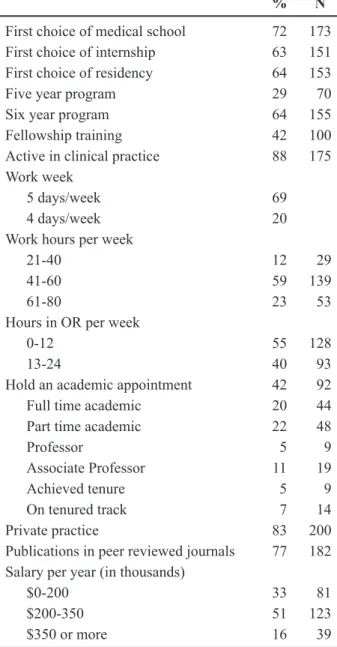
Of the 365 women on our mailing list, ad -dresses were available for 354. Two mailings culmi -nated in a 69% response rate (n = 243). The average respondent age was 43 years of age (range 31-77 years). The majority of the respondents were married (n = 197, 81%), with most being in their irst mar -riage (n = 181, 74%). Divorce and separation rates combined were 8% (n = 20) among respondents. The survey identiied 163 women (67.4%) who delivered a total of 331 biological children. Six percent (n = 15) of respondents were single parents at the time of survey completion. Years of training, practice envi -ronment, academic afiliation and hours worked are listed in Table-2. Satisfaction with life, salary, time management, and marriage are listed in Table-3.
The survey revealed that the number of years in training, the numbers of hours currently spent working, and private versus academic practice had no bearing on satisfaction rates. In addition, the logistic regression model did not identify any predictors of career satisfaction (p > 0.25). Satisfaction appears to be independent of the number of years spent training (p = 0.30) and independent of the type of practice entered once training is complete (p = 0.529). The number of hours spent working, both in and out of the operating room, does not appear to inluence career satisfaction level (p = 0.569).
There was a positive correlation between the number of hours worked and inancial compensation. The highest earners reported working 41-60 hours per week. The hardest workers (and not necessarily the highest earners) worked more than 80 hours per week [4% (n = 9)]. There was a positive correlation between inancial compensation and the level of reported satisfaction p = 0.006, however, it was not true that dissatisied women earned less.
Three percent (n = 7) of respondents indicated that their personal life and family responsibilities have compromised their careers to a great extent. Eleven percent (n = 26) of respondents indicated that their career had greatly compromised their family and
per-sonal lives. Ninety percent (19/21) of the moderately (20) to very (1) dissatisied urologists reported a mod -erate to great degree of compromise of their personal life due to their career. A total of 63% (137/216) of the very to moderately satisied urologists reported a moderate to great level of compromise of their per -sonal life due to their career (p = 0.024). In spite of these realities, 81% (n = 198) would remain in medi -cine, and 91.4% (n = 222) would choose a surgical
Table 2 – Survey responses.
% N
First choice of medical school 72 173 First choice of internship 63 151 First choice of residency 64 153
Five year program 29 70 Six year program 64 155
Fellowship training 42 100
Active in clinical practice 88 175 Work week
5 days/week 69
4 days/week 20
Work hours per week
21-40 12 29
41-60 59 139
61-80 23 53
Hours in OR per week
0-12 55 128
13-24 40 93
Hold an academic appointment 42 92 Full time academic 20 44
Part time academic 22 48
Professor 5 9
Associate Professor 11 19
Achieved tenure 5 9
On tenured track 7 14
Private practice 83 200
Publications in peer reviewed journals 77 182 Salary per year (in thousands)
$0-200 33 81
$200-350 51 123
$350 or more 16 39
subspecialty again if given the choice. Eighty-seven percent (n = 211) of respondents indicated that they were happy with their decision to enter urology. As expected, there was a positive correlation between those women who felt their family life was compro-mised by their career and those that would choose a career outside of medicine if they had the choice to do it again (p = 0.002).
Female urologists who worked more hours achieved greater inancial compensation, (p = 0.005) and those that are compensated well report a higher level of career satisfaction, (p = 0.006). When asked if their spouse/partner expected his/her career advance -ment to take priority over her own, 82% (n = 176) answered no, 13% (n = 27) answered yes and 6% (n = 12) were uncertain. Fifty-seven percent (n = 128) of respondents stated they shared the household re-sponsibilities equally with their partner. In our survey,
76% (n = 181) of respondents decided on their career path during medical school.
COMMENTS
There has been a growing interest in the as-sessment of female surgeon’s self-perceived quality of life. In 1990, female surgeons in Canada were sur -veyed in an effort to evaluate their ability to combine their careers with their personal and family lives (7). Our study is the irst to speciically target American women urologists in assessing satisfaction with career choice - professionally, personally, and inancially. Overall satisfaction in this study group was very high.
In a recent publication by Troppmann et al. (2), 3507 general surgeons were surveyed regarding career and lifestyle choices. Twenty-three percent of the respondents were women. Both genders stated they would choose their profession again (women 82.5% and men 77.5%). Overall, 83.5% of women would recommend surgery to other women (p < 0.001). Not surprisingly, women were more strongly in favor of part-time work opportunities for surgeons, perhaps due to the additional parenting responsibilities of women surveyed. The researchers found a grow -ing interest by both genders for child care facilities at work, highlighting one of the many changes in the evolving surgical workplace. The results of their study suggest that maximizing recruitment and retention of women surgeons will include giving serious consider -ation to alternative work schedules and optimiz-ation of maternity leave and childcare opportunities.
Two studies utilizing a survey, one from which ours was adapted, revealed that career satisfaction is greater among women urologists than that seen in women specializing in other surgical ields, including ophthalmology and otolaryngology (Table-4) (8,9). In one study, 75% of female ophthalmologists reported they would again choose a career in medicine if given the choice and 79% reported they would choose a surgical specialty, compared to 81% and 91.4% of our cohort. When asked if they felt that their career had compromised their family or personal lives, surgeons in the various specialties had signiicantly different responses. Only 40.3% of gynecologists and 41.9% Table 3 – Results of satisfaction.
Satisfaction with Salary
Very or moderately satisied 89 212
Satisfaction with Life
Very or moderately satisied 95 227 Satisfaction with time management be
-tween career and family/personal responsibilities
Very or moderately satisied 73 175 Very or moderately dissatisied 26 64
Marriage satisfaction
Very happy 57 137
Moderately happy 26 62
Table 4 – Comparison of specialty groups.
Specialty Would Choose
Surgical Field Again
Family / Life Compromise to any Degree
Urology 91.4% 30%
General surgery 82.5% 58.1%
Gynecology 62.1% 59.7%
of general surgeons reported that their career choice resulted in “some, a little, or no compromise” of their family and/or personal lives.
A study of otorhinolaryngologists revealed results that were very similar to ours (9). Only 30.6% of women otorhinolaryngologists reported that their career compromised their family or personal life to a “great deal” or a “very great deal”, which is similar to the 30% found in our cohort. Also mirroring our results, 83% of women in otolaryngology would re -main in medicine and 91% would choose a surgical subspecialty again (9).
In contrast to the high rates of professional satisfaction among female surgical sub specialists, primary care physicians report a growing level of dissatisfaction. A 2002 study by Landon et al. com-pared two satisfaction surveys among primary care physicians in 1996 and 1999. In 1996, 19.8% of phy -sicians were somewhat or very dissatisied with their current practice situations versus 33.4% in 1999, an increase of more than 50% (p < 0.001) (10). A more recent survey from 2008 found that only 70% of fam -ily physicians said that they “agree/strongly agree” that they would choose to practice family medicine if given the opportunity to choose again. This represents a 4% decline compared to data from 2001 and a 9% decline compared to 1995 (11). Although this survey was not a random sampling of primary care physi-cians, a surprising 73% of respondents answered that they were sorry they went into primary care (11).
In a recent 2008 study by Clem et al., 2502 women emergency medicine physicians were sur-veyed regarding their degree of career satisfaction. Only 35.5% reported being very satisied, 44% were satisied, 11.1% were neutral, and 9.4% were not/very unsatisied (12). Similarly, in a 2001 survey of 5704 general pediatricians, subspecialty pediatricians, general internists, internal medicine subspecialists, and family physicians, only 44% combined would encourage their children to pursue a career in medi-cine (13).
Competition for placement in urology is among the highest for all residencies. There are 112 non-military accredited urology programs in the United States. In 2008, there were 247 positions in 110 non-military accredited urology resident programs with 246 vacancies matched. Four hundred and four
applicants submitted preference lists resulting in 158 unmatched applicants. Of senior medical student ap-plicants, 70 percent were matched (4). Despite the growing number of competitive women candidates applying for positions, it does not appear that they are choosing surgical ields (4,13). Lifestyle consid -erations appear to drive the specialty choice of female medical students (6).
If lifestyle considerations are the deterrent for many female (or male) medical students, then results such as ours refute the misconception that all surgical ields affect lifestyle. Most respondents were moderately to highly satisied with their career and personal lives and did not feel that their personal and/or family lives were compromised. One of the explanations for this high rate of satisfaction is that the type of woman who is drawn to the demands of a surgical lifestyle has a different idea of quality of life versus a woman drawn to a primary care ield. Some consideration must be given to the difference in personalities between women and their choice of medical ield.
Like all survey - based studies, our analysis has limitations. First, the survey is not validated, however it has been used by three other specialties resulting in multiple publications, (8,9). Secondly, the study is retrospective and respondents were asked to remember important factors from several years ago, thus there is likely some degree of recall bias. A prospectively administered survey would address this weakness. It is also possible that the respond -ers represent a more satisied group than the 31% of non-responders, therefore revealing the role of self-selection of participants (the volunteer effect). In addition, respondents may have felt compelled to provide professionally desirable responses. A surgical career requires a signiicant time and inancial com -mitment. Having made these sacriices, physicians may not freely admit to negative feelings about their career choice.
appropriate male group (age and year of residency completion) and labor intensive. It is the hopes of the authors that publication of the current study will promote the importance of a future study that includes both men and women.
The strength of our study was the high re-sponse rate (69%). Research on survey rere-sponses by physicians report rates of 54%, which is lower than ours (13). Additionally, we had a national sample of board certiied women urologists, thus providing a representative selection.
CONCLUSIONS
Despite the small number of women who choose a career in urology, our study reveals that urol -ogy can provide a fulilling career, a satisfying personal life, and suficient inancial rewards to the women who choose this subspecialty. While many female medical students may be concerned that a career in a surgical ield will limit their personal choices, our study refutes this. Competitive female medical students who are in -terested in surgical careers should be educated about the growing opportunities in urology and the high level of satisfaction personally, professionally, and inancially among women in this ield.
CONFLICT OF INTEREST
None declared.
REFERENCES
1. AAMC GME Track (2007 data); AMA (1997 data). AAMC Data Warehouse. available at: http://www.aamc. org/members/gwims/statistics/stats08/table02.pdf 2. Troppmann KM, Palis BE, Goodnight JE Jr, Ho HS,
Troppmann C: Women surgeons in the new millen
-nium. Arch Surg. 2009; 144: 635-42.
3. Wendel TM, Godellas CV, Prinz RA: Are there gender differences in choosing a surgical career? Surgery. 2003; 134: 591-6; discussion 596-8.
4. McCord JH, McDonald R, Leverson G, Mahvi DM, Rikkers LF, Chen HC, et al.: Motivation to pursue surgical subspecialty training: is there a gender dif
-ference? J Am Coll Surg. 2007; 205: 698-703.
5. Lerner LB, Stolzmann KL, Gulla VD: Birth trends and
pregnancy complications among women urologists. J
Am Coll Surg. 2009; 208: 293-7.
6. Lerner LB, Baltrushes RJ, Stolzmann KL, Garshick E: Satisfaction of women urologists with maternity leave and childbirth timing. J Urol. 2010; 183: 282-6. 7. Mizgala CL, Mackinnon SE, Walters BC, Ferris LE,
McNeill IY, Knighton T: Women surgeons. Results of the Canadian Population Study. Ann Surg. 1993; 218: 37-46.
8. Mackinnon SE, Mizgala CL, McNeill IY, Walters BC, Ferris LE: Women surgeons: career and lifestyle com
-parisons among surgical subspecialties. Plast Reconstr Surg. 1995; 95: 321-9.
9. Grandis JR, Gooding WE, Zamboni BA, Wagener MM, Drenning SD, Miller L, et al.: The gender gap in a surgical subspecialty: analysis of career and lifestyle factors. Arch Otolaryngol Head Neck Surg. 2004; 130: 695-702.
10. Landon BE, Aseltine R Jr, Shaul JA, Miller Y, Auer
-bach BA, Cleary PD: Evolving dissatisfaction among primary care physicians. Am J Manag Care. 2002; 8: 890-901.
11. Young R, Webb A, Lackan N, Marchand L: Family
medicine residency educational characteristics and
career satisfaction in recent graduates. Fam Med. 2008; 40: 484-91.
12. Clem KJ, Promes SB, Glickman SW, Shah A, Finkel MA, Pietrobon R, et al.: Factors enhancing career
satisfaction among female emergency physicians. Ann
Emerg Med. 2008; 51: 723-8.
13. Shugerman R, Linzer M, Nelson K, Douglas J, Wil
-liams R, Konrad R, et al.: Pediatric generalists and subspecialists: determinants of career satisfaction. Pediatrics. 2001; 108: E40.
Accepted after revision: July 30, 2010
Correspondence address:
Dr. Ciara S. Marley Department of Urology Lenox Hill Hospital, 100 East 77th Street
New York, NY 10075, USA Fax: + 1 212 434-2000
EDITORIAL COMMENT
“Life, liberty and the pursuit of happiness” are
cited as unalienable rights in the United States Decla
-ration of Independence. This study by Marley and co-workers examines the “pursuit of happiness” in per
-sonal, professional and inancial satisfaction in female American Board Certiied Urologists. This is a com
-prehensive study that reports that these urologists are in general a satisied cohort, both at work and at home. The vast majority of women would enter a surgical subspe
-ciality, and would choose medicine as a career if given
the choice again. Despite careful analysis, there were no
clear predictors of satisfaction analyzed from working
pattern, years of training and type of practice. There are
relevant comparisons drawn between studies of women in other surgical subspecialties who have reported simi
-lar rates of satisfaction to these urologists; and special -ists such as general surgery and general medicine where satisfaction with career, and medicine in general were
much lower (1,2).
Of note was the high response rate from the
urologists surveyed (69%) which the authors rightly note may relect “satisfaction bias”. Interestingly, this
was almost exactly the same number of respondents as replied in two studies of pregnancy and maternity carried out by one of the authors of the same
co-hort of urologists (3,4) It could be presumed this is a particularly well-motivated cohort of women, or
are particularly sympathetic to questionnaire based research.
Fundamentally, it is dificult to separate
whether the lifestyle of surgical specialties is
par-ticularly conducive to satisfaction both profession
-ally and person-ally; or whether the personalities drawn to these specialities have shaped their lives around work practices. The authors have noted this, and the dificulty in asking individuals to remem -ber and critically assess decisions in retrospect with the possibility of recall practice. The independence
of satisfaction from the multiple variables assessed
demonstrates what a complex and personal subject
satisfaction is to analyze.
Clearly with men forming the vast majority of American Board Certiied Urologists, this study
should create considerable interest in repeating the analysis to examine the satisfaction rates in male urologists. As the authors rightly note, the much larger numbers, and potentially lower response rates
(2) would make a follow-on study of male urologists a considerable undertaking. However, consideration of a longitudinal prospective study of recently certi
-ied male and female urologists would allow com
-parison between the sexes, and over the course of
a career. Hopefully interest generated by this article
may encourage the American Urology Association and the American Board of Urology to continue re -search into satisfaction and quality of life amongst its members.
In summary, Marley et al. (5) have provided a comprehensive analysis of high rates of personal
and professional satisfaction among female
urolo-gists. However, bearing in mind Abraham Lincoln’s quotation “most folks are about as happy as they make up their minds to be” it remains unclear if the high rates of fulillment are due to the lifestyle pro
-vided by urology as a specialty, or a matter of se -lection and adaptation in the “pursuit of happiness”. Hopefully this study will ignite interest in comparing
satisfaction in a cohort of newly certiied urologists,
both male and female.
REFERENCES
1. Frank E, McMurray JE, Linzer M, Elon L: Career satisfaction of US women physicians: results from the Women Physicians’ Health Study. Society of General Internal Medicine Career Satisfaction Study Group. Arch Intern Med. 1999; 159: 1417-26. 2. Zutshi M, Hammel J, Hull T: Colorectal surgeons:
gender differences in perceptions of a career. J Gas-trointest Surg. 2010; 14: 830-43.
3. Lerner LB, Stolzmann KL, Gulla VD: Birth trends and pregnancy complications among women urolo-gists. J Am Coll Surg. 2009; 208: 293-7.
5. Marley CS, Lerner LB, Panagopoulos G, Kavaler
E: Personal, professional and inancial satisfaction among American women urologists. Int Braz J Urol. (in press)