INTRODUCTION
Urinary incontinence (UI) is considered a clinical condition with multifactor etiology (1). Studies of UI during pregnancy have reported prevalence of 32% to 64% for all UI and 40% to 59% for stress UI, including mixed incontinence
(2), persisting after delivery in 6% to 29% of wom-en (3). Estimating the post-partum prevalwom-ence of urinary incontinence is complex because the prev-alence may depend upon the number of previous births, type of delivery, and history of previous in-Introduction and Objectives: The increase of the intensity of urinary symptoms
in late pregnancy and postpartum has been well documented by several authors, but their causes remain uncertain, partly because of its probable multifactor origin. There are also controversies whether the etiology of lower urinary tract symptoms during pregnancy is the same as postpartum and whether the method of delivery could infl uence the risk of onset of urinary symptoms. This study aimed to evaluate the urinary symptoms triggered during pregnancy and its evo-lution in the late puerperium, correlating them with the delivery method.
Materials and Methods: A longitudinal study was conducted, which included 75 primigravidae women, classifi ed according to method of delivery as: (VD) vaginal delivery with right mediolateral episiotomy (n = 28); (CS) elective cae-sarean section (n = 26); and (EC) emergency caecae-sarean section (n = 21). Urinary symptoms were assessed in the last trimester of pregnancy and at 45 days (± 10) of puerperium with validated versions for Portuguese language of the following questionnaires: International Consultation on Incontinence Questionnaire - Uri-nary Incontinence Short Form (ICIQ-UI SF) and the International Consultation on Incontinence Questionnaire Overactive Bladder (ICIQ-OAB).
Results: It was observed that frequency, urgency, nocturia and urge incontinence, triggered during pregnancy, decreased signifi cantly in the postpartum period, regardless of the delivery method (p = 0.0001). However, symptoms related to urinary loss due to stress persisted after vaginal delivery (p = 0.0001).
Conclusions: Urgency, frequency and nocturia triggered during pregnancy tend to disappear in the late postpartum period, regardless of the delivery method, but the symptoms related to urinary loss due to stress tend to persist in late postpar-tum period after vaginal delivery.
Can the delivery method infl uence lower urinary tract
symptoms triggered by the fi rst pregnancy?
_______________________________________________
Simone Botelho, Joseane Marques da Silva, Paulo Palma, Viviane Herrmann, Cassio Riccetto
Federal University of Alfenas - UNIFAL (SB), Alfenas, MG, Brazil and State University of Campinas - UNICAMP (SB, JMS, PP, VH, CR), Campinas, SP, Brazil
ABSTRACT ARTICLE INFO
_______________________________________________________________ _____________________
Key words:
Pregnancy; childbirth; postpartum; pelvic fl oor; urinary symptoms
Int Braz J Urol. 2012; 38: 267-76 ________________
Submitted for publication: April 12, 2011
________________
continence (2). Studies suggest that its incidence may increase with age (4,5), and multiparity (6-8), but the actual mechanisms remain unclear (2,5,9).
Vaginal birth has been recognized to be potentially traumatic to the pelvic floor (10-15). However, the pathophysiological effects of preg-nancy and method of delivery on the lower uri-nary tract in general and the pelvic floor in partic-ular remain uncertain, despite frequent references in obstetric literature (2,16).
Urinary continence is greatly committed to quality of life. Since 1997, the International Continence Society (ICS) recommends that the as-sessment of quality of life should be included in the studies, and it is consensual that the improved quality of life is important for the evaluation of the success of the proposed treatments as well as the impact and severity of the impairment (17,18).
This study aimed to evaluate the lower urinary tract symptoms (LUTS) triggered during pregnancy in primigravidae women, to assess their persistence in late puerperium and to corre-late them with the different methods of delivery: vaginal, elective caesarean section and emergency caesarean section.
MATERIALS AND METHODS
We conducted a prospective, longitudinal, comparative clinical study which included 75 pri-migravidae women, aged between 14 and 39 years (mean 23.24 years), selected from health programs in Poços de Caldas (Minas Gerais, Brazil). All pa-tients signed a consent form approved by the Eth-ics Committee in accordance with the Declaration of Helsinki (Clinical Trial Registration Number - Zip: 0207.0.213.146-05) and it was approved on 02/10/2006 (17:35:18).
Primigravidae women in the third trimes-ter (average of 31.19 weeks of gestation), who pre-sented some voiding complaints that had begun during the pregnancy, were included in the study. The patients had a mean body mass index (BMI) of 27.49 in the enrollment and 25.04 at reevaluation in the late puerperium.
Twenty five pregnant women were ex-cluded from the study due to high-risk pregnancy; urinary tract infection; urinary incontinence and/
or prior pelvic organ prolapse; myopathies and diseases with known modification of collagen; neurological abnormalities; metabolic disorders (diabetes) or chronic lung diseases; history of ab-domino-pelvic surgery; premature labor; and those who did not attend the two evaluations provided or who underwent instrumental vaginal delivery with forceps (Figure-1).
Patients were evaluated during the last trimester of pregnancy and reassessed 45 days (± 10 days) after delivery, through culturally adapted and validated versions of the question-naires: International Consultation on Incontinence Questionnaire - Urinary Incontinence Short Form (ICIQ-UI SF) and the International Consultation on Incontinence Overactive Bladder Questionnaire (ICIQ-OAB) (19,20).
The ICIQ-UI SF has four questions that assess the frequency, volume and impact of uri-nary symptoms in the quality of life, and its score is calculated by the sum of the first three ques-tions. The score can vary from zero to twenty-one points, the greater the total value the higher the commitment. The questionnaire also assesses the causes and situations that trigger the loss of urine (19). The ICIQ-OAB consists of four questions that assess overactive bladder symptoms - frequency, urgency, nocturia, with or without urge inconti-nence - with scores varying from zero to sixteen points. If the symptoms are more severe, the score increases (20). Both questionnaires are part of the ICIQ project modular questionnaire (www.iciq. net). The ICIQ provides clarity over the selection of questionnaires by recommending only those with evidence of high quality and robust psychomet-ric validation including validity, reliability and sensitivity to change. This assurance provides the user confidence in the results obtained, which is important in clinical practice and research where treatment decisions or trial outcomes depend on these evidences. Increasing awareness of the ICIQ aims to promote increased use of standardized questionnaires, thereby facilitating communica-tion between clinicians and researchers enabling more widespread comparisons between different treatments and patient groups worldwide (21,22).
based on the patient’s obstetrician’s indication: (VD) vaginal delivery with right mediolateral epi-siotomy (n = 28); (CS) elective caesarean section (n = 26); (EC) emergency caesarean section (cae-sarean section during labor) i.e., women who went into labor, but for lack of progress, were submitted to a caesarean section (n = 21).
In each group, the following variables were analyzed: (a) demographic data (age, declared skin color, education level, marital status, occupation and family income); (b) puerperal and pregnancy his-tory (change in weight during pregnancy, newborn’s weight, length of labor, return to previous weight).
The statistical methods used were Fisher Exact Test and Analysis of Variance (ANOVA) with Rank Transformation.
RESULTS
It was shown that frequency, urgency, nocturia and urge incontinence, which have been observed during pregnancy, decreased signifi-cantly in the postpartum period, regardless of the delivery method (p = 0.0001). However, symp-toms related to urinary loss due to stress persist-ed after vaginal delivery (p = 0.0001), comparpersist-ed to the two types of caesarean section (Table-1).
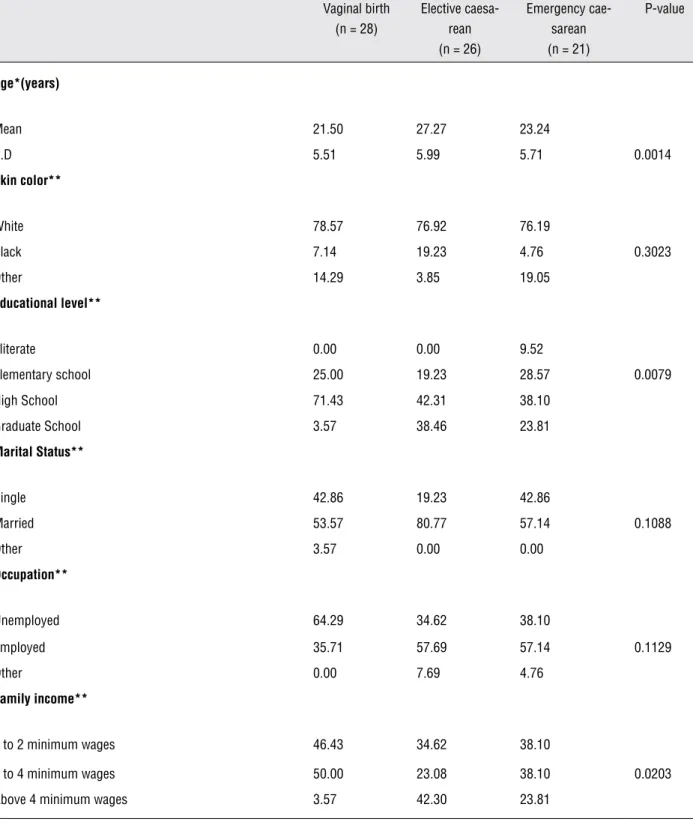
The demographic information as well as pregnancy and postpartum history were also an-alyzed, as shown in the Tables 2 and 3. There was a lower educational level (p = 0.0079) and family income (p = 0.0203) in the group that underwent vaginal delivery compared to caesarean groups. Figure 1 – Organogram representating the study population.
ORGANOGRAM
100 Brazilian women
75 primigravidae women
Elective caesarean (n=26) Vaginal birth
n=28 Emergency caesarean(n=21)
Table 1 - Puerperal and gestational urinary symptoms evaluated through ICIQ-OAB and ICIQ-UI SF.
Vaginal birth (n = 28)
Elective caesarean (n = 26)
Emergency caesarean
(n = 21)
P-value
Groups Time Interaction group
versus time
ICIQ-OAB Gestational**
Mean 5.68 6.87 4.86
S.D 3.75 3.55 2.73
Minimum 0.00 0.00 0.00
Medium 5.00 7.00 5.00
Max 14.00 13.00 9.00
ICIQ-OAB Puerperal** 0.1375 0.0001 0.1818
Mean 2.40 1.87 1.24
S.D 3.00 2.30 1.95
Minimum 0.00 0.00 0.00
Medium 1.00 1.00 0.00
Max 10.00 8.00 6.00
ICIQ-UI SF Gestational**
Mean 5.00 7.91 3.00
S.D 4.65 6.52 4.39
Minimum 0.00 0.00 0.00
Medium 5.00 8.50 0.00
Max 18.00 20.00 17.00
ICIQ-UI SF Puerperal** 0.0801 0.0001 0.0186
Mean 3.81 1.05 0.67
S.D 5.39 3.00 1.71
Minimum 0.00 0.00 0.00
Medium 0.00 0.00 0.00
Max 15.00 12.00 7.00
** ANOVA with ranks
ICIQ-OAB: score variation possibility-0 - 16 points, being as higher the score as severe the UI. ICIQ-UI SF: score variation possibility 0 - 21 points, being as higher the score as severe the UI.
P-value: the table represents comparison among the studied groups (vaginal birth, elective and emergency cesarean); the comparison between the evalu-ation time (gestevalu-ational evaluevalu-ation and puerperal reevaluevalu-ation); and interaction between both (groups versus time).
Table 2 - Demographic characteristics.
Vaginal birth (n = 28)
Elective caesa-rean (n = 26)
Emergency cae-sarean (n = 21)
P-value
Age*(years)
Mean 21.50 27.27 23.24
S.D 5.51 5.99 5.71 0.0014
Skin color**
White 78.57 76.92 76.19
Black 7.14 19.23 4.76 0.3023
Other 14.29 3.85 19.05
Educational level**
Illiterate 0.00 0.00 9.52
Elementary school 25.00 19.23 28.57 0.0079
High School 71.43 42.31 38.10
Graduate School 3.57 38.46 23.81
Marital Status**
Single 42.86 19.23 42.86
Married 53.57 80.77 57.14 0.1088
Other 3.57 0.00 0.00
Occupation**
Unemployed 64.29 34.62 38.10
Employed 35.71 57.69 57.14 0.1129
Other 0.00 7.69 4.76
Family income**
1 to 2 minimum wages 46.43 34.62 38.10
3 to 4 minimum wages 50.00 23.08 38.10 0.0203
Above 4 minimum wages 3.57 42.30 23.81
Table 3 - Gestational and puerperal history.
Vaginal birth (n = 28)
Elective caesarean
(n = 26)
Emergency caesarean
(n = 21)
P-value
Weight increase during pregnancy** (KG)
Mean 12.97 12.12 10.28
S.D 5.89 4.21 5.89 0.1970
Newborn weight** (KG)
Mean 3239.04 3337.65 3085.24
S.D 475.51 332.19 435.75 0.1716
Labor duration** (Hours)
Mean 11.05 9.86 0.2652
S.D 7.31 --- 9.46
Return to pre pregnancy weight** (weight %)
Mean 10.65 11.77 8.24
S.D 12.89 10.91 9.64 0.5559
Return to daily life activity* (%)
Early puerperium 35.71 42.31 57.14
Late Puerperium 64.29 57.69 42.86 0.3194
* Fischer’s Exact Test ** ANOVA with ranks S.D: Standard Deviation
The group that underwent vaginal delivery had a mean age significantly lower than the elective caesarean section group (p = 0.0014), and there was no statistical difference from the emergency caesarean group.
No significant differences were found among groups in the other examined criteria, like body mass index, newborn’s weight, weight gain during pregnancy and labor time.
DISCUSSION
There is evidence in the literature that pel-vic floor disorders are at least partially determined by changes resulting from pregnancy and child-birth, and can be responsible for the onset of LUTS (15,16).
Symptoms of overactive bladder - frequency, ur-gency, nocturia, with or without urge incontinence - are common in the third trimester and may be related to the pressure exerted by the fetal head on the bladder (17,24-26).
However, this study demonstrated that such symptoms tend to decrease in the late post-partum period, regardless of the delivery method (p = 0.0001). Other authors confirm these findings, concluding that overactive bladder symptoms are more transient, compared to symptoms related to urinary loss due to stress (27-32).
Van Brummen et al. (2007) compared LUTS three months and one year after both vaginal de-livery and caesarean section. Their results showed a lower prevalence of overactive bladder symptoms in the group submitted to caesarean section, but without any significant difference after one year of follow-up (25). Scarpa et al. (2008) assessed the frequency of LUTS three years after childbirth in women previously interviewed in the third trimes-ter and concluded that pregnancy, rather than de-livery, was associated with the appearance of stress urinary incontinence (SUI) and nocturia, while the urge incontinence was significantly higher after delivery. Most women stated further that the pres-ence of SUI triggered social problems (26).
The high prevalence of urinary com-plaints during pregnancy are expected in ob-stetrical practice. In contrast, there is a growing concern about the persistence of these symptoms, such as complaints associated with defecation symptoms, sex and presence of genital prolapse (2,3,5,6,16,19,28,29).
Urinary incontinence is usually experi-enced by women during the first pregnancy (29). Thomason et al. (2007) found 51% of incontinence after six and nine months of delivery in primip-arous women with a history of urinary leakage, compared to 60% of women without this history who developed urinary incontinence in the first pregnancy (33). A study of Brazilian women re-vealed the presence of LUTS in 63% of the 500 women who had been interviewed (8).
Wesner et al. (2009) (34) and Arrue et al. (2010) (11) observed that women who developed in-continence during pregnancy had a higher preva-lence of incontinence six months after delivery, with
a risk of 3.2 (confidence interval = 95%; 2.2 to 4.7) for spontaneous vaginal delivery and 2.9 (confi-dence interval = 95%; 2.3 to 3.4) for elective caesar-ean delivery (34). Another study in our department showed that urinary symptoms remained present six months after delivery; however, women did not cor-relate them with a worsening of quality of life (35).
Thus, the UI after delivery may be transient or not, but its persistence may be considered a pre-dictor for reduced quality of life of women later on (36-38).
This study showed that stress urinary in-continence symptoms persisted after vaginal de-livery (p = 0.0001), compared to two types of cae-sarean section - elective caecae-sarean delivery and emergency caesarean.
Other research confirms a higher preva-lence of SUI after vaginal delivery. Ekström et al. (2008) reported that the relative risk of SUI nine months after vaginal delivery is 8.9%, while for urge incontinence is 7.3% (confidence interval = 95%). These authors confirm that the presence of SUI during pregnancy until the third month af-ter birth is a predictor for the maintenance of the symptoms for longer periods (32).
According to the study by Rortveit et al. (2003) the risk of urinary incontinence is higher among women who had caesarean delivery than among nulliparous women and is even higher among women who had vaginal deliveries. How-ever, these results should not be used to justify an increased rate of recommendation of caesarean sections (10).
There is no doubt that vaginal delivery is associated with urinary incontinence after child-birth and that the presence of UI during pregnancy can predispose to UI in the postpartum period (13). However, Huebner et al. (2010) related that showed that the effects of pregnancy on the pelvic floor are different from those triggered after vaginal delivery (12). Brown et al. (2010) studied the risk factors for UI in pregnancy, and concluded that there are prob-ably different mechanisms on the onset of symptoms at each stage of life of women and on their recur-rences. Thus, it is important to consider the interac-tion of the effects of pregnancy and delivery (9).
epi-dural anesthesia, newborn’s weight above 3.5 kilograms, and prolonged labor are factors that must be considered when investigating urogy-necologic complaints (30). However, in several studies no significant relationship among them was observed (2).
Burgio et al. (2003) associated the UI in first six months and then one year after delivery with the presence of incontinence during pregnan-cy, vaginal delivery and use of forceps. However, these authors found no significant relationship be-tween age, race, education, episiotomy and num-ber of vaginal deliveries (39). In the present study, we assessed the demographic and obstetric history. There were no significant influences of the vari-ables: weight gain during pregnancy; constipation; newborn’s weight and duration of labor as well as the evolution of lower urinary tract symptoms.
Although no significant differences were observed among groups, patients who joined the vaginal delivery group had lower BMI than the others, demonstrating that increasing maternal weight did not influence the results.
Our findings also show that the group sub-mitted to elective caesarean section showed age, education level and family income higher than other groups. Possibly, these findings are related to the mother’s and obstetrician’s preference of a more selective group of women. This characteristic of the studied subjects reflects the Brazilian reality, since it is observed that the higher the socioeco-nomic level, the greater the prevalence of elective cesarean section.
To Bruschini (2005) (40) and Leijonhufvud et al. (2011) (14) vaginal delivery is strongly as-sociated with late need of SUI correction surgery. The maternal mortality reduction and the increase of life expectancy have contributed to highlight late sequelae related to childbirth. This probably justifies the preference for caesarean section in the occidental world (16,40).
Although many studies have demon-strated the protective effect of caesarean section (7,10,14,15,34), McLennan et al. (2006) (38) suggest that information regarding the route of delivery should be offered as a routine in obstetric consulta-tions, emphasizing the real indicaconsulta-tions, contraindi-cations, complications and sequelae, which would
help educate women about the risks, helping them choosing the method of delivery (14,38).
By comparing the two types of caesarean section - elective and emergency, no significant dif-ferences between the two groups were found. How-ever, Chin et al. (2006) found a higher frequency of urinary incontinence in women submitted to vaginal delivery and emergency caesarean delivery compared to elective caesarean section (41).
Van Brummen et al. (2007), assessing the bladder symptoms after three months of postpar-tum, found a significant reduction in urgency and urge incontinence after caesarian section; how-ever, no significant alterations were found a year after delivery. On the other hand, SUI was signifi-cantly higher in the vaginal delivery group, both after three and twelve months. The authors con-firmed that SUI during pregnancy was a predictive factor of its persistence after delivery. The presence of SUI during pregnancy increased the risk of SUI by 18 times one year after delivery (25).
Thus, the concern with the prevention and treatment of urinary incontinence is imminent. The implementation of awareness and prevention programs must be emphasized (15,19,42,43).
CONCLUSIONS
Urgency, frequency and nocturia trig-gered during pregnancy trend to disappear in the late postpartum period, regardless of the delivery method, but the symptoms related to urinary loss due to stress tend to persist in late postpartum pe-riod after vaginal delivery.
ABBREVIATIONS
BMI: body mass index;
ICIQ-OAB: International Consultation on Inconti-nence Questionnaire Overactive Bladder;
ICIQ-UI SF: International Consultation on In-continence Questionnaire – Urinary InIn-continence Short Form;
ICS: International Continence Society; LUTS: lower urinary tract symptoms; SD: standard deviation;
CONFLICT OF INTEREST
None declared.
REFERENCES
1. Abrams P, Cardozo L, Fall M, Griffiths D, Rosier P, Ulm-sten U, et al.: The standardisation of terminology of lower urinary tract function: report from the Standardisation Sub-committee of the International Continence Society. Neurourol Urodyn. 2002; 21: 167-78.
2. Milsom I, Altman D, Lapitan MC, Nelson R, Sillén U, Thom D: Epidemiology of urinary (UI) and faecal (FI) incon-tinence and pelvic organ prolapse (POP). In: Abrams P, Cardozo L, Khoury S, Wein A (eds). Incontinence, 4th edn. Committee 1. Paris, France: Health Publication Ltd. 2009: 37-111.
3. Mostwin J, Bourcier J, Haab F, Koebl S, Rao N, Resnick S, et al.: Pathophysiology of urinary incontinence, fecal incontinence and pelvic organ prolapse. In: Abrams P, Cardozo L, Khoury, Wein A (eds). Incontinence. 3nd ed. Plymouth: Health Publication Ltd. 2005; Vol. 1: 436-62. 4. Viktrup L, Lose G: The risk of stress incontinence 5 years
after first delivery. Am J Obstet Gynecol. 2001; 185: 82-7. 5. Toozs-Hobson P, Boos K, Cardozo L: Pregnancy, childbirth
and pelvic floor damage. In: Appell RA, Bourcier AP, La Torre F, eds. Pelvic floor dysfunction: Investigations and conservative treatment. Rome: Casa Editrice Scientifica Internazionale. 1999; pp. 97-106.
6. Amaro JL, Macharelli CA, Yamamoto H, Kawano PR, Pa-dovani CV, Agostinho AD: Prevalence and risk factors for urinary and fecal incontinence in Brazilian women. Int Braz J Urol. 2009; 35: 592-7; discussion 598.
7. Torkestani F, Zafarghandi N, Davati A, Hadavand SH, Garshasbi M: Case-controlled study of the relationship between delivery method and incidence of post-partum urinary incontinence. J Int Med Res. 2009; 37: 214-9. 8. Martins G, Soler ZA, Cordeiro JA, Amaro JL, Moore KN:
Prevalence and risk factors for urinary incontinence in healthy pregnant Brazilian women. Int Urogynecol J. 2010; 21: 1271-7.
9. Brown SJ, Donath S, MacArthur C, McDonald EA, Krastev AH: Urinary incontinence in nulliparous women before and during pregnancy: prevalence, incidence, and associated risk factors. Int Urogynecol J. 2010; 21: 193-202. 10. Rortveit G, Daltveit AK, Hannestad YS, Hunskaar S;
Nor-wegian EPINCONT Study. Urinary incontinence after vagi-nal delivery or cesarean section. N Engl J Med. 2003; 348: 900-7.
11. Arrue M, Ibañez L, Paredes J, Murgiondo A, Belar M, Saras-queta C, et al.: Stress urinary incontinence six months after first vaginal delivery. Eur J Obstet Gynecol Reprod Biol. 2010; 150: 210-4.
12. Huebner M, Antolic A, Tunn R: The impact of pregnancy and vaginal delivery on urinary incontinence. Int J Gynae-col Obstet. 2010; 110: 249-51.
13. Diez-Itza I, Arrue M, Ibañez L, Murgiondo A, Paredes J, Sarasqueta C: Factors involved in stress urinary inconti-nence 1 year after first delivery. Int Urogynecol J. 2010; 21: 439-45.
14. Leijonhufvud A, Lundholm C, Cnattingius S, Granath F, An-dolf E, Altman D: Risks of stress urinary incontinence and pelvic organ prolapse surgery in relation to mode of child-birth. Am J Obstet Gynecol. 2011; 204: 70.e1-7.
15. Thüroff JW, Abrams P, Andersson KE, Artibani W, Chapple CR, Drake MJ, et al.: EAU guidelines on urinary inconti-nence. Eur Urol. 2011; 59: 387-400.
16. Koebl H, Nitti V, Baessler K, Salvatore S, Sultan A, Yama-guchi O: Pathophysiology of urinary incontinence, fecal incontinence and pelvic organ prolapse. In: Abrams P, Car-dozo L, Khoury, Wein A (ed.), Incontinence. 4th ed. Plym-outh: Health Publication Ltd. 2009; 255-330.
17. Parente MP, Jorge RM, Mascarenhas T, Fernandes AA, Martins JA: Deformation of the pelvic floor muscles during a vaginal delivery. Int Urogynecol J Pelvic Floor Dysfunct. 2008; 19: 65-71.
18. Arruda RM, Castro RA, Girão MJBC: Impacto na qualidade de vida. In: Truzzi JC, Dambros M. Bexiga Hiperativa – As-pectos Práticos. São Paulo, Nome da Rosa. 2009; pp. 36-9. 19. Tamanini JT, Dambros M, D’Ancona CA, Palma PC, Ro-drigues Netto N Jr: Validação para o português do Interna-tional Consultation on Incontinence questionnaire - Short Form (ICIQ-UI SF). Rev Saude Publica. 2004; 38: 438-44. 20. Pereira SB, Thiel RRC, Riccetto C, Silva JM, Pereria LC,
Herrmann V, et al.: Validação do International Consultation on Incontinence Questionnaire Overactive Bladder (ICIQ-OAB) para a língua portuguesa. Rev. Bras. Ginecol. Obstet. 2010; 32: 273-8.
21. Abrams P, Andersson KE, Birder L, Brubaker L, Cardozo L, Chapple C, et al.: Fourth International Consultation on Incontinence. Fourth International Consultation on In-continence Recommendations of the International Scien-tific Committee: Evaluation and treatment of urinary in-continence, pelvic organ prolapse, and fecal incontinence. Neurourol Urodyn. 2010; 29: 213-40.
23. van Brummen HJ, Bruinse HW, van der Bom JG, Heintz AP, van der Vaart CH: How do the prevalences of urogenital symptoms change during pregnancy? Neurourol Urodyn. 2006; 25: 135-9.
24. Scarpa KP, Herrmann V, Palma PCR, Riccetto CLZ, Morais S: Prevalências de sintomas do trato urinário inferior no terceiro trimestre da gestação. Rev Assoc Med Bras. 2006; 52: 153-6.
25. van Brummen HJ, Bruinse HW, van de Pol G, Heintz AP, van der Vaart CH: The effect of vaginal and cesarean delivery on lower urinary tract symptoms: what makes the difference? Int Urogynecol J Pelvic Floor Dysfunct. 2007; 18: 133-9. 26. Scarpa KP, Herrmann V, Palma PCR, Ricetto CLZ, Morais S:
Sintomas do trato urinário inferior três anos após o parto: estudo prospectivo. Bras Ginecol Obstet. 2008; 30: 355-9. 27. Sharma JB, Aggarwal S, Singhal S, Kumar S, Roy KK:
Prevalence of urinary incontinence and other urological problems during pregnancy: a questionnaire based study. Arch Gynecol Obstet. 2009; 279: 845-51.
28. Genadry R: A urogynecologist’s view ofthe pelvic floor ef-fects of vaginal delivery/cesarean section for the urologist. Curr Urol Rep. 2006; 7: 376-83.
29. Mørkved S, Salvesen KA, Bø K, Eik-Nes S: Pelvic floor muscle strength and thickness in continent and incontinent nulliparous pregnant women. Int Urogynecol J Pelvic Floor Dysfunct. 2004; 15: 384-9; discussion 390.
30. Casey BM, Schaffer JI, Bloom SL, Heartwell SF, McIntire DD, Leveno KJ: Obstetric antecedents for postpartum pel-vic floor dysfunction. Am J Obstet Gynecol. 2005; 192: 1655-62.
31. Scarabotto LB, Riesco ML: Fatores relacionados ao trauma perineal no parto normal em nulíparas Rev Esc Enferm USP. 2006; 40: 389-95.
32. Ekström A, Altman D, Wiklund I, Larsson C, Andolf E: Planned cesarean section versus planned vaginal delivery: comparison of lower urinary tract symptoms. Int Urogyne-col J Pelvic Floor Dysfunct. 2008; 19: 459-65.
33. Thomason AD, Miller JM, Delancey JO: Urinary inconti-nence symptoms during and after pregnancy in continent and incontinent primiparas. Int Urogynecol J Pelvic Floor Dysfunct. 2007; 18: 147-51.
34. Wesnes SL, Hunskaar S, Bo K, Rortveit G: The effect of urinary incontinence status during pregnancy and delivery mode on incontinence postpartum. A cohort study. BJOG. 2009; 116: 700-7.
35. Botelho S, Riccetto C, Ribeiro G, Gome J, Brisola M, Herrmann V, et al.: Overactive bladder symptoms in pregnancy and pu-erperium: is there a relationship between the symptoms score and quality of life?. Actas Urol Esp. 2010; 34: 794-7.
36. Viktrup L, Lose G, Rolff M, Barfoed K: The symptom of stress incontinence caused by pregnancy or delivery in pri-miparas. Obstet Gynecol. 1992; 79: 945-9.
37. Viktrup L, Rortveit G, Lose G: Does the impact of subse-quent incontinence risk factors depend on continence sta-tus during the first pregnancy or the postpartum period 12 years before? A cohort study in 232 primiparous women. Am J Obstet Gynecol. 2008; 199: 73.e1-4.
38. McLennan MT, Melick CF, Alten B, Young J, Hoehn MR: Pa-tients’ knowledge of potential pelvic floor changes associ-ated with pregnancy and delivery. Int Urogynecol J Pelvic Floor Dysfunct. 2006; 17: 22-6.
39. Burgio KL, Zyczynski H, Locher JL, Richter HE, Redden DT, Wright KC: Urinary incontinence in the 12-month postpar-tum period. Obstet Gynecol. 2003; 102: 1291-8.
40. Bruschini, H: Etiopatogenia e classificação da incontinência urinária feminina. In: Amaro JL, Haddad JM, Trindade JCS, Ribeiro RM (ed.), Reabilitação do assoalho pélvico nas disfunções urinárias e anorretais. São Paulo: Segmento Farma. 2005; pp. 41-6.
41. Chin HY, Chen MC, Liu YH, Wang KH: Postpartum urinary incontinence: a comparison of vaginal delivery, elective, and emergent cesarean section. Int Urogynecol J Pelvic Floor Dysfunct. 2006; 17: 631-5.
42. Dumoulin C, Hay-Smith J: Pelvic floor muscle training ver-sus no treatment for urinary incontinence in women. Eura Medicophys. 2007; 43: 1-17.
43. Hay-Smith J, Berghmans B, Burgio K, Dumoulin C, Hagen S, Moore K, et al.: Adult Conservative Management In: Abrams P, Cardozo L, Khoury S, Wein A (ed.), Incontinence. 4th Inter-national Consultation on Incontinence, Paris, July 5-8, 2008. Health Publications Ltd, Portsmouth. 2009; pp. 1025-120.
______________________ Correspondence address: