Autores
Diego Marquez1 Carolina Ramonda1 Jorge E. Lauxmann1 Cesar A. Romero2 Valeria L. Vukelic1 Carolina Martinatto1 Belén Barrón1 Pablo A. Novoa1 Aldo J. Peixoto3 Marcelo Orías1
1Sanatorio Allende, Cor-doba, Argentina. 2Hospital Privado, Cordo-ba, Argentina.
3Yale University School of Medicine, New Haven, USA.
Data de submissão: 25/11/2011 Data de aprovação: 13/02/2012
Correspondência para:
Diego Marquez Nephrology Service – Sanatorio Allende Hipolito Yrigoyen, 454 Cordoba, Argentina 5000 T E-mail: lincemar1@ hotmail.com
O referido estudo foi realizado no Servicio de Nefrologia, Unidad de Hemodiálisis – Sanatorio Allende, Córdoba – Argentina.
Os autores declaram a inexistencia de conlitos de interesse.
R
ESUMOIntrodução: Prurido urêmico é comum entre pacientes em diálise. Tratamentos eficazes não estão disponíveis até o mo-mento. Provas recentes com anti-hista-mínicos e gabapentina indicam vários efeitos. Objetivo: Comparar a eficiência e os efeitos colaterais da gabapentina e da desloratadina em pacientes com prurido na diálise. Métodos: Estudo prospectivo, aberto e comparativo com 22 pacien-tes em hemodiálise crônica com prurido constante durante um período de pelo menos 60 dias. Após uma semana, sub-metemos os pacientes a três semanas de gabapentina 300 mg, três vezes por sema-na, ou desloratadina 5 mg três vezes por semana. Após um período de eliminação de uma semana, os pacientes trocaram de regime por mais três semanas. O ob-jetivo primário do estudo foi a mudança na escala visual analógica (EVA) de pru-rido. Resultados: Dezenove indivíduos completaram os dois tratamentos e foram submetidos à análise. Os escores da EVA caíram com ambos os tratamentos (5,95 para 4,6 com gabapentina, p = 0,07; 5,89 para 3,4 com desloratadina, p = 0,004), mas somente a desloratadina teve signifi-cância estatística. Nenhuma diferença foi observada ao comparar o escore final do prurido com gabapentina e desloratadi-na (4,6 versus 3,4, p = 0,16). Excesso de sedação foi comum com gabapentina. A desloratadina teve alto nível de tolerân-cia. Conclusão: A desloratadina dá alívio significante do prurido urêmico quando comparada a nenhum tratamento. A ga-bapentina tem eficiência marginal. A des-loratadina tem maior nível de tolerância em relação à gabapentina.
Palavras-chave: Prurido. Antagonistas his-tamínicos. Diálise renal.
A
BSTRACTIntroduction: Uremic pruritus is common among dialysis patients. Effective tre-atments are not readily available. Early evidence with antihistamines and gaba-pentin indicate variable effects. Objective:
To compare the efficacy and side effects of gabapentin and desloratadine in
pa-tients with dialysis pruritus. Methods:
Prospective, open-label, cross-over clini-cal trial in 22 patients on chronic hemo-dialysis with sustained pruritus over a pe-riod of at least 60 days. After a one-week run-in period, we assigned patients to three weeks of either gabapentin 300 mg thrice weekly or desloratadine 5 mg thrice weekly. After a one-week washout period, each patient crossed-over to the alternate regimen for three more weeks. The prima-ry endpoint of the study was the change in the visual analogue pruritus score (VAS).
Results: Nineteen subjects completed the two treatment blocks and were available for analysis. VAS scores decreased with both treatments (5.95 to 4.6 with gaba-pentin, p = 0.07; 5.89 to 3.4 with deslo-ratadine, p = 0.004), but only deslorata-dine reached statistical significance. There were no differences when comparing the final pruritus score with gabapentin and
desloratadine (4.6 versus 3.4, p = 0.16)
Excessive sedation was common with ga-bapentin. Desloratadine was well
tolera-ted. Conclusion: Desloratadine provides
significant relief of uremic pruritus com-pared with no therapy. gabapentin has marginal efficacy. Desloratadine is better tolerated than gabapentin.
Keywords: Pruritus. Histamine antago-nists. Renal dialysis.
I
NTRODUCTIONPruritus is a common symptom in chronic hemo-dialysis patients, with significant impact on quality of life.1,2 Despite improvements in dialytic technolo-gy, the incidence of uremic pruritus remains between 20-30%.3,4 The pathophysiology of uremic pruritus is unknown, which limits the use of effective treatments. Most patients are treated with topical emollients, though the majority requires the addition of systemic therapy.5 Some of the more frequently used drugs are oral antihistamines (including hydroxyzine, cetirizine, loratadine, desloratadine), gabapentin, ondansetron, thalidomide, naltrexone/nalbufine, UV light and topi-cal tacrolimus.6-12 Unfortunately, the results of diffe-rent studies are not uniform and have methodological inconsistencies, so that the best treatment options are still uncertain.13
Given the widespread use of antihistamines for pruritic conditions, the use of gabapentin in patients with several sensory disturbances and the use of both drugs reported for dialysis pruritus, we conducted the present study comparing the efficacy and side effect profile of these agents.
M
ETHODSWe conducted a prospective, open-label, cross-over study in chronic hemodialysis patients with uremic
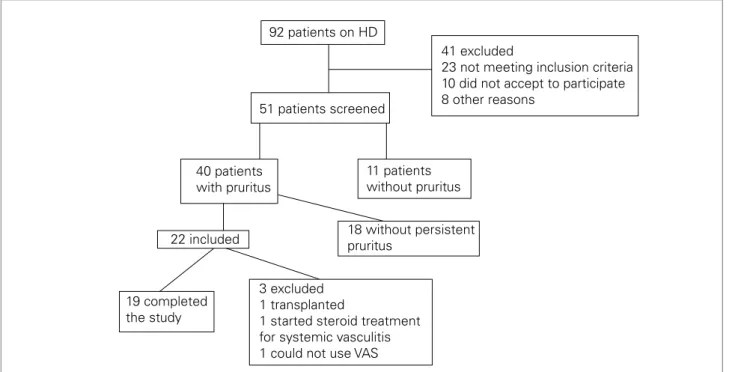
pruritus. Subjects were adults 18 years or older on sta-ble hemodialysis for at least three months. Enrollment occurred between December 2007 and July 2008. In order to identify patients with persistent pruritus, we reviewed the records of 92 potentially eligible patients from our chronic hemodialysis unit (Figure 1). We excluded patients with chronic skin diseases (allergic, parasitic, infectious), chronic liver disease, systemic malignancies and those receiving chronic opiate the-rapy or corticosteroids. Of the 92 dialysis patients, 51 were eligible and willing to participate by answering to a pruritus assessment tool (Table 1) on two occa-sions ~60 days apart. “Persistent pruritus” was defi-ned as pruritus of any intensity occurring three times a week throughout the initial 60 days of evaluation. After appropriate exclusions, 22 subjects started the intervention portion of the study. The study was con-ducted in accordance with the ethical principles that have their origins in the Declaration of Helsinski and its amendment. The local Ethics Committee approved the study, and all subjects provided written informed consent.
Patients received standard thrice weekly (four hours per session) bicarbonate-based hemodialysis with Fresenius 4008 machines and low-flux polysul-fone membranes. Dializer reused was allowed. A 16 gauge needle, blood flow 350 mL/min and a dialyzer flux of 500 mL/min were used in all patients.
Figure 1. Flow chart of study participants
92 patients on HD
22 included
51 patients screened
18 without persistent pruritus
40 patients with pruritus
3 excluded 1 transplanted
1 started steroid treatment for systemic vasculitis 1 could not use VAS 19 completed
the study
41 excluded
23 not meeting inclusion criteria 10 did not accept to participate 8 other reasons
11 patients without pruritus
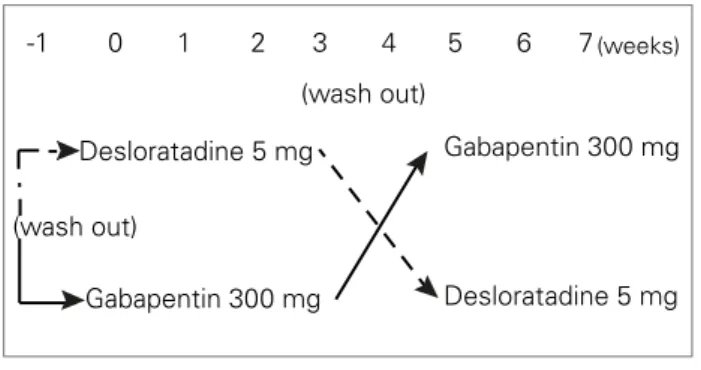
ASSIGNMENT, INTERVENTIONSAND MEASUREMENTS Subjects who qualified for the study were taken off any antipruritic agents for a one-week run-in period (Figure 2). After this run-in/washout period, subjects were assigned to receive orally either desloratadine 5 mg (provided by Laboratorio Roemmers, Buenos Aires, Argentina) or gabapentin 300 mg (provided by Laboratorio Raffo, Buenos Aires, Argentina) three times a week. A physician study directly observed ingestion of the medications immediately after each dialysis session for a three-week period. Following another one-week washout period, subjects crossed over to the other treatment arm for three more weeks. We assigned the order of drug administration based on the dialysis schedule of each patient. The use of emollients or other coadyuvant treatment for pruritus was not allowed during the study.
We measured basic clinical and laboratory para-meters at baseline. We applied the pruritus assess-ment tool (Table 1) at baseline and at the end of each treatment and washout periods. The investigator ad-ministering the questionnaire was blinded to the drug assignment.
STATISTICAL ANALYSIS
The primary endpoint of the study was the change in pruritus VAS during each treatment period. We considered an effect size of a two-unit difference in the final VAS between groups as clinically significant. To test this difference, and assuming a within-subject standard deviation of the VAS of ~2 units, 18 sub-jects were required to generate a power of 80% with a two-tailed alpha of 0.05. We performed intergroup comparisons using standard methods for repeated measures. For non-parametric data (such as visual analogue scores - VAS), we used the Wilcoxon test for paired measurements. We considered p values < 0.05 as statistically significant.
R
ESULTSTwenty-two patients were assigned to the interven-tions. Of these, three did not complete the study (Figure 1), leaving 19 subjects for analysis. Table 2 describes the baseline patient characteristics. Baseline VAS scores for pruritus were 5.95 (range 4-8). Most patients had frequent (three or more times in a week), significant, and generalized pruritus.
Figure 3 shows the main results of the study. Both gabapentin and desloratadine resulted in decreased VAS scores compared with baseline, but only deslo-ratadine reached statistical significance. There were
no statistically significant differences between the two agents when comparing the final VAS for each group (4.6 versus 3.4, p = 0.16). Eleven of 19 patients (58%) experienced a relative decrease in VAS of least 50% while on desloratadine, whereas 5 of 19 (16%) had similar reductions while on gabapentin (p = 0.049, Fisher’s exact test).
While receiving gabapentin, 9 of 19 subjects (47%) reported fatigue and somnolence, and 4 of these patients discontinued use of the drug due to excessive somnolen-ce, all after the first dose. While receiving desloratadine, one subject discontinued treatment due to nervousness. No other adverse events were reported.
D
ISCUSSIONWe have demonstrated that both gabapentin and desloratadine improve pruritus in dialysis patients compared with baseline (no therapy), but only des-loratadine reached statistical significance. There were no significant differences observed between the two drugs. However, in our patient population, deslora-tadine was associated with fewer side effects than gabapentin. Therefore, our overall impression is that
1. Questions:
- History of pruritus (Do you usually complain about pruritus?)
- Frequency (number of episodes during a week)
- Localization (head, neck, arms, legs, abdomen, back)
- Time of day that appear
- Impact on quality of life (Does it affect on sleep, during activities, etc.)
- Solutions that you try during pruritus access (medications, other therapies)
2. Intensity: VAS (Visual Analogue Scale)
0 1 2 3 4 5 6 7 8 9 10
TABLE 1 PRURITUSASSESSMENTTOOL
Figure 2. Treatment assignment scheme
Desloratadine 5 mg
Desloratadine 5 mg Gabapentin 300 mg
(wash out)
-1 0 1 2 3 4 5 6 7(weeks)
(wash out)
the patients.16-18 Our results were not as impressive as those of other investigators. Razeghi et al. compared gabapentin with placebo and showed a reduction in pruritus score in the majority (73%) of the patients.19 Similar observations were noted in three other stu-dies (83-79-85%).16-18 It is not entirely clear to us why our response rates were lower than those observed by others. Patient characteristics were relatively simi-lar, and the doses used were similar to the studies of Gunal et al. (300 mg three times a week) and Naini et al. (400 mg two times a week).17,18 All of these stu-dies carried the intervention for four weeks rather than the three weeks in our study, but we have little reason to believe that this short period would have a significant additional effect on pruritus control.
To our knowledge, this is the first study using des-loratadine for uremic pruritus.
Desloratadine is the major active metabolite of loratadine. The main difference between them is that desloratadine is a non-sedative antihistamine. However, the pharmacokinetic of desloratadine was less study than loratadine. Considering the studies with loratadine and the increase half life in patients with end-stage renal disease (ESRD), we used desloratadi-ne in the same way to avoid possible adverse events in our study.15 This long half life permitted us to gi-ve it at the end of each dialysis session, as well as Gabapentin, and assure that the patient received the treatment.
However, several other antihistamines have been evaluated with modest results.6,14 Of particular rele-vance, the antihistamine loratadine has been evalu-ated in a trial comparing it with naltrexone.14 In this two-week study, loratadine produced a minor effect on VAS (only one unit on average) that was not sta-tistically significant.
Although most would argue that there are no cli-nically relevant differences between the two agents, our observations proved otherwise.
The frequent intolerance to gabapentin is perhaps the most significant finding from our study. Other stu-dies with gabapentin in uremic pruritus have reported adverse event in many of the patients.16-19 Sedation, dizziness and somnolence were the most common symptoms and all of them were observed after the first dose. Only in the study of Razeghi et al. two patients discontinued due to adverse events. These symptoms are in concordance with our observations, although in our study four patients discontinued. It is our substantiate impression that, although effective for symptom control, gabapentin should not be used unless other strategies, such as topical therapy with TABLE 2 BASELINEPATIENTCHARACTERISTICS (n = 19)
Age (years): 54 ± 18
Time on HD (years): 4.9 ± 3.9
Vascular access (%):
- AVF 84.2
- Graft 10.5
- Cuffed Catheter 5.2
Laboratory test:
- Hematocrit (%) 32.5 ± 4.3
- Creatinine (mg/dL) 9 ± 2.7
- Urea (mg/dL) 133.1 ± 33.6
- Phosphate (mg/dL) 5.1 ± 1.6
- Calcium (mg/dL) 9.4 ± 1.2
- Calcium x Phosphate 49.7 ± 17.9
- Intact PTH (ng/dL) 529.4 ± 455
- Protein catabolic rate 1.21 ± 0.3
- Kt/V (single pool) 1.23 ± 0.3
desloratadine is a preferable agent for the treatment of dialysis pruritus.
Dialysis pruritus is still a condition without effec-tive treatment. It is probably caused by multiple me-chanistic pathways, thus limiting the relative efficacy of any individual treatment options. This often leads to patient and physician frustration. Because antihis-tamines and gabapentin have been used in many stu-dies,6,14 we chose to compare these two classes directly. Studies evaluating the efficacy of gabapentin de-monstrated improvement in pruritus in about 80% of
Means (error bars: 95% Cl for mean)
5.95 vs. 4.6 p = 0.07
2 3 4 5 6 7 8
5.89 vs. 3.44 p = 0.004
4.6 vs. 3.44 p = 0.16
Baseline Gaba WO Gaba Deslorat WO_Deslorat
Figure 3. Treatment results
emollients and oral use of antihistamines, have not been effective. It is possible that the excessive rates of sedation observed were due to our starting dose of 300 mg, higher than the used in some of the previous studies,16,19 though others used this dose as well.17,18 It may be advisable to start at a lower dose (e.g., 100 mg once daily, as in the Razeghi study) and progressively titrate as tolerated. Desloratadine, on the other hand, was well tolerated, as was loratadine in the study of Legroux-Crespel et al.14
Our study has several limitations. First and fore-most, it was not placebo-controlled. Other studies in the field indicate minimal effects from placebo, so we believed it was not necessary to have a placebo group in our study. Second, it is possible that the three-week intervention period was insufficient to lead to ma-ximal effects. Lastly, our sample size was not large enough to detect small differences in efficacy, possibly explaining the lack of statistical significance in the di-fference of achieved VAS and pruritus control betwe-en the two groups.
In conclusion, our study provides evidence in sup-port of the use of both gabapentin and desloratadine as modestly effective treatments in uremic pruritus. The unfavorable side effect profile of gabapentin should limit its use as first line therapy. Further work is necessary in search of more effective treatments for uremic pruritus.
A
CKNOWLEDGEMENTSDesloratadine was provided free of charge by Laboratorio Roemmers (Buenos Aires, Argentina). Gabapentin was provided free of charge by Laboratorio Raffo (Buenos Aires, Argentina).
R
EFERENCES1. Mistik S, Utas S, Ferahbas A, et al. An epidemiology study of patients with uremic pruritus. J Eur Acad Dermatol Venereol 2006;20:672-8.
2. Zucker I, Yosipovitch G, David M, Gafter U, Boner G. Prevalence and characterization of uremic pruritus in patients undergoing hemodialysis: uremic pruritus is still a major problem for patients with end-stage renal disease. J Am Acad Dermatol 2003;49:842-6.
3. Pauli-Magnus C, Mikus G, Alscher DM, et al. Naltrexone does not relieve uremic pruritus: results of a randomized, double-blind, placebo-controlled crossover study. J Am Soc Nephrol 2000;11:514-9.
4. Pisoni RL, Wikström B, Elder SJ, et al. Pruritus in haemodialysis patients: International results from the Dialysis Outcomes and Practice Patterns Study (DOPPS). Nephrol Dial Transplant 2006;21:3495-505. 5. Patel TS, Freedman BI, Yosipovitch G. An update
on Pruritus associated with CKD. Am J Kidney Dis 2007;50:11-20.
6. Russo GE, Spaziani M, Guidotti C, et al. Pruritus in chronic uremic patients in periodic hemodialysis. Treatment with terfenadine (an antagonist of histamine H1 receptors) [in Italian]. Minerva Urol Nephrol 1986;38:443-7.
7. Vila T, Gommer J, Scates AC. Role of gabapentin in the treatment of uremic pruritus. Ann Pharmacother 2008;42:1080-4.
8. Murphy M, Reaich D, Pai P, Finn P, Carmichael AJ. A randomized, placebo controlled, double-blind trial of ondasetron in renal itch. Br J Dermatol 2003;148:314-7. 9. Silva SR, Viana PC, Lugon NV, Hoette M, Ruzany F,
Lugon JR. Thalidomide for the treatment of uremic pruritus: a crossover randomized double-blind trial. Nephron 1994;67:270-3.
10. Wikström B, Gellert R, Ladefoged SD, et al. Kappa-opioid system in uremic pruritus: multicenter, randomized, double blind, placebo-controlled clinical studies. J Am Soc Nephrol 2005;16:3742-7.
11. Gilchrest BA, Rowe JW, Brown RS, Steinman TI, Arndt KA. Relief of uremic pruritus with ultraviolet phototherapy. New Engl J Med 1977;297:136-8. 12. Pauli-Magnus C, Klumpp S, Alscher DM, Kuhlmann U,
Mettang T. Short-term efficacy of tacrolimus ointment in severe uremic pruritus. Perit Dial Int 2000;20:802-3. 13. Manenti L, Tansinda P, Vaglio A. Uraemic pruritus:
clinical characteristics, pathophysiology and treatment. Drugs 2009;69:251-63.
14. Legroux-Crespel E, Clèdes J, Misery L. A comparative study on the effects of naltrexone and loratadine on uremic pruritus. Dermatology 2004;208:326-30. 15. Aronoff GR, Golper TA, Morrison G. Drug Prescribing
in Renal Failure: Dosing Guidelines for Adults. 4th ed. Philadlephia: American College of Physicians Publishers; 1999.
16. Manenti L, Vaglio A, Constantino E, et al. Gabapentin in the treatment of uremic itch: an index case and a pilot evaluation. J Nephrol 2005;18:86-91.
17. Naini AE, Harandi AA, Khanbabapour S, Shahidi S, Seirafiyan S, Mohseni M. Gabapentin: a promising drug for the treatment of uremic pruritus. Saudi J Kidney Dis Transpl 2007;18:378-81.
18. Gunal AI, Ozalp G, Yoldas TK, Gunal SY, Kirciman E, Celiker H. Gabapentin therapy for pruritus in haemodialysis patients: a randomized, placebo-controlled, double-blind trial. Nephrol Dial Transplant 2004;19:3137-9.