Session-Oriented Communication System for
Truly Reliable and Robust Smart Grid
Augusto Neto1, 2, 5, Eduardo Cerqueira3, Neuman Souza2, Luci Pirmez4, Danielo Gomes1, 2, Rui Aguiar5
1
Federal University of Ceará, Department of Informatics Engineering (DETI), Fortaleza-CE, Brazil
2
Group of Computer Communications, Software Engineering and Systems (GREat), Fortaleza-CE, Brazil
3
Computer Engineering (ENGCOMP), Federal University of Para (UFPA), Belém-PA, Brazil
4
Federal University of Rio e Janeiro, Rio de Janeiro, Brazil
5
Telecommunication’s Institute (IT), Aveiro, Portugal.
[email protected], [email protected], [email protected], [email protected], [email protected]
Abstract— Environmental sustainability issues and the costs of new power generation and transmission have increased the interest in evolving current power grid to new technologies. The Smart Grid is a promising technology, since it allows a distributed computing approach with potentials for self-diagnosing/-healing, reliable multi-user communication and fast hard real-time control. However, the missing standardization associated with heterogeneity of legacy systems and wide-area service demands, makes very challenging to adopt Smart Grid in a cost-effective way. By considering this, we propose the Session-Oriented Communication System (SOCSys) to overcome the above issues by enhancing Smart Grid with truly reliable and robust capabilities over heterogeneous environments. SOCSys achieves this goal by orchestrating session-control with innovative network-centric facilities operating over a wireless mesh Information Network compliant with IEEE 802.11e/s standard. The simulation results show that SOCSys improved network performance in terms of bandwidth utilization and minimization of delay, while consuming low network resources. Graphical analyses showed that SOCSys supported multimedia sessions with excellent quality, where it outperforms the experiments with regular settings.
Keywords- Smart Grid; session control; Quality of Service; IP Multicast; Wireless Mesh Networks.
I. INTRODUCTION
The Smart Grid expects leveraging the benefits of modern computing capabilities by supporting a two-way flow of electricity and information. Most existing Smart Grid solutions mainly involve Automated Meter Reading (AMR) applications for accurate billing and cost savings. Indeed, current power grid utilities have been used automated systems for a long time with proprietary phase metering. However, we believe that future Smart Grid must package a suite of interoperable
applications and services, including legacy system, with truly intelligent capabilities considering the rest of the grid (bulk storage, transmission, customer). In this context, a fully functioning Smart Grid must take advantage of its communication-enabled potential for wide-are distributed approach. Moreover, ultimate Information and Communication Technologies (ICT) must be adopted embedding enhanced computing levels combining instrumentation, analytics, and control for architecting a distributed, scalable, self-diagnosing/-healing architecture with reliable group communication and fast real-time control [1].
In this field, Smart Grid management demands capabilities to deal with [2]: distribution fault anticipation; problem detection on smart switches and reclosers; fast fault isolation and power rerouting; and adaptive energy storage systems to store and release energy at sub-cycle control loop rates. Such applications require Intelligent Electronic Devices (IED) publishing, in suitable time, metering data (status and consume). For that, the Advanced Metering Infrastructure (AMI) was conceived to supply diversity and high quality metering data in near real-time, so that improve detecting events in time to respond.
AMI defines that one IED publishes information and only subscriber applications will receive it to react depending on its configuration and functionality. As a standard publish-subscribing scheme is strongly missing, utilities are forced to
implement their own protocols and non-interoperable applications. For instance, legacy systems are separated, which difficult a lot the power grid management. Most of power grid designers adopt the Manufacturing Message Specification (MMS) [3] approach, which makes implementation complex and prone to error.
Furthermore, the heterogeneity and large scale expected in future Smart Grid make the acquisition of massive amounts of data and information in (near to) real-time very difficult and complex, posing strong performance issues. In this context, efficient data networking plays a critical role in allowing a fully distributed and efficient Smart Grid. To that, the information network requires embedding innovations beyond standards for Quality of Service (QoS), seeking intermittent, low latency and reliable data exchanges.
The open issues described hereinabove motivated our studies to enhance Smart Grid architecture with ultimate ICTs to facilitate interoperability of legacy and future systems over a truly robust and reliable communication system. Therefore, we propose the Session-Oriented Communication System (SOCSys) to embed Smart Grid architecture with session-awareness, reliable group communication, self-organizing and performance capabilities. With these goals in mind, SOCSys operates over a wireless mesh Information Network orchestrating innovative network-centric facilities for seamless and intermittent QoS-guaranteed interoperability of heterogeneous IEDs and group of applications. Moreover, SOCSys envisions facilitating additions in the Smart Grid (applications and IEDs, including legacy systems) without considerable changes and performance degradations.
The rest of the paper is organized as follows. Section II introduces SOCSys proposal. Section III, provides a use case to facilitate understanding our proposal. In Section IV, results of SOCSys performance evaluation confirm its expected benefits. Finally, Section V presents our outcomes by conclusions and further research lines.
II. SESSION-ORIENTED COMMUNICATION
SYSTEM OVERVIEW
The Session-Oriented Communication System (SOCSys) aims to enhance future Smart Grid with
a session-aware control approach, orchestrated with networking innovations, to embed: (i)
seamless session-driven control over a wide distributed environment, to allow adding new services and applications without substantial changes in the system; (ii) normalized publish-subscribing of heterogeneous AMI; (iii) low-cost dynamic provisioning of network resources for reliable communication; (iv) multi-user transport of metering data for bandwidth-constrained connections; and (vi) support resilience for intermittent connections. To achieve these goals, SOCSys is composed by network and session facilities, namely Multi-Service Resource Provisioning mechanism over Wireless Mesh Channels (M-Mesh) and Session-Aware Control (SAC), which are interconnected by the SOCSys Protocol (SOCSys-P).
A. SOCSys Protocol
The SOCSys Protocol (SOCSys-P) provides the signaling support to coordinate SC and M-Mesh cooperation. The signaling scheme of SC-P follows a single-way control approach using two types of messages, with message-specific flags for differentiating operations, for low complexity. On one hand, REQUEST is a downstream message used to control the behavior of SOCSys sub-components (i.e., SAC and M-Mesh). On the other hand, RESPONSE is an upstream message used to:
(i) feedback previous operations; (ii) alarm asynchronous events; (iii) and request resource releasing.
SOCSys-P relies on the Hybrid Wireless Mesh Protocol (HWMP) to forward messages, which are classified into high-priority Access Category (AC, IEEE 802.11e standard service class) to avoid packet loss. The SOCSys-P signalings are sent with the router-alert option, in the IP header, set to
on. Thus, all on-path SOCSys agents are enabled to intercept such messages, in order to react as indicated in the message-specific flags accordingly.
B. Multi-Service Resource Provisioning mechanism over Wireless Mesh
broadband channels with high-quality perception and intermittency. M-Mesh seeks efficiently provisioning resources in the devices within the Information Network, as well as re-routing sessions under network disruption events. For this work, M-Mesh operates above a wireless mesh topology compliant with IEEE 802.11e/s standard for multi-point QoS-aware bi-directional high-redundancy capabilities. However, we consider SOCSys operating over multi-homed environments, thus requiring interfaces with different wired (PLC [4] and Optical [5]) and wireless network technologies (IEEE 802.16, and 3GPP – 2.5G, 3G and LTE).
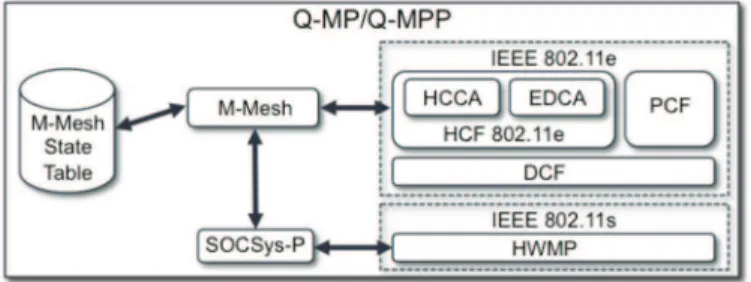
M-Mesh classifies network resources into QoS and Connectivity, to deal with per IEEE 802.11e AC bandwidth-assured channel and IP Multicast trees respectively. M-Mesh agents are embedded on all aided Mesh Points (Q-MPs) and QoS-aided Mesh Portal Points (Q-MPPs) within the Information Network to react upon signalings. M-Mesh supports interfaces exposing its functionalities to mechanisms/standards outside the suite, as well as interacting to IEEE 802.11e/s facilities to enforce network resources. Fig. 1 shows M-Mesh architecture.
Figure 1. M-Mesh architecture interfacing with IEEE 802.11e/s
The M-Mesh is in charge to dynamically provision and enforce QoS and Connectivity resources. The operations include mapping of session QoS requirements into one IEEE 802.11e AC to further compose the Traffic Specification (TSPEC). The TSPEC must include at least average bit-rate, nominal SDU size, minimal PHY rate, delay and maximum service interval. This mapping mechanism is only deployed at ingress Q-MPPs, and follows our previous solutions [6]. The main objective is choosing the most appropriated AC by comparing, one-by-one, the QoS requirements of sessions with the list of available IEEE 802.11e ACs and their current QoS
capacities. The session is denied if none of the available ACs can support the required QoS level.
In order to enforce QoS resources, M-Mesh deals with per-AC bandwidth-reserved channels on all on-path nodes, to guarantee QoS over the time. To that, M-Mesh interfaces with IEEE 802.11e facilities so that requesting the local Hybrid Coordination Function (HCF) to create bandwidth-reserved Traffic Streams (TS) according to the referred Traffic Specification (TSPEC). Whenever a M-Mesh agent confirms a TS installation (reservation), the requesting ingress Q-MPP IP address is locally booked. Such information is used to send wireless link failure alarms (via RESPONSE messages) so that providing support to SAC for re-routing affected sessions. M-Mesh detects link failure by monitoring wireless link status.
In what concerns Connectivity resource enforcement, M-Mesh forces the available multicast routing approach to install multicast state tree state in the reverse path of REQUEST messages, by populating the Multicast Routing Information Base (MRIB) during the QoS enforcement. Thus, M-Mesh allows creating QoS-aware IP Multicast trees in the Information Network, envisioning drastically reducing overall amount of data packets in comparison to standard solutions (based on unicast and broadcast). The M-Mesh resource control approach is edge-to-edge, to allow intra-domain communications of M-Mesh agents from ingress-Q-MPP (application side) to egress-Q-MPP (IED side).
C. Session-Aware Control
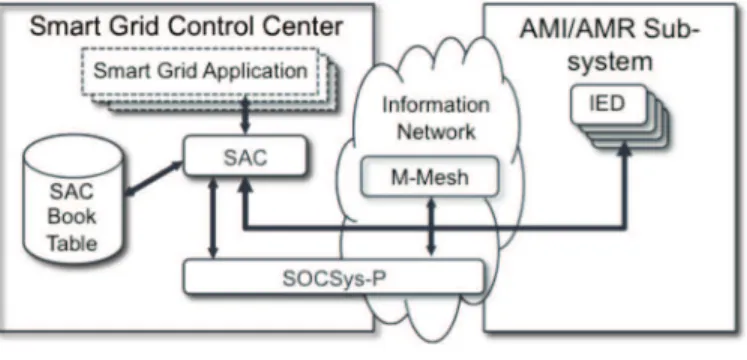
quality-guaranteed metering data over IP multicast trees for bandwidth-constrained connections. The Fig. 2 depicts SAC architecture and interfaces inside a Smart Grid domain.
Figure 2. SAC architecture
The SAC allows seamless interactions and organization of the different elements inside and outside the Smart Grid system. The main idea is to make transparent the heterogeneity aspects of the overall Smart Grid system, in terms of technology, location, naming, addressing, etc. The mapping between interfaces and component discovering are done by SAC, which self-organizes the system to keep available IED information coherent. Therefore, whenever a Smart Grid application intends subscribing IEDs, it simply triggers SAC in local system providing the intended measures and Smart Grid sub-system (e.g., substation). Based on that information, SAC retrieves in local book tables the IEDs identifiers, composes the QoS-requirements of the session (based on static information or policies) and requests establishing the demanding session.
SAC must implement different plug-ins to subscribe IEDs in their technology (e.g. DNP3, IEEE C37.118, IEC 61850, etc.). The cooperation with M-Mesh allows SAC forcing IED contents delivering over QoS-aware IP multicast trees. To that, SAC supplies desired IEDs with the destination address (IP Multicast), and all associated packets are sent over IP multicast trees (one for each IED). SAC controls the session joining in the application side. Hence, whenever SAC notices application(s) interested in subscribing content of IEDs attached to on-going sessions, it just connects the demanding application to the correct multicast group(s) without signaling the entire system. Therefore, SC-M expects drastically reducing the overall amount
of data exchanges in comparison to what it is done today.
III. PERFORMANCE EVALUATION
The tests and evaluations performed with SOCSys were developed with the goal of determining the efficiency of the mechanism when compared to standards currently used on Smart Grid scenarios. For this, the functionality of the simulator NS-2 (Network Simulator v2) [7] was extended with SOCSys and IEEE 802.11e/s facilities, and measurements regarding the network (QoS) and the users (QoE) status were collected. The NS-2 was considered in this work by the reason of allowing reutilization of previous work codes developed by our team.
The selected simulation model was configured with a topology with bandwidth of 11Mbps (limit of patch adopted). For the traffic differentiation support, two IEEE 802.11e ACs were defined, one AC_BE for background and three AC_VI for smart metering and video content transmission. For publishing AC_VI-alike content, 65 traffic generators were configured to place multicast flows with a constant data rate of 256 kbps (to allow exceeding in 50% the total bandwidth capacity for congestion experience) each one, and varying time intervals randomly assigned within 7 to 20 seconds. The AC_BE has 40% of maximum reservation limit, and each AC_VI-alike has 20%. Such definitions have been specified as commonly deployed in related works [8]. Finally, to demonstrate the impact generated by SOCSys on the user experience, subjective measurements were done with real video sequences. The Evalvid tool [9] was used to assess and validate the QoE evaluation. The Fig. 3 shows the scenario used for the simulation described above.
According Fig. 3, the traffic generators are linked to Q-MPP1, simulating IED publishing behavior, and session requests are invoked in Q-MPP2 and Q-MPP3 in their random times and with network requirements following the functionalities and communication needs defined by NIST [9]. The policy flexibility and complexity of SOCSys were not considered, since it would require a very different evaluation environment and methodology. The difficult of obtaining related work codes guided two configurations for the simulation model: (i) Regular configuration, with IEEE 802.11e/s facilities with static configurations and over-reserves for each AC; and (ii) SOCSys configuration, with M-Mesh agents attached to the Q-MP(P) interacting with IEEE 802.11e/s facilities. The experiments have been repeated 10 times, and plotted averaging results with confidence interval of 95%.
A. Results
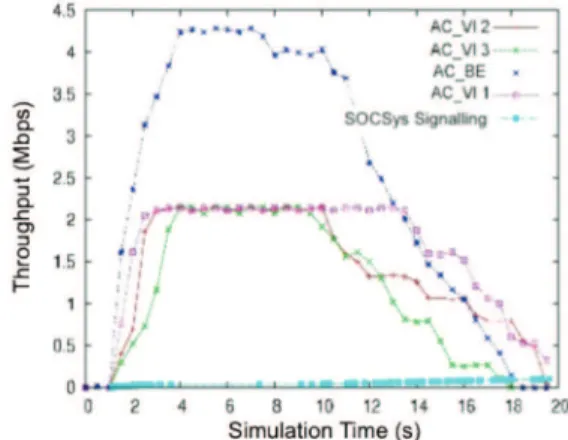
The evaluation starts with per-AC throughput study over the simulation time. The main goal is noticing the impact that the tools of both Regular and SOCSys configuration take in the system performance when delivering flows over the Information Network under congestion.
Figure 4. Per-AC throughput in experiments with Regular configuration
Fig. 4 reveals that the Regular configuration experiments averaged only 30% of throughput in the simulation experiment. The lack of QoS provisioning and resource enforcement tools of standard additions justifies this behavior. Thus, heavy data loss is placed by the severe congestion conditions in which the simulation model was exposed, in addition to the hostility of the wireless system. Fig. 5 shows the throughput results obtained in the simulation model configured with
SOCSys tools, revealing a very different traffic behavior in comparison to the results of Fig.4 as in the following.
Figure 5. Per-AC throughput in experiments with SOCSys configuration
Fig. 5 notices that the QoS provisioning support of M-Mesh allows all ACs experiencing uniform throughput, respecting their maximum reservation limit. The exceeding traffic of each AC_VI was mapped to AC_BE, thus exposed to congestion demands and packets were lost. In what concerns signaling exchanges, SOCSys placed low rates, less than 1% of the wireless resources (~100 kbps), in comparison to the content of activated sessions. Therefore, the reduction of bandwidth waste in all ACs evidences the efficiency of SOCSys tools, which can be performed by analyzing the delay values presented in Fig. 6.
Figure 6. Delay of flows in Regular and SOCSys experiments
comparison to the experiments with Regular configuration.
In order to testify the results in user’s point of view, we analyzed two randomly selected video frame of the wide-used video file “News”, provided by the site Evalvid. The random selected frames are depicted in Table I.
TABLEI
FRAMES OF VIDEO “NEWS” IN REGULAR AND SOCSYS EXPERIMENTS
Configuration Frame No [12] Frame No [17]
Regular
SOCSys
Due to its QoS/QoE support, SOCSys keeps sessions with excellent quality levels. The benefit of the SOCSys over the Regular configuration is visible in the quality of the captured video frames and measured by using Mean Opinion Score (MOS). Therefore, it is notorious confirming that SOCSys mechanism enables session propagation with excellent quality over the time.
IV. CONCLUSION AND FUTURE WORK
In this paper, we proposed the Session-Oriented Communication System (SOCSys) to allow future Smart Grid efficiently handling interoperability and performance issues of heterogeneity and large-scale scenarios. SOCSys follows a session-oriented control approach, orchestrating network-centric facilities, to facilitate adding new and legacy systems (IEDs, services, applications, etc.) while saving the overall Smart Grid communication performance. The simulation results show that SOCSys improves the bandwidth utilization, of wireless mesh Information Network compliant with IEEE 802.11e/s, by 70%. In terms of QoS, SOCSys reduces the network delay by 11.7%, while consuming less than 1% of the overall network resources with signaling exchanges. Moreover, QoE analyses showed that
SOCSys allowed supporting multimedia sessions with excellent quality of perception, where it outperforms the experiments with Regular setting.
These results provided a strong basis for evaluating the SOCSys through prototyping, for more precise conclusions of performance aspects, such as system complexity. Finally, we consider proposing SOCSys for standardization, since many of the Smart Grid standards are immature or not even developed.
REFERENCES
[1] C. Gellings, “Estimating the Costs and Benefits of the Smart Grid-A Preliminary Estimate of the Investment Requirements and the Resultant Benefits of a Fully Functioning Smart Grid”, Electric Power Research Institute (EPRI), Technical Report (1022519), March 2011. [2] “Report to NIST on the Smart Grid Interoperability Standards
Roadmap”, Electric Power Research Institute (EPRI), 6, June, 2009. [3] ISO/IEC 9506 (2003): Industrial Automation systems -
Manufacturing Message Specification: Service Definition
[4] Fahd Hashiesh and Pavel Soukal "A Proposed Broadband Power Line Communication System for Smart Grid Applications in a Typical Egyptian Network", 17th Telecommunications forum TELFOR 2009 [5] Y. Yorozu, M. Hirano, K. Oka, and Y. Tagawa, “Electron
spectroscopy studies on magneto-optical media and plastic substrate interface,” IEEE Transl. J. Magn. Japan, vol. 2, pp. 740–741, August 1987 [Digests 9th Annual Conf. Magnetics Japan, p. 301, 1982]. [6] E. Cerqueiraet al, "QoS Mapping and Adaptation Control for
Multi-user Sessions over Heterogeneous Wireless Networks," in ACM International Mobile Multimedia Communications Conference, Nafpaktos, Greece, August 2007.
[7] The NS-2 Home Page, http://www.isi.edu/nsnam/ns/
[8] Y. Botza, M. Shaw, P. Allen, M. Staunton, and R. Cox, “Configuration and Performance of IEC 61850 for First-Time Users – UNC Charlotte Senior Design Project”. University of North Carolina Charlotte and Schweitzer Engineering Laboratories, Inc.
[9] Evalvid - A Video Quality Evaluation Tool-set, available in http://www.tkn.tu-berlin.de/research/evalvid/