Social conditions and urban environment
associated with participation in the Ciclovia
program among adults from Cali, Colombia
Condiciones sociales y ambientes urbanos
asociados con la participación al programa de
Ciclovía en adultos en Cali, Colombia
Condições sociais e ambientes urbanos associados
à participação no programa Ciclovia entre adultos
em Cali, Colômbia
1 Facultad de Medicina, Pontificia Universidad Javeriana, Bogotá, Colombia. 2 Escuela de Salud Pública, Universidad del Valle, Cali, Colombia.
3 Escuela de Medicina y Ciencias de la Salud, Universidad del Rosario, Bogotá, Colombia. 4 Universidad Jorge Tadeo Lozano, Bogotá, Colombia. 5 Organización
Panamericana de la Salud, Washignton DC, U.S.A. 6 Washington University School of Medicine in St. Louis, St. Louis, U.S.A.
Correspondence L. F. Gómez
Departamento de Medicina Preventiva y Social, Facultad de Medicina, Pontificia Universidad Javeriana. Calle 23, no 68-59, Interior 18, Apartamento 303, Bogotá, Distrito Capital
11001000, Colombia. [email protected]
Luis Fernando Gómez 1
Janeth Mosquera 2
Olga Lucia Gómez 2
José Moreno 3
Jose D. Pinzon 4
Enrique Jacoby 5
Magda Cepeda 2
Diana Celmira Parra 6
Resumen
El programa de Ciclovía (PC) ha surgido como una iniciativa efectiva para promover actividad física en el contexto urbano de América Latina. Este estudio evaluó la asociación entre las con-diciones sociales, el ambiente urbano y la parti-cipación en el PC en adultos que vivían en Cali, Colombia. Se llevó a cabo un estudio transversal en 2011 y 2012 en 719 adultos de 18 a 44 años. Se obtuvieron medidas del ambiente urbano utili-zando Sistemas de Información Geográfica. Un poco más del 7% de las personas participaron en el PC en los últimos 4 fines de semana. Ser hom-bre y tener un nivel de escolaridad de secunda-ria se asoció positivamente con la participación en el PC. Así mismo, se encontró una asociación positiva con residir en barrios con existencia de corredores con este programa. Por el contrario, la existencia de muertes por accidentes de tránsito fue negativamente asociada. Este estudio brinda nuevos conocimientos acerca de un programa recreativo que tiene beneficios potenciales para la salud, en una región marcada por desigual-dades urbanas relacionadas con actividad física.
Actividad Motora; Participación Social; Salud Urbana
Abstract
The Ciclovia program (CP) has emerged as an effective initiative to promote active living in urban spaces in Latin America. This study as-sessed the association between social conditions, the urban environment and participation in the CP among adults living in the city of Cali, Co-lombia. A cross-sectional study was conducted in 2011 and 2012 among 719 adults aged 18 to 44. Urban environment measures were ob-tained using Geographic Information Systems. A multilevel logistic regression was used for the analysis. Slightly more than 7% of participants had participated in the CP in the previous four weekends. Being male and having a high school degree were positively associated with participa-tion in the CP. Participaparticipa-tion in the CP was posi-tively associated with living in neighborhoods with Ciclovia lanes. In contrast, a negative asso-ciation was found among those living in neigh-borhoods with a presence of traffic fatalities. This study provides new insights about a recreational program that has potential health benefits in a region marked by urban inequalities in terms of opportunities for physical activity.
Introduction
The promotion of physical activity is recognized as an integrated component of several healthy public policies that are undertaken in urban set-tings 1. From the various domains of physical ac-tivity, leisure time physical activity is especially important in public health, due not only to its benefits in preventing non communicable dis-ease but also for being consistently linked with health related quality of life 2,3,4,5,6,7,8.
In the urban context of Latin America, char-acterized by social fragmentation and inequali-ties in opportuniinequali-ties to engage in leisure time physical activity, the Ciclovia program (CP) has emerged as an effective initiative to promote ac-tive living 9,10,11. This initiative is characterized by closing avenues or secondary streets to mo-tor vehicles on Sundays and public holidays, and allowing only recreational activities, such as walking and bicycling 11. In the last 10 years the number of Latin American cities with the CP has increased particularly in Peru, Colombia and Mexico 12. This growing interest may be partially explained by the fact that CP allows for the time-bound and regular use of public spaces in urban contexts in which there are relatively low avail-ability of public recreation facilities and public spaces 13. In addition, the CP represents an op-portunity to encourage the equitable and sus-tainable use of public spaces, as it has the poten-tial to change transportation behaviors in what has been called “unfreezing” 14.
Several studies have found positive associa-tions between participation in the CP and meet-ing physical activity recommendations in leisure time as well as having higher perceptions of so-cial capital 15,16.
In Latin America, little is known about the associations between social conditions, urban environments and participation in the CP. The few studies in the area have been conducted in Bogota and have found that men and people who have studied at the graduate level have a higher prevalence of participation in the CP 16. In addi-tion, another study found that proximity of CP corridors in a neighborhood was positively as-sociated with participation in the program while high park density was negatively associated, pos-sibly indicating a competing recreational option in the vicinity 17.
Social conditions are understood in this study as social constructions which are biologi-cally incorporated in ecological and societal con-texts, affecting population patterns of health 18,19.
In this sense, this study attempts to surpass the mainstream approach that assumes that social conditions, such as gender, age and education
level, are merely confounders or express only in-dividual characteristics which are not connected with social contexts 18,19. The urban environment
is assumed as a set of attributes that involves so-cial interactions with the urban space and com-prises political, social and organizational pro-cesses 20. Therefore, this study examines the
ex-tent to which some social conditions and urban environment attributes are associated with the participation in the CP in the city of Cali, Colom-bia, in order to offer specific and relevant pro-grammatic recommendations to improve and expand this initiative.
A brief overview of the city of Cali
Cali is one of the main economic and cultural centers of Colombia with a population of ap-proximately 2,200,000 inhabitants 21. The city is
located in a flat valley with an average annual temperature of 24ºC and an urban density of 193 inhabitants per hectare 21. Similarly to other Lat-in American cities, the urbanization process Lat-in Cali has been characterized by accelerated and unplanned growth, accompanied by marked so-cioeconomic inequalities 22. Large urban infor-mal settlements are located throughout the city, which face significant challenges both in terms of the quality of housing but also the availability of recreational spaces, public transportation and urban safety 23.
The CP in Cali is named Ciclovida and the first lane was launched in October near to the city’s major sports facilities. Shortly afterwards, six community CPs were informally organized by resident community groups in different neigh-borhoods 24.
Material and methods
Study and sampling design
This was a multilevel cross-sectional analysis conducted between September 2011 and Febru-ary 2012 among 729 adults that was part of a wid-er study aimed at examining the relationships be-tween urban environment attributes and bicycle use for transportation among adults aged 18 to 44. The study uses a four-stage probabilistic sam-pling design without replacement. The primary sampling units were the urban sectors defined by the National Administrative Department of Sta-tistics (DANE; Departamento Administrativo Na-cional de Estadística) as geographic areas charac-terized by having the same socioeconomic status based on public utility bills and being delimited by natural and urban barriers (range area of 8,000 to 10,000m2). In this study urban sectors are re-ferred to as neighborhoods. Sixty-seven neigh-borhoods were probabilistically selected from a sampling frame of 860. Two blocks were ran-domly selected in each neighborhood and an av-erage of 12 households was obtained. Finally, an adult aged 18 to 44 years was randomly selected in each household following the inclusion crite-rion of residing at least one year in the neighbor-hood. The households and participants were se-lected using probabilistic systematic procedures. The response rate of this study was 66.9%. This rate was lower in upper-middle class neighbor-hoods (48%).
General measurement procedures
A face to face questionnaire was administered to the selected participants by interviewers with previous experience in population surveys. The average duration of the interviews was 24 min-utes. All protocols and questionnaires were re-viewed and approved by the Institutional Review Board of the Universidad del Valle in Cali and the participants were asked to provide informed consent before the survey.
Dependent variable
Participation in the CP was determined using the following question: “In the last 4 weekends did you participate in the Ciclovida program for sport or recreation purposes?”, with response options of yes or no.
Social conditions
Considering the theoretical assumption de-scribed in the introduction, this study included
the following social conditions: gender (male and female), age groups (18-29 and 30-44 years), self-perceived racial-ethnicity (mixed race, Afro-Colombian, white and other) and education level (incomplete high school or less, complete high school and more than high school).
Even though race is a social construction, it has practical implications on people every day. In fact, using race and ethnicity in public health studies contributes to understanding historical processes of racism and discrimination related to people’s health. Cali is characterized by so-cioeconomic and persistent spatial segregation by race 25. Therefore in this research, this social construction was “converted” into a variable and it was collected using images of people from dif-ferent ethnic and racial groups (mixed race, Afro-Colombian, white and other). Participants in the study were asked to identify themselves choos-ing the picture that looks more similar to them. In this study, both race and ethnicity categories were used because they include skin color and ethnic identity.
The variable of gender was included in this research because differences by sex are associ-ated not only with their biological conditions but also with differences on social roles, which has consequences on health outcomes 19.
Urban environment attributes
Based on the empirical evidence from other studies about urban environments, participation in the CP and physical activity for leisure time in Colombia 17,26,27,28,29, the following urban
en-vironment variables were obtained using Geo-graphic Information Systems (GIS): socioeco-nomic status of the neighborhood, public park density, presence of CP corridors, presence of bike paths and traffic fatalities. These geographic indicators were calculated in network polygons of 500 meters from the centroid of each neigh-borhood delimited by interception lines using the Thyssen methodology 30. The software Arc-GIS version 10.1 (http://www.esri.com/software/ arcgis/index.html) was used to conduct these measurement procedures. This approach was used in order to reduce spatial overlapping in some buffers due to the relatively high compact-ness of the city.
Socioeconomic status of the neighborhood was obtained based on the spatial stratification used by the municipality of Cali to bill public utilities and were classified in the following cat-egories: low, middle and middle-upper 31.
100. This indicator was classified in tertiles in the statistical analysis. Binary variables were created to determine the presence of CP corridors (in-cluding community Ciclovidas) during Sundays (yes versus no), the presence of bike paths and reporting of traffic fatalities during the year 2011 (yes versus no). The source of this information was the Social Observatory of Cali (Observatorio Social de Cali; http://www.cali.gov.co/observa-torios/). The research team made a thorough as-sessment of the quality of this data as well as how up-to-date it was.
Statistical analysis
Individual and GIS data were cleaned and checked for missing values prior to merging. A multilevel logistic regression model was developed using the command xtmelogit of Stata (StataCorp., Col-lege Stattion, USA). For this analysis, the ethnic group variable was recoded into three categories: white, Afro-Colombian, and mixed race/other. Public park density was classified in tertiles and new binary variables were recoded for CP cor-ridors, bike paths and traffic fatalities (yes versus no). The model was adjusted for all individual and geographic variables considering
theoreti-cal criteria and following the criteria proposed by Kleinbaum et al. 32. This analysis assumed a ran-dom intercept form, and regression coefficients were taken as fixed. Collinearity was examined using regression diagnostic tests with none de-tected. All the statistical analyses were conducted using Stata 12.
Results
Characteristics of the study population
Table 1 shows selected characteristics of the par-ticipants included in this analysis. Mean age was 29.9 years (SD = 7.6) and 53.4% of participants were aged between 30 and 44. 63% were women and 83.8% had more than high school studies. Sixty-two reported to be of mixed race (mestizo or mulatto in Spanish). Average time of residence in the neighborhood was 14.2 years (SD = 10.5). Slightly more than 7% of participants reported participation in the CP program in the last four weekends.
Table 1
Characteristics of the study population. Cali, Colombia (N = 729).
Characteristics n % or mean
Age groups (years)
18-29 340 46.6%
30-44 389 53.4%
Mean age (years) 29.9 (SD = 7.6)
Gender
Female 461 63.2%
Male 268 36.8%
Ethnic groups
Mixed race 453 62.2%
Afro-Colombian 128 17.6%
White 112 15.4%
Other 36 4.8%
Education level
Incomplete high school or less (referent) 256 35.1%
Complete high school 355 48.7%
More than high school 118 16.2%
Years of residence in the neighborhood 14.2 (SD = 10.5) Participation in Ciclovia program
Yes 53 7.3%
Environmental measures obtained through GIS
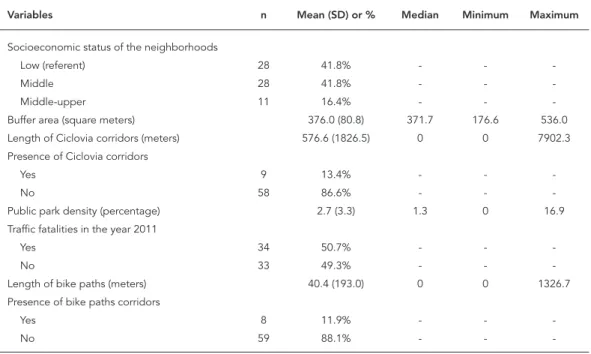
Table 2 displays the urban environment variables measured in the geographic polygons of borhoods. The majority of the selected neigh-borhoods belonged to low and middle socioeco-nomic status (41.8% in both categories). The buf-fer areas had a mean of 376 square meters (SD = 80,897). The mean length of CP lanes includ-ing those neighborhoods without the program was 576.6 meters (SD = 1,826.5) and its presence was identified in 13.4% of the selected neighbor-hoods. Slightly more than 50% of the geographic polygons had at least one traffic fatality during the year 2011. The mean length of bike-paths was 40.4 meters (SD = 193.0) and were present in 11.9% of the polygons.
Social conditions, urban environment and participation in the CP
After adjusting for social conditions and urban environment attributes, the model showed that male gender was positively associated with par-ticipation in the CP (POR = 1.85; 95%CI: 1.01-3.41). Moreover, those who had completed high school were more likely to participate in this program than those with incomplete high
school or less (POR = 2.28; 95%CI: 1.03-5.09). Conversely, living in neighborhoods of middle socioeconomic status was negatively associated (POR = 0.40; 95%CI: 0.17-0.97). Participation in the CP was positively associated with living in neighborhoods with Ciclovia corridors (POR = 4.27; 95%CI: 1.66-11.02). In contrast, a negative association was identified among those living in neighborhoods with reported traffic fatalities in 2011 (POR = 0.45; 95%CI: 0.22-0.92) (Table 3).
Discussion
The findings of this study suggest that some social conditions and urban environment attri-butes are associated with participation in the CP among adults living in Cali. In a region like Latin America, characterized by unequal opportunities to engage in physical activity during leisure time in urban settings, this study provides evidence about a recreational program that has potential health benefits.
The positive association between being male and participating in the CP has been document-ed in a previous study conductdocument-ed in Bogotá 12 and is also related to gender disparities consistently reported in leisure time physical activity in Latin America 33,34,35,36. A potential explanation for this
Table 2
Environmental measures obtained by Geographic Information Systems (GIS) in the network polygons of 500 meters around the centroid of the 67 selected neighborhoods. Cali, Colombia.
Variables n Mean (SD) or % Median Minimum Maximum
Socioeconomic status of the neighborhoods
Low (referent) 28 41.8% - -
-Middle 28 41.8% - -
-Middle-upper 11 16.4% - -
-Buffer area (square meters) 376.0 (80.8) 371.7 176.6 536.0
Length of Ciclovia corridors (meters) 576.6 (1826.5) 0 0 7902.3 Presence of Ciclovia corridors
Yes 9 13.4% - -
-No 58 86.6% - -
-Public park density (percentage) 2.7 (3.3) 1.3 0 16.9
Traffic fatalities in the year 2011
Yes 34 50.7% - -
-No 33 49.3% - -
-Length of bike paths (meters) 40.4 (193.0) 0 0 1326.7 Presence of bike paths corridors
Yes 8 11.9% - -
-is the marked differences in cultural roles that are traditionally assigned to women in this region, mainly related to higher levels of household work
and less autonomy in their decisions 37. For in-stance, 14.3% of women in Cali never learned to ride a bike compared to only 1.5% among men 38.
Table 3
Multilevel binary logistic regressions of social conditions and urban environment attributes associated with participation in the Ciclovia program, among 729 adults. Cali, Colombia.
Variables Ciclovia
participation (%)
Unadjusted model Adjusted model *
POR 95%CI POR 95%CI
Social conditions Age groups (years)
18-29 (referent) 5.3 1.00 1.00
30-44 8.5 1.68 0.90-3.16 1.61 0.84-3.07
Gender
Women (referent) 5.5 1.00 1.00
Men 9.7 1.85 1.01-3.39 1.85 1.01-3.41
Ethnic groups Mixed race or other (referent)
7.1 1.00 1.00
Afro-Colombian 7.3 1.02 0.46-2.29 1.10 0.49-2.49
White 6.7 0.84 0.34-2.05 0.93 0.38-2.32
Education level
Incomplete high school or less (referent)
3.6 1.00 1.00
Complete high school 8.6 2.53 1.15-5.57 2.28 1.03-5.09 More than high school 10.1 2.91 1.11-7.60 2.29 0.80-6.53 GIS (urban environment attributes)
Socioeconomic status of the neighborhoods
Low (referent) 7.5 1.00 1.00
Middle 5.0 0.63 0.26-1.52 0.40 0.17-0.97
Middle-upper 9.4 1.29 0.40-4.16 0.75 0.23-2.52
Public park density tertiles
0.00-0.01 6.2 1.00 1.00
0.12-2.69 7.5 1.21 0.50-2.96 2.18 0.88-5.44
2.90-16.9 7.4 1.15 0.47-2.84 1.56 0.68-3.63
Presence of Ciclovia program
No (referent) 9.2 1.00 1.00
Yes 15.2 2.94 1.16-7.50 4.27 1.66-11.02
Presence of bike paths
No (referent) 7.2 1.00 1.00
Yes 4.5 0.76 0.22-2.62 0.66 0.20-2.22
Traffic fatalities in the year 2011
No (referent) 8.7 1.00 1.00
Yes 5.5 0.59 0.29-1.22 0.45 0.22-0.92
Notes: buffer of 500m around the neighborhoods delimited by interception lines cut by Thyssen methodology. GIS: Geographic information systems; POR: prevalence odds ratios.
* Model adjusted by age groups, gender, SES, ethnic group, education level, public park density, presence of Ciclovia program, presence of bike-paths, traffic fatalities and interaction terms.
In addition, a qualitative study conducted in Bogotá found that women reported a higher number of barriers to riding a bicycle compared to men, mainly related to personal and traffic safety 39. This means that promoting bicycle use in Latin American cities may also contribute to the social empowerment of women.
Moreover, studies have found that men are more active than women in the domains of lei-sure time, work and transportation, but less so in the household, where women were more ac-tive than men 40. In fact, in Colombia González et al. 41 reported that women were less likely to meet physical activity recommendations in all domains. This could illustrate inequalities in lei-sure time opportunities, and explain why being male is associated with CP participation in Cali. However, more research that focuses on gender issues (i.e. constrains to physical activity in pub-lic spaces) could contribute to identifying specif-ic strategies to encourage women’s partspecif-icipation in the CP program in Cali.
In comparison with participants that did not complete high school, those who reported com-pleting high school were more likely to partici-pate in the CP. However, this positive association was not found in those who had studied beyond high school, which may be explained by engage-ment in other leisure time physical activities in this population. This topic and potential expla-nation will require further exploration.
The negative association between residing in a middle socioeconomic status neighborhood and participation in the CP is in some way un-expected. This association was found even after adjusting for urban environment attributes such as presence of the CP and public park density. This may be due to residual confounding due to urban attributes and social conditions not mea-sured in this study.
The relatively high magnitude of the posi-tive association between the presence of a CP lane may highlight the relevance of this initia-tive in Latin American cities like Cali. This finding suggests that if people in Cali had more public spaces in which to be active, such as the CP, they would be willing to use them. The last quality of life survey carried out in 2012 in Cali showed that 19% of people who lived in the urban area were not satisfied with the provision of public spaces in the city and 39% were not satisfied with the availability of parks and green areas 21. Thus, the CP contributes to “win public space” for people in a city where public space is scarce, even if only on Sundays and holidays.
The negative association between traffic fatalities and participation in the CP is a chal-lenge for the implementation of programs
aimed at increasing active recreation. Cali is experiencing a process of higher motoriza-tion mainly due to a rising number of motor-cycles, which have been simultaneously linked with higher traffic accidents and fatalities 42. Many of the CP corridors have an inflow of mo-tor-vehicles, thus limiting accessibility to bik-ers and pedestrians and increasing the risk and fear of injury 38. In consequence, our findings highlights the need to expand the CP, but also to consider the adverse context or unintended consequences to which pedestrians and cyclists are exposed while engaging in outdoor physical activity. It is due to this fact that a concerted effort is being made by several public sectors in Cali to face these challenges and implement the Ciclo-via, including the Sports Secretariat (responsible for the CP in Cali), the Health Secretariat and the transportation and public safety sectors. One of the main advantages and unique characteristics of the CP in Cali is the combination of citywide corridors as well as community Ciclovidas locat-ed within neighborhoods. This design may in-crease social engagement and ownership of the programs among participants, thus increasing participation and long-term sustainability.
In this study, park density was not associated with participation in the CP. One potential expla-nation for this finding is that the average size of neighborhood parks in Cali is relatively small 21, which would increase the need and likelihood of people for using the Ciclovía corridor as a means to supplement space for leisure time physical activity.
Findings from this study highlight the fact that programs such as the CP should also include strategies to increase the social participation of women in order to reduce gender inequalities in physical activity. The involvement of more wom-en leaders in the staff of the program may con-tribute, because they can consider barriers and incentives that are more relevant to them.
This study has several strengths. First, the study design allowed for the inclusion of ar-eas of different socioeconomic conditions and variability in the urban environments. The use of geographic information systems provides an objective indicator of the environment and can increase the validity of the results. Finally, this is the first study evaluating the CP in Cali, thus con-tributing to the body of research on this topic in Latin America.
of participants in the CP may have affected the statistical power. Third, the non-response rate of 33% does not rule out the possibility of selection bias which may be more likely in upper-middle socioeconomic status. Fourth, the relatively nar-row age range (18 to 44 years) limits the reach of the study and the generalizability of the findings to the remaining adult population of Cali. Finally, the cross sectional design of this study does not allow for the assessment of temporality between selected exposure variables and participation in the CP. Even considering these limitations, studies such as this one are relevant for tracing inequalities linked to physical activity and rec-ognizing the importance of alternative uses for public spaces for the promotion of physical ac-tivity.
Conclusion
This study shows that being male, having com-pleted high school and living in neighborhoods close to Ciclovia lanes were positively associated with participation in the CP. Conversely, living in neighborhoods of middle socioeconomic status and with reported traffic fatalities were negative-ly associated. Future qualitative and quantitative studies should be conducted in order to better understand the role of social conditions in ex-plaining participation in these types of programs and also the relationships with other comple-mentary recreational options such as the avail-ability of green spaces and parks.
Resumo
O programa Ciclovia (PC) surgiu como uma iniciati-va eficaz para promover a atividade física no contexto urbano da América Latina. Este estudo avaliou a asso-ciação entre as condições sociais, o ambiente urbano e participação no PC em adultos que vivem em Cali, Co-lômbia. Um estudo transversal foi realizado em 2011 e 2012, em 719 adultos com idades entre 18 e 44 anos. Medidas do ambiente urbano utilizando SIG foram obtidos. Pouco mais de 7% das pessoas participaram do PC nos últimos quatro finais de semana. Ser do sexo masculino e ter um nível de ensino médio foi positiva-mente associado com a participação no PC. Da mes-ma formes-ma, umes-ma associação positiva com residência em bairros com corredores existência desse programa foi encontrada. Pelo contrário , a existência de mortes no trânsito foi negativamente associado . Este estudo fornece novos conhecimentos sobre um programa de lazer que tem benefícios de saúde potenciais em uma região marcada por desigualdades urbanas em ativi-dade física.
Atividade Motora; Participação Social; Saúde Urbana
Contributors
All authors contributed to the study design, data analy-sis and writing of the paper.
Conflict of interest
The authors declare no conflict of interest.
Acknowledgments
References
1. Gómez LF, Sarmiento R, Ordoñez MF, Pardo CF, de Sá TH, Mallarino CH, et al. Urban environment intervention linked to the promotion of physical activity: a mixed methods study applied to the ur-ban context of Latin America. Soc Sci Med 2015; 131:18-30.
2. Sattelmair J, Pertman J, Ding EL, Kohl HW, Haskell W, Lee IM. Dose response between physical activ-ity and risk of coronary heart disease: a meta-anal-ysis. Circulation 2011; 124:789-95.
3. Jeon CY, Lokken RP, Hu FB, van Dam RM. Physi-cal activity of moderate intensity and risk of type 2 diabetes: a systematic review. Diabetes Care 2007; 30:744-52.
4. Monninkhof EM, Elias SG, Vlems FA, van der Tweel I, Schuit AJ, Voskuil DW, et al. Physical activity and breast cancer: a systematic review. Epidemiology 2007; 18:137-57.
5. Wolin KY, Glynn RJ, Colditz GA, Lee IM, Kawachi I. Long-term physical activity patterns and health-related quality of life in U.S. women. Am J Prev Med 2007; 32:490-9.
6. Tessier S, Vuillemin A, Bertrais S, Boini S, Le Bihan E, Oppert JM, et al. Association between leisure-time physical activity and health-related quality of life changes over time. Prev Med 2007; 44:202-8. 7. Chai W, Nigg CR, Pagano IS, Motl RW, Horwath C,
Dishman RK. Associations of quality of life with physical activity, fruit and vegetable consumption, and physical inactivity in a free living, multiethnic population in Hawaii: a longitudinal study. Int J Behav Nutr Phys Act 2010; 7:83.
8. Gómez LF, Moreno J, Gómez OL, Carvajal R, Par-ra DC. Physical activity and health-related qual-ity of life among adult women in Cali, Colombia: a cross-sectional study. Qual Life Res 2013; 22: 2351-8.
9. Sarmiento OL, Torres A, Jacoby E, Pratt M, Schmid TL, Stierling G. The Ciclovía-recreativa: a mass-recreational program with public health potential. J Phys Act Health 2010; 7 Suppl 2:S163-80. 10. Montes F, Sarmiento OL, Zarama R, Pratt M, Wang
G, Jacoby E, Schmid TL, et al. Do health benefits outweigh the costs of mass recreational programs? An economic analysis of four Ciclovía programs. J Urban Health 2012; 89:153-70.
11. Díaz del Castillo A, Sarmiento OL, Reis RS, Brown-son R. Translating evidence to policy: urban inter-ventions and physical activity promotion in Bo-gotá, Colombia and Curitiba, Brazil. Transl Behav Med 2011; 1:350-60.
12. Díaz del Castillo A, Pedraza C, González S, Díaz J, Ibarra L, Fernández D, et al. Ciclovías recreativas. A healthy epidemic. http://epiandes.uniandes.edu. co/?page_id=822 (accessed on 18/May/2013). 13. Parra D, Gómez LF, Pratt M, Samiento OL, Triche E,
Mosquera J. Policy and built environment changes in Bogotá and their importance in health promo-tion. Indoor Built Environ 2007; 16:344-8.
14. Lugo A. How can ciclovias can unfreeze the streets and open them to equitable human infrastructure. http://bikeleague.org/sites/default/files/Unfreez ing%20Streets.pdf (accessed on 01/Apr/2015).
15. Gómez LF, Mateus JC, Cabrera G. Leisure-time physical activity among women in a neighbour-hood in Bogotá, Colombia: prevalence and socio-demographic correlates. Cad Saúde Pública 2004; 20:1103-9.
16. Torres A, Sarmiento OL, Stauber C, Zamara R. The Ciclovia and Cicloruta Programs: promising inter-ventions to promote physical activity and social capital in Bogota, Colombia. Am J Public Health 2013; 103:e23-30.
17. Cervero R, Sarmiento OL, Jacoby E, Gómez LF, Neiman A. Influences of built environments on walking and cycling: lessons from Bogotá. Interna-tional Journal of Sustainable Transportation 2009; 3:203-26.
18. Krieger N. A glossary for social epidemiology. J Epi-demiol Community Health 2001; 55:693-700. 19. Krieger N. Epidemiology and the people’s health.
New York: Oxford University Press; 2011.
20. Galea S, Freudenberg N, Vlahov D. Cities and pop-ulation health. Soc Sci Med 2005; 60:1017-33. 21. Departamento Administrativo de Planeación,
Alcaldía de Santiago de Cali. Cali en cifras 2011. http://www.cali.gov.co/descargar.php?id=33101 (accessed on 18/May/2013).
22. UN-Habitat. Towards a new urban transition. http://www.unhabitat.org/pmss/getElectron-icVersion.aspx?nr=3386&alt=1 (accessed on 18/ Jan/2013).
23. Ipsos NF. Encuesta de percepción: Cali cómo va-mos 2012. http://www.fundacioncorona.org.co/ bajarDocDos.php?tl=1&per=325 (accessed on 18/ Jan/2013).
24. Ávila D. Ciclovida. Tres décadas de deporte y diver-sión. Q’hubo 2013; 25 sep.
25. Vivas H. Persistencia de la segregación residencial y composición del capital humano por barrios en la ciudad de Cali. Ensayos sobre Política Económi-ca 2013; 70:121-55.
26. Parra DC, Gomez LF, Fleisher N, Pinzón JD. Built environment characteristics and perceived ac-tive park use among older adults: results from a multilevel study in Bogotá. Health Place 2010; 16: 1174-81.
27. Gómez LF, Parra D, Buchner D, Brownson R, Sarmiento OL, Pinzón JD, et al. Built environment attributes and walking patterns among the elderly population in Bogotá. Am J Prev Med 2010; 30: 592-9.
28. Gomez LF, Sarmiento OL, Parra D, Schmid T, Pratt M, Jacoby E, et al. Characteristics of the built en-vironment associated with leisure-time physical activity among adults in Bogota, Colombia: a mul-tilevel study. J Phys Act Health 2010; 7:S182-95. 29. Parra D, Gómez LF, Sarmiento OL, Buchner D,
Brownson R, Schmid T, et al. Perceived and objec-tive neighborhood environment attributes and health related quality of life among the elderly in Bogotá. Soc Sci Med 2010; 70:1070-6.
31. Departamento Administrativo Nacional de Esta-dística. Estratificación socioeconómica. https:// www.dane.gov.co/index.php?option=com_conten t&view=article&id=354&Itemid=114 (accessed on 18/Feb/2013).
32. Kleinbaum D, Kupper L, Nizan A, Muller K. Ap-plied regression analysis and other multivariate methods. 4th Ed. Belmont: Duxbury Press; 2008. 33. Azevedo MR, Araújo CL, Reichert FF, Siqueira
FV, da Silva MC, Hallal PC. Gender differences in leisure-time physical activity. Int J Public Health 2007; 52:8-15.
34. Monteiro CA, Conde WL, Matsudo SM, Matsudo VR, Bonsenor IM, Lotufo PA. A descriptive epide-miology of leisure-time physical activity in Brazil, 1996-1997. Rev Panam Salud Pública 2003; 14: 246-54.
35. Steptoe A, Wardle J, Cui W, Bellisle F, Zotti AM, Ba-ranyai R, et al. Trends in smoking, diet, physical exercise, and attitudes toward health in European university students from 13 countries, 1990-2000. Prev Med 2002; 35:97-104.
36. Simoes EJ, Hallal P, Pratt M, Ramos L, Munk M, Damascena W, et al. Effects of community-based, professionally supervised intervention on physi-cal activity levels among residents of Recife, Brazil. Am J Public Health 2009; 99:68-75.
37. Marquez DX. McAuley E. Gender and accul-turation influences on physical activity in Latino adults. Ann Behav Med 2006; 31:138-44.
38. Mosquera J, Gómez OL, Gómez LF, Ordóñez J, Méndez F. Evaluación del impacto de la red de ciclo-rutas en la actividad física utilitaria en la po-blación adulta de Cali. Cali: Universidad del Valle/ Fundación FES/Colciencias; 2013.
39. Mosquera J, Parra D, Gómez LF, Sarmiento OL, Schmid T, Jacoby E. An inside look at active trans-portation in Bogotá: a qualitative study. J Phys Act Health 2011; 9:776-85.
40. Talaei M, Rabiei K, Talaei Z, Amiri N, Zolfaghari B, Kabiri P, et al. Physical activity, sex, and socioeco-nomic status: a population based study. ARYA Ath-eroscler 2013; 9:51-60.
41. González S, Sarmiento O, Ramírez A, Grijalba C. Niveles de actividad física de la población colom-biana: desigualdades por sexo y condición socioe-conómica. Biomédica 2014; 34:447-59.
42. Cali Cómo Vamos. Informe de calidad de vida en Cali, 2012. http://calicomovamos.org.co/calico movamos/index.php?option=com_content&view =article&id=16&Itemid=35 (accessed on 30/Sep/ 2013).
Submitted on 01/Jun/2014