
Trade Marketing Analytics
in Consumer Goods Industry
Vadym Safronov
ii
NOVA Information Management School
Instituto Superior de Estatística e Gestão de Informação
Universidade Nova de Lisboa
TRADE MARKETING ANALYTICS IN CONSUMER GOODS INDUSTRY
Vadym Safronov
Project report presented as a partial requirement for the degree of Master of Information Management, specialization in Information Technologies and Systems Management
Advisor: Roberto Henriques (NOVA Information Management School)
iii
ACKNOWLEDGEMENTS
I would like to thank all those who influenced and helped me become me (in order of appearance): My family – for our history and role models in this game of life.
Coach Dmytro Soloviov – for entertaining exploration of human training process.
Professor Vladislav Vinnitskiy – for giving me challenges I could stand, and constant harsh feedback. Colonel Alexey Shnurko – for making distinction between good and great.
Konstantin Kukibniy – for early lessons of leadership.
Alexander Ungul – for setting benchmark of a good sales person. Fredrick Aherne – for mentorship and far-sighted advises.
Bruno Le Cicle – for giving me freedom to act and teaching the nature of choice. Coach Alexander Pilotov – for teaching how to regain lost time in a race.
Alexandre De Raemaeker – for good career advices.
Coach Vadim Dzigovskiy – for lessons of technique improvement. Michael Rozenko – for entertaining journey into knowledge enterprise.
Michael Morozov – for amusing perspective on entrepreneurship in emerging markets.
Professors Guilherme Victorino and Vasco Monteiro – for introduction into social network analysis. Professor Fernando Bação– for sharing style in science of making data actionable.
Professor Roberto Henriques – for supervision and patience during evolution of this study.
iv
ABSTRACT
We address transparency of trade spends in consumer goods industry and propose a set of business performance indicators that follow Pareto (80/20) rule – a popular concept in optimization problem solving. Discovery of power laws in behaviors of travelling sales persons, buying patterns of customers, popularity of products, and market demand fluctuations – all that leads to better-informed decisions among all those involved into planning, execution, and post-promotion evaluation. Practical result of our work is a prototype implementation of proposed measures.
The most remarkable finding – consistency of travelling sales person journey between customer locations. Loyalty to brand, or brand market power – whatever forces field sales representatives to put at least one product of market player of interest into nearly every market basket – fits into small world model. This behavior not only changes from person to person, but also remains the same after reassignment into different territory.
For industrialization stage of this project, we outline key design considerations for information system capable of handling real-time workload scalable to petabytes. We built our analyses for collaborative processes of integrated planning that requires joint effort of multidisciplinary team. Field tests demonstrate how insights from data can trigger business transformation. That is why we end up with recommendation for system integrators to include Knowledge Discovery into information system deployment projects.
KEYWORDS
v
TABLE OF CONTENTS
1.
Introduction ... 1
2.
Clockwork of Trade Marketing ... 5
2.1.
Rotation and distribution ... 5
2.2.
Observe-Plan-Do-Check-Act ... 7
3.
Insights from data ... 8
3.1.
Data sources and methods of treatment ... 8
3.2.
Power laws ... 9
3.3.
RFM ... 12
3.4.
FM ... 13
3.5.
R ... 13
3.6.
Travelling Sales Persons leave traces ... 14
3.7.
Associations and Dissociations in Market Baskets ... 17
3.8.
End of season
–
product returns ... 22
4.
Prototype deployment ... 24
4.1.
Trade Marketing data landscape ... 24
4.2.
Component choice and implementation support ... 24
4.3.
Reference business processes ... 27
4.4.
Integrated Planning ... 28
4.5.
Trade Activity Planning ... 29
4.6.
Target architecture ... 32
4.7.
Why ‘Big BI killer’ is a myth
... 34
5.
Conclusion ... 35
1
1.
INTRODUCTION
Trade promotion management (TPM) is defined as the process of planning, budgeting, presenting and executing incentive programs, which occur between the manufacturer and the retailer to enhance sales of specific products (Hagemeyer, 2015). For example, a manufacturer paying a retailer
to feature their product in the retailer’s weekly newspaper advertising or paying a retailer to build a
special promotional display in their store are both considered trade promotions.
Recent decades demonstrated growths of trade marketing costs up to 25% of net sales in the consumer goods industry – the worrying 2/3 promotions fail to break even. Trade spends steadily increase while efficiency decreases – meaning more weeks on promotion and lower return on every $ invested (Nielsen, 2014). For manufacturers, cost of sales becomes primary driver in the profit and loss statement. This is the industry shift that is happening now – sales cost became higher than manufacturing expences – we withness power transition to retailors.
Meanwhile, industry top performers achieve five times better Return On Investment (ROI) than low performers. Low maturity of existing practices in trade marketing is a blue ocean of quick wins in classification of trade promotions in order to discover practices that work best. Transparency of cost structure and clear data ownership enable industrial performance improvement programs that could improve situation with $1 trillion spent yearly on trade activities (Nielsen, 2014).
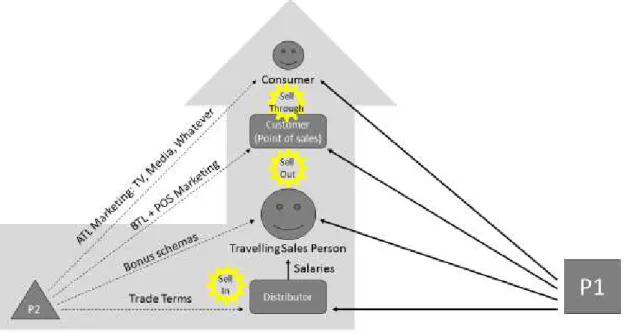
Sales in consumer goods is a multistage process that involves numerous participants (Figure 1).
Figure 1. Actors, activities and relations in distributio of consumer goods.
2
Sell-in as the sales from manufacturer to distributor.
Sell-out as the sales from distributor to a customer.
Sell-through as the sales from customer to a consumer.
Distributors are wholesale companies that supply consumer products to stores. Travelling sales persons work for distributors and they provide personalized service to customers (point of sales). Customers are composed of outlets: supermarkets, convenience stores, cafes, restaurants, gas stations, hotels, kiosks or whatever point of sales.
Manufacturers can influence every intermediary by establishing and communicating targeted incentives. Tactics and audience vary: trade terms set rules for tens of distributors, bonus schemas address hundreds of sales force, POS marketing (promotional activity at points of sales: sampling, leaflets, etc.) affects thousands of places. Market is an arena for multiple manufacturers and usually only two strongest players influence national distribution in a category – no place for a third player. Structured data exists for every type of sales events, yet availability varies. Every company is supposed to have sell-in. Some have sell-out. Sell-through is also available and in some cases, retailors (example: Walmart) encourage manufacturers to use detailed sales information.
Sell-out data are harder to obtain (distributors are not interested in exposing details) unless manufacturer has strong negotiation position that is backed by strong brands demanded by market. Digital divide of both first (availability) and second (use) orders influences data exchange – in some cases we observe national-scale information platforms that support processes of distributors and promote unified data standards in market. In less developed markets, low maturity in systems and processes results in low-granularity latent data that comes from heterogeneous systems.
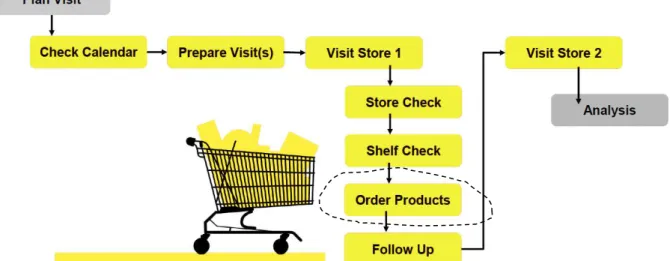
Every sales order (sell-out) records interaction between a customer and the distributor through the travelling sales representative. As an example of a travelling sales person’s daily routine, see Figure 2.
3 What makes this situation interesting is that distributors (through travelling sales person) offer competing products and report to manufacturers only the lines of orders they refer to. If no products were ordered, manufacturer does not receive any information – non-disclosure agreements keep competition sales figures safe. Every sales order records silent fight between market players for a position in a basket. That is the moment all trade marketing activity adds up.
Another important aspect is the limitation of the number of visits to customers a travelling sales person can perform. Visiting more than 20 customers a day could be a challenge. Thus, tracking market only by travelling sales person does not seem reasonable if we want at least daily status check. Figure 3 presents a real example for the Lisbon area, where customers in a small neighborhood were mapped and a travelling sales person limitation for one-day trip is projected.
Figure 3. Example of a travelling sales person activity in one day. Too many customers, too few sales persons – that is the problem for most consumer goods manufacturers that struggle between conflicting objectives of maintaining distribution while keeping trade costs as low as possible.
Industrial grade TPM solutions include best practices for working with supermarkets. Meanwhile, sell-out analytics has not been addressed before (mostly due to digital divide of first order) – and it is an opportunity we pursue - distributor sell-out data becomes available as more businesses go digital. We suppose, exploration of statistics of events can lead to insights in balancing sales operations. Classification and ranking of promotional activity not only brings actionable knowledge about what works, but also builds foundation for future application of machine learning in the enterprise context by revealing magnitude of inequality in products and customers. Doing the things right is not enough anymore for manufacturers to survive economy. Learning patterns from whatever legitimate sources in order to personalize offer –that seems like winning strategy in today’s digital world.
4 Sell-through data is available from retail chains (big businesses whose survival depends on maturity in information technology) – yet, this constitutes only a half of the total sell-through. Modern trade distribution channel stands for nearly half of sales in many categories while the other half goes through traditional retail and other channels. Collecting sell-through data from smaller stores does not seem to be feasible for the time being.
One of the frameworks applied to these data is association analysis also known as market basket analysis or frequent item mining. Many names for the family of techniques for finding statistical patterns of relations between products. We enhance the method in 3.7.
There is a demand for tools that support promotion planning and post-promotion evaluation – no surprise, Boston Consulting Group has put trade promotion optimization case first in their compilation on Business Transformation (Faest & Hemerling, 2016). In this work, we address the problem in three domains, which constitute general objectives: 1) data analytics; 2) prototype construction and 3)business transformation concerns towards implementation of this system. In the first domain, data analytics addresses how information can reveal actionable patterns. We propose several techniques of knowledge discovery to analyze sell-out data and sell-through data. More specifically, we use power laws, to demonstrate that the behavior of customers in consumer goods fits Pareto (80/20) rule and there are at least several parameters that enable such a ranking that minor top would represent major part of business in monetary or operational measures. As a practical application of Pareto rule, we applied RFM analysis (reference heuristic for classification of customers by recency, frequency, and monetary track record – born in direct mail industry) to identify those most important customers. In this line, we also analyzed that the path followed by a travelling sales person and used power law to explain their expected behavior.
A new visual way to reason about rotation was also presented, by analyzing two new measures: distance to served customer (in comparison to a specific customer) and recency (number of days since last purchase). Using sell-through data, a network of product associations was built allowing to understand relations between products bought together, as an extent of traditional market basket analysis techniques. Finally, we applied different classifiers to predict return of products from each order made from customers.
In the second general objective, we propose a prototype development that fits existing Trade Marketing landscape, implements models that build upon existing technology, and contains a set of new features.
Finally, the third main objective was to address business transformation. Business transformation is inevitable consequence of the shift we observe in industry. Reference processes (also called best practices) become differentiation point in market of information systems. Organizational Change Management ensures company transforms operations into the new state smoothly and results in fast adoption and improved data ownership due to immediate insights from customer, product, and sales person classification.
5
2.
CLOCKWORK OF TRADE MARKETING
2.1.
R
OTATION AND DISTRIBUTIONSell often at maximum number of stores – that might be an overall objective setting for the field sales force. Rotation (intensity of stock replenishement at customers over a period of time) is an important measure of behavior that allows prediction. For example, we achieved 99% accuracy in guessing whether a customer is going to buy or return seasonal product, given rotation history, amount of sales, and weather conditions (see 3.8). As we demonstrate in 3.3, regular customers buy more, so sell often.
Distribution (presence on shelves) is the second of two most important measures in sales. Numeric distribution is the number of stores that sell product. Weighted distribution is the proportion of product quantity to the total quantity of product category including competition. We find that numeric distribution can be assessed from distributor sell-out data (see Figure 1).
The objective of the sales force is to maintain rotation and distribution.
Every sales order records silent fight between market players for a position in a basket. That is the moment all trade marketing activity adds up. We suppose that exploration of statistics of events can lead to insights in balancing sales operations. Classification and ranking of promotional activity not only brings actionable knowledge about what works, but also builds foundation for future application of machine learning in the enterprise context by revealing magnitude of inequality in products and customers. Doing the things right is not enough anymore for manufacturers to survive economy. Learning patterns from whatever legitimate sources in order to personalize offer seems to be a
winning strategy in today’s digital world.
Digital transformation forces review existing practices and we might witness extinction of a travelling sales person job. Zero-checkout store recently introduced by Amazon challenges retail tradition. Do we need a sales representative visit on an outlet that uses computer vision to control shelves? Store tracks products picked (or put back) by customers so that virtual shopping basket contents reflect reality. Why wait in queues at cash desk? Better faster shopping experience and lower operational cost seems like competitive advantage. The only downside is a threat to wellbeing of considerable involved workforce.
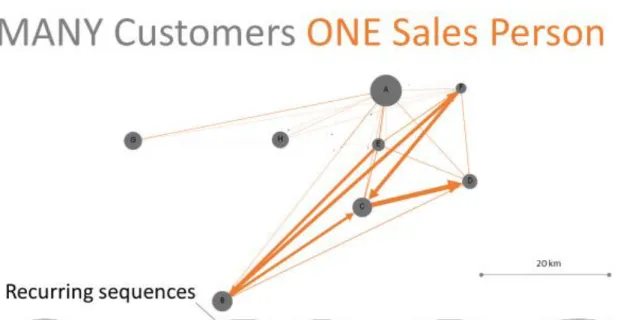
6 Figure 4. Graph built from a sequence of orders taken by one sales representative as follows. Nodes represent customer locations and area of a circle is proportional to the volume of business. Edges represent consequent visits within one day and weight is proportional to the number of observations. Infrequent customers that buy small quantities do not receive a letter code –we use ‘x’ to mark these in the sequence of orders instead.
Longer periods of observation reveal a tendency among travelling sale persons to visit neighborhoods regularly – a weekly recurring pattern is possible to be seen on Figure 5.
7 As we see on Figure 5, recency is an important measure – number of days since last order. Frequency of orders varies over time – there are periods of regular weekly service that result in better rotation of products. A closer examination of events in the system has led to development of a new measure
– distance to the nearest served neighbor. Visits to neigborhoods persist – we can see weekly pattern in the plot of distance to the closest encounter over time. We believe having an order at customer every time area is wisitied is a good binary measure of success in maintaining rotation. Deviations between these two are easy to spot visually and this problem can also be addressed by machine learning.
Today’s marketers have a chance to understand dynamics at every step of sales process. .
We discover new knowledge about behavior of market in sell-out and sell-through data. In our cases numbers range at 20-30 distributors, 400-800 sales representatives, 20-30K customers, and 20-70K orders a month for sell-out. Sell-through cases deal with 3-7M records yearly.
2.2.
O
BSERVE-P
LAN-D
O-C
HECK-A
CTWhat made customer a regularly buying one? That is the problem that can and should be solved by matching patterns that emerge from sell-out and sell-through data with plans for trade marketing. Clearly, we can expect to find out what tactics work best by comparison of detailed behavior records of events during respective periods. Collecting and storing records is not only a good practice, but also a prerequisite for certification against ISO 9001 family of standards for quality management. This is also a must have for manufacturers that expect to put product on shelves of international retailors (and lesser scale players too).
Plan-Do-Check-Act is an iterative four-step management method used in business for the control and continual improvement of processes and products. It is also known as the Deming cycle. Another version of this PDCA cycle is OPDCA. The added "O" stands for observation or as some versions say "Grasp the current condition." This emphasis on observation and current condition has currency with Lean manufacturing/Toyota Production System literature (Wikipedia).
Whatever framework is used, data granularity becomes essential. Capacities for observation of the current situation and checking tendencies in fact data are growing while detailed planning is still a luxury not every manufacturer has. Planning and tracking of trade spends at lowest levels (point of
8
3.
INSIGHTS FROM DATA
3.1.
D
ATA SOURCES AND METHODS OF TREATMENTKnowledge discovery relates on quality of data and it is crucial for businesses to maintain records timely and accurately. Enterprise Resource Planning (ERP) and Customer Relationship Management (CRM) systems, among others, address this topic. No surprise, key determinants for acquisition decision and successful use are analytical and collaborative capacity (Ruivo, Oliveira, & Neto, 2015). Since enterprise grade Business Intelligence (BI) implementations rely on transaction processing systems, and knowledge consumers have to wait for ERP implementation (9-12 month), insights from the existing data can score quick wins in data ownership by making immediately actionable knowledge available. We alter presales and implementation processes and introduce analytical services to customers in order to build data driven decision making practices and incept the need for industrial application of machine learning at early stages of digital transformation.
We analyze data from three sources: Two international consumer goods manufacturers operating in Eurasia (sell-out data) and a retail network in America (sell-thought data).
The two international consumer goods manufacturers operating in Eurasia have collected sell-out data for our study through the period of 2013-2016 years. Both companies originated in Europe. Strong brands in portfolio of both build foundation for market leadership – champion or challenger positions in different markets. Neither of the two operates competing or substituting category – there is no traceable sign of competition. One company produces highly seasonable goods and we apply machine learning to the problem of finding meaningful correlation between sales and weather and produce early warning concerning the end of season situation and following returns of unsold items.
Data is composed of orders from point of sales, collected by distributors. Each record represents one order line. Since distributors usually sell products from multiple market players, one important characteristic of this dataset is that each manufacturer only has access to a part of the orders (only those concerning their products).
Some records contain geotags. Data comes from information systems of distributors and not every market has centralized data persistence – while some markets have access to shared information services that enable data exchange between distributors and manufacturers.
The third dataset comes from a retail network in America – a sell-through case. We have a month of operations for two stores. Each record represents an order line item and is a timestamped record of the moment bar code has been scanned at cash desk.
9 Heterogeneous data limits global application of analyses we used and does not allow for cross-comparison between two manufacturers. Examples of inconsistencies we have already faced include, but not limited to: different features, incomplete data, delays in data submission and batch entry. All those may skew behavioral patterns and therefore should be taken seriously. The most annoying example of incomplete data in both sell-out datasets is that date information is limited to calendar date – thus we leave some promising time series analysis techniques for the later stages of this project – until the moment we have timestamps.
In the course of data preparation, we extract, transform, load data, and produce statistics in Python. For supervised learning part of this project, we use KNIME Analytics Platform. On top of the subject data, we integrate weather information from external provider. For some of the analyses, we generate quasi-time-series data – thus capturing trail of events triggered by travelling sales person. Our exercises in feature engineering vary from rather widespread RFM analysis to ergodic and stationery hypotheses check. We demonstrate that chosen parameters can enhance decision-making capacity in various setups of national-wide distribution of consumer goods.
3.2.
P
OWER LAWSRecent discoveries in dynamics of complex systems suggest that Poisson distribution, widely used in operations and statistics to describe stochastic behavior of unrelated events, do not describe real world systems very well (Barabasi, 2003). Surprisingly, statistical laws that approximate processes in complex interrelated environments – Pareto (power) law, and Zipf distribution have long history and only now humanity started to realize mechanics that lead to skewed heavy-tailed distributions in the real world. Here we provide brief overview of fundamental research that shaped our project.
Pareto principle (also known as 80/20 rule) – a notion that 20% of activity accounts for 80% of result
– was first observed by Italian statistician and an economist Vilfredo Pareto in late XIX century and its implications range from wealth distribution in societies to size of craters on Moon. Until recently, there were few explanations of this skew. One of the first research that connected power laws to networked structures that nowadays received wide use in modelling complex systems, was study of real world networks (the neural network of the worm Caenorhabditis elegans, the power grid of the western United States, and the collaboration graph of film actors) that discovered small-world properties and suggested alternative to the use of random graphs (Watts & Strogatz, 1998).
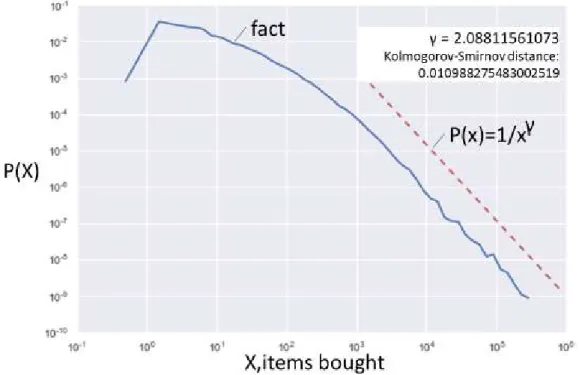
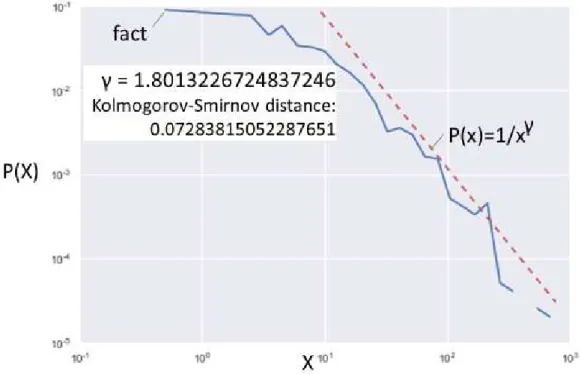
10 The best fit we find (see Figure 6) is the distribution of unit sales among customers – net amounts along customer lifecycle. Immediate implications – classification of existing customer base and enhancement of master data. We elaborate on this in detail in the next chapter (see 3.3.).
Figure 6. Unit sales distribution in 34915 stores. The situation customer bought three times more is nearly nine times less likely to happen. Probability density function in double logarithmic scale and best fit power law we discovered in four years of traditional retail network order items.
11 One of distinctive features of a small-world network is degree distribution – number of edges connected to nodes follows power law and when plotted on double logarithmic scale, results in a straight line (Watts & Strogatz, 1998). This feature has name of power law signature. Only recently, the problem of fitting of power laws was solved and nowadays we have tools that define parameters of distribution at reasonable computation cost (Gillespie, 2014). Testing for power law becomes standard step in data analysis workflow for all those who use network models. It is remarkable that most of real world networks very well approximate power law with exponent ranging between 2 and 3 (Newman, 2008).
More surprising discoveries emerged when researchers started to study World Wide Web (Broder et al., 2000). Not only power laws emerged in a structure of hypertext links between separate documents and websites, but also the way humanity structures information and relates concepts seem to be a small-world network. Study of how people navigate Wikipedia that a group of researchers turned into a game (West & Leskovec, 2012) where participants have to reach one article from another in minimal number of hops between intermediate topics demonstrated how easy is next item prediction – and we see multiple applications in the real world ranging from assisted search and recommendation systems to predictions of taxi trip destination (de Brébisson, Simon, Auvolat, Vincent, & Bengio, 2015). Same principles define underlying structure of natural languages. The way how recurrent people are in addressing problems of information navigation and wayfinding in real world and social structures supports our idea of a good sales person being repetitive.
Networks are of great interest not only because their structure suggest solutions for multiple problems of ranking between nodes, but also because topology can greatly influence diffusion over network. News propagation between websites, rumor spread in communities, or epidemic dynamic – these processes depend on underlying structure (Cheng, Adamic, Dow, Kleinberg, & Leskovec, 2014). New direction of studies in the area of network structure reconstruction based on timing of events in the system resulted in a family of algorithms. Once connections between nodes defined, it is possible to reason about influence, paths and directions of diffusion, predict outreach and classify system response to infusion (Leskovec, Huttenlocher, & Kleinberg, 2010). In trade marketing, these algorithms can address the problem of campaign classification – and help in judging what works from what does not.
A recent study discovered that artificially influenced positive bias could occur in a socially networked system. That suggest mechanics for how to increase rating of a product, up-vote a news article, or create social buzz about a product. All these processes relate to that of promotional activity in trade marketing – suggesting new methods of promotion planning and evaluation. Interestingly, while social systems accept positive manipulation, negative manipulation does not create hype and collective behavior balances out the introduced artificial bias (Muchnik, Aral, & Taylor, 2013). Such mechanics suggest that rather than blaming competitions in face of customers, it is more efficient to focus on promotion of own products – chances for positive hype are way better.
12 networks and algorithmic perspective of frequent graph mining has just recently been addressed, providing new methods for reading patterns in complex systems (Benson, Gleich, & Lescovec, 2016). What makes networked models so attractive is that graphs serve a level of abstraction and allow for use of algorithms from different fields: time series classification techniques developed for meme propagation tracking can redefine view on marketing campaign effectiveness evaluation; next item prediction problem that has been solved for assisted search can address sales person route planning or cross-selling; community detection methods can address customer classification, to name a few. Moreover, in the context of machine learning, network representations are indispensable source for new features of data.
3.3.
RFM
In order to communicate need for customer classification we use existing framework – RFM analysis
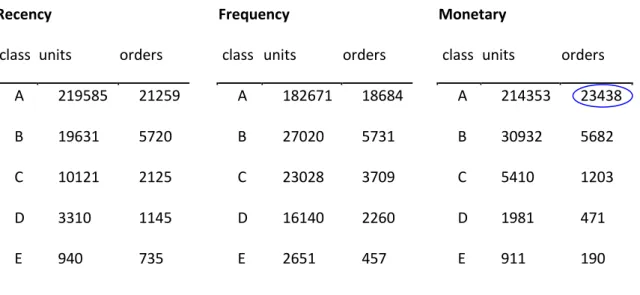
– marketing technique that emerged in direct mail industry in 80-s years of XX century. Method received its name according to impact of recency, frequency, and monetary parameters on chance of future sale. Contrary to what was expected, we discover that monetary driver dominates in consumer goods, recency moves into second position while frequency has least determinant power in our context. Thus, RFM method turns into MRF in consumer goods industry. At least we could argue that it works differently not only because of different dynamics, but also due to different
categories studied: direct mail industry names ‘customer’ what is called ‘consumer’ in consumer
goods industry.
For both sell-out datasets, we order all customers by recency, frequency and monetary value and equally bin the set into 5 categories of equal size (ABCDE), where A stands for most while E stands for least attractive. At national distribution level we find patterns: 1) monetary A class customers generate more orders and revenues than A classes of recency and frequency; 2) monetary value defines chance for next purchase as good as monetary. For example (see Table 1), for 34915 customers, we run RFM classification over sales of 54 month – and for the 55th month we analyze distribution of sales among classes of each variable.
Recency Frequency Monetary
class units orders class units orders class units orders
A 219585 21259 A 182671 18684 A 214353 23438
B 19631 5720 B 27020 5731 B 30932 5682
C 10121 2125 C 23028 3709 C 5410 1203
D 3310 1145 D 16140 2260 D 1981 471
E 940 735 E 2651 457 E 911 190
13 We can see that every variable of RFM method performs well in isolation, so the next step is a
combination of two factors – monetary and frequency.
3.4.
FM
The classification of the customers into two dimensions fragments data into 25 segments (see Figure 7). Combination of three dimensions results in 125 segments. This technique proved to be easy to communicate - profitability of segments varies and optimization decisions fit 80/20 rule – logic is straightforward and understood by business.
Figure 7. Distribution of net sales and orders between segments of customers obtained by binning monetary and frequency parameters into five categories. Pareto (80/20) rule works in customer dimension – data represents operations in Eastern Europe along 4 years. Note: % do not sum up to 100 due to rounding
We use this pair of dimensions – frequency and monetary – together with some machine learning techniques to solve problem of predicting whether a customer is going to buy or return a seasonal product, given the weather conditions. We elaborate more on this topic in section 3.8.
This approach reveals the only weak point of the RFM method – segments of customer base vary in size – this issue does not allow for straightforward comparison. Yet, normalization is a solution for this issue as long as people in business are capable of operating fractions and metrics more complex than counts.
3.5.
R
We study Recency separately. First, we analyze inter-event time intervals and discover, that although customer service seems to be periodic, there are noticeable gaps in the pattern of visits (see Figure 5). For example, a customer that has been normally visited at weekly basis, has several disruptions
AA customers - best
14 and intervals between consequent purchases increase drastically – just to return to normal behavior. On one hand, such bursts of non-activity are not something unexpected and non-Poisson dynamics emerge in somewhat alike setup – priorities in human decision making lead to these skewed distributions (Bees et al., 2005) that cannot be described by mean values. Yet, on the other hand, sales force has clear objectives for regular maintenance of customers – and consumer goods industry is driven by rotation and distribution – and it is not only us, but also every sales manager is who expects visit pattern regularity.
Moreover, when working on a sales force merge project for Nestle in Ukraine in late 2008, we had conducted time and motion study in order to capture effort that each of several categories receives. That project brought up knowledge that in dedicated sales force key performance parameters – inter-visit intervals, duration of visits, time spent on particular activity – all those follow Poisson statistics as it is expected from repeatable routine operations. In a situation of shared sales force that works for distributors and sells not only our products, but also those of competitor, we did not see the expected pattern.
Therefore, we developed a new feature for our data and, for every day of the observation period, computed minimal distance to a different customer – nearest served neighbor. The idea behind such statistic is to capture recurring visits to neighborhoods, if such exist. We discover that all of sales persons in population demonstrate high level of regularity in visits to areas – weekly pattern emerges suggesting that our subjects indeed have objective to maintain rotation in designated areas. Moreover, when we analyzed first orders taken on every day, we discovered that sales representatives started their journeys in recurring neighborhoods. All that suggests that sales force is indeed regular, yet fragmentary nature of data distorts the resulting picture.
When plotted together (see Figure 5), recency and distance to the nearest served neighbor reveal that regular pattern of visits to neighborhoods does not necessarily result in recurring sales at particular customers.
3.6.
T
RAVELLINGS
ALESP
ERSONS LEAVE TRACESWe believe the working environment of sales team to be highly regular and routinized. That is exactly what is expected from field force. This way of thinking not only corresponds to common sense, but also opens opportunities for building predictive models that address vital topics of demand forecasting promising area for enterprise machine learning. One of such application is the next item prediction problem – guessing where sales person would go after a certain customer visit – and pointing to the customer to be served next. Since distributor sell-out data are fragmentary, we first develop a set of analyses that would demonstrate this kind of regularity.
15 Figure 8. We use history of orders collected by a sales person and customer locations in order to build travel graph. Our customer has invested effort into mapping of customer coordinates and this enables use of geographical layout for visualization.
Rationale behind analysis of personal travel routes grounds on several findings that were recently reported. First, it is human navigation and wayfinding process (West & Leskovec, 2012) – we, as species demonstrate high tendency to stick to previously known routes and associations – a mind trick that makes humans human – we are predictable. Remarkably, this feature leads to models that predict with high accuracy final destinations of trips based on few steps taken, sentence completion (e.g. search query auto completing) based on several words typed, or fraud detection algorithms – and multiple applications other than listed. Second, sales representatives, assigned to a territory, have to solve travelling sales person problem for themselves – that limits route to one of few sub-optimal solutions. Finally, taking into account scarce resources and especially time pressure (usually, visit to a store takes few minutes and includes multiple activities: stock check, assessment of merchandising standards, order picking and so on) we find no reason to believe much variance is possible at all.
16 of traceable recurring journeys. Also, when we measured whether or not these sequences recur in different order (all possible combinations), we discovered linear correlation between two obtained statistics. What is even more surprising is that distribution of regularity measure in population follows power law very closely.
A number of highly regular traces of recurring visits emerged from a sell-out sample of 24
distributors’ field teams – 401 travelling sales representatives servicing 41574 customers along two years. Interestingly, Pareto (80/20) rule describes regularity of travelling sales representatives – degree to which they stick to specific travel pattern fits power law (see Figure 9).
Figure 9. Stationery process test in 308 salesmen along two years. Probability density of sales person regularity measure (normalized to scale 1 to 1000 due to fact that power law is not defined below 1) One possible explanation for this phenomenon is the fragmented nature of data – we analyze order line items – and the working hypothesis is that more popular categories demanded by market distorts our perception of rather regular travelling sales person. Thus, instead of solving the next item prediction problem (which can be solved only for a part of population), we reframe the situation and find three alternative scenarios for utilization of the obtained statistic.
Use case 1: Loyalty Rating. As we discovered, there is a fraction of sales representatives that tends to place at least one our product into every order – that is the reasonable explanation of repeatable trace those leave – and we foresee no better evidence of loyalty other than that. Best scientific explanation we know of it the concept of preferential attachment (Bees et al., 2005) – and Kolmogorov-Smirnov statistic of 0.0728 gives us some certainty. From common sense perspective,
sales person’s success and ability to persuade customers builds on confidence in three factors:
17 in, so in an uncertain situation, e.g. customer asking for a category item (instead of a specific product), they offer an option that is best to their belief.
Use case 2: Post-Promotion efficiency evaluation. As we find, there are periodic disruptions in sales history of particular customers (see Figure 5). We believe that successful trade promotions result in better sales and thus regularity should increase during the trade activity period. That is the essence of trade marketing – increase of a chance to put certain product into every market basket. This kind of comparison is available to manufacturers that maintain information systems capable of storing detailed information about marketing and trade marketing plans and execution – so that sales orders could be linked to specific campaigns. SAP Trade Promotion Management is an example of such a system. As we know, 2/3 of trade promotions do not break even (Nielsen, 2014), and this measure could improve classification – differentiation of working marketing tactics is the most promising area for quick wins.
Use case 3: Market As A Sensor. For those who mastered trade promotion classification and found out which tactics work best, we point to an opportunity to establish surveillance over competition. The rationale behind is that market (and sales representatives) demonstrates nearly the same reaction to trade promotions and capacity is limited. Thus, a successful promotion run by one player disrupts sales of another – and those disruptions signal competitive activity. We believe market reacts nearly the same way to similar motivation – and systematic analysis of competitor activity in trade would result in strategy derived from observed tactics. The approach of strategy inference from tactic analysis is not new – what we suggest, as innovation is classification of response derived from impact on our sales, not only competitor activity and publicity observation.
3.7.
A
SSOCIATIONS ANDD
ISSOCIATIONS INM
ARKETB
ASKETSMarket basket analysis is a widespread modeling technique based upon notion that people buy associated items. Usually rules build like IF {fish, no vegetables, and no wine} THEN {chips, beer}. These methods build upon observed facts. Our method, in contradistinction, is based on the absence
of observed associations in that it is assumed there are substitutive forces (Porter, 2008) that prevent simultaneous purchase of certain goods.
Dynamics in the system change over time – for example, sales of coffee are more intensive in morning hours in general. Relations can change over time. That is why study of how graphs of associations develop over time is part of the workflow. We discover expected properties of small world – densification of graphs over time, connected components, community structures and bridges that connect these.
18
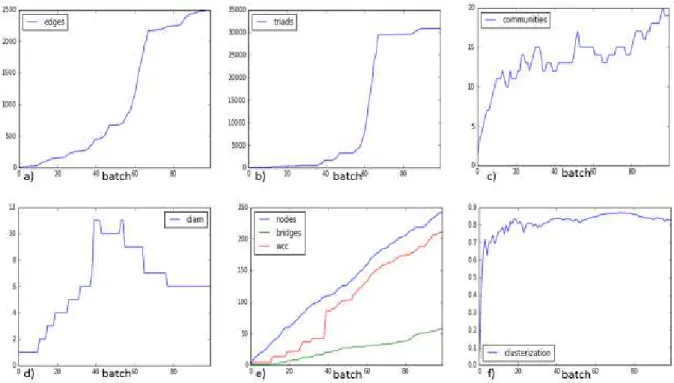
Figure 10. Key parameters of product association graph over time – we build it by drawing connections between products that were bought together. We process stream of order line items in batches – 5 items at a time. As we see, diameter (d) shrinks over time. Number of nodes (e) grows linearly while triads (b) demonstrate steep increase in the middle of observation period. Clusterization (f) remains nearly the same – community structures (c) grow in number as graph grows and they repeat the same growth pattern. Tightly knit communities connect through bridges (e) – nodes that link them together and we can identify moment when most nodes connect into giant component – wcc (e).
As behavior of the system confirms generic statements about network structures, we define a method that utilizes such common properties of real world networks, as: homophily (like always finds like and most of new edges close triads), community structure, and recurrence of higher order structures. Our method enhances traditional workflow of market analysis as follows:
Apriori (Nichol et al., 1994) is an algorithm that addresses problem of discovering association rules between items in a large database of sales transactions. Method stays popular and has been implemented by major vendors of analytical software.
We suggest alternative implementation on graphs as:
Step 1. Construct undirected weighted graph G1 where node Nicorresponds to i-th item, edge Eij
captures association between items i and j, and weight W(Eij) reflects number of observed
associations.
Step 2. Given threshold C, from G1 construct G2 by selecting Eij, where W(Eij) > C.
Step 3. While #Mn > 0, identify fully connected motifs (Milo et al., 2002) Mn of size K > 2,
19 It is easy to see that resulting sets Mn are identical to output of Apriori algorithm, yet graph
representation allows us to use homophily property of real world networks that is a basis for link prediction on graphs (Liben-Nowell & Kleinberg, 2003) and move further.
As we know, presence is the measure of absence (Hegel., 1817). That is why we test G1 built upon
series of transactions from retail for homophily by measuring weight distribution between edges Eij
against fraction of common associations against total associations for both Ni and Nj. As we can see
from Figure 11, most of weight on structure stays in highly mutually interconnected area, while structural holes there are rare.
These rare structural holes, in our opinion, represent dissociative relation between items. Items happen many times in similar contexts (have many associations in common), but never together. We propose an algorithm for finding such associations in transactional databases that uses the same input as Apriori:
Step 1. Construct undirected weighted graph G1 where node Ni corresponds to i-th item, edge Eij
captures association between items i and j, and weight W(Eij) reflects number of observed
associations.
Step 2. From G1, construct inverse graph G3 by doing bit flip of G1’s adjacency matrix and zeroing
diagonal.
Step 3. For every edge Eij in G3, for Ni and Nj, compute minimal fraction F(Eij) = min(F(Ni), F(Nj)) of
common associations from G1.
Step 4. Given threshold D, from G3 construct G4 by selecting Eij, where F(Eij) > D.
Step 5. While #Mm > 0, identify fully connected motifs Mm of size K > 2, incrementing K.
Resulting sets Mm are sets of mutually exclusive items – there will be only one of those in a market
basket.
We apply proposed algorithm to our only sell-through dataset.
First, we create undirected association graph G1 where nodes represent each of 203 product
categories (our customer invested time into creation of product hierarchy) and weighted edges stand for number of times two categories connected by edge appeared together on a market basket throughout observation period.
At this moment we test system for homophily – and choose to test it as a link prediction problem (Liben-Nowell & Kleinberg, 2003) – the reason for doing so is wide availability of algorithms. We use Supervised Random Walk (Backstrom & Leskovec, 2010) implementation for SNAP library (Leskovec & Sosic, 2016) and find out that algorithm predictions are 83% accurate. We perform the test by running a sliding window over the series of transactions and algorithm predicts new edges by observing only minor part of G1. Such rate of accurate predictions from a method that utilizes
20 Second, we create undirected dissociation graph G3 by applying bit flip operation to adjacency matrix
of G1 and removal of self-edges. As a result, edges in G3 represent pairs of categories that have not
been observed. In other words, edges in G3 represent structural holes in G1.
As we can see from Figure 11, chances for having an edge between two arbitrary nodes rise as fraction of common complimentary nodes increases, while number of structural holes drops.
Figure 11. Category relations, normalized to scale [0, 1]
Third, we create an undirected graph G4 as sub-graph of G3 transferring only those edges where
fraction of common complimentary categories between two nodes is above 80%. We argue G4
reflects dissociative relation between categories since these appear many times on similar market baskets yet never go together. Such relations can be interpreted as product substitution – one of fundamental factors that shape strategy (Porter, 2008).
The first aspect of using a graph is creating a graph. Once a graph has been created, it can be subjected to algorithms that quantify aspects of its structure, alter its structure, or solve problems that are a function of its structure (Rodriguez & Neubauer, 2010). However valuable, G4 is still hardly
readable by humans – that is why we decide to split it into smaller structures.
Our first attempt of dividing relatively big G4 into smaller parts is dictated by core-periphery property
21 are more densely connected than the non-overlapping parts, which is in sharp contrast to the conventional wisdom that community overlaps are more sparsely connected than the communities themselves (Yang & Lescovec, 2012). We explain fitting process on Figure 12.
Figure 12. Fitting of Community-Affiliation Graph Model. a) Initial graph G b) Community G-1 defined by fitting procedure c) Community G-1 separated from graph G d) Community G-1 has flat structure that can be used as visual aid for category managers as a whole or can be partitioned by conventional methods into smaller elements.
As we can see from Figure 12d, network can be seen as a patchwork of recurring elements – triads, quadrats, bowties, and so on. That is why we try an alternative to partitioning and go for motif search (Milo et al., 2002). In order to do so, we integrate the network motif detection tool mfinder1.2 generously shared by authors into our workflow. Frankly, our choice of software for this step has been limited by operational system (we use Windows) while cutting edge research in this area reside in the *nix world. We leave those experiments for the future.
Complete motifs (fully connected graphs) are of interest for us – it is a nice story to tell prospects:
“Look, here’s a list of N categories. Bought in similar contexts, but never together.” We discovered 84
complete motifs of 4 nodes, and 5 complete motifs of 5 nodes in G4. We foresee at least three
immediate applications for this result.
Use case 1: input for price sensitivity analysis – traditionally substitutes were picked by humans. Use case 2: promotion portfolio optimization for retailors – as we can see, some categories follow
‘there should be only one’ rule, so running simultaneous promotions might be not a wise idea.
Use case 3: cannibalization - reduction in sales volume, sales revenue, or market share of one product as a result of the introduction of a new product by the same producer – same as use case 2,
22 Both methods are computationally expensive and control of input graph size becomes crucial.
Overall, network representation of complex systems is not only a good exploratory technique, but also a promising area for enterprise machine learning. As Fujitsu research demonstrated, networks, written as tensors and fed into deep neural network appear to be a winning recipe for chemical component classification problem overperforming prior champion by 10% and reaching 80% accuracy (Fujitsu Labaratories, 2016). Since networks are universal abstraction for many complex systems, graph algorithms are universally applicable between disciplines.
3.8.
E
ND OF SEASON–
PRODUCT RETURNSOne of datasets we explore belongs to company that runs seasonal products and returns of unsold items at the season end are common (see Figure 13). Clearly, there is correlation between demand (or returns) and weather conditions – that is why products got title ‘seasonal’ and we, instead of measuring coefficients (which can be puzzling for business people that struggle reading boxplots), address this rather as a machine learning problem – given weather conditions, how well can we predict whether customer is going to buy or return products. Rationale behind such analysis is that weather forecast accuracy has amazingly improved over last years and accurate prediction of daily summaries for the following week, or detailed up-to minute alerts for the following hour became reality. For business, that opens opportunity to plan return logistics in advance or to run a promotion that incentivizes stock clearance.
Our dataset is quite scarce and we go for external provider in order to enhance it. Currently there are multiple opportunities for those seeking historical records of weather: Global Surface Summary of the Day (GSOD) provided free of charge for scientific and educational purposes by National Oceanic and Atmospheric Administration of the USA; Dark Sky website; IBM company Weather.com; and many other providers. Weather.com and Dark Sky provide convenient API that allows for seamless data integration. The latest daily summary data are normally available 1-2 days after the date-time of the observations used in the daily summaries. Historical data are generally available for 1929 to the present, with data from 1973 to the present being the most complete. Over 9000 stations' data are typically available. As primary data source for weather conditions we choose rp5.ru – and rationale for choosing this provider is its generous use agreement.
23 Figure 13. Seasonal effect in sales and comparison between classifiers. Barbeque supplies do not sell well in autumn and some customers (supermarkets) return goods to distributors. We combine sell-out with weather records for a given city. Monetary and frequency measures define behavior of a customer very well as we can see from performance of a range of classifiers trained on a set of 769 examples and tested against 514 (both sets come from stratified sampling of 1283 data records) that represent sales in autumn throughout 4 consequent years.
24
4.
PROTOTYPE DEPLOYMENT
4.1.
T
RADEM
ARKETING DATA LANDSCAPECurrent offer from Trade Promotion Management system vendors includes support for business-to-business-to-consumer (B2B2C) scenarios – typical for modern trade – operations with national networks of supermarkets (Key Accounts(KA)) fit into this business practice. Some retailors (Walmart) even encourage suppliers into joint business planning and provide information system for respective processes.
Meanwhile, B2B2B2C process of consumer goods distribution through regional and national distributors that supply traditional retail outlets remains not yet addressed (see Figure 3). Planning and tracking of trade budget remains at high level. We propose a set of data analyses that increases granularity of understanding the market and provides insights into behavioral patterns of prevailing majority of customers yielding more than half of business – despite growing share of modern trade, traditional retail remains important channel for majority of consumer goods accounting for at least half of revenues.
Recent review of trade promotion management systems suggests (Gartner, 2016) more than 20 major vendors.
4.2.
C
OMPONENT CHOICE AND IMPLEMENTATION SUPPORTInformation systems ensure data persistence and provide interface to knowledge and actions for end users. Contemporary landscape of Trade Promotion Management solutions has emerged in early 2000-s and now a company that strives to take control of sales costs has a choice between tens of vendors. After careful considerations and review of existing offer, we ended up with two criteria for choosing a system:
Data Integration tools and capacity
Data Quality tools and capacity
To our opinion, supported by panel discussion of C-level executives, these two capabilities address traits and challenges in B2B2B2C scenario of consumer goods distribution. Multiple sources of heterogeneous data and information make first a paramount, while requirement for data quality capability ensures highest quality of analysis. That high certainty in data supported by transparent statistical techniques can make advantage is the paradigm of contemporary information system management. Among all competition, SAP solution stands out in both capacities (Gartner, 2015; Gartner, 2016) and our choice of benchmark solution is obvious.
25 of the implementation methodology and second stream in the overall importance ranking after Project Management (SAP AG, 2009).
According to SAP Activate, project goes through four phases:
Prepare. The project is initiated and planned, including quality and risk plans. The system environment is set up, including best practices for ready-to-run processes.
Explore. The customer team explores SAP solution capabilities while the system integrator
researches the customer’s business. Together, they use fit/gap workshops to identify the
configuration and extensions that best meet customer requirements.
Realize. The team configures and extends the system, based on prioritized the requirements captured in the Explore phase. Configuration and build are done in short cycles, ensuring regular validation and feedback from the business. Structured testing and data migration activities ensure quality.
Deploy. Final preparations before cutover to production ensure that that the system, users, and data are ready for transition to productive use. The transition to operations includes setting up and launching support, then handing off operations to the organization managing the environment. During each phase, the project team produces a prescribed set of deliverables that serve as input for the subsequent steps. The methodology provides examples of key project deliverables, including a procedure description of how to prepare and complete the deliverable. There are accelerators for each phase and work stream, including templates, questionnaires, checklists, guidebooks, and other tools that facilitate the efficient, consistent, and repeatable delivery of implementations and upgrades of SAP solution landscape.
Standard methodology assumes organization of project activities into several interrelated streams: Project Management, Organizational Change Management, Training, Data Migration, Data Archiving, Value Management, Business Process Management, Technical Solution Management, Application Lifecycle Management, Test management, and Cutover Management. All work in SAP implementation project is grouped into delivery-oriented packages, and accelerators enable standardized and rapid execution of all necessary work.
We build our approach on artefacts of ASAP and address key pain areas of information system deployment project: early stakeholder engagement, data ownership culture, and data driven decision making (SAP AG, 2007, 2009). All these issues can undermine large information system implementation project and achieving the only goal – acceptance and routinization might become uneasy.
26 Figure 14. Timing of intervention is essential for successful adoption of change (image credit: SAP) Moreover, all big systems from any vendor have one trait in common – time of delivery that stretches for month and even years – long enough to lose patience. We address this challenge by suggesting introduction of the Knowledge Discovery stream into implementation project structure and reinforcement of deliverables of Explore phase of SAP Activate with insights that go further than conventional statistics. Such enhancement results in several advantages for both system integrator and customer.
First, it is quick wins in new practice adoption. We intentionally focus on Integrated Planning and Trade Activity Planning processes – quite advanced business routines that require thinking about sales planning in multiple perspectives: brand, channel, and category management – and reaching excellence in every of those requires multiple small changes in working with market. Every analysis we built intends to highlight necessity for those changes. It is surprising, how tiny could be insights that trigger business transformation. In our experience, a prospect company changed process of trade activity planning from setting goals for regions to specific objectives for distributors based on customer classification and channel performance – after seeing sales to channels on the map and finding out that 20% of Customers accounted for 90% of revenue. Such insights change mood in
customer organization from ‘OK, we have been waiting a year for those reports, are they worth what we have paid?’ to ‘Wow, that is actionable insight and we are looking forward to real-time analytics
27 Second, it is better quality of BI. Typical approach for big information system delivery is that BI part of the project starts at later stage, after transaction flow has been defined, and necessary configuration has been delivered and tested. Normally, first batch of BI reports consists of standard content. Such approach proved robustness, yet we foresee an opportunity to build better reports by understanding statistical patterns in customer data. Such approach, as we believe, can result not only in better quality of information system (and by quality we understand fulfilling customer expectations), but also creates cross-selling opportunity for new reports and dashboards that address discovered insights.
Third, it is better understanding of existing information architecture and available data sources that builds upon results of Extraction, Transformation, and Load (ETL) – that improves data collection and preparation for migrations into the new system as issues are identified at earlier stages of implementation project. Also, as awareness of true value of data spreads in customer organization, it is easier to build good data governance practices on top of this wake of success.
Finally, such approach builds trust. One of the canonic problems in information system
implementation is that ‘They know nothing about our business!’ opinion. Changing this situation
requires huge effort and we believe that small fast insights, such as pointing out overperforming
channels (for one of our prospects significant volumes in channel ‘Other’ became surprise that
triggered change in objective setting for some distributors), unrealistically planned promotions, or winning product bundles – all those small things delivered at earlier stages of project build credibility of integrator in the eyes of a customer.
4.3.
R
EFERENCE BUSINESS PROCESSESProcesses, best practices, and benchmarks – these assets define value of information system in an organization – and Trade Promotion Management users demand change management, guidance of implementation and robust workflows from solution vendors (Hagemeyer, 2015). That is why we address issues in transparency of trade spend planning, use, and monitoring by a process of integrated planning. Solid and transparent volume planning and alignment routine can change situation – some say it can be a silver bullet for consumer goods industry – and we claim it could. Collaborative planning and involvement of partners into business development process is a reflection of growing roe of retailors – sign of trend in vertical collaboration within industry – and an opportunity for B2B2B2C process of distribution for consumer goods. Pioneers in trade marketing – food manufacturers encountered challenges of this networked media years before other industries – and contemporary body of knowledge is constantly evolving as more businesses undergo digital transformation. No surprise, joint planning can benefit from insights that reside in sell-out data of distributors.
28 business, and improves not only quality of information available and quality of decisions, but also builds solid foundation for behavioral baseline. Such baseline, measured objectively can set evident basis for numeric reasoning in decision-making and management practice.
4.4.
I
NTEGRATEDP
LANNINGIntegrated Planning is the process of systematic review and alignment of all activities of marketing, sales, logistics, and production functions. Consumer goods have to reach shelves timely, in necessary quantities in order to ensure freshness and quality, industrial assets need utilization, and supply chain has to have sufficient capacity to handle customer orders. All plans for promotions, activities at points of sales, advertisement and so on – after internal alignment – at final stage reach agreement on execution at stores.
Contemporary operations utilize two approaches to planning – yearly budget process, and a rolling forecast. Both approaches have in common joint cross-functional team activity of planning against observed performance – only horizon varies from a fixed yearly interval to a sliding window of predefined length (usually 12 or 18 month) – whatever the option is, a team of experts aligns plans in a series of workshops.
Channel management capacity – ability to differentiate in market according to consumer experience
– becomes of essence in modern operations. Not to be confused with omni channel CRM – concept – which relates to seamless customer journey. Traditional and dominant channels in consumer goods – traditional retail (convenience stores) and fast growing modern trade (supermarkets) – channel competence builds upon understanding patterns of response to varying marketing stimuli we research in the system.
Process of integrated planning can be set up in a company in a relatively short timeframe and it consists of the following stages: analysis of current situation; channel prioritization; channel strategy; channel tactics; customer commitment. Whole process takes one to two month for implementation from the scratch during business planning period. It is essential to ensure clear process ownership since the very beginning and trade marketing function seems ideal candidate for the position of the process champion – the new approach naturally evolves from traditional responsibilities for channel/category development and prioritization. Process structure is streamlined and integrity of data is cornerstone – thus execution of joint planning sessions builds productive habits that maintain and develop knowledge assets. Process key steps:
Analyze current situation. The marketing department has to be clear and realistic about the current products, market, opportunities, and challenges so that they can devise a clear path from their current to desired situation.
29 Define channel strategy for each brand. Once the channels and brands are defined, evaluate sales capabilities and capacity. Then map the two to determine the best sales channels and the resources involved in supporting them.
Define channel tactics for brands. Defining set of strategic methods intended to promote the goods and services with the goal of increasing sales and maintaining a competitive product. Good marketing tactics typically result in substantial customer satisfaction while facilitating the business in focusing its limited financial resources in the most efficient manner to maximize the effective promotion of its products.
Discuss trade facilities with customer. Facilitate the exchange of money and products between manufacturer and its customers.
Ultimate evolution of Integrated Planning is joint planning with customers – practice that emerged in retail industry – and we suggest bringing this experience into context of planning with distributors. Transparency of dynamics in channels, customers, and products in market brings solid baseline for analysis and establishes platform for continuous improvement – vital necessity in today’s highly paced business. Understanding priorities and trends at granularity of point of sales enforced by customer classification and understanding travel patterns of sales force – all that leads to vital decision on what trade marketing practices work best.
4.5.
T
RADEA
CTIVITYP
LANNINGTrade Activity Planning is the process of creation and handling operational part of Trade Marketing. The following demonstrates an integrated SAP Trade Promotion Management system (see Figure 15). The core part SAP CRM enables key capabilities in planning, creation, optimization and execution of complex trade promotions. The rest of integral components handle support activities and create a sustainable process flow.


![Figure 11. Category relations, normalized to scale [0, 1]](https://thumb-eu.123doks.com/thumbv2/123dok_br/15759542.639414/25.892.117.816.278.784/figure-category-relations-normalized-scale.webp)
