The immature stages (larvae and pupae) of Chironomidae inhabit a great variety of freshwater environments, being one of the more abundant insects (Pinder 1983). They can be found in lotic and lentic systems, stable or temporary, colonizing bottom sediments, weeds (Trivinho-Strixino & Strixino 1991, Marchese & Paggi 2004, Poi de Neiff & Neiff 2006) and also phytotelmatas (Ospina-Bautistaet al 2004, Liria 2007), what reflects the wide adaptive strategies of this taxonomic group (Trivinho-Strixino & Strixino 1999). Besides, they are of great importance in the energetic metabolism of ecosystems, transferring organic matter and
energy to the aquatic and aquatic-terrestrial food webs (Masaferroet al1991, Paggi 1998).
Goeldichironomus holoprasinusGoeldi has a Neotropical and Neartic distribution (Cranston et al in Wiederholm 1989) and usually presents dense populations in natural and man-made habitats, especially in those that are organically enriched, colonizing ephemeral habitats as pioneer species (Epler 2001).
Despite the importance of chironomids in biomonitoring studies and laboratory toxicity tests (Rosenberg & Resh 1993, Nazarova et al2004), little is known on their life
ECOLOGY, BEHAVIOR AND BIONOMICS
Life Cycle of
Goeldichironomus holoprasinus
Goeldi (Diptera:
Chironomidae) in Laboratory
F
LORENCIAZ
ILLI1, M
ERCEDESM
ARCHESE1, A
NALÍAP
AGGI21Instituto Nacional de Limnología (Consejo Nacional de Investigaciones Científicas y Técnicas, Univ. Nacional del Litoral), Ciudad Universitaria, Santa Fe, Argentina; Facultad de Humanidades y Ciencias, Univ. Nacional del Litoral, Santa Fe, Argentina; 2Instituto de Limnología“Dr. Raúl A. Ringuelet”(Consejo Nacional de Investigaciones
Científicas y Técnicas, Univ. Nacional de La Plata), Florencio Varela, Buenos Aires, Argentina Edited by Stephen Lapointe–USDA
Neotropical Entomology 38(4):472-476 (2009)
Ciclo de Vida deGoeldichironomus holoprasinusGoeldi (Diptera: Chironomidae) en Laboratorio
RESUMEN - Las larvas de Chironomidae son muy importantes en los ambientes acuáticos continentales por su abundancia y por su rol en las tramas tróficas.Goeldichironomus holoprasinusGoeldi es una de
las especies más abundantes de Chironomidae en ambientes urbanos y naturales, siendo indicadora de calidad de ambientes. Por su tolerancia a factores ambientales estresantes muchos estudios se han realizado en relación con los efectos en su anatomía y atributos bionómicos. El objetivo principal de este estudio
fue establecer las características del ciclo de vida deG.holoprasinusen condiciones de laboratorio. El
crecimiento de las dimensiones cefálicas entre estadios tuvo una razón de 1,64 en promedio (proporción
de Dyar), mientras que el crecimiento en longitud fue continuo. La temperatura promedio medida en el laboratorio de cría fue de 26ºC (18-33ºC). En estas condiciones el valor deD(tiempo de desarrollo desde
la oviposición a la emergencia del primer imago) fue de 13 días y el valor de G mínimo (intervalo desde
la oviposición a la primer progenie de la siguiente generación) fue de 16 días.
PALABRAS-CLAVE: Región Neotropical, Argentina, estadío
ABSTRACT - The larvae of Chironomidae are very important due to their density and role in aquatic food webs.Goeldichironomus holoprasinusGoeldi is one of the most abundant species of Chironomidae in man-made and natural systems, being widely used in water quality assessments. Because of its tolerance to stressing environmental factors, many studies have investigated the effects of stressors onG.holoprasinusanatomy and bionomic attributes. The main aim of this work was to describeG. holoprasinuslife cycle attributes in laboratory conditions. The cephalic capsule growth among instars was 1.64 in average (Dyar proportion), whereas the total size growth was continuous. The average room temperature registered was 26ºC (18-33°C). In this conditions theDvalue (time from oviposition to
cycle attributes (Lindergaard & Mortensen 1988, Jackson & Sweeney 1995, Corbi & Trivinho-Strixino 2006). The main aim of this analysis was to describe theG.holoprasinuslife cycle attributes in laboratory conditions.
Material and Methods
Four egg masses of G.holoprasinus were collected in lentic urban environments of Santo Tomécity (Santa Fe, Argentina, 31°40’2.54”S 60°45’13.09”W) in February 2007 and transported to the laboratory in recipients with water from the collecting site. They were conditioned in petri dishes up to the eclosion whenfirst larval instar left the mucilaginous mass. The number of eggs per egg mass was counted and measured (width and length) with a micrometric scale under an optic microscope.
The larvae were placed in plastic aquariums (12 cm x 21 cm x 6 cm) with permanently oxygenated water (1L) at room temperature (18-33ºC). The room temperature (maximum and
minimum) was daily measured with a standard thermometer. The larvae were fed withfinely ground suspension offlaked fish food (TetraMin®) every two days (Trivinho-Strixino & Strixino 1982).
A sample of larvae was daily collected from the rearing containers,fixed in 5% formaldehyde 5% and preserved in 70% alcohol. Larvae were measured with a micrometric scale under an optic microscope. The cephalic capsule width (CCW: maximum ventral width of the cephalic capsule measured transverse to the major axis of the body), the ventral length (VL: ventral length of the cephalic capsule measured from the anterior margin of the mentum to the posterior margin of the cephalic capsule) and total body length (TBL: length measured from the anterior margin of the cephalic capsule to thefinal portion of the last abdominal segment) were measured for each collected larva. Larvae were separated into instars by the ratio between consecutive measurements of cephalic capsule and body length. The growth proportion (r) between larval instars (Dyar 1890) was calculated considering its wide application in arthropods. The growth curve was obtained by relating total body length and time, adjusting the regression curve to determine the model giving the bestfit.
The duration of the larval instars, pupal and imaginal stages were determined as a population average of the four replicates. In order to determine the minimum immature development time (D) as the time whenfirst individual imago emerged, the life time of adult (without feeding), the time of last individual emergence and the average generation time (G), the rearing aquariums were covered to retain the adults.
Results and Discussion
Egg masses. Each egg mass had an average of 382± 10 eggs. In a study carried out in Brazil by Corbi & Trivinho-Strixino (2006), the egg masses ofG.maculatuspresented 780 eggs, whereasG.luridusTrivinho-Strixino & Strixino had an average of 600 eggs. Similar differences were also reported between the tropicalChironomus xanthus(Rempel) and the subtropicalChironomus calligraphus(Goeldi) (Zilli
et al2008). These differences could be a consequence of diverse adaptive strategies of Chironomidae from different climates. The eggs ofG.holoprasinuswere 228.9±11.74 μm long and 85.0±9.27μm wide.
Eggs ofG.holoprasinusare laid inflatfloating masses similar to those ofG.maculatusStrixino & Strixino (Corbi & Trivinho-Strixino 2006). Once conditioned, the egg masses fell down to the bottom of the container, where eclosion began in approximately 36h. Despite the fact that many eggs eclosed in 24-36h, while other eggs in the masses took as long as three days (average of 2.3 days).
Larval instars.ForG.holoprasinus, the abdominal tubules appeared in instarΙΙand the anterior pair bifurcated in instar ΙΙΙ, making difficult to identify earlier stages. However, the larvae can be identified from other species of genus by a fourth inner mandible tooth (Epler 2001).
The larval instars were clearly separated when comparing the relative size between the cephalic capsule (VL and CCW) and the total body length (TBL) (Fig 1 a,b). It is really difficult
Fig 1 Interaction betweenGoeldichironomus holoprasinus larvae cephalic capsule ventral length (VL) and total body length (TBL). Larval instars are enclosed by squares.
L I L II L III L IV
500
450
400
350
300
250
200
150
100
50
0 A
CCW
(
μ
m)
350
300
250
200
150
100
50
0
0 1000 2000 3000 4000 5000 6000 7000 8000 B
VL
(
μ
m)
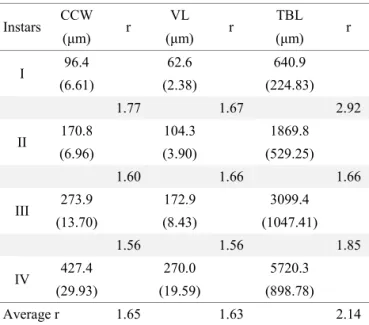
to collectfirst instars of chironomids developing on macrophytes or sediments. However, the size offirst instars can be estimated applying the Dyar´s rule. The growth proportions (Table 1) were very similar for cephalic capsule measurements (1.65 CCW and 1.63 VL) and an average value of 1.64 could be determined. In contrast, the growth proportion for TBL had a high variability (Table 1) with an average r of 2.14.
As stated by many authors, the more sclerotized structures (as the cephalic capsule) grow with gaps between moultings (Strixino & Trivinho-Strixino 1985), while the less sclerotized structures (as the abdominal segments) show continuous growth. Thus, the continuous length growth was the result of the resource exploitation capability of the organism, whereas the changes between instars were showed by cephalic increments.
The larval growth accounted for an average of 893% of the initial length, whereas for the cephalic capsule the total increment was approximately half of it (437%). Species such asG.maculatusandG.luridus(Trivinho-Strixino & Strixino) showed higher increments (Corbi & Trivinho-Strixino 2006), probably as a consequence of a longer larval developmental time. Moreover, C. calligraphus larvae (with immature stages developing in the same habitat) showed almost the same increment thanG.holoprassinus, but the instars length was always higher (Zilliet al2008). These differences in the development of immature stages among species in the same habitat show the different adaptive life cycle strategies used; while some species expend more time exploiting the food resources, others (such asG.holoprassinus) may enhance theirfitness reducing the immature development time and the emergence period by synchronization, and probably by increasing the number of generations.
The growth curve obtained based on the TBL of larvae and time, showed afirst phase of low increment for the instar Ι, followed by a rapid increase corresponding to instarsΙΙ,ΙΙΙ
and IV. Finally, it reached an asymptote which corresponded to the last instar. The regression equation that bestfitted to the data set was TBL = 6216.3 + (662.7 - 6216.3) / (1 + (time / 16.9)4.6) (R2= 0.928) (Fig 2).
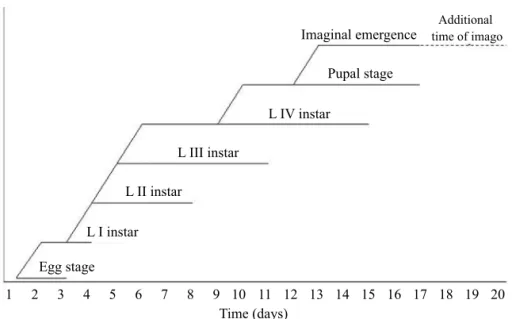
In the studied replicates,first instars were registered for an average of 2.5 day (1.5-3), second instars (II) registered for 3.0 days (2-4), third instars (III) for an average of 3.5 days (2-4) and fourth instars (IV) for an average of 6.5 days (5-7). As larvae at different instars coexisted in the Table 1 Mean cephalic capsule width (CCW), ventral length (VL) and total body length (TBL). Standard deviations are indicated between brackets (n=128). The growth proportions (r) between instars are shown for each measurement.
Instars CCW r VL r TBL r
(μm) (μm) (μm)
I 96.4 62.6 640.9
(6.61) (2.38) (224.83)
1.77 1.67 2.92
II 170.8 104.3 1869.8
(6.96) (3.90) (529.25)
1.60 1.66 1.66
III 273.9 172.9 3099.4
(13.70) (8.43) (1047.41)
1.56 1.56 1.85
IV 427.4 270.0 5720.3
(29.93) (19.59) (898.78)
Average r 1.65 1.63 2.14
Fig 2 Larval growth curve relating total body length and larval instars development time. TBL = 6216.3 + (662.7 - 6216.3) / (1 + (time / 16.9)4.6).
L I
L II
L III
L IV
7000
6000
5000
4000
3000
2000
1000
0
1 2 3 4 5 6 7 8 9 10 11 12 13 14
TBL
(
μ
m)
replicates (Fig 3), G.holoprassinus completed its larval developmental time in an average of 12.0 days (11-14). Pupal and imaginal stages.Pupae were registered for an average of 4.5 days (3-5). The individual pupae developed in the tube built by fourth instars, and then swam actively to the surface up to the moment when imago emerged short after (usually a few minutes).
As the overlapping between larval instars and pupal stages was relatively high (Fig 3), thefirst emerged imago was registered in the 13th day (D). Imago emergence lasted only four days (up to 17th day) and as the last emerged imagoes lived three days without feeding, this additional time was considered the life time of individual imagoes (Fig 3). Thus, the minimum and maximum G were of 16 and 20 days respectively, and the average life cycle duration ofG. holoprassinuswas 18 days. The highest density of adults was observed at the 14thday in agreement with an increment in temperature (26ºC to 29ºC).
The effects of temperature and food availability on life history traits of chironomids are widely reported (Strixino & Strixino 1982, Strixino & Trivinho-Strixino 1985, Lindergaard & Mortensen 1988, Danks 2006). At high temperatures, larval development tends be more synchronized, favoring a short period for emergence (Trivinho-Strixino & Strixino 1982). In our study, high overlapping was observed when third and fourth instars and pupae coexisted (Fig 3), mainly because of the duration of fouth instars. However, a fast synchronically response probably due to the increment in temperature, determined a short emergence time (four days).
Some authors consider that a life cycle is short when last less than 12 days (G) (Danks 2006) and others establish a rank of 14 to 30 days as short (Strixino & Trivinho-Strixino 1985). In our study the average duration ofG.holoprasinus generation time (G) indicates that this species has a short life cycle in temperatures around 26°C.
Fig 3 Duration of the different development stages and imago emergence ofGoeldichironomus holoprasinus. The additional life time of emerged imagoes (without feeding) is showed (pointed line).
Acknowledgments
This study was supported by Consejo Nacional de Investigaciones Científicas y Técnicas (CONICET) and Universidad Nacional del Litoral (UNL).
References
Corbi J J, Trivinho-Strixino S (2006) Ciclo de vida de duas espécies
de Goeldichironomus (Diptera, Chironomidae). Rev Bras
Entomol 50: 72-75.
Cranston P S, Dillon M E, Pinder L C V, Reiss F (1989) The adult males of Chironominae (Diptera: Chironomidae) of the Holartic region-keys and diagnoses, p 353-502. In Wiederholm T (ed) The adult males of the Chironomidae (Diptera) of the Holarctic region - keys and diagnoses. Entomol Scand Suppl, Sandby, 532p.
Danks H V (2006) Short life cycles in insects and mites. Can Entomol 138: 407-463.
Dyar H G (1890) The number of molts of Lepidopterous larvae. Psyche 5: 420-422.
Epler J H (2001) Identification manual for the larval Chironomidae (Diptera) of North and South Carolina. NC Dept Environ Nat Res, Raleigh, NC 526p.
Jackson J K, Sweeney BW (1995) Egg and larval development times for 35 species of tropical stream insects from Costa Rica. J North Am Benthol Soc 14: 115-130.
Lindergaard C, Mortensen E (1988) Abundance, life history and production of Chironomidae (Diptera) in a Danish lowland stream. Arch Hydrobiol Suppl 4: 563-587.
Liria J (2007) Faunafitotelmata en las bromeliasAechmea fendleri
AndréyHohenbergia stellataSchult del Parque Nacional San
Esteban, Venezuela. Rev Peru Biol 14: 33-38. 1 2 3 4 5 6 7 8 9 10 11 12 13 14 15 16 17 18 19 20
Time (days) Egg stage
L I instar L II instar
L III instar
Imaginal emergence
Additional time of imago
Pupal stage
Marchese M, PaggiAC (2004) Diversidad de Oligochaeta (Annelida) y Chironomidae (Diptera) del Litoralfluvial argentino, p.217-223. In Aceñolaza F C (ed) Temas de la biodiversidad del Litoral
fluvial argentino. Insugeo, Tucumán, Argentina, 380p.
Masaferro J, Paggi A C, Rodrígues Capítulo A (1991) Estudio poblacional de los quironómidos (Insecta Diptera) de la laguna de Lobos, Provincia de Buenos Aires, Argentina. Graellsia 47: 129-137.
Nazarova L B, Riss H W, Kahlheber A, Werding B (2004) G Some observations of buccal deformities in chironomid larvae (Diptera: Chironomidae) from the Ciénaga grande de Santa Marta, Colombia. Caldasia 26: 275-290.
Ospina Bautista F, Estévez Varón J V, Realpe Rebolledo E (2004) Estructura y composición de macro invertebrados acuáticos asociados aTillandsia turneri Baker (Bromeliaceae) en un bosque alto andino colombiano. Acta Zool Mex 20: 153-166.
Paggi A C (1998) Chironomidae, p.202-207. In Morrone J J, Coscarón S (eds) Biodiversidad de artópodos argentinos. Una perspectiva biotaxonómica. Ediciones Sur, La Plata, Argentina, 599p.
Pinder L C V (1983) The larvae of Chironomidae (Diptera) of the holartic region. Introduction, p.7-10. In Wiederholm T (ed) Chironomidae of the Holartic region - keys and diagnoses. Entomol Scan Supp, Sandby, 457p.
Poi de Neiff A, Neiff J J (2006) Riqueza de especies y similaridad de
los invertebrados que viven en plantasflotantes de la planicie de inundación del río Paraná(Argentina). Interciencia 31: 220-225.
Rosenberg D, Resh V (1993) (eds) Freshwater biomonitoring and benthic macroinvertebrates. Chapman & Hall, London, 488p.
Strixino G, Trivinho-Strixino S (1985) A temperatura e o desenvolvimento larval deChironomus sancticaroli(Diptera: Chironomidae). Rev Bras Zool 3: 177-180.
Trivinho-Strixino S, Strixino G (1982) Ciclo de vida deChironomus sancticaroliStrixino & Strixino, (Diptera, Chironomidae). Rev Bras Entomol 26: 183-189.
Trivinho-Strixino S, Strixino G (1991) Estrutura da comunidade de insetos aquáticos associadosàPontederia lanceolataNuttal. Rev Bras Entomol 53: 103-111.
Trivinho-Strixino S, Strixino G (1999) Insectos dípteros quironomídeos, p.141-148. In Ismael D, Valenti W C, Matsumura-Tundisi T Rocha O (eds) Biodiversidade do estado de São Paulo Brasil, 176p.
Zilli F L, Montalto L, Paggi A C, Marchese M R (2008) Biometry and life cycle ofChironomus calligraphus Goeldi 1905 (Diptera, Chironomidae) in laboratory conditions. Interciencia 33: 767-770.