IN VITRO ROOTING OF ARAUCARIA EXCELSA R.
BR. VAR. GLAUCA USING AGROBACTERIUM
RHIZOGENES
Mostafa Khoshhal Sarmast, Hassan Salehi * , Morteza Khosh-Khui
Department of Horticultural Science, College of Agriculture, Shiraz University, Shiraz, Iran. *corresponding author; Tel/Fax no.:+98 (711) 2286133; Email address: ([email protected])
ABSTRACT
The family Araucariaceae encompasses several evergreen forest tree species, which has a high ornamental value due to being a good specimen and having symmetrical branches. Conventional propagation of Araucaria excelsa R. Br. var. glauca by
cutting has limited success because of topophysis and dificult-to-root characteristics, and grafting is accompanying incompatibility. The aim of this research was to
evaluate the application of Agrobacterium rhizogenes as well as the IBA, NAA and ancillary compounds potential to increase the rooting of this plant under in vitro
condition. Neither ancillary compounds such as salicylic acid, putrescine nor hydrogen peroxide affected the rooting of this recalcitrant species. Subculturing in vitro shoots to MS medium containing 7.5 μM of both IBA and NAA for 15 days before being moved to hormone-free half-strength MS medium, resulted in a 33% increase of rooting of shoots each with one or two roots. Using Agrobacterium rhizogenes
strain K599 improved rooting percentage up to 40%. Green luorescents protein (GFP) gene, as a reporter gene, was employed to verify the successful
transformation.
Keywords: Araucaria excelsa R. Br., micropropagation, proliferation, rooting
INTRODUCTION
14 years old A. columnaris Hook, but root initiation was not observed [9]. Rooting is still one of the most important problems in conifers micropropagation. It has been reported that addition of putrescine and hydrogen peroxide to the rooting medium of ´GF-677´ rootstock could improve root weight and number under in vivo and in vitro systems [10]. In most cases ancillary compounds such as salicylate or polyamines which are classiied as phytohormones, have been reported to enhance rooting in combination with an auxin but their effects on rooting percentage are quite variable in woody plant species [11]. Hairy root initiation in plants can be achieved by the genetic transformation of the host genome via Agrobacterium rhizogenes containing root inducing plasmid. Four root loci (rol) including rol A, B, C and D after integrating with the host genome might improve morphological characteristics of plants [12] and then they have improved root production in many fruit tress [13] and conifers [14].
Experiments had shown that when proliferated shoots of Pinus maximartinezii
Rzedowsky and Pinus pinceana Gordon were treated with auxin, increase in rooting was observed by 13% and 7%, respectively; however, inoculation of these
proliferated shoots with A. rhizogenes A4 strain improved rooting up to 65% and 67%, respectively [14]. In another studies use of A. rhizogenes 1855 strain along with auxin treatment in in vitro condition had positive effect on rooting percentage of
micropropagated almond, apple, plum and pear [13, 15]. It indicated that this strain specially improve rooting in recalcitrant genotypes. To our knowledge there are no reports on the production of roots in Araucaria excelsa R. Br. var. glauca explants. Considering that this species is hard-to-root, the improvement of even a low percentage of rooting is very important for its establishment. The objective of the present work was to use A. rhizogenes for improvement of rooting percentage in this species. Furthermore we wanted to investigate the inluence of IBA and NAA as well as putrescine, salicylic acid and hydrogen peroxide on rooting in Araucaria excelsa
R. Br. var. glauca.
MATERIALS AND METHODS
Decontamination of explants and production of orthotropic shoots
Three year old seedlings (seedling were in the same height) of A. excelsa R. Br. var.
glauca were used as explants source. The potting medium consisted of a 1:1:1 (in volume) of loam, peat moss, and perlite and it was fertilized by Kristalon solution (1/1000, each 15 days). Four cm of apical stem segments of main stem were cut from seedlings and kept under running tap-water for 2 h. Because of high
contamination rate, nano silver (NS) with concentration of 500 µg/ml under reduced pressure (300 mm Hg in 5 min) [16, 17] was used to eradicate bacterial
Rooting
Proliferated shoots after nearly 70 days of growth (1-1.5 cm and in some cases 2 cm long) were cut from main explants and then were cultured on MS medium without plant growth regulators. In the irst experiment, some proliferated shoots
(1.5 cm length) were quick-dipped (3-5 second) in different concentration (0, 10, 20, 30, 40, and 50 mM) of indolebutyric acid (IBA) solution and then cultured on the half-strength MS solid or liquid medium without plant growth regulators. In another experiment propagated shoots were kept under dark condition for 7 days and then were cultured on the MS liquid or solid medium containing 7.5 µM IBA and/or naphthaleneacetic acid (NAA) for 2 weeks before moving to the half-strength MS medium supplemented with 0.0, 0.3, or 1% activated charcoal (AC). Effects of supplemented ancillary compounds such as salicylic acid and putrescine
(0.1 to 10 µM) on rooting percentage were also investigated. Salicylic acid and putrescine were added after autoclaving (15 min in 121 ºC) and reduction of medium temperate to 50 ºC by millipore ilters. Effect of hydrogen peroxide (quick dip in 30% hydrogen peroxide for 3-5 sec) along with 4000 mg/L IBA (quick dip for 3-5 sec) was also investigated. A. rhizogenes (K599) containing binary vector pKGWFS7.0-35SP (kindly provided by B.S. Hahn, National Academy of Agricultural Science, Suwon, Korea) was grown and selected in rotator (200 rpm) in LB liquid medium containing 300 mg/L spectinomicine overnight at 28˚C.
When optical density of 0.8 was reached the cells were harvested by centrifugation (3000×g, 10 min at 4 ºC) and then were re-suspended in 10-15 ml MS medium. Acetosyringone was added to the medium up to 100 μM. Then, the medium was poured to disinfect ELIZA plates. Only bottom part of micropropagated shoots were inoculated with bacterial suspension (Fig. 1).
After 2 h explants were blotted on Whatman #1 ilter papers and then cultured for three days on MS co-cultivation medium. After co-cultivation, bottom part of infected explants washed with 400 mg/L cefotaxime and cultured of MS medium
supplemented with 400 mg/L cefotaxime along with 0.5% activated charcoal (AC) for removing surplus bacteria. As PKGWFS 7.0 35 SP vector was containing GFP gene, the presence of green luorescent protein gene and successful transformation was evaluated under luorescence microscope. Each experiment was carried out as a completely randomized design with at least 5 replications for each treatment (at least 20 explants per treatment). Data were analyzed using SPSS statistical software, and means were compared using LSD’s test at P≤0.05 level.
RESULTS
In most cases, application of 500 µg/ml nano silver for 5-10 min before surface sterilization reduced the contamination to less than 18% [16]. Apical parts of orthotropic stems can be used for good multiplication (Fig. 2). Explants grown in medium supplemented with TDZ, were morphologically better than other explants treated with plant growth regulators (PGRs) (Fig. 2), hence the explants treated with TDZ were used for further experiments [17].
Fig. 2. Araucaria excelsa R. Br. shoot proliferation after 60 days culture of shoot explants on the medium supplemented with 0.045 µM TDZ.
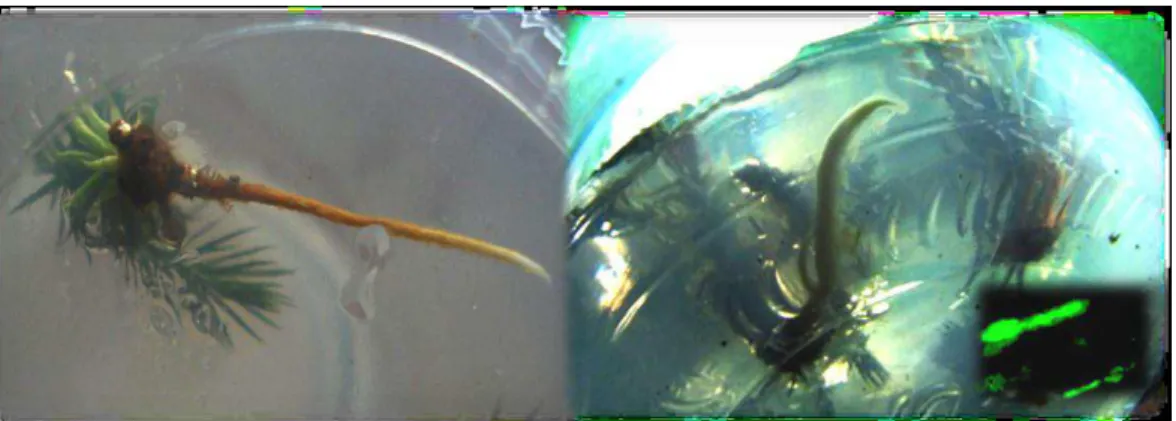
luorescent microscopy. Of 40% rooted plantlets only less than 2% of them were transformed (Fig. 3).
Table 1. Effects of PGRs and Agrobacterium rhizogenes-mediated root induction on
A. excelsa R. Br. shoots after 40 days.
Treatments (µM) Rooting (%) numberMean Mean length of roots of roots (cm)
IBA (0) + NAA (0) 0.0 c† 0.0 b 0.0 b
IBA (0) + NAA (7.5) 0.0 c 0.0 b 0.0 b
IBA (0) + NAA (10) 0.0 c 0.0 b 0.0 b
IBA (7.5) + NAA (0) 0.0 c 0.0 b 0.0 b
IBA (7.5) + NAA (7.5) 33 b 1.09 a 0.50 a
IBA (7.5 )+ NAA (10) 0.0 c 0.0 b 0.0 b
IBA (10) + NAA (0) 0.0 c 0.0 b 0.0 b
IBA (10) +NAA (7.5) 0.0 c 0.0 b 0.0 b
IBA (10) +NAA (10) 0.0 c 0.0 b 0.0 b
A. rhizogenes without PGRs 0.0 c 0.0 b 0.0 b
A.rhizogenes + 7.5 μM (both
IBA and NAA) 40 a 1.03 a 0.53 a
†In each column, means followed by different letters differ signiicantly at
P≤0.05.
Fig. 3. Rooted explants of Araucaria excelsa R. Br. without inoculation with
DISCUSSION
There is an immense need to protect tree ecosystems for their aesthetic and ecological values. Plant tissue culture and genetic engineering are suitable options for genetic improvement of trees in a limited time frame. Stem cutting propagation of
A. excelsa is not practical because of its hard-to-root properties and the limitation of its cutting numbers (one cutting from each plant). However, micropropagation procedures may be applicable. Using either NAA or IBA was not effective but their combination was successful in root induction of explants used. It is hypothesized that these plant growth regulators activate receptors of both hormones inside the plant and by this way causing rooting, whereas using of one of them activates only one of the receptors inside the plant which is not suficient enough [11]. Different treatments applied for root induction in A. excelsa in this study was not successful. It is probably due to a high tannin and resin levels in tissues of this plant. In a study using
Agrobacterium rhizogenes K559 strain injected to the hypocotyls of Glycine max L. seedlings, rooting increased up to 100% after one month [19]. However in this
experiment A. rhizogenes was unable to improve rooting highly but this less increase may be acceptable due to A. excelsa hard-to–root properties. With regards to low oxygen level in most of in vitro cultures, no hairy root is induced and a following failure of acclimatization is ensured. Using A. rhizogenes, due to the induction of hairy roots, improvement of acclimatization abilities of plantlets in the ield is
achievable. A. rhizogenes also increase cell sensitivity to auxin [15, 20]. Among the
rol genes, rol C is studied most extensively because of its most advantageous effects in improving ornamental and horticultural traits [12]. It tends to increase roots growth and number in addition to dwarfness. Some negative effects of rol genes have been also reported including changing the lower shape and lower numbers as well as changing the number of lateral branches. The increase in lateral shoots lead to a bushy phenotype. This might be due to changing GAs hormone levels [12]. It is suggested that in order to increase rooting percentages in A. excelsa, different temperatures for co-cultivation, different concentrations of asetosyringone, different optical densities of bacterial solution, positive or negative effects of NS on rooting, other bacteria strains and etc. must be evaluated. Overall, plantlets produced by tissue culture had a low growth rate and were similar in appearance to seedlings of
A. excelsa in the primary stage of growth.
References
[1] Mandel M.A., Yanofsky M.F., A gene triggering lower formation in Arabidopsis. Nature, (1995) 377: 522–524.
[2] Tzira T., Zuker A., Altmann A., Forestry biotechnology: Genetic transformation and its application to future forest. Trends in Biotechnolology, (1998) 16: 439–446.
[4] Jouanin L., Goujon T., de Nadai V., Martin M.T., Mila I., Vallet C., Pollet B., Yoshinaga A., Chabbert B., Petit-Conil M., Lapierre C., Ligniication in
transgenic poplars with extremely reduced caffeic acid O-methyl transferase activity. Plant Physiology, (2000) 123:1363–1374.
[5] McCown B.H., McCabe D.E., Russell D.R., Robinson D.J., Barton K.A., Raffa K.F., Stable transformation of Populus and incorporation of pest resistance by electric discharge particle acceleration. Plant Cell Reports, (1991) 9: 590–594.
[6] Pena L., Seguin A., Recent advances in the genetic transformation of trees. Trends in Biotechnology (2001)19: 500–506.
[7] Haines R.J., de Fossard R.A., Propagation of Hoop pine (Araucaria cunninghamii) by organ culture. Acta Horticulturae, (1977) 78: 297-302.
[8] Burrows G.E, Doley D.D., Haines R.J., Nikles D.G., In vitro propagation of
Araucaria cunninghamii and other species of the Araucariaceae via axillary meristems. Australian Journal of Botany, (1988) 36: 665-676.
[9] Sehgal L., Sehgal O.P., Khosla P.K., Micropropagation of Araucaria columnaris
Hook. Annals of Forest Science, (1989) 46: 158-160.
[10] Zilkah S., Zamiri N., Ziv, M., Putrescine and hydrogen peroxide improve the rooting of ´GF-677´ rootstock in woody cuttings and tissue culture shoots. Acta Horticulturae, (2005) 713.
[11] Hartmann H.T., Kester D.E., Davies F.T., Geneve, R.L., Plant Propagation, Principles and Practices. Pearson Education, Inc., Upper Saddle River, NJ, USA, 2002, 880 p.
[12] Casanova E., Trillas M.I., Moysset L., Vainston A., Infuence of rol gene in loriculture. Biotechnology Advances, (2005) 23: 3-39.
[13] Damiano C., Momticelli S., In vitro fruit trees rooting by Agrobacterium
rhizogenes wild type infection. Electronic Journal of Biotechnology, (1998) 2: 1-7.
[14] Villalobos-Amador E., Rodríguez-Hernández G., Pérez-Molphe-Balch E., Organogenesis and Agrobacterium rhizogenes-induced rooting in Pinus
maximartinezii Rzedowsky and P. pinceana Gordon. Plant Cell Reports, (2002) 20: 779–785.
[16] Sarmast M.K., Salehi H., Khosh-Khui M., Nano silver treatment is effective in reducing bacterial contamination of Araucaria excelsa R. Br. var. glauca
explants. Acta Biologica Hungarica, (2011) 62: 477-484.
[17] Sarmast MK., Salehi H., Ramzani A., Abolimoghadam A.A., Niazi A., Khosh-Khui M., RAPD ingerprint to appraise the genetic idelity of in vitro propagated
Araucaria excelsa R. Br. var. glauca plantlets. Molecular Biotechnology, (2011) (DOI 10.1007/s12033-011-9421-7).
[18] Murashige T., Skoog F., A revised medium for rapid growth and bioassays with tobacco tissue cultures. Physiologia Plantarum, (1962)15: 473–497.
[19] Kereszt A., Li D., Indrasumunar A.C., Nguyen D.T., Nontachaiyapoom S., Kinkema M., Gresshoff P M., Agrobacterium rhizogenes-mediated
transformation of soybean to study root biology. Nature Protocols, (2007) 2: 948-952.