Nmf9
Encodes a Highly Conserved Protein
Important to Neurological Function in Mice
and Flies
Shuxiao Zhang1, Kevin D. Ross1, Glen A. Seidner2, Michael R. Gorman3,4, Tiffany H. Poon1, Xiaobo Wang5¤a, Elizabeth M. Keithley5, Patricia N. Lee6¤b, Mark Q. Martindale6¤c, William
J. Joiner1,2,4, Bruce A. Hamilton1,7*
1Biomedical Sciences Graduate Program, University of California, San Diego School of Medicine, La Jolla, California, United States of America,2Department of Pharmacology, University of California, San Diego School of Medicine, La Jolla, California, United States of America,3Department of Psychology, University of California, San Diego School of Medicine, La Jolla, California, United States of America,4Center for Circadian Biology, University of California, San Diego School of Medicine, La Jolla, California, United States of America,5Division of Otolaryngology-Head and Neck Surgery, University of California, San Diego School of Medicine, La Jolla, California, United States of America,6Kewalo Marine Lab, University of Hawaii, Honolulu, Hawaii, United States of America,7Department of Cellular and Molecular Medicine, Department of Medicine, University of California, San Diego Moores Cancer Center, and Institute for Genomic Medicine, University of California, San Diego School of Medicine, La Jolla, California, United States of America
¤a Current Address: Otonomy, Inc., San Diego, California, United States of America
¤b Current Address: University of Hawai'i at Mānoa, Honolulu, Hawaii, United States of America
¤c Current Address: The Whitney Laboratory for Marine Science, University of Florida, Florida, United States of America
Abstract
Many protein-coding genes identified by genome sequencing remain without functional annotation or biological context. Here we define a novel protein-coding gene,Nmf9, based on a forward genetic screen for neurological function. ENU-induced and genome-edited null mutations in mice produce deficits in vestibular function, fear learning and circadian behav-ior, which correlated withNmf9expression in inner ear, amygdala, and suprachiasmatic nuclei. Homologous genes from unicellular organisms and invertebrate animals predict interactions with small GTPases, but the corresponding domains are absent in mammalian
Nmf9. Intriguingly, homozygotes for null mutations in theDrosophilahomolog,CG45058, show profound locomotor defects and premature death, while heterozygotes show striking effects on sleep and activity phenotypes. These results link a novel gene orthology group to discrete neurological functions, and show conserved requirement across wide phylogenetic distance and domain level structural changes.
Author Summary
Genome sequencing projects have identified large numbers of genes that encode proteins of unknown function. Many of these genes show strong evolutionary conservation, pre-dicting important and well-conserved functions. A fraction of these show strong
OPEN ACCESS
Citation:Zhang S, Ross KD, Seidner GA, Gorman MR, Poon TH, Wang X, et al. (2015)Nmf9Encodes a Highly Conserved Protein Important to Neurological Function in Mice and Flies. PLoS Genet 11(7): e1005344. doi:10.1371/journal.pgen.1005344
Editor:Gregory P. Copenhaver, The University of North Carolina at Chapel Hill, UNITED STATES
Received:February 16, 2015
Accepted:June 9, 2015
Published:July 1, 2015
Copyright:© 2015 Zhang et al. This is an open access article distributed under the terms of the Creative Commons Attribution License, which permits unrestricted use, distribution, and reproduction in any medium, provided the original author and source are credited.
Data Availability Statement:All relevant data are within the paper and its Supporting Information files.
conservation of core domains but dynamic changes in other domains, predicting both con-served and lineage-dependent functions. Here we identify neurological functions associated with one such gene identified by a forward genetic screen in mice. We use recently developed genome editing tools both to confirm the mouse studies and to test comparative functions
in a model insect, the fruit flyDrosophila melanogaster. Each of these species has a single
homolog of this gene family, but differ by inclusion of a ras-association (RA) domain present in most invertebrate species but missing in mammals. Null mutations in both mice and flies produce neurological phenotypes, but while the mouse phenotypes are comparatively mild (vestibular deficits, mild tremor, hyperactivity, mild circadian phenotypes and abnormal
fear learning–but normal viability and breeding), null flies rarely survive to adulthood and
surviving flies have severe locomotor deficits. Interestingly, heterozygous flies have signifi-cant sleep-related phenotypes. Together, our results provide a detailed first look at compara-tive function for a gene lineage with an unusual evolutionary history.
Introduction
The biological functions of many protein-coding genes remain unknown, often despite
conser-vation across considerable evolutionary distance. Such“orphan”molecules may include genes
whose functions affect fitness but not overt phenotypes in experimental settings, genes that affect overt but under-studied phenotypes, and/or genes that have been difficult to study due to unusual molecular properties, such as low level expression or poor physical annotation in genomes of well-studied organisms. Forward genetics offers one entry point into functional
studies by highlighting those genes whose alterations produce measurable effects [1,2]. A key
challenge in de-orphanizing novel genes is to integrate their functions with observable sites of action, organism-level phenotypes and known cellular activities.
Nmf9and its homologs were essentially unknown prior to our studies. Thenmf9mutation
was recovered in a N-ethyl-N-nitrosourea (ENU) screen at the Neuroscience Mutagenesis
Facility (NMF) of the Jackson laboratory [3,4] based on tremor and vestibular phenotypes.
Several exons of the gene we identify asNmf9had been systematically annotated asAnkfn1
(for ANK and FN3 domain containing), while other exons annotated as separate genes were identified only by clone names, based on non-overlapping partial cDNA clones from
high-throughput screens [5,6]. We selectednmf9for study as part of a long-standing interest in
mice with unusual tremors and ataxias [7–11]. The unusual conservation pattern we identified
amongNmf9homologs, along with recent innovations in genome editing [12–18], motivated
additional studies to test conservation of function in mice and flies, including the generation of equivalent mutations at the same amino acid position in both species.
While our work was in progress, two groups reported identification of theDrosophila
homolog in very different contexts. A transposon-based screen for low-sleeping mutants by
Mark Wu and colleagues found insertions in a poorly conserved, variably included 5’region of
the gene, but concluded based on antibody studies that the resultingwide-awake(wake) alleles
were null [19]. The same group also found that the fly gene interacts with and promotes cell
surface localization of the fly GABA-A receptor encoded byResistance-to-dieldrin(Rdl),
through physical and genetic interactions. Independently, an RNAi screen for genes required for proper segregation of Numb during asymmetric cell division of sensory organ precursors carried out by Juergen Knoblich and colleagues identified the same gene, which they named Banderuola(Bnd). Intragenic deletion of most of theBndcoding sequence resulted in pupal
and early adult lethality [20]. This group also showed physical, genetic and functional
design, data collection and analysis, decision to publish, or preparation of the manuscript.
interactions withDiscs-large 1(Dlg1), a prototypical membrane-associated guanylate kinase
(MAGUK). We will refer to theDrosophilagene by its current annotation symbol,CG45058,
and to 5’P element alleles aswake.
Here we use positional cloning, expression-guided behavioral studies, deep evolutionary
constraint, and genome editing to define novel activities ofNmf9and itsDrosophilahomolog.
Positional cloning of mousenmf9identified a single point mutation at a splice donor sequence,
resulting in exon skipping of a frame-shifting exon inNmf9. The expression pattern ofNmf9in
mouse brain suggested neural circuits that might be compromised in mutant animals. Behavioral tests confirmed deficits in vestibular function, fear learning, and circadian behavior. Female mice were more severely affected than males for several phenotypes. Sliding window analysis of rela-tive constraint across the protein coding sequence showed that the skipped exon encodes the most evolutionarily constrained peptide sequence among Nmf9 homologs and genome editing of a single glycine to alanine at this site was sufficient to generate a non-complementing allele.
Genome editing of theDrosophilahomolog at three different sites produced null alleles that
resulted in premature lethality and severe locomotor retardation in homozygotes. Remarkably, heterozygous flies showed mild activity and sleep-related phenotypes. Our studies thus show the
first genetic, behavioral and molecular information for mammalianNmf9, highlight functional
importance of the most conserved sequence among its homologs, and resolve competing views
regardingCG45058null phenotypes. These genetic, behavioral, and comparative studies provide
a foundation for understanding activities ofNmf9homologues in broad context.
Results
Vestibular dysfunction in
nmf9
mice is sexually dimorphic and
progressive
Thenmf9mutation was recognized in a chemical mutagenesis screen based on tremor and
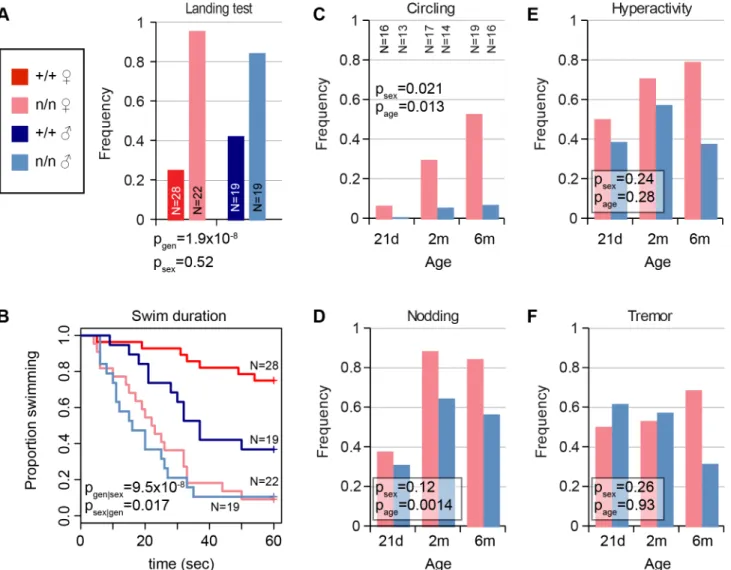
ves-tibular phenotypes. In our evaluation, vesves-tibular signs included circling, nodding, and head tilt (S1 Video) and abnormal landing and forced swim tests. Not every mutant was abnormal in every test, but all mutant animals were abnormal in at least one test and by visual inspection rela-tive to co-isogenic non-mutant littermates. Visible head nodding, hyperactivity, and tremor were enhanced by light vertical acceleration or extended handling. In the landing test, animals were suspended by their tails and scored for trunk curling and attempts to rotate, rather than reaching for ground, by an investigator blinded to genotype. Mutant animals showed a significant increase
in frequency of both trunk curling and rotation compared to littermate controls (Fig 1A). In the
forced swim test, most control littermates swam with their snout above water for1 min., while
nmf9mutants typically were unable to remain righted above the surface and had to be rescued
before 30 sec. to prevent drowning (Fig 1B). Differences between genotypes were more
pro-nounced in females than males for vestibular phenotypes. The frequency and severity of circling
and head nodding in mutant animals increased progressively from 21 days to 6 months (Fig 1C
and 1D), though hyperactivity and tremor did not (Fig 1E and 1F); these phenotypes were essen-tially absent from control littermates. Histologically, however, mutant animals had grossly
nor-mal inner ear structures and did not show hearing impairment (S1 Fig), suggesting a mature
functional, rather than a gross morphological, basis for vestibular defects.
Positional cloning of
nmf9
reveals a novel gene expressed at low
abundance
We mapped thenmf9mutation by recombination in ~1000 F2 progeny from crosses between
from BALB/cJ, 371 from C3H/HeJ, and 119 from DBA/2J that were typed by PCR ([21] andS1 Table). The data confirmed a fully penetrant, recessive phenotype with no evidence of
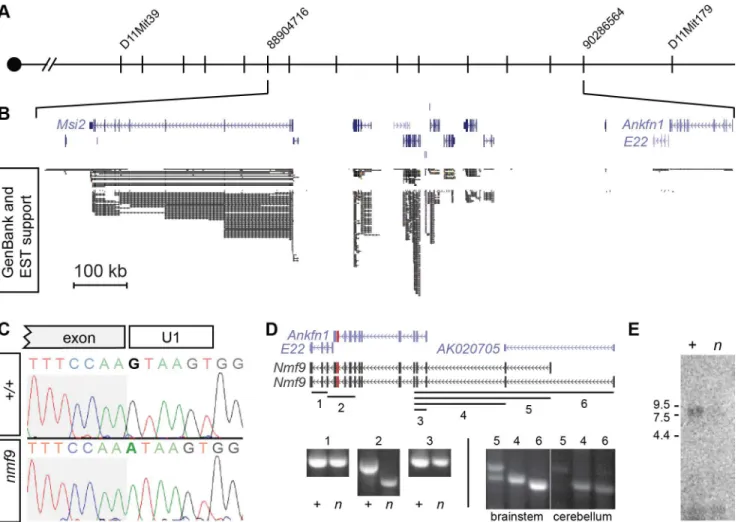
segregat-ing modifier genes. Exclusion mappsegregat-ing placednmf9within a 1.3 Mb interval (Chr11:
88,240,426–89,538,743 in GRCm38/mm10 assembly) that included several well-annotated
genes. We previously estimated the frequency of induced nucleotide mutations in the NMF
screen as ~1/Mb [4], which predicts a very low probability of confounding functional
muta-tions in an interval of this size [22]. Sanger sequencing of all canonical and EST exons (Fig 2B)
in mutant and littermate control identified a single mutation: a G-to-A transition in the splice
donor U1 binding site of a frame-shifting exon of predicted geneAnkfn1(Fig 2C). RT-PCR,
homologous cDNAs from other species, and detailed in situ hybridization patterns indicated
that the major transcript of this gene comprised bothAnkfn1and4932411E22Rikannotations
Fig 1. Mutantnmf9animals show age and sex-dependent vestibular dysfunction.(A) Landing test showed increased frequency of rotation or curling by
nmf9homozygotes relative to control (+/+) littermates (Fisher's exact test, p = 1.9x10⁻⁸between genotypes, 0.52 between sexes). (B) Forced swim test
further showed vestibular dysfunction innmf9relative to littermates (Asymptotic logrank test, p = 9.5x10⁻⁸for geneotype stratified by sex) with a greater performance difference in females (p = 0.017 for sex stratified by genotype) due to lower performance among control males. Red, control; pink, mutant females. Navy, control; blue, mutant males. (C) Circling by mutant animals also showed significant sex bias (Fisher’s exact test, p = 0.021) and age-dependent progression (p = 0.013) in frequency. Sample sizes apply to panels C-F. (D) Head nodding also supported progression (p = 0.0014), but not significant sex bias (p = 0.12). Although (E) hyperactivity and (F) tremor were pronounced in mutant animals, effects of sex and age on did not reach statistical significance.
as well as additional 5’exons (Figs2DandS2). We refer to this transcript and locus asNmf9to
avoid confusion with the narrower definition ofAnkfn1. RT-PCR across EST and predicted
exons showed low overall abundance (requiring polyA+RNA for detection from whole brain),
skipping of the frame-shifting exon adjacent to the mutated U1 site, and variable utilization of
alternative 5’ends (Fig 2D). RNA gel blot hybridization showed a single major size form and
confirmed that while the transcript had very low abundance in control brain, the mutant
tran-script had still lower levels innmf9homozygote brains, consistent with predicted
nonsense-mediated decay for the frame-shifted splice product (Fig 2E). While it remains possible that
other transcripts exist at low levels, our data support a single major open reading frame, with
some variation at the 5’end.
Fig 2. Positional cloning identifiesNmf9.(A) Recombination mapping places thenmf9mutation within a 1.3 Mb interval on Chr. 11. (B) Aligned UCSC Genome Browser window shows known and predicted genes in the non-recombiningnmf9interval. Extent of EST support indicates poor sampling of putative genes4932411E22RikandAnkfn1. (C) Sanger sequencing across the exon-intron junction shows a G-to-A transition in the essential GU splice donor adjacent to a frame-shifting exon inAnkfn1. (D) Schematic shows alignment of gene annotations from the UCSC genome browser (purple) with empirically determined transcripts (black) based on RT-PCR assays (numbered lines). Amplification and sequence analysis of assay 2 showed both inclusion ofAnkfn1andE22in a single transcript in littermate control samples (+) and selective skipping of the mutated exon (red) in mutant samples (n). Additional assays indicated based on conservation, predicted exons and 5’RACE showed variable inclusion of exons 5’to theAnkfn1annotation. (E) Northern blot shows a single major band forNmf9poly(A)+RNA from brain ~9 kb, with reduced level innmf9mutant (n) compared to control (+) littermate
brain RNA.
Nmf9
is expressed in discrete sensory and CNS structures
To define potential sites ofNmf9action, we examined its pattern of expression. In situ
hybrid-ization to both male and female embryos and RT-PCR from dissected tissue showedNmf9
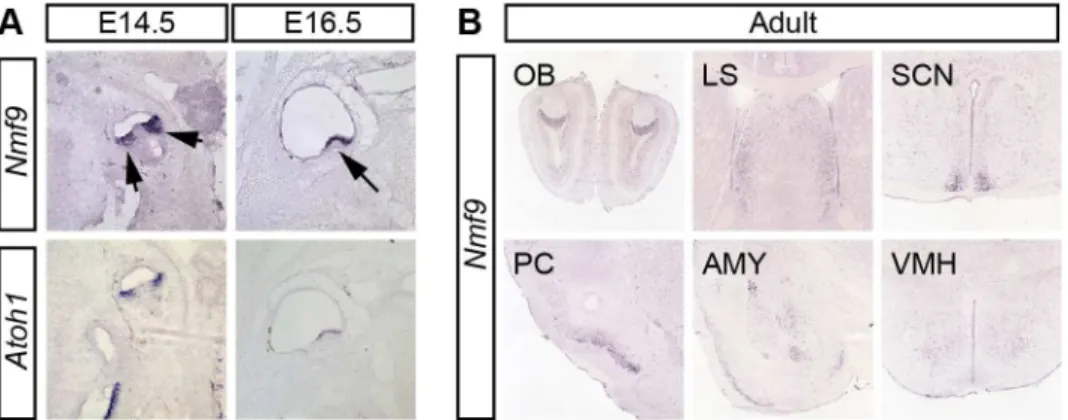
expression largely restricted to the nervous system. In vestibular inner ear,Nmf9expression
fully overlappedAtoh1(Fig 3A), a well-studied marker for hair-cell progenitors [23,24]. In situ
hybridization showed thatNmf9was expressed as early as E14.5 in inner ear, nasal epithelium,
ventricular zone, and the spinal cord (S2 Fig). In adult brain, both our data and data from the
Allen Brain Atlas [25] showed expression enriched in a few centers (Fig 3B), including the
accessory olfactory bulb (OB), piriform cortex (PC), lateral septum (LS), amygdala (AMY), suprachiasmatic nucleus (SCN), and modest enrichment in ventral medial hypothalamus
(VMH). Probes corresponding toAnkfn1and4932411E22Rikannotated exons showed the
same detailed pattern in our data (S2 Fig) and in comparable data from the Allen Brain Atlas,
further supporting a single transcription unit. Identification ofNmf9pattern in mouse brain
allows behavioral tests of neurological function for each of the major sites of expression,
pro-viding a structured approach to defining additional phenotypes innmf9mice.
Fear learning and circadian behaviors are impaired in
nmf9
mice
To probe the functional significance ofNmf9expression in neuroanatomical structures outside
of the vestibular system, we testednmf9and littermate (+/+) control mice on selected
behav-ioral tasks. Each task included enough male and female animals to assess potential sex differ-ences, as female mice had shown earlier and stronger vestibular defects than males. A
summary of statistical analyses is presented inS2 Table.
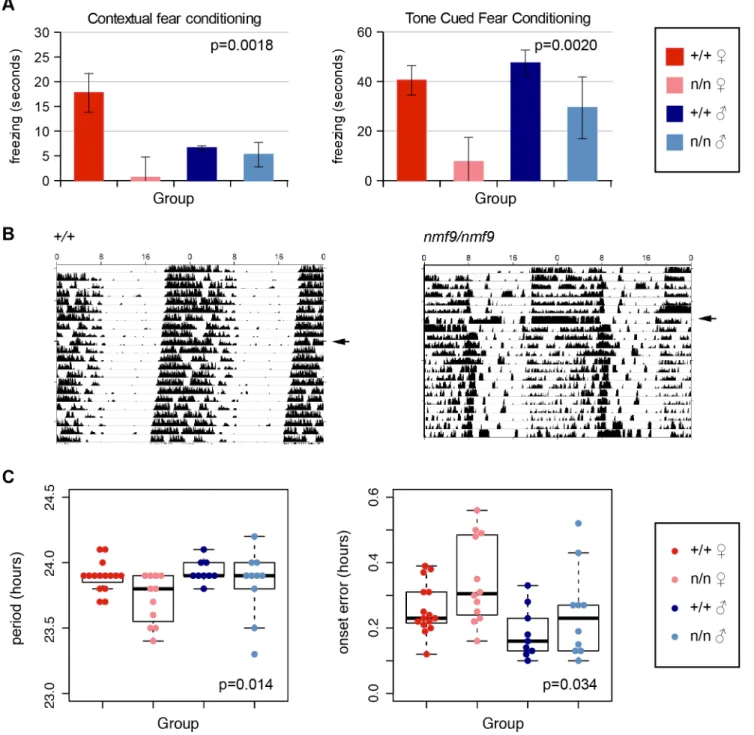
AMY. The amygdala is essential for fear learning. In both contextual and cued fear
condi-tioning paradigms,nmf9mutants showed diminished freezing behavior after training
com-pared to littermates, indicating decreased fear learning (Fig 4A). Similar to vestibular defects,
fear learning was more strongly affected in females than in males.
SCN. The suprachiasmatic nuclei are essential for classic circadian behaviors, in which
nmf9mutant animals showed significant defects. Animals were monitored for activity on a
wheel running apparatus in 12 h light: 12 h dark (LD) and in constant dark (DD) conditions.
The most severely affectednmf9mice showed less robust consolidation of activity into
Fig 3.Nmf9expression pattern predicts new sites of function.(A)In situhybridization to adjacent sections in E14.5 and E16.5 embryos show thatNmf9andAtoh1, a marker of hair cell progenitor were expressed in the same population of cells (indicated with arrows). Scale bar = 500μm. (B) Panels from the Allen Brain Atlas [25] showNmf9RNA enriched in distinct structures of adult brain, including accessory olfactory bulb (OB), piriform cortex (PC), lateral septum (LS), amygdala (AMY), suprachiasmatic nucleus (SCN) and Ventromedial hypothalamus (VMH).
nighttime hours when compared to +/+ littermates (Fig 4B). Mutants in aggregate showed
both a slight shortening of period and an increase in onset error in DD (Fig 4C). Hyperactivity
Fig 4.Nmf9is important to fear learning and circadian rhythm.(A) Mutant animals showed decreased freezing behavior in both tone cued and contextual fear conditioning. (2-factor ANOVA p = 0.0018 for genotypes in contextual conditioning, 0.002 in tone-cued conditioning. Sex effects were non-significant, p = 0.29 in contextual, p = 0.09 in tone-cued, N = 14 +/+ female, 8 mutant female, 11 +/+ male, 8 mutant male, although the interaction between genotype and sex was supported for contextual fear conditioning, p = 0.026.) (B) Double-plotted actograms of running-wheel counts of mutant and wildtype from the same litter housed in 12 hour light: 12 hour dark (LD) cycle and continuous dark (DD) illustrates less robust circadian rhythm in a more severely affected animal. Arrowheads indicate transfer to DD. (C) Mutants showed a small but significant decrease in period length (p = 0.014) and an increase in period onset error (p = 0.034) during DD (2-factor ANOVA; effects of sex p = 0.14 for period length, p = 0.012 for onset error, with larger deviation in females. N = 14 wildtype females, 12 mutant females, 9 wildtype males, 10 mutant males).
did not significantly affect activity counts in either LD or DD housing conditions (Fig 4Band
S3 Table).
LS. Measures of innate anxiety, which are dependent on the lateral septum, appeared
intact innmf9mutants. Behavior on an elevated plus maze detected no significant difference
between genotypes (Fig 5A). In an open field test,nmf9mutants spent more time in the center
of the open field, which could indicate a functional change in LS, but the number of line cross-ings was also significantly higher, suggesting that the hyperactivity and circling behaviors in
nmf9confound a simple interpretation of the open field results (Fig 5B). Marble burying, a
third test of anxiety-related behavior that is less affected by activity, showed no significant
dif-ference between genotypes (Fig 5C).
PC, OB and olfactory epithelium. Piriform cortex plays an important role in olfactory
sensing and behavior. Although PC, OB and olfactory epithelium showed significantNmf9
expression, mutants showed no significant difference from littermates in behavioral tests of
olfactory function, which included a buried food finding task (Fig 5D) and odor habituation /
dishabituation tests with either social or non-social odors (Fig 5E).
VMH. Ventromedial nuclei of the hypothalamus are important to satiety and feeding
behavior, among other functions. Mutant animals show a slight but significant decrease in
weight compared to littermates at 2–6 months (Fig 5F) but no significant difference in the
amount of food consumed (Fig 5G). While these results were also potentially confounded by
hyperactivity and energy expenditure, the small effect sizes suggested limited, if any, impact on feeding behavior.
Taken together, results of these behavioral data support selective functional impairments in
anatomical circuits that expressNmf9.
Pattern of conservation among
Nmf9
homologs indicates modular
architecture and novel domains
Homologs ofNmf9across wide taxonomic boundaries showed strong patterns of conservation
that highlight select domains, as well as lineage-restricted modulation of domain architecture
(Figs6AandS4). Homologs were identified by reciprocal BLAST/BLAT searches in sequenced
genomes of nearly all metazoan lineages, including placozoa and porifera, and in at least some choanoflagellates and filasterea, sister groups to animals that diverged from the lineage leading
to animals after the split between animals and fungi. Choanoflagellate (M.brevicollis,S.rosetta)
and filasterea (C.owczarzaki) homologs included an N-terminal CRIB domain (associated
with binding to Cdc42/Rac subfamily small GTPases), a C-terminal Ras-association (RA)
domain, or neither. A single instance in fungi–comprising only a choanoflagellate-like copy of
the conserved, non-motif domains–was found inMortierella verticillata, but not in basal or
sis-ter lineages, and might therefore represent a horizontal gene transfer event rather than an
ear-lier origin of the gene genealogy. Sequenced invertebrate animal genomes had a singleNmf9
homolog, except for an apparent loss in the urochordate lineage (0/4 species). Invertebrate homologs included an RA domain, except for the single placozoa sequence and a few genomes with incomplete assembly, but none included a CRIB domain. Jawed vertebrates basal to mam-mals contained two homologs: an ancestral copy with the RA domain and a derived copy with-out it. Mammalian genomes had only the derived copy. Most animal homologs occur in poorly annotated regions of their respective genome assemblies, limiting the number of complete sequences available among homologs we examined.
Analysis of evolutionary constraint among 14 animal species spaced by known evolutionary
distance [26] confirmed conservation of the annotated ankyrin and fibronectin type 3 motifs,
Fig 5. Tests of LS, PC/olfactory pathway, and VMH.Behaviors that depend onNmf9-expressing circuits were assayed and assessed by 2-factor ANOVA or MANOVA for sex and genotype. Number tested for each group (N) is indicated in each bar or a legend to line graphs. (A) Elevated Plus Maze behaviors were not significantly different between control (+/+) and mutant (n/n) littermates (Percent time in open arm p = 0.27 for genotype, p = 0.22 for sex; Number of transitions p = 0.12 for genotype, p = 0.23 for sex). (B) In the Open Field Test, mutant animals showed increased time spent in center, but potentially confounded by increased number of line crosses due to hyperactivity (Time in center p = 0.0043 for genotype, p = 0.82 for sex; number of transitions, 3.4x10 -7for genotype, p = 0.0004 for sex). (C) No significant difference between genotypes was detected for the Marble Burying Test (p = 0.15 and 0.68 for genotype
and sex, respectively). (D) While mutant females took somewhat longer in olfactory-dependent Buried Food Finding Test, this was did not reach conventional significance (p = 0.11 for genotype, 0.09 for sex). (E) Similarly, Odor Habituation / Dishabituation Tests did not support a significant difference (MANOVA, p = 0.69 for genotype, p = 0.30 for sex). (F) Weight was significantly different by genotype at 2 months (ANOVA, p = 0.014) and remained significant at 6 months (p = 0.0088), including well-known sex differences, while food consumption (G) was not significantly different (p = 0.11 for genotype, 0.75 for sex).
stronger constraint (Fig 6B). Novel domain 2 was the most conserved region in the entire pro-tein, including a GLYLGYLK sequence that is nearly invariant among animals and whose first
glycine was the most highly conserved residue (Fig 6C). This region contained no motif
anno-tation in current databases nor predicted post-translational modification sites. In a detailed analysis of 113 homologous sequences, Domain 2 was the most highly conserved sequence both among ancestral homologs and among derived homologs, with the GLYLGYLK signature
providing the strongest sliding window support in both (S5 Fig).
In situ hybridization studies in diverse animal species suggested the potential for a
con-served neuronal function. In contrast to mouse, the homolog inD.melanogasterappeared
more broadly expressed during development, including both CNS and tissues outside of the
nervous system (S6 Fig). Expression in the sea anemoneN.vectensisalso showed neural
expres-sion: in the planula, highest expression was in the apical tuft, a larval chemosensory organ, and in the pharyngeal nerve ring; in the polyp stage highest expression was in the endoderm, the
predominant region of the net-like adult nervous system [27]. Ancestral and derived homologs
may also differ in expression pattern. In the model fishD.rerio, the ancestral homolog
appeared broadly expressed, as inD.melanogaster, while the derived homolog appeared more
strictly localized, including distinct expression in the developing inner ear.
Genome-edited alleles confirm functional importance of conserved
domain 2
To confirm the gene identification ofNmf9and to test the functional importance of conserved
domain 2, we used CRISPR/Cas9-mediated genome editing in mouse one-cell embryos [17,
28] to target mutations to the conserved GLYLGYLK region. We recovered 26 G0 animals, of
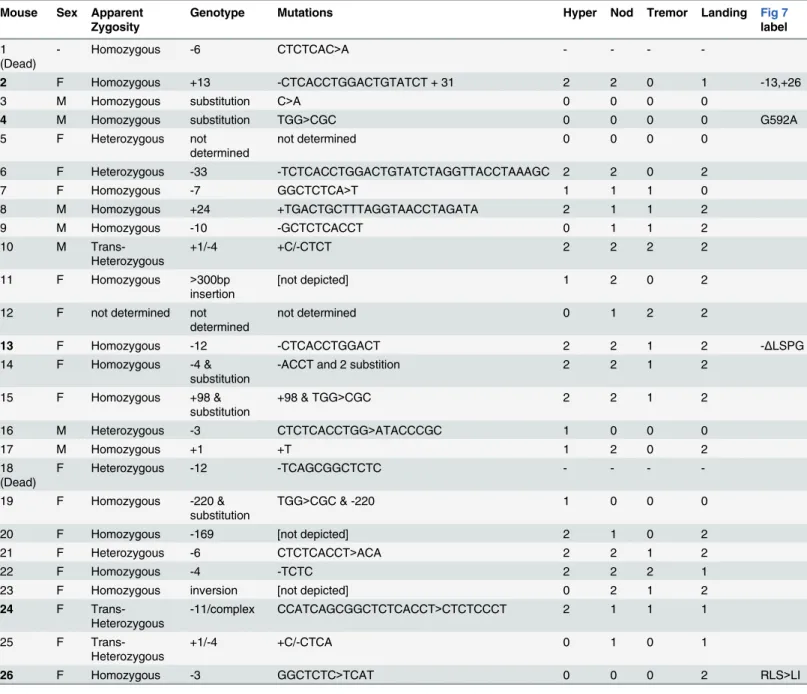
which 24 survived to adulthood. Sequencing of a 550-bp PCR product encompassing the target site showed that 21 G0 animals were edited on both alleles, 4 were edited on only one allele, and one was not determined. Among 21 edited on both alleles, 17 appeared to be homozygous (or possibly heterozygous to an allele that precluded amplification, such as a large deletion). G0 mice with both alleles edited to frameshift or other clearly deleterious lesions phenocopied the
overt vestibular phenotypes ofnmf9(Table 1). Four predicted pathogenic mutations were used
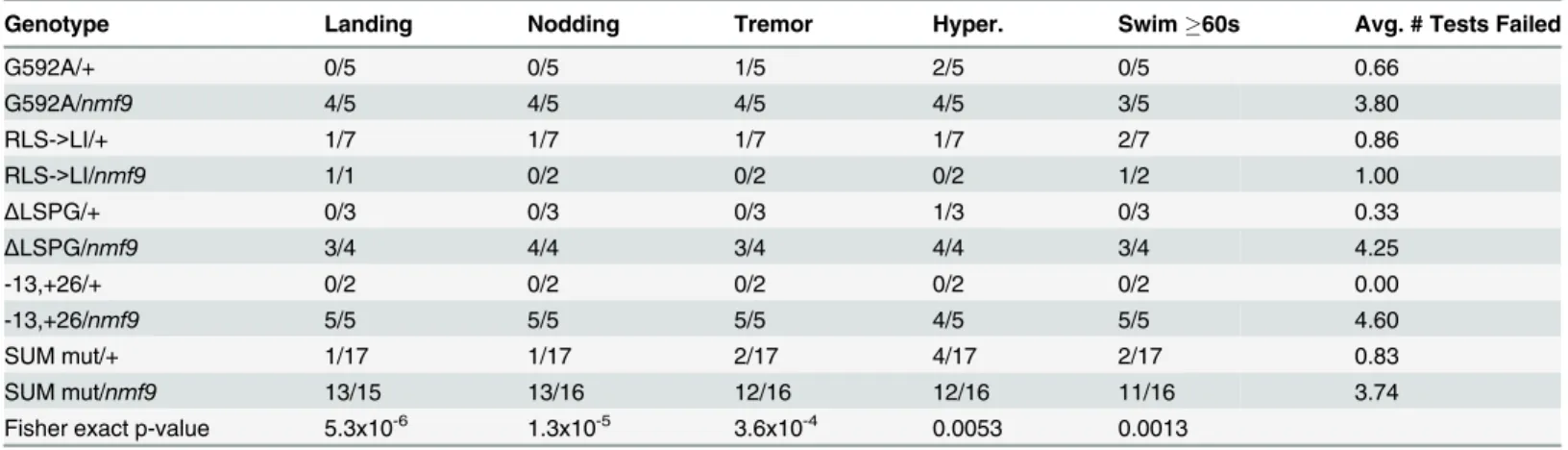
for complementation tests with the originalnmf9allele (Fig 7AandTable 2). In aggregate, G1
and later progeny carrying one edited allele heterozygous to the originalnmf9mutation failed
to complement in both the landing test and forced swim test (Fig 7B and 7C), confirming
cor-rect gene identification ofnmf9. The first glycine of the GLYLGYLK sequence was conserved
through metazoa and holozoan sister groups. Strikingly, an alanine substitution at this residue
failed to complementnmf9. Although homozygotes for this allele did not show a strong
pheno-type, G-to-A/nmf9heterozygotes had the tremor, hyperactivity, and vestibular dysfunction
characteristic ofnmf9homozygotes (Table 2andS2 Video). These results support the
func-tional importance of the highly conserved domain at a neurological level, even under the relaxed constraints of inbred laboratory mice.
verticillata) may represent horizontal gene transfer. (B) Sliding window analysis of 14 approximately full-length metazoan homologs highlights known motifs and predicts three novel domains where the most highly conserved individual residues tend to cluster. Threshold line (red) indicates 25% percentile of values. Aligned schematic shows motif annotations (rectangles) and constrained intervals (ovals) in relation to the sliding window plot. (C) The most highly conserved amino acid sequence (red box) was in domain 2 and encoded by the exon skipped innmf9mRNA.
Null alleles of the
Drosophila
homolog have viability and locomotor
deficits and heterozygous effects on sleep
To test conservation of function at an organismal level, we similarly edited theDrosophila
homolog ofNmf9,CG45058, at conserved sites in three different exons: the first ANK repeat,
the FN3 domain, and conserved domain 2 (Fig 8A). Apparent null and other predicted
delete-rious mutations induced at each site showed a consistent, severe adult locomotor phenotype and reduced viability. Newly eclosed homozygotes were predominantly stationary and most could be placed unanesthetized on a cardboard surface without the animal attempting to fly or Table 1. Mousenmf9alleles generated by CRISPR/Cas9-mediated genome editing.
Mouse Sex Apparent Zygosity
Genotype Mutations Hyper Nod Tremor Landing Fig 7
label
1 (Dead)
- Homozygous -6 CTCTCAC>A - - -
-2 F Homozygous +13 -CTCACCTGGACTGTATCT + 31 2 2 0 1 -13,+26
3 M Homozygous substitution C>A 0 0 0 0
4 M Homozygous substitution TGG>CGC 0 0 0 0 G592A
5 F Heterozygous not
determined
not determined 0 0 0 0
6 F Heterozygous -33 -TCTCACCTGGACTGTATCTAGGTTACCTAAAGC 2 2 0 2
7 F Homozygous -7 GGCTCTCA>T 1 1 1 0
8 M Homozygous +24 +TGACTGCTTTAGGTAACCTAGATA 2 1 1 2
9 M Homozygous -10 -GCTCTCACCT 0 1 1 2
10 M
Trans-Heterozygous
+1/-4 +C/-CTCT 2 2 2 2
11 F Homozygous >300bp insertion
[not depicted] 1 2 0 2
12 F not determined not determined
not determined 0 1 2 2
13 F Homozygous -12 -CTCACCTGGACT 2 2 1 2 -ΔLSPG
14 F Homozygous -4 & substitution
-ACCT and 2 substition 2 2 1 2
15 F Homozygous +98 & substitution
+98 & TGG>CGC 2 2 1 2
16 M Heterozygous -3 CTCTCACCTGG>ATACCCGC 1 0 0 0
17 M Homozygous +1 +T 1 2 0 2
18 (Dead)
F Heterozygous -12 -TCAGCGGCTCTC - - -
-19 F Homozygous -220 & substitution
TGG>CGC & -220 1 0 0 0
20 F Homozygous -169 [not depicted] 2 1 0 2
21 F Heterozygous -6 CTCTCACCT>ACA 2 2 1 2
22 F Homozygous -4 -TCTC 2 2 2 1
23 F Homozygous inversion [not depicted] 0 2 1 2
24 F
Trans-Heterozygous
-11/complex CCATCAGCGGCTCTCACCT>CTCTCCCT 2 1 1 1
25 F
Trans-Heterozygous
+1/-4 +C/-CTCA 0 1 0 1
26 F Homozygous -3 GGCTCTC>TCAT 0 0 0 2 RLS>LI
Phenotypes are noted as 2 for strong, 1 for mild, or 0 for not evident.
walk (Fig 8B, 8C and 8D). Most held their wings at unusual postures, either up or slightly down from the horizontal plane. When these animals did move, they typically fell over onto their backs and kicked their legs without apparent coordination. Mutant adults had very poor
survival, even in uncrowded, horizontal vials (Fig 8E). In addition to three independent sets of
alleles with consistent phenotype, deficiency mapping with two distinct alleles induced at
con-served domain 2 confirmed that the severe locomotor defects map to theCG45058locus as a
loss of function (S7 Fig). These data conflict with an interpretation thatwakealleles of this
locus, which do not have strong locomotor phenotypes, are null [19]. In contrast, these data
are fully consistent with thebndintragenic deletion allele as null [20].
Sincewakealleles were previously reported to have reduced sleep andnmf9mice had
abnor-mal circadian behaviors, we made related measurements for heterozygotes of our engineered
null mutations. Consistent with previous reports,wakealleles showed decreased sleep in both
sexes (Fig 9). While male null heterozygotes also showed reduced daily sleep, surprisingly,
females showed slightly increased daily sleep. Null heterozygotes also had increased latencies to first sleep bout after lights on (daytime sleep latency), and heterozygote females had increased latency to first sleep bout after lights off (nighttime sleep latency) as well. Increased Fig 7. Genome edited alleles show importance of conserved domain 2 and confirm identity ofnmf9.(A) CRISPR/Cas9 target sequence is underlined, PAM site boxed, and predicted cut site shown as an arrow. Sequences of four induced alleles selected for further analysis are shown; deleted bases are indicated by dashes and insertions/substitutions by red lower-case letters. The first glycine residue, targeted for replacement, was at position 592 relative to RefSeq protein NP_001074402. (B) Results of the landing test with induced mutations heterozygous either to a coisogenic nonmutant allele (+/n) or to the originalnmf9Jackson allele (nJ/nC) showed non-complementation (p = 5.3x10⁻⁶, Fisher
’s exact test). Similarly, head nodding (p = 1.3x10⁻⁵), tremor (3.6x10⁻⁴),
and hyperactivity (p = 0.0053) were more frequently observed in trans-heterozygotes fornmf9and CRISPR-induced alleles than in controls. (C) Time-to-event in the forced swim tests also showed non-complementation between edited and the originalnmf9alleles (Asymptotic logrank test, p = 0.0011).
latencies were consistent with, but less severe than,wakealleles (Fig 9). Reduced sleep and increased sleep latencies could not be accounted for by an increase in rate of movement since heterozygotes for engineered null alleles showed moderately reduced waking activity levels, as
did P-elementwakealleles (Fig 8F). Statistical summaries for these tests are given inS5 Table.
Together, these results show a strong requirement forCG45058function for viability, activity
level, and sleep-related measures; show sexual dimorphism for impact on daily sleep; and
resolve a conflict between previous reports ofCG45058null phenotypes.
Discussion
Functional annotation of a novel gene genealogy
Through a combination of genetic and molecular approaches, we showed thatNmf9encodes a
novel yet highly conserved protein that is functionally important to a distinct set of
neurologi-cal phenotypes in both mice and flies. Starting with the mutation, we identifiedNmf9
tran-scripts using positional cloning and experimental validation of predicted exons. RT-PCR and in situ hybridization experiments defined timing and location of gene expression. Sites of expression predicted, in addition to readily observed vestibular abnormalities, substantial phe-notypes in fear learning and circadian behavior that were not obvious from the initial
descrip-tion or gross observadescrip-tion. Sequence informadescrip-tion from>100 animal homologs identified
distinct regions of strong evolutionary constraint, including ANK and FN3 motifs and three novel segments that lack motif annotation. Induced mutations at most conserved peptide sequence among the novel conserved domains produced strong phenotypes in both mice and flies, including a single glycine to alanine substitution in mice that failed to complement the
originalnmf9allele. Among animal and non-animal Holozoan homologues some strongly
pre-dicted functional motifs appeared to be modular across phyla, including two small GTPase-binding motifs, CRIB and RA. Among animals, the Nmf9 homology group appears to have been lost only in urochordates, based on four genomes available in that taxon. The N-terminal CRIB domain was found only in choanoflagellate and filasterean sequences and was either Table 2. Allele-level data and p-values for non-complementation ofnmf9by CRISPR-induced mutations.
Genotype Landing Nodding Tremor Hyper. Swim60s Avg. # Tests Failed
G592A/+ 0/5 0/5 1/5 2/5 0/5 0.66
G592A/nmf9 4/5 4/5 4/5 4/5 3/5 3.80
RLS->LI/+ 1/7 1/7 1/7 1/7 2/7 0.86
RLS->LI/nmf9 1/1 0/2 0/2 0/2 1/2 1.00
ΔLSPG/+ 0/3 0/3 0/3 1/3 0/3 0.33
ΔLSPG/nmf9 3/4 4/4 3/4 4/4 3/4 4.25
-13,+26/+ 0/2 0/2 0/2 0/2 0/2 0.00
-13,+26/nmf9 5/5 5/5 5/5 4/5 5/5 4.60
SUM mut/+ 1/17 1/17 2/17 4/17 2/17 0.83
SUM mut/nmf9 13/15 13/16 12/16 12/16 11/16 3.74
Fisher exact p-value 5.3x10⁻⁶ 1.3x10⁻⁵ 3.6x10⁻⁴ 0.0053 0.0013
Frequency with which animals of the indicated genotype were called abnormal by a trained observer blind to genotype is indicated for each test and allele combination, as is the average number of thefive tests for which a given genotype was considered abnormal. P-values are for the one-sided Fisher’s Exact Test of the null hypothesis that mutant/nmf9heterozygotes are not more often affected than mutant/+ heterozygotes, based on sums across allfive induced alleles.
gained in these lineages or lost in the lineage leading to animals. The RA domain appears to have been lost in a derived paralog during or soon after a gene duplication event at the basal vertebrate lineage and the ancestral paralog was lost in the basal mammalian lineage. Fig 8. Genome editing ofDrosophila CG45058exons results in severe locomotor deficits and early death.(A) Target sites and recovered alleles are shown for separately targeted exons encoding the first ANK repeat, FN3 domain, and the GLYLGYLK peptide. (B) Posture of a heterozygous control fly. (C) Posture of a mutant fly homozygous for a frame-shifting mutation in conserved domain 2. Note wings held up at an angle with respect to the body. (D) The same mutant fly subsequently fell over and moved legs in an uncoordinated fashion. (E) Survival frequencies at eclosion and 7 days post-eclosion. (F) Total waking activity (beam breaks per minutes awake) for males (blue) and females (pink) of the indicated genotypes. Heterozygotes for framshifting mutations in
CG45058ANK, FN3 or conserved domain 2 consistently showed reduced activity relative to +/+ control, similar in magnitude towake(EY02219) homozygotes.***p<2.2x10⁻¹⁶.
Expression and function of
Nmf9
in mammalian brain
Nmf9showed a complex pattern of expression in the vestibular system, olfactory system, and
regions of the brain implicated in satiety and metabolism, innate anxiety, fear learning, and cir-cadian rhythm. We tested the functional integrity of each of these systems with a battery of standardized behavioral assays. Deficits in vestibular, circadian and fear learning measures were clear despite significant sex differences. Abnormalities in measures of anxiety and
appeti-tive behavior were nominally significant, but confounded by hyperactivity in the mutant mice–
particularly after sustained handling, which may suggest either an anxiety-related aspect or perhaps feedback from disturbed sensory input from the vestibular system. Although mutants and non-mutant littermates were easily distinguished by overall behavior, mutant phenotypes for any single formalized test were not fully penetrant and tended toward higher variance than
control littermate values, which suggests thatNmf9may be important to the robustness of
these pathways, but not essential to their basic function. On this interpretation, loss ofNmf9
activity in AMY, LS, and the olfactory system may not be disruptive enough to these circuits for behavioral phenotypes to be detected on a standard inbred background, but might have consequences that would be subject to selection under the more competitive fitness constraints Fig 9.CG45058null heterozygotes have abnormal sleep patterns.Male heterozygotes (blue graphs) recorded less total sleep per 24 hr. period and slightly longer latency to first sleep bout after lights on (daytime sleep latency) than +/+ controls, but no significant difference in latency after lights off (nighttime sleep latency). By contrast female heterozygotes (pink graphs) recorded slightly more overall sleep than
+/+ controls and slightly longer daytime and nighttime sleep latencies. HeterozygouswakeP-element alleles (EY02219, KG02188, KG08407 and MI02905 insertion lines) and a homozygouswakeallele (EY02219) were recorded as a comparison.*p<0.025,***p<5x10⁻⁴, ns p = 0.78, Wilcoxon rank sum test.
of wild populations. Although we observed strikingNmf9expression in cortical ventricular zones, the adult cortex appeared normal on gross inspection, with no obvious loss of cells in
any of theNmf9-enriched sites.
Females were more severely affected than males by thenmf9mutation in several tests (Figs
1and4). While both sexes expressNmf9RNA, we have not explicitly tested for quantitative
differences in specific pattern elements. Sex-dependence is known for several mouse behaviors
both at baseline and in response to perturbations [29]. Interestingly, mutations ofNtrk2
(TrkB) also induce vestibular defects that are substantially more pronounced in female mice
[30], although any shared mechanism remains to be explored.
Functions of
CG45058
in
Drosophila
Our analysis ofCG45058inDrosophilaresolves a conflict in the current literature and extends
both sets of previous findings. While our work was nearing completion, two other groups
reported putative null mutations inCG45058, but with very different primary outcomes. In a
P-element screen for sleep phenotypes, Mark Wu and colleagues reported viable P-element
and imprecise excision alleles, which they termedwide-awake(wake) based on increased
latency to sleep and decreased total sleep by mutant animals [19]. In contrast, through an
RNAi screen for regulators of asymmetric cell division, Juergen Knoblich and colleagues
reported pupal-lethal gene deletion alleles ofCG45058, which they termedbanderuola(bnd)
based on the cytological appearance of dividing sensory organ precursor cells [20]. A major
dif-ference between these studies is the nature of the alleles examined.CG45058has several
anno-tated transcripts, which primarily differ in transcriptional start site and utilization of 5’exons
that are not well-conserved outside of Diptera. Thewakealleles occur in the variant 5’region
of the gene and appear likely to affect only those transcripts, but not several others that include
all of the conserved protein coding sequences. Alternatively, thebndgene deletion allele might
have removed regulatory sequences or barriers that influence expression of neighboring genes resulting in a synthetic phenotype. Our results resolve this conflict by creating discrete loss-of-function alleles induced at three distinct, loss-of-functionally important sites in the predicted protein,
encoded by separate exons that are each included in all knownCG45058transcripts. These
alleles strikingly reduced adult viability and locomotor function of surviving adults, demon-strating that this is the null phenotype, in support of Mauri et al. Heterozygotes for these null alleles had reduced waking activity, increased latencies to first sleep bout, and effects on total
sleep, confirming and extending the behavioral results of Liu et al. forwakealleles. Our data
show sexually dimorphic effects on total sleep in null heterozygotes, in contrast to decreased
sleep found in both sexes ofwakemutants. This allelic difference suggests either distinct
cellu-lar functions ofCG45058isoforms or, perhaps more likely, isoform-specific expression in cell
types that impinge on sleep regulation.
Conservation, divergence, and pleiotropy
While theNmf9orthology group shows extraordinary conservation–including highly
con-strained sequence domains that had no prior functional or motif annotation–the
reorganiza-tion of putative GTPase-binding domains across major phylogenetic boundaries, loss of the homology group in urochordates, and duplication and rescission events in the vertebrate line-age all suggest a degree of adaptive plasticity that may be reflected in both shared and lineline-age-
lineage-specific requirements. Indeed, mutations in theNmf9homologues of both mouse and fly
resulted in phenotypes related to daily cycles of activity, as well as locomotor abnormalities,
but with some clear differences. While mousenmf9null alleles showed hyperactivity and
domains (ANK, FN3, and conserved domain 2) produced severe locomotor retardation and early death, within one week of eclosion. These studies lay a foundation for understanding
both common functions ofNmf9homologs and lineage-restricted activities that might relate to
derived loss of the RA domain or other lineage-specific features. How differences in domain architecture and expression patterns reshape the functional networks in which Nmf9/CG45058 proteins act will surely be of interest in the evolutionary development of the nervous system.
Materials and Methods
Nmf9
genetic mapping
Coisogenic C57BL/6J–nmf9mice were obtained from the Neuroscience Mutagenesis Facility
(NMF) and AKR/J, BALB/cJ, C3H/HeJ and DBA/2J mapping partners from production colo-nies at the Jackson Laboratory. Conventional exclusion mapping was performed as described
[11,31]. PCR primers for new genetic markers are given inS1 Table. New markers were also
typed on a smaller C57BL/6J–nur12x BALB/cJ cross obtained from NMF. C57BL/6J–nmf9
mutant line was maintained on C57BL/6J and genotyped by sequencing.
Gene expression detection and measurements
Northern blots were performed by standard methods [32], essentially as described [33]. RNA
from whole brains was extracted with Trizol reagent (Life Technologies). Poly(A)+RNA was
isolated on Oligo(dT) cellulose type 7 (Amersham Biosciences). Concentrations and integrity
were verified by spectrophotometry and gel electrophoresis. 8.5μg poly(A)+RNA per sample
was electrophoresed through a denaturing formaldehyde/agarose gel and transferred to Hybond-N+ membrane (Thermo Fisher). Size standard was removed prior to transfer and imaged by ethidium bromide fluorescence. Probes were synthesized from two cloned
frag-ments ofNmf9by random priming in the presence of32P-dCTP and hybridized overnight.
Blots were exposed to a phosphor screen for 5 days before quantitative imaging with a Storm 860 instrument (Molecular Dynamics). Quantitative RT-PCR was performed using SybrGreen
fluorescence quantification on a BioRad CFX96 instrument. Expression was relative toGapdh
andRP49inDrosophila, and toGAPDHandSDHAin zebrafish.
In situ
hybridization
Mouse tissues were processed by a standard method [34] as previously modified [8]. Briefly,
embryos were fixed in formalin, adult mouse brain in 4% PFA. Samples were cryoprotected in
30% sucrose and sectioned at 20μm. Slides were treated 15’with boiling sodium citrate,
fol-lowed by acetic anhydride in triethanolamine prior to hybridization with dioxigenin-labeled RNA probes at 65°C overnight. After hybridization and washing, sections were blocked with 5% normal donkey serum (Jackson ImmunoResearch) in PBSTX (0.2% Triton-X100 in PBS) for 1 hour and incubated with anti-digoxigenin-AP Fab fragments (Roche) at 1:2000 overnight
at 4°C. Whole mountin situin zebrafish was performed as described [35]. Samples were fixed
in 4% PFA. Proteinase K was used for antigen retrieval at 10μg/mL for 1 hour at 37°C.
Hybrid-ization was at 65°C for 48 hours. Samples were blocked with 2% normal donkey serum, 2mg/ mL BSA (NEB) in PBTx and incubated with 1:5000 anti-dig-AP Fab fragments overnight at
4°C. Hybridization to whole mount fly embryos was performed as described [36]. Briefly,
from linearized plasmid templates and diluted in hybridization buffer prior to use. Sea
anem-one in situ hybridization was performed as described [37]. Probe templates for all species were
generated by RT-PCR and cloned into appropriate vectors for in vitro transcription.
Mouse behavioral assays
All behavioral tests were performed on mice between 2 to 6 months of age, with wild-type
lit-termates as control to the mutant animals, by investigators blinded to the animals’genotypes.
Vestibular function. For the forced swim test, animals were individually placed in a 4L beaker filled with 3L 25°C water and the swim time measured as the length of time an animal
was able to keep its snout above water [38]. For the landing test, animals were individually
lifted by their tails. Normal animals extended their head and forelimbs toward the ground, exhibiting landing behavior, whereas mutant animals tend to curl their trunk sideways or
ven-trally and occasionally trying to rotate [39]. The presence of the curling / rotation behavior was
scored. For nodding, tremor, circling, and hyperactivity, each animal was placed in a fresh cage and observed for one minute to score each phenotype.
Auditory function. The startle response was performed in startle chambers (SR-Lab, San Diego Instruments) in the La Jolla Neuroscience Blueprint Behavioral Core Facility at The Scripps Research Institute (TSRI Behavioral Core). The chambers consisted of nonrestrictive Plexiglas cylinders 5 cm in diameter resting on a Plexiglas platform in a ventilated chamber. High-frequency speakers mounted 33 cm above the cylinders produced all acoustic stimuli, which were controlled by SR-LAB software. Piezoelectric accelerometers mounted under the cylinders transduce movements of the animal, which were digitized and stored by an interface and computer assembly. Startle pulses started at 70 dB, 40ms in duration, and increased to 120 dB in 5 dB increments and then ramped back down, interspersed by no stimulus trials. The background noise level was at 70 dB.
Fear learning. Conditioning was performed by the TSRI Behavioral Core and took place in Freeze Monitor chambers (Med Associates) stationed in sound-proof boxes. The Plexiglas conditioning chambers (26 x 26 x 17 cm) had speakers and lights mounted on two opposite walls and were installed with an electric grid floor. On day 1, mice were habituated in the con-ditioning chamber for five minutes. On day 2, mice were exposed to the context and condi-tioned stimulus (30 seconds, 3000 Hz, 80 dB sound) in association with foot shock (0.70 mA, 2 second, scrambled current). Each mouse received 2 shock exposures, each in the last 2 seconds of a 30 second tone exposure during a 5.5 minute session. On day 3, contextual conditioning in animals was measured in a 5 minute test in the training chamber. On day 4, cued conditioning was measured in a novel context, where the chamber previously used was disguised (new opaque plastic rounded compartment replacing old clear square compartment, new opaque plastic floor replacing metal grid, novel odor with a drop of orange extract under floor). The animals were allowed to habituate for 3 minutes before exposure to the conditioned stimulus (tone) for 3 minutes. Freezing behavior was measured in all sessions by a validated
computer-controlled recording of photocell beam interruptions [40].
Circadian function. Mutant and wildtype littermates of either sex, between three-five
months of age, were individually housed with food and waterad libitum. Activity records were
Innate anxiety. The elevated plus-maze and open field tests were performed at the TSRI Behavioral Core. The plus maze apparatus had four arms (5 x 30 cm) at right angles and was elevated 30 cm from the floor. The two closed arms had 16 cm high walls. The two open arms had a 0.5 cm lip and no walls. Animals were placed in the center of the maze and allowed free access to all arms for 5 minutes. Behaviors were recorded with mounted cameras. The open field apparatus was a 50 x 50 cm plexiglass square surrounded by 22 cm high walls. The field was divided into 16 squares (12 outer and 4 inner) of equal areas. Animals were placed in the center of the field and recorded for 10 to 60 minute with mounted cameras. The marble bury-ing test was performed by placbury-ing individual animals in a standard mouse cage containbury-ing 5 cm deep bedding with 20 small marbles arranged in an evenly spaced grid of 4 rows of 5 bles on top of the bedding material. After 30 min mice were removed and the number of mar-bles that were at least 2/3 covered by bedding was counted.
Olfaction. The buried food finding test was performed on individually housed mice. Beginning 3 days before testing, animals received one piece of Froot Loops cereal (Kellog's, the
same color/flavor was used for all animals) per day withad libitumaccess to water and normal
chow. Fourteen hours (overnight) before testing, animals were deprived of food while water remained ad libitum. Each animal was tested in a clean cage containing 2 cm of bedding, in the corner opposite to the corner where a piece of cereal was hidden. The time taken to locate and hold the cereal in both of its paws was recorded with a stopwatch. The odor habituation / dish-abituation test was performed by placing individual animals in a clean cage and allowing 30 minutes for habituation. Non-social odors were presented before social odors. For non-social odors, a cotton-tipped applicator dipped in either de-ionized water or 1:100 dilution of almond or vanilla extract (McCormick &Co) was presented. For social odors, each applicator was used to swab the inside of a cage that had housed a single non-littermate animal for three days and then presented to the animal being tested. The length of time each animal spent investigating the tip applicator was recorded, with two minutes given per applicator trial. The same odor was presented in three consecutive trials, with the same order of odor presentation for all animals.
Satiety and metabolism. Animals were weighed at 21 days, 2 months, and 6 months of
age. For food consumption test, a known mass of food was provided to the animalsad libitum
at the start of experiment. The mass of the food was weighed each subsequent evening at the same time and monitored for spillage (Huszar et al. 1997, Crawley 1999).
Conservation analysis
Protein sequences homologous to mouse Nmf9 were retrieved through NCBI tblastn, UCSC Genome Browser, Ensembl, and JGI web sites and made use of GNOMON and ENSEMBL transcript predictions. Identified fragments were used to search the full length sequences in
surrounding genomic sequences where available (seeS4 Table). For homologs inferred purely
through genomic sequences, a combination of BLAT [41], BLAST [42] and GENSCAN [43]
programs were used to predict open reading frames. All database searches were performed before February 2013. For the full-length protein analysis, the best-annotated sequence of each evolutionary branch was used. For the high resolution analysis sequences with more than 50% gaps in that domain were excluded. Predicted cDNA sequences were translated using ExPASy
Translate [44] and aligned using MUSCLE [45,46] and the result of the amino acid alignment
used to manually correct the nucleic acid alignment. Conservation rates were calculated with
Datamonkey [47] using codon data type and universal genetic code with neighbor joining tree.
Motif search was performed with Motif Scan [48], Scansite 2.0 Scan Motif [49], Scan Prosite
performed using The Sulfinator (ExPASy) for sulfination and YinOYang [53] for glycosylation and phosphorylation.
Genome edited animals
Genome-edited mice were generated essentially as described [17,28]. Briefly, in-vitro
synthe-sized Cas9 mRNA, sgRNA, and ssDNA homology-directed repair oligos were co-injected as a cocktail into C57BL/6 one-cell embryos at the Moores UCSD Cancer Center Transgenic
Mouse Shared Resource. Oligonucleotide sequences are listed inS6 Table. sgRNA templates
and ssDNA repair oligonucleotides were synthesized as Ultramers by IDT. All procedures were approved by the UCSD IACUC. RNA and DNA reagents for fly injection were prepared as above. Conserved Domain 2 mutants were generated by co-injection of in-vitro synthesized
Cas9, sgRNA, and ssDNA repair oligo intow1118embryos. ANK and FN3 mutants were
gener-ated by co-injection of sgRNA and repair oligonucleotides into Cas9-expressing embryos
(PBac<y[+mDint2] = vas-Cas9>VK00027, Bloomington Stock Number 51324) as described
by [54]. All fly embryo injections were performed by Rainbow Transgenic Flies, Inc.
(Cama-rillo, CA). Oligonucleotide sequences are listed inS6 Table.
Drosophila
stocks
Mutations were verified by Sanger sequencing of PCR products encompassing targeted genomic loci. Transposon mutant and deficiency lines for CG45058 were obtained from the
Bloomington Stock Center according to the following stock numbers:wakeEY02219[15858],
wakeKG02188[14082],wakeKG08407[15129],wakeMI02905[37162], Df(3R)Exel6273 [7740], Df (3R)ED6085 [150049], Df(3R)ED6091 [9092], Df(3R)BSC527 [25055], Df(3R)Exel6192 [7671], Df(3R)BSC618 [25693], and Df(3R)ED6090 [150614].
Drosophila
behavior assays
Flies were raised at room temperature (~21°C) on standard cornmeal/molasses. Within 1–2
days of eclosion, flies were assayed for wing orientation and the ability to maintain a standing
position. For sleep assays, 1–5 day old flies were loaded into 65x5 mm glass tubes containing
5% sucrose and 2% agarose and entrained to a 12hr:12hr light:dark (LD) cycle for 2 days before
recording sleep/wake patterns using theDrosophilaActivity Monitoring System (Trikinetics,
Waltham, MA). Sleep was defined as 5 minutes of inactivity and, along with waking activity,
was measured at 25°C using custom software as previously described [55].
Ethics statement
Mice were euthanized by CO2 inhalation or by perfusion or organ removal under deep anes-thesia with tribromoethanol (avertin). Fish embryos were euthanized by fixation or snap-fro-zen in E3 media. All vertebrate animal procedures were approved by the University of California San Diego Institutional Animal Care and Use Committee (IACUC). The University of California San Diego is AAALAC accredited, AAALAC institutional number 000503.
Supporting Information
S1 Table. Genetic markers used for genetic fine mapping.Dinucleotide repeat sequences were identified from an early draft public mouse reference sequence (MGSCv2) and tested for length polymorphism in mapping strains.
S2 Table. Statistical analyses of mouse behavioral tests. (XLSX)
S3 Table. Circadian phenotype ofNmf9.Animals were housed in 12:12 LD cycles for a mini-mum of 7 days prior to transition to DD. Tau, power, and onset were calculated as average over ~14 days. N = 14 +/+ females, 12 mutant females, 9 +/+ males, 10 mutant males. Data was analyzed using two-way ANOVA.
(XLSX)
S4 Table. Species used in evolution conservation analysis.Homologs ofNmf9were identified in various databases and hand curated. Due to quality of genomes available, sequences that contain more than 50% gaps were removed and not included in this list. Due to poor assembly,
all homolog sequences, with the exception ofH.sapiens, was manually assembled utilizing the
BLAST, BLAST, TBLASTN tools available in many of the databases, the ID of the seed sequence was listed when available. Species highlighted in yellow indicate the sequences used on whole-protein conservation analysis. 52 species containing ancestral versions of the homo-log and 61 species containing derived version of the homohomo-log were used for the region specific analysis of conservation.
(XLSX)
S5 Table. Statistical analyses ofDrosophilabehavioral tests. (XLSX)
S6 Table. Oligonucleotides used in genome editing of flies and mice. (XLSX)
S1 Fig. Mutant animals have normal inner ear histology and hearing.(A) Ampulla, saccule,
Scarpa's ganglion, utricle, and semi-circular canals were grossly normal innmf9animals. (B)
Acoustic brainstem responses were within normal range (waveform threshold25 dB) for 5 of
6 mutant mice between 2–4 months age. (C) Acoustic startle responses were also normal in a
separate cohort animals between 2–6 months age. Two-factor MANOVA p = 0.30 for
geno-type, p = 0.28 for sex. N = 12 +/+ females, 12 +/+ males, 13 mutant females, 7 mutant males. Error bars, s.e.m.
(TIF)
S2 Fig.Nmf9mRNA includes bothAnkfn1and4932411E22Rik.(A) UCSC Genome Browser
shows minus-strand transcripts for the 3’exons ofAnkfn1and 5’exons ofE22compared to
BLAT alignment of empirically determinedNmf9mRNA sequence. Positions of primers used
for RT-PCR are indicated. (B) Relative quantities for real-time fluorescence measurements (SYBR) of RT-PCR products from the indicated assays from either brain cDNA or cloned
plas-mid. (C) Publicly deposited cDNA sequences for insect (D.melanogaster, A. mellifera),
echino-derm (S.purpuratus), nematode (C.elegans) and cnidarian (N.vectensis) also support a single
transcript across segments homologous toAnkfn1andE22. (D) In situ hybridization patterns
were indistinguishable forAnkfn1andE22probes in ventromedial hypothalamus (VMH),
amygdala (AMY), lateral septum (LS), piriform cortex (PC), suprachiasmatic nuclei (SCN) and
spinal cord (SpC). This mirrors data for both annotations in the Allen Brain Atlas (Fig 3B).
(TIF)
S3 Fig.Nmf9expression in developing brain and sensory structures.Nmf9RNA was
detected byin situhybridization as early as E14.5 in ventricular zones, inner ear, and nasal
S4 Fig. Modular organization ofNmf9homologs.Known motifs are indicated in green.
Highly consereved domains novel to theNmf9homology group are shown in blue. An
amino-terminal CRIB domain was found only in the two choanoflagellae species, while inclusion or loss of a ras-association domain (RA) appears not to be monophyletic. Vertebrate species basal to mammals had paralogous copies, one with and one without the RA domain in each species. All mammals examined had only one copy, which never had an identifiable RA domain. Con-servation of the first ANK repeat, and consensus match to the motif definition were poor or absent in some invertebrate and choanozoa species.
(TIF)
S5 Fig. CoreNmf9domains have lineage-dependent patterns of conservation. High-resolu-tion sliding window analysis of domains, with inclusion of species that lacked full-length sequence. Separate analyses were performed for ancestral homologs and vertebrate-derived
homologs. Y-axis shows dN/dS values calculated using HyPhy [56]. The 10 residues with
smallest dN in each analysis are plotted in orange. Light blue points indicate gaps in sequence. Amino acid residues are given for regions of highest conservation. (A) Annotated ankyrin and fibronection type III motifs are plotted. For the ankyrin repeats, N = 53 species for derived homologs, 47 for ancestral homologs. For fibronectin type III repeats, N = 50 derived, 50 ances-tral homologs. (B) The three highly conserved domains that do not align with known motif definitions are plotted. For domain 1, N = 60 species for derived homologs, 52 for ancestral. For domain 2, N = 54 derived, 49 ancestral. For domain 3, 49 derived, 48 ancestral.
(TIF)
S6 Fig. Expression ofNmf9homologs suggests both conserved and adapted functions.
Nmf9homologues were expressed during development in (A) fruit fly and (B) zebrafish.
Sam-ples included 3 biological replicates for fruit fly, but only technical replicates of single samSam-ples
for each zebrafish stage and paralogous gene. (C)In situhybridization toDrosophilaembryos
showed broadCG45058expression, including CNS, agreeing with stage-specific expression in
the BDGP in situ database (http://insitu.fruitfly.org/). (D) Expression in sea anemoneN.
vec-tensisplanulae (left) includes endoderm (arrow) and some apical tuft cells. In polyps, expres-sion appears uniform throughout the endoderm (arrow) and mesenteries. (E) In zebrafish embryos, ancestral paralog retained a broad but weak expression pattern that includes expres-sion in the developing inner ear (box and inset). The derived paralog showed a cleaner, more restricted pattern.
(TIF)
S7 Fig.CG45058allele locations and deficiency mapping for severe phenotypes.(A)
Sche-matic of theCG45058locus shows exon position of encoded protein domains (blue) across
transcripts (navy) from the UCSC browser. Chromatin accesibility to DNase I at stage 5 (green), 9 (orange), 10 (red), 11(blue) and 14 (purple) embryos suggests dynamic regulation of
alternative transcripts. (B) UCSC transcripts (navy) in the interval aroundCG45058(red) on
Drosophilachromosome 3R are shown relative to deficiencies that complement (green bars) or fail to complement (red bars) frameshift mutation at conserved domain 2 (GLYLGYLK). The inferred interval (yellow box) defined by the shared breakpoint of Df(3R)Exel6273 and Df(3R) Exel6192 and the right breakpoint of Df(3R)ED6090 contains parts of 6 transcription units. (TIF)
non-circling littermate control. (MOV)
S2 Video. Trans-heterzyogotes for the G-to-A edited andnmf9chemically induced alleles show agitation, tremor and mild vestibular defects compared to same-sex littermates that are heterozygous for either mutant allele over wild type.Birth date and identifier is indicated for each animal.
(MP4)
Acknowledgments
We thank Amanda Roberts in the La Jolla Interdisciplinary Neuroscience Behavior Core at the Scripps Research Institute for consultation and assistance with behavioral assays; Ella Kothari and Jun Zhao in the UCSD Moores Cancer Center Transgenic Mouse Shared Resource for assistance in creating genome-edited mice; Wilson Clements and David Traver for zebrafish
embryos, ISH protocols and control probes; Anita Hermann and William McGinnis for
Dro-sophilaembryos, ISH protocols and control probes.
Author Contributions
Conceived and designed the experiments: SZ KDR MRG EMK MQM WJJ BAH. Performed the experiments: SZ KDR GAS MRG THP XW EMK PNL WJJ BAH. Analyzed the data: SZ KDR GAS MRG EMK PNL MQM WJJ BAH. Contributed reagents/materials/analysis tools: SZ KDR GAS MRG EMK PNL MQM WJJ BAH. Wrote the paper: SZ KDR MRG EMK MQM WJJ BAH.
References
1. Beutler B, Du X, Xia Y. Precis on forward genetics in mice. Nat Immunol. 2007; 8(7):659–64. Epub 2007/06/21. PMID:17579639
2. Justice MJ, Noveroske JK, Weber JS, Zheng B, Bradley A. Mouse ENU mutagenesis. Hum Mol Genet. 1999; 8(10):1955–63. Epub 1999/09/02. PMID:10469849
3. Clark AT, Goldowitz D, Takahashi JS, Vitaterna MH, Siepka SM, Peters LL, et al. Implementing large-scale ENU mutagenesis screens in North America. Genetica. 2004; 122(1):51–64. Epub 2004/12/29. PMID:15619961
4. Concepcion D, Seburn K, Wen G, Frankel WN, Hamilton BA. Mutation rate and predicted phenotypic target sizes in ENU-treated mice. Genetics. 2004; 168(2):953–9. PMID:15514066
5. Kawai J, Shinagawa A, Shibata K, Yoshino M, Itoh M, Ishii Y, et al. Functional annotation of a full-length mouse cDNA collection. Nature. 2001; 409(6821):685–90. Epub 2001/02/24. PMID:11217851 6. Okazaki Y, Furuno M, Kasukawa T, Adachi J, Bono H, Kondo S, et al. Analysis of the mouse
transcrip-tome based on functional annotation of 60,770 full-length cDNAs. Nature. 2002; 420(6915):563–73. PMID:12466851
7. Alcaraz WA, Chen E, Valdes P, Kim E, Lo YH, Vo J, et al. Modifier genes and non-genetic factors reshape anatomical deficits in Zfp423-deficient mice. Hum Mol Genet. 2011; 20(19):3822–30. Epub 2011/07/07. doi:10.1093/hmg/ddr300PMID:21729880
8. Alcaraz WA, Gold DA, Raponi E, Gent PM, Concepcion D, Hamilton BA. Zfp423 controls proliferation and differentiation of neural precursors in cerebellar vermis formation. Proc Natl Acad Sci U S A. 2006; 103(51):19424–9. PMID:17151198
9. Gold DA, Baek SH, Schork NJ, Rose DW, Larsen DD, Sachs BD, et al. RORa coordinates reciprocal signaling in cerebellar development through sonic hedgehog and calcium-dependent pathways. Neu-ron. 2003; 40(6):1119–31. PMID:14687547
10. Hamilton BA, Frankel WN, Kerrebrock AW, Hawkins TL, FitzHugh W, Kusumi K, et al. Disruption of the nuclear hormone receptor RORa instaggerermice. Nature. 1996; 379:736–9. PMID:8602221 11. Hamilton BA, Smith DJ, Mueller KL, K A.W., B R.T., van Berkel V, et al. Thevibratormutation causes