Juliana B
arbosa C
onsoni e Roseli Rodrigues de Mello
CADERNO
S DE PESQUIS
A v
.44 n.
154 p
.10
7
1-1091 out./
de
z. 20
14
107
1
OTHER ISSUES
http://dx.doi.org/10.1590/198053142967
CADERNOS
DE PESQUISA
:
PSYCHOLOGY AND
EDUCATION IN THE
SCHOOL’S TEACHING
AND LEARNING
PROCESS
JULIANA BARBOSA CONSONI
ROSELI RODRIGUES DE MELLO
TRANSLATED BY Peter Laspina
ABSTRACT
Psychology and Education are two areas which historically maintain a close relationship on building elements for school teaching and learning processes. The present study presents data related to such a relationship, as displayed in the Brazilian journal Cadernos de Pesquisa – CP –, from 1980 to 2012. The aim was to highlight how the relationship between the two areas regarding content teaching was established in the more recent past and to verify if it is still effective in the CP publications. Results, obtained through Content Analysis of seventy articles, indicated that the prominent psychological theory in the 1980s and 1990s was Piaget’s; different Psychological trends underlie the discussions from 2000 to 2012; in the last decade, it has been possible to identify a decrease in the number of articles that articulate Psychology and Education within content learning and teaching processes.
CADERNO
S DE PES
QUIS
A
: PS
Y
CHOL
OG
Y AND EDUCA
TION IN THE SCHOOL
’S TEA
CHING AND LEARNING PROCES
S
10
7
2 CADERNO
S DE PESQUIS
A v
.44 n.
154 p
.10
7
1-1091 out./
de
z. 20
14
B
ASED ON THE UNDERSTANDING THAT DIFFERENT AREAS SUCH AS PSYCHOLOGY, sociology, anthropology, among others, can support the area of education in the development of pedagogical practices that ensure learning educational content (instrumental learning) for all students, while respecting diversity, a study was developed to analyze the presence and contributions of some of those areas in the educational scientific production, over the past three decades, in Brazil. Three major journals were taken as the basis for the study: Educação & Sociedade, RevistaBrasileira de Educação e Cadernos de Pesquisa.1 For each area and each of
the magazines, subprojects were deployed aiming to deepen decision making and the necessary analyses. This article intends to present and discuss the data and results of these subprojects, more specifically related to the relationship between psychology and education in the publications of Cadernos de Pesquisa, from 1980 to 2012, understanding psychology as one of the scientific areas which historically provides theoretical elements to formulate educational actions in teaching.2
In Brazil, since the early 20th century, psychological science was seen as a foundation of pedagogical and scientific publications in education, constituting the field of educational psychology. In general, the recognition of psychological knowledge in Brazil as scientific has always been articulated with the field of education, so that educational psychology was at the basis of psychology as a science, in Brazil
1
Research financed by CNPq, in the Universal/2010.
2
Juliana B
arbosa C
onsoni e Roseli Rodrigues de Mello
CADERNO
S DE PESQUIS
A v
.44 n.
154 p
.10
7
1-1091 out./
de
z. 20
14
107
3
(ANTUNES, 2001). Yet, the presence of psychology in education was not uniform in terms of propositions.
Over the decades, different psychological trends have been part of educational research and conceptions, supporting issues on teaching and learning of content at school, presenting more than one theoretical model influencing education (CARVALHO, 2002; LIMA, E., 1990; PLACCO, 2002). Throughout history, some conceptions have brought progress, while others have contributed to the establishment of an individualist vision of the student (ANGELUCCI et al., 2004), or even helped to raise biased views about the actor who learns (PATTO, 2000). However, all psychological theories about teaching and learning were predominantly influenced by the socioeconomic context of the moment (PATTO, 2000), since the theories seek to interpret and to intervene in specific socio-historical contexts.
Based on such assumptions, a case-study of the journal Cadernos de
Pesquisa was used to analyze the contributions of psychology to education,
regarding teaching and learning processes, from 1980 to 2012, a period of political opening and resumption of democracy in the country. Cadernos
de Pesquisa was considered representative of the relationship between
psychology and education in the Brazilian scenario, since it was founded in 1971, in a close relationship between the two areas, as already pointed out by Gouveia (1971), Poppovic (1971) and Espósito (1992), which can be confirmed especially in the 80th issue, dated February 1992. Different
authors carried out, on the twentieth anniversary of the magazine, a thematic analysis of the publications in the period. Pre-school education, primary education, secondary education, assessment and educational research, classic educational topics, occupied a prominent place in the commemorative issue; but there was also an article with an analysis of the production regarding the relationship between education and work, as well as issues of race and gender, with special mention of one of them about how Cadernos de Pesquisa assisted in the consolidation of gender
research in Brazil. From the next issue on, the journal assumed, in the editorial of the printed versions and in the guidelines for authors, the description of the orientation adopted up to today. Such description was initially shown in parentheses, which were soon removed, and currently it claims that the journal:
CADERNO
S DE PES
QUIS
A
: PS
Y
CHOL
OG
Y AND EDUCA
TION IN THE SCHOOL
’S TEA
CHING AND LEARNING PROCES
S
10
7
4 CADERNO
S DE PESQUIS
A v
.44 n.
154 p
.10
7
1-1091 out./
de
z. 20
14
However, in the research in question, it was considered important to study the production of Cadernos de Pesquisa to verify the
impact brought about by the identity shift to the presence of psychology in the dialogue with education. A well respected magazine on national evaluations, and well recognized by researchers in education and related fields, Cadernos de Pesquisa serves here as a parameter to analyze the central theme of school education.
THE METHODOLOGY USED FOr THE
DEVELOPMENT OF THE rESEArCH
The research followed the stages proposed by Bardin (2004) for organization and content analysis. For this author, content analysis is organized in three distinct phases: pre-analysis; exploration of the material; treatment of results (inference and interpretation) (BARDIN, 2004).
In the pre-analysis, a bibliographic survey was conducted, related to the object of research of Cadernos de Pesquisa, for the period of 1980 to
2012, leading to the selection of issues 32 to 147 of the journal. In this first stage, the articles chosen were those on theoretical trends of psychology, or teaching of school-related content (instrumental dimension of education), to identify also the articles that articulated these two axes. The descriptors3 used were search words connected directly with the
subject of the investigation. The descriptors used to select articles with a psychological approach were: intelligence; thought; development; cognitive development; Vygotsky, vigotski, vygotski, vigotsky, vigotskii; Piaget;
Ausubel; Bruner; constructivism-constructivist; Mead; mind; test(s);
reflection-reflexivity; “Psychology”; “Emilia Ferreiro”; “Behaviorism”; “psychoanalysis”. To select the articles that addressed the instrumental dimension of education the words used were: teaching/teach; learning; knowledge, content, concept, competence, skill, knowledge (in its multiple forms); popular wisdom/popular knowledge, culture, popular. The selected articles were the ones that contained the descriptors in the title, keywords or abstract.
Analysis of the selected articles revealed that, sometimes, the same article had been identified by different descriptors. It was also observed that, in articles selected by descriptors taken from their title or abstract, many did not directly discuss psychology or the instrumental dimension of education. Thus, a selection refinement was conducted, based on a second reading of the abstract of all articles selected, to select only those that related directly to psychology, or to the instrumental dimension of education. In this first selection, texts with a psychological perspective were selected (that is, in the abstract, the author declares a psychological approach as the theoretical basis, or
3
Juliana B
arbosa C
onsoni e Roseli Rodrigues de Mello
CADERNO
S DE PESQUIS
A v
.44 n.
154 p
.10
7
1-1091 out./
de
z. 20
14
107
5
when concepts of psychology were present), those which approached teaching and learning of academic content and those that presented the two perspectives, i.e., they addressed the instrumental dimension of education based on some psychological theory. By reading the abstracts, it was possible to identify, in the three decades, how many and which of the articles selected: a) presented psychological trends addressing various themes, different from teaching and learning of academic content; b) brought only issues related to the instrumental dimension, without theoretical trends of psychology; and (c) showed an intersection between the perspectives, addressing thus the instrumental dimension of school education based on psychology. Considering the focus of the research, it was decided to analyze only those articles that, in every decade, discussed content teaching linked to any theoretical trend of psychology.
Thus, 70 articles were selected. They were analyzed based on the Thematic Categorical Analysis, one of the methods indicated by Bardin (2004), through which the articles were organized into thematic categories, generated from his study. A total of 10 thematic categories were generated under which the 70 articles were classified, namely: school failure (category divided into the sub-categories “learning difficulties”, “preschool” and “possible causes”); cognitive performance (divided into the sub-categories “academic performance”, “mathematics education” and “social interaction”); reading and writing (divided into the sub-categories “maturity factors” and “formal appropriation of written language”); articulation between school knowledge and everyday knowledge; curriculum; educational assessment; formation/ construction of scientific knowledge; teachers’ actions and learning; Piaget/Vygotsky comparison; and others (containing the articles that were not classified under any of the categories). Table 1, attached, displays all the themes generated by the study. The most common themes and psychological trends for each decade were identified, as well as key theoretical elements highlighted in the discussions. In identifying the articles as research data, when referencing each one to be analyzed, the “CP” code was used next to its citation, followed by the issue referring to the journal in which it was published. References of studies analyzed from 1980 to 2012 and cited in this article can be viewed in Table 4, attached.
THE rESULTS FOUND
CADERNO
S DE PES
QUIS
A
: PS
Y
CHOL
OG
Y AND EDUCA
TION IN THE SCHOOL
’S TEA
CHING AND LEARNING PROCES
S
10
7
6 CADERNO
S DE PESQUIS
A v
.44 n.
154 p
.10
7
1-1091 out./
de
z. 20
14
shown in a table. The main theoretical elements that can be evidenced in the discussions of the articles are also highlighted.
FrOM 1980 TO 1989: THE ISSUE OF SCHOOL FAILUrE AND THEIr POSSIBLE CAUSES UNDEr DISCUSSION
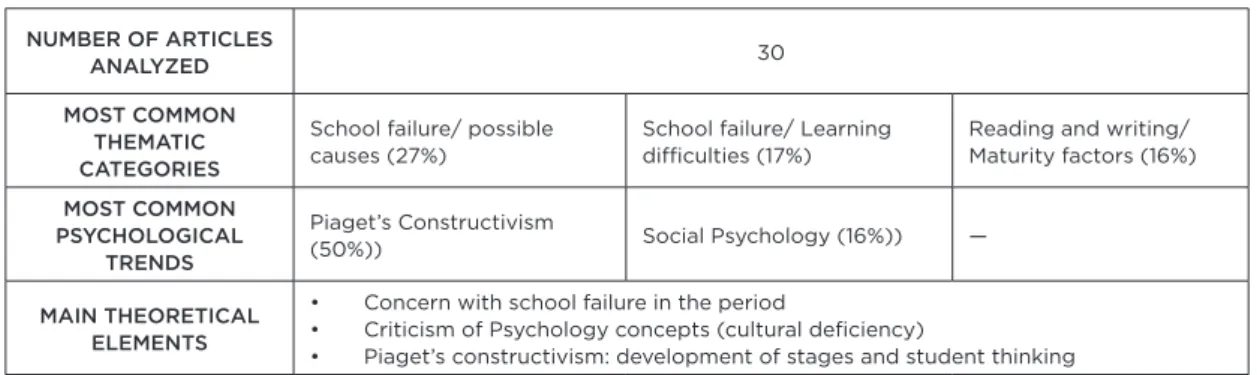
Thirty articles from the 1980s were analyzed. In them, school failure was a predominant theme of concern of researchers, who leaned on different psychological trends to introduce elements of understanding of the processes. The table below shows the main information from the analysis of articles for that period:
TABLE 1
MAIN INFOrMATION OF THE ANALYSIS OF THE PUBLICATIONS OF 1980S
NUMBEr OF ArTICLES
ANALYZED 30
MOST COMMON THEMATIC CATEGOrIES
School failure/ possible causes (27%)
School failure/ Learning difficulties (17%)
Reading and writing/ Maturity factors (16%)
MOST COMMON
PSYCHOLOGICAL
TrENDS
Piaget’s Constructivism
(50%)) Social Psychology (16%)) —
MAIN THEOrETICAL ELEMENTS
• Concern with school failure in the period
• Criticism of Psychology concepts (cultural deficiency)
• Piaget’s constructivism: development of stages and student thinking
Table 1 shows that the most common theme in the 1980s was “school failure”, with the subcategories “possible causes” and “learning difficulties”. Following that, the thematic category “reading and writing” was the next most common one, with the subcategory “maturity factors”. The predominant psychological trend in the publications was Piaget’s constructivism, as the theoretical foundation for half the articles analyzed, followed by social psychology trends. A theoretical element that predominated in the publications analyzed was the concern of researchers with school failure (in the period characterized by high dropout and repetition rates in the initial years of elementary school, mostly with children from lower classes). Such concern was evidenced by the frequency with which the topic appeared in the articles analyzed, especially during the first half of the 80s (12 out of the 15 were classified under the theme, produced up to the year 1985). Esposito (1992), Silva and Davis (1992) and Faria (2008), who conducted bibliographic research on the publications of the Cadernos de Pesquisa on
Juliana B
arbosa C
onsoni e Roseli Rodrigues de Mello
CADERNO
S DE PESQUIS
A v
.44 n.
154 p
.10
7
1-1091 out./
de
z. 20
14 10
77
Such studies, notably, raised criticism of the psychological concepts present in the previous decade, and took a more individualistic view of school failure (ESPOSITO, 1992; FARIA, 2008). With regard to the articles analyzed with the focus considered in the present study, this trend was also observed since many of the articles classified under the theme “School Failure” explicitly criticized the theory of Cultural Deficiency (influential in the 1970s), of other individualized conceptions of school failure and of programs of compensatory education. Research also included, as support, concepts from Social Psychology and intercultural studies to search for broader elements outside the individual scope of the student to explain their learning processes, e.g., studies by Silva (CP32, 1980), Gatti et al. (CP38, 1981), Kramer (CP42, 1982), Carraher, Carraher and Schliemann (CP42, 1982), Carraher and Schliemann (CP45, 1983) and Patto (CP65, 1988).
Piagetian constructivism was the most influential psychological trend of the decade, and its theory of stages of cognitive development supported the many publications. It brought, as its theoretical element, the condition of cognitive development to the learning of school content, such as the case of articles discussing mathematical content, whose learning depends on the development of logical notions of ordering and of conservation, such as the discussions explored by Silva (CP44, 1983), Moro (CP45, 1983) and Moro (CP56,1986). Such propositions also occurred both in discussion about learning of reading and writing, in articles such as those by Koff and Bonamigo (CP34, 1980), Poppovic (CP36, 1981), Pozner (CP42, 1982), Valente (CP51, 1984) and Freitag (CP53, 1985).
Based on Piagetian constructivism, one element brought to the publications was the emphasis on students’ understanding and thinking, in their learning processes. In these publications, like those of Carraher and Rego (CP39, 1981), Ferreiro (CP52, 1985) and Moro (CP56, 1986), mechanical or rote forms of teaching are questioned and the active role of the child in his own learning is valued. Based on the students’ thinking about their learning, an emphasis on the learning process itself was proposed, and not so much on teaching results as on a way to strengthen student thinking (SILVA, CP34, 1980).
CADERNO
S DE PES
QUIS
A
: PS
Y
CHOL
OG
Y AND EDUCA
TION IN THE SCHOOL
’S TEA
CHING AND LEARNING PROCES
S
10
7
8
CADERNO
S DE PESQUIS
A v
.44 n.
154 p
.10
7
1-1091 out./
de
z. 20
14
FrOM 1990 TO 1999: COMPArING PIAGET AND VYGOTSkY
Twenty-five articles from 1990 to 1999 were assessed. They had the same concerns already present in the 1980s regarding school content learning for all children. The publications were diversified in relation to the topics dealt with, yet, just as it happened in the 1980s, Piagetian constructivism was dominant in the support of practice-theoretical formulations on school learning. Table 2 provides summary information on the thematic categories and most common psychological trends in the discussions, as well as key theoretical elements discussed in publications from 1990 to 1999:
TABLE 2
ELEMENTS HIGHLIGHTED FrOM THE ANALYSIS OF PUBLICATIONS IN THE 1990S
NUMBEr OF ArTICLES
ANALYZED 25
MOST COMMON THEMATIC CATEGOrIES
Piaget/Vygotsky Comparison (20%)
Reading and Writing/ Written language formal appropriation (16%)
Formation and Construction of scientific knowledge (16%)
MOST COMMON
PSYCHOLOGICAL
TrENDS
Piaget’s Constructivism
(52%) —
MAIN THEOrETICAL ELEMENTS
• Concern for support to pedagogical practices: Piaget and Vygotsky theories
• Piaget’s Constructivism: balancing theory and learning process – reflection, group discussion
• Criticisms to misinterpretation of Piaget’s theory and its practical application – shift away from teaching content
Table 2 shows that the most common theme was “Piaget/Vygotsky Comparison”, followed by the categories “reading and writing”, in the subcategory “written language formal appropriation” and “formation/ construction of scientific knowledge”.
As in the previous decade, Piaget’s constructivism was the most common psychological trend among the articles analyzed.
As an important theoretical element, it may be observed that, with regard to the discussions on teaching school content, Piaget’s and Vygotsky’s psychological theories were the most influential, with predominance of the former. The comparison between the two theories and their implications for educational practices was a relevant element in the 1990s, when compared to the previous decade. The comparative studies between the two theories demonstrate researchers’ concern in the search of theoretical elements to support pedagogical practices, as can be seen in the articles of Rocco (CP75, 1990), Souza and Kramer (CP77, 1991), Ferreiro (CP88, 1994), Mortimer and Carvalho (CP96, 1996) and Castorina (CP105, 1998). These data support the study by Silva and Davis (2004), who carried out a literature review in the Cadernos de
Pesquisa, seeking to analyze how Vygotsky’s and his followers’ theory
Juliana B
arbosa C
onsoni e Roseli Rodrigues de Mello
CADERNO
S DE PESQUIS
A v
.44 n.
154 p
.10
7
1-1091 out./
de
z. 20
14
107
9
of Vygotsky and Piaget and say that, although Vygotsky made a critical analysis of Piaget’s postulates in his work, there was a tendency, in the articles of CP, to compare the theories, often considering them similar, or complementary. Anyway, the authors consider that it was one way for Brazilian researchers to better understand the ideas of the Soviet author, thus far unknown, and disclose their studies.
Despite the greater influence of Vygotsky’s ideas in the 1990s, based on the 25 articles analyzed, it was found that the influence of Piaget’s constructivist theory was dominant in supporting the discussion of teaching and learning processes of school content. The publications supported by Piagetian theory, motivated by the proposal to overcome the traditional teaching practices regarded as mechanistic, valued students’ learning processes, seeking to understand their thought processes in relation to school content. Since the previous decade, this concern was already on the basis of the Piagetian articles studied, and extended to the 1990s, as in the discussions conducted by Davis (CP75, 1990), Macedo (CP93, 1995), Darsie (CP99, 1996), Mortimer and Carvalho (CP96, 1996). Thus, practical propositions were brought to deal with such concerns, whereby classroom actions which could favor the construction of scientific knowledge, are addressed, taking into account students’ reflection on and understanding of their own learning processes, as discussed in the articles of Davis and Esposito (CP74, 1990), Moro (CP79, 1991), Carvalho et al. (CP82, 1992), Macedo (CP93, 1995), Darsie (CP99, 1996), Carvalho (CP101, 1997), Melo and Rego (CP105, 1998) and Leão (CP107, 1999).
The principles of Piagetian constructivism were hegemonic in the publications of Cadernos de Pesquisa throughout the decade, even
CADERNO
S DE PES
QUIS
A
: PS
Y
CHOL
OG
Y AND EDUCA
TION IN THE SCHOOL
’S TEA
CHING AND LEARNING PROCES
S
1080
CADERNO
S DE PESQUIS
A v
.44 n.
154 p
.10
7
1-1091 out./
de
z. 20
14
discussed and questioned, as they emphasized the psychologization of pedagogical processes, observed, for example, in the National Curriculum Parameters.
In general, in the 1990s, explicit concern of the researchers was observed in relation to the instrumental dimension of education, either as a learning process, supported by Piaget’s theory, or as a process and learning product, supported by criticism to biased reading of Piaget’s or Vygotsky’s theory. In the following period, in the CP publications of the first twelve years of the 21st century, there were still articles concerned with instrumental learning; yet, there was a significant decrease in the use of psychological theories as a support in the discussions of the subject.
YEArS 2000 TO 2012: TEACHErS’ CONCEPTIONS AND NEw EDUCATIONAL SkILLS
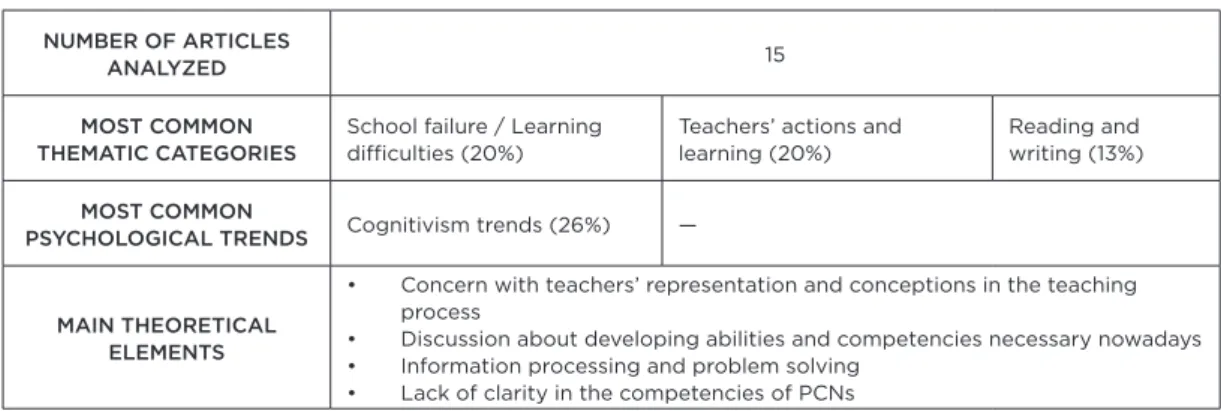
Between 2000 and 2012, 15 articles of the CP approaching subjects on instrumental learning linked to psychology were identified and analyzed. Unlike previous decades, Piaget’s constructivism was not the basis of the discussions, with articles addressing different psychological trends and various themes. Table 3 presents the main points that emerged from the analysis of the publications of the period:
TABLE 3
ELEMENTS HIGHLIGHTED IN THE ANALYSIS OF THE PUBLICATIONS FrOM 2000 TO 2012
NUMBEr OF ArTICLES
ANALYZED 15
MOST COMMON THEMATIC CATEGOrIES
School failure / Learning difficulties (20%)
Teachers’ actions and learning (20%)
Reading and writing (13%)
MOST COMMON
PSYCHOLOGICAL TrENDS Cognitivism trends (26%) —
MAIN THEOrETICAL ELEMENTS
• Concern with teachers’ representation and conceptions in the teaching process
• Discussion about developing abilities and competencies necessary nowadays
• Information processing and problem solving
• Lack of clarity in the competencies of PCNs
Table 3 shows that between 2000 and 2012, of the 15 articles found using the search criteria, the most common themes were “School failure/learning difficulties” and “Teachers’ practice and learning”, both with 3 articles each, totaling 20% of the total number of articles selected. The category “Reading and writing” follows as the next most frequent, with 2 articles (13%).
Juliana B
arbosa C
onsoni e Roseli Rodrigues de Mello
CADERNO
S DE PESQUIS
A v
.44 n.
154 p
.10
7
1-1091 out./
de
z. 20
14
1081
the Theory of Social Representations could be found in articles that discuss teachers’ conceptions and their relationship to the processes of teaching and learning in classrooms. These data agree with what Alves-Mazzotti (2008) states about using the Theory of Social Representations in the educational area. He says that such a psychological trend has been serving as theoretical support, in an attempt to understand the effects of teachers’ expectations and conceptions regarding students’ performance, mainly of low social classes, whose education is still a concern in this field.
In this sense, the articles that have brought this reference converged with each other, such as Carmo and Chaves (CP114, 2001) and Gazinelli (CP115, 2002), focusing on the importance of paying attention to the social representations of the teachers on various topics, since these representations could influence the educational processes. It can be said that this type of study brings something new, i.e., the shift of attention from students’ thought processes and learning to teachers’ thought processes and learning. It must be stated that, although outnumbered, studies were found with this theoretical basis which sought to understand a wider process, comprising certain educational situations, as the study of Franco and Novaes (CP112, 2001). This study was dedicated to the social representations of high school students about school and work, to think better about the curricular reform that was being implemented in the period.
Another area of concern, between 2000 and 2012, on more than one thematic category, was related to the discussions on the recent contextual changes with its new demands and abilities, and the role of the school in the new context. Some articles describe the current context as the one with the largest knowledge production, rapid development of technologies and inequality of access to this knowledge and information. In this sense, the publications converge on the proposition that it is no longer enough for schools to transmit content and information. Schools need to develop cognitive skills that provide the ability to use such knowledge and transfer them to different contexts. In this proposition, cognitivist trends are frequent in the theoretical support used by the researchers, emphasizing the cognitive processes for processing information and resolving conflicts. Teaching activities that stimulate reflection in students’ thought are regarded as important elements for teaching reading and writing, and physics, for example. Such discussions are present in articles by Davis, Nunes and Nunes (CP125, 2005), Salles and Parente (CP132, 2007), and Tedesco (CP138, 2009).
CADERNO
S DE PES
QUIS
A
: PS
Y
CHOL
OG
Y AND EDUCA
TION IN THE SCHOOL
’S TEA
CHING AND LEARNING PROCES
S
1082
CADERNO
S DE PESQUIS
A v
.44 n.
154 p
.10
7
1-1091 out./
de
z. 20
14
implementation, considered generic, would have generated impacts on the pedagogical actions and on school organization and should have been further discussed, as shown in the article by Silva (CP137, 2009). It is worth mentioning that the concern about Brazilian students’ poor performance in official national and international assessments, such as Saeb and PISA, was also evidenced in publications of that decade. Based on these findings, Soares’ study (CP130, 2007) analyzed different aspects in and out of school that could interfere with the results of learning and cognitive performance of the students.
When comparing the articles analyzed in each decade/period, some specificities in relation to publications between 2000 and 2012 were observed. Unlike what happened in the publications of the two previous decades, when Piagetian constructivism was the psychological approach most commonly used as a theoretical support in discussions about teaching content, that did not happen in the period starting in 2000; at least not explicitly. Although some articles mentioned the influence of Piaget in pedagogical practices, or even in the implementation of a competency based curriculum, they did not state clearly to be based on this approach to offer theoretical and practical elements on the processes of teaching and learning.
In general, the concern with learning school content, observed in the publications of the previous decades, remained the same from 2000 to 2012. Besides the teaching of school content, the development of abilities and skills seen as necessary for the student was also seen as part of the schools’ role. However, the association of the discussions on teaching school content having psychology as a support decreased between 2000 and 2012 in relation to other decades, as shown, for example, by the lower number of articles selected in the period (only 15).
CONTINUITIES AND CHANGES:
INSTrUMENTAL LEArNING AND PSYCHOLOGY IN THE
CADERNOS DE PESQUISA
BETwEEN 1980 AND 2012
Based on results found (above), it can be concluded that, in the texts ofthe Cadernos de Pesquisa from the 1980s and 1990s, there was a prevalence
Juliana B
arbosa C
onsoni e Roseli Rodrigues de Mello
CADERNO
S DE PESQUIS
A v
.44 n.
154 p
.10
7
1-1091 out./
de
z. 20
14
1083
mid-twentieth century, which sought to move forward in relation to the propositions of traditional teaching (BANKS-LEITE, 1998; LEÃO, 1999).
In these two decades, because of the concern of taking student thought into account and not just the mechanical learning of teaching content, it seems, based on the publications analyzed, that there was a movement to emphasize the learning process to the detriment of educational results. This view, although well represented in the publications of the first two decades analyzed, was not exempt from counterarguments in the sense that too much emphasis on the learning and teaching processes would make room for the shift away from effective teaching and learning of educational content. This concern with the non-prioritization of school content was exposed both in critical studies of Piaget’s constructivism and in Piaget-based studies that have criticized the misinterpretation of Piaget’s theory, present in the CP from the 1990s.
In the publications between 2000 and 2012, the students’ concern with their own understanding of their learning processes remained the same; however, there was a shift of attention to the teachers’ thought and learning processes as a topic of study. Psychology emerges then as a support through research on social representations and conceptions of the teachers about what is taught, and how such representations and conceptions interfere in the students’ learning. There was also a concern with the process of teaching content along with the changes which society was undergoing, due to technological changes and higher production and circulation of knowledge around the world. In addition to teaching content, there was, in the last decade, concern with the development of skills that are important for the current context, such as information processing and the transfer of what is learned in school to other contexts.
As for the theories that support the studies, in contrast to previous decades, Piagetian constructivism was not mentioned in publications from 2000, at least not explicitly, as the main theoretical reference for discussions about teaching and learning processes. When the references are analyzed, the theories about social representations emerge and, in fewer numbers, other cognitive approaches to psychology such as Information Processing or Problem Solving. Such theories emphasize the cognitive processes involved in reading and comprehension skills, and problem solving in the classroom.
CADERNO
S DE PES
QUIS
A
: PS
Y
CHOL
OG
Y AND EDUCA
TION IN THE SCHOOL
’S TEA
CHING AND LEARNING PROCES
S
1084
CADERNO
S DE PESQUIS
A v
.44 n.
154 p
.10
7
1-1091 out./
de
z. 20
14
new LDB (the law that regulates education in Brazil) and the creation of the PCN, assigning new competencies and skills to be developed in school. Nevertheless, in the publications analyzed, it is clear that there is still a lack of understanding on how to teach the skills required by the PCN, and this lack of understanding is also reported in the literature (GARCIA, 2005; SANTOS; CAMPOS; ALMEIDA, 2005; RICARDO, 2010).
In addition to incorporating the development of skills and competencies into the discussions about school teaching and learning, the analysis of the publications of the three decades has shown that the association between teaching content and psychological trends has decreased in the debates of the last period reviewed. Something worth considering in this analysis is the number of issues of Cadernos de
Pesquisa published, which also declined from 1997 when the magazine
started being published every four months. But that does not seem to explain the lower number of articles associating instrumental learning to psychology from 2000 to 2012. The drop in this frequency of selection was proportionately larger if compared to the decrease of the journal issues. In the 1980s, 38 issues of the Cadernos de Pesquisa were published;
and, from 2000 to 2010, 33 issues of the journal (Cadernos de Pesquisa,
2012) were published, which means a decrease of approximately 13%. This research identified 30 articles published in the 1980s, and 15 articles between 2000 and 2012, i.e., there was a 50% fall in the number of articles associating psychology and discussions about the instrumental dimension of education.
An important consideration about such a decrease is that there is no way to say that discussions about educational psychology and its association with instrumental learning have decreased in the country. Starting in the 1990s, several Brazilian scientific journals devoted to publications directly related to educational psychology were created
(PAIDEIA; PSICOLOGIA EDUCACIONAL E ESCOLAR, for example) and the
authors in that area may have migrated their work to such periodicals. But, that can also imply other elements that deserve our attention.
CONCLUSIONS
This article, by analyzing the publications of Cadernos de Pesquisa between
Juliana B
arbosa C
onsoni e Roseli Rodrigues de Mello
CADERNO
S DE PESQUIS
A v
.44 n.
154 p
.10
7
1-1091 out./
de
z. 20
14
1085
Based on the analysis of the publications of the CP, a significant change regarding the presence of psychological theories in educational research and the emergence of different theories to deal with themes about instrumental learning were noticed. The definition of the CP editorial line, from 1992, illustrates themes such as “the relationships between education and the problems and social perspectives of the country, public policy guidelines in the area, educational assessment and ethnic-racial, gender and family themes “. This definition did not lead to the decrease in the support of psychology for education from the perspective of the instrumental teaching and learning processes, since, in the 1990s, there were 25 articles with such characteristics. From the psychology point of view, this finding is consistent with studies that analyze changes in the field of educational psychology (BARBOSA, 2012; BEZERRA; ARAUJO, 2012). Barbosa’s analysis (2012, p. 120), for example, indicates a moment of reconfiguration of the field of educational psychology beginning in 2000, and suggests that the area is assessing “the present moment in order to renew our theories and practices” (BARBOSA, 2012, p. 120). But, under the educational perspective, it is worth asking: how is educational research affected by this reconfiguration, regarding discussions on instrumental learning? How are the studies that address the instrumental dimension of education, whether or not based on psychology, dealing with the processes of teaching and learning? Is there, in the loss of influence of psychology, also a loss of influence of the debate concerning the processes of teaching and learning content as a central theme in the work of the school?
It is important to make this analysis to see how research in education and educational psychology is doing and progressing with regard to proposals on formal teaching and learning processes. As long as the school is a central institution in our society, and one of the places responsible for the learning process of knowledge historically systematized by mankind, it is important to search for guidelines that empower its role.
Currently, the conditions for producing and disseminating scientific knowledge are more favorable, with a much broader access to databases allowing for interaction between researchers from different fields and places around the world and the consequent improvement of the insularity of the Brazilian production. As Caldas (2005), A. Lima (2004) and Barbosa and Souza (2012) point out, such conditions for academic production may favor the search for theoretical formulations that are the basis of practices focused on the educational development of our country and, moreover, strengthen the commitment of the researchers with elementary school.
Cadernos de Pesquisa was created with such determination and has
CADERNO
S DE PES
QUIS
A
: PS
Y
CHOL
OG
Y AND EDUCA
TION IN THE SCHOOL
’S TEA
CHING AND LEARNING PROCES
S
1086
CADERNO
S DE PESQUIS
A v
.44 n.
154 p
.10
7
1-1091 out./
de
z. 20
14
academic production. This article sought to highlight its participation in the articulation between psychology and education, with a focus on the instrumental teaching and learning processes in the three decades of its existence. The challenge for the next ten years seems to be fostering debate and research that help systems and agents in the constitution of a present with a future for all generations.
rEFErÊNCIAS
ANGELUCCI, Carla et al. O estado da arte da pesquisa sobre o fracasso escolar (1991-2002): um estudo introdutório. Educação e Pesquisa, São Paulo, v. 30, n. 1, p. 51-72, jan./abr. 2004.
ANTUNES, Mitsuko. A consolidação da Psicologia no Brasil (1930-1962): sistematização de dados e algumas aproximações analíticas. Psicologia da Educação, v. 22, p. 79-94, 2001.
BANKS-LEITE, Luci. Piaget 100 anos (resenha). Educação e Sociedade,Campinas, v. 19, n. 63, 1998. Disponível em: <http://dx.doi.org/10.1590/S0101-73301998000200011>. Acesso em: dez. 2013.
BARBOSA, Deborah R. Contribuições para a construção da historiografia da Psicologia Educacional e Escolar no Brasil. Psicologia: Ciência e Profissão, v. 32, num esp., p. 104-123, 2012. Disponível em: <http://www.scielo.br/pdf/pcp/v32nspe/v32speca08.pdf>. Acesso em: nov. 2013.
BARBOSA, Deborah R.; SOUZA, Marilene. Psicologia Educacional ou Escolar? Eis a questão.
Revista Semestral da Associação Brasileira de Psicologia Escolar e Educacional, São Paulo, v. 16, n. 1,
p. 163-173, 2012.
BARDIN, Laurence. Análise de conteúdo. 3. ed. Lisboa: Edições 70. 2004.
BEZERRA, Giovani F.; ARAUJO, Doracina A.C. Psicologia da Educação: uma disciplina em crise
no pós-construtivismo. Psicol. Esc. Educ., v. 16, n. 1, p. 143-151, 2012.
CADERNOS DE PESQUISA. Sobre a revista. Disponível em: <http://www.scielo.br/revistas/cp/ paboutj.htm>. Acesso em: maio 2012.
CALDAS, Roseli F.L. Fracasso escolar: reflexões sobre uma história antiga, mas atual. Psicologia
Teoria e Prática, v. 7, n. 1, p. 21-33, 2005.
CAMPOS, Regina Helena de Freitas et al. Funcionalismo no Brasil: pioneiros.In: MASSINI, Marina. História da Psicologia no Brasil do século XX.São Paulo: EPU, 2004. p.155-174.
CARVALHO, Diana C. A Psicologia frente a Educação e o Trabalho Docente. Psicologia em Estudo, Maringá, v. 7, n. 1, p. 51-60, 2002.
CONSONI, Juliana B. Contribuições da Psicologia para o ensino de conteúdos e aprendizagem
instrumental: um estudo das publicações dos Cadernos de Pesquisa de 1980 a 2012, Dissertação
(Mestrado em Educação) – Universidade Federal de São Carlos, São Carlos. 2014.
DAVIS, Claudia; OLIVEIRA, Zilma de. Psicologia na educação. São Paulo: Cortez, 1990.
ESPOSITO, Yara Lúcia. Alfabetização em revista: uma leitura. Cadernos de Pesquisa, n. 80, p. 21-27, Fev. 1992.
FARIA, Gina Glaydes G. de. Os ciclos do fracasso escolar: concepções e proposições. 2008. 150f. Tese (Doutorado em Educação) – Universidade Federal de Goiás, Goiânia. 2008.
GARCIA, Lenise Aparecida M. Competências e habilidades: você sabe lidar com isso? Educação
e Ciência On-line, Brasília: Universidade de Brasília, 2005. Disponível em: <http://uvnt.
universidadevirtual.br/ciencias/002.htm>. Acesso em: jan. 2014.
GOUVEIA, Aparecida Joly. A Pesquisa educacional no Brasil. Cadernos de Pesquisa, n. 1, p. 1-48, jul. 1971.
Juliana B
arbosa C
onsoni e Roseli Rodrigues de Mello
CADERNO
S DE PESQUIS
A v
.44 n.
154 p
.10
7
1-1091 out./
de
z. 20
14
108
7
LIMA, Aline O.M.N. de. Breve histórico da psicologia escolar no Brasil. Psicologia Argumento, Curitiba, v. 23, n. 42 p. 17-23, jul./set. 2004.
LIMA, Elvira C. A. S. O conhecimento psicológico e suas relações com a educação. Em Aberto, Brasília, ano 9, n. 48, out./ dez. 1990.
MELLO, Roseli R. Aprendizagem Dialógica: aprofundando a compreensão teórica e ampliando as possibilidades educativas. CNPq- Edital Universal, 2010-2013. 2012b.
PAIDEIA. Revista da Universidade de São Paulo, Faculdade de Filosofia Ciências e Letras de Ribeirão Preto. Disponível em: <http://www.scielo.br/scielo.php?script=sci_serial&pid=0103-863X&lng=pt&nrm=iso>. Acesso em: 02 abr. 2014.
PATTO, Maria Helena S. Para uma crítica da razão psicométrica. In: ______. Mutações do cativeiro:
escritos de psicologia e política. São Paulo: Edusp, p. 65-83, 2000.
PLACCO, Vera M. de Souza (Org.). Psicologia & Educação: Revendo contribuições. São Paulo: Fapesp/Educ, 2002. 179p.
POPPOVIC, Ana Maria. Alfabetização: um problema interdisciplinar. Cadernos de Pesquisa, São Paulo, n. 2, nov. 1971.
PSICOLOGIA ESCOLAR E EDUCACIONAL. Revista da Associação Brasileira de Psicologia Escolar e Educacional (ABRAPEE). Disponível em: <http://www.scielo.br/revistas/pee/paboutj.htm>. Acesso em: 02 abr. 2014.
RICARDO, Elio Carlos. Discussão acerca do ensino por competências: problemas e desafios.
Cadernos de Pesquisa, São Paulo, v. 40, n. 140, maio/ago. 2010.
SANTOS, Verônica T.; CAMPOS, Angela F.; ALMEIDA, Maria Angela V. de. Concepções dos(as) professores(as) de química sobre o desenvolvimento de competências na escola. Ensaio: Pesquisa
em Educação e Ciências,Belo Horizonte, v. 7, n. 1, p. 33-46, jul. 2005.
SILVA, Flávia G. da; DAVIS, Claudia. Conceitos de Vygotsky no Brasil: produção divulgada nos Cadernos de Pesquisa. Cadernos de Pesquisa, São Paulo, n. 123, v. 34, set. 2004.
SILVA, Rose Neubauer da. Influências teóricas no ensino e currículo no Brasil. Cadernos de
Pesquisa, São Paulo, n. 70, p. 5-19, ago. 1989.
SILVA, Rose Neubauer da; DAVIS, Claudia. O nó górdio da educação brasileira: ensino fundamental. Cadernos de Pesquisa, São Paulo, n. 80, p. 28-40, fev. 1992.
JULIANA BARBOSA CONSONI
Master in Education by the Universidade Federal de São Carlos – UFSCar – and member of the Núcleo de Investigação e Ação Social e Educativa – Niase/UFSCar (Center for Research and Social and Educational Action) –, São Carlos, São Paulo, Brazil
ROSELI RODRIGUES DE MELLO
Professor of the Departamento de Teorias e Práticas Pedagógicas (Department of Pedagogic Theories and Practices) – DTPP – da Universidade Federal de São Carlos – UFSCar – and coordinator of the Núcleo de Investigação e Ação Social e Educativa – Niase/UFSCar (Center for Research and Social and Educational Action) –, São Carlos, São Paulo, Brazil
CADERNO
S DE PES
QUIS
A
: PS
Y
CHOL
OG
Y AND EDUCA
TION IN THE SCHOOL
’S TEA
CHING AND LEARNING PROCES
S
1088
CADERNO
S DE PESQUIS
A v
.44 n.
154 p
.10
7
1-1091 out./
de
z. 20
14
ATTACHMENTS
TABLE 1
LIST OF THE THEMATIC CATEGOrIES DEVELOPED FrOM THE ANALYSIS OF THE ArTICLES OF THE THrEE DECADES
THEMATIC CATEGOrY (Ur) THEMATIC SUBCATEGOrY
1. SCHOOL FAILURE
1.1 Learning diffculties
1.2 Pre-school
1.3 Possible causes
2. COGNITIVE PERFORMANCE
2.1 School performance
2.2 Mathematics teaching
2.3 Social interaction
3. READING AND WRITING
3.1 Maturity factors
3.2 Written language formal appropriation
4. ARTICULATION SCHOOL KNOWLEDGE AND EVERYDAY KNOWLEDGE
5. CURRICULUM
6. EDUCATIONAL ASSESSMENT
7. FORMATION/CONSTRUCTION SCIENTIFIC KNOWLEDGE
8. TEACHERS’ ACTION AND LEARNING
9. PIAGET/VYGOTSKY COMPARISON
10. OTHERS
TABLE 4
LIST OF ArTICLES SELECTED TO BE ANALYZED IN CADERNOS DE PESQUISA,
FrOM 1980 TO 2012
ArTICLES FrOM 1980 TO 1989
ACIOLY, Nadja Maria; SCHLIEMANN, Analúcia Dias. Escolarização e conhecimento de matemática desenvolvido no contexto de jogo do bicho. Cadernos de Pesquisa, n. 61, p. 42-57, maio 1987.
BRANDÃO, Zaia; ABRAMOVAY, Miriam; KRAMER, Sonia. O pré-escolar e as classes desfavorecidas. Cadernos de Pesquisa, n. 39, p. 43-45, nov. 1981.
CAGLIARI, Luis Carlos. O príncipe que virou sapo: considerações a respeito da dificuldade de aprendizagem das crianças na alfabetização. Cadernos de Pesquisa, n. 55, p. 50-62, nov. 1985.
CARRAHER, Terezinha Nunes; CARRAHER, David William, SCHLIEMANN, Analúcia Dias. Na vida, dez; na escola, zero: os contextos culturais de aprendizagem da matemática.
Cadernos de Pesquisa, n. 42, p. 79-86, ago. 1982.
CARRAHER, Terezinha Nunes; SCHLIEMANN, Analúcia Dias. Fracasso escolar: uma questão social. Cadernos de Pesquisa, n. 45, p. 3-19, maio 1983.
CARRAHER, Terezinha Nunes; CARRAHER, David William, SCHLIEMANN, Analúcia Dias. Cultura, escola, ideologia e cognição: continuando um debate. Cadernos de Pesquisa, n. 57, p. 78-85, maio 1986.
CARRAHER, Terezinha Nunes; REGO, Lúcia Lins Browne. O realismo nominal como obstáculo na aprendizagem da leitura. Cadernos de Pesquisa, n. 39, p. 3-10, nov. 1981.
Juliana B
arbosa C
onsoni e Roseli Rodrigues de Mello
CADERNO
S DE PESQUIS
A v
.44 n.
154 p
.10
7
1-1091 out./
de
z. 20
14
108
9
FRANCHI, Eglê Pontes. A pós-alfabetização e um pouco de compreensão dos “erros” das crianças. Cadernos de Pesquisa, n. 52, p. 121-124, fev. 1985.
FREITAG, Barbara. Piagetianos brasileiros em desacordo? Contribuição para debate.
Cadernos de Pesquisa, n. 53, p. 33-44, maio 1985.
GATTI, Bernardete A.; PATTO, Maria Helena Souza; COSTA, Marisa C. Lobo; ALMEIDA, Melany; KOPIT, Romeu de M. A reprovação na 1ª série do 1º grau: um estudo de caso.
Cadernos de Pesquisa, n. 38, p. 3-13, ago. 1981.
KOFF, Elionora Delwing; BONAMIGO, Euza Maria de Rezende. Desenvolvimento da capacidade de identificação perceptiva em pré-escolares. Cadernos de Pesquisa, n. 34, p. 21-27, ago. 1980.
KRAMER, Sonia. Privação cultural e educação compensatória: uma análise crítica.
Cadernos de Pesquisa, n. 42, p. 54-62, ago. 1982.
LEWIN, Zaida Grinberg. Tempo conceitual e sucesso escolar. Cadernos de Pesquisa, n. 34, p. 3-20, ago. 1980.
LUNA, Sérgio Vasconcellos de. Comentários sobre “Ensino de 1º grau: direção ou espontaneísmo?”. Cadernos de Pesquisa, n. 36, p. 95-97, fev. 1981.
MOREIRA, Marcos A.; SOUSA, Célia M. S. G. de; SILVEIRA, Fernando L. Organizadores prévios como estratégia para facilitar a aprendizagem significativa. Cadernos de Pesquisa, n. 40, p. 41-53, fev. 1982.
MORO, Maria Lucia Faria. Iniciação em matemática e construções operatório-concretas: alguns fatos e suposições. Cadernos de Pesquisa, n. 45, p. 20-24, maio 1983.
MORO, Maria Lucia Faria. A construção de inteligência e a aprendizagem escolar de crianças de famílias de baixa renda. Cadernos de Pesquisa, n. 56, p. 66-72, fev. 1986.
PATTO, Maria Helena Souza. O fracasso escolar como objeto de estudo: anotações sobre as características. Cadernos de Pesquisa, n. 65, p. 72-77, maio 1988.
POPPOVIC, Ana Maria. Alfabetização: um problema interdisciplinar. Cadernos de Pesquisa, n. 36, p. 71-86, fev. 1981.
POPPOVIC, Ana Maria. Bases teóricas do Programa Alfa. Cadernos de Pesquisa, n. 43, p. 31-36, nov. 1982.
POZNER, Pilar. El impacto del pré-escolar en los niños de sectores populares. Cadernos de
Pesquisa, n. 42, p. 63-78, ago. 1982.
RASCHE, Vânia Maria Moreira; KUDE, Vera Maria Moreira. Pigmalião na sala de aula: quinze anos sobre as expectativas do professor. Cadernos de Pesquisa, n. 57, p. 61-70, maio 1986.
ROCKWELL, Elsie. Os usos escolares da língua escrita. Cadernos de Pesquisa, n. 52, p. 85-95, fev. 1985.
SANTOS, Maria Madalena Rodriguez dos. Relatório da experiência do Programa Alfa em Pernambuco – 1977/1980. Cadernos de Pesquisa, n. 39, p. 26-31, nov. 1981.
SCHIEFELBEIN, Ernesto; SIMMONS, John. Os determinantes do desempenho escolar: uma revisão de pesquisas nos países em desenvolvimento. Cadernos de Pesquisa, n. 35, p. 53-71, nov. 1980.
SILVA, Fátima Sampaio. Operações lógico-matemáticas de crianças na 1ª série do 1º grau.
Cadernos de Pesquisa, n. 44, p. 63-74, fev. 1983.
SILVA, Rose Neubauer da. A democratização das oportunidades educacionais. Cadernos
de Pesquisa, n. 34, p. 87-89, ago. 1980.
SILVA, Rose Neubauer da. A responsabilidade pelo sucesso e fracasso escolar em crianças.
Cadernos de Pesquisa, n. 32, p. 31-44, fev. 1980.
CADERNO
S DE PES
QUIS
A
: PS
Y
CHOL
OG
Y AND EDUCA
TION IN THE SCHOOL
’S TEA
CHING AND LEARNING PROCES
S
1090 CADERNO
S DE PESQUIS
A v
.44 n.
154 p
.10
7
1-1091 out./
de
z. 20
14
ArTICLES FrOM 1990 TO 1999
BAJARD, Élie. Afinal, onde está a leitura? Cadernos de Pesquisa, n. 83, p. 29-41, nov. 1992.
CARVALHO, Ana Maria Pessoa de; CASTRO, Ruth Schmitz de; LABURU, Carlos Eduardo; MORTIMER, Eduardo Fleury. Pressupostos epistemológicos para a pesquisa em ensino de Ciências. Cadernos de Pesquisa, n. 82, p. 85-89, ago. 1992.
CARVALHO, Anna Maria Pessoa de. Relato de experiência: Ciências no Ensino Fundamental. Cadernos de Pesquisa, n. 101, p. 152-168, jul. 1997.
CASTORINA, José Antonio. Teoria psicogenética da aprendizagem e a prática educacional: questões e perspectivas. Cadernos de Pesquisa, n. 88, p. 37-46, fev. 1994.
CASTORINA, José Antonio. Piaget e Vigotsky: novos argumentos para uma controvérsia.
Cadernos de Pesquisa, n. 105, p. 160-183, nov. 1998.
CHARLOT, Bernard. Relação com o saber e com a escola entre estudantes de periferia.
Cadernos de Pesquisa, São Paulo, n. 97, p. 47-63, maio 1996.
COLELLO, Silvia M. Gasparian. Alfabetização e motricidade: revendo essa antiga parceria.
Cadernos de Pesquisa, n. 87, p. 58-61, nov. 1993.
CORRÊA, Jane; MOURA, Maria Lucia Seidl. Uso de “provas piagetianas” como instrumento diagnóstico: questionando uma prática consensual. Cadernos de Pesquisa, n. 79, p. 26-30, nov. 1991.
DAVIS, Claudia. Uma escolinha de saber miúdo. Cadernos de Pesquisa, n. 75, p. 45-56, nov. 1990.
DAVIS, Claudia; ESPOSITO, Yara Lúcia. Papel e função do erro na avaliação escolar.
Cadernos de Pesquisa, n. 74, p. 71-75, ago. 1990.
DARSIE, Marta Maria Pontim. Avaliação e aprendizagem. Cadernos de Pesquisa, n. 99, p. 47-59, nov. 1996.
FERREIRO, Emilia. Luria e o desenvolvimento da escrita na criança. Cadernos de Pesquisa, n. 88, p. 72-77, fev. 1994.
FRANCO, Maria Laura P. Barbosa. Pressupostos epistemológicos da avaliação educacional.
Cadernos de Pesquisa, n. 74, p. 63-67, ago. 1990.
LAJONQUIÉRE, Leandro de. Acerca da instrumentação prática do construtivismo: A (anti) pedagogia piagetiana, ciência ou arte? Cadernos de Pesquisa, n. 81, p. 61-66, maio 1992.
LEÃO, Denise Maria Maciel. Paradigmas contemporâneos de educação: escola tradicional e escola construtivista. Cadernos de Pesquisa, n. 107, p. 187-206, jul. 1999.
MACEDO, Lino de. Os jogos e sua importância na escola. Cadernos de Pesquisa, n. 93, p. 5-10, maio 1995.
MARTINS, Cláudia Cardoso. A consciência fonológica e a aprendizagem inicial da leitura e da escrita. Cadernos de Pesquisa, n. 76, p. 41-49, fev. 1991.
MELO, Kátia Leal Reis de; REGO, Lúcia Lins Browne. Inovando o ensino da ortografia na sala de aula. Cadernos de Pesquisa, n. 105, p. 110-134, nov. 1998.
MOREIRA, Antonio Flavio Barbosa. A Psicologia e o resto: o currículo segundo Cesar Coll.
Cadernos de Pesquisa, n. 100, p. 93-107, mar. 1997.
MORO, Maria Lucia Faria. Crianças com crianças, aprendendo: interação social e construção cognitiva. Cadernos de Pesquisa, n. 79, p. 31-43, nov. 1991.
Juliana B
arbosa C
onsoni e Roseli Rodrigues de Mello
CADERNO
S DE PESQUIS
A v
.44 n.
154 p
.10
7
1-1091 out./
de
z. 20
14 1091
NUÑEZ, Isauro Beltrán; PACHECO, Otmara Gonzalez. Formação de conceitos segundo a teoria de assimilação de Galperin. Cadernos de Pesquisa, n. 105, p. 92-109, nov. 1998.
ROCCO, Maria Thereza Fraga. Acesso ao mundo da escrita: os caminhos paralelos de Luria e Ferreiro. Cadernos de Pesquisa, n. 75, p. 25-34, nov. 1990.
SOUSA, Clarilza Prado de. Limites e possibilidades dos programas de aceleração de aprendizagem. Cadernos de Pesquisa, n. 108, p. 81-99, nov. 1999.
SOUZA, Solange Jobim e; KRAMER, Sonia. O debate Piaget/Vygotski e as políticas educacionais. Cadernos de Pesquisa, n. 77, p. 69-80, maio 1991.
ArTICLES FrOM 2000 TO 2012
CARMO, Elisabete Regina; CHAVES, Eneida Maria. Análise das concepções de aprendizagem de uma alfabetizadora bem-sucedida. Cadernos de Pesquisa, n. 114, p. 121-136, nov. 2001.
CASTORINA, José Antonio. El impacto de las representaciones sociales en la Psicología de los conocimientos sociales: problemas y perspectivas. Cadernos de Pesquisa, v. 38, n. 135, p. 757-776,set./dez. 2008.
CRAHAY, Marcel. Qual pedagogia para os alunos em dificuldade escolar? Cadernos de Pesquisa, v. 37, n. 130, jan./abr. 2007.
DAVIS, Claudia; NUNES, Marina M. R.; NUNES, Cesar A. A. Metacognição e sucesso escolar: articulando teoria e prática. Cadernos de Pesquisa, v. 35, n. 125, p. 205-230, maio/ago. 2005.
EIDT, Nadia Mara; TULESKI, Silvana Calvo. Transtorno de déficit de atenção/hiperatividade e Psicologia histórico-cultural. Cadernos de Pesquisa, v. 40, n. 139, p. 121-146,jan./abr. 2010.
FRANCO, Maria Laura P. Barbosa; NOVAES, Gláucia Torres Franco. Os jovens do Ensino Médio e suas representações sociais. Cadernos de Pesquisa, n. 112, p. 167-183,mar. 2001.
GAZZINELLI, Maria Flávia. Representações do professor e implementação do currículo de Educação Ambiental. Cadernos de Pesquisa, n. 115, p. 173-194,mar. 2002.
GOMES, Maria de Fátima Cardoso; MORTIMER, Eduardo Fleury. Histórias sociais e singulares de inclusão/exclusão na aula de química. Cadernos de Pesquisa, v. 38, n. 133, p. 237-266,jan./abr. 2008.
JUNIOR, Josimeire M.; VAZ, Arnaldo M. Atividades de investigação escolar: análise psicanalítica do engajamento em pequenos grupos. Cadernos de Pesquisa, v. 40, n. 141, p. 921-941,set./dez. 2010.
PAULI, Sueli Cristina de; ROSSETTI-FERREIRA, Maria Clotilde. Construção das dificuldades de aprendizagem em crianças adotadas. Cadernos de Pesquisa, v. 39, n. 138, set./dez. 2009.
SALLES, Jerusa Fumagalli de; PARENTE, Maria Alice Mattos Pimenta. Relação entre desempenho infantil em linguagem escrita e percepção do professor. Cadernos de
Pesquisa, v. 37, n. 132, p. 687-709, set./dez. 2007.
SILVA, Monica Ribeiro da. Tecnologia, trabalho e formação na reforma curricular do ensino médio. Cadernos de Pesquisa, v. 39, n. 137, p. 441-460,maio/ago. 2009.
SOARES, José Francisco. Melhoria do desempenho cognitivo dos alunos do ensino fundamental. Cadernos de Pesquisa, v. 37, n. 130, jan./abr. 2007.
TEDESCO, Juan Carlos. Calidad de la educación y políticas educativas. Cadernos de
Pesquisa, v. 39, n. 138, p. 795-811,set./dez. 2009.
TUNES, Elizabeth; TACCA, Maria Carmen V. R.; JÚNIOR, Roberto dos Santos Bartholo. O professor e o ato de ensinar. Cadernos de Pesquisa, v. 35, n. 126, p. 689-698, set./dez. 2005.