*e-mail: [email protected]
1. Introduction
The need for weight reduction of structural elements, particularly in the aerospace and automotive industries where the implementation of lighter structures is associated with energy saving policies, has led to an increased interest in the development of lightweight materials over the last years1-3. In this context, Mg and its alloys draw signiicant
attention since they comprise the lightest available structural metals (1.74g/cm3 density in comparison to 2.70g/cm3 for
Al and 7.87g/cm3 for steel, for instance) with an excellent
strength to weight ratio. Furthermore, Mg alloys present good castability, machinability, and damping properties4.
Widespread use of Mg alloys is, however, hindered by a number of factors. Mg alloys exhibit low room temperature plasticity due to their hexagonal close packed crystal structure which limits the number of possible slip systems5.
Owing to its low melting point (650 °C), Mg possesses low creep resistance and low high temperature mechanical strength. Furthermore, Mg has high chemical reactivity, which limits its applications in corrosive environments6.
Improvement of the overall mechanical performance of Mg can be achieved by addition of appropriate alloying
elements. Because of the low solubility of most alloying elements in Mg, strengthening is usually obtained by dispersion or formation of precipitates in the Mg matrix1.
To this end, Mg-Zn-Zr alloys have been developed to considerable extent. The addition of Zn significantly increases room temperature tensile properties without adversely affecting the elevated temperature characteristics and Zr is known to increase high temperature strength in
magnesium alloys due to its remarkable grain reinement
effect7-8 and the sensitivity of Mg tensile strength to grain
size9. The addition of Zr also reportedly increases corrosion
resistance due to formation of a stable Zr rich oxide ilm 10-12. Rare earth (RE) elements have also been successfully
alloyed with Mg. For instance, it has been reported that
addition of rare earth (RE) elements can reine grains and
weaken anisotropy to improve ductility of the Mg alloys13-14.
In addition, RE elements give rise to a dispersion of thermally stable precipitates with high melting point (above 620 °C)15, an improvement over precipitates of the Mg-Zn
system which melt at approximately 340°C and thus have poor thermal stability and exhibit tendency for hot tearing. For these reasons, alloys of the Mg-Zn-RE-Zr system have been matter of study in a number of recent researches16-20.
Solution and Ageing Heat Treatments of ZK60 Magnesium Alloys with
Rare Earth Additions Produced by Semi-Solid Casting
Erenilton Pereira da Silvaa, Larissa Fernandes Batistaa, Bruna Callegaria, Ricardo Henrique Buzolina,
Fernando Warchomickab,c, Guillermo Carlos Requenab, Pedro Paiva Britod,
Haroldo Cavalcanti Pintoa*
aEscola de Engenharia de São Carlos – EESC, Universidade de São Paulo – USP,
Av. Trabalhador São Carlense, 400, CEP 13566-590, São Carlos, SP, Brasil
bInstitute of Materials Science and Technology, Vienna University of Technology,
Karlsplatz 13, 1040 Vienna, Austria
cInstitute for Materials Science and Welding, Graz University of Technology,
Rechbauerstrasse 12, 8010 Graz, Austria
dPontifícia Universidade Católica de Minas Gerais – PUC-MG, Av. Dom José Gaspar,
500, CEP 30535-901, Belo Horizonte, MG, Brasil
Received: January 23, 2014; Revised: November 17, 2014
Rare earth elements reportedly improve high temperature strength and creep resistance of Mg alloys. In the present work, ZK60 Mg alloys containing different amounts (0.5, 1.5 and 2.5 wt.%) of rare earth additions were prepared by thixocasting and submitted to solution and ageing heat treatments (T4, T5 and T6). The as-cast and heat treated microstructures were investigated by scanning electron microscopy and hardness was evaluated as a function of heat treatment parameters. In the as-cast
state, the alloys are formed by globular α-Mg grains reinforced by a network of composite Mg-Zn-RE
precipitates with either smooth or lamellar/acicular morphologies. Solution of the smooth precipitates took place in alloys containing 0.5 and 1.5wt.%RE for T4-500 °C but no precipitates were dissolved
with T4-380 °C. The optimum temperature for T5 and T6 was identiied as 175 °C, while T6-500 °C
led to the highest hardness, followed by T5 and T6-380 °C, respectively.
In the present work, ZK60 (Mg-6%Zn-1%Zr) alloys containing different amounts of RE elements were produced by thixocasting, a semi-solid casting process whereby semi-solid billets with a non-dendritic microstructure are
injected into a cast die, resulting in a inal product with a
globular grain structure and superior mechanical properties compared to those obtained from conventional casting processes21. Thixoforming processes have been largely
applied to the production of high strength Al alloys22 but
have only recently been attempted for the production of Mg alloys23-24. The objective of this research is to clarify the role
of RE elements on the formation of precipitates in Mg-Zn-Zr alloys produced by thixocasting and to describe possible heat treatment sequences for the thixocast ZK60-RE alloys.
2. Experimental Procedure
Ingots of Mg alloy ZK60 containing RE additions were prepared from metallic Mg, Zirmax alloy (Mg-33.3%Zr), electrolytic Zn and mischmetal (55% Ce, 24% La, 15% Nd, 4% Pr) by thixocasting in an electric resistance furnace equipped with a mechanical stirrer. A controlled Ar atmosphere at 0.75bar pressure was maintained in the furnace in order to avoid oxidation of the base materials. The chemical composition of the ingots produced by thixocasting was assessed by X-Ray Fluorescence (XRF) and the results are presented in Table 1.
Samples were produced with 40×40×40 mm dimensions and were subjected to the following heat treatments:
I) T4-1: Solution treatment at 500 °C for 8h;
II) T4-2: Solution treatment at 380 °C for 16h;
III) T5: Ageing directly after casting at 150 °C and at 175 °C;
IV) T6-1: Solution treatment at 380 °C + ageing at 175 °C;
V) T6-2: Solution treatment at 500 °C + ageing at 175 °C. The kinetics of the T5 and T6 ageing processes was evaluated by measuring hardness (Vickers hardness with a 5kgf load, HV5) over heat treatment time. The microstructure of the heat treated samples was characterized by applying Scanning Electron Microscopy (SEM) using a FEI Inspect S50 microscope. Images were recorded in Backscattered Electron (BSE) mode in order to highlight the differences between the light Mg matrixes (dark contrast) and the heavier precipitates (bright contrast). Prior to microscopic examination, samples were submitted to standard metallographic preparation, which included
grinding, polishing and inally etching in a Nital 5% solution.
While Nital is not a common etchant for Mg alloys, in the present case it was useful for increasing contrast between the Mg matrix and the intermetallic precipitates formed along grain boundaries.
3. Results and Discussion
3.1. As cast microstructure
The as-cast microstructures of the three ZK60-RE alloys produced are displayed in Figures 1a, 1b and 1c, for the samples containing 0.5, 1.5 and 2.5wt.%RE, respectively. Because of the stirring process applied during casting, the microstructure is essentially formed by a homogeneous matrix of α-Mg globular grains reinforced by an extensive
network of ine grained intermetallic precipitates which
congregate along the main α-Mg grain boundaries. These precipitates are likely formed by segregation of Zn and RE
elements from the liquid phase during solidiication. The
average grain size of the α-Mg grain size was determined
Table 1. Chemical composition of investigated alloys.
ELEMENTS ZK60-0,5RE (%wt) ZK60-1,5RE (%wt) ZK60-2,5RE (%wt)
Mg Bal. Bal. Bal.
Zn 6,752 6.841 6.635
Zr 0.580 0,923 1.036
La 0.112 0.461 0.626
Ce 0.173 0.808 1.156
Pr 0.049 0.203 0.268
Nd 0.163 0.414 0.838
(by using lower resolution micrographs) and was found to decrease with increasing RE content: 160mm for the alloy containing 2.5wt.%RE, 225mm for the alloy containing 1.5wt.%RE and 300mm for the alloy containing 0.5wt.%RE.
At least two different morphologies can be identiied in the intermetallic network: ine structured lamellar or acicular
phases (possibly eutectic Zn component), and a smooth precipitate, probably containing RE elements.
3.2. Solution treatment (T4)
The microstructures obtained after solution treatment (T4) at 500 °C of the ZK60 alloys containing 0.5, 1.5 and 2.5wt.%RE are presented, respectively, in Figure 2a, 2b and 2c. The dissolution of the intermetallic compounds present in the as-cast microstructure (Figure 1) was not complete, since part of the solutes is retained in the liquid phase during the casting process. For the alloys containing 0.5 and 1.5wt.%RE, it appears that only the
ine grained eutectic Zn precipitate remains, with complete
dissolution of the RE smooth phases. On the other hand, after the solution heat treatment, the smooth intermetallic compounds containing RE elements are still present in the ZK60-2.5wt.%RE microstructure, as indicated by the white arrows in Figure 2c. The average grain size of the ZK60-0.5wt.% RE alloy was increased after heat treatment, reaching an average size of 500 mm, Figure 2a.
The microstructures of the ZK60 alloys submitted to solution heat treatment at 380 °C are presented in Figure 3. No dissolution of intermetallic precipitates was observed for any of the alloys, contrary to the results presented
in Figure 2a and 2b which showed that the smooth RE-containing phases were dissolved by heat treatment at 500 °C. However, the change in precipitate morphology is much more severe for heat treatment performed at 380 °C (Figure 3) than for the heat treatment temperature of 500 °C (Figure 2). This modiication could be due to spheroidization of the Mg-Zn precipitates, or increase in the volume fraction of the Mg-Zn-RE precipitates. Support for the latter assertion relies upon the fact that BSE images reveal two distinct contrasts at the intergranular region with the darker phase thus representing the ternary intermetallic compound.
3.3. T5 and T6 treatments
The hardness (HV5) evolution of the ZK60-2.5wt.%RE alloy is presented in Figure 4 as a function of heat treatment
time. In order to compare the inluence of ageing temperature
on the mechanical strength of the alloys two temperatures were chosen, as indicated in Figure 4: 150 °C and 175 °C. The results presented in Figure 4 show that both heat treating conditions yield very similar ageing kinetics. Therefore, the
175 °C was deined as the standard ageing temperature for
T5 and T6 treatment of all alloys.
The results presented in Figure 4 show that hardness increased significantly from 54HV in the as-cast to approximately 80HV after 30 h of ageing treatment at 175 °C. This is most likely due to formation of new intermetallics compounds, probably homogeneously dispersed in the α-Mg grains. The maximum difference in hardness between the different heat treatments was approximately 5HV, with the following trend regarding
Figure 2. BSE images of the investigated ZK60-RE alloys submitted to solution heat treatment for 8h at 500 °C: (a) ZK60-0.5 wt.%RE, (b) ZK60-1.5 wt.%RE and (c) ZK60-2.5 wt.%RE.
Vickers hardness numbers: HV (T6-380 °C) < HV (T5) < HV (T6-500 °C). This can be attributed to the higher hardness of rare earth intermetallic compounds.
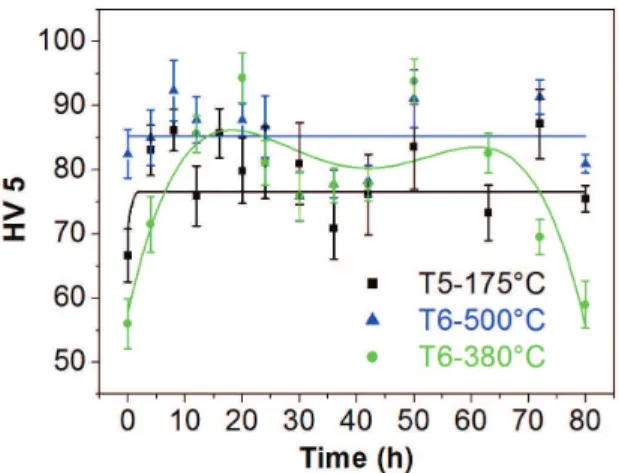
Figure 5 displays the age hardening behavior of the ZK60-1.5wt.%RE submitted to T5 and T6 treatments at 175 °C. The T5 ageing potential of the as-cast ZK60-1.5wt.%RE alloys is lower than that observed for the alloys containing 2.5wt.%RE (Figure 4) and the kinetics of the process is slower. This can be partially attributed to the different amounts of mischmetal in the alloys, but one must also consider the following: at the end of the casting process,
a ixed temperature (440 °C) was used for a inal quench
to bring all samples to room temperature. Because the Zn content of the alloy containing 1.5wt%RE is slightly higher than that of the alloy containing 2.5wt.%RE (see Table 1), the amount of liquid present in the ZK60-1.5wt.%RE alloy before quenching was higher in comparison with the ZK60-2.5wt.%RE alloy. This happens because at 440 °C, for the Zn contents given in Table 1, the alloys fall into the semi-solid region which lies left of the eutectic point in the binary Mg-Zn phase diagram. Still according to the Mg-Zn phase diagram, preferential segregation of Zn takes
place in the liquid phase with a partition coeficient k < 1.
This segregation becomes more intense as the temperature decreases in semi-solid interval. Thus, considerable solute depletion occurs in the α-Mg matrix leading to a lower potential for direct ageing as a consequence. The same
depletion of the α-Mg matrix is expected to occur with the
RE elements, also reducing the ageing potential. Hardness of the as-cast ZK60-1.5wt.%RE alloy is higher in comparison with the ZK60-2.5wt.%RE alloy because, with the higher fraction of liquid phase prior to quenching, the volume of intergranular precipitates is also increased. Finally, it is worth noticing that the application of a preliminary solution treatment (T6-500 °C and T6-380 °C) led to a maximum hardness close to 85HV and considerably faster ageing kinetics in relation to the T5 treatment.
The age hardening behavior of the ZK60-0.5wt.%RE alloy for T5 and T6 heat treatments is presented in Figure 6. Application of T5 heat treatment did not
result in strengthening for the same reasons listed above concerning the ZK60-1.5wt.%RE alloy. For the T6-380 °C treatment, 85HV hardness was achieved after 15h of heat treatment. This happens because in this alloy, given its low RE content, the majority of the precipitates are composed of Mg and Zn alone, which partially dissolve at 380 °C. The T6-500 °C treatment does not effectively produce precipitation hardening because the solution treatment at 500 °C targets the dissolution of RE containing precipitates, which occur in low amounts for the ZK60-0.5wt.%RE alloy.
4. Conclusions
- The ZK60-RE alloys exhibited two distinct precipitate morphologies: an eutectic lamellar structure formed by Zn containing phases and a smooth structure formed by RE containing phases;
- Increase in the amount of mischmetal leads to an increase in the fraction of the smooth precipitates; Figure 4. Hardness (HV5) as a function of heat treatment time
for the ZK60-2.5wt.%RE alloy submitted to ageing treatment at various temperatures.
Figure 5. Hardness (HV5) as a function of heat treatment time for the ZK60-1.5wt.%RE alloy submitted to ageing treatment at various temperatures.
- T4 solution heat treatments at 500 °C and 380 °C do not produce complete precipitate dissolution. At 380 °C the lamellar precipitates were dissolved whereas at 500 °C the smooth precipitates were dissolved;
- The age hardening behavior of the ZK60-2.5wt.%RE alloy and its increase in hardness at 175 °C are not
signiicantly inluenced by a previous solution heat
treatment, indicating that direct ageing (T5) would be the best option for heat treatment of this alloy for applications which demand mechanical strength.
- The age hardening behavior of the ZK60-1.5wt.%RE at 175 °C is accelerated by a previous partial solution
treatment. Direct ageing (T5) takes place at a much slower pace in this alloy in comparison with the ZK60-2.5wt.%RE alloy.
Acknowledgements
The authors acknowledge the funding of FAPESP, processes 2010/11391-2, 2011/09324-8, 2011/19218-0 and 2013/10937-0. This work was partially supported by the NanoCom Network Project, 7th Framework Program – IRSES – Project Nr. 247524. HP and LFB are CNPq fellows. The Rima Group is kindly acknowledged for providing the raw materials for casting the Mg alloy.
References
1. Mordike BL and Ebert T. Magnesium: properties-applications-potential. Materials Science and Engineering A. 2001; 302(1):37-45. http://dx.doi.org/10.1016/S0921-5093(00)01351-4.
2. Friedrich H and Schumann S. Research for a “new age of magnesium” in the automotive industry. Journal of Materials Processing Technology. 2001; 117(3):276-281. http://dx.doi. org/10.1016/S0924-0136(01)00780-4.
3. Kulekci MK. Magnesium and its alloys application in automotive industry. International Journal of Advanced Manufacturing Technology. 2008; 39(9-10):851-865. http:// dx.doi.org/10.1007/s00170-007-1279-2.
4. Froes FH, Eliezer D and Aghion E. The science, technology and applications of magnesium. Journal of the Minerals Metals & Materials Society. 1998; 50(9):30-34. http://dx.doi. org/10.1007/s11837-998-0411-6.
5. Koike J, Kobayashi T, Mukai T, Watanabe H, Suzuki M, Maruyama K, et al. The activity of non-basal slip systems and dynamic recovery at room temperature in fine-grained AZ31B magnesium alloys. Acta Materialia. 2003; 51(7):2055-2065. http://dx.doi.org/10.1016/S1359-6454(03)00005-3.
6. Ambat R, Aung NN and Zhou W. Evaluation of microstructural effects on corrosion behavior of AZ91D magnesium alloy.
Corrosion Science. 2000; 42(8):1433-1455. http://dx.doi. org/10.1016/S0010-938X(99)00143-2.
7. Luo A and Pekguleryuz MO. Cast magnesium alloys for elevated temperature applications. Journal of Materials Science. 1994; 29(20):5259-5271. http://dx.doi.org/10.1007/ BF01171534.
8. Lee YC, Dahle AK and StJohn DH. The role of solute in grain refining of magnesium. Metallurgical and Materials Transactions. A, Physical Metallurgy and Materials Science. 2000; 31(11):2895-2906. http://dx.doi.org/10.1007/ BF02830349.
9. Ono N, Nowak R and Miura S. Effect of deformation temperature on Hall-Petch relationship registered for polycrystalline magnesium. Materials Letters. 2004; 58(1-2):39-43. http://dx.doi.org/10.1016/S0167-577X(03)00410-5.
10. Chang W, Guo XW, Fu PH, Peng LM and Ding WJ. Effect of heat treatment on corrosion and electrochemical behaviour of Mg-3Nd-0.2Zn-0.4Zr alloy. Electrochimica Acta. 2007; 52(9):3160-3167. http://dx.doi.org/10.1016/j. electacta.2006.09.069.
11. Ben-Hamu G, Eliezer D, Shin KS and Cohen S. The relation between microstructure and corrosion behavior of Mg-Y-RE-Zr
alloys. Journal of Alloys and Compounds. 2007; 431(1-2):269-276. http://dx.doi.org/10.1016/j.jallcom.2006.05.075.
12. Sun M, Wu G, Wang W and Ding W. Effect of Zr on the microstructure, mechanical properties and corrosion resistance of Mg–10Gd–3Y magnesium alloy. Materials Science and Engineering A. 2009; 523(1-2):145-151. http://dx.doi. org/10.1016/j.msea.2009.06.002.
13. Li N, Liu JR, Wang SQ, Sheng SJ, Huang WD and Pang YT. Application of rare earth in magnesium and magnesium alloys.
Foundry Technology. 2006; 27(10):1133-1136.
14. Barnett MR, Sullivan A, Stanford N, Ross N and Beer A. Texture selection mechanism in uniaxially extruded magnesium alloys. Scripta Materialia. 2010; 63(7):721-724. http://dx.doi. org/10.1016/j.scriptamat.2010.01.018.
15. Wu A, Xia C and Wang J. Distribution, evolution and the effects of rare earths Ce and Y on the mechanical properties of ZK60 alloys. Journal of University of Science and Technology Beijing, Mineral, Metallurgy, Material. 2006; 13(5):424-428. http://dx.doi.org/10.1016/S1005-8850(06)60086-8.
16. Silva EP, Batista LF, Callegari B, Feierabend I, Buzolin RH, Coelho RS, et al. Casting in the semi-solid state of ZK60 magnesium alloy modified with rare earth addition. Advanced Materials Research. 2014; 922:694-699. http://dx.doi. org/10.4028/www.scientific.net/AMR.922.694.
17. Zhou HT, Zhang ZD, Liu CM and Wang QW. Effect of Nd and Y on the microstructure and mechanical properties of ZK60 alloy. Materials Science and Engineering A. 2007; 445-446(15):1-6. http://dx.doi.org/10.1016/j.msea.2006.04.028.
18. Ma Y, Zuo R, Tang A, Wang W, Zhang J and Pan F. Effect of yttrium on morphologies of precipitation phases along grain boundaries of as-cast ZK60 magnesium alloy. Materials Science Forum. 2005; 488-489:245-248. http://dx.doi. org/10.4028/www.scientific.net/MSF.488-489.245.
19. Chen Q, Shu D, Zhao Z, Zhao Z, Wang Y and Yuan B. Microstructure development and tensile mechanical properties of Mg-Zn-RE-Zr magnesium alloy. Materials & Design. 2012; 40:488-496. http://dx.doi.org/10.1016/j.matdes.2012.03.059.
20. Chen Q, Lin J, Shu D, Hu CK, Zhao Z, Kang F, et al. Microstructure development, mechanical properties and formability of Mg-Zn-RE-Zr magnesium alloy. Materials Science and Engineering A. 2012; 554:129-141. http://dx.doi. org/10.1016/j.msea.2012.06.025.
21. Zhao Z, Cheng Y, Chen Q, Wang Y and Shu D. Reheating and thixoforging of ZK60+RE alloy deformed by ECAE.
22. Liu D, Atkinson HV, Kapranos P, Jirattiticharoean W and Jones H. Microstructural evolution and tensile mechanical properties of thixoformed high performance aluminium alloys. Materials Science and Engineering A. 2003; 361(1-2):213-224. http:// dx.doi.org/10.1016/S0921-5093(03)00528-8.
23. Chen TJ, Wang RQ, Ma Y and Hao Y. Semisolid microstructure evolution of AZ91D magnesium alloy refined by Al-Ti-B.
Materials Research. 2011; 14(4):532-540. http://dx.doi. org/10.1590/S1516-14392011005000085.