Thermorregulation influences physiological, behavioral and ecological features in ectotherms (AVERY 1982, BAUWENSet al. 1996, SEEBACKER & FRANKLIN 2005). Behavioral mechanisms allow temperature regulation, including changes in activity times, the selection of thermally appropriate microhabitats, and postural adjustments (PORTER & GATES 1969, HUEY & SLATKIN 1976,
DUNHAMet al. 1989, ADOLPH 1990, ADOLPH & PORTER 1993, HERTZ et al. 1993, BAUWENSet al. 1996, TRACY & CHRISTIAN 1996, MELVILLE
& SCHULTE 2001, SEARS 2005). In lizards, thermoregulatory
be-havior and microhabitat selection are correlated because the thermal microclimates vary in space (BARTLETT & GATES 1967,
ROUGHGARDENet al. 1981, MELLA 2007), promoting intra and
in-terspecific differences (MARQUETet al. 1989, ADOLPH 1990, CORTÉS et al. 1992, HERTZet al. 1994, VERRASTRO & BUJES 1998, LABRAet al.
2001, 2008, LABRA & VIDAL 2003).
In most animal groups, sexual differences in morphologi-cal characters (sexual dimorphism) is a common phenomenon, particularly in body size. The direction of this difference, i.e., whether males or females are larger, differs between animal groups; in vertebrates males typically constitute the sex with larger body size (SCHOENERet al. 1982, SHINE 1986, FAIRBAIRN 1990,
1997, ANDERSSON 1994). Several proximate mechanisms have been
proposed to explain sexual dimorphism, such as differential mortality of sexes (STAMPS 1993) and different growth rates of sexes (WATKINS 1996); however, natural or sexual selection
re-mains the ultimate mechanism explaining sexual dimorphism (SHINE 1986, ANDERSON 1994, WATKINS 1998). In species with sexual
dimorphism, thermal behavior and microhabitat use have many ecological implications due to the displacement of sexes to fa-vorable or unfafa-vorable thermal sites (SCHEERS & VAN DAMME 2001,
VIDALet al. 2002) or they may determine a highly variable daily
pattern (WINNE & KECK 2004, RADDERet al. 2005).
Phymaturus palluma (Molina, 1782) is a high-mountain, ovoviviparous, saxicolous and herbivorous lizard (DONOSO-BARROS
1966, LAMBOROT & NAVARRO 1984) that inhabits niches between
31ºS and 38ºS in Chile (DONOSO-BARROS 1966, VIDAL 2008). This
lizard is exposed to harsh environments with cold and snowy winters and it hibernates throughout the winter and part of spring and autumn (DONOSO-BARROS 1966), which is a particular thermal strategy to enable it to withstand these environments.
Phymaturus palluma shows sexual size dimorphism (HABIT & ORTIZ
1994), and during the reproductive season (November to March,
Thermoregulation and activity pattern of the high-mountain lizard
Phymaturus
palluma
(Tropiduridae) in Chile
Marcela A. Vidal
1, 5; Evelyn Habit
2; Pedro Victoriano
3; Angélica González-Gajardo
4& Juan C. Ortiz
31 Laboratorio de Genómica y Biodiversidad, Departamento de Ciencias Básicas, Facultad de Ciencias, Universidad del Bío-Bío.
Casilla 447, Chillán, Chile. E-mail: [email protected]
2 Unidad de Sistemas Acuáticos, Centro Eula, Universidad de Concepción. Casilla 160-C, Concepción, Chile.
3 Departamento de Zoología, Facultad de Ciencias Naturales y Oceanográficas, Universidad de Concepción. Casilla 160-C,
Concepción, Chile.
4 Centro de Estudios Avanzados en Ecología y Biodiversidad, Departamento de Ecología, Facultad de Ciencias Biológicas,
Pontificia Universidad Católica de Chile. Casilla 114-D, Santiago, Chile.
5 Corresponding author.
ABSTRACT. Behavioral and physiological mechanisms of thermoregulation in ectotherms are conditioned by thermal constraints. These mechanisms may be even more restrictive when environmental conditions are unfavorable for indi-viduals, especially when sexual dimorphism segregates the sexes spatially. In order to understand behavioral and physi-ological regulation mechanisms, we investigated the thermal biology of Phymaturus palluma (Molina, 1782), a sexually size dimorphic, high–mountain lizard that inhabits extreme climatic conditions. P. palluma showed a bimodal activity pattern, a major peak in the morning (11:00-13:30h) and in the afternoon (15:30-18:00 h). The lizards were more active when substrate temperatures were between 25 and 28° C. The highest abundance was found around 27º C (between 11:00-12:30). Females showed greater activity than males in the early morning. Sub-adults and juveniles did not show differences in their activity pattern. There was a positive relationship between body temperature and air and substrate temperatures, suggesting typically thigmothermal regulation.
IBARGÜENGOYTÍA 2008) it forms hierarchic systems in which domi-nant males have a more extensive home range than females and juveniles (HABIT & ORTIZ 1996a,b). The spatial segregation in P. palluma may reflect differences in thermal strategies (VIDALet al.
2002, LABRAet al. 2008) because males would have access to
bet-ter resources than females and juveniles. To understand the be-havioral and physiological thermal mechanisms used by P. palluma in response to spatial segregation, we analyzed inter-sexual and age differences in daily activity patterns. If the rigor-ous environment exerts selection pressure on the thermoregula-tory traits in this species, and if also dimorphism determines the quality of the microhabitat used, then we expect to find that males and females have differences in their thermoregula-tory ability. We expect that females and juveniles, being at a thermal disadvantage compared to males, will be more efficient in the use of space and in their thermoregulatory ability.
MATERIAL AND METHODS
The study was performed during November-March (aus-tral spring and summer) in 1986-1987 and in 2002-2004 in La-guna del Laja National Park, Chile (37º20’S, 71º18’W, 1700 m.a.s.l.). To investigate the activity patterns of P. palluma, we established linear transects during the entire daily activity pe-riod of lizards (08:30 to 20:30 h). These transects were walked in opposite directions to minimize the probability of repeated counts of the same individual. For each lizard observed, sex, age class, and time of day were recorded. Additionally, one hundred and seven lizards (56 females and 51 males) were collected and thermal data were recorded. Upon capture, the following tem-peratures were recorded: body (cloacal, Tb), air (10 cm above the
substrate, Ta), and substrate (in contact with the surface, Ts) with a Cu-Constantan thermocouple (Cole Parmer® thermometer, ±
0.1º C). Sex and body size (snout-vent length, SVL) were recorded for each lizard. Body classes were defined as juveniles (males and females: 48.7-64.0 mm), subadults (males: 65.0-84.0 mm and females: 65.0-80.0 mm) and adults (males: >84.0 mm and females: >80.0 mm) according to HABIT & ORTIZ (1996a).
Differences in SVL between sexes and age classes were analyzed by two-way Analysis of Variance (ANOVA), followed by HSD-Tukey tests (ZAR 1999). Prior to ANOVA, homogeneity of variance and normality were tested by the Levene and Kolmogorov-Smirnov tests, respectively (SOKAL & ROHLF 1996). A
two-way ANCOVA was used to investigate Tb differences between sexes and age classes, using SVL as covariate. Variation in daily activity patterns between sexes was analyzed by a G test (ZAR
1999). Data were pooled in four blocks of three hours. The rela-tionship between the frequency of individuals and Ta and Ts was analyzed by Pearson correlation (SOKAL & ROHLF 1996). The
ther-moregulatory ability was estimated from the variance of Tb, and
from the slopes of the linear regressions (SOKAL & ROHLF 1996) between Tb and Ta and between Tb and Ts (HUEY 1982, PEREZ
-MELLADO & RIVA 1993). A slope equal to one indicates that
ani-mals are completely thermoconformers (BÁEZ & CORTÉS 1990).
RESULTS
Body size (SVL) differed significantly between sexes (F1,98 = 3.55, p < 0.05) and among age classes (F2,98 = 393.57, p < 0.001, Tab. I). All age classes were different (HSD – Tukey tests, p < 0.001). Contrary to the expected, Tb did not show significant
differences between sexes (F1,98 = 0.355, p > 0.05) or among age
classes (F2,98 = 1.06, p > 0.05). Lizards had a bimodal daily activity pattern; the frequency recorded in the morning (11:00-13:30 h) was greater than in the afternoon (15:30-18:00 h), and the high-est activity was observed at around 25° to 28° C (Fig. 1).
0
1
1:30 12:30
13:30 14:30 15:30 16:30 17:30 18:30 19:30
10:30
9:30
8:30
2 4 6 8 10 12 14 16 18 20
Daily Activity
T
emperature
°C
Observation
number
0 5 10 15 20 25 30 35 40
M F Ts Ta
Figure 1. Daily activity pattern of males (black bar) and females (white bar) of Phymaturus palluma. Mean values and standard deviation of air temperature (Ta, dashed line) and substrate tem-perature (Ts, solid line) are indicated.
The number of lizards observed at different times of day varied significantly. Females emerged earlier than males, when Ta and Ts had not exceeded 20º C (
2 = 10.6, p < 0.05), whereas
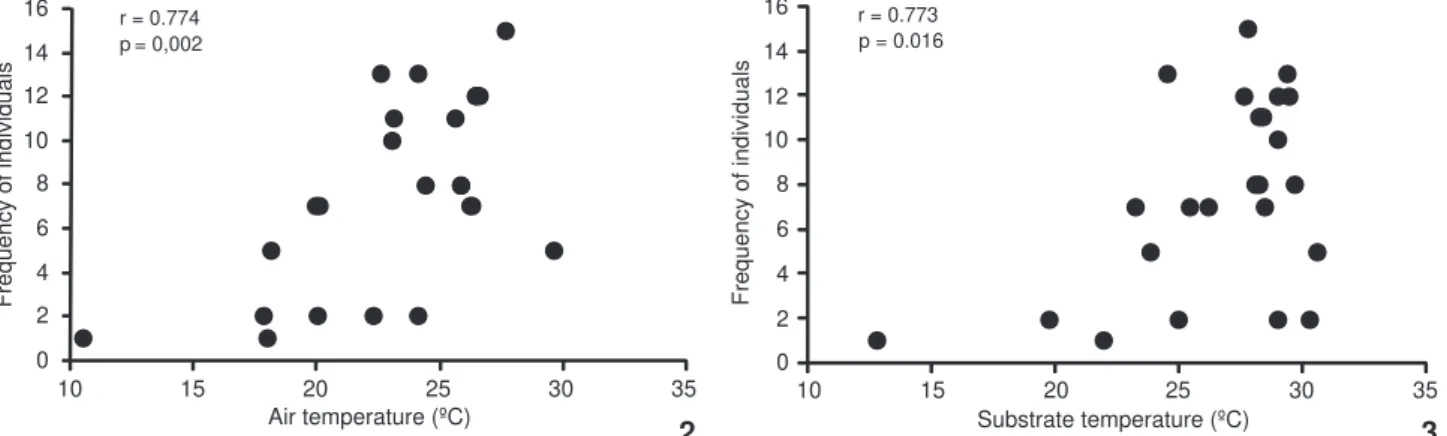
males were only active when the temperature was about 27° C (12:30-13:30 and 16:00-17:00 h). The frequency of individuals was positively correlated with Ta-Ts (Figs 2 and 3). Furthermore, significant relationships were found between Tb and Ta (Fig. 4) and between Tb and Ts (Fig. 5). The thermoregulatory ability
estimated showed that P. palluma is a thermodependent spe-cies because the slopes were positively related.
DISCUSSION
Thermal behavior and microhabitat selection are usually correlated with the spatial and temporal variability in thermal resources (PORTERet al. 1973, LABRA & VIDAL 2003). Phymaturus palluma showed a high thermoconformism, although many species that occur in highly fluctuating habitats are thermoregu-lators (VIDALet al. 2002, IBARGUENGOYTÍA 2005). This species has
costs are high in these cases, forcing individuals to maintain body temperature near the temperature of the environment (CRUZet al. 2009). These ecological constraints may be
com-pensated by behavioral thermoregulation (HERTZ & HUEY 1981,
VAN DAMMEet al. 1989, LEMOS-ESPINAL & BALLINGER 1995, HUEYet al. 2003). It is well known that lizards from cooler habitats can compensate the high cost of thermoregulation by increasing basking time and using microhabitats differentially (HERTZ &
0 2 4 6 8 10 12 14 16
10 15 20 25 30 35
Air temperature (ºC)
Frequency
of
individuals
r = 0.774 p = 0,002
Frequency
of
individuals
0 2 4 6 8 10 12 14 16
10 15 20 25 30 35
Substrate temperature (ºC) r = 0.773
p = 0.016
2
3
Figures 2-3. Frequency of lizards in relation to (2) air temperature and (3) substrate temperature in Phymaturus palluma.
10 15 20 25 30 35 40
10 15 20 25 30 35 40
Body
temperature
ºC
Air temperature Cº
r = 0.779**
10 15 20 25 30 35 40
10 15 20 25 30 35 40
Body
temperature
ºC
Substrate temperature Cº
r = 0.668**
4
5
Figures 4-5. Relationship between (4) body and air temperature (Tb-Ta), and (5) body and substrate temperature (Tb-Ts) in Phymaturus
palluma. rand p < 0.01 are indicated by **.
Table I. Descriptive statistics (mean ± standard deviation) of body size – snout-vent length (SVL, mm), body temperature (Tb), air temperature (Ta) and substrate temperature (Ts) of females and males of different age classes for P. palluma. (n) Sample size.
Age classes Sex n SVL Tb Ta Ts
HUEY 1981, CHRISTIANet al. 1983, DUNHAMet al. 1989, ADOLPH & PORTER 1993, 1996, BAUWENSet al. 1996). Additionally, lizards can change body posture and/or body orientation to the sun (BAUWENSet al. 1996, GVO•DÍK 2002), and change activity
pat-terns (VAN DAMMEet al. 1989, BAUWENSet al. 1996).
Phymaturus palluma showed a clear sex difference in ac-tivity patterns, but not in Tb. The overall, mean body tempera-ture of P. palluma was 29º C. This temperature is similar to that reported by IBARGUENGOYTÍA (2005) for P. patagonicus Koslowsky,
1898 although LABRA & VIDAL (2003) reported temperatures
around 22° C for P. palluma. They pointed out that the low body temperature is a consequence of constraints to ther-moregulation. In this context, P. palluma was found basking on rocks with the body surface exposed to the substrate. This may indicate that heat surface accounts for a greater percent-age of body temperature variance, and suggests a predominantly thigmotherm behavior such as that found in P. patagonicus
(IBARGÜENGOYTÍA 2005).
Body temperature is often influenced by activity time (PAULISSEN 1999) and the daily thermal cycle (WINNE & KECK 2004)
to maximize prey ingestion, digestive efficiency, reproduction and growth (IBARGÜENGOYTÍA 2005). We found that P. palluma
lizards had a bimodal daily activity pattern and most individu-als were active between 11:00-13:30 and between 15:30-18:00 h. In general, lizards are cool in the early morning just after they emerge from their refuges and warm up at different rates until they have reached the body temperature at which they will remain active for the rest of the day (HABIT & ORTIZ 1996b,
PAULISSEN 1999, IBARGUENGOYTÍA 2005, LABRAet al. 2008). We did
not find variation in Tb among age classes; the hierarchical so-cial behavior of P. palluma (HABIT & ORTIZ 1994) could imply changes in microhabitat use and the time spent, however, this was not determined in the field.
Several studies have pointed out that skin color in lizards plays an important role in thermoregulation, because darker reptiles are able to warm faster and maintain higher body tem-peratures (CRISPet al. 1979, BITTNERet al. 2002, LUTTERSCHMIDTet al.
2003, RANDRIAMAHAZO & MORI 2005). In many vertebrates, males
tend to be more colorful than the females, particularly during the reproductive season (COOPERet al. 1983, COOPER 1988, WATKINS
1997), whereas females tend to have the same colors as the sub-strate, decreasing the risk of predation, especially during preg-nancy (ENDLER 1978, COOPER & GREENBERG 1992, ANDERSON 1994,
WATKINS 1997, CUADRADO 2000, MACEDONIA et al. 2000). Males and
females of P. palluma showed sexual dimorphism in color pat-tern and morphology. In fact, females are darker and more flat-tened than males (DONOSO-BARROS 1966), thus they increase their area-volume relationship, being able to gain heat faster than the males. This agrees with IBARGUENGOYTÍA (2005) who suggested
that females of P. patagonicus have a greater control over heating than males, indicating some physiological control over heat gain and loss. On the other hand, the intersexual differences in daily activity patterns may be explained because dominant males have
to patrol an extensive home range to maintain the harem (FERGUSON 1970, WALDSCHMIDT & TRACY 1983). In addition, an ex-tensive home range allows them to have access to a greater avail-ability of thermal microhabitats for foraging activities than the females and juveniles (SCHEERS & VAN DAMME 2001, VIDALet al.
2002). Thus, females must display activities earlier to diminish the pressure of dominant males on microhabitat selection (BAUWENSet al. 1996, MELVILLE & SCHULTE 2001). Females emerge
earlier than males, possibly to occupy favorable microhabitats and increase a thermal opportunity for thermoregulatory be-havior. Although our results did not show age class differences in Tb, a clear temporal niche separation between males and
fe-males is obvious in P. palluma. The hierarchical social behavior of this lizard appears to influence intraspecific differences in microhabitat selection and in the time spent engaging in ther-moregulatory behavior and foraging activities (LABRAet al. 2008). In conclusion, our data support the hypothesis that daily activity patterns differ among sexes but not among age classes in P. palluma. Sex differences may probably be due to the hier-archical social system that induces mainly behavioral adjust-ments for thermal processes. We suggest that P. palluma uses a wide display of behaviors (but not physiological regulation) that allows individuals to thermoregulate above the ambient temperature, as has been found for P. patagonicus in Argentina (IBARGUENGOYTÍA 2005). According to STEVENSON (1985),
behav-ioral mechanisms contribute to changes in Tb that may be four to five times greater than those provided by physiological mechanisms. This is because behavior is seemingly more plas-tic than physiology.
ACKNOWLEDGEMENTS
We thank to Hector Ibarra-Vidal by the field assistance. This study was partly funded by NSF PIRE 05-533 to EH and PV and DIUC 205.113.067-1sp of the Universidad de Concepción.
LITERATURE CITED
ADOLPH, S. 1990. Influence of behavioral thermoregulation on microhabitat use by two Sceloporus lizards. Ecology7: 315-327.
ADOLPH, S. & W. PORTER. 1993. Temperature activity and lizard
life histories. American Naturalist 142: 273-295.
ADOLPH, S. & W. PORTER. 1996. Growth, seasonality, and lizard
life histories: age and size at maturity. Oikos77: 267–278. ANDERSON, M. 1994. Sexual selection. Princeton, Princeton
University Press, 599p.
AVERY, R.A. 1982. Field studies of body temperatures and
thermoregulation, p. 167-211. In: C. GANS & F.H. POUGH (Eds). Biology of Reptilia. New York, Academic Press, 536p. BÁEZ, C. & A. CORTÉS. 1990. Precisión de la termorregulación
conductual del lagarto neotropical Tropidurus quadrivittatus
BARTLETT, P. & D. GATES. 1967. The energy budget of a lizard on a tree trunk. Ecology48: 315-322.
BAUWENS, D.; P. HERTZ & A. CASTILLA. 1996. Thermorregulation in
a lacertid lizard: the relative contributions of distinct behavioral mechanisms. Ecology77: 1818-1830.
BITTNER, T.D.; R.B. KING & J.M. KERFIN. 2002. Effects of body size and melanism on the thermal biology of garter snakes (Thamnophis sirtalis). Copeia2002: 477-482.
CHRISTIAN, K.A.; C.R. TRACY & W. PORTER. 1983. Seasonal shifts in
body temperature and use of microhabitats by Galapagos land iguanas (Conolophus pallidus). Ecology64: 463-468. COOPER, W. 1988. Scelorporus undulatus consobrinus (southern
praire lizard) coloration. Herpetological Review19: 34. COOPER, W. & N. GREENBERG. 1992. Reptilian coloration and
behavior, p. 298-422. In: C. GANS & D. CREWS (Eds). Biology of the Reptilia, physiology and behavior. Chicago, University of Chicago Press, 423p.
COOPER, W.; C. ADAMS & J. DOBIE. 1983. Female color change in
the keeled earless lizard, Holbrookia propinqua, relationship to the reproductive cycle. Southwest Naturalist28: 275-280. CORTÉS, A.; C. BÁEZ; M. ROSENMANN & C. PINO. 1992. Dependencia térmica del teiido Callopistes palluma: una comparación con los iguánidos Liolaemus nigromaculatus y L. nitidus. Revista Chilena de Historia Natural65: 443-451.
CRISP, M.; L.M. COOK & F.V. HEREWARD. 1979. Color and heat
ba-lance in the Lizard Lacerta dugesii. Copeia 1979: 250-257. CRUZ F.B.; L. BELVER; J.C. ACOSTA; H.J. VILLAVICENCIO; G. BLANCO &
M.G. CANOVAS. 2009. Thermal biology of Phymaturus lizards:
evolutionary constraints or lack of environmental variation? Zoology 112: 425-432.
CUADRADO, M. 2000. Body colours indicate the reproductive status of female common chameleons: experimental evidence for the intersex communication function. Ethology106: 79-91. DONOSO-BARROS, R. 1966. Reptiles de Chile. Santiago, Ediciones
Universidad de Chile, 458p.
DUHAM, A.; B. GRANT & K. OVERALL. 1989. Interfaces between biophysical and physiological ecology and the population ecology of terrestrial vertebrate ectotherms. Physiological Zoology62: 335-355.
ENDLER, J. 1978. A predator’s view of animal color patterns. Evolutionary Biology11: 319-364.
FAIRBAIRN, D. 1990. Factors influencing sexual size dimorphism in temperate waterstriders. American Naturalist136: 61-86. FAIRBAIRN, D. 1997. Allometry for sexual size dimorphism: pattern
and process in the coevolution of body size in males and females. Annual Review of Ecology and Systematics28: 659-687.
FERGUSON, G. 1970. Matting behavior of the side-blotched lizards
of the genus Uta (Sauria: Iguanidae). Animal Behavior18: 65-72.
GVO•DÍK, L. 2002. To heat or to save time?. Thermoregulation in the lizard Zootoca vivipara (Squamata: Lacertidae) in different thermal environments along an altitudinal
gradient. Canadian Journal of Zoology80: 479-492. HABIT, E. & J.C. ORTIZ. 1994. Ámbito de hogar de Phymaturus
flagellifer (Reptilia, Tropiduridae). Boletín de la Sociedad de Biología (Concepción)65: 149-152.
HABIT, E. & J.C. ORTIZ. 1996a. Ciclo reproductivo de Phymaturus flagellifer (Reptilia, Tropiduridae). Boletín de la Sociedad de Biología (Concepción) 65: 149-152.
HABIT, E. & J.C. ORTIZ. 1996b. Patrones de comportamiento y
organización social de Phymaturus flagellifer (Reptilia, Tropiduridae), p. 141-154. In: J.E. PÉFAUR (Ed.). Herpetología Neotropical. Mérida, Universidad de los Andes, Consejo de Publicaciones, 451p.
HERTZ, P.E. & R.B. HUEY. 1981. Compensation for altitudinal
changes in the thermal environment by some Anolis lizards on Hispaniola. Ecology 62: 515-521.
HERTZ, P.; L. FLEISHMAN & C. ARMSBY. 1994. The influence of light intensity and temperature on microhabitat selection in two
Anolis lizards. Functional Ecology8: 720-729.
HERTZ, P.; R. HUEY & R. STEVENSON. 1993. Evaluating temperature
regulation by field-active ectotherms: the fallacy of the inappropiate question. American Naturalist142: 796-818. HUEY, R.B. 1982. Temperature, physiology, and the ecology of reptiles, p. 25-91. In: C. GANS & F.H. POUGH (Eds) Biology of Reptilia. New York, Academic Press, 536p.
HUEY, R.B. & M. SLATKIN. 1976. Cost and benefits of lizard
thermoregulation. Quarterly Review of Biology 51: 363-384. HUEY, R.B.; P.E. HERTZ & B. SINERVO. 2003. Behavioral drive versus behavioral inertia in evolution: a null model approach.
American Naturalist161: 357-366.
IBARGÜENGOYTÍA, N.R. 2005. Field, selected body temperature and
thermal tolerance of the syntopic lizards Phymaturus patagonicus and Liolaemus elongates (Iguania: Liolaemidae).
Journal of Arid Environmental62: 435-448.
KOSLOWSKY, J. 1898. Enumeración sistemática y distribución de
los reptiles argentinos. Revista Museo La Plata 8: 161-200. LABRA, A. & M.A. VIDAL. 2003. Termorregulación en reptiles: un veloz pasado y un futuro lento, p. 207-224. In: F. BOZINOVIC
(Ed.). Fisiología Ecológica y Evolutiva. Teoría y Casos de Estudio en Animales. Santiago, Ediciones Universidad Ca-tólica de Chile, 531p.
LABRA, A.; M. SOTO-GAMBOA & F. BOZINOVIC. 2001. Behavioral and
physiological thermorregulation of Atacama desert-dwelling
Liolaemus lizards. Ecoscience8: 413-420.
LABRA, A.; M.A. VIDAL; R. SOLIS & M. PENNA. 2008. Ecofisiología de
anfibios y reptiles, p. 483-516, In: M.A. VIDAL & A. LABRA (Eds). Herpetología de Chile. Santiago, Science Verlag, 593p. LAMBOROT, M. & J. NAVARRO. 1984. Karyotypes and sex determination
in Phymaturus flagellifer Molina (Iguanidae). Herpetologica40: 258-264.
LEMOS-ESPINAL, J.A. & R.E. BALLINGER. 1995. Comparative thermal
ecology of the high-altitude lizard Sceloporus grammicus on the eastern slope of the Iztaccihuatl volcano, Puebla, Mexico.
LUTTERSCHMIDT, D.I; W.I. LUTTERSCHMIDT & V.H. HUTCHISON. 2003. Melatonin and thermoregulation in ectothermic vertebrates: a review. Canadian Journal of Zoology 81: 1-13
MACEDONIA, J.M.; S. JAMES; L.W. WITTLE & D. CLARK. 2000. Skin
pigments and coloration in the jamaican radiation of Anolis
lizards. Journal of Herpetology34: 99-109.
MARQUET, P.; J.C. ORTÍZ; F. BOZINOVIC & F. JAKSIC. 1989. Ecological aspects
of thermorregulation at high altitudes: the case of Andean
Liolaemus lizards in northern Chile. Oecologia81: 16-20. MELLA, J. 2007. Reptiles en el Monumento Natural El Morado
(Región Metropolitana, Chile): abundancia relativa, distribución altitudinal y preferencia por rocas de distinto tamaño. Gayana 71: 16-26
MELVILLE, J. & J. SCHULTE II. 2001. Correlates of active body
temperatures and microhabitat occupation in nine species of central Australian agamid lizards. Austral Ecology 26: 660-669.
MOLINA, G.I. 1782. Saggio sulla Storia Naturale del Chili.
Stamperia di S. Tommaso d’Aquino, Bologne, 368p. PAULISSEN, M.A. 1999. Thermal biology of the parthenogenetic
whiptail lizards of the Cnemidophorus laredoensis complex (Sauria: Teiidae) in Southern Texas. Texas Journal of Science 51: 37-48.
PEREZ-MELLADO, V. & I. DELA RIVA. 1993. Sexual dimorphism and
ecology: the case of a tropical lizard, Tropidurus melanopleurus
(Sauria: Tropiduridae). Copeia1993: 969-976.
PORTER, W. & D. GATES. 1969. Thermodynamic equilibria of animals with environment. Ecological Monograph39: 245-270. PORTER, W.; J. MITCHELL; W. BECKMAN & C. DEWITT. 1973. Behaviorals
implications of mechanistic ecology. Oecologia13: 1-54. RADDER, R.S.; S.K. SAIDAPUR & B.A. SHANBHAG. 2005. Population
density, microhabitat use and activity pattern of the Indian rock lizard, Psammophilus dorsalis (Agamidae). Current Science 89: 560-566
RANDRIAMAHAZO, H.J.A. & A. MOKI. 2005. Factors affecting the
intra-populational variation in dorsal color pattern of an Iguanian lizard, Oplurus cuvieri cuvieri. Current Herpetology 24: 19-26.
ROUGHGARDEN, J.; W. PORTER & D. HECKEL. 1981. Resource
partition-ing of space and its relationship to body temperature in
Anolis lizard population. Oecología50: 256-264.
SCHEERS, H. & R. VAN DAMME. 2001. Micro-scale differences in thermal quality and a possible case of evolutionary flaxibility in the thermal physiology of lacertid lizards. Oecologia132: 323-331. SCHOENER, T.; J. SLADE & C. STINSON. 1982. Diet and sexual
dimorphism in the very catholic lizard genus, Leiocephalus,
of the Bahamas. Oecologia 53: 160-169.
SEARS, M.W. 2005. Geographic variation in the life history of
the sagebrush lizard: the role of thermal constraints on activity. Oecologia 143: 25-36.
SEEBACHER, F. & C.E. FRANKLIN. 2005. Physiological mechanisms of thermoregulation in reptiles: a review. Journal of Comparative Physiology B 175: 533-541.
SHINE, R. 1986. Sexual differences in morphology and niche
utilization in an aquatic snake, Acrochordus arafurae. Oecologia 69: 260-267.
SOKAL, R. & F.J. ROHLF. 1996. Biometry: the principles and practice of Statistics in Biological Research. New York, W.H. Freeman, 773p.
STAMPS, J.A. 1993. Sexual size dimorphism in species with
asymptotic growth after maturity. Biological Journal of the Linnean Society 50: 123-145.
STEVENSON, R.D. 1985. The relative importance of behavioral and
physiological adjustments controlling body temperature in terrestrial ectotherms. American Naturalist 126: 362-386. TRACY, R. & K. CHRISTIAN. 1996. Ecological relations among space,
time, and thermal niche axis. Ecology67: 609-615. VAN DAMME, R.; D. BAUWENS; A.M. CASTILLA & R.F. VERHEYEN. 1989.
Altitudinal variation of the thermal biology and running performance in the lizard Podarcis tiliguerta. Oecologia80: 516-524.
VERRASTRO, L. & C. BUJES. 1998. Rhythm of activity of Liolaemus occipitalis (Sauria, tropiduridae). Revista Brasileira de Bio-logia 15: 913-920.
VIDAL, M. 2008. Biogeografía de anfibios y reptiles, p. 195-231. In: M.A. VIDAL & A. LABRA (Eds). Herpetología de Chile.
San-tiago, Science Verlag, 593p.
VIDAL, M.; J.C. ORTIZ & A. LABRA. 2002. Sexual and age differences
in ecological variables of the lizard Microlophus atacamensis
(Tropiduridae) from Northern Chile. Revista Chilena de Historia Natural75: 283-292.
WALDSCHMIDT, S. & R. TRACY. 1983. Interactions between a lizard and its thermal environment: implications for sprint performance and space utilization in the lizard Uta stansburiana. Ecology64: 476-484.
WATKINS, G.G. 1996. Proximate causes of sexual size dimorphism in the Iguanian lizard Microlophus occipitalis. Ecology 77: 1473-1482.
WATKINS, G. 1997. Intersexual signalling and the functions of
female coloration in the Tropidurid lizard Microlophus occipitalis. Animal Behavior53: 843-852.
WATKINS, G.G. 1998. Function of a secondary sexual ornament: the crest in the South American iguanian lizard Microlophus occipitalis (Peters, Tropiduridae). Herpetologica 54: 161-169. WINNE, C.T. & M.B. KECK. 2004. Daily activity patterns of
Whiptail Lizards Squamata: Teiidae: Aspidoscelis: a proximate response to environmental conditions or an endogenous rhythm? Functional Ecology 18: 314-321.
ZAR, J. 1999. Biostatistical analysis. New Jersey, Prentice Hall,
663p.