2018 Global Marketing Conference at Tokyo Proceedings: 1352-1362 (July 2018) https://doi.org/10.15444/GMC2018.11.05.04
FASHION BRANDS COMMUNICATING AND INTERACTING IN INSTAGRAM: A NETNOGRAPHY APPROACH
Sandra Maria Correia Loureiro, Instituto Universitário de Lisboa (ISCTE-IUL) and Business research Unit (BRU/UNIDE), Portugal1
Jessica Serra, Instituto Universitário de Lisboa (ISCTE-IUL), Portugal2
João Guerreiro, Instituto Universitário de Lisboa (ISCTE-IUL) and Business research Unit (BRU/UNIDE), Portugal3
ABSTRACT
The study aims to analyze and compare how fashion brands of different categorization communicate in Instagram. Six global brands (Zara, H&M, Prada, Gucci, Nike, and Adidas) are chosen to be analyzed due to their different type/category of brands and their worldwide recognition. Netnography concept and method is used to conduct the data collection and data analyze during a period of time of six mouth. The results show that overall fast fashion brands (Zara and H&M) emerge to be more effective than other fashion categories in online communication. The Haute-de-couture brands (Prada and Gucci) reveal to be very similar in the way they communicate, demonstrating a good level of interactivity with consumers. The Sports brand (Nike and Adidas) have a low level of communication with the consumers and low number of photos and videos uploaded, which results in an average online communication of the brands in Instagram. This research highlights that to be successful in the online communication, fashion brands must be always updating photos and videos, they need to interact with consumers and make them feel a part of the brand, use celebrities to give more notoriety to the brand and be always present in the latest trends.
Keywords: fashion brands, online communication, instagram, netnography Introduction
The fashion industry is very competitive. Brands need to adjust the communication and promotion regarding the changes due to the use of internet (Nicky, 2014). For this reason, brands tend to have their own online platform, where customers can interact and be a part of the company. These online platforms can also provide information and compare information helping customers to save time and money. Customers are also more active in trying to get information and so brands tend to update news and launch new products more often. That can provide shared values leading to a positive impact on trust and an opportunity for organizations to improve customer relationships (Nicky, 2014; Loureiro, Pires, & Kaufmann, 2015; Loureiro & Gomes, 2016).
In this vein, the current study aims to analyze and compare how fashion brands of different categorization communicate in Instagram. Six global brands (Zara, H&M, Prada, Gucci, Nike, and Adidas) are chosen to be analyzed due to their different type/category of brands and their worldwide recognition. Netnography concept and
2
method is used to conduct the data collection and data analyze during a period of time of six mouth (Kozinets, 2010). Our research question is: How can we perceive
whether or not fashion brands are being successful in terms of online communication in the Instagram?
The remainder of this article is structured as follows. Second section provides the literature review, Third and fourth sections present the methodology and results. Finally, conclusions, implications and further research are presented.
Theoretical background
Shopping motivations
Babin et al. (1994) argue that the shopping motivations are associated to consumers’ values towards shopping and the pleasure they get. Shopping is perceived to be driven by a need to acquire a specific product with a specific cognition purpose (Forsythe & Bailey, 1996). Yet, shopping can also be an hedonic activity, in which consumers examine factors like: shopping for leisure and recreation, the emotional roles of mood and pleasure (Hoffman and Novak, 1996). Thus, consumers shopping because of both utilitarian and hedonic motivations.
Utilitarianism is directly related to a rational view, meaning that the utilitarian shopping motivations are task-oriented, rational, and cognitive, with clear intentions/ desire to purchase a product efficiently and rationally (Babin et al., 1994). On the other hand, a desire motivates hedonism to have fun and be playful, that corresponds to the experiential values of shopping: fantasy, arousal, sensory stimulation, enjoyment, pleasure, curiosity, and escapism (Scarpi, 2006). People may use shopping to relax, and improve the negative mood, or to buy a special treat (Arnold & Reynolds, 2003). Some consumers can even be motivated to shopping because wants to give pleasure or gifts to others to make himself happier. Other consumers are motivated by the discounts and sales and the enjoyment of finding bargains and reduced prices, which correspond to a game to be won or conquered. Social shopping motivations is considered for the people that shop to maintain their membership in social groups. Finally, consumers could also have a goal to learn new styles and keep up with trends.
Fashion and the internet
Finkelstein (1998) describes fashion as one of the social forces which keeps us ever attentive to the present in one of the worst possible ways; that is, as a source of novelty, distraction, and self-absorption. Another definition of fashion come from Kefgen and Touchie-Specht (1986) that describes as a style that a large group of people accepts during a specific period. Shopping for fashion may be encouraged by using Internet. Social media networks could stronger the relationship with consumers (e.g., Facebook, Twitter, Pinterest, Instagram, Blogs, and YouTube) by helped brands to enlarge and connect with the audience (Kim & Ko, 2012).
The Word of mouth (WOM) is a strong source of information that has huge influence for consumers. In the social media context, WOM can also be online and becomes viral and very powerful information (Alreck & Settle, 1995). For social media users, the promotion of WOM is amplified, they benefit from news, information, entertainment in an online community, and consider suggestions and recommendations from friends (Brogi et al., 2013). With the amount of information that is posted daily, consumers are not able to determine their veracity, which originates people to exchange views (Alreck & Settle, 1995). In the online platforms, consumers can discuss their before and after purchase experience, and give recommendations to other consumers regarding purchase decisions and product quality (Muralidharam et al., 2017).
Typology of fashion
Following Tungate (2008), we may find different categories of fashion brands, such as: haute couture brands, high-fashion brands, fast-fashion brands and sports brands. According to Barnes and Lea-Greenwood (2006), fast fashion is a consumer-driven approach that intends to reduce the number of processes in the buying cycle and getting fashion products into stores to fulfil the consumer demand. Retailers invented the term Fast Fashion to show how fashion trends change rapidly (Brooks, 2015), retailers such as H&M and Zara adopted the business strategy, always refreshing their products with new styles and catching the media and consumers attention towards the brand (Rosenblum, 2015). Fast fashion brands are defined as a business model that combines three elements: quick response, frequent changes, and fashionable designs at affordable prices (Caro & Martínes-de-Albéniz, 2014).
Sports brands are conceptualized as clothing designed for, or that could be used in active sports. Consumers claim that they purchase with such brands for the intention of using the apparel in active sport (Newbery, 2008). A sport brand is described by a name, design, symbol, or any combination that a sport organization or individual athlete uses to help differentiate its products from the competition (Aaker, 1991). Sports brands include a variety of sport-specific products such as: leagues, teams, events, media companies, athletes, sporting goods, services, and the sport itself (Hoye & Parent, 2017). In each category, certain characteristics associate specific brands: (i) Chanel, Prada, Dior, and Gucci are considered haute couture brands; (ii) Massimo Dutti, COS, Hackett are considered high-fashion brands; (iii) Zara, H&M, Pull & Bear, Asos are considered fast-fashion brands; (iv) Nike, Adidas, Reebok, New Balance are considered sports brands.
Methodology
Kozinets (2010) argues that netnography is participant-observational research based in online fieldwork, that uses computer communications to source data as an accomplishment for the ethnographic understanding and representation of a cultural or communal phenomenon. Netnography is considered a marketing research technique, that uses the information publicly available in online forums to identify and understand the needs and decision influences of relevant online consumer groups (Kozinets, 2002). Based on Kozinets (2010), we consider five main steps. The first is the definition of the problem or the topic of research and the social network to be used. Kozinets (2010) claims that social networking sites are excellent examples of online platform to implement the netnography because they combine: web-page, private email, blog, forums, and chat rooms access. Thus, we select the Instagram as the platform where we analyze and compare how fashion brands of different categorization communicate in Instagram.
In the second Step, we choose six brands to analyze: Zara, H&M, Prada, Gucci, Nike, and Adidas. These brands are chosen for their notoriety and worldwide distribution, and the Instagram account that will be studied are global accounts. We paired the brand according to their fashion category to allow the comparison, that is, Zara and H&M will be compared regarding fast fashion brands, Prada and Gucci regarding luxury brands and Nike and Adidas regarding sports brands.
In the third step, we use the criteria proposed by Russmann and Svensson (2016) to collect data, that is, congregate data considering four clusters: perception, image management, integration, and interactivity. First, perception considers three components: perspective, broadcasting and mobilization. Perspective means that pictures can be published instantly from smartphones and tablets, which can raise a
question as to if the organization is posting a professional photo or selfie-like. Russman and Svensson (2016) coded the perspective of the perceived post, as an
official photo of the organization context or a snapshot/selfie context, if they don’t
apply they coded as not applicable. Posting are coded as broadcasting (refers to posts that diffuse information on statements, facts, performances, opinions, and ideas), or not broadcasting, and if not evident is balanced/ambivalent. In mobilization, the coding is referred to if the organization is focused in mobilizing and activates the audience. The posts are coded as mobilizing when more than 50% of the elements of the post have a mobilizing character and not mobilizing if less than 50% of the elements of the post have a mobilizing character. If not clear the code is
Balanced/ambivalent.
Regarding image management, the brand communication depends on the image management, since images influence how individuals see the products and the services, which influences in the brand image, and identification (Fahmy et al., 2014). Image management comprises three aspects: personalization, privatization and
celebrities.
In personalization, the coding is that postings are primarily carried by one or more
single individual(s) (personalized) and postings that are primarily carried by many people or those that do not show any people (not personalized). If not clear the code is Balanced/ambivalent. The code of privatization focuses on professional context or in
a privatized /personal context. If not clear the code is Balanced/ambivalent. Celebrities are very important in marketing; many organizations use celebrities to gain the attention of the consumers. If there are celebrities identified, the posts are coded as
celebrity visible and not visible if there are no celebrities.
The question regarding integration is whether the Instagram is integrated in existing information and communication mix. Integration groups three aspects: hybridity,
shared content and campaign reference. The coding of hybridity is to differentiate if
the posts are explicit offline media reference in the picture or if they are explicit new
media reference (hashtags). If neither applies, then the code is no explicit reference.
In sharing content, the coding is to differentiate if the posts are not shared (original from Instagram) or shared (if the post had already been posted offline or on the organization’s other social media accounts). Finally, the coding for campaign
reference is to distinguish if the campaigns are explicit campaign refences (hashtags)
or no explicit campaign reference.
A main attraction of Instagram is the interactivity of consumers with the brands, empowering consumers for online debates and participation in decision-making process. This last criterion consists of three components: content of captions and
comments, negative vs positive tonality, reciprocity. In content of captions and comments Russman and Svensson (2016) differentiate the variable between emoticons,
comments with intrinsic value and without intrinsic value. Emotions are applied if the posts display mood trough emoticons; posting with intrinsic value is when the posting has relevant and substantive information, such as opinion, statement on current events; and without intrinsic value if the comment is encouragement or nonsense.
In negative vs positive tonality, all consumer’s posts that display critiques, conflict, scandals, pessimism, are coded negative, and posts with smileys, success, pleasant developments, approval are coded as positive. If the post contains no negative or positive comments or they are not distinguished, then it is neutral/ambivalent. Finally, for reciprocity, if the organization or the followers react to other’s people’s comments or not by answering to any questions or giving their opinion, the code is recorded and to the reaction being related to a comment or not related to a comment.
According to Kozinets (2010) data analysis incorporates the entire process of turning the data collected into a research representation such as: article, book, presentation, or report. Thus, in fourth step, we collect the number of followers, following, posts photos and videos, as well as, the celebrities image present and the consumer-brand interaction. The final step regards the report of the results.
Results
The data collection is done based on aspects that influence the success of the brand communication and interaction with the consumers. We compare brands from: a) Fast Fashion- Zara and H&M; b) Haute de Couture- Prada and Gucci; c) Sports Brands- Nike Women and Adidas.
Data collection is referred to a period of 6 months, from January to June of 2017. Every brand is studied with the objective to analyze if the communication and interaction is good. This data will be interpreted regarding to the following aspects: (1) the number of followers, following, posts photos and videos, (2) celebrities in the divulgation of the photos, (3) brand interaction with the customers in the comments, (4) a table with variables of Russmann & Svensson (2016).
Figure 1 shows that H&M tend to have has more videos and more photos than Zara. The difference between the numbers are very high, the highest number of photos published by Zara is 40, from H&M is 70. About the videos, the highest number of Zara is 8 and H&M is 30.
Figure 1. Comparison of Zara VS H&M
H&M emerges as more active than Zara in posting a photos and videos in Instagram. Zara doesn’t use any celebrities in Instagram, but H&M does. H&M use famous celebrities such as bloggers, actors, models, and singers for their endorsements, giving the brand visibility and credibility. H&M also creates potential outfits with the clothes of the brand, helping the consumers to visualize the outfits in their own bodies,
18 40 33 37 29 15 62 53 64 60 70 67 5 5 8 8 7 6 17 17 30 21 23 16 0 10 20 30 40 50 60 70 80
January February March April May June
Zara VS H&M
leaving an imagination feature to be established in the consumers’ minds (see figure 1).
The importance of the consumers when following a brand is that the content is relevant and that the interaction between brand and consumers is strong, H&M responds to the comments of the consumers regarding to questions of launches, stores, collections and many more topics. This feature of H&M is a positive one, because consumers get the responses that they are looking for and the sense of belonging in the online community.
Finally, H&M uses photos with bloggers and models in the Coachella Festival, a world known Festival of Music that gets a lot of attention, smart move from H&M because all young people want to be updated with the latest trends and Coachella is one of them. This gives H&M the appearance with what is in, and the consumers like those updated brands.
Zara lacks a lot of things that H&M uses to divulge the brand in the Instagram account, they need to be more interactive and in the latest trend.
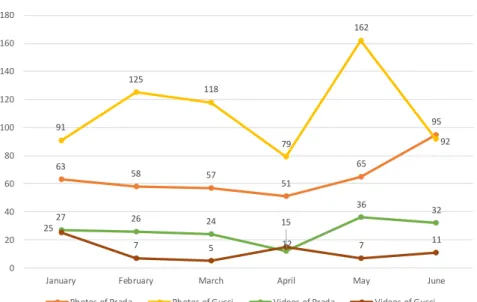
Assessing figure 2, it is noticeable that Gucci has the highest number of photos in almost every month. Prada has less photos but still a relevant number of photos published in a period of 6 months. The highest number of photos published by Prada is 92, and from Gucci is 162. Prada has the highest number of videos published in this 6 months, with 36 has the maximum number and Gucci with 25 videos.
Figure 1. Comparison of Prada VS Gucci
Both brands have a high number of photos and videos, giving a lot of movement and interaction in the Instagram account, and entertaining the consumers that follow the accounts. Both brands also have strong ambassadors to advertise the new collections which gives the brand high attention and publicity when famous celebrities re the faces of the campaigns. Because the brands are haute de couture, a lot of celebrities use the outfits in galas and important events. When celebrities are spotted in an important event with Prada or Gucci’s outfits, the brands publicize in their Instagram accounts the photos, which is easier for people to see that the brand is wearable and exclusive.
In the description of the photos or tagged in the photos are the designers of the collection, piece or accessory in both Prada and Gucci’s Instagram. By mentioning the designer, they value their work and potential.
63 58 57 51 65 95 91 125 118 79 162 92 27 26 24 12 36 32 25 7 5 15 7 11 0 20 40 60 80 100 120 140 160 180
January February March April May June
Prada VS Gucci
One positive aspect of Gucci is that in March they created a campaign with a lot of jokes (memes) regarding the new Gucci watch, this can transpire a humoristic side of Gucci, and a funny way to publicize the watch. Giving a fun look and updated to the brand that uses humoristic memes to communicate with their consumers.
As for the pair Adidas and Nike (see figure 3), Adidas has the highest number of photos and videos throughout the 6 months. Nike Women has a week interaction regarding both the photos and the videos, also doesn’t have any famous celebrities associated in the Instagram reducing the dynamics of the account.
Figure 2. Comparison of Nike and Adidas
Adidas uses celebrities from the sport world, which gives the brand the right ambassadors and great publicity to the brand. They also use hashtags in the photos, which gives the consumers an easier way to get the information about their products. The campaign that stands out the most about Adidas, is the one with Snoop Dogg, although he is not a celebrity from the sport world, he is a well-known rapper with a lot of fans. Adidas has visibility and notoriety by using Snoop Dogg as the ambassador of that campaign.
Regarding the four clusters proposed by Russman and Svensson (2016), table 4 shows that luxury fashion brands tend to be better than other categories for the first (perception). Luxury fashion brands reveal to be better in mobilization than other categories of brands. They try to mobilize their customers to buy fashion items and participate in the creation of new ones. In what concerns to image management the six brands do not reveal dramatical differences. They are very similar in their endeavor to manage their audience’s impression of them. The same similarity occurs in the cluster integration. Finally, the cluster interactivity emerges as more effective in the case of H&M brand.
Conclusions and implications
This study explores the online communication of fashion brands in Instagram. Using netnography, we found some important aspects for the good running of the Instagram’s account. We may find three main factors that influence a brand to be very good and liked by the general consumers, such as: the interaction of brand and consumers in the publications of the brand, the constant and consistent update of photos and videos with relevant content and use celebrities to advertise the products and campaigns of the brand.
According to the 3 main factors described above, H&M is the best brand communicating with the audience, fulfilling every aspect that matters to be successful
5 0 4 4 2 1 12 9 8 11 4 9 4 1 1 0 1 1 18 14 13 6 5 3 0 2 4 6 8 10 12 14 16 18 20
January February March April May June
Nike Women VS Adidas
and recognized. Nike is the worst brand communicating, with very poor content and a very low number of photos and videos. The other brands have fulfilled almost every aspect that describes success for Instagram accounts communication. While doing the data analysis is determined that luxury brands have a high number of photos in the space of 6 months comparing to fast-fashion and sport brands.
The variables proposed by Russmann and Svensson (2016) are very crucial to understand if the communication is being well done or not. Perception, image management, integration, and interactivity are clusters that must be consider when evaluating Instagram communication.
Regarding theoretical implications, brands need to have a good interaction with consumers, constant update and celebrities as ambassadors to give credibility and notoriety to the brand. Considering managerial implications, the brands studied should engage and interact with consumers in the comments, answering their questions and be always alert to new trends, festivals, big events that matter to their target, so that they show concern to aspects that will occur throughout the year.
Although the study has been carried out with rigor and attention, some limitations must be pointed out, which can also be avenues for further research. One of the limitations observed was the limited period to collect data, that is six mouths. Further research can be conducted for periods of several years and evaluate the progress of the fashion brand in Instagram or other social media platforms.
Considering the brands chosen for the study, it is very difficult to find online communities of the brands like websites with a specific online community of each brand. Since Instagram is opened to all consumers and all the brands have pages, the decision to use the brands accounts of Instagram was the obvious choice.
For future researches, it would be important to conduct the same study but with different brands in Facebook context, and compare what are the factors that prove whether or not the online communication of those brands is being successful or not. References
Aaker, D. A. (1991). Managing brand equity: Capitalizing on the value of a brand name. New York: The Free Press.
Alreck, P. L., & Settle, R. B. (1995). The importance of word-of-mouth communications to service buyers. Proceedings of American Marketing
Associations. 188-193.
Arnold, M. J., & Reynolds, K. E. (2003). Hedonic shopping motivations. Journal of
Retailing. 79, 77-95.
Arnold, M. J., Reynolds, K. E., & Lueg, J. E. (2005). Customer delight in a retail context: investigating delightful and terrible shopping experiences. Journal of
Business Research. 58(8), 1132-1145.
Babin, B. J., Daren, W. R., & Griffen, M. (1994). Work and/or fun? Measuring hedonic and utilitarian shopping value. Journal of Consumer Research. 20(4), 644-656.
Barnes, L., & Lea-Greenwood, G. (2006). Fast Fashioning the supply chain: Shaping the research agenda. Journal of Fashion Marketing and Management. 3(10), 259-271.
Bergstrom, T., & Backman, L. (2013). Marketing and PR in social media: how the
utilization of Instagram builds and maintains customer relationship.
Braimllari, A., & Sala, E. (2017). Internet use for learning by the undergraduate students of University of Tirana in Albania. International Conference
Proceedings.
Brakus, J., Schmitt, B. H., & Zarantonello, L. (2009). Brand experience: what is it? How is it measured? Does it affect loyalty? Journal of Marketing, 73(3), 52-58. Brogi, S., Calabrese, A., Campisi, D., Capece, G., Costa, R., & Pillo, F. D. (2013).
The effects of online brand communities on brand equity in the luxury fashion industry. International Journal of Engineering Business Management, 5, 1-9. Brooks, A. (2015). Clothing poverty: The hidden world of fast fashion and
second-hand clothes. London: Zed Books Ltd.
Caro, F. & Martínez-de-Albéniz, V. (2014). Fast Fashion: business model overview and research opportunities. In N. Agrawal & S. A. Smith (Eds.) Retail Supply
Chain Management: Quantitative Models and Empirical Studies, 1-30. New
York: Springer.
Chante, K., Jessica, C., Lindsay, B., Tyler, Q., &Robert, P. D. (2014). Dermatology on Instagram. Dermatology Online Journal. 20(7), 1-6.
Chevalier, M. & Mazzalovo, G. (2008). Luxury brand management: A world of
privilege. Singapore: Wiley & Sons.
Childers, T. L., Christopher, L. C., Peck, J., & Carson, S. (2001). Hedonic and utilitarian motivations for online retail shopping behaviour. Journal of Retailing, 77: 511-535.
Christodoulides, G. (2009). Branding in the post-internet era. Marketing Theory, 9(1): 141-144.
Constantin, I., & Belgiu, C. G. (2017). The effect of promoting brands through the facebook network. Postmodern Openings, 8(1), 111-119
Cresswell, J. W. (2009). Research Design: Qualitative, Quantitative, and Mixed Methods Approaches. Thousand Oaks: Sage.
Doherty, N. F., & Ellis-Chadwick, F. E. (2006). New perspectives in internet retailing: a review and strategic critique of the field. International Journal of Retail &
Distribution Management, 34(4/5), 411-428.
Dong-Mo, K., Jae-Jin, K., & Sang-Hwan, L. (2008). Personal values as underlying motives of shopping online. Asia Pacific Journal of Marketing and Logistics. 20(2), 156-173.
Erdem, O., Ben, O. A., & Tuncalp, S. (1999). Consumer values and the importance of store attributes. International Journal of Retail & Distribution Management. 27(4), 137-144.
Ergul, S. A., Machleit, K. A., & Davis, L. M. (2001). Atmospheric qualities of online retailing- A conceptual model and implications. Journal of Business Research. 54, 177-184.
Fahmy, S., Bock, M. A., & Wanta, W. (2014). Visual communication theory and
research: A mass communication perspective. New York: Palgrave Macmillan.
Finkelstein, J. (1998). Fashion: An introduction. New York: New York University Press.
Forsythe, S. M., & Bailey, A. W. (1996). Shopping enjoyment, perceived time poverty, and time spent shopping. Clothing and Textiles Research Journal, 14(3), 185-191.
Ha, Y., Kwon, W., & Lemon, S. J. (2007). Online visual merchandising of apparel web sites. Journal of Fashion Marketing and Management, 11(4), 477-493. Haijli, M. Nicky 2014. A study of the impact of social media on consumers.
Hameide, K. (2011). Fashion branding unravelled. New York: Fairchild Books. Hoch, S. J. (2002). Product experience is seductive. Journal of Consumer Research,
29(3), 448-454.
Hoffman, S. F., & Novak, T. P. (1996). Marketing in hypermedia computer-mediated environments: conceptual foundations. Journal of Marketing, 60, 50-68.
Holbrook, M. B., & Hirschman, E. C. (1982). The experiential aspects of consumption: consumer fantasies, feeling and fun. Journal of Consumer
Research, 9(2), 132-140.
Horváth, V. (2014). Project-oriented companies in the fashion industry. Kozgazdász
Fórum on Economics and Business, 17(6), 57-70.
Hoye, R., & Parent M. M. (2017). The Sage Handbook of Sport Management. London: Sage Publications ltd.
Iris, M. (2013). The impact of social media on the fashion industry. Journal of
Applied Business and Economics, 15(2), 17-21.
Kefgen, M., & Touchie-Specht, P. (1986). Individuality in clothing selection and
personal appearance. New York: Macmillan.
Kim, A. J., & Ko, E. (2012). Do social media marketing activities enhance customer equity? An empirical study on luxury fashion brand. Journal of Business
Research, 65(10), 1480-1486.
Kozinets, R.V. (2015). Netnography: Redefined. London: Sage Publications Ltd. Kozinets, R.V. (2010). Netnography: Doing ethnography research online. London:
Sage Publications Ltd.
Kozinets, R. V. (2002). The field behind the screen: using netnography for marketing research in online communities. Journal of Marketing Research, 39(1), 61-72. Lages, L. F., & Fernandes, J. C. (2005). The SERPVAL scale: a multi-item
instrument for measuring service personal values. Journal of Business Research, 58(11), 1562-1572
Loureiro, S.M.C., & Gomes, D. (2016). Relationship between companies and the public on Facebook: the Portuguese and the Brazilian context. Journal of
Promotion Management, 22(5) 705-718
Loureiro, S.M.C., Pires, A.R., & Kaufmann, H.R. (2015). Creating value for customers through engagement and participation in brand communities.
International Journal of Business Performance Management, 16(2/3), 114-132.
Madsen, D. (2015). Social media and management fashions. Cogent Business &
Management, 2, 1-17.
Mosca, F., & Gallo, R. (2016). The relationship between fast fashion and luxury brands: an explanatory study in the UK market, Global Marketing Strategies for
the Promotion of Luxury Goods: 244-261. Hersey PA: Business Science
Reference.
McAlexander, J. H., Schouten, J. W., & Koenig, H. F. (2002). Building brand community. Journal of Marketing, 66(1), 38-54.
Muniz, A. M., & O’Guinn, T. C. (2001). Brand community. Journal of Consumer
Research, 27(4), 412-432.
Muralidharam, S., Yoon, H. J., Sung, Y., Miller, J. & Lee, A. (2017). Following the breadcrumbs: Na analysis of online product review characteristics by online shoppers. Journal of Marketing Communications, 23(2), 113-134
Newbery, M. (2008). The active sportswear and athletic footwear market. Just- Style: 9-20. Bromsgrove: Aroq Ltda.
Nutley, M. (2010). Brand-builders look to online space for growth. Marketing Week. https://www.marketingweek.com/2010/11/24/brand-builders-look-to-online-space-for-growth/; Updated in: 24-11-2010.
Okonkwo, U. (2007). Luxury fashion branding: trends, tactics, techniques. New York: Palgrave Macmillan.
Okonkwo, U. (2009). Sustaining the luxury brand on the internet. Brand
Management,16(5/6), 302-310.
Pandita, R. (2017). Internet a change agent: An overview of the internet penetration and growth across the world. International Journal of Information
Dissemination and Technology, 7(2), 83-91.
Park, J., & Stoel, L. (2005). Effect of brand familiarity, experience and information on online apparel purchase. International Journal of Retail & Distribution
Management, 33(2), 148-160.
Park, C., & Lee, T. M. (2009). Information direction, website reputation and ewom effect: A moderating role of product type. Journal of Business Research. 62, 61-67.
Pieters, R., Baumgartner, H., & Allen, D. 1995. A men-end chain approach to consumer goal structure. International Journal of Research in Marketing, 12, 227-244.
Rokeach, M. (1973). The Nature of Human Value. New York: The Free Press.
Rosenblum, P. (2015). Fast fashion has completely disrupted apparel retail. Forbes. Retrieved from: http://www.forbes.com/sites/paularosenblum/2015/05/21/fast-fashion-has-completelydisrupted-apparel-retail/ Accessed in: 30/08/2017
Rowley, J. (2009). Online branding strategies of fashion retailers. Internet Research, 19(3), 348-369.
Russmann, U. & Svensson, J. (2016). Studying organizations on Instagram.
Information, 7(58), 1-12.
Scarpi, D. (2006). Fashion stores between fun and usefulness. Journal of Fashion
Marketing and Management, 10(1), 5-24.
Shim, S., & Eastlick, M. A. (1998). The hierarchical influence of personal values on mall shopping attitude and behaviour. Journal of Retailing. 74(1), 139-160. Swinyard, W. R. (1998). Shopping mall customer values: the national mall shopper
and the list of values. Journal of Retailing and Consumer Services, 5(3), 167-172.
Tungate, M. (2008). Brands: branding style from Armani to Zara. London: Kogan Page Limited.
Wilson, R. E., Gosling, S. D., & Graham, L. T. (2012). A review of Facebook research in the social sciences. Perspectives on Psychological Science, 7, 203-220.
Zhang, K. Z. K., Cheung, C. M. K., & Lee, M. K. O. (2014). Examining the moderating effect of inconsistent reviews and its gender differences on consumers’ online shopping decision. International Journal of Information