1 Acknowledgements - The 2002 HBSC study in Portugal was possible due to a grant from FCT/MCES/POCT1 37486 / PSI / 2001 / FSE /FEDER and PSIDA /PSI/49649/2003 and the support of the all Portuguese team “Aventura Social & Saúde”
Matos, M.G & Diniz, J.A. Faculty of Human Kinetics, Technical University of Lisbon, Portugal
Introduction
Lawson (1992) considered health education as the art and science of helping people to maintain or modify their emotional, social, intellectual, spiritual and physical characteristics and, if necessary, to change the social institutions and the environment to provide a greater harmony both in individual and collective health. Therefore Education is considered to promote health if it assumes the compromise of helping in the construction of healthy practices, in the development of motor skills, of critical spirit and self-training in order to help the individuals to take decisions individually and/or collectively, having in mind the improvement of their health status and the environment, this is, giving them the skills to develop healthy lifestyles.
The concern with the inclusion of physical activity in lifestyle is based in the supposed benefits for health and, mainly, in the current recognition that physical inactivity constitutes a risk factor for a wide range of diseases (Matos & Sardinha 1999; Matos, Carvalhosa & Diniz 2001). Besides these factors, that associate an active lifestyle with health and well-being, we must consider that the practice of physical activity is a phenomenon of multifaceted nature with strong impact in what concerns factors of affective, social and moral nature (Diniz, 1998)
The perspective of health and fitness improvement constitutes an important factor of attraction for the practice of physical activities. Nevertheless, around 50% of those who start a physical activity program evoking health as motivation abandon it, if no other motives of satisfaction are found (Pieron, Telama, Naul & Almond, 1997).
There are proven psychological and sociological aspects that influence the adhesion to the practice of physical activities and likewise determine the continuity of those practices (Dishman, 1993).
There are a great number of situational and environmental factors that have been associated with physical activity. Based in the school context, these include appropriate places for the practice of physical activity, the importance of small classes and the teacher’s pedagogical qualities (Berger & McInman, 1993).
It has also been pointed out that children and youngsters tend to keep on practicing a physical activity if they have the social support of relevant people from their relational universe, friends and/or relatives, for example.
Sallis & Nader (1988) stressed the importance of the parents’ physical activity habits as facilitators of their acquisition and maintenance in their children. These authors have also referred to the importance of the parents in the valuation of the practice of physical activity, what may influence the practice of physical activity by the children. This influence may still be enlarged if parents are directly involved in physical activities with their children. On the other hand, it has been shown that the parents’ level of obesity is inversely associated to the children’s physical activity.
Biddle (1995) highlights the importance of the way how people perceive social norms and how much they are willing to change in their life because of the importance they assign to social norms. The importance of peer pressure is especially relevant in adolescence. If a teenager has a group of peers physically active, he/she will tend to practice more and find it easier to include it in his/her daily routine. These are just some of the convictions resulting from the research carried out. However we must refer that, in fact, the literature covering the determinants/correlates of physical activity in youngsters is scarce worldwide and even scarcer in Portugal.
Sallis and collaborators performed in 2000 a review of the studies published on this subject. They referenced 108 researches, 82 of which were carried out in the 90’s. As Mota and Sallis (2003) underline, 80% of these works were performed in the United States of America, what makes it difficult to admit a generalization of their results to the other countries. As these authors recognize, at European level, the highlights go to HBSC - Health Behaviour of School Children (King et al. 1996; Currie et al., 2001) and the European Health Behaviour Survey of University Students (Steptoe et al., 1997)
The HBSC will be the major empirical support for this communication, once it is the one that refers to a sample of children and youngsters in school age (eleven to sixteen-years old), and it includes data from Portugal.
The international data of the above mentioned study concluded that the levels of physical activity in teenagers decrease with age, especially in girls (Hickman, Roberts, & Matos, 2000). The results of the national study both of 1996 (Matos et al. 2000) and
1998 (Matos, Simões, Carvalhosa, Reis & Canha, 2000) confirm these data at national level. It was concluded that, at least between 11 and 16-years-old boys practise more than girls and practise decrease with age . At a bivariate level, data also revealed that teens that are physically active come from families with higher socio-economic Status (SES), are more happy with their bodies, think more often that they “look good”, are less frequently on a diet to lose weight, have a better relationship with peers in school, perceive themselves as “more happy”, have less sedentary behaviours and smoke less. However drink more alcohol and get involved in bullying and fights more often (Matos et al, 2001).
A Multivariate model (Matos et al, 2002) associate PA level to gender, age, higher father SES, having private transport (number of cars in the family), liking school, higher “pocket money”, having a support peer group after school hours, feeling healthy, “looking good” , smoking less, but also tending to get drunk more often and bullying more at school . In this model, the association between PA and dieting, and watching TV, and feeling happy were not statistically confirmed.
It was suggested that the association between alcohol, violence and PA practise could be seen in the context of a higher autonomy level, that expose youths to situations of group pressure earlier. In a more recent study (Matos et al., 2004) the association of PA with violence and alcohol was not confirmed when considering only older students (10th grade). It was then argued that younger teens that practise PA out of school hours add indeed potential health risks, and that those risks are related to an higher access to an early autonomy and peer group pressure, that is no longer relevant in older teens. This fact highlights the importance of promoting personal and social competences in early adolescence, in association with PA promotion interventions, in order to help teens protect themselves to early social exposure potential consequences (Matos, 2005).
Practising PA with friends and family, practising “a lot”, feeling “skilled” and enjoying PA were also associated with increased practise in older adolescents (10th grade), suggesting the relevance of a social support group (peers and family), the perception of competence, the pleasure of practicing PA and the previous PA habits were associated with increased practise( Matos , 2004).
At an international level, using HBSC data from 1998 study, it was already found that PA in youth decrease with age specially in girls group; that physically active youths tend to feel healthier, have more frequently a family car, and have a peer group out of school context. A negative association was revealed between PA level and watching TV (Hickman, Roberts & Matos, 2000).
These data confirms in general international data on the issue (Sallis, 1993; Sallis, Nader et al, 1993; Sallis & Nader, 1988; Sallis, Alcaraz et al, 1992; Sallis &
Hovell, 1990; Sallis & Owen, 1999; Dishman, 1993; Biddle, 1995; Biddle & Nutrie, 2001)
While stressing the need of further studies clarifying moderators and mediating factors in the process of promoting PA, in order to increase health gains and reduce potential social risks associated with early autonomy, this study aims presenting descriptive data from HBSC Portuguese study in 1996 and 2002 (Matos et al, 2000; Matos et al, 2003; Matos et al, 2004) in what PA and sports practise is concerned, considering age and gender differences involving an international comparisons.
Methods
Data used has is origin in the Portuguese HBSC survey involving a large representative sample of Portuguese adolescents. Differences in lifestyle were examined according to adolescents age, gender and region. Results from 1998 study were also compared with those from 2002 study, and Portuguese results compared with international HBSC study (Currie et al, 2004)
In 1998 the HBSC Portuguese study included 6,903 adolescents, used a random sample, representative of 6th, 8th and 10th graders from public Portuguese schools.
Mean age was 14.1 with a standard deviation of 1.7. Sample was stratified by regions (5 geographic regions), showed approximately the same number of boys and girls, with 47% boys (Matos & al 2000) .
Similarly, in 2002 the HBSC Portuguese study included 6,132 adolescents, and it was again used a random representative sample of 6th, 8th and 10th graders from
public Portuguese schools. Mean age 14-years-old with a standard deviation of 1.85. Sample was stratified according to the previous 5 region. Once again, approximately the same number of boys and girls were selected - 49% of boys (Matos & al 2003).
Age was grouped as following: 11-years-old group include all pupils less than 13-years-old (11 up to 13), 13-years-old group include all pupils less than 15-years-old, “15 years old” group include all pupils younger than 16 and the “16+ years old group” included pupils with 16 year and more that, in the present study, were residuals once the mean age groups concerned were 11.5, 13,5, 15, 5, and 16.2.
In the 2002 international HBSC study were included 162,306 adolescents with similar age and gender distribution, and from 35 countries (Currie & al., 2004)
Questionnaire
The questionnaire consists of two parts, the main HBSC survey questionnaire that included questions on demographics (age, sex and socio-demographics), school ethos, tobacco and alcohol use, physical activity and leisure, nutrition, safety, aspects of psychosocial health, general health symptoms, social relations and social support. An additional national questionnaire included questions on drug use and attitude face to it, and knowledge about AIDS, peer culture, leisure time and sexual behaviour.
Results
In the HBSC regarding 1998 (nineteen ninety-eight), from the set of socio-demographic variables considered for personal, economical, social and educational characterization, gender was the one that best explained the physical activity performed.
Actually, both gender and age appeared significantly associated to the practice of physical activity. The Boys and the younger ones are more engaged in physical activity. This confirmed the results previously described in literature (Sallis, 1993).
The perception of health and self-image were also associated to the practice of physical activity. A better self-perception of health and a more positive self-image are associated to a greater practice of physical activity. This result also confirms others already mentioned (Dishman, 1993).
The practice of physical activity is also positively associated with the time spent with friends outside school and with nights spent with friends. However, with a cross-sectional study, as this one is, the doubt does still remain: is physical activity the cause or the consequence of more time with friends out of school?
In what concerns the factors associated to the practice of physical activity, the following was verified:
- Engaging in physical activity with friends is a factor that positively promotes the practice.
- Feeling good with the result of the physical activity practiced is also a much referenced factor.
- It also helps spending time in a positive way, and there is enjoyment with physical activity itself – not only the effects are positive, the activity itself provides satisfaction.
This issue is very important because it shows a clear adhesion to physical activity in a dimension of enjoyment and not as a sacrifice that has to be accepted in order to be healthy.
As for the perceived barriers, the majority of the youngsters has never practiced any physical activity with their parents and believes that the parents do not like physical activity. For approximately half of the inquired adolescent, there are not many spots for the practice of physical activity. They also consider it expensive.
It should also be emphasised that students who dislike physical education do also dislike school and practice less physical activity.
PA and Sports practise from 1998 to 2002, gender and age comparisons
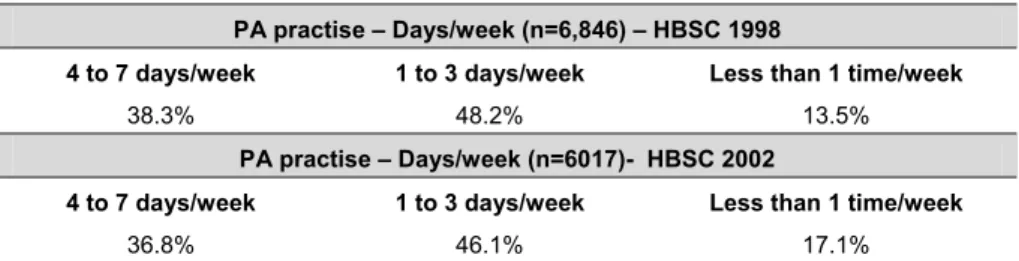
Analysing Table 1 it is clear that PA practise decrease in Portugal, in the studied age groups, from 1998 to 2002. Extremely sedentary pupils increase from 13.5% in 1998 to 17.1% in 2002, while frequent practitioners decrease from 38.3% in 1998 to 36.8% in 2002.
There are significant gender differences in PA practise in both 1998 and 2002 study , with girls being significantly more frequent in the extremely inactive group (less than once a week) , in 1998, 5.9% of the boys and 20.2% of the girls, and in 2002 10.7% of the boys and 23.1% of the girls.
There are significant age differences in PA practise in both 1998 and 2002 studies, with PA frequency during the week steadily and regularly decreasing in older groups. Thus extreme inactivity (less than once a week) increases and frequent practise (4 to 7 days) decrease.
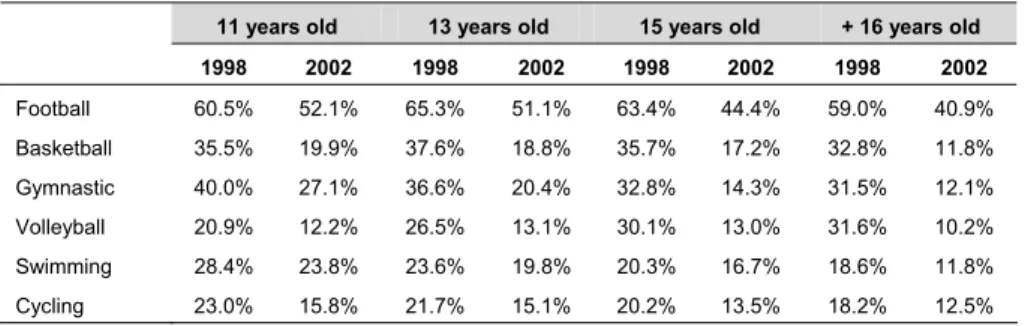
In what sports practise is concerned, the more popular sports are football, basketball, gymnastic, volleyball, swimming and cycling. Practise decrease from 1998 to 2002.
Table 1. PA practise in the last week, out of school hours
(HBSC, 1998 and HBSC, 2002)
PA practise – Days/week (n=6,846) – HBSC 1998
4 to 7 days/week 1 to 3 days/week Less than 1 time/week
38.3% 48.2% 13.5%
PA practise – Days/week (n=6017)- HBSC 2002
4 to 7 days/week 1 to 3 days/week Less than 1 time/week
Football, basketball and cycling are more popular among boys, and gymnastic, volleyball and swimming seemed to be more popular among girls. In both genders there was a decrease in practise from 1998 to 2002
Sports practise decreased steadily with age and besides there is a general decrease in sports practise from 1988 to 2002.
Age differences, HBSC 1998 – PA practise a)
4 to 7 days/week 1 to 3 days/week Less than 1 time/week
11 anos 45.3% 45.5% 9.2%
13 anos 40.0% 48.2% 11.9%
15 anos 36.1% 49.0% 14.9%
+ 16 anos 32.7% 49.6% 17.7%
Table 2. PA practise in the last week out of school curriculum – Gender differences
(HBSC, 1998 and HBSC, 2002)
Gender differences, HBSC 1998- PA practise a)
4 to 7 days/week 1 to 3 days/week Less than 1 time/week
Boy 53.5% 40.6% 5.9% Girl 24.8% 54.9% 20.2% a) (χ² = 696.14, g. l. = 2, p<.001). n=6846
Gender differences, HBSC 2002 - PA practise a)
4 to 7 days/week 1 to 3 days/week Less than 1 time/week
Boy 48.9% 40.4% 10.7% Girl 25.5% 51.4% 23.1% a) (χ² = 397.05, g. l. = 2, p<.001). n=6017
Table 3. PA practise in the last week, out of school curriculum – Age differences
(HBSC, 1998 and HBSC, 2002)
a) (χ² = 68.45, g. l. = 6, p<.001). n=6758
Age differences, HBSC 1998 – PA practise a)
4 to 7 days/week 1 to 3 days/week Less than 1 time/week
11 anos 41.5% 45.9% 12.6%
13 anos 40.4% 44.2% 15.3%
15 anos 35.1% 47.3% 17.6%
+ 16 anos 27.8% 47.7% 24.6%
Leisure activities – 2002 study
In Table 7 there is a list of the most popular leisure activities referred by adolescents, the complete list is available in the national report (Matos et al, 2003). The leisure activities in table 7 were the ones referred by more than 90% of the youngsters, and as seen they are mostly inactive.
Table 4. Sports practice, HBSC survey 1998 and 2002 Sports practice (n=6,903) HBSC 1998 ( n= 6,903) HBSC 2002 ( n= 6,130) Football 62.8% 47.5% Basketball 35.7% 17.3% Gymnastic 34.9% 18.5% Volleyball 27.8% 12.4% Swimming 22.3% 18.3% Cycling 20.7% 14.3%
Table 5. Sports practice, HBSC survey, 1998 and 2002 – gender comparisons
HBSC – 1998 HBSC - 2002
Boy Girl Boy Girl Football 78.2% 49.2% 66.2% 29.5% Basketball 36.7% 34.8% 18.7% 16.0% Gymnastic 25.5% 43.2% 11.4% 25.2% Volleyball 25.0% 30.3% 9.9% 14.8% Swimming 21.6% 22.9% 17.0% 19.5% Cycling 23.5% 18.1% 20.1% 8.8%
Table 6. Sports practice, HBSC survey, 1998 and 2002 – age comparisons
11 years old 13 years old 15 years old + 16 years old
1998 2002 1998 2002 1998 2002 1998 2002 Football 60.5% 52.1% 65.3% 51.1% 63.4% 44.4% 59.0% 40.9% Basketball 35.5% 19.9% 37.6% 18.8% 35.7% 17.2% 32.8% 11.8% Gymnastic 40.0% 27.1% 36.6% 20.4% 32.8% 14.3% 31.5% 12.1% Volleyball 20.9% 12.2% 26.5% 13.1% 30.1% 13.0% 31.6% 10.2% Swimming 28.4% 23.8% 23.6% 19.8% 20.3% 16.7% 18.6% 11.8% Cycling 23.0% 15.8% 21.7% 15.1% 20.2% 13.5% 18.2% 12.5%
There is a seasonal variation in leisure occupation. In general it looks like they refer less leisure occupations in winter/autumn. The more popular leisure activity in summer/spring is: going to the beach; and talking with friends, listening to music while in winter/autumn most popular leisure occupation is listening to music, sleeping, watching TV, and doing homework.
Motivation to practise – 2002 study
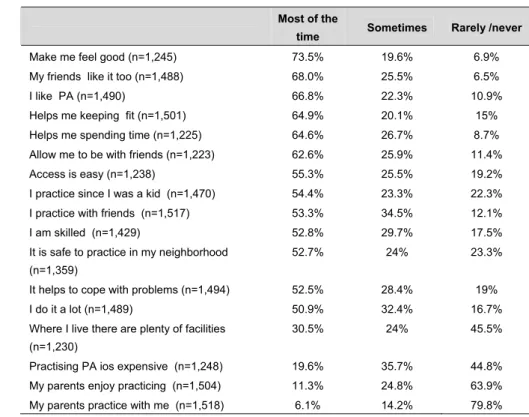
In table 8 there are some reasons presented by the older group (10th grade, mean age 16.2 years old) that may help or prevent PA practise.
The role of feeling good, enjoying it, having a support group, feeling skilled and having previous early habits were highlighted.
International comparisons – 2002 international HBSC study
From the 35 countries included in the 2002 HBSC study (for details see Currie and al, 2004) , Portuguese adolescents that meet the weekly PA guidelines (60 minutes or more of activity 5 or more days a week) are above HBSC average in 3 age groups (11, 13 and 15-years-old).
In 11-years-old group, HBSC average is 33.1% for girls and 43.8% for boys. France shows lower results and Ireland the highest. In Portugal this percentage for girls is 22.3% and for boys 38%.
In 13-years-old group, HBSC average is 26.9% for girls and 40.9% for boys. Flemish Belgium shows lower results and Ireland the highest. In Portugal this percentage for girls is 14.5% and for boys 38.3%.
Table 7. Leisure activities (n= 6,131)
Listen music 97.6%
Playing cards, videogames, computer games 95.4%
Talk with friends 95.2%
Be together with friends 94.7%
Watch TV or video 94.4%
Go to the beach 94.2%
Sleep 93.3%
In 15-years-old group, HBSC average is 22.3% for girls and 35.3% for boys. Portugal shows lower results and the USA the highest. In Portugal this percentage for girls is 13.2% and for boys 24.6%.
This mean that, in general, girls practise less than boys independently of age group and country but Portuguese results are lower that HBSC average and in the older group Portugal is indeed the country that present worst results.
Discussion and recommendations
This study confirmed previous research results indicating that PA has higher levels in younger boys. Portuguese levels of PA are lower than HBSC international levels, especially in the older group. From 1998 to 2002 a number of health risk behaviours are rising among Portuguese adolescents (Matos et al, 2003; Matos et al 2004) including PA decrease, and sedentary leisure time activities are expanding.
Most of the
time Sometimes Rarely /never
Make me feel good (n=1,245) 73.5% 19.6% 6.9% My friends like it too (n=1,488) 68.0% 25.5% 6.5%
I like PA (n=1,490) 66.8% 22.3% 10.9%
Helps me keeping fit (n=1,501) 64.9% 20.1% 15% Helps me spending time (n=1,225) 64.6% 26.7% 8.7% Allow me to be with friends (n=1,223) 62.6% 25.9% 11.4% Access is easy (n=1,238) 55.3% 25.5% 19.2% I practice since I was a kid (n=1,470) 54.4% 23.3% 22.3% I practice with friends (n=1,517) 53.3% 34.5% 12.1% I am skilled (n=1,429) 52.8% 29.7% 17.5% It is safe to practice in my neighborhood
(n=1,359)
52.7% 24% 23.3%
It helps to cope with problems (n=1,494) 52.5% 28.4% 19% I do it a lot (n=1,489) 50.9% 32.4% 16.7% Where I live there are plenty of facilities
(n=1,230)
30.5% 24% 45.5%
Practising PA ios expensive (n=1,248) 19.6% 35.7% 44.8% My parents enjoy practicing (n=1,504) 11.3% 24.8% 63.9% My parents practice with me (n=1,518) 6.1% 14.2% 79.8%
A study carried out with a population of twelve and fifteen-year’s old young Europeans covering 4.964 individuals of five countries, revealed that sport activities are not included among those in which they engage more often in their free time. It also stated that age was associated to the abandonment of the practice of organized physical activities and that girls engaged less in sports than boys (Cloes, Ledent, Didier, Diniz & Piéron, 1997). It was also noted that the frequency and intensity of the activities practiced were, in most cases, lower to the ones required to induce beneficial health effects (Ledent, Cloes, Telama, Almond, Diniz & Piéron, 1997).
In a population of 4.341 nine to fifteen-years-old young people from the Azores Islands, Diniz et al. (2001) noticed that near 80% were involved in sedentary activities after school time and that the activities demanding moderate to intense physical activity were only often performed by 16% of those youngsters.
Matos (2004) study confirmed Dishman (1993) results pointing out that the best predictor for PA is the PA previous habits during personal and social development, highlighting the importance of PA routines in daily life the sooner the best during childhood and adolescence. Sallis and Hovell (1990) also highlighted the importance of early establishment of active lifestyle habits in order to help people be active in adulthood.
School is seen as a suitable setting to establish PA habits (Biddle, 1995). However, according to this author, school curricula are not very effective in developing active lifestyles that may help children to become active adults, especially in when girls are concerned. Schools are generally not able to use their full potential to promote health and increase active lifestyles. If we accept the broadly recognized positive psychological and physical effects of PA practice (see Calmeiro & Matos 2004; Matos, 2005; and Matos & Sardinha 1999, for a review), an effort has to be made in order to improve the school’s role in the acquisition and maintenance of active lifestyles in adolescents.
References
[1] Berger, B. & McInman, A. (1993). Exercise and the quality of life. In R. Singer, M. Murphey & L. Tennant (Eds.). Handbook of Research on Sport Psychology. NY: MacMillan.
[2] Biddle, S. (1985). Exercise and Psychosocial Health. Research Quarterly for Exercise and Sport, vol. 66, 4, 292-297.
[3] Biddle, S. & Nutrie, N. (2001). Psychology of physical activity, London: Routledge [4] Calmeiro, L. & Matos, M. (2004). Psicologia do exercício e da saúde. Lisboa: Omniserviços,
Visão e Contextos.
[5] Cloes, M., Ledent, M., Didier, P., Diniz, J. & M. Piéron, M. (1997). Pratique et Importance des Principales Activités de Loisirs Chez les Jeunes de 12 à 15 Ans dans Cinq Pays Européens. Sport, 159/160, 51-60.
[6] Currie, C., Hurrelmann, K., Settertobulte, W., Smith, R., Todd, J. (2000). Health and Health behaviour among young people, HEPCA series, WHO, 1.
[7] Currie, C., Roberts, C., Morgan, A. et al. (2004). Young people health in context. Copenhagen: WHO.
[8] Diniz, J. (1998) Aptidão física e saúde - Desafios para a educação física. In Neil Amstrong et al (eds). A Educação para a saúde. Lisboa:Omniserviços.
[9] Diniz, J., Onofre, M., Carvalho, L., Mira, J. & Costa, F. (2001). A Educação Física no 1º ciclo do Ensino Básico na Região Autónoma dos Açores. Açores: Direcção Regional da Educa-ção Física e Desporto.
[10] Dishman, R. (1993). Exercise adherence, in R. Singer, M. Murphey, L. Tennant (Eds.) Handbook of research on sports psychology. NY: Macmillan.
[11] Hickman, M., Roberts, C., Matos, M. (2000). Exercise and leisure time activities in C. Currie, K. Hurrelmann, W. Settertobulte, R. Smith, J. Todd (eds.) Health and Health behaviour among young people. HEPCA series, WHO, 1.
[12] King, A., Wold, B., Tudor Smith, C., & Harel, Y. (1996). The health of youth: a cross national survey. Copenhagen, WHO Regional Office for Europe, WHO Regional Publications, European series, nº 69.
[13] Lawson, H. (1992). Toward a socioecological conception of health. Quest 44:105-121. [14] Ledent, M., Cloes, M., Telama, R., Almond, L., Diniz, J. & Piéron, M. (1997). Participation
des Jeunes Européens aux Activités Physiques et Sportives. Sport, 159/160, 61-71. [15] Matos, M. (2005). Comunicação, gestão de conflitos e Saúde na escola. Lisboa: Edições
FMH
[16] Matos, M. (2004). Active Lifestyles and Health. Proccedings from the Health Psychology International Conference. Coimbra.
[17] Matos, M. & Equipa do projecto Aventura Social e Saúde (2004). Risco e protecção. Edições FMH: Lisboa.
[18] Matos, M. & Equipa do Projecto Aventura Social e Saúde (2003). A saúde dos adolescentes portugueses (Quatro anos depois). Edições FMH: Lisboa.
[19] Matos, M., Carvalhosa, S. & Diniz, J. (2002). Factores associados à prática da actividade física nos adolescentes portugueses. Análise Psicológica, 1, XX, 57-66.
[20] Matos, M., Carvalhosa, S. & Diniz, J. (2002). Actividade física e prática desportiva nos ado-lescentes portugueses. Edições FMH: Lisboa.
[21] Matos, M., Simões, C., Carvalhosa, S., Reis, C., & Canha, L. (2000). A Saúde dos Adoles-centes Portugueses. Lisboa: FMH /PEPT-Saúde.
[22] Matos, M., Sardinha, L. (1999). Estilos de vida activos e qualidade de vida. In L. Sardinha, M. Matos, I. Loureiro (Eds.). Promoção da saúde, Modelos e práticas de intervenção nos âmbitos da actividade fisica, nutrição e tabagismo, Lisboa: FMH.
[23] Mota, J., Sallis, J. (2003). A actividade física e saúde. Factores de influência da actividade física nas crianças e nos adolescentes. Campo das Letras.
[24] Piéron, M., Telama, R., Naul, R. & Almond, (1997). Étude du Style de Vie d’Adolescents Européens – Considerations Théoriques, Objectifs et Méthodologie de Recherche. Sport, 159/160, 43-50.
[25] Sallis, J (1993). Epidemiology of physical activity and fitness in children and adolescents, Critical reviews in Food Science and Nutrition. 33, 216-223.
[26] Sallis, J., Alcaraz, J., Mckenzie, T., Hovell, M., Kolody, B. & Nader, P. (1992). Parents’ behaviour in relation to physical activity and fitness in 9 years old. American Journal of Diseases of Children, 146, 1383-1388.
[27] Sallis, J. & Owen, N. (1999). Physical activity & Behavioural Medicine. London: Sage [28] Sallis, J. & Hovell, M. (1990). Determinants of Exercise Behaviour. Exercise and Sport
Sciences Reviews, 18, 307-330.
[29] Sallis, J., Nader, P., Broyles, S., Berry, C., Elder, J., McKenzie, T. & Nelson, J. (1993). Correlates of physical activity at home in Mexican-American and Anglo-American pre-school children, Health Psychology, 12, 390-398.
[30] Sallis, J. & Nader, P. (1988). Family determinants of health behaviours. In D. Gachman, (ed.). Health Behaviour, cap. 6, Plenum Publishing Corporation.