Full Terms & Conditions of access and use can be found at
http://www.tandfonline.com/action/journalInformation?journalCode=tgsi20
Geo-spatial Information Science
ISSN: 1009-5020 (Print) 1993-5153 (Online) Journal homepage: http://www.tandfonline.com/loi/tgsi20
Geographic information technology usage
in developing countries – A case study in
Mozambique
Nelson Amade, Marco Painho & Tiago Oliveira
To cite this article: Nelson Amade, Marco Painho & Tiago Oliveira (2018) Geographic information technology usage in developing countries – A case study in Mozambique, Geo-spatial Information Science, 21:4, 331-345, DOI: 10.1080/10095020.2018.1523995
To link to this article: https://doi.org/10.1080/10095020.2018.1523995
© 2018 Wuhan University. Published by Informa UK Limited, trading as Taylor & Francis Group.
Published online: 19 Oct 2018.
Submit your article to this journal
Article views: 142
Geographic information technology usage in developing countries
– A case
study in Mozambique
Nelson Amadea, Marco Painhoband Tiago Oliveira b
aUniversidade Catolica de Mocambique, Beira, Mozambique;bNova Information Management School, Universidade Nova de Lisboa, Lisboa, Portugal
ABSTRACT
Geographic information technologies (GIT) have matured, have become pervasive through-out many types of organizations over recent decades and gained a wide range of attention in diverse sectors of society. The goal of this paper is to identify the main drivers and uses of GIT in organizations and to give an overview of GIT uses in developing countries with a focus on a case study developed for Mozambique by analyzing the results of a survey of 123 Mozambican organizations that are current GIT users. The results show that the main drivers behind are compatibility, complexity, competitive pressure, donor pressure, government policy, intention to adopt, innovation, relative advantage, security, and technology compe-tence. Organizations of the public and private sectors use GIT for customer/resource/risk management, decision support, education, research, monitoring, prediction, simulation, suit-ability analysis, sustainsuit-ability, use and access.
ARTICLE HISTORY Received 11 January 2018 Accepted 2 April 2018 KEYWORDS Geographic information technologies; organizations; remote sensing; GPS; geographic information systems; Mozambique 1. Introduction
Technology has come to pervade many types of orga-nizations in recent decades as they take advantage of the opportunities offered by technology for improv-ing efficiency, flexibility, and growth possibilities. Geographic information technologies (GIT), devel-oped during the 1960s and 70s, have matured in the last three decades and have gained attention across many sectors of society. The ability of these technol-ogies to support decision making is taken as one of the main reasons for organizations to select this type of technology (Harrison et al.2007). GIT include all types of computer systems (hardware and software) and tools used in processing georeferenced informa-tion. This set of systems and tools include remote sensing (RS) systems (Horler and Barber 1981), GPS (Kaplan and Hegarty2005), Geographic information systems (GIS) (Chrisman 2002), and all systems and sub-systems that deal with geographic information processing (Jankowski and Nyerges 2001; Harrison et al. 2007). These technologies have been studied in several ways, including their use as decision support systems and as integrating backbones for the organi-zational information systems (Hendriks 2000).
Development of infrastructure of natural resource management, and other social and economic devel-opment activities, can benefit from the use of GIT as they contain a major spatial component. We illustrate the importance of GIT for organizations in the devel-oping world by using Mozambique as a case study.
As in other countries, the introduction and numerous applications of GIT and information and communication technologies (ICT) (Dong-Ju 2013) in Mozambique, has increased in the recent years. However, there is no efforts mentioned in the litera-ture, and no clear understanding of how GIT use has evolved exactly, how it is being used and in which sectors. This paper, therefore, seeks to understand the factors behind GIT adoption and use in Mozambique. The goal of the work presented here is to understand the main drivers and uses of GIT in organizations, and to give an overview of the GIT situation in Mozambique by analyzing the results of a survey responded to by 123 Mozambican organizations that are current GIT users. The research focus on three main sectors: (1) agricul-ture and natural resources; (2) public services; (3) other services and manufacturing.
The paper is organized into four sections:Section 2describes the methodology;Section 3analyses GIT uses in organizations and society, and their drivers through a literature review; Section 4 discusses the preliminary results of GIT uses in the Mozambican context; and the last section presents the conclusions and future research.
2. Methodology
To the best of our knowledge, literature that supports the process of GIT adoption in organizations is rare or unpublished, and information regarding GIT adoption in Mozambique is non-existent. Less literature about
CONTACTMarco Painho [email protected]
2018, VOL. 21, NO. 4, 331–345
https://doi.org/10.1080/10095020.2018.1523995
© 2018 Wuhan University. Published by Informa UK Limited, trading as Taylor & Francis Group.
This is an Open Access article distributed under the terms of the Creative Commons Attribution License (http://creativecommons.org/licenses/by/4.0/), which permits unrestricted use, distribution, and reproduction in any medium, provided the original work is properly cited.
GIT does not mean few applications. GIT has been used in many countries for different purposes, and integrated with many applications. The research com-bines what exists in the literature with the results of a survey, and targets a real case study (Mozambican context).
The review approach includes articles identified in peer-reviewed journals or conference proceedings from 1990 to 2017, using the Web of Science, Google Scholar, Science Direct, information system journals, and etc. as information sources. The review was compiled based on the following list of keywords: GIT/GPS adoption/use, GPS/GIS adoption/use, GIS diffusion, GIS implementation, GIT/GIS integration, RS adoption, and use of RS in organizations. The literature review systematically isolated domain appli-cation areas, drivers, uses, and countries where the technology has been used through a qualitative assessment of its content analysis for each source. Domain application areas, uses and countries were directly extracted from the text by the authors. We used the drivers normally used in the technology adoption literature (Cooper and Zmud 1990; Moore and Benbasat 1991; Rogers 2003; Zhu and Kraemer
2005; Zhu, Kraemer, and Xu 2006; Ghobakhloo, Arias-Aranda, and Benitez-Amado 2011; Low, Chen, and Wu 2011; Oliveira and Martins 2011; Nkhoma and Dang2013; Zhu, Chang, and Luo2016).
In order to get an insight of GIT use in developing countries, we developed a case study for the case of Mozambique. Mozambique has a favored and strate-gic geographic location in Southern Africa. With an area of approximately 800,000 km2, its economy has grown at an average of 7.7% annually between 1996 and 2011 (Foster and Dominguez 2011) and above 7% between 2011 and 2014 (World Bank 2016). In the late 2000s, the country spent an annual average of 664 million USD (equivalent to 10% of its GDP) on infrastructure, including ICT (Foster and Dominguez
2011). In its master plan, the Mozambican govern-ment establishes the use of technology and regulates the availability of ways that enable organizations to introduce new technology approaches (Moçambique, Republica de2010).
A survey on GIT adoption was conducted during mid-2014, and targeted at governmental, private, and non-profit organizations. There is no known orga-nized database or list of organizations using GIT in Mozambique. As a result, we tried to contact all government levels, private sector and non-profit organizations, and specialists in the field of GIT, and to gather as many contacts as possible. The part of the survey used in this paper includes eight ques-tions that involve a characterization of the organiza-tion pertaining to the use of GIT: sector, organizaorganiza-tion size (number of employees), type of GIT used, and maturity. The complete survey is composed of 33
questions. The remaining questions are related to adoption constructs and will be used in developing the adoption model. See Annex 1 for a list of the questions used in this article. The questionnaire was conducted online using the Survey Monkey engine, and the link was addressed to and shared with orga-nizations through emails.
The data collected provides a good overview on how organizations are using GIT in Mozambique. It also enables the development of a conceptual adop-tion model in the future. 2043 surveys were sent, 123 were returned and validated (of which, 61 from gov-ernmental organizations and 62 from the private and non-profit sectors). Considering that 2043 individuals who received the survey were distributed by approxi-mately 380 organizations, the return rate, at the orga-nizational level, was 32%. The study only considers organizations that are using GIT.
The resultant data is analyzed in terms of the main sectors (also found in the literature), as well as glob-ally in terms of the country as whole.
3. Overview of GIT applications and reasons for use
In the 21st century, there are many sensitive issues (including biodiversity, natural hazards, sustainable agriculture, transportation, crime, climate change, migration and urbanization, health care, etc.), all of these share a common trait: they exhibit a geographi-cal component, and thus can benefit from the use of GIT.
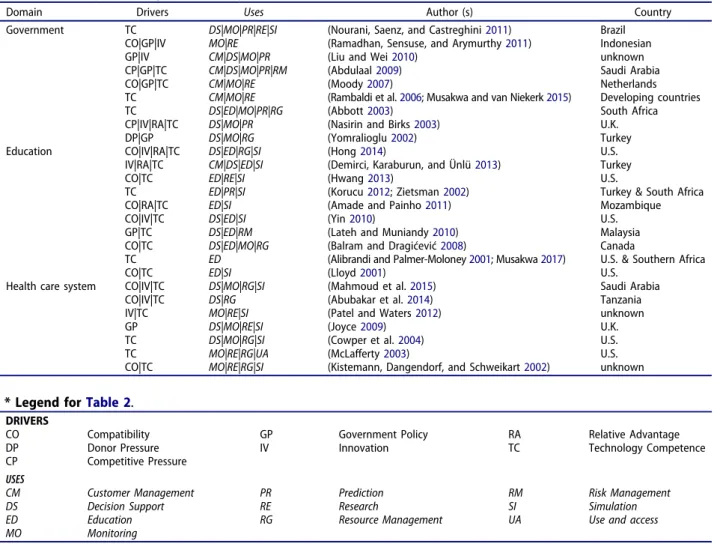
This section reviews GIT applications with a focus whenever on developing countries, covering past 27 years (1990−2017), and a wide range of application domains and sectors. There seemed to be very few (if any) articles having core objective that was to study the factors behind adoption of GIT, and the reasons for taking up GIT in organizations are deduced from the qualitative assessments in the text. Tables 1 to 3
summarize the most frequently mentioned domains, drivers, and uses that explain the reasons why, in the articles reviewed, organizations are using GIT as a working tool, as well as the authors and country where the application took place. These tables are further summarized and analyzed in Figures 1 and2
in Section 3.4. We assume that the applications described in the reviewed articles take place within an organization. Based on the results of the text ana-lysis, we infer the type of organization, the application domain and the main drivers and uses for each case.
Cases of reported GIT use are very diverse and numerous, and it is difficult to construct a complete overview of all the possible uses and motivations. The review below offers relevant examples found in the scholarly literature to illustrate the importance and widespread use of GIT in society.
3.1. Agriculture and natural resources
Table 1 presents the GIT drivers and uses for orga-nizations in the fields of agriculture and natural resources. In the agricultural sector, the crop suitabil-ity issue is leading many organizations (that deal with land) to adopt GIT. The need of this sector (to improve the understanding of land and productivity related variables) is crucial.
Studies developed in the agriculture sector point out some examples and practices. Zolekar and Bhagat (2015) and Chen, Yu, and Khan (2010) used a com-bination of GIS and RS tools to analyze soil suitability for agriculture and rainwater harvesting. Mkiramwinyi et al. (2009) and VoPham et al. (2015) used GIT tools to estimate agriculture pesticide expo-sure, and Zhu, Zhang, and Sun (2009) used GIT tools to improve precision agriculture by providing detailed spatial information on soil characteristics. On the physical side, GIT can provide support in soil analysis (Bandyopadhyay et al. 2009), and can predict soil erosion hazard through a combination of the universal soil loss equation and GIS tools (Mati et al.2000).
In the environmental and natural resources sector, van Westen (2013) reported that the adoption of GIT has been motivated to implement disaster risk manage-ment procedures, Mohammed et al. (2015) adopted it to avoid heavy losses in productive land, environmental degradation, and biodiversity conservation (Swetnam and Reyers 2011). Other related studies include the management of earthquake damage through web-based mapping services and management of urban forestry (Zook et al. 2010; Tasoulas et al. 2013). Millock, Xabadia, and Zilberman (2012) refer the reason of adopt-ing GIT to the management of externalities (pollution) generated by automobiles through a combination of land based sensors and RS tools. Quite a large number of other application related uses are found in the literature, including the identification of sustainable urban devel-opment in Tehran (Javadian, Shamskooshki, and Momeni2011), forestry management in India (Michael, Sahay, and Walsham2001), improvement of the evalua-tion of landfill suitability in Iran (Javaheri et al.2006), land administration (Puri and Sahay 2003; Karikari, Stillwell, and Carver2005; Kamusoko et al.2009), land use change in Tanzania (Haule, Mlozi, and Mulengera
Table 1.GIT adoption in organizations in agriculture and natural resources.
Domain Drivers Uses Author(s) Country
Agriculture RA|TC DS|MO|PR|RE (VoPham et al.2015) United States
TC DS|PR|SU (Zolekar and Bhagat2015) India
CX|TC DS|MO|PR|RE|SU (Chen, Yu, and Khan2010) Australia
CO|TC DS|MO|PR|RE (Zhu, Zhang, and Sun2009) China
CX DS|PR|RE|SI|SU (Bandyopadhyay et al.2009) India
CX|TC DS|MO|PR|SI (Mati et al.2000) Kenya
Environment and natural resources
TC DS|MO|PR|RE|SI (Mohammed et al.2015; Swetnam and Reyers2011) Malaysia & Africa
RA|TC RG|SU (Mkiramwinyi et al.2009) Tanzania
DP|TC CM|DS|MO|RM (Pactwa, Blachowski, and Górniak-Zimroz2015) Poland
CO|DP|TC DS|MO|PR|RM (van Westen2013) unknown
GP|TC DS|MO|PR|RM (Tasoulas et al.2013) Greece
GP CM|DS|MO|RM|SI (Millock, Xabadia, and Zilberman2012) U.S. ST|TC DS|SI (Haule, Mlozi, and Mulengera2009; Kamusoko et al.
2009)
Tanzania & Zimbabwe TC DS|ED|PR|ST|RM (Javadian, Shamskooshki, and Momeni2011) Iran
CO|TC DS|MO|PR|RM (Zook et al.2010) Haiti
CO|TC DS|SI|SU (Javaheri et al.2006) Iran
GP DS|PR|RM|SU (Karikari, Stillwell, and Carver2005) Ghana
GP DS|MO|RG|SU (Puri and Sahay2003) India
GP DS|MO|RG|SU (Michael, Sahay, and Walsham2001) India
Marine resources GP DS|MO|PR|RG (Levine and Feinholz2015) U.S.
CO|TC DS|MO|PR|RM (Mahboubi et al.2015; Kairo, Kivyatu, and Koedam
2002)
Canada & Kenya
TC|IA DS|MO|RG|SI (Claus et al.2014) Belgium
TC DS|MO|PR|RM (Nunes and Almeida2011) Brazil
CO|TC DS|MO|RE|SI (Kulawiak, Chybicki, and Moszynski2010) Greece TC DS|MO|PR|RM|SI (Wright and Heyman2008) Arctic & Canada
DP|TC DS|MO|RG|SI (Tuama and Hamre2007) E.U.
CO|TC DS|MO|RG (Nath et al.2000) Canada
CO|CX|TC DS|MO|RE|RG (Gold and Condal1995) unknown
*Legend forTable 1(For a definition of the concepts, please seeAnnex 2). DRIVERS
CO Compatibility GP Government Policy RA Relative Advantage
CX Complexity IA Intention to Adopt TC Technology Competence
DP Donor Pressure USES
CM Customer Management PR Prediction SI Simulation
DS Decision Support RE Research SU Suitability Analysis
ED Education RG Resource Management ST Sustainability
2009), and mineral resource management (Pactwa, Blachowski, and Górniak-Zimroz2015).
In the marine resources sector, the adoption of GIT has been motivated to address a lack of efficient methods
Table 2.GIT adoption in organizations in public service.
Domain Drivers Uses Author (s) Country
Government TC DS|MO|PR|RE|SI (Nourani, Saenz, and Castreghini2011) Brazil CO|GP|IV MO|RE (Ramadhan, Sensuse, and Arymurthy2011) Indonesian
GP|IV CM|DS|MO|PR (Liu and Wei2010) unknown
CP|GP|TC CM|DS|MO|PR|RM (Abdulaal2009) Saudi Arabia
CO|GP|TC CM|MO|RE (Moody2007) Netherlands
TC CM|MO|RE (Rambaldi et al.2006; Musakwa and van Niekerk2015) Developing countries
TC DS|ED|MO|PR|RG (Abbott2003) South Africa
CP|IV|RA|TC DS|MO|PR (Nasirin and Birks2003) U.K.
DP|GP DS|MO|RG (Yomralioglu2002) Turkey
Education CO|IV|RA|TC DS|ED|RG|SI (Hong2014) U.S.
IV|RA|TC CM|DS|ED|SI (Demirci, Karaburun, and Ünlü2013) Turkey
CO|TC ED|RE|SI (Hwang2013) U.S.
TC ED|PR|SI (Korucu2012; Zietsman2002) Turkey & South Africa
CO|RA|TC ED|SI (Amade and Painho2011) Mozambique
CO|IV|TC DS|ED|SI (Yin2010) U.S.
GP|TC DS|ED|RM (Lateh and Muniandy2010) Malaysia
CO|TC DS|ED|MO|RG (Balram and Dragićević2008) Canada
TC ED (Alibrandi and Palmer-Moloney2001; Musakwa2017) U.S. & Southern Africa
CO|TC ED|SI (Lloyd2001) U.S.
Health care system CO|IV|TC DS|MO|RG|SI (Mahmoud et al.2015) Saudi Arabia
CO|IV|TC DS|RG (Abubakar et al.2014) Tanzania
IV|TC MO|RE|SI (Patel and Waters2012) unknown
GP DS|MO|RE|SI (Joyce2009) U.K.
TC DS|MO|RG|SI (Cowper et al.2004) U.S.
TC MO|RE|RG|UA (McLafferty2003) U.S.
CO|TC MO|RE|RG|SI (Kistemann, Dangendorf, and Schweikart2002) unknown
* Legend forTable 2. DRIVERS
CO Compatibility GP Government Policy RA Relative Advantage
DP Donor Pressure IV Innovation TC Technology Competence
CP Competitive Pressure USES
CM Customer Management PR Prediction RM Risk Management
DS Decision Support RE Research SI Simulation
ED Education RG Resource Management UA Use and access
MO Monitoring
Table 3.GIT adoption in organizations in other services and manufacturing.
Domain Drivers Uses Author (s) Country
Banks and insurance CO|CX|SE|TC CM|DS|MO|PR|RM (Ajah and Inyiama2011) Nigeria
IV|TC DS|MO|RE|RM (Ngai et al.2011) U.S.
TC DS|MO|RG|SI (Gabriela, Laurenţiu, and Simona2010) Romania CO|CP|IV|SE|TC CM|DS|MO (Jafrullah and Uppuluri2003) unknown
CP|GP|TC DS|PR|RG (MacDonald2001) Canada
Manufacturing CP|IV|TC DS|MO|RE (Chong and Chan2012) Malaysia
CO|IV|TC MO|RE (Drummond and French2008) U.S.
TC DS|RG (Bansal2007) unknown
CO|CP|SE|TC DS|MO (Freire2004) Brazil
Transport and communication TC DS|MO|PR|RG|SI (Kawamura et al.2014; Dorosh et al.2012) Japan & Africa
SE|TC DS|MO|PR|RG (Chen, Wu, and Tri2012) Vietnam
GP|IV|TC DS (Mahesh, Zellner, and Zielinski2011) India
TC DS|MO|RE|SI (Ma et al.2009) U.S.
TC DS|MO|PR|RG|SI (Batarlienė2007) Lithuania
CO|TC ED|PR|RG|SI (Harvey and Chrisman1998) unknown
TC DS|MO|PR|RE (Gutiérrez, González, and Gómez1996) E.U.
* Legend forTable 3. DRIVERS
CO Compatibility GP Government Policy SE Security
CP Competitive Pressure IV Innovation TC Technology Competence
CX Complexity
USES
CM Customer Management MO Monitoring RG Resource Management
DS Decision Support PR Prediction RM Risk Management
for monitoring and managing marine environment pro-cesses and resources (Kairo, Kivyatu, and Koedam2002; Kulawiak, Chybicki, and Moszynski 2010; Mahboubi et al.2015; Nunes and Almeida2011), to control critical life habitats (Wright and Heyman2008), and to map the coral reef marine ecosystem (Levine and Feinholz2015). Gold and Condal (1995), Nath et al. (2000) introduced GIT to support aquaculture and manage pollution crises in coastal and ocean regions of Europe (oil spills). Finally, Claus et al. (2014) calls for the need to standardize marine geographic names (seas, ocean basins, ridges, seamounts) and boundaries through the use of an open application that will link names to information and maps with geo-graphic location, as well as the need to have a web-based information system to improve management (Tuama and Hamre2007).
3.2. Public service
Table 2shows GIT drivers and uses in public service organizations. Technology policies in the government sector are leading to the adoption and use of GIT, especially because governments wish to promote and
encourage citizen participation, for example, in urban planning and re-development (Rambaldi et al. 2006; Moody2007; Musakwa and van Niekerk2015). Some examples of these actions can be urban governance (Ramadhan, Sensuse, and Arymurthy2011), and man-agement of urban violence (Abdulaal 2009) with the help of geo-referencing in crime events. On the imple-mentation side, Yomralioglu (2002), Abbott (2003), Nasirin and Birks (2003), Liu and Wei (2010), Nourani, Saenz, and Castreghini (2011) notice in these technologies the opportunity to integrate and link exist-ing government infrastructures and platforms (e-Government) and make information more suitable for network transactions.
The education sector has been one of those that have actively adopted GIT. The capability to offer innovation and compatibility increases students’ productivity by providing virtual environments and rapid problem sol-ving (Balram and Dragićević2008; Korucu2012). There are similar views applied technologies as tools to help students acquire critical thinking, spatial skills and social skills (Alibrandi and Palmer-Moloney2001; Lloyd2001; Zietsman 2002; Lateh and Muniandy 2010; Kim and
Figure 1. Sharing of drivers by the main sectors (size of drivers, represented as shaded circles, denotes frequency of appearance in the literature).
Figure 2. Sharing of uses by the main sector (size of uses, represented as shaded circles, denotes frequency of appear-ance in the literature).
Bednarz 2011; Musakwa 2017). Furthermore, Yin (2010), Demirci, Karaburun, and Ünlü (2013), Hwang (2013), and Hong (2014) emphasize the potentiality of these technologies to create a good learning environ-ment for students and teachers. Because of their poten-tialities, GITs are capable of going beyond the classroom and being used in comparative studies as tools to test potential new teaching methods versus old ones (Amade and Painho2011).
The health sector also has been among those that have actively adopted GIT, the reason lies in the interest in simulation and ability to predict disease outbreaks and spread (epidemiology). McLafferty (2003) and Joyce (2009) reported the use of GIT to improve support in health care delivery, Mahmoud et al. (2015) mentioned that these tools could build a spatial decision-making support system for hospitals to monitor disease. Other examples include epide-miological studies and deployment of emergency ser-vices (Kistemann, Dangendorf, and Schweikart2002). Analysis and understanding of the relationship between geography and disease are probably the main reason for GIT use in the health sector for research, simulation and monitoring (Patel and Waters 2012). On other hand, one of the factors that has been identified as a constraint for GIT use in health is its cost, and thus Abubakar et al.(2014) pointed out the need to analyze how open-source GIT tools can provide feasible solutions for data visualization in the health care system and also pro-vided patient record information through atlas data-base systems built with GIT (Cowper et al.2004).
3.3. Other services and manufacturing
The GIT drivers and uses within organizations in other services and manufacturing are presented inTable 3. The banking sector is using GIT to improve customer man-agement, decision support, prediction, and risk manage-ment. This adoption has been motivated by current problems that banks are facing, namely competition (MacDonald 2001), financial fraud (Ngai et al. 2011), poor customer satisfaction and retention (Jafrullah and Uppuluri2003), loan losses and a lack of decision-making mechanisms in distributing loans (Ajah and Inyiama
2011; Gabriela, Laurenţiu, and Simona2010).
Competitive pressure is leading the manufacturing sector to use GIT. This is the case for planners who need to understand and use these tools to meet their professional requirements (Drummond and French
2008) and for business people to whom these technol-ogies are crucial, especially if the activities are related to space and location management (Freire2004). The construction of these tools is imperative to solve engi-neering problems related to spatial data (complex visualizations, integration of information, route plan-ning, cost estimation and others) (Bansal2007).
In the transport and communication sector the use of GIT has been motivated by the lack of appropriate decision support systems to mitigate communication network damage (Kawamura et al.2014; Dorosh et al.
2012). Chen, Wu, and Tri (2012) point to problems related to communications with network coverage that have been solved with a GIS model to predict network coverage systems. Ma et al. (2009) and Mahesh, Zellner, and Zielinski (2011) justify GIT use with the need to manage the highway network transportation system, which must respond to an increasing population and number of vehicles, and with urban sprawl; as well as with the safe transportation of dangerous freights in safe conditions (Batarlienė2007).
3.4. Analysis of GIT adoption in organizations and society
The literature reviewed above indicates the pervasive use of GIT in society and how this technology traverses a very large range of economic sectors in the private and public domains. It also shows that these technologies are used worldwide, although the scientific literature for Africa in this area is very scarce. A closer analysis of the different GIT drivers and uses leads to a summary of GIT adoption factors that can help to explain and understand the reasons why organizations take on GIT. It is clear that public and private organizations are looking to use the spatial domain to improve produc-tivity and performance, predict unusual situations, reduce losses, increase customer satisfaction and face competition. The drivers, indirectly extracted from the text content analysis of the literature, moti-vating organizations from different sectors to use GIT are: compatibility, competitive pressure, complexity, donor pressure, government policy, intention to adopt, innovation, relative advantage, security and technology competence as shown inTables 1to3.
Figure 1shows how these drivers are shared among the main domains. TC and CO are the most common drivers found and are shared by the three domains. DP and RA are driving public services and agriculture and natural resources, while GP, together with IV and CP, are shared by public services and other services and manufacturing. Security seems to be a driver mostly connected to other services and manufacturing.
Most of the uses identified in the literature are shared by the three domains (Figure 2), the most important ones (i.e. those occurring most frequently in the litera-ture review) being DS, MO, RG, and PR. ED is mostly utilized, as expected by the public services, which includes the education and research field, and, to a certain extent by the other services and manufacturing domain. Public services have an emphasis on UA and agriculture and natural resources on SU and ST.
In this section we have made an overview of the drivers and uses that are leading organizations to
adopt GIT identified through a qualitative analysis of scientific literature. The drivers and uses for GIT identified in this work provide a basis for the further development of a quantitative adoption study.
4. GIT use in Mozambique– state of affairs In its master plan Mozambican government supports the use of technology to improve the current scenario and move the country forward (Moçambique, Republica de 2010). The World Bank strategy for African countries resides in supporting them in their transformation through country strategies. The strategy lies heavily on sectors like manufacturing, agriculture, transportation, education, health, and ICT. A priority of the World Bank is to focus on reforms and public investments including infrastruc-ture development (World Bank2011).
In what follows we analyze the results of the survey from Mozambican organizations. We will analyze the same sectors as those found in the literature and use Mozambique as a case study of GIT adoption in developing countries. GIT has been widely used by both the public and private sectors since its 1980s. The Mozambican Government Moçambique, Republica de 2010) as well as the World Bank (World Bank 2011) have been reinforcing measures and program to invest more in ICT as well as in the need to develop GIT-based systems for use in funded projects.
4.1. Distribution of GIT by organization and activity sector
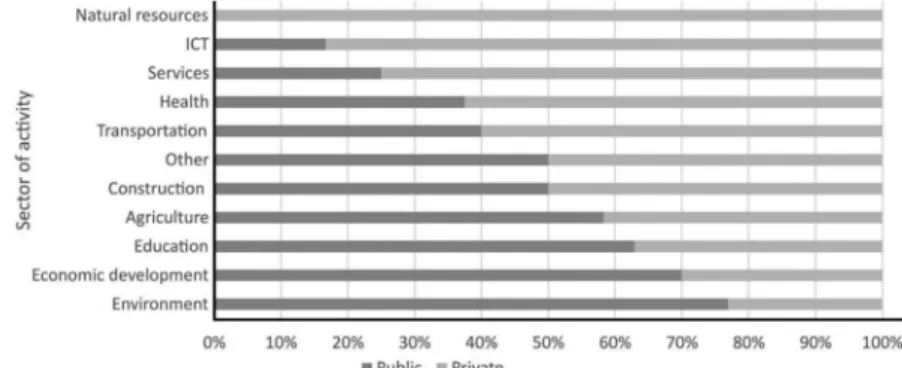
The proportion of public and private organizations that responded to the survey is balanced. Figure 3
depicts the weight of the public and private in the different sectors. The public sector has been more present in the environment, economic development, education, and agriculture whereas the private sector has more weight in the transportation, health, ser-vices, ICT, and natural resources. The proportion of organizations in the construction and other sectors is balanced. The other sector includes tourism manage-ment, logistics, public administration including road and urban planning, sports, and water management.
The analysis of the data collected from the ques-tionnaire shows that organizations in the education sector with a percentage of 23% are those that repre-sent most of the GIT use in Mozambique (see
Figure 4) followed by environment (11%). Other important GIT users can be found in the agriculture (10%), economic development (8%), health (7%), and natural resources (7%) sectors. ICT, transportation, construction, and services sectors are also noteworthy although still in a very early stage of implementation. The other sector class (18%) includes other sectors less important in terms of GIT use such as tourism management, logistics, public administration includ-ing road and urban planninclud-ing, sports, and water man-agement, among others. For the sectors agriculture and environment, it is important to remark that
Figure 3.Distribution of public and private organizations by activity sector.
Mozambique public policies are emphasizing the development of these two sectors (Moçambique, Republica de 2010) given their importance both as a main means of income and food production for the population. The agriculture sector absorbs 75% of the population of Mozambique (UN FAO2015).
The environment is facing many challenges such as climate change, biodiversity conservation, among others, which are influencing the productivity of nat-ural and semi-natnat-ural ecosystems (Tilman2001). It is also noteworthy that transportation, construction, and services are the sectors with the least use of GIT among the respondents (Figure 4).
It seems that there is no relationship between organization size and GIT use. The percentage of GIT use by organization size is depicted in Figure 5. The organizations were classified in terms of their number of employees (European Commission 2015). More than 50% of the organizations using GIT have over 50 employees. However, it is important to note that GIT use is spread throughout all organizational sizes.
4.2. Evolution and intensity of GIT use
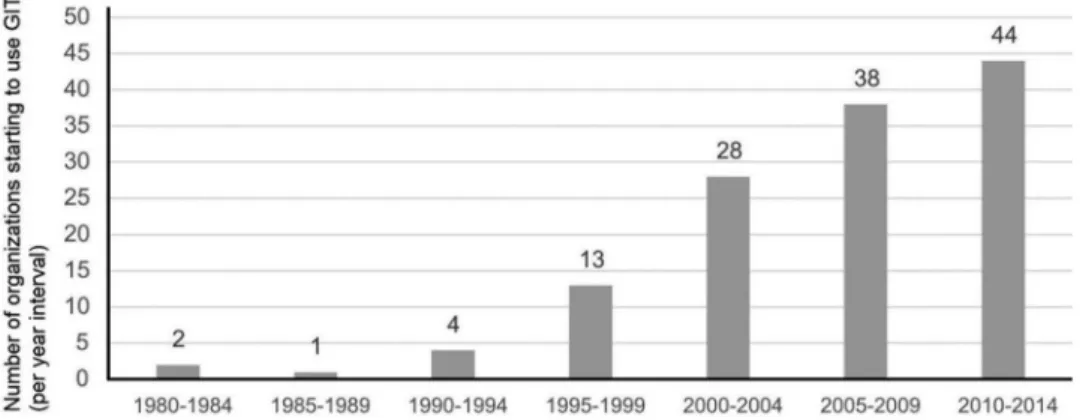
It is possible tofind inFigure 6that the organizations started to intensify the use of GIT from 1995: in the period of 2010−2014, the number of new organiza-tions using GIT reached 44; 1995−2014, the number of organizations using GIT increases very quickly in
line with world evolution of GIT use (Henttu, Izaret, and Potere 2012). Before the year 1995, the use of these technologies was very rare and almost insignif-icant. It is also clear that between 1980 and 1995 organizations were stagnant in terms of new technol-ogy approaches.
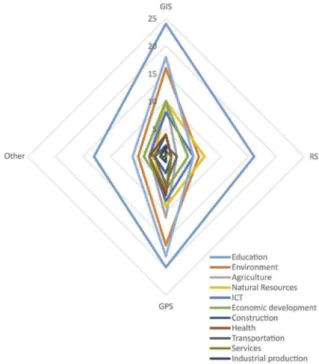
Crossing data between sectors of activity and type of most used technologies is illustrated theFigure 7. All three GIT types, GIS, GPS, and RS, are led by the education sector. The GIS technology is, as men-tioned, topped by the education sector. A second group of sectors in intensity of GIS use includes the environment, agriculture, natural resources, eco-nomic development, and ICT. The remaining sectors form a group of low GIS use (five or fewer organiza-tions per sector). In the same the way, RS intensity is led by education followed by natural resources, envir-onment, and ICT, leaving all the other sectors in a large group of low use intensity (fewer than five organizations per sector). Finally GPS, the most recent of GIT technologies, is mostly used by the education and environment sectors closely followed by the agriculture, natural resources, and ICT, the remaining forming a group of lower use intensity (five or fewer organizations per sector). The other class sector includes organizations using complemen-tary technologies, of which Google Earth, Google Maps and automatic information system are exam-ples. GIS and GPS are the most frequently used technologies in all sectors. Independently of the
Figure 5.Percentage of GIT use by organization size.
intensity of use all sectors share a similar pattern of the technology mix use.
Using a technology mix of GIT creates synergies and efficiency in works. When looking at the technol-ogy mix (Figure 8), it is possible tofind that the most common technologies (GPS and GIS) used by the organizations are also those that are used together more frequently. Other mixes also exist and about one third of the organizations use some kinds of mix including GIS/RS and RS/GPS or a mixture of the three (GIS/GPS/RS). A group of organizations (46) actually use some or all of the identified GIT tech-nologies with complementary ones.
4.3. Summary of GIT use in Mozambique
Analysis of the data collected from the questionnaire shows that GIT is being used by many and diverse sectors in Mozambique. The proportion of public and private organizations that responded to the survey is balanced. The public sector has been more present in the environment, economic development, education,
and agriculture, whereas the private sector has more weight in transportation, health, services, ICT, and nat-ural resources (Figure 3). Organizations in the educa-tion sector with a percentage of 23% are those that represent most of the GIT use in Mozambique (Figure 4) followed by environment (11%). More than half of the organizations using GIT have more than 50 employees (Figure 5). Organizations started to intensify the use of GIT from year 1995 and in year 2014 the number of new organizations using GIT reached 44 (Figure 6). All three GIT types, GIS, GPS, and RS are led by the education sector (Figure 7). However, it is important to note that GIT use is spread throughout all organizational sizes and the technologies most used are GIS and GPS in all sectors.
5. Conclusions
This paper has analyzed the main drivers and uses of GIT revealed in a literature review, and the current situation in Mozambique in terms of GIT uses. The literature review showed that the main drivers of GIT uses in organizations are compatibility, competitive pressure, complexity, donor pressure, government pol-icy, intention to adopt, innovation, relative advantage, security, and technology competence (with compatibil-ity and technology competence being the main ones). Organizations of the public and private sectors use GIT for customer management, decision support, education, monitoring, prediction, research, resource manage-ment, risk managemanage-ment, simulation, suitability analysis, sustainability, use, and access.
The results of the questionnaire revealed that GIT is being used as well by many and diverse sectors in Mozambique. The public sector has been more present in the environment, economic development, education, and agriculture, whereas the private sector has more weight in transportation, health, services, ICT, and natural resources. Organizations in the education sector represent the largest sector of GIT use in Mozambique followed by the environment. GIT application started to intensify since 1995 with 44 new organizations using GIT in the period 2010−2014. All three GIT types (GIS, GPS, and RS) are led by the education sector. However,
Figure 7.Intensity of GIT type by sector.
it is important to note that GIT use is spread through-out all organizational sizes, and the most used technol-ogies are GIS and GPS in all sectors.
This first study gave an overview of the state of affairs of GIT used in Mozambique, and identified a number of drivers and uses that can form the support to develop a conceptual model inspired on some of the results of the current research.
There are many models on information technology adoption that are operating at individual and organiza-tion level, and have been studied and developed over the years. The most important theories operating at organization level are the diffusion of innovation (DOI) theory (Rogers2002), technology, organization and environment (TOE) framework (Tornatzky and Fleischer1990) and organizational theory (Powell and Dimaggio 1991). The DOI theory explains how new ideas spread through cultures using communication channels. The TOE framework seeks to explain how organizations can reach the right equilibrium between internal and external factors. Finally the organizational theory emphasizes the aspects related to social culture (norms, routines, and rules) and how they become established as authoritative guidelines for social beha-vior. As future research, we suggest using the remaining answers to the questionnaire to test the existing adop-tion models at the organizaadop-tion level and enriching them with thefindings of the current study to under-stand GIT adoption in Mozambique.
Funding
This research was partially funded by NUFFIC, the Dutch organization for internationalization in education, through a doctoral grant [grant number: NICHE-MOZ-136].
Notes on contributors
Nelson Amade obtained his Bachelor’s degree from the
Faculty of Tourism Management and Information Technology, Catholic University of Mozambique in 2008 and a Master’s degree in 2011. He is currently a PhD candidate in the field of Information Management at the NOVA Information Management School (NOVA IMS) of the Universidade Nova de Lisboa.
Marco Painhois a full professor at the NOVA Information Management School (NOVA IMS) of the Universidade Nova de Lisboa and the coordinator of the Masters Programs in Geospatial Technologies and Geographic Information Systems and Science. He holds a PhD in Geography from the University of California in Santa Barbara. His research interests include Geographical Information Systems and Science, (Spatial) Decision Support Systems, Data Integration, Spatial Analysis, User Generated (Spatial) Content, Information Infrastructures, New Technology Implementation, GIS Education and Distance Learning (e-learning). Additional detail can be found at http://www.novaims.unl.pt/docentes-investiga cao-docentes?d=3.
Tiago Oliveira is an associate professor at the NOVA Information Management School (NOVA IMS). His research interests include technology adoption, digital divide and privacy. He has published papers in several academic journals and conferences, including the Information & Management, Decision Support Systems, Computers in Human Behavior, Journal of Business Research, Information Systems Frontiers, International Journal of Information Management, Journal of Global Information Management, Industrial Management & Data Systems, Computers in Industry, International Journal of Accounting Information Systems, etc. Tiago has authored more than 100 scientific articles in Journals and conference proceedings and has more than 3000 citations (https:// scholar.google.com/citations?user=RXwZPpoAAAAJ).
ORCID
Tiago Oliveira http://orcid.org/0000-0001-6523-0809
References
Abbott, J. 2003. “The Use of GIS in Informal Settlement Upgrading: Its Role and Impact on the Community and on Local Government.” Habitat International 27 (4): 575–593. doi:10.1016/S0197-3975(03)00006-7.
Abdulaal, W. A.2009.“Framework for Enterprise GIS for Saudi Municipalities.” International Journal of Geographical Information Science 23 (6): 687–702. doi:10.1080/13658810701378838.
Abubakar, B., K. Honest, S. Bakar, and H. Sleiman.2014. “Adoption of Free Open Source Geographic Information System Solution for Health Sector in Zanzibar Tanzania.” Journal of Health Informatics 8 (1): 1–11.
http://jhidc.org/index.php/jhidc/article/view/110. Ajah, I., and C. Inyiama.2011.“Loan Fraud Detection and
IT-based Combat Strategies.” Journal of Internet Banking and Commerce 16(2): 1. Special section.
Alibrandi, M., and J. Palmer-Moloney. 2001. “Making a Place for Technology in Teacher Education with Geographic Information Systems (GIS).” Contemporary Issues in Technology and Teacher Education 1 (4): 483– 500.http://www.editlib.org/p/10739.
Amade, N., and M. Painho. 2011. “Google Earth Como Ferramenta Didáctica - Um Estudo de Caso Numa Escola Secundária.” REID, 1–14. http://reid.ucm.ac.mz/ index.php/reid/article/view/6.
Balram, S., and S. Dragićević.2008. “Collaborative Spaces for GIS-based Multimedia Cartography in Blended Environments.” Computers and Education 50 (1): 371– 385. doi:10.1016/j.compedu.2006.07.004.
Bandyopadhyay, S., R. K. Jaiswal, V. S. Hegde, and V. Jayaraman. 2009. “Assessment of Land Suitability Potentials for Agriculture Using a Remote Sensing and GIS Based Approach.” International Journal of Remote Sensing 30 (4): 879–895. doi:10.1080/01431160802395235. Bansal, V. K.2007.“Potential of GIS to Find Solutions to Space Related Problems in Construction Industry.” Proceedings of World Academy of Science Engineering Technology 136119 (8): 307–310.
Batarlienė, N. 2007. “Implementation of Advanced Technologies and Other Means in Dangerous Freight Transportation.” Pažangių Technologijų Ir Kitų Priemonių Diegimas Vežant Pavojinguosius Krovinius 22 (4): 290–295. doi:10.1080/16484142.2007.9638144.
Chan, F. T. S., and A. Y. L. Chong.2012. “A SEM-Neural Network Approach for Understanding Determinants of Interorganizational System Standard Adoption and Performances.” Decision Support Systems 54 (1): 621– 630. doi:10.1016/j.dss.2012.08.009.
Chen, X., H. Wu, and T. M. Tri. 2012. “Field Strength Prediction of Mobile Communication Network Based on GIS.” Geo-Spatial Information Science 15 (3): 199– 206. doi:10.1080/10095020.2012.720457.
Chen, Y., J. Yu, and S. Khan. 2010. “Spatial Sensitivity Analysis of Multi-Criteria Weights in GIS-based Land Suitability Evaluation.” Environmental Modelling and Software 25 (12): 1582–1591. doi:10.1016/j. envsoft.2010.06.001.
Chong, A. Y. L., and F. T. S. Chan. 2012. “Structural Equation Modeling for Multi-Stage Analysis on Radio Frequency Identification (RFID) Diffusion in the Health Care Industry.” Expert Systems with Applications 39 (10): 8645–8654. doi:10.1016/j.eswa.2012.01.201.
Chrisman, N. 2002. Exploring Geographic Information Systems. New York: John Wiley and Sons.
Claus, S., N. De Hauwere, B. Vanhoorne, P. Deckers, F. Souza Dias, F. Hernandez, and J. Mees. 2014. “Marine Regions: Towards a Global Standard for Georeferenced Marine Names and Boundaries.” Marine Geodesy 37 (2): 99–125. doi:10.1080/01490419.2014.902881.
Cooper, R. B., and R. W. Zmud. 1990. “Information Technology Implementation Research: A Technological Diffusion Approach.” Management Science 36 (2): 123– 139. doi:10.1287/mnsc.36.2.123.
Cowper, D., W. Yu, M. Kuebeler, J. D. Kubal, L. M. Manheim, and B. A. Ripley. 2004. “Using GIS in Government: An Overview of the VHA’s Healthcare Atlas, FY-2000.” Journal of Medical Systems 28 (3): 257–269. doi:10.1023/B:JOMS.0000032843.52406.2f. Demirci, A., A. Karaburun, and M. Ünlü. 2013.
“Implementation and Effectiveness of GIS-based Projects in Secondary Schools.” Journal of Geography 112 (5): 214–228. doi:10.1080/00221341.2013.770545. Dong-Ju, C.2013.“Whither Should ICT4D Go in Africa?”
African Affairs 33 (1): 227–246.
Dorosh, P., H. G. Wang, L. You, and E. Schmidt. 2012. “Road Connectivity, Population, and Crop Production in Sub-Saharan Africa.” Agricultural Economics 43 (1): 89–103. doi:10.1111/j.1574-0862.2011.00567.x.
Drummond, W. J., and S. P. French.2008.“The Future of GIS in Planning: Converging Technologies and Diverging Interests.” Journal of the American Planning Association 74 (2): 161–174. doi:10.1080/01944360801982146. European Commission.2015.“What Is an SME?”http://ec.
europa.eu/growth/smes/business-friendly-environment/ sme-definition/index_en.htm.
Foster, V., and C. Dominguez.2011.“Zambia’s Infrastructure: A Continental Perspective.” Policy Research Working Papers. World Bank. doi:10.1596/1813-9450-5599. Freire, N. 2004. “O Geonegócio - as Geotecnologias E a
Emergência de Novos Mercados Em Regiões Periféricas: O Caso de Maceió - AL.” http://hdl.handle.net/ 123456789/6070. (in Portuguese)
Gabriela, D., D. Laurenţiu, and M. Simona. 2010. “Geographical Information Systems - Applicability in Investments and Banking.” Annals of the University of Craiova, Economic Sciences Series 2 (38): 1–8.
Ghobakhloo, M., D. Arias-Aranda, and J. Benitez-Amado.
2011.“Adoption of E-Commerce Applications in SMEs.” Industrial Management and Data Systems 111 (8): 1238– 1269. doi:10.1108/02635571111170785.
Gold, C. M., and A. R. Condal. 1995. “A Spatial Data Structure Integrating GIS and Simulation in A Marine Environment.” Marine Geodesy 18 (3): 213–228. doi:10.1080/15210609509379757.
Gutiérrez, J., R. González, and G. Gómez. 1996. “The European High-Speed Train Network.” Journal of Transport Geography 4 (4): 227–238. doi:10.1016/ S0966-6923(96)00033-6.
Harrison, T., T. A. Pardo, J. R. Gil-Garcia, F. Thompson, and D. Juraga. 2007. “Geographic Information Technologies, Structuration Theory, and the World Trade Center Crisis.” Journal of the American Society for Information Science and Technology 58 (14): 2240– 2254. doi:10.1002/asi.20695.
Harvey, F., and N. Chrisman.1998.“Boundary Objects and the Social Construction of GIS Technology.” Environment and Planning A 30 (9): 1683–1694. doi:10.1068/a301683. Haule, C., M. Mlozi, and M. Mulengera.2009.“The Pattern
and Magnitude of Land Use/Cover Change in Three Wards of Ludewa District, Tanzania and Its Implications to Smallholder Farmers’ Livelihoods.” African Affairs 25 (1): 31–58.
Hendriks, P. H. J. 2000. “An Organizational Learning Perspective on GIS.” International Journal of Geographical Information Science 14 (4): 373–396. doi:10.1080/ 13658810050024296.
Henttu, H., J. M. Izaret, and D. Potere. 2012. “(Boston Consulting Group) Geospatial Services: A $1.6 Trillion Growth Engine for the U.S. Economy.”https://www.bcg. com/documents/file109372.pdf.
Hong, J. E. 2014. “Promoting Teacher Adoption of GIS Using Teacher-Centered and Teacher-Friendly Design.” Journal of Geography 113 (4): 139–150. doi:10.1080/ 00221341.2013.872171.
Horler, D., and J. Barber. 1981. Plants and the Daylight Spectrum: Principles of Remote Sensing of Plants. London: Academic Press.
Hwang, S.2013.“Placing GIS in Sustainability Education.” Journal of Geography in Higher Education 37 (2): 276– 291. doi:10.1080/03098265.2013.769090.
Jafrullah, M., and S. Uppuluri. 2003. “An Integrated Approach for Banking GIS.” Paper Presented at the Map India 2003 Conference, India, New Delhi, January 28–31. Jankowski, P., and T. Nyerges. 2001. GIS for Group
Decision Making. Boca Raton: CRC Press.
Javadian, M., H. Shamskooshki, and M. Momeni. 2011. “Application of Sustainable Urban Development in Environmental Suitability Analysis of Educational Land Use by Using AHP and GIS in Tehran.” Procedia Engineering 21: 72–80. doi:10.1016/j.proeng.2011.11.1989. Javaheri, H., T. Nasrabadi, M. H. Jafarian, G. R. Rowshan, and
H. Khoshnam. 2006. “Site Selection of Municipal Solid Waste Landfills Using Analytical Hierarchy Process Method in a Geographical Information Technology Environment in Giroft.” Iranian Journal of Environmental Health, Science and Engineering 3 (3): 177–184.
Joyce, K. 2009. “‘To Me It’S Just Another Tool to Help Understand the Evidence’: Public Health Decision-Makers’ Perceptions of the Value of Geographical Information Systems (GIS).” Health and Place 15 (3): 831–840. doi:10.1016/j.healthplace.2009.01.004.
Kairo, J. G., B. Kivyatu, and N. Koedam.2002.“Application of Remote Sensing and GIS in the Management of Mangrove Forests within and Adjacent to Kiunga Marine Protected Area, Lamu, Kenya.” Environment, Development and Sustainability 4 (2): 153–166. doi:10.1023/A:1020890711588.
Kamusoko, C., M. Aniya, B. Adi, and M. Manjoro.2009. “Rural Sustainability under Threat in Zimbabwe – Simulation of Future Land Use/Cover Changes in the Bindura District Based on the Markov-Cellular Automata Model.” Applied Geography 29 (3): 435–447. doi:10.1016/j.apgeog.2008.10.002.
Kaplan, E. D., and C. Hegarty. 2005. Understanding GPS: Principles and Applications. 2nd ed. Boston: Artech House. Karikari, I., J. Stillwell, and S. Carver.2005.“The Application of GIS in the Lands Sector of a Developing Country: Challenges Facing Land Administrators in Ghana.” International Journal of Geographical Information Science 19 (3): 343–362. doi:10.1080/13658810412331280149. Kawamura, Y., A. M. Dewan, B. Veenendaal, M. Hayashi,
T. Shibuya, I. Kitahara, H. Nobuhara, and K. Ishii.2014. “Using GIS to Develop a Mobile Communications Network for Disaster-Damaged Areas.” International Journal of Digital Earth 7 (4): 279–293. doi:10.1080/ 17538947.2013.808277.
Kim, M., and R. Bednarz.2011.“GIS Education for Teachers in South Korea: Who Participates and Why?” Korean Geographical Society 46 (3): 382–395.http://www.kgeogra phy.or.kr/homepage/kgeography/www/old/publishing/ journal/46/03/11.PDF.
Kistemann, T., F. Dangendorf, and J. Schweikart. 2002. “New Perspectives on the Use of Geographical Information Systems (GIS) in Environmental Health Sciences.” International Journal of Hygiene and Environmental Health 205 (3): 169–181. doi:10.1078/ 1438-4639-00145.
Korucu, M. G. 2012. “GIS and Types of GIS Education Programs.” Procedia - Social and Behavioral Sciences 46: 209–215. doi:10.1016/j.sbspro.2012.05.095.
Kulawiak, M., A. Chybicki, and M. Moszynski. 2010. “Web-Based GIS as a Tool for Supporting Marine Research.” Marine Geodesy 33 (2–3): 135–153. doi:10.1080/01490419.2010.492280.
Lateh, H., and V. Muniandy. 2010. “ICT Implementation among Malaysian Schools: GIS, Obstacles and Opportunities.” Procedia - Social and Behavioral Sciences 2 (2): 2846–2850. doi:10.1016/j.sbspro.2010.03.426. Levine, A. S., and C. L. Feinholz.2015.“Participatory GIS
to Inform Coral Reef Ecosystem Management: Mapping Human Coastal and Ocean Uses in Hawaii.” Applied Geography 59: 60–69. doi:10.1016/j.apgeog.2014.12.004. Liu, H. B., and Y. G. Wei.2010.“The Application of Web GIS in
e-Government.” Paper Presented at the IEEE International Conference on e-Business and e-Government, China, Guangzhou, May 7–9 doi:10.1109/ICEE.2010.139. Lloyd, W. J.2001.“Integrating GIS into the Undergraduate
Learning Environment.” Journal of Geography 100 (5): 158–163. doi:10.1080/00221340108978443.
Low, C., Y. Chen, and M. Wu.2011. “Understanding the Determinants of Cloud Computing Adoption.” Industrial Management and Data Systems 111 (7): 1006–1023. doi:10.1108/02635571111161262.
Ma, Y. C., Y. Zhou, M. Chowdhury, K. C. Wang, and R. Fries.
2009. “A Framework for Performance Evaluation of Communication Alternatives for Intelligent Transportation Systems.” Journal of Intelligent Transportation Systems 13 (3): 111–126. doi:10.1080/15472450903084212.
MacDonald, E. H. 2001. “GIS in Banking: Evaluation of Canadian Bank Mergers.” Canadian Journal of Regional Science 24 (3): 419–442.
Mahboubi, P., M. Parkes, C. Stephen, and H. M. Chan.
2015. “Using Expert Informed GIS to Locate Important Marine Social-Ecological Hotspots.” Journal of
Environmental Management 160: 342–352. doi:10.1016/ j.jenvman.2015.03.055.
Mahesh, A., M. L. Zellner, and S. Zielinski. 2011. “Emerging Private Sector Roles in Urban Transport: A Case Study of an Innovative Telecom-GIS Solution in Bangalore.” Journal of Urban Technology 18 (3): 67–80. doi:10.1080/10630732.2011.615568.
Mahmoud, M. S. A., M. Ibrahim, A. Magid, S. M. A. Abdullah, and N. M. El-Tayeb.2015.“Development of Health Care Systems in Subareas of KSA Using GIS Concept.” Journal of Information Sciences and Computing Technologies 1 (1): 7– 53.http://www.scitecresearch.com/journals/index.php/jisct/ article/download/16/7.
Mati, B. M., R. P. C. Morgan, F. N. Gichuki, J. N. Quinton, T. R. Brewer, and H. P. Liniger.2000. “Assessment of Erosion Hazard with the USLE and GIS: A Case Study of the Upper Ewaso Ng’iro North Basin of Kenya.” International Journal of Applied Earth Observation and Geoinformation 2 (2): 78–86. doi:10.1016/S0303-2434(00)85002-3.
McLafferty, S. L. 2003. “GIS and Health Care.” Annual Review of Public Health 24 (1): 25–42. doi:10.1146/ annurev.publhealth.24.012902.141012.
Michael, B., S. Sahay, and G. Walsham.2001.“Information Technology and Social Transformation: GIS for Forestry Management in India.” The Information Society 17 (1): 5–20. doi:10.1080/019722401750067397.
Millock, K., A. Xabadia, and D. Zilberman. 2012. “Policy for the Adoption of New Environmental Monitoring Technologies to Manage Stock Externalities.” Journal of Environmental Economics and Management 64 (1): 102– 116. doi:10.1016/j.jeem.2012.02.004.
Mkiramwinyi, F. O., B. P. Mbilinyi, P. T. K. Munishi, S. D. Tumbo, and M. C. S. Lalika. 2009. “Identification of Potential Sites for Rainwater Harvesting Using Remote Sensing and GIS in the Makanya River Catchment, Same District, Northern Tanzania.” African Affairs 25 (1): 169–184.
Moçambique, Republica de. 2010. “Programa Quinquenal Do Governo Para 2010–2014.” http:// www.mpd.gov.mz/index.php/documentos/instrumen tos-de-gestao/programa-quinquenal-do-governo-pqg/ 2015-2019.
Mohammed, K. S., Y. Elhadary, N. Samat, and N. Q. Omar.
2015. “GIS and Remote Sensing Techniques for Measuring Agriculture Land Loss in Balik Pulau Region of Penang State, Malaysia.” Asian Journal of Agriculture and Rural Development 5 (2): 30–41. Moody, R.2007.“Electronic Government.” Paper Presented
at the International Conference on Electronic Government, Regensburg, Germany, September 3–7. doi:10.1007/978-3-540-74444-3.
Moore, G. C., and I. Benbasat. 1991. “Development of an Instrument to Measure the Perceptions of Adopting an Information Technology Innovation.” Information Systems Research 2 (3): 192–222. doi:10.1287/isre.2.3.192.
Musakwa, W.2017.“Perspectives on Geospatial Information Science Education: An Example of Urban Planners in Southern Africa.” Geo-Spatial Information Science 20 (2): 201–208. doi:10.1080/10095020.2017.1339403.
Musakwa, W., and A. van Niekerk. 2015. “Earth Observation for Sustainable Urban Planning in Developing Countries.” Journal of Planning Literature 30 (2): 149–160. doi:10.1177/0885412214557817. Nasirin, S., and D. F. Birks.2003.“DSS Implementation in
the UK Retail Organisations: A GIS Perspective.” Information and Management 40 (4): 325–336. doi:10.1016/S0378-7206(02)00015-0.
Nath, S. S., J. P. Bolte, L. G. Ross, and J. Aguilar-Manjarrez.
2000. “Applications of Geographical Information Systems (GIS) for Spatial Decision Support in Aquaculture.” Aquacultural Engineering 23 (1–3): 233– 278. doi:10.1016/S0144-8609(00)00051-0.
Ngai, E. W. T., Y. Hu, Y. H. Wong, Y. Chen, and X. Sun.
2011. “The Application of Data Mining Techniques in Financial Fraud Detection: A Classification Framework and an Academic Review of Literature.” Decision Support Systems 50 (3): 559–569. doi:10.1016/j. dss.2010.08.006.
Nkhoma, M. Z., and D. P. T. Dang. 2013. “Contributing Factors of Cloud Computing Adoption : A Technology -Organisation - Environment Framework Approach.” International Journal of Information Systems and Engineering 1 (1): 38–49. http://researchbank.rmit.edu. au/view/rmit:22196.
Nourani, F., M. C. Saenz, and M. I. Castreghini. 2011. “Tecnologias de Informação Geográfica No Apoio À Tomada de Decisão Em Políticas Públicas de Controle Da Violência.” Revista Do Laboratório de Estudos Da Violência Da UNESP/Marília. (in Portuguese) http:// 200.145.171.5/revistas/index.php/levs/article/download/ 1659/1414.
Nunes, C., and O. Almeida. 2011. “A Atuação Das Instituições Governamentais Na Atividade Pesqueira E O Uso de Geotecnologias Na Amazônia.” Formação Online 1 (18): 214–237. (in Portuguese) http://revista. fct.unesp.br/index.php/formacao/article/view/875/1088
Oliveira, T., and M. Martins. 2011. “Literature Review of Information Technology Adoption Models at Firm Level.” The Electronic Journal Information Systems Evaluation 14 (1): 110–121.
Pactwa, K., J. Blachowski, and J. Górniak-Zimroz. 2015. “GIS as a Support Tool in Regional Management of Rock Mineral Resources – Experiences from SW Poland.” Procedia Earth and Planetary Science 15: 488– 494. doi:10.1016/j.proeps.2015.08.054.
Patel, A., and N. Waters. 2012. Application of Geographic Information Systems: Chapter 16: Using Geographic Information Systems for Health Research. InTech.
https://www.intechopen.com/books/application-of-geo graphic-information-systems/using-geographic-informa tion-systems-for-health-research.
Powell, W. W., and P. J. Dimaggio. 1991. The New Organizationalism in Organizational Analysis. Chicago: University of Chicago Press.
Puri, S. K., and S. Sahay. 2003. “Participation through Communicative Action: A Case Study of GIS for Addressing Land/Water Development in India.” Information Technology for Development 10 (3): 179– 199. doi:10.1002/itdj.1590100305.
Ramadhan, A., D. I. Sensuse, and A. M. Arymurthy.2011. “Assessment of GIS Implementation in Indonesian E-Government System.” Paper Presented at the IEEE International Conference on Electrical Engineering and Informatics, Indonesia, Bandung, July 17–19. doi:
10.1109/ICEEI.2011.6021515.
Rambaldi, G., P. A. K. Kyem, M. McCall, and D. Weiner.
2006.“Participatory Spatial Information Management and Communication in Developing Countries.” The Electronic Journal of Information Systems in Developing Countries 25 (1): 1–9. doi:10.1002/j.1681-4835.2006.tb00162.x.
Rogers, E. M.2002.“Diffusion of Preventive Innovations.” Addictive Behaviors 27 (6): 989–993. doi: 10.1016/S0306-4603(02)00300-3.
Rogers, E. M. 2003. Diffusion of Innovations.5th ed. New York: Free Press. doi:10.1007/978-94-011-1771-5_2. Swetnam, R. D., and B. Reyers.2011.“Meeting the Challenge
of Conserving Africa’s Biodiversity: The Role of GIS, Now and in the Future.” Landscape and Urban Planning 100 (4): 411–414. doi:10.1016/j.landurbplan.2011.02.002.
Tasoulas, E., G. Varras, I. Tsirogiannis, and C. Myriounis.
2013. “Development of a GIS Application for Urban Forestry Management Planning.” Procedia Technology 8: 70–80. doi:10.1016/j.protcy.2013.11.011.
Tilman, D.2001.“Forecasting Agriculturally Driven Global Environmental Change.” Science 292 (5515): 281–284. doi:10.1126/science.1057544.
Tornatzky, L., and M. Fleischer. 1990. The Process of Technology Innovation. Lexington, MA: Lexington Books.
Tuama, É. Ó., and T. Hamre. 2007. “Design and Implementation of a Distributed GIS Portal for Oil Spill and Harmful Algal Bloom Monitoring in the Marine Environment.” Marine Geodesy 30 (1–2): 145– 168. doi:10.1080/01490410701296671.
UN FAO. 2015. “FAO in Mozambique.” http://www.fao. org/mozambique/fao-in-mozambique/en/.
van Westen, C. J.2013.“3.10 Remote Sensing and GIS for Natural Hazards Assessment and Disaster Risk Management.” Treatise on Geomorphology 3: 259–298. doi:10.1016/B978-0-12-374739-6.00051-8.
VoPham, T., J. P. Wilson, D. Ruddell, T. Rashed, M. M. Brooks, J. M. Yuan, E. O. Talbott, C. C. H. Chang, and J. L. Weissfeld. 2015. “Linking Pesticides and Human Health: A Geographic Information System (GIS) and Landsat Remote Sensing Method to Estimate Agricultural Pesticide Exposure.” Applied Geography 62: 171–181. doi:10.1016/j.apgeog.2015.04.009.
Wang, Y. M., Y. S. Wang, and Y. F. Yang. 2010. “Understanding the Determinants of RFID Adoption in the Manufacturing Industry.” Technological Forecasting and Social Change 77 (5): 803–815. doi:10.1016/j. techfore.2010.03.006.
World Bank.2011. “Africa’s Future and the World Bank’s Support to It.” http://siteresources.worldbank.org/ INTAFRICA/Resources/AFR_Regional_Strategy_3-2-11. pdf.
World Bank.2016.“GDP Growth (Annual %).”http://data. worldbank.org/indicator/NY.GDP.MKTP.KD.ZG/coun tries/MZ?display=graph.
Wright, D. J., and W. D. Heyman.2008. “Introduction to the Special Issue: Marine and Coastal GIS for Geomorphology, Habitat Mapping, and Marine Reserves.” Marine Geodesy 31 (4): 223–230. doi:10.1080/01490410802466306.
Yin, L.2010.“Integrating 3D Visualization and GIS in Planning Education.” Journal of Geography in Higher Education 34 (3): 419–438. doi:10.1080/03098260903556030.
Yomralioglu, T. 2002. “GIS Activity in Turkey.” International Symposium on GIS, Turkey Istanbul, September 23–26. doi:10.1044/1059-0889(2002/er01)
Zhu, D. H., Y. P. Chang, and J. J. Luo.2016.“Understanding the Influence of C2C Communication on Purchase Decision in Online Communities from a Perspective of Information Adoption Model.” Telematics and Informatics 33 (1): 8–16. doi:10.1016/j.tele.2015.06.001.
Zhu, K., S. Dong, S. X. Xu, and K. L. Kraemer. 2006. “Innovation Diffusion in Global Contexts: Determinants of Post-Adoption Digital Transformation of European Companies.” European Journal Of
Information Systems 15 (6): 601–616. doi: 10.1057/pal-grave.ejis.3000650.
Zhu, K., and K. L. Kraemer. 2005. “Post-Adoption Variations in Use and Value of e-Business by Organizations : Cross-Country Evidence from the Retail Industry.” Information Systems Research 16 (1): 61–84. doi:10.1287/Isre.1050.0045.
Zhu, K., K. L. Kraemer, and S. Xu.2006. “The Process of Innovation Assimilation by Firms in Different Countries: A Technology Diffusion Perspective on e-Business.” Management Science 52 (10): 1557–1576. doi:10.1287/mnsc.1050.0487.
Zhu, Z., R. Zhang, and J. Sun.2009.“Research on GIS-based Agriculture Expert System.” Paper Presented at the WRI
World Congress on Software Engineering, China, Xiamen, May 19–21. doi:10.1109/WCSE.2009.104.
Zietsman, H. L.2002.“Geographic Information Science in South Africa.” South African Geographical Journal 84 (1): 30–37. doi:10.1080/03736245.2002.9713753. Zolekar, R. B., and V. S. Bhagat.2015.“Multi-Criteria Land
Suitability Analysis for Agriculture in Hilly Zone: Remote Sensing and GIS Approach.” Computers and Electronics in Agriculture 118 (C): 300–321. doi:10.1016/j.compag.2015.09.016.
Zook, M., M. Graham, T. Shelton, and S. Gorman.2010. “Volunteered Geographic Information and Crowdsourcing Disaster Relief: A Case Study of the Haitian Earthquake.” World Medical and Health Policy 2 (2): 7–33. doi:10.2202/1948-4682.1069.
Appendix
Annex 1. List of questions used in article (translation to English, between brackets and in italics) Caracterização da instituição (Organizational description)
1. Qual o sector de actividade da sua instituição (seleccione por favor uma das opções abaixo)? (What is the activity sector of your organization (select one of the options below)?
● Agricultura (Agriculture) ● Produção e indústria (Porduction and industry)
● Ambiente (Environment) ● Desenvolvimento económico e Social (Social and economic development)
● Comércio (Trade) ● Recursos naturais (Natural resources)
● Construção (Construction) ● Serviços (Services)
● Educação (Education) ● Saúde (Health)
● Informação e comunicação (Information and communication) ● Transportes e comunicações (Transport and comunications)
● Outro (especifique) (Other (Specify))
2. Quais as Tecnologias de Informação Geográfica (TIG) utilizadas na sua instituição? (What geographic information technologies (GIT) are used in your organization?)
● Sistema de informação geográfica (Geographic information systems (GIS))
● Deteção remota (Remote sensing)
● Sistemas de posicionamento global (Global Positioning Systems (GPS))
● Outras (especifique) (Other (Specify))
● Nenhuma (None)
3. Na sua instituição utiliza as seguintes TIG: (In your organization, geographic information technologies are used)
● No computador pessoal (In a personal computer)
● Na Web/Internet (On the Web/Internet)
4. Há quantos anos a sua instituição utiliza TIG? (For how many years has your organization been using GIT?)
5. Qual o número de trabalhadores da instituição (aproximadamente)? (How many people, approximately work in your organization?)
6. Aproximadamente qual o volume de negócios anual da sua instituição em Moçambique? (What the annual trade volume of your organization?)
● Até 80.000.00 MZN (Up to. . .)
● 81.000.00 MZN 400.000.00 MZN
● 401.000.001 MZN 2.000.000.00 MZN
● Superior a 2.000.000.000.001 MZN (Above. . .)
● Não aplicável a instituições do Estado (Does not apply to governmental organizations) 7. Qual o cargo que ocupa na sua instituição? (What is your position in the organization?)
8. Caso esteja interessado em receber os resultados deste estudo, indique por favor o seu e-mail: (If you are interested in receiving the results of the study please provide your email)
Annex 2. Definition of the concepts
Compatibility (CO) Is the harmonization between the potential adopter’s, existing values, previous practices, and current needs (Rogers2003) Competitive pressure
(CP)
It refers to the pressure felt by thefirm from industry competitors (Low, Chen, and Wu2011)
Complexity (CX) It reflects the interrelationships within the organization and the degree of difficulty to use the innovation (Rogers2003) Donor pressure (DP) A person or organization who donates something voluntary and puts pressure to a specific goal be accomplished
(self-developed)
Government policy (GP) Group of polices and rules set by government to regulate a specific activity (self-developed) Intention to adopt (IA) Desire or belief to implement something (Nkhoma and Dang2013)
Innovation (IV) The process of translating an idea or invention into a good or service that creates value for a customer’s (Nkhoma and Dang
2013)
Relative advantage (RA) Degree to which a new product is more advantageous to the customers than the competing brands the extent to which an innovation is better than the previous generation (Nkhoma and Dang2013; Wang, Wang, and Yang2010)
Security (SE) Reflects the degree of concern of one organization with data security (Chan and Chong2012; Wang, Wang, and Yang2010) Technology
competence (TC)
Can be understood as the ability to improve an organizations product portfolio (Zhu et al.2006; Zhu, Kraemer, and Xu2006; Zhu and Kraemer2005)