ISSN 0100-2945 http://dx.doi.org/10.1590/0100-29452017045
COMPARISON OF QUALITY BETWEEN ORGANIC
AND CONVENTIONAL STRAWBERRIES FROM
MULTIPLE FARMS
1CaROlINa amaNDa WIPPICh aNDRaDe2, aNa CaROlINa almeIDa mIguel3,
POlIaNa CRIStINa SPRICIgO3, CaRlOS taDeu DOS SaNtOS DIaS4,
aNgelO PeDRO JaCOmINO4
ABSTRACT-Strawberries are appreciated worldwide. however, a large quantity of agrochemicals is used in their production because of their highly susceptibility to pests and diseases. many studies have compared the quality of fruits grown on organic production system and conventional system, but results are often contradictory. the aim of this study was to compare the strawberries fruits quality (Fragaria ananassa Duch) grown under organic and conventional production systems. Seven pairs of farms were selected, and fruits were collected at different times and production locations. experimental design was completely randomized,
with a 2 x 5 factorial scheme (two production system types x five storage periods) with four replicates of
ten strawberries. Strawberries produced under organic production system exhibited higher soluble solids
contents and firmer pulp than those produced under conventional system. Weight loss, titratable acidity and ascorbic acid concentrations were not influenced by farming systems. Conventional system resulted in
fruits with lower rot index, while strawberries produced under organic production system exhibited higher
soluble solids contents and firmer pulp. Thus, in this study it was observed that each production system was responsible for benefit different attributes in strawberries.
Index terms:Fragaria spp., storage, physical and chemical parameters.
COMPARAÇÃO DA QUALIDADE DE MORANGOS ORGÂNICOS
E CONVENCIONAIS DE VÁRIAS PROPRIEDADES
RESUMO- morangos são apreciados em todo o mundo. No entanto, uma grande quantidade de produtos agroquímicos é utilizada na sua produção por serem muito susceptíveis a pragas e doenças. muitos estudos têm comparado à qualidade de frutos provenientes do sistema orgânico e do sistema convencional, mas os
resultados são contraditórios. O objetivo deste estudo foi comparar a qualidade de morangos (Fragaria
ananassa Duch) cultivados sob métodos de cultivo orgânico e convencional. Sete pares de fazendas foram selecionados, e frutos foram coletados em diferentes momentos e locais de produção. O delineamento experimental foi inteiramente casualizado, com esquema fatorial 2 x 5 (dois tipos de cultivo x cinco períodos de armazenamento), com quatro repetições. morangos produzidos no sistema de cultivo orgânico apresentaram
maiores teores de sólidos solúveis e polpa mais firme que os produzidos no sistema convencional. A perda de massa fresca, acidez titulável e os teores de ácido ascórbico não foram influenciados pelos sistemas de
cultivo. O sistema convencional resultou em frutos com menores índices de podridão, enquanto que morangos provenientes do sistema de cultivo convencional exibiram frutos com conteúdo maior de sólidos solúveis
e polpa firme. Desta forma, neste trabalho foi observado que cada sistema de cultivo foi responsável em beneficiar diferentes atributos de qualidade em morangos.
Termos para indexação:Fragaria spp., armazenamento, parâmetros físicos e químicos.
1Paper (221-15). Received on September 28, 2015. accepted July 07, 2016.
2 mSc in Crop Science, luiz de Queiroz College of agriculture. 11, Pádua Dias ave, Piracicaba/SP- Brazil. 13418-900. e-mail: [email protected]
3Post-Doctorate in Crop Science, luiz de Queiroz College of agriculture. 11, Pádua Dias ave, Piracicaba/SP- Brazil. 13418-900. e-mail: [email protected]
3 Post-Doctorate in Crop Science, luiz de Queiroz College of agriculture. 11, Pádua Dias ave, Piracicaba/SP- Brazil. 13418-900. e-mail: [email protected]
INTRODUCTION
Strawberries are one of the most commonly consumed fruits worldwide, mostly due to their
appearance, flavor and nutritional characteristics. However, their production show many difficulties
associated with their high susceptibility to pests and diseases. like other countries, strawberry production in Brazil uses agrochemicals intensively, receiving up to 45 sprayings during one production cycle (DaROlt, 2003).
according to the Program of Food Pesticide Residue analysis (Brazil - PaRa), of the National health Surveillance agency, 63.4% of strawberry samples analyzed in 2010 were classified as unsatisfactory due to an unacceptable employment of unregistered agrochemicals for this crop or use of agrochemical above of the maximum levels allowed by Brazilian legislation (aNVISa, 2016).
Due to an intensive use of pesticides in conventional productions system, organic cultivation system has been gaining prominence, supplying fruits without chemical residues. In addition, organic strawberries may be distinguished from those produced conventionally in terms of quality, although results found in literature still remain contradictory (OlIVeIRa et al., 2013; ÁVIla et al., 2012; CReCeNte-CamPO et al., 2012; CamaRgO et al., 2011; CaYela et al., 1997).
Studies comparing conventional and organic production methods and fruits quality are often difficult to perform, involving a large number of factors, leading with non-conclusive results (VallVeRDú-QueRalt; lamuela-RaVeNtóS, 2015). Crop management (mineral nutrition, soil management, sprayings, irrigation, etc.), environmental factor (temperature, humidity and soil texture) (aKhtOu; ReCamaleS, 2014) and farm history and technology used by producers
are some of a large extrinsic factors influencing fruits
quality depending on production system.
Despite the difficulty of obtaining conclusive
results in studies associating production systems, most research compares only single properties (Organic vs. Conventional). the aim of this study was compare strawberries quality of seven commercial farm pairs, having one organic system farm and conventional systems farm composing each pair, previously selected in one of the most important producing regions of Brazil.
MATERIALS AND METHODS
Initially, it was identified organic and conventional strawberry farms in São Paulo and minas gerais States, Brazil. these farms were grouped into seven pairs. each pair had a very similar farm conditions in terms of strawberry cultivar, origin of seedlings, age of plants, irrigation system and technology level. Farms within each pair were spatially close enough to ensure similar conditions of soil and microclimate, being located in a maximum of 15 km away.
‘Oso grande’ strawberry was grown in six farms pairs. each two pairs were grown in one of following cities of São Paulo State: atibaia (23º 07’ 38” S, 46º 34’ 27” W), Jarinú (23º 06’ 03” S, 46º 43’ 40” W) and monte alegre do Sul (22º 40’ 55” S, 46º 40’ 51” W). ‘albion’ strawberry was grown at Senador amaral city (22º 35’ 13” S, 46º 10’ 37” W) in minas gerais State.
harvests of each pair were performed in the same morning, between 8 and 10 a.m., from July 2012 to January 2013. Fruits harvest were done when maturation stage corresponded to ¾ of red color peel. then, strawberries were placed in polyethylene terephthalate clamshells (capacity 300 g). Packages containing strawberries were placed in cardboard boxes, each one containing four packages, and stored temporarily in expanded polystyrene boxes containing ice cubes to keep temperature at 17 and 19 ºC. Fruits were taken to Postharvest laboratory of horticultural Products of “luiz de Queiroz” agriculture College, university of São Paulo (Brazil), located approximately 130 km from producing region of the state of São Paulo and 240 km from Senador amaral (mg).
Strawberries were stored in cold rooms at 15±1 ºC and 90 ± 5% of relative humidity, simulating Brazilian market conditions. Quality evaluations were performed on the harvest day and every two days until the end of storage period, which varied between 4 and 8 days. experiments were performed using a completely randomized experimental design, with a 2 x 5 factorial scheme (two production
systems x five storage times) and four replicates of
ten strawberries each.
section. Firmness was also measured in two opposite sides of ten strawberries of each replicate, using a digital penetrometer (53200 Sammar tr – turoni, Forli, Italy) with a 6-mm diameter probe. Results were expressed in Newton (N). Soluble solid content was measured using a digital refractometer (Palette 101, atago) and values were expressed in ºBrix. titratable acidity and ascorbic acid contents were measured by titration and results expressed
in percentage of citric acid and mg 100 g-1 pulp,
respectively (aOaC, 2005). Weight loss was obtained by weighting ten strawberries individually before and after storage. Data were expressed in percentage of initial mass. anthocyanin content was performed by spectrophotometry and results were expressed in mg 100g-1 of fruit pulp (pelargonidin-3-glucoside).
Rot index was determined visually, based on rot incidence and severity. Strawberries presenting rot symptoms up to approximately 10% of their surface were considered “fruits with slight rot”; fruits with more than 11% of impaired surface were considered “rotting fruits”. the results were expressed in percentage.
Statistical analyses were performed using
SaS (Statistical Analysis System) software. the
Box-Cox best power procedure was used to identify the best data transformation. the homogeneity of variance was tested, and when necessary, data were transformed or tested using non-parametric methods. Data were analyzed by aNOVa and means compared
using a Tukey’s test at significance level 0.05.
RESULTS AND DISCUSSION
Storage Period
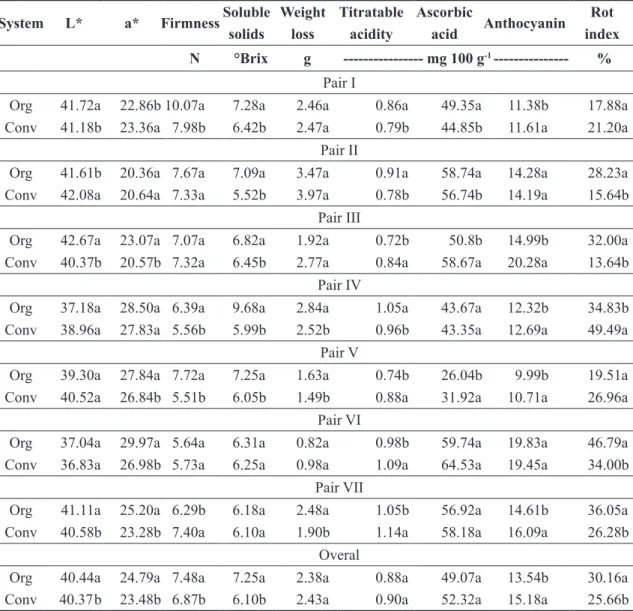
It was observed decrease in lightness (l*) for strawberries along postharvest storage for both production systems (Fig 1a). Strawberries of conventional farming showed a great reduction of lightness values after 2nd day, but not significant or perceptible by naked eye. this result agrees with Ávila et al. (2012) study, where authors also reported no effect of production systems in ‘Camarosa’ and ‘Camino Real’ lightness (l*). Comparing the seven pairs it was not possible to point a production system that promote better lightness (tab 1). It was found three pairs with no differences, other three pairs where lightness was higher for fruits from organic system and one pair where fruits from conventional system were lightener (tab 1).
There were significant differences between
strawberry production systems during storage related to green/red color (a* coordinate). however, it was not possible observe any tendency related to system production, once pair I had higher values for fruits from conventional production and pairs III, V, VI and VII higher values of a* for fruits from organic production. likewise, pairs II and IV did not showed
significant differences in this work (Tab 1).
Firmness for conventional strawberries decreased through storage period, while organic ones showed a slight initial increase followed by a decrease. however, both organic and conventional
strawberries reached similar firmness at the end of
storage period (Fig 1C).
There were no significant differences between
production systems for weight loss, which is consistent with lima et al. (2012) and lima (2015) in strawberries cultivated similarly. Weight loss reduction in strawberries reached 7% on the 8th day. according to garcía et al. (1998), strawberries lose commercial value when weight loss is greater than 6%, indicating that, the analyzed fruits had showed marketing conditions along 6 days.
Soluble solid contents did not change during storage and it was higher in organic system fruits for pairs I, II, III, IV, and V (Fig 1D), which was similar to those results described by Cayuela et al. (1997) in ‘Chandler’ strawberry. according to Seufert et al. (2012), this behavior can be explained by soil fertilization in organic system, carried out by methods and tools that promote slow nutrients release to plant, unlike conventional system. although it was observed this trend for soluble solids content, it was not possible directly associate these higher values with organic system, once two pairs showed similarity between systems.
titratable acidity does not seem to be related to cultivation system, since three pairs of organic cultivations exhibited higher average, while the other four highest values were evaluated in organic farming. this result is opposite trend to before reported by Camargo et al. (2011) and lima et al. (2012) in ‘Oso grande’ strawberries.
It was observed an increase in ascorbic acid content during storage period (Fig 1e) for strawberries from both production systems.
maximum values found were 92.6 mg 100 g-1
(organic) and 68.9 mg 100 g-1 (conventional) at the end of storage. Cayuela et al. (1997) also reported
similar results. Comparable results were verified for
(2012) observed a higher content of anthocyanins in ‘Camarosa’ and ‘Camino Real’ strawberries produced by conventional system, while Camargo et al. (2011) described opposite performance for ‘Oso grande’ strawberries.
Regardless the type of production system, there was an increase in rot index during postharvest
storage (Fig 1F). Indexes registered on 8th day
were 89.1% for organic strawberries and 54.1% for those conventional. Ávila et al. (2012) did
not find differences in this parameter in organic
or conventional ‘Camino Real’ and ‘Camarosa’ strawberries stored for 8 days at 1 °C. lima et al. (2012) reported similar results in fruits of the same species stored under environmental condition.
Cultivation System
Organic strawberries exhibited higher
lightness (L*), green/red modification (a*) values, firmness and soluble solids contents than conventional
strawberries (table 1).
Lightness value varied between field pairs
(table 1). Organic production system left strawberries less dark than conventional system for three, of six farm pairs, coming from São Paulo State. the remaining other three pairs kept similar lightness.
Overall, considering all seven field pairs, organic
strawberries revealed tendency to lighter external color than those cultivated in conventional system. however, it was a slightly difference, (40.44 and 40.37, respectively) not being possible to detected visually, what was also previously related in literature (KROlOW et al., 2007).
Organic strawberries showed higher a* value, indicating that strawberries grown in this system exhibit more red external color. this behavior was
observed for five of the seven field pairs evaluated
(table 1). however, these results cannot be detect by naked human eye, despite been statistically different. although the instrumental analysis by colorimeter provides a good relationship between color detected and differences perceived by human evaluators, many times these differences were minimal enough to be not perceived (Cáceres et
al., 2016). Crecente-Campo et al. (2012) reported
darker red color in strawberries ‘Selva’ produced by organic system, as well as Reganold et al. (2010) for ‘Diamante’, ‘lanai’ and ‘San Juan’ strawberries. Nevertheless, Roussos et al. (2012) found no effect for red color between production systems, as wells as no difference between organic and conventionally grown strawberries was observed in most of the studies (CaYela et al., 1997).
Strawberry firmness is a very important quality parameter (VelICKOVa et al., 2013). In the strawberries case, which are not protected by a
hard-outer peel, a little difference in firmness may
lead to handling resistance and greater shelf life. In this study, strawberries produced organically
were 8.8% (average) firmer than those produced by conventional system were (Tab 1). When each field
pair was analyzed separately, this difference reached
up to 40.1%, observed in field pair V, where firmness
was 7.72 N for organic strawberries and 5.51 N for conventional strawberries, whereas in pair VII
fruits from conventional system were 17% firmer
than organic fruits (tab 1). In other previous report, when fruits were produced in similar locations, no
effect of production system on strawberry firmness
was observed (ROuSSOS et al., 2012). however,
Ávila et al. (2012) found higher firmness values
in organic ‘Camino Real’ strawberries (3.84 N) compared to conventional strawberries (3.45 N), while in ‘Camarosa’ strawberries the difference was bigger, showing 4.77 N for organic and 3,04 N for conventional strawberries.
Soluble solids contents were higher in organic fruits (7.25 ºBrix) than in conventional strawberries
(6.10 ºBrix) for five pairs, while, two pairs showed
no differences (tab 1). the largest difference was
observed in field pair IV, where organic strawberries
showed contents 61.6% higher than conventional
strawberries. These findings are similar to previous
results reported by Roussos et al. (2012) for strawberries cultivated in integrated and organic managements. Oliveira et al. (2013) showed soluble solid contents were approximately 56% higher for organic fruits compared to conventional fruits. Studies reporting higher values for conventional strawberries when compared to organic fruits are rare (CamaRgO et al., 2011).
Better color, higher firmness and greater soluble solids in organic strawberries are related to fertilization management and nutrient levels, when compared to conventional fruits. Some studies have
associated inferior fruit firmness and minor soluble
solids contents with high nitrogen dosages applied to strawberries (D’aNNa et al., 2012; el-SaWY
et al., 2012). Nitrogen is beneficial to plant and
contribute to fruit preservation.
No significant differences in weight loss,
titratable acidity and ascorbic acid contents were observed between organic and conventional strawberries (tab 1). lima et al. (2012) also described no differences in these parameters in strawberries cultivated in different production systems. Weight loss is correlated to water vapor loss, one of the main deterioration causes, resulting not only in quantitative but also in appearance (causing shriveling and wrinkling in fruits), textural (causing softening, loss of coolness and succulence) and in nutritional losses (SPaRKS, 2014). Weight losses among 3% and 6% are enough to cause quality reduction in many horticultural crops, while others can lost up to 10% or more with a still good marketable (SPaRKS, 2014). Strawberries cultivated in both systems had less than 2.5% of weight loss, indicating that these fruits were appropriate for consumption.
No differences in titratable acidity were observed between organic (0.88%) and conventional
strawberries (0.90%) (Table 1). When each field pair
was analyzed separately, it was observed that in four pairs organic strawberries showed less acidity and greatest acidity in other three pairs. lima et al. (2015) found no conclusive differences in titratable acidity among cultivars, regardless production location. these authors studied three strawberry cultivars, and observed higher acidity in organic fruits for one cultivar, lower acidity for another cultivar and no
significant differences for the third cultivar.
ascorbic acid content of organic strawberries (49.07 mg 100 g-1) was not significantly different
from conventional strawberries (52.32 mg 100 g-1)
(tab 1). In the same way of titratable acidity, previous results on ascorbic acid content for strawberry from different production systems were not conclusive. Some studies reported higher ascorbic acid contents in organic strawberries, while others reported conventional system provided higher ascorbic acid
content for fruits or even, no significant differences
between production systems. Vitamin C content depends on many factors, including variety, maturity stage, cultivation conditions and harvest time. these factors may result in considerable variations in results, both between and within studies (SIlVa et al., 2013).
a n t h o c y a n i n c o n t e n t w a s h i g h e r i n conventional strawberries (tab 1). It was measured
15.18 mg 100 g-1 of anthocyanin in conventional
strawberries and 13.54 mg 100 g-1 for organic
strawberries. higher anthocyanin contents in conventional strawberries were observed in five of the seven field pairs studied. a higher
content of anthocyanin in strawberries under conventional farming could be explained by the role of these compounds in diseases prevention and plant protection. this performance can be related by the
low rot index verified in these strawberries (Tab 1).
there are few studies in literature clearly
determining some influence of agriculture practices
on the anthocyanins contents (CReCeNte-CamPO et al., 2012). Cantillano et al. (2003) observed higher anthocyanin in conventional ‘Camarosa’ and ‘Camino Real’ strawberries. Jin et al. (2011) showed ‘allstar’ and ‘earlig’ strawberries produced significantly higher antioxidant capacities and
flavonoid contents under organic culture than those
produced under conventional production system. In this study, it was found samples from conventional
production system had a significantly higher content
of anthocyanins.
Rot index was higher in organic fruits than conventional strawberries in five of seven field pairs. the average rot index was 30.16% for organic strawberries and 25.6% for conventional strawberries (tab 1). a higher rot index for conventional fruits was only observed in field pair IV. the main disease symptoms observed were soft rot caused by Rhyzopus spp., gray mold caused by Botrytis cinerea and anthracnose caused by Colletotrichum acutatum Simmonds. Disease control in conventional strawberry production can be more effective than organic production due to synthetic products employment. however, the chemical products restriction for food security and environmental impact issues has stimulated alternative and biological methods (VallVeRDú-QueRalt & lamuela-RaVeNtóS, 2015). Ávila et al. (2012)
did not find significant differences in disease control
TABLE 1 - Overall average of quality parameters for organic (Org) and conventional (Conv) production
systems of strawberries in seven field pairs (I to VII).
System L* a* FirmnessSoluble Weight Titratable Ascorbic Anthocyanin Rot
solids loss acidity acid index
N °Brix g --- mg 100 g-1 --- %
Pair I
Org 41.72a 22.86b 10.07a 7.28a 2.46a 0.86a 49.35a 11.38b 17.88a
Conv 41.18b 23.36a 7.98b 6.42b 2.47a 0.79b 44.85b 11.61a 21.20a
Pair II
Org 41.61b 20.36a 7.67a 7.09a 3.47a 0.91a 58.74a 14.28a 28.23a
Conv 42.08a 20.64a 7.33a 5.52b 3.97a 0.78b 56.74b 14.19a 15.64b
Pair III
Org 42.67a 23.07a 7.07a 6.82a 1.92a 0.72b 50.8b 14.99b 32.00a
Conv 40.37b 20.57b 7.32a 6.45b 2.77a 0.84a 58.67a 20.28a 13.64b
Pair IV
Org 37.18a 28.50a 6.39a 9.68a 2.84a 1.05a 43.67a 12.32b 34.83b
Conv 38.96a 27.83a 5.56b 5.99b 2.52b 0.96b 43.35a 12.69a 49.49a
Pair V
Org 39.30a 27.84a 7.72a 7.25a 1.63a 0.74b 26.04b 9.99b 19.51a
Conv 40.52a 26.84b 5.51b 6.05b 1.49b 0.88a 31.92a 10.71a 26.96a
Pair VI
Org 37.04a 29.97a 5.64a 6.31a 0.82a 0.98b 59.74a 19.83a 46.79a
Conv 36.83a 26.98b 5.73a 6.25a 0.98a 1.09a 64.53a 19.45a 34.00b
Pair VII
Org 41.11a 25.20a 6.29b 6.18a 2.48a 1.05b 56.92a 14.61b 36.05a
Conv 40.58b 23.28b 7.40a 6.10a 1.90b 1.14a 58.18a 16.09a 26.28b
Overal
Org 40.44a 24.79a 7.48a 7.25a 2.38a 0.88a 49.07a 13.54b 30.16a
Conv 40.37b 23.48b 6.87b 6.10b 2.43a 0.90a 52.32a 15.18a 25.66b
Averages followed by the same letter within the same column for each field pair are not significantly different
CONCLUSIONS
Strawberries produced under organic production system exhibited higher soluble solids
contents and firmer pulp than those produced under
conventional system.
Weight loss, titratable acidity and ascorbic
acid contents were not influenced by production
systems.
lower rot index was observed in fruits from conventional system, which may be related to soils with minor microbial load due to the use of agrochemicals.
In this work, it was observed that each production system was responsible for contributing differently to quality attributes in strawberries.
ACKNOWLEDGMENTS
The authors are grateful for the financial
support provided by Conselho Nacional de Pesquisa e Desenvolvimento – CNPq and for the producers who contributed with this work.
REFERENCES
aKhtOu, I.; ReCamaleS aF. Influence of cultivar and culture system on nutritional and
organoleptic quality of strawberry. Journal of the
Science of Food and Agriculture, london, v. 94, n. 5, p. 866-875, 2014.
aNVISa - agência Nacional de Vigilância
Sanitária. Programa de análise de resíduo de
agrotóxicos em alimentos (PARA). Disponível em: <http://portal.anvisa.gov.br/wps/wcm/ connect/b380fe004965d38ab6abf74ed75891ae/ R e l a t % C 3 % B 3 r i o ± P a R a ± 2 0 1 0 ± -±Vers%C3%a3o±Final.pdf?mOD=aJPeReS>. acesso em: 5 dez. 2016.
aOaC. Official methods of analysis. 18th ed.
gaithersburg: aOaC, 2005. p.10-11.
ÁVIla, J.m.m.; tORalleS, R.P.; CaNtIllaNO, R.F.F.; PeRalBa, m.C.R.; PIZZOlatO, t.m. Influência do sistema de produção e do armazenamento refrigerado nas características físico-químicas e no desenvolvimento de compostos
voláteis em morangos. Ciência Rural, Santa maria,
v. 42, n. 12, p. 2265-71, 2012.
CÁCeReS, D.; DíaZ, m.; ShINYa, P. INFaNte,
R. Assessment of peach internal flesh browning
through colorimetric measures. Postharvest Biology and Technology, New York, v.111, p.48–52. 2016.
C a m a R g O , l . K . P. ; R e S e N D e , J . t. V. ; tO m I N a g a , t. t. ; K u R C h a I D t, S . m . ; C a m a R g O , C . K . ; F I g u e I R e D O , a . S . t. Postharvest quality of strawberry fruits produced
in organic and conventional systems. Horticultura
Brasileira, Brasília, DF, v.29, n.4, p.577-83, 2011.
CaNtIllaNO, R.F.F.; aVIla, J.m.m.; PeRalBa, m.C.R.; PIZZOlatO, t.m.; tORalleS, R.P. actividad antioxidante, compuestos fenólicos y ácido ascórbico de frutillas en dos sistemas de producción. Horticultura Brasileira, Brasília, DF, v.30, p.617-23, 2012.
CaNtIllaNO, F.; BeNDeR, J.R.; luChSINgeR, l.l. Fisiologia e manejo pós-colheita. In:
CaNtIllaNO, F. Morango:pós-colheita. Brasília:
embrapa Informação tecnológica, 2003. p.14-24.
CaYuela, J.a.; VIDeIRa, J.m.; alBI, m.a.; gutIÉRReZ, F. Influence of the ecological
cultivation of strawberries (Fragaria x Ananassa)
cv. Chandler on the quality of the fruit and on their capacity for conservation. Journal of Agricultural and Food Chemistry, easton, v.45, n.5, p.1736-40, 1997.
CReCeNte-CamPO, J.; NuNeS-DamaCeNO, m.; ROmeRO-RODRígueZ, m.a.; VÁZQueZ-ODÉRIZ, m.l. Color, anthocyanin pigment, ascorbic acid and total phenolic compound determination in
organic versus conventional strawberries (Fragaria
x ananassa Duch, cv Selva). Journal of Food Composition and Analysis, Orlando, v.28, n.1, p.23-30, 2012.
D’aNNa, F.; CaRaCCIOlO, g.; mONCaDa, a.; PaRRINellO, a.; aleSSaNDRO, R. effects of different levels of nitrogen on production and quality of strawberries from fresh “plug plants”. Acta Horticulturae, the hague, v.952, p.309-16, 2012.
DaROlt, m.R. Comparação entre a qualidade do alimento orgânico e a do convencional. In:
StRINgueta, P.C.; muNIZ, J.N. Alimentos
SaWY, S.m.; SalmaN, S.R.; aBD el-mONIem, e.m.; SaWaN OmaIma, m.; aBOu-haDID, a.F. Influence of some fertilizer treatments on productivity and fruit quality of strawberries.
Journal of Applied Sciences Research, Jordan, v.8, n.1, p.483-90, 2012.
gaRCía, J.m.; meDINa, R.J.; OlíaS, J.m. Quality of strawberries automatically packed in
different plastic films. Journal of Food Science, amsterdam, v.63, n.6, p.1037-41, 1998.
JIN, P.; WaNg, S.Y.; WaNg, C.Y.; ZheNg, Y. effect of cultural system and storage temperature on antioxidant capacity and phenolic compounds in
strawberries. Food Chemistry,Netherlands, v.124,
n.1, p.262-70, 2011.
KROlOW, a.C.R.; SChWeNgBeR, J.e.; FeRRI, N.l. avaliações físicas e químicas de morango cv. aromas produzidos em sistema orgânico e
convencional. Revista Brasileira de Agroecologia,
Porto alegre, v.2, n.2, 2007.
lIma, m.a. Qualidade e segurança do morango produzido nos sistemas convencional , orgânico e
produção integrada. Revista Agrogeoambiental,
Pouso alegre, v.7, p.47–57. 2015.
lIma, m.a.; CalegaRIO, F.F.; SaNCheS, J. Quality and safety of strawberries produced
in different production systems. Horticultura
Brasileira, Brasília, DF, v. 30, n. 2, p.S7560-S7567, 2012.
OlIVeIRa, a.B.; mOuRa, C.F.h.; gOmeS-FIlhO, e.; maRCO, C.a.; uRBaN, l.; mIRaNDa, m.R.a. the impact of organic farming on quality of tomatoes is associated to increased oxidative
stress during fruit development. PLoS ONE,San
Francisco,v.8, p.e56354, 2013.
POllaN, m. Em defesa da comida: um manifesto.
Rio de Janeiro: Intrínseca, 2008. 272p.
RegaNOlD, J.P.; aNDReWS, P.K.; ReeVe, J.R.; CaRPeNteR-BOggS, l.; SChaDt, C.W.; allDReDge, J.R.; ROSS, C.F.; DaVIeS, N.m.; ZhOu, J. Fruit and soil quality of organic and
conventional strawberry agroecosystems. PLoS
ONE,San Francisco, v.5, p.e12346, 2010.
ROuSSOS, P.a.; tRIaNtaFIllIDIS, a.; KePOlaS, e. Strawberry fruit production and quality under conventional, integrated and organic
management. Acta Horticulturae, the hague,
v.926, p.541-546, 2012.
SeuFeRt, V.; RamaNKuttY, N.; FOleY, J. a. Comparing the yields of organic and conventional agriculture. Nature, london, v.485, p.229-32, 2012.
SIlVa, P.a.; aBReu, C.m.P. de; aSmaR, a.S.; CORRÊa, a.D. Quality evaluation of strawberries grown in the region of lavras, minas gerais State.
Acta Scientiarum, maringá, v.35, n.4, p.777-82, 2013.
SPaRKS, S.a. Postharvest handling. 3rd ed.
amsterdam: elsevier, 2014. <http://doi.org/ urn:doi:10.1016/B978-0-12-408137-6.00002-8>
VallVeRDú-QueRalt, a.; lamuela-RaVeNtóS, R.m. Foodomics: a new tool to differentiate between organic and conventional foods. Electrophoresis,Weinheim, v.1, n.11, p.1784-84, 2015.