BANDIDA DO POMAR – BREAKING THE STATUS QUO
THROUGH COMMUNICATION STRATEGY
Bandida do Pomar Case Study
Inês Conde Rodrigues Coutinho Marques
Case-Study submitted as partial requirement for the conferral of Master in Marketing
Supervisor:
Prof. Mónica Ferreira, ISCTE Business School, Marketing, Operations and General Management Department
Acknowledgements
First of all, I would like to thank to Professor Mónica Ferrerira for sharing all her vast insights and experiences inside the Mrketing field and all her guidance since the beginning of this project.
I would like to thank my family for all the moral support and for motivating me to go through an optimistic path throughout this process. Both of you inspired me to keep on doing my best.
To all my team of Central de Cervejas e Bebidas who helped me, in special to Sara Ornelas (Bandida do Pomar Brand Manager) who was incredible since the start and provided me with all the information needed to write the present case-study.
Last but not least, I would like to thank to all of my friends’ encouragement and inspiration to keep on moving on with my head up high in order to finish this project. You were the ones who helped me to do my best.
Index
BANDIDA DO POMAR – BREAKING THE STATUS QUO THROUGH
COMMUNICATION STRATEGY ... 1
1. ABSTRACT ... 7
2. THE CASE ... 9
2.1. Presentation of the Issue ... 9
2.2. The Market Overview ... 9
2.2.1. FMCG and Drinks Market ... 9
2.2.2. The Cider Market ... 10
2.2.2.1. Cider vs The Consumer ... 12
2.2.2.2. The Cider Market in Portugal ... 14
2.2.3. Sociedade Central de Cervejas e Bebidas ... 16
2.2.3.1. SCC Ciders ... 18
2.2.4. The Competitors ... 19
2.2.4.1. The Perceptual Map ... 25
2.2.5. Consumer Behavior and Preferences ... 25
2.3. Bandida do Pomar – The Brand ... 29
2.3.1. Values and Mission ... 30
2.3.2. Branding ... 31
2.3.2.1. The name – Bandida do Pomar ... 32
2.3.2.2. The Brand’s Identity Pyramid ... 33
2.3.2.3. The Packaging ... 34
2.3.3. Where can we find Bandida do Pomar? ... 35
2.3.4. The Product ... 36
2.3.5. Bandida do Pomar Communication – Tone of Voice ... 37
2.3.5.1. Bandida do Pomar Identity ... 38
2.3.5.2. Target Consumer ... 39
2.3.5.3. Brand’s Promotion ... 41
2.3.5.4. The Brand’s Communication in the On-Trade Channel vs the Off-Trade channel .... 43
2.3.5.5. The Brand inside the Social Media ... 45
2.3.5.6. The Brand’s Communication Strategies Taken ... 46
2.3.6. Price ... 47
2.3.7. The Brand’s Impact ... 48
3. QUESTIONS ... 51
4. TEACHING NOTES ... 51
4.1. Target and Objectives ... 51
4.2. Literature Review ... 53
4.2.1. Marketing Strategy ... 53
4.2.1.1. Marketing Mix ... 54
4.2.1.2. Marketing Communication Strategy ... 54
4.2.1.3. Marketing Communication Tools ... 55
4.2.1.4. Integrated Marketing Comunications ... 57
4.2.1.5. Brand’s positioning ... 58
4.2.2. Branding ... 59
4.2.3.1. Social Media Influencers ... 63
4.2.3.2. Celebrity Endorsement ... 64
4.2.4. Consumer Engagement ... 65
4.2.5. Digital Engagement ... 67
4.2.5.1. Digital Engagement through Storytelling ... 68
4.2.5.2. Digital Engagement in the alcoholic drinks ... 69
4.2.6. Offline and Online Distribution Channels ... 70
4.3. Methodology ... 71
4.4. Animation Plan ... 73
4.5. Animation Questions ... 73
4.6. Case Study Resolution Proposal ... 74
4.7. Slide ... 86
5. MANAGEMENT LESSONS ... 87
6. REFERENCES ... 89
Index of Tables
Table 1: Why cider is better ... 12
Table 2: Strong points and low points of existing brands ... 24
Table 3: Bandida do Pomar Strategies Taken over 2018 ... 46
Table 4: Animation Plan ... 73
Index of Figures Figure 1: Cider Making Process ... 12
Figure 2: How to serve cider ... 13
Figure 3: Evolution of consume of cider ... 15
Figure 4: Overall resume of the cider industry ... 16
Figure 5: Evolution of SCC volume of sales vs Portugal volume of sales, regarding the category. ... 19
Figure 6: Bandida do Pomar Competitors (Resume). ... 23
Figure 7: Ciders Perceptual Map ... 25
Figure 7: The Fox Icon ... 30
Figure 8: Bandida do Pomar Logo ... 31
Figure 9: Orchard Thieves Logo vs Bandida do Pomar Logo. ... 32
Figure 10: Brand’s Identity Pyramid ... 33
Figure 11: Bandida do Pomar Packaging Evolution of the Can – 2017 to 2018 ... 34
Figure 12: Bandida do Pomar Packaging Evolution of the Bottle – 2017 to 2018 ... 34
Figure 13: Bandida do Pomar Expansion Strategy ... 36
Figure 14: Bandida do Pomar Target ... 40
Figure 15: Bandida do Pomar Timeline, 2018. ... 43
Figure 16: Bandida’s Communication Strategy in each distribution channel ... 44
Figure 17: Bandida do Pomar Brand in a Bottle. ... 77
Figure 18: Bandida do Pomar Slides. ... 86
Index of Graphics Graphic 1: SCC Data Report, 2018. ... 10
Graphic 2: Categories spontaneously said by consumers ... 26
Graphic 3: Consumer’s characterization of cider ... 27
Graphic 4: Cider consumption ... 28
Graphic 5: Bandida do Pomar development ... 28
Graphic 6: Price Value - Cider ... 48
Graphic 7: Cider 3 key Players – On-Trade Channel ... 48
Graphic 8: Volume Sales - Cider ... 49
Graphic 9: Volume Sales of Ciders 3 Key Players inside the on-trade channel vs the off-trade channel ... 49
Graphic 10: Volume Sales of Ciders 3 Key Players ... 50
Index of Appendixes
Appendix 1: SCC Portfolio ... 93
Appendix 2: Bandida do Pomar Communication Merchandise and Visuals ... 94
Appendix 4: Bandida do Pomar Micro-Influencers Impact on Instagram. ... 95
Appendix 5: Bandida do Pomar Instagram Page ... 95
Appendix 6: Bandida do Pomar Instagram Publications - Giveaways ... 96
Appendix 7: Bandida do Pomar Mupis ... 96
Appendix 8: Bandida Can Strategy Proposal and examples of the brand activation. .. 97
Appendix 9: Sara Ornelas’s Interview ... 98
1. Abstract
Recently, we have been witnessing a global attractiveness enhancement for cider. People have discovered its enjoyable natural and uplifting taste, creating tailwinds in this market. Cider itself, is a refreshing alcoholic drink made essentially from fermented apple juice, designed specifically to be an alternative for those who don’t find satisfaction in drinking beer and prefer a sweetener option for their drinking enjoyments.
Despite being a tasty and natural drink, cider brands have a privation when it comes to establishing long-term relationships of loyalty along with consumers, which is a fact that contributes to a path towards becoming forgotten in the future. With this relationship absence, brands end up losing their strength in their market’s sector, losing their relevance among possible clients.
The present case-study aims to analyze the impact that communications has when it comes to reaching the success of brands in general and, in a more specific investigation, analyzing the example of the cider brand Bandida do Pomar. Despite being a new born brand inside the Portuguese market, Bandida aspires to break the traditional communication rules regarding this type of products.
In order to understand the situation point of the theme, it will be initially explored the overall market position of ciders, leading to the specific Portuguese market and, in a more concrete form, it will be analyzed the brand itself, which is already present in several countries with several names, being part of the Global Heineken Group. Furthermore, it will be presented the strategy adapted by the brand in Portugal, referring to its communication and impact regarding the position that the brand wants to establish in the market. In order to successfully understand that, it will be added a more detailed approach to the 4 P’s of the brand, giving a special focus on Promotion, and it will also be explored the Brands’ Awareness and Equity.
This case-study will be mainly focusing on the performance and potential growth of the brand within the Portuguese market.
Keywords: Marketing, Branding, Communication, Brand Awareness, Positioning.
JEL Classification System:
M30: General Marketing M31: Marketing
Resumo
Recentemente, temos vindo a assistir a uma atração a nível global pela categoria sidra. As pessoas têm descoberto o seu sabor natural e revigorante, mexendo com este mercado. A Sidra é uma bebida refrescante, com álcool, produzida essencialmente com sumo de maça fermentado, desenhada especificamente como alternativa para aqueles que não encontram qualquer satisfação no consumo da cerveja, preferindo um sabor mais doce para a sua bebida de eleição.
Apesar de ser uma bebida natural e saborosa, as marcas de sidra têm um handicap no que respeita ao relacionamento de longo prazo com os consumidores, facto que contribui para um percurso que se quer esquecer no futuro. Com esta dificuldade de relacionamento, as marcas acabam por perder força no seu sector de mercado, perdendo também relevo entre os possíveis clientes.
O presente Case-Study visa analisar o impacto que as comunicações têm quando se trata de alcançar sucesso das marcas em geral e, de uma forma mais específica, analisar a marca de sidra “Bandida do Pomar”. Apesar de ser uma marca criada recentemente no mercado português, Bandida aspira a quebrar as regras tradicionais de comunicações em relação a este tipo de produtos. Esta marca está a lançar-se no mercado de uma forma mais disruptiva, superando a ideia de apenas vender uma bebida e se tornar numa moda a ser seguida.
Em ordem a compreender o ponto de situação, inicialmente, será analisada a posição geral no mercado das sidras, no que diz respeito ao mercado específico de Portugal e, de uma forma mais concreta, será analisada a própria marca, que já se encontra presente em diversos países, com os seus respetivos nomes, fazendo parte do Grupo Global Heineken. Além disso, será apresentada a estratégia adaptada pela marca em Portugal, referindo-se à sua comunicação e impacto em relação à posição que a marca quer estabelecer no mercado.
Este Case-Study centrar-se-á principalmente no desempenho e potencial de crescimento da marca no mercado português.
2. The Case
2.1. Presentation of the Issue
The proposed theme for the case-study will be the impact that communication alongside with the new digital platforms are able to have when launching a brand that is part of a market that already encompasses a great competition that is well established and marks a strong position in the minds of the consumers., having a special focus on the brand Bandida do Pomar.
In order to that, it is important to have a vision about the strategy taken from the brand’s competitors along with what consumers want. By understanding the impact that the overall market in able to have, it will become more clearly to understand how Bandida do Pomar can use its strengths to take advantage of its opportunities and avoid potential threats, by overcoming its weaknesses.
The present case-study aims to conclude if the brand in focus is able to communicate successfully with its consumers, contributing to the creation and establishment of relationships, alongside with understanding if it is able to have a positive impact in the brand’s several KPI’s. The main goal of the case will be to understand if this brand’s example can be considered as a successful case to be followed by other brands that want to break the status quo when it comes to communication, and what tactics and techniques can be used to develop and follow that strategy.
2.2. The Market Overview
2.2.1. FMCG and Drinks Market
The FMCG market is responsible for a large part of consumer goods, being one of the markets with greater volatility when compared to other consumer markets.
The beverages sector is the most penalized category, containing sharp variations due to its diversity and volume of factors. We have been observing a volume growth in all categories since 2015, which ceased to be at the end of the first half of 2018. The only
MAT Junho 2012 MAT Junho 2013 MAT Junho 2014 MAT Junho 2015 MAT Junho 2016 MAT Junho 2017 MAT Junho 2018 VAR (%) vs Per. Ant. CERVEJAS 410 947 040 382 916 390 386 958 856 362 006 382 367 155 664 389 535 458 382 823 872 -1,7% SIDRA 282 970 584 640 1 705 644 3 341 309 5 635 403 7 117 050 7 269 295 2,1% WINE & SPIRITS
1)GIN 453 583 456 784 643 112 870 608 1 015 236 1 063 166 1 053 455 -0,9% 1)RUM 324 766 290 445 257 110 223 255 221 841 245 192 239 408 -2,4% 1)VODKA 1 103 176 985 720 938 903 905 254 945 758 1 015 908 1 000 291 -1,5% 1)LICORES 4 180 978 3 767 285 3 468 037 3 348 230 3 478 319 3 475 331 3 444 579 -0,9% 3)WHISKY 11 319 890 9 814 062 9 234 059 8 566 086 8 701 208 8 542 021 8 005 768 -6,3% 2)AGUARDENTE 1 306 107 1 174 941 1 085 532 1 039 017 1 010 044 1 001 914 989 016 -1,3% 2)TOTAL MIXERS 264 787 166 216 66 564 42 371 -36,3% 2)VINHOS APERITIVOS 2 830 374 2 607 071 2 425 376 2 327 278 2 350 764 2 473 869 2 445 253 -1,2% 3)VINHO DO PORTO 5 647 515 5 652 196 5 651 498 5 483 246 5 379 141 5 511 711 5 818 751 5,6% 2)VINHO ESPUMANTE 8 070 177 8 205 294 7 763 324 7 745 174 8 382 463 9 280 586 9 184 382 -1,0% 4)VINHOS 243 009 910 229 685 330 222 870 906 226 456 502 237 253 596 244 948 196 244 420 612 -0,2% ÁGUAS 904 551 420 837 320 272 851 040 592 850 510 640 909 488 908 998 257 452 1 020 357 908 2,2% REFRIGERANTES 690 739 724 635 737 476 631 583 104 616 271 496 608 174 880 613 916 388 574 961 704 -6,3% 4)TOTAL CAFÉ 28 514 684 28 008 119 28 060 194 28 866 157 29 282 502 29 445 050 29 832 043 1,3% 5)TOTAL CHÁ 455 561 478 632 485 825 531 913 515 708 538 599 4,4% TOTAL PORTUGAL
category that continues to see a present growth is the Cider category, which grew 2.1% comparing to the previous year, which can be analyzed in the table above:
Graphic 1: SCC Data Report, 2018. Source: Nielsen, 2018
It is also perceived that the beverages sector is dominated by manufacturer brands in both volume, value and market share in 2018. When it comes to the category of ciders, there are 3 main key players, where the newly arrived Bandida do Pomar managed to steal market share from the market leader Somersby and his rival in house Strongbow, achieving 3.3% market share, facing the previous year (Nielsen, 2018).
It is possible to verify that the final consumer has developed an interest for new players and is lean on opening space for the emergence of new brands and categories.
2.2.2. The Cider Market
The first concept that was born about ciders came from the Romans (55BC), who made a cider-like drink. It was then that the love for cider started to be developed and spread through all the Roman Empire and across Europe to the Germanic tribes and the Normans.
William the Conqueror and the Normans decided to put a tax on cider in order to be able to profit from its growing attractiveness. In fact, the word Cider comes from the old
French word – Cisdre, which comes from the Latin word – Sicera, meaning “Strong Drink”.
In 1200, due to the growing demand, the creation of the screw apple press contributed to facilitate the process of Cider production, which led to a rapid growth of the market.
It was between 1300 and 1850 that apples started to replace the grapes. Due to this fact, Cider started to be a replacement of the traditional wine, increasing its popularity, especially in France and through the English elite.
Cider’s popularity has grown and decreased throughout the centuries, especially in the United Kingdom, France and the United States of America. Despite this ups and downs through the cider history, the sector has blossom itself by turning into an attractive and modern drink to be consumed.
Cider drinking turned into a trend mainly due to the fact that ciders started to work hard in order to innovate and redesign its boring and antique image with the main goal of attracting new consumers. The recent success of cider products inside a market that is already established and it’s still growing, is able to open doors to new opportunities to acquire new consumers and generate engagement.
Below, it is possible to observe some curiosities about why cider is considered to be better when comparing to other alcohol drinks:
Drinks Why Cider?
Wine – This drink is considered to be more traditional and heavy. Wine is often suited to be part of more formal and slow energy occasions, for example in dinners or more formal parties.
Cider is a more bright and easy drink. Despite the fact that it still is a formal drink, cider is seen as more inclusive.
Spirits – Are considered to be short measures, high in alcohol and directed to business. This type of drinks are more suitable for high energy occasions later in the evening or night.
Cider is more refreshing. It englobes both tradition and authenticity but with less alcohol.
Beer – It is a slightly bitter drink, designed to drink ate every moment of the day, which is the reason why it’s the top of mind choice for consumers when thinking about choosing a drink.
Cider is field with a fruity taste, which makes it an easier and more refreshing drink. Just like beer, it is suitable for any occasion at every moment of the day.
RTD’S – Ready to drink cocktails are more chemically produced, being less healthy than any others. It is a mixed drink that can be unexpectedly and overly sweet.
Cider has the major characteristic of being refreshingly natural, which makes it healthier drink.
Table 1: Why cider is better
Source: Own illustration, based on the Cider Discovery Guide, 2017.
To sum up, creating a new category in the alcohol industry is not an easy task and has its similarities to planting a tree – it is needed to plant the right roots and make them strong in order to grow and flourish.
2.2.2.1. Cider vs The Consumer
Cider is a fermented drinks that goes through a process of creation in order to offer the final consumer the promise of a tasty and refreshing drink.
Figure 1: Cider Making Process Source: SCC Sales Folder, 2018.
There are four different types of Cider apple used in Cider-making – sweet, sharp, bittersweet and bitter sharp. All of these varieties are able to increase brand’s portfolio along with the possibility of reaching new targets that are into different flavors and like to try out new things. Cider involves many characteristics that are attractive for the final consumer, such us:
Transparency is all – Consumers are becoming more aware about what is inside their drinks, where it comes from and how it is made. They want clear labelling in order to get to know the product before trying it out. By being transparent as a brand, will contribute to the influence of the consumers purchase decision.
Influencers and Cider’s social reach – the future of this market is in the hands
of influencers – the one who love to take pictures and share experiences and moments on social media networks. In order to reach this target, cider-makers must work in order to create products that are enjoyable to share.
Cider goes local – Cider drinkers care about how their drinks are made and where do the apples used to create it come from. That is the reason why, by using local apples, the brand will be engaging with the consumer almost subconsciously.
Sweet to Dry – The cider market is able to provide its consumers with a large variety of flavors, which can satisfy everyone.
Fruity blends – Apples and pears are no longer the only fruits used to make ciders. The most modern ciders are made with other fruits such as strawberries, limes, passionfruit and wild berries. These refreshing alternatives to the traditional ciders are able to reach a whole new target and generations of more adventurous drinkers.
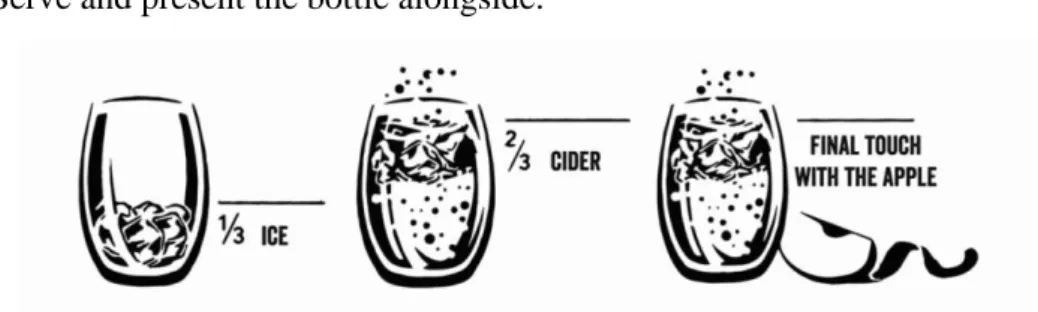
At the end, we are able to conclude that cider is all about the drinking experience, so it is important to understand how that process must be delivered in order to engage correctly with the final consumer. Despite the fact that the cider inside the bottle is served fresh, if it is served with the addition of ice, the experience will be extra refreshing. In order to serve the perfect cider, there are a few steps to be taken:
1. Fill a glass with 1/3 with ice;
2. Pour the cider to the center of the glass; 3. Serve and present the bottle alongside.
Figure 2: How to serve cider
When it comes to experience, details can be the key element to make the difference, and in the case of cider, the ice has a whole new effect on the taste and experience. Serving Cider cold over ice brings out the crisp taste of the apples. As the drink fizzes, it sparkles with vitality, releasing an apple aroma in the air. But in order to do this successfully, the drink can’t be pour all at once, to enrich the freshness of the cider.
By having all of these factors in mind, the cider category wants to create a world of “InCiders”, which is composed by a cider drinking tribe that strives to enjoy the present and create experiences by refreshing every moment with a simple touch of pure gold.
2.2.2.2. The Cider Market in Portugal
Nowadays, Cider drinking is more popular than ever, and in this new era, new flavors and new styles are being created, increasing the sector’s variety.
The alcoholic drinks’ consumers in Portugal are exposed to a large number of products inside this category that vary only according to their personal likes and dislikes. It’s a fact that a group of consumers don’t appreciate beer, due to its bitter taste and, due to that, cider has become the best alternative as it offers a similar product, with a similar price, to be enjoyed at those moments with friends. Cider as a category has been planting its roots in the market, especially aside with the beer category. It is an offer for the same moments of consume as beer, but with a lighter touch, sweeter, younger and more fruity.
Currently, cider is considered to be a trend and is increasing its position in the mindset of consumers. Due to that reason, the growth of the category has been being reinforced and the relevance of this product is increasing.
What was initially just a trend of the moment is starting to rise its relevance. Portugal doesn’t have a specific tradition of cider drinking, although there is a clear pattern on the growth of this sector, not only in volume, but also in value.
By being such a dynamic category, there is still a lot of space to be expanded, despite having a strong seasonable characteristic, as the summer is the principal season for the
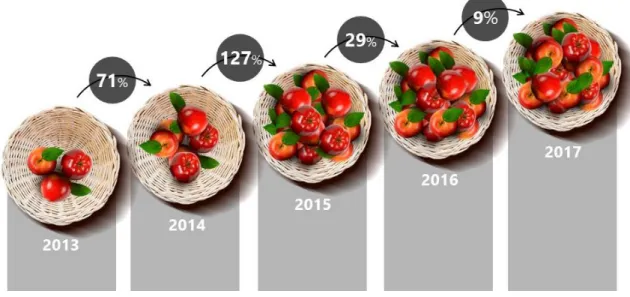
business’ development. The study made by the TGI Marketest states that in 2017, one million and 648 thousand individuals drank cider in the latest twelve months, which represents 20% of the overall residents in Portugal with more than 18 years old. The consume of this drink has been systematically growing since 2013, increasing 56% since then.
Figure 3: Evolution of consume of cider Source: Nielson presentation, 2017.
In Portugal, the main target for the cider sector is very diverse. But, in comparison with other alcoholic drinks’ categories, men are still the ones who consume more cider, although cider is still a very attractive drink for women due to its sweet taste. When segmenting the target inside this sector, a big percentage of consumers has less than 35 years old.
Despite the fact that cider is more drank during the summer, having a 53% of total volume during this time, several companies work towards introducing this product to other occasions and moments, selling the experience itself and not only the product.
The first cider brand that was introduced to the Portuguese market was Somersby, with its launch in 2011. Nowadays, Somersby has three varieties - apple, blackberry and citrus, which makes it a triple threat cider.
On the other hand, for SCC the principal challenge when investing in that sector, was the creation of awareness towards the product itself. Actually, the cider portfolio of SCC is composed by three brands – Strongbow, Bandida do Pomar and Old Mout. Strongbow is a brand that strives to reinforce the natural origin of its ingredients, bringing them to the city. Bandida do Pomar is the most recent daughter of SCC and is known by its young, irreverent and different positioning that is already overcoming expectations. Old Mout is a brand with very tropical cider’s flavors and with a more premium positioning.
Despite being an old concept, Cider entered the life of Portuguese people and its growing inside this sector since 2013. The trend was developed years ago between the youngsters community and converted itself as an evening cool drink. In Portugal, Cider is a unisex drink, enjoyed by everyone. The cities of Lisbon and Porto are the ones who consume cider the most, followed by the Algarve, for the reason that it is a very touristic zone of the country and tourists are already familiarized with the category.
To sum up, a resume of the market context can be analyzed in order to provide more insights for future conclusions
Figure 4: Overall resume of the cider industry
Source: Nielsen; In-sites consulting; Cider Launch Tracker 2017; U&A Cider report [Ipsos]; Beer Image tracker.
2.2.3. Sociedade Central de Cervejas e Bebidas
Sociedade Central de Cervejas (SCC) was born in 1934 as a result of the association of Companhia Portuguesa de Malte and Portugalia Cervejas, Companhia de Cervejas
Estrela, Companhia da Fábrica de Cerveja Jansen and Companhia de Cervejas de Coimbra. In 1935, the patrimony of Fábrica de Cervejas da Trindade, including its brewery, is integrated in the SCC society. At this time, SCC’s beer production involved 5.1 million litters.
Being a reference of SCC portfolio as one of the most successful beers in Portugal, Sagres was launched in 1940, being considered to be a landmark of great Portuguese tradition that was emerged as an export beer at the Portuguese World Exhibition, in Lisbon. The name was born from the village of Sagres in the extreme south of the Portugal coast. In 1943, the exportation of beer began, passing through Gibraltar, Azores, Timor, Goa and Macao. For more than a year, Sagres left the Portuguese factories directly and exclusively for the cliff at the gates of the Mediterranean. Humberto Pelagio, the first president of SCC, soon realized that he had a successful case in his hands. With the time that went by, the founder brands of SCC began to disappear, leaving Sagres as the main brand responsible for SCC.
In 1947, CUCA (Companhia União de Cervejas de Angola), with a capital of 25 thousand euros, was signed by the companies of SCC group and CUFP. This happening was the beginning of SCC’s presence in Africa, whose main objective would be to implement a brewery in Luanda or Lobito.
Due to the crisis in the colonies and to the various commercial and industrial activities, the 60’s were considered to be intense for the SCC. It was at this time that the slogan written by the poet José Ary dos Santos appeared – “Cerveja Sagres – A sede que se deseja”.
Meanwhile, in 1965, the project of the creation of a new factory was being explored by SCC along with the administrator Beirão da Veiga. After several studies and surveys, 35 hectares of land were acquired in Vialonga (Alverca), in order to ensure the supply of the future factory.
On June 22, 1968, the head of state, Admiral Americo Thomaz, inaugurated in Vialonga, the new SCC factory, which at this time, was one of the largest in Europe and the most modern and well-equipped in the world. Designed by the architect Eduardo Iglésias, the new brewery was an icon for the industrial architecture of the sixties.
After the revolution, in 1977, the industry was divided into two principal breweries: Centralcer – SCC and Unicer.
In 1990, Sagres completed 50 years, becoming a market leader, in 1993, SCC was 100% owned by the Bavaria Business Group, controlled by the Colombian family Santodomingo, followed by the Scots from Scottish & Newcastle and, the most recent ones, the Dutch from Heineken.
In the reorganization of the group, in 2001, SCC was renamed, becoming Sociedade Central de Cervejas e Bebidas. Due to the Heineken International Group, SCC suffered an expansion of its portfolio, which included not only beers and water, but also ciders and soft drinks, as we can observe in Appendix 1.
2.2.3.1. SCC Ciders
The significant growth of the global cider market contributed to allocate this type of drink in every map, providing the attraction of more consumers, especially youngster generations. The tendency was brought to Portugal and became a trend in the market in a blink of an eye.
The recent success of this product is creating awareness along with opportunities that are capable of attracting new consumers and new competitors. That is the reason why it exists a huge activity regarding this sector.
Sociedade Central de Cervejas e Bebidas already has invested in a huge portfolio of drinks that go from beers to water, and more recently, this new sector – the ciders. There was a need of investing in a middle drink to offer to consumers as an alternative to beer that was considered to be stronger than just a simple water.
SCC is the mother of three cider brands: Strongbow, Old Mout and Bandida do Pomar. Strongbow was launched by the company as an alternative of a fermented drink, being initially considered to be a global market leader inside the cider sector. Strongbow offers the consumers a sophisticated product, able to connect with a more specific target that wishes to preserve its elegant and exclusive lifestyle. Despite its leading start, nowadays Strongbow is starting to be over performed by SCC most recent brand – Bandida do
Pomar, which offers the same type of product with a less elaborated recipe. Despite Bandida’s cider is considered to be inferior when comparing to Strongbow, Bandida offers to its consumers a disruptive lifestyle and is able to establish relationships with them through its positioning statement, which is the reason why the company is focused on investing into the development of this brand. Last but not least, Old Mout is a more touristic cider, being mainly targeted to the tourists that come to our country.
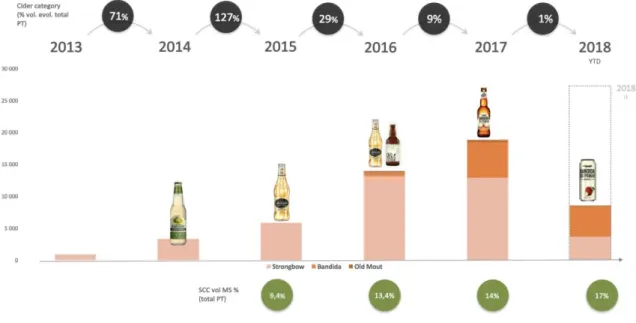
Figure 5: Evolution of SCC volume of sales vs Portugal volume of sales, regarding the category. Source: Own elaboration, adapted from the Cider Global Tracker, 2018
Although they are considered to be competitors between each other, SCC cider brands work as a family to provide a product that is able to reach every type of target, contributing to the company’s overall percentage of volume of sales.
2.2.4. The Competitors
Nowadays, we are all aware of the importance an effective competitor analysis has on the success of a business. Clearly, meeting customer’s needs is not enough. Firms need to focus on understanding competitor’s strategies in order to know how to act to reach a place of advantage. They don’t have to be only the best in answering customers’ need, they also have to be better than their own competitors.
In order to do a prodigious competitors analysis, firstly there is the need to identify the brand’s current competitors and answer some questions about the competitor’s location, weaknesses, strengths, products, sales, among others.
The rivalry inside this sector is extremely powerful, as the brands that already exist have their own identities well-established in the market, along with the same offer of products and the appearance of new brands inside the industry is happening more often than expected.
Concerning de alcohol drinks industry, it is possible to identify two categories of competitors – the direct competitors and the indirect ones – based on the following criteria: identity, flavours and products. On one hand, we can find the direct competitors which are those who are present in the same distribution channels as Bandida do Pomar and offer the exact same type of product. These direct competitors are those who possess a powerful strategy when it comes to reach the top of mind of the consumers. As such, it is possible to identify as direct competitors the following brands:
Somersby – Somersby was created by the Carlsberg Group in 2008, reaching a great success in Denmark and Norway. It is a very refreshing easy-drink with many flavours aimed at a young and experimentalist target. The base of this cider is the juice of fermented apples and natural ingredients. Somersby has become a city drink, more directed to large urban centres where the consumer has a more open-minded mentality, is not afraid of breaking habits and seeks to get to know new products. The cider is a refreshing drink with a low percentage of alcohol (4.7%), produced from the fermentation of the apple and the adding of 15% of juice and natural aromas. The brand has as insight “refresh the good moments” and presents itself in a transparent glass bottle, with a label where the light colours are predominant and the nature element is highlighted, reinforcing the concepts of freshness and lightness (Briefing Unicer, 2011). In the foreign market, after the success of the apple cider, other variants of the drink have been being explored, such as pear flavour, double press cider (which is a drier and less sweet cider) and, the most recent one being launched, the Somersby Apple, with 45% less calories. Today, Somersby is being sold in 22 countries, with Northern Europe taking the lead in the market, followed by Western Europe and, most recently, being expanded to Asia.
Strongbow – The brand has its roots in the UK, being originally produced by H. P. Bulmer in England in 1962. Strongbow was the name given to Richard of Clare, one of England’s greatest knights of the 12th century. De Clare was baptized with the nickname “Strongbow” for relying heavily on his archers during his campaigns. The arrow of Strongbow is still lodged in the trunk of the Strongbow apple tree, which is visible on the label of the brand. The Bulmer Company is an arm of the Heineken International Group. The Strongbow Gold was manufactured in Belgium and launched to other European countries in 2011.the drink is a mixture of culinary apples, creating a bitter-sweet cider. The apples used in the production of Strongbow are cultivated and grown in France and England. A production method is used, and it contains sugar and apple concentrate. The apple concentration is then fermented with controlled yeast strain and with the addition of sweeteners. The Bulmer’s Strongbow is considered to be the largest alcoholic container in the world and has a capacity of 6.8 million litters. Strongbow has a range of six ciders with different taste profiles, from sweet to lower carb, in order to be present at every moment, mood or momentous occasion.
Regarding the indirect competitors, the main brands in Portugal that can be considered are those who offer the same type of product but with a completely different style and we can only find them in the off-trade channel. These brands are considered to be indirect competitors due to its various characteristics and values:
Sagres Radler – The brand was presented to the market in 2013 by SCC (Sociedade Central de Cervejas e Bebidas) as a low-alcohol beer with natural lemon juice, being intended to provide to its consumers a unique experience. The beer is inspired by a traditional Bavarian recipe, with a natural ingredient which is lemon juice. The product was born by the combination of Sagres beer with natural lemon juice. However, the brand wanted to go further and, due to that fact, the brand launched the new Sagres Radler Lima Green Maize, which was a combination of Sagres beer, natural lime juice and green apple. This variety wants to establish itself in the market as an ideal alternative to the beer segment, which is the main reason why the brand is being characterize as a sider competitor. Presented to the Portuguese market in 2013, until the end of the last year (2017), SCC sold 19 million litters of the Radler variety.
Old Mout Cider – This cider’s varieties are made from ripe local fruits which are picked less than 50kms away from Nelson-based cidery. This area is characterized by having loads of sunshine and the soil provides the growth of fine apple trees. Old Mout Cider is made by fermenting the whole juice from the fruits. The usage of culinary or “eating apples” are used in order to get a delicious apple taste, without the pucker. Braeburn makes up around 65% of the mix. It contains a pinch of potassium met bisulphite and potassium sorbate, which is used since Roman times to preserve cider’s natural colour, flavour and quality. All Old Mout Ciders are field with flavours, due to the reason that they are made from perfectly ripe whole pressed fruit, being 100% gluten free.
Vadia Cider – This cider was born by the result of a partnership between the University of Aveiro and Cerveja Vadia, having been voted the best Portuguese cider at the World Cider Awards in 2018 and considered to be one of the best in the whole world. The main characteristic of this handmade cider is the use of apple pomace as one of the principal ingredients, which is considered to be an ingredient whose elimination has many environmental and economic implications for the industry. The cider is simple and cheap to produce and is 100% made with Portuguese apples. The low temperature fermentation over several weeks, allows to preserve the authentic flavour of the apple and is able to provide a balance between the freshness of its acidity, the natural carbonation acquired and the natural sweetness of the apple. Vadia is an excellent choice to combine not only sweet but also sour dishes, sushi, salads and cheeses.
Continente Cider – To increase its local portfolio, Continente launched a cider in order to compete in a market which is growing and increasing interest in the minds of the consumers. This cider, although is still not very known, is considered to be a competitive threat due to its lower price range.
Pingo Doce Cider – The supermarket brand also decided to invest in its own cider product, providing its consumers with a national recipe of cider along with a low-price value.
Mercadona Cider – Despite only entering in Portugal for the next year (2019), the Mercadona supermarket chain is converting Ciber Wild Panther cider as its own, betting on the fizzy drinks and fruity flavours, more specifically the apple flavour. The cider is characterized by being a soft drink with a percentage of
alcohol of 4.5%, which is sold only in bottles of 330 millilitres. The recommendation of Mercadona is that this cider should be drunk very cold, even with ice, being ideal to consume during the appetizers and cocktails.
Magners – This brand represents an old cider inside the market which was born in 1935. The main competitor for this brand is Strongbow British Dry, which can be compared by offering the same taste with the same refreshing sense. This competitor only strikes directly on the on-trade channel and is more directed for the tourists in the Algarve.
Refrigerants – Refrigerants are considered to be indirect competitors for the main reason that they represent a variety of products that, despite not having alcohol, are refreshing and work in the same way that cider works. This type of drinks are considered to be a brand’s repertoire. This sector is composed by a big portfolio capable of reaching everyone, being considered the most intuitive competitor for the alcohol category.
Figure 6: Bandida do Pomar Competitors (Resume). Source: Own illustration.
The cider market is field with opportunities to expand and communicate, which is the reason why so many brands have been born through the years. But as everything, there is always strong and low points that every brand faces at sometimes:
Table 2: Strong points and low points of existing brands Source: Own illustration
Even though there is a higher number of strong points connected with existent brands, there is always the possibility to innovate and implement something new in the market. When it comes to business, the risk is to be safe so brands must be focus and have to play the right cards, even if it’s not at the right time. The market is becoming more and more adaptable through the years, which is a factor that can be seen as an advantage, as it will work in order to the adjustment of every demand that can arise along the way.
When entering the market of alcohol drinks, four factors must be lined up with the strategy of every brand: quality, flavour, calories and promotion. As we can analyse through the questionnaire that was made, this features have a huge impact when choosing a brand to drink, so the market has to be aware in order to offer the best product to its consumer.
The competition factor is able to influence brands in order to lead them to invest even more in innovation, quality of products, photoshoots, image and points of sale. With every new entrance, the market will generate the need to create advantages over differentiation
Strong Points Low Points
Having a financial profit, which provides them with possible new investments to expand portfolio and enter new categories;
Capacity for high stock;
The opportunity to be desired in order to be present not only on the off-trade channel but also on the on-trade channel;
Powerful communication expansion which contributes to the possibility of making high promotions through social networks in order to reach other targets;
The involvement of celebrities in campaigns to settle celebrity endorsement;
Creation of powerful and strong identity.
Due to reputation, brands are able to raise their prices, which may not be affordable for everyone;
Despite having a strong image, the innovation process may be a difficult path to go through.
towards the competitors, in order to create awareness and to make the brand stand out from the crowd.
In a market that is already field with fresh new content and trends, it becomes really easy for brands to copy each other in terms of communication. In fact, there are some brands which use this type of strategy to expand and reach new targets.
Although they all have the same type of product, the concept behind every identity is unique. Having this in mind, every brand is able to focus and to work towards the right communication strategy which will face their expectations in the market.
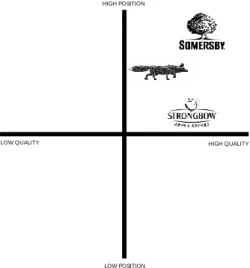
2.2.4.1. The Perceptual Map
As it was referred before, it was considered a criterion to establish a brand’s direct
competitors and then it was designed the perceptual map.
Figure 7: Ciders Perceptual Map Source: Own Illustration
As it is possible to observe in the perceptual map, Bandida do Pomar is able to offer consumers a resilient identity capable of capturing their attention and attracting them, not only to purchase the product, but also to become part of the fox’s tribe, more than any other brand in the market that is only interested in selling its cider. Despite being behind Somersby, Bandida is getting very close to overcome this brand in the market.
2.2.5. Consumer Behavior and Preferences
HIGH QUALITY LOW QUALITY
HIGH POSITION
The Portuguese Cider category continues to grow along the year of 2018, although it is possible to observe a slightly deceleration of the market overall, registering a sales increase, partly due to the raising number of tourists visiting Portugal and due to seasonable features, which allowed the impulse cider demand to move upwards (Cider Global Tracker in Portugal, 2018).
The cider category is considered to be more mentally available for consumers in Portugal comparing to two years ago, due to the fact that it has become more relevant, visible and talked about. By analysing the Cider Global Tracker of 2018, it is possible to examine that 16% of consumers spontaneously mentioned cider when evoking all the alcohol categories they know.
Graphic 2: Categories spontaneously said by consumers Source: Cider Global Tracker, 2018
On the downside, frequency of consumption which involved current drinkers is considered to be low – less than 30%, substituting it with other drinks, such us beer, wine and juices. Despite that fact, cider is able to rely on a solid consumer which are the 25% monthly drinkers who evaluate the category with 9 or 10 out of 10 in general appeal (Cider Global Tracker, 2018).Cider is still considered to be the perfect drink to enjoy during the summer, due to its light touch and sweet flavour, as it is possible to analyse below. According to both regular and occasional drinkers, cider is a drink that fits best in
warm environments and drunk in social occasions, either at home or at a bar (Cider Global Tracker, 2018).
Graphic 3: Consumer’s characterization of cider Source: Cider Global Tracker, 2018
Focusing on Bandida do Pomar, the brand has been increasing significantly its reach inside the market over the last year, being almost immune to the seasonable feature that strikes the cider market in general. Comparing to the other brands in the same category. Bandida do Pomar defends a distinctive brand proposition, which allows the brand to become more appealing to the mind of consumers. When analysing the Cider Global Tracker of 2018, it is possible to conclude that 20% of target consumers are able to mention the brand spontaneously and 35% know the brand by name, which contributes to the brand’s maintenance of the same level of engagement as Somersby.
The brand is clearly on a growing path. The brand made a solid debut by April 2017 with over 10% awareness and 8% trial amongst alcohol drinkers, increasing its percentage by almost three times higher than at that time (Cider Global Tracker, 2018). A third of target consumers know Bandida do Pomar and one quarter have already tried it, as we can analyse on the graphic bellow.
Graphic 4: Cider consumption Source: Cider Global Tracker, 2018
Bandida offers a more authentic feel and a more unique tone of voice than the two major leaders in the market (Somersby and Strongbow), which turns it into a huge competitor and a huge threat inside the market. An overall analysis of the brands improvement can be analysed in the following graphic.
Graphic 5: Bandida do Pomar development Source: Cider Global Tracker, 2018
As a principle state of mind, Bandida designed a fox trail around a new conceptualization. Many young consumers understand the irreverence and cosmopolitan side of the brand. However, for many others, particularly within the older age segment, it’s hard to pass the message, as this target only out signs the socio-economic decadence in the urban atmosphere (Cider Global Tracker, 2018).
Moreover, concerning this market, another feature should be highlighted. Due to an increase in health consciousness, Portuguese consumers are becoming progressively aware of what is inside their drinks before even trying them out. However, Bandida doesn’t particularly suffer from this factor as the other brands may do, due to the reason that its target is not as concerned about it as other generations.
2.3. Bandida do Pomar – The Brand
As the global brand’s main value defends “the thieved apple tastes better”, so this cider is all about breaking the rules and enjoying the moment. Bandida do Pomar is made by the finest apples, which are thieved from orchards around the world to create a distinctive, smooth Cider that delivers a crisp, apple taste with a pleasant fruit aroma.
Before expanding to other countries, Bandida do Pomar was initially called Orchid Thieves, born and raised in New Zealand. The very first cider was pressed from the finest variety of apples, creating a bold and fresh apple taste. Drawing on years of cider heritage, Orchid Thieves was able to steal the best of generations of cider crafting, to create a distinctive and refreshingly drinking experience.
Bandida do Pomar is a cider that has entered inside the Portuguese market in 2016 and since the very first time it has been creating and constructing its territory alongside with its consumers.
While the cider market in general is consolidating as a category, Bandida do Pomar is fitting through personality, revealing itself as a lifestyle, being considered to be trendy (78%), bold (65%) and unique (68%), (U&A Cider Report, 2018).
Its Portuguese name – Bandida do Pomar, and its mysterious attitude, disruptive and irreverent has conquered consumers of all ages, leaving everyone wanting more about the brand. Despite selling a product, Bandida has been striving itself to become an icon in order to create and empower a brand new type of lifestyle. In fact, Bandida do Pomar is more than just an apple cider, it is a whole new concept. The brand defends the ones who are smart, mysterious, and intuitive. She wants to reach the ones who have courage and are not afraid of breaking the rules. Furthermore, the brand wants to make the difference
inside the market, making the best with less. To sum up, Bandida is more than just a cider, it is an attitude and is working towards being an icon of a generation.
Despite being the first thing that pops to our minds when thinking about the cider, Bandida do Pomar is not a fox. It doesn’t have paws, it doesn’t talk. The fox only represents an icon, being the identity and signature of the brand.
Figure 7: The Fox Icon
Source: Bandida do Pomar Brand Book, 2018.
As a brand, Bandida wants to be the voice of a tribe that defend their own tendencies, are keen on breaking the rules and aspire to challenge patterns. Due to that reason, Bandida’s tone of voice has to work in that level and never above that. The brand is recognized by working with a low-profile, as it doesn’t shout and it doesn’t whisper, it only speaks when it needs to. By not being actually present, Bandida is always there, especially when it is not expected. When it comes to this sense, for Bandida, silence is gold and the rest is just meaningless words.
2.3.1. Values and Mission
The internal analysis of the brand will be useful to get a deeper insight on Bandida do Pomar’s strategy. The brand’s main activity is selling cider and even though it is being successful on doing that, Bandida’s communication strategy is its main source of profits and recognition inside the market.
Bandida do Pomar defends the following values:
Be Real – which refers to the authenticity and reflection of the brand’s down to earth attitude, and fresh take on the cider category.
Be Inclusive – the spirit of the brand is rooted in friendship and social inclusivity, leading to moments of experience and adventure.
Be Bold – Bandida do Pomar is daring and playful at the same time in everything that it does, and influences its drinkers to follow the same path.
Figure 8: Bandida do Pomar Logo
Source: Bandida do Pomar Brand Book, 2018.
The brand works towards a specific role of creating opportunities for consumers to be bold and to spark social adventures with friends. Being bold is a rallying call to pursue enjoyment at every opportunity that may show up. It means to seek for adventures instead of just waiting for them to show up. Being bold means being alive and alert of what is happening around. Finally, Bandida do Pomar always means in the context to pursuing the enjoyment that comes from sparkling social adventures with friends above it all.
2.3.2. Branding
A brand should be linked to a country’s culture. Each country has its own unique challenges, features and opportunities, so, before launching a new product in the Portuguese market of cider, the original recipe from the global brand Orchid Thieves, had to suffer some changes. As Portuguese people are leaner on to what it is sweeter, the recipe had to be adapted according to that, in order to attract the right crowd and convince them through taste.
While not quite there in terms of basic taste perception and self-relevance, Bandida do Pomar is able to outperform itself through naturalness and craftsmanship. The brand has more of an authentic feel when comparing to the two mine cider brands in the market (Somersby and Strongbow). Bandida is also able to distinguish from its competitors due to its unique tone of voice, which might make it as a stronger challenger to Somersby in the years to come.
Bandida offers its consumers a product made by the combination between the high-quality and artisanal feel and the promise of taste and flavour. It is through its authentic local feel and sheer novelty that Bandida produces a product for its consumers in order to provide them with a refreshing and fruity drink to enjoy at every moment of consume. The main goal of the brand is to offer a quality product to its consumers along with a whole new concept experience of rebellion and uniqueness. That is the reason why, Bandida do Pomar didn’t stand only for the cider, but decided to invest in merchandising products along with a fashion collection, characterized by the fox icon. By investing in this type of repertoire, the brand can increase its positioning and reach a whole new number of tribers that like to follow new trends and the fox icon is clearly becoming a fashion trend to the new generations.
2.3.2.1. The name – Bandida do Pomar
Every detail counts when it comes to the process of creating the brand image, as it is the main characteristic of identity of the whole concept.
The name of the brand – Bandida do Pomar, was born by the mother name – Orchard Thieves, being transformed and adapted to the national language.
Figure 9: Orchard Thieves Logo vs Bandida do Pomar Logo. Source: Bandida do Pomar Brand Book, 2018.
Regarding the fact that it’s catchy, the name can be simple to identify and easy to remember in our consumers’ minds. The concept of the brand can be summarized by the short sentence of “Be Bold”. What the brand wants to transmit as its main purpose is the capacity to lead consumers to their next big adventure.
Despite being considered a long name, the brand can be characterized only by its icon – the fox. The fox represents the irreverence, the unknown, the mystery. The fox will be the guide of the tribers’ trail to reach that sense of satisfaction and power.
The brand logo is designed in black to accomplish its main idea of being connected with the underground and all the mystery that surrounds it.
2.3.2.2. The Brand’s Identity Pyramid
Figure 10: Brand’s Identity Pyramid
Source: Bandida do Pomar Brand Book 2018
As we can observe in the image above, Bandida do Pomar has a very specific way of being presented to consumers, having a powerful personality and strong position to reinforce. The logo of the brand has to be always present as it is the most important thing when it comes to branding. On the second floor of the pyramid, we are able to find the brand’s products with the icon of the fox, which are the major factors to deliver profit for the brand. On one hand we have the product itself that is directly connected with the consumer and is the reason why the brand exists, on the other hand, we can find the fox that is starting to be the brand’s reason to increase awareness, so both work together to establish the brand in the market in order to increase revenues. On the third and fourth floor of the pyramid, it is presented the brand’s patterns and images, which are used to communicate, not only through social media, but also through the brand’s distribution channels.
2.3.2.3. The Packaging
In order to remain consistent with the brand image and its communication, Bandida do Pomar’s packaging was designed to be trendy and appealing. The format of the package had to be light and simple, allowing people to easily transport the product. The logo is also present in the package being the principal call for identity and recognition in the market.
Firstly, the can of the brand was conceptualized and designed as black, in order to be consistent with the brand’s identity. But, in order to be closer to what the global brand was doing, the packaging had to be transformed into a lighter version and turned into white.
Figure 11: Bandida do Pomar Packaging Evolution of the Can – 2017 to 2018 Source: Bandida do Pomar Brand Book 2017/2018
When it comes to the bottle, and by thinking about the slogan of the global brand – “Thieved apples taste better”, Bandida do Pomar decided to steal the bottle of Sagres to use it as its own. The label also suffered a slightly change to be more connected with the global brand’s label.
Figure 12: Bandida do Pomar Packaging Evolution of the Bottle – 2017 to 2018 Source: Bandida do Pomar Brand Book 2017/2018
It is these little details that make the difference when it comes to creating a good and strong communication strategy. Almost subconsciously, Bandida strikes and plants its roots through every element that it offers.
2.3.3. Where can we find Bandida do Pomar?
Bandida do Pomar wants to be connected to all the experiences that a customer has since the very first contact with the brand – information, touching, payment, drinking and sharing, increasing customer loyalty with every interaction, generating new opportunities to make the difference and to reach a stand out place in the minds of consumers.
The brand can be purchased through the on-trade channel (bars, discos and restaurants) and through the off-trade channel (supermarkets), being the process different in the two different channels. In the drinks industry, the off-trade market includes all retail outlets like hypermarkets, supermarkets, convenience stores, mini markets, wine and spirit shops, among many others. On the other hand, we can find the on-trade market, which includes outlets like bars, restaurants, coffee shops, club, hotels and others.
Both channels work as two sides of the same coin, as complimentary opposites. If one is about quantity (off-trade), the other is all about qualitative selling (on-trade). Both channels require relationship building skills and in order to handle them, it is required experience in markets segmentation, channels management and development.
On one side, we have the on-trade channel where a relationship between client and waiter is directly established as they start to connect and the product is delivered from one hand to another. When it comes to this channel, Cider volume growth in Cafes, Restaurants and Fast Food is not enough to compensate decline in Snacks, Hotels and Bars. Despite this scenery, the company SCC is gaining market share in On-Trade versus last year at 20%, thanks to Bandida do Pomar, which has increased with 11.4% (Nielsen Data Report of Ciders, 2018).
On the other side, the off-trade channel is a place where the client makes its choice by facing numerous amounts of other possible choices, which turns this channel into an important one to invest in the brand’s identity and create awareness to reach those consumers. The Off-Trade channel is gaining volume across all sub channels (except for Lidl) and regions (Nielsen Data Report of Ciders, 2018). The company is reaching 17.2%
volume share with the growth of Bandida do Pomar compensating the decline of Strongbow at 7.3% versus last year.
Despite being present all over Portugal, Bandida do Pomar has a particular strategy when it comes to its manifestation all over the country, Bandida do Pomar wants to reinforce its statement not only on the country’s main capitals – Lisbon and Porto, but also wants to be well-established on the academic areas, such as Coimbra, Aveiro and Braga, among others, investing in this regions in order to expand the brand’s identity.
Figure 13: Bandida do Pomar Expansion Strategy Source: Own Elaboration.
By having two distribution channels, Bandida do Pomar has to be presented in both with a specific design that can be immediately recognized by anyone that already is familiarized with the brand’s identity and, on the other hand, it will be able to attract consumers on getting to know more about the brand. That is the reason why, Bandida do Pomar has invested since the beginning in visibility materials that are distinctive, innovative and disruptive, when facing the competitors’ own materials (Appendix 2). The brand wants to increase its footprint, by creating a specific icon – the fox.
2.3.4. The Product
Bandida do Pomar offers to its consumers an alcoholic beverage made essentially from fermented apple juice, which in the end, it becomes the actual cider. The juice of any variant of apple can be used in order to make cider, but the brand uses specific apples to
develop its recipe. After fermenting the apple juices, the addition of sugar before a second fermentation will increase the ethanol content of the final beverage.
Bandida do Pomar contains 4.5% of alcohol, offering its consumers a distinctive taste combined with a fruity flavor.
The product of which the image has been internally developed is commercialized in a returnable bottle of 0,33L or through a barrel with 20L, being served in a black glass, which contributes to the overall statement that the brand strives to transmit to ist consumers.
2.3.5. Bandida do Pomar Communication – Tone of Voice
A tone of voice of a brand is not what it says but how it says it. In order to be successful, a brand should invest in a tone of voice that is distinctive, recognizable and unique. Bandida do Pomar is able to pass its tone of voice in a very attractive way to its consumers, being able to recruit new consumers through the most unusual forms:
Bandida doesn’t speak unless it is needed and, even though, it speaks with only a few words.
Bandida is straight to the point, with only a few words, but it is never quiet.
It prefers to be expressed through images and emojis, in order to reach the smart ones.
It is mysterious without forcing it, but it is always aware of what is happening around it.
It doesn’t speak in the first tense, due to the fact that it doesn’t want to humanize its icon: the fox.
It is young and sarcastic, but never in an offensive form.
To conclude, Bandida doesn’t need to justify itself, it only needs to take risks, which are the reason why the brand in considered to be unique.
2.3.5.1. Bandida do Pomar Identity
Bandida do Pomar is simultaneously a cider and a lifestyle and, in order to respond to both parts, it lives through great photos and images, which breathe the identity of the brand. It is important for the brand to acquire a good balance between drinking, appealing and acting, in order to work the product and the experience as only one.
Despite having a low-key tone of voice and talking with only a few words, Bandida do Pomar doesn’t want to be seen as arrogant or bored. In fact, that is the reason why by using only a word, expression or an emoji, every photo has to be published and shared with a description.
The brand is not able to respond by the look to comments, but it never ignores its followers. So, due to this fact, it is a challenge for the brand to show its consumers how it is aware of everything by not doing anything. But, for Bandida, challenges are what makes life worth living, so it strives to connect with followers in a very enigmatic way.
In only a few time, the visual identity of the brand suffered a massive revolution and redesign, mainly through the fact that what was black before is now turning into black and white. In order to expand the visual possibilities that where needed to produce by the brand, some textures and patterns where added to the catalogue of visual possibilities to communicate the identity of Bandida do Pomar.
To complement the visual identity of the brand and to reinforce the lifestyle that it wants to transmit as its main characteristic, the usage of photography will be essential. The incorporation of lifestyle inspiring images combined with the brand’s graphics in a “Cut Paste” form of urban art will develop the enormous possibilities of increasing the brand’s visuals. Every image and photography used must be developed according to the brand’s communicating strategy of delivering to its consumers the most mysterious forms of engagement. The pictures chosen must hide all the faces, covering only details of the brand’s icon and every time it is possible, the product must be shown. To sum up, the rand works mainly to deliver to its consumers a visual identity that is born through layers, contamination and intervention.
In a world where technologies are essential on the daily life routine, people feel the need to follow trends and, due to this factor, there are getting even more influenced with what surrounds them. To Bandida do Pomar, PR is able to reinforce brand positioning and, by doing that, the brand is able to introduce its influencers. By providing an influencer endorsement, Bandida do Pomar is strategically already promoting itself in an efficient way that will reach consumers is a most attractive form. But in order to keep up with the brand’s positioning, Bandida do Pomar has a short list of micro-influencers. The brand doesn’t particularly care about those influencers who have a lot of followers. In fact, the brand wishes to trigger the ones who are more unusual and live through a differentiating statement. Furthermore, Bandida has to choose the ones who are capable of wearing the brand’s spirit to increase the brand’s authenticity and credibility.
The brand mainly defends the idea of being bold and has to live with the challenge of how it will act in order to deliver that message. The traditional publicity doesn’t work as a strategy for this brand. Instead, Bandida challenges the barriers in order to invest in something unexpected for the eyes of its consumers. The brand had a campaign of outdoors where the only element present was the fox. This type of promotion was made through a more down low expression of the brand. On the other hand, Bandida also invest in publicity made through urban art, such as the graffiti.
2.3.5.2. Target Consumer
The cider market depends directly on the buyer’s decision, which is part of a very complex set of behaviours that marketers can’t predict or even satisfy all their needs and demands. So, it is important to have an effective segmentation of the market in order to be able to divide it into groups of consumers that have the same needs and priorities when it comes to choosing a cider to drink. This process facilitates the company to focus on the group that is more likely to buy and enjoy the product. In other words, this process will help on defining the brand’s target. In order to identify the groups of focus of the brand, the following criteria will be used:
Geographically: The brand believes that in order to better understand the market, it should be divided into regions. With that, it is possible to analyse the level of purchasing power and new trends of communication acceptance, existent in each
area. Portugal can be divided in 4 geographical areas – North, Interior, Centre and South. When talking about Bandida do Pomar, the brand has a specific geographic strategy, which works mainly by the investment in zones where universities are seen as opportunities (Coimbra for example). Is in this areas that the brand wishes to communicate its products in order to be more connected with its target.
Demographic: It is possible to segment the market by gender (male and female) and also by age. Bandida do Pomar is a brand that attracts both genders around all ages, despite being focused in a specific target that is between 18 years old to 25 years old.
Behavioural: which is referred to a set of characteristics of the new consumer’s way of acting. In this criterion, it will be studied the benefits demanded on the product as well as the price sensitivity of the consumer. Last but not least, it will also be analysed people’s main motivations and lifestyle around the brand’s concept. The behavioural feature is essential to establish the way the brand will determine its strategy in order to reach its target the best way possible.
Having this in mind, it is possible to refer that the main target of the brand are youngsters that wish to be part of a tribe – the tribers. This tribers are characterized by being part of an urban young generation which is loyal to their pack of friends, who want to make the most of life by enjoying spontaneous, fun and who dare to question conventions. The tribers are the ones who aren’t afraid to follow the fox’s trail in order to discover the mystic unknown.
In terms of ages, the target goes from the 18 years old to 25 years old. According to TGI 2017 source there is a total of 767 K individuals inside this target, with 56% being male and 44% being female.
Figure 14: Bandida do Pomar Target Source: TGI 2017 [L12M]