jfbc_249763..776
EFFECTS OF DIFFERENT PHENOLS EXTRACTION CONDITIONS ON ANTIOXIDANT ACTIVITY OF
ALMOND (PRUNUS DULCIS) FRUITS
JOÃO C.M. BARREIRA1,2
, ISABEL C.F.R. FERREIRA1,3
, M. BEATRIZ P.P. OLIVEIRA2and JOSÉ A. PEREIRA1
1CIMO/Escola Superior Agrária
Instituto Politécnico de Bragança
Campus de Santa Apolónia, Ap. 1172, 5301-855 Bragança, Portugal
2REQUIMTE/Serviço de Bromatologia
Faculdade de Farmácia, Universidade do Porto Rua Aníbal Cunha, 164, 4099-030 Porto, Portugal
ABSTRACT
In order to determine the optimum operational conditions for phenols extraction, a series of assays were performed in the Guara variety of almond (Prunus dulcis). Four variable operational conditions factors were consid-ered: solvent type, solvent volume, temperature and extraction time. Phenols extracts antioxidant properties were evaluated, either chemically, by screening the free radical scavenging activity, or biochemically, by measuring the inhi-bition of thiobarbituric acid reactive substances formation in brain cells used as model for the study of lipid peroxidation damage in biomembranes. The extraction of the totality of phenols, confirmed by their antioxidant properties, allows the calculation of ideal doses for almond intake concerning antioxidant effects. The best outcome, regarding these proposals was obtained in the following conditions: 50 mL of methanol with 60 min of extraction time at 25C.
PRACTICAL APPLICATIONS
The correlations obtained between phenols and antioxidant activity allows an estimation of extract concentration providing 50% inhibition values instead of their experimental determination. In future works with the same or other varieties we can achieve antioxidant activity parameters through phenols determination. From an industrial point of view, the obtained results offer a possibility to valorise almond as a better food product obtained from an economical natural resource. Furthermore, almond tree could be cultivated more intensively, namely in areas with little agricultural potential, as it represents a culture with modest needs in terms of practical management.
INTRODUCTION
Almond,Prunus dulcis(Miller) D.A. Webb, apparently originated from one or more wild species that evolved in the deserts and lower mountain slopes of central and southwestern Asia (Micke and Kester 1998). Almond tree is an important crop and it produces fruits of high commercial value currently used worldwide in bakery and confectionery (Cordeiro and Monteiro 2001). It is especially spread through and well adapted to the whole Mediterranean region from which about 28% of the world production is obtained. In Portugal, almond is a traditional crop, mainly spread through Algarve and Baixo Alentejo in the south, and “Terra Quente” of Trás-os-Montes in the north (Cordeiro and Monteiro 2001; Martinset al.2003).
Prunusspecies are reported to have interesting biological properties such as sedative, anti-inflammatory, anti-hyperlipidemic, antitumoral and antioxi-dant activities (Donovanet al.1998; Wanget al.1999; Sanget al.2002). The importance of the antioxidant constituents of plant materials in the mainte-nance of health and protection from coronary disease and cancer is raising interest among scientists, food manufacturers and consumers since the future trend is toward functional foods with specific health effects (Löliger 1991). Some synthetic antioxidants (2-tert-butyl-4-methoxyphenol) are used nowa-days in the food industry with serious concerns about their health effects. Therefore, there is great interest in replacing them by natural antioxidants. The most common plant phenolic antioxidants include flavonoid compounds, cin-namic acid derivatives, coumarins, tocopherols and polyfunctional organic acids (Shahidi and Wanasundara 1992). Even though it is unclear whether active compounds are active against free radicals after being absorbed and metabolized by cells in the body, radical-scavenging assays have gained accep-tance for their capacity to rapidly screen materials of interest (Ferreiraet al.
hydrogen-atom donors. Thus, natural antioxidants may work as free-radical scavengers and chain breakers, complexers of pro-oxidant metal ions and quenchers of singlet oxygen present in the environment (Amarowicz et al.
2004).
Several studies were performed on almond phenolics determination (Donovanet al.1998; Sanget al.2002; Takeoka and Dao 2003; Moureet al.
2007). Yet, they were only carried out on by-products of almond such as shells, skins and green bark, and curiously, not on the fruit itself, which is precisely the edible part. Also, none of those studies reported optimization procedures for phenols extraction. Extraction efficiency is commonly a func-tion of process condifunc-tions. Previous findings have reported the influence of some variables (e.g., temperature, time contact, solvent-to-solid ratio, etc.) on the phenolic yields extracted from different natural products such as almond hulls, pine sawdust or apple by-products. The role of each factor in the mass transfer of the process is not always obvious; the chemical char-acteristics of the solvent and the diverse structure and composition of the natural products ensure that each material-solvent system shows different behavior (Pinelo et al. 2005).
The aim of the present work is the establishment of the best phenols extraction conditions for almond in order to obtain the higher antioxidant activity, measured by 2,2-diphenyl-1-picrylhydrazyl (DPPH) radical scaveng-ing capacity and thiobarbituric acid reactive substances (TBARS) test. It is necessary to ensure that the totality of phenols (well-known antioxidants) is extracted in order to advice consumers regarding the ideal doses for almond intake. For the optimization of the extraction procedure, we chose mainly solvents with high polarity (water [W] and methanol [M]), taking into account that the high lipid fraction of the almond seed, which ranges from 50 to 60% (Sánchez-Belet al.2007), interfere significantly in the results when nonpolar solvents were tested.
MATERIALS AND METHODS
Samples
Standards and Reagents
Gallic acid was purchase from Sigma (St. Louis, MO). DPPH was obtained from Alfa Aesar (Ward Hill, MA). All other chemicals were obtained from Sigma Chemical Co.. M was obtained from Pronalab (Lisboa, Portugal). W was treated in a Milli-Q water purification system (TGI Pure Water Systems, Brea, CA).
Phenols Extraction
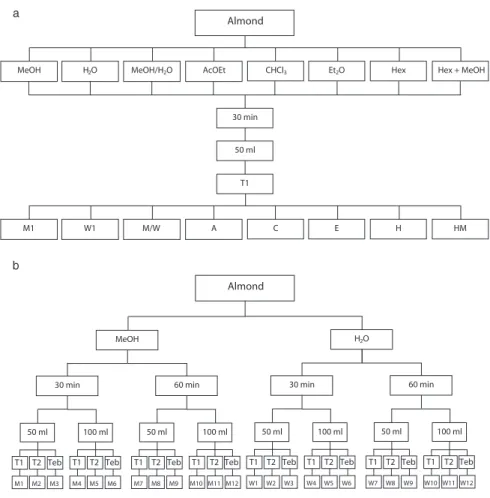
For phenols extraction optimization, a fine powder (20 mesh) of sample (2 g) was extracted using different conditions (solvent, temperature, solvent-to-solid ratio, extraction time). The first stage was the selection of the most appropriate solvent among hexane (H), diethyl ether (E), ethyl acetate (A), chloroform (C), M, W and a hydromethanolic mixture (1:1, M/W), fixing temperature at 25C (T1), as well as the solvent volume (50 mL) and the extraction time (30 min) (Fig. 1a). The extraction was performed using a 250 mL beaker and heating magnetic stirrer (VELP Scientific, Europe). In the second stage we carried out new assays with the better solvents but using different temperatures T1 (25C), T2 (50C) and bT (64.7C for M and~100C for W), solvent volumes (50 and 100 mL) and times (30 min and 60 min) (Fig. 1b). The extractions at 50C and boiling temperature were performed using a reflux-ing system (250 mL round-bottom flask, heatreflux-ing mantle and condensator).
Extracts obtained with W were filtered through Whatman n° 4 paper (Dassel, Germany) under reduced pressure, frozen and then lyophilized (Ly-8-FM-ULE, Snijders, Tilburg, Holland). Extracts obtained with the other sol-vents were evaporated under reducing pressure to dryness. HM was obtained extracting the sample in H (50 mL) at 25C for 30 min, and re-extracting the residue in M (50 mL) at 25C for 30 min. All the extracts were re-dissolved in the corresponding solvent at a concentration of 10 mg/mL and analyzed for their content in phenols, DPPH radical scavenging activity (RSA) and forma-tion of TBARS.
Determination of Phenols Content
standard curve (0.01–0.4 mM;y=2.94848x-0.09211;R2=0.99914, for W;
y=2.08926x-0.10207,R2=0.99842, for M) and the results were expressed as milligram of gallic acid equivalents/gram of extract (GAEs).
RSA
The capacity to scavenge the “stable” free radical DPPH was monitored according to the method of Hatano (Hatano et al. 1988). Several concentra-tions of extracts soluconcentra-tions (0.3 mL) were mixed with 2.7 mL of methanolic
a
b
Almond
Hex + MeOH Hex
Et2O
CHCl3
AcOEt MeOH/H2O
H2O
MeOH
30 min
50 ml
T1
HM H
E C
A M/W
W1 M1
H2O
MeOH
30 min
50 ml 100 ml
Almond
T1 T2 Teb
M1 M2 M3
T1 T2 Teb
M4 M5 M6
50 ml 100 ml
T1 T2 Teb
M7 M8 M9
T1 T2 Teb
M10 M12
60 min
M11
30 min
50 ml 100 ml
T1 T2 Teb
W1 W2 W3
T1 T2 Teb
W4 W5 W6
50 ml 100 ml
T1 T2 Teb
W7 W8 W9
T1 T2 Teb
W10 W12
60 min
W11
FIG. 1. EXPERIMENTAL DESIGN FOR OPERATIONAL CONDITIONS USED IN ALMOND PHENOLS EXTRACTION
solution containing DPPH radicals (6¥10-5mol/L). The mixture was shaken vigorously and left to stand for 60 min in the dark (until stable absorbance values were obtained). The reduction of the DPPH-radical was determined by continuously monitoring the decrease of absorption at 517 nm. DPPH scav-enging effect was calculated as a percentage of DPPH discoloration using the equation: % scavenging effect=([ADPPH-AS]/ADPPH)¥100, where AS is the
absorbance of the solution when the extract solution has been added at a particular level, andADPPHis the absorbance of the DPPH solution. The extract
concentration providing 50% inhibition (EC50) was calculated from the graph
of scavenging effect percentage against extract concentration. BHA and a-tocopherol were used as reference compounds.
Inhibition of Lipid Peroxidation (LPO) Using TBARS
Brains were obtained from pig (Sus scrofa) of body weight ~150 Kg, dissected and homogenized with a PT-2100 Polytron (Kinematica AG, Lucerne, Switzerland) in ice-cold Tris–HCl buffer (20 mM, pH 7.4) to produce a 1:2 (w/v) brain tissue homogenate that was centrifuged at 3,000¥g for 10 min. An aliquot (0.1 mL) of the supernatant was incubated with the almond extracts (0.2 mL) in the presence of FeSO4(10mM; 0.1 mL) and ascorbic acid
(0.1 mM; 0.1 mL) at 37C for 1 h. The reaction was stopped by the addition of trichloroacetic acid (28% w/v, 0.5 mL), followed by thiobarbituric acid (TBA; 2%, w/v, 0.38 mL), and the mixture was then heated at 80C for 20 min. After centrifugation at 3,000¥g for 10 min to remove the precipitated protein, the color intensity of the malondialdehyde-TBA complex in the supernatant was measured by its absorbance at 532 nm. The inhibition ratio (%) was calculated using the following formula: Inhibition ratio (%)=[(A-B)/A]¥100%, where A and B were the absorbance of the control and the compound solution, respectively. The extract concentration providing 50% LPO inhibition (EC50)
was calculated from the graph of antioxidant activity percentage against extract concentration. BHA was used as reference compound.
Statistical Analysis
For each one of the assayed conditions, three portions of the sample were simultaneously extracted, and the obtained extracts were analyzed in triplicate. The results are expressed as mean values and standard error or standard deviation (SD). The differences between extraction conditions (solvent, tem-perature, volume and time) were analyzed using one-way analysis of variance followed by Tukey’s honestly significant difference test with a =0.05. This treatment was carried out using SAS v. 9.1.3 (Cary, NC) program. The regres-sion analysis between phenol contents and EC50values for scavenging activity
RESULTS AND DISCUSSION
In order to optimize phenols extraction procedure in almonds, a well-known and widespread variety (Guara) ofP. dulciswas assayed under differ-ent experimdiffer-ental conditions. The first step was the selection of the most appropriate solvent among solvents with different polarities: H, E, A, C, M, W and a hydromethanolic mixture (1:1). To compare the extraction efficiencies among different solvents, the temperature was fixed at T1 (25C), as well as the volume (50 mL) and the extraction time (30 min) (Fig. 1a).
As it was expected, the most polar solvents (M and W) were more efficient (Table 1). To evaluate the influence of lipids present in metha-nolic extracts, a previous assay was conducted (HM extract) using a sequen-tial extraction, first with H to remove lipids and then re-submitting the residue to an extraction with M. As we did not observe significant differ-ences between M1 (similar assay but without removing fat) and HM (Table 1), we decided to carry out the experiments without the H preliminary extraction.
As M and W prove to be the most efficient solvents, we carried out new assays with these solvents at different temperatures, T1 (25C), T2 (50C) and bT (64.7C for M and ~100C for W), different solvent volumes (50 and 100 mL) and times (30 min and 60 min) (Fig. 1b). The higher amount of phenolic compounds was obtained at 25C, with 50 mL of solvent, and for 60 min of extraction time, both for M (M7, 14.01 mg/g) and W (W7, 14.46 mg/g) (Table 1).
Temperature is the variable with greater influence. The assay conducted at boiling temperature was carried out only to conclude if the heating could influence the phenols extraction for each specific solvent. Some authors reported that phenolic compounds are unstable and easily became non-antioxidative under heating (Leffer 1993; Yen and Hung 2000), whereas the other authors (Choiet al.2006) explained that heat treatment might produce changes in phenols extractability because of the disruption of the plant cell wall; thus bound polyphenolics may be released more easily relative to the assays carried out at lower temperatures. The acquired results in the present study indicate that some of the phenolics could have been destroyed at high temperatures.
TABLE 1.
EXTRACTION YIELDS (h), TOTAL PHENOLS CONTENT, SCAVENGING EFFECT (EC50) AND CORRESPONDING COEFFICIENTS OF
VARIATION FOR ALMOND EXTRACTS OBTAINED USING DIFFERENT CONDITIONS
Extracts h(%) CV (%) Phenols (mg/g extract) CV (%) DPPH EC50(mg/mL) CV (%) LPO EC50(mg/mL) CV (%)
M1 9.36⫾0.73 hij 7.81 11.60⫾2.70 def 23.28 2.13⫾0.04 hij 3.84 2.02⫾0.07 klm 3.52
M2 9.29⫾3.21 hij 34.52 11.00⫾1.34 efgh 12.22 2.73⫾0.53 efg 19.44 2.56⫾0.49 ij 19.18
M3 15.60⫾7.33 efghi 46.98 6.00⫾1.68 m 27.96 4.54⫾0.30 ab 6.48 4.38⫾0.39 bcd 8.89
M4 13.51⫾0.61 fghij 4.48 8.53⫾0.72 kl 8.48 2.64⫾0.52 efgh 19.83 2.48⫾0.50 ij 20.16
M5 16.54⫾2.03 defgh 12.27 7.38⫾0.71 l 9.58 4.18⫾0.40 bc 11.29 4.11⫾0.46 bcde 11.23
M6 10.62⫾2.94 hij 27.65 9.37⫾1.42 ijk 15.17 4.11⫾0.21 bc 10.65 4.24⫾0.46 bcde 10.73
M7 8.97⫾0.54 hij 5.97 14.01⫾1.13 ab 8.12 1.93⫾0.11 j 5.55 1.80⫾0.10 m 5.42
M8 7.45⫾1.35 ij 18.00 11.31⫾1.24 ef 10.96 3.05⫾0.59 e 19.47 2.86⫾0.55 i 19.31
M9 7.38⫾1.21 ij 16.34 7.87⫾0.74 l 9.40 4.32⫾0.21 bc 4.96 4.06⫾0.22 cdef 5.29
M10 11.80⫾0.84 hij 7.11 12.03⫾1.36 de 11.34 2.76⫾0.20 ef 7.12 2.59⫾0.19 ij 7.34
M11 15.63⫾1.76 efghi 11.27 5.66⫾0.65 m 11.48 4.11⫾0.29 cd 7.03 3.87⫾0.28 efgh 7.20
M12 7.36⫾0.19 ij 2.62 9.98⫾1.82 ghij 18.25 4.33⫾0.21 bc 19.62 4.08⫾0.80 bcde 19.66
W1 25.88⫾3.50 c 13.53 13.27⫾1.19 bc 8.97 2.88⫾0.53 ef 18.41 2.71⫾0.51 ij 18.96
W2 25.20⫾5.63 cd 22.34 12.74⫾1.38 cd 10.86 3.72⫾0.37 d 9.88 3.51⫾0.35 h 10.09
W3 8.59⫾0.45 hij 5.22 9.85⫾0.98 hij 9.92 3.73⫾0.37 d 9.90 3.51⫾0.35 h 9.96
W4 20.86⫾1.41 cdefg 6.70 13.45⫾0.99 abc 7.33 3.70⫾0.63 d 17.15 3.47⫾0.61 h 17.67
W5 21.98⫾1.61 cdef 7.33 13.99⫾0.93 ab 6.62 2.45⫾0.23 fghi 9.26 2.29⫾0.22 jkl 9.58
W6 12.74⫾1.20 ghij 9.42 11.10⫾0.45 efg 4.05 2.04⫾0.28 ij 13.70 1.91⫾0.27 lm 14.29
W7 21.19⫾3.59 cdefg 16.93 14.46⫾0.53 a 3.67 4.46⫾0.37 abc 8.69 4.31⫾0.39 bcd 9.11
W8 21.51⫾1.08 cdefg 5.00 9.08⫾0.22 jk 2.42 >5 a na 4.46⫾0.35 bc 7.86
W9 10.53⫾0.94 hij 8.94 11.87⫾1.15 de 9.71 3.10⫾1.25 e 40.43 3.60⫾0.77 gh 21.42
W10 23.77⫾3.09 cde 12.98 11.56⫾1.23 def 10.67 4.61⫾0.56 ab 12.15 3.96⫾0.47 defg 11.75
W11 29.01⫾3.75 c 12.94 11.54⫾0.91 ef 7.89 >5 a na 4.52⫾0.22 b 5.02
W12 10.67⫾0.49 hij 4.58 12.05⫾0.55 de 4.57 2.25⫾0.11 ghij 4.98 2.39⫾0.45 jk 18.70
MW 10.96⫾0.04 hij 37.60 11.76⫾1.07 de 9.14 3.71⫾1.18 d 31.74 3.62⫾0.96 fgh 26.56
A 54.28⫾4.30 a 5.60 ND NA >5 a NA >5 a NA
C 40.29⫾1.80 b 4.48 ND NA >5 a NA >5 a NA
E 38.78⫾3.44 b 8.88 ND NA >5 a NA >5 a NA
H 39.73⫾4.07 b 10.25 ND NA >5 a NA >5 a NA
HM 6.14⫾1.23 j 20.10 10.16⫾0.64 fghi 4.49 2.25⫾0.02 ghij 0.91 2.39⫾0.37 jk 15.47
In each row different letters mean significant differences (P<0.05).
yield, the coefficients of variation (CV) values (calculated by the ratio between standard deviation and mean, presented in percentage) revealed a great het-erogeneity of the results varying from 2.62, in M12, to 46.98, in M3. Never-theless, the extraction procedures M4, M7, M12, W3, W8, W12, A and C presented high reproducibility, with CV less than 6%.
As the plant phenolics constitute one of the major groups of compounds acting as primary antioxidants or free radical quenchers (Miliauskas et al.
2004), the total phenol contents of the selected fruit extracts and assays of the corresponding antioxidant activity, namely DPPH RSA and LPO inhibition were performed. These assays were performed on the whole phenolic extracts, as that could be more beneficial than isolated constituents because of the additive and synergistic effects, and considering that a bioactive individual component can change its properties in the presence of other compounds present in the extracts. In fact, bioactive compounds are best acquired through whole-food consumption (“cocktail” of bioactive compounds), than from expensive dietary supplements or individual antioxidant compounds (Liu 2003).
The EC50values for RSA and LPO inhibition obtained for each almond
extract, are presented in Table 1, except for H, A, ether and C, as these extracts were considerably less effective radical scavengers, presenting percentages lower than 20% at the maximal concentration, 5 mg/mL (percentages obtained through the formula presented in the experimental section). Accordingly, with these values it was not possible to achieve 50% of inhibition and, therefore, the EC50values were unavailable.
M and aqueous extracts were quite effective DPPH radical scavengers as well as LPO inhibitors. Some of the evaluated extracts for these two solvents (e.g., M7 and W6) revealed percentages of antioxidant activity higher than 90%, at 5 mg/mL. In the case of RSA assay, those percentages can be consid-ered as full absorption inhibition of DPPH, because after completing the reaction, the final solution always possesses some yellowish color, and there-fore its absorption inhibition compared with colorless M solution cannot reach 100% (Miliauskaset al.2004).
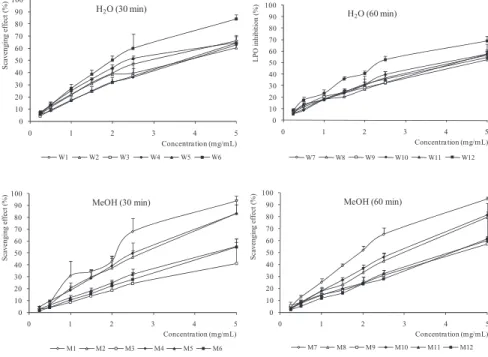
Figure 2 shows the free radical scavenger capacity of almond extracts obtained as a function of their concentration. From the analysis of Fig. 2 we can observe that the extracts scavenging effects on DPPH radicals improved as the concentration increases. Methanolic extracts were generally better, with
maximum values obtained for M7 (94.6%⫾2.1, at 5 mg/mL). These values
were similar to the scavenging effect obtained for the standards BHA (96% at 3.6 mg/mL) anda-tocopherol (95% at 8.6 mg/mL).
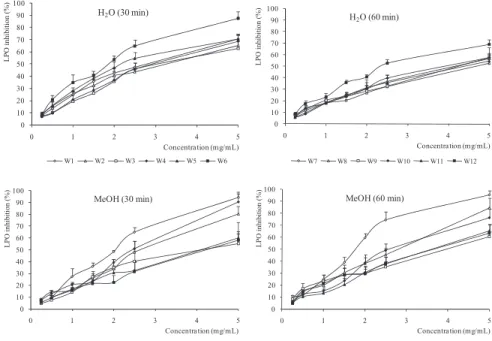
concentra-tion rise. Methanolic extracts were once more generally better, with maximum values obtained for the same extract (M7; 95.3%⫾3.5, at 5 mg/mL).
In summary, the lower RSA EC50 values (higher antioxidant activity)
were obtained at 25C for M, with 50 mL of solvent, and for 60 min of extraction time (M7, 1.93⫾0.11 mg/mL), and at boiling temperature for W, with 100 mL of solvent, and for 30 min of extraction time (W6, 2.04⫾0.28 mg/mL). The lower LPO inhibition EC50 values were obtained
for the same operational conditions (M7, 1.80⫾0.10 mg/mL; W6, 1.91⫾
0.27 mg/mL) (Table 1).
Antioxidant activity results were correlated to the phenols content found in methanolic extracts (RSA: y= -0.2995x-6.2224; r2
=0.6992;
F=23.2477; df=11; p<0.001; LPO inhibition: y= -0.2918x-6.0441;
r2
=0.6128;F=15.8301; df=11;p<0.005). The results obtained for aqueous extracts were very poorly correlated. For example, boiling W leads to a decrease in phenols content that is not reflected in the antioxidant properties, indicating that eventually, other antioxidants besides phenols are present in the
0 10 20 30 40 50 60 70 80 90 100
0 1 2 3 4 5
Scavenging effect (%)
Concentra tion (mg/mL)
H2O (30 min)
W1 W2 W3 W4 W5 W6
0 10 20 30 40 50 60 70 80 90 100
0 1 2 3 4 5
LPO inhibition (%)
Concentra tion (mg/mL)
H2O (60 min)
W7 W8 W9 W10 W11 W12
0 10 20 30 40 50 60 70 80 90 100
0 1 2 3 4 5
Scavenging effect (%)
Concentration (mg/mL)
MeOH (30 min)
M1 M2 M3 M4 M5 M6
0 10 20 30 40 50 60 70 80 90 100
0 1 2 3 4 5
Scavenging effect (%)
Concentra tion (mg/mL)
MeOH (60 min)
M7 M8 M9 M10 M11 M12
FIG. 2. RADICAL SCAVENGING ACTIVITY OF ALMOND EXTRACTS OBTAINED USING WATER AND METHANOL AS SOLVENTS UNDER DIFFERENT EXTRACTION TIMES,
extracts and contributing to their antioxidant activity. This is well observed for W6 extract in which the good antioxidant activity EC50values are not
propor-tional to the phenols content.
In the case of the M almond extracts, a significantly negative linear correlation was established between the phenols content and EC50values. This
correlation proves that the extracts with highest phenols content show lower EC50values, confirming that phenolics are likely to contribute to the RSA of
these fruit extracts, as it has been reported in other species (Veliogluet al.
1998). Particularly, the high content of total phenols in M7 (14.01 mg/g) might account for the good results found in its antioxidant activity.
The obtained correlations are particularly useful when the total phenol content is known because it allows the estimation of EC50 values instead of
their experimental determination. In future works with the same or other varieties we can achieve antioxidant activity parameters through phenols determination.
Previous studies on the influence of different extracting solvents on the antioxidant activity and the yield of phenolics content have already been
0 10 20 30 40 50 60 70 80 90 100
0 1 2 3 4 5
LPO inhibition (%)
Concentra tion (mg/mL)
H2O (30 min)
W1 W2 W3 W4 W5 W6
0 10 20 30 40 50 60 70 80 90 100
0 1 2 3 4 5
LPO inhibition (%)
Concentra tion (mg/mL)
H2O (60 min)
W7 W8 W9 W10 W11 W12
0 10 20 30 40 50 60 70 80 90 100
0 1 2 3 4 5
LPO inhibition (%)
Concentra tion (mg/mL)
MeOH (30 min)
M1 M2 M3 M4 M5 M6
0 10 20 30 40 50 60 70 80 90 100
0 1 2 3 4 5
LPO inhibition (%)
Concentra tion (mg/mL)
MeOH (60 min)
M7 M8 M9 M10 M11 M12
FIG. 3. LIPID PEROXIDATION (LPO) INHIBITION OF ALMOND EXTRACTS OBTAINED USING WATER AND METHANOL AS SOLVENTS UNDER DIFFERENT EXTRACTION
reported but with different matrixes (Cheunget al.2003; Sun and Ho 2005). Our results are in accordance with those authors that observed a better scav-enging activity in methanolic extracts.
The results obtained in the present work denote that almond may consti-tute a good source of healthy compounds. So the intake in the diet of almond fruits suggests that it could be useful in the prevention of diseases in which free radicals are implicated. Almond seems to be a natural provider of antioxidants, which are increasing its value as food or food component, as they offer effective protection against oxidative damage.
CONCLUSION
The optimization of operational conditions to extract the maximum phenols content in almond (whole fruit) has made it possible to determine the following conditions as adequate: 50 mL of M at 25C for 60 min. The quan-tification of total phenols in the extracts allows the definition of the most adequate doses of almond to be included in healthy diets in order to obtain the best antioxidant effects. This is quite important as it is not well defined if the over-intake of these compounds can cause deleterious effects.
ACKNOWLEDGMENTS
The authors are grateful to Foundation for Science and Technology (Portugal) for financial support to J.C.M. Barreira (SFRH/BD/29060/2006).
REFERENCES
AMAROWICZ, R., PEGG, R.B., RAHIMI-MOGHADDAM, P., BARL, B. and WEIL, J.A. 2004. Free-radical scavenging capacity and antioxidant activity of selected plant species from the Canadian prairies. Food Chem.
84, 551–562.
CHEUNG, L.M., CHEUNG, P.C.K. and OOI, V.E.C. 2003. Antioxidant activ-ity and total phenolics of edible mushroom extracts. Food Chem. 81, 249–255.
CHOI, Y., LEE, S.M., CHUN, J., LEE, H.B. and LEE, J. 2006. Influence of heat treatment on the antioxidant activities and polyphenolic compounds of Shiitake (Lentinus edodes) mushroom. Food Chem.99, 381–387. CORDEIRO, V. and MONTEIRO, A. 2001. Almond growing in
DONOVAN, J.L., MEYER, A.S. and WATERHOUSE, A.L. 1998. Phenolic composition and antioxidant activity of prunes and prunes juice (Prunus domestica). J. Agric. Food Chem.46, 1247–1252.
FERREIRA, I.C., BAPTISTA, P., VILAS-BOAS, M. and BARROS, L. 2007. Free-radical scavenging capacity and reducing power of wild edible mushrooms from northeast Portugal: Individual cap and stipe activity.
Food Chem.100, 1511–1516.
HATANO, T., KAGAWA, H., YASUHARA, T. and OKUDA, T. 1988. Two new flavonoids and other constituents in licorice root: Their relative astringency and radical scavenging effects. Chem. Pharm. Bull. 36, 2090–2097.
LEFFER, J.E. 1993. The small radicals. In An Introduction to Free
Radicals (J.E. Leffer, ed.) pp. 119–121, John Wiley & Son, New York, NY.
LIU, R.H. 2003. Health benefits of fruits and vegetables are from additive and synergistic combination of phytochemicals. Am. J. Clin. Nutr.78, 517S– 520S.
LÖLIGER, J. 1991. The use of antioxidants in foods. InFree Radicals and Food Additives(O.I. Aruoma and B. Halliwell, eds.) pp. 121–150, Taylor and Francis, London, UK.
MARTINS, M., TENREIRO, R. and OLIVEIRA, M.M. 2003. Genetic relat-edness of Portuguese almond cultivars assessed by RAPD and ISSR markers. Plant Cell Rep.22, 71–78.
MICKE, W.C. and KESTER, D.E. 1998. Almond growing in California. Acta Hortic.470, 21–28.
MILIAUSKAS, G., VENSKUTONIS, P.R. and VAN BEEK, T.A. 2004. Screening of radical scavenging activity of some medicinal and aromatic plant extracts. Food Chem.85, 231–237.
MOURE, A., PAZOS, M., MEDINA, I., DOMÍNGUEZ, H. and PARAJÓ, J.C. 2007. Antioxidant activity of extracts produced by solvent extraction of almond shells acid hydrolysates. Food Chem.101, 193–201.
PINELO, M., RUBILAR, M., JEREZ, M., SINEIRO, J. and NÚÑEZ, M.J. 2005. Effect of solvent, temperature, and solvent-to-solid ratio on the total phenolic content and antiradical activity of extracts from different components of grape pomace. J. Agric. Food Chem.53, 2111– 2117.
SÁNCHEZ-BEL, P., MARTÍNEZ-MADRID, M.C., EGEA, I. and ROMO-JARO, F. 2007. Oil quality and sensory evaluation of almond (Prunus amygdalus) stored after electron beam processing. J. Agric. Food Chem.
53, 2567–2573.
almond skins (Prunus amygdalus Batsch). J. Agric. Food Chem. 50, 2459–2463.
SHAHIDI, F. and WANASUNDARA, P.K.J.P.D. 1992. Phenolic antioxidants. Crit. Rev. Food Sci. Nutr.41, 32–35.
SINGLETON, V.L. and ROSSI, J.A., JR. 1965. Colorimetric of total phenolics with phosphomolybdic-phosphotungstic acid reagents. Am. J. Enol. Vitic.16, 144–158.
SUN, T. and HO, C.T. 2005. Antioxidant activities of buckwheat extracts. Food Chem.90, 743–749.
TAKEOKA, G.R. and DAO, L.T. 2003. Antioxidant constituents of almond (Prunus dulcis(Mill.) D.A. Webb) hulls. J. Agric. Food Chem.51, 496– 501.
VELIOGLU, Y.S., MAZZA, G., GAO, L. and OOMAH, B.D. 1998. Antioxi-dant activity and total phenolics in selected fruits, vegetables, and grain products. J. Agric. Food Chem.46, 4113–4117.
WANG, H., NAIR, M.G., STRASBURG, G.M., BOOREN, A.M. and GRAY, J.I. 1999. Novel antioxidant compounds from tart cherries (Prunus cerasus). J. Nat. Prod.62, 86–88.