Training teachers to manage problem-solving
classes with computer support
Philippe R. Richard
Département de didactique, Université de Montréal, Canada
Pedro Cobo
Departament de Didàctica de la Matemàtica i de les Ciències Experimentals, Universitat Autònoma de Barcelona, Espanya
Josep M. Fortuny
Departament de Didàctica de la Matemàtica i de les Ciències Experimentals, Universitat Autònoma de Barcelona, Espanya
Markus Hohenwarter
Department of Mathematical Sciences, Florida Atlantic University, United States of America
[email protected] [email protected] [email protected] [email protected]
Resumo: O uso limitado de tecnologias nas salas de aula pode ser conseqüência da sua falta nas escolas, da despreocupação dos professores sobre os recursos disponíveis e da necessidade de adaptá-las às situações das aulas; ou da insuficiência teórica e prática para que os professores as integrem ao seu ensino. Neste artigo propomos formas e descrevemos exemplos do uso do GeogebraTUTOR, um tutorial que incorpora elementos da geometria dinâmica, para um treinamento inicial focalizado na resolução de problemas, raciocínio matemático e processo de comunicação. Adicionalmente, discutimos a necessidade de habilidades profissionais relativas ao processo de resolução de problemas para o ensino e aprendizado com suporte computacional em sala de aula. Palavras-chave: tecnologias na sala de aula, treinamento docente, resolução de problemas.
Abstract: The limited use of technology in classrooms may be a consequence of a lack of technological means in schools, of teachers’ unawareness of available ICT teaching resources and the need of having to adapt them to their classroom situation; or of the insufficient theoretical and practical training that teachers have to allow them to successfully integrate technology learning environments into their teaching. In this paper we propose ways and describe examples of using GeogebraTUTOR, a tutorial system incorporating elements of dynamic geometry, for initial teacher training focusing on problem solving, mathematical reasoning, and communication processes. In addition, we discuss the necessary professional skills of teachers related to the processes of teaching and learning problem solving with computer support in the classroom.
1 INTRODUCTION
The contrast between the non-technological world in which young people live in their school environment and the technological world by which they are surrounded in their everyday life (mobile telephones, messaging programmes, sound and video equipment...) is so large that we should reflect on the cau-ses, and ways of overcoming these, of the pre-valent absence of technology use in mathe-matics teaching.
Little use of technology in mathematics classrooms may be a consequence of a lack of technological means, which are often concen-trated in computer or media labs; or of the teachers’ unawareness of available teaching resources, and the need of having to adapt them to their classroom situation, which is often essential for their use; or of the insuffi-cient theoretical and practical training that teachers have to allow them to integrate con-ceptual frameworks into learning environ-ments with computer support.
Our research in recent years has sought to contribute computer-based environments for mathematics teaching and learning. For exam-ple, the current development of the intelligent tutorial system GeogebraTUTOR, which con-cerns us in this article, is based on research and experiences with the previous system AgentGeom (COBO & FORTUNY, 2007). In the new system we have kept the style and structure of the existing student system communication of AgentGeom and we have integrated the open source software GeoGebra (HOHENWARTER & PREINER, 2007) as part of its interactive user inter-face. With this addition our intention is to pro-vide instrumental learning of the skills of dyna-mic geometry. In addition to improving the stu-dents’ user interface, and adapting it to formats more in accordance with those that students frequently use in their everyday virtual commu-nications (like chats), the new system conside-rably eases their communication with the tea-cher, making it very easy to implement new problems and message systems.
Our aim in using the GeogebraTUTOR tuto-rial system is to support students to develop
mathematical skills relating to problem sol-ving, mathematical reasoning and communi-cation processes with the help of mathematical language, either by facilitating dialogues with the tutorial system, which is considered a cog-nitive system, or by using the processes of dy-namic geometry favoured by the system (repre-sentation, visualisation, demonstration, etc.). In the GeogebraTUTOR (or AgentGeom) envi-ronment, our research has been organised around teaching, ways to improve students’ mathematical skills, and technology, in an attempt to integrate new technologies into tea-ching and learning. This research is beginning to show the need for methodological teacher training that considers both teaching and tech-nology in order to continue contributing to the use of computers in mathematics classrooms.
When it comes to addressing initial or per-manent teacher training, trainers must res-pond to questions such as the following: What type of professional knowledge and skills should trainee teachers acquire? In what area of practice and by means of which methods? How can technology help to facilitate such professional development?
In this paper we will attempt to provide an answer to these questions and to situate the technological medium in teacher training. To do this, we define the professional teaching skills and the processes of learning required to teach mathematics within the context of using
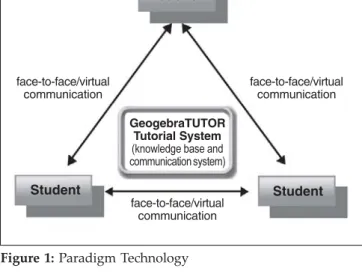
Student Student
GeogebraTUTOR Tutorial System
(knowledge base and communication system) face-to-face/virtual communication face-to-face/virtual communication face-to-face/virtual communication
Figure 1: Paradigm Technology
the computer in the classroom; and we describe the context in which the experience is develo-ped, providing examples of activities for initial teacher training which integrate the teaching of problem solving into the GeogebraTUTOR environment, highlighting references to our theoretical framework and analysing the me-thodology which combines the use of the tuto-rial systems with face-to-face teaching models. 2 DEFINING THE KNOWLEDGE
NECESSARY TO TEACH AND THE PROCESSES OF LEARNING TO TEACH MATHEMATICS
2.1 The technological paradigm
The introduction of the computer and its increasing influence on the processes of tea-ching and learning have contributed to impro-vement of the paradigm that represented the insertion of technological media only at the time of their application in the classroom. As a consequence of this change, the approach to using new technologies finds a new place in curriculum planning, the design of lesson plans and teaching itself. In this respect, in order to be able to plan training for teachers who have computers available to them as a support we must stipulate, on the one hand, their roles with regard to the students, the technological me-dium and the transfer of knowledge, and on the other, our ideas regarding the professional skills of mathematics teachers in these new situations and the processes for acquiring and generating these skills. All of the above will provide the foundation for our proposal for initial teacher training.
The teacher’s traditional role as a mediator of basic knowledge and interactions between students is gradually being substituted by teaching and learning processes where com-munication among students and between the students and the teacher is always bi-direc-tional. As can be observed in Figure 1, in these processes the students interact with the technological medium and learn directly from it. They interact among themselves and with the teacher by means of communication
systems which are virtual (visual) or face-to-face (oral or visual). In this way, teaching is moving away from a focus on the classroom and the teacher as the transmitter of know-ledge towards the technological medium and the student. The teacher is becoming a person who supervises and manages all phases of the teaching and learning process, in what has become known as the «technological para-digm» (BRANSON, 1990).
Specifically, in this technological paradigm the teacher will be in charge of:
• Analysing mathematical teaching propo-sals implicit in the technological medium and proposing modifications of the new plans and ways of organising content, if deemed necessary.
• Managing face-to-face or «live» mathema-tical communication, whether in the class-room or virtually via an online discussion forum.
• Analysing, diagnosing and bringing mea-ning to students’ work; also, collaborating with the tutorial system on student eva-luation.
2.2 Professional skills of the mathematics teacher
Llinares (2002) states five components characteristic of the professional knowledge of the mathematics teacher: knowledge of and about mathematics; knowledge of the curricu-lum; knowledge of learners’ cognitions; peda-gogic knowledge specific to mathematics; and knowledge about its teaching. In accordance with the role of the mathematics teacher within this new technological paradigm, we must add to these domains of the teacher’s professional knowledge specific knowledge regarding the technological medium and, in particular, the computer. According to Badía (2006), we can specify this component of knowledge still further: knowledge of technological charac-teristics with clear teaching implications.
In this paper we will discuss the profes-sional skills of teachers in the sense of abilities
to use knowledge and in contexts and situa-tions related to the processes of teaching and learning problem solving with computer sup-port. Therefore, the trainee teacher must have professional knowledge and be capable of putting it into practice in an effective way.
By integrating Llinares’ definition of profes-sional knowledge and Badía’s technological component we therefore propose five profes-sional skills for teachers in the context we are considering: heuristic, curricular, discursive-instrumental, semiotic, and teaching skills, which we are going to analyse in section 2.3.
Our proposal is in line with integrating and transforming knowledge into practice in a coherent and systematic way, and as a conse-quence we will tend to develop cognitive actions such as: observing, predicting, criticising, generating and analysing (LLINARES, 2002). Following these principles, we will propose activities and take advantage of the debates arising from these to situate the knowledge generated within the corresponding theoretical frameworks (see section 4).
To be specific, the initial teacher training we propose will be aimed at studying the learning and generating of knowledge necessary for teaching mathematical problem solving in an interactive tutoring system called Geogebra TU-TOR, for learning mathematical geometry skills in secondary education. In this respect, our research team has already developed a proto-type tutorial system, called AgentGeom, which allows the user, whether expert or teacher, to introduce the heuristic and discursive charac-teristics of a problem that students should sol-ve in the context of a gisol-ven didactic contract.
The term GeogebraTUTOR refers to both a tutorial system (TUTOR) and an emerging approach for instrumental learning of skills involved in dynamic geometry (GeoGebra). Thus our project contributes an original approach to research on teaching based on the idea of a reciprocal adaptation process bet-ween the development of the tool – our tutorial system as a technological instrument – and its
use as a means of instrumentation in teaching situations.
In teacher training we consider two didactic relationships: the real relationship «teacher (instructor) - student (future teacher) - mathe-matics teaching», and the simulated relation-ship «teacher-student-mathematics». The tea-cher tends to have a dual role, that is, a real role (of an «instructor») and a simulated role (of a «teacher»), although he or she is not accus-tomed to simulating the role of a student (as there are no technological means to this end), or controlling his or her role as a teacher (si-mulated) in the role of an instructor (real). Our technological instrument (GeogebraTUTOR) allows the simulation of the «teacher-student-mathematics» relationship in teacher training. Figure 2 provides an overview of our objec-tives in proposing initial teacher training to problem solving in the GeogebraTUTOR envi-ronment, relating the roles of the typical beha-viour of the «solving» teacher to his or her res-pective professional tasks, in line with the ideas expressed by Callejo (2006).
In this initial training proposal, we would like to highlight the significance of reflecting on the actions that are being carried out – hence the adjective «reflective» used to des-cribe the roles of solver and teacher in the training process.
With “reflecting on the action” we mean the promotion of elements of reflections among trainee teachers which contribute to develo-ping their learning processes. Schön (1987) identifies five fundamental elements that faci-litate these reflections which we have attemp-ted to include in our proposal: technological-student-teacher interaction must itself become the object of reflection; the description of knowledge itself must be promoted; there must be reflection on how to understand one another; making use of one’s own and others’ experiences must also become an object of study; and the theories implicit in communi-cative processes must be highlighted.
OBJETIVES ROLES EXPERIENCES/ACTIVITIES
TO GET TO KNOW GeogebraTUTOR AND LEARN TO SOLVE PROBLEMS IN ITS ENVIRONMENT
TO LEARN TO TEACH GeogebraTUTOR SOLVING USING GeogebraTUTOR
TO TEACH PROBLEM SOLVING COMBINING VIRTUAL AND FACE-TO-FACE ENVIRONMENTS
REFLECTIVE PROBLEM SOLVER
REFLECTIVE TEACHER
REFLECTIVE PRACTICE: Analysis of own practice and that of colleagues Training intervention
PLANNING THE TEACHING TASK a) Planning programming; analysis of content, difficulties, communicative processes, etc.
b) Planning teaching; methodological proposal to be developed
CARRYING OUT THE TEACHING TASK REEVIEWING THE TEACHING TASK Reproduction and interpretation of own practice in virtual and face-to-face contexts
Figure 2: An overview of our objectives
2.3 Professional skills in managing problem-solving classes with computer support For the management of problem-solving classes we have considered that the teacher must develop professional skills relating to heuristics, the curriculum, the discursive-ins-trumental relationship, semiotics, and didactic. 2.3.1 Heuristic skills
We give heuristic skills a broad meaning which includes: heuristics, ways of focusing solving, argumentative processes, controlling and managing elements of solving processes, etc. In short, the analysis and putting into practice of constructive models for teaching and learning of problem solving.
2.3.2 Curricular skills
Other mathematical content (conceptual and procedural) involved in problem solving and its place on the mathematics curriculum. For this aspect we introduce concepts such as the basic space of a problem, problem tree and problem forest (RICHARD & al., 2008).
2.3.3 Discursive-instrumental skills
The discursive-instrumental skill includes analysing students’ interactions with both the
technological medium (simulated social deba-te), and with the teacher in carrying out the tasks proposed. At the beginning of this ana-lysis, we introduce the notion of the basic spa-ce of the tutorial action, which forms the basis of the discursive component we have imple-mented in the GeogebraTUTOR tutorial system (COBO & al. 2007).
The recent development of tutorial systems, and in particular our prototype AgentGeom, allows the establishment of a relationship between the student and the system in which the different virtual pedagogic agents work together to resolve the same situation-pro-blem. In order to resolve a given problem, stu-dents are being provided an interface to cons-truct an element of a figure or to write a discur-sive proposition to introduce a calculation or a structured inference. If necessary, the system responds to the student’s actions in real-time with the help of written messages. These mes-sages are prepared in advance by the teacher according to the set of possible inferences wi-thin the logic established by the basic problem space. For the teacher or researcher it is pos-sible to adapt the inferences and its associated messages to the characteristics of a specific didactic contract, such as, for example, one which allows contradiction as an integral part of the solving process or one which accepts
the use of graphical propositions in the reaso-ning structure.
Furthermore, in the analysis of interactions between students and technological medium it must also be taken into account that, accor-ding to Rabardel (1995 & al, 2001), the compu-ter program influences «not only the user’s manner of acting, but also their way of thin-king», and that the student needs to cons-ciously mobilise knowledge control structures which are controlled during the «instrumen-tal genesis». All of this occurs despite the lin-king of technical components in the students’ development of mental schemas, or students only having indirect access to the mathematical models underlying the construction of the program – either symptomatically or confir-ming the effect of the action-reaction mecha-nism, in accordance with Rabardel’s theory of instrumentation.
2.3.4 Semiotic skills
In a learning situation, the question of se-miotics is often underestimated by mathemati-cians or computer experts. Furthermore, it is also often ignored in the contents of teacher training programmes. We believe that the fu-ture teacher must be capable of analysing the influence of using different semiotic represen-tation systems in students’ cognitive develop-ment, based on the ideas we expose below.
Any semiotic representation system, whe-ther figural signs, mathematical symbols or word symbols in a natural language, possesses both producing and reducing effects in the representation of knowledge. That is, if the mobilised signs allow certain properties to be «seen», they also prevent others from being «seen». This paradox is a determining factor in the acquisition of knowledge, whether on a level of communication, the treatment of cognitive representations or the objectivation of virtual representations (those in the mind of the student, for example).
Geometry is characterised by the use of fi-gures. Nowadays, it is normal to insist on diffe-rent forms of viewing to those that may be
used in mathematics in order to make concepts more accessible. Visualisation is considered a more economical support or medium for com-prehension. By introducing the notions of graphic reasoning and figural inference (RI -CHARD, 2004a, b), we have shown that all modes of visualisation that can be used in mathema-tics constitute registers for treatment (proces-sing) which allow autonomous rhythms of thought as powerful as the different discursive registers (verbal and symbolic). Thus, as a geometrical design links reasoning steps, it is natural for the student to integrate their figural representations into the discursive structure of their reasoning. But the main interest in these notions is perhaps found in their distinc-tion. While the notion of graphic reasoning sends a mathematical treatment in a unique register, figural inference can be combined with semantic and discursive inferences (in the sense of DUVAL, 1995) within the unit of a single thought.
In summary, the figural inference allows the discovery of a transversal reasoning with diver-se registers. Therefore, in problem solving and in a situation of validation, the social debate must integrate the coordination of diverse representation systems (figural, verbal and symbolic) during the progression of reasoning and, of course, dialectic argumentations. 2.3.5 Didactic skills
The teaching skill is not only related to the ability the teacher has in enabling the students to achieve the skills they are aiming for, but also in developing their autonomy. From a constructivist perspective, the effective cons-truction of pertinent knowledge is achieved by changing the students’ conception and overco-ming obstacles such as situations that repro-duce the constitutive characteristics of mathe-matical work. According to Brousseau (1998, p. 61), the only way to «do» mathematics is to look for and resolve certain specific problems and, to this end, approach new questions. If this is the case, teaching situations are para-doxical in two ways. Firstly, the teacher wants the student to produce appropriate responses,
thereby displaying the, at least apparent, success of the teacher. However, the student does not have the necessary cognitive or discursive means: it is precisely the job of the teacher to make it possible for them to have these. Secondly, it is considered that the student will not have acquired full knowledge until he or she knows how to put it into practice autonomously, without the help of the teacher or his or her colleagues.
To minimise these paradoxes, the trainee teacher must be aware that social debate appears as a medium that guarantees students to work on the same situation-problems as those proposed and to respect its internal logic and indispensable conditions for developing autonomy. As a consequence of the above, we can say that the theoretical context of our proposal for initial teacher training may be situated in a hyperspace in which professional skills – heuristic, curricular, discursive-instru-mental, semiotic and teaching skills – are constituted as the bases to achieve the profes-sional and technological objectives as expres-sed in section 2.2 of this paper.
3 CHARACTERISTICS OF THE CONTEXT FOR THE TEACHER TRAINING
EXPERIENCE
In an attempt to specify the field of practice in which trainee teachers are to acquire know-ledge, in this section we shall determine the general characteristics of the students who par-ticipate in the experience and our conception of how to focus teaching in the context of teaching practice. In the following paragraph, we provide examples of activities for initial teacher training in the computer science envi-ronment of GeogebraTUTOR.
This experience will take place within the initial training programme for secondary school teachers and, specifically, in teaching practice for the Curs de Qualificació Pedagògica «Pedagogical Qualification Course» (CQP) tau-ght at the UAB’s Department of Didactics of Mathematics, and at the Centre de formation initial des maîtres de l’Université de Montréal to
students who have just graduated in Mathe-matics or in other Sciences (Physics, Computer Science, Engineering, etc.), thereby guaran-teeing, in general, a good mathematical back-ground but lack of teacher training.
With regard to specifying our way of concei-ving teaching practice in initial teacher training, we agree with Schön (1987) in considering it a type of reflection-in-action in which there is analysis of typical practical situations for students or situations proposed by the tutor in which it cannot be assumed «either that the existing professional knowledge adapts itself to each case or that each problem has a correct response» (p. 47). Therefore, trainee teachers must not be satisfied with simply applying known facts, rules and procedures to instru-mental problems in a non-conflictive way, nor even learn to think like the tutor leading the practice sessions, although at specific times this may help them, but rather that their reflection-in-action must also include «the construction and verification of new categories of knowledge, strategies of action and ways of formulating problems» (p. 47), it being, in these cases, the role of the tutor to promote reflections that tend to achieve these objectives.
In our technological context the use of the GeogebraTUTOR system allows simulation of the whole relationship «teacher-student-ma-thematics» with a dual role for teachers, facili-tating their professional development. Nor-mally, what teachers find most difficult is acquiring sufficient self-confidence to be able to ensure control of their tutorial action (from a socio-constructivist perspective) and foster the students’ development of autonomy. 4 EXAMPLES OF ACTIVITIES FOR THE
INITIAL TRAINING OF TEACHERS IN THE COMPUTER SCIENCE
ENVIRONMENT OF GeogebraTUTOR In this section we will be simultaneously introducing the working methodology and the contents of the activities we propose. We shall therefore specify the methods used to achieve our objectives. Furthermore, we will present
the activities by matching them with the pro-posed objectives (see Figure 2).
4.1 Enhancing knowledge of
GeogebraTUTOR and learning to resolve problems in its environment First of all, trainee teachers are presented with the basic characteristics of the Geoge-braTUTOR system – interfaces, forms of com-munication, etc. – and they are immediately assigned a given problem from the system, in order for them to familiarise themselves with its use. In this initial stage, therefore, familia-risation with the system is combined with beginning to learn how to resolve problems in this environment. Furthermore, teachers will be asked to complete the problem solving report – provided by the system – in as much detail as possible, taking notes about the moments they consider to be vital in the blems they have solved and their thought pro-cesses. Then, they have to attempt to solve the same problem in different ways.
Trainee teachers are asked to reflect suc-cessively on the following questions in the GeogebraTUTOR virtual debate forum:
• Analyse the uses of the graphic and de-ductive areas that you have implemented throughout each problem-solving process. How has the introduction of mathematical knowledge evolved with the different uses of the aforementioned work areas?
• Analyse the proactive and reactive nature of your interventions.
• What semiotic representation systems do you think the system has provided you with in terms of mathematical content? • Study the nature of the mathematical
in-formation the system displayed in the messages throughout the solving proces-ses and the influence these have had in the development of said processes. • Considering the reflections generated in
the above sections, analyse one of the sol-ving processes using Schoenfeld’s catego-ries (1985) or others you define yourself.
• Using the solutions you have found or contributions of your colleagues, attempt to construct a graph that illustrates all of the solutions found that resolve the pro-blem proposed.
• Reflect on the knowledge learned as a con-sequence of your interaction with the Geo-gebraTUTOR tutorial system and post your reflections on the virtual discussion forum. 4.2 Formative intervention
When managing the virtual discussions that originate as a consequence of the above reflections, the tutor suggests to trainee tea-chers readings of theoretical works referring to knowledge arising in the dialogues, in accor-dance with the following subject matter:
• Interactions between the teacher-student-technological medium as an object of reflection. Characteristics of the tutorial system discourse. Message systems (COBO & FORTUNY; 2000, 2007).
• Integration of different semiotic represen-tation systems. Semiotic axis of the theoretical foundation of GeogebraTUTOR (RICHARD, & al. 2007).
• Some aspects relating to the theory of instrumentalization. Technological axis of the theoretical foundation of Geogebra TUTOR (RICHARD, & al. 2007).
• Adapting the GeogebraTUTOR tutorial system to the cognitive characteristics of students (COBO & FORTUNY, 2007).
• Generating the GeogebraTUTOR know-ledge base. Introduction to the «basic spa-ce of a problem» (COBO, 2004a).
• Polya’s ideal problem-solving model and Schoenfeld’s knowledge components and behaviour for explaining students’ actions when resolving mathematical problems (model for action) (POLYA, 1975; SCHOEN -FELD, 1985).
• Situating the proposed problem on the mathematics curriculum and modes of considering problem solving on the curri-culum (CALLEJO, 1999).
• Establishing a model to analyse the pro-cesses you have developed for resolving problems considering the above reflec-tions and contribureflec-tions (Cobo, 2004a). Following the virtual debates, there are face-to-face sessions for trainee teachers to present summaries of their virtual interven-tions and discuss these whilst completing and summarising the theoretical foundations of the GeogebraTUTOR tutorial system and the solving of problems and aspects of its operation.
4.3 Learning to teach problem solving in the GeogebraTUTOR environment The activities we propose for achieving this objective can be carried out individually whilst expounding reflections, questions, contribu-tions, etc., on the virtual discussion forum. At the end of the activities, as with the above section, there are face-to-face sessions for in-depth analysis of the most important aspects of each one. Activities have the following struc-ture: trainees select one of the tutorial system’s problems and attempt to construct its basic space. They then use this to reflect on the following training activities.
• Problem solving analysis: Attempt to state the mathematical content involved in the possible solutions. Identify the key points of each branch of the basic space of the problem. Propose a message system, on different levels, that the system should send to the students in the event that they get stuck on one of these key points. Using the basic space and the mathe-matical content necessary for solving it, attempt to modify the original principle to generate simpler problems (on lower levels) and more difficult problems (on higher levels). Propose others with diffe-rent principles which involve similar content and different levels of difficulty. How do you think the system favours these processes?
• Identifying the formulation of conjectures and tests for these: Try to predict what
type of difficulties you think students will have in resolving the problem. Evaluate the progression of cognitive and heuristic skills in a process of collaborative solving. Also identify whether the interlocutors are reasoning about the same objects, con-tributing to training or to the testing of the same conjecture and whether respon-sibility for the initiatives or for the reac-tions are truly shared in the argumenta-tive process, that this, whether a coopera-tive interaction is really established. • Analysing the level of learning and the
level to which students have developed their autonomy: How do you think Geoge-braTUTOR should act when faced with the difficulties of the previous section (what type of messages should it send?). Evalua-te the level of learning (MOSCHKOVICH, 2004) from a socio-cultural perspective to descri-be learning through interaction, which positions the discursive activity at the cen-tre of learning mathematics (FORMAN, 1996, LERMAN, 2001). Let us consider that the student’s search for autonomy should be situated in relation to the acquisition of knowledge (facts, discursive or cognitive means). However, the evaluation of said acquisition only makes sense after a long period of learning and in relation to va-rious situation-problems that comprise the same concept (VERGNAUD, 1999). Stu-dents are autonomous if they themselves are able to construct the new knowledge (conclusion) from the conditions (hypo-thesis) of the situation-problem, which necessarily involves cognitive progress. • Indicators for evaluation: Identify the
indicators the GeogebraTUTOR interactive tutorial system uses to evaluate students, using labels (markers) for concepts, heu-ristics, semiotic aspects and mathematical processes – which also allow the problems to be defined. Markers are identified by the system by means of the student’s graphic and discursive actions. Reflect on their importance in the context of the student’s problem solving in order to generate a qualitative evaluation of the
mathematical skills of the students. When one of the students has resolved the problem, the initial characterisation beco-mes an oriented graph that retains the order in which the labels were stored in the solving process. Reflect on and argue the possibility of including other indica-tors in addition to those contemplated by the system. Complete the evaluation re-port the tutorial system presents to the student (REVERTER & al., 2007).
4.4 Reproducing and reinterpreting own practice in contexts that combine virtual and face-to-face environments This phase of initial teacher training must be based on a fundamental principle, such as con-sidering the teacher as a reflective individual who must reproduce and reinterpret his or her own practice. It is for this reason that not only reflective processes must always be present, but also interpretation and revision of the teaching process, as we highlight in this section.
In the context in which the teaching practice is carried out, teachers need to do teaching practice of 6 to 8 hours with students, planning and experimenting with GeogebraTUTOR as a supporting tool, before reviewing and repro-ducing.
4.4.1 Planning programming
During the planning phase, teachers may choose between: selecting one of the problem itineraries already implemented in the tutorial system; programming a new itinerary based on the proposal and implementation of inter-linking problems over which the system is able to move in order to adapt to the cognitive cha-racteristics of the students; or following a pro-cess somewhere between the two, by means of which one of the itineraries implemented in the system is selected and only some of the problems in it are modified. In all cases, during this planning phase teachers must:
• Analyse the cognitive and social charac-teristics of the group-class with which you
are working, in order to be able to initially assign problems from the system accor-ding to those characteristics.
• Justify the hierarchical positioning of pro-blems within the itinerary on the basis of the problem-solving strategies each of these requires for it to be solved (basic space of the problem) and establish peda-gogical criteria which allow the system to move within the problem tree in order to adapt itself at all times to the cognitive characteristics of the students.
• Taking as a reference the cognitive and social characteristics of the students invol-ved in the practice, justify the choice of message system to be implemented in GeogebraTUTOR, or propose modifica-tions to those already implemented, depending on which option you have chosen, using the set of messages pro-posed by Cobo (2004a) or others the tea-cher considers appropriate (construction of the basic space of the tutorial action). • Decide the position on the curriculum for
the mathematical content of the problems considered (mathematical skills that contribute to developing, concepts, heu-ristics, forms of arguing that favour, types of languages and systems of represen-tation that facilitate, etc.).
• Predict indicators to complete the evalua-tion reports the GeogebraTUTOR system is to issue to each student.
4.4.2 Planning teaching
Once the teaching experience with the students has been planned with regard to content, teachers must plan the methodology they will follow during teaching practice. In this respect, they must reflect on how to develop the experience:
• Face-to-face and/or virtual sessions; • Content of each;
• Forms of interaction (managing the tea-ching and learning process);
• Idea-sharing sessions and means of ma-naging them (COBO, 2004b);
• Prevision of new knowledge to introduce in said sessions, etc.
4.4.3 Reflection, revision and synthesis Once practice with students has been completed, the plan is for a face-to-face idea-sharing session for the more relevant results each teacher has encountered. In this session, the advantages and difficulties of each stage of the teaching practice will be analysed and, in particular, the experience of having developed the process of teaching and learning problem solving in an ICT environment like Geogebra TUTOR. A further aim of this session is to for-mulate open questions with regard to this pro-cess in the manner in which they are formulated in the experience developed by Callejo (1999). 4.4.4 Compiling a report
To complete this initial teacher training, participants must prepare a report which comprises the three stages of their initial trai-ning process with GeogebraTUTOR – plantrai-ning, developing and reviewing the teaching task – and in which they give priority to the reflective and critical elements over the purely descrip-tive ones. In view of the results of the teaching practice with students and following the final session of the face-to-face debate, trainee teachers are asked to reformulate their initial plan. By means of a guideline, below we state just some of the aspects they are invited to reflect upon when reformulating their plan:
• How have you managed interactions in class? Do you think this could be improved? How?
• Have you provided students with special multimedia or hypermedia resources? Which and for what purpose? Review the-se and make proposals for improvement. • Analyse the students’ problem-solving processes and justify in them the itine-raries the system has proposed to the
students within each problem tree and forest. Justify these itineraries in terms of what students have learned with reference to their initial knowledge. Do you think that the allocation was correct for each case? Make justified proposals in your practice which improve the system’s allocation of itineraries.
• Analyse and review the criteria the system uses to evaluate students and those you have contributed to complement this evaluation. Would you change any of them? Justify your decisions.
5 CONCLUSIONS
In this paper we have laid out a proposal for the initial training of mathematics teachers in secondary schools, using the intelligent tutorial system GeogebraTUTOR as a reference point on both a theoretical (based on the educational theories behind the system) and practical level (analysing proposals developed in its environment), that is, in the context of the technological paradigm.
In the proposal we have considered five professional skills for teachers: heuristic, curricular, discursive-instrumental, semiotic, and teaching skills as the basis for initial training of teachers who teach problem solving at secondary school level.
We have highlighted the importance we give to training based on reflection-in-action in all stages of the development of the teaching task, including: the interactions produced in the context in which the proposal is developed; description of and reflection on own and others’ knowledge; and reference to the theories involved in communicative processes, as shown in the activities we propose for the four training phases: i) enhancing knowledge of GeogebraTUTOR and learning to resolve problems in its environment, ii) formative intervention, iii) learning to teach problem solving in the GeogebraTUTOR environment and iv) reproducing and reinterpreting own practice in contexts that combine virtual and face-to-face environments.
The approach we have formulated in this paper is framed in our future research project: «geogebraTUTOR: a new approach to research
Objective 1 To analyse the teaching effectiveness of an interactive tutorial system (geogebraTUTOR) in terms (Instructional model) of improving the development of mathematical skills by means of demonstration problem
solving for secondary students.
Objective 2 To interpret and theorize on representational, teaching and instrumental characteristics with (Interpretation and regard to developing student autonomy in an interactive tutorial system.
theorization)
Objective 3 To evaluate the evolution of the subject-medium system in interaction with the interactive (Evaluation and control) tutorial system with regard to control structures for semiotic and cognitive conditions.
into interactive skills learning for geometry on a secondary level» (ARIE-2007, CRSH-2007), with the following objectives:
ARIE (2007). GeogebraTUTOR : una nueva apro-ximación a la investigación sobre el aprendizaje competencial e interactivo de la geometría a nivel de secundaria. Agència de Gestió d’Ajuts Universitaris i de Recerca del Departament d’Universitats, Recerca i Societat de la Infor-mació de la Generalitat de Catalunya.
BADIA, A. (2006). Ayuda al aprendizaje con tecnología en la educación superior. Revista de Universidad y Sociedad del Conocimiento. UOC. BRANSON, R.K. (1990). Issues in the design of schooling: changing the paradigm. Educational technology. XXX, 4, pp. 7-10.
BROUSSEAU, G. (1998). Théorie des situations didactiques. Grenoble : La Pensée Sauvage. DUVAL, D. (1995). Sémiosis et pensée humaine : registre sémiotique et apprentissages intellectuels. Berne : Peter Lang.
CALLEJO, M.L. (2006). Uso de los sistemas tuto-riales inteligentes para la formación del pro-fesorado. En Conocimiento, entornos de aprendi-zaje y autorización para la formación del profe-sorado de matemáticas. Constuyendo comunida-des de práctica. Ed. M. C. Penalva. I. Escudero y D. Barba, pp. 127-135.
CALLEJO, M.L. (1999). Un marco para activida-des de formación permanente centradas en la resolución de problemas. UNO. Revista de Didáctica de las Matemáticas. 20, 75-87.
COBO, P. (2004a). Disseny d’agents pedagògics intel·ligents per millorar les competències estra-REFERENCES
tègiques de l’alumnat en la resolució de problemes de matemàtiques. Memoria inédita de la llicen-cia de estudios concedida por el Departament d’Ensenyament de la Generalitat de Catalunya (DOGC, núm. 3926 de 16-7-2003). < http:// www.xtec.es/sgfp/llicencies/200304/memories/ 868m.pdf>
COBO, P. (2004b). Experiencias sobre enseñanza de resolución de problemas. En: La Actividad matemática en el aula. Homenaje a Paulo Abran-tes. Ed. Graó. Biblioteca de UNO.
COBO, P. & FORTUNY, J.M. (2000). Social interac-tions and cognitive effects in contexts of area-comparison problem solving. Educational Stu-dies in Mathematics (42): 115-140.
COBO, P. & FORTUNY, J.M. (2007). Agentgeom: un sistema tutorial para el desarrollo de com-petencias argumentativas de los alumnos a tra-vés de la resolución de problemas. XIII Jorna-das sobre el Aprendizaje y Enseñanza de las Ma-temáticas (JAEM). Granada.
COBO, P., FORTUNY, J.M., PUERTAS, E., & RICHARD, P.R. (2007). AgentGeom : a multiagent system for pedagogical support in a geometric proof problem. International Journal of Computers for Mathematical Learning. pp 57-79.
CRSH (2007). GeogebraTUTOR : une nouvelle approche pour la recherche sur l’apprentissage com-pétentiel et instrumenté de la géométrie à l’école secondaire. Conseil de recherches en sciences humaines du Canada.
FORMAN, E. (1996). Learning mathematics as participation in classroom practice: implica-tions of sociocultural theory for educational reform. In Steffe, L., Nesher, P., Cobb, P., Gol-din, G. & Greer., B. (Éds.), Theories of Mathema-tical Learning, 115–130. Mahwah, New Jersey: Lawrence Erlbaum Associates.
HOHENWATER, M. & PREINER, J. (2007). Dynamic Mathematics with GeoGebra. The Journal of Online Mathematics and Its Applications, 7(3). Washington: The Mathematical Association of America
LERMAN, S. (2001). Cultural, discursive psycho-logy : a sociocultural approach to studying the teaching and the learning of mathematics. Educational Studies in Mathematics, 46, 87-113. LLINARES, S.(2002). Proyecto docente y Memoria de investigación. Universidad de Alicante. MOSCHKOVICH, J. (2004). Appropriating mathe-matical practices : a case study of learning to use and explore functions through interaction with a tutor. Educational Studies in Mathematics, 55, 49-80.
POLYA, G. (1975). Cómo plantear y resolver pro-blemas. Ed. Trillas.
RABARDEL, P. (1995). Les hommes et les techno-logies : approche cognitive des instruments contem-porains. Paris : Armand Colin.
RABARDEL, P. (2001). Instrument mediated activity in situations. In Blandford A., Vander-donckt J. & Gray P. (Éds.), People and computers XV—interactions without frontiers, 17-30. Berlin: Springer-Verlag.
REVERTER, F., FORTUNY, J.M., COBO, P., RICHARD, P.R. & PUERTAS, E. (2007). Indications for Evalua-tion for an Intelligent Tutorial System: Agent Geom. Applied Computing-2007. Edited by N. Guimaraes and P. Isaías, IADIS Pres. pp. 599-603. RICHARD, P.R. (2004a). Raisonnement et stratégies de preuve dans l’enseignement des mathématiques. Berne: Peter Lang.
RICHARD, P.R. (2004b). L’inférence figurale: un pas de raisonnement discursivo-graphique. Educational Studies in Mathematics, 57, 229-263. RICHARD, P.R. COBO, P. & FORTUNY, J.M. (2008). Mejora de competencias matemáticas en la en-señanza secundaría con un nuevo entorno tecnológico. Actas del IV Seminario sobre Entor-nos de Aprendizaje y Tutorización para la For-mación del Profesorado de Matemáticas. Alacant (in press).
RICHARD, P.R. FORTUNY, J.M. HOHENWARTER, M. & GAGNON, M. (2007). geogebraTUTOR : une nouvelle approche pour la recherche sur l’apprentissage compétentiel et instrumenté de la géométrie à l’école secondaire, actes de la World Conference on E-Learning in Corporate, Government, Healthcare & Higher Education (E-Learn 2007) of the Association for the Advancement of Computing in Education. Québec.
SCHOENFELD, A.H. (1985). Mathematical Problem Solving. Orlando: Academic Press.
SCHÖN, D.A. (1987). La formación de profesionales reflexivos. Barcelona: Paidós/ M.E.C.
VERGNAUD, G. (1990). La théorie des champs conceptuels. Recherches en Didactique des Ma-thématiques, 10(2, 3), 133-170.