Repositório ISCTE-IUL
Deposited in Repositório ISCTE-IUL: 2019-03-26
Deposited version: Post-print
Peer-review status of attached file: Peer-reviewed
Citation for published item:
Batel, S. & Castro, P. (2015). Collective action and social change: examining the role of representation in the communication between protesters and third-party members. Journal of Community and Applied Social Psychology. 25 (3), 249-263
Further information on publisher's website: 10.1002/casp.2214
Publisher's copyright statement:
This is the peer reviewed version of the following article: Batel, S. & Castro, P. (2015). Collective action and social change: examining the role of representation in the communication between protesters and third-party members. Journal of Community and Applied Social Psychology. 25 (3), 249-263, which has been published in final form at https://dx.doi.org/10.1002/casp.2214. This article may be used for non-commercial purposes in accordance with the Publisher's Terms and Conditions for self-archiving.
Use policy
Creative Commons CC BY 4.0
The full-text may be used and/or reproduced, and given to third parties in any format or medium, without prior permission or charge, for personal research or study, educational, or not-for-profit purposes provided that:
• a full bibliographic reference is made to the original source • a link is made to the metadata record in the Repository • the full-text is not changed in any way
The full-text must not be sold in any format or medium without the formal permission of the copyright holders. Serviços de Informação e Documentação, Instituto Universitário de Lisboa (ISCTE-IUL)
Av. das Forças Armadas, Edifício II, 1649-026 Lisboa Portugal Phone: +(351) 217 903 024 | e-mail: [email protected]
FULL TITLE: Collective action and social change: Examining the role of representation in the
communication between protesters and third party members
SHORT TITLE: Collective action and social change
AUTHORS:
Susana Batel1 Paula Castro1 2
1Instituto Universitário de Lisboa (ISCTE-IUL), Cis-IUL, Lisboa, Portugal
2 Department of Social and Organisational Psychology, ISCTE-IUL, Lisboa-Portugal
CONTACT DETAILS OF CORRESPONDING AUTHOR: Email address: [email protected]; [email protected]
Postal address: Centre for Psychological Research and Social Intervention, School of Social
Sciences - Lisbon University, Edf. ISCTE, Av. das Forças Armadas, 1649-026 Lisboa, Portugal
Telephone number: (+351) 210 464 017
ACKNOWLEDGMENTS:
We would like to thank Caroline Howarth for her helpful comments on an earlier draft of this paper. This research was supported by the Portuguese Science Foundation (FCT), through the grant
1. INTRODUCTION
Public demonstrations and protests and other forms of collective action generate many interrogations. In social psychology two of the most central ones have been: What are the factors responsible for mobilising people to engage in collective actions? And: How can collective actions affect society at large, triggering enduring social change? (cfr. Louis, 2009). There have been numerous attempts to understand the first question by looking at how inter-group relations can encourage collective action (Simon & Klandermans, 2001; van Zomeren, Spears & Postmes, 2008). The second question, arguably the one with more important social repercussions (Subasic, Reynolds, Reicher, & Klandermans, 2012), “remains almost untouched within social psychology” (Louis, 2009, p.728; also Thomas & Louis, 2013). It was recently suggested that answering it entails looking beyond the actors directly involved in collective protests, and investigating also the role played by members of the public not directly implicated in the conflicts - or third parties (Simon & Klandermans, 2001; also Hopkins & Reicher, 1997; Klandermans, 2014). However, few studies have empirically analysed this issue (see Mazzoni & Cicognani, 2013; also McGarty et al., forthcoming; Smith, Thomas & McGarty, forthcoming, for some examples). The main goal of this paper is to contribute to overcome that neglect.
1.1. BEYOND AN INTER-GROUP APPROACH TO COLLECTIVE ACTION
Social Psychology has examined the role played by social identities on collective action mainly through approaches informed by Social Identity (Tajfel, 1972) and Self-Categorization (Turner, Hogg, Oakes, Reicher, & Wetherell, 1987) theories. Influenced by these theories, a socio-cognitive approach to collective action (Sturmer & Simon, 2005; van Zomeren et al., 2008) has looked at the intergroup based determinants of that action and examined, mainly through experimental and survey studies, what makes members of a disadvantaged group organise meetings and go to public demonstrations (for a review see van Zomeren et al., 2008). Yet how exactly they
try to achieve their goals, and whether those goals are achieved or not, are topics this line has barely addressed.
A second approach to collective action, also influenced by the same theories, has a more socio-constructionist orientation, and has mostly focused on the public and ‘more active’ side of collective action, that is, accompanying specific crowd events or protest campaigns, and often relying on interviews with participants (Drury & Reicher, 2000; 2005; Hopkins & Reicher, 1997). This approach offers a more dynamic perspective on collective action and its actors, with identities to be understood as a “site of argument (...) constructed in and through language” (Hopkins & Reicher, 1997, p. 263; Subasic et al., 2012). However, this body of research also strongly focuses on the analysis of two-sided inter-group relations.
Yet there is a need to further consider the societal context where collective action takes place (Simon & Klandermans, 2001; Louis, 2009), since participants in collective protests will at some point “transform the confrontations into a more comprehensive power struggle forcing society at large to take sides with their in-group or with their opponent” (Simon & Klandermans, 2001, p.325). Afterwards, if protesters “seek to win support of third parties such as more powerful authorities or the general public, collective identity fully politicizes” (Simon & Klandermans, 2001, p. 324). To understand the effects the role of third parties may have on collective action, and how they may contribute to promote or undermine enduring social change, it is then important to look beyond the relations between protesters and opponents. For that, however, it is crucial to overcome some assumptions that have dominated Social Psychology’s literature on collective action so far. Firstly, that social identities are ‘there’ and used ‘automatically’ (Reicher & Hopkins, 2001; Howarth, 2009), instead of considering them as social constructions and practices – or social representations, that are co-constructed in the relation with the Other and can therefore be negotiated, contested, and transformed during collective action (Reicher & Hopkins, 2001; Howarth, 2009; Elcheroth, Doise & Reicher, 2011). Secondly, considering that social identities and associated representations only reflect given social and historical contexts. This dismisses the fact
that social change can happen precisely because social identities and associated representations also constitute those contexts, that is, they can be ‘used’ and negotiated in a dynamic and strategic way for contesting and transforming those contexts (Howarth, 2009; Elcheroth et al., 2011; see also Smith et al., forthcoming). Finally, the still dominant focus on examining isolated individuals, as members of social groups, instead of relations and communication (Elcheroth et al., 2011; Reicher & Hopkins, 2001; see also Smith et al., forthcoming) – even if without “context, dialogue and debate (…) we would not develop resistant identities, counter-arguments and narratives of survival” (Howarth, 2009, p. 421). Next, we will propose how Social Representations Theory can help us with overcoming these assumptions and in understanding the role that third parties might play in the relation between collective action and social change.
1.2. SOCIAL REPRESENTATIONS THEORY’S CONTRIBUTIONS TO THE ANALYSYS OF COLLECTIVE ACTION
A central aim of Social Representations Theory (SRT) is to understand change and stability in our societies (Castro & Batel, 2008; Moscovici, 1961/76). Three of the main tools it offers for that goal are summarised in the very definition of ‘social representation’: conceived, in the one hand, as “a communication process taking place in social groups and, on the other hand, as the result of this process” (Wagner, 1994, p. 205; Jovchelovitch, 2007).
This definition implies first of all that social representations are dialogically elaborated (Marková, 2003), and what we think and do is always constructed through the relation with an Other - individual, group, institution (Elcheroth, Doise & Reicher, 2011; Wagner, 1998). For the analysis of collective actions, this implies that the way actors perceive the ideas and actions of Others – be these their direct out-group in the protests, or other groups in society - impacts how they think and act. This makes it crucial to examine how the representations associated with the identities involved in protest are negotiated and contested within and between groups.
The second contribution of SRT for understanding social change is the primacy offered to communication and discourse, through which social representations are contested, reiterated and transformed (Castro & Batel, 2008, Howarth, 2006). This means that to understand how collective action impacts social change it is necessary to examine communicative practices, i.e. how communication is used by and between individuals, groups and institutions to negotiate or contest representations, defend identities, resist or promote change (Batel & Castro, 2009; Howarth, 2006).
Finally, a related third proposal of SRT for understanding social change is the consideration that communicative practices express the fact that not all representations are alike (Moscovici, 1988; Castro & Batel, 2008; Liu, 2004). Some representations - hegemonic ones - are rather stable, prescriptive and consensually shared across a society or a culture, objectified in structures and institutions and therefore difficult to dispute (Moscovici, 1988; Wagner, 1994). Other representations - emancipated ones – despite being founded on a generic support, have “each subgroup creating its own version” of them “and sharing it with the others” (Moscovici, 1988, p.221), therefore reflecting the diverse social positioning of different groups (Liu, 2004; Mouro & Castro, 2012). Finally, polemic representations are “generated in the course of social conflict, social controversy, and society as a whole does not share them” (Moscovici, 1988, p.221), so the communicative practices expressing them clearly identify the groups who defend them (Wagner, 1994). This typology clearly links social representations with change – the polemic and emancipated representations - as well as with stability – the hegemonic representations. From the perspective of this typology, collective action is the practical expression of polemic representations between two groups (Wagner, 1994). Particularly important in the context of the present analysis, is the fact that this typology allows putting forward the idea that emancipated and hegemonic representations form the societal basis of consensual ideas that will support or undermine the claims of the actors of collective actions. This means that these have to take those consensual ideas into account if they want their polemical claims to reach society at large, and wish to negotiate in any meaningful way with third parties and thereby instigate societal change.
In the next section, we will present an analysis of a case of community protest, empirically illustrating the role played by the involvement of members of the public not directly associated to the protests, in order to examine the usefulness of these proposals.
2. AN EMPIRICAL ANALYSIS OF THE ROLE OF THE INVOLVEMENT OF THIRD PARTY MEMBERS IN COLLECTIVE ACTION
2.1. The Context: Community involvement in urban rehabilitation
In August 2004 a Portuguese newspaper broadcasted that the residents of Bairro Alto, a
historic neighborhood of Lisbon, intended to resist the approved architectural project for
transforming a 17th century Convent - Convento dos Inglesinhos - located at the heart of the
neighborhood, into a closed condominium. When out-doors on the outer-walls of the Convent
started advertising the project, a group of residents initiated a series of protest actions (public debate
sessions, street protests – e.g., Boaventura, 2004 -, a petition, a Court injunction), and created a
space in an internet forum (http://cidadanialx.blogspot.pt), for contesting and discussing the transformation of the Convent.
The protest actions and initiatives took place from August 2004 to December 20081. Yet, it
was during the period August 2004-December 2004 that they were more numerous, since it was in
this period that protesters directly debated the transformations with the group they deemed
responsible for them - the experts of Bairro Alto office. The professionals of this Office — the
community’s local authority structure for urban rehabilitation (BA Office) —, had approved the transformations without public consultation. However, the BA Office had been moved to the
neighborhood five years earlier with the explicit aim of fostering more public involvement in local
matters. This followed the new legal Directives on public participation currently imperative in
Portugal, as in many European countries, and incorporated in national legislations as a result of the commitments signed in international treaties like the Aarhus Convention (1998). However, these
1 The construction of the Convent started still in 2005 and finished in 2008, despite the protests and legal actions put forward against its construction.
imperatives are not strongly binding for groups and individuals, as they do not involve direct sanctions for those failing to apply them. They open space for decision-makers and experts to neglect and resist them (e.g., Castro & Batel, 2008).
Previous studies have analysed the controversy between the protesters and the BA office (see
XXX). These analyses showed, in line with previous research (e.g., Drury & Reicher, 2000), that the debate between these two protagonists was mostly shaped by polemic representations, associated with polarised identities, and the non-legitimization of the actions and position of each group regarding the other. Now, we will instead focus on the role played by third parties. For illustrating this we will examine both interviews conducted with the protesters and the internet forum they created, analysing the discussion therein developed between protesters and other members of the public, and if, how and why the content of arguments of the protesters changed throughout time (for a discussion on the use of internet blogs as a source of data, see Jones & Alony, 2008).
2.2. Materials and procedure
We relied on two sets of materials. First, four narrative interviews (Jovchelovitch & Bauer, 2000) conducted with protesters (Mean length = 2h30m) in January 2005. The interviews aimed to understand how the protesters saw: (a) the reasons justifying their initial protests against the transformation of the Convent, (b) the role of the professionals of the BA Office in that process, (c) their participation in the movement and the movement’s goals and (d) their perspectives on the development of the movement. Secondly, we examined all comments posted in the space created in the Internet forum (http://cidadanialx.blogspot.pt) by protesters and other citizens in the period from August 2004 to December 2008, and concerning that controversy, as well as comments in other Internet blogs referred to in that blog. This resulted in a corpus of analysis of 199 comments.
For examining those two sets of data, two complementary analyses were conducted, both with the support of Atlas.ti (5.2 version). Firstly, a temporal approach to the protesters’ debate was
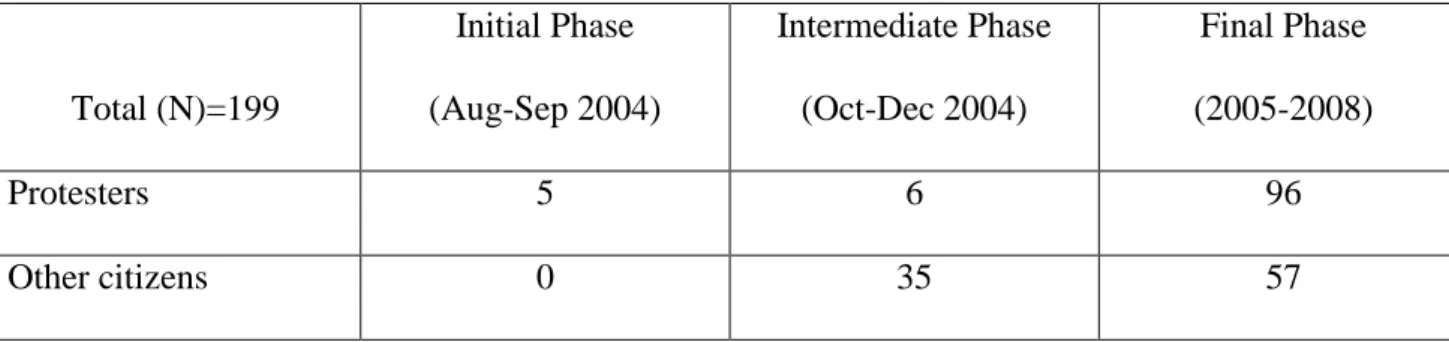
taken (following Drury & Reicher, 2005; Bauer & Gaskell, 1999). The temporal analysis suggested that the debate had three main phases: an Initial Phase (August - September 2004), during which all the posts appearing in the Internet blog were authored by the protesters (Table 1); an Intermediate Phase (October - December 2004), with comments posted mostly by other citizens (Table 1); and a Final Phase (January 2005 to December 2008), when the more heated phase of the debate was finished and protesters were again responsible for the majority of the comments. Table 1 summarizes this data.
Given this distribution of the posts, for analysing the Initial Phase of the debate we focused on the protesters’ posts, along with the interviews with them; for the Intermediate Phase, we looked at the posts of other citizens in the Internet blog; for the Final Phase we examined the comments of the protesters after the reaction of other citizens, both through the analysis of their posts in the blog and the interviews conducted with them. Here we focused on those segments of the interviews in which the protesters discussed their current action (January 2005) and future plans.
- TABLE 1 -
A Structured Thematic Analysis (see van Bavel & Gaskell, 2004) was conducted with this material. This involved a two-steps analysis of the material. First, we read all the material and coded every sentence (or the next larger segment of text with a meaningful content) by assigning it to a central theme. Secondly, we performed a more fine-grained analysis of the quotations that were ascribed to those themes, by identifying which arguments constituted those themes, that is, which opinions or positions were put forward to talk about those themes. The first author coded all the data and then the second author checked a sample of the data that covered all the identified themes and arguments. Finally, we analyzed if the arguments that were identified in the discourses of the protesters had changed throughout time, and the impact of the arguments put forward by third party members on that.
In a second moment, we conducted a discourse analysis aimed at understanding the results from the Structured Thematic Analysis, that is, how and why the arguments of the protesters changed. This analysis examined the arguments of protesters and other citizens as situated communicative or rhetorical practices (see Billig, 1997; also Di Masso, Dixon & Pol, 2011).
Next, we will begin by presenting a systematisation of the results of the Structured Thematic Analysis, organised by the debate’s phases. Then, we will go on to the discourse analysis.
3. ANALYSIS
3.1. Results from the Structured Thematic Analysis
3.1.1. The arguments of the protesters: Initial and Final Phases
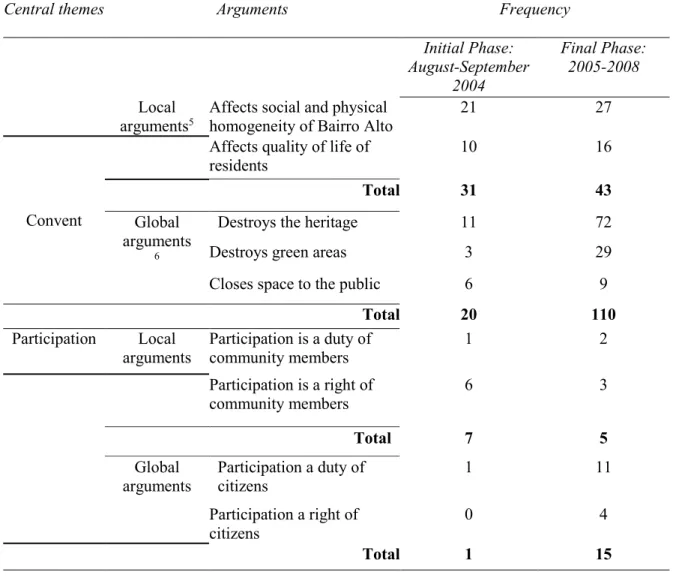
The comments of the protesters are organised around two main themes: ‘Transformation of the Convent’ and ‘Participation/Collective action’. For both themes, the arguments used by the participants emerged as structured in two thematic groups (Table 2). One group was named ‘Local Arguments’ and it aggregates arguments discussing (1) the impact of the transformation of the Convent on Bairro Alto, and (2) participation in decision-making processes as both a right and a duty of the residents of Bairro Alto. The other set of arguments, identified as ‘Global Arguments’, is associated with more global dimensions of the controversy, focusing on (1) the impact of the transformation for the preservation of the built and natural environment in general, and (2) participation as a right and duty of citizens in general. As Table 2 shows, initially the protesters emphasize mainly local arguments to justify their actions.
- TABLE 2 -
By contrast, at the Final Phase of the protests, the analysis shows that, proportionally, local arguments are less frequent, both regarding the transformation of the Convent in itself and
participation (Figure 1).
- FIGURE 1 -
In the Final Phase, global arguments are more emphasized. This happens both for arguments concerning the importance of the preservation of the Convent, as cultural and historical heritage, and its garden, and for arguments regarding participation as a duty and a right of citizens in general. This analysis clearly shows then that the arguments emphasized by the protesters changed throughout time.
3.1.2. The arguments of the other participants in the Internet Forum: Intermediate Phase The analysis of the posts of other citizens discussing the transformation of the Convent revealed the following: (1) the posts could be organized into two categories: those in agreement and those in disagreement with the transformation of the Convent; (2) independently of their position regarding the transformation of the Convent, the other citizens discussed three main themes: the ‘Arguments used by the protesters’, the ‘Action of the protesters’ and ‘Participation’.
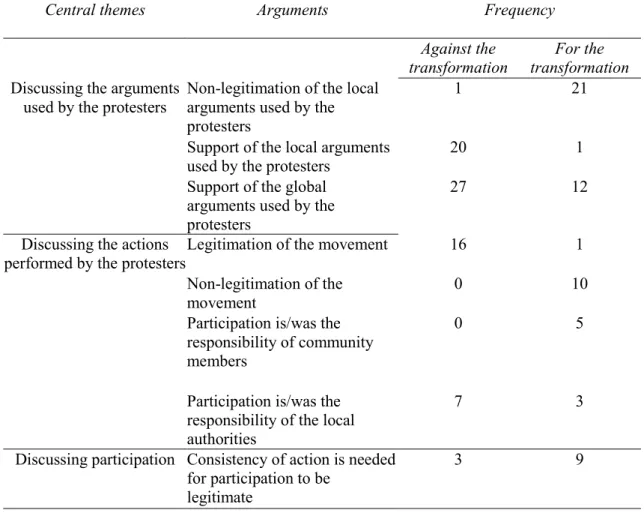
Table 3 presents a systematisation of the results of the Structured Thematic Analysis of the themes and arguments used by other citizens, during the phase when the controversy was ”hotter” (Intermediate phase: October-December 2004).
- TABLE 3 –
These results show that those against the transformation of the Convent: (1) support the local arguments the protesters used; (2) support also their global arguments. These citizens, while discussing the actions performed by the protesters, also consider that it was not the community’s responsibility to get involved in the Inglesinhos decision-making process, but that it was instead the
local authorities’ responsibility.
Table 3 also shows that the participants in favour of the transformation of the Convent more often endorse the global arguments used by the protesters in their protests against the transformation. However, both the disqualification of the local arguments used and the actions performed by the protesters are also frequent by these participants, as well as arguments demanding that participation has to follow specific criteria if it is to be considered legitimate.
The conjoint analysis of the results so far presented reveals that the change of the type of arguments emphasized by the protesters to contest the transformation of the Convent – from local to global arguments – throughout the duration of the protests, is articulated with the position of other citizens regarding the initial arguments and action of the protesters. It is now relevant to understand how that concretely happened. For that we will, relying on the discourse analysis, examine some extracts of the discourses of the protesters and of other citizens, taken from both the Internet forum and the interviews with protesters.
3.2. The discourses of protesters and of other citizens
3.2.1. Initial Phase: Protesters and “their” protests
As concluded above, the arguments presented by the protesters for justifying their initial protests are mainly focused on Bairro Alto. They are related with their attachment, as residents of Bairro Alto, to the neighbourhood, with their perspectives about the community and their identification with it. Some examples:
[Set of extracts n.1]
(1) for me Bairro Alto has a tradition2 (...) which is (…) the small houses, the small streets, the fruit mongers and the grocery shops (...) the communal nature of relationships (...) if I was the owner of that project [the transformation of the Convent], I would respect [the tradition of ]
its area and its surroundings [4:96, 2:2]
(2) the rich people (…) coming to the condominium (...) will not bring anything to the neighbourhood [3:37, 42:42]
In these two extracts the specific transformation that the Convent will suffer is presented as menacing the social and place identity of Bairro Alto, by changing it. According with the protesters, a closed condominium does not fit with what Bairro Alto is, neither from an architectural and urban planning perspective, nor from a social one.
The relation residents have established with the neighbourhood is presented as menaced by the transformation. The extracts suggest that this suddenly imposed grievance (Simon & Klandermans, 2001) threatens the characteristics that are the basis of their identification, is perceived as illegitimate and is therefore related with their actions of protest. The way in which these residents represent their neighbourhood and their identification with it is thus strategically used to justify refusal of the transformation. In the initial phase this was the type of arguments used by the protesters, both in the interviews and in the Internet forum; these were therefore the arguments targeted by the posts of other citizens during the intermediate phase.
3.2.2. Intermediate Phase: Debating the movement in the Internet forum
We will now examine how the positions of other citizens regarding the arguments used by the protesters are expressed in the Internet blog. We present some arguments of those in favour3 of the transformation of the Convent into a closed residential condominium, bringing forward the social-psychological processes they mobilise:
3We only present extracts of the discourses of those in favour of the transformation, since those against concur, overall,
[Set of extracts n.2]
(1) Regarding the devilish “closed condominium”, I don’t see what’s wrong with it - which block of Bairro Alto is open? [8:13, 3:3]
(2) I am unsure about contesting the transformation of the Convent into a residential condominium. Why not? Bairro Alto desperately needs new residents, just like Lisbon does. [10:502, 326:326]
(3) Regarding Inglesinhos, it seems like the heritage issue was little more than a pretext for contesting ‘innovation’ - the construction of luxury dwellings at Bairro Alto, which in fact is a secular tradition. [8:88, 7:7]
These three extracts have a common dimension. For expressing their position they invoke the local arguments used by the protesters in order to disqualify them. This rhetorical mechanism, which brings to own discourse the position of the Other for counter-arguing it (Billig, 1997), is instrumental for directly challenging the protesters’ arguments. The posts highlight that they are specifically disqualifying the local arguments used by the protesters, but not necessarily the movement in itself.
In fact, and as shown by the results of the Structural Thematic Analysis, the participants who favour the transformation of the Convent also frequently support the global arguments used by the protesters, despite contesting the local ones. The global arguments are also invoked in the posts, as illustrated in the extracts below, which are by the same participants and presented in the same order as in extracts n.2:
[Set of extracts n.3]
(1) No, definitively I’m not against this project (…). I am against the destruction of the Convent, because I think it is always possible to reinvent buildings [8:13, 3:3]
focused on that aspect, it seems to me that probably a consensus would be reached... [10:502, 326:326]
(3) That is, the movements of opinion in Lisbon worry a lot about innovation, and show little concern with the preservation of the memory of the city. [8:88, 7:7]
When we consider simultaneously the two sets of extracts presented above we see that while the local arguments of the protesters are criticised (set of Extracts n.2), it is also suggested that the movement would be supported if it paid more attention to more inclusive and global dimensions (set of Extracts n.3), such as the preservation of the Convent’s heritage as a part of the ‘the memory of the city’ and the preservation of its green areas to be used by ‘the public’.
The simultaneous disqualification of local arguments and endorsement of global ones allows these citizens to position themselves as residents of Lisbon and, thus, to accentuate some versions of Lisbon while undermining others (Di Masso et al., 2011), but not criticising the movement in itself. Yet some extracts directly criticize the protests:
[Set of extracts n.4]
(1) The ‘Inglesinhos case’ was another illustration that, overall, the big movements of citizens in Lisbon which focus on urban issues are, mainly, reactionary (...) at the same time that the systematic destruction of Avenidas Novas and Avenida da Liberdade [other two neighbourhoods in Lisbon] and their surroundings, have not been contested at all. [8:51, 27:27]
(2) the protesters object against rich people going to Bairro Alto. The logic is ‘I was here before and I do not want new money people in my neighbourhood, leave my people alone’ (...) But does anyone complain about the social heterogeneity in the Lapa area (...) or in Alvalade (...) [other two neighbourhoods in Lisbon]? [8:50, 25:25]
In these extracts the movement is criticised for more than just using local arguments. The movement is disqualified for its inconsistency and for being reactionary. In the set of extracts n.4, other areas of Lisbon are mentioned for highlighting that those cases were not targets of protests, although the same local arguments used by the protesters at Bairro Alto would apply to them. However, these extracts do not contest the importance of participation and the preservation of the heritage per se, as they have normative legitimacy (Barnett et al., 2012). Instead they make their disagreement with this specific case of participation legitimate by particularising it (Billig, 1985) as not being proper participation, since it is reactionary and inconsistent.
In other words, while talking about the movement, these citizens invoke a set of ideas – not questioning citizens’ attempts to be engaged in decision-making processes, but establishing disclaimers for how that should happen if they are to be actually supported (see also Haggett & Futak-Campbell, 2011) - we could call emancipated representations (Moscovici, 1988). These reveal and appeal to shared positions of actors who are subjected to the same cultural and normative pressures. In this sense they leave space for new answers and arguments from the protesters that re-negotiate the previous ones (Moscovici, 1988; Liu, 2004), as we shall see happened in the next phase.
3.2.3 Final Phase: Protesters’ re-presented arguments
At this phase, the disqualification of the main actions and arguments used by the protesters had already become very clear and strong. The protesters therefore recognise what is said about the arguments and forms of action adopted, as shown below:
[Set of extracts n.6]
(1) He only protests because he lives in front of the Convent - this is what they say about us. [3:34, 38:38]
as they do not want to give us voice, and we already won a lot, I say, they already fear us, they really fear us. [3:138, 26:26]
The two extracts demonstrate that the protesters are aware that the local arguments they used to protest against the transformation of the Convent as well as its line of action – focusing just in the Convent and not in other urban interventions – were criticised both by the professionals of the BA Office (see XXX) and other citizens.
The arguments that criticise the movement are thus in this phase strategically used by the protesters to realign their own arguments so that they take into account the audience and context (Hopkins & Reicher, 1997). In debates with the larger society, constituted by more inclusive identities, their arguments do not need to be strongly polarised and reified, as they were in the interaction with the BA Office (see XXX). They can instead be managed in a more flexible and strategic way, accentuating that the protesters, besides being residents of Bairro Alto, are also residents of Lisbon and citizens. This is well illustrated in the next extract:
[Set of extracts n.7]
(1) We are here talking about Inglesinhos, but there are lots of other cases throughout Lisbon and Portugal of heritage being destroyed and transformed, despite its value. And in these things [heritage issues] we, all of us, loose. [10:801, 220:220]
(2) But those who defend a more ecological and historical city are those always accused of egotism, even of madness (...) It’s the victory of the wealthy individual over citizenship. It’s the “Two bedroom apartment with two garages” above the patrimonial identity of Bairro Alto. It’s the instantaneous luxury condominium denying the organic and continuous process of neighbourly relationships [10:295, 165:165]
to global. They focus now on the defense of the heritage in general, in Lisbon and in Portugal (Extract 7.1), of which the Convent and Bairro Alto are just a part and an instance (Extract 7.2.). And this defense does not only imply these protesters, but all of us (Extract 7.1). In turn, this more frequent and clear use of global arguments may be instrumental not only to recruit more participants to the protesters’ cause, but also, in that way, to achieve their goals. In fact, the very goals of the protesters also change throughout the duration of the protests, namely, enlarging the focus of the protests or, in other words, politicizing them (Simon & Klandermans, 2001).
4. CONCLUSIONS AND DISCUSSION
It has been recently proposed that a fruitful avenue to investigate the relation between collective action and social change would be to consider the role played by the involvement of members of the public not directly implicated in the conflicts (Simon & Klandermans, 2001). However, few empirical analyses have so far examined that. This is what we attempted in this paper.
We started by presenting the two steps needed for fulfilling that task. First, going beyond a two-sided inter-group approach to collective action (Louis, 2009; Simon & Klandermans, 2001); secondly, and following Social Representations Theory (Batel & Castro, 2009; Howarth, 2006), to examine the communication between the groups involved in collective actions and other groups, paying special attention at how communication, as a relational practice, is pragmatically used for negotiating representations and therefore social change, with other members of the public.
The empirical illustration of these proposals involved analysing a case of collective protests by residents from a Lisbon neighbourhood. The protesters organized an Internet blog to discuss this transformation with other citizens, and we analysed the communication in this blog.
The analyses show that the arguments used by the protesters change throughout time. At the initial phase, they rely mainly on local arguments – e.g., the importance of the Convent for their neighbourhood - ; yet at the final phase, they rely more on global arguments - e.g. contesting the
transformation because it implies the destruction of Lisbon’s heritage. The detailed analysis of the posts of other citizens allowed us to better understand these changes. While the arguments put forward by uninvolved citizens illegitimate the local arguments of the protesters, as the professionals of the BA office had done (see XXX), they also endorse some of the protesters global arguments. In time the protesters re-aligned their arguments and actions in order to broaden their focus, in a way that simultaneously allowed them to continue fighting for their goals and include broader goals that could have more impactin the larger society.
The analyses showed then how the inclusive identities and emancipated representations (Moscovici, 1988) available in the larger public sphere about citizen’s involvement in urban matters were used in the debate by the protesters and those debating with them. These representations opened space for a negotiation in which the protesters were able to maintain their goals while reframing the scale of the arguments, attracting more support of other members.
However, there are some aspects in this study that could have been better addressed. It would have been relevant to conduct a second round of interviews with the protesters during the final phase of the protests. This would allow better examining protesters’ discourses about the development of the movement across time, and the changes in its actions and goals. It would also have been relevant to better examine representations of public participation in general, namely regarding authorities at different levels and if and how those shaped perceptions of efficacy
(Mazzoni & Cicognani, 2013; Thomas & Louis, 2013). It would also have been relevant to examine representations of the support (or lack of) of the movement by other citizens, across the different phases of the protests.
Nevertheless, the present study contributes to the research on the analysis of the relation between collective action and social change (Louis, 2009) by providing an empirical illustration of the impact of third party members. This was diagnosed through the very transformation of the arguments and actions of the protesters throughout time. Specifically this was done through a process of re-presenting their claims to an engaged audience, a re-presentation that brought these
claims progressively closer to emancipated dimensions of meaning making. In this vein, this study is a good illustration of how for a social psychology of collective action and social change (van Zomeren & Klandermans, 2012), it is important to take into account the type of social representations (e.g., polemic, emancipated) involved in the communicative practices constituting collective action. Moreover, the present study also highlights that going beyond the analysis of only two-sided intergroup relations is crucial to acknowledge and give voice to other identity projects that are also affected by collective actions, and would otherwise be marginalised. In fact, through their participation in the internet forum, other citizens besides the inhabitants of Bairro Alto were also able to put forward other collective actions or citizenship enactments (Di Masso et al., 2011), regarding the definition of Lisbon’s public space.
Finally, for SRT the present study provides further illustration of how the typology of social representations may be empirically grasped and concretely used in order to understand social change and stability (see also Liu, 2004; Mouro & Castro, 2012). Moreover, by focusing on communicative practices, and by showing the consequential nature of social representation and illustrating how agency is a situated and collaborative phenomena, this study puts forward a socio-constructionist approach to social representation that can be very relevant to further potentiate SRT’s understanding of how social change can be constrained or promoted.
REFERENCES
Aarhus Convention (1998). Convention on Access to Information, Public Participation in Decision-Making and Access to Justice in Environmental Matters. United Nations ECE/CEP/43, agreed in Aarhus, Denmark, 23–25 June.
Barnett, J., Burningham, K., Walker, G., & Cass, N. (2012). Imagined publics and engagement around renewable energy technologies in the UK. Public Understanding of Science, 21(1), 36-50.
Batel, S., & Castro, P. (2009). A social representations approach to the communication between different spheres: An analysis of the impacts of two discursive formats. Journal for the Theory of Social Behaviour, 39, 415-433.
Bauer, M., & Gaskell, G. (1999). Towards a paradigm for research on social representations. Journal for the Theory of Social Behaviour, 29, 163-186.
Billig, M. (1985). Prejudice, categorization and particularization: From a perceptual to a rethorical approach. European Journal of Social Psychology, 15, 79-103.
Billig, M. (1997). Rhetorical and discursive analysis: How families talk about the royal family. In N. Hayes (Ed.), Doing Qualitative Analysis in Psychology (pp. 39-54). Hove, UK:
Psychology Press.
Boaventura, I. (2004). Moradores organizam vigília pela preservação do Convento dos Inglesinhos. Público, 8th October. Available at:
http://publico.pt/local/noticia/moradores-organizam-vigilia-pela-preservacao-do-convento-dos-inglesinhos-1205396.
Castro, P., & Batel, S. (2008). Social representation, change and resistance: On the difficulties of generalizing new norms. Culture & Psychology, 14, 477-499.
Di Masso, A., Dixon, J., & Pol, E. (2011). On the contested nature of place: ‘Figuera’s well’, ‘The Hole of Shame’ and the ideological struggle over public space in Barcelona. Journal of Environmental Psychology, 31, 231-244.
Drury, J., & Reicher, S. (2005). Explaining enduring empowerment: A comparative study of collective action and psychological outcomes. European Journal of Social Psychology, 35, 35-58.
Drury. J., & Reicher, S. (2000). Collective action and psychological change: The emergence of new social identities. British Journal of Social Psychology, 39, 579-604.
Elcheroth, G., Doise, W., & Reicher, S. (2011). On the knowledge of politics and the politics of knowledge: How a social representations approach helps us rethink the subject of political psychology. Political Psychology, 32, 729-758.
Haggett, C., & Futak-Capbell, B. (2011). Tilting at windmills? Using discourse analysis to understand the attitude-behaviour gap in renewable energy conflicts. Механізм регулювання економіки (1), 207-220.
Hopkins, N., & Reicher, S. (1997). Social movement rhetoric and the social psychology of
collective action: A case study of anti-abortion mobilization. Human Relations, 50, 261-287. Howarth, C. (2009). ‘I hope we won’t have to understand racism one day’: Researching or
reproducing race in social psychological research?. British Journal of Social Psychology, 48, 407-426.
Howarth, C. (2006). A social representation is not a quiet thing: Exploring the critical potential of social representations theory. British Journal of Social Psychology, 45, 65-86.
Jones, M., & Alony, I. (2008). Blogs – The New Source of Data Analysis. Issues in Informing Science and Information Technology, 5, 433-446.
Jovchelovitch, S. (2007). Knowledge in Context: Representations, community and culture. London: Routledge.
Jovchelovitch, S., & Bauer, M. (2000). Narrative interviewing. In M. Bauer & G. Gaskell (Eds.), Qualitative researching with text, image and sound: A practical handbook (pp.57-74). London: Sage Publications.
Liu, L. (2004). Sensitising concept, themata and shareness: A dialogical perspective of social representations. Journal for the Theory of Social Behaviour, 34, 249-264.
Louis, W. (2009). Collective action – and then what? Journal of Social Issues, 65, 727-748. Marková, I. (2003). Dialogicality and social representations – the dynamics of mind. Cambridge:
Cambridge University Press.
Mazzoni, D., & Cicognani, E. (2013). Water as a commons: An exploratory study on the motives for collective action among Italian water movement activists. Journal of Community & Applied Social Psychology, 23, 314-330.
McGarty, C., Thomas, E., Lala, G., Smith, L., & Bliuc, A.-M. (forthcoming). New technologies, new identities and the growth of mass opposition in the Arab Spring. Political Psychology. Moscovici, S. (1961/1976). La Psychanalyse, son image et son public. Paris: PUF.
Moscovici, S. (1988). Notes towards a description of social representations. European Journal of Social Psychology, 18, 211-250.
Mouro, C., & Castro, P. (2012). Cognitive polyphasia in the reception of legal innovations for biodiversity conservation. Papers on Social Representations, 21, 3.1-3.21.
Simon, B., & Klandermans, B. (2001). Politicized colective identity: A social psychological analysis. American Psychologist, 56, 319-331.
Smith, L., Thomas, E., & McGarty, C. (forthcoming). “We must be the change we want to see in the world”: Integrating norms and identities through social interaction. Political Psychology. Stürmer, S., & Simon, B. (2005). Collective action: Towards a dual-pathway model. European
Review of Social Psychology, 15, 59-99.
Subasic, E., Reynolds, K., Reicher, S., & Klandermans, B. (2012). Where to from here for the psychology of social change? Future directions for theory and practice. Political Psychology, 33, 61-74.
Tajfel, H. (1972). La catégorisation sociale. In S. Moscovici (Ed.), Introduction à la psychologie sociale (Vol. 1) (pp.272-302). Paris: Larousse.
Thomas, E., & Louis, W. (2013). Doing Democracy: The Social Psychological Mobilization and Consequences of Collective Action. Social Issues and Policy Review, 7, 173-200.
Turner, J., Hogg, M., Oakes, P., Reicher, S. & Wetherell, M. (1987). Rediscovering the social group: A self-categorisation theory. Oxford: Blackwell.
van Bavel, R., & Gaskell, G. (2004). Narrative and systemic modes of economic thinking. Culture & Psychology, 10, 417-439.
van Zomeren, M. , Postmes, T., & Spears, R. (2008). Toward an integrative Social Identity Model of Collective Action: A quantitative research synthesis of three socio- psychological perspectives. Psychological Bulletin, 134, 504 – 535.
van Zomeren, M., & Klandermans, B. (2012). Editorial: Towards innovation in theory and research on collective action and social change. British Journal of Social Psychology, 50, 573-574. Wagner, W. (1994). Fields of research and socio-genesis of social representations: a discussion of
criteria and diagnostics. Social Science Information, 33, 199-228.
Wagner, W. (1998). Social representations and beyond: Brute facts, symbolic coping and domesticated worlds. Culture & Psychology, 4, 297-329.
TABLE 1 – Frequency of comments posted by protesters and other citizens in the Internet blog, by phase of the debate4
Total (N)=199 Initial Phase (Aug-Sep 2004) Intermediate Phase (Oct-Dec 2004) Final Phase (2005-2008) Protesters 5 6 96 Other citizens 0 35 57
TABLE 2 – Central themes and arguments used by the protesters against the transformation of the Convent at the Initial and Final Phases of their protests
Central themes Arguments Frequency
Initial Phase: August-September 2004 Final Phase: 2005-2008 Local arguments5
Affects social and physical homogeneity of Bairro Alto
21 27
Convent
Affects quality of life of residents 10 16 Total 31 43 Global arguments 6
Destroys the heritage 11 72
Destroys green areas 3 29
Closes space to the public 6 9
Total 20 110
Participation Local
arguments Participation is a duty of community members 1 2 Participation is a right of community members 6 3 Total 7 5 Global arguments Participation a duty of citizens 1 11 Participation a right of citizens 0 4 Total 1 15
5 ‘Local arguments’ refer to arguments focused only on the Convent and on the impacts and associated issues (e.g., participation) of the Convent/its transformation for the specific
neighbourhood where it is located and for the local community – e.g., the rich people (…) coming to the condominium (...) will not bring anything to the neighbourhood.
6 ‘Global arguments’ refer to arguments focused not only on the Convent and on the impacts of its transformation for Bairro Alto and the people living there, but also other similar cases of heritage transformation and on the impacts of the transformation of the Convent for other places and people
TABLE 3 – Main themes and arguments used by other citizens against and for the transformation of the Convent: Intermediate Phase (October-December 2004)
Central themes Arguments Frequency
Against the transformation
For the transformation Discussing the arguments
used by the protesters
Non-legitimation of the local arguments used by the protesters
1 21
Support of the local arguments used by the protesters
20 1
Support of the global arguments used by the protesters
27 12
Discussing the actions performed by the protesters
Legitimation of the movement 16 1
Non-legitimation of the movement
0 10
Participation is/was the responsibility of community members
0 5
Participation is/was the responsibility of the local authorities
7 3
Discussing participation Consistency of action is needed for participation to be
legitimate