NAA and STS effects on potted bougainvillea:
early flower death
allows delayed bract abscission.
Custódia M. L. Gago, José A. Monteiro*
F.C.T., University of Algarve, 8005-139 Faro, Portugal
*Corresponding author. Tel.: +351-289-800-966; fax: +351-289-818-419; e-mail address: [email protected]
Abstract
The effects of Silver Thiosulphate (STS) and Naphtalene Acetic Acid (NAA) (0,45%NAA+1,2% NAA-amide at 500 mg.l-1) on flowering bud development, anthesis duration, bract longevity and bract photosynthetic rate were studied in Bougainvillea spectabilis ‘Killie Campbell’ plants, under interior conditions. The relationships between bract longevity and the above parameters were also investigated.
NAA induced longer bract longevities, shorter flower anthesis duration and lower percentage of flowers reaching anthesis. STS alone increased duration of flower anthesis but did not affect CD (completely developed) bract abscission, as compared to the water treatment. Depending on the experiment, adding STS to NAA delayed or had no effect on bract abscission. Longer bract longevities were related to shorter flower anthesis and lower percentage of flowers reaching anthesis. Manual removal of flowers from the bract+flower unit increased bract longevity. Despite the low level of
irradiance, bracts photosynthesized and plants treated with NAA (alone or with STS) had lower bract photosynthetic rates. Bract photosynthetic activity, although with relevant rates (similar to leaves and most probably capable of covering respiration expenditure) did not seem important as an energy source for bract longevity since bracts that lasted longer had lower photosynthetic rates. In the water control, percentage of flowers reaching anthesis positively correlated with bract photosynthetic rates.
In potted bougainvillea under low light conditions, flower senescence and bract abscission are under different types of control. In addition to the classical effect of auxin reducing ethylene production, and/or sensitivity of the abscission zone to ethylene, NAA delays bougainvillea bract abscission via early interruption of flower
development.
Keywords: auxin, ethylene, anthesis duration, longevity, bract photosynthesis, flower development.
1. Introduction
The influence of hormones in plant reproductive development is far from being well defined. Ethylene is involved in stamen initiation (Ogawa et al., 2007) and
regulation of floral sex determination in cucumber (Duan et al., 2008). Ethylene can inhibit, promote or modify the opening of a flower. In cut roses, ethylene may
accelerate, prevent or modify flower opening, depending on cultivar, flower stage and ethylene concentration (Reid et al., 1989), although it is not part of natural senescence (Reid, 1989). In Euphorbia fulgens ethylene reduces flower opening, while STS or gibberellins promote it (van Leeuwen, 1985). Also, in Lilium and freesia STS promotes the development and opening of flower buds (van Meeteren and De Proft, 1982; van Meeteren et al., 1995).
Auxins have an important role in reproductive development. Auxins are needed for the initiation of floral primordia and, modifications in the auxin levels may cause abortion, or different flower forms (Cheng and Zhao, 2007, McSteen, 2010). Auxins also control the relative growth of the different flower organs (Aloni et al., 2006). Auxins affect abscission, not only by regulating the sensitivity to ethylene but also by modifying the transport of the enzyme polygalacturonase which degrades the cell wall (Degan et al., 2001). In rose, NAA inhibits the opening of flower buds, but does not promote their abscission (Halevy and Kofranek, 1976). In Theobroma cacao flowers, a single application of NAA at anthesis, anticipates petal wilting but prevents flower abscission (Aneja et al., 1999; Hasenstein and Zavada, 2001). In potted bougainvillea postproduction, auxins delay bract+flower abscission (Gago et al., 2001, Meir et al., 2007, Gago and Monteiro, 2011, Liu and Chang, 2011). The auxin form influences plant morphology: NAA causes severe epinasty of young stems and leaves but 2,4,5-trichlophenoxy acetic acid (Meir et al., 2007) or 0.45%NAA+1.2% NAA-amide (Gago and Monteiro, 2011) do not have this effect. Previous works focused on the general plant appearance, evaluated bract abscission, but there are no detailed reports on the specific effects of the exogenous auxins on bougainvillea’s floral
development/morphology, or flower longevity.
Few studies focused on flower and bract photosynthesis. Vemmos and Goldwin (1994), report that photosynthesis of ‘Cox´s Orange‘ apple flowers, when in the ’ballon‘ stage, represent about one third of leaf photosynthesis, contributing to the development of the flower and early development of the small fruit. In Euphorbia pulcherrima Willd., when comparing leaf and bract photosynthesis at a light intensity of 350 µmol.m -2.s-1, Woodrow and Grodzinski, (1987) state that bracts have photosynthetic rates 10 times lower than green leaves. It is unknown whether bougainvillea bracts have the ability to photosynthesize under interior conditions, and if so how does their
photosynthesis compare to that of green leaves.
The objective of this work is to study the effects of exogenously applied STS and NAA (0.45%NAA+1.2% NAA-amide) on bougainvillea’s flower development, anthesis and single bract photosynthetic rate. The relationship between these effects and bract longevity is also investigated for a better understanding of the influence of the flower, and of the chemicals applied, in bract abscission.
2. Materials and methods
2.1. Main experiment2.1.1. General procedures
Two postproduction experiments with B. spectabilis ’Killie Campbell‘ plants were done (beginning September 23, 2005 and July 25, 2006), with completely randomized designs and at least four replications per treatment.
Plants were grown in plastic greenhouses, using the normal procedures, at the “Horto” of University of Algarve, Faro, until the beginning of the experiments. The only environmental control provided was greenhouse ventilation when the temperature exceeded 24 ºC.
At end of production, plants were approximately 60cm high, with at least ten groups of three bracts completely developed and at least one group with an open flower (at anthesis).
Treatments with STS were initiated during production, starting when bracts became visible, and were applied every 15 days up to the end of production. They
consisted of a 160 mgL−1spray of STS (2 g L−1 of Argylene®; Argylene Biochem ApS, Frederiksberg, Denmark). Treatments with NAA consisted of a single spray, at end of production (day 0 postproduction), using 500 mgL−1of NAA (30.30 g L−1of Agritone® (0.45% NAA+ 1.2% NAA-amide; Etisa, Barcelona, España)). Both types of spray were applied to wet uniformly the leaves and bracts, up to the start of dripping. Treatments performed were: (a) STS, (b) NAA, (c) STS +NAA and (d) WATER. Once dry from the sprays, plants were sleeved, boxed in open card boxes at 10 plants per 30 cm × 52 cm × 50cm (height × length × width) box, and kept for three days under simulated transport conditions (17 ± 1 ºC, no light).
At day 3 postproduction (PP), plants were unboxed, placed under interior conditions [21 ± 1 ºC and 12 µmol.m−2.s−1of cool white fluorescent light (Philips, TLD, 58/830) 12 h a day] and the sleeves removed. Both experiments ended at day 30 PP. 2.1.2. Bract longevity, flower development and leaf abscission
At the end of the production period (i.e. day 0 PP), each single bract and flower in a plant was tagged, numbered and, its developmental stage recorded. Each bract in a group of three had the same developmental stage. A group of 3 bracts was named “completely developed” (CD) if the bracts had definitive size and color, or
“developing” (D) for all other bract stages before CD. Also, at day 0 PP the number of leaves in each plant was recorded.
The developmental stage of each flower and bract, as well as the bracts and leaves that abscised, were recorded at the end of the simulated transport period (day 3 PP) and daily from then on. Bract longevity is the number of days from the start of the postproduction experiment until the bract abscised or the end of the experiment.
Flower development was only monitored on CD bracts. Flowers were
considered: a) pre-anthesis, when the flower tubular perianth was still linear and closed, b) in anthesis, when the flower was open and the white part of the corolla visible, c) post-anthesis when the white part of the corolla was not visible anymore and the tubular perianth twisted itself, forming a senescent spiral structure. Computed variables
included: the percentage of closed flowers that developed to anthesis and the anthesis duration of each flower, (i.e., the period of time that the flower remained open). For the calculations, events that occurred during the simulated transport period were considered to have happened at day 3 PP.
2.1.3. Photosynthesis measurement
Single bract and leaf CO2 exchange rates were measured at day 8 PP, under interior conditions, using a portable gas exchange system (HCM-1000, Walz, Effeltrich, Germany) operating as an open system mode. Measurements were performed on
attached bracts and leaves, using 3 bracts per plant, with similar exposition, and 3 leaves per plant, immediately below the bract zone. Due to the size of the chamber, bract photosynthetic rate was assessed only in CD bracts and did not include any flower part. Measurements started one hour after the beginning of the light period in the chamber. 2.2. Additional experiment
To do a preliminary test of an explanatory hypothesis, in the Spring of 2011, 10 potted bougainvilleas were obtained, from a local grower (Viveiros Monterosa,
www.monterosa.pt) which uses STS treatments, similar to what was described above. Half of the plants were treated with NAA, at arrival, as described above and, the other half was left untreated. For both treatments, i.e. with or without NAA, on half of the bracts+flowers per plant, the flowers were manually removed. Plants were exposed to
the postproduction sequence of environments described above (simulated transport + simulated interior conditions). Bract longevity of bracts+flowers and of bracts without flowers was assessed during a 30 day postproduction period.
2.3. Statistical Analysis
Analysis of variance (ANOVA) was performed on the data and, when needed, means were compared using Duncan’s Multiple Range Test at p=0.05. Regressions were also run when appropriate. Softwares utilized for the statistical treatments were SAS (SAS Institute Inc., Cary, NC,USA) and SPSS (SPSS Inc., Chicago, USA). 3. Results
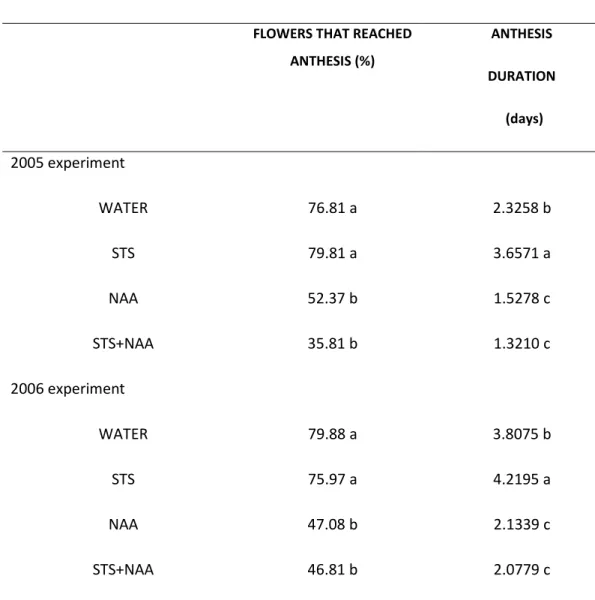
The percentage of closed flowers reaching anthesis was affected by
postproduction treatment (P=0.0002) (Table 1). In both experiments, plants treated with WATER and STS opened more flowers (75% to 80%), than plants treated with NAA and NAA+STS (36% to 52%). Anthesis duration was also clearly affected by
postproduction treatment (P=0.0001) and experiment (P=0.0001) (Table 1). Flowers treated with STS remained open the longest, followed by the flowers treated with WATER. Flowers sprayed with NAA or NAA+STS remained open the shortest. In 2006 flowers lasted longer than in 2005 but the treatments’ ranking was the same in the two years (Table 1).
Bract longevity was affected by experiment(year) (P=0.0001) and
postproduction treatment (P=0.0001), with a significant 3-way interaction, among experiment, postproduction treatment and bract developmental stage (P=0.0037). As a consequence each factor was ultimately analyzed at fixed levels of the two other factors.
In both experiments and for both bract stages, bracts treated with STS+NAA lasted the longest, and bracts sprayed with WATER and STS lasted the shortest (Fig.1). In 2005, bracts treated with NAA lasted shorter than bracts treated with STS+NAA. In 2006, bracts treated with NAA lasted the same as bracts treated with STS+NAA. Generally and in both experiments, D bract longevity was equal or shorter than CD bract longevity, only in plants treated with STS alone, did D bracts last longer than CD bracts (Table 2).
Despite the low level of irradiance, the vast majority of bracts photosynthesized. In a first approach, bract net photosynthetic rate, was not influenced by postproduction treatment, experiment, or developmental stage of the flower adjacent to the bract. Pooling the data for the two treatments without NAA (i.e., WATER and STS) and for the two treatments with NAA (i.e., NAA and STS+NAA) revealed an higher bract photosynthetic rate in treatments without NAA (0.469 vs. 0.368 µmol CO2.m-2.s-1) (P=0.0478). Lower bract photosynthetic rates, in bracts treated with NAA or NAA+STS, could have been caused by the excipient included in the commercial product (Agritone) or a real NAA effect. Plants sprayed with Agritone had a visible white dust deposit on leaves and bracts, which could have reduced the light reaching the plant tissue. However, reduced light does not seem a probable cause since, for the same treatments, no differences could be found in leaf photosynthetic rates.
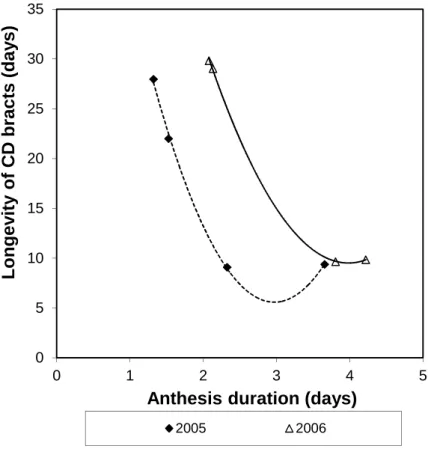
In both experiments, anthesis duration quadratically correlated with longevity of CD bracts in the different treatments (Fig. 2). Surprisingly, the shorter the anthesis duration of a flower the longer the bract longevity. STS alone did not increase bract longevity, but increased anthesis duration. In 2006, a good, linear, negative correlation could be established between plant bract longevity and anthesis duration (R2=0.952, P=0.024). In 2005, only if the plants treated with STS were excluded from the
calculations, were we able to establish a linear negative correlation between bract longevity and anthesis duration (R2=0.983,P=0.082).
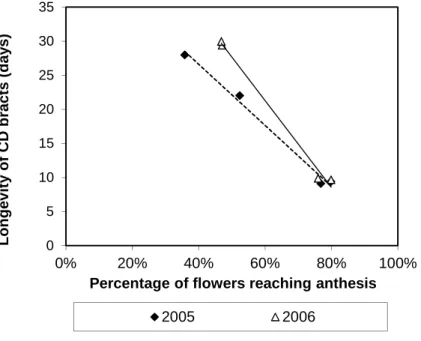
Also using the averages for the treatments and in both experiments, linear negative correlations were found between CD bract longevity and percentage of flower reaching anthesis (Fig.3). STS alone, although increasing anthesis duration (Fig.2), did not influence percentage of flowers reaching anthesis (Fig.3). However, correlations between CD bract longevity and percentage of flowers reaching anthesis could not be revealed at the plant or bract level, possibly due to: a) forced termination of the
experiments at day 30 PP (most of the NAA or NAA+STS treated bracts had longevities close to 30 days), b) variability induced by the different bract positions in the plants and c) discrete levels of percentage of flowers reaching anthesis in the abscising unit (only 3 flowers per abscising unit).
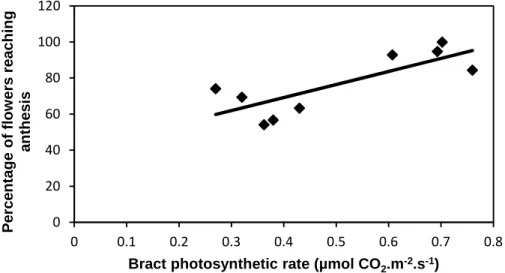
In the WATER treatment, the higher the bract net photosynthetic rate, the higher the percentage of flowers reaching anthesis (Fig. 4). This trend was also observed for the treatment means, but with a less significant correlation (R2=0.837, P=0.0853).
Under interior conditions, leaf net photosynthetic rates did not differ from bract net photosynthetic rates (Fig.5). Leaf net photosynthetic rate was lower in 2005 than in 2006, which can be explained by different leaf developmental stages. Leaf net
photosynthetic rate was not affected by postproduction treatment, experiment or leaf position (1st, 2ndor 3rdleaf, immediately below the bract zone). No relationships could be established between leaf net photosynthetic rate and leaf abscission (data not shown). Variability was considerable and leaf photosynthesis was measured in the upper part of the plant (leaves immediately below the bract zone), while leaves that fell the most, were in the lower part of the plant. Plants abscised less than 40% of the leaves in 2005 and, less than 30% in 2006.
In the additional experiment all plants were STS treated. At day 30 PP, plants treated with NAA had almost all the bracts (abscission ≤ 0.5%), independently from flower removal. In the plants not treated with NAA, bracts lasted longer if the flowers were previously removed (25.8 days) than if the flowers were left intact (19.8 days) (P=0.013).
4. Discussion
Under interior conditions, the clearest effects of NAA (NAA or STS + NAA) in B. spectabilis reproductive organs were shorter anthesis duration, decreased percentage of flower buds reaching anthesis, decreased bract photosynthetic rates and increased bract longevity.
4.1. Flower opening and anthesis duration
The anthesis period of Bougainvillea stipitata flowers (López and Galetto, 2002), growing outside, is at least 5 days and the opening of the flower is usually in the evening. The longest anthesis duration we had, was 4.2 days, and is most probably explained by the different environmental conditions or differences between species.
Exogenous auxins inhibiting flower opening was reported previously in Ipomoea (Kaihara and Takimoto, 1983). Auxins may enhance or inhibit ethylene production (van Doorn and van Meeteren, 2003) as well as, modify the sensitivity to ethylene (Taylor and Whitelaw, 2001). Enhanced ethylene production or enhanced ethylene sensitivity, do not seem probable explanations for NAA-induced flower death, since adding STS to the NAA treatment, did not significantly influence anthesis duration or percent of flowers reaching anthesis. Also, Liu and Chang (2011) found inhibited ethylene
impaired normal flower development via decreased ethylene production or sensitivity: STS alone prolonged anthesis and did not affect the percentage of flowers reaching anthesis, as compared with the water treatment (Table 1).
Flower opening and closing has been explained through differences in growth rate of the different tissues of petals (van Doorn and van Meeteren, 2003) and this differential tissue growth is a typical auxin response (Zhao, 2010). Auxins regulate and synchronize the development of the different flower organs and, their levels are tissue-specific, with minimal auxin redistribution among different flower parts (Chandler, 2010). Blocking auxin biosynthesis, transport or signaling, disrupts flower formation (Cheng and Zhao, 2007). Thus, it makes sense that altering the flower-bract auxin gradient, with an exogenous auxin application, induces flower abortion. NAA-induced impairment of flower development explains why, in previous experiments (Gago and Monteiro, 2011), NAA treated plants decreased bract carbohydrate consumption per gram of bract dry weight.
4.2. Bract abscission
CD and D bracts lasted longer in NAA (alone or with STS) treated plants. In 2005, adding STS to NAA increased bract longevity while in 2006 NAA alone was enough for maximal bract longevity (Fig.1). This experiment dependent type of
response was previously found in other reports (Gago et al., 2001, Gago and Monteiro, 2011). Different bract ages, even in what we considered to be CD bracts, meaning different ethylene sensitivities of the abscission layer, may explain why in some experiments adding STS to NAA can effectively increase bract longevity. D bract longevity was equal or shorter than CD bract longevity, except for the STS treatment, where D bracts lasted longer than CD bracts. This agrees with previous works (Chang and Chen, 2001, Liu and Chang, 2011) where less developed bracts were shown to be more ethylene sensitive, showing a stronger response to STS. However, even for D bracts, the longest longevities were obtained with the NAA treatments. NAA may reduce ethylene sensitivity of the abscission layer (in the same way as STS) or ethylene production (as shown by Liu and Chang, 2011) but this is not enough. An NAA-induced elimination of the competing flower and/or an increased priority for bract development is also needed, for full bract longevity.
4.3. Flower-bract interactions
Excluding the STS treatment, the shorter the anthesis duration, the longer the CD bract longevity (Fig.2). STS alone increased anthesis duration but did not affect CD bract longevity. Also, the lower the percentage of flowers reaching anthesis, the longer the CD bract longevity (Fig.3). This strongly suggests flower-bract competition for some scarce resource, such as available carbohydrates. Competition for carbohydrates has been shown to exist among the petals of one flower, among opening flowers as well as among flowers and flower buds (van Doorn and van Meeteren, 2003) and could be expected between bracts and flowers. Mechanical flower removal, allowing for longer bract longevities (as in our additional experiment), supports this competition. This can also be envisaged as an auxin-mediated change in developmental priorities: floral organs producing high levels of auxin inhibit or retard the development of neighboring organs (Aloni et al., 2006). The exogenous NAA sprayed to Bougainvillea, a species where the flowers are protected by the bracts, would alter the relative concentrations, increasing NAA concentration in the bracts, and increasing their developmental priority in relation to the flower.
In our additional experiment (all plants treated with STS), untouched bracts in NAA treated plants lasted even longer than bracts without flowers in non-NAA treated plants. It suggests therefore, that NAA sprays do not only remove the competing flowers but also increase bract developmental priority at the whole plant level.
In bougainvillea, bracts abscise and flowers senesce (in-roll). Bract abscission and flower longevity seem to be under different types of control, although somewhat affecting one another. Due to the specific morphology, they abscise together. Different types of control for bract and flower senescence were shown previously. Under interior conditions, Euphorbia pulcherrima (poinsettia) flowers (cyathia), abscise much earlier than bracts (Scott et al.,1984). Actually, cyathia are the first organs to abscise, then leaf abscission starts and, bracts are the last organs to abscise under interior conditions. Reports of, NAA inhibiting simultaneously abscission and development of floral organs, also exist for other systems: spraying potted roses with NAA, before simulated transport, prevents abscission of flower buds, but the buds do not open (Halevy and Kofranek, 1976).
In opposition to what was assumed in a previous report (Gago and Monteiro, 2011), under interior conditions, bracts had photosynthetic rates similar to leaves (Fig. 5). Treatments with NAA had lower bract photosynthetic rates than treatments without NAA. In Gago and Monteiro (2011), treatments with NAA had decreased bract+flower respiratory rates per unit of dry weight. Since dark respiration usually reflects the metabolic intensity of an organ, the two reports agree: organs with lower photosynthetic rates, i.e. lower metabolic activity, have lower respiratory rates. Net photosynthesis of reproductive organs providing considerable amounts of carbon for their development was previously shown in the flowers of Ambrosia trifida L. (Bazzaz and Carlson, 1979), the carpels of the flower of Ranunculus adoneus (Galen et al., 1993), the sepals,
receptacles and pedicels of apple flowers (Vemmos and Goldwin, 1994), and in cotton bracts (Zhao and Oosterhuis, 1999).
With all the inaccuracies involved in mixing data from different experiments (Gago and Monteiro, 2011 and this report), we estimate that bract net photosynthesis can provide enough energy for supporting bract+flower+adjacent stems expenditure during postproduction under interior environments (data not shown). In WATER-treated plants, the more a bract photosynthesizes the higher the percent of flowers reaching anthesis (Fig.4), suggesting that flower development is controlled by carbohydrate availability or, simply, that photosynthetic rates are responding to
increased energy demand. Nevertheless, since NAA-treated bracts photosynthesize less, at least in NAA-treated plants, bract longevity does not seem to be limited by energy supply from bract photosynthesis.
4.4. Conclusion
In potted bougainvillea under low light conditions, flower senescence and bract abscission are under different types of control. NAA shortens flower anthesis, decreases percentage of flowers reaching anthesis and, decreases bract net photosynthesis, at the same time that it delays bract abscission. In addition to the classical effect of auxin in reducing ethylene production and/or sensitivity of the abscission zone to ethylene, NAA delays bougainvillea bract abscission via early interruption of flower development and increased bract developmental priority.
STS alone induces longer anthesis duration in the flowers and may increase D bract longevity but does not affect CD bract longevity. Depending on the experiment, adding STS to NAA may delay or has no effect on bract abscission.
Acknowledgements**
This research was supported by a grant Praxis XXI/BD/15640/98 and the project PBIC/C/2286/95, both from Fundação para a Ciência e Tecnologica. We also thank CDCTPV/University of Algarve (including Projecto de Unidade I&D: CDCTPV 2003- 2005. POCTI7POCI 2010) for the support and the facilities. We thank Viveiros
Monterosa, (Moncarapacho, Portugal) for providing some of the plants. References
Aloni, R., Aloni, E., Langhans, M., Ullrich C, 2006. Role of auxin in regulating Arabidopsis flower development. Planta 223, 315-328.
Aneja, M., Gianfagna, T., Ng, E., 1999. The roles of abscisic acid and ethylene in the abscission and senescence of cocoa flowers. Plant Growth Regul. 27, 149-155.
Bazzaz, F.A., Carlson, R.W., 1979. Photosynthetic contribution of flowers and seeds to reproductive effort of an annual colonizer. New Phytol. 82, 223-232.
Chandler, J. W., 2010. The hormonal regulation of flower development. J. Plant Growth Regul. 30, 242-254.
Chang, Y.-S., Chen, H.-C., 2001. Variability between silver thiosulfate and 1-naphthaleneacetic acid applications in prolonging bract longevity of potted bougainvillea. Sci. Hortic. 87, 217-224.
Cheng, Y., Zhao, Y., 2007. A role for auxin in flower development. J. Integr. Plant Biol. 49, 99−104.
Degan, F.D., Child, R., Svendsen, I., Ulvskov, P., 2001. The cleavable N-terminal domain of plant endopolygalacturonases from clade B may be involved in a regulated secretion mechanism. J. Biol. Chem.276, 35297-35304.
Duan, Q.-H., Wang, D.-H., Xu, Z.-H., Bai, S.-N., 2008. Stamen development in Arabidopsis is arrested by organ-specific overexpression of a cucumber ethylene synthesis gene CsACO2. Planta 228, 537-543.
Gago, C.M.L., Monteiro, J.A., 2011. NAA and STS effects on bract survival time, carbohydrate content, respiration rate and carbohydrate balance of potted Bougainvillea spectabilis Willd. Postharvest Biol. Technol.60, 235- 243.
Gago, C.M.L., Monteiro, J.A., Rodrigues, M. H., 2001. Bougainvillea postproduction: NAA and STS control of bract abscission is subject to exogenous ethylene. Acta Hortic. 543, 47-53.
Galen, C., Dawson, T.E., Stanton, M.L., 1993. Carpels as leaves: Meeting the carbon cost of reproduction in an alpine buttercup. Oecologia 95, 187-193.
Halevy, A.H., Kofranek, A.M., 1976. The prevention of flower bud and leaf abscission in pot roses during simulated transport. J. Am. Soc. Hortic. Sci. 101, 658-660.
Hasenstein, K.H., Zavada, M.S., 2001. Auxin modification of the
incompatibilityresponse in Theobroma cacao. Physiol. Plant. 112, 113-118.
Kaihara, S., Takimoto, A., 1983. Effect of plant growth regulators on flower opening of Pharbitis nil. Plant Cell Physiol. 24, 309-316.
Liu, F-Y., Chang, Y-S., 2011. Growth regulators prolong bract longevity of potted bougainvillea. Korean J. Hortic. Sci. Tecnol. 29, 326-335.
López, H.A., Galetto, L., 2002. Flower structure and reproductive biology of Bougainvillea stipitata (Nyctaginaceae). Plant Biol. 4, 508-514.
McSteen, P., 2010. Auxin and Monocot Development. Cold Spring Harb. Perspect. Biol. 2: a001479.
Meir, S., Salim, S., Chernov, Z., Philosoph-Hadas, S., 2007. Quality improvement of cut flowers and potted plants with postharvest treatments based on various cytokinins and auxins. Acta Hortic. 755, 143-156.
Ogawa, T., Uchimiya, H., Yamada, M.K., 2007. Mutual regulation of Arabidopsis thaliana ethylene-responsive element binding protein and a plant floral homeotic gene, APETALA2. Ann. Bot. 99, 239–244
Reid, M. S., 1989. The role of ethylene in flower senescence. Acta Hortic. 261, 157-169.
Reid, M.S., Evans, R.Y., Dodge, L.L., Mor, Y., 1989. Ethylene and silver thiosulfate influence opening of cut rose flowers. J. Am. Soc. Hortic. Sci.114, 436-440.
Scott, L.F., Blessington, T.M., Price, J., 1984. Postharvest effects of storage method and duration on quality retention of poinsettias. HortScience 19, 290-291.
Taylor, J.E., Whitelaw, C.A., 2001. Signals in abscission. New Phytol., 151, 323- 339. van Doorn, W.G., van Meeteren, U., 2003. Flower opening and closure: a review. J. Exp. Bot.389, 1801-1812.
van Leeuwen, P.J., 1985. Postharvest treatment of Euphorbia fulgens. Acta Hortic. 181, 467-469.
van Meeteren, U., De Proft, M., 1982. Inhibition of flower bud abscission and ethylene evolution by light and silver thiosulfate in Lilium. Physiol. Plant. 56, 169-177.
van Meeteren, U., van Gelder, H., van Peppel, A.C., 1995. Aspects of carbohydrate balance during floret opening in freesia. Acta Hortic. 405, 117-122.
Vemmos, S.N., Goldwin, G.K., 1994. The photosynthetic activity of cox`s orange pippinapple flowers in relation to fruit setting. Ann. Bot. 73, 385-391.
Woodrow, L., Grodzinski, B., 1987. Ethylene evolution from bracts and leaves of poinsettia, Euphorbia pulcherrima Willd. J. Exp. Bot.197, 2024-2032.
Zhao, D., Oosterhuis, D.M., 1999. Photosynthetic capacity and carbon contribution of leaves and bracts to developing floral buds in cotton. Photosynth. 26, 279-290.
Zhao, Y., 2010. Auxin biosynthesis and its role in plant development. Annu. Rev Plant Biol. 61, 49–64.
Table 1 – Percentage of flowers that reached anthesis and anthesis duration in the 2005 and 2006 experiments, for the different treatments.
FLOWERS THAT REACHED ANTHESIS (%) ANTHESIS DURATION (days) 2005 experiment WATER 76.81 a 2.3258 b STS 79.81 a 3.6571 a NAA 52.37 b 1.5278 c STS+NAA 35.81 b 1.3210 c 2006 experiment WATER 79.88 a 3.8075 b STS 75.97 a 4.2195 a NAA 47.08 b 2.1339 c STS+NAA 46.81 b 2.0779 c
*the values followed by the same letter, in the same column and experiment are not significantly different (Duncan’s New Multiple Range Test, at P=0.05).
Table 2 – Bract longevity. Comparison between developing (D) and completely developed bracts (CD), by year and post-production treatment.
Year Treatment D bract longevity (days) CD bract longevity (days) Significantly different at P=* 2005 WATER 8.533 9.100 N.S. STS 15.111 9.383 0.0001 NAA 19.529 22.000 N.S. STS+NAA 25.032 27.973 0.0072 2006 WATER 9.500 9.652 N.S. STS 11.815 9.856 0.0014 NAA 27.932 29.888 0.0089 STS+NAA 29.321 29.964 0.0014 * N.S.-Non Significant
Fig.1 – Longevity of CD and D bracts, in 2005 (A) and in 2006 (B), for the different postproduction treatments. Letters compare postproduction treatments for the same developmental stage and year. Bars with different letters are significantly different (Duncan’s New Multiple Range Tests, at P=0.05).
0 5 10 15 20 25 30 35 CD D B ra c t lo n g e v it y ( d a y s )
Bract development stage
WATER STS NAA STS+NAA
a a b b c c c d (A) 0 5 10 15 20 25 30 35 CD D B ra c t lo n g e v it y ( d a y s )
Bract development stage
WATER STS NAA STS+NAA
a a a a b b b b (B)
Fig. 2 – Relationship between anthesis duration and longevity of CD bracts in the different treatments for the 2005 and 2006 experiments.
2005: CD Bract longevity=77137-48.182×(Anthesis duration)+8.111×(Anthesis duration)2, R2=0.9987 and P=0.0358.
2006: CD Bract longevity=99.957-45.346×(Anthesis duration)+5.684×(Anthesis duration)2, R2=0.9995 and P=0.0229. 0 5 10 15 20 25 30 35 0 1 2 3 4 5 L o n g e v it y o f C D b ra c ts ( d a y s )
Anthesis duration (days)
Fig. 3 – Relationship between percentage of flowers reaching anthesis and CD bract longevity in the different treatments for the 2005 and 2006 experiments.
2005 : CD bract longevity=44.521-44.783×(% of flowers reaching anthesis), R2=0.9904 and P=0.0048;
2006 : CD bract longevity=59.598-63.873×(% of flowers reaching anthesis), R2=0.9931 and P=0.0034. 0 5 10 15 20 25 30 35 0% 20% 40% 60% 80% 100% L o n g e v it y o f C D b ra c ts ( d a y s )
Percentage of flowers reaching anthesis
Fig. 4 – WATER control. Relationship between percentage of flowers reaching anthesis and CD bract net photosynthetic rate (each dot is a plant average). Percentage of flowers reaching anthesis=0.403234+0.72203(Bract photosynthetic rate), R2=0.6279, P=0.0109.
0 20 40 60 80 100 120 0 0.1 0.2 0.3 0.4 0.5 0.6 0.7 0.8 P e rc e n ta g e o f fl o w e rs r e a c h in g a n th e s is
Fig. 5 – Photosynthetic rate in bracts and leaves, at day 8 PP, for the 2005 and 2006
experiments. Letters compare experiments for the same organ. Bars with different letters are significantly different (Duncan’s New Multiple Range Tests, at P=0.05).
0 0.1 0.2 0.3 0.4 0.5 0.6 bracts leaves P h o to s y n th e ti c r a te ( µ m o l C O2 .m -2.s -1) 2005 2006 a b a a a b a a