Repositório ISCTE-IUL
Deposited in Repositório ISCTE-IUL: 2018-03-27
Deposited version: Post-print
Peer-review status of attached file: Peer-reviewed
Citation for published item:
Espírito-Santo, A. & Sanches, E. (2018). Looking for locals under a closed-list proportional representation system: the case of Portugal. Electoral Studies. 52, 117-127
Further information on publisher's website: 10.1016/j.electstud.2018.01.004
Publisher's copyright statement:
This is the peer reviewed version of the following article: Espírito-Santo, A. & Sanches, E. (2018). Looking for locals under a closed-list proportional representation system: the case of Portugal. Electoral Studies. 52, 117-127, which has been published in final form at
https://dx.doi.org/10.1016/j.electstud.2018.01.004. This article may be used for non-commercial purposes in accordance with the Publisher's Terms and Conditions for self-archiving.
Use policy
Creative Commons CC BY 4.0
The full-text may be used and/or reproduced, and given to third parties in any format or medium, without prior permission or charge, for personal research or study, educational, or not-for-profit purposes provided that:
• a full bibliographic reference is made to the original source • a link is made to the metadata record in the Repository • the full-text is not changed in any way
The full-text must not be sold in any format or medium without the formal permission of the copyright holders. Serviços de Informação e Documentação, Instituto Universitário de Lisboa (ISCTE-IUL)
Av. das Forças Armadas, Edifício II, 1649-026 Lisboa Portugal Phone: +(351) 217 903 024 | e-mail: [email protected]
Accepted Manuscript
Looking for locals under a closed-list proportional representation system: The case of Portugal
Ana Espírito-Santo, Edalina Rodrigues Sanches
PII: S0261-3794(16)30296-7
DOI: 10.1016/j.electstud.2018.01.004
Reference: JELS 1895
To appear in: Electoral Studies
Received Date: 4 August 2016 Revised Date: 30 October 2017 Accepted Date: 12 January 2018
Please cite this article as: Espírito-Santo, A., Sanches, E.R., Looking for locals under a closed-list proportional representation system: The case of Portugal, Electoral Studies (2018), doi: 10.1016/ j.electstud.2018.01.004.
This is a PDF file of an unedited manuscript that has been accepted for publication. As a service to our customers we are providing this early version of the manuscript. The manuscript will undergo copyediting, typesetting, and review of the resulting proof before it is published in its final form. Please note that during the production process errors may be discovered which could affect the content, and all legal disclaimers that apply to the journal pertain.
M
AN
US
CR
IP
T
AC
CE
PT
ED
TITLELooking for Locals under a Closed-list Proportional Representation System: The case of Portugal
AUTHOR NAMES AND AFFILIATIONS Author 1: Ana Espírito-Santo
Affiliations: Assistant Professor at ISCTE-IUL (Lisbon University Institute), Department Political Science & Public Policies and Researcher at the Centre for Sociological Studies and Research, Lisbon University Institute (CIES-IUL).
Address: ISCTE – Instituto Universitário de Lisboa, Avenida das Forças Armadas, 1649-026 Lisboa, Portugal.
Email: [email protected]
Author 2: Edalina Rodrigues Sanches
Address: Instituto de Ciências Sociais da Universidade de Lisboa, Avenida Professor Aníbal Bettencourt 9, 1600-189 Lisboa, Portugal.
Affiliations: Postdoctoral researcher at Institute of Social Sciences, University of Lisbon (ICS-UL) and Portuguese Institute of International Relations, New University of Lisbon.
Email: [email protected]; [email protected]
CORRESPONDING AUTHOR Author 1: Ana Espírito-Santo
Email: [email protected] Present Address: same as above.
M
AN
US
CR
IP
T
AC
CE
PT
ED
Looking for Locals Under a Closed-List Proportional Representation System: The Case of Portugal
Highlights
• Fewer locals among higher positions on candidates’ lists and among heads of lists • District magnitude has minor role in explaining candidates’ localness
• A few more locals in peripheral regions • Localness is not homogenous
Abstract
Parties’ motivation to include locals depends on the characteristics of the electoral system. This article analyzes where on the lists parties choose to position locals under closed-list proportional representation systems. Furthermore, it also investigates how that choice varies depending on two key district factors, namely district magnitude and whether or not the district is in a peripheral region. To that end, it draws on an original biographical data set of candidates for the Portuguese National Parliament (1983, 1995, 2002, 2005 and 2009). The findings show that there are fewer “locals” among the higher positions on the candidates’ lists and among heads of lists. District magnitude and peripheral region effects go in the expected direction, but these effects are small.
Keywords: closed-list proportional representation system, localness, relative rank, head of list,
M
AN
US
CR
IP
T
AC
CE
PT
ED
1. Introduction1Parties’ motivation to include locals depends on the characteristics of the electoral system. While politicians need to signal their personal vote-earning attributes (PVEA) to get elected in open-list proportional representation systems (OLPR), under closed-list proportional representation systems (CLPR) it is the party profile that matters. Here, political parties present ranked lists and voters simply chose one list over another. Therefore, this system offers fewer incentives for political parties to consider PVEA such as localness in the process of candidate selection (Carey and Shugart, 1995); and this is specially the case as district magnitude increases (Shugart, Valdini, and Suominen, 2005; André and Depauw, 2012).
Although, it is more likely to find locals in OLPR systems, it has been shown that even in the most extreme cases of CLPR, such as Israel and the Netherlands, there are significant distinct patterns of geographic representation (Latner and McGann, 2005). This suggests that there might not be many candidates with important local ties within CLPR systems, but there are certainly some. This is so because voters “may be more inclined to vote for a party given knowledge that someone they know from local service is on the list and has a rank that makes election plausible” (Nemoto and Shugart, 2013: 3). Despite some important contributions, many open questions remain on why parties recruit locals in CLPR. This article will address two of those questions: where on the list are locals positioned? And does the probability of finding locals vary significantly across key district characteristics?
The relevance of these questions is two-fold. First, since the voters have no say in the final composition of the lists in CLPR systems, the most important distinction between the candidates is where on the list they stand. Thus, secure positions and especially the top position on the list are crucial for both parties and candidates’ aspirations. The head of list is generally well known as she/he is usually the protagonist of the party campaign in the district, and in some cases even at the national level. She/he often has a safe position, particularly in the case of major parties, but more importantly, she/he is the “face” of the party and therefore represents the image the party wants to give itself. She/he personalizes the party’s campaign and, at least in theory, her/his characteristics are considered the best to enhance the party’s performance. If the “value” of the candidate somehow translates to where she/he is positioned on the list, then it is likely that localness will vary along the positions on the list. The expectation that candidate order is relevant for parties and voters is mostly explored in open list systems (Chen et al., 2014), but we argue that it also matters in CLPR and in the
1 The authors would like to thank the reviewer for the careful reading of the article and for the precise and
M
AN
US
CR
IP
T
AC
CE
PT
ED
Portuguese case in particular, where studies on leaders effects (Lobo, 2006) and modes of campaign (Lisi and Santana-Pereira, 2014), suggest that citizens do value candidates’ characteristics.
Second, district characteristics may influence the probability of finding locals. Beyond district magnitude, considering whether or not the district is in a peripheral region might prove meaningful for capturing the specificity of recruitment in areas where political attitudes and demands are tendentiously more localized.
The article draws on an original data set of very comprehensive biographical data on candidates for the Portuguese National Parliament. The data set comprises all winners and many losing candidates2 of the most relevant political parties who ran for five legislative elections between 1983 and 2009. The Portuguese case offers the perfect conditions to analyze these research questions, as it features a steady CLPR system with great variance at the district level, namely concerning district magnitudes and with two out of 22 districts that are clearly peripheral regions (Azores and Madeira).
To answer these questions, we have organized this article as follows: the next section presents the state of the art about localness and candidate selection in CLPR systems and introduces our working hypotheses; Sections 3 introduces the key institutional features of Portugal and resumes what is already known about the way parties chose their candidates; Section 4 details the structure of the data and shows descriptive results on localness and main explanatory variables; Section 5 presents the results of the main analysis; and finally Section 6 summarizes the main conclusions of the study.
2. Localness within CLPR systems: working hypotheses
One of the shortcuts citizens employ to elect legislators is that of local ties, as these are cues to politicians’ understanding of local needs. While party platforms convey information to voters about the policy goals of parties, candidates’ attributes may signal more parochial and local considerations (Shugart, Valdini, and Suominen, 2005: 440). Furthermore, diverse indicators of localness might fulfill slightly different goals: ‘(…) local birth can be viewed as a way of communicating to voters that «I know what you want», [electoral] experience is a way of reminding voters that «I know how to get it»’ (Shugart, Valdini, and Suominen, 2005: 441). Tavits adds that it is more credible for a candidate with local roots to claim to be a local servant in national decision-making than for one without local roots (2010: 217). As a
M
AN
US
CR
IP
T
AC
CE
PT
ED
consequence, candidates with strong local ties have better chances of being elected, at least in systems that allow for intraparty competition such as in Ireland and Estonia, and majoritarian systems like Canada’s (Marsh, 1987; Blais et al. 2003; Tavits, 2010)3.
What about closed-list systems? Considering that voters are forced to vote for a whole list with a pre-determined order, what could justify a party’s strategy to nominate locals? The literature offers some interesting answers to this question. A first approach argues that the simple fact that there are sub-national electoral units in most countries creates a basis for regional representation (Latner and McGann, 2005: 712). Another view underlines the electoral advantage usually associated with balanced lists from all perspectives, but especially from the regional perspective (Latner and McGann, 2005: 713; Nemoto and Shugart, 2013: 3)4. Finally, party organizations from different regions are likely to apply pressure for having “their” candidates in good positions on the lists (Latner and McGann, 2005: 713). This should especially be true if the recruitment process is a decentralized one. Comprehensibly, parties with decentralized organization are expected to nominate more local candidates than centralized parties (Hazan and Rahat, 2010).
However, altogether, the reasons for including locals as candidates are by far more salient in open than in closed-list systems. In fact, although there is some evidence of the presence of locals in CLPR lists (Latner and McGann, 2005 for Israel; Shugart, Valdini, and Suominen, 2005 for other countries), there is a broad consensus around the idea that personal vote-earning attributes such as localness are not very valuable in closed-list proportional representation systems (Carey and Shugart, 1995). This is the case not only because being local offers limited electoral utility, but also because locals might imply other costs for the parties that in the end do not pay for their inclusion. Using a diverse, though small, set of countries, Tavits (2009) argues that MPs who have local-level political experience are more likely to behave independently, and therefore vote against the party line in parliament (see also Tavits, 2010).
Hence, our first hypothesis poses: if localness is indeed not a relevant asset in CLPR systems, the more secure the position on the list, the lower the probability of finding locals (H1a). Furthermore, since heads of lists occupy the most secure positions of all, we expect that the lowest probability of finding locals is reached within the first positions on the lists (H1b).
3 In the case of Italy (under a majority system), it has been shown that candidates with experience in local
government are nominated for contestable districts (Galasso and Nannicini, 2011).
4 But see Morgensten and Swindle (2005), who show that the electoral system does not have a clear impact on
M
AN
US
CR
IP
T
AC
CE
PT
ED
Within the literature on the impact of electoral rules on personal vote — defined as part of the legislator’s vote that is based on his or her individual characteristics or record (Cain, Ferejohn, and Fiorina, 1987 through Shugart, Valdini, and Suominen, 2005: 437) — the ballot structure and the district magnitude have privileged positions. Long ago, Carey and Shugart (1995) argued that the kind of ballot and district magnitude interact to affect personal vote. One decade later, the argument was empirically corroborated. When lists are closed, legislators’ PVEA (operationalized as local birthplace or lower-level electoral experience) are of decreasing usefulness to voters as magnitude (and hence the number of candidates on a list) increases. Conversely, in open lists the PVEA usefulness is greater as magnitude increases (Shugart, Valdini, and Suominen, 2005). Although they use a different measure of localness as a dependent variable, namely the time legislators spend nurturing their districts, André and Depauw (2012) also show a negative effect of district magnitude in closed-list systems and a positive one in open-list systems. In other words, low magnitude districts in CLPR systems are believed to share some of the characteristics of open lists or even majoritarian systems. That happens mainly for two reasons. The first one is that since there are fewer candidates, they are arguably easier to get to know and therefore the people pay more attention to who they are. The second reason is that high magnitude districts coincide with more urban areas, which are usually more impersonal, not only because of the bigger dimensions but also because their inhabitants tend to have lighter relationships with these districts — many were born somewhere else. If this special attention towards PVEA (including localness) existed in small magnitude districts, we would expect to find locals in more secure positions in those districts. Therefore, our second hypothesis poses: the higher the district magnitude, the lower the probability of finding locals on candidates’ lists (H2).
Among low magnitude districts, those in peripheral regions enjoy some particular characteristics. Latner and McGann (2005) have shown that even in cases of extreme proportionality — such as Israel and the Netherlands — there is some representation of geographic interests, especially in peripheral regions. This happens because those regions usually have strong regional identities and political interests, so parties tend to consider being local as an asset to capture votes. In fact, in those districts voters arguably pay more attention to the candidates’ characteristics that prove they belong (and are committed) to the district. In the case of Portugal, Azores and Madeira fit well within the category of peripheral regions. Their geographical remoteness, their high level of autonomy, insularity, and isolation, their low dimension, and the fact that they are considered as ultra-peripheral by the European Union leave little doubt. Moreover, MPs from Azores and Madeira show particular interest in
M
AN
US
CR
IP
T
AC
CE
PT
ED
representing the local needs of their electors (Leston-Bandeira, 2004: 143-144). Hence, our third hypothesis argues that there is a higher probability of finding locals on the candidates’ lists of districts in peripheral regions (H3).
3. Portuguese Context
Portugal is a unicameral semi-presidential regime with a proportional electoral system using a closed-list ballot, adopted from the onset of democratic transition. The unicameral parliament, named Assembly of the Republic, is currently composed of 230 seats, which are allocated through the application of the D’Hondt method in 22 plurinominal districts. The average district magnitude (11) is relatively high when compared to other European democracies such as Spain and France (Jalali, 2003: 548), yet there is great variance across these units: the largest district (Lisbon) currently elects 47 seats and the smallest elects as few as two seats. Even though the issue of electoral reform is recurrently put into the public agenda, the only changes made so far have to do with the sizes of both the parliament5 and the electoral districts (and these are rather minimal, i.e. the allocation of one or two seats may change in between elections). All other rules have remained unchanged.
Thus, it is a stable institutional framework that has been the basis of electoral competition and candidate selection for the six most relevant political parties at the national level, PS, PSD, CDS-PP, PCP, PEV, and BE6. However, what do we know about the way parties choose their candidates?
Studies about parliamentary recruitment, and more specifically candidate selection in Portugal are rather recent and have mainly focused on the type of party recruitment (decentralized vs. centralized) and on the outcome of political recruitment. To specify, they have focused on depicting the political and socio-demographic profiles of the candidates elected for parliament (Cruz, 1988; Freire, 1998; 2001; 2002; Freire, Matos, and Sousa, 2001; Freire and Pinto, 2003; Freire, Viegas, and Seiceira, 2009). Nevertheless, little is known about the way PVEA, namely localness, are weighted within parties’ lists.
5 In 1976 the size of Parliament was 263 seats. After that, the number decreased to 250 until 1987. From 1991
onwards, it has consisted of 230 seats.
6
CDS-PP (Centro Democrático Social-Partido Popular/ Democratic and Social Centre-Popular Party), PSD (Partido Social Democrata/ Social Democratic Party), PS (Partido Socialista/Socialist Party), CDU (Coligação
M
AN
US
CR
IP
T
AC
CE
PT
ED
Teixeira’s (2009)7 study about the candidates’ for parliament between 1987 and 2002 is one of the few that tackles the localness issue, since she explores, albeit superficially, the relationship between district magnitude and the candidates’ local ties. The results are as interesting as they are surprising, insofar as they show that localness matters: (i) 94% of the candidates are insiders, meaning that they are either born and/or reside in the same district in which they are running for elections8, (ii) there is a positive correlation between district magnitude and localness, with insiders being more frequent in large and medium size districts, and (iii) there is a correlation between being local and having higher positions on lists, because insiders are more common in eligible positions than in non-eligible positions. These findings portray the Portuguese case as puzzling, given that it contradicts two solid assumptions, namely that CLPR systems offer few incentives for political parties to care about the PVEA (namely localness) of their candidates and that there are fewer locals at high district magnitudes. These results are even more significant if we take into account that Shugart, Valdini, and Suominen (2005: 444) demonstrated the opposite using biographical data of candidates elected to the Portuguese parliament in 1995: the probability of being native to the district decreased significantly as district magnitude increased9. Yet, it should be noted that these studies covered different time periods and treated localness differently. Whereas Teixeira (2009) covers five elections and combines being native and resident under the same category (which the author calls insiders), Shugart, Valdini, and Suominen (2005) observed one election and estimated the probability of being native and of having lower-level electoral experience individually. The present article adds new empirical findings and gives a valuable contribution to the literature on this topic by helping to disentangle this puzzle.
In our view, tackling this puzzle requires two important decisions from the outset of the analysis. The first relates to how localness is operationalized. Like Shugart, Valdini, and Suominen (2005), we believe that each component of localness signals different things to voters and thus matter differently for parties. In this sense, clustering indicators of localness together might overshadow an important source of variance. Otherwise, treating them individually might prove more meaningful for understanding parties’ rationales for selecting candidates according to different types of local ties. Furthermore, our data set is the first one
7 The study relies on biographical data collected at National Electoral Commission (CNE) for the country’s
major parties and alliances.
8 This result is even more surprising as all but one of the main Portuguese parties has a centralized political
recruitment process. However, the measure of localness used by the author is very broad: “born and/or resident in district.” In our data set, selecting only the most important parties, the respective value is 81%.
9 They found no significant result for lower-level electoral experience in the case of Portugal (Shugart, Valdini, and Suominen, 2005: 444).
M
AN
US
CR
IP
T
AC
CE
PT
ED
on Portugal that includes the three main indicators of localness: being native, being resident, and having experience in local politics.
The second relates to the data collection process. We have used a bigger and more varied number of sources than the existing data sets on candidates to Portuguese parliament; therefore, our data are more complete. Besides drawing upon the electoral forms deposited at the National Electoral Commission (CNE)10, and the public biographies of MPs (either published and/or available online through the parliament website)11 as all other previous studies have done, we have also collected information available online on each person (through Google). Moreover, for the lower-level electoral experience12 we did systematic matching between the names in our data set and a list of those elected for local positions.
Shugart, Valdini, and Suominen (2005: 439) wrote: ‘Carey and Shugart’s (1995) logic takes the perspective of the politician, cultivating (or not) a personal vote. We extend this logic further by tying it to the demands of voters.’ In the present article, we take yet another perspective by focusing on the parties’ strategies — where parties choose to place locals and whether this strategy varies significantly according to district characteristics. The rational for the option to focus on parties is connected to the fact that CLPR systems are clearly party-based systems. So, although it can be argued that even in these systems, politicians might choose whether or not to cultivate their personal vote and that voters might decide which party to vote for because of candidate attributes, what really matters is the position each candidate occupies on the list. That is something that is largely decided by the party leadership.
4. Data structure, measurement of variables, and descriptive results
To research the questions raised in this study, we use an original data set of candidates for the Assembly of the Republic that we put together13. The data set covers five parliamentary elections in 1983, 1995, 2002, 2005, and 200914 and includes biographical background data on the candidates of the six most relevant Portuguese political parties. We collected biographical data on all winning candidates. Data were also collected for the most significant
10 Which are not public, but can be consulted upon request. 11
The Portuguese parliament does not impose any form on the MPs’ CVs. They are free to post whatever information they wish on the biographical pages. Those biographies are eventually gathered into books.
12 As well as for all other political positions – although they are not that relevant for this paper.
13
Reference of data source is omitted for blind peer review.
14 The choice to collect data on these particular elections was based on a comparability criteria with the other
M
AN
US
CR
IP
T
AC
CE
PT
ED
losers from the major parties (PS and PSD)15 and for the first losing candidates from secondary parties (CDS-PP, PCP, PEV, and BE). The basic observation unit for this data set is candidate election, and this gives us 1759 candidate election observations in total.
Before proceeding to the main analysis, let us introduce the variables used in this study and briefly show how they are portrayed by our data.
Dependent and Independent Variables
We follow the research design proposed by Shugart, Valdini, and Suominen (2005) and therefore, we define the probability that a candidate has local ties (localness) as our dependent variable (DV)16. As mentioned before, to operationalize localness, we use three variables. Two of these have often been used in the literature, namely whether or not the candidate was born in the district where she/he runs (native) and whether or not the candidate has lower-level electoral experience (local politics)17. The third one, which states whether the candidate lives in the district (resident), is less common in the literature. These three are dummy variables.
As mentioned before, we are particularly interested in the probability of finding locals according to the positions the candidates occupy on the lists (i), among heads of lists (ii), depending on the district magnitude (iii) and in peripheral regions (iv). These comprise our four independent variables. Positions on the lists were operationalized considering each candidate’s relative rank, which was calculated by subtracting the position each candidate occupies on the list from the number of MPs her/his party elected in that district. For example, if Candidate A occupies position number 4 in the district of Lisbon and her party elected 10 MPs in that district, then her relative rank is 6 (10-4). By contrast, Candidate B was placed in the first position of that list, so her relative rank is 9 (10-1). Therefore, the higher the relative rank, the more secure the position. Candidates with negative numbers as relative ranks did not get elected. For example, Candidate C occupied position number 30 on the same list, so her
15 Losers included in the data set for major parties correspond to 1.25 of the total seats won by a party in a
specific district. So if party A wins 15 seats in district 1 then 1.25*15=19. This means that we collected data on 19 candidates for district 1/party A: 15 winners and 4 losers. The data collection criteria were decided within the project and employed by all member countries.
16 However, we replicated all possible models using a different DV and the results hold. See footnote 21.
17 The following variables, which measure local electoral positions, were considered: served in a city council in
the last three local elections, served in a local assembly in the last three elections, was elected as mayor in the last three local elections, and had any local electoral position in the last three local elections in the district. Scoring “yes” to any element leads to a score of 1 in local politics.
M
AN
US
CR
IP
T
AC
CE
PT
ED
relative rank is -20 (10-30), i.e. she was 20 positions away from succeeding into parliament18. This is a discrete numerical variable that goes into our data set with values ranging from -6 to 23. Concerning heads of lists, a dichotomous variable was constructed, where 1 corresponds to the first position on the list, and zero to all other positions. District magnitude corresponds to the number of MPs elected in each electoral district. Although the range of district magnitude currently runs from two to 47 MPs (Lisbon), it used to go up to 56 (in 1983). Therefore, this discrete numerical variable runs from two to 56 MPs in our data. Finally, the variable peripheral region consists of a dummy variable for the districts of the autonomous regions of Azores and Madeira.
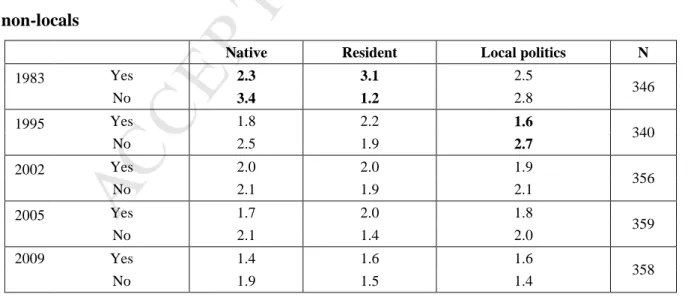
Table 1 displays the global and yearly relative rank average of those who are local and of those who are not. Generally speaking, we observe significant (though not very substantive) differences between locals and non-locals in terms of the average position on the lists. However, there are differences contingent to the type of localness. Those who are native to the district and who have experience in local politics have lower relative ranks (i.e. have less secure positions) than those who do not share those characteristics. On the contrary, candidates resident in the district have better positions on the lists than non-residents. In fact, residents feature on average a relative rank of 2.2 whereas non-residents have 1.6. This pattern is present when the election years are considered separately, although the differences are only rarely significant. Overall, it is a consistent but soft pattern.
Table 1. Candidates’ localness across elections: average of relative rank for locals and non-locals
Native Resident Local politics N
1983 Yes 2.3 3.1 2.5 346 No 3.4 1.2 2.8 1995 Yes 1.8 2.2 1.6 340 No 2.5 1.9 2.7 2002 Yes 2.0 2.0 1.9 356 No 2.1 1.9 2.1 2005 Yes 1.7 2.0 1.8 359 No 2.1 1.4 2.0 2009 Yes 1.4 1.6 1.6 358 No 1.9 1.5 1.4 18
Nemoto and Shugart (2013) establish a variable with the same name, but in their case the candidate’s relative rank corresponds to her/his position on the list divided by the number of seats the party won in that district. This formula cannot be applied to the Portuguese case because when the number of candidates elected by the party is zero (which happens often), the division cannot be executed. Therefore, an alternative way of calculating the relative rank was found.
M
AN
US
CR
IP
T
AC
CE
PT
ED
All years Yes 1.8 2.2 1.8 1759 No 2.4 1.6 2.3Note: numbers in bold indicate significant differences between the average of relative rank of locals and non-locals as a result of a t-test to the difference of means.
Table 2 presents similar data, but for candidates who are heads of lists and for all other candidates. This time the data are shown as percentages. There are considerable fewer locals among heads of list vis-à-vis all other candidates, either generally — native (39% against 57%), resident (57% against 86%), and local politics (35% against 56%) — or when we look at yearly percentages. This suggests that political parties are privileging other criteria (such as party loyalty, political career, and public notoriety) rather than local ties when selecting the heads of lists. Furthermore, we do not find a great variety across elections, although two light evolutionary tendencies might be observed. The first one is that, compared to the 1980s, heads of lists today are less native than they used to be. The second tendency concerns local politics, which increases both for heads of lists and for all other candidates over time, and particularly among the former. This might be related to the consolidation of the Portuguese political system, i.e. it is very likely that in the beginning of the democratic period, few candidates with local political experience were nominated simply because there were fewer potential candidates with that attribute. Finally, place of residence emerges as the most relevant indicator of localness, since its percentage is systematically higher across elections (consistent with the results for relative rank).
Altogether, our data suggest that Portugal features high percentages of candidates with local ties (thus confirming Teixeira, 2009).
Table 2. Candidates’ localness across elections: % of heads of lists and non-heads that are locals
Native Resident Local politics N
1983 Heads of lists 52.9 55.8 23.0
346 All other candidates 58.0 88.1 34.8
1995 Heads of lists 43.2 58.0 33.0
340 All other candidates 56.0 86.5 55.2
2002 Head of list 36.3 55.6 35.8
356 All other candidates 54.3 84.6 64.4
2005 Heads of lists 33.6 55.1 37.3
359 All other candidates 53.8 88.0 67.5
2009 Heads of lists 32.7 58.3 41.8
358 All other candidates 62.8 82.8 56.5
All years
Heads of lists 39.1 56.5 34.7
1759 All other candidates 56.9 86.0 55.5
Note: Percentages were calculated for the total of heads of lists (and of non-heads) within each year. For example, in 1983, 52.9% of the heads of lists were born in the district in which they ran. Numbers in bold
M
AN
US
CR
IP
T
AC
CE
PT
ED
indicate significant differences between the percentages of heads of lists and non-heads as a result of a chi-square test.
Shifting to the district characteristics in which locals and non-locals run, Table 3 presents average district magnitudes by type of localness and year. The results highlight two things. First, being resident is the only type of localness for which we find systematic and significant differences in terms of the average district magnitude, with resident candidates running in larger circles (22 seats) than non-residents (14 seats). The same pattern can be observed for every election year included on the table. Second, the remaining two indicators of localness have no apparent and significant relationship to district magnitude (the partial exception is local politics in 2005).
Table 3. Candidates’ localness across elections: average of district magnitude for locals and non-locals
Native Resident Local politics N
1983 Yes 20.1 25.0 19.9 346 No 25.2 10.5 23.0 1995 Yes 19.1 22.2 19.6 340 No 22.2 14.0 21.5 2002 Yes 20.4 21.5 19.6 356 No 19.6 14.3 19.7 2005 Yes 19.5 21.2 21.1 359 No 19.3 13.3 17.2 2009 Yes 20.7 21.0 18.9 358 No 19.4 16.1 20.4 All years Yes 20.0 22.2 19.8 1759 No 21.0 13.8 20.6
Note: numbers in bold indicate significant differences between the average of relative rank of locals and non-locals as a result of a t-test to the difference of means.
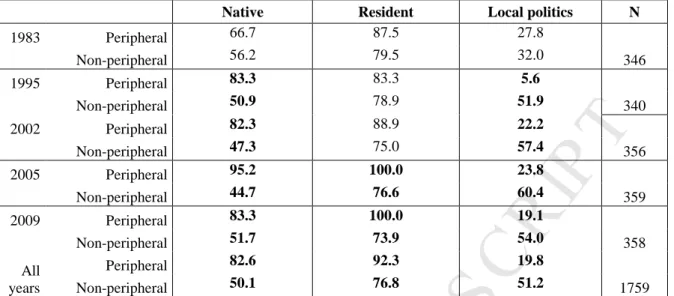
Table 4 displays the percentage of locals among the candidates who ran in peripheral districts compared to those who ran in non-peripheral ones. Here again we conclude that localness is not homogeneous. We find significantly higher percentages of natives (82.6%) and residents (92.3%) in parties’ lists of peripheral regions than in peripheral regions. However, we find the opposite result with regards to local politics: non-peripheral regions feature more candidates with experience in local politics than non-peripheral ones.
M
AN
US
CR
IP
T
AC
CE
PT
ED
Table 4. Candidates’ localness across elections: % of candidates of peripheral and non-peripheral regions that are locals
Native Resident Local politics N
1983 Peripheral 66.7 87.5 27.8 346 Non-peripheral 56.2 79.5 32.0 1995 Peripheral 83.3 83.3 5.6 340 Non-peripheral 50.9 78.9 51.9 2002 Peripheral 82.3 88.9 22.2 356 Non-peripheral 47.3 75.0 57.4 2005 Peripheral 95.2 100.0 23.8 359 Non-peripheral 44.7 76.6 60.4 2009 Peripheral 83.3 100.0 19.1 358 Non-peripheral 51.7 73.9 54.0 All years Peripheral 82.6 92.3 19.8 1759 Non-peripheral 50.1 76.8 51.2
Note: Percentages were calculated for the total of candidates in our data set who ran in peripheral districts (and in non-peripheral districts) within each year. For example, in 1983, 66.7% of candidates who ran in peripheral districts were born in that district. Numbers in bold indicate significant differences between the percentages of locals between peripheral and non-peripheral regions as a result of a chi-square test.
Besides the four main independent variables, we have employed several controls, which provide fairly robust models. First, we estimated models for each type of localness in which we controlled for the effect of other types of localness. So for instance, if being native is the DV, then we control for whether the candidate is resident and has experience in local politics in the district where she/he is running for election. Second, some socio-economic variables were also included, namely year of birth (discrete numerical), being a women (dummy variable 1 = woman), and level of education (a categorical variable with 5 categories). Of utmost importance is the inclusion of the variable “incumbent” (dummy variable 1 = incumbent19), which accounts for the higher probability that incumbent candidates have of being nominated to higher positions on lists (Schwindt-Bayer, 2005).
Finally, a last control variable was added for major parties (dummy variable 1 = major party) because the political strength of a party is likely to play a crucial role on the allocation of candidates to the lists (Nemoto and Shugart, 2013: 4). In particular, while heads of lists of major parties have guaranteed places as MPs in almost all districts, the same is far from true concerning secondary parties, which have small chances in low magnitude districts.
19 A candidate was considered incumbent when she/he was serving as a member of parliament when the
M
AN
US
CR
IP
T
AC
CE
PT
ED
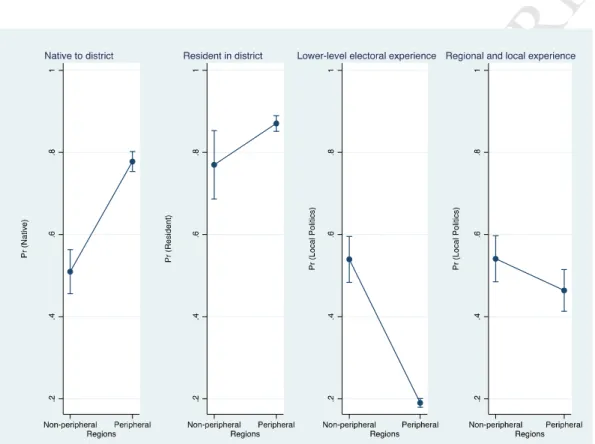
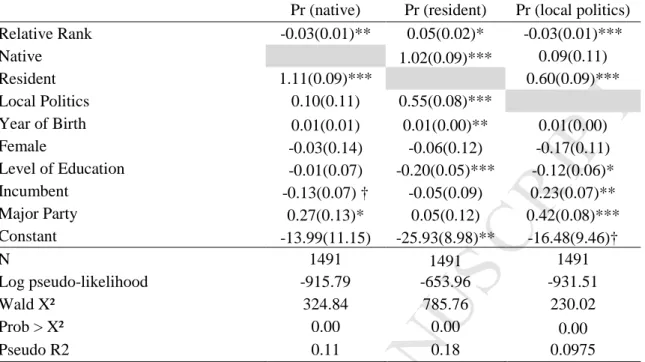
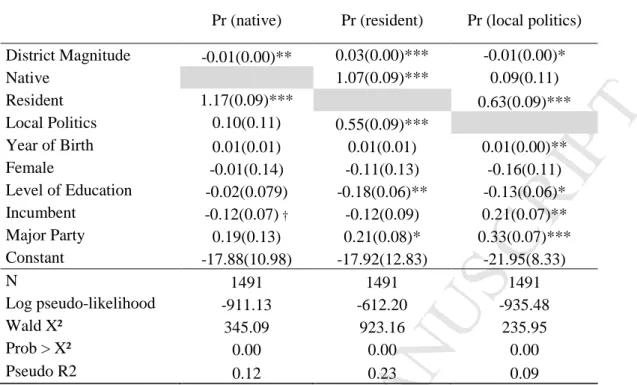
5. Main analysisAs mentioned before, following Shugart, Valdini, and Suominen (2005), we use the probability that a candidate has local ties as our dependent variable, which originates three dependent variables: the probability (Pr) that a candidate is native to the district - Pr (native), the probability that a candidate lives in a district - Pr (resident), and the probability that a candidate has lower-level political experience in a district - Pr (local politics). Having this as a baseline, four models were estimated: one including the variable that identifies the relative position occupied by the candidate on the list, relative rank (Model 1); another indicating whether or not the candidate is a head of list (Model 2); a third one having district magnitude as the main independent variable (Model 3); and a final one where the most relevant factor is whether or not the region is peripheral (Model 4). We estimate our models using probabilistic regression (probit), with fixed effects for election years and with errors clustered at the district level, due to the multilevel nature of the data. Tables A1, A2, A3, A4 in the Appendix present the results for the four models, respectively.
Looking at the overall health of each model (namely at the Pseudo R2), we conclude that our models succeed more at predicting the probability of finding district residents than at predicting the probability of having a native candidate or a candidate with local political experience. The models confirm that localness is not a homogenous concept leading to mixed results for all hypotheses. We now proceed to show the most relevant predicted probabilities20 in order to get a clearer idea of the results we get for the most important independent variable in each model. When reporting the results, we consider that the probability of finding locals is significantly affected by a given independent variable when the confidence intervals associated with the predicted probabilities (for each value of the independent variable) do not overlap.
M
AN
US
CR
IP
T
AC
CE
PT
ED
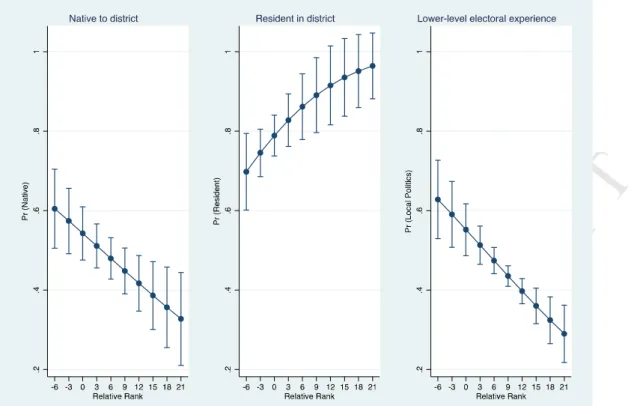
Figure 1 - Predicted probabilities of being local (native, resident, and local politics) depending on the candidates’ relative rank (Model 1).
Note: The values in axis x correspond to the original distribution of the variable in the data set.
According to our first hypothesis (H1a), the more secure the position on the list, the lower the probability of finding locals. Looking at Figure 1, we observe mixed results. On the one hand, we confirm that being native and having experience in local politics matter little when party leaders are selecting candidates to good positions on lists, in line with Carey and Shugart (1995). The result concerning local politics comes as a surprise since it contradicts the common perception in Portugal that local political experience is relevant in parliamentarians’ careers (Freire, 2002). According to our data, that experience does not assure candidates a higher chance of getting into parliament. On the other hand, being a resident seems to be a valuable asset. In the third section “Portuguese Context”, we mentioned that Teixeira (2009) concluded that locals are more common in eligible than in non-eligible positions. The fact that this author aggregated being native and living in a district in a single variable might have led her results to be driven by residency. In fact, when both indicators of localness are kept separate (Figure 1), they portray contradictory results: while residency is an added value, being native is quite irrelevant.
M
AN
US
CR
IP
T
AC
CE
PT
ED
Figure 2 - Predicted probabilities of being local (native, resident, and local politics) for heads of lists and for all other candidates (Model 2).
Notes: The values selected for the x-axis correspond to the current distribution of the number of MPs by district in Portugal.
According to hypothesis H1b, the lowest probability of finding locals is reached when heads of lists are considered, since they occupy the most secure positions of all. The results presented in Figure 2 give partial support to this hypothesis21. The probability of having a local occupying the first position on a list is usually lower than the probability of finding locals among all other candidates for two kinds of local ties, namely residency and having local political experience. However, the latter result is not significant and being native is not a differentiating criterion separating heads of lists from all other candidates. We argue that the opposing results we get for being native and resident when secure positions or heads of lists are considered are related to the way the political recruitment takes place in Portugal. This issue is given full attention below when we discuss Table 5.
21 To control the robustness of our findings, we estimated Model 1 and 2 again (i.e. H1a and H1b), having
relative rank and head of list as dependent variables and all local variables as independent variables plus controls. Our findings hold overall. The only difference is that residency is not significant in the first model of the alternative model. The reason why we opt to present our models with locals as a dependent variable is to allow greater comparison with the findings of Shugart, Valdini, and Suominen (2005).
M
AN
US
CR
IP
T
AC
CE
PT
ED
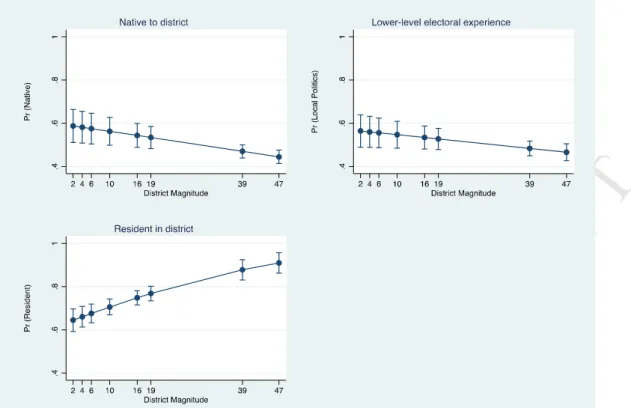
Figure 3 - Predicted probabilities of being local (native, resident, and local politics) depending on the district magnitude (Model 3).
Figure 3 presents predicted probabilities for each of the dependent variables according to district magnitude, whose effects we test under H2. Our expectation for this hypothesis is that the higher the district magnitude, the lower the probability of finding locals. Looking at the figure, it becomes clear that the district’s dimension is not a very differentiating criterion for finding locals, and once again we get mixed results. Although the curves for being born in a district and having experience in local politics run in the expected direction – as in Shugart, Valdini, and Suominen’s cross-national analysis (2005) – in our data, the differences between low and high district magnitude are not as striking, particularly for local politics22. This lies in the fact that, in Portugal, the first names on each list are often chosen by the national party leaders (Freire and Teixeira, 2011). Whereas this leaves room for district party branches to have a say in who receives many eligible positions in high magnitude districts, in much smaller magnitude districts (say 2, 3, or 4 positions) all or almost all eligible places are centrally chosen. Since party leaders tend to select non-locals, this contributes to decreased differences between district magnitudes.
22 Looking at Figure 3 we realize that the difference in the probability of being native is only significant when
M
AN
US
CR
IP
T
AC
CE
PT
ED
Furthermore, residency behaves conversely, i.e. the probability of finding residents increases as the district magnitude grows, in line with Teixeira (2009). This might happen simply because the higher magnitude districts correspond to the two biggest cities (Greater Lisbon and Porto) where more potential candidates live. That is very likely the case since, according to our data, those are clearly the cities where the highest percentages of candidates live, with 33% and 13% respectively.
Figure 4 - Predicted probabilities of being local (native, resident, and local politics) for peripheral and other regions (Model 4).
The expectation that parties nominate more locals for peripheral regions than for non-peripheral ones (H3) is confirmed for Pr (native) and Pr (resident), although only the former has significant differences in predicted probabilities (see Figure 4). The probability of being native — and to a certain extent resident — is higher in peripheral regions. However, when we look at Pr (local politics) we realize that it is actually higher in non-peripheral regions. This implies that being local in a peripheral region mainly means being native, partly means living there, but not at all means having served in local politics. Since Azores and Madeira have the status of autonomous regions, they also have their own political organs, namely regional parliaments and governments, which are elected in specific elections. Hence, it could
M
AN
US
CR
IP
T
AC
CE
PT
ED
be the case that the candidates of these districts to National Parliament did not have lower-level electoral experience, but did have regional-lower-level electoral experience. In order to test for that possibility, we added information on whether each candidate was ever elected to the Legislative Assembly of the Autonomous Region or nominated to the regional government to the variable local politics (dummy variable 1 = ever elected/nominated). The results are shown in the last graph of Figure 4 and in the fourth column of Table A4. Indeed, when both regional and local political experiences are considered, the difference between non-peripheral and peripheral regions substantially decreases and stops being significant.
Table 5. Overview of the main results by type of localness
Native Resident Local politics
H1a: fewer locals in secure positions Yes
No Yes
H1b: fewer locals among heads of lists No Yes Yes
H2: fewer locals as district magnitude increases
Yes No† Yes
H3: more locals in peripheral regions Yes Yes No
Note: “Yes” identifies that the predicted probability for a given indicator of localness follows the hypothesis (“No” otherwise). Bold is used to signal significant predicted probabilities.
† This result is probably due to the fact that the higher magnitude districts correspond to the two biggest cities and these are the cities in which the highest percentages of candidates live.
As summarized in Table 5, the results vary substantially depending on how localness is measured, and none of our indicators of localness confirms all hypotheses. Being resident is the measure of localness that challenges more hypotheses, whereas being native and having local political experience fit our expectations better. Furthermore, since the latter two help sustain the more classical hypotheses (H1a and H2), they seem to better correspond to the established knowledge on the localness of candidates to National Parliaments which has been very much informed by Carey and Shugart (1995). In other words, residency’s inclusion as an indicator of localness covers a dimension of candidates’ localness that has been overlooked by the literature.
Our data show that there are different ways of being local, reinforcing the idea that each indicator of localness passes on a diverse message to voters and is used differently by the parties. Plus, not all gatekeepers perceive localness equally, even within the same party. More precisely, our data suggest that, whereas national party leaders prioritize native candidates, district leaders prefer residents, as explained below.
M
AN
US
CR
IP
T
AC
CE
PT
ED
As mentioned before, political recruitment in Portugal is a fairly centralized process (Freire and Teixeira, 2011) and national party leaders can nominate candidates to top positions of lists, including the first position. As shown by our data, they often tend to choose candidates who have no relationship to the district (confirming H1b), i.e. heads of lists are usually not local politicians and they do not live in the districts where they run. In fact, according to our data, 39% of them live in Lisbon. National leaders tendentiously choose non-locals as heads of lists because they prefer to nominate people who have strong public visibility for occupying the most secure positions (AUTHORS’ reference). Within the pool of candidates that have the most prestigious political roles (i.e. party leadership and ministerial positions) 65% occupy the first position on the list (as opposed to 35% who are placed somewhere else on the list). Comprehensibly, candidates with those characteristics are usually not locals. However, since constituents are aware of who the heads of lists in their district are and the media often mentions the fact that some are “paratroopers”23, native heads of lists are strategically chosen by national leaders whenever possible. In other words, from the pool of candidates that have the ideal characteristics for being heads of lists, preference is given to natives. This preference for natives (instead of residents) is probably due to the fact that residents have fewer chances to belong to the intimate circle of national party leaders. This explains the fact that H1b is sustained for residency and not for being native.
Whereas heads of lists are nominated by the national leaders alone, secure positions are nominated both by national leaders and district party leaders, which has implications in these candidates’ localness. Since H1a is confirmed for being native and having lower-level experience but not for being resident, we argue that district party leaders prefer to choose residents. Many reasons might be behind this preference. Resident candidates supposedly know their districts and the people they are about to represent, have proven to be loyal to the party district, and their nominations are easy to justify to constituents. Plus, a resident candidate has possibly acquired “local capital” through the time she/he has spent in the district either studying or working and therefore her/his nomination might increase the odds of the party getting a good electoral result. Though this might be also true for candidates with local political experience, our data suggest that the pool of potential candidates to National Parliament is greater than the group of local politicians, implying that only a few local politicians are nominated for secure positions to National Parliament.
The latter sentence applies particularly well to peripheral regions, as illustrated by the negative result we get for local political experience in our final hypothesis (H3). In fact,
M
AN
US
CR
IP
T
AC
CE
PT
ED
parties do not seem to value candidates’ local political experience in these districts as much as expected. Otherwise, what seems to count more for candidates’ recruitment – although it does not count very much – is their career at the regional level (parliament and government).
A last note on the second hypothesis (H2): we have intentionally left it out of this summary, since the only outlier result (residency) for this hypothesis (as previously argued) is due to the circumstantial reason that the higher magnitude districts correspond to the two biggest cities where more candidates live.
6. Conclusions
Focusing on Portugal’s CLPR system and on parties’ strategies for selecting locals, this article has examined two main questions: 1) where on lists are locals mainly positioned? And 2) does the probability of finding locals vary significantly across two key district characteristics? The first question aims to understand whether localness matters in CLPR systems and our argument is that if it does, then we would see more locals in the most important positions on the lists, namely secure positions and heads of lists. Even if Portugal has quite a high percentage of locals among candidates overall, our results point to a negative answer to the question, corroborating the conventional wisdom in the literature that PVEAs such as localness are not very valuable in CLPR systems (Carey and Shugart, 1995). The fact that localness is lower among the higher positions on the candidates’ lists and among heads of lists demonstrates that candidates’ local ties are not valuable assets for Portuguese political parties. The only clear exception to this tendency is that resident candidates are easier to find as we go up the positions on the lists. We will come back to this exception below.
In the second question, we examined the probability of finding locals by district characteristics. The analysis developed here suggests that district magnitude has a rather minor role in explaining locals’ presence within party lists. The only exceptions are native candidates, who have lower expected chances of being selected as district magnitude increases. Otherwise, having experience in local politics is irrelevant and being resident works in the opposite direction, i.e. we find more resident candidates at higher district magnitudes. Our results show a less clear picture of the effect of district magnitude on candidates’ localness in CLPR systems than previous studies have shown (Shugart, Valdini, and Suominen 2005). We believe that some intraparty variables – in particular characteristics of the recruitment process – intervene here, corroborating the idea that party organization plays a role in explaining candidate selection (Hazan and Rahat, 2010). As mentioned before, due to
M
AN
US
CR
IP
T
AC
CE
PT
ED
the high level of centralization of the political recruitment process in most Portuguese parties, a considerable number of the eligible positions (including the heads of lists) are chosen by national party leaders. Furthermore, in districts with low magnitudes, all or almost all eligible places are centrally chosen, whereas in districts with higher magnitudes, the recruitment is shared by national and district leaders. Hence, since national party leaders probably choose fewer locals than local gatekeepers, the district magnitude might in fact have the opposite effect in a country like Portugal. So, our results suggest that Carey and Shugart’s established conclusions probably apply better to parties where the recruitment process is not too centralized.
Still concerning the second question, the specificity of peripheral regions explains the significantly higher number of native candidates in those regions, reversing the results stated before for being native and district magnitude. However, the centrality of the recruitment process is strong enough to avoid the same effect taking place for the other two indicators of localness.
Altogether, our results demonstrate that localness is not homogenous and that while some indicators of localness support the well-established findings in the literature on this matter (in particular being native, but also having local political experience), others (namely being resident) challenge them. We have previously mentioned the probable implications for voters of being native and having local political experience, namely, that the candidates are aware of the constituency’s problems (native) and that they can solve them (local politics) (Shugart, Valdini, and Suominen 2005: 441). However, our results indicate that – from the point of view of the parties, at least within parties with centralized recruitment processes, there are other meanings attached to local ties. In fact, being resident emerges as the most valued local characteristic by district party leaders, whereas being native is not considered to be that relevant. This might mean that resident candidates (and not necessarily native candidates) are more aware of the constituency problems and have been able to collect “local capital” through the course of their professional careers and experiences within the party. Resident candidates will be rewarded because they are physically present (known and trustworthy) and therefore can contribute to the party’s electoral success. Concerning national leaders, being native is the most appreciated indicator of localness because it allows them to nominate someone from their intimate circle while assuring a link to the district, i.e. of the three indicators of localness, it has fewer costs. Having experience in local politics seems to be the characteristic least valued by all gatekeepers. It is possible that the finding that MPs with local-level political experience are more likely vote against the party line in parliament
M
AN
US
CR
IP
T
AC
CE
PT
ED
(Tavits, 2009) is a playing a role here, but further research on Portugal is necessary to confirm this hypothesis.
The heterogeneity of localness leads us to recommend that future scholarship in this area keep each indicator separately. Aggregating them might cover up the real effect of one of the indicators and originate puzzling results such as the ones reported before by Teixeira (2009).
It is well known that in CLPR, candidates’ localness is of limited importance, as voters are forced to vote for a whole list with a pre-determined order. Portugal features an extreme example of CLPR because most parties perform a centralized recruitment process and because, according to the Portuguese Constitution, MPs represent all national citizens and not a specific constituency. It is therefore striking — as has been demonstrated for other different though equally extreme cases of CLPR, Israel and the Netherlands (Latner and MacGann, 2005) — that Portugal has quite a high percentage of locals among candidates, and that although being local is not very important for succeeding into parliament, it might be an asset in some situations.
References
André, A., Depauw, D., 2014. District magnitude and the personal vote. Electoral Studies 35, 102-114.
Blais, A., Gidengil, E., Dobrzinska, A., Nevitte, N., Nadeau, R., 2003. Does the Local Candidate Matter? Candidate Effects in the Canadian Election of 2000. Canadian Journal of Political Science 36, 657–64.
Carey, J., Shugart, M., 1995. Incentives to Cultivate a Personal Vote: a Rank Ordering of Electoral Formulas. Electoral Studies 14 (4), 417-39.
Chen, E., Simonovits, G., Krosnick, J.A., Pasek, J., 2014. The impact of candidate name order on election outcomes in North Dakota. Electoral Studies 35,115-122.
Cruz, M. B., 1988. Sobre o Parlamento português: partidarização parlamentar e parlamentarização partidária. Análise Social XXIV (1), 97-125.
Freire, A., 1998. Lógicas de recrutamento parlamentar. Os deputados portugueses, 1975-1999. Sociologia, Problemas e Práticas 28, 115-147.
Freire, A., 2001. Recrutamento Parlamentar: os deputados portugueses da Constituinte à VIII Legislatura, Lisboa, STAPE/MAI, 45-83.
Freire, A., 2002. A profissionalização política dos deputados portugueses. Sociologia 12, 27-56.
Freire, A., 2012. European Integration and Party Attachments: The Portuguese Case as an Example for New Democracies. In: Teixeira, N.S., Pinto, A.C. (Eds.), The Europeanization of Portuguese Democracy. Boulder, Columbia University Press, New York, 183-224.
M
AN
US
CR
IP
T
AC
CE
PT
ED
Freire, A, Matos, T., Sousa, V.A., 2001. Recrutamento parlamentar: Os deputados portugueses da constituinte à VIII legislatura. STAPE/MAI, Lisboa.
Freire, A., Pinto, A.C., 2003. Elites, Sociedade e Mudança Política. Celta, Oeiras.
Freire, A., Viegas, J.M.L., Seiceira, F., 2009. Representação política em Portugal: Inquéritos e bases de dados. Lisboa, Sextante.
Freire, A., Teixeira, C.P., 2011. Choosing before Choosing: The Selection of Parliamentary Candidates. Revista de Ciências Sociais e Políticas 2 (September), 13-29.
Galasso, V., Nannicini, T., 2011. Competing on Good Politicians. American Political Science Review 105 (1), 79-99.
Hazan, R., Rahat, G., 2010. Democracy Within Parties: Candidate Selection Methods and Their Political Consequences. Oxford University Press, Oxford.
Jalali, C., 2003. A investigação do comportamento eleitoral em Portugal: história e perspectivas futuras. Análise Social XXXVIII (167), 545-572.
Latner, M., MacGann, A., 2005. Geographical representation under proportional representation: The cases of Israel and the Netherlands. Electoral Studies 24(4), 709-734. Leston-Bandeira, C., 2004. From Legislation to Legitimation: The role of the Portuguese Parliament. London and New York, Routledge.
Lisi, M., Santana-Pereira, J. 2014. Campaign Individualisation before and after the Bailout: A Comparison between Greece and Portugal. South European Society and Politics 19(4), 541-559.
Lobo, M.C., 2006. Short-term voting determinants in a young democracy: Leader effects in Portugal in the 2002 legislative elections, Electoral Studies 25(2), 270-286.
Marsh, M., 1987. Electoral Evaluations of Candidates in Irish General Elections 1948–82. Irish Political Studies 2, 65–76.
Morgenstern, S., Swindle, S., 2005. Are Politics Local?: An Analysis of Voting Patterns in 23 Democracies. Comparative Political Studies 38 (2), 143-170.
Nemoto, K., Shugart, M., 2013. Localism and coordination under three different electoral systems: The national district of the Japanese House of Councillors. Electoral Studies 32 (1), 1-12.
Schwindt-Bayer, L., 2005. The incumbency disadvantage and women's election to legislative office. Electoral Studies, 24 (2), 227-244.
Shugart, M., Valdini, M., Suominen, K., 2005. Looking for Locals: Voter Information Demands and Personal Vote-Earning Attributes of Legislators under Proportional Representation. American Journal of Political Science 49 (2), 437-449.
Tavits, M., 2009. The making of mavericks: Local loyalties and party defection. Comparative Political Studies 42, 793-815.
Tavits, M., 2010. Effect of local ties on electoral success and parliamentary behaviour: The case of Estonia. Party Politics 16 (2), 215-235.
Teixeira, C.P., 2009. O Povo Semi-Soberano. Partidos e Recrutamento em Portugal. Almedina, Coimbra.