
Composition, temporal and spatial patterns of very-nearshore larval fish assemblages at the Arrábida marine park
359
0
0
Texto
(2)
(3) UNIVERSIDADE DO ALGARVE FACULDADE DE CIÊNCIAS DO MAR E DO AMBIENTE. COMPOSITION, TEMPORAL AND SPATIAL PATTERNS OF VERYNEARSHORE LARVAL FISH ASSEMBLAGES AT THE ARRÁBIDA MARINE PARK (Tese para a obtenção do grau de doutor no ramo de Ciências do Mar, especialidade de Ecologia Marinha). RITA ALEXANDRA DUARTE BORGES. Orientador: Doutor Emanuel João Flores Gonçalves (I.S.P.A.). Co-orientadores: Doutora Maria Alexandra Anica Teodósio Chícharo (UAlg) Doutor Pedro Miguel Alfaia Barcia Ré (F.C.U.L.).. Constituição do Júri: Presidente: Reitor da Universidade do Algarve Vogais: Doutora Maria Pilar Olivar Buera Doutor Pedro Miguel Alfaia Barcia Ré Doutor Emanuel João Flores Gonçalves Doutor Karim Erzini Doutor Luís Manuel Zambujal Chícharo Doutora Maria Alexandra Anica Teodósio Chícharo Doutor Henrique Manuel Roque Nogueira Cabral. FARO (2006).
(4)
(5) Este trabalho foi apoiado pela Fundação para a Ciência e a Tecnologia (F.C.T.), através da bolsa de doutoramento SFRH/ BD/4852/2001, financiada pelo POCI 2010 e pelo Fundo Social Europeu..
(6)
(7) Ao Miguel Ao Pedro.
(8)
(9) AGRADECIMENTOS. Este trabalho resulta da colaboração entre diversas pessoas e instituições, sem as quais não teriam sido possíveis as várias fases que o constituiram, desde o trabalho de campo, passando pelo laboratório, tratamento de resultados e escrita da presente dissertação. Assim, esperando não omitir nenhum agradecimento merecido, gostaria de expressar a minha gratidão a todos aqueles que me ajudaram a chegar a esta etapa. Ao Prof. Doutor e amigo Emanuel Gonçalves (Instituto Superior de Psicologia Aplicada) que me desafiou a entrar no “maravilhoso mundo das larvas”, queria expressar um agradecimento muito especial. É um previlégio poder trabalhar com alguém que tem a capacidade de saber “pensar ciência” de uma forma tão clarividente. Poucos seriam capazes de se ter aventurado neste trabalho, que não produz resultados publicáveis de imediato, com a pouca experiência em larvas e com os limitados recursos humanos e materiais de que dispunhamos no início. Foram o seu empenho e amizade que me motivaram a começar e a continuar, quando me parecia que nunca seria possível obter resultados dadas as dificuldades nas identificações de tantas larvas minúsculas e danificadas. Soube pacientemente esperar e acreditar nos resultados que levaram algum tempo a ganhar corpo. A sua paixão pelo mar, pela Arrábida e pelos peixes que a povoam, tem-no motivado a abraçar a protecção da fauna marinha da Arrábida, numa altura em que as ameaças crescentes ao equilíbrio das populações poderiam facilmente desmotivar a vontade de conhecer para proteger. Os peixes da Arrábida não podiam estar melhor entregues. À Prof. Doutora M. Alexandra Chícharo (Universidade do Algarve), por todo o apoio prestado desde a minha “aterragem” na Universidade do Algarve com o trabalho numa fase já avançada e a precisar de uma lupa e de um pouco de bancada. Desde então, aceitou ser co-orientadora deste trabalho e sempre se esforçou para me proporcionar as condições adequadas à sua continuação. Acompanhou a progressão dos trabalhos com amizade e interesse constantes. Ao Prof. Doutor Pedro Ré (Faculdade de Ciências da Universidade de Lisboa), coorientador deste trabalho, por ter acompanhado o meu percurso científico desde o estágio de licenciatura no Laboratório Marítimo da Guia. Por me ter ensinado a trabalhar no campo, a fazer arrastos de plâncton em águas menos calmas do que as da Arrábida. Foi o seu entusiasmo pelo ictioplâncton que me despertou interesse por “uns certos” ovos de sardinha, que me levaram a conhecer a fantástica diversidade de pequenos organismos que povoam o mar. Facilitou em muito a tarefa de reunir informação de suporte às identificações e de esclarecimento de algumas das dúvidas que foram surgindo. Ao Prof. Doutor Luís Chícharo (Universidade do Algarve) por ter permitido a minha integração no grupo de investigação do qual também é coordenador e por ter facilitado as condições necessárias à minha investigação. Ao Doutor Radhouan Ben-Amadou (Universidade do Algarve) pela ajuda preciosa no tratamento dos dados. Pela amizade e esforço que permitiram extrair “o sumo” de tanta informação, choukran! Ao Prof. Doutor Frederico Pereira (Director do Instituto Superior de Psicologia Aplicada) por permitir que um “ninho” de biólogos possa fazer investigação, num instituto de Psicologia..
(10) Ao Prof. Doutor Vítor Almada (Instituto Superior de Psicologia Aplicada) devo um agradecimento pelo seu esforço para criar a Unidade de Investigação em Eco-Etologia do ISPA. As suas excepcionais qualidades científicas estão na base do rápido crescimento que esta unidade teve em tão pouco tempo. Foi-me possível acompanhar parte deste crescimento, desde o tempo em que fazia observações de tilápias no “submarino” e pelos corredores do ISPA. Agradeço ainda a colaboração nos trabalhos de desenvolvimento das larvas e na análise genética de larvas. Ao Ricardo Beldade agradeço todos estes anos de equipa. Desde as nossas saídas de campo na Arrábida, com tortas de Azeitão, barcos empanados, ondas fortes às 10 milhas de costa, sol, golfinhos e até...baleias!!!, “que coisa linda!!”. Todos estes momentos tornaram o trabalho de campo inesquecível. Por partilhar comigo a beleza das escarpas da Arrábida, únicas em cada saída. E por conduzir a scooter, que nos permitiu apanhar as larvas maiores e enriquecer este trabalho. Ao Jorge, por me ter acompanhado em tantas saídas de campo, desde o meu estágio até este trabalho. Pela boa disposição que tornou mais leve o trabalho “de braços”. Ao Miguel Barbosa, pelo acompanhamento nas saídas de campo e pelo árduo trabalho que desempenhou nas triagens. Ao Nagib Sousa, pelo apoio prestado no campo. Ao Miguel Henriques, agradeço o seu bom humor com que sempre acompanhou e apoiou o trabalho na Arrábida e por ter facilitado e disponibilizado condições de apoio no Museu Oceanográfico da Arrábida. Agradeço ainda as larvas disponibilizadas e todos os dados e informações fornecidas. Ao Parque Natural da Arrábida (Instituto de Conservação da Natureza) por ter facilitado todo o trabalho de campo, quer pelo apoio no Museu Oceanográfico da Arrábida, quer por ter disponibilizado, quando necessários, a embracação e o técnico de apoio às saídas. Passando do trabalho de campo para o laboratório, gostaria em primeiro lugar de agradecer a todos aqueles que ajudaram nos trabalhos de desenvolvimento de larvas: À Cláudia Faria agradeço toda a amizade. A sua excepcional capacidade de trabalho fez com que fossem possíveis os vários trabalhos de desenvolvimento de larvas em laboratório. A partilha das idas ao Aquária Vasco da Gama, tornou mais suportável o trabalho aos fins de semana. Por todas as sugestões e informações que sempre disponibilizou. À Dra. Fátima Gil (Aquário Vasco da Gama) agradeço o apoio constante no desenvolvimento das larvas. A manutenção dos aquários com as condições necessárias não teria sido possível sem a sua dedicação. Agradeço ainda aos técnicos do Aquário Vasco da Gama José Pedro Macedo, Manuel Mântua, Miguel Cadete, Pedro Gomes, Paula Sousa e Madalena Correiao apoio na alimentação das larvas e manutenção dos aquários. À Sofia Henriques agradeço o esforço para tentar desenvolver larvas de G. xanthocephalus. O seu invulgar entusiasmo contribuirá certamente para que seja uma “bióloga científica” de sucesso. Ao Aquário Vasco da Gama e ao IPIMAR agradeço as condições disponibilizadas para o cultivo de larvas. Agradeço ao João Quintela e em particular ao João Sendão por toda a ajuda na tentativa de criar larvas em laboratório na Universidade do Algarve..
(11) Ao CCMAR por ter disponibilizado espaço no edifício do Prodep para a montagem dos aquários. Ao grupo de alunos que voluntariamente me ajudaram na tentativa de desenvolver larvas na Universidade do Algarve, devo um agradecimento especial, pela sua capacidade de organização e por terem sacrificado dias de férias. Não foi por falta de esforço que o insucesso foi grande. Gostaria de expressar uma enorme gratidão à Vera Carvalho, Samanta Vizinho e Ana Catarino, por terem executado a difícil tarefa de triar larvas. O trabalho de triagem foi fundamental para o sucesso das fases seguintes. À Ana Faria quero expressar um agradecimento muito especial. Por ter facilmente aprendido a difícil tarefa de identificar larvas, a sua ajuda foi fundamental para completar os dados que constituem este trabalho. Agradeço-lhe toda a amizade e todo o apoio, que me permitiram concluir este trabalho em tempo útil. Estou certa que a Ana terá um contributo relevante na continuação desta “história”. À Joana Monteiro agradeço todo o trabalho que teve na descrição do desenvolvimento dos G. xanthocephalus, apenas possível devido à sua paciência e minuciosa capacidade de observação. Agradeço-lhe também todo o apoio com que pude contar, na fase de escrita. À Joana Robalo, pelo apoio na análise genética das larvas. A todos os amigos da Unidade de Investigação em Eco-Etologia (para além daqueles que já referi), agradeço a boa disposição que facilitou o sempre bom ambiente de trabalho no ISPA: Tânia Oliveira, Clara Amorim, David Gonçalves, Albert Ross, Teresa Fagundes, Joana Jordão, Joana Martins e Vera Domingues. Ao Rui Oliveira, com quem tive o prazer de trabalhar, pelo entusiasmo com que faz e entusiasma os outros a fazer ciência. Ao Manuel Eduardo agradeço a boa disposição e a paciência por ter “aturado” as nossas reniões de grupo. Ao Luís Carneiro, que iria certamente gostar de ler esta tese, agradeço a grande amizade e boa disposição que me faziam rir quando desesperava à lupa. Ainda hoje as suas gargalhadas parecem ecoar pelo ISPA. Quero também agradecer a todos os meus amigos da Universidade do Algarve, que ajudaram a alegrar o laboratório onde parte deste trabalho decorreu: ao Pedro Morais, por toda a amizade, apoio, comentários, sugestões e paciência para aturar a “mãe Rita”; ao “vizinho” Norton agradeço a companhia e bom sentido de humor; à Ana Amaral e à Xana por toda a amizade e apoio. À Sílvia Condinho, Isabel, Ana Rita e Marta por terem ajudado a alegrar o laboratório. A todos aqueles que ilustraram os trabalhos de desenvolvimento larvar, devo um agradecimento especial. Por terem sabido expressar nas ilustrações o que é fundamental para que estes trabalhos possam ser compreendidos e úteis a quem identifica larvas. Agradeço pois à minha amiga Rita Lourenço, ao Pedro Segurado, à Maria Dornelas e à Lara Nunes. À Prof. Doutora Isabel Âmbar e ao Prof. Doutor José Teixeira da Silva, agradeço toda a colaboração e informação disponibilizada sobre os factores oceanográficos que podem actuar na Arrábida. Devo ainda um agradecimento à Prof. Doutora Teresa Moita pelas informaçãoes prestadas..
(12) À Doutora Isabel Meneses agradeço a bibliografia disponibilizada sobre os trabalhos de ictioplâncton efectuados pelo IPIMAR I would like to thank Dr. Pilar Olivar, Francesc Llodrà, Erwan Roussel, Patricia Ximénes Rosenberg, Jhoni Ismael Becerra and Steve Simpson by discussing some ideas on larval identification and/or by bibliographic support. À Paula Caboz agradeço todo o apoio prestado. À Elsa, amiga do peito, agredeço a força constante. É bom ouvir a voz de uma boa amiga quando o cansaço nos baralha por vezes as ideias. Agradeço ainda o seu esforço pessoal das últimas semanas, sem o qual esta tese teria ficado mais pobre. Ao Diogo agradeço a paciência que teve em esperar que o “livro” terminasse. Agora que este volume está terminado, o Diogo já pode contar com a brincadeira prometida e com uns pais mais descansados. À Cidália agradeço todo o “pão quente” e apoio prestados durante a fase da escrita da tese. Aos meus pais, agradeço o amor com que sempre me apoiaram, em todas as etapas da minha vida; sem eles certamente não teria conseguido chegar até aqui. Ao Miguel e ao Pedro quero antes de mais pedir desculpa pela minha falta de paciência e de atenção que tanto mereciam e de que precisavam nos últimos tempos. Foram as pessoas que mais sofreram com este trabalho, dada minha “alienação”. Agora acabou, a mãe está de volta! Finalmente agradeço ao Guilherme todo o amor e paciência, por ter sido pai e mãe nos últimos tempos. Sem ele, nunca teria conseguido..
(13) NOME: RITA ALEXANDRA DUARTE BORGES FACULDADE DE CIÊNCIAS DO MAR E DO AMBIENTE ORIENTADOR: Prof. Doutor Emanuel João Flores Gonçalves CO-ORIENTADORES: Prof. Doutora Maria Alexandra Chícharo; Prof. Doutor Pedro Ré DATA: 22 de Maio 2006. COMPOSIÇÃO E PADRÕES TEMPORAIS E ESPACIAIS DE VARIAÇÃO DAS ASSEMBLEIAS DE LARVAS DE PEIXES QUE OCORREM JUNTO À COSTA NO PARQUE MARINHO DA ARRÁBIDA. RESUMO No presente trabalho pretendeu-se investigar alguns aspectos da ecologia e biologia da fase larvar dos peixes que vivem associados aos recifes rochosos no Parque Marinho da Arrábida. Com o objectivo geral de caracterização das assembleias de larvas e de determinação dos seus padrões de dispersão, investigou-se a composição das assembleias de larvas que ocorrem junto à costa, bem como os padrões temporais e espaciais (horizontal e vertical) de variação da sua estrutura, diversidade e densidade larvares. A diversidade foi máxima durante a época de reprodução da maioria das espécies e diminuiu, tal como a densidade larvar, com o afastamento de costa. Os padrões de dispersão foram variáveis de espécie para espécie, tendo a maioria das espécies ocorrido apenas junto à costa. Detectou-se um padrão vertical na estrutura das assembleias de larvas, tendo-se obtido junto ao fundo uma elevada densidade de um reduzido número de espécies. As larvas de algumas espécies parecem ficar retidas junto ao fundo durante toda a fase pelágica. Os resultados são discutidos face aos mecanismos que podem influenciar a dispersão ou retenção larvares no Parque Marinho da Arrábida. É ainda descrito o desenvolvimento embrionário e larvar para algumas espécies de recifes. Palavras-chave: larvas de peixe, variação temporal, distribuição, retenção, desenvolvimento larvar, recifes temperados..
(14)
(15) COMPOSITION, TEMPORAL AND SPATIAL PATTERNS OF VERYNEARSHORE LARVAL FISH ASSEMBLAGES AT THE ARRÁBIDA MARINE PARK. ABSTRACT In this thesis some aspects of the ecology and biology of reef fish larvae living at the Arrábida Marine Park were investigated. With the general goal of characterizing fish larval assemblages and their dispersal patterns, the composition, temporal and spatial (both horizontal and vertical) patterns of variation in larval diversity, abundance and in the structure of the assemblages was studied. Diversity was highest during the breeding season of most species. Both diversity and total abundance decreased with increasing distance from shore. The dispersal patterns obtained were species specific, with most species occurring exclusively in the very-nearshore. A vertical pattern of distribution could be found, with bottom assemblages being dominated by a small number of species, with very high larval densities. Larvae of some species seem to be retained nearshore during the whole pelagic phase by remaining at the bottom. Results are discussed considering possible mechanisms affecting larval dispersal or retention patterns, potentially acting at the Arrábida Marine Park. Embryonic and larval development of some reef fish species is also described.. Key-words: fish larvae, temporal variation, distribution, retention, larval development, temperate reefs..
(16)
(17) TABLE OF CONTENTS I. INTRODUCTION 1. Larval supply, recruitment and reef fish population dynamics 1.1. Relationship between larval supply and settlement 2. Dispersal/ retention patterns as determinants of larval supply 2.1. Distributional studies 2.2 Models of larval dispersal 2.3. Otolith studies 2.4. Genetic studies 2.5. Retention in temperate nearshore environments 3. Factors affecting larval retention 3.1. Physical factors 3.2. Biological factors 3.3. Larval behaviour and environmental cues 4. Ecological consequences of larval retention 5. Importance of larval descriptions 6. Study Area 7. Objectives 8. References. 1 6 9 13 16 20 22 23 23 28 28 30 31 37 39 40 41 43. II. TEMPORAL DYNAMICS OF VERY-NEARSHORE ICHTHYOPLANKTON ASSEMBLAGES AT THE ARRÁBIDA MARINE PARK. 67. III . HORIZONTAL SPATIAL PATTERNS OF DISTRIBUTION OF NEARSHORE LARVAL FISH ASSEMBLAGES AT A TEMPERATE ROCKY SHORE. 117. IV. VERTICAL STRUCTURE OF VERY NEARSHORE LARVAL FISH ASSEMBLAGES IN A TEMPERATE ROCKY COAST. 163. V . EARLY LIFE HISTORY ASPECTS OF REEF FISHES V- A. EMBRYONIC AND LARVAL DEVELOPMENT OF LIPOPHRYS PHOLIS (PISCES: BLENNIIDAE) V- B. EARLY DEVELOPMENT OF THE RED MOUTHED GOBY, GOBIUS CRUENTATUS (PISCES: GOBIIDAE) V-C. EMBRYONIC AND LARVAL DEVELOPMENT OF GOBIUS PAGANELLUS (PISCES: GOBIIDAE) V-D. LARVAL DEVELOPMENT OF GOBIUS XANTHOCEPHALUS AND GENETIC VALIDATION OF LARVAL IDENTIFICATION. 199. VI. DISCUSSION 1. Composition 2. Temporal patterns 3. Spatial patterns 4. Planktonic larval duration 5. Summary of the patterns observed 6. Temperate reef and coral reef fish larvae compared 7. Evidences contributing to the “Emerging View” 8. Final Remarks: Relevance of this study at the Arrábida Marine Park 9. Future directions 10. References. 283 289 290 292 303 308 309 311 321 323 325. 201 219 231 253.
(18)
(19) I. INTRODUCTION. 1.
(20) 2.
(21) The early life history stage of fishes extends from fertilization to the early part of the juvenile stage (Kendall, Jr. et al. 1984; Trippel and Chambers 1997; Fuiman and Higgs 1997). This period includes the embryonic and larval stage, during which the mortality is high and significant changes occur in their morphology (e.g. Moser 1981), behaviour and ecological aspects, including habitat use (Kendall, Jr. et al. 1984; Leis 1991a; Trippel and Chambers 1997). These changes are particularly notorious in most reef associated fishes in which the pelagic larval phase alternates with a benthic life style when adults (Doherty and Williams 1988; Leis 1991a; Armsworth et al. 2001; James et al. 2002). The different environments in which these two stages live increase the number of factors that may limit population size (Irisson et al. 2004). Fluctuations in fish populations have been considered, since the beginning of the 20th century, to depend on recruitment (for a detailed historical review see Sinclair 1997). The need to understand the processes underlying the fluctuations in fished populations led to the development of several hypotheses. Hjort (1914) proposed the “Critical Period Hypothesis” to explain inter-annual fluctuations in populations, relevant to fisheries (Sinclair 1997). Recruitment would depend on food availability for first feeding larvae during the critical period, after yolk absorption (Richards and Lindeman 1987; Sinclair 1997). He also proposed that larval survival would depend on advection or failure in the transport to nursery grounds at the end of the larval period (Doherty and Williams 1988; Sinclair 1997). His contribution was crucial as he was the first to emphasise the importance of the larval stage to fish population dynamics. The Stock size can influence recruitment (Cushing 1973 in Richards and Lindeman 1987). It is assumed that the recruitment potential can be measured directly. 3.
(22) by the spawning stock biomass (Trippel et al.1997). This has been extensively used in fisheries. In 1975, Cushing proposed the “Match-Mismatch Hypothesis” which considers that spawning would be coincident with periods in which conditions would maximize larval survival (Cushing 1990). This theory also considered starvation and emphasised the importance of temporal and spatial overlapping between larval distribution and phytoplankton blooms. It also included larval stages other than only the newly hatched larvae (Cushing 1990). The “Stable Ocean Hypothesis” (Lasker 1981), a particular case of the Hjort hypothesis, considered that successful larval survival would depend on aggregations of food items that usually occur in stable conditions; disturbance of this stability by oceanographic events (e.g. upwelling or storms) could lead to high larval mortality (Lasker 1981). As an alternative to starvation hypothesis, predation has been proposed as the major cause of mortality controlling recruitment (Lasker 1981). Predation could act not just over the first larval stages, but during all development. In the case of reef fish larvae, recruitment would be also dependent on predation level over these late stages, in which larvae may explore the demersal habitats, being more exposed to predators (Richards and Lindeman 1987). However, most studies about the impact of predation have been conducted with clupeoid larvae and little is known about this factor in reef species (Richards and Lindeman 1987). Models of recruitment have also integrated physical dispersal, considering that spawning and nursery grounds can be different. Parish et al. (1981) proposed the “Theory of the Larval Transport”. This states that spawning locations in coastal zones. 4.
(23) would occur in places that could minimize offshore displacement of eggs and larvae to areas with low food availability and that the recruitment level would thus depend on oceanographic factors. Parish et al. (1981) concluded that offshore transport of eggs and larvae of several coastal species could be important in the reproductive success of these species. In this case, larval mortality would depend both on predation and starvation. The “Retention” or “Member/Vagrant Hypothesis” was proposed by Iles and Sinclair (1982). This considered that herring spawns in areas where water circulation generates retention of larvae near the spawning sites (Iles and Sinclair 1982; Sinclair 1988). Therefore, the recruitment would be dependent on the appropriate larval retention patterns near spawning grounds, where predation is low and food is available. This suggests that optimal spawning locations would be coincident with persistent and predictable hydrodynamic regimes, and considered the interaction between larval behaviour and oceanographic conditions. Other models integrate growth (depending on food and temperature) and mortality considering that this is size selective (due to predation), with small individuals having higher probability of mortality than bigger ones (Anderson 1988 in Cowen and Sponaugle 1997). The “Bigger is Better Hypothesis” states that individuals that grow faster and get larger take advantages in avoiding predators and in getting food (Ware 1975; Shepherd and Cushing 1980, both in Cowen and Sponaugle 1997). The “StageDuration Hypothesis” defends that given that mortality is highest in the beginning of the pelagic period, the faster the development, the bigger will be the chance of surviving (Chambers and Legget 1987; Houde 1987, both in Cowen and Sponaugle 1997). Recent models tend to incorporate several aspects of the interaction between larvae and the environment. Bakun (1996) has proposed the “Triad Hypothesis” which considers three major elements that combined provide favourable conditions for 5.
(24) reproduction: enrichment processes (e.g. upwelling), concentration processes (e.g. convergences and fronts) and drift to or retention within appropriate habitat. Where these three processes meet, locations are called “ocean triads” (Bakun 1996). Small scale turbulence has also been proposed to affect the encounter rates between predators and preys, determining prey ingestion rates (Rothschild and Osborne 1988; MacKenzie and Miller 1994). However, more studies are needed to adequately evaluate the effect of turbulence on growth and mortality of larval fishes (Browman and Skiftesvik 1996). Trippel et al. (1997) proposed that future emphasis should be placed to include also aspects of the “parent-progeny” relationship on the stock production. These include the effects of adult age and body size and the duration and timing of spawning (Trippel et al. 1997). Recent models consider several other aspects like energetics (Winkle et al. 1997), offspring size, variable juvenile growth and age at maturity (Hutchings 1997). Recruitment transitions have been proposed to depend upon activating or inactivating processes of recruitment control, like “regime shifts” or species interactions as predation and competition (Duffy-Anderson et al. 2005).. 1. Larval supply, recruitment and reef fish population dynamics. In contrast to the acceptance of variability in pelagic fish recruitment, coral reef fish assemblages have been considered as stable, without depending on recruitment (Doherty and Williams 1988). Several models have been proposed to predict spatial patterns of recruitment and population dynamics in reef fish ecology at ecological or evolutionary time scales. 6.
(25) (Doherty and Williams 1988). These can be grouped in equilibrium vs non-equilibrium models. Equilibrium models were traditionally accepted (reviews by Richards and Lindeman 1987, Doherty and Williams 1988, Doherty 1991, 2002). These models assume that there is a saturation of recruits in the environment and that post-settlement processes, which depend on resources at the benthic habitat, must act in limiting rates of settlement and post-settlement mortality (Doherty and Williams, 1988). In this case the structure of the assemblages is predictable. However, recent studies showed that reef fish recruitment can be highly variable in time and space (Sale 2004; reviews by Doherty and Williams 1988 and Caley et al. 1996). Several studies have shown that larval supply can control adult populations (see next section; reviews by Doherty 1987; Richards and Lindeman 1987; Caley et al. 1996). These evidences led ecologists to start considering larval supply in attempts to understand reef fish recruitment variability (Hamer and Jenkins 1996). As larval supply depends on several factors, recruitment may not be enough to saturate benthic environments. The result is “non-equilibrial assemblages without predictable structure” (Sale 1980, in Doherty 1987). Non-equilibrium models state that resources are not the factors limiting the abundance of fishes but, instead, species are not saturated in their habitats due to fluctuations in recruitment. The importance of the larval phase gained new force when reef fish ecologists recognized that these non-equilibrium models could explain the dynamics and structure of reef fish communities, depending on several biotic and abiotic factors affecting survival of the individuals during and after recruitment (see Caley et al. 1996). Doherty (1981 in Caley et al. 1996) proposed the “recruitment-limitation” hypothesis, which considers that local reef populations are limited by the supply of recruits and that competition has little influence over population size. Later he 7.
(26) postulated that the limiting larval supply would maintain populations under their carrying capacity and that enhanced recruitment would promote higher abundance. Victor (1986b) defended that it is not clear whether it is the recruitment rate or the juvenile mortality that mostly affect the adult population. This author defended that population limitation may not be always explained by only one factor and proposed a model in which he distinguished primary recruitment from secondary recruitment limitations. Primary recruitment limitations occur when the input in larval supply is lower than the carrying capacity of the population. Secondary recruitment limitation act when the number of settling larvae is enough to reach the adult carrying capacity but juvenile mortality reduces these numbers below the carrying capacity (Victor 1986b). Between the two extreme situations of non equilibrium and equilibrium models, a continuum may exist and the observations about the predictability of recruitment may vary according to the scale considered in sampling designs (Doherty 1987). Inconsistent variations in recruitment must indicate fluctuations in larval supply. On the other hand, when patterns are predictable they can reflect post-settlement mortality but also habitat selection by larvae (see Marliave 1977, 1986; Doherty, 1987; Breitburg 1991; Levin, 1991; Breitburg et al. 1995; Doherty et al. 1996; Risk 1997). To better understand temporal and spatial variation in recruitment, it is necessary to investigate variation in larval production and survival, patterns of larval transport and habitat selection (Caley et al. 1996). The extent to which populations are more influenced by larval supply or by other factors occurring during or after the settlement process is controversial (Victor 1986b; Caley et al. 1996; Armsworth 2002). The difficulty in relating the supply of presettlement larvae with settlement regulation processes is in part due to the spatial and temporal scales analysed and to the sampling methods used (Steele et al. 2002). Most. 8.
(27) recruitment studies have been done with organisms after settlement (e.g.: Victor 1986 b, Carr 1991; Levin 1991; Tolimieri et al. 1998; Petrik et al. 1999; Hsiao et al. 2003) and few studies have directly related larval supply with recruitment (Jenkins et al. 1998). The recent development of new sampling methods (e.g. light traps or reef crest nets) allowed sampling directly over reefs and this has given new insights to understand small scale larval distribution and patterns of recruitment variability (e.g. Leis 1982; Leis 1986b; Leis and Goldman 1987; Smith et al. 1987; Robertson et al. 1988; Kobayashi 1989; Leis 1993; Leis 1994; Doherty and McIlwain 1996; Dufour et al. 1996, Sponaugle and Cowen 1996b; Leis et al. 1998; Tolimieri et al. 1998; Hendriks et al. 2001; Kingsford 2001; Wilson 2001;Valles et al. 2001; Sponaugle et al. 2003; Leis et al. 2003b; Wilson 2003).. 1.1. Relationship between larval supply and settlement. Some studies have focused in the direct comparison between larval supply and settlement patterns. Victor (1986b) found that the intensity of settlement of a coral reef fish was correlated to the diversity of larvae collected with night-lights in the night before. Although the intensity of settlement was variable, densities of recruits were consistent among reefs and well predicted with the exposure to the onshore current. Robertson et al. (1988) studied spawning and settlement of a Caribbean reef fish. They found no correlation between these factors and proposed that variation in the planktonic phase could explain the high fluctuations in the settlement patterns found.. 9.
(28) Milicich et al. (1992) caught late stage larvae at the Great Barrier Reef (GBR) with light traps and followed recruitment, collecting fish one week after settlement. They found that patterns of larval supply correlated well with recruitment levels observed in three coral reef species. For one of these species, Meekan et al. (1993) also found a good correlation between spawning patterns and temporal patterns of larval supply and recruitment in a damselfish; the magnitude of recruitment was related to factors affecting the larval stage. Hamer and Jenkins (1996) found positive correlation between pre-settlement larval supply and post-settlement recruits of Sillaginodes punctata. They suggested that temporal variability in larval supply explained well the short-term variability in recruitment. However these authors pointed that at longer time scales post-settlement processes could also be acting. Swearer et al. (1999) showed the existence of a high degree of self-recruitment in the leeward side of St Croix (where >70% of the annual recruitment of the island occurs) and suggested that a significant part of the local recruitment would result from the local retention of larvae. Valles et al. (2001) investigated the relationship between the supply of 10 selected species larvae and their settlement patterns. The patterns obtained were species specific; for one of the species investigated there was a good correlation between larvae and settlers. They suggested that local variation of physical and biological factors could be influencing larval supply. Breitburg (1991) and Breitburg et al. (1995) found that benthic schooling of larvae of the naked goby in an oyster temperate reef was related to distribution of fishes after settlement.. 10.
(29) Although the above studies showed a good relationship between larval supply and settlement, others led to opposite results. Sponaugle and Cowen (1996 a) simultaneously sampled late stage larval supply and recruitment patterns of two Caribbean reef fishes. They found that for one of the species investigated, spatial and temporal patterns of recruitment were related to larval supply. For the other species, however, post-settlement processes seemed more important. Schmitt and Holbrook (1996) compared the patterns of larval supply and settlement of a damselfish settling into anemones that lacked residents (to test the effect of larval supply), with those where recruits accumulated (to test the effect of larval supply and interactions with residents). The obtained spatial patterns related to the larval supply were reduced after some time, possibly as a consequence of interactions between settlers and residents on the reef. Levin (1996) investigated the relationship between late stage larval supply and settlement patterns of a temperate reef fish at a small spatial scale in the Gulf of Maine. He found the size of pre-settlement larvae to be correlated to the variability in the magnitude of settlement occurring in artificial substrata. Levin (1996) concluded that, at a scale of hundreds of meters to kilometres, processes occurring within the first hours of settlement, rather than larval supply, were influencing recruitment. However, at smaller spatial scales, the relationship between settlement and recruitment disappeared with time. Jenkins et al. (1998) defended that in coral reefs, habitat selection would be of minor importance when compared to larval supply, but that in temperate zones recruitment would be related to the habitat complexity at small scales. They investigated the abundance of pre-settlement larvae and recruits in natural and artificial seagrass beds and concluded that settlement patterns were not related to larval supply but probably dependent on post-settlement processes at the seagrass beds. Steele et al.. 11.
(30) (2002) used artificial substrate devices to investigate late stage larval supply and recruitment of a temperate reef fish, at 4 different sites. They found no influence of larval supply; instead, recruitment was correlated to 1-year old individuals. These authors proposed that post-settlement deterministic processes should regulate recruitment at large scales. They also found temporal consistency in larval supply at small spatial scales and suggested that deterministic mechanisms could regulate larval supply at small scales. However, these patterns were not consistent for every taxa. McIlwan (2002) found a weak relationship between larval supply and spawning temporal patterns. He related this failure with the action of disturbing factors like cyclone activity. Large pulses of recruitment may increase population sizes and the action of density-dependent regulating mechanisms (Caselle et al. 2003). If a population is limited by recruitment, higher recruitment will lead to increased population sizes and higher local production (Caselle et al. 2003). Caselle et al. (2003) studied the relationship between larval supply and retention, juvenile density and mortality of adult populations at three sites of St.Croix. The site with the highest larval retention and recruitment had the highest juvenile mortality and the site with the highest production had low retention and moderate recruitment rates. These authors proposed that sites with higher larval retention and recruitment may not be the most productive due to density-dependent processes. From what was exposed, it can be concluded that the relative importance of larval supply to recruitment patterns can vary between species (Sponaugle and Cowen 1996b) and places. A possible combination of factors may be best suited to explain abundance patterns (Jones 1991, Shima 1999, 2001). Shima (2001) and Jones and. 12.
(31) McCormick (2002) emphasized the need of quantifying the relative importance of each factor, considering multiscale studies.. 2. Dispersal/ retention patterns as determinants of larval supply. Recruitment has five main components (according to Jenkins et al. 1998): 1) input of larvae to a given water body; 2) larval transport; 3) eggs and larval mortality; 4) settlement; 5) post-settlement growth and survival. The importance of larval transport to the dynamics of nearshore populations is the focus of the present study and will be emphasized. The time spent in the plankton varies from no planktonic stage to many months (Victor 1991). The ability to disperse is higher in the planktonic stages when compared to the benthic adults living in reefs (Leis 2002). Therefore, larval dispersal has been considered to allow connectivity between populations of benthic marine organisms; recruitment to local populations would occur from the “pelagic larval pool” (Doherty 1991; Caley et al. 1996; Roberts 1997; Planes et al. 2000; Sponaugle et al. 2002; Sale 2004). The larval stages of reef fishes would have a higher influence in determining the geographical size of populations than adults (Leis 1991a; Shanks et al. 2003). This connectivity between populations through the passive dispersal of larval stages was generally assumed in the recruitment models and was called the “Open Population Paradigm”. This was based on the following assumptions (Leis 2002): 1) reef-fish larvae are passive, having no control over their “trajectories”; 2) reef-fish populations are demographically open at large scales; 3) genetic panmixia gives evidence that reef. 13.
(32) fish populations are open; 4) ”far-field” currents are appropriate for use in modelling dispersal.. Several hypotheses have been developed to explain possible ecological advantages of sending propagules away from reefs (Leis 1991a; Bonhomme and Planes 2000): larval dispersal has been proposed as a mechanism of avoiding the high predation pressure near reefs (Johannes 1978). In fact, several species spawn at night (Doherty and Williams 1988), which could be a mechanism of avoiding diurnal reef predators. However, data on predation rates near reefs vs offshore are inexistent (Leis 1991a). Bourret et al. (1979 in Bonhomme and Planes 2000) proposed that if larvae did not have to swim against currents near reefs, they would save energy since passive drifting expends little energy. Barlow (1981) has proposed that dispersal could avoid local extinction, since reefs are uncertain patchy environments. Dispersal has been also considered as a way of exploring resources in new environments where benthic adults, living in patchy food environments, could not reach (Doherty et al. 1985). But this would be unnecessary in unsaturated adult habitats, given the evidences of recruitment limitation (Leis, 1991a). Barlow also suggested that larvae from pelagic eggs would disperse more than larvae from demersal eggs, as demersal spawners cannot produce enough eggs for successful long-distance dispersal (Kobayashi 1989). Bakun (1986 in Bonhomme and Planes 2000) stated that larvae dispersing offshore could avoid the surf zone near reefs reducing loss through pulverisation. Dispersal has also been proposed to provide mobility among habitats (Bonhomme and Planes 2000; Strathmann et al. 2002). However, Strathmann et al. (2002) defended that to select new habitats larvae should be released as precompetent larvae and these larvae can only disperse for short distances.. 14.
(33) These hypotheses have been criticized by lacking generality (Bonhomme and Planes 2000) and still remain to be tested (Leis 1991a).. Understanding the degree of dispersal of marine organisms and its effect in structuring marine populations is one of the central issues in marine ecology (Armsworth 2002; Largier 2003; Irisson et al. 2004). In fact, there is increasing evidence that the assumptions of the “open population paradigm” may not always meet and that local larval retention may be more prevalent than previously thought (e.g. Leis 1991a; Jones et al. 1999; Swearer et al. 1999; Cowen 2002; Leis 2002; Leis and McCormick 2002; Sponaugle et al. 2002, Swearer et al. 2002; Warner and Cowen 2002, Taylor and Hellberg 2003; Paris and Cowen 2004; Jones et al. 2005). Larval retention near reefs could be adaptive for many coastal marine organisms with planktonic larvae given the more favourable environmental conditions for larval growth and survival and the higher probability of encountering suitable adult habitats to settle (Leis 1991a; Swearer et al. 1999). Advection from these habitats could lead to effective loss causing significant larval mortality (Kobayashi 1989). The evidences of larval retention near source populations have been reviewed by Cowen (2002), Leis and McCormick (2002), Swearer et al. (2002) and Sponaugle et al. (2002). These evidences were obtained from: 1) work on larval distribution in nearshore waters; 2) modelling larval dispersal; 3) tagging studies and 4) genetic evidence (reviewed by Planes 2002).. 15.
(34) 2.1. Distributional studies Leis and Miller (1976) investigated the composition of larval assemblages sampled from very nearshore reefs to 12 Km offshore, in Hawaii. They found that larvae of several reef species were found offshore and that the most common patterns were for larvae from pelagic spawners to increase in density with distance from shore, and from demersal spawners to have the opposite pattern. Leis and Miller (1976) suggested that vertical migration of larvae from demersal eggs could contribute for this pattern of retention nearshore. A smaller spatial scale was investigated by Leis (1982), sampling at several distances from shore, from 0.2 to 3 Km. He found different patterns, depending on the species and on the ontogenetic stage considered. Reef larvae from pelagic eggs were not found near reefs. This author suggested that the currents regime could have influenced the observed patterns; however, not all distributions could be explained by passive drift. Leis (1982) suggested that inshore patterns of distribution should be maintained by larval behaviour. Latter, Kobayashi (1989) studied the distribution of larval fish around reefs at the opposite side of the same island, at a fine spatial scale. This author used vertical nets and found gobiid larvae to be significantly more abundant near reefs than offshore and related these patterns as a result of the interaction between vertical distribution and currents; other species were however present mainly offshore. Around Lizard Island, Great Barrier Reef, Leis (1986b) obtained different spatial patterns of larval distribution, through vertical stratified horizontal tows and current measurements. The patterns found related well with local oceanographic conditions. Larval vertical patterns were also evident in locations where clear current regimes differed with depth and Leis suggested that differential vertical positioning by the larvae in face of the oceanographic conditions would result in retention near reefs at one 16.
(35) location, while favouring dispersal at the other. As most larvae avoided surface waters, he considered that this behaviour could contribute to retention. Later, Leis and Goldman (1987) studied the composition and temporal variation of the larval assemblages. They found that, although diverse, assemblages were dominated by larvae spawned from demersal eggs. However, larvae of some reef species were rare or absent from their catches. They found seasonal and distinct spatial patterns in assemblages and suggested that those patterns could reflect different retention patterns. Smith et al. (1987) sampled very nearshore larvae in the Caribbean using lights and netting and obtained assemblages different from those previously collected offshore. Inshore collections had larvae within all developmental stages, indicating that those species could complete the entire planktonic cycle nearshore. These authors listed several larval specializations to planktonic life and suggested that the inshore larval assemblage was composed by unspecialized larvae that remained near the reefs. Small scale patterns of vertical larval distribution were investigated at very nearshore waters, for the 50 most abundant species at Great Barrier Reef (Leis 1991b). Species specific patterns were found during the day which seemed to contribute to larval retention near reefs (Leis 1991 b). Leis (1993) summarized previous results for Indo-Pacific reef species, and included some new data. He analysed the patterns of horizontal and vertical distribution depending on the flexion stage of the larvae and on the taxa, with distance from reefs. Leis’ general conclusions confirmed that vertically there was a strong structure during the day that was less clear at night. Along the horizontal axis, onshore-offshore patterns were more clear than alongshore ones. Leis (1993) related the observed patterns with several factors including currents, mode of spawning and spawning behaviour of adults, planktonic larval duration, habitat requirements and larval behaviour.. 17.
(36) Cowen and Castro (1994) found very high nearshore densities of larval fishes at Barbados. They related the pattern found with physical features of the environment, given that onshore flow was stronger at depths where maximum larval densities were found. These authors suggested that larvae could be retained near reefs due to around island circulation patterns. Hendriks et al. (2001) also found vertical patterns of distribution of larvae in nearshore waters, with older larvae occupying deeper strata; the authors emphasized that differences may exist in the response to light in species of different families. In the Florida Keys Sponaugle et al. (2003) also obtained near reef larval assemblages different from those from offshore collections. Although without vertical patterns of distribution, some taxa were found nearshore within several size classes. These authors proposed that currents could have influence over the temporal patterns observed and emphasized the need to more studies involving biophysical interactions. Coral Sea atoll lagoons have also been investigated in relation to their larval composition. Leis (1994) found few oceanic taxa inside two atoll lagoons in the western Coral Sea, whereas several reef fish larvae dominated the catches. Leis identified 33 taxa with larvae of all size classes and developmental stages inside the lagoon, and concluded that these species were locally completing their pelagic phase. These taxa included Blennids, Tripterygids and Gobies among other reef fishes. Leis et al. (1998) also found six out of 18 taxa to be present within the full range of sizes (including both larvae from pelagic and benthic spawners) at Taiaro Atoll, in the French Polynesia. The other taxa, however, were only present when newly hatched, suggesting completion of their pelagic cycle off the lagoon. Similar results were obtained by Planes et al. (1998b) and by Leis et al. (2003b).. 18.
(37) Taylor et al. (2004) identified larvae of several species of rock fishes through DNA analysis; they found that for some species, the southern California eddy could act as a retention mechanism that could maintain larvae near the adults’ habitats; other species had more offshore distributions that could result from vertical distribution in the water column. Although the above described studies are indicative of local retention, other studies have found evidence of dispersal. Planktonic larval duration (PLD) may vary from 7-10 days to several months (Victor 1991; Sale 2004). Species with long PLD often have specialized structures to live in the pelagic environment (Smith et al. 1987) and this has been related to the geographic range of species. It is frequently assumed that long PLD’s are related to high connectivity between populations (e.g. Victor, 1987, Sale 2004). Populations of species with longer PLD have also been found to be less genetically differentiated (review by Doherty and Williams 1988; Planes 2002). Therefore, the geographic range of reef species has been sometimes related to their dispersal ability, considering PLD (Mora et al., 2003). In a review of the studies that investigated PLD and geographic distribution in tropical reef fishes, Lester and Ruttenberg (2005) found that, although some times correlated with species range, PLD is not a universal predictor of range size (see e.g. Victor 1986, Thresher et al. 1989, Victor and Wellington 2000; Raventós and Macpherson 2001). Species with long PLD may also be retained nearshore (Leis et al. 2003b; Shanks et al. 2003). At smaller relevant ecological scales, the probability of self-recruitment is higher for species with a short PLD (Raventós and Macpherson 2001; Sponaugle et al. 2002). Species developing faster have more chance of being locally retained by physical mechanisms, until the settlement stage. 19.
(38) 2.2 Models of larval dispersal The first models of larval dispersal considered larvae as passive particles. Williams et al. (1984 in Doherty and Williams 1988) showed that passive drifting organisms could be transported along several Kilometres in a few weeks (Doherty and Williams 1988). In the Caribbean, Roberts (1997) has modelled larval transport routes only based on current patterns and has proposed that the use of these patterns could help in the design of reserve networks in the area. Cowen et al. (2000) simulated passive larval dispersal potential around Barbados; their results indicated that larval exchange between closely located islands was not sufficient to sustain downstream populations over ecological time scales, even when all larvae produced left the source area. They suggested that mechanisms like vertical migration by larvae in stratified waters should exist to maximize retention near the source population. On the contrary, James et al. (2002) modelled the influence of regional physical oceanographic factors over the possible self-recruitment of reef fishes of the GBR. Their results predicted that most populations would depend mainly on external sources of larvae. Hare et al. (2002) have incorporated a function of larval mortality in a model that considered the influence of physical factors on larval transport from southeast to the northeast US continental shelf; their results showed that modelled transport matched observed distributions.. While the first models of dispersal did not include behavioural information, sometimes overestimating larval exchange rates (Cowen et al. 2000), recent models started to incorporate the behavioural components and obtained more realistic results.. 20.
(39) Werner et al. (1993 in Armsworth et al. 2001) and Armsworth (2000 in Armsworth et al. 2001) incorporated horizontal swimming into models; Wolansky et al. (1997) modelled larval dispersal including larval swimming with tidal, current and wind information. They considered three distinct behavioural patterns: passive larvae, and swimming larvae at two different speeds when approaching the reefs. Simulations that considered larval swimming fitted better the observed distributions of larvae collected in the field. The authors emphasized the need of better understand the sensorial and behavioural processes of larvae in order to improve more realistic results in models. Armsworth et al. (2001) developed two types of models of larval distribution focusing on larval behaviour of reef species: models that assumed larval return to the reefs and models that assumed dispersal; models outputs depended on the efficiency and sustainability of larval swimming. Individual larval releases considering flow, PLD and settlement competency of larvae, were modelled by Siegel et al. (2003). Averaged patterns of dispersal varied from few to 100’s of Km, and matched well with population genetic information. Paris and Cowen (2004) collected in situ currents data and larvae of different ontogenetic stages, during the same period. They found that general patterns in larval transport determined by circulation were altered by the vertical distribution of larvae. Larvae actively responded to a vertically stratified flow with bigger larvae having distributions that minimized strong advective loss in the surface by 20% hence retaining c.a. 20-25% of the larvae in the study area after 15 days (Paris and Cowen 2004).. 21.
(40) 2.3. Otolith studies Swearer et al. (1999) investigated trace elemental composition in larval otoliths of a Caribbean coral reef. This method can give information about larval dispersal, considering that concentrations between coastal and open oceans can result in differences in the growth rate and elemental composition between larvae developing in the two environments. Their findings indicated that recruitment was strongly influenced by “retention signatures”. At the GBR Jones et al. (1999) marked otoliths of embryos using tetracycline and recaptured juveniles; they showed that as many as 15-60% of juveniles could return to natal populations, showing a high degree of self-recruitment. More recently, Jones et al. (2005) marked all the larvae of one clownfish species produced in a population at Schumann Island, Papua New Guinea, and investigated parentage between adults and the new recruits. Microsatellite DNA analysis allowed them to measure dispersal distance and direction. Jones et al. (2005) found that most of the juveniles settled at a distance <100 m from their birth site. This was the smallest scale of dispersal studied, showing a significant degree of self-recruitment for the species considered. Other studies have found no evidence of retention. For example, McIlwan (2002) estimated juveniles’ birth date through otolith analysis; he found that most juveniles were spawned when local spawning activity was low, indicating that they were originated from external populations.. 22.
(41) 2.4. Genetic studies Gene flow between populations can promote panmixis even with a small number of migrants. Nonetheless, genetic differences may reflect biological isolation in similar environments (Planes et al. 1998a,b). Several studies indicated the existence of genetic homogeneity among populations while others showed genetic differentiation (see reviews by Planes et al. 1998a,b). Doherty et al. 1995 (in Planes et al. 1998a) genetically analysed seven species at the GBR; they found a good relationship between PLD and the genetic structure of the populations. On the contrary, Planes et al. (1998a), investigated allozyme variation in three reef species of New Caledonian lagoon, having different PLD, behaviour, size range and reproductive strategies. They showed evidence of limited genetic flow at a small scale, for two species. This genetic differentiation was not correlated to the PLD of the species considered. Planes et al. (1998a) explained the results considering the possible limited water flow between populations and climatic factors. Taylor and Hellberg (2003) also found strong genetic differentiation between 17 populations of a Caribbean goby. They considered that although having an extended PLD of 21 days, the differences obtained could reflect “absent or restricted” gene flow among populations.. 2.5. Retention in temperate nearshore environments. In temperate waters most work on ichthyoplankton composition and distribution has been performed in oceanic or shelf waters (Australia: Gray 1993, 1998; Smith 1999; Gray and Miskiewicz 2000; Neira and Sporcic 2002; Canada: Suthers and Frank 1991;. 23.
(42) North Sea/ Irish Sea/Galway Bay: Russell 1973; Fives and O’Brien 1976; Southward and Barret 1983; Riley et al. 1986; Tully and O’Céidigh 1989; Conway et al. 1997; Grioche et al. 1999; Coombs et al. 2001; Lee et al. 2005; Celtic Sea: Southward and Bary 1980; Horstman and Fives 1994; Acevedo et al. 2002; Baltic: Parmanne and Lindström 2003; Black Sea: Satilmis et al. 2003; Gordina et al. 2005; N Spain: Suau and Vives 1979; Dicenta 1984; NW Mediterranean: Sabatés 1990; Palomera 1991, 1992; Sabatés and Masó 1992; Sabatés and Olivar 1996; Olivar and Sabatés 1997; Olivar et al. 1998, 2001; Sabatés 2004; Greece: Somarakis et al. 2002; Koutrakis et al. 2004; Peru: Vélez et al. 2005; Canaria: Rodríguez et al. 2001; Chile: HernandézMiranda et al. 2003; Arabian Sea: Röpke 1993; NE Pacific: Boehlert et al. 1985; Brewer and Kleppel 1986; Doyle et al. 2002; Eastern coast USA: Grothues and Cowen 1999; Reiss and McConaugha 1999; Powell et al. 2000; Hare et al. 2001; Grothues et al. 2002; SE Atlantic/South Africa: Olivar 1990; Olivar and Fortuño 1991; Harris et al. 1999; Mid-Atlantic Bight: Kendall and Naplin 1981. Along the Portuguese coast, the ichthyoplankton studies include those of Ré 1984, 1986; Afonso 1989, 1995; Ré et al. 1990; Andres et al. 1992; John and Ré 1993; Afonso and Lopes 1994; Lopes and Afonso 1995). The above studies have been conducted over large temporal and spatial scales. Fewer ichthyoplankton studies exist in nearshore waters due to the difficulty in sampling close to shore and over heterogeneous substratum (Smith et al. 1987; Kingsford and Choat 1989). In temperate systems, nearshore studies of composition and distribution of larval assemblages included sampling over soft bottoms (e.g. Brewer and Kleppel 1986, Walker Jr. et al. 1987; Grioche et al. 1999), near estuaries (e.g. Olney and Boehlert 1988; Harris et al. 1999, at the surf zone (e.g. Whitfield 1989; Watt-Pringle and. 24.
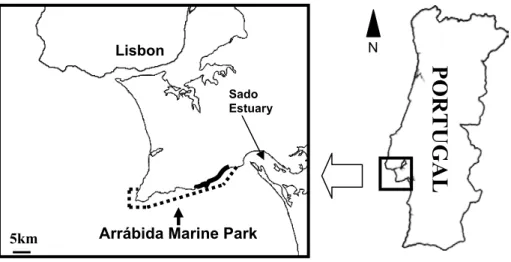
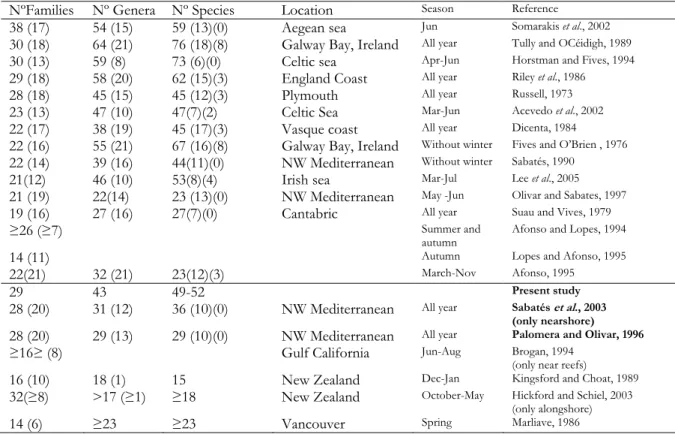
(43) Strydom 2003; Strydom and d’Hotman 2005), in coastal inlets (e.g. Drake and Arias 1991) or in coastal lagoons (e.g. Pérez-Ruzafa et al. 2004). There are fewer studies near rocky reefs, which include those of Walker Jr et al. (1987), Marliave (1986), Kingsford and Choat (1989), Suthers and Frank (1991), Brogan (1994), Palomera and Olivar (1996), Yoklavich et al. (1996), Tilney et al. (1996), Hernández et al. (2003), Hickford and Schiel (2003) and Sabatés et al. (2003). Some of these studies also obtained larval distributional patterns that can be indicative of retention. Marliave (1986) sampled at a fine scale at extreme nearshore waters of a rocky shore in the British Columbia. Using plankton tows and diver observations, he concluded that larvae of some families as the Gobiesocidae were predominant in inshore waters, and were never found in the more offshore samples. Other families had predominantly offshore distributions. Marliave related the inshore distribution of larvae with schooling behaviour and proposed that larvae could actively respond to “visual landmarks” and velocity gradients, promoting their retention nearshore. In New Zealand, Kingsford and Choat (1989) sampled at several distances from reefs, using oblique towing. Most larvae caught were from reef fishes. Tripterygiids of different sizes were captured at all distances and with high densities in bays and near reefs. Other families including Gobiesocidae, Labridae and Gobiidae, although less abundant, were also present in bays and near reefs. They also used visual censing of late stage larvae by SCUBA diving near the bottom. Large numbers of tripterygiids accumulated in small gutters along the reef close to the surface, whereas gobiesocids were mainly at very shallow waters (1-2m), at mid-depths or near the bottom. Gobiesocidae larvae were only found nearshore, indicating retention near reefs.. 25.
(44) Suthers and Frank (1991) found a more uniform distribution of larvae from pelagic eggs, than of larvae hatching from benthic eggs which were predominantly distributed in inshore waters near spawning sites, at South-western Nova Scotia. They proposed that the larger larvae from benthic eggs could have vertical migration behaviours which could influence their retention. In the Gulf of California, Brogan (1994) sampled along transects perpendicular to the shoreline, over depths that ranged from 1 to 30 m; light traps and net tows during daytime were used over reefs and over sand in the more offshore station. Brogan obtained different patterns of horizontal distribution, depending on the species. The most represented larvae near reefs were from reef fishes with demersal spawning, including larvae of the families Blenniidae, Gobiesocidae, Gobiidae and Tripterygiidae. From these, the author concluded that Gobiesocidae, Tripterygiidae and possibly some Gobiidae larvae were retained near reefs. At the Tsitsikamma National Park, South Africa, Tilney et al. (1996) compared larval abundance over reefs and sand patches at very-nearshore waters, and over different water depths (between 20 and 80 m, located respectively 0,35 to 3,83 Km offshore). Gobiesocidae, Blenniidae, Engraulidae and Sparidae were the most abundant families, mostly with larvae in the preflexion stage. While Gobiesocidae larvae were most abundant in deeper waters near reefs, Engraulidae and Sparidae showed a more homogeneous distribution. Gobiesocids and blenniids were more abundant inshore. From these, the former were significantly more abundant over reefs than over sand; the fact that these larvae were present near reefs in different size classes, seemed to indicate active larval retention nearshore. Tilney et al. (1996) also concluded that blennies, although distributed at surface waters, also showed retention patterns.. 26.
(45) Yoklavich et al. (1996) investigated abundance and distribution patterns of rockfish larvae off California; they related larval retention nearshore with onshore flow during one El-Niño event; in the subsequent year, density of larvae nearshore decreased due to upwelling. Miller and Shanks (2004) have analysed the geochemichal signatures in rockfish larvae; their results indicated a reduced flow of larvae between locations separated by hundreds of Kilometres. In the NW Mediterranean, larval fish assemblages at very shallow waters (7-9 m depth) off the Costa Brava were composed mainly by larvae of demersal spawners (Palomera and Olivar 1996). Later, Sabatés et al. (2003) compared the composition and abundance of larval assemblages in this area with larvae from nearshore waters at the Medes islands Marine Reserve and from shelf waters. For some reef fish species with larvae hatching from demersal eggs as blenniids and gobies, they found patterns of larval dispersal offshore. Others, as were tripterygiids and gobiesocids, seemed to be retained near reefs. At more exposed nearshore waters of New Zealand, Hickford and Schiel (2003) analysed larval distribution, with perpendicular and parallel to shore sampling. No pattern of retention/ dispersal related to the pelagic vs. demersal mode of spawning of the most abundant species could be found. Even larvae usually retained as tripterygiids were well dispersed in the nearshore-offshore axis. Hickford and Schiel (2003) proposed that in coasts more exposed to oceanographic conditions, retention of larvae from demersal eggs near reefs may not be the pattern.. 27.
(46) 3. Factors affecting larval retention. Pineda (2000) proposed that the settlement processes of marine organisms are hierarchic. Determinants of larval supply, settlement and population abundance would be different levels in this hierarchy. The factors influencing larval supply would include the interaction between the larval pool and physical and larval transport processes. The first would be influenced by large scale oceanographic factors, while smaller scale processes would act during the transport. Variation in large-scale processes could produce large fluctuations in larval supply (Pineda 2000). More close to settlement, other factors would act at a microscale. Although some studies found no correlation between the structure of larval assemblages of reef fishes and physical factors (see Leis 1993, Wilson 2003, Sampey, 2004), there is evidence of the influence of these factors over larval transport. Several physical mechanisms can influence transport from and towards the shore, retention patterns and larval growth and survival nearshore (reviewed by Norcross and Shaw 1984; Leis 1991a, Pineda 2000; Cowen 2002 and Sponaugle et al. 2002).. 3.1. Physical factors Oceanographic factors can influence the distribution of larvae, their retention/ transport, and their interaction with prey or with predators (Kingsford and Cowen 1996). Among the physical factors that may influence larval transport from and towards the shore are the intensity and direction of currents (e.g. Hare and Cowen 1991; Cowen and Castro 1994; Roberts 1997; Hare et al. 2002). These can promote long distance transport of larvae. Interaction between currents and wind may also be important. For. 28.
(47) example, upwelling can influence offshore or shoreward transport of planktonic organisms (Olivar 1990; Yoklavich et al. 1996; Pitts 1999); eddies can retain larvae (Nishimoto and Washburn 2002; Taylor et al. 2004). Mesoscale circulation patterns interacting with bathymetry and fronts (Sabatés and Olivar 1996) can create retention or transport mechanisms of planktonic organisms. Although large-scale oceanographic processes may influence larval dispersal, nearshore environments offer distinct characteristics due to the shallow depths and shoreline proximity (Pineda 2000; Cowen 2002; Sponaugle et al. 2002; Largier 2003). Hydrodynamic patterns associated with shallow depths can “restrict” the transport mechanisms and create unique patterns: interaction with shallow bottoms originates currents alongshore that are more energetic that across shore currents (Pineda 2000, Largier 2003). Tides are known to have a crucial influence in larval transport and retention in estuaries (see Norcross and Shaw 1984; Boehlert and Mundy 1988). Tidal fluxes can have a strong influence at nearshore shallow waters and the interaction between tides and bottom topography may create small-scale patterns of circulation (Pineda 2000; Cowen 2002; Largier 2003). Fronts may be created, between less productive offshore waters and more productive nearshore (e.g. Munk et al. 1995) or estuarine environments. Tidal and saline fronts often create convergence zones where larvae can be retained (Thorrold and McKinnon 1995; Grimes and Kingsford, 1996; Reiss and McConaugha 1999). Thermal or saline stratification, can promote different flux conditions. Site location is also important. More isolated populations are more likely to be maintained by self-recruitment, considering at the extreme the case of endemic populations (Sponaugle et al. 2002).. 29.
(48) Wind speed and direction can create surface currents that transport organisms (Nakata et al. 2000; Wilson and Meekan 2001; Voss and Hinrichsen 2003). In shallow environments wind currents and other flow speeds may be slowed through bottom friction; the “coastal boundary layer” may retain larvae produced nearshore for some time, near the natal environments (Largier 2003). The coastline orientation can have influence in retention patterns. Upwelling shadows along a coast may form in the lee of headlands that may retain organisms (Graham et al. 1992 in Cowen, 2002; Marín et al. 2003; Largier 2003; Roughan et al. 2005a,b). Internal tidal bores can also be important in the shoreward transport of planktonic organisms (Pineda 1991, 1994, 1999, 2000; Lamb 1997; Leichter et al. 1998; Lennert-Cody and Franks 1999).. 3.2. Biological factors The physical factors may promote passive transport or retention of larvae. Several biological factors can interact with those factors at different scales, influencing dispersal patterns (reviews by Cowen and Sponaugle 1997; Sponaugle and Cowen, 1997; Cowen 2002; Leis and McCormick 2002; Sponaugle et al. 2002). Several features of the adults may indirectly influence larval transport dynamics. These include adult fecundity, mobility and spawning patterns (e.g. when adults select spawning sites that enhance retention/ dispersal). Several coral reef species have spawning patterns synchronized with tidal cycle or with the moon phase (e.g. Robertson et al. 1988). Temporal patterns of spawning (e.g. seasonal cycles) and their relation to larval feeding conditions and physical environment can affect larval survival.. 30.
(49) The spawning mode of fishes can also have a strong influence over dispersal patterns: reef fishes that spawn demersal eggs have usually parental care that leads to larger and more developed larvae at hatching, when compared to larvae hatching from pelagic eggs. These more developed larvae may be able of swimming early in development (Thresher 1984; Leis 1993; Sponaugle et al. 2002; Hickford and Schiel 2003). Size at hatching and growth during the planktonic phase can also influence the success of recruitment onto reefs (Bergenius et al. 2002; Vigliogla and Meekan 2002; Meekan et al. 2003; Raventós and Macpherson 2005). Larval growth rates can, in turn, be variable depending on the environmental conditions (Victor 1986 a; Houde and Zastrow 1993; Arvedlund et al. 2000; Searcy and Sponaugle 2000; Meekan et al. 2003; Sponaugle and Pinkard 2004; Bergenius et al. 2005). The extent of the planktonic larval duration, as already focused, is another factor that can give different dispersal potential for different species. Considering larvae as passive organisms, different patterns of larval positioning in the water column can occur. These can be explained for instance by differential buoyancy patterns that can vary from species to species and that can change with development (e.g. Adlansvik et al. 2001). Furthermore, environmental conditions like different salinities or feeding can have impact over buoyancy responses (Miller 1988).. 3.3. Larval behaviour and environmental cues Larval fishes are seldom passive particles; their ability to interact with the environment can influence their position in the water column and alter significantly larval dispersal.. 31.
(50) The ability of larvae to vertically migrate in the pelagic environment has been well documented (see review by Neilson and Perry 1990). Vertical patterns of distribution have been related to water thermal stratification, often associated with thermocline positioning (Southward and Barry 1980; John and Ré 1993; Flores-Coto et al. 2001) but also in mixed waters (Sabatés 2004), being influenced by the light regime (Blaxter 1973; Trotter et al. 2003; Sabatés 2004) or food availability (Fortier and Harris 1989; Clay et al. 2004; Sabatés 2004). The interaction between vertical positioning behaviour and physical factors may influence horizontal displacement of larvae affecting their shoreward transport (Hill, 1995; Stobutzki 2001; Paris and Cowen 2004). Vertical migration behaviour has been related to the ability of larvae to be retained within estuaries (Laprise and Dodson 1989; Dauvin and Dodson 1990; Ré 1990; Forward Jr et al. 1996a,b; reviews by Norcross and Shaw 1984 and Boehlert and Mundy 1988). As described above, several studies have detected vertical patterns of larval distribution at a small spatial scale in reef environments, (see reviews by Leis 1991a; Cowen 2002; Leis and McCormick 2002; Sponaugle et al. 2002; IV). Remaining near the bottom, where usually currents are slower, may also allow larvae to stay locally retained (e.g. Leis 1986a, 1991a,b; Steffe 1990; Breitburg, 1991; Breitburg et al. 1995).. Other examples of larval active behaviour are the settlement patterns observed at night (Kingsford 2001; Wilson 2001, 2003), often in relation to tidal or moon phase condition (e.g. Robertson et al. 1988; Sponaugle and Cowen 1996 a, b; Lozano and Zapata 2003; McIlwain 2003). Settling larvae may also be able of responding to habitat specific cues, both in tropical reefs and in temperate reefs (Marliave 1977). Habitat. 32.
Imagem

+7


Documentos relacionados