Deposited in Repositório ISCTE-IUL: 2019-03-27
Deposited version: Post-print
Peer-review status of attached file: Peer-reviewed
Citation for published item:
Aparicio, M., Bação, F. & Oliveira, T. (2016). Cultural impacts on e-learning systems' success. Internet and Higher Education . 31, 58-70
Further information on publisher's website: 10.1016/j.iheduc.2016.06.003
Publisher's copyright statement:
This is the peer reviewed version of the following article: Aparicio, M., Bação, F. & Oliveira, T. (2016). Cultural impacts on e-learning systems' success. Internet and Higher Education . 31, 58-70, which has been published in final form at https://dx.doi.org/10.1016/j.iheduc.2016.06.003. This article may be used for non-commercial purposes in accordance with the Publisher's Terms and Conditions for self-archiving.
Use policy
Creative Commons CC BY 4.0
The full-text may be used and/or reproduced, and given to third parties in any format or medium, without prior permission or charge, for personal research or study, educational, or not-for-profit purposes provided that:
• a full bibliographic reference is made to the original source • a link is made to the metadata record in the Repository • the full-text is not changed in any way
The full-text must not be sold in any format or medium without the formal permission of the copyright holders. Serviços de Informação e Documentação, Instituto Universitário de Lisboa (ISCTE-IUL)
Av. das Forças Armadas, Edifício II, 1649-026 Lisboa Portugal Phone: +(351) 217 903 024 | e-mail: [email protected]
Cultural impacts on e-learning systems’ success
Manuela Aparicio, Fernando Bacao, Tiago Oliveira
PII: S1096-7516(16)30036-7
DOI: doi:10.1016/j.iheduc.2016.06.003 Reference: INTHIG 610
To appear in: The Internet and Higher Education
Received date: 16 September 2015 Revised date: 11 June 2016 Accepted date: 13 June 2016
Please cite this article as: Aparicio, M., Bacao, F. & Oliveira, T., Cultural im-pacts on e-learning systems’ success, The Internet and Higher Education (2016), doi: 10.1016/j.iheduc.2016.06.003
This is a PDF file of an unedited manuscript that has been accepted for publication. As a service to our customers we are providing this early version of the manuscript. The manuscript will undergo copyediting, typesetting, and review of the resulting proof before it is published in its final form. Please note that during the production process errors may be discovered which could affect the content, and all legal disclaimers that apply to the journal pertain.
ACCEPTED MANUSCRIPT
1
Cultural Impacts on e-Learning Systems’ Success
Manuela Aparicio ¹ ² ³, Fernando Bacao ¹, Tiago Oliveira ¹
1 NOVA IMS, Universidade Nova de Lisboa, 2 Instituto Universitario de Lisboa (ISCTE-IUL) ISTAR-IUL,
3 Unidcom/IADE
[email protected], [email protected], [email protected]
Corresponding Author: Manuela Aparicio
Address: NOVA IMS Information Management School, Campus de Campolide, 1099-085 Lisboa,
Portugal.
Telephone: (+351) 21 382 8610
Abstract
E-learning systems are enablers in the learning process, strengthening their importance as part of the educational strategy. Understanding the determinants of e-learning success is crucial for defin-ing instructional strategies. Several authors have studied e-learndefin-ing implementation and adoption, and various studies have addressed e-learning success from different perspectives. However, none of these studies have verified whether students’ cultural characteristics, such as individualism ver-sus collectivism (individualism/collectivism), play a determinant role in the perceived e-learning success. This study provides a deeper understanding of the impact of students’ cultural characteris-tics, for individualism/collectivism, on the perceived outcomes of e-learning systems use. This study proposes an e-learning systems success model that includes a cultural construct, individual-ism/collectivism. This paper reports an empirical study developed through an electronic survey dis-tributed to higher education students belonging to various learning levels and from various universi-ties. The study applies quantitative methods to obtain results. Our findings demonstrate that learners’ perceived individual impact is positively influenced by their satisfaction and e-learning systems’ use. Results demonstrate the determinant role of individualism/collectivism on individual and organiza-tional impacts. Students influenced by collective culture perceive more individual and organizational impacts than individualistic culture students. Individualism/collectivism also moder-ates the users’ perceived satisfaction on individual impact, and from individual impacts to
organiza-ACCEPTED MANUSCRIPT
2 tional impacts. The result shows that for the students with a stronger individualistic culture, satisfac-tion plays a central role in the way they assess the individual impacts, and individual impacts on organizational impacts. This empirical research discusses the theoretical and practical implications.
Keywords: e-Learning Systems, Satisfaction, Use, Culture, Individualism/Collectivism, Success
ACCEPTED MANUSCRIPT
3
Cultural Impacts on e-learning Systems’ Success
1. Introduction
E-learning systems are among the educational enablers of the 21st-century and have a huge impact on the educational ecologies. Technology does not always change education; Dewey said,
“Educa-tion is life” (1897, p. 82). Educa“Educa-tion is part of a social process in which communica“Educa-tion and artifacts
play critical roles. Thus, education is part of society and learning is everywhere, and acquiring knowledge is an important asset to any society, organization, or person. E-learning systems are part of a structural infrastructure that leverages knowledge diffusion and acquisition. These systems also allow socialization within a knowledge-sharing context. In sharing contexts, communities of prac-tice may arise, and are the backbone of a social learning system (Wenger, 2000).
Education and e-learning have been the subject of several studies, e.g., modeling e-learning sys-tems’ adoption (Abdullah & Ward, 2016; Chen & Liu, 2013; Tarhini, Hone, Liu, & Tarhini, 2016), satisfaction (Aggelidis & Chatzoglou, 2012; Kassim, Jailani, Hairuddin, & Zamzuri, 2012), and success (Wang, Wang, & Shee, 2007). Most studies of e-learning systems stress the adoption of those systems. E-learning success determinants need more in-depth studies, especially in under-standing e-learning determinant factors related to cultural characteristics. Cultural characteristics correspond to the individualities that are used to categorize several groups of people (Hofstede, 1980b). Students have their cultural contrasts, for example, in individualism versus collectivism (individualism/collectivism). There are students from individualism cultural backgrounds, who di-rect their behavior to the attainment of their individual goals. On the other hand, there are students whose social relationships prevail over learning tasks. These students have collectivism cultural characteristics. Individualism/collectivism is a theoretical construct that measures the opposition between individualism and collectivism (low values indicate individualism; high values indicate collectivism).
Actually, e-learning success has been studied from various perspectives (Appendix A). Some suc-cess studies focus more on the use of a specific platform or on the attendance of a course (Baker, Boggs, & Arabasz, 2003; Newman, 2003; Wang, Wang, & Shee, 2007). Other success studies focus on technological and financial characteristics (McGill, Klobas, & Renzi, 2014). Researchers have also studied the impact of students’ prior experience on e-learning systems use and success (Gay & Dringus, 2012; Hachey, Wladis, & Conway, 2015; Parkes, Stein, & Reading, 2015). Other studies address the impact of social environment and collaboration in course completion (Artino & Jr., 2009; Rosé, Goldman, Sherer, & Resnick, 2015). Some studies have focused on the different types of
e-ACCEPTED MANUSCRIPT
4 learning strategies and performed meta-studies (Aparicio, Bacao, & Oliveira, 2016; Belcadhi & Ghannouchi, 2015; Means, Toyama, Murphy, Bakia, & Jones, 2009; Means, Toyama, Murphy, & Baki, 2013). However, to the best of our knowledge, none of these earlier e-learning systems’ suc-cess studies have thought to determine whether individualism/collectivism, which is a cultural di-mension according to Hofstede (1984b), and determines or moderates the success in e-learning. This is the motivation for our study. Cultural differences were studied to characterize several coun-tries (Hofstede, 2001; Hofstede, 1984) or to understand cultural attributes that influence new tech-nologies’ adoption. To the best of our knowledge, however, none of these empirical studies have examined e-learning systems’ success according to individuals’ cultural differences. Thus, our re-search question is: do students’ cultural characteristics affect e-learning systems success?
Motivated by the research gap mentioned, and in order to increase the understanding of success factors, Seddon (1997; 1999) suggested the inclusion of constructs in the information systems success model (D&M) (DeLone & McLean, 1992), which reflected the different groups of stakeholders for their various interests and perceived outcomes. D&M (DeLone, 1988; Delone, 2003; DeLone & McLean, 1992) is a model constructed on information systems success theory. In this model use, and user satisfaction explain individual impacts, and individual impact explains or-ganizational impacts. According to Star & Griesemer (1989) boundary objects’ characteristics are flexible and adaptable to the environment and can also be tangible or intangible. According to their definition (Star & Griesemer, 1989), an e-learning system can be classified as a boundary object. The e-learning system concept has been changing over time. E-learning can be defined as learning that takes place partially or entirely over the Internet, making information or knowledge available to users discounting time restrictions or geographic proximity (Rosenberg, 2005). The e-learning concept is focused on the technological aspects of an information system, which enables diffusion of explicit and tacit knowledge in the form of virtual classes or digital synchronous classes.
E-learning can be studied in various scopes, including a technological scope, by focusing on artifacts, in other words, in a static point of view; or an interaction scope, by focusing on the relationships and impacts of these artifacts on different stakeholders’ behaviors, within specific contexts. Going deeper into the concept of boundary object, the scopes of e-learning studies may be defined as a common space in which individuals interact through and within this space.
Star (2010, p. 603) clarified the concept of boundary object in the following way: “an object is
something people (or, in computer science, other objects and programs) act toward and with.”. In
e-ACCEPTED MANUSCRIPT
5 learning systems to accomplish their learning tasks, and we are also interested in the perceived success attained by different students of several universities.
This study is not at an organizational level, we are not addressing different organizational cultures, but are addressing different user approaches. Assuming that different e-learning platforms, strictu
sensus, are not a panacea, it is important to understand if different individuals have different
opinions and perceived outcomes when using computers as a learning mediator. In other words, it is relevant to understand if individualism/collectivism determines e-learners’ success, although the reason for this study can derive from the need to capture a complex phenomenon, using a different method (Star, 2010). We are in the presence of what is called a “boundary infrastructure” (Bowker & Star, 1999). A boundary infrastructure is “any working infrastructure [that] serves multiple
communities of practice simultaneously be these within a single organization or distributed across multiple organizations” (Bowker & Star, 1999, p. 313).
Although an e-learning system can be a boundary object, when we study the relationship between learners and the mediator technological platform, it can also be considered as a boundary infrastructure, when studying the mediated relationships between the various groups of e-learning stakeholders (students, teachers, and institutions, among others. As our main contributions, we first integrate the culture dimension with the D&M model, because culture differentiates the various stakeholder groups. This is the first study that integrates the impact of individualism/collectivism on individual and organizational impacts of e-learning systems. Another contribution of this article is the proposal of a theoretical model that includes a cultural dimension as direct and moderator ef-fects on the D&M model. Individualism/collectivism is, therefore, associated with the way students learn and with the way they perceive performance. A more individualistic student may perform dif-ferently compared to a collectivist student. Therefore, individualism/collectivism contributes with a new insight on e-learning success. Our aim is to understand the main drivers of e-learning success. Data were collected through an online survey to which 323 university students responded. To un-derstand the success determinants of e-learning systems, it is appropriate to adapt D&M (DeLone & McLean, 2003).
The next sections introduce the problem context and present the theoretical foundations of e-learning systems’ success. In the third section, we propose a theoretical model for measuring learn-ers’ satisfaction taking into account the perceived individual and organizational impacts of e-learning considering the individualist/collectivistic factor. This is followed by the methodological
ACCEPTED MANUSCRIPT
6 approach. The fifth section contains the empirical study analysis and the results obtained. In the last two sections, we present the discussion and conclusions.
2. Theoretical foundations 2.1. E-learning studies
A number of authors have used IS models to study e-learning systems. Table 1 contains the constructs used in the various studies and the theoretical models used. It reveals that e-learning has been widely studied in the adoption phase, and we can see that technology acceptance model (TAM) is the most frequently used model in an e-learning context. D&M model (2003) has also been used in some studies. From the studies recorded, we observe that the D&M (2003) can be used in the context of e-learning systems’ evaluation.
ACCEPTED MANUSCRIPT
7
Table 1- Studies on adoption and use of e-learning Systems
Authors Publication Model Constructs
IS life cycle stage Theoreti cal model
(Heo & Han, 2003)
Information & Managemen
t
System quality: reliability, response time, Information quality: content, availability, Use: subsystem use,
User satisfaction: overall satisfaction, perceived utility Post-adoption D&M (Lee et al., 2005) Information & Managemen t
Perceived usefulness, ease of use,
attitude, perceived enjoyment, behavioral intention Adoption TAM (Gregor, Martin, Fernandez, Stern, & Vitale, 2006) Journal of Strategic Information Systems
Strategic benefits, informational benefits, transactional benefits, transformational benefits, Post-adoption Value Framewo rk (Wang, Wang, & Shee, 2007b) Computers in Human Behavior
System quality, information quality, service quality, system use, user satisfaction and net benefits
Post-adoption D&M
( Lee & Lee, 2008)
Computers in Human
Behavior
AP: academic performance, learning environmental satisfaction, perceived usefulness, perceived ease of use, contextual information quality, information representational quality, service quality, self-regulatory efficacy
Adoption TAM
(Lee et al., 2009)
Computers & Education
Teacher characteristics, teaching materials, design of learning contents, playfulness, perceived usefulness, perceived ease of use, intention to use e-learning Adoption TAM (Lin & Bhattacherjee , 2010) Info Systems Journal
Usage intention, attitude, perceived enjoyment, social image, technical quality, interaction quality,
Adoption
TRA TAM TPB (Chen & Liu,
2013)
Computers & Education
Technology policy, information integrity, information accessibility, usefulness, ease of use, system supportability
Adoption UTAUT (Schoonenbo om, 2014) Computers & Educa-tion
Task performance, task importance,
use-fulness, ease of use, intention, Adoption TAM
(Mohammadi , 2015)
Computers in Human
Behavior
Educational quality, system quality, con-tent & information quality, ease of use, usefulness, satisfaction, intention to use, effective use Adoption TAM D&M (Tarhini et al., 2016) Interactive Learning Environ-ments
Perceived ease of use, usefulness, subjec-tive norms, quality of work life, mascu-linity/femininity,
individual-ism/collectivism, power distance, uncer-tainty avoidance, intention to use, and actual use.
ACCEPTED MANUSCRIPT
8
Authors Publication Model Constructs
IS life cycle stage Theoreti cal model (Che, Luo, Wang, & Meinel, 2016) Internation-al JournInternation-al of Information and Educa-tion Tech-nology
Power distance, uncertainty avoidance, individualism/collectivism, masculini-ty/femininity, long-term/short-term orien-tation, and indulgence/restraint
Use Hofstede Model (Porter, Graham, Bodily, & Sandberg, 2016) Internet and Higher Ed-ucation
Innovators, early adopters, early majority, late majority, and laggards.
Adoption and Diffusion (DOI) (Abdullah & Ward, 2016) Computers in Human Behavior
Experience, subjective norm, enjoyment, computer anxiety, self-efficacy, useful-ness, ease of use, attitude, intention to use, and actual use.
Adoption TAM
Notes: D&M: DeLone & McLean Model; DOI: Diffusion of Innovation, TAM: Technology
Acceptance Model; TPB: Theory of Planned Behavior; TRA: Theory of Reasoned Action; TTF: Task Technology Fit; UTAUT: Unified Theory of Acceptance and Use of Technology
E-learning systems success´ evaluation variables are organized into three clusters: first are those that refer to the implementation process (Cooper & Zmud, 1990; Kwon & Zmud, 1987), the second variables are of behavior perceptions (Davis, Bagozzi, & Warshaw, 1992; DeLone & McLean, 1992), and the third are those that belong to a performance dimension (DeLone & McLean, 1992; DeLone, 1988). Although DeLone & McLean’s model has been used and verified in e-learning systems contexts, this model was constructed to evaluate IS in general.
We conclude that the majority of the studies address the adoption phase. Our aim will be to identify specific determinants of e-learning systems’ success, which belongs to a post-adoption phase (Larsen, 2003). Other researchers have studied only technology characteristics and users’ perceptions on actual use. However, the impacts of individual and cultural characteristics have not been studied deeply enough with regard to e-learning systems’ success.
2.2. IS success measurement
Our goal is to understand the extent to which cultural characteristics affect e-learning systems’ success. We reviewed the literature and found that e-learning has been studied in various phases of its cycle: adoption, use, and success. For the e-learning adoption phase, several authors build models based on the most well-known adoption model, the technology adoption model (TAM) (Davis, 1986), which explains the determinants of technology adoption. This model is based upon the theory of planned behavior (Ajzen, 1985), which determines that behavioral intention derives
ACCEPTED MANUSCRIPT
9 from the perceived self-efficacy of an experience. TAM demonstrates that technology adoption is due to the perceived usefulness and ease of use of a certain technology.
Figure 1- TAM model (Davis, 1986)
To measure e-learning success, some studies have assessed the perceived usefulness, ease of use, and effective use. Although these constructs can be useful to understand e-learning success, a later model of information system success (DeLone & McLean, 1992) was suggested to be more adequate, because it was tested and validated in other contexts of IS use. The DeLone & McLean (1992) information system success explains IS success through the technological aspects: system quality, information quality, use, and satisfaction. Later DeLone & McLean updated their model including service quality as a determinant of IS success, referring to the personal support deriving from the technological platform (Delone, 2003). Figure 2 shows the evolution of the DeLone & McLean IS success model. The original D&M model (Figure 2) identified six factors for the success of IS, namely system quality, information quality, system use, user satisfaction, individual impact, and organizational impact.
ACCEPTED MANUSCRIPT
10
Figure 2- Evolution of DeLone & McLean IS success model
The newer DeLone & McLean IS success model adds service quality and merges individual impacts with organizational impacts, defining it as net benefits. It is the authors’ belief that although technological aspects are important, they are nevertheless not a panacea in e-learning success, and other aspects related to the users’ characteristics should also be considered. Success factors in IS differ according to various points of view of organizational groups, due to differences in cultural background and education (Dwivedi et al., 2015). As a natural consequence of this line of thought, the authors decided to study the impact of individualism/collectivism. Individualism/ collectivism corresponds to the degree to which students’ social behavior is driven by personal rather than collective goals.
IS success is based on several studies. DeLone (1988) identified the determinants of success of computer usage. Success factors in IS differ according to various points of view of organizational groups, due to differences in cultural background and education (Dwivedi et al., 2015). Other authors mention that organizational culture is a dimension that influences change management, often a consequence of IS implementation (Pillay, Hackney, & Braganza, 2012). Information sharing values, which are related to social conditions of voluntary knowledge sharing, were also studied as a critical factor to enhance business intelligence systems’ success (Popovič, Hackney, Coelho, & Jaklič, 2014). Larsen (2003) studied IS success antecedents (ISSA) resulting from a meta-study of approximately 5000 articles from top IS journals. Success is evaluated in all phases of IS, from implementation to performance. According to Larsen (2003), success in the implementation phase uses measures such as initiation, adoption, and adaptation. In the following phase, success stresses users’ perceptions. For example, it is assessed through users’ acceptance, intention to use, actual use of IS, and users’ satisfaction level. To measure systems performance success, researchers measure the systems’ impact on people’s lives (individual impact), organizational efficiency, and overall success (organizational impact). The ISSA taxonomy is composed of five meta-categories: IS expertise related, organization related, IT related, individual and job-related, and task communication (Larsen, 2003). From ISSA, meta-categories resulted in three classes according to IS pre-adoption and post-adoption phases (Karahanna, Straub, & Chervany, 1999).
The theoretical model most commonly used to measure IS success is the DeLone and McLean model (D&M) (1992, 2003). The D&M Model corresponds to a post-adoption phase in which the independent variables are: system quality, information quality, and service quality. Seddon et al.
ACCEPTED MANUSCRIPT
11 (1999) made some recommendations for measuring IS effectiveness, proposing a set of different measures that includes various groups of stakeholders in the systems. The D&M model is the cornerstone of our study because our main goal is to measure the determinants of e-learning systems’ success, but since other studies suggest that specific individuals’ characteristics are needed to increase the reliability of the explanation, we will analyze the cultural factors. As dependent variables, we defined: use, user satisfaction, individual impact, and organizational impact.
2.3. Cultural factors
Culture embodies the convictions that people have toward human behavior and their relationships with reality. Reality can be considered to be the way people live in a country, and express their truths and values. Supported by the fact that few studies have analyzed the impact of individualism/collectivism on IT adoption and diffusion (Leidner & Kayworth, 2006), we suggest that if culture can be considered as an important factor in IS adoption (Baptista & Oliveira, 2015; Srite & Karahanna, 2006), then it is also relevant to study individualism/collectivism as a measure of success in IS. Cultural aspects are often studied within various layers. As cultural boundaries are difficult to define, a number of profiles of IT users were suggested by Walsh, Kefi, and Baskerville (2010). They suggested various profiles of IT users according to their attitudes toward technology and defined three groups of individuals: one that is driven by a pro-active involvement, another characterized by a passive involvement, and people who refuse to adopt the technology.
Individualism/collectivism is a cultural dimension that measures “the degree of interdependence a
society maintains among individuals” (Hofstede, 1984a, p. 83). Persons in western cultures are
characterized by a higher level of individualism, and in non-western cultures persons are more collectivistic (Hofstede, 1995). Individualism accepts the cultural value that each person should take care of the self before others, while, collectivism favors the importance of the group and society over an individual’s objectives. Hofstede (2001) supported the hypothesis that individualism is significantly associated with the adoption of technology. Individualistic societies lead toward individual interests rather than the collective interests (Hofstede, 1984b). E-learning systems’ success can be influenced by the degree of the users´ individualism/collectivism. For this reason we developed the following model.
3. Research model & hypotheses
Based on D&M (1992) the perceived impacts of e-learning systems are caused by satisfaction and by e-learning systems’ actual use (Heo & Han, 2003; Mohammadi, 2015; Wang et al., 2007b).
ACCEPTED MANUSCRIPT
12 Culture is a dimension that influences learning styles (Joy & Kolb, 2009) and IT usage and adoption (Hofstede, 2001). Consequently, in our research model we combine D&M (1992) with a cultural value, individualism/collectivism (Hofstede, 2001).
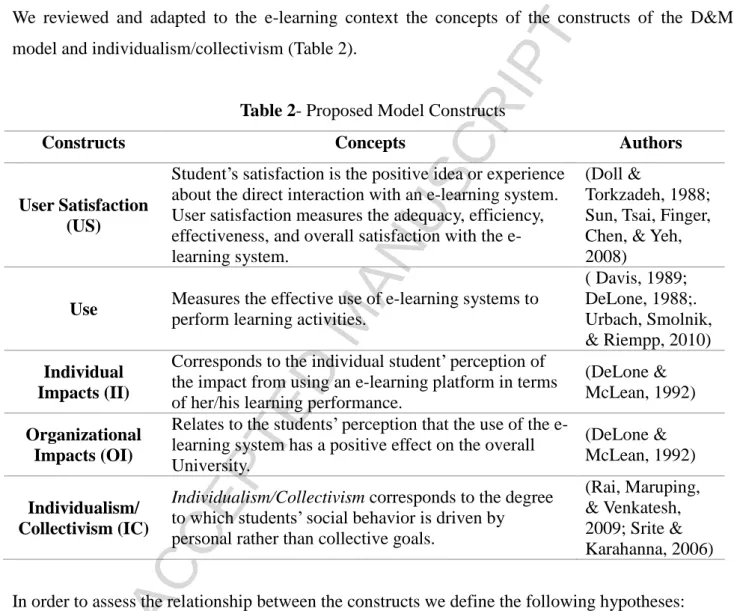
We reviewed and adapted to the e-learning context the concepts of the constructs of the D&M model and individualism/collectivism (Table 2).
Table 2- Proposed Model Constructs
Constructs Concepts Authors
User Satisfaction (US)
Student’s satisfaction is the positive idea or experience about the direct interaction with an e-learning system. User satisfaction measures the adequacy, efficiency, effectiveness, and overall satisfaction with the e-learning system.
(Doll &
Torkzadeh, 1988; Sun, Tsai, Finger, Chen, & Yeh, 2008)
Use Measures the effective use of e-learning systems to
perform learning activities.
( Davis, 1989; DeLone, 1988;. Urbach, Smolnik, & Riempp, 2010) Individual Impacts (II)
Corresponds to the individual student’ perception of the impact from using an e-learning platform in terms of her/his learning performance.
(DeLone & McLean, 1992)
Organizational Impacts (OI)
Relates to the students’ perception that the use of the e-learning system has a positive effect on the overall University.
(DeLone & McLean, 1992)
Individualism/ Collectivism (IC)
Individualism/Collectivism corresponds to the degree
to which students’ social behavior is driven by personal rather than collective goals.
(Rai, Maruping, & Venkatesh, 2009; Srite & Karahanna, 2006) In order to assess the relationship between the constructs we define the following hypotheses:
Satisfaction is a driver for IS success (Doll & Torkzadeh, 1988). Early studies on satisfaction centered on the systems’ implementation phase (DeLone & McLean, 1992; Doll & Torkzadeh, 1988). In this study students’ satisfaction is based on their positive experiences toward the e-learning system usage. Learners’ positive experience may have a positive impact on the perceived individual outcomes in terms of matching the students’ needs and self-efficacy (Piccoli, Ahmad, & Ives, 2001). Therefore, the current study hypothesizes that:
(H1). User satisfaction has a positive effect on the individual impacts of e-learning systems.
The actual use is a measure of success in IS (Seddon et al., 1999). Use is a behavior that precedes satisfaction, and it has positive effects on individual impacts (DeLone, 1988). Based on the D&M
ACCEPTED MANUSCRIPT
13 theoretical model other authors note that use impacts on the perceived e-learning benefits (Hassanzadeh, Kanaani, & Elahi, 2012; Wang et al., 2007b). Students relate their good grades and their understanding of contents to the use of web-based learning (Montrieux, Vangestel, Raes, Matthys, & Schellens, 2014) Therefore; the current study hypothesizes that:
(H2). Use has a positive effect on the individual impacts of e-learning systems.
Student individual impacts are measured in terms of a perceived increased effectiveness resulting from the use of e-learning systems. Effectiveness is a dimension that includes the effective increase of learner performance (Piccoli et al., 2001). If learners accomplish their tasks quickly and productively, they recognize a positive individual impact. Etezadi-Amoli & Farhoomand (1996) established the relationship between end-user satisfaction and organizational performance. Even if different users have different perspectives on performance, if they perceive an improvement in their individual performance, that performance would be reflected in the overall performance. Therefore, we believe that if students recognize personal effectiveness, then universities also recognize an overall benefit at an organizational level, recognized as an overall success (DeLone & McLean, 1992; Urbach et al., 2010). Therefore, the current study hypothesizes that:
(H3). Individual impact has a positive effect on organizational impact.
The individualism concept is defined as the level of independence that each person has from one another, and collectivism is defined as the feeling that individuals are bound and obligated to the group, which is why individualism focuses more on individual rights than on duties (Hofstede, 1980; Oyserman, Coon, & Kemmelmeier, 2002). Individualism/collectivism has been studied as a single dimension in several studies – individualism as opposed to collectivism (Chen & West, 2008; Karahanna et al., 1999; Oyserman et al., 2002; Rogers & Spitzmueller, 2009; Singelis, Triandis, Bhawuk, & Gelfand, 1995; Tarhini et al., 2016). The individual’s sense of group-belonging influences individual impacts. Individualism and collectivism are cultural values (Hofstede, 1984a). Individualistic persons have a sense of the “I”, as self-interest prevails over the collective interest. On the other hand, collectivistic persons feel that being accepted as a group member and the success of the group is more important than individual success. Rai et al. (2009) demonstrated that cultural differences influence IS success. Joy and Kolb (2009) studied cultural differences, especially in-group collectivism influence on different learning styles, concluding that individualism/collectivism affects individual perceived outcomes. Another study on individualism/collectivism suggested that collectivist online students face communication barriers compared to colleagues from other cultures (Tapanes, Smith, & White, 2009). For these reasons, we believe that high levels of individualism/collectivism may positively affect the individual’s outcome. On one hand, the
ACCEPTED MANUSCRIPT
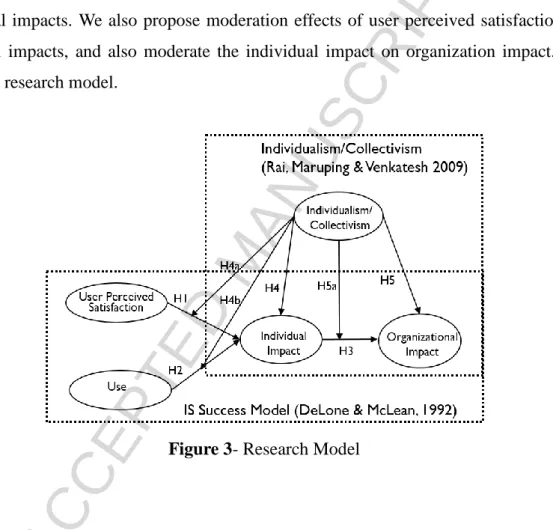
14 collectivism may affect the relationship of user satisfaction on individual impact. For example, if students are very satisfied with the system, but if they have an enormous sense of group belonging, the importance of user perceived satisfaction on individual performance can be weaker. On the other hand, if learners have a high level of individualism/collectivism, this might influence the effect of use on individual impacts. For example, for students with high levels of individualism/collectivism, either way, this dimension can weaken the positive effect of use on the individual impacts. In this context, it is hypothesized that individualism/collectivism has an impact on individual performance in various ways. In a direct way individualism/collectivism affects individual impacts, and also, moderates the effect of satisfaction on individual impacts, and moderates the effect of use on individual impact. Therefore, the current study hypothesizes that:
(H4). Individualism/collectivism has a positive effect on individual impacts of e-learning systems. (H4a). Individualism/collectivism moderates the user’s perceived satisfaction on individual impact,
such that the effect will be weaker among individuals with higher levels of individualism/collectivism.
(H4b). Individualism/collectivism moderates the use of e-learning systems on individual impact, such that the effect will be weaker among individuals with higher levels of individualism/collectivism.
Cultural differences influence information system success (Rai, Lang, & Welker, 2002). (Rai, Lang, & Welker, 2002). Cultural differences are relevant for e-learning in this global reality, where universities recruit multicultural students belonging to different countries. Etezadi-Amoli & Farhoomand (1996) mentioned that individual performance could change user's discernment of a software, and in this line of thought, if students perceive an improvement in individual performance, the perception of a greater organizational impact can be strengthened by the sense of group belonging. Individualism/collectivism has a positive effect on organizational impacts. A study reveals a positive relationship between individual efficacy orientation and collectivism (Rogers & Spitzmueller, 2009). Joy and Kolb (2009) studied the impacts of individualism/collectivism on two levels: in-group and institutional collectivism. On the one hand, in-group collectivism is attained with loyalty to a group or an institution. On the other hand, the concept of institutional collectivism corresponds to the use of extrinsic rewards in order to obtain a collective action. This may lead to the idea that individualism/collectivism can have different impacts on II and OI. For this reason, the authors hypothesize that the higher the level of individualism/collectivism, the weaker is the relationship between individual and organizational impacts. Therefore, the current study hypothesizes that:
ACCEPTED MANUSCRIPT
15
systems.
(H5a). Individualism/collectivism moderates the individual impact on organizational impact, such that the effect will be weaker among individuals with higher levels of individualism/collectivism.
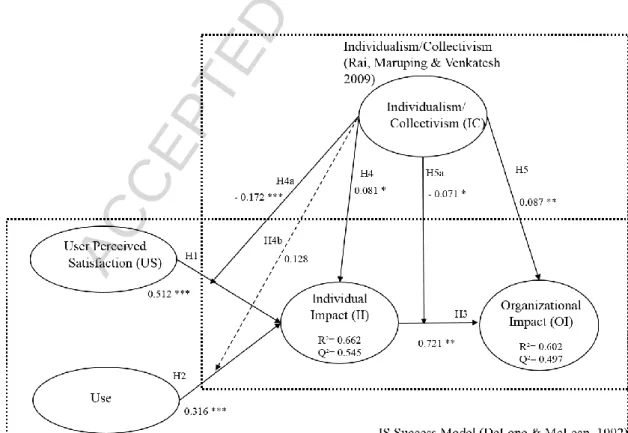
We propose a model that studies the effects of individualism/collectivism on the individual and organizational impacts. We also propose moderation effects of user perceived satisfaction and use on individual impacts, and also moderate the individual impact on organization impact. Figure 3 illustrates the research model.
Figure 3- Research Model
4. Empirical methodology 4.1. Measurement instrument
To operationalize each construct we used tested scales to increase validity. User satisfaction (US) perceived by students is determined by the adequacy of the system in providing support to the area of study. Students’ satisfaction is also measured by the effectiveness and the efficiency of the learning system (Urbach et al., 2010). Use was operationalized considering the various uses of an e-learning system, whether students use the system for retrieving information on the courses, or to publish, store, or share documents, or even to communicate with the teacher and/or with colleagues (Urbach et al., 2010). Students evaluate their individual impacts (II) of e-learning systems use according to their perception that e-learning is useful for their job, if it helps in their productivity as a learner, or if they accomplish tasks more efficiently. The organizational impact (OI) in universities related to the use of e-learning systems can be measured through the improvement of coordination
ACCEPTED MANUSCRIPT
16 and the enhancing of the efficiency of internal university operations. Another measure item is the overall university success in terms of results (Urbach et al., 2010). The individualism/collectivism construct represents a continuum, i.e. low values indicate individualism as a characteristic of the culture and high values represent collectivism as a characteristic of the culture. The degree of individualism/collectivism construct can be measured in terms of personal beliefs that being accepted or not in a group is more important than having autonomy and independence – alternatively, whether group success is perceived as being more important or not than individual success – or even if the loyalty to a group is more important than the individual gain (Rai et al., 2009). Appendix B contains the measurement items used for testing the structural model.
4.2. Data collection
The research model was validated through the quantitative method, using a survey addressed to university students. The questionnaire was composed of several questions to characterize the respondents, answering on numerical rating scales of seven-points (1- Strongly disagree to 7- Strongly agree). The questionnaire included items on the respondents’ characteristics, e.g., gender, age, which e-learning platform they use, and general comments. To assure the perfect understanding of its content we conducted a pilot test with 31 university masters students. The pilot test was applied during a face-to-face class, but these students used an e-leaning system for every course they have. After applying the pilot test, some questions were simplified and improved. We did not use the pilot test results in the main analysis. The pilot measurement model was evaluated, i.e., the assessments of construct reliability, indicator reliability, convergent validity, and discriminant validity of constructs were satisfactory, indicating that the constructs can be used to test the conceptual model. For these reasons, we collected the full sample.
The research involved a survey that was operationalized through an online survey. In order to guarantee the quality of the data and the responding students’ profile, 11 institutes were randomly selected, from an official database of 68 higher education institutions, and contacted e-learning systems administrators through e-mail. We obtained the public contacts provided on the universities’ websites. To distribute the survey, several contacts were made in order to obtain permission to post the survey on the internal platforms. The survey instrument was electronically distributed to students attending 11 institutions of higher education in a European country. The e-mail containing the questionnaire link was directed to program coordinators, IS professionals, and teachers of several universities. The online survey sampling strategy was to send e-mails to public universities and private universities. In some cases, the survey was disseminated in e-learning platforms or the university’s social networks. The survey was conducted in the autumn semester of 2014, from
mid-ACCEPTED MANUSCRIPT
17 October until the beginning of December. All data were provided voluntarily by students who used e-learning systems platforms and were asked about their own opinion on the variables. Data were treated with strict confidentiality and anonymity. No information on the university institution was asked for or tracked.
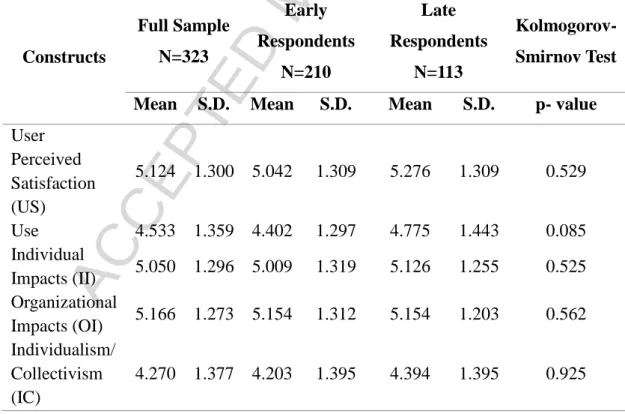
397 students responded to the survey, indicating that they used at least six different e-learning platforms, but due to some incomplete questionnaires, 74 cases were eliminated. The remaining 323 were considered valid for further analysis and used to test the hypotheses. To test for non-response bias in the 323 valid responses, we assessed the early respondents and the late respondents separately and compared the sample distributions using the Kolmogorov-Smirnov (K-S) test (Ryans, 1974). The K-S test results showed that the sample distributions were the same across early and late respondents (Table 3). To confirm that none of the factors individually explained the majority of the variance we used the Harman’s one-factor test (Podsakoff, MacKenzie, Lee, & Podsakoff, 2003).
Table 3- Testing possible response bias: early vs. late respondents
Constructs Full Sample N=323 Early Respondents N=210 Late Respondents N=113 Kolmogorov-Smirnov Test
Mean S.D. Mean S.D. Mean S.D. p- value
User Perceived Satisfaction (US) 5.124 1.300 5.042 1.309 5.276 1.309 0.529 Use 4.533 1.359 4.402 1.297 4.775 1.443 0.085 Individual Impacts (II) 5.050 1.296 5.009 1.319 5.126 1.255 0.525 Organizational Impacts (OI) 5.166 1.273 5.154 1.312 5.154 1.203 0.562 Individualism/ Collectivism (IC) 4.270 1.377 4.203 1.395 4.394 1.395 0.925
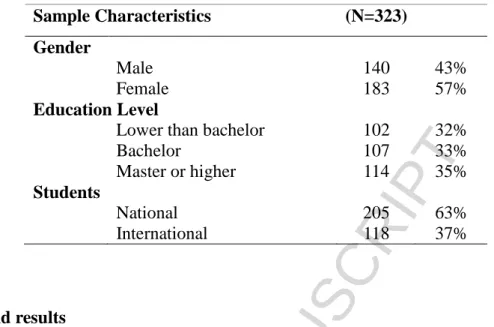
The survey has a reasonably balanced number of male (43.3%) and female (56.7%) respondents. The university student populations in the country sampled are respectively 46.5% for male and 53.5% for female. There is therefore no statistically significant difference between the gender of our sample and the university student population at large. Descriptive data are in Table 4.
ACCEPTED MANUSCRIPT
18 Sample Characteristics (N=323) Gender Male 140 43% Female 183 57% Education LevelLower than bachelor 102 32%
Bachelor 107 33%
Master or higher 114 35%
Students
National 205 63%
International 118 37%
5. Analysis and results
Structural equation modeling (SEM) is a statistical method for testing and assessing causal relationships with a combination of statistical data and theoretical causal assumptions. Cautious researchers recognize the possibilities of differentiating between measurement and structural models and explicitly take measurement error into consideration (Henseler, Ringle, & Sinkovics, 2009). There are two SEM techniques: (i) covariance-based techniques and (ii) variance-based techniques. Partial least squares (PLS) is a variance-based technique and is used in this research since: (i) the Kolmogorov–Smirnov test confirmed that none of the measurement items was distributed normally (p < 0.001) (Hair Jr., Ringle, & Sarstedt, 2013). This allows the use of partial least squares (PLS) for the analysis, as it does not require a normal data distribution (Hair, Ringle, & Sarstedt, 2011; Hair, Sarstedt, Ringle, & Mena, 2012); (ii) the research model has not been verified in the literature; (iii) for PLS assessment, the minimum sample size should satisfy one of the following conditions: (1) ten times the largest number of formative indicators used to measure one construct; or (2) ten times the largest number of structural paths directed at a particular latent construct in the structural model (Chin, Marcolin, & Newsted, 2003). Our sample consists of 323 students using e-learning systems, consequently meeting the necessary conditions for using PLS. Smart PLS 2.0 M3 (Ringlr, Wende, & Will, 2005) was the software used to analyze the relationships defined by the theoretical model.
Subsection (5.1) examines the measurement model in order to assess internal consistency, indicator reliability, convergent validity, and discriminant validity, and subsection (5.2) validates the structural model.
5.1. Assessment of the measurement model
ACCEPTED MANUSCRIPT
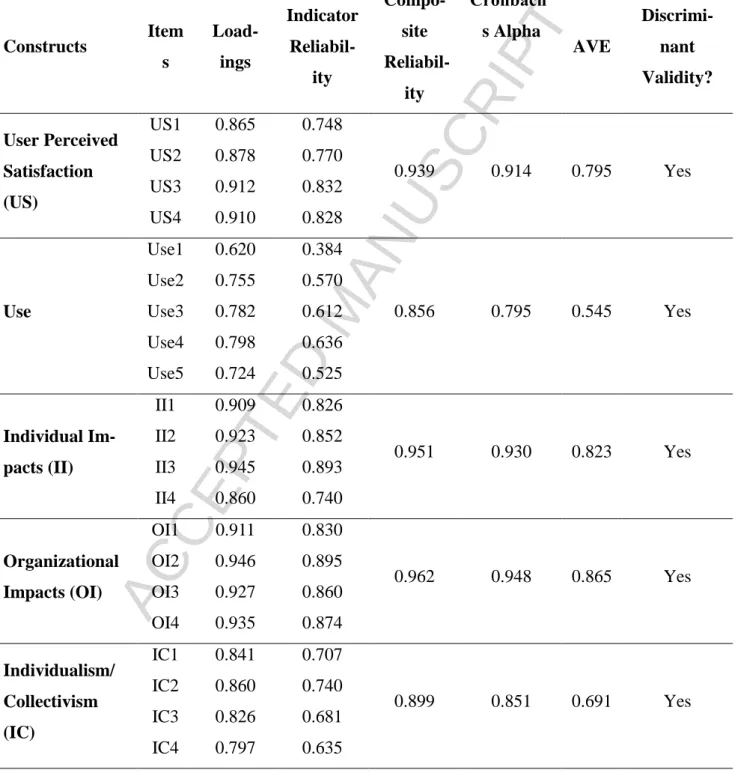
19 are equally reliable (see Appendix C). Table 6 demonstrates convergent validity and discriminant validity.
Table 5- Results of the measurement model
Constructs Item s Load-ings Indicator Reliabil-ity Compo-site Reliabil-ity Cronbach’ s Alpha AVE Discrimi-nant Validity? User Perceived Satisfaction (US) US1 0.865 0.748 0.939 0.914 0.795 Yes US2 0.878 0.770 US3 0.912 0.832 US4 0.910 0.828 Use Use1 0.620 0.384 0.856 0.795 0.545 Yes Use2 0.755 0.570 Use3 0.782 0.612 Use4 0.798 0.636 Use5 0.724 0.525 Individual Im-pacts (II) II1 0.909 0.826 0.951 0.930 0.823 Yes II2 0.923 0.852 II3 0.945 0.893 II4 0.860 0.740 Organizational Impacts (OI) OI1 0.911 0.830 0.962 0.948 0.865 Yes OI2 0.946 0.895 OI3 0.927 0.860 OI4 0.935 0.874 Individualism/ Collectivism (IC) IC1 0.841 0.707 0.899 0.851 0.691 Yes IC2 0.860 0.740 IC3 0.826 0.681 IC4 0.797 0.635
Table 6-Interconstruct correlations and square root of AVEs
Constructs US Use II OI IC
User Perceived Satisfaction (US) 0.891 0 0 0 0
ACCEPTED MANUSCRIPT
20
Constructs US Use II OI IC
Individual Impacts (II) 0.733 0.637 0.910 0 0
Organizational Impacts (OI) 0.653 0.560 0.769 0.930 0
Individualism/ Collectivism (IC) 0.313 0.446 0.396 0.372 0.831 Notes: Diagonal elements are square roots of average variance extracted (AVE), Off-diagonal
elements are correlations
Table 5 reveals that all items converge and share a high proportion of variance. This is important because the constructs explain more than half of the variance of their indicators. Commonality shows that all outer loadings of the constructs have much in common when measuring each of the latent variables US, Use, II, OI, and IC.
The empirical results on the discriminant validity show that each construct is distinct from other constructs. Considering a more liberal criterion (Hair Jr. et al., 2013), from Appendix B, we infer that each indicator is associated with only one construct. The cross-loading table shows that indicators’ outer loadings are greater than all of their loadings on other constructs. An item loading is considered high if the loading coefficient is above 0.600 and considered low if the coefficient loading is below 0.400 (Gefen & Straub, 2005).
Cross loading indicators are considered to be a rather liberal criterion in terms of discriminant validity. A more conservative approach to assess discriminant validity is the Fornell-Larcker criterion, which validates constructs by comparing the square root of Average Variance Extracted (AVE) with the results of the latent variable correlation (Fornell & Larcker, 1981; Hair et al., 2011). This criterion is based on the reasoning that a construct shares more variance with its associated indicators than with any other construct. Table 6 reports that comparison and shows that all of the model’s constructs are validated, and that the measures of different constructs differ from one another.
The results of the measurement model show the reliability of the items and that all items have convergent validity. In other words, the latent variables of the model, US, Use, II, OI, and IC are well represented by all the questions posed to the students. Having confirmed the reliability and validity of the measurement model in PLS, the next phase is to assess the structural model.
5.2. Assessment of the structural model
ACCEPTED MANUSCRIPT
21 which is considered to be a threat to experimental model design (Farrar & Glauber, 1967). We calculated the variance inflation factor (VIF). Test results showed that multicollinearity does not exist; all variance inflation factors obtained were lower than 1.482, which is far less than the conservative threshold of 5 (Rogerson, 2001).
The quality of the structural model was assessed using bootstrapping, a resampling technique that draws a large number of subsamples retrieved from the original dataset. In our study, we used 5000 subsamples to determine the significance of paths within the structural model (Henseler et al., 2009).
Figure 4 illustrates the results of the structural model. The model explains 66.2% of the variation in individual impact (II). User perceived satisfaction (US) ( = 0.512, p<0.01), use (Use) ( = 0.316, p<0.01), and individualism/collectivism (IC) ( = 0.081, p<0.10) are statistically significant. That the individualism/collectivism (IC) moderates the US on II is also confirmed ( = -0.172, p<0.01), as the sign is negative, meaning that for high levels of individualism/collectivism the relationship of user satisfaction (US) on individual impacts (II) is weaker.
Figure 4- Results of the structural model analysis
The individual impact (II) ( = 0.721, p<0.01) and individualism/collectivism (IC) ( = 0.087, p<0.05) are statistically significant in explaining organizational impact (OI). The
ACCEPTED MANUSCRIPT
22 individualism/collectivism (IC) moderator effect of the II on OI is also confirmed ( = -0.071, p>0.10). The model explains 60.2% of the variation in OI.
In summary, H1, H2, H3, H4, H4a, H5, and H5a are supported. The H4b is not supported.
Our model supported paths having at least a small predictive impact, as seen in Table 7. The three latent variables are explained in more than half of the variances, students perceived individual impact (II) with R²=0.662 and organizational impact (OI) R²=0.602, and these values can be considered substantial. Q² is a measure of the predictive success for positive values (Geisser & Eddy, 1979; Stone, 1974), individual impact (Q²=0.545), and organizational impact (Q²=0.497).
ACCEPTED MANUSCRIPT
23
Table 7 - Results of hypotheses tests Hypoth-esis Inde-pendent Variable → Depend-ent Variable Modera-tor Findings Conclusion H1 User Satis-faction (US) → Individ-ual Im-pacts (II) Individ-ualism/C ollectivis m (IC)
Positively & statistically significant ( 0.512, p<0.001) Supported with large effect H2 Use → Individu al Impacts (II) Individu alism/Co llectivis m (IC)
Positively & statistically significant ( 0.316, p<0.001) Supported with medium effect H3 Individual Impacts (II) → Organiza tional Impact (OI) Individu alism/Co llectivis m (IC)
Positively & statistically significant ( 0.721, p<0.001) Supported with large effect H4 Individu-alism/Coll ectivism (IC) → Individu al Impacts (II) None
Positively & statistically significant ( =0.081, p<0.005) Supported with medium effect H4a User Satis-faction (US) → Individu al Impacts (II) None
Negatively & statistically significant ( =-0.173, p<0.010) Supported with small effect H4b Use → Individu al Impacts (II)
None Non-significant effect Not support-ed H5 Individu-alism/Coll ectivism (IC) → Organiza tional Impact (OI) None
Positively & statistically significant ( =0.087, p<0.005) Supported with small effect H5a Individual Impacts (II) → Organiza tional Impact (OI) None
Negatively & statistically significant
( =-0.071, p<0.10)
Supported with small
effect
Notes: Path Coefficient - ; NS=not significant; * significant at p<0.10.; ** significant at
p<0.05.; *** significant at p<0.01; Effect size: >0.350 large; >0.150 and ≤0.350 medium; >0.20 and ≤0.150 small (Chin, 1998; Cohen, 1988)
6. Discussion
6.1. Hypothesis discussion
All the hypotheses of the model are empirically supported by e-learning systems, with the exception of one, H4b. Results show that learners’ satisfaction has a positive effect on the individual benefits
ACCEPTED MANUSCRIPT
24 perceived by students (p<0.01). This means that if a student feels satisfied with the e-learning system, he also experiences an increase in productivity. The findings are consistent with those of Hassanzadeh et al. (2012), in which students’ satisfaction had a positive impact on the individual benefits ( = 0.66), although Saba (2012) reports conflicting findings. Hypothesis 1 is supported and has a large effect.
Hypothesis 2 is supported (p<0.01), i.e. the use of e-learning systems has a positive impact on students’ individual impacts. This means that when learners use e-learning systems, they perceive self-efficacy. Similar results are reported by Xu, Huang, Wang, and Heales (2014).
Hypothesis 3 was validated by empirical results (p<0.01), meaning that students’ individual impacts positively influence organizational impacts. Similar results are reported in other studies (Tang, Hsu, & Kiet, 2014; Urbach et al., 2010).
Theorists who studied individualism/collectivism found that individuals apply equity norms and balance their relationships with other individuals (Oyserman et al., 2002). Therefore, people tend to act carefully when they regard the costs of intensive participation. In our study, we found that individualism/collectivism has a significant (p<0.05) impact on II (H4). Results show that individualism/collectivism activities are perceived as being a positive contribution to II. A possible reason for this can be emphasized by the negative effect of the moderation between satisfaction and individual impacts. Students do not feel that a group success is not more important than their individual success. Still, IC moderates the effect of learners’ satisfaction on the individual benefits. Hypothesis 4a verifies that for higher levels of individualism/collectivism students might experience a negative impact on benefits, and therefore on individual efficacy. This means that students consider that valuing group importance above individual impacts may lead to less effectiveness.
Hypothesis 4b was not supported in this study, meaning that individualism/collectivism does not moderate the effect of e-learning systems’ usage on individual impacts. A plausible reason for this can be the fact that students perceive a positive impact on individual performance when they use e-learning systems. Results show that this impact is not affected by variations of individualism/collectivism, meaning that if individualism/collectivism affects the relationship between satisfaction and individual impacts, the same does not apply for the relationship between use and individual performance. This can also mean that if students are more individualist/collectivist, they would use the e-learning system and perceive benefits on their
ACCEPTED MANUSCRIPT
25 individual performance. From our results, it can be inferred that individualism/collectivism moderates the positive relationship between satisfaction and individual impacts but does not affect the positive relationship between e-learning systems’ use and individual impacts.
Hypothesis 5a is valid in this study, implying that individualism/collectivism weakens the positive effect of learners’ II on organizational success. Results seem to demonstrate that learners lack a sense of ties between peers when using e-learning systems (Hofstede, 2011), although they perceived a positive impact in terms of the overall organization. Another possible explanation for this is that individualism is closely associated with the adoption of communication technologies (Hofstede, 2001).
Individualism/collectivism positively influences organizational impacts (p<0.05). Students feel that being accepted as a group member, coupled with the group’s success, leads to efficiency at the university level. This indicates that students perceive an improvement of work quality in terms of the overall university impact. By validating Hypothesis 5, our empirical study reveals that higher levels of individualism/collectivism have a positive impact on the perception of the university’s success.
The endogenous variable individual impact is 66% explained by students’ satisfaction, and e-learning systems use and the dependent variable organizational impact are 60% explained by individual impact and individualism/collectivism.
Earlier studies on individualism/collectivism had empirical results as a score (Hofstede, 1980, 1984; Hofstede & Bond, 1988; Oyserman et al., 2002), while other studies included this variable as a moderator (Srite & Karahanna, 2006; Wagner, 1995) in the relationship between two variables, and still others considered it as an independent variable (Rai et al., 2009; Wagner, 1995). None of these studies, however, had results on the impact of individualism/collectivism on the relationship between US→II or II→OI. Our findings indicate that students give much more importance to the group achievements than to their own achievements. Collectivism weakens the effect of satisfaction on individual impact, and weakens the effect of individual impact on organizational impacts. It influences the students’ perception of the overall university efficacy.
6.2. Theoretical implications
Our research has theoretical implications, as the model proposed combines three dimensions: satisfaction and use, success, and culture. We consider this study to be among the first empirically
ACCEPTED MANUSCRIPT
26 tested post-adoption models to combine individualism/collectivism and information systems. Our study indicates that the success dimensions of the DeLone & McLean model (D&M) (1992) do not fully capture the factors that influence students’ individual impact, and consequently, the overall university success in the students’ perspective. Therefore, our study included an exogenous cultural variable. Individualism/collectivism– which is determinant in explaining e-learning systems’ success. Results suggest that individualism/collectivism is a contributing factor to the achievement of positive impacts at both an individual and organizational level. Individualism/collectivism as studied (as a moderator of our model relationships, in user satisfaction and individual impact) moderates individual impacts and organizational impacts, although results do not support the moderation effect between use and individual impact. The study provides more understanding to support pedagogical decisions in e-learning.
Results suggest that individualism/collectivism is a factor contributing to the achievement of direct positive impacts at both individual and organizational levels. Results suggest that the individualism/collectivism construct is an important variable to consider when analyzing impacts at individual and organizational levels. The construct helps improve our understanding of how satisfaction influences the perceived individual impacts, and how individual impacts influence the perception of organizational impacts, depending on the culture type (individualist or collectivist). The individualism/collectivism construct moderates the effect of satisfaction on individual impacts, and moderates the effect of individual impacts on organizational impacts. Our findings suggest that for higher levels of collectivism characteristics, a weakening effect of satisfaction on individual impact is verified. However, results do not support the moderation effect of individualism/collectivism between use and individual impacts, meaning that whether students are characterized by individualism or by a more collective culture has no effect on the positive relationship of use on individual impact. The study provides more understanding to support pedagogical decisions in e-learning. Technological aspects of e-learning systems, and their use are not the only mechanisms to achieve success. The structural model demonstrates that individualism/collectivism levels of students play a determinant role in the success. Students characterized by a collective culture have more individual and organizational impacts than individualistic students. Additionally, the importance of user satisfaction to explain individual impact, and also the individual impact to explain organizational impact are strengthened in individualist culture, in comparison to collectivist culture. This study implies that future studies in e-learning systems should include cultural constructs or students’ individual characteristics in addition to e-learning use, to satisfaction level, and to technology features. This study demonstrates that to fully understand e-learning systems’ success, individual factors must be considered, because
ACCEPTED MANUSCRIPT
27 they affect the positive impact of satisfaction on individual impacts.
6.3. Practical implications
E-learning has been widely studied in the adoption phase; we present a post-usage model. Our study indicates that students perceive that e-learning systems increase their productivity and facilitate their tasks. Therefore, the use of e-learning positively impacts the overall university success. Although students find that being part of a group is important, our study reveals that when this collectivistic sentiment achieves certain levels, the impact weakens the positive relationship between satisfaction and individual benefits. On the other hand, more collectivistic students perceive that universities gain performance when e-learning systems are used. Due to the learners’ collective sentiment and to certain levels of collectivism, this weakens the positive impact of individual performance on the organizational performance.
The study encourages universities to improve their initiatives. It explains which factors can influence students’ effectiveness, and demonstrates that the cultural dimension has an impact on individual and organizational performance. This study’s findings reveal that students with more individualism perceive more success than those students with a higher level of collectivism. Our contribution is also valuable to industry since it sheds light on the factors that lead to e-learning systems’ success. Performance can be leveraged with a certain level of collectivism. However, for higher levels of collectivism, individual performance can be compromised.
E-learning systems are crucial to knowledge management (KM) processes, as they support all of the KM phases: socialization, externalization, combination, and internalization of knowledge. The use and success of e-learning can increase organizational capabilities. These results also contribute to decision making, when deciding about the main factors regarding a learner’s satisfaction and increased performance in e-learning. This research is important for multinational companies that use e-learning systems in their activities, because cultural factors of users affect their learning performance, which is to say that even within the same company e-learning strategies have to be adapted to users according to their particular characteristics. Universities’ e-learning systems decisions makers also benefit from these findings, since universities are part of a global market, and can expect learners with different cultural features. Massive open online courses (MOOCs) are also e-learning platforms gathering a significant variety of individuals from the various parts of the globe. This research is also relevant in the definition of learning strategies and activities at a MOOC level.
ACCEPTED MANUSCRIPT
28
6.4. Limitations and future research
Our research contains some restrictions. Although some of the respondents were international students attending various universities within a single European country, the validity of the model could increase if the data were gathered from more universities, or in more countries. This study could bring even more insights if it considered more cultural dimensions. The survey was directed to students only, and if this study included teachers’ responses it could be possible to establish comparisons between students’ and teachers’ assessments. For future research our model suggests undertaking a deeper study of cultural differences among students, for example, by conducting a comparative study of students from various countries, especially considering the use of MOOCs. Another pertinent study that might obtain interesting findings would be to conduct the same survey among Industry learners, to understand if there are similarities or dissimilarities between university students and trainees in an organization.
For future research, comparative studies would enlighten the understanding of e-learning success. An important comparison is to test the model in multi-group studies. It would also be useful to conduct studies comparing the e-learning use with other information systems, for example with collaborative systems and open innovation systems.
7. Conclusions
Education is a cornerstone of society’s development. Thus, e-learning systems’ success is strategically important to any society, organization, or individual. This topic is a strategic topic for both academia and industry since e-learning systems’ usage has been increasing over the years. Several authors have studied e-learning systems adoption, and e-learning success demands a deeper understanding. We present a theoretical model to evaluate the student’s perceived e-learning success. The model is based on information systems’ success literature, and includes a cultural dimension. The research model was empirically tested and validated among university students of a European country. Our model explains more than 66% of the variation of the perceived individual performance and 60% of the perceived organizational performance, due to the e-learning systems use, learners’ satisfaction, and to individualism/collectivism. Our findings provide valuable implications for e-learning systems design strategies. The study demonstrates that individualism/collectivism is an important determinant of e-learning success. Students’ with collective culture characteristics achieve higher individual and organizational impact. Additionally, the individualism/collectivism is also a moderator of user satisfaction with individual impact and individual impact with organizational impact, i.e., the importance of both relationships are intensified in individualistic cultures, in comparison to collectivist cultures. This means that for