Universidade do Minho
Escola de Psicologia
Rita Margarida da Silva Araújo
The neural basis of motor intention:
An fMRI study
junho de 2019 UMinho | 2019 Rita A raújo The neur al basis of mot or in ten tion: A n fMRI studyRita Margarida da Silva Araújo
The neural basis of motor intention:
An fMRI study
Dissertação de Mestrado
Mestrado Integrado em Psicologia
Trabalho realizado sob a orientação da
Professora Doutora Adriana Sampaio
e do
Professor Doutor Yann Coello
Universidade do Minho
Escola de Psicologia
ii
DIREITOS DE AUTOR E CONDIÇÕES DE UTILIZAÇÃO DO TRABALHO POR TERCEIROS
Este é um trabalho académico que pode ser utilizado por terceiros desde que respeitadas as regras e boas práticas internacionalmente aceites, no que concerne aos direitos de autor e direitos conexos. Assim, o presente trabalho pode ser utilizado nos termos previstos na licença abaixo indicada.
Caso o utilizador necessite de permissão para poder fazer um uso do trabalho em condições não previstas no licenciamento indicado, deverá contactar o autor, através do RepositóriUM da Universidade do Minho.
Licença concedida aos utilizadores deste trabalho
Atribuição CC BY
iii
Acknowledgements
To all my family for the unconditional support and love.
To my dear friends of a lifetime and to the ones that were always there for me during these five years. To Professor Adriana Sampaio and Professor Yann Coello for the guidance during this year, thank you so much for your support, availability and patience.
To Professor Sónia Sousa, for helping me with the fMRI data analysis.
To all the participants, for spending your time taking part in this study. Without your collaboration, this study would not be possible.
iv
STATEMENT OF INTEGRITY
I hereby declare having conducted this academic work with integrity. I confirm that I have not used plagiarism or any form of undue use of information or falsification of results along the process leading to its elaboration.
v
As bases neuronais da intenção motora: Um estudo de RMF
Um aspeto crucial da cognição social é a capacidade de perceber as intenções dos outros. Estudos recentes têm comprovado que os seres humanos têm a capacidade de perceber a intenção principal de ações motoras. O que acontece no cérebro humano quando é detetada a intenção motora ou social de ações semelhantes? Este estudo visou construir duas tarefas de reconhecimento com foco nas diferenças cinemáticas dos movimentos de acordo com a intenção motora e social. O estudo piloto, com quatro participantes a percecionarem estas diferenças durante uma Ressonância Magnética funcional, revelou essencialmente uma rede motora e uma rede sociocognitiva envolvida no reconhecimento das intenções motoras e sociais em movimentos direcionados a objetos, respetivamente.
vi
The neural basis of motor intention: An fMRI study
A crucial aspect of social cognition is to be able to decode others’ intentions. Recent studies have proved that humans have the ability to perceive the main intention in motor actions. What happens in the human brain while detecting a motor or social intention in actions that have the exact same motor goal? To this purpose, we built two recognition tasks focusing on the differences in the kinematic parameters of movements according to motor and social intention and we run a pilot study with four participants perceiving these differences during functional Magnetic Resonance Imaging. Results revealed essentially a motor and a socio-cognitive network for perceiving motor and social intentions in reach to grasp movements, respectively.
vii
Contents
The neural basis of motor intention: An fMRI study ... 8
Method... 12 Study 1 ... 12 Study 2 ... 15 Study 3 ... 19 Results ... 21 Discussion ... 23 References ... 27 Index of tables Table 1 ... 15 Table 2 ... 22 List of illustrations Figure 1 ... 13 Figure 2 ... 17 Figure 3 ... 17 Figure 3 ... 22
8
The neural basis of motor intention: An fMRI study
In the social world, the ability to understand the goals of others’ actions is crucial for our everyday communication and for our social interactions. There is a great amount of research investigating our aptitude to infer the underlying intentions of any observed action (Jeannerod & Frak, 1999; Meary, Orliaguet & Decety, 2001; Canessa et al., 2012; Neal & Kilner, 2010; Lewkowicz, Quesque, Coello & Delevoye-Turrell, 2015; Bono et al., 2017; Chaminade, Meary, Orliaguet & Decety, 2001) essential to coordinate our own behavior on the surrounding environment.
When we observe other people executing an action we are able to estimate their main intention/goal (Neal & Kilner, 2010). The mechanisms underlying the ability to understand the intention or goals of an observed action have been enrolling a particular class of neurons – the mirror neurons – which operate in the observer’s own motor system during action observation (AON) (Gallese, Fadiga, Fogassi, & Rizzolatti, 1996; Rizzolatti & Craighero, 2004). The simulation theory postulates that we understand observed actions by simulating them in an internal process that requires the activation of the mirror neuron circuit (Gallese & Goldman, 1998). However, some studies point that the process does not necessarily involve mirror properties, but rather rationalization and mentalization systems, especially when we try to understand actions with situational constraints (Brass, Schmitt, Spengler, & Gergely, 2007).
In fact, perceiving and understanding the intention of any action can rely on a variety of sources and may be related with different processes (Frith & Frith, 2006). Our declarative knowledge, the contextual cues given by the environment in which an action takes place and their physical constraints are some examples that help us to identify the intention of others’ behavior (Brass et al., 2007). Studies have been claimed that these contextual effects are related to the role that past experience has in the planning and control processes but also with the movement constraints, i.e., variables that limit the way in which movement can be organized and controlled (Marteniuk, MacKenzie, Jeannerod, Athenes, & Dugas, 1987). The processes involved in the organization and control of movements have been investigated through the characteristics of movements’ trajectories in different tasks. These characteristics are referred as the kinematics parameters that describe movements in terms of space and time duration (Marteniuk et al.,1987).
By investigating these characteristics, a descriptive model of human movement has emerged - the Fitts law (Fitts, 1954). This predicts the movement time in function of the distance and the size of the
9
targets, in movements toward objects (Fitts, 1954) and is traduced by the following equation: MT = a + b log2 (A / W + 1), where “MT” is the dependent variable (“movement time”); “a” and “b” are regression coefficients (constants that are measured experimentally, depending on the nature of the task); “A” (“movement amplitude”) which is the distance or amplitude to move; “W” width of the region within the move terminates. This law supports that the further away and the smaller the target, the longer the time in grasping and locate an object.
Recently, experimental studies support evidence that humans have the capacity to predict the action-outcome goal only through the observation of the kinematics (Chaminade et al., 2001; Quesque, Lewkowicz, Delevoye-Turrell & Coello, 2013; Quesque & Coello, 2014; Lewkowicz et al., 2015; Quesque et al., 2015). Indeed, it has been shown that observers are sensitive to early differences in visual kinematics, being able to detect and discriminate between movements performed with different oriented motor intentions (Lewkowicz et al., 2015). Interestingly, studies have been investigating specific changes in the kinematics of the arm and hand movements in the same motor actions with different intentions (Quesque et al., 2013; Quesque & Coello, 2014; Lewkowicz et al., 2015). Jacob and Jeannerod (2005) distinguished two types of intentions in motor actions – a motor intention, which refers to the mental state that causes the execution of a voluntary action (e.g., grasp for a pen) and involving or not a conspecific. This later level of description is referred as social intention, i.e., the intention to affect a conspecific’s behavior. For example, one can reach a pen whether to use it oneself, or to give it to anybody else - the question that arises would then be: will the other person be able to detect in a predictive manner, simply by observing the movement of the hand, whether the pen is directed to him or not?
Studies have been documenting that when endorsing a social intention in driving an action, humans tend to amplify the spatiotemporal parameters of their movements (Quesque et al., 2013). Specifically, an action with a social intention in mind, the subject’s hand tends to move with higher trajectories, slower velocities and longer movement durations (Quesque and Coello, 2014) and therefore, it would be possible for an observer to distinguish different social goals driving similar motor actions (Lewkowicz et al., 2015).
Lewkowicz and collaborators (2015) conducted a study to test whether by maintaining the motor intention identical, an observer would still be able to dissociate between social and personal intentions in movements performed toward an object. They recorded trials of actors performing social and personal reach in order to grasp actions, and questionnaires to capture both social cognition and motor imagery abilities. The results revealed that on average participants were able to categorize the underlying intention
10
above chance level, distinguishing the video clips presenting a personal intention as quickly as the video clips presenting a social intention. Furthermore, they noted that participants were not equally good at performing the task and thus, the ability of participants to discriminate between social and personal intentions was highly correlated with the scores obtained in a social cognition test.
As described above, although the mirror neurons have been proposed as the neural underpinnings that could enable us to understand the intentions or goals of an observed motor action (Gallese and Goldman 1998), little is known about on the brain mechanisms engaged in discriminating social and personal intentions. A recent study, that combined kinematic with functional Magnetic Resonance Imaging (fMRI) in reach to grasp movements toward objects, showed a distinct voxel pattern activity in the mirror neuron and the mentalizing systems during action execution with different social intention (Bono et al., 2017). Additionally, a meta-analysis of fMRI studies, showed that as hand actions, gestures involve a perceptual-motor network important for action recognition (Yang, Andric, & Mathew, 2015). Transcranial magnetic stimulation (TMS) and fMRI studies, suggest that the inferior frontal gyrus (IFG) and the inferior parietal lobule (IPL) are important brain areas elicited in action understanding (Brass et al., 2007) with movement anticipation to small or large targets engages the left premotor area and the right intraparietal sulcus (IPS) (Chaminade et al., 2001).
Finally, it is assumed that, when two people interact, common thoughts are shared. In social contexts, we unconsciously spend time predicting the behavior of others by imaging ourselves in the same situation, trying to place our own self within the other person’s mind, beliefs and desires (Lewkowicz et al., 2015). These social-cognitive abilities have been linked to the effective ability to recognize social motor intentions. The Empathizing - Systemizing system theory considers that these two characteristics are able to explain how people tend to predict behaviors (Baron-Cohen et al., 2014). Empathizing would help us understanding and predicting the social world and it can encompass concepts such as the so called “theory of mind” or “mentalizing” whereas systemizing would allow us to predict the behavior of a system, focusing on the observation of the details and their functioning and would allow to understand the variables of a system and its rules, which enables the individual to predict and control behaviors (Castelhano-Souza et al., 2018). These abilities depend upon the integrity of social cognition brain regions as the temporo-parietal junction (TPJ) and the medial prefrontal cortex (mPFC) (Overwalle, 2009), among others.
The processing of motor action has been studied using varying amounts of task demands on the participants, such as passive viewing of action videos. However, there are no studies in the focusing
11
specifically on the brain activation patterns during recognition of motor and social intention in motor actions. This study aims to fulfill this gap in the literature by assessing which parts of the brain have predictive attributes towards perceiving the intentions of actions using a behavioral and fMRI study. This study will be another step forward into deciphering the brain code and it might be an impetus for further development of research on this topic.
The present study
The main objective of this study is to unravel the neural correlates of perceiving intentions in motor actions. To accomplish this, we will first analyze the differences in movements toward objects by modifying aspects of motor intention (target size) and social intention (for me or for him). Subsequently, we will test if subjects are able to recognize these intentions by only observing the kinematic of movements as well the relation of this ability with social cognition skills, assessed by measures of empathy and systemizing. Finally, we will conduct an fMRI study in which we assess two different recognition tasks – a Motor intention and Social intention.
Considering the previous studies, we defined the following hypothesis:
(H1) The movement time will be shorter when placing the object for me in big targets and longer when placing the object for someone else in small targets. The amplitude of movements will be higher when placing the object for someone else in small targets and lower when placing the object for me in big targets.
(H2) Participants will be able to perceive the motor intention (target sizes) and the social intention (personal vs. social) above chance level. Furthermore, we expected that the scores of the cognitive measures will be positive related with this performance.
(H3) The brain areas that will be more activated during the processing of Motor intention will be areas of the mirror neuron system as the inferior frontal gyrus (IFG), the inferior parietal lobule (IPL) and the right intraparietal sulcus (IPS). Brain areas that will be more activated during the processing of Social intention will engage the social network and will include the inferior frontal gyrus (IFG), the inferior parietal lobule (IPL), the temporo-parietal junction (TPJ) and the medial prefrontal cortex (mPFC).
12
Study 1
Participants
Twenty-five right-handed French volunteers (three males) were recruited from University of Lille, ages between 19 and 51 years old (M= 22.4, SD= 6.43), without history of neurological or psychiatric disorder, participated in this experiment. The participants signed a written informed consent to the experimental procedure.
Experimental Task.
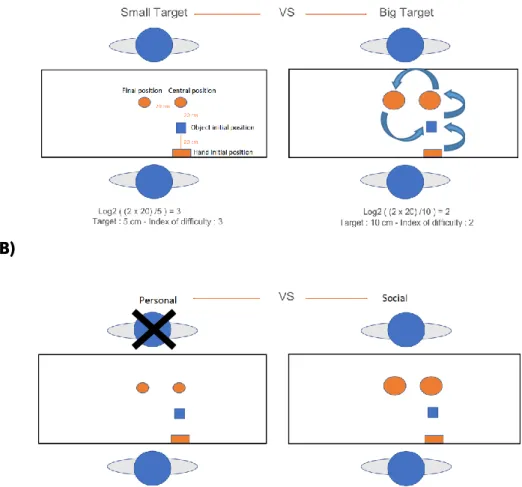
Stimuli were built based on Lewkowicz and collaborators (2015) work. Briefly, we recorded videos with two persons seated on either side of a table playing a cooperative game. One was referred as “Actor” and the other was referred as the “Partner”. In this game, the “Actor” was always the focus of the game even though he/she was not aware of this. On the table there was an object (a wooden dowel - width 2 cm; height 4 cm) and two drawn targets. The objective of this task was to move the wooden dowel, between the thumb and the index finger, from one target to another in a sequence of three successive manual actions: a Preparatory action, a Main action and a Repositioning action. The Preparatory action was always performed by the Actor and consisted in (1) reaching to grasp the object, and (2) move it vertically from the initial position to the central target. The Main action consisted in moving the object horizontally from one target to another, and this one could be performed by the Actor or by the Partner. Both Actor and Partner were informed before the Preparatory action about who would be performing the up-coming action. The Repositioning action was replacing the object at the initial position, making the
setup ready for the next trial. This last action was always performed by the Actor (see Figure 1. – Panel
(A)).
As the Main action could be performed by the Actor or by the Partner, in this condition we were manipulating the intention of the Preparatory action, i.e., the object could be placed “for me” (personal
condition (M)) or the object could be placed to the Partner (social condition (H)) (see Figure 1 – Panel
(B)). Besides the intention (personal vs social intention) of the movement, we also manipulated the size of the targets on the table (small targets (S) with a diameter of 5 cm or big targets (B) with a diameter of 10 cm), in order to test the Fitt’s law effect. The targets had the same size in both central and final position for each trial (so it didn’t interfere in the effect). This was considered as the “motor intention” condition of the movement (see Figure 1 – Panel (A)).
13
As this was presented as a cooperative game, we instructed participants to perform the movements as fast and accurately as possible, by correctly placing the object inside the designed targets on the table and that they could earn points and proceed in the task. Once they were informed on who would perform the actions, they were not allowed to communicate or to look at each other during the game, but rather to keep the eyes fixed on the object. All the actions were preceded by a high pitch sound so that the participants knew when to perform the movements. After placing the object in the final position, a feedback sound was also given to participants, indicating a winning point (sound of “coins”) or not (low pitch sound), according to their performance. In order to estimate the maximum speed (threshold) at which participants could grasp the wooden dowel and place into the targets, we performed pilot study. To this end, we used an adjustment procedure similar to the one used by Quesque et al. (2013). We calculated the median amplitude of peak velocity of trajectories (APV= 1300 ms) and we set a threshold of minimum 80% of this APV as a condition to get correct performances.
(A)
(B)
Figure 1. Descriptive examples of the experimental setting. (A) shows the initial position of the hand, the initial position of the object and the targets’ positions, with the distances between each. The scheme also shows the two conditions of motor intention (small and big targets) and the respective
14
index of difficulty (Fitts law). The arrows represent the two segments of the Preparatory action, the Main action and the Repositioning action. (B) two conditions of social intention (personal and social).
Procedure
The experimental session was divided in four blocks. Each block was comprised by 20 correct trials in each block. The blocks were counterbalanced according to the size of the targets and the intentions - Small/Personal (SM); Small/Social (SH); Big/Personal (BM); Big/Social (BH). The total experimental session lasted approximately 40 minutes and the blocks were counterbalanced across participants. The experimenters were present during the whole session to ensure that participants followed the instructions. All participants underwent into a practice block containing 10 trials so they could get familiar with the task and to ensure that they understood the general instructions and demonstrated an appropriate response.
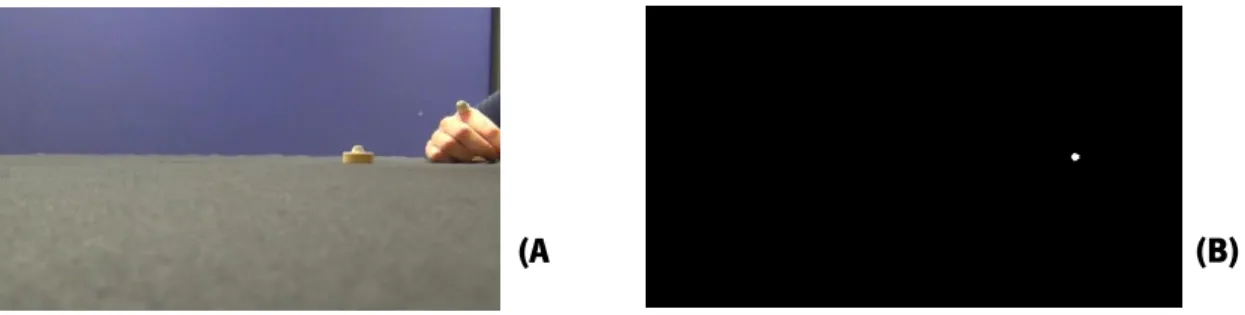
In order to record the kinematics of the movement, we used three infrared cameras (Qualisys system) with five infrared reflective markers placed on the index (base and tip), the thumb (tip), the wrist (scaphoid and pisiform) of the Actor and one marker at the top of the object. The calibration was considered correct when the standard deviation accuracy was smaller than 0.2 mm, at 200-Hz sampling rate. All movements were recorded using a video camera, and the contextual information was suppressing from the image. Specifically, only the Actor and Partners’ arms, the object and the table at a certain degree were framed within the video clips (see Figure 2 – Panel (A)).
Data analysis
For the kinematic analysis we used a similar procedure to Quesque et al. (2013). Specifically, we focused on the kinematic parameters of the Preparatory action, measured from the scaphoid wrist marker. We analysed data of segment 1 and segment 2 of the Preparatory action of the 22 participants in all conditions (data outside three standard deviations were eliminated). Kinematic parameters as amplitude of the peak height of trajectories (APH) and movement time (MT) were analysed as these variables inform the motor strategies behind displacing the hand through motor actions, according to intention (Quesque et al., 2013). The APH was defined as the maximum z coordinate of the wrist measured in the grasping (1) and in the lift to place (2) segments and the MT was calculated as the time interval of each segment. We run a mixed model ANOVA analysis of variance to test for differences between MT and APH according to motor intention (Big/Small targets), social intention (Personal/Social) and when the two interact together (S/M; S/H; B/M; B/H).
15 Results
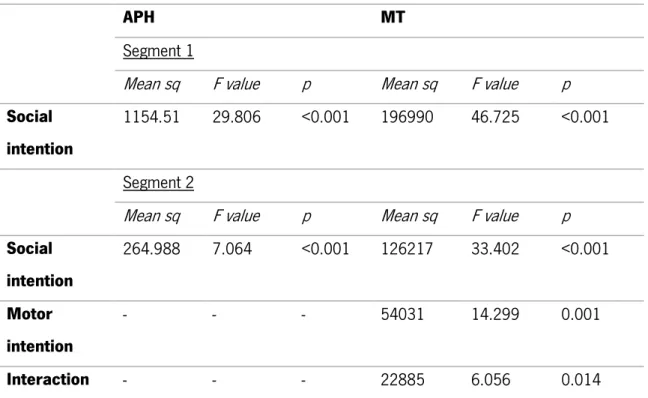
The results showed significant differences in MT according to social intention in the segment 1
(F(1)= 46.725, p<0.001) and according to social intention (F(1)= 33.402, p<0.001), motor intention
(F(1)= 14.299, p=0.001) and social/motor intention interaction (F(1)= 6.056, p<0.05) for segment 2.
Regarding the APH, there was a significant difference according to social intention in both segment 1
(F(1)= 29.806, p<0.001) and 2 (F(1)= 7.064, p<0.001). No significant differences were observed
according to motor intention neither in the interaction of both motor and social intention (see Table 1). These results show that participants execute longer movements when placing objects in Small targets and in Social intention (placing the object for the Partner), the same holds true if both of these two conditions interact together (S/H). Also, participants display higher movements’ trajectories when they are in cooperation (i.e., social intention conditions).
APH MT
Segment 1
Mean sq F value p Mean sq F value p
Social intention
1154.51 29.806 <0.001 196990 46.725 <0.001
Segment 2
Mean sq F value p Mean sq F value p
Social intention 264.988 7.064 <0.001 126217 33.402 <0.001 Motor intention - - - 54031 14.299 0.001 Interaction - - - 22885 6.056 0.014 Table 1. Results of the mixed model ANOVA in kinematic analysis.
Study 2 – Validation of stimuli
Participants
This validation was conducted with 30 Portuguese students recruited from University of Minho (6 males), ages between 19 and 38 (M= 24,03; SD= 4,06), without history of neurological or psychiatric disorder.
16
Empathy Quotient (EQ-Short) and the Systemizing Quotient (SQ-Short). To assess the empathizing – systemizing theory, we used a 22-item version of the EQ and a 25-item version of the SQ (Castelhano-Souza et al., 2018).
Experimental task.
For the selection of stimuli for this task, we selected the kinematic data from Study 1 (data on the Preparatory action). We divided these in two different tasks, the Motor intention task that considered the differences in target size and the Social intention task, that considered the differences in the social cooperation. According to the results described in study 1, we ordered data from the longer to the shorter MT of the segment 2. We then calculated the mean of MT of the global dataset and we selected those MT that were around +13% - 8% from the mean for the Small target and -13% - 8% from the mean for the Big target. After we selected those APH on segment 2 that were comprised between +1/2 SD and - 1/2 from the global mean value of APH value. Finally, we matched all stimuli to obtain the same amount of stimuli for Big and Small conditions, with the same social intention (in this case, 5 stimuli of BM and 5 stimuli of SM), and that were translated into MT differences but not APH. The same procedure was applied for the Social intention task, with the data ordered according to the APH value in segment 2 and matched on MT in order to assure the same amount of stimuli for Personal and Social conditions, with the same target size (in this case, 5 stimuli of SM and 5 of SH), and translated in APH differences but same MT. So, using comparison to the median values, this analysis confirmed the possibility to dissociate these two tasks on the basis of movement time (MT) and height of placing the object (APH). In order to build the videos dataset, we cut the videos before the Main action (described in study 1), as we wanted to assure that participants anticipated the target size and the social intention only by observing the Preparatory action. Therefore, the video clips that were further used as stimuli consisted in a sequential action of the two segments (1) reach to grasp the object and (2) place the object in the target, that ended one frame immediately after the Actor finished placing the object. All video clips had the duration of approximately 1,7 s and were compressed at 30 Hz.
Although we tried to avoid the maximum of the contextual cues during the recording of these videos, it was not possible to get exactly the same characteristics in terms of visual aspects (e.g. lightness, zoom, etc.), so we decided to convert these video clips into point light display, using only one white dot representing the wrist of the arm executing the gesture (see example above, Figure 2 – Panel (B)). These differences in the kinematic parameters of movements have been shown to be perceptible for the
17
(A )
(B)
observers, only through motion cues as point-light display is considered a powerful technique for the recognition of biological motion (Cooketal.,2009).
Figure 2. Stimuli representation. (A) shows an example of a real video clip image of the movement. (B) shows an example of the representation in point-light display.
With this final dataset of point-light display videos, we conducted a validation study. Therefore, we performed a Yes/No recognition task for both Motor intention and Social intention. Participants had to perform two blocks; in one block the task was to recognize the different size of the targets and in the other block the task required participants to identify the social intention of the actions. The validation experiment was designed on PsychoPy3 software and displayed on a computer screen. For each task there was a training phase with 8 video clips (2 video clips of each condition, repeated twice). For the experimental phase, we used the selected stimuli as mentioned above, 5 for each condition that were repeated, with a total of 20 video clips per task. The video clips were displayed randomly in the training and experimental phases of each task and the tasks were counterbalanced between participants. Each trial lasted 3,4 seconds, with each stimulus being presented with a duration of approximately 1700 ms, followed by a black screen with a delay of 1500 ms and then a white bar at the end of the movement during which participants were prompt to give their answer (see Figure 3).
Figure 3. Validation experiment paradigm. (A) and (B) show the paradigm of the two tasks. (C) shows an example of a trial.
Motor intention task – SM/BM
Training phase Experimental phase
(A
) Social intention task –
Training phase Experimental phase
(B) (C)
18 Procedure
Before the experiment, the participants were instructed on the cooperative game. In the training phase, participants watched real videos with individuals performing the movements of the Preparatory and Main action and in the different conditions (with big/small targets and involving one or two people). After that, we showed the type of video clip participants were about to classify, by displaying a real video of an arm performing only the Preparatory action and a video of the same representation but with a point-light display video. Then, we asked participants to categorize each video clip as fast and accurately as possible by pressing the respective response key (“s” for yes and “n” for no). For the Motor intention participants were required to answer the question “Does it involve a Big target?” and for the Social intention task, “Does it involve another person?”. The corresponding Yes/No keys were written on the computer screen at the time the participants had to answer. No feedback was given during the experiment. After that, the participants performed the cognitive assessment by answering the Empathy (EQ-Short) and the Systemizing (SQ-Short) questionnaires. The order of the two tasks and the order of the questionnaires were counterbalanced across participants. After the experiment, participants were asked to comment their performance on the categorization tasks.
Data analysis
The results were expressed in total percentage of correct responses, with the response times being calculated as the time interval between the appearance of the white bar and the participant’s key press. We run the behavioural and cognitive analysis in the SPSS Statistics version 25 (IBM Corp., Armonk, NY, USA). For each task, we calculated the mean and the standard deviation of the percentage of correct responses and compared them to a reference random answer value of 50%, with a single sample t-test. In order to observe if there was a differences in individual performance on both tasks, we run a paired sample t-test. After scoring the questionnaires, we tested if the percentage of correct responses of each task was correlated with these cognition measures each task with the respective
expected correlation questionnaire, separately. For this, we used the Pearson correlation method. All
analyses were conducted with an alpha level of significance set to 0.05. Results
For the Motor intention task, the mean percentage of correct responses was 61,3% (SD= 23.9); t= 2.595, p< 0.05. For the Social intention task, the mean percentage of correct responses was 52.2%
19
between the two tasks (t= 1.613, p= 0.118). Additionally, results yelded no significant effect of the different tasks in the mean response times. Participants categorized the video clips from the Motor intention task (M = 1.14 s, SD = 0.74) as fast as the video clips from the Social intention task (M = 1.37
s, SD = 0.75); t= -1.869, p= 0.072. Regarding the cognitive assessment, no correlation between the
performance in the Motor intention task and the score in the SQ (R= 0.051, p= 0.787), and the same
lack of association was observed between performance in the Social intention task and the score in the EQ (R= -0.126, p= 0.506).
Study 3 - fMRI study on motor and social intention
Participants
Four right-handed healthy participants (2 males), with ages between 24 and 31 years old (M= 29; SD= 3.367), without history of neurological or psychiatric disorder, participated in this pilot study. This pilot study was also approved by the ethical committee from University of Minho.
fMRI data acquisition
Magnetic Resonance Imaging data was acquired in Hospital de Braga, in a clinically approved Siemens Verio 3T scanner using a 32-channel head coil. For the functional images, a multiband echo planar imaging acquisition sensitive to blood-oxygen-level dependent (BOLD) signal was acquired during the execution of the task, with the following parameters: time of repetition (TR) = 1 s, time of echo (TE) = 34 ms, flip angle (FA) = 62 º, isometric voxel resolution of 2 mm3, 64 slices, multi band acceleration factor of 3 and 670 volumes. For the spatial co-registration of the data, a structural acquisition was also acquired with a 3D T1-weighted Magnetization Prepared Rapid Gradient Echo (MPRAGE), with the following parameters: (TR) = 2.42 s, (TE) = 4.13 ms, (FA) = 9 º, 176 sagittal slices, in plane resolution = 1.0 x 1.0 mm2 and slice thickness = 1.0 mm.
fMRI experimental task.
Considered the results described in study 2, we selected the three best categorized videos in the validation task, of each condition. In the fMRI task we used a block design with two runs -the Motor intention recognition task and the Social intention recognition task. The procedure was designed with Psychopy software. Each run consisted in 6 experimental blocks, 6 control blocks and 11 resting blocks between each experimental/control block. For the Motor intention recognition run, the experimental block began with the instruction (“Does it involve a Big target?”) and the Yes/No respective response keys that were followed by randomized 6 trials (3 video clips per condition – SM/BM). The control blocks had the
20
same video clips as the respective experimental block but with a different instruction - “Does the white bar appear at the right?”. The resting blocks consisted in a fixation cross and lasted the same time as the experimental/control block. The same scheme was used for the Social intention run, with the only difference being in the stimuli presented (SM/SH) and the instructions, “Does it involve another person?” (for the experimental blocks) and “Does the white bar appear at the right?” (for the control blocks). Each trial lasted 4s, each block lasted 28s, with a total duration of approximately 10 minutes each run. The order of the blocks in each run was always the same for all the participants (blocks= ['e','r','c','r','c','r','e','r','e','r','c','r','e','r','c','r','c','r','e','r','e','r','c’], being ‘e’=experimental; ‘c’=control and ‘r’=rest), but the order of the tasks and the response keys were counterbalanced across participants. The participants answered by pressing a command-box with two buttons.
Procedure
Before entering in the scanner, participants were trained and instructed about the tasks they should perform. Training was similar to the validation experiment, i.e., watched videos of individuals playing the game in the different conditions, observed a real video of the Preparatory action and then the respective point-light display video. Participants were instructed on the two tasks, and the respective questions they would answer in each task – for the experimental and control conditions. Besides that, they performed the experiment task of study 2 to get familiar with the tasks. This time, we also asked the participants to perform the movements. They took part in the short cooperative game with similar manipulative movements than those performed by the Actor in the stimuli video. They were required to grasp and place an object at the centre of the table inside a Big or Small target and for their own purpose (Personal intention) or for the experimenter (Social intention). After all this familiarization procedure, and before entering the scanner, they were asked to pay attention to the instructions and response keys’ order during the experiment, to give the answer only when the white bar appeared and always with their left hand.
Behavioral and fMRI data analysis
The behavioural data was analysed using SPSS Statistics version 25 (IBM Corp., Armonk, NY, USA) (similar as in the validation analysis).
The fMRI data pre-processing and statistical analyses were performed using Statistical Parametric Mapping version 12 (SMP12) implemented in MATLAB. After pre-processing the data with a filter of 8mm in smoothing, we performed a first level analysis and we selected the following contrasts – “Motor intention vs. Control” and “Social intention vs Control”. Then, we performed a one sample t-test in the
21
second level for the group analysis, where we contrasted the brain activations to each task “Condition vs
Control”, with a voxel level intensity threshold of p<0.001 (uncorrected). We obtained the anatomical
brain localizations using MNI coordinates in the cuixf software.
Results
Behavioral results from fMRI session
For the Motor intention task, the mean percentage of correct responses was 67.4% (SD= 5.73); t= 6.067, p< 0.05 and for the respective control task, the mean percentage of correct responses was
82.7% (SD= 8.31); t= 7.857, p< 0.05. For the Social intention task, the mean percentage of correct
responses was 49.3% (SD= 50.50); t= -0.27, p= 0.980 and for the respective control task, the mean
percentage was 89.6% (SD= 9.43), t= 8.390, p< 0.05. There was no difference in the percentage of
correct responses between the two experimental tasks (t= 0.772, p= 0.496), neither between the two control tasks (t= -1.461, p= 0.240). When we compared the performance between the validation experiment in the familiarization phase with the behavioural responses inside the scanner we did not find differences in both Motor intention (t= -0.013, p=0.990) and Social intention tasks (t=-0.058, p= 0.957). fMRI results
Motor intention task
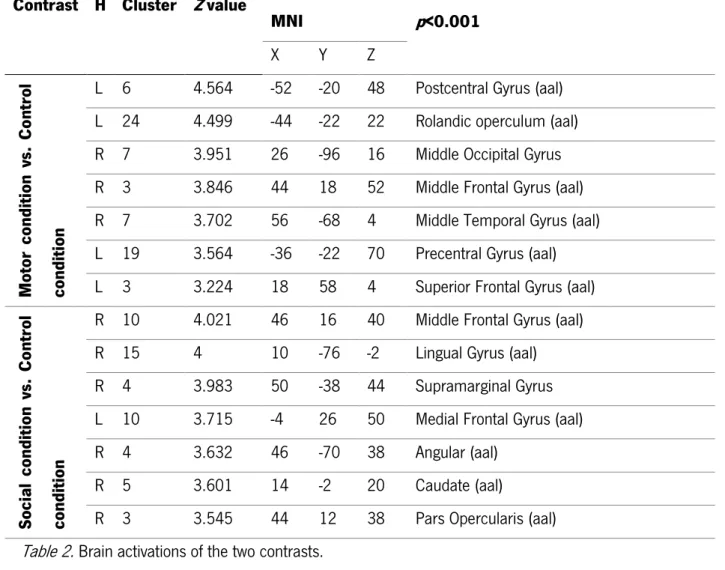
In the Motor intention task, the comparison between the experimental and control condition elicited a leftlateralized brain network, involving the left postcentral gyrus (k= 6; Z= 4.564; x= 52, y= -20, z= 48) , left precentral gyrus (k= 19; Z= 3.564; x= -36, y= -22, z= 70). We also observed a pattern of increased activation in the right hemisphere, as the right middle occipital gyrus (k= 7; Z= 3.951; x= 26, y= -96, z= 16), the right middle temporal gyrus (k= 7; Z= 3.702; x= 56, y= -68, z= 4) and the right middle frontal gyrus (k= 3; Z= 3.846; x= 44, y= 18, z= 52) (see Table 2).
Social intention task
In the Social intention task, the contrast experimental vs. control conditions elicited a more right-lateralized brain network. Specifically, an increased activations of the right middle frontal gyrus (k= 10; Z= 4.021; x=46, y= 16, z= 40), right medial frontal gyrus (k= 10; Z= 3.715; x= -4, y= 26, z= 50) and right caudate (k= 5; Z= 3.601; x= 14, y= -2, z=20). Furthermore, and increased activations of the right parietal lobe were elicited, specifically in the inferior parietal lobule (namely, supramarginal (k= 4; Z= 3.983; x= 50, y= -38, z= 44) and angular (k= 4; Z= 3.632; x= 46, y= -70, z= 38) gyri) (see Table 2).
22 Table 2. Brain activations of the two contrasts.
(A) (B)
Figure 4. Areas with significant activation (in red) for (A) Motor intention vs. Control condition; (B) Social intention vs. Control condition.
Contrast H Cluster Z value
MNI p<0.001 X Y Z M otor con dition vs . Co nt ro l con dition
L 6 4.564 -52 -20 48 Postcentral Gyrus (aal)
L 24 4.499 -44 -22 22 Rolandic operculum (aal)
R 7 3.951 26 -96 16 Middle Occipital Gyrus
R 3 3.846 44 18 52 Middle Frontal Gyrus (aal)
R 7 3.702 56 -68 4 Middle Temporal Gyrus (aal)
L 19 3.564 -36 -22 70 Precentral Gyrus (aal)
L 3 3.224 18 58 4 Superior Frontal Gyrus (aal)
So cia l con dition vs . Co nt ro l con dition
R 10 4.021 46 16 40 Middle Frontal Gyrus (aal)
R 15 4 10 -76 -2 Lingual Gyrus (aal)
R 4 3.983 50 -38 44 Supramarginal Gyrus
L 10 3.715 -4 26 50 Medial Frontal Gyrus (aal)
R 4 3.632 46 -70 38 Angular (aal)
R 5 3.601 14 -2 20 Caudate (aal)
23
Discussion
In this study, we investigated how individuals distinguish motor and social intention with a behavioural and neuroimaging approach. Therefore, we assessed the neural networks underlying the recognition of different intentions in movements performed toward objects. Using point-light display stimuli, i.e., without verbal, facial expressions or any contextual cues, being reduced to the simple movement of the hand grasping objects and with different underlying intentions, this study helped to fill the gap in the literature using an innovative behavioural and neuroimaging approach to investigate the neural networks involved the perception of motor and social intentions in movements, while controlling for kinematics.
Our results showed differences in MT according to motor intention and social intention. Participants tended to execute longer MT with small targets and when placing the object to someone else. These results are in line with the Fitts law regarding to longer MT being related with small targets (Fitts, 1954) and with social intention (Quesque & Coello, 2014). Furthermore, these differences were predominantly observed in the segment 2, where the deceleration phase occurs. The duration of the deceleration phase tends to be modified when more precision is required, resulting in longer MT in this segment (Marteniuk et al.,1987; Quesque et al., 2013). Regarding APH, participants displayed higher movements’ trajectories when they were in cooperation (i.e., social condition), which is also in concordance with previous studies (Quesque & Coello, 2014). Conversely, we did not observed differences in the APH value in the motor intention condition. This may be explained by the fact that motor intention requires more precision in movement, which is associated with the observed differences in MT, while differences in spatial parameters (APH) of movements are more associated with social intention as they are related to the attempt to catch the attention of the other and alert about who will be the next one performing the movement, and thus optimizing the cooperation (Quesque et al., 2013).
With the kinematic and behavioural experiments, we aimed to replicate the findings of previous studies documenting differences in the kinematic of movements according to intention and their recognition (Quesque et al., 2013; Quesque & Coello, 2014; Lewkowicz et al., 2015), but also introduce a novelty by putting two types of intention – Motor and Social - in interaction. By modifying both motor and social intention at the same time, we obtained a highlighted increase of MT as effect of the interaction of small targets with social intention. The effect of Fitts law regarding to MT is therefore emphasized when we added a social intention to the movement.
24
Additionally, we wanted to test whether the subjects were able to perceive the Motor intention and the Social intention of the movements by observing only these changes in the kinematics’ parameters based on the recordings of these movements using point light display videos. By using an innovative approach, our behavioural and neuroimaging procedure considered “Motor intention” as the condition where movements were performed to an end that did not involve a conspecific. To this end, by manipulating the size of the targets where the objects should be placed, the intentions were only regarding the motor properties of the task. We also considered “Social intention” as the condition those movements in that we required participants to attribute a social intention when positioning the object for another person rather than just for personal use. Results showed that the participants were able to recognize the video clips in the Motor intention task, by correctly identifying the ones involving a Big target from those
of a Small target, above chance level (Lewkowicz et al., 2015). Conversely, for the Social intention task
the participants displayed difficulty in distinguishing the video clips presenting a Social intention from those presenting a Personal intention. These results suggest that the stimuli for assessing “social intention” are likely to be inappropriate to assess this condition or more difficult to infer an intention. In fact, some participants pointed to the fact that it was difficult to imagine a social interaction through a movement represented by just one dot. Perhaps the effort to eliminate all the contextual information, also eliminated the capacity of perceiving a social component in this kind of representation. Though these parameters are considered of being perceived through biological motion, some studies raise concerns on the generalizability of formless motion cues (Atkinson, Tunstall & Dittrich, 2007). This can be the case, as we only used one point to represent the all hand/arm movement. In addition, the differences in the kinematics of movements that differ in social intention, although notorious, are not so pronounced as in motor intention and tend to differ more from individual to individual (Quesque et al., 2013). We can question whether or not our stimuli are representative of these differences to be perceived. Moreover, the recognition of these kind of stimuli that integrates social aspects, requires higher-level socio-cognitive mechanisms, associated not only to “mirroring” network, that helps us to identify the movements, but also to the “mentalizing”, that helps us to infer about the intention of others ‘movements (Barrett & Satpute, 2013). In fact, the ability to identify the intentions and goals of others is related to the interaction of these two systems and entails high-level capacities mediated by the prefrontal cortex (PFC) (Overwalle, 2009).
Despite these results in the validation phase of the stimuli, fMRI results highlighted a dissociation in the neural networks engaged in recognizing motor and social intention conditions. The direct contrasts
25
between condition and control in both tasks revealed essentially a motor and a socio-cognitive network for perceiving motor and social aspects in reach to grasp movements, respectively.
More specifically, the Motor intention task elicited areas associated with the “motor” network that included the precentral and the postcentral gyri. The precentral gyrus located in the frontal lobe is related with the observation of object-related hand/arm movements (Rizzolatti & Craighero, 2014). Furthermore, the role of the postcentral gyrus is associated with the comprehension of gestures when there are no other cues (Yang, Andric & Mathew, 2015). On the other hand, the Social intention recognition task recruited brain regions traditionally involved in the “mirroring” and “mentalizing” networks, consistent with previous literature the role of the interaction of both systems in perceiving social intention (Barrett & Satpute, 2013; Bono et al., 2017). The increased activation of the pars opercularis in the inferior frontal gyrus (IFG) and the right inferior parietal lobule (IPL) are well documented to be associated with the activation of the “mirroring network” during action recognition (Overwalle, 2009). As we excepted, regions along the superior temporal sulcus (STS) and near to the temporoparietal junction (TPJ), namely the supramarginal and angular gyri are typical regions of the social-cognition network (Adolphs, 2003). These regions are associated with the inferential processes of mentalization and rationalization when intention recognition requires analysing situational constraints (Brass et al., 2007). Furthermore, the social intention condition also recruited other brain areas related with social cognition, as the middle frontal gyrus and the cingulate (Sebastian et al., 2012).
Additionally, our results showed that the motor intention condition elicited a more left-lateralized brain networks in comparison with the social intention condition that was associated with a higher activation of the right hemisphere, which is consistent with Brownell and collaborators (2000) highlighting the role of the right hemisphere in social cognition domains.
Finally, we did not observe any association between behavioural and neuroimaging performance and the scores in systematization. In fact, higher scores in this questionnaire were not associated with the capacity to perceive the motor deviants in movements, e.g. the target size in motor goal directed movements. This is likely to be associated with the fact this is more associated to the analysis of explicit variables of a system, being practically useless to predict this type of subtle kinematic variations of a person's movement according to intention (Baron-Cohen et al., 2014).
Overall this study highlighted the role of different brain mechanism to perceive social and motor intention, despite the behavioral result was only evident for the motor intention condition. In fact, this study has some limitations. As it was a pilot study, the results of the fMRI recognition task cannot be
26
generalized. Some of them have been interpreted even though with low cluster sizes. So, for this aim, the sample size should be enlarged. Regarding the stimuli, the validation experiment did not allow us to clearly conclude that the participants were able to distinguish the different intentions of the movements. We could point out as possible causes, the representation in point-light display which, despite being informative, may not be sufficient or may have to be improved in terms of biological motion characteristics. The few amount of stimuli used for the validation task may have also contributed to the result. Despite that, we still used these stimuli since we were interested in the neural correlates during the process of perceiving motor vs. social intention in motor actions. Nevertheless, it would be interesting to improve the stimuli in order to establish a relation between the behavioral results and the brain elicited activations.
27
References
Adolphs, R. (2003). COGNITIVE NEUROSCIENCE OF, 4(March). https://doi.org/10.1038/nrn1056 Atkinson, A. P., Tunstall, M. L., & Dittrich, W. H. (2007). Evidence for distinct contributions of form and
motion information to the recognition of emotions from body gestures ଝ, 104, 59–72.
https://doi.org/10.1016/j.cognition.2006.05.005
Barrett, L. F., & Satpute, A. B. (2013). Large-scale brain networks in affective and social neuroscience : towards an integrative functional architecture of the brain. Current Opinion in Neurobiology, 1–12. https://doi.org/10.1016/j.conb.2012.12.012
Brass, M., & Schmitt, R. M. (2007). Report Investigating Action Understanding : Inferential Processes versus Action Simulation, 2117–2121. https://doi.org/10.1016/j.cub.2007.11.057
Brownell, H., Griffin, R., Winner, E., Friedman, O., Happé, F., Dennett, D., … Hill, C. (2000). Cerebral Lateralization and Theory of Mind, 1–23.
Canessa, N., Alemanno, F., Riva, F., Zani, A., Proverbio, A. M., Mannara, N., … Cappa, S. F. (2012). The Neural Bases of Social Intention Understanding : The Role of Interaction Goals, 7(7). https://doi.org/10.1371/journal.pone.0042347
Chaminade, T., Meary, D., Orliaguet, J., Decety, J., & Mende, Â. P. (2001). Is perceptual anticipation a motor simulation ? A PET study, 12(17), 3669–3674.
Frith, C. D., & Frith, U. (2006). The Neural Basis of Mentalizing Minireview, 531–534. https://doi.org/10.1016/j.neuron.2006.05.001
Gallese, V., Fadiga, L., Fogassi, L., & Rizzolatti, G. (1996). Action recognition in the premotor cortex. Brain, 119(2), 593–609. https://doi.org/10.1093/brain/119.2.593
Gallese, V., Fadiga, L., Fogassi, L., Rizzolatti, G., Umana, F., Parma, U., & Rizzolatti, G. (1996). Action recognition in the premotor cortex, 5, 593–609.
Gallese, V., & Goldman, A. (1998). Mirror neurons and the mind-reading, 2(12), 493–501.
Grazia, M., Bono, D., Begliomini, C., Budisavljevic, S., Sartori, L., Miotto, D., … Castiello, U. (2017). Decoding social intentions in human prehensile actions : Insights from a combined kinematics-fMRI study, 1–20. https://doi.org/10.1371/journal.pone.0184008
Information, T. H. E., Of, C., Human, T. H. E., & Movement, O. F. (1954). THE INFORMATION CAPACITY OF THE HUMAN MOTOR, 47(6).
Jacob, P., & Jeannerod, M. (2005). The motor theory of social cognition: A critique. Trends in Cognitive Sciences, 9(1), 21–25. https://doi.org/10.1016/j.tics.2004.11.003
28
Jacob, P., & Jeannerod, M. (2005). The motor theory of social cognition : a critique, 9(1). https://doi.org/10.1016/j.tics.2004.11.003
Jeannerod, M., & Frak, V. (1999). Mental imaging of motor activity in humans, 735–739.
Lewkowicz, D., Quesque, F., Coello, Y., & Delevoye-turrell, Y. N. (2015). Individual differences in reading social intentions from motor deviants.
Marteniuk, R. C., & Mackenzie, C. L. (1987). Constraints on Human Arm Movement Trajectories *, 41(3). Neal, A., & Kilner, J. M. (2010). What is simulated in the action observation network when we observe
actions ?, 32(August), 1765–1770. https://doi.org/10.1111/j.1460-9568.2010.07435.x
Overwalle, F. Van. (2009). Social Cognition and the Brain : A Meta-Analysis, 858, 829–858. https://doi.org/10.1002/hbm.20547
Pollick, F. E., Paterson, H. M., Bruderlin, A., & Sanford, A. J. (2001). Perceiving affect from arm movement, 82, 51–61.
Quesque, F., & Coello, Y. (2014). For your eyes only : effect of confederate ’ s eye level on reach-to-grasp action, (November). https://doi.org/10.3389/fpsyg.2014.01407
Quesque, F., Lewkowicz, D., Delevoye-turrell, Y. N., & Coello, Y. (2013). Effects of social intention on
movement kinematics in cooperative actions, 7(October), 1–10.
https://doi.org/10.3389/fnbot.2013.00014
Rizzolatti, Y. G., & Craighero, L. (2004). T HE M IRROR -N EURON S YSTEM. https://doi.org/10.1146/annurev.neuro.27.070203.144230
Ruigrok, A. N. V, Salimi-khorshidi, G., Lai, M., Baron-cohen, S., Lombardo, M. V, Tait, R. J., & Suckling, J. (2014). Neuroscience and Biobehavioral Reviews A meta-analysis of sex differences in human
brain structure ଝ. Neuroscience and Biobehavioral Reviews, 39, 34–50.
https://doi.org/10.1016/j.neubiorev.2013.12.004
Reed, R., Tagiuri, R., & Petrullo, L. (1960). Person Perception and Interpersonal Behavior. The American Catholic Sociological Review, 21(1), 58. doi: 10.2307/3708831
Rodrigues, J., Lopes, A., Giger, J., Gomes, A., Santos, J., & Gonçalves, G. (2013). Escalas de medição do Quociente de Empatia/Sistematização: Um ensaio de validação para a população portuguesa. PSICOLOGIA, 25(1), 73. doi: 10.17575/rpsicol.v25i1.280
Sebastian, C. L., Fontaine, N. M. G., Bird, G., Blakemore, S.-J., De Brito, S. A., McCrory, E. J. P., & Viding, E. (2012). Neural processing associated with cognitive and affective theory of mind in adolescents and adults. Social Cognitive and Affective Neuroscience, 7(1), 53–63. doi: 10.1093/scan/nsr023
29
Yang, J., Andric, M., & Mathew, M. M. (2015). The neural basis of hand gesture comprehension: A
meta-analysis of functional magnetic resonance imaging studies. Neuroscience and Biobehavioral