R E S E A R C H A R T I C L E
Open Access
Isolation and functional characterization of a
cotton ubiquitination-related promoter and 5
’
UTR
that drives high levels of expression in root and
flower tissues
Antonio AB Viana
1,2†, Rodrigo R Fragoso
3,4†, Luciane M Guimarães
1, Naiara Pontes
1, Osmundo B Oliveira-Neto
1,
Sinara Artico
5, Sarah M Nardeli
5, Marcio Alves-Ferreira
5, João AN Batista
6, Maria CM Silva
1and
Maria F Grossi-de-Sa
1,2*Abstract
Background:Cotton (Gossypium spp.) is an important crop worldwide that provides raw material to 40% of the textile fiber industry. Important traits have been studied aiming the development of genetically modified crops including resistance to insect and diseases, and tolerance to drought, cold and herbicide. Therefore, the
characterization of promoters and regulatory regions is also important to achieve high gene expression and/or a specific expression pattern. Commonly, genes involved in ubiquitination pathways are highly and differentially expressed. In this study, we analyzed the expression of a cotton ubiquitin-conjugating enzyme (E2) family member with no previous characterization.
Results:Nucleotide analysis revealed high identity with cotton E2homologues. Multiple alignment showed a premature stop codon, which prevents the encoding of the conserved cysteine residue at theE2active site, and an intron that is spliced inE2 homologues, but not inGhGDRP85. TheGhGDRP85 gene is highly expressed in different organs of cotton plants, and has high transcript levels in roots. Its promoter (uceApro2) and the 5’UTR compose a regulatory region named uceA1.7, and were isolated from cotton and studied inArabidopsis thaliana. uceA1.7 shows strong expression levels, equaling or surpassing the expression levels of CaMV35S. The uceA1.7 regulatory sequence drives GUS expression 7-fold higher in flowers, 2-fold in roots and at similar levels in leaves and stems. GUS expression levels are decreased 7- to 15-fold when its 5’UTR is absent in uceApro2.
Conclusions:uceA1.7 is a strong constitutive regulatory sequence composed of a promoter (uceApro2) and its 5’UTR that will be useful in genetic transformation of dicots, having high potential to drive high levels of transgene expression in crops, particularly for traits desirable in flower and root tissues.
Background
Cotton plants (Gossypiumspp.) produce the most widely used textile fiber in the world. Moreover, the cotton seed is used to feed livestock and its oil is important in biodiesel production and human consumption. In 2010, more than half world cotton area was planted with genetically modified (GM) cotton, which occupied 21.0
million hectares (14% global biotech area) [1]. Up to date, around 35 cotton events have been approved, in which insect-resistant trait is one of most used and spread, behind only of herbicide tolerance or both traits combined [1].
Despite significant efforts towards the isolation and characterization of plant genes, only a reduced number of plant promoters have been isolated and functionally characterized [2-4]. The most widely used general-pur-pose promoter in GM plants is the Cauliflower Mosaic Virus (CaMV) 35S promoter [5], used in more than 80%
* Correspondence: [email protected] †Contributed equally
1
Laboratório de Interação Molecular Planta-Praga, Embrapa Recursos Genéticos e Biotecnologia, PqEB final W5 Norte, Brasília/DF, 70770-900, Brasil Full list of author information is available at the end of the article
of GM plants [6] because of its constitutively high levels of transgene expression [7]. However, the stability and expression patterns of foreign genes driven by the CaMV35S promoter, including genes expressed in cot-ton [8,9], have been widely debated [9-11]. Moreover, the combination of different traits like drought and cold tolerance, bacteria, fungi and nematode resistance, requires different promoter activities not only to avoid transgene silencing, but also to target the expression to different tissues or developmental stages. Up to date, around 15 different promoters have been used and eval-uated in GM cotton varieties, usually chimeric products from viral and/or Agrobacterium promoters, with 5 being derived from maize or Arabidopsis promoters [12]. Therefore, the discovery and characterization of additional plant promoters is essential to a better under-standing of transgene expression in GM plant develop-ment with predictable high level, temporal and tissue-specific expression patterns [13].
The ubiquitination-related genes have been reported to display high levels of expression across several plant tissues [14], provided that ubiquitination is a major posttranslational protein modification, which is based on the addition of one or multiple ubiquitin molecules to the lysine residues of substrate proteins [15]. Ubiquitina-tion plays important roles in the regulaUbiquitina-tion of lipidaUbiquitina-tion, protein activity, protein-protein interactions, subcellular protein localization [16], transcriptional regulation (through histone ubiquitination), translational regula-tion, DNA repair, endocytosis and protein turnover and trafficking [17].
Ubiquitination-related gene promoters isolated from
Arabidopsis[18], sunflower [19], tobacco [20], maize [21] and several other crops can drive the expression of repor-ter genes in transformed cells or plants. Previous studies have reported that the expression pattern of the ubiqui-tin-conjugating enzymes (E2s) is differentially regulated across tissues and developmental stages [22-24].
Therefore, the main goal of this study is the evaluation of the expression pattern of a non-characterized cotton ubiquitin-conjugating enzyme (E2)-related gene in order to isolate a novel promoter with different properties. In this study, we report the identification of the gland development related protein 85 [GenBank:EU373075]
GhGDRP85gene, a member of the E2 family that pre-sents a high level of transcript accumulation in several cotton tissues. TheGhGDRP85regulatory region, hereby named uceA1.7 [GenBank:JN887312] and promoter named uceApro2 [GenBank:JN887311] was isolated and its GUS expression pattern characterized in transgenic
Arabidopsis. The data generated in this study indicate that uceA1.7 has potential to be a reliable alternative to the CaMV35S promoter and its variations to be applied in GM crop generation programs.
Results
Root preferential expression of an ubiquitin-conjugating enzyme related gene in cotton plants
Aiming the identification and the isolation of a novel cotton promoter, a search was performed in the Gen-Bank for the ubiquitin-conjugating enzyme (E2) family members. The search resulted in seven E2 sequences, retrieved from four different cotton species. A multiple sequence alignment analysis revealed that six of the identified sequences are closely related with high scores (>1,000) and low e-values (<1.00E-24). However, one sequence deposited as‘Gossypium hirsutum gland devel-opment related protein 85-like mRNA’ (GhGDRP85, [GenBank:EU373075.1]) showed a slightly lower score and a higher e-value than all the analyzed E2 sequences. No reports were found in regards to GhGDRP85 pro-tein. Due to its relatively high identity with the cotton E2s (e-values ranging from 1.00E-24 to 1.00E-55), we selected it as a good candidate and carried out further analysis.
Multiple nucleotide sequence alignment showed a 247-bp insertion inGhGDRP85gene (Additional file 1 Figure S1). The nucleotides flanking the insertion are similar to exon-exon junctions in all six other analyzed E2 sequences, which strongly suggests that an intron in
GhGDRP85is not removed during RNA splicing. Further-more, the putative not processed intron includes a stop codon rendering a truncated E2 homologue, missing the active cysteine residue site (Figure 1), which may block ubiquitin transfer. This observation prompted us to inves-tigate the expression pattern of theGhGDRP85gene. Specific primers for qPCR were designed, in which the reverse primer annealed to the putative not processed intron (Additional file 1 Figure S1), allowing us to ana-lyze the possibility of its retention and to assay the expression pattern ofGhGDRP85 gene without interfer-ence from the other homologue mRNAs that share high sequence identity.
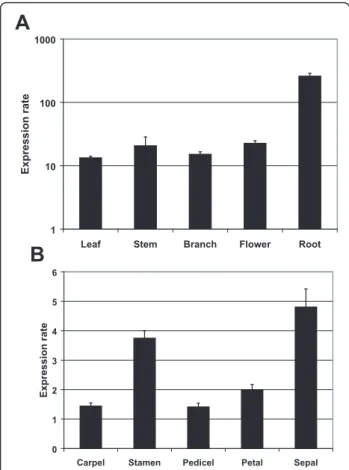
The qPCR analysis (Figure 2A) employed GhUBQ14
and GhPP2A1 as reference genes (Additional file 2 Table S1) because of their high stability [25].
GhGDRP85 transcripts are at least 10 times more abun-dant than reference genes in all analyzed tissues. In roots, GhGDRP85 transcripts accumulated approxi-mately 200-fold more than the reference genes.
The analysis revealed similarGhGDRP85transcript levels in all flower verticils, indicating its regulatory region as a potential alternative to the CaMV35S to direct strong gene expression to floral tissues (Figure 2B).
Isolation of the uceApro2 promoter and its 5’UTR from cotton plants
Because of the GhGDRP85 interesting expression pat-tern, we proceeded with the isolation of its regulatory region as a potential candidate for biotechnological use. The regulatory sequence upstream to GhGDRP85 was amplified by TAIL-PCR [26], using alternating rounds of high and low stringency to amplify specific products preferentially over non-specific products. An 1,049-kb fragment named uceA1.7 [GenBank:JN887312] was cloned (Additional file 3, Figure S2) and sequenced. Alignment of this cloned sequence showed an overlap of the 3’ end of the isolated sequence with the 5’ end of
the GhGDRP85 mRNA. The 5’ end of the cloned
sequence contained no open reading frames and no sig-nificant identity to any previously described promoters.
The sequence of the isolated regulatory region was analyzed to predict the core promoter and cis-elements using the PlantCARE software (Figure 3). PlantCARE
predicted four CAAT-boxes and 19 TATA-boxes. The most probable combination of CAAT-box and TATA-box was selected according to the common promoter pattern, also considering predicted transcription start site (TSS), following the Y Patch and YR Rules [27]. Using this strategy, the region of the core promoter was therefore predicted (shaded in black in Figure 3) as one functional group. Based on these predictions, the core promoter plus its upstream 325-bp region was isolated and named uceApro2 [GenBank:JN887311]. The ratio-nale behind the isolation of these two sequences was the assessment of the 5’UTR influence in the expression pattern of the uceApro2 promoter, provided that 5’UTRs have been reported to enhance the expression levels of reporter genes in previous studies [28,29]. In addition, uceA1.7 contains several putative functional cis-regulatory elements, boxed in Figure 3 and briefly described in Table 1.
The sequence alignment between uceA1.7 and the
GhGDRP85mRNA reveals the existence of an intron in the 5’UTR (shaded in gray in Figure 3). This intron is flanked by nucleotides that match with junction motifs, and the intronic sequence is spliced 10 bp upstream of the translation initiation codon. The presence of an
G . h i r s u t u m - 1 1 M A S K R I L K E L K D L Q K D P P T S C S A G P V A E D M F H W Q A T I M G P S D S P Y A G G V F L V S I H F P P D Y G . h i r s u t u m - 2 1 M A S K R I L K E L K D L Q K D P P T S C S A G P V A E D M F H W Q A T I M G P S D S P Y A G G V F L V S I H F P P D Y G . h i r s u t u m - 3 1 M A S K R I L K E L K D L Q K D P P T S C S A G P V A E D M F H W Q A TLM G P S D S P Y A G G V F L V S I H F P P D Y G . h i r s u t u m - 4 1 M A S K R I L K E L K D L Q K D P P T S C S A G P V A E D M F H W Q A TLM G P S D S P Y A G G V F L V S I H F P P D Y G . a r b o r e u m 1 M A S K R I L K E L K D L Q K D P P T S C S A G P V A E D M F H W Q A TLM G P S D S P Y A G G V F L V S I H F P P D Y G . r a i m o n d i i 1 M A S K R I L K E L K D L Q K D P P T S C S A G P V A E D M F H W Q A T I M G P S D S P Y A G G V F L V S I H F P P D Y G . t h u r b e r i 1 M A S K R I L K E L K D L Q K D P P T S C S A G P V A E D M F H W Q A T I M G P S D S P Y A G G V F L V S I H F P P D Y G D R P 8 5 1 M A S K R I L K E L K D L Q K D P P T S C S A G P V A E D M F H W Q A T I M G PPD S P Y A G G V F L VTI H F P P D Y
G . h i r s u t u m - 1 6 1 P F K P P K V A F R T K V F H P N I N S N G S I C L D I L K E Q W S P A L T I S K V L L S I C S L L T D P N P D D P L V G . h i r s u t u m - 2 6 1 P F K P P K V A F R T K V F H P N I N S N G S I C L D I L K E Q W S P A L T I S K V L L S I C S L L T D P N P D D P L V G . h i r s u t u m - 3 6 1 P F K P P K V A F R T K V F H P N I N S N G S I C L D I L K E Q W S P A L T I S K V L L S I C S L L T D P N P D D P L V G . h i r s u t u m - 4 6 1 P F K P P K V A F R T K V F H P N I N S N G S I C L D I L K E Q W S P A L T I S K V L L S I C S L L T D P N P D D P L V G . a r b o r e u m 6 1 P F K P P K V A F R T K V F H P N I N S N G S I C L D I L K E Q W S P A L T I S K V L L S I C S L L T D P N P D D P L V G . r a i m o n d i i 6 1 P F K P P K V A F R T K V F H P N I N S N G S I C L D I L K E Q W S P A L T I S K V L L S I C S L L T D P N P D D P L V G . t h u r b e r i 6 1 P F K P P K V A F R T K V F H P N I N S N G S I C L D I L K E Q W S P A L T I S K V L L S I C S L L T D P N P D D P L V G D R P 8 5 6 1 P F K P P KG K W L V Q T L L G I D MSK S
-G . h i r s u t u m - 1 1 2 1 LE I A H M Y K T D R A K Y E A T A R G W T Q K Y A M G G . h i r s u t u m - 2 1 2 1 LE I A H M Y K T D R A K Y E A T A R G W T Q K Y A M G G . h i r s u t u m - 3 1 2 1 P E I A H M Y K T D R A K Y E A T ACG W T Q K Y A M G G . h i r s u t u m - 4 1 2 1 P E I A H M Y K T D R A K Y E A T ACG W T Q K Y A M G G . a r b o r e u m 1 2 1 P E I A H M Y K T D R A K Y E A T A R G W T Q K Y A M G G . r a i m o n d i i 1 2 1 P E I A H M Y K T D R A K Y E A T A R G W T Q K Y A M G G . t h u r b e r i 1 2 1 P E I A H M Y K T D R A K Y E A T A R G W T Q K Y A M G G D R P 8 5
-*
Figure 1Multiple protein sequence alignment of the E2 family members in cotton.G. hirsutum-1 to 4 correspond to the protein sequences [GenBank:AAL99220.1, GenBank:AAL99222.1, GenBank:AAL99221.1 and GenBank:AAL99219.1] [45].G. raimondii,G. thurberi,G. arboreum
intron in the GhGDRP855’UTR provides an indication that it may contain important cis-elements involved on intron-mediated enhancement (IME) of gene expression [30,31].
Functional characterization of uceA1.7
To analyze the tissue expression pattern directed by the uceA1.7 regulatory sequence in a heterologous system, GMArabidopsis plants harboring three different promo-ter:reporter gene constructs were generated. The dupli-cated CaMV35S with the alfalfa mosaic virus enhancer (35SdAMV) [32], uceA1.7 and uceApro2 were individu-ally inserted into pCAMBIA1391 upstream of theuidA
gene coding region followed by the tNOS terminator (Figure 4). A quantitative assessment ofb-glucuronidase (GUS) activity was measured using a fluorometric assay with protein extracts from leaf, stem, floral bud and root tissues. All three sequences drove GUS expression in all four tissues examined (Figure 4).
The levels of GUS activity directed by uceA1.7 and 35SdAMV were quite similar in leaf (a ratio of 0.9) and stem (a ratio of 1.2) tissues. However, uceA1.7 drove a 2-fold higher level of GUS expression in roots and about 7-fold higher level in floral buds compared to the widely used 35SdAMV (Figure 4 and 5). Moreover, uceA1.7 drove around 15, 13, 11 and 7-fold higher expression levels in leaves, stems, floral buds and roots, respectively, compared to uceApro2. The uceApro2 pro-moter directed basal GUS expression mainly in vascular tissues, such as the vascular cambia and leaf veins (Figure 5), whereas uceA1.7 showed strong and well-distributed expression in all tissues and organs.
Discussion
Ubiquitin-conjugating enzymes (E2) are known to show both spatial and temporal regulated expression, because their role in ubiquitination process, which can be asso-ciated to different molecular, cellular and physiological processes. With the goal of identifying a promoter and/ or a regulatory region in cotton with new properties, we first analyzed Gossypium spp E2 family in GenBank. Among the seven members found, one of them (GhGDRP85) seems to be a truncated version of the E2 homologues due to a premature stop codon. The stop codon is present in an uncommon region that seems to be an unspliced intron. Indeed, the GhGDRP85mRNA possesses an internal 274-bp sequence that is spliced as an intron in an alternative Gossypium E2 transcript. This data was confirmed by qPCR using a reverse pri-mer annealing in this region. The premature termina-tion of GhGDRP85 protein prevents the conserved cysteine residue (Cys85) of the active site responsible for ubiquitin transfer to be encoded [33]. The truncated E2 protein may act as a competitive inhibitor of the func-tional E2, and thereby down-regulate the ubiquitination pathway. Therefore, it seems that GhGDRP85 protein has evolved from E2 family, but as a result of alternative splicing that ultimately encodes a truncated E2-related protein. We observed intron junctions that could alter-natively spliced over this 274-bp intron from the
GhGDRP85primary transcript under specific conditions, developmental stages and/or in certain tissue types. The alternative mRNA encodes the Cys85 along an E2 pro-tein that shares very high sequence identity (from 2E-98 to 3E-109, 97-100%) with E2 family members, including UBC2, 8, 9, 10, 11, 28 and 30.
Thus, the GhGDRP85transcript abundance in cotton tissues was evaluated to verify its regulatory sequence activity and its biotechnology usefulness. TheGhGDRP85
transcript abundance was approximately 10-fold greater than the reference genes GhPP2A1 and GhUBQ14 in four analyzed tissues (leaf, stem, branch and flower). These results showed that the GhGDRP85 transcript is 1
10 100 1000
Leaf Stem Branch Flower Root
Expression rate
0 1 2 3 4 5 6
Carpel Stamen Pedicel Petal Sepal
Expression rate
A
B
Figure 2Expression profiles of theGhGDRP85in cotton plants. The transcript levels of different cotton organs and tissues were determined by qPCR. (A) Log scale of the transcript levels of the
GhGDRP85gene normalized with the reference genesGhPP2A1and
GhUBQ14in several plant organs. (B) Transcript levels of the
GhGDRP85gene in floral tissue relative to the reference genes
highly abundant in most cotton tissues, especially in roots, which the mRNA levels are 200-fold higher than the reference genes (Figure 2).
To obtain further detail about the expression activity of the GhGDRP85 regulatory region, we isolated the corresponding upstream promoter (uceApro2) within theGhGDRP85regulatory region (which included uceA-pro2 and a 5’UTR, named uceA1.7). The activity and the spatial gene expression driven by the constructs uceA1.7, uceApro2 and 35SdAMV nucleotide sequences fused to the GUS reporter were evaluated in the respec-tive transgenicArabidopsis plants.
Transgenic plants harboring uceApro2::GUS present basal levels of GUS activity in leaf, stem, flower bud and root, although GUS activity in root was approximately
4-fold higher when compared to other tissues (Figure 4). The PlantCARE software did not identify any cis-acting element that would explain such high levels of expres-sion in roots (Table 1). Therefore, further analyses are still needed to locate root-specific cis-acting elements.
The remarkable difference in expression levels (Fig-ures 4 and 5) driven by the uceA1.7 and uceApro2 con-structs can be directly associated to the presence of the
GhGDRP855’UTR. The presence of this region triggers an important quantitative effect, increasing from 11 to 15-fold expression in leaf, stem and flower bud tissues. In root the presence the 5’UTR result in an increase of only 7-folds, however it is also possible that the detec-tion sensitivity of the GUS assay has reached its satura-tion point in the root tissues. On the other hand, some
a -b c
d
e -f
g h
i j k
-l
m -n
-p
q
r s
uceApro2
-o
u w
-t
v
UCE2
W4
- 417
AGTGAAGTAGCAGAGATAATAGTTATTACAGTAGCAGTAATAAAATAAAATACATTTTAT
- 357
TACAAAAAAACGTACAAGAGGTCCGCGAAGATAGCCAATGAGAACGCAAGAAGACAACCC
- 297
AATTCTCCTATTTTTTTATTAAATATTTCTAGAAGAAAGGGTAAATTACGCCCCACGGTC
- 237
ACAAAACTATTAATAAGATCATATATTTATCACTCAACTTCCAAAAGTTACAAAATGATT
- 177
ATTAAACTATTCAAAAGTTTTATTTCAAGTCATTGGATTGTTAAAATAGCATTTGTATGG
- 117
ATTTCCCTGTTCACATTGCCTACAT
CAAT
CGAAGCCTCTCATTCCCCTTCTTTTTTATAG
- 57
ATTAAGTTTTTTTT
TATAAA
ACAATTTTAAACATCATGAA
TCTCT
GAACTAAAATT
T
A
AA
+ 4
TAACTTTTTTCTTCGATCTTTGACATTGA
ATG
TTAAATTAACTTGAATCTAAGGT
ATG
TT
+ 64
CTACTTGTTGATAAATACAGATCCATCGTGTTGATCATTGAATCGTCACTTGGAGCTCAC
+ 124
TCATCGGACTTAAAAAAAAAACCTTAACAACCTAGTGACTTAAATAAAACTTTTGAATAG
+ 184
TTTACTGACTATTTTGTAACTTTTTAAAGTTAAGTGACTAAAACGTGAACATACTAATAG
+ 244
TTTAGTGACCTCGGATGATTTTACCCAAAAAATTATTATTCAACCTCTCGTCCTCTCCTT
+ 304
TTTACACCTTTTTATTATTTTTTATTTTTTCTCTTTACTTTGTTTTTTTAGCTATTTCCA
+ 364
GCGACTACTAAACAAAATAAAAATTAGCCCAGGACAGGAGGATCTCTCAGCTACTTTTTC
+ 424
TCTCAAAATTTCTCCAATTAGCTCTgtaattttctattttgtttctctttattttagatt
+ 484
ttttttggtccgtgttaatcttcgttgaaggcgatctagctttgatttgaatttcatttt
+ 564
ttttcttttttccttttaagatacttttttgtttgttttagGGTTTAGGCG
ATGGCTTCA
+ 604
AAGCGGATCTTGAAGGAGCTCAAGGACCT
putative light-responsive cis-acting elements observed in 5’UTR could be responsible for the higher GUS expres-sion in light-exposed tissues (motifs (p) and (r) in Figure 3 and Table 1).
In addition to the numerous regulatory elements present along the 5’UTR to regulate the transcription process, this sequence may also possess other elements that increase favorable effects on mRNA stability, processing, nucleus-cytoplasm translocation and translational apparatus assembly [13,34,35], such as an intron just before the first exon that could characterize intron-mediated enhance-ment (IME) [30,31]. Taken together, these findings suggest that the presence of the 5’UTR downstream of the uceA-pro2 promoter likely accounts for the observed increase in expression levels driven by uceA1.7. This phenomenon has already been described in previous reports of gene expression analyses in pea and conifers [28,29].
The uceA1.7 sequence drives GUS expression to leaves and stems in comparable levels to the strong con-stitutive enhanced plant promoter CaMV35S. However, uceA1.7 drives higher GUS expression in roots (2-fold) and flowers (7-fold). 35SdAMV:GUS plants present a 10-fold decrease of GUS expression in flower bud, rela-tive to leaf. It is noteworthy that GUS staining in leaf (Figure 5) driven by uceA1.7 seems to be higher than that driven by CaMV35S. However this observation does not match to the quantitative fluorometric data presented on Figure 4. This kind of variance is com-monly observed with GUS staining assays. Furthermore, the CaMV35S promoter, which has been widely used for plant expression systems, induces low and variable expression in floral organs [9], rendering the production of plants expressing foreign genes on floral organs unpredictable. Due to the reported reduced gene
Table 1 Sequence motifs of cis-acting elements found in uceA1
Motif sequence (letter in Figure 3)
Motif name Motif site (from/to)
Strand Expression
(a) CTCC Unnamed 4 -293/-290 + Unknown
(b) CGTGG Unnamed1/3 -245/-241 - Unknown
(c) CGGTCA MBS -242/-237 + MYB Binding Site; Weak homology to the consensus TAACTG/CAGTTA
involved in Bz2 gene activation and R and C1 factors
(d) ATTAAT Box 4 -229/-224 + Part of the pal conserved DNA module array (pal-CMA1) involved in light
responsiveness
(e) GTCAT Skn-1 motif -149/-145 + Required for high levels of endosperm expression in cooperative
interaction with others motifs (AACA, GCN4, ACGT)
(f) ATACAAAT ATGCAAAT-motif -127/-120 - One base mismatch; Associated to the TGAGTCA motif (GCN4) separated by two bases in tandem
(g) CAAT CAAT-box (4) -92/-89 + Core promoter; common element in promoter and enhancer regions;
about 50 bp from TATA-box
(h) CCATCTTTTT TCA-element -72/-63 + Involved in salicylic acid responsiveness; one TCA-element does not
confer salicylic acid responsiveness, more than one might do it
(i) TTATAAAA TATA-box (19) -44/-37 + Core promoter; element found from -50 to -20 of the TSS
(j) TCTCT Y Patch -17/-13 + Core promoter; found between -100 to -1 of TSS
(k) Pyrimidine/Purine YR Rule -1/+1 + Core promoter; Transcription Start Site (TSS)
(l) AAAAGTTAGTTA MBSII -1/+11 - MYB binding site involved in flavonoid biosynthetic genes regulation
(m) CGTCA CGTCA-motif +107/+111 + Involved in the MeJA-responsiveness; associated with its complementary
sequence TGACG 15 bp downstream (palindrome)
(n) TGACG TGACG-motif +107/+111 - cis-acting regulatory element involved in the MeJA-responsiveness
(o) CTCC Unnamed 4 +115/+118 - Unknown
(p) CACGTT G-Box +225/+230 - cis-acting regulatory element involved in light responsiveness
light responsive element site associated to Box II and P-box to confer elicitor-mediated gene activation in a number of phenylpropanoid genes
(q) CTCC Unnamed 4 +298/+301 + Unknown
(r) AATTATTTTTTATT AT1-motif +316/+329 + Part of light responsive module
(s) TTTCTTCTCT 5’UTR Py-rich stretch +328/+339 + Region in the 5’UTR conferring high transcription levels without the need for other upstream cis elements except for a TATA-box
(t) CTCC Unnamed 4 +400/+403 - Unknown
(u) ATTTTCTCCA TC-rich repeats +431/+439 + cis-acting element involved in defense and stress responsiveness
(v) CTCC Unnamed 4 +435/+438 + Unknown
(w) AGAAACAA AE-box +462/+469 - part of a system composed of 3 to 4 Gap-boxes and 2 AE-boxes,
conferring light responsiveness
expression driven by CaMV35S promoter in different plants upon nematode infection [36], we intend to per-form the analyses of uceA1.7 driven expression at nema-tode feeding sites.
TheGhGDRP85expression patterns in cotton plants are comparable to the GUS expression assays in
transgenic A. thalianaplants. Despite of the similarity of expression levels measured in leaf, stem and flower tissues, the levels ofGhGDRP85transcript abundance in roots were much higher than the levels of GUS mea-sured in the fluorometric assays. If there is no GUS detection limit threshold, we suggest that this difference
Figure 4Schematic representation of the promoter:reporter gene constructs and GUS activity in different plant tissues. The uceA1.7 and uceApro2 constructs were sub-cloned and compared to the commonly used CaMV35Sd plant promoter. GUS specific activity was measured by a fluorometric assay inA. thalianaleaves, stems, floral buds and roots. CaMV35Sd: modified viral constitutive promoter; AMV: viral 5’UTR enhancer;uidA//tNOS: GUS gene with the NOS terminator; uceA1.7:GhGDRP85regulatory sequence containing uceApro2, and the 5’UTR of
GhGDRP8; uceApro2:GhGDRP85gene promoter. The figure elements are not to scale.
might be due to the absence of cotton-specific trans-act-ing factors in Arabidopsis. Alternatively, the cloned uceA1.7 sequence might not contain cis-acting enhancer elements that are located far up- or downstream and present in the nativeGhGDRP85gene regulatory region.
Conclusions
In conclusion, the uceA1.7 regulatory sequence isolated in this study drives high and constitutive expression in
Arabidopsis plants and displays great potential to be applied as biotechnological tool for the generation of GM crops, especially cotton. This sequence is particu-larly promising for those traits requiring high expression levels in root and flower tissues.
Methods
Cotton plant material for qPCR
Three-month-old, greenhouse-grown Gossypium hirsu-tumplants (BRS Cedro) were used in this study. Flower buds (2-10 mm), leaves, stems, branches, roots and floral organs (sepal, petal, stamen, carpel and pedicel; from 6 mm flower buds) were harvested from at least five different plants and pooled. The entire procedure was repeated to obtain a second pool. All samples were immediately frozen in liquid nitrogen and stored at -80° C until RNA extraction.
Real-time quantitative polymerase chain reaction (qPCR)
Total RNA was extracted from 100 mg of ground plant tissue using the Invisorb Spin Plant RNA Mini kit (Invi-tek), according to the manufacturer’s instructions. RNA concentration and purity were determined using a NanoDropTM Spectrophotometer ND-1000 (Thermo Scientific). The integrity of the RNA was also assessed by 1% agarose gel electrophoresis. The presence of con-taminating DNA in the RNA samples was tested by PCR and gel electrophoresis analysis. No genomic DNA was identified in any of the samples tested (data not shown). The presence of spurious amplification products caused by genomic DNA was also continuously moni-tored by the verification of the qPCR dissociation pro-file. The cDNA synthesis was performed with 1μg of
total RNA using the Superscript III kit (Invitrogen), according to the manufacturer’s protocol.
Primers for qPCR were designed with Primer 3 soft-ware [37] using the criteria for generating amplified pro-ducts with sizes ranging from 80 to 180 bp, with a Tm
of approximately 60°C, resulting in RT_uceA1_7-For sense primer (5’ ATATGCCGGTGGAGTGTTTC 3’) and RT_uceA1_7-Rever antisense primer (5’ TCATGT-CAATGCCAAGCAAT 3’). Primers for reference genes were the same used in our previous study [25]. Primer set efficiencies were estimated for each experimental set with theMinersoftware [38], and the values were used
for all subsequent analyses. PCRs were carried out in an optical 96-well plate with a Chromo4 Real time PCR Detector sequence detection system (BioRad) using SYBR®
Green to monitor dsDNA synthesis. The reaction mixture contained 10μl of diluted cDNA (1:50), 0.2μM
of each primer, 50μM of each dNTP, 1X PCR Buffer
(Invitrogen), 3 mM MgCl2, 1μl SYBR®Green I (1:10,000
dilution in water; Molecular Probes) and 0.25 U of Plati-num Taq DNA polymerase (Invitrogen) in a total volume of 20 μl. Reactions were incubated for five min
at 94°C, followed by 40 amplification cycles of 15 s at 94°C, 10 s at 60°C and 15 s at 72°C. PCR efficiencies and optimal cycle threshold (Ct) values were estimated using the Realtime PCR Miner[38]. Ct values were con-verted in qBase software v1.3.5 [39] into non-normalized relative quantities, corrected by PCR efficiency, using the formula Q = E∆Ct where E is the efficiency of the
gene amplification and∆Ct is the sample with the low-est expression in the data set minus the Ct value of the sample in question. GhUBQ14andGhPP2A1were used as reference genes for the normalization of qPCR data for plant organs (leaf, stem, branch, flower bud and root) and GhACT4andGhFBX6as reference genes for floral organs (carpel, stamen, pedicel, petal and sepal). The identification of the ideal reference genes was pre-viously performed [25].
Isolation of the uceA1.7 sequence from cotton plants
The regulatory region of theGhGDRP85 gene was iso-lated from plant genomic DNA using the TAIL-PCR technique [26]. Two PCR rounds (primary and second-ary) were performed sequentially using two antisense pri-mers based on the sequence of theGhGDRP85 gene 5’ terminus sequence and a random sense primer against the unknown sequence of the promoter region. Briefly, DNA extraction was performed using the DNeasy plant mini kit (QIAGEN), and the promoter was amplified as follows: (i) Primary reaction: 200 ng of genomic DNA (cotton cv. IAC98/708) was added to a 20-μl PCR mix
containing 20 mM Tris-HCl, 50 mM KCl, pH 8.4, (Invi-trogen PCR buffer), 2 mM MgCl2, 200μM dNTPs, 400
nM primer UCE1 (5’ GCTTGCCAATGGAACAT 3’), 3
μM primer W4 (5’AGWGNAGWANCANAGA 3’) and
reaction: 1 μl of a 1:50 dilution of the primary reaction
product was added to 19 μl of a similar PCR mix, with
the exception that 400 nM primer UCE2 (5’ AGRTCCT-TIAGCTCCTT 3’), 2 μM primer W4 and 0.6 U Taq
DNA polymerase (Invitrogen) were used. Control reac-tions were performed using the W4 primer and the UCE2 primer only. The reactions were run for 12 cycles of two incubations of 30 s at 94°C, 1 min at 55°C and 2.5 min at 72°C (two high stringency cycles) followed by one incubation of 94°C for 30 s, 44°C for 1 min, 72°C for 2.5 min (one low stringency cycle), and a final extension at 72°C for 5 min.
The PCR products were separated by TBE agarose gel electrophoresis, and the amplified fragment was purified from the gel using the GeneClean II kit (Bio 101), according to the manufacturer’s instructions. The frag-ment was then sub-cloned into the pGEM-T vector (Promega), and the recombinant vector was used to transformEscherichia colicells by electroporation. Colo-nies were selected by beta-complementation, and small-scale plasmid DNA were extracted as described [40] for further sequencing using T7 and SP6 primers.
Sequence analysis of the uceA1.7
The complete isolated sequence of uceA1.7 was ana-lyzed with the PlantCARE [2], PLACE [41,42] and Plant-PAN [43] software packages. The Y Patch and YR Rule were visually selected from several possibilities [27]. This allowed us to suggest the 5’UTR and isolate the uceApro2 promoter.
Binary vectors cloning
The uceA1.7, uceApro2 and 35SdAMV sequences were sub-cloned from pGEM-T into the plant transforming binary vector pCAMBIA1391 upstream of theuidA cod-ing sequence, followed by the termination sequence from the nopaline synthase gene of Agrobacterium
(tNOS). Both vectors were double-digested with NcoI andSpeI. The resulting fragments were purified with the GeneClean II kit (Bio 101), cloned using the T4 DNA ligase system and used to transformE. colicells by elec-troporation. Clones were selected and analyzed by col-ony PCR using the W4 and UCE2 primers. The pCAMBIA1391/uceA1.7 construct includes the uceA-pro2 promoter, the 5’UTR and 38-bp region of the first exon of theGhGDRP85gene translationally fused with theuidAreporter gene.
The uceApro2 promoter was directly cloned upstream to theuidAreporter gene as described above. After PCR amplification with a specific antisense primer uceApro2-R (5’ CAATGTCAAAGATCGAAG 3’) located at +14/ +31, 68 bp downstream from the predicted TATA-box, the product was cloned into pGEM-T and sub-cloned into pCAMBIA1391, as described previously.
For comparison of expression levels and patterns, the 35SdAMV promoter was used. This construct, which consists of the duplicated CaMV35S [44] with the AMV (Alfalfa Mosaic Virus) 5’UTR enhancer [39,45-47], was sub-cloned into pCAMBIA1391, using the same meth-ods described previously.
Plant transformation
The three vector constructs (1 μg each) were used to
transform Agrobacterium tumefaciens LBA4404 via heat-shock (30 min at 0°C, 5 min at 37°C and 2 h at 28° C in YEB medium) [48]. The transformed Agrobacter-iumcells were then used to transformArabidopsis thali-ana(Columbia) floral buds via the floral dip infiltration method [49,50]. The seeds (T1) of the transformed plants were selected in MS media [51] supplemented with 20μg/ml hygromycin. Plantlets were transferred to
a greenhouse for further analyses.
Fluorometric and histochemical assays for GUS activity
Functional characterization of uceA1.7 and uceApro2 was performed usingArabidopsisplants grown in green-house conditions for six weeks. Sections of leaves, stems, flower buds and roots were collected from at least three plants for each construct, pooled and ground in protein extraction buffer (100 mM phosphate buffer pH 7.0, 10 mM EDTA, 0.1% Triton X-100, 0.1% Sarco-syl, 1 mM DTT, 25μg/ml PMSF and 10 μg/ml
leupep-tin) then centrifuged at 12,000 × g for 5 min at 4°C. Protein extracts were quantified [52], and 50μl of each
extract was added to 100μl of substrate solution
con-taining 2 mM MUG (4-methyl-umbelliferyl-glucuronide) in protein extraction buffer followed by incubation at 37°C. At different time points (0, 15 and 30 min), an ali-quot of 40 μl of the reaction was quenched with 200
mM Na2CO3. After the third time point, the
fluores-cence emission of all time points was measured using three replicates.
Arabidopsistissue samples (leaf, stem, floral bud and root) for each construct (35SdAMV, uceA1.7 and uceA-pro2) and WT (wild type plants) were collected and analyzed for GUS expression. The samples were incu-bated in a 2 mM X-gluc solution [53] for 16 hours at 37°C as described by Howard and colleagues [54] and analyzed using optical microscopy.
Additional material
Additional file 1: Multiple nucleotide sequence alignment of the E2 family members in cotton.G. hirsutum-1 through 4 correspond to the nucleotide sequences [GenBank:AY082005.1, GenBank:AY082007.1, GenBank:AY082006.1 and GenBank:AY082004.1].G. raimondii,G. thurberi,
are indicated by an asterisk. The alignment was performed using ClustalW with parameters GAP Open of 25, GAP Extension of 0.05 and GAP distances of 2. Start codon, premature stop codon, not spliced intron, qPCR primers, conserved cysteine residue are all indicated by arrows along the multiple sequence alignment.
Additional file 2: Description of cotton genes used in expression pattern analysis by quantitative real-time PCR.
Additional file 3: Isolation of uceA1.7 from cotton plants by TAIL-PCR. Fragments were amplified by TAIL-PCR using cotton genomic DNA. (A) Amplification products obtained using the UCE2 and W4 primers; (B) control reaction with W4 primer; (C) control reaction with UCE2 primer. The molecular weights are shown in kb. The arrow indicates the specific amplified fragment of 1,049 bp.
Acknowledgements
This work was financially supported by the Brazilian government (EMBRAPA, CNPq, CAPES and FAPRJ). We would also like to thank Fernando Fonseca for assistance with the photographs and Julia Lambret for comments.
Author details
1Laboratório de Interação Molecular Planta-Praga, Embrapa Recursos
Genéticos e Biotecnologia, PqEB final W5 Norte, Brasília/DF, 70770-900, Brasil. 2Universidade Católica de Brasília, QS 07 Lote 01 EPCT, Taguatinga/DF,
71966-700, Brasil.3Embrapa Cerrados, Rodovia Brasília/Fortaleza BR 020, Km18, Planaltina/DF, 73310-970, Brasil.4Depto. Biologia Celular, Universidade de Brasília, IB, Campus Universitário Darcy Ribeiro, Brasília/DF, 70910-900, Brasil.5Depto. Genética, Universidade Federal do Rio de Janeiro, Centro de Ciências da Saúde (CCS), Bloco A, 2° andar, Sala 85, Ilha do Fundão, Rio de Janeiro/RJ, 21941-570, Brasil.6Depto. Botânica, Universidade Federal de Minas Gerais, Instituto de Ciências Biológicas, Av. Antônio Carlos 6627, Pampulha, Belo Horizonte/MG, 31270-901, Brasil.
Authors’contributions
AABV participated in the study design, cloning, designed and performed
Arabidopsistransformation, histochemical assays, fluorimetric assays, manuscript writing, data interpretation and revision. RRF participated in experimental design, sequence analyses, histochemical assays, qPCR, manuscript writing, data interpretation, discussion and revision. LMG participated in cloning,Arabidopsistransformation, histochemical assays and fluorimetric assays. NP worked onArabidopsistransformation, histochemical assays and fluorimetric assays. OBON participated in the TAIL-PCR, nucleotide sequence isolation and manuscript revision. SA and SMN were responsible for the qPCRs and manuscript revision. MAF designed the qPCR studies, participated in the manuscript revision and data interpretation. JANB has made substantial contributions to experimental design, carried out the TAIL-PCRs and nucleotide sequence isolation and cloning. MCMS was involved in drafting the manuscript and revising it critically for important intellectual content. MFGS has also made substantial contributions to data interpretation, manuscript writing and revision. All authors read and approved the final manuscript.
Received: 11 August 2011 Accepted: 24 November 2011 Published: 24 November 2011
References
1. James C:Global Status of Commercialized Biotech/GM Crops: 2010.ISAAA - International Service for the Acquisition of Agri-biotech Applications2010, EXECUTIVE SUMMARY Brief 42.
2. Lescot M, Dehais P, Thijs G, Marchal K, Moreau Y, Van de Peer Y, Rouze P, Rombauts S:PlantCARE, a database of plant cis-acting regulatory elements and a portal to tools for in silico analysis of promoter sequences.Nucleic Acids Res2002,30(1):325-327.
3. Shahmuradov IA, Gammerman AJ, Hancock JM, Bramley PM, Solovyev VV:
PlantProm: a database of plant promoter sequences.Nucleic Acids Res
2003,31(1):114-117.
4. Peremarti A, Twyman RM, Gomez-Galera S, Naqvi S, Farre G, Sabalza M, Miralpeix B, Dashevskaya S, Yuan D, Ramessar K,et al:Promoter diversity in multigene transformation.Plant Mol Biol2010,73(4-5):363-378.
5. Odell JT, Nagy F, Chua NH:Identification of DNA sequences required for activity of the cauliflower mosaic virus 35S promoter.Nature1985,
313(6005):810-812.
6. Hull R, Covey SN, Dale P:Genetically modified plants and the 35S promoter: assessing the risk and enhancing the debate.Microbial Ecology in Health and Disease2002,12:1-5.
7. Venter M:Synthetic promoters: genetic control through cis engineering. Trends Plant Sci2007,12(3):118-124.
8. Bakhsh A, Rao AQ, Shahid AA, Husnain T, Riazuddin S:CaMV 35S is a developmental promoter being temporal and spatial in expression pattern of insecticidal genes (Cry1ac & Cry2a) in cotton.Research Journal of Cell and Molecular Biology2009,3(1):56-62.
9. Dong HZ, Li WJ:Variability of endotoxin expression in Bt transgenic cotton.Journal of Agronomy and Crops Science2007,193(1):21-29. 10. Yang NS, Christou P:Cell type specific expression of a CaMV 35S-GUS
gene in transgenic soybean plants.Developmental Genetics2005,
11:289-293.
11. Wessel Vl, Tom R, Antoinette B, Linus VP, Alexander VK:Characterization of positioninduced spatial and temporal regulation of transgene promoter activity in plants.Journal of Experimental Botany2001,52:949-959. 12. GM Crop Database. Center for Environmental Risk Assessment (CERA).
[http://cera-gmc.org/index.php?action=gm_crop_database]. 13. Lu J, Sivamani E, Azhakanandam K, Samadder P, Li X, Qu R:Gene
expression enhancement mediated by the 5’UTR intron of the rice rubi3 gene varied remarkably among tissues in transgenic rice plants. Mol Genet Genomics2008,279(6):563-572.
14. Bachmair A, Novatchkova M, Potuschak T, Eisenhaber F:Ubiquitylation in plants: a post-genomic look at a post-translational modification.Trends Plant Sci2001,6(10):463-470.
15. Nalivaeva NN, Turner AJ:Post-translational modifications of proteins: Acetylcholinesterase as a model system.Proteomics2001,1:735-747. 16. Mukhopadhyay D, Riezman H:Proteasome-independent functions of
ubiquitin in endocytosis and signaling.Science2007,315:201-205. 17. Muratani M, Tansey WP:Proteasome-independent functions of ubiquitin
in endocytosis and signaling.Nature Reviews in Molecular and Cellular Biology2003,4(192-201).
18. Callis J, Raasch JA, Vierstra RD:Ubiquitin extension proteins ofArabidopsis thaliana. Structure, localization, and expression of their promoters in transgenic tobacco.J Biol Chem1990,265(21):12486-12493. 19. Binet M-N, Lepetit M, Weil J-H, Tessier L-H:Analysis of a sunflower
polyubiquitin promoter by transient expression.Plant Science1991,
79(1):87-94.
20. Genschik P, Marbach J, Uze M, Feuerman M, Plesse B, Fleck J:Structure and promoter activity of a stress and developmentally regulated
polyubiquitin-encoding gene ofNicotiana tabacum.Gene1994,
148(2):195-202.
21. Christensen AH, Sharrock RA, Quail PH:Maize polyubiquitin genes: structure, thermal perturbation of expression and transcript splicing, and promoter activity following transfer to protoplasts by electroporation. Plant Mol Biol1992,18(4):675-689.
22. Thoma S, Sullivan ML, Vierstra RD:Members of two gene families encoding ubiquitin-conjugating enzymes, AtUBC1-3 and AtUBC4-6, from
Arabidopsis thalianaare differentially expressed.Plant Mol Biol1996,
31(3):493-505.
23. Watts FZ, Butt N, Layfield P, Machuka J, Burke JF, Moore AL:Floral expression of a gene encoding an E2-related ubiquitin-conjugating protein fromArabidopsis thaliana.Plant Mol Biol1994,26(1):445-451. 24. Bird DM:Manipulation of host gene expression by root-knot nematodes.
J Parasitol1996,82(6):881-888.
25. Artico S, Nardeli SM, Oliveira-Neto OB, Grossi-de-Sa MF, Alves-Ferreira M:
Identification and evaluation of new reference genes inGossypium hirsutumfor accurate normalization of real-time quantitative RT-PCR data.BMC Plant Biol2010,10(49):12.
26. Liu YG, Whittier RF:Thermal asymmetric interlaced PCR: automatable amplification and sequencing of insert end fragments from P1 and YAC clones for chromosome walking.Genomics1995,25(3):674-681. 27. Yamamoto YY, Ichida H, Matsui M, Obokata J, Sakurai T, Satou M, Seki M,
analysis of local distribution of short sequences.BMC Genomics2007,
8:67.
28. Warkentin TD, Jordan MC, Hobbs SLA:Effect of promoter-leader sequence on transient reporter gene expression in particle bombardment pea (Pisum sativumL.) tissues.Plant Science1992,87:171-177.
29. Charest PJ, Calero N, Lachance D, Datla RSS, Duchesne LS, Tsang EWT:
Microprojectile-DNA delivery in conifer species: factors affecting assessment of transient gene expression.Plant Cell Reports1993,
12:189-193.
30. Callis J, Fromm M, Walbot V:Introns increase gene expression in cultured maize cells.Genes Dev1987,1(10):1183-1200.
31. Le Hir H, Nott A, Moore MJ:How introns influence and enhance eukaryotic gene expression.Trends Biochem Sci2003,28(4):215-220. 32. Datla RSS, Bekkaoui F, Hammerlindl JK, Pilate G, Dunstan DI, Crosby WL:
Improved high-level constitutive foreign gene expression in plants using an AMV RNA4 untranslated leader sequence.Plant Science1993, 94(1-2):139-149.
33. Zhang X-D, Jenkins JN, Callahan FE, Creech RG, Si Y, McCarty JC, Saha S, Ma D-P:Molecular cloning, differential expression, and functional characterization of a family of class I ubiquitin-conjugating enzyme (E2) genes in cotton (Gossypium).Biochimica et Biophysica Acta (BBA) - Gene Structure and Expression2003,1625(3):269-279.
34. Samadder P, Sivamani E, Lu J, Li X, Qu R:Transcriptional and post-transcriptional enhancement of gene expression by the 5’UTR intron of rice rubi3 gene in transgenic rice cells.Mol Genet Genomics2008,
279(4):429-439.
35. van der Velden AW, Thomas AA:The role of the 5’untranslated region of an mRNA in translation regulation during development.Int J Biochem Cell Biol1999,31(1):87-106.
36. Gheysen G, Fenoll C:Gene expression in nematode feeding sites.Annu Rev Phytopathol2002,40:191-219.
37. Rozen S, Skaletsky H:Primer3 on the WWW for general users and for biologist programmers.Methods Mol Biol2000,132:365-386.
38. Zhao S, Fernald RD:Comprehensive algorithm for quantitative real-time polymerase chain reaction.J Comput Biol2005,12(8):1047-1064. 39. Menassa R, Zhu H, Karatzas CN, Lazaris A, Richman A, Brandle J:Spider
dragline silk proteins in transgenic tobacco leaves: accumulation and field production.Plant Biotechnol J2004,2(5):431-438.
40. Sambrook J, Fritsch EF, Maniatis T:Molecular Cloning. A Laboratory Manual.New York: Cold Spring Harbor Laboratory Press;, 2 1989. 41. Higo K, Ugawa Y, Iwamoto M, Korenaga T:Plant cis-acting regulatory DNA
elements (PLACE) database: 1999.Nucleic Acids Res1999,27(1):297-300. 42. Prestridge DS:SIGNAL SCAN: a computer program that scans DNA
sequences for eukaryotic transcriptional elements.Comput Appl Biosci
1991,7(2):203-206.
43. Chang WC, Lee TY, Huang HD, Huang HY, Pan RL:PlantPAN: Plant promoter analysis navigator, for identifying combinatorial cis-regulatory elements with distance constraint in plant gene groups.BMC Genomics
2008,9:561.
44. Kay R, Chan A, Daly M, McPherson J:Duplication of CaMV 35S promoter sequences creates a strong enhancer for plant genes.Science1987,
236(4806):1299-1302.
45. van der Kuyl AC, Langereis K, Houwing CJ, Jaspars EM, Bol JF:cis-acting elements involved in replication of alfalfa mosaic virus RNAs in vitro. Virology1990,176(2):346-354.
46. van Rossum CM, Reusken CB, Brederode FT, Bol JF:The 3’untranslated region of alfalfa mosaic virus RNA3 contains a core promoter for minus-strand RNA synthesis and an enhancer element.J Gen Virol1997,78(Pt 11):3045-3049.
47. Suo G, Chen B, Zhang J, Gao Y, Wang X, He Z, Dai J:Expression of active hBMP2 in transgenic tobacco plants.Plant Cell Rep2006,
25(12):1316-1324.
48. Holsters M, de Waele D, Depicker A, Messens E, van Montagu M, Schell J:
Transfection and transformation of Agrobacterium tumefaciens.Mol Gen Genet1978,163(2):181-187.
49. Clough SJ, Bent AF:Floral dip: a simplified method for Agrobacterium-mediated transformation ofArabidopsis thaliana.Plant J1998,
16(6):735-743.
50. Mara C, Grigorova B, Liu Z:Floral-dip transformation ofArabidopsis thalianato examine pTSO2::beta-glucuronidase reporter gene expression.J Vis Exp2010,11(40).
51. Murashige T, Skoog F:A revised medium for rapid growth and bioassays with tobacco tissue cultures.Physiol Plant1962,15(3):473-497.
52. Bradford MM:A rapid and sensitive method for the quantitation of microgram quantities of protein utilizing the principle of protein-dye binding.Anal Biochem1976,72:248-254.
53. Jefferson R:Assaying chimeric genes in plants: The GUS gene fusion system.Plant Molecular Biology Reporter1987,5(4):387-405.
54. Howard EA, Zupan JR, Citovsky V, Zambryski PC:The VirD2 protein of A. tumefaciens contains a C-terminal bipartite nuclear localization signal: Implications for nuclear uptake of DNA in plant cells.Cell1992,
68(1):109-118.
55. Larkin MA, Blackshields G, Brown NP, Chenna R, McGettigan PA, McWilliam H, Valentin F, Wallace IM, Wilm A, Lopez R,et al:ClustalW and ClustalX version 2.Bioinformatics2007,23(21):2947-2948.
doi:10.1186/1472-6750-11-115
Cite this article as:Vianaet al.:Isolation and functional characterization of a cotton ubiquitination-related promoter and 5’UTR that drives high
levels of expression in root and flower tissues.BMC Biotechnology2011
11:115.
Submit your next manuscript to BioMed Central and take full advantage of:
• Convenient online submission • Thorough peer review
• No space constraints or color figure charges
• Immediate publication on acceptance
• Inclusion in PubMed, CAS, Scopus and Google Scholar
• Research which is freely available for redistribution
![Figure 1 Multiple protein sequence alignment of the E2 family members in cotton. G. hirsutum-1 to 4 correspond to the protein sequences [GenBank:AAL99220.1, GenBank:AAL99222.1, GenBank:AAL99221.1 and GenBank:AAL99219.1] [45]](https://thumb-eu.123doks.com/thumbv2/123dok_br/16857829.753462/3.892.81.808.133.559/multiple-sequence-alignment-hirsutum-correspond-sequences-genbank-genbank.webp)