Nursing errors in the medication process: television electronic
media analysis
Erros de enfermagem no processo de medicação: análise de mídia eletrônica televisiva
Errores de enfermería en el proceso de medicación: análisis de medio electrónico televisivo
Verusca Soares de Souza1 Kelly Cristina Inoue2 Maria Antonia Ramos Costa1 João Lucas Campos de Oliveira2 Sonia Silva Marcon2 Laura Misue Matsuda2
1. Universidade Estadual do Paraná. Paranavaí, PR, Brasil.
2. Universidade Estadual de Maringá. Paranavaí, PR, Brasil.
Corresponding author: Verusca Soares de Souza. E-mail: [email protected] Submitted on 10/10/2017. Accepted on 01/23/2018.
DOI: 10.1590/2177-9465-EAN-2017-0306
AbstrAct
Objective: To analyze the disclosures of a Brazilian television medium about medication errors in nursing. Methods: Documental research based on audiovisual news stories broadcast until December 2016, on the G1 portal and submitted to error type categorization and Bardin's Thematic Content Analysis. Results: A total of 14 cases of medication error were analyzed, including 25 news stories. The majority of them occurred in hospitals (n = 12); including children (n = 7) and older adults (n = 6); and leading
to death (n = 10). In the qualitative analysis, two thematic categories emerged: (1) Identification of medication errors and Reaction of those (allegedly) involved and (2) Reactions, feelings and attitudes towards medication errors. Conclusion and implications for practice: The news stories show the apparent culpability of individuals and do not address the mechanisms and flawed
processes that may have triggered errors. Risk management must be associated with academic and professional discussions,
with greater public awareness of patient safety.
Keywords: Medication Errors; Video-Audio Media; Health Personnel; Patient safety.
resumo
Objetivo: Analisar divulgações de uma mídia televisiva brasileira acerca dos erros de medicação na enfermagem. Método: Pesquisa documental pautada em reportagens audiovisuais divulgadas até dezembro/2016, pelo portal G1, submetidas à categorização do tipo de erro e Análise de Conteúdo Temática de Bardin. Resultados: Foram analisados 14 casos de erro de medicação, que totalizaram 25 reportagens. A maioria ocorreu no hospital (n=12); vitimando crianças (n=7) e idosos (n=6); com
desfecho fatal (n=10). Na análise qualitativa, emergiram duas categorias temáticas: (1) Identificação do erro de medicação e Reação dos (supostos) envolvidos e (2) Reações, sentimentos e condutas frente ao erro de medicação. Conclusão e implicações para a prática: As notícias reportadas demonstram aparente culpabilização de indivíduos e não contemplam os mecanismos e processos falhos que possam ter desencadeado o erro. É preciso associar o gerenciamento de risco às discussões acadêmicas
e profissionais, com maior consciência pública sobre a segurança dos pacientes.
Palavras-chave: Erros de medicação; Mídia audiovisual; Profissionais de enfermagem; Segurança do paciente.
resumen
Objetivo: Analizar divulgaciones de un medio televisivo brasileño acerca de los errores de medicación en enfermería. Método: Investigación documental pautada en reportajes audiovisuales divulgados hasta diciembre/2016 por Portal G1, sometidas a la categorización del tipo de error y Análisis de Contenido Temático de Bardin. Resultados: Se analizaron 14 casos de errores de medicación, totalizando 25 reportajes. La mayoría ocurrió en el hospital (n=12); con niños (n=7) y personas mayores (n=6);
con desenlace fatal (n=10). En el análisis cualitativo, emergieron dos temas: Identificación del error de medicación y reacción de los (supuestos) involucrados; y Reacciones, sentimientos y conductas frente al error. Conclusión e implicaciones para la práctica: Las noticias reportadas demuestran aparente culpabilización de individuos y no contemplan los mecanismos y procesos fallidos que puedan haber desencadenado el error. Es necesario asociar la gestión de riesgo a las discusiones académicas y profesionales, con mayor conciencia pública sobre la seguridad del paciente.
Palabras clave: Errores de Medicación; Media Audiovisual; Profesionales de Enfermería; Seguridad del Paciente.
INTRODUCTION
Patient safety is known to be an important dimension of
quality of health and it became more evident with the disclosure of a high incidence of adverse events by the Institute of Medicine
of the United States.1 Thus, adverse events are understood as real harm of different magnitudes resulting from health
care, which can change the service result; affect users' and
professionals' health; and increase hospitalization time and/or health care costs.1,2
The magnitude of occurrence of adverse events led national and international institutions to establish goals aimed at patient safety1,3,4 and, consequently, reduce their incidence. In agreement with global trends, the Brazilian Ministry of Health proposed the Programa Nacional de Segurança do Paciente
(PNSP - National Patient Safety Program), which determined that Patient Safety Centers should be available in health institutions
in the entire country, aiming to achieve quality of care favored by the implementation of safety strategies.3,4
Medication safety is among the patient safety points and the theme of the 3rd global challenge, entitled "Medication Without
Harm". The Brazilian Health Ministry proposed that the Safety
Protocol should be included in drug prescriptions, use and administration, thus establishing guidelines for safe practices in the entire drug therapy process.5 Its importance refers to the fact that, in health care, failures in the medication process frequently occur and extrapolate situations that include high-surveillance concentrated drugs exclusively.4 This is because drug use in health care is frequent, representing an important threat to safe health services.6
The medication process is complex - and liable to errors - and it involves the prescription, distribution and administration of therapeutic pharmacological agents.5 It is known that such
process includes multidisciplinary work, especially the medical,
pharmaceutical and nursing teams.4,5,7 However, nursing professionals associated with direct care are responsible for the stage of drug administration, which, at the end of the medication process, is what shows the chain of possible errors, frequently blaming nursing for such failures.6
The nursing team plays a key role in the administration of drugs on different levels of health care and, because this is the
last stage of the medication process, such administration can be a relevant safety barrier.8 Thus, it would be prudent to obtain the active participation of the nursing team in organizational
efforts towards safe health services, aiming to reduce the risks
and prevent medication errors, among other things, in addition to mitigating harms caused by their occurrence.9
Although, in many health institutions, reports of errors do
not require workers who committed such errors to be identified,
professionals still neglect this stage of the process of search for safety,9 especially due to the fear of possible punishments from middle to high management and/or to the embarrassment caused by such error.10 This problem can be the result of the
culture of borderline safety or its low dissemination among collaborators and leaders, which is still frequent in Brazilian health organizations.9
The culture of safety, especially in the context of errors, is a
multi-faceted phenomenon influenced by factors external to the
organizational dynamics,3 originating from society itself, just like the media in health. In this aspect, the literature10 emphasizes
the potential of the media to influence the population's behavior
and health, apart from being a relevant tool for health education. The involvement of researchers in the disclosure of studies
on patient safety can bring benefits in the sense of encouraging
the community to support changes following practices based on
scientific evidence.11 In this context, studies aimed at disclosing errors in the health and nursing sectors on the media are important, because their results can contribute to the promotion of this theme, especially for errors to be seen as sources of improvement.
The increase in the community's and professionals'
knowledge about this theme can support assertive decision-making and enable better social understanding of errors and the
potential learning resulting from their occurrence. In light of this, the present study aimed to analyze disclosures of a Brazilian television medium about medication errors in nursing.
METHODS
A descriptive-exploratory, cross-sectional, documental study with a qualitative approach was performed. This study used G1 news stories, the online electronic portal for Brazilian
news associated with Globo Network. This source of data was selected on purpose as this is a free-to-air television network
with a large audience in this country.
Aiming to define the news stories to be analyzed, the following criteria were included: audio-visual news stories
(televised) about medication errors with (suspected or confirmed)
involvement of nursing professionals and/or students, broadcast until December 2016.
Due to the limited resources of search and organization of the results found in the electronic documentary database used as
source of data (G1), the links to news stories found with the use of
the uncontrolled terms "error" AND "medication" were accessed sequentially. News stories were categorized into themes and
selected through reading of the headline, deck and lead, terms that designate the highlighted sentence and first paragraph of
the story, aimed at answering basic questions to inform readers.
Thus, the first 100 news stories associated with the occurrence
of medication errors were included.
Among the stories selected, with the purpose of refining the
The news stories selected were watched repeatedly to transcribe the dialogue of all participants involved. The data transcribed were subsequently read to categorize the types of error, as recommended by the World Health Organization (WHO),12 which determines the following error typology: wrong patient; wrong medication; wrong dosage/frequency; wrong presentation or pharmaceutical form; wrong route; wrong amount; wrong label/instructions for administration; contraindication; wrong storage; omitted dosage or medication; expired medication; and adverse drug reaction. Additionally, the following data were obtained: location of the error (city, state and type of health establishment); basic characteristics of the victim (age group and sex); and outcome of the case.
After data organization, these data were analyzed through Thematic Content Analysis, respecting the following stages: pre-analysis, material exploration and data treatment.13
Pre-analysis was performed with superficial/free-floating reading
of the content transcribed from the news stories, the moment when it was possible to define the main ideas, which are expressions frequently found in reports on the videos or terms that completely disagree with one another.13
Preceded by new successive readings of corpus, material exploration brought the content of the main ideas closer together
through units of meaning, which are groups of main ideas defined
by similarity or thematic similarity, using the semantic criterion of the selected methodological reference. Finally, the units of meaning emerged as thematic categories, which legitimized the systematic analysis of content brought up by those giving reports. The present study fully met the ethical requirements that regulate studies including human beings, as the empirical material analyzed is public domain, thus not imposing the need for a formal
ethical process. The videos selected were identified by the term
"Case", followed by the number corresponding to the order in which they were included in the present study.
RESULTS AND DISCUSSION
A total of 14 cases of medication error were analyzed, disclosed through 25 news stories. There were 25 videos that lasted from 34 seconds to 8 minutes and 15 seconds; 20 written reports; and 15 disclosed photos. Of all 25 stories, (24%) were broadcast in 2012; six (24%) in 2013; seven (28%) in 2014; two (8%) in 2015; and one (4%) in 2016.
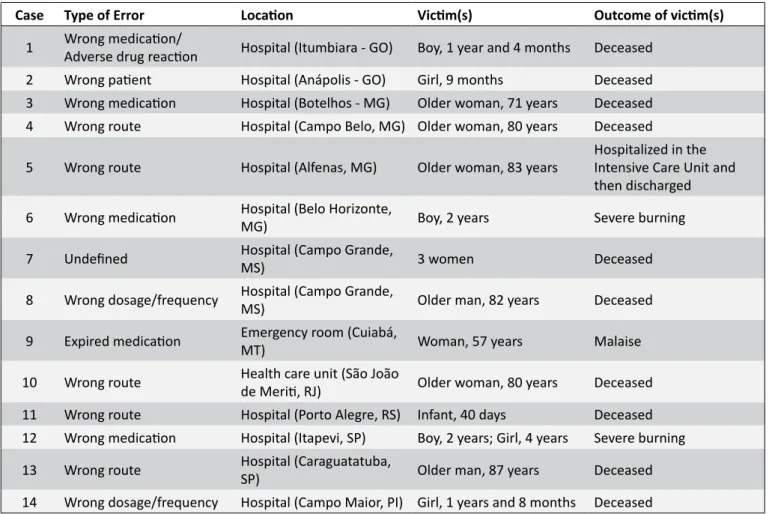
The errors reported (Table 1) led to severe harm to victims who died in the majority of cases (n=10). This fact emphasizes the hazard involved in the medication process, which consequently requires constant (re)planning of safety actions with an emphasis on error prevention. This is because death, considered to be an adverse event of high severity,3 can be frequent in the case of medication errors.
Errors included different Brazilian regions. However, when the type of health establishment of occurrences is taken into
consideration, the majority of cases were found in hospitals
(n=12). This fact is expected to some degree, because, according to the literature,14 health care is more complex in hospitals, due
to the increasing incorporation of knowledge and technology,
although this has not concomitantly helped to solve professional
quantification and qualification problems present in these services.
In the context of medication processes, the nursing team
usually has a high workload, as it is responsible for direct drug
manipulation, before they are given to patients.6 This may be even more evident in the hospital context, as, during clinical practice, pharmacological management in these environments usually occurs through invasive routes - especially the intravenous route. This manipulation is very time consuming for the maintenance of permeability of devices (catheters) inserted in the vascular endothelium, apart from the need for more caution when drugs are administered.
Regarding victims' characteristics, the majority were in
extreme age groups, i.e. children (n=7) and older adults (n=6), groups that usually require more health care, compared to other
age groups. It is known that extreme age groups in the life cycle
include natural physiological changes which can lead to certain pathological processes and even hospitalizations.
Children, in particular, are more vulnerable to the occurrence of medication errors when compared to other age groups, which
can be justified by their anatomical and physiological peculiarities and by the lack of pharmaceutical industry and health policies
to meet the special needs of this clientele.15 In view of these
facts, one should rethink the official social initiatives on behalf of the implementation of specific strategies of medication error
prevention, aiming to promote pediatric patient safety.
In the international context, there are already recommenda-tions for the reduction of medication errors and patient safety principles in Pediatrics15 that can contribute to the improvement of Brazilian health programs and policies and child safety. This means that the previously mentioned policies can be adapted to this country's reality, aiming to improve the health conditions of this particular clientele.
Given the use of multiple medications (polypharmacy) and high frequency of hospitalizations, the literature16 emphasizes
the greater risk of occurrence of errors in the elderly population. Thus, for this clientele, the nursing team must provide significantly
more care and, in the case of nurses, prescribed pharmacological intervention must be considered rationally, so that this can also contribute to elderly patient safety and promote the reduction of
medication error risks.3,16
After the analytical procedure of speech included in the reports was performed, two thematic categories emerged.
Identification of medication errors and reaction of
those (allegedly) involved
It is possible that many errors made during the administration
of drugs are not identified or perceived by the nursing team. In
Table 1.
Characterization of cases of medication error involving Nursing, disclosed by an electronic television medium.
Brazil, 2012-2016.
Case
Type of Error
Location
Victim(s)
Outcome of victim(s)
1
Wrong medication/
Adverse drug reaction
Hospital (Itumbiara - GO)
Boy, 1 year and 4 months
Deceased
2
Wrong patient
Hospital (Anápolis - GO)
Girl, 9 months
Deceased
3
Wrong medication
Hospital (Botelhos - MG)
Older woman, 71 years
Deceased
4
Wrong route
Hospital (Campo Belo, MG) Older woman, 80 years
Deceased
5
Wrong route
Hospital (Alfenas, MG)
Older woman, 83 years
Hospitalized in the
Intensive Care Unit and
then discharged
6
Wrong medication
Hospital (Belo Horizonte,
MG)
Boy, 2 years
Severe burning
7
Undefined
Hospital (Campo Grande,
MS)
3 women
Deceased
8
Wrong dosage/frequency
Hospital (Campo Grande,
MS)
Older man, 82 years
Deceased
9
Expired medication
Emergency room (Cuiabá,
MT)
Woman, 57 years
Malaise
10
Wrong route
Health care unit (São João
de Meriti, RJ)
Older woman, 80 years
Deceased
11
Wrong route
Hospital (Porto Alegre, RS) Infant, 40 days
Deceased
12
Wrong medication
Hospital (Itapevi, SP)
Boy, 2 years; Girl, 4 years
Severe burning
13
Wrong route
Hospital (Caraguatatuba,
SP)
Older man, 87 years
Deceased
14
Wrong dosage/frequency
Hospital (Campo Maior, PI) Girl, 1 years and 8 months
Deceased
The error was made by a nursing technician at around 7:00am on Friday, but it was only perceived two hours later by a team nurse. (Reporter, Case 5).
The medication process imposes fast work dynamics on
the nursing team, especially professionals without a university
degree, as they are responsible for most of the workload
associated with the health care process.6 In this case, there was
a delay before the error could be identified, as nearly two hours had passed after the occurrence, due to this identification being
made by a professional other than the one who administered
the medication. This professional, a nurse, may have identified
the error due to the characteristic of supervision of the technical
team's work, who perhaps did not detect this error immediately because of the multiple tasks they are responsible for.
Although this is not a justification for legal and ethical
backing, nor was it pointed out as the cause of the error reported in Case 5, the nursing work overload is directly associated with greater likelihood of adverse events in health care.6 Thus, it is
evident that the nursing work must include safety measures,
aiming to prevent the occurrence of adverse events while,
concomitantly, its action can obtain greater scientific backing.
Although certain cases do not clearly identify the individuals who detected the errors, family members who accompanied the
victims were found to be the ones who most frequently identified
such errors:
My granddaughter picked up the saline solution [...] she looked at it and said: 'Grandma, they gave you an expired solution' [...] (Victim, Case 9).
I said, 'You're injecting milk in her vein, coffee with milk in
her vein, take it out! [...] (Daughter, Case 10).
Patients and their family members can and must contribute to health care quality, acting as active agents in search for their own safety, including for the prevention of medication errors.3 In this sense, apart from encouraging these individuals to partici-pate in health care, it is important that nursing professionals listen to and value their warnings, aiming to prevent error situations from becoming irreversible conditions.3,4
A study performed in a university hospital in the state
of Paraná showed that patients' knowledge about the use of
is one of the factors of greatest lack of knowledge about the
hospital care provided.17 In light of this reality and what has been observed in the present study, family participation is invaluable
to develop a safety measure, as possible lack of knowledge or
unfavorable clinical conditions can cause patients not to detect
possible health care errors and risks, thus not contributing to the identification of errors, as observed in Cases 9 and 10.
Actively listening to family members can help professionals
in the detection of changes or early identification of errors.3,4 In contrast, there were reports on the nursing team's disbelief or undervaluing of family complaints about the clinical conditions
of their sick member:
I talked to the nurse that he wasn't well, but she said he was, then he did something and left [...] (Mother, Case 1).
[...] when she received the medication, she began to feel
bad, but she was treated as if she had suffered from an
allergic attack and then discharged. Later on, she was hospitalized again, with third-degree burns [...] (Reporter, Case 6).
It should be emphasized that the patient and their family are
the best ones to know their health history, development of their
disease, symptoms and experiences with previous treatments.3 In this perspective, disregarding the information provided by these
individuals can have harmful effects, in addition to revealing
professionals' anti-ethical approach.
The disregard for family requests or information shows that certain professionals still believe they are above patients and their family members. Additionally, this distant relationship hinders everyone's involvement and participation in the health care process, especially when medication is administered, which requires more attention.17,18 This can be a factor that enables the occurrence of errors and it can also aggravate the analysis of such errors in a context where the norm is to blame professionals.19
Despite the professional attitude of nursing workers towards
the reported cases, Case 6 should be mentioned, as the reporter
affirmed that the patient/victim of an error "was treated as if they
had suffered from an allergic reaction and then discharged". When this report is analyzed, what stands out is the fact that errors are too complex and delicate to be narrowed down to only one professional category being blamed or, at least, judged for this. This is because therapeutic actions adopted in this case after
the error was made reveal that medical conducts like diagnosis
and discharge were followed, despite the apparently unfavorable
clinical conditions after the wrong medication was taken.
In light of this, using protocols to regulate health care and establishing service routines in case errors occur requires the involvement of the entire multidisciplinary team, aiming to avoid situations that generate culpability among categories, as evidenced in the report below:
As the doctor left the ICU, he said, "Your mother has passed. But the reason why she passed was an error made by the nurse, as she administered the medication in the wrong way, which aggravated her situation and caused her to die [...] (Son, Case 4).
It should be emphasized that the relationships between doctors and other professionals must be based on ethics, mutual
respect, freedom and professional autonomy, constantly seeking
patients' interest and well-being.20 The report obtained from Case 4 emphasizes the fact that the culture of blame remains stronger than that of safety.
What stands out when an error occurs is the fact that the professionals involved must act honestly, without fear of punishment, as this would be the path for measures towards
patients, family members and professionals to be taken, aiming
to prevent/minimize the occurrence of errors.21 This could be observed in Cases 8 and 11.
As soon as it [the error] was identified, the nurse in
charge of this sector was informed and she went there with a doctor to assess the patient. The necessary measures were taken immediately (Hospital Director, Case 8).
A hospital nursing technician [...] admitted that she'd injected food in the vein of a child who was hospitalized in the neonatal ICU (Reporter, Case 11).
She [the nursing technician] confessed that she had administered the medication in the wrong way [...] (Chief of Police, Case 13).
Nursing professionals admitting to errors is something that
arouses several feelings, resulting in psychological suffering.
Feelings such as sadness, guilt and embarrassment are sometimes aggravated by the frequent emphasis on punishment given by the institution and family members, thus resulting in psychological stress and turning professionals into "second victims" of the adverse event.22
Among health professionals, nursing team members are
responsible for finishing the process of drug administration and,
upon detecting errors, they can contribute to their prevention. As a result, blaming a professional for a medication error tends
to become an individual burden on them. This rarely takes into consideration infrastructure, human resources and financial
conditions that contribute to the occurrence of errors.
It should be emphasized that none of the news stories pointed to aggravating situations that could lead to errors, causing the social imaginary to blame the professional who administered the medication exclusively. Thus, notably, the repercussion of errors
Reactions, feelings and attitudes towards
medication errors
Family members of victims of medication errors with the involvement of nursing professionals expressed reactions and feelings through their pain, sadness and/or outrage, as observed in the reports below.
This can't go unpunished! How can this girl [nurse] give the boy an injection that is harmful and makes him have a heart attack? [...] (Father, Case 1).
[...] I hope my mother's death was not in vain, but that it works as a warning for people to be careful [...] (Son, Case 4).
We want justice, it was a child who died without knowing anything. This case needs to be investigated and those who are wrong must pay for their mistakes. (Mother, Case 14).
Due to the outrage with the medication error and its outcome, some family members demanded justice and more attention and safety in health care. The occurrences of errors led to catastrophic consequences to patients and nursing professionals, incurring ethical punishments meted out by the
Federal and Regional Nursing Councils,23 aiming to implement
safer and more effective practices of patient care.
Instead of being an angel who saves lives, this nurse caused a death, because she didn't know how to administer a medication [...] (Son, Case 4).
It's not fair to let someone who is not qualified, someone
who is an intern, to do the job of those who have to do it [...] (Daughter, Case 10).
When the reports above are analyzed (Cases 4 and 10), the angel stereotype that has perpetuated through Nursing since Florence Nightingale is the result of the association between this profession and humility, human dedication and divine gift. In
this aspect, family members hope to find emotional and spiritual
support in these professionals, in addition to the
technical-scientific knowledge required to care for their sick member.
News stories revealed important reports of insufficient
professional qualification in the nursing area. It must be pointed
out that errors made by students, including medication ones, do not exempt nurses from the responsibility for the events occurred under their supervision.24 Moreover, there is the need to constantly use continuing health education to qualify
professionals and seek quality of care.
The severity of the consequences attributed to medication errors determines the penalties for the professionals involved,
taking into consideration the body injuries caused to patients
and the type of consequence. Professionals may have to face lawsuits due to negligence, imprudence or malpractice, whose
responsibility is regulated by civil, criminal and ethical law.23 Penalties were attributed to the professionals involved in the cases studied, as described in the reports below.
The chief of police affirmed that the nursing assistant
acted with negligence, imprudence and malpractice. (Reporter, Case 5).
Those involved were accused of manslaughter and serious bodily injury [...] (Reporter, Case 7).
The Regional Nursing Council says that they're analyzing the case and that they'll take all the measures necessary,
in case the infraction is confirmed [...] (Reporter, Case 12).
Although there is a movement to promote a just culture, the punitive culture remains a reality in institutions where there is no adequate disclosure or mention of the causal factors that contribute to medication errors. This is because medication
errors are influenced by multiple systemic factors and scientific evidence is still limited to support changes in the work process
of health institutions.21
As a precaution, many institutions remove those involved from their duties for investigation, as observed in the reports below.
The woman who changed the medication was removed and the police will investigate the case [...] (Reporter, Case 6).
The health department is investigating the case and it has already removed both the intern and nurses who should be supervising the students [...] (Reporter, Case 10).
The nursing technician continues to work in the hospital, but she's been removed from her duties. (Reporter, Case 5)
Health institutions must adopt a culture of openness towards medication errors, with the creation of policies and standardizations for reporting, disclosure and strengthening of preventive measures.3,7 After all, errors are part of human nature and, upon their occurrence, measures must be adopted for the patients' clinical condition to be adequate and for strategies to be implemented to prevent new occurrences.
CONCLUSIONS AND IMPLICATIONS FOR
PRACTICE
The news stories about medication errors reported through a television medium were found to be relatively limited. This is because potential health service users become aware of the existence of medication errors that can be deadly without, however, obtaining any information about the mechanisms and
processes of identification and prevention of errors, nor about
It is urgent and necessary to associate risk management
measures and academic and professional discussions with greater public awareness of patient safety issues. Additionally,
evidence of flaws in the system must be viewed as an opportunity to review the health work process and to improve health care.
Accusations against nursing professionals must follow ethical-legal procedures. However, one must remember that individuals seem to be blamed without any concern about the processes that lead to medication errors.
REFERENCES
1. Institute of Medicine (US) Committee on Quality of Health Care in America; Kohn LT, Corrigan JM, Donaldson MS, eds. To err is human: building a safer health system. Washington (USA): National Academy; 2000.
2. Rutberg H, Risberg MB, Sjödahl R, Nordqvist P, Nilsson L. Characterisations of adverse events detected in a university hospital: a 4-year study using the Global Trigger Tool method. BJ Open [Internet]. 2014; [cited 2017 May 23]; 4(5):1-6. Available from: https://goo.gl/ AsMLDh
3. Ministério da Saúde (BR). Agência Nacional de Vigilância Sanitária. Implantação do Núcleo de Segurança do Paciente em Serviços de Saúde. Brasília (DF): Anvisa; 2014.
4. Ministério da Saúde (BR). Portaria Nº 529/2013, de 1 de abril de 2013. Institui o Programa Nacional de Segurança do Paciente (PNSP). Brasília (DF): Ministério da Saúde; 2013.
5. Ministério da Saúde (BR). Portaria Nº 2.095/2013, de 24 de setembro de 2013. Aprova os protocolos básicos de segurança do paciente. Brasília (DF): Ministério da Saúde; 2013.
6. Magalhães AMM, Moura GMSS, Pasin SS, Funcke LB, Pardal BM, Kreling A. The medication process, workload and patient safety in inpatient units. Rev Esc Enferm USP [Internet]. 2015; [cited 2017 Jun 12]; 49(n.esp.):43-50. Available from: https://goo.gl/VFsJtj
7. Vilela RPB, Jericó MC. Medication errors: management of the medication error indicator toward a more safety nursing practice. Rev Enferm UFPE On Line [Internet]. 2016 Jan; [cited 2017 Feb 14]; 10(1):119-27. Available from: file:///C:/Users/susana/Downloads/10929-23764-1-PB.pdf 8. Gaíva MAM, Souza JS. Medication administration errors in neonatal
intensive care units. Ciênc Cuid Saúde [Internet]. 2015 Jul/Sep; [cited 2017 Jun 14]; 14(3):1330-8. Available from: https://goo.gl/Wth2Nj 9. Souza VS, Kawamoto AM, Oliveira JLC, Tonini NS, Fernandes LM, Nicola
AL. Errors and adverse events: the interface with health professional' safety culture. Cogitare Enferm [Internet]. 2015 Jul/Sep; [cited 2017 May 15]; 20(3):474-81. Available from: https://goo.gl/dFPF1U
10. Silva JQ, Oliveira VB. Medicamentos de alta vigilância em meio hospitalar: uma revisão. Rev Saúde Desenvolvimento [Internet]. 2015; [cited 2017 May 14]; 7(4):179-94. Available from: https://www. uninter.com/revistasaude/index.php/saudeDesenvolvimento/article/ view/403/0
11. Hinchcliff R, Westbrook J, Greenfield D, Baysari M, Moldovan M, Braithwaite J. Analysis of Australian newspaper coverage of medication errors. Int J Qual Health Care [Internet]. 2012; [cited 2017 May 14]; 24(1):1-8. Available from: https://goo.gl/Gx6jBa
12. World Health Organization (WHO). Conceptual Framework for the International Classification for Patient Safety. v 1.1. Final Technical Report and Technical 2009. [cited 2016 Jul 28]. Available from: http:// www.who.int/patientsafety/taxonomy/icps_full_report.pdf
13. Bardin L. Análise de conteúdo. Lisboa: Edições 70; 2011. 229 p. 14. Ferreira PC, Machado RC, Vitor AF, Lira ALBC, Martins QCS.
Dimensionamento de enfermagem em Unidade de Terapia Intensiva: evidências sobre o Nursing Activities Score. Rev Rene [Internet]. 2014 Sep/Oct; [cited 2018 Apr 26]. 15(5):888-97. Available from: file:///C:/ Users/susana/Downloads/1685-13533-1-PB.pdf
15. Harada MJCS, Chanes DC, Kusahara DM, Pedreira MLG. Safety in medication administration in pediatrics. Acta Paul Enferm [Internet]. 2012; [cited 2017 May 12]; 25(4):639-42. Available from: https://goo.gl/7EsyDt 16. Barreto MS, Reiners AAO, Marcon SS. Knowledge about hypertension
and factors associated with the non-adherence to drug therapy. Rev Latino Am Enferm [Internet]. 2014 May/Jun; [cited 2017 May 14]; 22(3):491-8. Available from: https://goo.gl/eEJPn3
17. Pedro DRC, Silva GKT, Molin TD, Oliveira JLC, Nicola AL, Tonini NS. Knowledge about patient hospital care received during your admission. Rev Min Enferm [Internet]. 2016; [cited 2018 Apr 26]; 20:e978. Available from: http://www.reme.org.br/artigo/detalhes/1114
18. Lemos NRF, Silva VR, Martinez MR. Fatores que predispõem à distração da equipe de enfermagem durante o preparo e a administração de medicamentos. Rev Min Enferm [Internet]. 2012 Apr/Jun; [cited 2018 Apr 26]; 16(2):201-7. Available from: http://www.reme.org.br/artigo/detalhes/520 19. Silva LG, Matsuda LM. Um olhar para a qualidade no processo de
atendimento em um serviço de urgência público. Ciênc Cuid Saúde [Internet]. 2012 [cited 2017 Jun 13]; 11(Supl.):121-8. Available from: https://goo.gl/pV7vYW
20. Conselho Federal de Medicina (BR). Código de Ética Médica: Resolução CFM Nº 1931, de 17 de setembro de 2009. Brasília (DF): Conselho Federal de Medicina; 2010.
21. Keers RN, Williams SD, Cooke J, Ashcroft DM. Prevalence and nature of medication administration errors in health care settings: a systematic review of direct observational evidence. Ann Pharmacother [Internet]. 2013 Feb; [cited 2018 Apr 26]; 47(2):237-56. Available from: https:// www.ncbi.nlm.nih.gov/pubmed/23386063
22. Pellino IM, Pellino G. Consequences of defensive medicine, second victims, and clinical-judicial syndrome on surgeons' medical practice and on health service. Updates Surg [Internet]. 2015 Dec; [cited 2018 Apr 26]; 67(4):331-7. Available from: https://link.springer.com/article/1 0.1007%2Fs13304-015-0338-8
23. Conselho Federal de Enfermagem (BR). Resolução COFEN Nº 311/2007. Aprova a Reformulação do Código de Ética dos Profissionais de Enfermagem. Rio de Janeiro: Conselho Federal de Enfermagem; 2007. 24. Conselho Nacional de Educação. Resolução CNE/CES Nº 3, de 7 de