Seventeenthcentury parochial manuscripts from Almada: study and conservation Ana Barrosa, Departament of Conservation and Restoration, Faculty of Sciences and Technology, Universidade NOVA de Lisboa, Caparica.
Rita Castro, Departament of Conservation and Restoration, Faculty of Sciences and Technology, Universidade NOVA de Lisboa, Caparica; LAQV-REQUIMTE, Faculty of Sciences and Technology, Universidade NOVA de Lisboa, Caparica and Institute of Medieval Studies, Faculty of Social Sciences and Humanities, Universidade NOVA de Lisboa, Lisbon.
Rita Araújo, Departament of Conservation and Restoration, Faculty of Sciences and Technology, Universidade NOVA de Lisboa, Caparica; LAQV-REQUIMTE, Faculty of Sciences and Technology, Universidade NOVA de Lisboa, Caparica and Institute of Medieval Studies, Faculty of Social Sciences and Humanities, Universidade NOVA de Lisboa, Lisbon.
Mª Conceição Casanova, Museus da Universidade de Lisboa (ULisboa), Lisbon; Department of Conservation and Restoration, Faculty of Sciences and Technology, Universidade NOVA de Lisboa, Caparica and Institute of Medieval Studies, Faculty of Social Sciences and Humanities, Universidade NOVA de Lisboa, Lisbon.
Abstract
This paper discusses the historical context, material study, conservation condition and treatment of two parochial manuscripts of Almada from the seventeenth century: the Commitment book of the Virgem de Nossa Senhora da Piedade from the Brotherhood of Nossa Senhora da Piedade, dating from 1606; and the Indulgences and Spiritual Graces book, from the Brotherhood of Santíssimo Sacramento, dating from 1616.
The study of these two manuscripts was developed using different analytical techniques: μ-EDXRF (micro-Energy Dispersive X-ray Fluorescence spectroscopy), FORS (Fibre Optics Reflectance spectroscopy), μ-Raman (Micro-Raman spectroscopy), μ-FTIR (micro-Fourier Transform Infrared spectroscopy), microspectrofluorimetry and SERS (Surface-Enhanced Raman spectroscopy). These were applied to characterise the material support and writing inks from both books and the painting materials of the illumination of the Commitment book. This multi-analytical approach was also used to identify previous conservation interventions, which turned out to be essential for the conservation treatment decision for both manuscripts.
In the conservation decision it was taken into account the manuscripts writing supports differences. Based on the IDAP system (Improved Damage Assessment of Parchment, www.idap-parchment.dk), it was evaluated the conservation condition of the Indulgences book – made of parchment. This diagnostic system was also adapted – to assess the Commitment book – made of paper – taking into account the main characteristics of this cellulosic material and its alterations. The diagnosis and conservation for both manuscripts are shortly described, considering the support materials of the text block, previous interventions and state of conservation.
Keywords: Commitment book, Indulgences book, multi-analytical approach, IDAP, conservation, intervention.
1. Introduction
In the seventeenth century, lay brotherhoods were expanding because of the counter-reformation of the Catholic Church. In Portugal, these communities were widely spread, especially the brotherhoods devoted to the Virgin Mary and Holy Sacrament.1,2 The Commitment and the Indulgences books are considered the most important manuscripts in a brotherhood. The Commitment books gather the statutes or rules that regulate the running of the brotherhoods and the moral conduct of the brothers, being valid only when approved by civil or ecclesiastic authorities.3 When approved, these organisations were normally given benefits, Indulgences or graces, depending on the status of the brotherhood, their connection to arch-brotherhoods or papal bulls.4 Brotherhoods usually embellished and applied high quality materials to this type of manuscripts, following the techniques found in practical treatises of the same period.5 Because of this, these books
are considered important testimonies to the study of these communities and their practices, as well as of their wealth and social evolution in the course of time.
1.1. The Commitment book
The Commitment book of Nossa Senhora da Piedade, owned by the brotherhood of Nossa Senhora da Piedade in Almada, measures 202 x 286 x 10 mm. The binding has pasteboards of flax or hemp fibres, covered with full leather with gold tooling decorations in a seventeeencentury style.6 The binding has also two holes with residual tissue from fastenings, both in flax or hemp fibres. It is also visible the traces of a two colour endbands, in yellow and green silk fibres at the head and tail of the manuscript. The sewing was made with flax or hemp fibres thread in an all-along sewing over three single cords. The spine has paper and parchment panel spine linings. The textblock is composed of nineteen paper folios of flax or hemp fibres. It has two illuminated folios (ff. 1 and 2, respectively): the first one is a parchment piece glued over a paper folio, representing an altarpiece with Veronica’s veil on top and an inscription on the bottom depicting: ’Attendite si estdolor simílis sicvt dolor mevs’ from the ’Vos omne’, which is inspired by the biblical passage 1:12 of the book of lamentations; the second one represents a Pietà that corresponds to the devotion of the brotherhood. Both folios can be seen in Figure 1.
f.1
f.2
Figure 1: Commitment book of Nossa Senhora da Piedade, parish of Cova da Piedade in Almada, 1606, frontispiece (f. 1) and illuminated folio representing Pietà (f. 2).
The folios 3r to 11v are divided in fourteen chapters with the rules of this brotherhood. These folios are written in brown, with red titles, inside a red frame. The folios 12 to 13r contain the civil authority approval: ’mesa de consciencias e ordens’ of Filipe II, granted in 1606. At the end of the manuscript there were three folios added later (folio 14 and two endpapers in the verso). One addition to the rules of the Commitment book was made after the approval by the civil authority in 1661, and also the Annulment and reconfirmation of the Commitment book and brotherhood, by the ecclesiastic authority in 1720.7
1.2. The Indulgences book
The Indulgences and Spiritual Graces book, owned by the brotherhood of Santíssimo Sacramento in Almada, measures 212 x 302 x 14 mm. The binding has pasteboards made of a mixture of flax, hemp and cotton fibres covered with full leather with gold tooling decorations, in what seems to be a late eighteenthor beginning of nineteenth century bookbinding.8The binding has also two holes with residual tissue from textile ties, both
in silk fibres. The textblock contains thirteen folios in flax or hemp fibres. The first eight folios are made of parchment and contain the Indulgences, privileges and spiritual graces granted to the brotherhood of Santíssimo Sacramento, from Almada in a diploma model.9 The parchment folios are organised according to Gregory’s rule and are followed by five folios in blank paper. Between folios 8v and 9r there are marks of several ripped paper folios. The parchment frontispiece has a decorative frame with figurative elements and flowers, while the others are decorated with a simple frame, all in brown, as seen in Figure 2. The all-along sewing is over four single leather supports. The spine has a parchment panel spine linings and the manuscript edges are golden.
Figure 2:Indulgences book, brotherhood of Santíssimo Sacramento, parish of Almada, in Almada, 1616, left pastedown and frontispiece, folios 2v and 3r.
2. Methods and Instrumentation 2.1. Manuscripts
In the Commitment book, a total of 10 folios were studied, from which 4 folios were analysed in-situ by micro-EDXRF, FORS and micro-Raman: folios 1r, 2r, 3 and 14v. The binding and endleaves were also analysed in-situ by micro-EDXRF. Micro-sampling was performed on folios 1r, 2r and 3 with a micro-chisel from Ted Pella micro-tools under a Leica KL 1500 LCD micro-scope, equipped with a 12x objective and a Leica Digilux digital camera, with external illumination via optical fibres.
In the case of the Indulgences book, three folios were analysed in-situ by micro-EDXRF and micro-Raman: the left pastedown from the front of the manuscript and folios 1r and 5r.
2.2. Instrumentation
Micro-EDXRF (micro-Energy Dispersive X-ray Fluorescence spectroscopy): was obtained using an ArtTAX spectrometer of Intax GmbH, with a low-power molybdenum (Mo) Ray tube attaining a microspot with a spatial resolution of circa 70 µm, an X-flash detector refrigerated by the Peltier effect (Sidrift), sustained by a mobile arm (providing a major freedom in choosing the spot of analysis). The accuracy of the incident beam position on the sample is achieved through three beams crossing diodes controlled by an integrated CCD camera; the characteristic X-rays emitted by the sample (at 40 ºC)
are detected by a silicon drift electro-thermally cooled detector with a resolution of 160 eV at Mn-Kα. The experimental parameters used were: 40 kV of voltage, 300 µA of intensity, for 120 s, under Helium gas flux.
FORS (Fiber Optics Reflectance Spectroscopy): was obtained with a reflectance spectrophotometer Ocean Optics in the UV-Vis region through optical fibres. The analyses were obtained with 8 ms integration time and 15 scans.
Raman microscopy: was carried out using a Labram 300 Jobin Yvon spectrometer, equipped with a He-Ne laser of 17 mW power operating at 633 nm (red laser), and a 532 nm diode laser of 50 mW power operating at 75% (green laser). Spectra were recorded as an extended scan. The laser beam was focused either with a 50 x or a 100 x Olympus objective lens. The laser power at the surface of the samples, between 4.3 and 0.17 mW. SERS (Surface-Enhanced Raman Spectroscopy) was performed in the same equipment. The silver colloid synthesis, hydrofluoric acid pre-treatment, sample pre-treatment and Orchil dye standard are the same as described in detail somewhere else.10
Micro-FTIR (Fourier Tranform Infrared Spectroscopy): was performed using a Nicolet Nexus spectrophotometer coupled to a Continuµm microscope (15 x objective) with a MCT-A detector cooled by liquid nitrogen. The spectra were collected in transmission mode, in 50 µm areas resolution setting 4 cm-1 and 128 scans, using a Thermo diamond anvil compression cell. For some infrared spectra the system was purged with nitrogen prior to the data acquisition; for all infrared spectra the CO2 absorption at circa 2400-2300
cm-1 was removed from the acquired spectra (4000- 650 cm-1). To improve result robustness, more than one spectrum was acquired from different sample spots.
Fluorescence excitation and emission: were recorded with a Jobin Yvon/Horiba SPEX Fluorog 3-2.2 spectrofluorometer. Fluorescence spectra were corrected for the wavelength response of the system. For microspectrofluorimetry analyses, the latter equipment was hyphenated to an Olympus BX51 M confocal microscope, with spatial resolution controlled with a multiple-pinhole turret, corresponding to a minimum 2 μm and maximum 60 μm spot, with 50 x objective. Standard dichroic filters of 500 and 600 nm were used at 45° to collect the emission and excitation spectra, respectively. Emission spectra were acquired exciting at 490 nm and excitation spectra were recorded collecting the signal at 610 nm. Both types of spectra were acquired on a 30 μm spot (pinhole 8) and the following slits set: emission slits = 3 / 3 / 3 mm, and excitation slits = 5 / 3 / 0.8 mm.
3. Painting and Ink Characterisation 3.1. The Commitment book
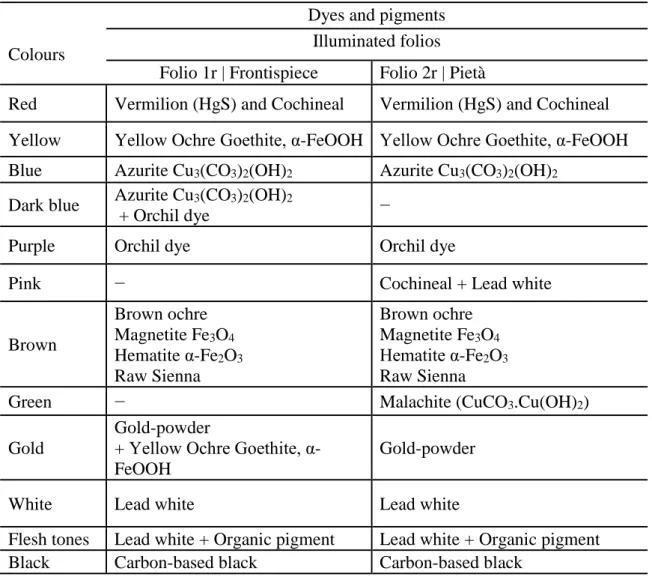
Through our multi-analytical approach it was possible to conclude that the main pigments and dyes used in the illuminated folios were in accordance with seventeenth century treatises, see Table 1. 11, 12
Table 1: Dyes and pigments identified in the illuminated folios of the Commitment book.
Colours
Dyes and pigments Illuminated folios Folio 1r | Frontispiece Folio 2r | Pietà
Red Vermilion (HgS) and Cochineal Vermilion (HgS) and Cochineal Yellow Yellow Ochre Goethite, α-FeOOH Yellow Ochre Goethite, α-FeOOH Blue Azurite Cu3(CO3)2(OH)2 Azurite Cu3(CO3)2(OH)2
Dark blue Azurite Cu + Orchil dye 3(CO3)2(OH)2 ‒
Purple Orchil dye Orchil dye
Pink ‒ Cochineal + Lead white
Brown Brown ochre Magnetite Fe3O4 Hematite α-Fe2O3 Raw Sienna Brown ochre Magnetite Fe3O4 Hematite α-Fe2O3 Raw Sienna
Green ‒ Malachite (CuCO3.Cu(OH)2)
Gold
Gold-powder
+ Yellow Ochre Goethite, α-FeOOH
Gold-powder
White Lead white Lead white
Flesh tones Lead white + Organic pigment Lead white + Organic pigment Black Carbon-based black Carbon-based black
Red colours, achieved with vermilion and cochineal, were identified by Raman spectroscopy – the latter was characterised with SERS through its main chromophore, acid carminic, Fig. 3a). Yellow was identified through infrared spectroscopy as goethite, Fig. 3b). Azurite was identified as the main blue pigment by infrared spectroscopy, Fig. 3c). Purple was achieved with orchil dye, which was identified with in-situ Raman spectroscopy and confirmed by SERS spectra standard, Fig. 3d). This dye has been also identified in an illuminated atlas from the sixteen century.13 Darker shades of blue were
obtained by admixing azurite and orchil dye. Pink tones were identified as a mixture of lead white with cochineal. Brown colours were achieved with several brown ochres. Malachite was identified by Raman spectroscopy in f. 2r. Gold-powder was used to paint gold, and goethite was sometimes admixed in f. 1 (most likely to lower the cost of production). Lead white was identified as the main white pigment, and was also used to paint the flesh tones. Finally, carbon-based black was identified by Raman spectroscopy.
Figure 3: Selected spectra of the dyes and pigments analysed in ff. 1 and 2 of the Commitment book: a) SERS spectrum of the dark red paint, in f. 1r; b) Infrared spectrum of the yellow paint, in f. 1r; c) Infrared spectrum of the blue paint, in f. 1r; d) Raman spectra of purple and dark blue, in ff. 1r and 2r, with a SERS spectrum of orchil dye (Lasallia Pustulata).
The inks from the original manuscript were identified as iron gall inks by micro-EDXRF and micro-Raman, while the textual brown reconstruction from previous intervention was made with carbon black. The red colour used in both original manuscript and frame reconstructions was made with vermillion.
3.2. The Indulgences book
Since the Indulgences book does not contain any illuminations, it was only possible to analyse the text and frames. Micro-EDXRF and micro-Raman allowed to conclude that the brown colour in the manuscript was an iron gall ink.
4. Conservation Condition
The pathologies diagnosis used for both manuscripts was based on the IDAP methodology, by using the PDAP (Parchment Damage Assessment Programme).14 This approach was supported by a parallel work conducted by Correia,15 who has adapted
detailed evaluation of the support and its damage distribution based on two levels of visual observation. The first level includes the identification of the support and the description of the general damages observed in the analysed folio, providing four levels of evaluation on the conservation condition: 1 – Undamaged; 2 - Slightly damaged; 3 - Damaged; 4 - Heavily damaged. The second level of observation selects several specific areas of the support, which should be illustrative of its conservation condition, establishing a correlation between the general evaluation of the folio and the damages observed in the selected areas.16,17
To assess and compare the conservation condition of the Commitment book – which is a paper support manuscript – it was necessary to develop an experimental system of evaluation of damage for paper supports, by visual observation, similar to IDAP, considering as well the main characteristics of the paper support.18,19
All folios from both manuscripts were observed, macroscopically, and for each folio three specific areas were selected to be observed at the stereomicroscope: 1) on the right upper corner of the folio (with a slight variation on the Indulgences book that have text also in the margins); 2) on the left middle corner of the folio; 3) on the right down corner of the folio. The purpose was to compare its overall damage and see how they behave and appear in each specific area.
4.1. The Commitment book
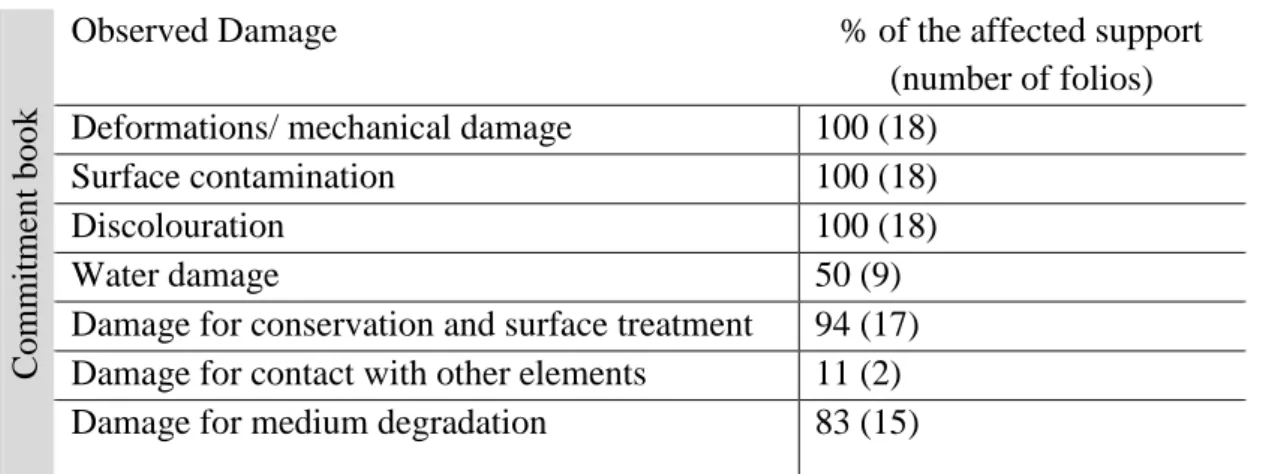
The diagnosis of the Commitment book allowed the definition of the damage distribution on the support. It was possible to conclude that 33% of the support was slightly damaged (level 2) and that 67% was damaged (on level 3). The slightly damaged folios included the endpapers and folio 14, while the damaged folios were found to be between folios 2 and 13, respectively. The description of the type of damages observed can be seen in Table 2.
Table 2: Damages in the Commitment book.
C
omm
it
ment book
Observed Damage % of the affected support
(number of folios) Deformations/ mechanical damage 100 (18)
Surface contamination 100 (18)
Discolouration 100 (18)
Water damage 50 (9)
Damage for conservation and surface treatment 94 (17) Damage for contact with other elements 11 (2) Damage for medium degradation 83 (15)
The damage for contact with other elements refers to the damage caused to the support by the wax seal present on folio 12 and the mechanical damage corresponds mostly to tears and gaps. The most damaged area was specific area 3, which is normally associated to handling. It presented more deformations / mechanical damages, surface contamination and surface treatment in the manuscript.
4.1.1. Previous interventions
While observing the manuscript at the microscope, it became apparent that the image of folio 2 was coated with paper fibres, Figure 4. As seen previously in Table 1, with the exception of the green colour, both folios had a very similar palette. The old and degraded appearance of the image was, consequently, given by that coating of thin paper, not by a different painting technique. It was not possible however to determine the reason of this coating, neither the way nor the time of its application.20
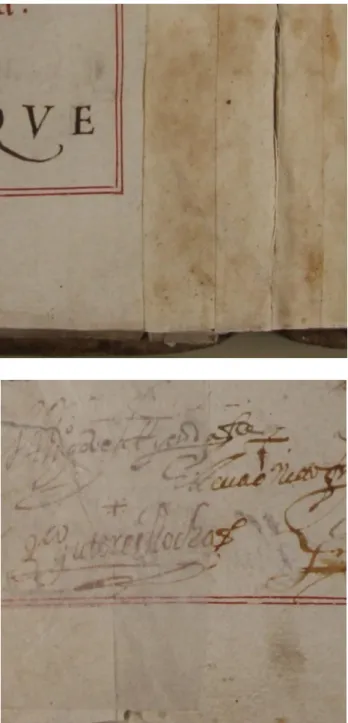
Figure 4: Details magnified 7x, 32x, 80x, respectively, from the Virgin's veil detail of the Commitment book of Nossa Senhora da Piedade, parish of Cova da Piedade in Almada, 1606. Besides that unusual coating, the manuscript suffered two other previous conservation treatments. The first intervention, named A, reassembled the support, allowing its sewing, by reinforcing the sewing stations with paper strips and additional patch for text and frame reconstructions. The second intervention, entitled B, was responsible for covering part of the original folios of the manuscript with a strong semi-transparent paper. This was supposed to add resistance to the paper and function as a protection to avoid the evolution of tears. These can be seen in Figure 5.
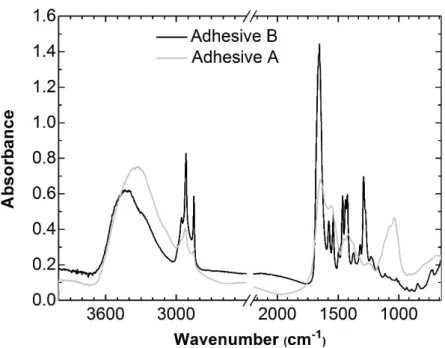
Figure 5: Commitment book of Nossa Senhora da Piedade, parish of Cova da Piedade in Almada, 1606, details of intervention A in folio 7v and detail of intervention B in folio 11v, respectively. The adhesives used in both interventions were analysed as well. By infrared spectroscopy, the adhesive used in intervention A was identified as a natural adhesive mixture of protein and polysaccharides, which is water soluble. On the other hand, the adhesive used in intervention B was possibly a synthetic mixture water activated, see Figure 6.
Figure 6: Infrared spectrum of the adhesives used in the two previous interventions of the Commitment book. Adhesive A: natural adhesives mixture; adhesive B: synthetic mixture.
4.2. The Indulgences book
The IDAP approach was applied in a simplified manner to the Indulgences book.21 The diagnosis of the Indulgences book allowed determining the damage distribution on the support, leading to the conclusion that 75% was slightly damaged (level 2) and that 25% was damaged (level 3). The damaged folios were folio 5 and 7, respectively, but it was not possible to determine the reason for this damage distribution irregularity. The damages observed in the parchment support of the manuscript are described in Table 3.
Table 3: Damage distribution in the Indulgences book parchment support.
Indulge nc es book P arc hment support
Observed damage % of the affected support (number of folios) Deformations 100(8) Mechanical damage 100(8) Discolouration 25(4) Glass-like layer 19(3) Calcite deposits 50(8) Damage of text 100(8)
Damages, such the calcite deposits, are only visible in the flesh side of the parchment and as a result the support is especially white on this side of the folios. Because of the
formation of the glass-like layer on the hair side, the surface developed a yellowish coloration and became brighter. It is also visible, as observed in the previous manuscript, that the specific area 3 is more damaged, with a predominance of calcite deposits and glass-like layer.
The paper folios in this manuscript present mechanical damages, such as small gaps caused by biological activity and discolouration, this one as a result of contact with water. In addition, the endpaper from the front was detached from the boards. This required reattachment, in order to prevent its loss.
The glue used to attach the endpapers to the boards was also analysed by micro-FTIR. It was concluded that the adhesive was a mixture of starch paste and animal glue, as seen in Figure 7.
Figure 7: Infrared spectra of the adhesive used in the Indulgences book and a standard mixture of 80% starch paste with 20% of animal glue.
5. Conservation of the manuscripts 5.1. The Commitment book
The intervention was established according to the conservation condition. The Commitment book was in a deteriorated state (Damaged, level 3). It seems that the two previous interventions promoted its physical degradation by putting the paper under stress, which led to the tearing of the paper. This also reduced the readability of the text because of the adhesives stains in the paper surface and the paper coating, causing loss of textual information. During the Intervention A it was also altered the order of the quires
of the book. The folios were originally bifolia and, with handling, they most likely ripped apart. During Intervention A, these were reattached as bifolia again, without changing the textual order. However, this reattachment disrespected the bifolia original union and the organisation of the quires. The binding was also very deteriorated and showing severe mechanical damage, such as gaps and surface abrasion with loss of the golden tooling decoration and part of the leather surface.
The conservation decision was mostly focused on the textblock, by approaching the following steps: removing the two previous interventions - keeping, however, the textual reconstructions in order to preserve it as historical evidence -; restructuring the manuscript in order to recuperate the textblock as much as possible into its original structure. In order to do this, the folios were rebounded again into bifolia, in order to recover its original format, and also the original quires shape. The binding needed consolidation of the leather cover surface and its gaps filling. In order to do this it was necessary to disassemble the manuscript, allowing the textblock conservation treatment and the binding cleaning and consolidation.
For the textblock, the main steps of conservation were: (i) the removal of the two previous interventions (this was made mechanically with a scalpel and tweezers); (ii) mechanical cleaning of the support (for it was used a Japanese brush, a Smoke-Sponge®22 and a Gum Mars Plastic 52650® from Staedtler inc®23); (iii) and the aqueous cleaning of the endpapers. Also, the adhesive from both interventions A and B was removed, using a preservation pencil with humidification and a scalpel. The textblock was rearranged, according to the original organisation of the quires. For this, paper reinforcements were applied in tears and filled the paper gaps using in both cases Japanese paper and Tylose ® MH 30024. Because of the risk of image loss, in folio 2 it was decided not to remove
the paper coating. The final result is depicted in Figure 8.
In the binding it was decided to reconstruct the endbands of the manuscript, using the same colours and material (silk) as found. The spine of the book was reinforced with the original parchment and paper panel spine linings after mechanical cleaning. And, the leather cover of the binding was treated with a solution of Klucel G®25 in a 3% mixture in ethanol, and the gaps filled with leather.
Figure 8: Commitment book Commitment book of Nossa Senhora da Piedade, parish of Cova da
Piedade in Almada, 1606, folios 2v and 3r, and folios 11v and 12r, where its visible intervention
5.2. The Indulgences book
The Indulgences book was mostly in level 2: slightly damaged. Consequently, the intervention was conservative, by re-attaching detached elements, such as the pastedown from the front and consolidating the binding. In order to do this, the conservation involved mechanical cleaning of the textblock using Japanese brush and Smoke-Sponge® The front paper pastedown was aqueous cleaned and its tears consolidated by using Japanese paper and starch paste. The pastedown was also reattached to the boards using starch paste. The cover of the binding was consolidated using Klucel G® in a 3% mixture in ethanol.
6. Conclusions
This interdisciplinary approach was essential for the decision making of book conservation treatment of these two different case studies. It also allowed the development of a pathologies diagnosis tool, comparable to IDAP tool for paper support books.
The multi-analytical approach helped understanding both manuscripts and the differences between the two illuminated folios in the Commitment book. Despite the use of the same type of pigments and colours, the illuminated folios appeared visually different. It was possible to explain the dissemblance not only due to the supports difference but also due to its appearance under microscopic observation, which revealed a layer of paper fibres on top of one of the paintings, adulterating its visual assessment. Infrared spectroscopy was fundamental for the identification of the adhesives used in the previous interventions of the Commitment book, helping in the decision making of the conservation treatment. The tailoring of the IDAP methodology to both parchment and paper supports allowed systematising the extension of the damages and its location in both manuscripts, helping on the main goal of this work, which was the conservation of these two manuscripts. Although requiring different approaches, due to differences in conservation condition of the two case studies, the conservation intervention in both manuscripts, respected the principle of minimum intervention and their physical and historical integrity.
In order to extend the preservation of both manuscripts, acid-free boxes with alkaline buffer were made and conservation guidelines delivered to their respective parishes, so that they can be preserved into the future times. The books were also digitalised, so that their content may be accessed without the need to consult the originals.
1 Caio César Boschi, Os leigos e o poder: Irmandades leigas e política colonizadora em
Minas Gerais, Editora Ática (São Paulo, 1986).
2 Pedro Penteado, ‘Confrarias’, Dicionário de história religiosa de Portugal, ed. Carlos
Moreira Azevedo, Círculo de leitores & Centro de estudos de história religiosa (Lisboa, 2000), pp. 459-470.
3 Márcia Almeida, Das artes da pena e do pincel: caligrafia e pintura em manuscritos no
séc. XVIII, Volume I, PhD dissertation, Faculdade de Filosofia e Ciências Humanas da Universidade Federal de Minas Gerais (Belo Horizonte, 2011).
4 António Xavier de Sousa Monteiro, Código das confrarias: resumo do direito
eclesiástico, civil, administrativo e criminal relativo a estas associações, Imprensa da Universidade de Coimbra (Coimbra, 1870).
5 Ana Barrosa, Estudo e conservação de dois manuscritos paroquiais de Almada do
século XVII, Master dissertation, Faculdade de Ciências e Tecnologia da Universidade Nova de Lisboa (Lisbon, 2016), p. 3.
6 Yves Devaux, Dix siècles de reliure, Editions Pygmalion (Paris, 1977). 7The dates are all mentioned in the manuscript.
8Devaux, Dix, 1977. 9 Monteiro, Código, 1870.
10Maria João Melo, et al., ‘Organic dyes in illuminated manuscripts: a unique cultural
and historic record’, Philosophical Transactions A, (2016), in press.
11Patrícia Monteiro & António João Cruz, ‘Breve tratado de iluminação composto por um
religioso da ordem de Cristo’, The materials of the image. As matérias da imagem, ed. Luís Urbano Afonso, Cátedra de Estudos Sefarditas «Alberto Benveniste» da Universidade de Lisboa (Lisboa, 2010), pp. 237-286.
12 Filipe Nunes, Arte da pintura, symmetria, e perspectiva (Lisboa, 1615). 13 Melo et al., ‘Organic dyes’.
14 René Larsen, Improved damage assessment of parchment IDAP. Assessment, data
collection and sharing of knowledge, The Royal Danish Academy of Fine Arts, S. o. Ed (Belgium, 2007).
15 Inês Correia, Estudo arqueológico dos códices iluminados do fundo Laurbanense: As
intervenções de conservação num corpus medieval, PhD dissertation, Faculdade de Ciências Sociais e Humanas da Universidade Nova de Lisboa (Lisboa, 2014), pp. 156-174.
16 Larsen, Improved damage assessement, 2007. 17 Correia, Estudo arqueológico, 2014, pp. 156-174. 18 Barrosa, Estudo e conservação, 2016, pp. 53-59.
19 Peter van der Most, Peter Defize & John Havermans, Archive damage atlas: a tool for assessing damage, Metamorfoze (The Hague, 2010).
20 Barrosa, Estudo e conservação, 2016, pp. 61-62. 21 Barrosa, Estudo e conservação, 2016, pp. 49-52.
22 The chemical composition is mostly cis-1,4-polyisoprene rubber filled with calcium
carbonate. It also contains a small amount of hydrocarbon oil and it has small amounts of sodium, silicon, sulphur, and zinc.
23 The chemical composition is PVC, calcium carbonate, and phthalate plasticiser
(dioctylphthalate and dialkylphthalate). It also contains chlorine and a trace of titanium.
24 Methyl-hydroxyethyl is a cellulose ether, water-soluble. It is a non-ionic polymer used
in materials to provide water retention, binding, thickening, film forming and colloid properties.
25 Hydroxypropylcellulose is a non-ionic cellulose ether. It is used as leather and paper