ORIGINAL ARTICLE
Neuroendocrine Liver Metastasis: Prognostic Implications
of Primary Tumor Site on Patients Undergoing Curative Intent
Liver Surgery
Gaya Spolverato, MD1&Fabio Bagante, MD1&Luca Aldrighetti, MD2&
George Poultsides, MD3&Todd W. Bauer, MD4&Ryan C. Field, MD5&
Hugo P. Marques, MD6&Matthew Weiss, MD7&Shishir K. Maithel, MD8&
Timothy M. Pawlik, MD, MPH, PhD9
Received: 23 May 2017 / Accepted: 30 June 2017 # 2017 The Society for Surgery of the Alimentary Tract
Abstract
Background Neuroendocrine tumors typically arise from pancreatic (PNET) vs. gastrointestinal or thoracic origins (non-PNET). The impact of primary tumor site on long-term prognosis following resection of neuroendocrine liver metastasis (NELM) remains poorly defined. The objective of the current study was to define the association of primary tumor location on prognosis of patients undergoing curative intent liver resection for NELM.
Methods Between 1990 and 2014, 421 patients who underwent resection of NELM were identified from a multi-institutional database. Clinicopathological characteristics, operative details, and outcomes were stratified and analyzed by location of the primary tumor (PNET vs. non-PNET). A propensity score-matched analysis was utilized to assess the impact of primary tumor location on long-term survival.
Results Among the 421 patients, 197 (46.8%) patients had NELM from a PNET primary while 224 (53.2%) had a non-PNET primary (small bowel, n = 145; rectal, n = 10; bronchial, n = 22; other, n = 47). There were no differences in tumor burden and tumor site, while presence of extrahepatic disease was more common among patients with non-PNET NELM (extrahepatic disease, PNET NELM, n = 11 27.5% vs. non-PNET NELM, n = 29 72.5%; p = 0.010). Patients with PNET NELM were more likely to have non-functional disease compared with patients who had non-PNET NELM (non-functional, PNET NELM, n = 117 54.9% vs. non-PNET NELM, n = 96 45.1%; p = 0.011). On the final pathological specimen of the resected NELM, patients with PNET NELM were more likely to have a moderately differentiated tumor (59.3%), while patients with non-PNET NELM were more likely to have a poorly differentiated tumor (67.8%) (p = 0.005). Patients with PNET NELM had a worse year DFS and 5-year OS compared with patients who had non-PNET NELM (DFS, PNET 36.2% vs. non-PNET 55.2%; p = 0.001 and OS, PNET 79.5% vs. PNET 83.4%; p = 0.008). After propensity score matching, both 5-year DFS and 5-year OS of the PNET and
non-Gaya Spolverato and Fabio Bagante equally contributed to the manuscript.
This paper was presented at the 2017 annual meeting of the Americas Hepato-Pancreato-Biliary Association, Miami, FL.
* Timothy M. Pawlik, MD, MPH, PhD [email protected]
1
Department of Surgery, University of Verona, Verona, Italy
2
Scientific Institute San Raffaele, Milan, Italy
3
Stanford University, Stanford, CA, USA
4
University of Virginia, Charlottesville, VA, USA
5
School of Medicine, Washington University, St Louis, MO, USA
6
Curry Cabral Hospital, Lisbon, Portugal
7
Johns Hopkins Hospital, Baltimore, MD, USA
8
Emory University, Atlanta, GA, USA
9 Department of Surgery, The Ohio State University Comprehensive
Cancer Center, Columbus, OH, USA / Published online: 25 July 2017
PNET groups were comparable (DFS, PNET 46.2% vs. non-PNET 55.9%; p = 0.22 and OS, PNET 81.5% vs. non-PNET 84.3%; p = 0.19).
Conclusion PNET patients more often present with non-functional NELM and moderately differentiated tumors. On propensity-matched analysis, factors such as extrahepatic disease and tumor grade, but not primary tumor location, were associated with prognosis of patients undergoing curative intent liver surgery for NELM.
Keywords NELM . Surgery . PNET . Pancreatic neuroendocrine tumor . Neuroendocrine liver metastasis
Introduction
Neuroendocrine tumors (NET) are a heterogeneous group of rare and typically slow-growing tumors with varied histologic features that arise most commonly from the pancreas and the luminal gastrointestinal tract.1 NET are often hormone-secreting tumors, causing a wide range of hormonal syn-dromes, sometimes characterized by severe symptoms that can negatively impact quality of life.2Specifically, in a subset of patients with functional tumors, NET can cause debilitating hormonal symptoms, such as flushing, palpitations, as well as diarrhea.3–8 Thus, treatment goals for NET should include both prolongation of survival, as well as NET-related symp-tom alleviation.2
Although the natural history of NET is often indolent and can be characterized by slow progression,9up to 60–80% of patients can present with synchronous or develop metachronous neuroendocrine liver metastasis (NELM) dur-ing the course of their disease. The presence of metastatic disease, perhaps not surprisingly, has been reported to be one of the strongest predictors of survival.10–12Indeed, the 5-year overall survival (OS) of patients with NELM ranges from 13 to 54 vs. 75–99% for patients with NET who do not have NELM.12–14Since many patients with NELM die of pro-gressive liver disease,1the utilization of liver directed thera-pies, including hepatic resection, remains central to the treat-ment of patients with NELM.15–17Following liver resection, while 5-year survival can be as high as 60–75%, recurrence is much more common with up to 75–90% of patients experiencing a recurrence within 5 years.15In fact, our group had previously reported that the probability of beingBcured^ from NELM by liver surgery was only 44%.18
Multiple clinicopathological factors have been proposed as having an impact on the long-term prognosis of patients fol-lowing resection of NELM. In particular, we recently reported a non-mixture cure fraction statistical model to estimate sur-vival following resection.18The model identified type of NET, grade of tumor differentiation, and extent of liver involvement as being independent predictors of cure. In a separate study of the Italian Neuroendocrine Liver Metastasis Database, Ruzzenente et al. identified number of NELM, tumor size, and Ki-67 index as prognostic factors associated with the
prognosis of patients undergoing liver resection of NELM.4 Moreover, Mayo et al. reported that hormonal status and pres-ence of extrahepatic disease were associated with long-term survival, while R0 resection was associated with improved outcomes only among patients with functional tumors.19 Despite these previous studies, the impact of primary tumor site on long-term prognosis following resection of NELM remains poorly defined. As such, the objective of the current study was to assess the impact of pancreatic (PNET) vs. gas-trointestinal or thoracic (non-PNET) primary tumor site on the prognosis of patients undergoing curative intent hepatic resec-tion of NELM.
Materials and Methods
Patient Demographic and Clinical Data
Patients were identified from a neuroendocrine liver metasta-ses database that included 421 patients who underwent multi-modal treatments for NELM from 1990 to 2014 at one of seven major hepatobiliary institutions (Johns Hopkins Hospital, Baltimore, MD; Stanford University, Stanford, CA; Washington University School of Medicine, St Louis, MO; University of Virginia, Charlottesville, Virginia; Scientific Institute San Raffaele, Vita-Salute San Raffaele University, Milan, Italy; Curry Cabral Hospital, Lisbon, Portugal; Winship Cancer Institute, Emory University, Atlanta, GA). Only patients who had either simultaneous or staged surgical resection of both the primary tumor and the liver metastases were included in the study cohort. Patients who received only non-surgical treatments (e.g., emboliza-tion, ablaemboliza-tion, etc.) and/or did not undergo surgical resection of the primary NET were excluded from the analyses. The Institutional Review Board of all the participating institutions approved the study.
Standard demographic and clinicopathologic data were collected including age, gender, disease functional status, liver tumor burden, liver tumor site, and primary tumor lymph node status, margin status, grade of differentiation, and presence of extrahepatic disease. According to the 2010 WHO grading system, tumor grade was classified as well (G0), moderately (G1), or poorly (G3) differentiated; if histo-logic grade varied in a specific specimen, theBworst^ grade was used as the index tumor grade.20A R0 resection was defined as the absence of macroscopic or microscopic disease
at the surgical margin, while a R1 resection was classified as microscopic presence of tumor and R2 was classified as mac-roscopic presence of tumor (debulking). Nodal status was ascertained based on final pathologic assessment. Treatment-related variables were also included, such as type of treatment before surgery, type of liver surgery, receipt of intraoperative ablation, and receipt of adjuvant treatment. Data on type of surgery were collected with major hepatic resection defined as resection of at least three full Couinaud segments.21 Hepatic resection was performed with a variety of techniques.22NELM primary NET sites included pancreas (PNET), gastrointestinal tract (G-NET), and tracheo-bronchopulmonary complex (TB-NET) neuroendocrine tumors. For the purposes of analyses, primary tumor site was categorized as pancreatic (PNET) vs. gastrointestinal or thoracic (non-PNET).
Statistical Analysis
Continuous variables were summarized as medians with interquartile ranges (IQR) while categorical variables were reported as whole numbers and percentages. The primary outcome of interest was OS; the secondary out-come was disease-free survival (DFS). OS was defined as the time interval between the date of surgery and the date of death. Time was censored at the date of last follow-up for living patients. DFS was defined as the time interval between the date of surgery and the date of recurrence. Time was censored at the date of last follow-up for pa-tients who were noted to be free of disease. Date of last follow-up and vital status were collected for all patients. Clinicopathological characteristics, operative details, and outcomes were stratified and analyzed by location of the primary tumor ((PNET) vs. (non-PNET)).
To account for any potential residual confounding when assessing the effect of NET primary site on surviv-al, propensity scores were estimated using a logistic re-gression model with binary outcomes specified as PNET vs. non-PNET. Gender, grade of tumor differentiation, lymph node status, functional status, synchronous disease, preoperative treatment, liver involvement, extrahepatic disease, margin status, and adjuvant treatment were in-cluded as independent variables in the logistic regression model. A caliper width of 0.1 times the standard deviation of the propensity score was used for matching; one-to-one matching without replacement was used to identify 132 PNET and 132 non-PNET matched patients. The degree of covariate imbalance in unmatched and matched sam-ples was measured using the standardized (mean and pro-portion) differences. All analyses were carried out with STATA version 12.0 (StataCorp, College Station, TX). All tests were two-sided and a p value <0.05 was consid-ered statistically significant.
Results
Demographic and Clinicopathologic Characteristics A total of 421 patients who underwent hepatic resection for NELM met the inclusion criteria and were included in the study cohort (Table1). Median patient age was 58 years (in-terquartile range, 49.0–67.9) and half of patients were female (n = 219, 52.0%). The tumor was well, moderately, and poorly differentiated in 173 (54.4%), 86 (27.0%), and 59 (18.6%), respectively. Lymph node metastasis occurred in 213 (56.5%) patients. Liver metastases were synchronous in 259 (61.8%) patients and metachronous in 160 (38.2%) patients. The ma-jority of patients (n = 285, 76.0%) did not receive any addi-tional treatment before hepatectomy, while 63 (16.8%) and 27 (7.2%) patients had received octreotide or chemotherapy, re-spectively. NELM involved >75%, 75–50%, 50–25%, and >25% of the liver in 190 (49.2%), 120 (31.1%), 62 (16.1%), and 14 (3.6%) patients, respectively. NELM disease was bi-lateral in 217 (57.3%) patients; extrahepatic disease was diag-nosed in 40 (9.5%) patients. At the time of surgery, intraoper-ative tumor ablations were performed in 90 (21.5%) patients. Final surgical margin status was R0, R1, and R2 in 279 (68.9%), 95 (23.5%), and 31 (7.6%), respectively. The major-ity of patients (n = 177, 56.9%) did not receive any adjuvant treatment, while 97 (31.2%) and 37 (11.9%) patients received post-operative octreotide and chemotherapy, respectively.
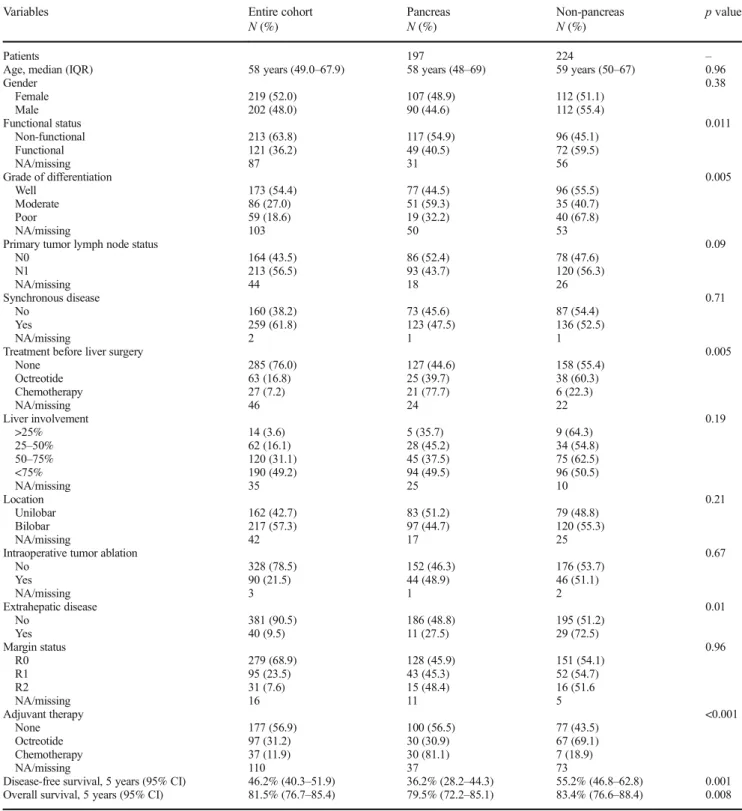
The primary NET was pancreatic in 197 (46.8%) patients vs. gastrointestinal tract or other organs (i.e., tracheo-bronchopulmonary, lung, etc.) in 224 (53.2%) patients. As expected, there were differences in the baseline clinicopatho-logical characteristics of patients with NELM from PNET vs. non-PNET primary tumors. While there were no differences in age and gender, patients with PNET-derived NELM were more likely to have non-functional disease compared with patients who had non-PNET-derived NELM (functional, PNET NELM, n = 117 54.9% vs. non-PNET derived NELM, n = 96 45.1%; p = 0.011). There were no differences in tumor burden and tumor site, while presence of extrahepatic disease was more common among patients with non-PNET-derived NELM (extrahe-patic disease, PNET-derived NELM, n = 11 27.5% vs. non-PNET derived NELM, n = 29 72.5%; p = 0.010). Presence of synchronous primary tumor and NELM was comparable among patients with a primary pancreatic NET and other primary NET. There was also no differ-ence in terms of type of surgery; 94 (43.7%) patients with PNET-derived NELM underwent a major liver resection compared with 121 (56.3%) patients with non-PNET-derived NELM (p = 0.20). Intraoperative tumor ablation was common among both groups (PNET-derived NELM 48.9% vs. non-PNET-derived NELM 51.1%). On the final pathological NELM specimen, patients with
PNET-derived NELM were more likely to have a moderately differentiated tumor (59.3%), while patients with non-PNET-derived NELM were more likely to have a poorly differentiated tumor (67.8%) (p = 0.005). Patients with PNET-derived NELM were slightly less likely to have lymph node metastasis (43.7%) compared with patients who had
non-PNET-derived NELM (56.3%) (p = 0.09). Margin status was comparable between the two groups (p = 0.96). Among patients who received any type of adjuvant treatment, octreotide was more commonly administered to patients with non-PNET-derived NELM, while chemotherapy was more common among patients with PNET-derived NELM (p < 0.001).
Table 1 Clinical and pathologic features of patients (n = 421)
Variables Entire cohort
N (%) Pancreas N (%) Non-pancreas N (%) p value Patients 197 224 –
Age, median (IQR) 58 years (49.0–67.9) 58 years (48–69) 59 years (50–67) 0.96
Gender 0.38 Female 219 (52.0) 107 (48.9) 112 (51.1) Male 202 (48.0) 90 (44.6) 112 (55.4) Functional status 0.011 Non-functional 213 (63.8) 117 (54.9) 96 (45.1) Functional 121 (36.2) 49 (40.5) 72 (59.5) NA/missing 87 31 56 Grade of differentiation 0.005 Well 173 (54.4) 77 (44.5) 96 (55.5) Moderate 86 (27.0) 51 (59.3) 35 (40.7) Poor 59 (18.6) 19 (32.2) 40 (67.8) NA/missing 103 50 53
Primary tumor lymph node status 0.09
N0 164 (43.5) 86 (52.4) 78 (47.6) N1 213 (56.5) 93 (43.7) 120 (56.3) NA/missing 44 18 26 Synchronous disease 0.71 No 160 (38.2) 73 (45.6) 87 (54.4) Yes 259 (61.8) 123 (47.5) 136 (52.5) NA/missing 2 1 1
Treatment before liver surgery 0.005
None 285 (76.0) 127 (44.6) 158 (55.4) Octreotide 63 (16.8) 25 (39.7) 38 (60.3) Chemotherapy 27 (7.2) 21 (77.7) 6 (22.3) NA/missing 46 24 22 Liver involvement 0.19 >25% 14 (3.6) 5 (35.7) 9 (64.3) 25–50% 62 (16.1) 28 (45.2) 34 (54.8) 50–75% 120 (31.1) 45 (37.5) 75 (62.5) <75% 190 (49.2) 94 (49.5) 96 (50.5) NA/missing 35 25 10 Location 0.21 Unilobar 162 (42.7) 83 (51.2) 79 (48.8) Bilobar 217 (57.3) 97 (44.7) 120 (55.3) NA/missing 42 17 25
Intraoperative tumor ablation 0.67
No 328 (78.5) 152 (46.3) 176 (53.7) Yes 90 (21.5) 44 (48.9) 46 (51.1) NA/missing 3 1 2 Extrahepatic disease 0.01 No 381 (90.5) 186 (48.8) 195 (51.2) Yes 40 (9.5) 11 (27.5) 29 (72.5) Margin status 0.96 R0 279 (68.9) 128 (45.9) 151 (54.1) R1 95 (23.5) 43 (45.3) 52 (54.7) R2 31 (7.6) 15 (48.4) 16 (51.6 NA/missing 16 11 5 Adjuvant therapy <0.001 None 177 (56.9) 100 (56.5) 77 (43.5) Octreotide 97 (31.2) 30 (30.9) 67 (69.1) Chemotherapy 37 (11.9) 30 (81.1) 7 (18.9) NA/missing 110 37 73
Disease-free survival, 5 years (95% CI) 46.2% (40.3–51.9) 36.2% (28.2–44.3) 55.2% (46.8–62.8) 0.001 Overall survival, 5 years (95% CI) 81.5% (76.7–85.4) 79.5% (72.2–85.1) 83.4% (76.6–88.4) 0.008
Long-Term Outcomes of Patients with NELM from PNET and Non-PNET
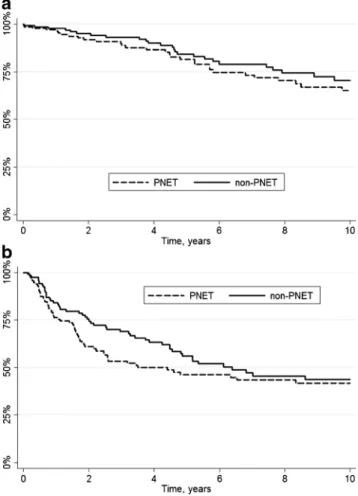
Within a median follow-up of 4.6 years, the 1-, 3-, and 5-year DFS was 80.2, 57.5, and 46.2%, respectively; the 3-, 5-, and 10-year OS was 89.4, 81.5, and 65.2%, respec-tively. Patients with PNET-derived NELM had a worse 5-year DFS and 5-5-year OS compared with patients who had PNET-derived NELM (DFS, PNET 36.2% vs. PNET 55.2%; p = 0.001 and OS, PNET 79.5% vs. non-PNET 83.4%; p = 0.008) (Fig.1).
A number of factors including location of the primary NET, functional status, grade of tumor differentiation, lymph node status, timing of primary and metastatic tumor, presence of extrahepatic disease, and liver tumor burden were each asso-ciated with 10-year OS (Table2). Particularly, patients with PNET-derived NELM had a markedly worse 10-year OS of 58.2% (95% CI, 48.2–66.9) vs. 71.6% (95% CI, 62.6–78.8) for patients with non-PNET-derived NELM (p = 0.008). Moreover, patients with a non-functional PNET-derived NELM had a much worse OS of 54.8% (95% CI, 43.7– 64.5) compared with 75.0% (95% CI, 63.3–83.4) for
non-PNET-derived NELM (p < 0.001). Patients with well, moder-ate, and poor tumor grade differentiation had a 10-year OS of 80.4% (95% CI, 71.1–87.1), 58.2% (95% CI, 40.5–72.3), and 51.9% (95% CI, 33.2–67.8), respectively (p = 0.001). Similarly, tumor burden and site were associated with prog-nosis. Specifically, 10-year OS was 58.4% (95% CI, 46.5– 68.6) for patients with >75% liver involvement, 66.6% (95% CI, 53.8–76.6) for patients with 75–50% liver involvement, 71.0% (95% CI, 56.4–81.5) for patients with 50–25% liver involvement, and 92.3% (95% CI, 56.6–99.9) for patients with <25% liver involvement (p < 0.027). Similarly, patients with extrahepatic disease had a worse OS of 42.8% (95% CI, 23.2–61.2) compared with 67.8% (60.8–78.7) for patients without extrahepatic disease. On the final pathological speci-men, presence of lymph node metastasis and R1-R2 resections were associated with worse outcome (Table2).
Propensity Score-Matched Analysis of Patients with NELM from PNET and Non-PNET
A propensity score matching analysis was then performed to minimize confounding and create more comparable cohorts of
Fig. 1 a Kaplan-Meier OS survival curve comparing PNET vs. non-PNET-derived NELM NET. b Kaplan-Meier survival DFS curve comparing PNET vs. non-PNET-derived NELM NET
Fig. 2 a Kaplan-Meier survival OS curve comparing PNET vs. non-PNET-derived NELM NET after propensity score matching. b Kaplan-Meier survival DFS curve comparing PNET vs. non-PNET-derived NELM NET after propensity score matching
patients in the PNET and non-PNET groups (Table3). After propensity matching for gender, grade of tumor differentia-tion, lymph node status, functional status, synchronous dis-ease, preoperative treatment, liver involvement, extrahepatic disease, margin status, and adjuvant treatment, the propensity-matched cohort included 264 patients. After propensity matching, demographic and clinicopathologic characteristics of the two groups were comparable, including lymph nodes status (p = 0.66), presence of extrahepatic disease (p = 0.48), and tumor differentiation (p = 0.09). With a median follow-up
of 5.1 years, the 5-year DFS and OS of patients with PNET-derived NELM and non-PNET PNET-derived NELM were compa-rable (DFS, PNET 46.2% vs. non-PNET 55.9%; p = 0.22 and OS, PNET 81.5% vs. non-PNET 84.3%; p = 0.19) (Fig.2). In the multivariable Cox model, while the presence of extrahe-patic disease and tumor grade were associated with DFS (ex-trahepatic disease, HR 2.12, 95% CI, 1.19–3.75, p = 0.010; tumor grade, HR 1.91, 95% CI, 1.43–2.55, p < 0.001) and OS (extrahepatic disease, HR 3.09, 95% CI, 1.65–5.79, p < 0.001; tumor grade, HR 1.76, 95% CI, 1.25–2.48, p = 0.001), prima-ry tumor location was not associated with long-term outcome (DFS, HR 0.92, 95% CI, 0.60–1.42; OS, HR 0.93, 95% CI, 0.58–1.49; both p > 0.05).
Discussion
Previously regarded as rare, the incidence of GEP-NET is increasing worldwide ranging from 2.5 to 4.5 per 100,000.9 The most common gastro-entero-pancreatic neuroendocrine t u m o r s a r e c a r c i n o i d , i n s u l i n o m a s , g a s t r i n o m a s , somatostatinomas, glucagonomas, and vipomas. NET can be either sporadic or part of the multiple neuroendocrine neopla-sia type 1 (MEN type 1) syndrome. While many NET are indolent, up to 60–90% of patients develop liver metastasis during the course of their disease.2Given the importance of NELM in the natural history of NET, we sought to evaluate the outcome of patients with NELM arising from different primary NET sites, undergoing curative intent liver surgery, with a particular emphasis on examining the impact of PNET vs. non-PNET derived primary tumors. In particular, the cur-rent study was important because we demonstrated that many of the clinicopathological characteristics of patients with PNET vs. non-PNET-derived NELM were different. In turn, while the PNET primary tumor site appeared to be associated with a worse long-term outcome, on propensity score analysis primary tumor site was no longer associated with either DFS or OS.
On univariable analysis, patients with PNET-derived NELM had a worse 5-year DFS and OS compared with pa-tients who had non-PNET-derived NELM (DFS, PNET 36.2% vs. non-PNET 55.2%; p = 0.001 and OS, PNET 79.5% vs. non-PNET 83.4%; p = 0.008). Importantly, several baseline clinicopathological characteristics of patients with PNET vs. non-PNET-derived NELM were different. In partic-ular, patients with PNET-derived NELM were more likely to have non-functional, moderate-to-poorly differentiated tu-mors. In contrast, patients with non-PNET-derived NELM more often had extrahepatic disease and other characteristics typically considered less prognostically favorable.2 3 However, similar to colorectal liver metastasis, the presence of extrahepatic disease should not be considered a strict con-traindication to surgical resection of NELM. In fact, while the
Table 2 Univariate 10-year overall survival analysis of the study cohort (n = 421)
Variable OS at 10 years (%) 95% CI p value
Whole cohort 65.2 58.5–70.9 – Age 0.12 <65 years 80.9 71.6–87.5 ≥65 years 65.5 50.9–76.7 Gender 0.33 Male 60.7 51.2–68.9 Female 70.2 60.6–77.8
Location of primary NET 0.008
Pancreas 58.2 48.2–66.9 Other 71.6 62.6–78.8 Functional status <0.001 Non-functional 54.8 43.7–64.5 Functional 75.0 63.3–83.4 Grade of differentiation 0.001 Well 80.4 71.1–87.1 Moderate 58.2 40.5–72.3 Poor 51.9 33.2–67.8
Primary tumor lymph node status <0.001
N0 78.1 69.2–84.7 N1 54.4 43.2–64.2 Synchronous disease 0.07 No 70.7 60.4–78.7 Yes 62.5 53.4–70.3 Extrahepatic disease <0.001 No 67.8 60.8–73.8 Yes 42.8 23.2–61.2
Treatment before liver surgery <0.001
None 64.8 56.5–71.9
Octreotide 91.0 76.9–96.7 Chemotherapy 39.4 12.9–65.3 Intraoperative tumor ablation 0.31
No 67.1 59.7–73.4 Yes 58.5 41.4–72.1 Liver involvement 0.027 >75% 58.4 46.5–68.6 75–50% 66.6 53.8–76.6 50–25% 71.0 56.4–81.5 <25% 92.3 56.6–98.9
Location of liver metastasis 0.17
Unilobar 54.8 41.9–66.0 Bilobar 62.4 52.6–70.8 Margin status <0.001 R0 71.7 63.8–78.2 R1 56.7 41.3–69.5 R2 28.0 6.9–54.6 Adjuvant therapy <0.001 None 71.0 61.1–78.9 Octreotide 56.2 38.3–70.7 Chemotherapy 33.5 15.1–53.3
presence of extrahepatic disease was associated with poor prognosis, curative intent resection in the presence of extraheptic disease should be considered when the disease is limited and an R0 resection is possible. The non-functional nature of PNET-derived NELM was another factor that has been associated with a worse prognosis.17 Specifically, Spolverato et al. reported a Markov decision model to estimate and compare the cost-effectiveness associated with different
management strategies (i.e., hepatic resection vs. intra-arterial therapy) for a simulated cohort of patients with NELM.17In that study, using a lifetime horizon analysis, patients with asymptomatic NELM had a worse overall survival after he-patic resection.17
Other reported clinicopathological prognostic factors of NELM that have been associated with a poor prognosis in-clude R1 resection margin,24 large hepatic tumor size,24
Table 3 Clinical and pathologic features of patients after propensity score matching (n = 264) Variables Pancreas N (%) Non-pancreas N (%) p value Patients 132 132 –
Age, median (IQR) 60.8 years (50.1–71.5) 61.8 years (53.0–67.0) 0.54
Gender 0.71 Female 72 (48.9) 75 (51.0) Male 60 (51.3) 57 (48.7) Functional status 0.70 Non-functional 59 (52.7) 53 (47.3) Functional 46 (50.0) 46 (50.0) NA/missing 27 33 Grade of differentiation 0.09 Well 80 (51.3) 76 (48.7) Moderate 33 (57.9) 24 (42.1) Poor 19 (37.3) 32 (62.7)
Primary tumor lymph node status 0.66
N0 54 (49.5) 55 (50.5)
N1 64 (52.5) 58 (47.5)
Synchronous disease 0.31
No 45 (45.9) 53 (54.1)
Yes 87 (52.4) 79 (47.6)
Treatment before liver surgery 0.85
None 85 (49.7) 86 (50.3) Octreotide 23 (47.9) 25 (52.1) Chemotherapy 8 (61.5) 5 (38.5) NA 16 16 Liver involvement 0.84 >75% 5 (50.0) 5 (50.0) 75–50% 27 (52.9) 24 (47.1) 50–25% 35 (44.9) 43 (55.1) >25% 50 (47.6) 55 (52.4) NA/missing 15 5 Location 0.62 Unilobar 62 (51.7) 58 (48.3) Bilobar 70 (48.6) 74 (51.4)
Intraoperative tumor ablation 0.66
No 105 (49.5) 107 (50.5) Yes 26 (53.1) 23 (46.9) NA/missing 1 2 Extrahepatic disease 0.48 No 124 (50.6) 121 (49.4) Yes 8 (42.1) 11 (57.9) Margin status 0.83 R0 89 (48.9) 93 (51.1) R1 25 (47.2) 28 (52.8) R2 10 (55.6) 8 (44.4) NA/missing 8 3 Adjuvant therapy 0.07 None 77 (50.0) 77 (50.0) Octreotide 38 (44.7) 48 (55.3) Chemotherapy 17 (70.8) 7 (29.2)
Disease-free survival, 5 years (95% CI) 46.2% (36.0–55.7) 55.9% (45.4–65.3) 0.22 Overall survival, 5 years (95% CI) 81.5% (72.3–87.9) 84.3% (75.5–90.1) 0.19
positive margin status,10poor tumor differentiation,24 synchro-nous disease,19 and extrahepatic disease.19 The effect of pri-mary tumor site has been more controversial. Most studies have examined cohorts that were predominantly derived from patients with either PNET or non-PNET gastrointes-tinal NET tumors.10–27 As such, the impact of primary tu-mor site has not been specifically investigated as a prog-nostic factor in many previous studies. In those studies that have examined primary tumor site as an independent var-iable, some reports have noted that tumor site was indeed an important long-term prognostic factor.18 In fact, in the current study, we similarly noted that patients with PNET-derived NELM had a markedly worse 10-year OS of 58.2% (95% CI, 48.2–66.9) vs. 71.6% (95% CI, 62.6–78.8) for patients with non-PNET-derived NELM (p = 0.008). However, given the varied baseline characteristics of pa-tient with PNET vs. non-PNET tumors, direct comparisons of these cohorts may be problematic. As such, propensity score matching was utilized to help eliminate the residual confounding effect of other potential clinicopathological v a r i a b l e s t h a t m i g h t h a v e i m p a c t e d p r o g n o s i s . Importantly, after propensity matching, both 5-year DFS and OS were comparable among patients with PNET and PNET derived NELM (DFS, PNET 46.2% vs. PNET 55.9%; p = 0.22 and OS, PNET 81.5% vs. non-PNET 84.3%; p = 0.19). Moreover, in the multivariable Cox model, while the presence of extrahepatic disease and tumor grade were associated with DFS and OS, prima-ry tumor location was not associated with long-term out-comes. As such, the data strongly suggest that any poten-tial effect of primary tumor site on prognosis was likely due to differences in underlying tumor biology and not the origin site of the tumor itself.
Our findings further define the characteristics of NELM and the impact of the varied tumor features on prognosis after liver resection. Patients with PNET-derived NELM were more likely to have non-functional disease compared with patients who had non-PNET-derived NELM, highlighting the impor-tance of close follow-up to early detect liver metastases. Indeed, as noted in the current study, patients with non-functional liver metastases may have a worse long-term outcome.17In addition, while a simple comparison of PNET vs. non-PNET NELM patients suggested a worse long-term outcome for PNET patients, on matched analysis, primary tumor site did not impact prognosis. As such, primary tumor location should not necessarily inform decisions around prog-nosis and do not have an influence on survival such as other factors including the presence of extrahepatic disease or tumor grade.
This study has several limitations that should be considered when interpreting the results. The study design likely resulted in some selection bias, as with all retrospective reports. In addition, the multi-institutional nature of the cohort that
included different centers in Europe and the USA increased the heterogeneity of patient selection criteria and treatment for NELM. However, the use of a large, multicenter data set in-creased the sample size and also improved the generalizability of the findings. Among patients with functional PNET, data on the type of tumor (i.e., gastrinoma, insulinoma, etc.) and hormonal levels were also not available. Moreover, in the present study, only patients who underwent curative intent liver surgery for NELM were included; patients who underwent palliative surgery, systemic or non-operative locoregional therapy were not assessed. As such, the findings of the current study may not pertain to these other clinical settings.
In conclusion, patients with PNET had a worse prognosis compared with patients who had non-PNET NELM on univariable analysis. Patients with PNET- vs. non-PNET-derived NELM had, however, different clinicopathological characteristics associated with their tumors. In particular, pa-tients with PNET tumors were more likely to present with non-functional NELM and worse tumor grade. After account-ing for potential confoundaccount-ing biases on propensity-matched analysis, primary tumor location was not associated with prognosis.
Compliance with Ethical Standards
Conflict of Interest The authors declare that they have no conflict of interest.
References
1. Farley HA, Pommier RF. Treatment of Neuroendocrine Liver
Metastases. Surgical oncology clinics of North America. Jan 2016;25(1):217–225.
2. Spolverato G, Bagante F, Wagner D, et al. Quality of life after treatment of neuroendocrine liver metastasis. J Surg Res. Sep 2015;198(1):155–164.
3. Chamberlain RS, Canes D, Brown KT, et al. Hepatic neuroendo-crine metastases: does intervention alter outcomes? Journal of the American College of Surgeons. Apr 2000;190(4):432–445. 4. Thompson GB, van Heerden JA, Grant CS, Carney JA, Ilstrup DM.
Islet cell carcinomas of the pancreas: a twenty-year experience. Surgery. Dec 1988;104(6):1011–1017.
5. Chen H, Hardacre JM, Uzar A, Cameron JL, Choti MA. Isolated liver metastases from neuroendocrine tumors: does resection pro-long survival? Journal of the American College of Surgeons. Jul 1998;187(1):88–92; discussion 92–83.
6. Sarmiento JM, Heywood G, Rubin J, Ilstrup DM, Nagorney DM,
Que FG. Surgical treatment of neuroendocrine metastases to the liver: a plea for resection to increase survival. Journal of the American College of Surgeons. Jul 2003;197(1):29–37.
7. Knox CD, Anderson CD, Lamps LW, Adkins RB, Pinson CW.
Long-term survival after resection for primary hepatic carcinoid tumor. Annals of surgical oncology. Dec 2003;10(10):1171–1175. 8. Osborne DA, Zervos EE, Strosberg J, et al. Improved outcome with cytoreduction versus embolization for symptomatic hepatic
metastases of carcinoid and neuroendocrine tumors. Ann Surg Oncol. Apr 2006;13(4):572–581.
9. Modlin IM, Lye KD, Kidd M. A 5-decade analysis of 13,715 car-cinoid tumors. Cancer. Feb 15 2003;97(4):934–959.
10. Saxena A, Chua TC, Sarkar A, et al. Progression and survival re-sults after radical hepatic metastasectomy of indolent advanced neuroendocrine neoplasms (NENs) supports an aggressive surgical approach. Surgery. Feb 2011;149(2):209–220.
11. Pape UF, Berndt U, Muller-Nordhorn J, et al. Prognostic factors of long-term outcome in gastroenteropancreatic neuroendocrine tu-mours. Endocrine-related cancer. Dec 2008;15(4):1083–1097. 12. Frilling A, Modlin IM, Kidd M, et al. Recommendations for
man-agement of patients with neuroendocrine liver metastases. The lan-cet oncology. Jan 2014;15(1):e8–21.
13. Rindi G, D'Adda T, Froio E, Fellegara G, Bordi C. Prognostic factors in gastrointestinal endocrine tumors. Endocrine pathology. Fall 2007;18(3):145–149.
14. McDermott EW, Guduric B, Brennan MF. Prognostic variables in patients with gastrointestinal carcinoid tumours. The British journal of surgery. Jul 1994;81(7):1007–1009.
15. Mayo SC, de Jong MC, Bloomston M, et al. Surgery versus intra-arterial therapy for neuroendocrine liver metastasis: a multicenter i n t e r n a t i o n a l a n a l y s i s . A n n a l s o f s u rg i c a l o n c o l o g y. Dec 2011;18(13):3657–3665.
16. Mayo SC, Herman JM, Cosgrove D, et al. Emerging approaches in the management of patients with neuroendocrine liver metastasis: role of liver-directed and systemic therapies. Journal of the American College of Surgeons. Jan 2013;216(1):123–134. 17. Spolverato G, Vitale A, Ejaz A, et al. Net health benefit of hepatic
resection versus intraarterial therapies for neuroendocrine liver me-tastases: A Markov decision model. Surgery. Aug 2015;158(2): 339–348.
18. Bagante F, Spolverato G, Merath K, et al. Neuroendocrine liver metastasis: The chance to be cured after liver surgery. Journal of surgical oncology. Feb 01 2017.
19. Mayo SC, de Jong MC, Pulitano C, et al. Surgical management of hepatic neuroendocrine tumor metastasis: results from an interna-tional multi-instituinterna-tional analysis. Annals of surgical oncology. Dec 2010;17(12):3129–3136.
20. Klimstra DS, Modlin IR, Coppola D, Lloyd RV, Suster S. The
pathologic classification of neuroendocrine tumors: a review of nomenclature, grading, and staging systems. Pancreas. Aug 2010;39(6):707–712.
21. Couinaud C. Liver anatomy: portal (and suprahepatic) or biliary segmentation. Digestive surgery. 1999;16(6):459–467.
22. Spolverato G, Pawlik TM. Liver-directed therapies: surgical ap-proaches, alone and in combination with other interventions. American Society of Clinical Oncology educational book / ASCO. American Society of Clinical Oncology. Meeting. 2014:101–110. 23. Harrell FE, Jr, Lee KL, Mark DB. Multivariable prognostic models:
issues in developing models, evaluating assumptions and adequacy, and measuring and reducing errors. Statistics in medicine. Feb 28 1996;15(4):361–387.
24. Saxena A, Chua TC, Perera M, Chu F, Morris DL. Surgical resec-tion of hepatic metastases from neuroendocrine neoplasms: a sys-tematic review. Surgical oncology. Sep 2012;21(3):e131–141. 25. Cho CS, Labow DM, Tang L, et al. Histologic grade is correlated
with outcome after resection of hepatic neuroendocrine neoplasms. Cancer. Jul 01 2008;113(1):126–134.
26. Glazer ES, Tseng JF, Al-Refaie W, et al. Long-term survival after surgical management of neuroendocrine hepatic metastases. HPB : the official journal of the International Hepato Pancreato Biliary Association. Aug 2010;12(6):427–433.
27. Elias D, Lasser P, Ducreux M, et al. Liver resection (and associated extrahepatic resections) for metastatic well-differentiated endocrine tumors: a 15-year single center prospective study. Surgery. Apr 2003;133(4):375–382.