ORIGINAL ARTICLE
Effects of an individualized home‑based unsupervised aerobic
training on body composition and physiological parameters
in obese adults are independent of gender
G. P. Emerenziani1 · M. C. Gallotta2 · S. Migliaccio2 · D. Ferrari2 · E. A. Greco3 ·
F. J. Saavedra4 · S. Iazzoni2 · A. Aversa1 · L. M. Donini3 · A. Lenzi3 · C. Baldari2 ·
L. Guidetti2
Received: 1 August 2017 / Accepted: 4 October 2017
© The Author(s) 2017. This article is an open access publication
significantly increased while heart rate during 6MWT was significantly lower after training. No significant differences were found in LC group between pre- and post-intervention in all variables. Interestingly, gender does not influence the effects of training.
Conclusions Our results indicate that subjects,
independ-ent of gender, with high compliance to the aerobic training based on a new individualized method can achieve a signifi-cant reduction in weight loss and also an improvement in physical and physiological parameters. This innovative per-sonalized prescription could be a valuable tool for exercise physiologist, endocrinologists, and nutritionists to approach and correct life style of obese subjects.
Keywords Obesity · Physical activity · Cardio fitness ·
Aerobic training · Gender differences Introduction
Obesity is a multifactorial pathological condition charac-terized by an excess of adipose tissue in the human body (> 35% in women > 25% in men) leading to a significant increased risk to develop metabolic chronic diseases [1]. Obesity is a predictor of metabolic syndrome, described as a clustering of risk factors (e.g., central obesity, type 2 dia-betes mellitus) becoming one of the most common causes of death worldwide [2].
It is well known that regular physical activity (PA) pro-vides health benefits and it is considered an essential compo-nent of primary and secondary prevention for most of meta-bolic syndrome-related pathologies [3]. However, physical inactivity and sedentary behavior are considered a global health problem. Half of subjects who begin exercise pro-grams to increase physical activity quit within few months
Abstract
Purpose Evaluation of the effects of an individualized
home-based unsupervised aerobic training on body compo-sition, physical and physiological parameters in female and male obese adults.
Methods Two hundred and twenty obese adults (age
47.9 ± 12.4 years; BMI 38.0 ± 7.2 kg/m2) entered the
4-month training program. Body composition, physiologi-cal and functional capacities were assessed pre- and post-intervention. All subjects were requested to perform unsu-pervised aerobic training with the intensity based on heart rate, walking speed and OMNI-RPE score corresponding to the individual ventilatory threshold for at least 5 days/week.
Results After 4-month study period, 40% of patients
com-pleted the protocol, 24% had high compliance (HC) (exer-cise ≥ 3 days/week), while 16% had low compliance (LC) to exercise prescription (exercise < than 3 days/week). In HC group, a significant improvement of body composition vari-ables after training was performed. Moreover, oxygen uptake and metabolic equivalent at peak significantly increased after training. Six-minute walking test (6MWT) distance * C. Baldari
1 Department of Experimental and Clinical Medicine,
University of Magna Græcia of Catanzaro, Catanzaro, Italy
2 Section of Health Sciences, Department of Movement,
Human and Health Sciences, University of Rome “Foro Italico”, Piazza Lauro De Bosis 6, 00135 Rome, Italy
3 Section of Medical Pathophysiology, Food Science
and Endocrinology, Department of Experimental Medicine, Sapienza University of Rome, Rome, Italy
4 Research Centre for Sports Sciences, Health and Human
Development Sport Sciences Department, University of Trás-os-Montes e Alto Douro, Vila Real, Portugal
[4]. Supervision has been shown to be effective in helping adults adhere to an exercise plan [5–7] but this approach often requires a center-based approach, which it might be not widely accessible in obese population for financial, logistic barriers and dependence on caregivers. Therefore, it seems necessary to implement more feasible approaches of exercise training so that a greater number of patients could benefit from regular physical exercise in an almost daily routine.
The role of exercise intensity on physical training adher-ence could play a fundamental role [8, 9] in regards of the effects obtained and it should be established to achieve posi-tive physiological effects and decreased injury risk, resulting in an improved adherence to physical activity. Considering the individual exercise capacity, the use of individual venti-latory threshold (IVT) and rate of perceived exertion (RPE) scale have been used in unfit populations to prescribe exer-cise intensity [10–14]. In particular, IVT is considered a useful submaximal breakpoint for optimal moderate exercise intensity prescription in T2DM patients and obese subjects [15–17] in both genders. The work load corresponding to these physiological events is termed as “ventilatory thresh-old 1” or “aerobic threshthresh-old” [13]; thus, the term “individual ventilatory threshold” (IVT) will be used in the manuscript.
This method could be more easily applied in a laboratory or in supervised conditions due to the controlled environ-ment (the presence of trainer and the possibility to control the body and environmental variables such as heart rate and walking speed).
Conversely, the use of IVT for unsupervised moderate training to modify the subjects’ lifestyle is difficult to apply. For instance, the use of walking speed corresponding to IVT could not be applied alone if the walking track is in an urban or rural setting due to the different characteristics of the track (positive or negative slopes). Moreover, maintenance of a heart rate (HR) intensity similar to the HR corresponding to IVT during training is a difficult task. Due to these reasons, it would be useful to apply a new method that includes more than one variable which could lead the subjects to control the exercise intensity corresponding to their IVT.
Rate of perceived exertion (RPE) is defined as the indi-vidual intensity of effort, strain, and/or fatigue that is experi-enced during physical exercise, and it can be used as a valid tool to assess the individuals’ perceptions of effort during exercise [18]. The RPE represents an inexpensive tool for monitoring exercise intensity in unfit populations [10] and it is suggested by the American College of Sports Medicine to modulate and refine the prescription of exercise intensity [19–21]. OMNI scales of perceived exertion (RPE-OMNI) were validated for adult and elderly populations [22]. RPE-OMNI scale is intuitive and simple to understand and it is valid and reliable for monitoring exercise intensity.
Walking is a traditional exercise type, which promotes healthy lifestyle and fitness in obese subjects but, due to lack
of controlling exercise intensity, obese individuals are often unable to reach their training objectives [23]. Therefore, both IVT and the RPE-OMNI-Walk/Run Scale variables could be very useful tools if used together, to prescribe home-based unsupervised walking exercise. While literature highlights the positive effects of supervised aerobic training, there are no studies showing evidence on the effects of home-based unsupervised aerobic training based upon HR, walking speed, and RPE-OMNI-Walk/Run Scale corresponding to IVT in obese subjects.
Therefore, aims of the study were: (1) to evaluate whether a 4-month home-based unsupervised aerobic training pro-gram, based upon gait speed, HR, and RPE-OMNI score corresponding to IVT, exerted positive effects on body composition, physical and physiological capacity and (2) to verify the adherence to an individualized exercise program in a real life conditions in female and male obese subjects. Materials and methods
Participants
Two hundred and twenty (48 males, 172 females) obese adults (age 48.1 ± 12.3 years; BMI 38.0 ± 6.5 kg/m2) were
selected from a large group of patients admitted to the Day Hospital of the Department of Experimental Medicine, Sec-tion of Medical Pathophysiology, Food Science and Endo-crinology, Policlinico Umberto I, “Sapienza” University of Rome. Subjects underwent clinical examination to rule out any contraindications to physical activity (PA). The inclu-sion criteria were adult age (> 30 year) and a BMI ≥ 30 or a fat mass ≥ 35% in women and ≥ 25% in men [1]. Body com-position was evaluated by hand–foot bioelectrical impedance method (Tanita BC 601, Tokyo, Japan) [24]. The descriptive characteristics of the subjects are summarized in Table 1. All subjects were sedentary and they had not been previously
Table 1 Comparison of anthropometric and body composition
parameters between males and females at the beginning of the study (males n = 48; females n = 172)
BMI body mass index, FFM fat-free mass, FM fat mass *p < 0.01 vs. males Males Females Age (years) 49.3 ± 12.0 47.8 ± 12.3 Height (m) 1.73 ± 0.06 1.61 ± 0.07* Weight (kg) 114.1 ± 18.9 98.3 ± 19.6* BMI (kg/m2) 37.8 ± 5.8 38.0 ± 6.7 FM (%) 36.3 ± 5.2 45.8 ± 5.2* FFM (kg) 73.0 ± 10.2 52.1 ± 7.8* FFM (%) 64.3 ± 7.5 53.4 ± 5.4*
engaged in regular physical exercise. All subjects provided a written informed consent before participating in the study. All procedures were approved by the Local Ethics Commit-tee, which was in accordance with principles outlined in the Declaration of Helsinki.
Experimental Design
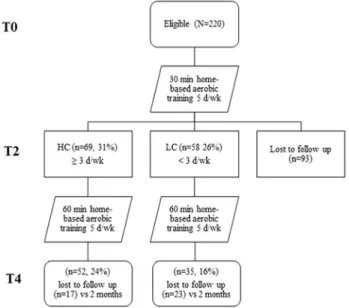
We studied the outcomes of a 4-month unsupervised home-based aerobic training, in addition to diet program, in obese adults. All participants received an individualized aerobic training in addition to a low calories diet as described in dietetic and physical activity program paragraph. A sche-matic map of the study design is shown in Fig. 1.
After basal clinical examination, subjects performed a series of tests to analyze body composition, physiological and functional capacities. Body composition and functional evaluation measurements were performed at the Department of Movement, Human and Health Sciences at the University of Rome “Foro Italico”.
During the intervention period, all subjects received an individualized hypocaloric diet and exercise programs. Six-minute walking test (6MWT) was performed to assess individual functional capacity [25]. Then a metabolic incre-mental test on a treadmill was performed to assess cardi-orespiratory capacity and IVT. All subjects were tested in the morning from 9.00 am to 12 pm. The exercise program consisted in 4 months of aerobic training based on a HR, walking speed, and OMNI-RPE-Walk/Run score corre-sponding to the IVT. All subjects were requested to fill out
a daily physical activity diary. Our study cohort consisted of the 87 (40%) subjects who completed the program. Accord-ing to the compliance to exercise program, subjects were divided in two groups: high compliance (HC, exercise per-formed 3–5 days/week), and low compliance (LC, exercise performed < 3 days/week).
Body composition
Pre- and post-intervention anthropometric measurements assessed subjects’ weight, height, body mass index (BMI), percentage of fat mass (% FM) and fat-free mass in kilo-grams (FFM). Weight and height were measured using a scale and a stadiometer to the nearest 0.1 kg and 0.1 cm, respectively. BMI was calculated as ratio between weight and square of the height (kg/m2). Moreover, for each subject,
% FM and FFM were measured by hand–foot bioelectri-cal impedance method (Tanita BC 601, Tokyo, Japan) [24] while the subjects wore minimal clothing (i.e., underwear).
Physiological capacity
Each subject rested quietly for 5 min to assess the resting HR. The mean HR of the last minute was taken as the rest-ing value.
The peak oxygen uptake ( ̇VO2peak) was assessed in all participants by means of a continuous, incremental graded exercise test on a treadmill (Woodway PRO, Woodway, Waukesha, WI, USA). ̇VO2, carbon dioxide production ( ̇V
CO2), and ̇VE were measured on a breath by breath basis by a gas analysis system (Quark RMR-CPET Cosmed™, Rome, Italy) [26]. The system was calibrated before each test according to the manufacturer’s instructions.
The continuous graded incremental treadmill protocol started at 3 km/h, then the speed was increased by 1 km/h every 2 min until 5 km/h was reached. Then, slope was increased by 3% every 2 min until one of the following con-ditions was reached: a value of 10 on RPE-OMNI-Walk/ Run Scale [22] or the subject’s HR reached a value of 90% of their HRmax. HR (beats/min) was continuously recorded
before and throughout the trial using a HR monitor (RS 400, Polar Electro™, Kempele, Finland) [12].
During the test, the highest ̇VO2 attained was chosen as
the ̇VO2peak. The individual ventilatory threshold (IVT) was
determined offline for each subject by plotting the ventila-tory equivalent ( ̇VE/ ̇VO2) as a function of ̇VO2 to identify the point during exercise where this curve reached its lowest value [27]. The level of ̇VO2 at which we observed the lowest
value of the ̇VE/ ̇VO2, in the individual plot, was the
individ-ual ventilatory threshold [11, 12, 27]. The exercise intensity corresponding to IVT was reached by all the subjects. At IVT and at maximal effort, HR and metabolic equivalent
Fig. 1 A schematic diagram indicating the flow of study subject
selection through the study and subject compliance. T0 baseline, T2 after 2 months, T4 after 4 months, HC high compliance (≥ 3 times/ week), LC low compliance (< 3 times/week)
(MET) were determined. In addition, % HRmax [(HR at IVT)/ (220-age)] was also calculated.
A standard definition of OMNI-Walk/Run Scale was explained to the subjects immediately before the exercise test. During exercise testing, subjects were asked to report the degree of exertion on the OMNI-Walk/Run scale every 2 min. The OMNI-Walk/Run scale illustration was in full view of the subject at all times during testing.
Functional capacity
The 6-min walking test measures the distance covered by subjects in 6 min [25]. Briefly, subjects were instructed to walk as fast as they could in a 50-m corridor marked every 5 m with white tapes on the floor. Subjects were allowed to stop or rest during the test if necessary. Standardized encour-agements were provided at recommended intervals.
Distance walked (6MWTdist) and subjects’ HRmean during
the 6-min walking test were measured, speed (6MWTspeed)
was calculated (m/s).
Dietetic and physical activity program
A hypocaloric diet was set at approximately 400 kcal less than total daily energy expenditure as described elsewhere (manuscript in preparation) with nutrients subdivided on the base of Mediterranean Diet scheme. Total daily energy expenditure was determined by adding the resting metabolic rate and the physical activity level. Resting metabolic rate was estimated by the Cunningham equation [28] while phys-ical activity level was estimated by the international physphys-ical activity questionnaire (IPAQ) [29].
All subjects were requested to perform 4 months of unsu-pervised aerobic training, minimum five times a week, based on HR, walking speed, and on the RPE-OMNI-Walk/Run score corresponding to their IVT as prescribed on basal evaluation. The training session duration varied between 30 min in the first 2 months and 60 min during the follow-ing 2 months. Each subject filled out a daily physical activ-ity diary including track length, duration, HR, and RPE-OMNI over the entire training period. After 2 months of intervention, subjects were re-evaluated to prescribe a new workload, leading to maintenance of the individual moderate exercise intensity constant during the 4-month period. Also, the volume of exercise was increased reaching a maximum of 60 min per daily session.
Statistical analysis
All results were expressed as mean ± SD. At the begin-ning of the study, differences on body composition between males and females were evaluated with a multiple unpaired
t test with Bonferroni correction. For each variable, a mixed
2×3 ANCOVA with repeated measures on time was used to detect significant effects of two main factors: group (high compliance vs. low compliance) and time (pre vs. 2 vs. 4 months). Since differences were present in male and female population, age, gender and height were used as covariates.
Significant interactions were further analyzed by means of appropriate post hoc analysis. All statistical analyses were performed with the SPSS statistical package (Version 24.0 for Windows; SPSS Inc., Chicago, IL, USA). All tests were two-tailed, with p ≤ 0.05 being taken as significant. Results
Evaluation of adherence to physical activity training proto-col in the study population, 43% subjects dropped out after 2-month training, while 31% had high adherence and 26% had low adherence. At the end of the 4-month training 60% subjects dropped out, while 24% had HC and 16% had LC. All subjects were contacted by telephone to understand the reasons of drop-out. Lack of time followed by health status and clinical condition factors have been reported to limit participation to the protocol. No subjects got injured during the training protocol.
Body composition variables
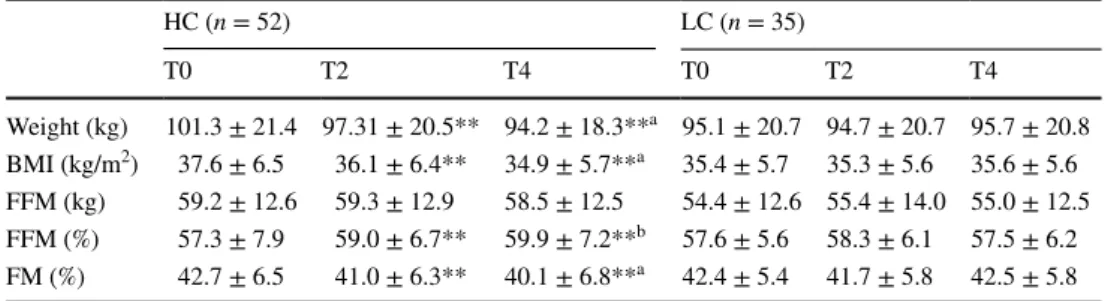
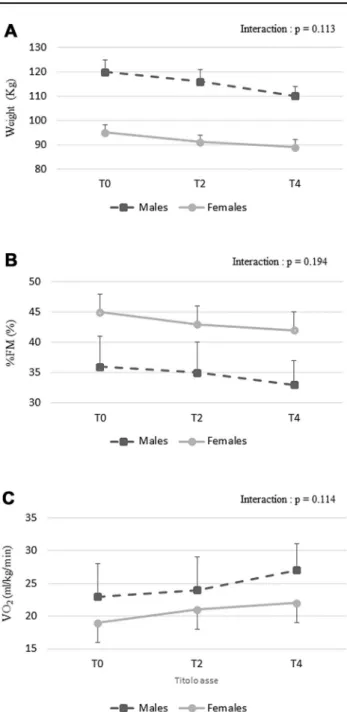
Anthropometric characteristics of female and male subjects who performed all training are depicted in Table 2. Sig-nificant main effect of time (p < 0.01) and group × time interactions (p < 0.001) were found for weight, BMI, and FM %. Post hoc analysis showed that weight, BMI, and % FM significantly decreased after 2 and 4 months of train-ing in HC group. No significant changes were found in LC group (Table 2). No significant time × gender interaction was found for body composition variable (Fig. 2a, b).
Physiological capacity
A significant main effect of time was observed for ̇VO2peak
(p = 0.02) and METpeak (p = 0.02) during the incremen-tal treadmill test. Interestingly, no significant time × gen-der interaction was found for ̇VO2peak variable (Fig. 2c). A
significant group × time interaction was found for ̇VO2peak
(p = 0.02) and METpeak (p = 0.02). Post hoc analysis showed that ̇VO2peak, and METpeak significantly increased after 2
and 4 months of training in HC group while no significant changes were found in LC group (Table 3).
No significant main effect of time and group and no sig-nificant group × time interaction were found for any param-eter at IVT during the incremental treadmill test (Table 4).
Functional capacity test
No significant main effect of time and group was found for speed, distance, and HR mean during the 6MWT. A significant group × time interaction was found for 6MTWdist (p = 0.04), 6MWTspeed (p = 0.04), and HRmean
(p < 0.01). Post hoc analysis demonstrated that 6MTWdist and 6MWTspeed significantly increased while HRmean
sig-nificantly decreased after 4 months of training in HC group. In contrast, no significant changes were found in LC group (Table 5).
Discussion
The results presented in the study demonstrate that the use of walking speed, HR and, OMNI-Walk/Run scale variables, corresponding to the IVT, leads to an improvement of body composition and physiological variables in obese subject independently from genders.
Aims of this study were to evaluate (1) adherence and (2) effects of 4-month home-based unsupervised aerobic train-ing, based upon the HR, walking speed, and RPE-OMNI score corresponding to the IVT, on body composition, physi-ological and physical capacities in female and male obese adults.
The drop-out rate (60%) after 4-month training, even if the exercise intensity was individualized according to sub-ject’s health, confirms that the incorporation of training into everyday life is still challenging in obese population without gender differences. Graffagnino et al. [7] reported that after the 6-month supervised weight loss program, offered in a community-based medical wellness facility, the drop-out rate was 53%. In contrast, Arikawa et al. [30] showed that using strategies based on social cognitive theory, women’s adherence to a 4-month supervised weight training interven-tion was higher than 90% during the training period. In our study, strategies based on social cognitive theory, such as incentive, phone and email reminders and personal booster
sessions were not employed to encourage and support adher-ence. Our experience indicate that the promotion of physical activity is more convincing when the intensity of exercise proposed is low rather than high [8, 23]. Thus, in a daily rou-tine training program, other parameters, such as social and cognitive factors, demographic factors, and environmental factors, should be taken into considerations beside exercise intensity [30]. A very interesting point was to assess that up to 40% of subjects that completed the 4-month period, only 24% had HC to exercise while 16% had LC. This 16% of subjects did not fulfill the physical recommendation but they were still on the program. This could be seen as a positive result, since, with the introduction of motivation factors, it might be possible to increase the compliance to the pro-gram. On the basis of the results obtained and described in this manuscript, we are planning training protocols in obese subjects with the aim to analyze differences on psychologi-cal and cognitive factors between subjects with high or low compliance to the training program.
The results obtained only in HC group of the present study suggest that the use of this new approach could be a valuable tool for physical intervention in obese subjects to improve body composition, physiological and functional capacity. The results of HC group after home-based unsu-pervised training indicate that this program is as efficient as a supervised frequent walking performed more than 3 days a week [16]. Furthermore, according to Perri et al. [31], middle-aged sedentary individuals, particularly those who are overweight and unfit, might be particularly susceptible to interrupt an activity that entails a relatively high degree of subjective discomfort. For this reason, our study proposed an individualized intensity corresponding to moderate exercise that was appropriate for obese subjects. Interestingly, our results also suggest that no gender differences are present in obese individuals in term of all parameters evaluated in the study. This is an important point, since it might indi-cate that life style correction positively influences physical parameters in both gender, which also suggest that a physical activity protocol designed on individual aerobic threshold
Table 2 Subjects’
anthropometric parameters at baseline (T0) and after 2 (T2) and 4 (T4) months of intervention
BMI body mass index, FFM fat-free mass, FM fat mass **p < 0.01 vs. T0 a p < 0.01 vs. T2 b p < 0.05 vs. T2 HC (n = 52) LC (n = 35) T0 T2 T4 T0 T2 T4 Weight (kg) 101.3 ± 21.4 97.31 ± 20.5** 94.2 ± 18.3**a 95.1 ± 20.7 94.7 ± 20.7 95.7 ± 20.8 BMI (kg/m2) 37.6 ± 6.5 36.1 ± 6.4** 34.9 ± 5.7**a 35.4 ± 5.7 35.3 ± 5.6 35.6 ± 5.6 FFM (kg) 59.2 ± 12.6 59.3 ± 12.9 58.5 ± 12.5 54.4 ± 12.6 55.4 ± 14.0 55.0 ± 12.5 FFM (%) 57.3 ± 7.9 59.0 ± 6.7** 59.9 ± 7.2**b 57.6 ± 5.6 58.3 ± 6.1 57.5 ± 6.2 FM (%) 42.7 ± 6.5 41.0 ± 6.3** 40.1 ± 6.8**a 42.4 ± 5.4 41.7 ± 5.8 42.5 ± 5.8
may induce similar adaptations in male and female obese subjects.
Inducing negative energy balance is the most important goal of weight loss programs and exercise plays a pivotal role to imbalance the energy equation to obtain weight loss [32]. An undesirable effect could be that weight loss program might induce a concomitant decline in lean tis-sue. Regarding the effects on body composition, the body weight and BMI decreased significantly as well as FM % in HC group. Moreover, fat-free mass expressed in kg was
maintained after a mix of training and diet. All these results highlight how an integrated approach of diet and physical activity can elicit a considerable general improvement of body composition in obese subjects. These results are in accordance with other studies [11, 32] that verified the posi-tive effects of walking exercise to contrast the decline of lean mass. Moreover, even though LC group received a calorie restricted diet, no differences were found in any body com-position variables between pre- and post-intervention. This result could be explained by a low adherence to a hypoca-loric diet, beside the low adherence to the physical activ-ity program during the study. Exercise alone has not been shown to produce substantial weight loss, but it is helpful during the weight loss phase to preserve lean muscle mass, and it plays a role in body weight maintenance [33, 34]. We might affirm that exercise intensities based upon heart rate, walking speed, and RPE-OMNI score at IVT play positive effects in maintaining FFM during a weight loss program in HC female and male obese subjects. These findings are significant, given that FFM represents a key determinant of the magnitude of resting metabolic rate (RMR). It follows that a decrease in lean tissue could hinder the progress of weight loss.
Even if the mix of aerobic and resistance training might have higher impact on body composition, in this study we did not prescribe resistance training since it is very difficult to perform this type of exercise in an unsupervised home-base settings due to the lack of specific devices, such us bench press, leg press, free weights, and the risk of perform-ing exercises in a wrong manner.
Regarding the peak exercise capacity of these subjects, data showed that they were untrained. Before intervention
̇VO2peak was 20.2 and 19.3 ml/kg/min in HC and LC group,
respectively. Moreover, during incremental exercise test-ing subjects did not reach their HRmax (220-age) but they
stopped around 83% of their maximal HR. Therefore, if exer-cise intensity is prescribed according only to relative param-eters, based upon HRmax, without individual adjustment on
exercise capacity, the exercise intensity could be overesti-mated in obese subjects of both genders. Before the train-ing program, the subjects ̇VO2peak is in agreement with the literature regarding the physical fitness in obese subjects [35,
36]. Conversely, the cardiorespiratory fitness reflected by the absolute ̇VO2peak (ml/min) is still preserved as reported for obese women of similar age [36]. After aerobic training HC group had significantly higher ̇VO2peak and MET than
at baseline. These results could be justified by the positive effects of moderate intensity exercise on weight loss. In the current study, ̇VO2peak, increased by 11% during a 4-month intervention and this result was similar to those reported in another study, which showed an increase of 9.5% in a group of 15 obese subjects with kidney disease who submit-ted to home-based aerobic training according to IVT [15].
Fig. 2 Time × gender interaction for weight (a), % FM (b), and ̇VO2
at peak (c variables during training intervention. T0 baseline, T2 after 2 months, T4 after 4 months. Data are presented as mean ± SD
Aoike et al. [15] showed that a home-based exercise program based upon HR, corresponding to IVT, was safe and effec-tive in improving cardiopulmonary and functional capaci-ties of overweight patients with CKD. However, this study did not analyze the dropout rate and did not use RPE and waking speed, corresponding to IVT, as training variables.
Our results, regarding a 4-month unsupervised aerobic training, are in agreement with those reported by Belli et al. [16], who proposed the ventilatory threshold as parameter to conduct 12 weeks of supervised aerobic training inter-vention in type 2 diabetic women. The authors recruited a small sample of participants (IG = 9; CG = 10) obtaining
Table 3 Adjusted parameters at peak during the incremental treadmill test
Data at baseline (T0) and after 2 (T2) and 4 (T4) months of intervention
̇VO2 oxygen uptake, Ab ̇VO2 oxygen uptake in ml/min, MET metabolic equivalent, HR heart rate, % HRmax heart rate expressed as percentage of HRmax (220-age) **p < 0.01 vs. T0 *p < 0.05 vs. T0 HC (n = 52) LC (n = 35) T0 T2 T4 T0 T2 T4 ̇VO2 peak (ml/kg/ min) 20.3 ± 4.1 21.9 ± 4.1* 22.9 ± 5.1** 21.2 ± 3.9 21.1 ± 4.4 21.6 ± 3.1 Ab ̇VO2 (ml/min) 2103.5 ± 513.3 2088.6 ± 545.4 2117.3 ± 611.3 2004.8 ± 519.2 1991.3 ± 546.0 2052.9 ± 473.8 MET peak 5.8 ± 1.2 6.3 ± 1.2* 6.5 ± 1.5** 6.1 ± 1.5 6.0 ± 1.5 6.2 ± 1.0 HR (bpm) 142.5 ± 16.5 143.0 ± 16.3 141.3 ± 20.6 146.2 ± 17.1 140.9 ± 17.1 145.4 ± 18.3 % HRmax (%) 83.8 ± 8.2 84.0 ± 7.1 82.9 ± 9.9 85.1 ± 8.1 82.0 ± 7.5 84.6 ± 8.1
Table 4 Adjusted parameters at individual ventilatory threshold (IVT) during the incremental treadmill test
Data at baseline (T0) and after 2 (T2) and 4 (T4) months of intervention
% ̇VO2peak oxygen uptake expressed as percentage of ̇VO2peak, MET metabolic equivalent, HR heart rate, % HRmax heart rate expressed as percent-age of HRmax (220-age), RPE OMNI scale
HC (n = 52) LC (n = 35) T0 T2 T4 T0 T2 T4 ̇VO2 (ml/kg/min) 14.8 ± 4.2 14.8 ± 3.1 15.8 ± 5.0 15.0 ± 1.9 14.5 ± 2.8 14.8 ± 2.6 Ab ̇VO2 (ml/min) 1462.2 ± 540.7 1392.8 ± 362.9 1448.9 ± 519.2 1465.5 ± 332.5 1402.6 ± 328.2 1432.7 ± 278.2 % ̇VO2peak (%) 73.3 ± 17.5 67.9 ± 10.2 69.1 ± 12.7 71.2 ± 15.1 66.7 ± 11.5 66.6 ± 12.1 MET 4.2 ± 1.2 4.2 ± 0.9 4.5 ± 1.4 4.3 ± 0.5 4.1 ± 0.8 4.2 ± 0.7 HR (bpm) 117.9 ± 15.6 114.0 ± 12.3 114.5 ± 16.5 122.8 ± 13.1 119.8 ± 11.6 121.5 ± 11.6 % HRpeak (%) 69.4 ± 8.9 67.0 ± 5.9 67.3 ± 8.6 70.6 ± 9.9 68.7 ± 7.0 69.8 ± 8.3 RPE 3.6 ± 2.5 3.4 ± 2.0 3.4 ± 2.0 3.6 ± 2.5 3.8 ± 2.0 3.7 ± 2.0
Table 5 Adjusted six-minute walking test (6MWT) parameters at baseline (T0) and after 2 (T2) and 4 (T4) months of intervention
6MWTdist distance walked during the 6-min walking test, 6MWTspeed subjects’ speed during the 6-min walking test, HRmean mean heart rate dur-ing the 6-min walkdur-ing test
**p < 0.01 vs. T0 *p < 0.05 vs. T0 a p < 0.05 vs. T2 HC (n = 52) LG (n = 35) T0 T2 T4 T0 T2 T4 6MWTdist (m) 567.9 ± 76.4 590.1 ± 59.8** 604.8 ± 69.1**a 590.7 ± 67.2 587.5 ± 61.7 597.2 ± 58.7 6MWTspeed (m/s) 1.58 ± 0.22 1.65 ± 0.17** 1.67 ± 0.19**a 1.65 ± 0.18 1.63 ± 0.18 1.66 ± 0.16 HRmean (bpm) 131.7 ± 18.7 126.7 ± 16.4* 123.9 ± 15.3** 130.9 ± 18.0 131.5 ± 15.6 131.4 ± 15.6 RPE 5.1 ± 2.3 5.0 ± 2.0 4.7 ± 1.7 6.3 ± 1.8 6.0 ± 1.7 5.8 ± 1.8
improvements in body weight (75.0 ± 6.1; 72.5 ± 5.9 kg), fat mass (30.6 ± 4.2; 27.2 ± 3.4 kg), BMI (32.2 ± 2.0; 31.1 ± 1.9), and body fat (39.5 ± 2.4; 36.6 ± 1.9%). More-over, no significant change was found in fat-free mass (44.4 ± 1.9; 45.4 ± 2.8 kg), suggesting that fat-free mass might not be lost during an aerobic training if a programmed and individualized resistance training effort is not added. In particular, we chose to use unsupervised aerobic training to allow obese individuals to perform physical activity as a daily workout routine. Seeing that ̇VO2peak increased after
training and no differences were assessed for any variables at IVT, after training, we might speculate that the capacity of obese subjects to perform exercise above the IVT was increased.
In conclusion, our results showed that only HC increased 6MWT distance and speed. Moreover, HRmean during 6MWT was lower after training than pre training. These positive results highlight that subjects’ fitness level increased after aerobic training. In fact, subjects were able to cover more distance with an HR lower than the pre training. Before training, the mean distance covered during 6MWT was 585 m, which is comparable with a previous study in obese who walked 548 m [37].
Study limitations
We are aware that our physical performance evaluation did not assess all fitness parameters (e.g., strength and flexibil-ity). Moreover, we are aware that our evaluation also lacks hormonal parameters that might be modified after train-ing period and consequently modify the body composition and physiological parameters. Indeed, we believe this is an important point to be evaluated to understand and charac-terize the mechanisms underlying the improvement of body composition obtained by the obese subjects upon physical and nutritional protocol intervention and, thus, we are in the process to further expand our study, also increasing the number of subjects, to fully address these specific points.
However, due to the great impact of morbid obesity on these subjects, we tried to implement the most important baseline standards to be performed by this population. Fur-ther studies are needed to evaluate different protocols that include both resistance and aerobic training. Moreover, we were not able to control whether the participants were adher-ent to the prescribed diet during the study. The lack to diet adherence could have attenuated the results on both body weight and body composition.
This is the first study that characterizes the use of heart rate, speed, and OMNI-RPE score variables, correspond-ing to individual IVT, as useful parameters for home-based unsupervised aerobic training to increase physical fitness in female and male obese adults. This method, without strate-gies based on social cognitive theory, results in a 60% of
drop-out rate within 4-month of training with 24% of sub-jects that had HC to exercise.
The present study suggests that an individualized home-based aerobic training home-based upon IVT might positively influence the individuals’ lifestyle. Our results also indi-cate that the use of walking speed, HR and, OMNI-Walk/ Run scale variables, corresponding to the IVT, might be a useful tool to prescribe home-based moderate aerobic training in obese subjects. However, this method should be implemented with psychological and cognitive strategies to increase the number of patients who can introduce physical activity in a daily routine.
Compliance with ethical standards
Funding Research was funded by PRIN 2011 052013 (to S.
Migli-accio), by PRIN 2015- 2015TC3Y9B_004 (to L. Guidetti), by PRIN 2015-2015JSWLTN_004 (to C. Baldari). EAG was supported by a fel-lowship JPI HDHL DEDIPAC DM593 MCC 855.
Conflict of interest The authors have no conflict of interest to
de-clare.
Ethical approval All procedure performed in studies involving
human participants were in accordance with the ethical standards of the institutional and/or national research committee and with the 1964 Helsinki declaration and its later amendments or comparable ethical standards.
Informed consent All subjects provided a written informed consent
before participating in the study.
Open Access This article is distributed under the terms of the
Creative Commons Attribution 4.0 International License ( http://crea-tivecommons.org/licenses/by/4.0/), which permits unrestricted use, distribution, and reproduction in any medium, provided you give appro-priate credit to the original author(s) and the source, provide a link to the Creative Commons license, and indicate if changes were made.
References
1. World Health Organization (2009) Redefining obesity and its treat-ment. Western Pacific Region, International Association for the Study of Obesity, International Obesity Task Force. WHO, p 56 2. O’Neill S, O’Driscoll L (2015) Metabolic syndrome: a closer look at the
growing epidemic and its associated pathologies. Obes Rev 16:1–12 3. Donnelly JE, Blair SN, Jakicic JM, Manore MM, Rankin JW,
Smith BK, American College of Sports Medicine (2009) Ameri-can College of Sports Medicine Position Stand. Appropriate phys-ical activity intervention strategies for weight loss and prevention of weight regain for adults. Med Sci Sports Exerc 41:459–471 4. Allen K, Morey MC (2010) Physical activity and adherence. In:
Bosworth H (ed) Improving patient treatment adherence: a clini-cian’s guide. Springer, New York, p 31
5. Carpenter R, Gilleland D (2016) Impact of an exercise program on adherence and fitness indicators. Appl Nurs Res 30:184–186
6. Gilleland DL, Bonner DE, Thomas J, Donley D, Zizzi S, Hornsby WG, Ullrich I, Yeater R (2006) A weight management program with costs shared by patients and insurance improves adherence and compliance. Med Sci Sports Exerc 38:S177–S178
7. Graffagnino CL, Falko JM, La Londe M, Schaumburg J, Hyek MF, Shaffer LE, Snow R, Caulin-Glaser T (2006) Effect of a community-based weight management program on weight loss and cardiovascular disease risk factors. Obesity (Silver Spring) 14:280–288
8. DaSilva SG, Guidetti L, Buzzachera CF, Elsangedy HM, Colombo H, Krinski K, Dos Santos SL, De Campos W, Baldari C (2009) The influence of adiposity on physiological, perceptual, and affec-tive responses during walking at a self-selected pace. Percept Mot Skills 109:41–60
9. Lazzer S, Tringali G, Caccavale M, De Micheli R, Abbruzzese L, Sartorio A (2017) Effects of high-intensity interval training on physical capacities and substrate oxidation rate in obese adoles-cents. J Endocrinol Invest 40:217–226
10. Emerenziani GP, Migliaccio S, Gallotta MC, Lenzi A, Baldari C, Guidetti L (2013) Physical exercise intensity prescription to improve health and fitness in overweight and obese subjects: a review of the literature. Health 5:113–121
11. Emerenziani GP, Gallotta MC, Meucci M, Di Luigi L, Migliac-cio S, Donini LM, Strollo F, Guidetti L (2015) Effects of aerobic exercise based upon heart rate at aerobic threshold in obese elderly subjects with type 2 diabetes. Int J Endocrinol 2015:695297 12. Emerenziani GP, Gallotta MC, Migliaccio S, Greco EA, Marocco
C, di Lazzaro L, Fornari R, Lenzi A, Baldari C, Guidetti L (2016) Differences in ventilatory threshold for exercise prescription in outpatient diabetic and sarcopenic obese subjects. Int J Endocrinol 2016:6739150
13. Meyer T, Lucía A, Earnest CP, Kindermann W (2005) A con-ceptual framework for performance diagnosis and training pre-scription from submaximal gas exchange parameters. Theory and application. Int J Sports Med 26:38–48
14. Pinet BM, Prud’homme D, Gallant CA, Boulay P (2008) Exercise intensity prescription in obese individuals. Obesity 16:2088–2095 15. Aoike DT, Baria F, Kamimura MA, Ammirati A, de Mello MT,
Cuppari L (2015) Impact of home-based aerobic exercise on the physical capacity of overweight patients with chronic kidney dis-ease. Int Urol Nephrol 47:359–367
16. Belli T, Ribeiro LFP, Ackermann MA, Baldissera V, Gobatto CA, da Silva Galdino R (2011) Effects of 12-week over ground walk-ing trainwalk-ing at ventilatory threshold velocity in type 2 diabetic women. Diabetes Res Clin Pract 93:337–343
17. Miyatake N, Nishikawa H, Morishita A, Kunitomi M, Wada J, Makino H, Takahashi K, Kira S, Fujii M (2003) Evaluation of exercise prescription for hypertensive obese men by ventilatory threshold. J Chin Med Assoc 66:572–578
18. Robertson RJ (2001) Exercise testing and prescription using RPE as a criterion variable. Int J Sport Psychol 32:177–188
19. Borg G (1998) Borg’s perceived exertion and pain scales. Human Kinetics, Champaign, IL, p 104
20. Garber CE, Blissmer B, Deschenes MR, Franklin BA, Lamonte MJ, Lee IM, Nieman DC, Swain DP, American College of Sports Medicine (2011) American College of Sports Medicine position stand. Quantity and quality of exercise for developing and main-taining cardiorespiratory, musculoskeletal, and neuromotor fitness in apparently healthy adults: guidance for prescribing exercise. Med Sci Sports Exerc 43:1334–1359
21. Utter AC, Robertson RJ, Green JM, Suminski RR, McAnulty SR, Nieman DC (2004) Validation of the Adult OMNI Scale of
perceived exertion for walking/running exercise. Med Sci Sports Exerc 36:1776–1780
22. Guidetti L, Sgadari A, Buzzachera CF, Broccatelli M, Utter AC, Goss FL, Baldari C (2011) Validation of the OMNI-cycle scale of perceived exertion in the elderly. J Aging Phys Act 19:214–224 23. Dias MR, Simão R, Machado GH, Furtado H, Sousa NF,
Fer-nandes HM, Saavedra FJ (2014) Relationship of different per-ceived exertion scales in walking or running with self-selected and imposed intensity. J Hum Kinet 43:149–157
24. Maïmoun L, Coste O, Georgopoulos NA, Roupas ND, Mahadea KK, Tsouka A, Mura T, Philibert P, Gaspari L, Mariano-Goulart D, Leglise M, Sultan C (2013) Despite a high prevalence of men-strual disorders, bone health is improved at a weight-bearing bone site in world-class female rhythmic gymnasts. J Clin Endocrinol Metab 98:4961–4969
25. Beriault K, Carpentier AC, Gagnon C, Ménard J, Baillargeon JP, Ardilouze JL, Langlois MF (2009) Reproducibility of the 6-min-ute walk test in obese adults. Int J Sports Med 30:725–727 26. Nieman DC, Austin MD, Dew D, Utter AC (2013) Validity of
COSMED’s quark CPET mixing chamber system in evaluating energy metabolism during aerobic exercise in healthy male adults. Res Sports Med 21:136–145
27. Hollmann W (2001) 42 years ago—development of the concepts of ventilator and lactate threshold. Sports Med 31:315–320 28. Schusdziarra V, Wolfschläger K, Hausmann M, Wagenpfeil S,
Erdmann J (2014) Accuracy of resting energy expenditure cal-culations in unselected overweight and obese patients. Ann Nutr Metab 65:299–309
29. Ainsworth BE, Bassett DR Jr, Strath SJ, Swartz AM, O’Brien WL, Thompson RW, Jones DA, Macera CA, Kimsey CD (2000) Comparison of three methods for measuring the time spent in physical activity. Med Sci Sports Exerc 32:S457–S464
30. Arikawa AY, O’Dougherty M, Schmitz KH (2011) Adherence to a strength training intervention in adult women. J Phys Act Health 8:111–118
31. Perri MG, Anton SD, Durning PE, Ketterson TU, Sydeman SJ, Berlant NE, Kanasky WF Jr, Newton RL Jr, Limacher MC, Martin AD (2002) Adherence to exercise prescriptions: effects of pre-scribing moderate versus higher levels of intensity and frequency. Health Psychol 21:452–458
32. Castres I, Tourny C, Lemaitre F, Coquart J (2017) Impact of a walking program of 10,000 steps per day and dietary coun-seling on health-related quality of life, energy expenditure and anthropometric parameters in obese subjects. J Endocrinol Invest 40:135–141
33. Racil G, Elmontassar W, Rommene I, Tourny C, Chaouachi A, Coquart JB (2017) Benefits of a regular vs irregular rhythm-based training programme on physical fitness and motor skills in obese girls. J Endocrinol Invest. doi:10.1007/s40618-017-0689-8 (Epub
ahead of print)
34. Vesely JM, DeMattia LG (2014) Obesity: dietary and lifestyle management. FP Essent 425:11–15
35. Aiello M, Teopompi E, Tzani P, Ramponi S, Gioia MR, Chetta A (2014) Maximal exercise in obese patients with COPD: the role of fat free mass. BMC Pulm Med 14:96
36. Hulens M, Vansant G, Lysens R, Claessens AL, Muls E (2001) Exercise capacity in lean versus obese women. Scand J Med Sci Sports 11:305–309
37. Ekman MJ, Klintenberg M, Björck U, Norström F, Ridderstråle M (2013) Six-minute walk test before and after a weight reduction program in obese subjects. Obesity (Silver Spring) 21:236–243