Spatial Characterization of Extreme Precipitation in Madeira Island Using
Geostatistical Procedures and a 3D SOM
Jorge Gorricha, Victor Lobo
CINAV-Escola Naval Portuguese Naval AcademyAlmada, Portugal
[email protected], [email protected]
Ana Cristina Costa
ISEGI-UNLUniversidade Nova de Lisboa Lisbon, Portugal [email protected]
Abstract— Extreme precipitation events can be analyzed from multiple perspectives. Precipitation indices, estimated from the empirical distribution of the daily observations, are increasingly being used not only to investigate trends in observed precipitation records, but also to examine scenarios of future climate change. In this study, we propose a methodology for characterizing the spatial patterns of extreme precipitation in Madeira Island that is based on two types of approaches. The first one uses linear models, such as Ordinary Kriging and Ordinary Cokriging, to produce continuous surfaces of five extreme precipitation indices. The second one uses a 3D Self-Organizing Map (SOM) to visualize the phenomenon from a global perspective, allowing identifying and characterizing homogenous areas in a geo-spatial perspective. The methodology was applied to a set of precipitation indices, which were computed using daily precipitation data from 1998 to 2000 measured at 19 meteorological stations located in Madeira Island. Results show that the island has distinct climatic areas in relation to extreme precipitation events. The northern part of the island and the higher locations are characterized by heavy precipitation events, whereas the south and northwest of the island exhibit low values in all indices. The promising results from this study indicate the proposed methodology, which combines linear and nonlinear approaches, as a valuable tool to deepen the knowledge on the local spatial patterns of extreme precipitation.
Keywords-Geostatistics; Kriging; Precipitation patterns; Self-Organizing Map.
I. INTRODUCTION
The occurrence of extreme weather events, such as the extreme precipitation, is often associated to climate change and constitutes an enormous challenge to society. In fact, the monitoring of risk associated with such phenomena is a key element in ensuring the sustainability of economic development and living conditions of populations. It is in this context that we have been witnessing an increase in information on this type of extreme weather [1].
Extreme precipitation events can be characterized using several approaches. To gain a uniform perspective on observed changes in precipitation extremes, a core set of standardized indices was defined by the joint working group CCI/CLIVAR/JCOMM Expert Team on Climate Change Detection and Indices (ETCCDI).
Numerous studies of changes in extreme weather events focus on linear trends in the indices, aiming to determine whether there has been a statistically significant shift in such indices of extremes [2-5], but only a few focus on their local spatial patterns [6].
Madeira is a Portuguese subtropical island located in the North Atlantic. It is considered a Mediterranean biodiversity 'hot-spot' and is especially vulnerable to climate change [7]. During the winter season, eastward moving Atlantic low-pressure systems bring precipitation to the island and stationary depressions can cause extreme precipitation events [7]. The characterization of precipitation in Portuguese islands has been less studied than in mainland Portugal [3].
The work reported herein investigates the spatial patterns of extreme precipitation in Madeira Island during three hydrological years (1998-2000). Among the eleven precipitation indices proposed by the ETCCDI, five indices were selected (R1, R1d, CWD, SDII and Rx5d), hoping to achieve a global characterization of the phenomenon in its different perspectives. The selected indices capture not only the precipitation intensity, but also the frequency and length of heavy precipitation events. Although the period chosen is not significant for a robust characterization of extreme precipitation events in Madeira Island, it is sufficient to test the proposed methodology and provide an exploratory analysis of the phenomenon.
First, and for spatial interpolation purposes, the spatial continuity models of the five precipitation indices will be computed using geostatistical procedures, such as Ordinary Kriging (OK) and Ordinary Cokriging (OCK). Finally, the estimated surfaces of all the precipitation indices will be analyzed using a clustering tool especially adapted for visualizing multidimensional data: the SOM [8-10].
This paper is organized into five Sections as indicated: Section 2 presents the study area and the main data characteristics; Section 3 provides a description of the methodology; Section 4 reports the results obtained; and, finally, some concluding remarks are made in Section 5.
II. STUDY REGION AND DATA
This Section provides a description of the study region and of the data used to characterize the extreme precipitation patterns in Madeira Island.
A. Madeira Island
The study area corresponds to Madeira Island, which is located in the Atlantic Ocean between latitudes 32° 30' N – 33° 30' N and longitudes 16° 30' W – 17° 30' W. The island has an area of approximately 737 km2 distributed over a mountain range of 58 km oriented in the direction WNW-ESE (Fig. 1).
Figure 1. Madeira’s Island Elevation Model.
The climate of the island is extremely affected by the Atlantic Azores anticyclone and also by its own characteristics of altitude and relief direction [11]. In fact, the Island topography orientation causes a barrier, almost perpendicular to the most frequent wind direction (northeast). As a result of this natural barrier, there is a continuous ascent of moist air masses from the Atlantic, causing frequent precipitation in the northern part of the island [11].
Despite the small size of the island, there are significant differences in the climate of its two halves [12]: the northern part of the island is colder and wetter, and the southern part is warmer and drier. Also, and as expected, the precipitation on the island increases with altitude but presents significant differences between those two halves.
The highest annual precipitation occurs in the highest parts of the island and the lower rainfall amounts are observed in lowland areas, such as Funchal and Ponta do Sol [13].
B. Precipitation indices
The daily precipitation data used to compute the indices were observed at 19 meteorological stations of the National Information System of Hydric Resources (NISHR) in the period 1998–2000 (Fig. 2), and downloaded from the NISHR database (http://snirh.pt). In the present study, only annually specified indices are considered. A wet day is defined as a day with an accumulated precipitation of at least 1.0 mm. The precipitation indices computed on an annual basis can be described as follows:
R1 is the number of wet days (in days);
Rx1d is the maximum 1-day precipitation (in mm);
CWD is the maximum number of consecutive wet days (in days);
SDII is named simple daily intensity index, and is equal to the ratio between the total rain on wet days and the number of wet days (in mm);
Rx5d is the highest consecutive 5–day precipitation total.
Figure 2. Distribution of meteorological stations over the island (NISHR network).
The precipitation data used in the subsequent analysis corresponds to the simple annual average of each index from October 1998 to September 2000, at each station location. Summary statistics of these data are presented in Table I. The combined analysis of the 5 indices allows characterizing extreme precipitation situations under different perspectives, namely considering the intensity, length and frequency of the precipitation events.
TABLE I. SUMMARY STATISTICS OF THE PRECIPITATION INDICES
VALUES AVERAGED IN THE PERIOD 1998–2000 Variable CWD R1 Rx1d SDII Rx5d Min 5 52 50 8 64 Median 9 104 114 15,00 216 Max 15 141 169 26 390 Mean 9,53 94,95 114,74 15,48 218,2 Standard-deviation 3,1 27,47 35,0 4,26 92,9 Skewness 0,44 -0,25 -0,06 1,11 0,18 Kurtosis -0,77 -1,22 -1,22 2,15 -0,63
The data and ancillary information used in this study, particularly the island map and its Terrestrial Digital Elevation Model (Fig. 1) were downloaded from the Portuguese Hydrographic Institute website and from the GeoCommunity™ portal, respectively.
III. METHODOLOGY
The methodology used in this study integrates two main steps: first, the values of each variable at unsampled locations are estimated using geostatistical procedures; second, the variables are visualized using the SOM.
A. Geostatistical modeling of precipitation indices
As the ultimate goal is to get an insight of the spatial patterns of extreme precipitation over the island, the first step corresponds to the spatial interpolation of each averaged index, i.e., to estimate the values of each primary variable at unsampled locations.
Deterministic interpolation methods, such as Inverse Distance Weighting (IDW), were not considered because this methods produce inaccurate results when applied to clustered data [14]. In fact, not only the number of stations is small, but also the stations are not distributed equally over the island.
Geostatistical methods, known as Kriging, are usually preferred to estimate unknown values at unsampled locations because they account for the attribute spatial continuity. In this study, we will focus on two particular cases of this group of linear regression estimators: the OK and the OCK. The main difference between these two Kriging variants is that OCK explicitly accounts for the spatial cross-correlation between the primary variable and secondary variables [15]. The elevation model of the Madeira Island will be used as secondary information as some primary variables are strongly correlated with elevation.
A key step of Kriging interpolation is the spatial continuity modeling, which corresponds to fit an authorized semivariogram model (e.g., exponential, spherical, Gaussian, etc.) to the experimental semivariogram cloud of points [15]. This procedure is extremely important for structural analysis and is essential to get the Kriging parameters [16]. The modeling results of this stage will be detailed in the next Section. The methodology used to model the spatial continuity of each index can be summarized as follows:
Determine the experimental semivariogram for the two main directions of the island relief orientation (if there is significant evidence of geometric anisotropy). Isotropy can be assumed only if the semivariogram is not dependent on direction [17];
In the remaining cases assume isotropy;
If there is evidence of strong correlation and linear relationship between some primary variable and the existing secondary information (i.e., elevation), the model of co-regionalized variables is considered in the semivariogram modeling phase;
After modeling the experimental semivariograms, the OK/OCK methods are applied. The interpolation model selected to describe each index will be chosen based on the Mean Error (ME) of the cross-validation (or "leave-one-out" cross-cross-validation) results. This criterion is especially appropriate for determining the degree of bias in the estimates [14], but it tends to be lower than the real error [18]. Therefore, the final decision will also consider the
Root Mean Square Error (RMSE) of the cross-validation results, which is an error statistic commonly used to check the accuracy of the interpolation method.
B. Using the SOM to Visualize the Precipitation Indices After producing the spatial surface of each averaged precipitation index, the main goal is to visualize this set of indicators in order to identify areas with similar patterns of occurrence of extreme precipitation. To achieve this, we propose the use of the SOM, a data visualization tool that has been proposed for visualizing spatial data [19, 20].
The SOM is an artificial neural network based on an unsupervised learning process that performs a gradual and nonlinear mapping of high dimensional input data onto an ordered and structured array of nodes, generally of lower dimension [10]. As a result of this process, and by combining the properties of an algorithm for vector quantization and vector projection, the SOM compresses information and reduces dimensionality [21].
Because the SOM converts the nonlinear statistical relationships that exist in data into geometric relationships, able to be represented visually [9, 10], it can be considered as a visualization method for multidimensional data especially adapted to display the clustering structure [22, 23], or in other words, as a diagram of clusters [9]. When compared with other clustering tools, the SOM is characterized mainly by the fact that, during the learning process, the algorithm tries to guarantee the topological order of its units, thus allowing an analysis of proximity between the clusters and the visualization of their structure [24].
Typically, a clustering tool must ensure the representation of the existing patterns in data, the definition of proximity between these patterns, the characterization of clusters and the final evaluation of output [25]. In the case of spatial data, the clustering tool should also ensure that the groups are made in line with the geographical closeness [24]. The geo-spatial perspective is, in fact, a crucial point that makes the difference between spatial clustering and clustering in common data. Recognizing this, there are several approaches, including some variants to the SOM algorithm [26], proposed to visualize the SOM in order to deal with geo-spatial features.
In this context, an alternative way to visualize the SOM taking advantage of the very nature of geo-referenced data can be reached by coloring the geographic map with label colors obtained from the SOM units [24]. One such approach is the “Prototypically Exploratory Geovisualization Environment” [27] developed in MATLAB®. This prototype incorporates the possibility of linking SOM to the geographic representation by color, allowing dealing with data in a geo-spatial perspective.
In this study, we propose to use a clustering method for spatial data based on the visualization of the output space of a 3D SOM [28]. This approach is based on the association of each of the three orthogonal axes (x, y and z) that define the SOM grid to one of the three primary colors: red, green and blue (RGB scheme). As a result, each of the three dimensions of the 3D SOM will be expressed by a change in
tone of one particular primary color (RGB), and each SOM unit will have a distinct color label. Therefore, each geo-referenced element can be painted with the color of its Best Matching Unit (BMU), i.e., the SOM unit where each geo-referenced element is mapped.
Fig. 3 represents schematically a SOM with 27 units (3x3x3) in the RGB space followed by the geographical representation of several geo-referenced elements painted with the color labels of their BMU’s.
Figure 3. Linking SOM’s knowledge to cartographic representation. A color is assigned to each SOM unit (following the topological order). Then
the geo-referenced elements are painted with the color of their BMU’s.
IV. RESULTS
In this Section we present the spatial interpolation of the precipitation indices and the spatial patterns of extreme precipitation obtained using the methodology proposed in the previous Section.
A. Spatial interpolation of precipitation indices
The semivariogram modeling was conducted using the GeoMS® software and the spatial prediction models were obtained using ARCGIS®. The final visualization of the extreme precipitation was produced through routines and functions implemented in MATLAB®.
Not surprisingly, the most correlated indices are Rx1d and Rx5d (R2=0.804). The remaining indices are moderately or weakly correlated, which indicates their suitability to characterize different features of the precipitation regime in the Madeira Island. Moreover, Rx5d and CWD are moderately correlated with elevation (Table II).
TABLE II. CORRELATION MATRIX BETWEEN INDICES AND
ELEVATION (ELEV.)
Variables Elev. CWD R1 Rx1d SDII Rx5d Elev. 1 CWD 0,768 1 R1 0,424 0,684 1 Rx1d 0,393 0,242 0,489 1 SDII 0,308 -0,134 -0,098 0,627 1 Rx5d 0,616 0,440 0,542 0,804 0,62 1
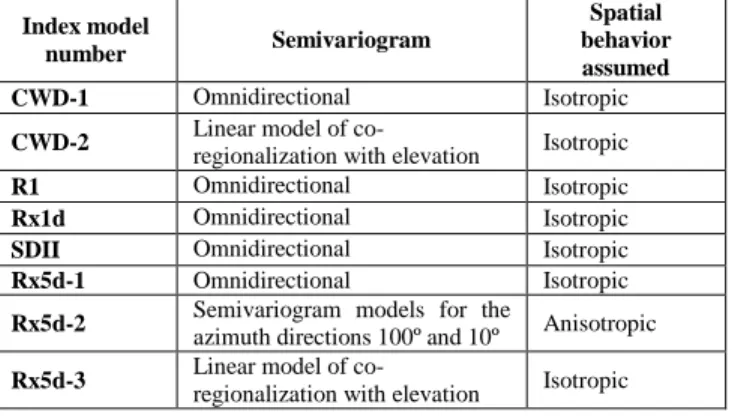
Taking into account the results obtained in the exploratory analysis (IDW models not shown), several modeling strategies were compared taking into account the spatial continuity behavior assumed for each index and its correlation with elevation (Table III). Although the relief of the island is in direction WNW-ESE, the analysis of the estimated surfaces obtained with IDW (not shown) shows no evidence of anisotropy, except for variable Rx5d. This means that the spatial variability of all other indices was assumed identical in all directions (i.e., isotropic).
Table IV summarizes the semivariogram parameters estimated for the models indicated in Table III.
TABLE III. EXPERIMENTAL SEMIVARIOGRAM MODELING STRATEGIES Index model number Semivariogram Spatial behavior assumed CWD-1 Omnidirectional Isotropic CWD-2 Linear model of
co-regionalization with elevation Isotropic
R1 Omnidirectional Isotropic
Rx1d Omnidirectional Isotropic SDII Omnidirectional Isotropic Rx5d-1 Omnidirectional Isotropic Rx5d-2 Semivariogram models for the
azimuth directions 100º and 10º Anisotropic Rx5d-3 Linear model of
co-regionalization with elevation Isotropic TABLE IV. SEMIVARIOGRAM PARAMETERS ESTIMATED FOR THE
MODELS INDICATED IN TABLE III Index model number Model type Nug
get Partial sill
Spatial range (Km)
CWD-1 Spherical 6 3 11.7
CWD-2 Exponential (Exp.) 0
9 (CWD) 940 (CWD-Elevation) 166272 (Elevation) 13.4 R1 Exp. 0 714 12.6 Rx1d Exp. 0 1157 8.2 SDII Exp. 0 17 5.3 Rx5d-1 Gaussian 1165 6992 12.7 Rx5d-2 Gaussian 1371 6794 14.3 (major) 8.2 (minor) Rx5d-3 Spherical 0 16440 (Rx5d) 23891 (Rx5d-Elevation) 166380 (Elevation) 12.6
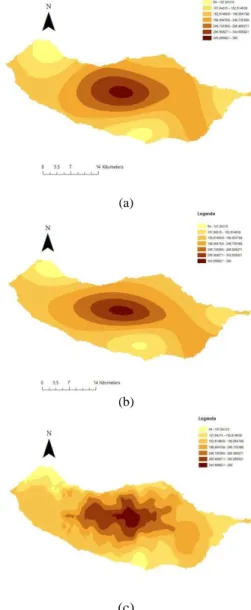
OCK with elevation was used in the spatial interpolation of the averaged Rx5d and CWD, whereas all other variables were interpolated through OK (Fig. 4-8).
The final interpolation model selected to describe the spatial distribution of Rx5d and CWD depends on the error statistics of the cross-validation (Table V). ME values close to zero indicate a small bias in the estimation. Hence, the best interpolation strategy for both variables is OCK with the semivariogram models Rx5d-3 and CWD-2, respectively.
TABLE V. CROSS-VALIDATION ERROR STATISTICS OBTAINED IN THE
VARIOUS SPATIAL INTERPOLATION STRATEGIES (SELECTED MODELS ARE IN ITALICS)
Indices Spatial interpolation model ME RMSE
CWD
OK with the semivariogram model
CWD-1 0,045 3,13
OCK with the semivariogram model
CWD-2 -0,02 3,214
R1 OK 0,529 20,77
Rx1d OK 2,68 31,67
SDII OK -0,01 5,012
Rx5d
OK with the semivariogram model Rx5d-1 5,647 59,52 OK with the semivariogram model Rx5d-2 4,493 56,5 OCK with the semivariogram model
Rx5d-3 -0,853 69,04
(a)
(b)
Figure 4. Interpolation of the averaged CWD index using: (a) OK and the semivariogram model CWD-1; (b) OCK and the semivariogram model
CWD-2.
(a)
(b)
(c)
Figure 5. Interpolation of the averaged Rx5d index using: (a) OK and the semivariogram model Rx5d-1; (b) OK and the semivariogram model
Rx5d-2. (c) OCK and the semivariogram model Rx5d-3.
Figure 7. OK interpolation of the averaged Rx1d.
Figure 8. OK interpolation of the averaged SDII index.
B. Spatial patterns of extreme precipitation
In order to visualize the spatial patterns of extreme precipitation from a global perspective, a 3D SOM was applied to the indices surfaces obtained through Kriging. First, the selected models (Table V), obtained in raster format, were converted back to point data, sampled at regular intervals. Afterwards, the indices values were normalized to ensure equal variance in all variables and the SOM was parameterized as follows:
The output space was set with 3 dimensions [4 × 4 × 4], which corresponds to 64 units in total;
The neighborhood function selected was Gaussian;
The length of the training was set to “long” (8 epochs);
Random initialization.
As the final results depend on the initialization of the SOM, 100 models were obtained and the best model was chosen according to the criterion of best fit, i.e., the lowest quantization error (Table VI).
TABLE VI. 3DSOMRESULTS (100MODELS) Quantization Error Topological Error Selected Model 0,74747 0,042616 Average Model 0,78156 0,041578
To each unit of the SOM (output space of the network) was then assigned a RGB color according to its output space coordinates. In turn, each raster cell was represented cartographically with the color assigned to the unit of the SOM where that cell is mapped, i.e., its BMU (Fig. 9). This means that each color corresponds to a homogeneous zone in terms of the various indices values.
Figure 9. Visualization of the five precipitation indices using the output of the SOM mapped to a 3D RGB space. Areas with similar colors have
similar characteristics.
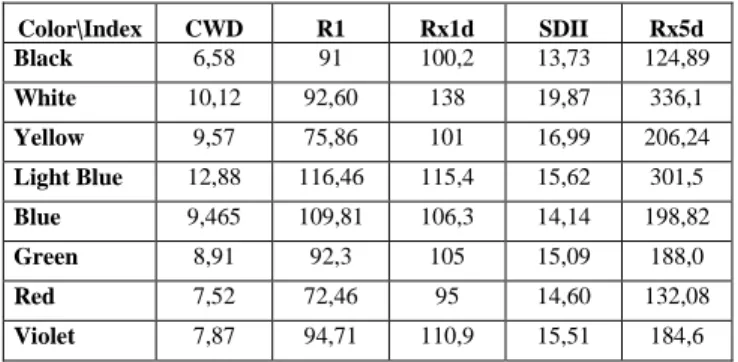
Table VII summarizes the characteristics of each area identified in Fig. 9. There are significant differences between the different areas (colors). Table VII allows comparing the predicted mean values for the whole island.
TABLE VII. SUMMARY OF THE AVERAGE VALUES FOR EACH AREA Color\Index CWD R1 Rx1d SDII Rx5d Black 6,58 91 100,2 13,73 124,89 White 10,12 92,60 138 19,87 336,1 Yellow 9,57 75,86 101 16,99 206,24 Light Blue 12,88 116,46 115,4 15,62 301,5 Blue 9,465 109,81 106,3 14,14 198,82 Green 8,91 92,3 105 15,09 188,0 Red 7,52 72,46 95 14,60 132,08 Violet 7,87 94,71 110,9 15,51 184,6 Despite its small size, Madeira Island has distinct zones in relation to extreme precipitation events. The white area corresponds to the higher regions of the island characterized by higher values in all indices, whereas the darkest area (black in the far east of the island), is characterized by the lowest values in all indices. The north of the island, which is colored dark blue and light blue, corresponds to high values in all indices (although much smaller than in the white colored area), with particularly high R1 index values. Finally, the area colored in red is characterized by low values in all indices. The green area is very close to the average values (a phenomenon that is partly explained by the lack of information in the area). There are no significant differences between the green and violet zone (analysis of Euclidean distance).
V. CONCLUSION
In this paper, we propose a methodology for characterizing the spatial patterns of extreme precipitation in Madeira Island. This methodology combines two different approaches: the first one is based on geostatistical procedures, and the second one is based on the 3D SOM. The first approach is used to estimate spatial surfaces of extreme precipitation indices, and the second one allows visualizing the phenomenon from a global perspective, thus enabling the identification of homogeneous areas in relation to extreme precipitation events.
The spatial and temporal resolution of the data set considered is too small to thoroughly characterize the extreme precipitation phenomenon in Madeira Island. Nevertheless, the results indicate the proposed methodology as a valuable tool to provide a set of maps that can effectively assist the spatial analysis of a phenomenon. It can have multiple perspectives and deal with high dimensional data, which requires a global view. The results of this particular application open perspectives for new applications not only in the climate context, but also in other domains.
REFERENCES
[1] A.M.G.K. Tank, F.W. Zwiers and X. Zhang, Guidelines on Analysis of extremes in a changing climate in support of informed decisions for adaptation, WMO-TD, WMO, 2009. [2] A.C. Costa and A. Soares, “Trends in extreme precipitation
indices derived from a daily rainfall database for the South of Portugal,” International Journal of Climatology, vol. 29, no. 13, 2009, pp. 1956-1975; DOI 10.1002/joc.1834.
[3] M.I.P. de Lima, S.C.P. Carvalho and J.L.M.P. de Lima, “Investigating annual and monthly trends in precipitation structure: an overview across Portugal,” Nat. Hazards Earth Syst. Sci., vol. 10, no. 11, 2010, pp. 2429-2440; DOI 10.5194/nhess-10-2429-2010.
[4] G.M. Griffiths, M.J. Salinger and I. Leleu, “Trends in extreme daily rainfall across the South Pacific and relationship to the South Pacific Convergence Zone,” International Journal of Climatology, vol. 23, no. 8, 2003, pp. 847-869; DOI 10.1002/joc.923.
[5] M. Haylock and N. Nicholls, “Trends in extreme rainfall indices for an updated high quality data set for Australia, 1910–1998,” International Journal of Climatology, vol. 20, no. 13, 2000, pp. 1533-1541; DOI 10.1002/1097-0088(20001115)20:13<1533::aid-joc586>3.0.co;2-j.
[6] A.C. Costa, R. Durão, M.J. Pereira and A. Soares, “Using stochastic space-time models to map extreme precipitation in southern Portugal,” Nat. Hazards Earth Syst. Sci., vol. 8, no. 4, 2008, pp. 763-773; DOI 10.5194/nhess-8-763-2008. [7] M.J. Cruz, R. Aguiar, A. Correia, T. Tavares, J.S. Pereira and
F.D. Santos, “Impacts of climate change on the terrestrial ecosystems of Madeira,” International Journal of Design and Nature and Ecodynamics, vol. 4, no. 4, 2009, pp. 413-422. [8] T. Kohonen, “The self-organizing map,” Proceedings of the
IEEE, vol. 78, no. 9, 1990, pp. 1464 -1480.
[9] T. Kohonen, “The self-organizing map,” Neurocomputing, vol. 21 no. 1-3, 1998, pp. 1-6.
[10] T. Kohonen, Self-organizing Maps, Springer, 2001.
[11] S. Prada, M. Menezes de Sequeira, C. Figueira and M.O. da Silva, “Fog precipitation and rainfall interception in the natural forests of Madeira Island (Portugal),” Agricultural and Forest Meteorology, vol. 149, no. 6-7, 2009, pp. 1179-1187.
[12] J.J.M. Loureiro, “Monografia hidrológica da ilha da Madeira,” Revista Recursos Hídricos, vol. 5, 1984, pp. 53-71. [13] S. Prada, “Geologia e Recursos Hídricos Subterrâneos da Ilha
da Madeira,” Universidade da Madeira, 2000.
[14] E.H. Isaaks and R.M. Srivastava, An introduction to applied geostatistics, Oxford University Press, 1989.
[15] P. Goovaerts, Geostatistics for natural resources evaluation, Oxford University Press, 1997.
[16] P.A. Burrough and R.A. McDonnell, Principles of Geographical Information Systems, Oxford University Press, 1998.
[17] A.D. Hartkamp, K.D. Beurs, A. Stein and J.W. White, Interpolation Techniques for Climate Variables, CIMMYT, 1999.
[18] I.A. Nalder and R.W. Wein, “Spatial interpolation of climatic Normals: test of a new method in the Canadian boreal forest,” Agricultural and Forest Meteorology, vol. 92, no. 4, 1998, pp. 211-225.
[19] E.L. Koua, “Using self-organizing maps for information visualization and knowledge discovery in complex geospatial datasets,” Proc. Proceedings of 21st International Cartographic Renaissance (ICC), International Cartographic Association, 2003, pp. 1694-1702.
[20] F. Bação, V. Lobo and M. Painho, “Applications of Different Self-Organizing Map Variants to Geographical Information Science Problems,” Self-Organising Maps: applications in geographic information science, A. Skupin and P. Agarwal, eds., John Wiley & Sons, 2008, pp. 22-44.
[21] J. Vesanto, J. Himberg, E. Alhoniemi and J. Parhankangas, SOM Toolbox for Matlab 5, Helsinki University of Techology, 2000.
[22] J. Himberg, “A SOM based cluster visualization and its application for false coloring,” Proc. Proceedings of the IEEE-INNS-ENNS International Joint Conference on Neural Networks, 2000, pp. 587- 592.
[23] S. Kaski, J. Venna and T. Kohonen, “Coloring that reveals high-dimensional structures in data,” Proc. Proceedings of 6th International Conference on Neural Information Processing, IEEE, 1999, pp. 729-734.
[24] A. Skupin and P. Agarwal, “What is a Self-organizing Map?,” Self-Organising Maps: applications in geographic information science, P. Agarwal and A. Skupin, eds., John Wiley & Sons, 2008, pp. 1-20.
[25] A.K. Jain, M.N. Murty and P.J. Flynn, “Data Clustering: A Review,” ACM Computing Surveys, vol. 31, no. 3, 1999, pp. 264-323.
[26] F. Bação, V. Lobo and M. Painho, “The self-organizing map, the Geo-SOM, and relevant variants for geosciences,” Computers & Geosciences, vol. 31, no. 2, 2005, pp. 155-163. [27] E.L. Koua and M. Kraak, “An Integrated Exploratory
Geovisualization Environment Based on Self-Organizing Map,” Self-Organising Maps: applications in geographic information science, P. Agarwal and A. Skupin, eds., John Wiley & Sons, 2008, pp. 45-86.
[28] J. Gorricha and V. Lobo, “On the Use of Three-Dimensional
Self-Organizing Maps for Visualizing Clusters in
Georeferenced Data ” Information Fusion and Geographic Information Systems, Lecture Notes in Geoinformation and Cartography 5, V. V. Popovich, et al., eds., Springer Berlin Heidelberg, 2011, pp. 61-75.