R+D-project Agroforestry
(FKZ 3508 88 0600)The potential function of short rotation coppice strips for ground beetles (Coleoptera, Carabidae)
Objetctive
It ist assumed that the results from the hedges can be tranferred to SRCs to a large extent. There will be some differences due to the frequent cutting of the wood, which will restrict the ocurrence of forest species in the SRCs. But the results of the analysis indicate, that the integration of SRCs into low structured agricultural landscapes could help to increase local biodiversity and to lower the endangerment of typical species of agricultural landscapes. To support the populations of woodland species the strips should have a width of at least 8 m and be connected to woodlands or other woody habitats.
Funded by the German Federal Nature Conservation Agency with resources of the Federal Ministry of Environment, Nature Conservation, Building and Nuclear Safety Website: www.landschaftsentwicklung.wzw.tum.de
Technische Universität München, Chair for Strategic Landscape Planning, Emil-Ramann-Str. 6, D-85354 Freising, [email protected]
Wolfgang Zehlius-Eckert
Due to the negative environmental impacts of modern intensive agriculture there is an urgent need for environmentally more sound agricultural land use systems. Agroforestry systems are a promising form of such land use systems.
The analysis presented here tries to specify, which ground beetle species could be expected in the woody strips of agroforestry systems. The analysis is restricted to short rotation coppice strips (SRCs). The aim is not to identifyhow muchspecies can be expected in the woody strips but to focus on thespecies identity. It is not claimed to present statistically confirmed results. The analysis has the character of a preparatory study which shall be the basis for the formulation of specific hypothesis, which can be tested by further empirical studies.
Discussion and conclusions
Discussio
n
Preliminary results
Preliminary Results Material and methods
Introduction and objective of the analysis
Approach
The analysis is based on a literature research. Due to the fact, that there are still very few agrororestry systems with SRCs and even less studies about the establishment of ground beetles in the strips, published studies about the carabid fauna of hedges were analysed, added by two studies about SRCs. 18 studies with 117 sites were integrated into the analysis. The following parameters were included as far as they were documented by the studies: age of the hedge (time since establishment), width of the hedge, distance to the next woodland and other woody habitats, soil conditions (soil type, soil moisture) and information about the existence of additional margins with herbs and/or grasses. In order to get an impression of the long term development the data were arranged along the age of the hedges and the SRCs respectively. The age classes were: 1-2 years, 3-5 years, 6-10 years, 11-20 years and older than 20 years. In some cases the age had to be estimated by the description in the study because there was no direct information about the age of the hedges. This was mainly the case for the older hedges (older than 20 years). Additionally 12 studies were analysed for the function of hedges as overwintering sites or refugia after harvesting or under adverse weather conditions (see column „habitat shift“ in the table below). Data about the species characteristics (regional distribution, biology) were taken from GAC (2009) and from the database carabids.org (Homburg et al. 2013).
Agroforestry system with short rotation coppice strips near Dornburg (Thuringia)
Carabus coriaceus, licking water from
the ground
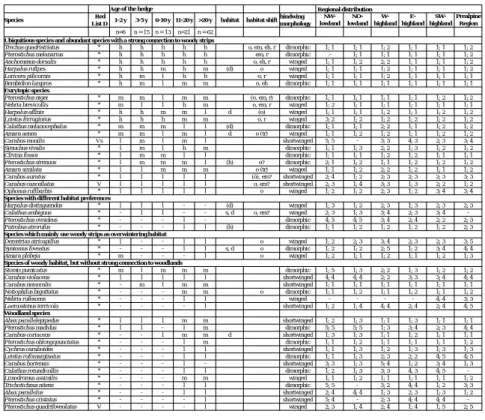
Table 1: Distribution of selected ground beetle species about different age classes of hedges and SRCs (ocurrence probability)
Abbreviations: l = low ocurrence probability (till 33 %); m = medium ocurrence probability (33-66 %); h = high ocurrence probability (more than 66 %);
column „habitat“: d = dry soil conditions; s = sandy soils; h = hygrophilous;
column „habitat shift“: o = using hedges as overwintering sites; em = using hedges or adjacent parts of the field as refugium during phases with adverse climatice conditions; eh = using hedges as refugium after harvesting; r = using hedges at least additionally for reproduction
regional distribution: 1; 1 = distribution covers the whole area of the region and the populated patches are evenly distributed without bigger gaps between the patches; 5;5 = only very small part of the region occupied and the populations within the occupied area are very isolated.
The table on the left side shows an extraction of the list of species observed in hedges. Mainly species with a high frequency in at least one age class were selected. Additional selection criteria were the possibility to show the influence of the regional species pool in combination with the mobility, indicated by the hind wing morphology.
Column 2 shows the Red-List-status of the species in Germany. In column 8 it is marked if the species has special habitat preferences concerning soil moisture and soil type, because this may cause lower frequencies in the hedges (especially relevant for the soil type). Column 9 shows the results of the literature analysis regarding the function of hedges as overwintering sites, as a refugium after the harvesting of the crops or under adverse climatic conditions and also as a (suboptimal) reproduction site. First result is, that hedges are mainly colonised by common species. Among the high frequent species there are merely any endangered species. The few species in the tabe show a low status of endangerment („V“ means „early warning level“). Two of the three Red-List-species are short winged and are therefore restricted to running for dispersal, which makes them susceptible to fragementation and disturbance effects. A second result is, as expected, that rare species with a limited distribution and additionally with a limited mobility (e. g. Carabus auratus und cancellatus) show lower frequencies in hedges as far distributed and mobile species (e. g.Bembidion lampros). Because there are also other factors influencing the occurence of the species (e. g. habitat preferences) this doesn‘t apply for all species.
The relevance of hedges for forest species has been analysed in detail by many studies. Species with a high ability to colonise hedges are Abax parallelepipedus, Carabus coriaceus, Pterostichus oblongopunctatus and Limodromus assimilis, in some regions alsoPterostichus madidus, which can be seen in the table by the relatively high frequencies at least in the older hedges. For most forest species distances between the habitats from more than 500-1.000 m will be difficult to cross (e. g. Gruttke 2001) and hedges with less than 8 m will be of low relevance for forest species in most cases (Stachow 1988).
References
GAC (Gesellschaft für Angewandte Carabidologie e. V.; 2009): Lebensraumpräferenzen der Laufkäfer Deutschlands – Wissensbasierter Katalog. – Angewandte Carabidologie, Suplement V.
Homburg, Katharina; Homburg, Nils; Schäfer, Florian; Schuldt, Andreas and Assmann, Thorsten (2013): carabids.org – A dynamic online database of ground beetle species traits (Coleoptera, Carabidae). - Insect Conservation and Diversity. DOI: 10.1111/icad.12045
Gruttke, Horst (2001): Welche Bedeutung haben Habitatgröße und -isolation für das Vorkommen waldtypischer Laufkäfer in Waldrelikten und Kleingehölzen einer Agrarlandschaft? - Angewandte Carabidologie Supplement 11, 81-98.
Stachow, Ulrich (1988): Zur Bedeutung der Wallhecken in einem Agrarökosystem Schleswig-Holsteins. II. Laufkäfer (Carabidae, Col.). – Z. f. Kulturtechnik und Flurbereinigung 29, 299-306.
Age of the hedge Regional distribution Species Red
List D 1-2 y 3-5 y 6-10 y 11-20 y >20 y habitat habitat shift hindwing morphology NW-lowland NO-lowland W-highland E-highland SW-highland Prealpine Region n=6 n = 15 n = 13 n=21 n = 62
Ubiquitious species and abundant species with a strong connection to woody strips
Trechus quadristriatus * h h h h h o, em, eh, r dimorphic 1; 1 1; 1 1; 2 1; 1 1; 1 1; 2
Pterostichus melanarius * h h h h h em, r dimorphic .- 1; 1 1; 1 1; 1 1; 1 1; 2
Anchomenus dorsalis * h h h h h o, eh, r winged 1; 1 1; 2 2; 2 1; 1 1; 1 1; 2
Harpalus rufipes * h h m h m (d) o winged 1; 1 1; 1 1; 2 1; 1 1; 1 1; 2
Loricera pilicornis * h m l h h o, r winged 1; 1 1; 1 1; 2 1; 1 1; 1 1; 1
Bembidion lampros * h m l m m o, eh dimorphic 1; 1 1; 1 1; 1 1; 1 1; 1 1; 1
Eurytopic species
Pterostichus niger * m m l m m (o, em, r) dimorphic 1; 1 1; 1 1; 1 1; 1 1; 2 1; 2
Nebria brevicollis * m l l h m o, em, r winged 1; 2 1; 1 1; 1 1; 1 1; 1 1; 1
Harpalus affinis * h h m m l d (o) winged 1; 1 1; 1 1; 2 1; 1 1; 2 1; 2
Leistus ferrugineus * h h h m m o, r winged 3; 2 1; 2 1; 2 1; 2 1; 2 1; 2
Calathus melanocephalus * m m m l l (d) dimorphic 1; 1 1; 1 2; 2 1; 1 1; 2 1; 2
Amara aenea * m m l m l d o (tr) winged 1; 1 1; 2 1; 2 1; 1 1; 2 1; 2
Carabus monilis Vs l m l m l shortwinged 5; 5 - 3; 3 4; 3 2; 3 3; 4
Synuchus vivalis * l m l h m dimorphic 1; 1 1; 3 2; 2 1; 3 1; 2 1; 2
Clivina fossor * l m m l l dimorphic 1; 1 1; 1 1; 2 1; 2 1; 1 1; 1
Pterostichus strenuus * l m m m l (h) o? dimorphic 2; 1 1; 2 1; 1 1; 2 1; 2 1; 2
Amara similata * l l m m m o (tr) winged 1; 1 1; 2 2; 2 1; 2 1; 1 1; 2
Carabus auratus * l l l l l (ö), em? shortwinged 2; 4 1; 2 2; 3 2; 3 2; 3 3; 3
Carabus cancellatus V l l l l l o, em? shortwinged 2; 3 1; 4 3; 3 1; 3 2; 2 1; 2
Ophonus rufibarbis * l l l l l o winged 1; 2 1; 2 2; 3 1; 2 3; 4 3; 4
Species with different habitat preferences
Harpalus distinguendus * l l l - - (d) winged 1; 3 1; 2 2; 3 1; 3 2; 3 2; 3
Calathus ambiguus * - l l - - s, d o, em? winged 2; 3 1; 3 3; 4 2; 3 3; 4
-Pterostichus ovoideus * - - - l - dimorphic 4; 5 4; 5 3; 4 2; 4 2; 2 2; 3
Patrobus atrorufus * - - - l l (h) dimorphic 1; 1 1; 2 1; 2 1; 2 1; 2 2; 3
Species which mainly use woody strips as overwintering habitat
Demetrias atricapillus * l - - l l o winged 1; 2 2; 3 3; 4 2; 3 2; 3 3; 5
Syntomus foveatus * - - - l l s, d o dimorphic 1; 2 1; 2 2; 5 1; 2 3; 4 4; 4
Amara plebeja * m - - - l o winged 1; 2 1; 1 1; 2 1; 1 1; 2 1; 3
Species of woody habitat, but without strong connection to woodlands
Stomis pumicatus * m l m m m dimorphic 1; 5 1; 3 2; 2 1; 3 1; 2 1; 2
Carabus violaceus * l l l l l shortwinged 4; 4 4; 4 2; 2 3; 3 3; 4 4; 4
Carabus nemoralis * - m l m m shortwinged 1; 1 1; 1 1; 1 1; 1 1; 1 1; 1
Notiophilus biguttatus * - - - m m o dimorphic 1; 1 1; 2 1; 1 1; 2 1; 1 1; 2
Nebria rufescens * - - - l l winged - - - - 4; 4 3; 3
Laemostenus terricola * - - - - l shortwinged 1; 2 1; 4 4; 4 2; 4 2; 4 4; 5
Woodland species
Abax parallelepipedus * l l l m m shortwinged 1; 2 1; 3 1; 1 1; 3 1; 1 1; 1
Pterostichus madidus * l l - l m dimorphic 5; 5 5; 5 1; 3 3; 4 2; 3 4; 4
Carabus coriaceus * - - l m m d shortwinged 1; 3 1; 3 1; 1 1; 2 1; 1 1; 1
Pterostichus oblongopunctatus * - - - l m dimorphic 1; 1 1; 2 1; 1 1; 1 1; 1 1; 2
Cychrus caraboides * - - - l l shortwinged 1; 1 1; 3 1; 2 1; 3 1; 3 1; 3
Leistus rufomarginatus * - - - l l dimorphic 1; 1 1; 3 2; 3 2; 2 4; 5 4; 5
Carabus hortensis * - - - l - shortwinged 3; 3 1; 3 5; 4 1; 2 3; 4 1; 3
Calathus rotundicollis * - - - l l dimorphic 1; 2 1; 3 3; 3 4; 3 4; 5
-Limodromus assimilis * - - - m m winged 1; 1 1; 2 1; 1 1; 1 1; 1 1; 2
Trichotichnus nitens * - - - l l dimorphic 5; 5 - 3; 2 4; 4 1; 2 3; 3
Abax parallelus * - - - l l shortwinged 2; 4 4; 4 1; 3 2; 3 1; 3 1; 2
Pterostichus cristatus * - - - - l shortwinged 5; 4 - 2; 3 4; 4 4; 4
-Pterostichus quadrifoveolatus V - - - - l winged 2; 3 1; 4 2; 4 1; 4 1; 5 2; 5
The potential function of short rotation coppice strips for ground beetles (Coleoptera, Carabidae)
Age of the hedge Regional distribution
Species Red
List D 1-2 y 3-5 y 6-10 y 11-20 y >20 y habitat habitat shift
hindwing morphology NW-lowland NO-lowland W-highland E-highland SW-highland Prealpine Region N=6 N = 15 N = 13 N=21 N = 62
Ubiquitious species and abundant species with a strong connection to woody strips
Trechus quadristriatus * h h h h h o, em, eh, r dimorphic 1; 1 1; 1 1; 2 1; 1 1; 1 1; 2
Pterostichus melanarius * h h h h h em, r dimorphic .- 1; 1 1; 1 1; 1 1; 1 1; 2
Anchomenus dorsalis * h h h h h o, eh, r winged 1; 1 1; 2 2; 2 1; 1 1; 1 1; 2
Harpalus rufipes * h h m h m (d) o winged 1; 1 1; 1 1; 2 1; 1 1; 1 1; 2
Loricera pilicornis * h m l h h o, r winged 1; 1 1; 1 1; 2 1; 1 1; 1 1; 1
Bembidion lampros * h m l m m o, eh dimorphic 1; 1 1; 1 1; 1 1; 1 1; 1 1; 1
Eurytopic species
Pterostichus niger * m m l m m (o, em, r) dimorphic 1; 1 1; 1 1; 1 1; 1 1; 2 1; 2
Nebria brevicollis * m l l h m o, em, r winged 1; 2 1; 1 1; 1 1; 1 1; 1 1; 1
Harpalus affinis * h h m m l d (o) winged 1; 1 1; 1 1; 2 1; 1 1; 2 1; 2
Leistus ferrugineus * h h h m m o, r winged 3; 2 1; 2 1; 2 1; 2 1; 2 1; 2
Calathus melanocephalus * m m m l l (d) dimorphic 1; 1 1; 1 2; 2 1; 1 1; 2 1; 2
Amara aenea * m m l m l d o winged 1; 1 1; 2 1; 2 1; 1 1; 2 1; 2
Carabus monilis Vs l m l m l shortwinged 5; 5 - 3; 3 4; 3 2; 3 3; 4
Synuchus vivalis * l m l h m dimorphic 1; 1 1; 3 2; 2 1; 3 1; 2 1; 2
Clivina fossor Vs l m m l l dimorphic 1; 1 1; 1 1; 2 1; 2 1; 1 1; 1
Pterostichus strenuus * l m m m l (h) o? dimorphic 2; 1 1; 2 1; 1 1; 2 1; 2 1; 2
Amara similata * l l m m m o winged 1; 1 1; 2 2; 2 1; 2 1; 1 1; 2
Carabus auratus * l l l l l (ö), em? shortwinged 2; 4 1; 2 2; 3 2; 3 2; 3 3; 3
Carabus cancellatus V l l l l l o, em? shortwinged 2; 3 1; 4 3; 3 1; 3 2; 2 1; 2
Ophonus rufibarbis * l l l l l o winged 1; 2 1; 2 2; 3 1; 2 3; 4 3; 4
Species with different habitat preferences
Harpalus distinguendus * l l l - - (d) winged 1;3 1;2 2; 3 1;3 2;3 2;3
Calathus ambiguus * - l l - - s, d o, em? winged 2; 3 1; 3 3; 4 2; 3 3; 4
-Pterostichus ovoideus * - - - l - dimorphic 4; 5 4; 5 3; 4 2; 4 2; 2 2; 3
Patrobus atrorufus * - - - l l (h) dimorphic 1; 1 1; 2 1; 2 1; 2 1; 2 2; 3
Species which mainly use woody strips as overwintering habitat
Demetrias atricapillus * l - - l l o winged 1; 2 2; 3 3; 4 2; 3 2; 3 3; 5
Syntomus foveatus * - - - l l s, d o dimorphic 1; 2 1; 2 2; 5 1; 2 3; 4 4; 4
Amara plebeja * m - - - l o winged 1; 2 1; 1 1; 2 1; 1 1; 2 1; 3
The potential function of short rotation coppice strips for ground beetles (Coleoptera, Carabidae)
Age of the hedge Regional distribution
Species Red
List D 1-2 y 3-5 y 6-10 y 11-20 y >20 y habitat habitat shift
hindwing morphology NW-lowland NO-lowland W-highland E-highland SW-highland Prealpine Region N=6 N = 15 N = 13 N=21 N = 62
Species of woody habitat, but without strong connection to woodlands
Stomis pumicatus * m l m m m dimorphic 1; 5 1; 3 2;2 1;3 1;2 1;2
Carabus violaceus * l l l l l shortwinged 4; 4 4; 4 2; 2 3; 3 3; 4 4; 4
Carabus nemoralis * - m l m m shortwinged 1; 1 1; 1 1; 1 1; 1 1; 1 1; 1
Notiophilus biguttatus * - - - m m o dimorphic 1; 1 1; 2 1; 1 1; 2 1; 1 1; 2
Nebria rufescens * - - - l l winged - - - - 4; 4 3; 3
Laemostenus terricola * - - - - l shortwinged 1; 2 1; 4 4; 4 2; 4 2; 4 4; 5
Woodland species
Abax parallelepipedus * l l l m m shortwinged 1; 2 1; 3 1; 1 1; 3 1; 1 1; 1
Pterostichus madidus * l l - l m dimorphic 5; 5 5; 5 1; 3 3; 4 2; 3 4; 4
Carabus coriaceus * - - l m m d shortwinged 1; 3 1; 3 1; 1 1; 2 1; 1 1; 1
Pterostichus oblongopunctatus * - - - l m dimorphic 1; 1 1; 2 1; 1 1; 1 1; 1 1; 2
Cychrus caraboides * - - - l l shortwinged 1; 1 1; 3 1; 2 1; 3 1; 3 1; 3
Leistus rufomarginatus * - - - l l dimorphic 1; 1 1; 3 2; 3 2; 2 4; 5 4; 5
Carabus hortensis * - - - l - shortwinged 3; 3 1; 3 5; 4 1; 2 3; 4 1; 3
Calathus rotundicollis * - - - l l dimorphic 1; 2 1; 3 3; 3 4; 3 4; 5
-Limodromus assimilis * - - - m m winged 1; 1 1; 2 1; 1 1; 1 1; 1 1; 2
Trichotichnus nitens * - - - l l dimorphic 5; 5 - 3; 2 4; 4 1; 2 3; 3
Abax parallelus * - - - l l shortwinged 2; 4 4; 4 1; 3 2; 3 1; 3 1; 2
Pterostichus cristatus * - - - - l shortwinged 5; 4 - 2; 3 4; 4 4; 4
-Pterostichus quadrifoveolatus V - - - - l winged 2; 3 1; 4 2; 4 1; 4 1; 5 2; 5
Abbreviations
Sources
l = low ocurrence probability (till 33 %); m = medium ocurrence probability (33-66 %); h = high ocurrence probability (more than 66 %); column „habitat“: d = dry soil conditions; s = sandy soils; h = hygrophilous; () = predominantly, but not exclusively
column „habitat shift“: o = using hedges as overwintering sites; em = using hedges or adjacent parts of the field as refugium during phases with adverse climatice conditions; eh = using hedges as refugium after harvesting; r = using hedges at least additionally for reproduction; () = uncertain due to few studies, unprecise study design or low transparency, on which data the conclusion is based; ? = hints in the studies but no clear evidence
regional distribution: 1; 1 = distribution covers the whole area of the region and the populated patches are evenly distributed without bigger gaps between the patches; 5;5 = only very small part of the region occupied and the populations within the occupied area are very isolated.
Column "hindwing morphology": Homburg, Katharina; Homburg, Nils; Schäfer, Florian; Schuldt, Andreas and Assmann, Thorsten (2013): carabids.org – A dynamic online database of ground
The potential function of short rotation coppice strips for ground beetles (Coleoptera, Carabidae) – studies integrated into the analysis Studies used to estimate the potential frequency of ground beetles in Short Rotation Coppice strips Ackermann, H.‐J. (1991): Untersuchung der Wechselbeziehungen zwischen Hecken und Feldern im Vergleich von alternativem und konventionellem Anbau, dargestellt am Beispiel von Laufkä‐ fern und Kurzflüglern (Coleoptera: Carabidae, Staphylinidae). Diss. an der Rheinischen Fried‐ rich‐Wilhelms‐Universität zu Bonn, Hohe Landwirtschafltiche Fakultät. Bonn. Fournier, Elisabeth; Loreau, Michel (2001): Respective roles of recent hedges and forest patch rem‐ nants in the maintenance of ground‐beetle (Coleoptera: Carabidae) diversity in an agricultural landscape. ‐ Landscape Ecology 16 (1) : S. 17‐32. GLÜCK, E. & KREISEL, A. (1986). Die Hecke als Lebensraum, Refugium und Vernetzungsstruktur und ihre Bedeutung für die Dispersion von Waldcarabiden. Laufener Seminarbeiträge 10, 64‐83. GRUTTKE, H., KORNACKER, P.M. & WILLECKE, S. (1998). Effizienz eines neu angelegten Biotopstrei‐ fens als Ausbreitungskorridor in der Agrarlandschaft ‐ Ergebnisse einer Langzeitstudie. Schr. R. Landschaftspfl. Natursch. 58, 243‐290. Gruttke, Horst (2001): Welche Bedeutung haben Habitatgröße und ‐isolation für das Vorkommen waldtypischer Laufkäfer in Waldrelikten und Kleingehölzen einer Agrarlandschaft? ‐ Ange‐ wandte Carabidologie Supplement 11, 81‐98. Hingst, R. (1991): Die Bedeutung von Wallhecken für die Vernetzung und den Verbund von Ökosys‐ temen. ‐ Faunistisch‐Okologische Mitteilungen, Supplement 10: 11‐40. MADER, H.J. & MÜLLER, K. (1984). Der Zusammenhang zwischen Heckenlänge und Artenvielfalt. Z. f. Kulturtechnik und Flurbereinigung 25, 282‐293. Platen, R. (2006): Integrierende Ökologische Dauerbeobachtung in Brandenburg (IÖDB) – Arthropo‐ denuntersuchung (Arachnidae, Coleoptera: Carabidae) in Hasenholz und Vierraden. – Natur‐ schutz und Landschaftspflege in Brandenburg 15 (4), 124‐133. Pollard 1968: Hedges III. The effect of removal of the bottom flora of hawthorn hedgerow on the CARABIDAE of the hedge bottom.‐ J. Appl. Ecol. 5: 125‐139. RÖHRICHT, CH., K. RUSCHER, S. KIESEWALTER, I. A. AL HUSSEIN & ZÖPHEL, B. (2007): Feldstreifenan‐ bau. Dresden, Sächsische Landesanstalt für Landwirtschaft. 108 S. (Schriftenreihe der Sächsi‐ schen Landesanstalt für Landwirtschaft; 25/2007).Ross‐Nickoll, M. (2000): Biozönologische Gradientenanalyse von Wald‐, Hecken‐ und Parkstandorten der Stadt Aachen – Verteilungs‐ muster von Phyto‐, Carabido‐ und Araneozönosen. Dissertation an der Rheinisch‐ Westfälischen Technischen Hochschule Aachen, Fakultät für Mathematik, Informatik und Na‐ turwissenschaften. Aachen, Shaker. (Akademische Edition Umweltforschung, Publikationsreihe des interdisziplinären Umwelt‐Forums der RWTH Aachen; 11/2000) SPREIER, B. (1982). Bedeutung von Hecken in Flurbereinigungsgebieten als Reservoir für tierische Organismen, Untersucht am Beispiel der Carabidae und Isopoda. Dissertation Ruprecht‐Karls Universität Heidelberg, 376 S. Stachow, U. (1987): Aktivitäten von Laufkäfern (Carabidae, Col.) in einem intensiv wirtschaftenden Ackerbaubetrieb unter Berücksichtigung des Einflusses von Wallhecken. Diss. an der Agrarwis‐ senschaftlichen Fakultät der Christian‐Albrechts‐Universität zu Kiel. Kiel. (Schriftenreihe Insti‐ tut für Wasserwirtschaft und Landschaftsökologie der Christian‐Albrechts‐Universität Kielät l; 5) Stachow, Ulrich (1988): Zur Bedeutung der Wallhecken in einem Agrarökosystem Schleswig‐ Holsteins. II. Laufkäfer (Carabidae, Col.). – Z. f. Kulturtechnik und Flurbereinigung 29, 299‐306.
Theves, F. (2013): Laufkäfer (Col., Carabidae) in Feldhecken Südwestdeutschlands ‐ Vergesellschaf‐ tung und Biodiversität in Abhängigkeit von der Habitatqualität. Diss. Universität Hohenheim, Institut für Phytomedizin, Fachgebiet Angewandte Entomologie. THIELE, H.U. (1964). Ökologische Untersuchungen an bodenbewohnenden Coleopteren einer He‐ ckenlandschaft. Z. Morph. Ökol. Tiere 53, 537‐586. TISCHLER, W. (1948). Biocönotische Untersuchungen an Wallhecken. Zool. Jb., Abt. Syst., Ökol. und Geogr. 77, 283‐400. Studies analysed to estimate the potential function of Short Rotation Coppice strips as an overwinter‐ ing habitat and as a refugium Ackermann, H.‐J. (1991): Untersuchung der Wechselbeziehungen zwischen Hecken und Feldern im Vergleich von alternativem und konventionellem Anbau, dargestellt am Beispiel von Laufkä‐ fern und Kurzflüglern (Coleoptera: Carabidae, Staphylinidae). Diss. an der Rheinischen Fried‐ rich‐Wilhelms‐Universität zu Bonn, Hohe Landwirtschafltiche Fakultät. Bonn. FUCHS, G. (1969). Die ökologische Bedeutung der Wallhecken in der Agrarlandschaft Nordwest‐ deutschlands, am Beispiel der Käfer. Pedobiol. 9, 432‐458. Hingst, R. (1991): Die Bedeutung von Wallhecken für die Vernetzung und den Verbund von Ökosys‐ temen. ‐ Faunistisch‐Okologische Mitteilungen, Supplement 10: 11‐40. Lorenz, J. (1999): Ökofaunistische Untersuchungen zur Coleopterenfauna einer strukturreichen Ag‐ rarlandschaft. Diss. an der Technischen Universität Dresden, Fakultät für Forst‐, Geo‐ und Hyd‐ rowissenscahften. Tharandt. Pollard 1968: Hedges III. The effect of removal of the bottom flora of hawthorn hedgerow on the CARABIDAE of the hedge bottom.‐ J. Appl. Ecol. 5: 125‐139. Renken, W. (1956): Untersuchungen über Winterlager der Insekten. – Zeitschrift für Morphologie und Ökologie der Tiere 45, 34‐106 Sotherton, N. W. (1985): The distribution and abundance of predatory Coleoptera overwintering in field boundaries. Annals of Applied Biology, 106, 17‐21. Stachow, Ulrich (1988): Zur Bedeutung der Wallhecken in einem Agrarökosystem Schleswig‐ Holsteins. II. Laufkäfer (Carabidae, Col.). – Z. f. Kulturtechnik und Flurbereinigung 29, 299‐306. THIELE, H.U. (1964). Ökologische Untersuchungen an bodenbewohnenden Coleopteren einer He‐ ckenlandschaft. Z. Morph. Ökol. Tiere 53, 537‐586. TISCHLER, W. (1948). Biocönotische Untersuchungen an Wallhecken. Zool. Jb., Abt. Syst., Ökol. und Geogr. 77, 283‐400. TISCHLER, W. (1958). Synökologische Untersuchungen an der Fauna der Felder und Feldgehölze. Z. Morph. Ökol. Tiere 47, 54‐114.