Editors: M. Märtsin, B. Wagoner, E.-L. Aveling et al. © 2011 Nova Science Publishers, Inc.
Chapter 8
I
NNOVATIVE
M
OMENTS IN
P
SYCHOTHERAPY
:
D
IALOGICAL
P
ROCESSES IN
D
EVELOPING
N
ARRATIVES
Miguel M. Gonçalves, Carla Cunha, António P. Ribeiro,
Inês Mendes, Anita Santos, Marlene Matos and João Salgado
I
NTRODUCTIONThis chapter presents an overview of the research programme that is being developed in our research centre addressing narrative change processes in psychotherapy. Our departing point was the narrative metaphor of psychotherapy (Angus & McLeod, 2004; Bruner, 2004; Hermans & Hermans-Jansen, 1995; White & Epston, 1990) and the emphasis on the narrative construction and re-construction of the self (Bruner, 1986, McAdams, 1993, Sarbin, 1986), which assumes that clients transform themselves through the stories they tell – to themselves and to others. We also proceed from the idea that self-narratives entail particular dialogical processes that can become visible or be enhanced in the psychotherapeutic setting. Furthermore, by adopting this dialogical and narrative standpoint, therapists and clients can use this inner multiplicity as an opportunity for identity changes.
While this general metaphor of ‘clients as storytellers’ has framed our work in psychotherapy research, the re-authoring model of White and Epston’s (1990; see also White, 2007) and the dialogical perspective of Hermans and collaborators (Hermans, 1996; Hermans & Hermans-Jansen, 1995; Hermans & Kempen, 1993; Hermans & Dimaggio, 2004) have been shaping our conceptual lenses in the study of change in therapy.
In this chapter we elaborate upon a central concept of our research: the concept of innovative moments (IMs, also named as i-moments in previous publications), drawn from White and Epston’s (1990) notion of ‘unique outcome’ and discuss the dialogical dynamics that are involved in IMs emergence and development in therapy.
C
HANGE ASN
ARRATIVER
E-
CONSTRUCTION OF THES
ELFOver the last decades, several authors within the narrative and dialogical fields have been acknowledging the centrality of ‘telling stories’ in human lives (e.g., Bruner, 1986; McAdams, 1993). Self-narratives are the result of the human effort to create meaning from our experience in the world and to have our perspectives validated by others, to whom we are dialogically intertwined (Gonçalves, Matos & Santos, 2009). The construction of meaning through self-narratives involves a process of interpretation, selection and synthesis of life experiences (McAdams, 1993). Complex elements of episodic memory, personal and social expectations, emotional and interpersonal experiences are selected and integrated into a personal account in the form of a story. The story is performed to others in the specific act of telling it, simultaneously projecting a certain present view into the future. The segments of the experience that are integrated in our self-narrative frames are shaped by our prior salient and more familiar experiences, both with social others and with ourselves. Additionally, the stories we tell are also constrained by the interlocutor and the context (for example, our self-narratives vary according to the social role we are assigned in a given context).
Therefore, given the multivocal nature of these sources of narrative production (see Hermans, 1996), self-narratives involve processes of dialogical negotiation, disagreement and conciliation between self and other (this ‘other’ can be specific social others, broader cultural messages and prescriptions, or even other parts of oneself).
Hence, the process of narrating a story pictures the self, as narrator, in dimensions that go beyond the narrated content. Self-narratives present the possibility of simultaneously revealing our authorship – by the way we view ourselves – and disclosing our position in the world – by the way we present ourselves to others (Wortham, 2001). As Hermans (1996) claims, this means that the self is simultaneously embedded in the content of the story and the act of telling it to another person. According to some authors (Hermans, 1996; see also Sarbin, 1986), this dual feature of agency and positioning of the self – both as an author/narrator and a social actor – is critically embedded in the unfolding narrative process, and it is through this process that self can be transformed.
According to the re-authoring model of White and Epston (1990), clients frequently seek therapeutic help when the self has lost its ability to flexibly interpret the world, becoming trapped within redundant forms of meaning-making that are no longer capable of incorporating the diversity and multiplicity of lived experience. Clients become entrapped in ‘problem-saturated stories’ (White, 2007; White & Epston, 1990) – that is, narratives that dominate and minimize the possibilities of creative and flexible meaning, and thus become problematic.
These all-encompassing stories usually favour one perspective over multiple others (being more monological than dialogical; Hermans & Hermans-Jansen, 1995), and tend to be fixed around a single dominant problematic theme (see Neimeyer, Herrero & Botella, 2006; Santos & Gonçalves, 2009). As a consequence they constrict personal adaptability and undermine other possibilities for thinking and acting (Gonçalves et al., 2009). For example, a client seeking therapy in order to deal with daily anxiety and panic attacks, may narrate several stories in the session that illustrate how he or she is too afraid to engage independently in everyday life activities, always needing to be taken care of by other members of the family.
In this case, fear is the theme of the problematic self-narrative and avoidance behaviours appear as compliance with the problem’s rule.
Congruently, therapy can be an opportunity for gaining awareness of the constraining power of these problematic self-narratives and developing alternative, more flexible ones. Following White and Epston (1990):
“when persons experience problems for which they seek therapy, (a) the narratives in which they are storying their experience and/or in which they are having their experience storied by others do not sufficiently represent their lived experience, and (b), in these circumstances, there will be significant and vital aspects of their lived experience that contradict these dominant narratives.” (p. 40)
Thus, with the acknowledgement that there are always details of lived experience not assimilated by the problematic self-narrative, the therapist’s action in re-authoring therapy should lead to the search for these opposing aspects or ‘unique outcomes’ in the client’s life. According to White and Epston (1990), the concept of unique outcome refers to all details outside the problematic self-narrative that appear as exceptions to the problem’s prescriptions and an attentive therapist would be listening to them within the stories brought by their clients. In the above example, our client that is currently consumed with panic attacks can remember a situation in the past when he or she was able to leave home alone and did not experience any panic attack as predicted (i.e., a unique outcome towards fear). White and Epston (1990) have argued that:
“As unique outcomes are identified, persons can be encouraged to engage in performances of new meaning in relation to these. Success with this requires that the unique outcome be plotted into an alternative story about the person’s life.” (p. 41)
Along these lines, by bringing the client’s awareness to these exceptional moments opposing the power of the problem, therapy can introduce novelty in meaning-making and, thus, create opportunities for the emergence of new self-narratives (White, 2007). Social validation (by the self, the therapist, meaningful social others) is essential in the development of the new self-narratives since narratives are always performative acts and, as such, produce relational results and new lived realities to which, in turn, we must reinterpret and adapt to.
When we began our research project, we directly took the notion of ‘unique outcome’ to analyse data but our terminology evolved along with our findings (Gonçalves et al., 2009). We now prefer the notion of IMs for two main reasons: first of all, ‘unique’ might convey the misleading idea – for readers unfamiliar with the re-authoring model – of rare experiences appearing outside the problematic rule; however, these exceptions occur quite frequently in therapy, even in unsuccessful cases. Secondly, the term ‘outcomes’ stresses results or outputs and, as we shall argue, these innovations reflect a developmental process building up towards a given outcome at the termination of therapy (that traditionally is classified into good or poor outcome). It is because we are more interested in the developing nature of narrative transformations in therapy that we favour the notion of IMs over unique outcomes.
I
NNOVATIVEM
OMENTS ASO
PPORTUNITIESFOR
T
HERAPEUTICC
HANGEIn our initial studies of re-authoring therapy with a sample of women who were victims of domestic violence (Matos, Santos, Gonçalves & Martins, 2009), we inductively identified five categories of IMs: ‘action’, ‘reflection’, ‘protest’, ‘re-conceptualisation’ and ‘performing change’ IMs (Gonçalves et al., 2009). We will now present these categories, illustrating them with clinical vignettes. In each example, an IM is identified according to the problematic self-narrative specific to the case1.
Action IMs are events when the person acted in a way that is contrary to the problematic self-narrative.
Clinical vignette 1 (problematic narrative: agoraphobia)
Therapist: Was it difficult for you to take this step (not accepting the rules of “fear” and going out)?
Client: Yes, it was a huge step. For the last several months I barely went out. Even coming to therapy was a major challenge. I felt really powerless going out. I have to prepare myself really well to be able to do this.
Reflection IMs refer to new understandings or thoughts that undermine the dominance of the problematic self-narrative, sometimes involving a cognitive challenge to the problem or cultural norms and practices that sustain it. In this sense, reflection IMs frequently assume the form of new perspectives or insights of the self, somehow contradicting the problematic self-narrative.
Clinical vignette 2 (problematic self-narrative: depression)
Client: I’m starting to wonder about what my life will be like if I keep feeding my depression. Therapist: It’s becoming clear that depression has a hidden agenda for your life?
Client: Yes, sure.
Therapist: What is it that depression wants from you?
Client: It wants to rule my whole life and in the end it wants to steal my life from me.
Protest IMs involve moments of critique, confrontation or antagonism towards the problem (directed at others or at oneself), its specifications and implications or people that support it. Opposition of this sort can either take the form of actions (achieved or planned), thoughts or emotions, but it necessarily implies an active form of resistance, repositioning the client in a more proactive confrontation to the problem (which does not happen in the previous action and reflection IMs). Thus, in this type of IMs we can always distinguish two positions in the self (implicit or explicit): one that supports the problematic self-narrative and other that challenges it; in these moments the second position acquires more power than the first.
Clinical vignette 3 (Problematic self-narrative: feeling rejected and judged by her parents) Client: I talked about it just to demonstrate what I’ve been doing until now, fighting for it.
Therapist: Fighting against the idea that you should do what your parents thought was good for you?
Client: I was trying to change myself all the time, to please them. But now I’m getting tired, I am realising that it doesn’t make any sense to make this effort.
Therapist: That effort keeps you in a position of changing yourself all the time, the way you feel and think.
Client: Yes, sure. And I’m really tired of that, I can’t stand it anymore. After all, parents are supposed to love their children and not judge them all the time.
Re-conceptualisation IMs are closer to stories due to their time sequencing nature. In these types of narratives there is a personal recognition of a contrast between the past and the present in terms of change, and also the personal ability to describe the processes that lead to that transformation. It is because the person is capable of describing the processes underneath the achieved changes – through a meta-reflective level – that these IMs go further than action, reflection and protest. Not only is the client capable of noticing something new, but he or she is also capable of recognizing him or herself as different when compared with a past condition, due to a transformation process that happened in between. Thus, they always involve two dimensions: a) a description of the shift between two positions (past and present) and b) the transformation process that underlies this shift.
Clinical vignette 4 (Problematic self-narrative: domestic violence and its effects)
Client: I think I started enjoying myself again. I had a time…2 I think I’ve stopped in time. I’ve always been a person that liked myself. There was a time… maybe because of my attitude, because of all that was happening, I think there was a time that I was not respecting myself… despite the effort to show that I wasn’t feeling… so well with myself… I couldn’t feel that joy of living that I recovered now… and now I keep thinking “you have to move on and get your life back”.
Therapist: This position of “you have to move on” has been decisive?
Client: That was important. I felt so weak in the beginning! I hated feeling like that…. Today I think “I’m not weak”. In fact, maybe I am very strong, because of all that happened to me, I can still see the good side of people and I don’t think I’m being naïve… Now, when I look at myself, I think “no, you can really make a difference, and you have value as a person”. For a while I couldn’t have this dialogue with myself, I couldn’t say “you can do it” nor even think “I am good at this or that”.
The final category is performing change IMs. They refer to new aims, projects, activities or experiences – anticipated or acted – that become possible because of the acquired changes. Clients may apply new abilities and resources to daily life or retrieve old plans or intentions postponed due to the dominance of the problem.
Clinical vignette 5 (Problematic self-narrative: domestic violence and its effects) Therapist: You seem to have so many projects for the future now!
Client: Yes, you’re right. I want to do all the things that were impossible for me to do while I was dominated by fear. I want to work again and to have the time to enjoy my life with my children. I want to have friends again. The loss of all the friendships of the past is something that still hurts me really deeply. I want to have friends again, to have people to talk to, to share experiences and to feel the complicity of others in my life again.
2 “…” - stands for a pause in the conversation.
According to Bruner (1986), narratives always imply two landscapes: on the one hand, there is the ‘landscape of action’ that refers to who the actors are, what actions are taking place, and what setting or scenario is framing the development of the plot. On the other hand, there is the ‘landscape of consciousness’ that refers to what the actors know, feel, think, value or plan. If we take Bruner’s two dimensions, we could clearly say that action IMs belong to the ‘landscape of action’ while reflection IMs belong to the ‘landscape of consciousness’, each being “pure” representatives of that particular dimension. Protest IMs, in turn, can occur in one landscape or the other, or even have elements from both; likewise, performing change can be situated at both landscapes, since they can refer to new feelings or thoughts (‘consciousness’) and also actions and plans (‘action’) triggered by change. Re-conceptualisation IMs, as they involve a meta-reflective level, usually combine elements from both landscapes, integrating them.
Levels of Development in Narrative Innovation
In recent works (Ribeiro, Bento, Salgado, Stiles, & Gonçalves, in press; Ribeiro, Bento, Gonçalves, & Salgado, 2010), we have been trying to understand the possible role of IMs in therapeutic development with the notion of change as a multilevel process. This is inspired in the work of Fogel, Garvey, Hsu and West-Stroming (2006) that use this idea in the study of early dyadic mother and child interaction. These authors depart from the notion of ‘frame’ as their observation unit. Frames are “segments of co-action that have a coherent theme, that take place within a particular location (in space or in time), and that involve particular forms of mutual co-orientation between participants” (Fogel, Garvey, Hsu & West-Stroming, 2006, p. 3). These authors distinguished two typical frames: the ‘guided object frame’ (when the mother is guiding the play with the child through the use of objects) and ‘the non-guided object frame’ (when the child picks the toy and starts playing with it autonomously, without the adult’s help). When studying the mother and child interaction, they noticed changes at three levels, each with different implications. A ‘level 1 change’ relates to a “natural” variability in the way mother and child play (on one day mother and baby can be playing with a ball and on the next day with a doll, but the ‘guided object frame’ is similar, since they maintain identical gestures and games towards the object). A ‘level 2 change’ happens when an innovation appears within the segment (within the ‘guided object frame’, the child, for the first time, throws the object to the ground and the mother picks it up). Finally, a level 3 change implies a clear developmental change (this can occur if, following our example, the child starts playing a new game of throwing and reaching a toy, this time without the help of the adult, repeating it over time and stabilizing a ‘non-guided object frame’).
Applying these three levels to psychotherapeutic change, we could say that, clients enter therapy with problematic self-narratives (White & Epston, 1990), in which a redundant theme is repeated over and over again, despite the possibility of telling and storying different events or situations (a “natural” variability equated to level 1 changes). For example, in depression, there is an enduring theme of hopelessness and helplessness in the client’s problematic self-narratives, while in anxiety disorders, danger and avoidance constitutes the rule or the plot connecting the stories together. Once in a while, something different emerges in the stories told during therapy as an exception to the problematic rule; that is, an IM (paralleled to level 2 changes). For example, the client has a different emotional experience that was not
congruent with her or his expectations concerning the problem or plans, something divergent from the boundaries and power limitations set by her or his difficulties. If these innovations are noticed, elaborated and valued as something “interesting” and “worthwhile” by therapist and, more importantly, by client, they can lead to enduring developmental transformations (level 3 changes). We parallel level 3 changes in psychotherapy to the development of a new self-narrative, through the elaboration of IMs that emerge. We will later also discuss the processes that allow the elaboration of changes from level 2 to level 3 and also how this process can be undermined, leading to the maintenance of the problematic narrative.
D
ESCRIBING THEI
NNOVATIVEM
OMENTC
ODINGS
YSTEMThe five types of IMs presented above were systematised in the Innovative Moments Coding System (IMCS; Gonçalves, Ribeiro, Matos, Santos & Mendes, in press), a qualitative method applicable to various research projects, from single cases to samples from different therapeutic models and even interviews about problems outside psychotherapy. The application of the IMCS requires at least two trained coders. Their training requires the familiarisation with the relevant theoretical notions and coding procedures, through several training exercises. We have structured the training in order to develop the various skills required for the methodological application of IMCS.
Then, these two coders engage independently in an initial reading/listening/visualisation of the materials (sessions or interviews) in order to be familiarized with the problems under analysis and their development. Afterwards, the coders meet in order to discuss and agree in terms of what the problematic self-narrative is and the different dimensions that it involves (personal, interpersonal, professional, etc). A list of problems is, then, consensually elaborated in close approximation to the client’s self-narrative (in terms of words, expressions, metaphors). The following independent identification of IMs departs from this first step. IMs are always identified in their relation to the previously/initially identified problematic self-narrative and it takes into consideration the specificity of the problem: for example, the act of “walking away from the situation” can be regarded as an IM in relation to a problem of domestic violence; alternatively, in a different case, it can be part of the avoidant behaviour that sustains a panic disorder.
Each session is analysed independently by each coder, according to three steps that result in three IM indexes (for further details, see Gonçalves, Ribeiro, Matos et al., in press):
1. Identifying IMs and defining their onset and offset in the session. The temporal salience of IMs is then, computed, as the percentage of time (in seconds) occupied by each IM. We consider that the duration is a preferred measure to the frequency of IMs since it reflects more closely their narrative elaboration. Several indexes of IM temporal salience can be computed: we can have an interest in computing the temporal salience of each type of IM in each session or the IM temporal salience for the entire case (as the mean score of IMs’ temporal salience in all sessions).
2. Categorizing IMs in terms of the five types (Action, Reflection, Protest, Re-conceptualisation and Performing Change).
3. Identifying who elicited IMs, i.e., who was responsible for their emergence. There are mainly three possibilities: a) the IM was explicitly produced by the therapist (through a question or commentary about the client), being accepted and further elaborated by the client; b) the therapist implicitly triggers or facilitates a client’ subsequent IM, through an indirect form (asking, for example: What have you learned from this experience?); or c) the IM emerges spontaneously from the client, without therapeutic guidance. The decision of which of these three possibilities applies to each IM is performed after the other two indexes are addressed.
M
AJORF
INDINGS OFIMS’
R
ESEARCHP
ROJECTSince the coding of IMs involves the analysis of each session in a therapy case, second by second, we have been working with relatively small samples (contrasting successful and unsuccessful cases) or conducting intensive case-studies. Up until now, our major findings derive from one sample of narrative therapy with women who were victims of domestic violence (N=10 participants; Matos et al., 2009), emotion-focused therapy (EFT) with depressed clients (N=6 participants; Mendes, Ribeiro, Angus, Greenberg, & Gonçalves, 2010) and client centred-therapy also with depressed clients (Gonçalves, Mendes, Cruz, Ribeiro, Sousa, Angus & Greenberg, submitted). Additionally, several case-studies from different therapeutic orientations have also been studied at a more microanalytic level (Gonçalves, Mendes, Ribeiro, Angus, & Greenberg, 2010; Ribeiro, Gonçalves & Ribeiro, 2009; Ribeiro, Gonçalves & Santos, in press; Santos, Gonçalves, Matos, & Salvatore, 2009; Santos, Gonçalves, & Matos, 2010).
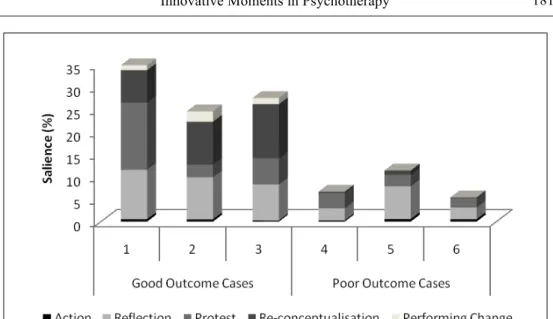
Figure 2. Successful and unsuccessful cases in EFT.
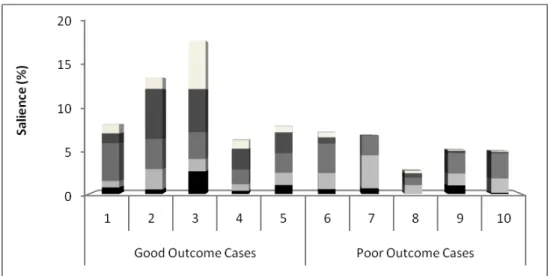
We will proceed now to an overview presentation of the EFT and domestic violence samples findings, which are also congruent with what we have found in several case-studies (Gonçalves et al., 2010; Ribeiro et al., 2009; Ribeiro, Bento et al., in press; Santos et al., 2010; Santos et al., 2009). These studies contrasted groups with differential therapeutic outcomes - successful or unsuccessful - distinguished through the assessment of symptoms carried out at the beginning and end of therapy. The following figures illustrate our main findings in the narrative sample (in Figure 1) and in the EFT sample (in Figure 2).
A first look at these figures shows that the overall temporal salience of IMs is higher in successful cases when compared to unsuccessful ones. Nevertheless, IMs also appear in unsuccessful cases. A closer look shows us that re-conceptualisation and performing change IMs, while present in the successful groups, are almost absent in the unsuccessful samples (in EFT performing change IMs are completely absent). These findings led us to enquire about the processes that generate these different outcomes and the role that re-conceptualisation and performing change seems to play in this development. We will later return to this issue.
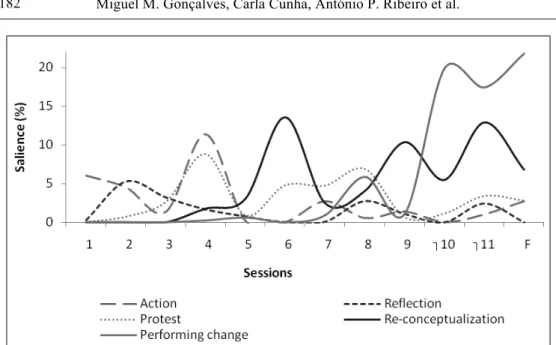
We will now focus on a more process-oriented view through the analysis of two contrasting cases of narrative therapy, presented in Figures 3 and 4, which represent prototypical cases of successful and unsuccessful therapy. These figures display the evolution of the several types of IMs in therapy, on a session-by-session basis (plus the follow-up interview at 6 months after the end of treatment).
In Figure 3, which represents a depiction of IM development in a successful case, we can observe an increasing tendency of IMs temporal salience that appears from the beginning of therapy. If we look at session two, in particular, we already see ‘action’, ‘reflection’ and ‘protest’ IMs; furthermore, in session 4, all the five types emerge, continuing to increase their presence until the end (see Santos et al., 2009, for an elaborated account upon this specific case-study).
Figure 3. A successful case in narrative therapy (11 sessions plus follow-up).
Figure 4. An unsuccessful case in narrative therapy (15 sessions plus follow-up).
Contrastingly, in an unsuccessful case, not only is the temporal salience of IMs lower, but its diversity is also much more restricted. As we can see in Figure 4, which represents the development of IMs in an unsuccessful case, reflection and protest IMs are present but they are not followed by re-conceptualisation and performing change IMs, as we see appearing and increasing in successful cases from the middle stage until the end of therapy. In other words, most of the time, action, reflection and protest IMs are present in unsuccessful cases from the beginning until the end of therapy (and can even slightly increase their temporal salience) but
the differences in terms of overall temporal salience are clear as far as successful cases are concerned.
To summarize our global findings in terms of IMs’ emergence and evolution in therapy, we can say that successful cases are typically characterized by a progressive tendency in the diversity and temporal salience of IMs from session to session. In the beginning of therapy, action, reflection and protest IMs start emerging and becoming more prominent as the treatment progresses. These IMs are then followed by re-conceptualisation that emerges in the middle of the process and continues increasing until the end. Performing change IMs tend to appear after re-conceptualisation. In turn, unsuccessful cases are typically characterized by a lower diversity and temporal salience of IMs, with action, reflection and protest being the main IMs, most of the time without a clear trend to increase from the beginning until the end of treatment. Re-conceptualisation and performing change IMs do not appear typically or have a very low temporal salience.
An interesting commonality between both groups is, to us, the presence of IMs from the first session until the end, regardless of the therapeutic outcome. This means that, if we took the terminology of Fogel and collaborators (2006), level 2 changes appear in therapy even when the final outcome is poor. In other words, even when the problematic narrative dominates in the beginning and keeps its power balance unchanged until the end, there are always novelties appearing and opportunities for new narratives to be developed, even if they are ignored, trivialized or dismissed after their emergence.
According to our studies, these results in the context of psychotherapy were also replicated in daily life changes (i.e., changes related to personal problems, transitions and processes of adaptation to life events that occur outside the therapeutic context). Cruz and Gonçalves (in press) conducted an exploratory study based on interviews with a non-clinical population that asked participants (N=27) to identify three types of difficulties in their lives: past (and solved) difficulties, current difficulties (in the moment of the interview) and persistent difficulties (present for more than 6 months). In this study the presence of re-conceptualisation IMs was the characteristic that distinguished solved from present difficulties (with statistically significant results). Furthermore, a similar study by Meira (2009; see also Meira, Gonçalves, Salgado & Cunha, 2009) on non-therapeutic change with a longitudinal design replicated the same findings about ‘re-conceptualisation (17 participants were interviewed about a personal problem every couple of weeks, for four months).
The consistency of these findings within and outside the therapeutic context suggests that re-conceptualisation is a key factor for sustaining narrative changes and the construction of new self-narratives. In the next section, we will elaborate upon a model of narrative change, supported by the several findings presented above and other case-studies that systematically pointed to the same results.
A
M
ODEL OFN
ARRATIVEC
HANGE INP
SYCHOTHERAPYIn our view, narrative change implies not only diversity of IMs but also specific interrelations between them. Due to the complexity of self-changes, it is unlikely that sustained changes could develop from a specific type of IM (Gonçalves et al., 2009). So, according to our findings, change starts with IM diversity, namely in the form of ‘action’ and
‘reflection’ IMs. These are more elementary forms of innovation that appear as early forms of opposing the problematic self-narrative (being level 2 changes). Nevertheless, these IMs are vital since, if recognized by the self and validated by others, they become the first signs that something new is taking place and that change is on its way. These novel actions, thoughts or intentions, either triggered by the therapist’s questions or spontaneously recognised by the client, defy the dominant problematic themes that prescribe redundant behaviour. The way these innovations appear can be quite idiosyncratic to the person or situation: sometimes they appear through new actions that lead to new thoughts and intentions, other times through new insights about the problem’s maintenance that feed new actions. We have also noticed protest IMs present from the first session on, in some cases. This can be due to the fact that not all clients enter therapy at the same stage of change (see Prochaska, DiClemente & Norcross, 1992). Some seek therapy already engaged in an active state, while others are still very contemplative and ambivalent and may take more time reflecting and exploring the problem before they gather enough motivation to enter in more active stages (Prochaska et al., 1992; see also Gonçalves, Ribeiro, et al., in press). We consider protest IMs an interesting type of innovation since they trigger a strong attitudinal movement against the problem and entail new positioning of the self in relation to the surrounding world.
Independent of the starting point, the idea is that these three forms of IMs keep feeding each other and amplifying their occurrence. For example, as the person starts recognising that the avoidance of certain activities only maintains the problem of fear, she might decide and plan to start doing small things that defy the problem (reflection IM) and actually starts re-experimenting in his or her daily life with previously abandoned activities (action IMs) while at the same time protesting frequently in therapy towards the problem’s assumptions (protest IMs).
At a certain point of therapy (usually in the middle of the process) re-conceptualisation IMs start to appear. We contend that these IMs are very important to the consolidation of further narrative changes, given that unsuccessful therapeutic processes and non-resolved personal problems usually do not exhibit them.
Since re-conceptualisation IMs are grounded in two important features: a) the contrast between present and past and b) a meta-level narration of the processes that made this transformation possible, they seem to be a type of narrative which is more complex than the previous IMs. As we have argued before, not only is its structure closer to the structure of a story (given its sequencing of events and higher narrative coherence), but it also gives a meta-level view of the agent in a story about change. In this sense, it pictures the actor in a given path towards self-transformation and, at the same time, frames the story in a new narrative perspective from the author (the person positions him or herself as different). Furthermore, these IMs also foster other action, reflection and protest IMs, acting like a meaning-making gravitational field towards future production of meanings and experiences. Since the person – as a changed narrator – assumes a different authoring position towards the self and the world, his or her narratives give coherence to the several types of novelties, acting as a meaning bridge (Osatuke & Stiles, 2006) between the old and new versions of the self. Thus, re-conceptualisation has the power of integrating old patterns into new ones, through a synthesis process (Santos & Gonçalves, 2009).
Figure 5. A heuristic model of successful psychotherapy.
Finally, performing change IMs emerge and represent the expansion of the change process into the future, as new experiences, projects and intentions emerge due to the transformations achieved. The future projection of a story is vital for an expansion of new self-narratives: as several authors suggest (Crites, 1986; Omer & Alon, 1997; Slusky, 1998), new stories need to have a future. Figure 5 illustrates the processes described above in successful psychotherapy.
We consider that all the variability that occurs within the problematic self-narrative (dark rectangle at the left of figure 5) is related to level 1 change that obeys the usual “rules” of the problem (for example, when the client narrates being vulnerable to the fear over and over again, despite the differences in events and situations). The emergence of IMs, in the middle section between the double braces, represents level 2 changes: something novel that is emerging and being noticed by the participating agents. Nevertheless, we think that the emergence of re-conceptualisation IMs is the starting point of a flow of processes that lead to level 3 changes: the development of a new self-narrative (pictured at the right of the figure above). This is the distinguishing feature between successful cases and unsuccessful ones. So, the next logical question is to enquire about what processes occur in unsuccessful cases that do not trigger developmental changes. Or, more specifically: What processes interrupt the emergence of re-conceptualisation IMs in unsuccessful cases?
A
M
ODEL OFN
ARRATIVES
TABILITY INP
SYCHOTHERAPYIf we compare the initial stages of successful and unsuccessful cases, they seem quite identical: action, reflection and protest IMs are present (although in some unsuccessful cases the temporal salience of these IMs is lower from the beginning). Clearer differences reside in the middle of therapy when, in the absence of re-conceptualisation, the potential power to foster change of the three previous IMs, is not built upon and amplified. Thus, despite some innovations, the person returns to the same narrative, not being able to challenge its dominance.
Exploring the processes that prevent the emergence of re-conceptualisation and, thus, facilitate the dominance of the problematic self-narrative, involves taking into account IMs potential to challenge a client’s usual way of understanding and experiencing, generating uncertainty. IMs can be easily understood as episodes of self-discontinuity and, thus, uncertainty (Gonçalves & Ribeiro, in press; Ribeiro & Gonçalves, 2010). We have argued that the development of IMs into a new self-narrative depends on the way people manage the emergence of uncertainty. Ignoring or avoiding uncertainty, by returning to the problematic self-narrative and, thus, attenuating IMs’ meaning, in order to promote a sense of continuity or coherence, may sustain the maintenance of the problematic self-narrative. The following example shows how, although the client elaborates an IM, its meaning is soon attenuated by a return to the problematic self-narrative that restores self-continuity (i.e., reinstates the power of the problematic self-narrative):
Clinical vignette 6
Client: Sometimes, I feel able to face my fears... I feel this strength inside me [Reflection IM], but then it suddenly disappears, as if my fears return and takeover! [Continuity restoration by returning to the problematic self-narrative]
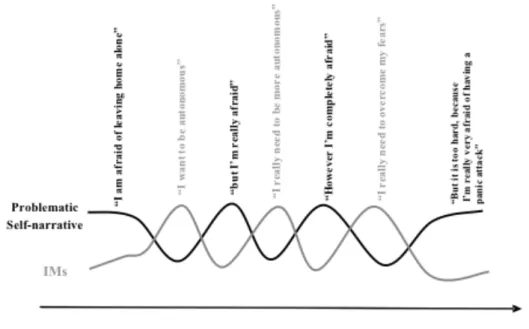
When uncertainty is not overcome during the therapeutic process, the problematic self-narrative and IMs may establish a cyclical relation that blocks the development of the self. This process is akin to what Valsiner (2002) described as ‘mutual in-feeding’: a dynamic balance between two contrasting voices in the dialogical self (e.g., voice A: “life is good”, voice B: “life is bad”) that feed each other in a perpetual movement back and forth. The
voices seem to be moving and quite unstable, but the dynamics actually remain the same as time goes by. It is a case of stability through a very dynamic process in the dialogical self. In our clinical example of a person with panic disorder, in the first sessions he or she could express a voice A that says “I am afraid of leaving home alone” and voice B that says “I must overcome my fears in order to become more autonomous”. According to the IMs coding system, voice A is an expression of the problematic self-narrative, while voice B expresses a reflection IM. Despite the novelty, they could be feeding each other infinitely, in a redundant back and forth movement that keeps the person within the same vicious cycle (see Figure 6).
Furthermore, this back and forth movement between voice A and voice B can even lead to a more striking polarization of meanings, in what Valsiner (2002) calls ‘mutual escalating’ of voices. The most interesting thing is that, despite the small variability gained through the oscillation between the voices as time passes, the relationship between them remains the same as it was in the beginning.
The process of mutual in-feeding has been addressed by other authors in different theoretical perspectives. In personal construct theory, it is sometimes referred to as ‘slot rattling’ (Kelly, 1955), a dance between two poles of the same construct. In strategic therapy, it is related to the ‘ironic process’ (Shoham & Rohrbaugh, 2002) of first order changes that only lead to an escalation of the problem (Watzlawick, Weakland & Fisch, 1974). And in the assimilation model of Stiles and collaborators (Brinegar, Salvi, Stiles & Greenberg, 2006) this is paralleled with a ‘rapid crossfire’ between two divergent voices.
We have been empirically observing the phenomenon of ‘mutual in-feeding’, by analysing whether IMs present ‘Return-to-the-Problem Markers’, as in the following example:
Clinical vignette 7
Client: “This week I decided to face some of my fears as we agreed in the last session ... I
decided to go to the mall [Reflection IM], but when I was on my way to the mall, I was suddenly caught by an incredible agitation. I felt I couldn’t breathe, as if I had a cramp, but I could do nothing. [RPM]
A study recently conducted by our team with the sample of women who were victims of domestic violence contrasted the successful group with the unsuccessful group to explore whether there would be significant differences in terms of the percentage of IMs with RPMs. As we suspected from the argument presented before, our results in this sample indicate that the unsuccessful group had a significantly higher percentage of IMs followed by RPMs (namely action, reflection and protest).
Our results also suggest that the presence of mutual in-feeding is rare in re-conceptualisation. One possible reason for this is that these IMs already dialectically integrate both opposites (past and present or, in other words, problematic voice and innovative one), making it difficult for an oscillation between them. Performing change IMs also escape this process of mutual in-feeding because they tend to emerge only after re-conceptualisation, being more characteristic of later stages of therapy. Moreover, according to the definition of performing change IM, they are the anticipation or planning of new experiences and projects. Since these projects and new experiences appear as a generalisation of the change process into other life domains and into the future, it is likely that they are not involved in a return to the problem. Figure 7 summarizes the processes that occur in unsuccessful cases.
We initially tried to understand mutual in-feeding mainly through the analysis of unsuccessful cases, but we concluded, later on, that this vicious cycle, although typical of unsuccessful cases (Santos et al., 2010), is not exclusive to them (Ribeiro, Bento et al., in press). Thus, it is important to note that successful cases also presented signs of mutual in-feeding that are surpassed as therapy progresses. The dialogical processes that allow evolution from mutual in-feeding to another type of dialogical relation and the role of the therapist in it are important dimensions that still need to be studied.
In this sense, we are now directing our research efforts to the exploration of the role of the therapist in these two specific situations: a) in the promotion of IMs – particularly in the facilitation of re-conceptualisation, and b) in the surpassing of mutual in-feeding. Up until now, we only have analysed data from case-studies (Cunha, Mendes, Gonçalves, Angus & Greenberg, 2009; Ribeiro, Loura, Gonçalves, Ribeiro, & Stiles, 2010). These preliminary findings indicate that the promotion of IMs is usually associated with the previous use of more directive interventions from the therapist (namely, direct guidance in therapeutic in the midst of therapeutic tasks or open questions to facilitate self-awareness). Focusing now on the therapist’s response to mutual in-feeding, preliminary findings indicate that mutual in-feeding tend to persist during therapy when the therapist respond to it by understanding predominantly the innovative voice (by amplifying it), instead of understanding the problematic voice (trying to explore what it is in the client’s experience that prevents change). In such cases, clients might feel that the therapists do not understand them, invoking a “strong
reactance on the part of the client, often hardening the client’s stuck position” (Engle & Arkovitz, 2008, p.390). Instead, surpassing of mutual in-feeding, involves empathic understanding not only for innovative voice(s) but also for problematic one(s) (Stiles & Glick, 2002).
C
ONCLUSIONAlthough at this point we cannot infer a causal relationship between mutual in-feeding and re-conceptualisation, our data suggests that the emergence of re-conceptualisation is strongly associated with a decreasing in the mutual in-feeding.
This integrative power of re-conceptualisation tends to give coherence to the meaning of other IMs and gives directionality to the change process, thus beginning to dissipate the redundancy of the problem in clients’ daily lives. The recognition of oneself as different and the awareness of exceptions to the problem can start a ‘domino effect’ (Watzlawick, Weakland & Fisch, 1974) that leads to a level 3 (developmental) change and to successful psychotherapy. Furthermore, since re-conceptualisation implies the contrast between past and present, and aggregates the old self with the transformed self, it achieves a new sense of unity in the dialogical self, surpassing the former dualities and ambivalence usually inherent to a mutual in-feeding process between opposing voices. The self’s multiplicity of experiences and perspectives become integrated in a more flexible way, with new resources at its disposal to deal with difficulties and a future-oriented view that triggers and amplifies new performances of change.
One of the powerful processes entailed by re-conceptualisation that, in our view, is responsible for this, is the development of a meta-position, allowing for a self-observation process. Through self-observation, new insights are created and new connections are established (see Castonguay & Hill, 2006 for a comprehensive discussion of insight in psychotherapy). This facilitates the development of a new sense of personal agency and the commitment to a new way of life where, through repetition, the novelties become familiar.
A
CKNOWLEDGMENTThis chapter was supported by the Portuguese Foundation for Science and Technology (FCT), by the Grant PTDC/PSI/72846/2006 (Narrative Processes in Psychotherapy) and also the PhD grants: SFRH/BD/30880/2006; SFRH/BD/29804/2006 and SFRH/BD/46189/2008. We are very grateful to Les Greenberg and Lynne Angus for allowing us to use of transcripts from the York Project I.
R
EFERENCESAngus, L. E., & McLeod, J. (2004). Toward an integrative framework for understanding the role of narrative in psychotherapy process. In L. E Angus & J. McLeod (Eds.), The
handbook of narrative and psychotherapy: Practice, theory and practice (pp. 367-374). Thousand Oaks: Sage.
Brinegar, M. G., Salvi, L. M., Stiles, W. B., & Greenberg, L. S. (2006). Building a meaning bridge: Therapeutic progress from problem formulation to understanding. Journal of Counselling Psychology, 53, 165-180.
Bruner, J. (1986). Actual minds, possible worlds. Cambridge, MA: Harvard University Press. Bruner, J. (2004). The narrative creation of self. In L. E. Angus & J. McLeod (Eds.), The
handbook of narrative and psychotherapy: Practice, theory and research (pp. 3 - 14). Thousand Oaks: Sage.
Castonguay, L. G., & Hill, C. (Eds.) (2006). Insight in psychotherapy: Definitions, processes, consequences, and research directions. Washington, DC: American Psychological Association.
Crites, F. (1986). Story time: Recollecting the past and projecting the future. In T. R. Sarbin (Ed.), Narrative psychology: The storied nature of conduct (pp. 152-173). New York: Praeger.
Cruz, G., & Gonçalves, M. M. (in press). Mudança inovativos e momentos de inovação: Um estudo exploratório [Spontaneous change and innovative moments: An exploratory study]. Psychologica.
Cunha, C., Mendes, I., Gonçalves, M. M., Angus, L., & Greenberg, L. S. (2009). Therapist and client interventions and the promotion of narrative innovative moments in Emotion Focused Therapy: A preliminary study with the case of Lisa. Poster presented in the 40th Meeting of the Society for Psychotherapy Research, Santiago, Chile.
Engle, D., & Arkowitz, H. (2008). Viewing resistance as ambivalence: integrative strategies for working with ambivalence. Journal of Humanistic Psychology, 48, 389-412.
Fernandez, I., & Faretta, E. (2007). Eye movement desensitization and reprocessing in the treatment of panic disorder with agoraphobia. Clinical Case Studies, 6, 44-63.
Fogel, A., Garvey, A., Hsu, H. C., & West-Stroming, D. (2006). Change processes in relationships: A relational-historical approach. New York: Cambridge University Press.
Gonçalves, M. M., Matos, M., & Santos, A. (2009). Narrative therapy and the nature of “innovative moments” in the construction of change. Journal of Constructivist Psychology, 22, 1–23.
Gonçalves, M. M., Mendes, I., Cruz, G., Ribeiro, A., Sousa, I., Angus, L., & Greenberg, L. (submitted). Innovative Moments and change in client-centered therapy. Psychotherapy Research.
Gonçalves, M. M., Mendes, I., Ribeiro, A., Angus, L., & Greenberg, L. (2010). Innovative moments and change in emotional focused therapy: The case of Lisa. Journal of Constructivist Psychology, 23, 267-294.
Gonçalves, M. M., & Ribeiro, A. (in press). Narrative processes of innovation and stability within the dialogical self. In H. J. M. Hermans & T. Gieser (Eds.), Handbook of dialogical self theory. Cambridge: Cambridge University Press.
Gonçalves, M.M., Ribeiro, A.P., Stiles, W.B., Conde, T., Santos, A., Matos, M., & Martins, C. (in press). The Role of Mutual In-Feeding in Maintaining Problematic Self-Narratives: Exploring one Path to Therapeutic Failure, Psychotherapy Research. Gonçalves, M. M., Ribeiro, A. P., Matos, M., Santos, A., & Mendes, I. (in press). The
psychotherapy. In S. Salvatore, J. Valsiner, S. Strout, & J. Clegg (Eds.), YIS: Yearbook of Idiographic Science - Volume 2. Rome: Firera Publishing Group.
Hermans, H. J. M., & Dimaggio, G. (2004). The dialogical self in psychotherapy. New York: Brunner-Routledge.
Hermans, H. J. M. (1996). Voicing the self: From information processing to dialogical interchange. Psychological Bulletin, 119, 31-50.
Hermans, H. J. M., & Hermans-Jansen, E. (1995). Self-narratives: The construction of meaning in psychotherapy. New York: The Guilford Press.
Hermans, H., & Kempen, H. (1993). The dialogical self: Meaning as movement. San Diego, CA: Academic Press.
Kelly, G. (1955). The psychology of personal constructs. New York: Norton.
Matos, M., Santos, A., Gonçalves, M. M., & Martins, C. (2009). Innovative moments and change in narrative therapy. Psychotherapy Research, 19, 68-80.
McAdams, D. P. (1993). The stories we live by: Personal myths and the making of the self. New York: William Morrow.
Meira, L. M. A. (2009). Mudança Narrativa: Estudo sobre processos de inovação pessoal na resolução de problemas de vida. [Narrative change: A study upon processes of personal innovation in the resolution of life problems]. Unpublished PhD thesis. University of Minho.
Meira, L., Gonçalves, M. M., Salgado, J. & Cunha, C. (2009). Everyday life change: Contribution to the understanding of daily human change. In M. Todman (Ed.), Self-regulation and social competence: Psychological studies in identity, achievement and work-family dynamics (pp. 145-154). Athens: ATINER.
Mendes, I., Ribeiro, A.P., Angus, L., & Greenberg, L., & Gonçalves, M.M. (2010). Innovative moments and change in emotion-focused therapy. Psychotherapy Research, 20, 692-701.
Neimeyer, R. A., Herrero, O., & Botella, L. (2006). Chaos to coherence: Psychotherapeutic integration of traumatic loss. Journal of Constructivist Psychology, 19, 127-145. Omer, H., & Alon, N. (1997). Constructing therapeutic narratives. Northvale, NJ: Jason
Aronson.
Osatuke, K., & Stiles, W. B. (2006). Problematic internal voices in clients with borderline features: an elaboration of the assimilation model. Journal of Constructivist Psychology, 19, 287-319.
Prochaska, J. O., DiClemente, C. C., & Norcross, J. (1992). In search of how people change: Applications to addictive behaviours. American Psychologist, 47, 1102-1114.
Ribeiro, A. P., Gonçalves, M. M., & Ribeiro, E. (2009). Processos narrativos de mudança em psicoterapia: Estudo de um caso de sucesso de terapia construtivista [Narrative processes of change in psychotherapy: A case-study of successful constructivist therapy]. Psychologica, 50, 181-203.
Ribeiro, A. P., & Gonçalves, M. M. (2010). Innovation and stability within the dialogical self: The centrality of ambivalence. Culture & Psychology, 16, 116-126.
Ribeiro, A. P., Bento, T., Gonçalves, M.M., Salgado, J. (2010). Self-narrative reconstruction in psychotherapy: Looking at different levels of narrative development. Culture & Psychology, 16, 195-212.
Ribeiro, A. P., Bento, T., Salgado, J., Stiles, W. B., & Gonçalves, M. M. (in press). A dynamic look at narrative change in psychotherapy: A case-study tracking innovative moments and protonarratives using State-Space Grids. Psychotherapy Research. Ribeiro, A. P., Gonçalves, M. M., & Santos, A. (in press). Innovative moments in
psychotherapy: From the narrative outputs to the semiotic-dialogical processes. In S. Salvatore, J. Valsiner, S. Strout, & J. Clegg (Eds.), YIS: Yearbook of Idiographic Science – Volume 3. Rome: Firera Publishing Group.
Ribeiro, A. P., Loura, J., Gonçalves, M. M., Ribeiro, E., & Stiles, W. B. (in preparation). How the therapist responds to mutual in-feeding during therapy?
Santos, A., & Gonçalves, M. M. (2009). Innovative moments and change processes in psychotherapy: An exercise in new methodology. In J. Valsiner, P. C. M., Molenaar, M. C. D. P., Lyra, & N. Chaudhary (Eds.), Dynamic process methodology in the social and developmental sciences (pp. 493-526). New York: Springer.
Santos, A., Gonçalves, M. M., Matos, M., & Salvatore, S. (2009). Innovative moments and change pathways: A successful case of narrative therapy. Psychology and Psychotherapy: Theory, Research and Practice, 82, 449–466.
Santos, A., Gonçalves, M. M., & Matos, M. (2010). Innovative moments and unsuccessful in narrative therapy. Counselling and Psychotherapy Research. DOI: 10.1080/14733140903398153.
Sarbin, T. R. (1986). The narrative and the root metaphor for psychology. In T. R. Sarbin (Ed.), Narrative psychology: The storied nature of human conduct (pp. 3-21). New York: Praeger.
Shoham, V., & Rohrbaugh, M. J. (2002). Brief strategic couple therapy. In A. S. Gurman & N. S. Jacobson (Eds.), Clinical handbook of couple therapy. 3rd Ed. (pp. 5-25). New York: Guilford.
Slusky, C. E. (1998). Strange attractors and the transformation of narratives in family therapy. In M. F. Hoyt (Ed.), The handbook of constructive therapies: Innovative approaches from leading practitioners (pp. 159-179). San Francisco: Jossey-Bass.
Stiles, W. B., & Glick, M. J. (2002). Client-centered therapy with multivoiced clients: Empathy with whom? In J. C. Watson, R. Goldman, & M. S. Warner (Eds.), Client-centered and experiential therapy in the 21st century: Advances in theory, research, and practice (pp. 406–414). London: PCCS Books.
Valsiner, J. (2002). Forms of dialogical relations and semiotic autoregulation within the self. Theory & Psychology, 12, 251-265.
Watzlawick, P., Weakland, J., & Fisch, R. (1974). Change: Principles of problem formation and problem resolution. New York: Norton.
White, M. (2007). Maps of narrative practice. New York: Norton.
White, M., & Epston, D. (1990). Narrative means to therapeutic ends. New York: Norton. Wortham, S. (2001). Narratives in action: A strategy for research and analysis. New York: