!
The Internet of Everything
Sustainable Advantages and Synergies in Clustered
Retail
!
Gustavo José Ramos de Carvalho
ADVISOR:
PROF. PAULO CARDOSO DO AMARAL
Dissertation submitted in partial fulfilment of requirements for the degree of Msc in Business Administration, at the Universidade Católica Portuguesa
Dissertation submitted in partial fulfilment of the requirements for the degree of MSc in Business Administration at Universidade Católica Portuguesa. Presented by Gustavo José Ramos de Carvalho (student number 152112077) in Católica-Lisbon School of Business and Economics under guidance of Professor Paulo Cardoso do Amaral.
Acknowledgments
Beforehand, I would like to thank my academic supervisor, Professor Paulo Cardoso do Amaral. His support with meaningful knowledge and insights in every step of this dissertation’s development, contributed to shape the final result.
Furthermore, I would like to thank my friends for their support along the way, helping me to overcome uninspired moments and keeping the momentum.
Finally and above all, I would like to express my heartfelt gratitude to my family for all the patience and encouragement not only throughout the elaboration of the dissertation, but mainly during the last years. To my parents for instilling the values of integrity, commitment and pride in work, and for always standing beside me no matter what. To my sister, for all the companionship, support, and affection given, always able to cheer me up.
Abstract
Title: The Internet of Everything: Sustainable Competitive Advantage in Clustered Retail
Author: Gustavo Ramos de Carvalho
The Internet of Everything (IoE) is a concept introduced by Cisco as the succeeding phase of the Internet of Things (IoT), consisting in creating a network connection of objects, people, processes and data (Cisco 2013). The novelty in this concept is that instead of referring simply to the network connection of physical objects, the IoE allows for connected ‘things’ to send higher-level information back to machines, computers, and people for further evaluation and decision making (Cisco 2013). !
This dissertation aims to analyze the IoE concept’s strategic impact in clustered retails. In order to contextualize the concept and, later, perform the correct analysis of the subject, a review of the technologies at its core and Cisco’s perspective of IoE’s realization in retail is made. Furthermore, making up the core of sustainable strategic advantage analysis, a review is made regarding Resource-based View (RBV) model according to Barney’s framework and Customer Relationship Management (CRM) through Payne and Frow’s framework.
In the subsequent chapter, the model of analysis is explained, incorporating the proposition that a smartphone application is, at a first phase, the optimal presentation layer for consumers. Empirical data collection is then performed through a questionnaire intended to give answer to the dissertation’s research question of sustainable competitive advantage. The results, collected from a population sample of 120 respondents, ascertained the importance of the smartphone app and its most appealing features.
The strategic applicability of IoE in clustered retail is, then, confirmed through the application of both RBV and CRM models, which verify the system’s potential to generate sustained competitive advantage, confirming the dissertation’s main objective.
Resumo
Título: A Internet of Everything: Vantagens Competitivas Sustentáveis em Retalho Conglomerado.
Autor: Gustavo Ramos de Carvalho
A Internet of Everything (IoE) – ou a Internet de Tudo - é um conceito introduzido pela Cisco como fase sucessora da Internet of Things (IoT) – ou a Internet das Coisas -, caracterizada por criar uma rede de conectiva de objectos, pessoas, processos e informação (Cisco 2013). A novidade introduzida por este conceito é de que, em vez de fazer referência apenas à rede de conexões de objectos físicos, o IoE permite à rede de ‘coisas’ o envio de informação de qualidade superior de volta para máquinas, computadores, e pessoas para avaliações e decisões adicionais (Cisco 2013).
O objectivo desta dissertação assenta na análise do impacto estratégico do conceito de IoE em retalho conglomerado. De modo a contextualizar o conceito e, mais tarde, proceder à correcta análise do tópico, uma revisão da tecnologia basilar e da perspectiva da Cisco em relação à implementação da IoE em retalho é realizada. Ademais, constituindo a origem da análise à vantagem estratégica sustentável, uma revisão é feita a ambos os modelo de Resource-base View (RBV), de acordo com enquadramento de Barney, e Customer Relationship Management (CRM) – ou Gestão de Relacionamento com o Cliente -, através do enquadramento de Payne e Frow.
No capítulo subsequente, o modelo de análise é explicado, incluindo a proposição que uma aplicação para smartphone seria, numa primeira fase, o canal de ligação e apresentação ao consumidor ideal. A recolha de dados empíricos é, de seguida, executada através de um questionário, pretendendo dar resposta dar resposta à pergunta central da dissertação relativa à vantagem competitiva sustentável. Os resultados, recolhidos de uma amostra populacional de 120 inquiridos, determinaram a importância da aplicação para smartphones e quais as suas características mais apelativas.
A aplicabilidade estratégica da IoE em retalho conglomerado é, assim, confirmada através da aplicação de ambos os modelos de RBV e CRM, que certificam o potencial do sistema em gerar vantagem competitiva sustentável, confirmando assim o objectivo principal da dissertação.
Table of Contents
! ! ! ! !
Abreviations!...!viii!
1 - INTRODUCTION!...!1!
1.1 Background!...!1!
1.2 Aims and Scope!...!2!
1.3 Methodology!...!4! 1.4 Dissertation Structure!...!5! 2 – LITERATURE REVIEW!...!7! 2.1 Machine-to-Machine!...!7! 2.2 Internet of Things!...!8! 2.2.1 Technologies!...!9! 2.2.1.1 Hardware!...!10! 2.2.1.2 Middleware!...!11! 2.3 Internet of Everything!...!12!
2.3.1 Data and Processes!...!13!
2.3.2 People and Social Networks!...!14!
2.4 Cisco’s Vision of IoE in Retail!...!15!
2.5 Theoretical Strategy Frameworks!...!18!
2.5.1 Customer Relationship Management!...!18!
2.5.1.1 Payne & Frow Framework!...!19!
2.5.2 Resource-based View!...!22!
2.5.2.1 Barney’s Competitive advantage!...!23!
2.5.3 Tacit Knowledge and Knowledge Management!...!25!
2.6 Chapter Conclusion!...!26!
3 – METHODOLOGY AND ANALYSIS!...!28!
3.1 Purpose and Objectives of the model!...!29!
3.2 Model of Analysis!...!30!
3.2.1 Information in Retail!...!31!
3.2.2 Privacy in Retail!...!31!
3.2.3 Devices in Retail!...!32!
3.2.4 Social Networks in Retail!...!32!
3.2.5 IoE Features!...!33!
3.3 Hypotheses Analysis!...!35!
3.4 Questionnaire Analysis!...!40!
3.4.1 Questionnaire Design!...!40!
3.4.1.1 Questionnaire’s Part II – Smartphone and Social Media!...!41!
3.4.1.2 Questionnaire’s Part III – Clustered Retail!...!42!
3.4.1.3 Questionnaire’s Part IV – Shopping Mall Smartphone App!...!45!
3.4.2 Sample Size and Characteristics!...!48!
3.4.3 Survey’s Results!...!49!
3.4.4 Survey’s Conclusions!...!56!
3.4.4.1 Information and Data!...!56!
3.4.4.3 Devices!...!57!
3.4.4.4 Social Media!...!58!
3.5 Chapter Conclusions!...!59!
4 – Strategic Applicability of IoE!...!60!
4.1 IoE Features in Clustered Retail!...!60!
4.1.1 App Attribute Analysis!...!61!
4.1.2 Application of the CRM Model!...!62!
4.1.2.1 Strategic Development Process!...!63!
4.1.2.2 Value Creation Process!...!63!
4.1.2.2 Multichannel Integration Process!...!64!
4.1.2.3 Information Management Process!...!65!
4.1.3 Application of the RBV Model!...!65!
4.1.3.1 Value!...!66!
4.1.3.2 Rare!...!67!
4.1.3.3 Imperfect Imitable Resources!...!68!
4.1.3.4 Substitutability!...!68!
4.2 IoE Challenges and Limitations!...!70!
4.3.1 Technology!...!70!
4.3.2 Security and Privacy!...!70!
4.3.3 Clustered Retail!...!71! 4.4 Chapter Conclusions!...!71! 5 – Conclusions!...!72! 5.1 Future Research!...!75! APPENDIXES!...!76! References!...!101! ! !
Abreviations
App – Application (Mobile Device) CPU – Central Processing Unit
CRM – Customer Relationship Management DIM – Data in Motion
EPC – Electronic Product Code Et al. – Et alii
GPS – Global Positioning System
IEEE – Institute of Electrical and Electronics Engineers IT – Information Technology
IoE – Internet of Everything IoT – Internet of Things
MTC – Machine-Type-Communication M2M – Machine-to-Machine
M2P – Machine-to-People
NFC – Near Field Communication ONS – Object Naming Service P2P – People-to-People
RFID – Radio-Frequency Identification RBV – Resource-Based View
TC – Tacit Knowledge VAS – Value-at-Stake
WSN – Wireless Sensor Network !
1 - INTRODUCTION
1.1 Background
The 1950’s witnessed the success and beginning of a new era for retailers and customers alike (HBC 2014). The tendency towards the concentration of retail steered towards bigger and better centres that would eventually lead to the development of huge malls that draw tourists as well as shoppers (HBC 2014).
Compared to single stores, retail agglomerations augment the shopping experience for their customers in many different ways (Teller & Reutterer 2008). Since consumers undertake shopping not only for purchasing or procuring products or services that satisfy emerging wants and needs but also to seek other values of shopping such as recreation, socialisation, information, self gratification, etc. (Sheth, Mittal, and Newman 1999 cited in Teller et al. 2008). For such reasons retailers seek out and locate next to other retailers in one place or in a nearby geographical area (Berman and Evans 2007; Guy 2007; Ingene 1984 cited in Teller et al. 2008).
In recent years, rising levels of consumer awareness, affluence and mobility have helped create a more discerning consumer, […] and so have social trends such as increasingly individualistic lifestyles and the growth of non-traditional households (Reimers and Clulow 2004). Whilst maintaining the essence of managed and controlled retail environment (Kim et al. 2005), these factors help explain the petering of retail centre’s emphasis on size, while other “shopping values”, as named by Babin, Darden, and Griffin (1994) or Jones, Reynolds, and Arnold (2006), rose to play a more relevant part in consumer’s decisions.
According to Darley (Darley 2010), with an increasing proportion of the world’s consumers spending more of their time interacting with and buying from the Internet, […] traditional models of consumer behavior may not reflect the new realities of a changing consumption environment.
Nowadays, there is the need for traditional retails to offer a better shopping experience to consumers. The development of “smart environments”, a multi-user, multi-device, dynamic interaction environment that enhances a physical space by virtual services, enables the
participants to interact with each other and other objects in a P2P way in the smart space (Wang et al. 2004). Smart connectivity with existing networks and context-aware computation using network resources is an indispensable part of Internet of Things (Gubbi et al. 2012) and a fundamental pillar for smart environments.
Just in 2011, the number of interconnected devices on the planet overtake the actual number of people. Currently there are 9 billion interconnected devices and it is expected to reach 24 billion devices by 2020 (Gubbi et al. 2013). The revenue potential that such a widespread of interconnectivity represents amounts to $1.3 trillion revenue opportunities for mobile network operators alone spanning vertical segments such as health, automotive, utilities and consumer electronics (Gubbi et al. 2013).
1.2 Aims and Scope
The Internet of Everything is the latest market transition that is allowing us to connect the 99% of the unconnected. That is driven by the Moore’s Law and the continue reduction in cost of computing and sensors.
Jim Grubb 20131
The emergence of the Internet and a more discerning consumer has created the need for traditional retail centres to provide a more convenient shopping environment (Reimers and Clulow 2004). As stated by Zheng (Zheng et al. 2011), the Internet has experienced a tremendous growth in the past three decades, evolving from a network of a few hundred hosts to a platform linking billions of “things” globally.
With the technology breakthroughs witnessed in internet-related services in the first decade of the 21st century, leading to the rise of social media and user-oriented content, the Internet morphed from a static on-line platform provider to an interactive provider. The Internet revolution led to the interconnection between people at an unprecedented scale and pace (Gubbi et al. 2013).
As soon as the Internet was developed, there was a desire to connect more “things” to it) !!!!!!!!!!!!!!!!!!!!!!!!!!!!!!!!!!!!!!!!!!!!!!!!!!!!!!!!!!!!!
!
(Dave Evans, 2012). The development of Wireless Sensor Networks and the proliferation of these devices in a communicating–actuating network creates the Internet of Things (IoT), wherein sensors and actuators blend seamlessly with the environment around us, and the information is shared across platforms (Gubbi et al. 2012). Internet of Everything, thus, has a strict relation with ambient intelligence, a concept which according to Miorandi (et al. 2012) builds upon the ubiquitous computing concept, loosely defined as the embedding of computational devices into the environment […] providing therefore the distributed infrastructure necessary to enable the development of Ambient Intelligence applications.
Nevertheless, according to Cisco (Cisco IBSG 2012), the Internet of Things is limited to the networked connection of physical objects. It is, therefore, a stepping-stone for the network of networks where billions or even trillions of connections create unprecedented opportunities (Dave Evans, 2012), which is the Internet of Everything
Introduced in 2012 by Cisco, the term “Internet of Everything”, brings together people (humans), process (manages the way people, data, and things work together), data (rich information), and things (inanimate objects and devices) to make networked connections more relevant and valuable than ever before—turning information into actions that create new capabilities, richer experiences, and unprecedented economic opportunity for businesses, individuals, and countries2.
The incorporation of people, process and data within the network connections allow for each of these factors to gain a more relevant role and influence in information harvest and process and the interactions with the physical world. Langrehr speculated that […] stimuli acting in a natural retail/mall arena would have the positive impact of facilitating shopping and spending behaviour (Kim et al. 2005). In light of society’s need for permanent logon and, according to Wakefield and Baker (1998) findings of consumers who rated the mall environment to be exciting tended to stay longer, have higher repatronage intentions, and were less likely to go outshopping, there is a clear potential for the creation of more dynamic environments in agglomerated retail.
!!!!!!!!!!!!!!!!!!!!!!!!!!!!!!!!!!!!!!!!!!!!!!!!!!!!!!!!!!!!! !
From the perspective of mall management, a mall that can generate more traffic is one that can demand higher lease price from its store tenants because more mall traffic usually translates into more store traffic and sales (Chebat et. al 2010 cited in Yadav et al. 2012).
RQ: Can the Internet of Everything have the potential to generate
sustainable competitive advantage for retail companies in a clustered
environment?
1.3 Methodology
This dissertation aims to shine a light on the potential benefits to both companies operating in retail and consumers when using the Internet of Everything on centric-managed retail clusters.
The methodology is based on the research question this dissertation is investigating, with support from a survey conducted by Cisco to consumers in USA - Cisco Consulting Digital Shopping Behavior 2014 – as the main guideline for the topics of research. With Cisco’s main findings of the survey acting as guidelines, the hypotheses are drawn considering the concrete case of centric-managed retail clusters.
!
Firstly, it is essential to understand if, as Cisco (Cisco IoE At-a-Glance 2013) claims, customers demand for new types of interaction while shopping. Cisco claims that the shoppers of tomorrow […] will increasingly prefer a store that provides an Internet-like experience as well as speed, convenience, information access, and product assortment (Cisco Consulting Digital Shopping Behavior 2014). Thus, regarding shoppers attitudes, data usage and experience personalization are one of Cisco’s main factors of concern in the upper mentioned study.
Furthermore, the same paper reinforces the idea that the use of personal digital devices throughout the shopping journey is one of the main transitions to consider in retail. As such, shopping journeys are digitally influenced by the presence of personal devices (e.g.
smartphones) with Internet capabilities, having access to a network that delivers abundant bandwidth and low latency (Cisco Consulting Digital Shopping Behavior 2014).
Finally, the issue of data harvesting and treatment is addressed, with special concern with trust and transparency between consumers and retailers. In this topic, Cisco suggests that shopper suspicion of retailers’ use of data is a major barrier to realizing value and, as such, it is essential that information is captured and used in permissible way, applied in non-intrusively, be secure and safe, and create tangible value for shoppers (Cisco Consulting Digital Shopping Behavior 2014). These factors imply that consumers ought to be an active module of the IoE system that not only receive but, more importantly, provide information to the entire system.
In order to assess the potential importance for consumers of incorporating IoE in clustered retail and, consequently, the potential value for retailers in ways to increase profitability, improve customer engagement, and move ahead of the competition (Cisco Consulting Digital Shopping Behavior 2014), the collection of the necessary empirical data is needed.
Throughout the validation of the hypothesis a complementary analysis of the IoE’s implicit characteristics’ strategic competitiveness is given in order to assess the potential competitive advantage of the implementation of such technology in the conglomerate retail. Such an analysis will focus on Barney’s framework of the Resource-based view model complemented by the Dynamic Capabilities model.
1.4 Dissertation Structure
The current dissertation is divided into three main chapters, first the Literary Review followed by the Survey Analysis and finally the Conclusion.
In the following chapter, an overall review of the main topics concerning the topics presented in the dissertation is made. The main topics in analysis regard the Internet of Everything, which is the main topic in hand, and what is considered to be the pillar stone of such concept – the Internet of Things. In the same chapter a review of the literature regarding
both Customer Relationship Management and Resource-based view is given as basilar frameworks to answer this dissertation’s research question. In the former, Payne and Frow’s framework is used to better understand the application of the IoE concept in a highly customer relation sector, while on the former, Barney’s framework is chosen as direct linkage towards sustainable competitive advantage. In addition, the concept of Tacit Knowledge is also reviewed as a complementary means to understand the importance of information in data-centric IoE’s system.
In the Survey Analysis chapter the main hypothesis considered to be the most influential in the application of IoE to clustered retail are identified. The validity and significance of such hypothesis will then be tested through a survey made on which the empirical results will help to pinpoint the main attractive and competitive factors that the IoE concept may present when applied to clustered retail.
Lastly, the Conclusion chapter will be used to systematize the results of the survey and the application to the models presented in the antecedent chapters.
2 – LITERATURE REVIEW
The aim of this chapter is to provide the necessary theoretical foundations to better comprehend the analysis enveloping the research question.
In the outset of this chapter, a review of the most relevant literature available is conducted, establishing the bridge between the existent Internet of Things and the Cisco’s novel vision of the Internet of Everything. Framework and technology will have a primary role in giving sustenance to both concepts, whereas the introduction of the components of people and processes, according to Cisco’s view, will reinforce the disparity between concepts.
On the second part of the chapter the theoretical outline is given, with the presentation of the strategic advantage perspective of companies and the customer-centric view of such companies. In the former, an overview of the Resource-based View will be presented, having Barney and Peteraf’s frameworks as core, with the inclusion of the Dynamic Capabilities view as an extension of concept. In the later, a brief presentation of Customer Relationship Management, through Payne and Frow’s framework, is given to further solidify the theoretical foundation of the dissertation.
2.1 Machine-to-Machine
!Nowadays, machine-to-machine (M2M) communication is being considered as the most promising solution for revolutionizing the future intelligent pervasive applications
Kim and Youm 2013
Machine-to-Machine communications are born from original telemetry technology with the intrinsic features of automatic data transmissions and measurement from remote sources typically by cable or rádio (Chen et al. 2012). These types of communication are described by Chang (Chang et al. 2011) as a form of data transfer that lets machines communicate directly with one another with little or no human interaction or intervention.
The same authors assert that given the widespread availability of wireless technologies and the declining prices of modules, the M2M industry is becoming more prominent. Furthermore, according to Weyrich (Weyrich et al. 2014), networks can be both wired and wireless, but wireless M2M protocols are increasingly used because they’re convenient to install, use, maintain, and enhance.
It is thanks to the capabilities of M2M architectures, devices and the network itself will be able to enrich the environment of application with additional data that may be useful for improving performance and saving costs (White Paper: Next Generation Platform Innovation In M2M – cited in Castro et al. 2012), as well as benefit the quality of life (Chen et al. 2012). This view is supported by Castro (Castro et al. 2012), which further adds that M2M solutions work as a huge collaborative and interoperable network for the transmission of the data gathered by the end-terminals, such as sensors and smart objects, to the backend, such as servers, where are running applications such as data processing solutions.
In terms of wireless technologies for M2M communication, see Appendixes 1 and 2.
2.2 Internet of Things
When wireless is perfectly applied the whole earth will be converted into a huge brain, which in fact it is, all things being particles of a real and rhythmic whole […] and the instruments through which we shall be able to do this will be amazingly simple compared with our present telephone. A man will be able to carry one in his vest pocket.
Nikolas Tesla 1926
Internet of Things (IoT) is a concept first coined by Kevin Ashton in 1999 in the context of supply chain management (Gubbi et al. 2013) at a conference for P&G (Ashton 2009). Whilst in the last decade the definition has been more inclusive covering wide range of applications like healthcare, utilities, transport […] (Gubbi et al. 2013), the concept of “Things” in IoT has been generalized to ordinary objects at present, and the interconnection technology is also extended to all networking technologies (Ma 2011).
the IoT as the global infrastructure for the information society, enabling advanced services by interconnecting (physical and virtual) things based on, existing and evolving, interoperable information and communication technologies.
The developments the IoT underwent in the last decade were fuelled by the prevalence of devices enabled by open wireless technology such as Bluetooth, radio frequency identification (RFID), Wi-Fi, and telephonic data services as well as embedded sensor and actuator nodes (Gubbi et al. 2013), further explained in subsequent chapters.
As stated by Xia (Xia et al. 2012), ubiquity in the context of Internet is one of the main consequences of the IoT. Such outcome is explained by the integration of objects and their consequential interaction via embedded systems, which will lead to highly distributed network of devices communicating with human beings as well as other devices.
Ubiquity is not only a outcome but a fundamental pillar of the IoT, as developments in ubiquitous computing and networking, with integral communication capability, provides the key technological foundation for an Internet of Things infrastructure and its integration within the existing and evolving Internet (Vermesan et al. 2012).
2.2.1 Technologies
The most profound technologies are those that disappear. They weave themselves into the fabric of everyday life until they are indistinguishable from it.
Mark Weiser 1991
Currently, the related technologies about IoT have become the international focus, and they are widely considered as one of the most important infrastructures for promoting economy development and technology innovation (Ma et al. 2011).
The existence and expansion of the IoT was only possible by the useful deployment of multiple technologies that covers the domain of hardware, software and extremely robust applications (Bandyopadhya & Sen 2011). The concept evolved in a wider sense, referring
now to a ubiquitous object society combining RFID, sensor networks and pervasive computing technologies (Gama et al. 2011).
Gubbi (Gubbi et al. 2013) suggest a tripartite division of the elements in IOT into the following categories:
• Hardware – the physical objects that collect data from the environment and transfer it throughout devices (sensors, actuators and embedded communication hardware); • Middleware – data aggregation, cloud computing (storage), event management and
data processing (software tools);
• Presentation – bridge of contact between the users and the collected and processed data.
2.2.1.1 Hardware
The first layer of technology – hardware – represent all different facets of the ubiquitous computing vision, where sensor-enabled devices become integrated in the environment and provide context-aware services to the users (Marin-Perianu et al. 2008 – cited in Floerkemeir et al. 2008). Under the architecture of IoT, M2M mainly concentrates machine-type-communication (MTC) that means no human intervention whilst devices are communicating end-to-end, and emphasizes the practical applications (Chen et al. 2012).
Some of the most important technologies associated are: RFID, NFC, Bluetooth, GPS, Code Bar and Sensor networks (González et al. 2008). Nevertheless, Atzori (et al. 2010) proposed a more narrowed spectrum of technologies to be the most relevant ones in the context of hardware layer: RFID, Wireless Sensor Networks and RFID Sensor Networks.
In the first case, RFID systems are composed of one or more reader(s) and several RFID tags […], characterized by a unique identifier and applied to objects (Atzori et al. 2010). RFID systems comprise tags that are attached to products, interrogators that read and write data on tags, and back-end systems that store and share data (Ilic et al. 2008). According to Nagel, Roidl and Follert (2008), in the past years, the development of the Radio Frequency Identification (RFID) technology has opened up the possibility to eliminate the central data warehouses in logistic systems.
and sensors which are used to monitor environmental conditions such as temperature, pressure, humidity, vibration and energy consumption (Wei, Lee and Murray 2012 - cited in Piyare et al. 2013). After harvesting data, sensor data is shared among sensor nodes and sent to a distributed or centralized system for analytics (Gubbi et al. 2013). Moreover, Atzori (et al. 2010) considers that most of commercial wireless sensor network solutions are based on the IEEE 802.15.4 standard, which defines the physical and MAC layers for low-power, low bit rate communications in wireless personal area networks (WPAN).
Furness (cited in Vermesan et al. 2010) states that objects […] may also be grouped or networked to fulfill particular application needs […], considering that such devices with additional functionality, in the form of sensory, location, global positioning and local communications capabilities, may be used to achieve network structures as well as single-device operation.
Finally, according to Atzori (et al. 2012), a smart object (e.g., a smartphone) may implement the functionality of the three layers so that the gateway is not needed, but for some communication facilities targeted to maintain the Internet connectivity of the object […], a gateway for ubiquitous network connectivity.
Elkhodr (et al. 2012) corroborates such a view by stating that mobile applications such as those which run on the iPhones or the Android enabled devices give mobile users the ability to access remote data anytime and anywhere, and to improve availability of services. This fact acquires special significance due to the growth of the smartphone category on the mobile device market, presented in Appendix 3.
2.2.1.2 Middleware
According to Gama (et al. 2011), the role of the middleware is to track not only RFID-tagged objects but also other objects that can provide relevant information. Therefore, such a
layer acts as an interface between the hardware layer at the bottom and the application layer
atthe top (Bandyopadhyay and Sen 2011).
in simplifying the development of new services and the integration of legacy technologies into new ones (Atzori et al. 2010). Bandyopadhyay and Sen (2011) accredit its importance to the role it has in critical functions such as device management and information management and also by taking care of issues like data filtering, data aggregation, semantic analysis, access control, information discovery such as EPC (Electronic Product Code) information service and ONS (Object Naming Service).
Gubbi (et al. 2013) corroborates the importance of the different aspects of middleware in regards to the ability to uniquely identify ‘Things’ […], persistent network functioning to channel the data traffic ubiquitously and data storage and analytics.
Given the creation of an unprecedented amount of data […] storage, ownership and expiry of data become critical issues (Gubbi et al. 2013). The same authors believe that Cloud based solutions can become the centralized infrastructure to support storage and analytics required. The potential of Cloud computing is also recognized by Vermesan (et al. 2013) when stating that IoT’s transformation is concomitant with the emergence of cloud computing capabilities and the transition of the Internet towards IPv6 with an almost unlimited addressing capacity.
2.3 Internet of Everything
As stated earlier, the main addition that IoE introduces in the IoT concept is the combined network connection of people, process, data and things (Cisco 2013). According to Cisco, this new concept has the advantage that the information extracted from these networked connections creates new capabilities, richer experiences, and incredible economic opportunity.
Moreover, Cisco claims that in comparison, the “Internet of Things” (IoT) refers simply to the networked connection of physical objects, thus not including the people and process factors. IoT is a single technology transition, while IoE comprises many technology transitions, having IoT at its core.
According to Dave Evans (Dave Evans – Cisco IBSG 2012), rather than just reporting raw data, connected things will soon send higher-level information back to machines,
computers, and people for further evaluation and decision making. Cisco estimates that by incorporating such changes, a $14.4 trillion of value (net profit) will be “at stake” over the next decade, driven by “connecting the unconnected” (people-to-people, people-to-machines, machines-to-machines, etc.) via the Internet of Everything (Cisco White Paper 2013). See Appendix 1 and 2 for more information
It is, thus, vital to refer that even though technology is an essential foundation for realizing IoE profits, it is not sufficient on its own […], with the quality of technology infrastructure and tools accounting to just 20 percent of the variation in value realized in Cisco’s Model (Cisco White Paper 2013).
2.3.1 Data and Processes
The importance of data management in IOT and, consequently, IoE is perceptible in the European Research Cluster Book on the Internet of Things (Vermesan et al. 2012), in which is asserted that it is a crucial aspect in the Internet of Things. When considering a world of objects interconnected and constantly exchanging all types of information, the volume of the generated data and the processes involved in the handling of those data become critical.
As such, Cisco (White Paper 2013) believes that data achieved an ubiquitous level in which it stands no longer as a relevant differentiator factor for companies’ competitiveness. Only by unlocking IoE data to help predict customer behavior, asset performance, and business outcomes using network-based and real-time streaming analytic can companies gain the necessary competitive insight (Cisco IoE 2013).
According to Jim Grubb (Chief Demonstration Officer of Cisco), most of the new data being generated today is real-time data that fits into a broad category called Data in Motion (Appendix 4). The real challenge for data-driven organizations is how to manage and extract value from this constant stream of information, and turn it to competitive advantage.
Furthermore, Cisco (White Paper 2013) appoints complementary key process’s components regarding information-management and measurement practices that are is the best fit in predicting changes in value realized. Regarding information-management, the
central aspect is using data strategically to achieve company objectives […], being that it is not data itself, but how it is managed and used, that determines success in realizing IoE value (Cisco White Paper 2013). Whereas, in the measurement practices the essential factor is tracking progress towards company goals or targets […], with companies that measure performance gaining a larger share of IoE Value at Stake than competitors that are less “fact-based” in their decision-making processes.
Moreover, and as mentioned earlier, Cloud Computing may prove a fundamental tool in IoT and, consequently, IoE frameworks. As such, cloud storage and management of data is also a concept of high relevance since the key idea is that all edge devices and intranet of things will send their information periodically to an application platform located in the cloud
(Roman et al. 2013).
2.3.2 People and Social Networks
The last fundamental pillar of IoE is a bipartite perspective of people, comprising the internal factor of employee productivity and, on the other hand, the external factors of customer experience.
In terms of relations and management of employees, the main focus of IoE is simultaneously enabling all employees to contribute and collaborate effectively and managing a company’s workforce and developing needed talent. Whereas the second factor is the incorporation of people according to a consumer-centered perspective, in which the driver is aimed at satisfying customer demand for new ways of interaction (Cisco White Paper 2013).
The consumer-centered perspective gains a more relevant meaning in retail, with the second-largest Value at Stake3
opportunity for retailers coming from P2P connections, in which retailers can provide on-demand sales advice, and scale expert sales staff, by !!!!!!!!!!!!!!!!!!!!!!!!!!!!!!!!!!!!!!!!!!!!!!!!!!!!!!!!!!!!!
!
3 Cisco defines Value at Stake as the potential bottom-line value (higher revenues and lower costs) that can be created or will migrate among companies and industries based on their ability to harness the IoE (Cisco 2013)
providing video collaboration in their stores (Cisco White Paper 2013).
Furthermore, Vermesan (et al. 2013) predicted that user engagement in IoT awareness
could build on the Social Network paradigm, where the users interact with the real world entities of interest via the social network paradigm. Such a notion would suggest that the integration with social networks could be seen as another bundle of information streams (Vermesan et al. 2013). This expectation is corroborated with the analyst firm Gartner in 2012 report “The Internet of Everything Innovation Will Transform Business” in which it is envisioned that people themselves will become nodes on the Internet, with both static information and a constantly emitting activity system4
.
2.4 Cisco’s Vision of IoE in Retail
It is up to all of us to get involved to ensure that the Internet, as IoE unfolds, continues to be a powerful force for improving people’s lives.
Jim Grubb (Chief Demonstration Officer of Cisco)
Having mentioned the different characteristics and technologies used in both IoT and IoE concepts, it is important to understand Cisco’s vision of IoE in retail.
Regarding the technology applicability of IoE in the retail industry, Cisco believes that companies should have a sense of urgency about aligning their strategies and practices to leverage IoE since in retail environment barriers to market entry are falling, customers are demanding new ways of interacting, and margins are compressing (Cisco IoE At-a-Glance 2013).
The company structures the connections between components of the IoE system into !!!!!!!!!!!!!!!!!!!!!!!!!!!!!!!!!!!!!!!!!!!!!!!!!!!!!!!!!!!!!
!
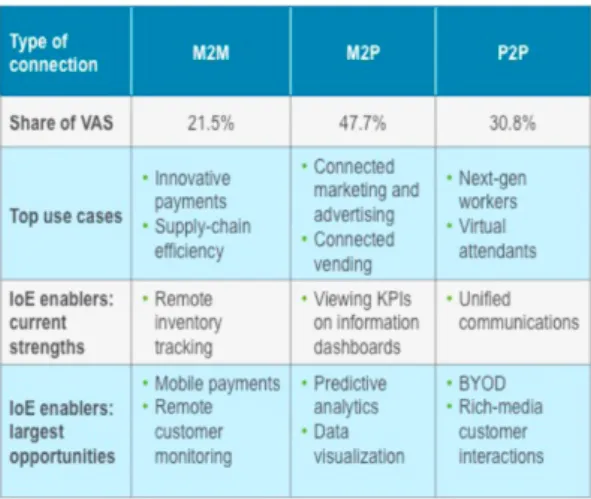
three categories: Machine-to-Machine (M2M), Machine-to-People (M2P) and People-to-People (P2P).
Table 1: IoE Strenghts and Opportunities (Cisco White Paper 2013)
The application of IoE in retail envisioned by Cisco aimed to drive business benefits in terms of a trifecta of factors - operational efficiency, customer service and profitability - is presented in the table above.
Machine-to-Machine
In spite of its importance as a component of IoE applied to retail, M2M connection is the factor with least Value at Stake with an estimated 21,5%. As stated earlier in the hardware section, the main purpose of M2M is to collect data, mainly through sensors, from the environment and specific parts components of the retail area that directly affect consumers. According to Cisco, the benefits of these connections are expressed in inventory visibility improvement, ordering processes automation, energy consumption optimization and a higher degree of flexibility regarding payment options.
Machine-to-People
Machine-to-People connections are envisioned as the most significant aspect of IoE in retail, with an estimated Value at Stake of 47,7% on the industry. By improving their M2P capacities with predictive analytics, retailers could realize more value from connected marketing and advertising, the second-largest area of IoE Value at Stake, by improving the chances that personalized offers and ads will resonate with customers (Cisco White Paper 2013).
The company foretells that M2P connections will grant companies the possibility to acquire behavioral insight of consumers and offer personal Social/Local/Mobile content. Furthermore, omnichannel features are also included through in-aisle interactive displays and digital signage to help shoppers explore products, driving upsell/cross-sell (Cisco IoE At-a-Glance 2013).
People-to-People
Finally, P2P connection has a bipartite application of interactions between employees of the retail company and between employees and customers.
Similarly to M2P connection, P2P has an intrinsic strong customer relationship component depicted by social media, immersive video and the shopper’s own smartphone. Such benefits of pioneering IoE into the relation between retailers and consumers are depicted by scenarios in which it is possible to maximize upsell and cross-sell and increase conversion rates by answering critical questions while shoppers are in the store and considering a purchase, and the possibility shoppers can receive expert advice regardless of the size and location of the store (Cisco White Paper 2013).
2.5 Theoretical Strategy Frameworks
The purpose of the following section is to lay the theoretical portrayal of the existing literature on the Customer Relationship Management (CRM) and Resource-Based View (RBV) theories. The combination of both theories will comprise the corner stone of the strategic reasoning behind the Research Question.
The section will commence with a review of the Customer Relationship Management (CRM), mainly through Payne and Frow’s conceptual framework, in which the processes to effective develop an effective CRM strategy are presented. is
To further enrich the strategic conceptualization of this dissertation, the introduction of the Resource-Based View (RBV) theory concept is made through Barney’s framework. The full benefits of incorporating this view arise when combined with the concept of Tacit Knowledge. This combination of concepts will consolidate RBV’s implicit VRIN concept, increasing its relevance to prove IoE’s sustainable competitive advantage.
2.5.1 Customer Relationship Management
CRM attempts to provide a strategic bridge between information technology and marketing strategies aimed at building long-term relationships and profitability.
Rashi Glazer 1997 (cited in Payne & Frow 2005)
According to Payne and Frow (2005), the concept of Customer Relationship Management (CRM) emerged in the information technology (IT) vendor community and
practitioner community in the mid-1990s […] and is often used to describe technology-based customer solutions.
Contrasting with Payne and Frow’s emphasis on the essential role technology plays in CRM, Ricardo Chalmeta (Chalmeta 2005) gives a more comprehensive definition of customer relationship management: a customer-focused business strategy that dynamically integrates sales, marketing and customer care service in order to create and add value for the company and its customers.
Regardless of the width of the definition, CRM is expressed in the fact that retail companies seek to maximize relationships with customers […], with organizational systems and processes, especially those related to data and information management, changing to respond to this shift toward ‘‘customer-centric’’ retailing (Anderson et al. 2007).
This centric view of the consumer, with the evolution and integration of marketing ideas and newly available data, technologies, and organizational forms, concentrates on establishing, developing, and maintaining successful long-term relationships with well-chosen customers (Boulding et al. 2005; Morgan and Hunt 1994; Reinartz et al. 2004 – cited in Ernst et al. 2011).
In the following pages, Payne & Frow’s conceptual framework for CRM application is presented.
2.5.1.1 Payne & Frow Framework
In 2005, Adrian Payne and Pennie Frow proposed a strategic conceptual framework that
positioned CRM at a strategic level by identifying the key cross-functional processes involved
in the development of CRM strategy.
In this article Payne and Frow identified five basilar processes that firms could use to develop and deliver and effective CRM strategy: Strategy Development Process, Value Creation Process, Multichannel Integration Process, information Management Process and Performance Assessment Process. See Appendix 9 for more information.
Strategic Development Process
The strategic development process can be divided in two correlated areas of strategy: Business Strategy and Customer Strategy.
According to the authors, the first strategic area can commence with […] an articulation of a company’s vision, especially as it relates to CRM. It takes into account the industry and
its competitive environment and must be considered first to determine how the customer strategy should be developed and how it should be evolve over time. The second strategic area to be defined involves examining the existing and potential customer base and identifying which forms of segmentation are most appropriate. In terms of the segmentation decision-making, several authors emphasize the potential for shifting from a mass market to an individualized, or one-to-one, marketing environment.
Value Creation Process
The process of value creation is a bilateral one, which transforms the outputs of the strategy development process into programs that both extract and deliver value. There is, thus, a duality of value factors that complement each other: the customer and organizational value.
The first factor is a concept of the benefits that enhance the customer offer (Levitt 1969; Lovelock 1995 – cited in Payne & Frow 2005). Payne and Frow (2005) defend that in order to determine whether the value proposition is likely to result in a superior customer experience, a company should undertake a value assessment to quantify the relative importance that customers place on the various attributes of a product.
The perspective of organizational received value is based on the customer value as an outcome of the coproduction of value, the deployment of improved acquisition and retention strategies, and the utilization of effective channel management. Intrinsic to this concept there are two elements fundamental for the organization: variation of potential customer profitability across segmentations and the comprehension of the economics behind customer acquisition and retention.
Multichannel Integration Process
The multichannel integration process focuses on:
• Decisions about what the most appropriate combinations of channels to use are; • How to ensure that the customer experiences highly positive interactions within those
channels;
• And, when a customer interacts with more than one channel, how to create and present a single unified view of the customer.
As seen in Appendix 9, the range of channels is organized in accordance to a scale of physical presence. Nevertheless, today, many companies enter the market through a hybrid channel model (Friedman and Furey 1999; Moriarty and Moran 1990 – cited in Payne and Frow 2005) that involves multiple channels.
Payne and Frow (2005) state that once established a set of standards for each channel that defines an outstanding customer experience for that channel, the organization can then work to integrate the channels.
Information Management Process
This component of CRM strategy is related to the collection, collation, and use of customer data […] to generate customer insight and appropriate marketing responses.
According to Greenberg (2001 – cited in Payne and Frow 2005):
[…] the key material elements of the information management process are the data repository, which provides a corporate memory of customers; IT systems, which include the organization’s computer hardware, software, and middleware; analysis tools; and front office and back office applications, which support the many activities involved in interfacing directly with customers and managing internal operations, administration, and supplier relationships.
Performance Assessment Process
Finally, in the last component of the Payne and Frow’s CRM strategy framework it is ensured that the organization’s strategic aims in terms of CRM are being delivered to an appropriate and acceptable standard and that a basis for future improvement is established.
In this component, a macro and microanalysis is rendered through shareholders results and performance monitoring, respectively. In the first global perspective of performance, the organization should consider how to build employee value, customer value, and shareholder value and how to reduce costs. Whereas, in the more detailed analysis, standards, metrics,
and key performance indicators for CRM should reflect the performance standards necessary across the five major processes to ensure that CRM activities are planned and practiced effectively and that a feedback loop exists to maximize performance improvement and organizational learning.
Companies recognize that customer relationships are the underlying tool for building customer value, and they are finally realizing that growing customer value is the key to increasing enterprise value (Rogers, 2005, p. 262 – cited in Anderson et al. 2007).
2.5.2 Resource-based View
The RBV intends to explain the conditions under which firms may achieve a sustained competitive advantage based on their bundles of resources and capabilities.
Barreto 2010
According to Porter (1991), the success of a firm in a given industry is attained through a competitive position or series of competitive positions that lead to superior and sustainable financial performance […] relative to the world’s best rivals (Porter 1991).
In order for the company to achieve the desired sustained competitive advantage, it must introduce strategies that exploit their internal strengths, through responding to environmental opportunities, while neutralizing external threats and avoiding internal weaknesses (Barney 1991).
The conjugation of the duality of internal and external aspects is likewise perceptible and further elucidated in Porter’s (1991) determinants of a firm’s success:
1. The ability of a company develop and implement an internally consistent set of goals and functional policies that collectively defined its position in the market;
2. Internally consistent set of goals and policies aligns the firm’s strengths and weaknesses with the external (industry) opportunities and threats;
3. The firm’s strategy be centrally concerned with the creation and exploitation of its so-called ‘distinctive competences’.
Thus, instead of solely within the firm, the true origin of competitive advantage may be the proximate or local environment in which a firm is base (Porter 1991).
2.5.2.1 Barney’s Competitive advantage
In 1991, Barney (1991) published an article revealing his resource-based view framework. According to such article, in order to extrapolate a firm’s (sustainable) competitive advantage two assumptions were needed:
1. Firms within an industry (or firms within a strategic group) may be heterogeneous with respect to the strategic resources they control;
2. Resources may not be perfectly mobile across firms, and thus heterogeneity can be long lasting.
Having as foundations stones both the assumptions of heterogeneity and imperfect mobility of resources, Barney (1991) identified four intrinsic attributes of a firm’s resource, mandatory for a sustained competitive advantage in such firm. For more information regarding the relationship of said attributes and sustained competitive advantage see Appendix 7.
Valuable
The resource must have two-edge features to be able to become a source of competitive advantage to the firm. In one instance, it must enable a firm to conceive of or implement strategies that improve its efficiency and effectiveness. Moreover, the resource must provide the firm with the ability to exploit opportunities and/or neutralize threats in a firm’s environment.
Rare
Only when a firm’s valuable resources are absolutely unique among a set of competing and potential competing firms, those resources […] may have the potential of generating a sustained competitive advantage. Thus, if the uniqueness of valuable resources or a bundle of valuable resources used to conceive of and implement strategies in a firm is questionable, then large number of firms will be able to conceive and implement the strategies in question.
Imperfectly Imitable Resources
The term developed by Lippman and Rumelt (1982) and Barney (1986a; 1986b) is used to describe the valuable and rare organizational resources of one firm that are not possessed and cannot be obtain by other (rival) firms. The imitability of resources of a given firm is derived from one or a combination of three factors:
• Unique historical conditions – the firm’s ability to acquire and exploit some resources depends upon their place in time and space;
• Causal ambiguity – the link between resources controlled by a firm and a firm’s sustained competitive advantage is not understood or understood only very imperfectly. In this case, if a rival firm comprehends the correlation between the resources controlled by a firm and its competitive advantage, while others do not, in the long run this information will be diffused […] eliminating imperfect imitability based on casual ambiguity;
• Social complexity – there may be very complex social phenomena, beyond the ability of firms to systematically manage and influence.
Substitutability
In the last prerequisite of a resource to potentially provide sustainable competitive advantage is that there must be no strategically equivalent valuable resources that are either not rare or imitable. Meaning that if two valuable firm resources […] are strategically equivalent when they each can be exploited separately to implement the same strategies, competing firms can implement such strategies in different ways and using different resources.
2.5.3 Tacit Knowledge and Knowledge Management
For knowledge to provide sustainable competitive advantage, the skills and resources that underlie a firm’s core competencies must be relatively widely transferable within the firm, but very difficult for other firms to copy or develop.
Lubit (2001)
In recent years, the vital importance of knowledge to business had been highlighted by such authors as Alvin Toffler, Peter Drucker, and James Quinn (Nonaka et al. 1996). According to Yang (Yang et al. 2010), the organization that knows more about its customers, services, technologies, markets, and their linkages should perform better.
Yang’s assessment of the importance of knowledge in organizations is shared by Lubit (2010), who asserts that because competitive advantage is increasingly found in knowing how to do things, rather than in having special access to resources and markets, knowledge and intellectual capital have become both the primary bases of core competencies and the key to superior performance. Nevertheless the latter author cautions that in order for sustained competitive advantage to be provided, one needs knowledge that is difficult for outsiders to copy as well as the ability to rapidly develop new knowledge.
Nonaka (Nonaka et al. 1996) identified two types of knowledge that are not totally separate but are mutually complementary entities of knowledge. First, the explicit knowledge is depicted by being uttered, formulated in sentences, and captured in drawings and writing […], with a universal character, supporting the capacity to act across contexts (Nonaka and Krogh 2009). Second, the tacit knowledge is characterized by being tied to the senses, tactile experiences, movement skills, intuition, unarticulated mental models, or implicit rules of thumb […], rooted in action, procedures, routines, commitment, ideals, values, and emotions (Nonaka et al. 1996, 2000a, b – cited in Nonaka and Krogh 2009).
Because tacit knowledge is much harder for competitors to copy than explicit knowledge, the ability to capture and transfer tacit knowledge is the key to developing sustainable competitive advantage (Lubit 2010). Teece (et al. 2007) corroborates the aforementioned idea when stating that the more tacit the firm's productive knowledge, the harder it is to replicate by the firm itself or its competitors […], to the point where imitation may well be impossible, absent the hiring away of key individuals and the transfers of key organization processes.
Lubit (2010) envisioned a perspective of tacit knowledge through four categories: a) hard to pin down skills—“know-how,” (b) mental models, (c) ways of approaching problems, and (d) organizational routines.
1. The first category tackles the skill component of tacit knowledge, that cannot be fully explained in words […] and only achieved by repeatedly practice skills, receive feedback and get the feel for them;
2. The second group is depicted by the people’s mental models drawn when trying to make sense of the situation, determining how we understand and analyze situations. These often unconscious abstractions […] help us to make sense of the masses of data we are faced with.
3. The third category concerns how people approach problems […] and underlying decision trees people use. The decision tree one uses to address a problem will markedly affect the solution one selects.
4. Finally, much of the tacit knowledge of a firm is stored in its routines, solidified as standard operating procedures and roles are developed and enforced. The tacit knowledge embedded in routines, such as decision-making procedures and advertising policy, includes an intuitive grasp of what data to focus on and of the relative priority of competing demands.
2.6 Chapter Conclusion
Throughout the chapter an overview of the most relevant literature was presented to lay the foundations for addressing the dissertation’s Research Question and provide the necessary insight on the topic addressed.
In the first part of the chapter, a presentation of the main aspects of Internet of Things was presented; as such elements constitute the foundation for the Internet of Everything. A
bridge between both visions of IoT and IoE was established, with the exposure of the main novelties introduced by the latter framework.
In the second part of the chapter, the theoretical frameworks were presented as a means of establishing the foundations to answer the Research Question proposed by this academic dissertation. In the RBV theory, special emphasis was given to Barney’s framework, while on the CRM theory Payne and Frow’s perspective was presented. A notion of Tacit Knowledge was included to further strengthen and contextualize the RBV model into the current topics of this academic dissertation.
With both theoretical frameworks, a better understanding of how the IoE may influence the competitive sustainable advantage of companies operating in retail is expected.
3 – METHODOLOGY AND ANALYSIS
The literature analysed in the previous chapter provides ground for the investigation of the current dissertation’s objective and underlying research question.
The chapter opens with the examination of the purpose of addressing the study of IoE in clustered retail and the resulting research objectives. The goal is to clearly explain the intentions which the study held in this dissertation hopes to realize and the research questions drawn from them. Given the specificity of the IoE benefits and their high correlation with consumer adoption and usage, a section regarding Cisco’s opportunities and strategies for the technology is made. This section is structured to mention both the Cisco’s vision of technology usage in retail and other possible traits that can be exploited in a clustered retail environment.
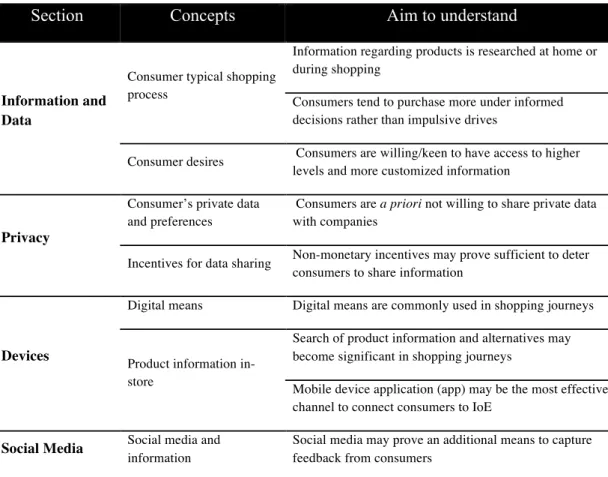
In the second segment of this chapter, the Model of Analysis is presented and explained. In this section, the Research Question is explained through the analysis of the IoE system’s characteristics that contribute to sustainable competitive advantage in a retail environment. Subsequent, the presentation the topics this academic dissertation is attempting to answer are explained, structured according to four different areas of approach regarding data content and channels of IoE. An additional topic is introduced in order to explain the possibility of creating a mobile device (tablet or smartphone) application (app) as a presentation layer for the IoE system, bridging the consumers and the collected and processed data.
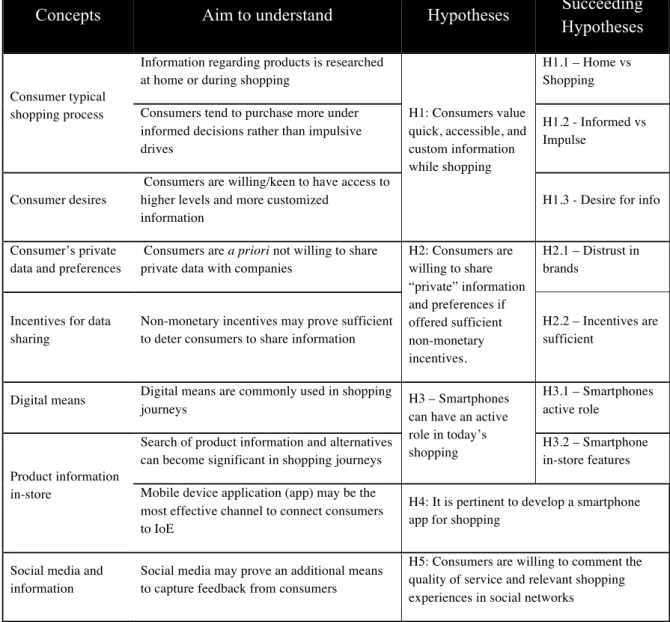
In the third part, the research hypotheses used in answering the research questions are
presented and explained in detail, with the reasoning behind each hypothesis and its intended purpose demonstrated. Latter on, their plausibility tested through empirical data collected resorting to an online survey.
On the final part of the chapter, the questions compiling the questionnaire are presented with an individual explanation on their importance and rationale on the core hypotheses. Moreover, the reason behind measurements and their correspondent scale used in the concepts in question is also a point of clarification. Afterwards, the results of the survey are presented and analysed according to the hypotheses presented, which in turn are validated. The final section is, hence, dedicated to summarize the validity of each hypothesis according to the findings of the questionnaire and the reasoning behind it.
3.1 Purpose and Objectives of the model
The chosen research paradigm of this work is based on a theory-driven quantitative approach, in which the prepared interrogations act as means to answer the core research question of the dissertation. This work’s goal is, thus, to understand whether it is advantageous to apply Cisco’s IoE concept in clustered retail under single management by collecting the necessary empirical proof to do so.
According to Teller (2008), one of the major trends in European retailing has been the rising popularity of shopping malls in contrast with a decline of shopping streets. Given such a trend, the conglomerate retailers considered in this dissertation’s analysis will be focus exclusively in shopping mall centres, rather than other forms of conglomerate retails.
Even though it is a simplification of the spectrum considered in clustered retail activity, the technical and managerial logistics of considering a (common) space that is physically open – outdoors - and possibly not under a single management may prove overly complicated and mitigate the potential benefits. As such, focussing exclusively on mall centres, limited spaces under a common management, there is a higher success rate when applying the concept of IoE and a stronger possibility of forming synergies with the individual retail brands when implementing the technology and data channels.
Furthermore, the possibility of creating and implementing a mobile device application (app) is regarded as the main piece for the first phase of IoE system’s adoption and, thus, it is necessary to collect evidence regarding the features that attract consumers the most. This notion arouse from the idea that data automatically generated from existing technology platforms measuring every shopper, every day provides an afordable way to acquire large amounts of data in a non-invasive manner (Cisco 2014).
3.2 Model of Analysis
The challenge addressed by this academic dissertation is whether Cisco’s concept of IoE has the potential to generate sustainable competitive advantage for retail companies in a clustered environment.
Cisco expects IoE technology in retail to bring ways to increase profitability, improve customer engagement, and move ahead of the competition (Cisco 2014). As presented through this section, customer engagement and relationship is one of the major assets of the IoE applied in retail and, as such, consumer engagement and propensity to purchase has a central role in the sustained competitive advantage. As stated by Rogers (Rogers, 2005, p.
262 – cited in Anderson et al. 2007) growing customer value is the key to increasing
enterprise value.
Through the examination of the main goal of this dissertation and Cisco’s research insights of the IoE in retail (Cisco 2014), underlying objectives, that stand an aid in answering the challenge proposed, arise.
Cisco (Cisco 2014) identified three major information technology transitions to consider from the retail perspective:
1. Continued evolution of digital shopping, as is being realized in e-commerce and the use of personal digital devices throughout the shopping journey;
2. Data-centric retail technology innovation race;
3. Privacy concerns […] in the capture and analysis of many new forms of data that average shoppers generate through their daily activities.
This academic dissertation aims to confirm such claims, while answering further topics regarding transformations that information technology, in the context of IoE, are instigating in retail. In the next sections, the objectives of this dissertation are presented and structured according to main areas of topics.