EUROPEAN ORGANIZATION FOR NUCLEAR RESEARCH (CERN)
CERN-PH-EP/2013-037 2014/08/22
CMS-SUS-13-002
Search for anomalous production of events with three or
more leptons in pp collisions at
√
s
=
8 TeV
The CMS Collaboration
∗Abstract
A search for physics beyond the standard model in events with at least three lep-tons is presented. The data sample, corresponding to an integrated luminosity of 19.5 fb−1of proton-proton collisions with center-of-mass energy√s=8 TeV, was col-lected by the CMS experiment at the LHC during 2012. The data are divided into exclusive categories based on the number of leptons and their flavor, the presence or absence of an opposite-sign, same-flavor lepton pair (OSSF), the invariant mass of the OSSF pair, the presence or absence of a tagged bottom-quark jet, the number of iden-tified hadronically decaying τ leptons, and the magnitude of the missing transverse energy and of the scalar sum of jet transverse momenta. The numbers of observed events are found to be consistent with the expected numbers from standard model processes, and limits are placed on new-physics scenarios that yield multilepton final states. In particular, scenarios that predict Higgs boson production in the context of supersymmetric decay chains are examined. We also place a 95% confidence level upper limit of 1.3% on the branching fraction for the decay of a top quark to a charm quark and a Higgs boson (t→cH), which translates to a bound on the left- and right-handed top-charm flavor-violating Higgs Yukawa couplings, λHtcand λHct, respectively, of
q
|λHtc|2+|λHct|2<0.21.
Published in Physical Review D as doi:10.1103/PhysRevD.90.032006.
c
2014 CERN for the benefit of the CMS Collaboration. CC-BY-3.0 license ∗See Appendix A for the list of collaboration members
1
1
Introduction
The recent discovery of a Higgs boson [1–3] at the relatively low mass of about 125 GeV implies that physics beyond the standard model (BSM) may be observable at energy scales of around 1 TeV. Supersymmetry (SUSY) is a prominent candidate for BSM physics because it provides a solution to the hierarchy problem, predicts gauge-coupling unification, and contains a “nat-ural” candidate for dark matter [4–6]. Supersymmetry postulates the existence of fermionic superpartners for each standard model (SM) boson, and of bosonic superpartners for each SM fermion. For example, gluinos, squarks, and winos are the superpartners of gluons, quarks, and W bosons, respectively. The superparter of a lepton is a slepton. In R-parity [7] conserving SUSY models, supersymmetric particles are created in pairs, and the lightest supersymmet-ric particle (LSP) is stable. If the LSP interacts only weakly, as in the case of a dark matter candidate, it escapes detection, leading to missing transverse energy (EmissT ). Here, R-parity is defined by R = (−1)3B+L+2s, with B and L the baryon and lepton numbers, and s the particle
spin. All SM particles have R= +1 while all superpartners have R=−1.
A wide range of BSM scenarios predict multilepton final states [8], where by “multilepton,” we mean three or more charged leptons. Since multilepton states are relatively rare in the SM, searches in the multilepton channel have good potential to uncover BSM physics.
Given the rich SUSY particle spectrum, multilepton final states in SUSY events take on multiple forms. For example, a cascade of particles initiated by the decay of a heavy gluino can proceed through intermediate squarks, winos, and sleptons to produce a final state that is democratic in lepton flavor, i.e., equally likely to contain electrons, muons, or τ leptons. Direct pair pro-duction of the superpartners of the electron and muon (selectron and smuon, respectively) can yield a multilepton state dominated by τ leptons should the superpartner of the τ lepton (stau) be substantially lighter than the selectron and smuon, as is expected in some models. Another path to a multileptonic final state arises from top-squark production in which the top squark decays to leptonically decaying third-generation quarks and to a Z boson that yields an opposite-sign same-flavor (OSSF) lepton pair. In these latter events, bottom-quark jets (b jets) might also be present. Similarly, many other multileptonic signatures are possible.
Besides SUSY, other BSM scenarios can yield multileptonic final states, such as t → cH tran-sitions, with t a top quark, c a charm quark, and H a Higgs boson. The t → cH process is extremely rare in the SM but can be enhanced through the production of new particles in loops [9, 10]. The top quark is the heaviest SM particle, and is thus the SM particle that is most strongly coupled to the Higgs boson. Since the t→cH process directly probes the flavor-violating couplings of the top quark to the Higgs boson, it provides a powerful means to search for BSM physics regardless of the underlying new-physics mechanism. The t→cH decay can give rise to a multilepton signature when a top quark in a top quark-antiquark (tt) pair decays to the cH state, followed by the decay of the Higgs boson to leptons through, e.g., H→ZZ∗or H→WW∗decays, in conjunction with the leptonic decay of the other top quark in the tt pair. In this paper, we present a search for BSM physics in multilepton channels. The search is based on a sample of proton-proton collision data collected at√s = 8 TeV with the Compact Muon Solenoid (CMS) detector at the CERN Large Hadron Collider (LHC) in 2012, corresponding to an integrated luminosity of 19.5 fb−1. The study is an extension of our earlier work [11], which was based on a data set of 5.0 fb−1collected at√s = 7 TeV. A related search, presented in Ref. [12], uses the 8 TeV data set to investigate R-parity-violating SUSY scenarios. Refer-ences [13–17] contain recent, related results from the ATLAS Collaboration, and Refs. [12, 18– 27] contain the same from CMS.
2 3 Event reconstruction, selection, and simulation
Because of the wide range of possible BSM signatures, we have adopted a search strategy that is sensitive to different kinematical and topological signatures, rather than optimizing the anal-ysis for a particular model. We retain all observed multilepton candidate events and classify them into multiple mutually exclusive categories based on the number of leptons, the lepton flavor, the presence of b jets, the presence of an OSSF pair indicative of a Z boson, and kinematic characteristics such as EmissT and HT, where HT is the scalar sum of jet transverse momentum
(pT) values. We then confront a number of BSM scenarios that exhibit diverse characteristics
with respect to the population of these categories.
This paper is organized as follows. In Sec. 2, a brief summary of the CMS detector and a de-scription of the trigger is presented. Section 3 discusses the event reconstruction procedures, event selection, and event simulation. The search strategy and the background evaluation methods are outlined in Secs. 4 and 5. Section 6 contains a discussion of systematic uncertain-ties. The results are presented in Sec. 7. Sections 8 and 9 present the interpretations of our results for SUSY scenarios and for the t → cH process, respectively. A summary is given in Sec. 10.
2
Detector and trigger
The CMS detector has cylindrical symmetry around the direction of the beam axis. The co-ordinate system is defined with the origin at the nominal collision point and the z axis along the direction of the counterclockwise proton beam. The x axis points toward the center of the LHC ring and the y axis vertically upwards. The polar angle θ is measured with respect to the z axis. The azimuthal angle φ is measured in the x−y plane, relative to the x axis. Both angles are measured in radians. Pseudorapidity η is defined as η=−ln[tan(θ/2)]. The central
feature of the detector is a superconducting solenoidal magnet of field strength 3.8 T. Within the field volume are a silicon pixel and strip tracker, a lead tungstate crystal calorimeter, and a brass-and-scintillator hadron calorimeter. The tracking detector covers the region|η| < 2.5
and the calorimeters|η| < 3.0. Muon detectors based on gas-ionization detectors lie outside
the solenoid, covering|η| <2.4. A steel-and-quartz-fiber forward calorimeter covers|η| <5.0.
A detailed description of the detector can be found in Ref. [28].
A double-lepton trigger (ee, µµ, or eµ) is used for data collection. At the trigger level, the leptons with the highest and second-highest transverse momentum are required to satisfy pT >
17 GeV and pT > 8 GeV, respectively. The lepton trigger efficiency is determined using an
independent data sample based on minimum requirements for HT[11]. After application of all
selection requirements, the trigger efficiencies are found to be 95%, 90%, and 93%, respectively, for the ee, µµ, and eµ triggers. Corrections are applied to account for the trigger inefficiencies.
3
Event reconstruction, selection, and simulation
The particle-flow (PF) method [29, 30] is used to reconstruct the physics objects used in this analysis: electrons, muons, hadronically decaying τ leptons (τh), jets, and Emiss
T .
Electrons and muons are reconstructed using measured quantities from the tracker, calorimeter, and muon system. The candidate tracks must satisfy quality requirements and spatially match energy deposits in the electromagnetic calorimeter or tracks in the muon detectors, as appro-priate. Details of the reconstruction and identification procedures can be found in Ref. [31] for electrons and in Ref. [32] for muons.
3
decays) or three charged tracks (three-prong decays) with or without additional electromag-netic energy from neutral-pion decays. Both one-prong and three-prong τh decays are
recon-structed using the hadron plus strips algorithm [33].
The event primary vertex is defined to be the reconstructed vertex with the largest sum of charged-track p2T value and is required to lie within 24 cm of the origin in the direction along the z axis and 2 cm in the transverse plane.
Jets are formed from reconstructed PF objects using the anti-kT algorithm [34, 35] with a
dis-tance parameter of 0.5. Corrections are applied as a function of jet pT and η to account for
nonuniform detector response [36]. Contributions to the jet pT values due to overlapping pp
interactions from the same or neighboring bunch crossing (”pileup”) are subtracted using the jet area method described in Ref. [37].
Finally, EmissT is the magnitude of the vector sum of the transverse momenta of all PF objects. We require the presence of at least three reconstructed leptons, where by ”lepton” we mean an electron, muon, or τhcandidate. Electron and muon candidates must satisfy pT >10 GeV and
|η| <2.4. At least one electron or muon candidate must satisfy pT >20 GeV. The τhcandidates
must satisfy pT>20 GeV and|η| <2.3. Events are allowed to contain at most one τhcandidate.
Leptonically decaying τ leptons populate the electron and muon channels. Leptons from BSM processes are typically isolated, i.e., separated in∆R ≡ p
(∆η)2+ (∆φ)2
from other physics objects. To reduce background from the semileptonic decays of heavy quark flavors, which generally yield leptons within jets, we apply lepton isolation criteria. For elec-trons and muons, we define the relative isolation Irelto be the sum of the pT values of all PF
objects within a cone of radius ∆R = 0.3 around the lepton direction (excluding the lepton itself), divided by the lepton pT value, and require Irel < 0.15. For τh leptons, the sum of
en-ergy Eτh
iso within a cone of radius ∆R = 0.5 around the lepton direction is required to satisfy
Eτh
iso <2 GeV. In all cases, we account for the effects of pileup interactions [37].
The signal scenarios contain prompt leptons, where by “prompt” we mean that the parent particles decay near the primary vertex. To ensure that the electrons and muons are prompt, their distance of closest approach to the primary vertex is required to be less than 2 cm in the direction along the beam axis and 0.02 cm in the transverse plane.
We construct OSSF pairs from charged lepton`+`−combinations, with`an electron or muon. Events with an OSSF pair that satisfies m`+`− < 12 GeV are rejected to eliminate background
from low-mass Drell–Yan processes and J/ψ and Υ decays. If there is more than one OSSF pair in the event, this requirement is applied to each pair. Events with an OSSF pair outside the Z boson mass region (defined by 75< m`+`− < 105 GeV) but that satisfy 75< m`+`−`(0)± <
105 GeV, where`(0)±is an electron or muon with the same (different) flavor as the OSSF pair, are likely to arise from final-state photon radiation from the Z-boson decay products, followed by conversion of the photon to a charged lepton pair. Events that meet this condition are rejected if they also exhibit kinematic characteristics consistent with background from events with a Z boson and jets (Z+jets background).
Jets are required to satisfy pT > 30 GeV and |η| < 2.5 and are rejected if they lie within a
distance∆R =0.3 from a lepton that satisfies our selection criteria. The identification of b jets is performed using the CMS combined secondary-vertex algorithm [38] at the medium working point. This working point yields a tagging efficiency of roughly 70% for jets with a pTvalue of
80 GeV, with a misidentification rate for light-flavor events of less than 2% and for charm-quark jets of roughly 20%.
4 5 Background estimation
Samples of simulated events are used to determine signal acceptance and to evaluate some SM backgrounds. The simulation of SM events is based on the MADGRAPH(version 5.1.3.30) [39] event generator with leading-order CTEQ6L1 [40] parton distribution functions (PDF), with the GEANT4 [41] package used to describe detector response. The cross sections are normalized to
next-to-leading (NLO) order [42–44]. The simulation of signal events is performed using both the MADGRAPH andPYTHIA (version 6.420) [45] generators, with the description of detector response based on the CMS fast simulation program [46]. Parton showering for all simulated events is described usingPYTHIA. The simulated events are adjusted to account for the multi-plicity of pileup interactions observed in the data, as well as for differences between data and simulation for the jet energy scale, rate of events with initial-state radiation (ISR) [23], and b-jet tagging efficiency [38].
4
Multilepton event classification
Multilepton event candidates are separated into mutually exclusive search channels. The level of the SM background varies considerably between the different categories. The overall sen-sitivity to new physics is maximized by separating the low- and high-background channels. Events with exactly three leptons generally suffer from a higher background level than events with four or more leptons, as do events with a τh candidate. We therefore categorize events
with three leptons separately from those with four or more, and events with a τh candidate
separately from those without such a candidate. Similarly, events with a tagged b jet suffer higher background from tt events, and so are categorized separately from events without a tagged b jet.
We also define categories based on the number n of OSSF dilepton pairs that can be formed us-ing each lepton candidate only once (OSSFn). For example, both µ+µ−µ−and µ+µ−e−events
fall into the OSSF1 category, while µ+µ+e− and µ+µ−e+e− events fall into the OSSF0 and
OSSF2 categories, respectively. Events with an OSSF pair exhibit larger levels of background than do OSSF0 events.
We further classify events with at least one OSSF pair as being “on-Z” if the reconstructed invariant mass m`+`− of any of the OSSF dilepton pairings in the event lies in the Z-boson
mass region 75 < m`+`− < 105 GeV. Since there is considerably less SM background above
the Z-boson region than below it, we also define “above-Z” and “below-Z” categories, but for three-lepton events only, where for above-Z (below-Z) events all possible OSSF pairs satisfy m`+`− >105 GeV (m`+`− <75 GeV). Additionally, we classify events with four leptons as being
“off-Z” if all possible OSSF pairs have m`+`− values outside the Z-boson mass region.
Events with SUSY production of squarks and gluinos may be characterized by a high level of hadronic activity compared to SM events. We therefore separate events according to whether HT is larger or smaller than 200 GeV. Similarly, we subdivide events into five EmissT bins: four
bins of width 50 GeV from 0 to 200 GeV, and a fifth bin with EmissT >200 GeV. For the purposes of presentation in Tables 2 and 3, a coarser EmissT binning has been used.
5
Background estimation
5.1 Overview
The largest background category for trilepton events arises from Z+jets events in which the Z boson decays to a lepton pair while the third lepton candidate is either a misidentified hadron or a genuine lepton from heavy-flavor decay. This background dominates the low-EmissT and
5.2 Misidentified prompt and isolated electrons and muons 5
low-HT channels. As described below (Secs. 5.2, 5.3, and 5.6), this background is evaluated
from data.
Search channels with τh candidates suffer from higher background compared to those with only electrons and muons because sufficiently narrow jets tend to mimic hadronically decaying
τleptons. We measure the background due to misidentified τhdecays from data (Sec. 5.3).
Background events containing three or more prompt genuine leptons and a significant level of ETmisscan arise from SM processes such as WZ+jets or ZZ+jets production if both electroweak bosons decay leptonically. This type of background is referred to as “irreducible” because its characteristics are similar to the search signature. We use simulation to estimate the irreducible background (Sec. 5.4). Comparison between data and simulation demonstrates that the Emiss
T
distribution is well modeled for processes with genuine ETmiss, viz., SM model processes with neutrinos [32, 47].
Another major source of background is tt production in which each top quark produces a W boson that decays leptonically, with a third lepton arising from the semileptonic decay of the b-jet daughter of one of the two top quarks. The character of this background differs significantly from the background due to Z+jets events, in which the jets are relatively soft. Simulation is used to evaluate the tt background (Sec. 5.5).
Two varieties of photon conversion are relevant to consider. “External” conversion of an on-shell photon in the detector material predominantly results in an e+e−pair, which is eliminated using a collection of tracking and kinematic criteria appropriate to the small opening angle of the pair. In contrast, the “internal” or “Dalitz” conversion of a virtual photon produces a µ+µ−
pair almost as often as an e+e−pair. When an internal conversion is also asymmetric, i.e., when one of the leptons has a very low pT value, the low pT track can fail to be reconstructed or to
satisfy the selection criteria. Drell–Yan processes accompanied by the high-pT lepton from an
asymmetric conversion constitute a significant source of background for trilepton channels. We estimate this background from data (Sec. 5.6).
Remaining backgrounds arise from rare SM processes such as triple-boson production or tt production in association with a vector boson and are estimated from simulation.
In the following subsections we describe the estimation of main SM backgrounds.
5.2 Misidentified prompt and isolated electrons and muons
Processes such as Z(→ 2`) +jets and W+W−(→ 2`) +jets predominantly generate dilepton final states. However, rare fluctuations in the hadronization process of an accompanying jet can provide what appears as a third prompt and isolated lepton, contributing to the background in the trilepton event category. Simulation of rare fragmentation processes can be unreliable. Therefore, we use dilepton data to evaluate this background [11, 48].
Consider a dilepton data sample, such as an e+e− sample, that shares attributes such as the Emiss
T and HTvalues with a trilepton search channel such as e+e−µ. The number of background
events in the e+e−µchannel that originate from e+e− dilepton events is given by the number
of misidentified isolated muons in the e+e−sample. We estimate this number to be the product of the observed number of isolated tracks in the dilepton sample and a proportionality factor fµ between isolated tracks and muons. The factor fµ depends on the selection requirements
of the search channel and, in particular, its heavy-flavor content. Since the impact parame-ters of tracks are generally larger for heavy-flavor decays than for light-flavor (pion and kaon) decays, the average impact parameter value of nonisolated tracks is a good indicator of the
6 5 Background estimation
heavy-quark content. Therefore, we characterize the variation of fµ from sample to sample as
a function of the average impact parameter value of nonisolated tracks in the dilepton sample. The factor fµ is determined in a procedure [11] that considers the numbers of nonisolated
muons and tracks in the dilepton samples. We use the difference between cross-checks per-formed with ee and µµ samples to evaluate a systematic uncertainty. From a sample of Z(→ e+e−) +jets events, we determine fµ = (0.6±0.2)%, where the uncertainty is systematic.
Using an analogous procedure with a sample of Z(→ µ+µ−) +jets events, we find fe =
(0.7±0.2)% for the background from misidentified electron candidates.
5.3 Misidentified τh leptons
The probability to misidentify an isolated τh lepton is determined by calculating an
extrapo-lation ratio fτ defined by the number of τh candidates in the isolation-variable signal region
Eτh
iso <2.0 GeV to the number in a sideband region 6.0<E
τh
iso<15.0 GeV for an event sample in
which no genuine τhleptons are expected, namely Z+jets events with Z→e+e−or µ+µ−. The
extrapolation ratio is sensitive to the level of jet activity in an event. We study the variation of this ratio with respect to HTand the number of jets, using a variety of jet-triggered and dilepton
samples, and assign a systematic uncertainty of 30% based on the observed variation. Using this procedure we obtain fτ = (20±6)%.
To estimate the τhbackground in a search channel, the number of candidates in the isolation sideband region of the corresponding dilepton sample is multiplied by the extrapolation ratio, analogously to the procedure for fµdescribed in Sec. 5.2 for the background from misidentified
electrons and muons.
5.4 Irreducible background from WZ and ZZ production
The irreducible background, from WZ+jets and ZZ+jets events where both electroweak bosons decay leptonically, is evaluated using samples of simulated events corrected for the measured lepton reconstruction efficiency and EmissT resolution. The simulated WZ and ZZ distributions are normalized to corresponding measured results obtained from WZ- and ZZ-dominated data control samples, defined by selecting events with on-Z, low-HT, and 50 < ETmiss < 100 GeV
requirements, or two-on-Z, low-HT, and ETmiss < 50 GeV requirements, respectively. The
nor-malization factors have statistical uncertainties of 6% and 12%, again respectively.
The ETmiss distribution is examined in individual two-dimensional bins of HT and the number
of reconstructed vertices in the event. In an individual bin, the x and y components of EmissT are found to be approximately Gaussian. The EmissT resolution is adversely affected by both pileup and jet activity, but in different ways. The effects of pileup are stochastic, affecting the Gaussian widths of the distributions, while jet activity affects the tails. We apply smearing factors to the Gaussian widths of the simulated events so that the ETmissresolution matches that of the data. The corrections to the widths vary from a few percent to as high as around 25% depending on the bin. The effects of jet activity are accounted for in the evaluation of systematic uncertainties, which are determined by varying the smearing factors and assessing the level of migration between different bins of EmissT and HT.
For purposes of validation, Fig. 1 shows the distribution of Emiss
T for an on-Z, low-HT,
trilep-ton (eee, eeµ, eµµ, and µµµ), WZ-dominated data control sample defined by 75 < m`+`− <
105 GeV, HT <200 GeV, and 50< MT <100 GeV, where MTis the transverse mass [49] formed
from the ETmissvector and the lepton not belonging to the OSSF pair. The results are shown in comparison to simulated results that include the above-mentioned corrections.
5.5 Background fromtt production 7 (GeV) T miss E 0 50 100 150 200 250 300 Events/10 GeV 0 50 100 150 200 250 300 CMS s = 8 TeV,
∫
L dt = 19.5 fb-1 Data Bkg uncertainty Misidentified t t W t t Z t t WZ ZZFigure 1: Distribution of EmissT for a WZ-enriched data control sample, in comparison to the re-sult from simulation. “Misidentified” refers to SM background from Drell–Yan events, misiden-tified τh decays, and internal photon conversions. The simulation is normalized to a control
region in data.
5.5 Background from tt production
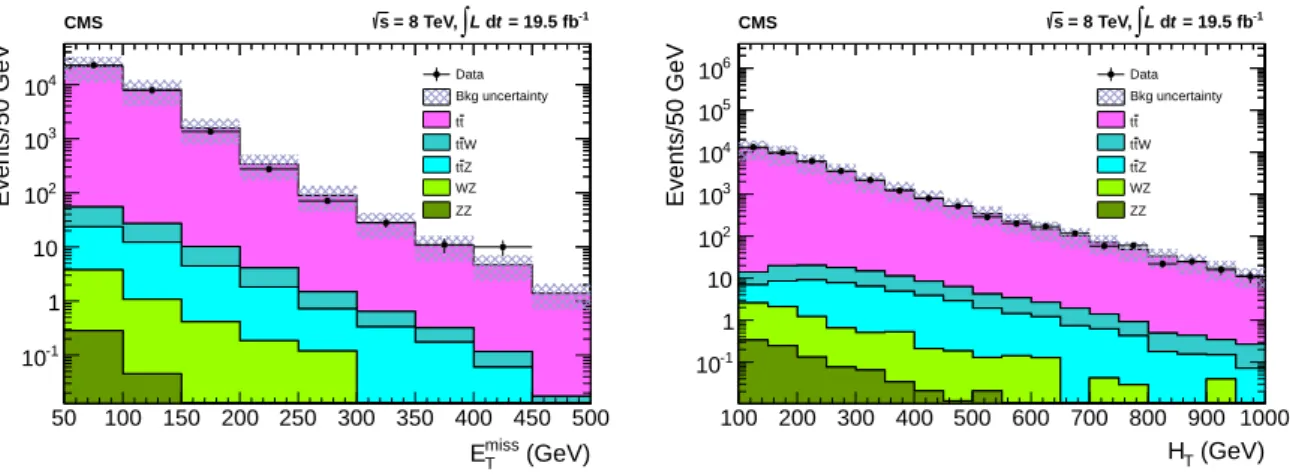
The background from tt events is evaluated from simulation, with corrections applied for lep-ton efficiencies and ETmissresolution as described in Sec. 5.4. Figure 2 shows the distributions of Emiss
T and HTfor the data and corrected simulation in a tt-enriched control sample selected by
requiring events to contain an opposite-sign eµ pair and at least one tagged b jet.
(GeV) T miss E 50 100 150 200 250 300 350 400 450 500 Events/50 GeV -1 10 1 10 2 10 3 10 4 10 CMS -1 = 19.5 fb t d L ∫ = 8 TeV, s Data Bkg uncertainty t t W t t Z t t WZ ZZ (GeV) T H 100 200 300 400 500 600 700 800 900 1000 Events/50 GeV -1 10 1 10 2 10 3 10 4 10 5 10 6 10 CMS -1 = 19.5 fb t d L ∫ = 8 TeV, s Data Bkg uncertainty t t W t t Z t t WZ ZZ
Figure 2: Distribution of (left) Emiss
T and (right) HT for a tt-enriched data control sample, in
comparison to the result from simulation.
5.6 Backgrounds from asymmetric internal photon conversions
The background from photon conversions is evaluated from data by selecting a low-ETmiss, low-HTcontrol region defined by ETmiss<30 GeV and HT <200 GeV and measuring the ratio of the
number of events with|m`+`−`(0)±−mZ| < 15 GeV to those with |m`+`−γ−mZ| < 15 GeV. We
find a result of(2.0±0.3)% for electrons and(0.7±0.1)% for muons, where the uncertainty is statistical. We multiply these factors by the measured`+`−
γrates in the signal regions to
estimate the rate of photon-conversion background events in these regions, with a systematic uncertainty of 50%.
8 7 Results
6
Systematic uncertainties
The evaluation of systematic uncertainties for the SM background is partially discussed in the previous section. In this section, we discuss additional sources of uncertainty, both for the background estimates and the signal predictions.
Simulated signal and background samples are subject to uncertainties from the trigger, lepton-identification, and isolation requirements. The latter two uncertainties are combined into a single term that is approximately 1.5% for leptons with pT > 20 GeV. The trigger efficiency
uncertainties are approximately 5%. Uncertainties associated with the jet energy scale [36], b-jet tagging efficiency [38], EmissT resolution, and luminosity [50] affect signal efficiencies as well as background estimates determined from simulation. The signal efficiencies are subject to an additional uncertainty, from the ISR modeling [23]. Uncertainties in the cross section calculations affect the signal samples and simulation-derived background estimates, with the exception of the background from WZ and ZZ production, whose normalization is determined from data.
We assign a 50% uncertainty to the estimate of the misidentified lepton background arising from tt production, which is a combination of the uncertainty attributed to the cross section and an uncertainty derived from the level of agreement between data and simulation for the distribution of the isolation variable.
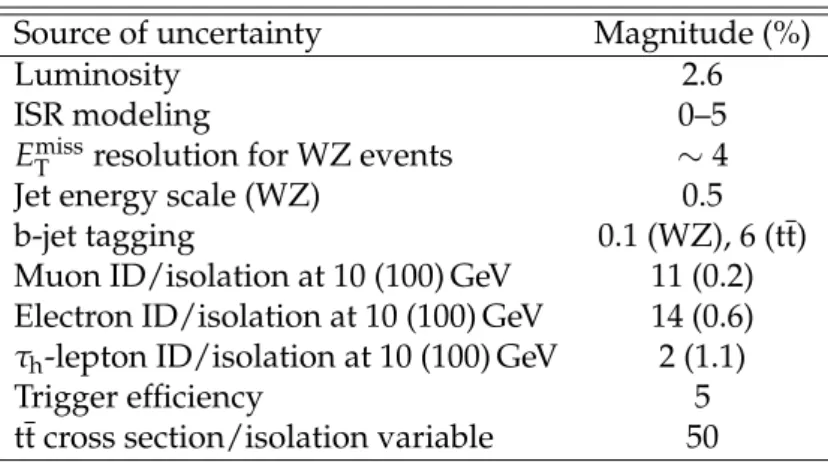
The total systematic uncertainty per channel varies between 3% and 40%. Table 1 list represen-tative values for some of the individual terms.
Table 1: Typical values for systematic uncertainties. Source of uncertainty Magnitude (%)
Luminosity 2.6
ISR modeling 0–5
Emiss
T resolution for WZ events ∼4
Jet energy scale (WZ) 0.5
b-jet tagging 0.1 (WZ), 6 (tt)
Muon ID/isolation at 10 (100) GeV 11 (0.2) Electron ID/isolation at 10 (100) GeV 14 (0.6)
τh-lepton ID/isolation at 10 (100) GeV 2 (1.1)
Trigger efficiency 5
tt cross section/isolation variable 50
7
Results
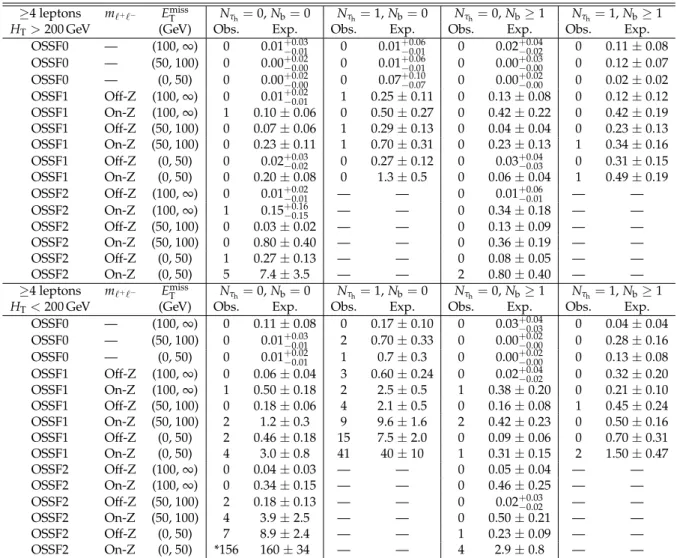
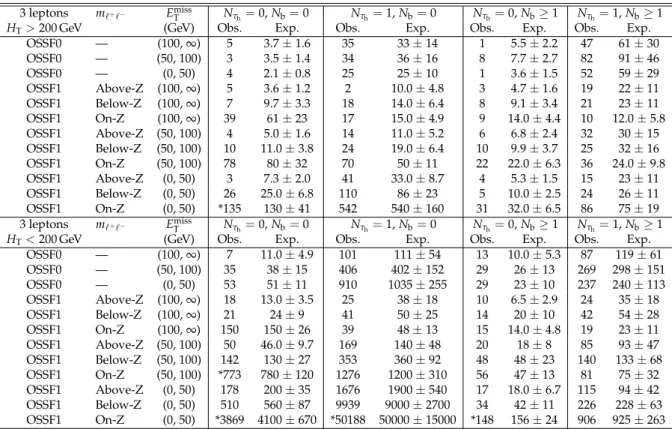
Table 2 presents the results of the searches for events with four or more leptons, and Table 3 the results for exactly three leptons. The observed numbers of events are seen to be in overall agreement with the SM expectations.
Three excesses in the data relative to the SM estimates are worth noting in Table 2. All con-cern events in the OSSF1, off-Z category with one τh-lepton candidate, no tagged b jet, and
HT <200 GeV. Specifically, we observe 15, 4, and 3 events for 0<EmissT <50 GeV, 50<EmissT <
100 GeV, and ETmiss > 100 GeV, respectively, when only 7.5±2.0, 2.1±0.5, and 0.60±0.24 SM events are expected, for an expectation of 10.1±2.4 events in the combined EmissT range. We de-termine the single-measurement probability to observe 22 or more events when the expected number is 10.1±2.4 events to be about 1%. However, once trial factors are incorporated to
9
account for the 64 independent channels of the analysis, the probability to observe such a fluc-tuation increases to about 50%. Alternatively, the joint probability to observe at least as large an excess for all three channels considered individually is about 5%. We account for systematic uncertainties and their correlations when evaluating these probabilities.
Table 2: Observed (Obs.) numbers of events with four or more leptons in comparison with the expected (Exp.) numbers of SM background events. “On-Z” refers to events with at least one e+e− or µ+µ− (OSSF) pair with dilepton mass between 75 and 105 GeV, while “Off-Z”
refers to events with one or two OSSF pairs, none of which fall in this mass range. The OSSFn designation refers to the number of e+e−and µ+µ−pairs in the event, as explained in the text.
Search channels binned in ETmisshave been combined into coarse EmissT bins for the purposes of presentation. All uncertainties include both the statistical and systematic terms. The channel marked with an asterisk is used for normalization purposes and is excluded from the search.
≥4 leptons m`+`− EmissT Nτh=0, Nb=0 Nτh=1, Nb=0 Nτh=0, Nb≥1 Nτh =1, Nb≥1
HT>200 GeV (GeV) Obs. Exp. Obs. Exp. Obs. Exp. Obs. Exp.
OSSF0 — (100,∞) 0 0.01+0.03−0.01 0 0.01+0.06−0.01 0 0.02+0.04−0.02 0 0.11±0.08 OSSF0 — (50, 100) 0 0.00+0.02−0.00 0 0.01+0.06−0.01 0 0.00+0.03−0.00 0 0.12±0.07 OSSF0 — (0, 50) 0 0.00+0.02−0.00 0 0.07+0.10−0.07 0 0.00+0.02−0.00 0 0.02±0.02 OSSF1 Off-Z (100,∞) 0 0.01+0.02−0.01 1 0.25±0.11 0 0.13±0.08 0 0.12±0.12 OSSF1 On-Z (100,∞) 1 0.10±0.06 0 0.50±0.27 0 0.42±0.22 0 0.42±0.19 OSSF1 Off-Z (50, 100) 0 0.07±0.06 1 0.29±0.13 0 0.04±0.04 0 0.23±0.13 OSSF1 On-Z (50, 100) 0 0.23±0.11 1 0.70±0.31 0 0.23±0.13 1 0.34±0.16 OSSF1 Off-Z (0, 50) 0 0.02+0.03−0.02 0 0.27±0.12 0 0.03+0.04−0.03 0 0.31±0.15 OSSF1 On-Z (0, 50) 0 0.20±0.08 0 1.3±0.5 0 0.06±0.04 1 0.49±0.19 OSSF2 Off-Z (100,∞) 0 0.01+0.02−0.01 — — 0 0.01+0.06−0.01 — — OSSF2 On-Z (100,∞) 1 0.15+0.16−0.15 — — 0 0.34±0.18 — — OSSF2 Off-Z (50, 100) 0 0.03±0.02 — — 0 0.13±0.09 — — OSSF2 On-Z (50, 100) 0 0.80±0.40 — — 0 0.36±0.19 — — OSSF2 Off-Z (0, 50) 1 0.27±0.13 — — 0 0.08±0.05 — — OSSF2 On-Z (0, 50) 5 7.4±3.5 — — 2 0.80±0.40 — — ≥4 leptons m`+`− EmissT Nτh=0, Nb=0 Nτh=1, Nb=0 Nτh=0, Nb≥1 Nτh =1, Nb≥1
HT<200 GeV (GeV) Obs. Exp. Obs. Exp. Obs. Exp. Obs. Exp.
OSSF0 — (100,∞) 0 0.11±0.08 0 0.17±0.10 0 0.03+0.04−0.03 0 0.04±0.04 OSSF0 — (50, 100) 0 0.01+0.03−0.01 2 0.70±0.33 0 0.00+0.02−0.00 0 0.28±0.16 OSSF0 — (0, 50) 0 0.01+0.02−0.01 1 0.7±0.3 0 0.00+0.02−0.00 0 0.13±0.08 OSSF1 Off-Z (100,∞) 0 0.06±0.04 3 0.60±0.24 0 0.02+0.04−0.02 0 0.32±0.20 OSSF1 On-Z (100,∞) 1 0.50±0.18 2 2.5±0.5 1 0.38±0.20 0 0.21±0.10 OSSF1 Off-Z (50, 100) 0 0.18±0.06 4 2.1±0.5 0 0.16±0.08 1 0.45±0.24 OSSF1 On-Z (50, 100) 2 1.2±0.3 9 9.6±1.6 2 0.42±0.23 0 0.50±0.16 OSSF1 Off-Z (0, 50) 2 0.46±0.18 15 7.5±2.0 0 0.09±0.06 0 0.70±0.31 OSSF1 On-Z (0, 50) 4 3.0±0.8 41 40±10 1 0.31±0.15 2 1.50±0.47 OSSF2 Off-Z (100,∞) 0 0.04±0.03 — — 0 0.05±0.04 — — OSSF2 On-Z (100,∞) 0 0.34±0.15 — — 0 0.46±0.25 — — OSSF2 Off-Z (50, 100) 2 0.18±0.13 — — 0 0.02+0.03−0.02 — — OSSF2 On-Z (50, 100) 4 3.9±2.5 — — 0 0.50±0.21 — — OSSF2 Off-Z (0, 50) 7 8.9±2.4 — — 1 0.23±0.09 — — OSSF2 On-Z (0, 50) *156 160±34 — — 4 2.9±0.8 — —
8
Interpretation of results for supersymmetric scenarios
We consider five new-physics scenarios that appear in the framework of the minimal super-symmetric standard model (MSSM) [4, 5]. They involve sleptons (including staus), bottom and top squarks, higgsinos, gravitinos, neutralinos, and charginos, where higgsinos are the super-partners of the Higgs bosons, the gravitino eG is the superpartner of the graviton, while neu-tralinos (charginos) are mixtures of the superpartners of neutral (charged) electroweak vector
10 8 Interpretation of results for supersymmetric scenarios
Table 3: Observed (Obs.) numbers of events with exactly three leptons in comparison with the expected (Exp.) numbers of SM background events. “On-Z” refers to events with an e+e−or
µ+µ−(OSSF) pair with dilepton mass between 75 and 105 GeV, while “Above-Z” and
“Below-Z” refer to events with an OSSF pair with mass above 105 GeV or below 75 GeV, respectively. The OSSFn designation refers to the number of e+e−and µ+µ−pairs in the event, as explained
in the text. Search channels binned in EmissT have been combined into coarse ETmissbins for the purposes of presentation. All uncertainties include both the statistical and systematic terms. The channels marked with an asterisk are used for normalization purposes and are excluded from the search.
3 leptons m`+`− EmissT Nτh= 0, Nb= 0 Nτh= 1, Nb= 0 Nτh= 0, Nb≥ 1 Nτh= 1, Nb≥ 1
HT> 200 GeV (GeV) Obs. Exp. Obs. Exp. Obs. Exp. Obs. Exp.
OSSF0 — (100,∞) 5 3.7± 1.6 35 33± 14 1 5.5± 2.2 47 61± 30 OSSF0 — (50, 100) 3 3.5± 1.4 34 36± 16 8 7.7± 2.7 82 91± 46 OSSF0 — (0, 50) 4 2.1± 0.8 25 25± 10 1 3.6± 1.5 52 59± 29 OSSF1 Above-Z (100,∞) 5 3.6± 1.2 2 10.0± 4.8 3 4.7± 1.6 19 22± 11 OSSF1 Below-Z (100,∞) 7 9.7± 3.3 18 14.0± 6.4 8 9.1± 3.4 21 23± 11 OSSF1 On-Z (100,∞) 39 61± 23 17 15.0± 4.9 9 14.0± 4.4 10 12.0± 5.8 OSSF1 Above-Z (50, 100) 4 5.0± 1.6 14 11.0± 5.2 6 6.8± 2.4 32 30± 15 OSSF1 Below-Z (50, 100) 10 11.0± 3.8 24 19.0± 6.4 10 9.9± 3.7 25 32± 16 OSSF1 On-Z (50, 100) 78 80± 32 70 50± 11 22 22.0± 6.3 36 24.0± 9.8 OSSF1 Above-Z (0, 50) 3 7.3± 2.0 41 33.0± 8.7 4 5.3± 1.5 15 23± 11 OSSF1 Below-Z (0, 50) 26 25.0± 6.8 110 86± 23 5 10.0± 2.5 24 26± 11 OSSF1 On-Z (0, 50) *135 130± 41 542 540± 160 31 32.0± 6.5 86 75± 19 3 leptons m`+`− EmissT Nτh= 0, Nb= 0 Nτh= 1, Nb= 0 Nτh= 0, Nb≥ 1 Nτh= 1, Nb≥ 1
HT< 200 GeV (GeV) Obs. Exp. Obs. Exp. Obs. Exp. Obs. Exp.
OSSF0 — (100,∞) 7 11.0± 4.9 101 111± 54 13 10.0± 5.3 87 119± 61 OSSF0 — (50, 100) 35 38± 15 406 402± 152 29 26± 13 269 298± 151 OSSF0 — (0, 50) 53 51± 11 910 1035± 255 29 23± 10 237 240± 113 OSSF1 Above-Z (100,∞) 18 13.0± 3.5 25 38± 18 10 6.5± 2.9 24 35± 18 OSSF1 Below-Z (100,∞) 21 24± 9 41 50± 25 14 20± 10 42 54± 28 OSSF1 On-Z (100,∞) 150 150± 26 39 48± 13 15 14.0± 4.8 19 23± 11 OSSF1 Above-Z (50, 100) 50 46.0± 9.7 169 140± 48 20 18± 8 85 93± 47 OSSF1 Below-Z (50, 100) 142 130± 27 353 360± 92 48 48± 23 140 133± 68 OSSF1 On-Z (50, 100) *773 780± 120 1276 1200± 310 56 47± 13 81 75± 32 OSSF1 Above-Z (0, 50) 178 200± 35 1676 1900± 540 17 18.0± 6.7 115 94± 42 OSSF1 Below-Z (0, 50) 510 560± 87 9939 9000± 2700 34 42± 11 226 228± 63 OSSF1 On-Z (0, 50) *3869 4100± 670 *50188 50000 ± 15000 *148 156± 24 906 925± 263
and Higgs bosons. The first three scenarios feature the gravitino as the LSP, while the lightest neutralinoχe
0
1 is the LSP for the other two scenarios. The first and last two scenarios proceed
through the production of third-generation squarks, yielding final states rich in heavy-flavor jets. Taken together, these five scenarios present a wide spectrum of multilepton signatures. Our search results lack striking departures from the SM, and we set limits on the production cross sections of the five scenarios. The limits are determined using the observed numbers of events, the SM background estimates, and the predicted event yields. For each scenario, we order the search channels by their expected sensitivities and then combine channels, starting with the most sensitive one. For ease of computation and with a negligible loss in overall sensitivity, we do not consider channels once the number of signal events integrated over the retained channels reaches 90% of the total. The list of selected channels thus depends not only on the scenario considered, but also on the assumed superpartner masses and branching fractions.
We set 95% confidence level (CL) upper limits on the signal parameters and cross sections using the modified frequentest CLsmethod with the LHC-style test statistic [51–53]. Lognormal
8.1 Natural higgsino NLSP scenario 11
8.1 Natural higgsino NLSP scenario
We first present a supersymmetric scenario in which theχe
0
1neutralino is a higgsino that forms
the next-to-LSP (NLSP) state [21]. We refer to this scenario as the “natural higgsino NLSP” sce-nario. This scenario arises in gauge-mediated SUSY-breaking (GMSB) models [54]. Production proceeds through the right-handed top-antitop squark pairetRet∗R, with the subsequent decays etR → bχe + 1 oretR → tχe 0 i (i = 1, 2), whereχe +
1 is the lightest chargino andχe
0
2the second-lightest
neutralino (both taken to be higgsinos), with the eq∗ state the charge conjugate of theeq state. Theχe
+
1 andχe
0
2states each decay to theχe
0
1and SM particles. Figure 3 shows an event diagram
and a schematic mass spectrum. The last step in each of the two top-squark decay chains is the decay χe
0
1 → H eG or Z eG, yielding an HH, HZ, or ZZ configuration, with EmissT from the
unde-tected gravitino. Note that we assume H eG and Z eG to be the only two possible decay modes for theχe
0
1higgsino [54].
Beyond the top-squark pair production diagram of Fig. 3, the natural higgsino NLSP scenario also encompasses direct higgsino pair production, in which theχe
+
1 andχe−1 states of Fig. 3 (plus other di-higgsino states) are produced through electroweak interactions, leading to the same HH, HZ, and ZZ configuration as in Fig. 3, but with less jet activity [54]. Our search results are also sensitive to this scenario.
Of the five new-physics scenarios we examine, the natural higgsino NLSP scenario exhibits the largest range with respect to its population of the different search channels. The channels with highest sensitivity are those that require b jets, and, for the decays through the HZ and ZZ states, the channels with on-Z and off-Z requirements.
P1 P2 ˜t∗ R ˜tR ˜ χ−1 ˜ χ+1 ˜ χ0 1 ˜ χ0 1 b (jet,`) (jet,ν) ˜ G H,Z H,Z ˜ G (jet,ν) (jet,`) b 1
!"#$%
&'()"*#$%
+,-.$#
%
%
&/0"#$%
1,.2%
340('52%
6"#$%
3/,-.$#
7%+,-.$#
%
%
1,.%
3/,-.$#%8$9:+3;%%
&'()"*#$%
+,-.$#
%
%
3<0$#
7%=(0
%
%
3.(0%>:?:+3;%
3,/,8.'$#
7%3.(0
7%&'()"*#$%
@%
A"BB2"#$
%A%
:(.0'(/%A"BB2"#$9:+3;%%
3.$-
7%C%
.%
Figure 3: Event diagram and a schematic superpartner mass spectrum for the GMSB natural higgsino NLSP scenario, withχe±1 (χe
0
1) the lightest chargino (neutralino), H the lightest MSSM
Higgs boson, and eG a gravitino. Particles in parentheses in the event diagram have a soft pT
spectrum.
The natural higgsino NLSP scenario is complex because the higgsino can decay to either a Z or Higgs boson, while the Higgs boson has many decay modes that lead to leptons. We consider seven decay channels for the HH configuration: WW∗WW∗, ZZ∗ZZ∗, ττττ, WW∗ZZ∗, WW∗ττ, ZZ∗ττ, and ZZ∗bb, and three decay channels for the HZ configuration: WW∗Z, ZZ∗Z,
and ττZ, where W∗ and Z∗ indicate off-shell vector bosons.
Signal events for the natural higgsino NLSP scenario are generated using MADGRAPH, as de-scribed in Sec. 3. Theχe
0 1andχe
0
2higgsinos are assigned masses 5 GeV below and above the mass
of theχe
±
12 8 Interpretation of results for supersymmetric scenarios
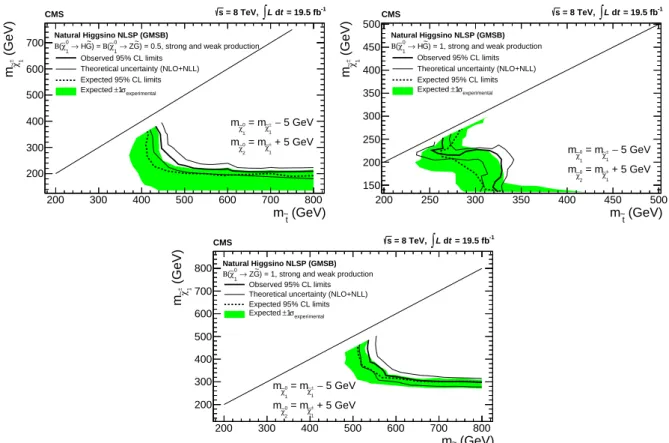
no mixing between higgsinos and gauginos, the light neutralinos and charginos become de-generate [54]. The 5 GeV splitting is representative of proximity to this limit. We de-generate signal events for a range ofetRandχe1±mass values. Cross sections for both the strong and elec-troweak production processes are assigned an uncertainty of 20%, which also accounts for the uncertainties associated with the PDFs and with the renormalization and factorization scales. Figure 4 shows the excluded regions in the plane of m
e
χ±1 versus met. The results are shown for
several choices for the χe
0
1 → H eG branching fraction. One-dimensional exclusion plots with
fixed choices for the branching fraction and chargino mass are shown in Fig. 5. The search sensitivity is larger for lower chargino masses because of the larger cross section. There is less sensitivity for the Higgs-boson-dominated mode in comparison with the Z-boson-dominated mode. Figure 6 shows the results as a function of theχe
0
1→H eG branching fraction and the top
squark mass for different chargino masses.
(GeV) t ~ m 200 300 400 500 600 700 800 (GeV) ±χ∼1 m 200 300 400 500 600 700 CMS s = 8 TeV, ∫L dt = 19.5 fb-1 Natural Higgsino NLSP (GMSB)
) = 0.5, strong and weak production G~ Z → 0 1 χ∼ ( Β ) = G~ H → 0 1 χ∼ ( Β Observed 95% CL limits Theoretical uncertainty (NLO+NLL) Expected 95% CL limits experimental σ 1 ± Expected + 5 GeV ± 1 χ∼ = m 0 2 χ∼ m 5 GeV − ± 1 χ∼ = m 0 1 χ∼ m (GeV) t~ m 200 250 300 350 400 450 500 (GeV)±χ∼1 m 150 200 250 300 350 400 450 500 CMS s = 8 TeV, ∫L dt = 19.5 fb-1 Natural Higgsino NLSP (GMSB) ) = 1, strong and weak production G~ H → 0 1 χ∼ ( Β Observed 95% CL limits Theoretical uncertainty (NLO+NLL) Expected 95% CL limits experimental σ 1 ± Expected + 5 GeV ± 1 χ∼ = m 0 2 χ∼ m 5 GeV − ± 1 χ∼ = m 0 1 χ∼ m (GeV) t ~ m 200 300 400 500 600 700 800 (GeV)±χ∼1 m 200 300 400 500 600 700 800 CMS s = 8 TeV, ∫L dt = 19.5 fb-1 Natural Higgsino NLSP (GMSB) ) = 1, strong and weak production G~ Z → 0 1 χ∼ ( Β Observed 95% CL limits Theoretical uncertainty (NLO+NLL) Expected 95% CL limits experimental σ 1 ± Expected + 5 GeV ± 1 χ∼ = m 0 2 χ∼ m 5 GeV − ± 1 χ∼ = m 0 1 χ∼ m
Figure 4: The 95% confidence level upper limits in the top squark versus chargino mass plane, for the natural higgsino NLSP scenario with the following χe
0 1 branching fractions: B(χe 0 1 → H eG) = B(χe 0 1 →Z eG) = 0.5 (upper left),B(χe 0
1 →H eG) =1.0 (upper right), andB(χe
0
1 →Z eG) =
1.0 (bottom). Both strong and electroweak production mechanisms are considered. The region to the left and below the contours is excluded. The region above the diagonal straight line is unphysical.
8.2 Slepton co-NLSP scenario
We next consider the slepton co-NLSP scenario [21, 53], in which mass-degenerate right-handed sleptons e`R(selectron, smuon, stau) serve together as the NLSP. This scenario arises in a broad
class of GMSB models and can lead to a multilepton final state [55–58]. The process proceeds primarily through gluinog and squarke eq pair production [59]. An event diagram and schematic
8.2 Slepton co-NLSP scenario 13 (GeV) t ~ m 200 300 400 500 600 700 800 (pb) Β × σ -1 10 1 10 2 10 CMS s = 8 TeV, ∫L dt = 19.5 fb-1 + 5 GeV ± 1 χ∼ = m 0 2 χ∼ m 5 GeV − ± 1 χ∼ = m 0 1 χ∼ m Natural Higgsino NLSP (GMSB) = 150 GeV ± 1 χ∼ ) = 0.5, m G~ Z → 0 1 χ∼ ( Β ) = G~ H → 0 1 χ∼ ( Β Observed 95% CL limits Expected 95% CL limits σ 1 ± Expected Theory (NLO+NLL) Theoretical uncertainty (GeV) t ~ m 200 300 400 500 600 700 800 (pb) Β × σ -2 10 -1 10 1 10 CMS s = 8 TeV, ∫L dt = 19.5 fb-1 + 5 GeV ± 1 χ∼ = m 0 2 χ∼ m 5 GeV − ± 1 χ∼ = m 0 1 χ∼ m unphysical Natural Higgsino NLSP (GMSB) = 350 GeV ± 1 χ∼ ) = 0.5, m G~ Z → 0 1 χ∼ ( Β ) = G~ H → 0 1 χ∼ ( Β Observed 95% CL limits Expected 95% CL limits σ 1 ± Expected Theory (NLO+NLL) Theoretical uncertainty (GeV) t ~ m 200 300 400 500 600 700 800 (pb) Β × σ -1 10 1 10 2 10 CMS s = 8 TeV, ∫L dt = 19.5 fb-1 + 5 GeV ± 1 χ∼ = m 0 2 χ∼ m 5 GeV − ± 1 χ∼ = m 0 1 χ∼ m = 150 GeV ± 1 χ∼ ) = 1, m G~ H → 0 1 χ∼ ( Β , Natural Higgsino NLSP (GMSB) Observed 95% CL limits Expected 95% CL limits σ 1 ± Expected σ 2 ± Expected Theory (NLO+NLL) Theoretical uncertainty (GeV) t ~ m 200 300 400 500 600 700 800 (pb) Β × σ -2 10 -1 10 1 10 CMS s = 8 TeV, ∫L dt = 19.5 fb-1 + 5 GeV ± 1 χ∼ = m 0 2 χ∼ m 5 GeV − ± 1 χ∼ = m 0 1 χ∼ m unphysical Natural Higgsino NLSP (GMSB) = 350 GeV ± 1 χ∼ ) = 1, m G~ H → 0 1 χ∼ ( Β Observed 95% CL limits expected 95% CL limits σ 1 ± Expected σ 2 ± Expected Theory (NLO+NLL) Theoretical uncertainty (GeV) t ~ m 200 300 400 500 600 700 800 (pb) Β × σ -1 10 1 10 2 10 CMS s = 8 TeV, ∫L dt = 19.5 fb-1 + 5 GeV ± 1 χ∼ = m 0 2 χ∼ m 5 GeV − ± 1 χ∼ = m 0 1 χ∼ m Natural Higgsino NLSP (GMSB) = 150 GeV ± 1 χ∼ ) = 1, m G~ Z → 0 1 χ∼ ( Β Observed 95% CL limits Expected 95% CL limits σ 1 ± Expected Theory (NLO+NLL) Theoretical uncertainty (GeV) t ~ m 200 300 400 500 600 700 800 (pb) Β × σ -2 10 -1 10 1 10 CMS s = 8 TeV, ∫L dt = 19.5 fb-1 + 5 GeV ± 1 χ∼ = m 0 2 χ∼ m 5 GeV − ± 1 χ∼ = m 0 1 χ∼ m unphysical Natural Higgsino NLSP (GMSB) = 350 GeV ± 1 χ∼ ) = 1, m G~ Z → 0 1 χ∼ ( Β Observed 95% CL limits Expected 95% CL limits σ 1 ± Expected Theory (NLO+NLL) Theoretical uncertainty
Figure 5: The 95% confidence level upper limits on cross section times branching fractionB, for the natural higgsino NLSP scenario forB(χe
0 1 → H eG) =B(χe 0 1 →Z eG) =0.5 (top),B(χe 0 1 → H eG) = 1.0 (middle), andB(χe 0
1 → Z eG) =1.0 (bottom). The charged higgsino mass is fixed at
150 GeV (left) and 350 GeV (right). The region to the left of the vertical line on the right plots is unphysical and limited by the charged higgsino mass.
mass spectrum are shown in Fig. 7. Theχe
0
1 neutralino is taken to be a bino, the superpartner
of the B gauge boson. The bino decays to a lepton and the NLSP, while the NLSP decays to the gravitino LSP and an additional lepton. Depending on the mass spectrum, the events can have large HT. Channels with no tagged b jets and off-Z OSSF pairs exhibit the largest sensitivity for
this scenario.
Beyond production through squarks and gluinos, production through chargino-neutralino or right-handed slepton pairs is possible. The decay of each parent eventually leads to a bino
e
χ01, which decays as shown in Fig. 7, leading to a final state with multileptons and ETmissas for
14 8 Interpretation of results for supersymmetric scenarios (GeV) t ~ m 200 300 400 500 600 700 800 ) G ~ H → 0 χ∼ 1 ( Β 0 0.2 0.4 0.6 0.8 1 CMS s = 8 TeV, ∫L dt = 19.5 fb-1 + 5 GeV ± 1 χ∼ = m 0 2 χ∼ m 5 GeV − ± 1 χ∼ = m 0 1 χ∼ m
= 150 GeV, strong and weak production
1
±
χ∼
Natural Higgsino NLSP (GMSB) Observed 95% CL limits Theoretical uncertainty (NLO+NLL) Expected 95% CL limits experimental σ 1 ± Expected (GeV) t~ m 200 300 400 500 600 700 800 ) G ~ H → 0 χ∼ 1 ( Β 0 0.2 0.4 0.6 0.8 1 CMS s = 8 TeV, ∫L dt = 19.5 fb-1 + 5 GeV ± 1 χ∼ = m 0 2 χ∼ m 5 GeV − ± 1 χ∼ = m 0 1 χ∼ m unphysical
= 250 GeV, strong and weak production
1
±
χ∼
Natural Higgsino NLSP (GMSB) Observed 95% CL limits Theoretical uncertainty (NLO+NLL) Expected 95% CL limits experimental σ 1 ± Expected (GeV) t ~ m 200 300 400 500 600 700 800 ) G ~ H → 0 χ∼ 1 ( Β 0 0.2 0.4 0.6 0.8 1 CMS s = 8 TeV, ∫L dt = 19.5 fb-1 + 5 GeV ± 1 χ∼ = m 0 2 χ∼ m 5 GeV − ± 1 χ∼ = m 0 1 χ∼ m unphysical
= 350 GeV, strong and weak production
1
±
χ∼
Natural Higgsino NLSP (GMSB) Observed 95% CL limits Theoretical uncertainty (NLO+NLL) Expected 95% CL limits experimental σ 1 ± Expected
Figure 6: The 95% confidence level upper limits on the branching fraction B(χe
0
1 → H eG)for
the natural higgsino NLSP scenario with fixed charged higgsino mass of 150 GeV (upper left), 250 GeV (upper right), and 350 GeV (bottom) assuming B(χe
0
1 → H eG) +B(χe
0
1 → Z eG) = 1.0.
The region to the left of the vertical line on the right plots is unphysical and limited by the charged higgsino mass.
P1 P2 ˜ q, ˜g ˜ q, ˜g ˜ χ0 1 ˜ χ0 1 ˜ `R ˜ `R jet(s) ` ` ˜ G ˜ G ` ` jet(s) 1 !"#$% &'()"*#$% +,-.$#%% &/0"#$% 1,.2% 340('52% 6"#$% 3/,-.$#7% +,-.$#%% 1,.% 3/,-.$#%8$9:+3;%% &'()"*#$% +,-.$#%% 3<0$#7% =(0%% 3.(0%>:?:+3;% 3,/,8.'$#7% 3.(07% &'()"*#$% 6$@$<% A"BB2"#$% A"BB2%%% :(.0'(/%A"BB2"#$9:+3;%% 3.$-7% C96$2$#%% =$-%
Figure 7: Event diagram and a schematic superpartner mass spectrum for the GMSB slepton co-NLSP scenario.
mechanisms depends on the values of the superpartner masses.
Signal events for the slepton co-NLSP scenario are generated using thePYTHIAgenerator. The superpartner mass spectrum is parametrized in terms of the masses of theχe
±
1 chargino and the
gluino. The remaining superpartner masses are chosen to be me`
R = 0.3mχe ± 1, mχe 0 1 = 0.5mχe ± 1,
8.3 The stau-(N)NLSP scenario 15
me`
L = 0.8mχe
±
1, and meq = 0.8meg, with no mixing of the left- and right-handed slepton and
squark components, and with the higgsino masses so large that their contributions are negli-gible. The cross sections are calculated at NLO using K-factors from PROSPINO [60] and are
assigned a 30% theoretical uncertainty, taking into account cross section, scale, and PDF uncer-tainties.
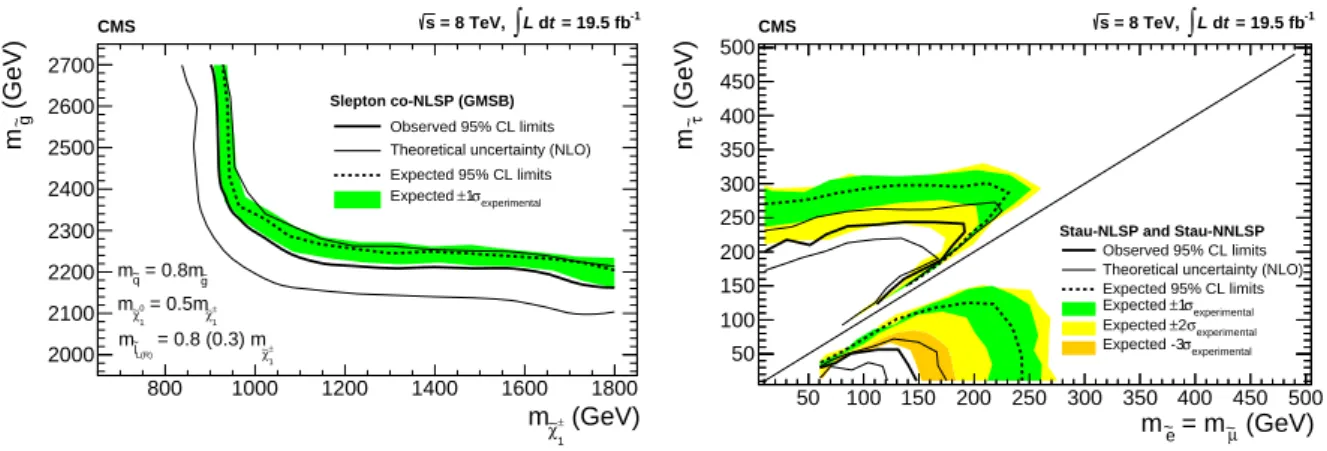
The 95% CL exclusions limits for the slepton co-NLSP scenario are shown in Fig. 8 (left) as a function of the gluino and chargino masses. In the region dominated by strong superpartner production, the exclusion curve asymptotically approaches a horizontal plateau, while it tends towards a vertical line in the region dominated by weak superpartner production.
(GeV) ± 1 χ∼ m 800 1000 1200 1400 1600 1800 (GeV) g~ m 2000 2100 2200 2300 2400 2500 2600 2700 CMS s = 8 TeV, ∫L dt = 19.5 fb-1 g ~ = 0.8m q ~ m ± 1 χ∼ = 0.5m 0 1 χ∼ m ± 1 χ∼ = 0.8 (0.3) m L(R) l ~ m Slepton co-NLSP (GMSB) Observed 95% CL limits Theoretical uncertainty (NLO) Expected 95% CL limits experimental σ 1 ± Expected (GeV) µ ~ = m e~ m 50 100 150 200 250 300 350 400 450 500 (GeV)τ ~ m 50 100 150 200 250 300 350 400 450 500 CMS s = 8 TeV, ∫L dt = 19.5 fb-1
Stau-NLSP and Stau-NNLSP Observed 95% CL limits Theoretical uncertainty (NLO) Expected 95% CL limits experimental σ 1 ± Expected experimental σ 2 ± Expected experimental σ Expected -3
Figure 8: The 95% confidence level upper limits for the slepton co-NLSP model in the gluino versus chargino mass plane (left) and for the stau-(N)NLSP scenarios in the stau versus degenerate-smuon and -selectron mass plane (right). The region to the left and below the con-tours is excluded.
8.3 The stau-(N)NLSP scenario
In the stau-NLSP scenario, the right-handed stau lepton is the NLSP. This scenario arises for moderate to large values of the MSSM parameter tan β [4, 5]. Mass-degenerate right-handed selectrons and smuons decay to the stau through the three-body processes eeR → eτRτe and e
µR → τeRτµ. The stau decays asτeR → Gτ. Pair production of selectrons or smuons leads to ae multilepton final state dominated by τ leptons. A diagram and schematic mass spectrum are shown in Fig. 9.
Besides the stau-NLSP scenario, we also consider the stau-NNLSP scenario in which mass-degenerate right-handed selectrons and smuons are co-NLSPs, while the right-handed stau is the next-to-next-to-lightest SUSY particle (NNLSP). The process proceeds via electroweak pair production of staus. The staus decay to the NLSP and a τ lepton. The NLSPs decay to a τ lepton and gravitino.
The search channels most sensitive to the stau-(N)NLSP scenarios contain τhleptons, no tagged
b jets, off-Z OSSF pairs, and large EmissT . Signal events for the stau-(N)NLSP model are gener-ated usingPYTHIA[45]. The cross sections are normalized to NLO calculations usingPROSPINO
[60] and are assigned a 30% theoretical uncertainty.
The 95% CL exclusion limits for the stau-(N)NLSP scenario are shown in Fig. 8 (bottom). When the mass difference between the stau and the other sleptons is small, the leptons are soft. This results in low signal efficiency, which causes the exclusion contour to become nearly parallel to the diagonal for points near the diagonal. The difference between the expected and observed limits in the region below the diagonal is driven by the excesses observed between the data
16 8 Interpretation of results for supersymmetric scenarios P1 P2 ˜ `−R ˜ `+R ˜ τR+ ˜ τR− `− τ− τ+ ˜ G ˜ G τ− τ+ `+ 1
!"#$%
&'()"*#$%
+,-.$#
%
%
&/0"#$%
1,.2%
340('52%
6"#$%
3/,-.$#
7%+,-.$#
%
%
1,.%
3/,-.$#%8$9:+3;%%
&'()"*#$%
+,-.$#
%
%
3<0$#
7%=(0
%
%
3.(0%>:?:+3;%
3,/,8.'$#
7%3.(0
7%&'()"*#$%
6$@$<%
A"BB2"#$
%A"BB2%%%
:(.0'(/%A"BB2"#$9:+3;%%
3.$-
7%C96$2$#%%
=$-%
Figure 9: Event diagram and a schematic superpartner mass spectrum for the GMSB stau-(N)NLSP scenario.
and SM estimates in the four-or-more lepton, OSSF1, off-Z, τhchannels without b jets, noted in Sec. 7.
8.4 Third-generation SMS scenario T1tttt
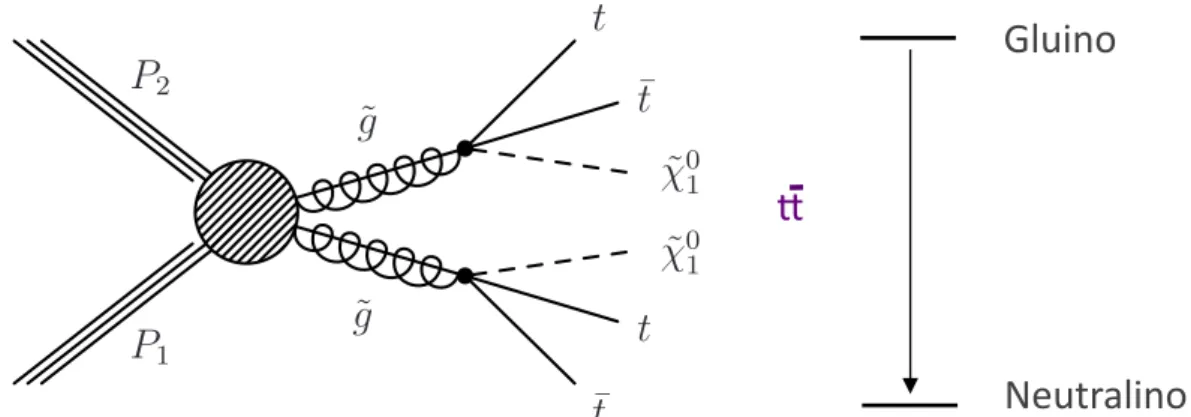
In the T1tttt simplified model spectra (SMS) scenario [58, 61, 62], pair-produced gluinos each decay to a top quark and a virtual top squark. The virtual top squark decays to a top quark and the LSP, where the LSP is the lightest neutralino. Thus each gluino undergoes an effective three-body decay to two top quarks and the LSP, yielding four top quarks in the final state. Each top quark can potentially yield a b jet and a leptonically decaying W boson, leading to a multilepton final state with b jets and EmissT . Because of the large number of jets, the HTvalue
can be quite large. An event diagram and schematic mass spectrum are shown in Fig. 10.
P1
P2
˜
g
˜
g
¯
t
t
˜
χ
01˜
χ
0 1¯
t
t
!"#$%&'
()#*+,"$%&
'-.//'
'
/''
01&/&2'
34,+5$%&'
-6/77'
()#*+,"$%&
'7''
*'''
Figure 10: Event diagram and a schematic superpartner mass spectrum for the SMS T1tttt scenario.
The presence of four top quarks in the final state results in four b quarks and four W bosons. The W-boson decays can produce up to four leptons with large EmissT . The SM background is significantly reduced by requiring the presence of a b jet. This requirement represents an improvement with respect to our analysis of the 7 TeV data [11].
Signal events for the T1tttt scenario are generated using MADGRAPH. The cross sections are
calculated at the NLO plus next-to-leading-logarithm (NLL) level [59, 63–66] with uncertainties that vary between 23% and 27% [67].
The 95% CL exclusion limits in the gluino versus LSP mass plane are shown in Fig. 11 (left). We exclude gluinos with mass values below 1 TeV over much of this plane.
8.5 Third-generation SMS scenario T6ttWW 17 (GeV) g~ m 700 800 900 1000 1100 1200 (GeV)0 1 χ∼ m 0 100 200 300 400 500 600 700 800 CMS s = 8 TeV, ∫L dt = 19.5 fb-1 0 1 χ∼ t t → g ~ , g ~ g ~ → , pp T1tttt Observed 95% CL limits Theoretical uncertainty (NLO+NLL) Expected 95% CL limits experimental σ 1 ± Expected (GeV) b~ m 350 400 450 500 550 600 650 700 (GeV) ± 1 χ∼ m 150 200 250 300 350 400 450 500 CMS s = 8 TeV, ∫L dt = 19.5 fb-1 0 1 χ∼ tW → 1 b ~ *, 1 b ~ 1 b ~ → , pp T6ttWW Observed 95% CL limits Theoretical uncertainty (NLO+NLL) Expected 95% CL limits experimental σ 1 ± Expected = 50 GeV 1 0 χ∼ m
Figure 11: 95% confidence level upper limits for the T1tttt scenario in the LSP versus gluino mass plane (left) and for the T6ttWW scenario in the chargino versus bottom-squark mass plane (right) are shown. Masses to the left and below the contours are excluded.
8.5 Third-generation SMS scenario T6ttWW
In the T6ttWW SMS scenario, we search for SUSY signals with direct bottom-squark pair pro-duction [62, 68]. An event diagram and schematic mass spectrum are shown in Fig. 12. The bottom squark decays as eb → tχe−1, while the chargino decays asχe1− → W−χe
0
1. This scenario
populates channels with tagged b jets.
P1
P2
˜b
˜b
∗χ
−W
−χ
+W
+t
˜
χ
0 1˜
χ
01¯
t
!"#$%&'
()#*+,"$%&
'-.//'
'
/''
01&/&2'
34,+5$%&'
-6/77'
()#*+,"$%&
'7''
*'''
Figure 12: Event diagram and a schematic superpartner mass spectrum for the SMS T6ttWW scenario.
For simplicity, we consider on-shell charginos. The W boson from the chargino decay can be either on- or off-shell. Signal events are generated using MADGRAPH with normalization of the cross section performed to NLO+NLL [59, 63–66]. The uncertainty of the cross section calculation is 30% [67].
Figure 11 (bottom) shows the exclusion limits for the T6ttWW scenario in the chargino versus bottom-squark mass plane. The mass of theχe
0
1 is assumed to be 50 GeV. We exclude bottom
squarks with mass values less than 550 GeV. This result complements our study of this same scenario performed using same-sign dilepton events and obtains similar conclusions [22].
9
Rare decay t
→
cH
Beyond the SUSY scenarios examined in Sec. 8, we interpret our results in the context of the flavor-changing decay of a top quark to a Higgs boson and a charm quark. Although not
18 9 Rare decay t→cH
forbidden in the SM, the SM branching fraction is predicted to be extremely small (10−13– 10−15 [9, 10]), due to suppression both by the Glashow–Iliopoulos–Maiani mechanism [69] and by the Cabibbo–Kobayashi–Maskawa quark-mixing matrix [70] factor. Observation of the t → cH transition can therefore provide evidence for BSM physics, i.e., for non-SM particles produced virtually in loops. In this sense the t→cH transition plays a complementary role to SUSY searches compared to the direct superpartner production scenarios considered in Sec. 8. In addition, the t → cH decay directly probes the flavor-violating couplings of the Higgs bo-son to the top quark. Since up-type quark-flavor violation is less constrained than down-type quark-flavor violation [71], exploration of this issue is of general interest.
The production of a tt pair followed by the decay of one top quark to a cH state and the other to a bW state can yield a multilepton signature, especially if the Higgs boson decays through one of the following channels:
• H→WW∗ → `ν`ν,
• H→ττ, or
• H→ZZ∗→ jj``, νν``,````,
where j refers to a jet. If the t → bW decay also produces a lepton, there can be up to five leptons in an event.
To simulate signal events, we generate a tt sample in which one top quark decays to cH and the other to bW. We assume mH = 126 GeV [72] and that the Higgs boson has SM branching
fractions. We only consider the decay modes listed above because the contributions of other Higgs boson decay modes to the multilepton final state are found to be negligible. Signal events are generated using MADGRAPH, with normalization performed at the next-to-next-to-leading order [73].
The signal events predominantly populate channels with three leptons, a tagged b jet, no τh
-lepton candidate, and an OSSF off-Z pair or no OSSF pair. The most sensitive channels are listed in Table 4. The main source of SM background arises from tt production. The observed numbers of events are seen to be in agreement with the SM expectations to within the uncer-tainties.
Table 4: The ten most sensitive signal regions for the t→cH process, along with the number of observed (Obs.), background (Exp.), and expected signal (Sig.) events, assumingB(t→cH) = 1%, ordered by sensitivity. All signal regions shown have exactly three selected leptons. The results are binned in EmissT , HT, number of tagged b jets or τhcandidates, and, if an OSSF pair is
present, its invariant mass with respect to the Z-boson mass window. OSSF pair Nτh E
miss
T (GeV) HT(GeV) Nb Obs. Exp. Sig.
Below-Z 0 50–100 0–200 ≥1 48 48±23 9.5±2.3 — 0 50–100 0–200 ≥1 29 26±13 5.9±1.3 Below-Z 0 0–50 0–200 ≥1 34 42±11 5.9±1.2 — 0 0–50 0–200 ≥1 29 23±10 4.3±1.1 Below-Z 0 50–100 >200 ≥1 10 9.9±3.7 3.0±1.1 Below-Z 0 0–50 >200 ≥1 5 10±2.5 2.8±0.8 Below-Z 0 50–100 0–200 0 142 125±27 9.7±2.1 — 1 0–50 0–200 ≥1 237 240±113 13.1±2.6 — 0 50–100 0–200 0 35 38±15 4.3±1.1 Above-Z 0 0–50 0–200 ≥1 17 18±6.7 2.8±0.8
19
Using the same limit-setting procedure as in Sec. 8, we obtain a 95% CL upper limit on the branching fraction ofB(t → cH) <1.3%. The measured branching fraction is(1.2+−0.50.3)%. The uncertainties include both the statistical and systematic terms. The observed limit corresponds to a bound on the left- and right-handed top-charm flavor-violating Higgs Yukawa couplings,
λHtc and λHct, respectively, of
q
|λHtc|2+|λHct|2 < 0.21. This result represents a significant
im-provement compared with the inferred result q
|λHtc|2+|λHct|2 < 0.31 from Ref. [9], which is
based on our 7 TeV results [11]. Reference [14] presents recent results from the ATLAS Collab-oration. Table 5 presents upper limits from individual Higgs boson decay modes. All other decay modes are ignored when calculating these limits. It is seen that the H→ WW∗ → `ν`ν
mode dominates the overall result.
Table 5: Comparison of the observed (Obs.) and median expected (Exp.) 95% CL upper lim-its onB(t → cH)from individual Higgs boson decay modes, along with their one standard deviation (σ) uncertainties. The uncertainties include both statistical and systematic terms.
Higgs boson decay mode Upper limits onB(t→cH) Obs. Exp. 1σ range B(H→WW∗) =23.1% 1.6 % 1.6% (1.0–2.2)% B(H→ττ) =6.2% 7.01% 5.0 % (3.5–7.7)%
B(H→ZZ∗) =2.9% 5.3% 4.11% (2.9–6.5)%
Combined 1.3% 1.2% (0.9–1.7)%
10
Summary
We have performed a search for physics beyond the standard model based on events with three or more leptons, where one of these leptons can be a hadronically decaying τ lepton. We search in channels with e+e− or µ+µ− pairs that are either consistent or inconsistent with Z boson
decay, in channels without such a pair, in channels with or without a hadronically decaying
τ-lepton candidate, in channels with and without a tagged bottom-quark jet, in events with
and without a large level of jet activity (measured with the scalar sum of jet pT values), and
in different bins of missing transverse energy. We find no significant excesses compared to the expectations from standard model processes. The search is performed separately for events with exactly three leptons and with four or more leptons.
We examine a broad class of supersymmetric scenarios that, taken together, populate a broad spectrum of multilepton final states. Compared to previous results, we probe new regions of the parameter space for the natural higgsino next-to-lightest supersymmetric particle (NLSP), slepton co-NLSP, and stau-(N)NLSP scenarios, where (N)NLSP denotes the (next-to-)next-to-lightest-supersymmetric particle. In addition, we investigate scenarios with gluino pair pro-duction followed by gluino decay to a top-antitop pair and the lightest supersymmetric par-ticle, and direct bottom-squark pair production. Cross section upper limits at 95% confidence level are presented for all these scenarios.
We further explore rare transitions of the top quark to a charm quark and a Higgs boson, t → cH. We set a 95% confidence level upper limit of 1.3% on the branching fraction of this decay, which corresponds to an upper bound
q
|λHtc|2+|λHct|2<0.21 on the flavor-violating couplings