BJRS
RADIATION SCIENCES
07-02B (2019) 01-12ISSN: 2319-0612 Aceppted: 2019-05-20
Human reliability in non-destructive inspections of
nuclear power plant components: modeling and analysis
V. Vasconcelos
a; W. A. Soares
a; R. O. Marques
a; S. F. Silva Júnior
a; A. L. Raso
aaCentro de Desenvolvimento da Tecnologia Nuclear - CDTN/CNEN, 31270-901, Belo Horizonte, MG, Brazil,
ABSTRACT
Non-destructive inspection (NDI) is one of the key elements in ensuring quality of engineering systems and their safe use. This inspection is a very complex task, during which the inspectors have to rely on their sensory, perceptual, cognitive, and motor skills. It requires high vigilance once it is often carried out on large components, over a long time, and in hostile environments and restriction of workplace. A successful NDI requires careful planning, choice of adequate methods and inspection procedures, as well as qualified and trained inspection team. A failure of such inspection to detect critical defects in safety-related components of nuclear power plants, for instance, may lead to catastrophic consequences for workers, public and environment. Therefore, ensuring that NDI is reliable and capable of detecting all critical defects is of utmost importance. Despite increased use of automation, human inspectors, and thus human factors, still play an important role in NDI reliability. Human reliability is the probability of humans conducting specific tasks with satisfactory performance. Many techniques are suitable for modeling and analyzing human reliability in NDI of nuclear power plant components, such as FMEA (failure modes and effects analysis) and THERP (technique for human error rate prediction). An example of using qualitative and quantitative assessments with these two techniques to improve typical NDI of pipe segments of a core cooling system of a nuclear power plant, through acting on human factors issues, is presented.
1. INTRODUCTION
Safety, reliability and availability are fundamental issues in design, construction and operation of nuclear facilities, as nuclear power plants (NPPs). Non-destructive inspection (NDI) is one of the key tools for ensuring quality of engineering systems and their safe use. NDI systems are characterized by real-time examination, which forces inadequate postures, and reduces the level of inspection quality. Moreover, there are many potential failures in data acquisition and evaluation, as well as significant variations in the individual performances, which could not be overcome by physical or engineering methods. At an early stage, the problem of varying performance in NDI has been typically approached by improving the equipment used and by changing the procedures. However, very few resources have been invested in research about the influence of human factors in NDI performance. In order an NDI be reliable, the whole system, as well as its parts, needs to be reliable (equipment, procedures and inspectors). The largest source of performance variation can be found in the inspectors. After all, the inspectors are responsible for interpreting the signals provided by the equipment [1].
Oriented to NDI, human factors can be understood as the inspector training and experience, as well as the conditions under which he must work which influence the ability of the NDI system to meet its intended purpose. Human errors are a result of unreliable human performance and occur due to an inadequate interaction between the human and systems (hardware and software) [2]. Human reliability analysis (HRA) involves systematic prediction of potential human errors when interacting with a system. Once such errors are identified, actions should be taken to eliminate or reduce their occurrence to maximize safety and performance [3]. This work presents a review of sources of variability in inspection performance, models of human performance in NDI, and the main existing literature on human factors applied to such inspection. The available approaches for HRA are explored, considering their strengths and weaknesses for NDI applications. An application example, encompassing qualitative and quantitative studies to improve typical NDI of pipe segments of a core cooling system of an NPP, through acting on human factors issues, is also presented.
2. HUMAN FACTORS IN NDI
2.1. Nondestructive Inspections (NDI)
Human performance plays an important role in all inspection systems, from simple visual inspections to technically advanced ones. The types of human actions required in performing a typical NDI are defining inspection strategy, selecting inspection technique, preparing equipment and procedures, acquiring, analyzing and recording data, and reporting inspections [4]. Inadequate performance of diagnosis and actions tasks can result in missed of falsely reported defects. NDI in nuclear industry is a very complex task, during which the inspectors have to rely on their sensory, perceptual, cognitive, and motor skills. It requires high vigilance, once it is often carried out on large components, over a long period of time, and in hostile environments, usually including radiation, noise, vibration, high temperatures and humidity, poor lighting, and restriction of workplace. The use of protective equipment due to high radiation doses is one of the factors that may significantly degrade inspection performance. A successful NDI requires careful planning, choice of adequate inspection methods and procedures, as well as qualified and trained inspection team [5].
2.2. NDI in nuclear power plants
Safety and effectiveness of NPP operations depend on the performance of many different types of inspections, as in-service inspections (ISI). The information obtained from these tasks provides the basis, for instance, for detecting and assessing flaws in steam generators, pipes, pipe welds, valves, pumps and other critical plant components. A failure of NDI in detecting critical defects in safety-related components of NPPs, for instance, may lead to catastrophic consequences for workers, public and environment. Therefore, ensuring that NDI methods are capable of detecting all critical defects, i.e. that they are reliable, is of utmost importance. Nuclear industry has been one of the precursors in human factors research to construct and operate safely and reliably facilities [6].
Considering the potential safety implications, the specific conditions met in the nuclear industry can make NDI especially demanding. The main reasons why it is important to investigate human factors in this type of application are [5]: the effects of an unreliable inspection can be catastrophic; the components to be inspected have complex geometries, and consist of materials and welds often difficult to access and inspect; and inspections are carried out under unfriendly working conditions, caused by hostile environment and economic stress, and poor accessibility to the inspection place. A conceptual model of possible influences on the manual NDI performance in NPPs is shown in Fig. 1 [5].
Figure 1: Model of NDI performance in nuclear power plants [1]
According to this conceptual framework, NDI performance is influenced by a set of internal individual predispositions (cognitive, perceptual, social, personality, knowledge, and skills), and by a set of external influences (organizational working conditions) and by technology. Physical working conditions also influence human performance. For example, difficult working conditions, e.g. high radiation, heat, and time pressure, could give rise to mental workload and the disturbance resulting in a decreased inspection performance. Under ideal conditions, mental workload would stay constant and could give rise to work satisfaction, and positively affects the inspection
performance. The organizational context, including management practices, standard operating procedures, and industrial relations, is also important for human performance [5]. As NDI is a complex task, no single performance-shaping factor is responsible for the performance of inspections. The attitudes of the inspectors significantly influence the inspections, such as trust in their own performance and motivation, as well as optimal working conditions and feedback. There is also a correlation of ability and personality with the NDI performance, as well as a positive influence of debriefing, understanding of geometry of area to be inspected, application of procedures in a systematic way, and of good preparation [1].
2.3. Performance-shaping factors applied to NDI in NPPs
Task complexity and the working conditions, typical in the context of NPPs, can shape human performance in unwanted ways. The so-called performance-shaping factors (PSFs) can be internal or external to the person. The internal PSFs include all those characteristics of the person that influence his performance, e.g. skills, motivation, and the expectations. The external include the work environment, as equipment, facilities and procedures. The work environment, which places high demands on the operator and does not match the inspector capabilities and limitations, can cause psychological and physiological stressors, considered as the most influential PSFs. A good match between the internal and the external PSFs will lead to a more reliable and ideal performance. On the contrary, a mismatch will lead to disruptive stress and suboptimal performance [3].
The concept of PSFs is used for estimating the HEPs of tasks within PRAs of NPPs, in order to calculate if the risks are acceptable. The understanding of the nature of human errors resulted, among others, in identifying many PSFs. The analysis of these PSFs aids the assessment of human error rates and development of relevant methods of reducing the incidence of human errors. A simple approach to HEP estimation is based on one or two of the following tasks, diagnosis or action. Examples of action tasks include operating equipment, conducting calibration or testing, and any activities performed. Diagnosis tasks consist of activities involving cognitive planning, prioritizing, determining the right courses of actions, and using knowledge and experience to understand existing conditions. For diagnosis tasks, people tend to show a nominal human error rate
equal to 0.01, excluding any adjustment for PSFs or human dependencies within a chain of events. For tasks that are more action-oriented, the nominal human error rate is equal to about 0.001. Examples of PSF multipliers are given in Table 1 [3, 7].
Table 1: Multipliers for performance-shaping factors [3, 7]
Type of PSF PSF Level Description Multiplier
Available Time
Inadequate time Problem not diagnosed in amount of time available. HEP = 1*
Barely adequate Only 2/3 the average time required is available. 10 Nominal time There is sufficient time to diagnose the problem. 1
Extra time Between one to two times greater than the nominal time. 0.1 Expansive time Greater than two times the nominal time required. 0.01 Stress and
Stressors
Extreme Performance of most people will deteriorate drastically. 5 High A level of stress higher than the nominal level. 2 Nominal Stress level that is conducive to good performance. 1
Complexity
Highly complex Very difficult to perform. 5
Moderate Somewhat difficult to perform. 2
Nominal Not difficult to perform. 1
Obvious
diagnosis Diagnosis becomes greatly simplified. 0.1 Experience
and Training
Low Less than six months of experience and/or training. 10 Nominal More than six months of experience and/or training. 1
High Extensive experience (a demonstrated master). 0.1
Procedures
Not available Procedure needed for a particular task is not available. 50 Incomplete Information needed is not contained in the procedure. 20 Poor procedure Difficult to use (ambiguity, inconsistency, etc.). 5
Nominal Procedures are available and enhance performance. 1 Diagnostic
oriented
Diagnostic procedures assist the operator/crew in
correctly diagnosing the event. 0.5
Ergonomics and Human-
Machine Interaction
Missing/
misleading Instrument fails to support diagnosis (or is inaccurate). 50 Poor Design of the plant negatively affects task performance. 20 Nominal Typically expected, but does not enhance performance. 1
Good System interfaces are easy to see, use, and understand. 0.5
Fitness for Duty
Unfit Unable to carry out task (illness or another
incapacitation). HEP = 1*
Degrade fitness The individual is able to carry out the tasks, although
performance is negatively affected. 5
Nominal The individual is able to carry out tasks. 1 Work
Processes
Poor Performance negatively affected (fatigue, distracted). 2 Nominal Do not play important role on performance. 1
Good Enhance performance more than expected. 0.8
3. HRA IN NDI: MODELING AND ANALYSIS
Despite increased use of automation in NDI, human factors still play an important role in NDI reliability. Human reliability is the probability of humans conducting specific tasks with satisfactory performance. As HRA involves systematic prediction of potential human errors, once such errors are identified, actions should be taken to eliminate or reduce their occurrence, to maximize safety and performance. Many techniques are suitable for modeling and analyzing human reliability in NDI of NPP components. Taking into account the strengths and weaknesses of these techniques, FMEA and THERP were selected to be applied in this work [3, 5].
3.1 Identifying human errors in NDI using FMEA
Among strengths of FMEA for analyzing human factors in NDI can be highlighted: identification of human failures, causes, and their consequences, and measures for preventing and mitigating risks; improvements on NDI performance through optimization of design of procedures and processes; and analysis of human errors, as well as equipment, hardware, software, and procedures failures. A weakness of this technique is to analyze only a single failure mode at a time, and not a combination of failure modes [5].
FMEA can be applied in NDI for identifying potential failure modes, analyzing their effect on performing the tasks and operating inspection equipment, finding potential cause(s)/ mechanism(s) of errors, identifying the current design controls for preventing and detecting errors, and proposing actions for preventing and mitigating failures or human errors. Different inspection methods of acquisition and evaluation can be compared using FMEA, for instance, gathering expert opinions about potential human errors during NDI tasks. Additionally, the use of this technique can be a starting point for building hypotheses to support the assessment of HEPs by the THERP technique. Prioritizing recommended actions for reducing human errors and improving NDI performance can be carried out using the Risk Priority Number (RPN = O x S x D), provided by FMEA, where “O” is a number that represents the error probability, “S” the severity of the effects, and “D” the
detection probability of the error. A scale for these three factors ranging from 1 to 3 is suitable for FMEA analysis of NDI [5].
3.2 Evaluating HEPs using THERP
Among strengths of THERP for analyzing human factors in NDI can be highlighted: investigation of the impact of humans on NDI performance; evaluation of human error influences on the system; identification of PSFs; and assessment of human error probabilities HEPs. Swain and Guttmann define THERP as a method to predict HEP and to check the degradation of a man-machine system, which can be caused by human errors alone or associated with equipment malfunctions, operational procedures and practices, or other system and human characteristics that influence system behavior [2].
THERP analysis encompasses, among others, the following steps: understanding human error context and how human tasks influence activity or system being assessed; listing and prioritizing human errors, their effects and design controls; estimating error probabilities for each task using database, expert opinion or literature data; estimating the HEP for the whole activity using a THERP event tree; and proposing recommendations to reduce the human errors. FMEA, PSFs and modeling of human dependency can support the THERP analysis [7].
4. APPLICATION OF HRA TO A TYPICAL NDI
An illustrative example, encompassing qualitative and quantitative studies to improve a typical NDI of pipe segments of a core cooling system of an NPP, through acting on human factors issues, is presented. The hypothetical context is In-service Inspection using a non-destructive testing (NDT), taking as an example the manual ultrasound testing of welds [8]. The human factors are investigated in the six basic steps of NDI: definition of inspection strategy, selection of inspection technique, preparation of equipment and procedures, data acquisition, data analysis, and data recording and inspection reporting. FMEA is used for illustrating a qualitative assessment of the potential failure modes and prioritizing the recommended actions to prevent human errors, mitigate
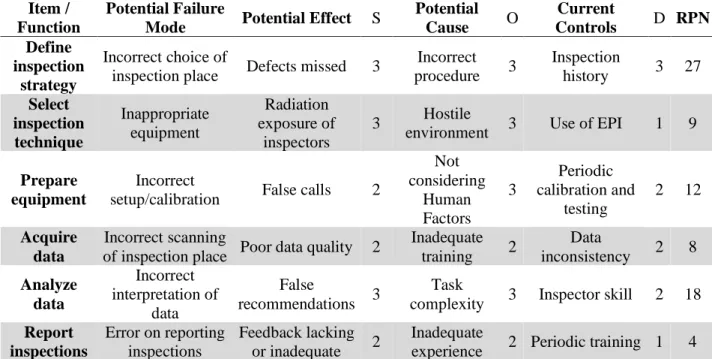
their effects, and improve NDI performance. Table 2 shows a simplified worksheet illustrating the use of FMEA for typical NDI in NPPs. Many recommended actions can be, in principle, be prioritized, taking into account the RPN values.
In this context, the following actions should be considered: use of Risk-Based Inspection approach as an alternative to prioritize inspection places and higher risks systems, improving inspection strategy [9]; organization improvemen to solve the problem of task complexity, designing the task to fit the human cognitive, physical, and time constraints [4]; increasing the automation level of inspections, to overcome some human limitations of manual inspections [5]; and cross checking of inspection results using complementary inspection techniques, reducing defects missed and false calls [5].
Table 2: Simplified FMEA worksheet for typical NDI in NPPs
Item / Function
Potential Failure
Mode Potential Effect S
Potential Cause O Current Controls D RPN Define inspection strategy Incorrect choice of
inspection place Defects missed 3
Incorrect procedure 3 Inspection history 3 27 Select inspection technique Inappropriate equipment Radiation exposure of inspectors 3 Hostile
environment 3 Use of EPI 1 9
Prepare equipment
Incorrect
setup/calibration False calls 2
Not considering Human Factors 3 Periodic calibration and testing 2 12 Acquire data Incorrect scanning
of inspection place Poor data quality 2
Inadequate training 2 Data inconsistency 2 8 Analyze data Incorrect interpretation of data False recommendations 3 Task
complexity 3 Inspector skill 2 18 Report inspections Error on reporting inspections Feedback lacking or inadequate 2 Inadequate
experience 2 Periodic training 1 4
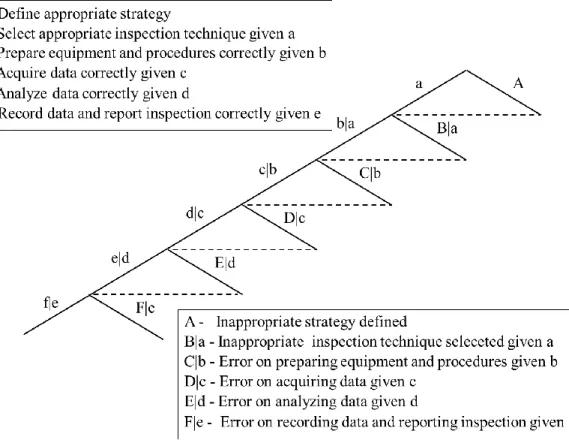
This preliminary FMEA is the starting point for building the THERP event tree shown in Fig. 2. This THERP illustrates the estimation of HEP of human subtasks and the inspection reliability, through the analysis of PSFs and human dependencies. Considering independent events and nominal HEPs (P(A) = P(B|a) = P(E|d) = 0.01, for the diagnosis tasks, and P(C|b) = P(D|c) =
P(F|c) = 0.001, for the action-oriented tasks), the inspection reliability would be calculated according to Equation 1.
P(a).P(b|a).P(c|b).P(d|c).P(e|d).P(f|c) = 0.967 (1)
This is a very optimistic estimate, comparing with results of ultrasound testing that is considered acceptable in analogous conditions (80% correct call rate and 20% false call rate, according to reference [4]). The main reason for this unconformity is that PSFs and human dependencies were not considered in estimating the HEPs in this application example. Just for illustration, if PSF multipliers of 25 for P(A), 2 for P(C|b) and 5 for P(E|d) are considered, maintaining the nominal values for the other probabilities, the inspection reliability becomes 0.703, that is a more realistic estimate.
5. CONCLUSIONS
This work analyzed how important is human factors in complex tasks, such as NDI, especially in the field of nuclear industry. An approach to assess human factors in NDI was proposed by using qualitative and quantitative studies. Prioritization of recommended actions for reducing human errors and improving NDI performance can be done by using the RPN (Risk Priority Number) provided by FMEA. The FMEA qualitative analysis is the starting point to do a quantitative analysis of human error probabilities with the THERP technique, supported by the PSFs analysis and the modeling of human dependencies. An application example, by studying alternatives to improve a typical NDI for pipe segments of an NPP core cooling system, by acting on human factors issues is presented.
The following actions among those prioritized through RPN values from FMEA, can be highlighted: the use of Risk-Based Inspection, improving inspection strategy; improving the organization to solve the problem of task complexity of NDI, designing the task to fit the human cognitive, physical, and time constraints (training, schedule, human redundancy, accessibility, usability, etc.); and increasing the automation level of inspections. The results of inspection reliability, taking into account the nominal HEPs, were very optimistic estimates, compared with acceptable values observed experimentally in analogous conditions. A more realistic estimate is also carried out taking into account the performance-shaping factors.
6. ACKNOWLEDGMENTS
The authors would like to thank the following institutions, which sponsored this work: CDTN/CNEN (Centro de Desenvolvimento de Tecnologia Nuclear/Comissão Nacional de Energia Nuclear), FINEP (Financiadora de Estudos e Projetos) and FAPEMIG (Fundação de Amparo à Pesquisa do Estado de Minas Gerais).
REFERENCES
1. BERTOVIC, M.; FAHLBRUCH, M. B.; MÜLLER, C.; PITKÄNEN, J.; RONNETEG, U.; GAAL, M.; KANZLER, D.; EWERT, U.; SCHOMBACH, D. Human factors approach to the acquisition and evaluation of NDT data, In: 18th WORLD CONFERENCE ON NONDESTRUCTIVE TESTING, 2012, Durban. Annals… Durban: South African Institute for
Non-Destructive Testing (SAINT), 2012.
2. WHITTINGHAM, R. B. The blame machine: why human error causes accidents, 1st ed. Oxford: Elsevier Butterworth-Heinemann, 2004.
3. SWAIN, A. D.; GUTTMANN, H. E. Handbook of human reliability analysis with emphasis
on nuclear power plant applications. NUREG/CR-1278, Washington: U. S. Nuclear Regulatory
Commission (USNRC), 1983.
4. HARRIS, D. H. Human performance in non-destructive inspections and functional tests.
EPRI NP-6052, Santa Barbara: Electric Power Research Institute (EPRI), 1988. 164p.
5. BERTOVIC, M. Human factors in non-destructive testing (NDT): risks and challenges of
mechanized NDT. Doctoral thesis, Technischen Universität Berlin, Berlin, Deutchland, 2016.
161p.
6. METWALLY, A. M. Analysis and modeling of human performance in nuclear power
plants. Doctoral thesis, Iowa State University, Iowa, USA, 1982. 290p.
7. BLACKMAN H. S.; GERTMAN D. I.; BORING, R. L. Human error quantification using performance-shaping factors in the SPAR-H method, In: HUMAN FACTORS AND
ERGONOMICS SOCIETY 52nd ANNUAL MEETING, 2008, New York. Annals… Santa
Monica: Human Factors and Ergonomics Society, 2008. p. 1733-1737.
8. IAEA - International Atomic Energy Agency. Improvement of in-service inspection in nuclear
power plants. IAEA TECDOC-1400, Vienna: IAEA, 2004. 38p.
9. SOARES, W. A.; VASCONCELOS, V.; RABELLO, E. G. Risk-Based Inspection in the context of nuclear power plants, In: INTERNATIONAL NUCLEAR ATLANTIC CONFERENCE, 2015, São Paulo. Annals… Rio de Janeiro: Associação Brasileira de Energia Nuclear, 2015.
![Figure 1: Model of NDI performance in nuclear power plants [1]](https://thumb-eu.123doks.com/thumbv2/123dok_br/18279831.881525/4.893.118.776.450.835/figure-model-ndi-performance-nuclear-power-plants.webp)
![Table 1: Multipliers for performance-shaping factors [3, 7]](https://thumb-eu.123doks.com/thumbv2/123dok_br/18279831.881525/6.893.84.817.323.1011/table-multipliers-performance-shaping-factors.webp)