I
ACHIEVING HOSTEL GUEST SATISFACTION: CUSTOMER
EXPERIENCE APPROACH
Alicja Pietrasz
Project submitted as partial requirement for the conferral of
MSc. in Science of Business Administration
Supervisor:
Prof. Miguel Figueiredo, ISCTE Business School
II
Spine
-ACHI EVI N G H OSTEL GU E S T SATI S F ACTI ON : C US TOME R EXPER IE NCE APP R OA C H Alicj a Pie tr as z A li cj a P iet ra sz An tó n io Au gu st o da Si lvaIII
Abstract
This thesis focuses on Tourism sector (youth hostel holiday accommodation) and it is led by the marketing strategy that has been recently adopted in most sectors as well in tourism that is Relationship Marketing.
Recently, youth travel is a growing sector, but there is still lack of studies related to it. The objective of this study is to identify the factors that build the customer experience within the Youth Hostel sector and investigate the factors that have impact on it. A theoretical framework was developed for this study. The customer experience has been defined according to the Shaw’s Customer Experience Hierarchy of Needs Theory. Following expectancy-disconfirmation theory of Oliver (1980), experiences were divided in expected and received by customer. The gap between what customer expects and receives is actually perceived as the obtained service, which is a base for customer satisfaction.
The study utilises two surveys as data collection tools. They were distributed in five European hostels and they contained questions related to the customer needs, according to Shaw’s Theory, and were divided in four groups (as layers). The data were analysed using quantitative methods.
The main practical implication of the thesis is that it provides guidelines for the hostel management, to create customer satisfaction, through improving customer experience. The results emphasize the importance of staff performance. Another finding is that the length of the stay has an important impact on the expectations of the youth travellers. People that stay longer are more involved in the hostel choice.
JEL Classification: L83, M31
IV
Abstracto
A presente tese incide sobre o setor do Turismo (alojamento de férias em pousada de juventude), sob o ponto de vista da estratégia de marketing que tem sido recentemente adotada na maior parte dos setores e também no turismo, o Marketing Relacional. Recentemente, o turismo juvenil tem-se revelado um setor em crescimento, mas ainda há alguma escassez de estudos que lhe estejam relacionados. O objectivo deste estudo é o de identificar os fatores que compõem a experiência do cliente no sector das Pousadas de Juventude e investigar o respectivo impacto. A investigadora escolheu as unidades de negócio das Pousadas de Juventude independentes como objeto da investigação. Foi desenvolvido um quadro teórico para este estudo. A experiência do cliente foi definida de acordo com a Teoria da Hierarquia de Necessidades de Experiência do Consumidor, de Shaw, e dividida em quatro componentes principais (ou níveis). Segundo a teoria da expectativa-desconfirmação de Oliver (1980), as experiências do cliente foram divididas entre esperadas e obtidas. A diferença entre o que o cliente espera e o que recebe é na realidade apercebida como o serviço obtido, o qual é uma base para a satisfação do cliente.
O estudo utiliza dois questionários como ferramentas de recolha de dados, que foram distribuídos em cinco pousadas europeias. Os questionários continham questões relacionadas com as necessidades do cliente, de acordo com a Teoria de Shaw, as quais estavam divididas por quatro grupos (referentes aos níveis de necessidade). Os dados foram analisados pela aplicação de métodos quantitativos.
A principal implicação prática desta tese é a de que ela disponibiliza linhas de orientação para a gestão das pousadas, de forma a criar satisfação no cliente, através da melhoria da respectiva experiência. Os resultados realçam a importância do desempenho do staff. Outro resultado aponta para que a duração da estadia tenha um impacto importante nas expectativas dos jovens viajantes. Os que planeiam permanecer mais tempo apresentam um maior envolvimento na escolha da pousada.
Classificação JEL: L83, M31
V
INDEX
Acknowledgements
This dissertation would not have been possible without the guidance and the help of several individuals who contributed in the preparation and completion of this study.
It gives me great pleasure in acknowledging the guidance and helpful comments of my supervisor Prof. Miguel Figueiredo, who has been my support and who helped me all along the way.
I thank my previous employer and all the staff from Goodnight Backpackers Hostel in Lisbon, for giving me a chance to familiarize with the hostel culture from the inside, from the perspective of the staff member.
I share the credit of my work with the managers of the hostels that agreed to cooperate and being involved in the research essential for this study. Also I am indebted to my many staff members of the hostels who supported me by distributing my research surveys among the hostel guests, thus collecting data. Without their kindness and help this thesis would not have been finished.
I want to thank especially to all the Backpackers and Travelers for the wonderful culture that is being created and for the inspiration for this Master Thesis.
Finally, I am grateful to my parents, who were supporting any decision I made, without complete understanding what writing a thesis is. I am so lucky to have them by my side.
VI
Executive Summary
With the increasing competitiveness in the markets, and the need for differentiation and having unique competitive advantages, companies turn to themselves in an effort to improve the quality of the products and/or service provided.
In the last years, youth travelling has become a very significant industry; however this sector was omitted in the research about the tourism product, called destination product. The nature of youth tourism sector is different, especially the hospitality part that is an element of the destination product and a main focus of this thesis.
New trend observed, especially in service sector (that includes tourism and hospitality) is Relationship Marketing, that besides providing high service quality, refers to delivering a
unique experience to the clients. This thesis investigates what experiences create customer
satisfaction within youth holiday hostels sector.
Findings are emphasizing the significance of the attitude and behavior of the members of the hostel staff. All the needs of experience (adopted from The Hierarchy of needs of Shaw) that had major value for the surveyed hostel guests were related to the employees. The conceptual
framework developed for this research bases on the expectancy-disconfirmation theory
(Lewin, 1938; Oliver, 1980), therefore focuses on the differences between customer expectations and his perception about the received service.
The most important factors influencing customers experience within hostel sector were identified. The result pointed overall Staff-care as the variable that impacts customer satisfaction most significantly. Thus focusing on improvement staff care can benefit in general assessment of the hostel service. Investing in trainings and motivating the staff is crucial for the managers of the holiday hostel accommodation for youth travelers.
Another important finding is that the length of the stay has significant impact on the customer satisfaction, via the impact on the expectations, thus the managers should focus on providing best service quality from the first contact between guest and hostel. Guests should experience highest quality of service, no matter if they stay for a short or for a long time.
VII
List of Figures
Fig. 1: Marketing Mix for the Service Sector ... 7
Fig. 2: The marketing Strategy Continuum: Some Implications ... 10
Fig. 3: Oh’s model of service quality, customer value, and customer satisfaction ... 11
Fig. 4: Model of Relationship Marketing Drivers and Outcomes ... 12
Fig. 5: ACSI Framework for Customer Loyalty ... 16
Fig. 6: Determinants of Perceived Service Quality ... 17
Fig. 7: Customer Experience Hierarchy of Needs ... 19
VIII
Table of Contents
Abstract ... III INDEX ... V Acknowledgments ... V Executive Summary ... VI List of Figures ... VII Table of Contents ... VIIIChapter 1: Introduction... 1
1.1.Background to the Study ... 1
1.2.Research Aims and Objectives ... 1
1.3.Research Outline ... 2
1.4.Research Disposal ... 2
Chapter 2: Literature Review ... 3
2.1. Tourism and Travel Market ... 3
2.1.1. Tourism Sector, Destination Experience and Tourism Product Overview ... 3
2.1.2. Youth Travel Market Growth ... 5
2.1.3. Youth Hostels ... 6
2.2. Marketing, Customer Experience and Related Concepts Literature ... 7
2.2.1. Service Marketing Mix ... 7
2.2.2. Relationship Marketing Concept ... 8
2.2.2a. Relationship Marketing Defined ... 8
2.2.2b.Transaction Marketing vs. Relationship Marketing ... 9
2.2.2c. Relationship Marketing Drivers Models ... 10
2.2.2d. Relationship Marketing Key Drivers ... 12
2.2.3. Customer Satisfaction ... 12
2.2.4. Service Quality ... 14
2.2.5. Relationship between Customer Satisfaction and Service Quality ... 15
2.2.6. Customer Experience ... 17
2.3. Studies on Drivers for Customer Satisfaction in Tourism Industry ... 20
IX
2.3.2. Service Quality in Tourism ... 20
2.3.3. Customer Experience in Tourism ... 21
2.4. Defining Working Concept and Conceptual Framework ... 23
Chapter 3: Research Methodology ... 24
3.1. Research Purpose ... 24
3.1.1. Exploratory Research ... 24
3.1.2. Descriptive Research ... 24
3.1.3. Explanatory Research ... 25
3.1.4. Research Purpose Defined ... 25
3.2. Research Approach ... 26
3.2.1. Qualitative vs. Quantitative ... 26
3.2.2. Defining Research Approach ... 27
3.3. Data Collection – Surveys ... 27
Chapter Four: Data Analysis and Interpretation. Research Findings ... 29
4.1. Research Question 1 ... 29
4.2. Research Question 2 ... 33
4.3. Research Question 3 ... 35
4.4. Research Question 4 ... 36
Chapter Five: Discussions and Conclusions ... 37
5.1. Conclusions ... 37 5.2. Practical Indications ... 40 5.3. Research Limitations ... 41 Bibliography ... 42 Appendices ... 46 Appendix 1: Survey 1 ... 46 Appendix 2: Survey 2 ... 49
Appendix 3: Excel Output – Standard Deviations for Each Question and the Means ... 51
Appendix 4: Cronbach's Alpha Test for the Survey 1 ... 53
Appendix 5: SPSS Output Factor Analysis (Survey 1) ... 54
Appendix 6: Excel Output-Standard Deviations ... 58
Appendix 7: SPSS Output: Cronbach's Alpha Test for new Factors (set of variables ... 60
X Appendix 9: SPSS Output – Kruskal-Wallis Test for Survey 1: Hostel as the Independent variable ... 65 Appendix 10: SPSS Output – Kruskal-Wallis Test for Survey 2: Hostel as the Independent variable ... 66 Appendix 11: SPSS Output – Kruskal-Wallis Test for Survey 1: Nationality as an independent variable. ... 67 Appendix 12: SPSS Output – Kruskal-Wallis Test for Survey 1: Travelling alone, with family or friends as an independent variable ... 68 Appendix 13: SPSS Output – Kruskal-Wallis Test for Survey 1: Length of the stay as the independent variable ... 69 Appendix 14: SPSS Output - Kruskal Wallis Test: People that chose hostel first or another time as the independent variable ... 78 Appendix 15: List of the Hostels ... 79
1 Chapter 1: Introduction
1.1. Background to the Study
This diploma thesis investigates what experiences create customer satisfaction within youth holiday hostels sector.
A key strategy that has been recently adopted in the Tourism Industry is creating long-term relationship with customers, building their loyalty and achieving satisfaction. Relationship marketing literature claims that customer satisfaction is essential in order to succeed for any product or service provider. Many studies on achieving customer satisfaction were made. They mostly result in describing the factors that have impact on satisfaction as well as the importance of building customer satisfaction related to its outcomes. Most of the researchers studying customer satisfaction focus on service quality and customer satisfaction measurement (e.g. Berry; 1991).
“Holbrook and Hirschmann (1982) first theorized that consumption has experiential aspect”. Later the studies on creating pleasant and memorable experiences for customers started to appear (Pine II & Gilmore, 1999; Schmitt, 1999; Shaw, 2005). Researchers agreed that creating a memorable experience is necessary to build relations with the customers, obtain their satisfaction and loyalty.
Customer experience literature is mainly limited to the description of the nature of customer experience and the operational tools and techniques related to it. It is not well defined how experience impact customer satisfaction. It is not clear while measuring customer satisfaction which elements build real experience for the customers and which are the part of the basic satisfaction with the service. There is also not much of the study about how the organizations can improve the customer satisfaction by improving specifically their customer experiences. Thus the objective of this study is to identify the factors that build the customer experience within the Youth Hostel sector and investigate the factors that have impact on it.
1.2. Research Aims and Objectives
The overall aim of this research is to identify the major determinants of building customer satisfaction through creating customer experience in Youth Hostels.
2 Objectives:
1. Analyze the impact of Shaw’s Layers of Needs in customer satisfaction.
2. Observe which independent variables have significant influence in customer expectations and experiences within the hostel sector.
Research Questions:
1. Which customer needs of experience are the most important determinants for achieving customer satisfaction?
2. How does the experienced service result different from the expectations? 3. Does the customer expectations and received service differ between hostels?
4. What are the independent variables that influence customer expectations within the hostel sector?
1.3. Research Outline
In order to define drivers for customer satisfaction within hostel sector the conceptual framework based on Relationship Marketing Frameworks, combined with Customer Experience Needs Theory of Shaw (2005) was developed. Based on the existing theory and research a set of questions was developed in order to investigate the experience and satisfaction of hostel guests. Questions were divided into four groups, considering the Experience Layers of Shaw’s Pyramid. Surveys were distributed in five selected hostels in Europe. The research purpose is descriptive and the approach is quantitative.
1.4. Research Disposal
The structure of this thesis is consistent with determined objectives, developed framework and research methodology. It is composed of 6 chapters.
Chapter 1 presents an overall view of this study. It addresses the research background, the problem, the purpose and objectives of the work. Further this chapter presents what kind of methodology will be used.
Chapter 2 provides a theoretical background on the topics studied. It introduces the overview of tourism sector and tourism product. Next describes the relationship marketing theory as a base for the study and the literature review of the related concepts in particular customer loyalty, customer satisfaction, service quality and customer experience and its alignment to
3 the tourism. The chapter ends with presentation of the developed for the study conceptual framework.
Chapter 3 starts with a description of different research methodologies. Next there is an explanation of the reasons for using chosen methodology.
Chapter 4 presents a data analysis. It concludes with providing the main findings of the research analysis as the answers for the research questions.
Chapter 5 contains main conclusions of the master thesis, related to the objectives, practical implications and recommendations for hostel managers. Next, the research limitations are described.
The last part of the thesis presents all the sources of information that were used for creating this work as well as appendices.
Chapter 2: Literature Review
2.1.Tourism and Travel Market Overview
2.1.1. Tourism Sector, Destination Experience and Tourism Product Overview
“He that travels in theory has no inconveniences.” –Samuel Johnson
In the twenty-first century world tourism industry keeps growing. United Nations World Tourism Organization (UNWTO) ranks the export income generated international tourism as fourth among the world industries.
This research focuses on tourism topics thus the term tourism is necessary to explain. Existing literature presents variety of definitions for this term. Therefore “UNWTO created an officially accepted one:
"Tourism comprises the activities of persons traveling to and staying in places outside their usual environment for not more than one consecutive year for leisure, business and other purposes (Cooper, Fletcher, Gilbert, Fyall, and Wanhill, 2008)””.
4 The fundamental product in Tourism is the destination experience and thus major part of the competition is focused on destination. “Stickdorn and Zehrer (2009) listed the significant components of the tourism destination that most of the researchers agreed with:
Accessibility: a function of distance from tourist markets, an external transport and communications, which enable a product to be reached;
Amenities (e.g. catering, entertainment, communications which enables tourists to move around during their stay);
Accommodation;
Attractions: stay (natural wonders, scenic) or event attractions (e.g. exhibitions, sporting events);
Activities (e.g. indoor and outdoor recreation activities).” “The UNWTO (2002) defines a local destination as:
“Physical space that includes tourism products such as support services and attraction, and
tourism resource. It has physical and administrative boundaries defining its management, and images and perceptions defining its market competitiveness””.
In tourism product is called destination product and it is presented as a bundle of elements such as transportation, accommodation, and entertainment. “In the tourism sector the source for the competition is the construction of services aiming to create memorable and satisfying customer experiences (Zabkar, Brenc and Dmitrovic, 2010)”.
The tourism product has a specific nature, where large part of it are the interpersonal relationships, for instance the performance level of the staff, is directly associated with the satisfaction and the overall experience of the customer.
The tourist satisfaction, service quality, its measure methods and tourist experience – the components necessary to achieve destination loyalty will be described in the next chapters. For this study tourism product perception would be narrowed to the accommodation or hospitality service.
5 “Oxford dictionary (2004) states that:
“Hospitality is the friendly and generous reception and entertainment of guests, visitors, or strangers””.
2.1.2. Youth Travel Market Growth
“According to the World Tourism Organization Youth Travel Matters – Understanding the
Global Phenomenon of Youth Travel Report (WTO, 2008), “the youth travel is becoming very
significant industry”. The report emphasizes how important is becoming to be a youth travelers market. We can find there many figures proving that, e.g.:”youth travel would account for over 20% of international tourist arrivals (of the estimated 160 million international tourist arrivals a year). The youth travel market is worth an estimated US$ 136 billion a year, or around 18% of worldwide international tourism receipts”. Authors claim that “due to longer average trip duration, a typical youth traveler spends more than the average tourist during his/her trip””.
The market of all the services and products intended for youth travelers is expanding. It includes the market of accommodation suppliers especially Youth Hostels. There are thousands Backpackers Mansions opened every year.
Here it is necessary to explain the terms “backpacker” and “backpacking”. Backpacking is related to the way of travelling usually associated with budget, independent, focused on change and experience gained as a result of the travel. The term Backpacker is a subject of analysis Association of Tourism and Leisure Education and Backpacker Research Group. According to both, the term “backpacker” has been used in the general travel literature since the 1970s, but in academic appeared first time in 1990, used by Pearce (Richards and Wilson, 2004). No formal definition of backpacker and backpacking exists.
“According to Pearce (1990) “backpackers are primarily defined by the preferences for: budget accommodations, social interactions with some other travelers, independence and flexibility in their plans, preference for longer rather than brief holidays, and significance on holidays that are informal and participatory””. Currently the most popular sources of information about backpacking are blogs and internet forums. “Backpackers cannot be assigned to any framework, because it is culture of the independence and avoiding too much of planning. These kinds of travelers usually choose so called Youth Hostels as the
6 accommodation while traveling, in order to meet other backpackers and make the plans for the next travels (Pearce, 1990)”.
2.1.3. Youth Hostels
In 1912 Richard Schirrmann opened the first youth hostel (Jugendherberge) in Germany aimed at serving the needs of poor young city dwellers that were willing to go on holidays. Later this term started to be used to describe the accommodation for the homeless people. Nowadays the meaning of a youth hostel has changed completely. However in some countries hostel is still perceived as a homeless or drug addicts accommodations. “In the sector of tourism it is considered as a place that provides cheap accommodation, aimed mainly at young (Oxford dictionary, 2004)”. As so called Youth Hostel doesn’t have one definition, most of the web portals about youth travelers and “backpackers” agree about some characteristics of it:
low-budget place
offering temporary accommodation
place that accommodates guests at both lower and higher standard
different to a hotel in terms of the number of places in rooms and the sharing of equipment and space with other guests (e.g. a shared kitchen, common room, bathrooms)
For many young travelers these characteristics are not enough. There are difficulties in finding the definition of the hostel, as well as the necessary features of it and the characteristics of the backpackers in official existing publications. The reason for this is that some time ago youth travel market was omitted.
Travel blogs contain information about what is most important for the travelers. Most of the Young Travelers argue that hostel is characterized by much more than what was listed before. They argue that the integral parts of it are for instance:
Hostel atmosphere: less official and more homely, easygoing
Having common room for the guests, where a backpacker can meet new friends and are able to share their experiences
Hospitality
7
Friendly and helpful staff
These elements are not always present, but they are part of a youth traveler experience. 2.2. Marketing, Customer Experience and Related Concepts Literature
2.2.1. Marketing Mix for the Service Sector (Extended Marketing Mix) 7P Theory Concept
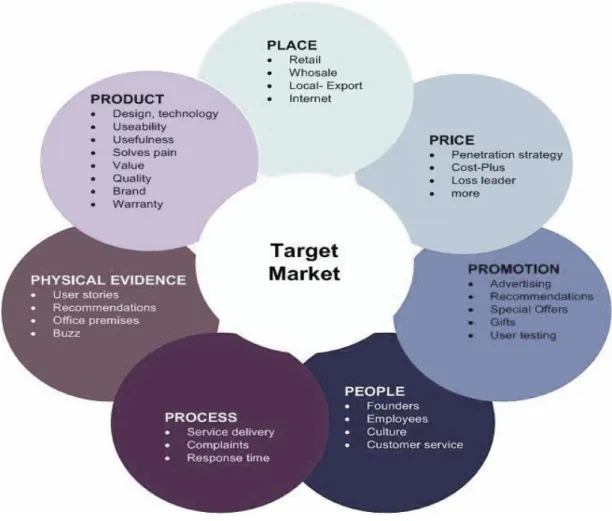
Since tourism marketing is within the service sector, hostel managers often build their marketing strategies using the 7P Marketing mix model. “The service marketing mix comprises of Product, Price, Place, Promotion, so basic marketing elements, plus as a service is not tangible it has three additional elements: People, Process and Physical Evidence Booms and Bitner, (1981: 47-51)”.
Fig. 1: Marketing Mix for the Service Sector.
8 2.2.2. Relationship Marketing Concept
2.2.2a. Relationship Marketing Defined
Customer Satisfaction is a central concern of the relationship marketing theories. Globalization and growing importance of customer retention and customer relationship economies forced the change on mainstream marketing form traditional marketing mix or transactional marketing towards relationship marketing. Relationship marketing is a strategy designed to foster customer satisfaction, loyalty, interaction and long-term engagement. “The first to use the term relationship marketing in the literature was Leonard Berry. He defined relationship marketing as “a strategy to attract main, and enhance customer
relationships (Berry, 1983:25)””. For other researchers relationship marketing is the idea of
market oriented activities, focused on long-lasting relationships with individual customers (e.g. Doyle and Roth, 1992 and O’Neal, 1989). “More broad view defining relationship marketing as “aligning marketing, customer service and quality, with an emphasis on a focus
on customer retention, an orientation on product benefit, a long time-scale, a high customer service orientation, a high customer commitment and a high customer contact as well as on the notion that quality is the concern of all” is presented by Christopher, Payne and Ballatyne
(1991)””.
As this study is related to the marketing more in the service sector the definitions of the researchers within this field are presented below:
“Marketing is to establish, maintain and enhance relationships with the customers and other
partners, at a profit, so that the objectives of the parties involved are met. This is achieved by a mutual exchange and fulfillment of promises” (Grönroos, 1990: 138)””.
“Parvatiyar, Sheth and Kellstadt (1999) claim:
“Relationship marketing is the ongoing process of engaging in cooperative and collaborative
activities and programs with immediate and end-user customers to create or enhance mutual economic value, at reduced cost”.
9 “The general purpose of relationship marketing is to improve marketing performance and
create mutual values for the parties involved in the relationship by increasing marketing effectiveness and/or improving efficiencies””.
2.2.2b. Transaction Marketing vs. Relationship Marketing
During the last few years there has been a growing interest in studying the economics of long-lasting customer relationships. Companies are slowly shifting from the traditional marketing approach called transactional marketing. The main idea of this approach is: ‘The more customers, the more profit’. Profit is maximized by acquiring more and more customers. It is a volume market. The goal and end of marketing activities is to sell. Companies invest more in product development, the quality improvements and promotion. Businesses are focused on increasing sells and market share, compete by exceeding competitors offer. This approach evolved in the era of mass marketing. It suited very well, but nowadays customers are becoming more and more demanding. Competing with the price (mass marketing pricing) not always works. Relationship marketing is a new trend – characterized by customer centricity. “Kotler (1992) in his article refers that companies have to move from a short-term transaction-oriented goal to a long-term relationship-building goal””. Several studies have been made, that confirm the maintenance of the customers is few times cheaper than acquiring new ones (Rosenberg and Czepiel, 1984). “Relationship marketing refers to all marketing activities directed toward establishing, developing, and maintaining successful relational exchanges (Morgan and Hunt, 1994: 22)”. “Grönroos claims “A company pursuing
relationship marketing strategy creates more value for its customers than that which is provided by the core product alone. Thus relationship marketing makes customers less sensitive to price changes. For the firm most important contacts with the customer are these outside the marketing mix and the marketing specialists in order to achieve marketing success. “What determines whether customer will continue keeping contact with the company is the customer’s contacts with employees, technology, systems of operations and other non-marketing functions” (Grönroos, 1994: 10)””. Customer-oriented approach is based on
determining what the target group of customers wants and then maximizing that group’s satisfaction with a product or service. In order to succeed firm has to listen to their customers’ needs.
10 Fig.2: The marketing Strategy Continuum: Some Implications.
The Strategy Continuum Transaction Marketing Relationship Marketing
Time perspective Short-term focus Long-term focus
Dominating marketing function Marketing Mix Interactive marketing (supported by marketing mix activities)
Price elasticity Customers tend to be more sensitive to price
Customers tend to be less sensitive to price
Dominating quality dimension Quality of output (technical quality dimension) is dominating
Quality of interactions (functional quality dimension) grows in importance and may become
dominating Measurement of customer
satisfaction
Monitoring market share (indirect approach)
Managing the customer base (direct approach)
Customer information system Ad hoc customer satisfaction surveys
Real-time customer feedback system
Interdependency between marketing, operations and
personnel
Interface of no or limited strategic importance
Interface of substantial strategic importance
The role of internal marketing Internal marketing of no or limited importance to success
Internal marketing of substantial strategic importance to success The production continuum Consumer packed goods Consumer durable Industrial goods Services Source: Grönroos, 1990
2.2.2c. Relationship Marketing Drivers Models
H. Oh (1999) proposed a model in which service quality, perceived price, customer value and perceptions of the company performance are determinants of the customer satisfaction, which has an influence on customer revisit intention (Fig. 3).
11 Fig. 3: Oh’s model of service quality, customer value, and customer satisfaction.
Source: Oh, 1999
“According to Oh “the results of actual and perceived price difference impact customer will to repurchase and to have communication intention of the word of mouth (Oh, 1999)””. He doesn’t consider expectations as a variable significant to develop customer loyalty. Oh sees the perceptions, value, satisfaction as the drivers for repurchase intention (we can say loyalty) and all together as a base for word of mouth intention.
Henning-Thruau, Gwinner and Gremler (2002) proposed an integrative model of the determinants of Key Relationship Marketing Outcomes. In this model they included most popular determinants that appear in the literature. Three types of benefits: Confidence Benefits (trust), Special Treatment Benefits and Social Benefits focused on relationships as a part of the service quality perception. These are the drivers for Commitment and Satisfaction, based on Customer experience that supposed to lead to the Customer Loyalty and Word-of-Mouth that give profits.
12 Fig. 4: Model of Relationship Marketing Drivers and Outcomes.
Source: Hennig-Thruau et al., 2002
Researchers set some hypothesis to investigate if all of the theoretical determinants for customers’ loyalty and word of mouth have a real impact on them in service providers sector. “The results showed that what have significant direct impacts on loyalty are: satisfaction, commitment, confidence benefits/trust and social benefits. Satisfaction is the leading construct. For the use of word of mouth as well the customer satisfaction was the main determinant (Hennig-Thruau et al., 2002)”.
2.2.2d. Relationship Marketing Key Drivers
Researchers agreed that relationship marketing leads to customer retention. Recently the tourism and hospitality literature presents growing interest in relations between the customer satisfaction, service quality, experience, customer loyalty and word of mouth.
In this chapter the key drivers for building the loyal customers will be presented, based on existing literature. Then they will be applied to the tourism and hospitality industry.
2.2.3. Customer Satisfaction
“Relationship marketing starts from building customer satisfaction. Higher customer satisfaction results in faster market share growth, better company performance (due to possibility of raising the prices) and increase in customer loyalty (Fornell, 1992; Hennig-Thruau et al., 2002; Vavra, 2002)”. It leads to repurchase intentions and positive word of
13 mouth (e.g. Holjevac, Marković and Raspor, 2000; Oh and Parks, 1997). By most of the businesses customer satisfaction is being considered as a basic goal because of the old rule: ‘the more a customer is satisfied, the more he is willing to buy’.
Fornell et al. (1996) recognized positive influence of the perceived value and customer satisfaction.
In order to succeed, the main concern of every organization should be to satisfy the customers, meet their needs and expectations, and build relations with them by delivering better service and unique experience.
Most of the relationship marketing literature mentions the price, perceptions, expectations, service quality, and customer satisfaction as most common drivers for the intention to repurchase or customer loyalty and the word of mouth communication behaviors.
Customer satisfaction was an interest of many researchers. The most common concept of the customer satisfaction is based on expectancy-disconfirmation theory of Lewin (1938), developed by Oliver (1980). According to them “the satisfaction level is a result of the differences between expected and perceived performance. If perceived performance exceeds a consumer’s expectations (a positive disconfirmation) the satisfaction of the consumer appears, but if perceived performance is worse that customer expectations (a negative disconfirmation) then he is dissatisfied (Lewin, 1938, Oliver, 1980)”.
“Expectations are the needs or desires of the customer, what he feels that should be delivered by the provider of the service, product before receiving it (Millan, 2004)”. Kotler, Keller and Burns (2006) point out those expectations are the only variables that have an impact on customer satisfaction from the purchase. “Anderson, Fornell and Lehmann (1994) agreed that customer satisfaction can be defined as overall evaluation based on the total purchase and consumption experience with a good or service over time. It is influenced by overall quality, price and disconfirmation or expectations”.
“Vavra (2002) presents the following definition of the customer satisfaction:
“Satisfaction is a customer’s emotional response to his or her evaluation of the perceived discrepancy between his or her prior experience with expectations of our product and organization and the actual experience performance as perceived after interacting with organization and consuming our product””.
14 Satisfaction can be determined by subjective, e.g. customer needs, emotions, expectations and objective factors, e.g. product and service features. “Holjevac, Marković and Raspor (2000) as well as most of the researchers agreed that customer satisfaction in a service sector is concerned with:
- the service functionality (perceived customer service quality) - subjective customer experience”.
In conclusion relationship marketing seeks to satisfy the customers. In order to build satisfaction a firm needs to deliver good service quality and create a memorable experience. 2.2.4. Service Quality
Service quality is a multi-dimensional and abstract concept. It is generally agreed that customer satisfaction is a broader term than service quality. Both have been identified as key factors for every business success, customer retention (Holjevac et al., 2000) and differentiation marketing strategy (Grönroos, 1990; Parasuraman, Zeithaml and Berry, 1988) Different researchers define service quality using different factors. “For LeBlanc (1992) there are corporate image, competitiveness, courtesy, responsiveness, accessibility and competence”. “For Grönroos (2000) it is the professionalism and skills, attitudes and behavior, accessibility and flexibility, reliability and trustworthiness, service recovery, reputation and credibility and atmosphere”.
“Parasuraman, Zeithaml and Berry (1985) described perceived service quality as a gap, the difference between consumers’ expectations and perceptions”. The measurement of service quality is based on both on how consumer evaluates the service delivery process and the outcome of the service. “A good service quality is considered as one which meets or exceeds consumer’s expectation of the service (Parasuraman et al., 1985: 46)”.
Researchers gathered the criteria for evaluating service quality. Ten key categories were identified which they called "Service Quality Determinants", similar to every service sector consumers, identified by Parasuraman et al. (1985, 1988):
1. Tangibles - Appearance of physical facilities, equipment, personnel, and communication materials.
15
3. Responsiveness - Willingness to help customers and provide prompt service.
4. Competence - Possession of the required skills and knowledge to perform the service. 5. Courtesy - Politeness, respect, consideration, and friendliness of contact personnel.
6. Credibility - Trustworthiness, believability, honesty of the service provider.
7. Security - Freedom from danger, risk or doubt.
8. Access - Approachability and ease of contact.
9. Communication - Keeping customers informed in language they can understand and listening to them.
10. Understanding the customer - Making the effort to know customers and their needs. Based on Parasuraman et al. (1985) model for measuring the quality of service by use of customer perception of it, “Gronroos (1984) proposed that customers compare their expectations to their experience of service quality in forming judgments. The author defined service quality as:
“the perceived quality of a given service will be the outcome of an evaluation process, where the consumer compares his expectations with the service he perceives he has received, i.e. he puts the perceived service against the expected service. The result of this process will be the perceived quality of the service (Grönroos, 1984: 37)””.
2.2.5. Relationship between Customer Satisfaction and Service Quality
As mentioned before high service quality has a positive impact on customer satisfaction. Service quality is used to measure customer satisfaction by many researchers.
A common measure for the service quality is American Customer Satisfaction Index ACSI that is based on six elements with customer satisfaction as a central construct, customer expectations, perceived quality and perceived value as the ascendants and two outcomes: customer loyalty and customer complaint behavior. Survey of ACSI is made of 15 indicators, ranked on 1 to 10 point scale (Fornell et al., 1996).
16 Fig. 5: ACSI Framework for Customer Loyalty.
Another and the most widely applied model in service industry that measure customer satisfaction by service quality is SERVQUAL, developed by Parasuraman, Zeithaml and Berry (1988). The model indicates that service quality contains five dimensions: reliability, responsiveness, assurance, empathy, and tangibles. “Tangible dimension is related to physical facilities, reliability is how accurately the firm performs promised service, empathy is being able to recognize customer’s emotional state about the service and paying individual attention to each customer, assurance is related to knowledge and ability to build trust of the employees (Gandhi and Singh Kang, 2009)”. These dimensions present how customers organize information about the quality of service in their minds. A degree of agreement or disagreement with an item is rated on the seven-point Likert scale. The results are being identified as positive or negative gaps. “The difference between perceptions and expectations scores measures each gap that indicates the level of customer satisfaction. Positive result means that perceived service meets or exceeds expected and therefore a service quality occurs (Parasuraman et al., 1988)”.
17 Fig. 6: Determinants of Perceived Service Quality.
Source: Parasuraman, et al., 1988
2.2.6. Customer Experience
Observed during the recent years, the economic, social and technological changes significantly influenced the thinking of nowadays customers. The New Generation we can call Experience Generation and it requires from the companies to focus on all the sensations experienced by the client that has contact with the company. Researchers emphasize that creating total memorable experience is extremely important in building customer satisfaction and loyalty. Delivered experience can help with creating competitive advantage for each company.
The literature in marketing hasn’t considered customer experience as a separate construct. Researchers have focused instead on studying the methods to measure service quality and customer satisfaction (e.g. Parasuraman, Berry). “Holbrook and Hirschmann (1982) theorized that consumption has experiential aspect”. “Schmitt (1999) has explored how companies create experiential marketing by having customers sense, feel, think, act and relate to a company and its brands”.
18 “According to Shaw “A Customer Experience is an interaction between an organization and
a customer. It is a blend of an organization’s physical performance, the senses stimulated, and emotions evoked, each intuitively measured against Customer Expectations across all moments of contact”. Shaw claims that “only physical or emotional aspects are not enough,
both must exist together and customers will compare then with their previous expectations at every moment they live with the company (Shaw, 2005: 51)””.
We can observe the relation of Shaw’s theory to the theory of Parasuraman model as we as the theory about Expectations and Perceived Performance of Oliver (1980).
“Schmitt (1999: 60) claims “Experiences are private events that occur in response to some
stimulation””. Stimulation must be made by companies in order to create those experiences to
customers.
“According also to Pine and Gilmore “An Experience occurs when a company intentionally
uses services as a stage and goods as props, to engage individual customers in a way that creates a memorable event”. They claim that “clients generally value the benefits of services more highly than the goods required to provide them (Pine and Gilmore, 1999) “”
““Customer Experience is the internal and subjective response customers have to any direct
or indirect contact with a company. Direct contact generally occurs in the course of purchase, use, and service and is usually initiated by the customer. Indirect contact most often involves unplanned encounters with representatives of a company’s products, service or brands and takes the form of word-of-mouth recommendations or criticisms, advertising, news reports, reviews and so forth” (Meyer and Schwager 2007: 118)”.
“Grönroos (1984), Berry and Seltman (2007) claim the customer experience as a way to build the quality of services and customer satisfaction and loyalty”. “According to Grönroos total customer experience drivers can be divided for technical and functional and according to Berry for mechanical, functional and human clues”.
“Another view on Customer Experience presents Shaw who refers that ”…in order to build
experience the needs of the customer have to be satisfied in the hierarchy…(Shaw, 2005)””.
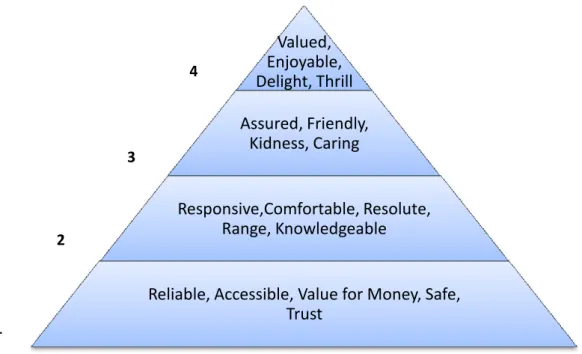
Model is similar to Maslow’s Pyramid, where first basic needs have to be satisfied, and then people start to think about more needs to be satisfied. However Shaw relates satisfaction to the meeting needs of higher layer and no dissatisfaction to the meeting needs of the lower level. From this point of view his theory is similar to Herzberg’s theory of motivation
19 (motivation factors can be compared to the needs). He didn’t agree with the hierarchy theories (e.g. Maslow’s). “Herzberg introduced two-dimensional theory of motivation, where each dimension is comprised of two distinct factors. The first dimension of factors is called
hygienes or dissatisfiers that can lead to dissatisfaction when not sufficiently present, but they
don’t raise motivation. The second dimension is represented by motivators which present can raise the motivation and satisfaction (Thomson, 1996: 13)”.
Shaw presents Customer Experience Hierarchy of Needs (Fig. 7). Shaw’s pyramid consists of the basic needs the people want to have before moving up in the hierarchy. First two levels from the bottom are quite common in all industries and all companies should provide all the elements. However what differentiate customers, build experience are the two higher layers, that consist of the elements related to customer emotions.
Fig. 7: Customer Experience Hierarchy of Needs.
Source: Shaw, 2005 Valued, Enjoyable, Delight, Thrill Assured, Friendly, Kidness, Caring Responsive,Comfortable, Resolute, Range, Knowledgeable
Reliable, Accessible, Value for Money, Safe, Trust
4
3
2
20 2.3. Studies on drivers for Customer Satisfaction in Tourism Industry
2.3.1. Customer Satisfaction in Tourism
Tourism is a service-intensive industry that is dependent on the quality of customer service and customers’ experiences as well as their consequent assessments of satisfaction or dissatisfaction.
Satisfaction has become a main focus of tourist’s behavior, because it is a determinant of tourist revisiting. “Oliver claims that tourist satisfaction can be seen as “…a tourist’s
post-purchase evaluation of the destination… (Oliver, 1981)””. “Baker and Crompton claim
satisfaction in relation to tourism is defined as “…the tourist’s emotional state after
experiencing the trip… (Baker and Crompton, 2000)””.
Satisfaction is strongly connected with tourist’s experience. It can be used to evaluate the products and services quality offered at the destination.
Tourism researchers have used different views and models in order to examine tourist satisfaction. Most popular models are:
- Expectancy-disconfirmation model of Oliver (1980), Oh and Parks (1997) - Equity model of Oliver and Swan (1989).
There are developed some less known models of tourist satisfaction as well e.g. assimilation or cognitive dissonance, contrast, attribution, comparisation (Oh and Parks, 1997). This research will be based on the Expectancy-disconfirmation theory of Oliver (1980). ”Very popular is SERVQAL Model based on service quality dimensions that was used in a range of research in tourism and hospitality service for many countries or regions as well as hotels, restaurants, historic houses, travel agencies, health spas, diving, tourism and hospitality higher education units (Holejevac et al., 2003)”.
2.3.2. Service Quality in Tourism
Tourism Industry is very sensitive to quality issues. People go on holidays in order to rest from the everyday life problems and they expect certain level of the quality related to the price, expectations, and perceptions. Competition in this industry must be driven by strategies focusing on quality of service to add value, as opposed to product or price differentiation. “The World Tourism Organization (WTO, 2003) has defined the quality in tourism as
21
"the result of a process which implies the satisfaction of all the legitimate product and service needs, requirements and expectations of the consumer, at an acceptable price, in conformity with mutually accepted contractual conditions and the underlying quality determinants such as safety and security, hygiene, accessibility, transparency, authenticity and harmony of the tourism activity concerned with its human and natural environment"”.
“According to Grönroos (1984), services in tourism have two quality dimensions. These dimensions are related to the way that customers perceive a given service:
1. Technical which concerns what tourists get at the destination, the technical outcome of the process
2. Functional referring to the manner the customers receive services. Grönroos calls it the ‘expressive performance of a service’”.
In the context of services, functional quality is generally perceived to be more important than technical quality. However the service must be provided at a technically satisfactory level. “Grönroos claims “Experience is a product of a technical and functional quality, which is
filtered through the image (Grönroos, 1984)””. Functional quality dimension can be perceived
in a very subjective manner. Grönroos model has more practical application as it shows factors that contribute to each side of the perception gap. It shows that by managing customer expectations the service provider has an impact on both sides of the gap. In addition it illustrates that the customer experience is a product of the image of delivered quality of the supplier, not just the actuality. Therefore marketing can influence the perception gap (Grönroos, 1984).
2.3.3. Customer Experience in Tourism
The tourism experience extends beyond the offered service. In this sector the construction of services aiming to create memorable and satisfying customer experiences.
Many researchers were trying to build the definition of the tourist experience. Experiences are often defined as being within the person who is engaged with the event on an emotional, physical, spiritual or intellectual level and is left with a memorable impression. An occurrence of the experience requires customer participation and connection. (Pine and Gilmore, 1999) “Accommodation is a part of the tourism product (Middleton and Clarke, 2001)”. Tourism is an experience industry thus destination managers have to deliver experience in order to
22 achieve tourist satisfaction. Best practice accommodation providers acknowledge this and show compassion, understanding and try to create an exceptional tourism experience. In order to be successful service provides need to know customer expectations, what do they value most, when they are satisfied. The need to specify customer touch points and make an improvement in these areas.
“Boswijk et al. (2005) refers that the approach to building experience should include: thinking about the things from the perspective of the individual then creating and delivering enjoyable and memorable experiences for them, treating every customer as a guest and create the culture of hospitality in every business, showing respect and breaking through pre-existing notions and changing paradigms to solve problems for the individuals”.
“A tourist experience consists of certain touch points: indirect (starting before the journey – e.g. websites, reviews, that build expectations) and direct that take place at the destination. (Stickdorm and Zehrer, 2009)”.
Stickdorm and Zehrer presented the Assessed Customer Journey Model based on disconfirmation paradigm of customer satisfaction. According to their research “Expectations (pre-service phase; hotel website and hotel rating website) have an impact on experiences (several single touch points at the destination) that influence an overall satisfaction (post-service phase; word of mouth, hotel ranking) (Stickdorm and Zehrer, 2009)”.
The tourism experience concept is prevalent in tourism literature. The main characteristics of the tourist experience, deducted from the exiting literature are as follow:
Elements that can impact experience, literature divides mainly into three categories: physical aspects, social aspects and products/services. “Physical aspects are natural or human-made attractions, geographical features etc, social aspects based on interactions with people at the destination (locals, personnel etc.) and the service quality (Morgan et al., 2010)”.
The overall tourist experience is the outcome of the combination of tangible and intangible elements.
The bundling of the wide range of the services required to produce tourism product (transformation, accommodation, information, marketing, financial service etc.) support the production of tourists experiences.
23
The tourism experience starts from the initial contact with the customer on company’s website or by telephone. It includes the decision process and the booking process, which must be as seamless and as easy as possible. Experience continues after the return of tourist.
“The outcomes of experience, according to Havlena and Holbrook (1986) are: pleasure, arousal and dominance. Pleasure is the level of happiness, satisfaction, arousal the level of being stimulated or excited and dominance refers to the level of control that the individual feels”. Most of the researchers agreed the satisfaction is the most significant result of the tourist experience
A good overall experience will culminate in the tourism being an advocate for the company or the destination and lead to a positive word of mouth.
2.4. Defining Working Concept and Conceptual Framework
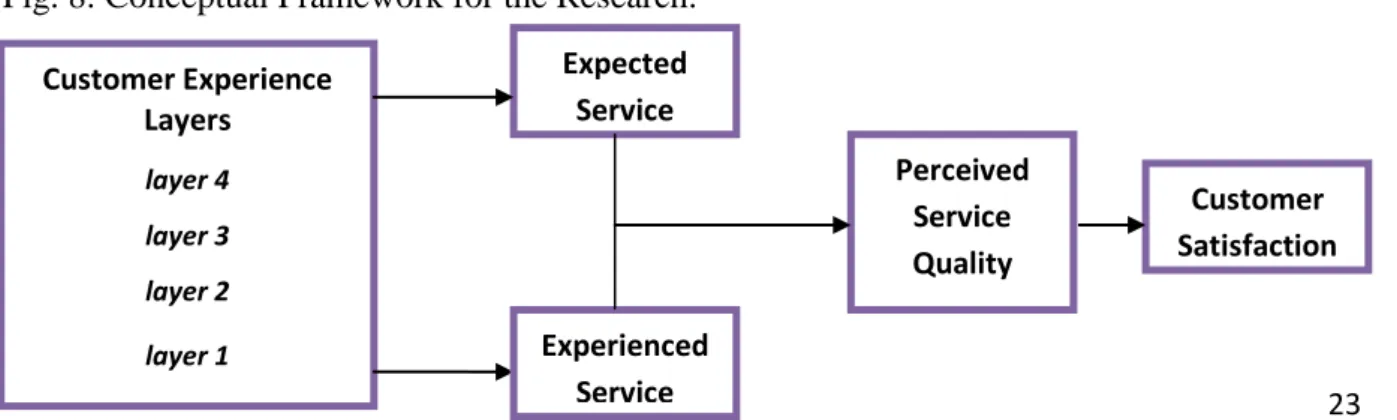
The main aim of this research is to study customer satisfaction, by customer experience. Developed model contain elements previously described in the literature. Thus in this model:
Customer Satisfaction element is according to the Expectancy-disconfirmation theory (Oliver, 1980; Oh and Parks, 1997) related to Perceived Service Quality
Perceived Service Quality is according to Lewin (1938), Oliver (1980) and Parasuraman (1988) a gap between customer expectations and real service performance (experienced service)
Ascendants of the Service Experience are according to the Customer Experience Hierarchy of Needs of Shaw (2005) represented by 4 layers of different experience needs. These 4 layers of experiences element became a base for creating the surveys’ questions for the hostel guests.
All these are combined and included in the Conceptual Framework for the Research (Fig. 8). Fig. 8: Conceptual Framework for the Research.
Customer Experience Layers layer 4 layer 3 layer 2 layer 1 Expected Service Experienced Service Customer Satisfaction Perceived Service Quality
24 Parasuraman et al. (1990) adopted expectancy-disconfirmation approach of Oliver (1980) and described most of listed above determinants for the experience. Basing of this theory as well as the SERVQUAL model survey questions from existing research within Hotel Industry and Shaw’s Pyramid the questions for the surveys, related to this conceptual framework were created.
Chapter 3: Research Methodology 3.1. Research Purpose
Research can be classified according to the purpose of it – the reason why it was conducted. There are three types of research: Explanatory, Exploratory and Descriptive. Every type is described below and later one has been chosen.
3.1.1. Exploratory Research
The primary aim of exploratory research is to discover important variables in a given situation. It’s very often used to study the new phenomenon as a kind of investigation of the problem or situation, where there are not much research done. “The goal is to formulate the problem more precisely, providing details, to clarify concepts and to gather some explanations or to produce qualitative data (Webb, 1992)”. “Explanatory research is concerned with explaining the why and how of the situation (Brotherton, 2008)”. It gives directions for the other types of research. It is characterized by a high flexibility level and no formal structure. “It may use a variety of methods such as trial studies, interviews, group discussions, experiments, or other tactics for the purpose of gaining information (Webb, 1992)”.
3.1.2. Descriptive Research
Descriptive research could be the continuation of the exploratory research. “Webb (1992) claims that the main aim of descriptive research is to provide an accurate and valid representation of the factors or variables, found by exploratory research, that are relevant to the research question”. It doesn’t attempt to establish links or relations between those variables, only describes them. Such research is more structured than exploratory research. “Shuttleworth (2008) says that it “...involves observing and describing the behaviour of a
25 questions about the current status of the subject or topic of study, to find information and stimulate new explanation. “Shuttleworth (2008) refers that “...descriptive research uses
variety of formal instruments in order to examine preferences, attitudes, practices, concerns, or interests of a sample...””.
3.1.3. Explanatory research
“The aim of explanatory research is to identify and explore the causes lying behind the effects and the nature of the relationships between the factors or variables from theory based expectations, link different topics or issues under a common general statement. It is the way to extend the theory or principle into new areas or issues by providing evidences to support or refute it and an explanation why (Neuman, 1994)”.
3.1.4. Research purpose defined
This research aim is to identify which of the major determinants related to the customer expectations and experience influence customer satisfaction in Youth Hostels.
“Basing on what Brotherton (2008) claims, we can consider descriptive and explanatory study in order to study factors that influence for instance customer satisfaction “…in case of
descriptive study would only identify these factors and perhaps speculate about their relationship to satisfaction. An explanatory study would seek to differentiate between, and measure, the relative influence of the factors and explain the cause and effect relationship between them. In this sense, the explanatory study clearly has more applied value than the descriptive one… (Brotherton, 2008)””.
The researcher of this study due to the difficulties in obtaining an international random sample, within the short term for this research, chose the descriptive method of study. The study will identify, in the available sample, the most important factors that affect hostel guest satisfaction and that are related to the customer experience and perceived service quality. Though the results may not be generalized, they can point out some clues for further research to be developed in a broader program. This thesis will be based on the conceptual framework created during the study of the existing literature (and developed while analyzing statistical data).
26 3.2. Research approach
3.2.1. Qualitative vs. Quantitative
Customer satisfaction research methodologies may be divided according to their content and objectives into quantitative and qualitative research. The researcher needs to choose the most appropriate one for the study. Both research approaches will be described in order to explain the reason of choosing by the researcher quantitative one for this study.
“Murray Thomas (2003) claims „qualitative methods involve a researcher describing kinds of
characteristics of people and events without comparing events in terms of measurements or amounts””. Qualitative Research is about the collecting, analyzing, and interpreting data by
observing how people act. Qualitative research studies can provide the researcher with details about the characteristics of something for instance human behavior, emotion, and personality characteristics that quantitative studies cannot match. “Qualitative data includes information about user behaviors, needs, desires, routines, use cases, and a variety of other information that is essential in designing a product that will actually fit into a user’s life (Madrigal and McClain, 2012)”. Statistical analysis lets us derive important facts from qualitative data, for instance preference trends, differences between groups, and demographics. The nature of this type of research is more exploratory and subjective.
Quantitative research is more about numbers, objective hard data; the measurement must be objective, quantitative and statistically valid. By definition of King et al. (1996):
“Quantitative Research uses numbers and statistical methods. It tends to be based on
numerical measurements of specific aspects of phenomena; it abstracts form particular instances to seek general description or to test casual hypotheses; it seeks measurements and analyses that are easily replicable by other researchers”.
“Qualitative research can be used to identify the factors that affect the areas under investigation, and then a researcher can use that information to devise quantitative research that assesses how these factors would affect the preferences of the studied group (Madrigal and McClain, 2012)”. In the case of this study identifying the factors that affect customer satisfaction by qualitative research is not necessary because of previous researchers that identified the determinants for customer satisfaction within tourism and hospitality sector. The researcher of this study will use them in order to discover which of the determinants have
27 bigger influence for customer satisfaction within youth hostels guests. Moreover these findings can be used to construct quantitative research for instance as a base or support for creating Questions.
3.2.2. Defining Research Approach
In conclusion, the researcher of this dissertation will use existing information about the determinants for the customer satisfaction in order to perform quantitative research, which will lead to determine how these variables might affect hostel guest preferences.
3.3. Data Collection - Surveys
The researcher of this study chose surveys as the method of data collecting, mainly because it makes easier to collect data from a large number of people during short time and people that are difficult to reach. It’s is an indirect method (there is no personal contact between the researcher and the respondents). The two surveys that investigated the hostel guests’ opinions at the beginning and at the end of their stay were created and sent to the hostels that agreed to cooperate to distribute them between the guests. In this way the survey could reach hostel guests staying in different cities in Europe. The surveys were sent by electronic mail to the staff of the five European hostels Hostel that agreed to cooperate: Interflat Hostel Budapest (Hungary), Goodnight Hostel Lisbon, Old Town Hostel Lisbon (Portugal), Ostello Bello Milan (Italy) and Melody Hostel Poznan (Poland). One month was the length of time that was given to the employees to distribute and collect responds to the surveys.
The researcher prepared two different surveys for the guests, that were based on information that were collected while analyzing the theory from the first part of this thesis about the customer satisfaction in the tourism and hospitality sector.
Two surveys for the hostel guests contain:
- Survey 1 (Appendix 1): questions related to the expected level of service quality and customer experience
- Survey 2 (Appendix 2): questions related to the received level of service quality and customer experience
28 The first questionnaire for the guests was delivered to them just after their arrival and the second in the end of their stay. They are designed in pairs in order to recognize the difference between the expected and perceived service quality and how this gap influence total customer satisfaction. More specifically, each question from Survey 1 is related to the same number of question from the Survey 2. The surveys contain question about the initials and the hostel in order to connect Survey 1 and 2 to the same person. Following the developed conceptual framework it was possible to identify the gap between expected and perceived quality.
The surveys were divided into four sequences of questions. Each sequence was related to the one layer of issues, which are the experiences of the Customer Experience Hierarchy of Needs Pyramid of Shaw (2005). Therefore questions of the layers are related to:
Layer 1 - Reliability, Accessibility, Value for Money, Safety, Trust and Security Experience.
Layer 2 - Responsiveness, Resolution, Comfortable, Resolute, Range, Knowledgeable, Satisfied Experience.
Layer 3 - Assured Friendly, Kindness and Caring Experience.
Layer 4 -Valued, Enjoyable, Delight and Thrill Experience.
Surveys are in the form of the Likert-type questionnaires, meaning the answer is to be marked on the 5–point scale: 1 –poor; 2- low; 3-neutral; 4-high; 5-very high.
Used Likert Scale is an ordered, one-dimensional scale from which respondents choose one option that best reflects their view. “Likert's original scale was bipolar, with five points running from one extreme to another, with a neutral central position, ranging from 'Strongly Agree' to 'Strongly Disagree' (Likert, 1932)”. Five-option scale is still most common. In scoring, numbers are usually assigned to each option (such as 1 to 5). A benefit is that questions used are usually easy to understand and so lead to consistent answers. A disadvantage is that only a few options are offered, with which respondents may not fully agree.
The statistics used to analyze the data:
In order to test the consistency of the surveys Cronbach's Alpha Test will be used.
Research Question 1. Which customer needs of experience are the most important determinants for achieving customer satisfaction?: The gaps will be compared, using standard deviations for each variable (because standard deviations squares the deviations