UNIVERSIDADE do ALGARVE
Faculdade de Ciências e Tecnologia
Bioecology and Movement Patterns of Sharks off Recife, Brazil:
Applications in the Mitigation of Shark Attack Hazard
Thesis for the degree in Doctor of Philosophy in Marine, Earth and Environmental Sciences,
specialty in Marine Ecology
André Sucena Afonso
UNIVERSIDADE do ALGARVE
Faculdade de Ciências e Tecnologia
Bioecology and movement patterns of sharks off Recife, Brazil:
applications in the mitigation of shark attack hazard
Bioecologia e padrões de movimentação de tubarões na costa de Recife,
Brasil: aplicações na mitigação do risco de ataque
Thesis for the degree in Doctor of Philosophy in Marine, Earth and Environmental Sciences, specialty in Marine Ecology
Tese de Doutoramento em Ciências do Mar, da Terra e do Ambiente, ramo de Ciências do Mar, especialidade de Ecologia Marinha
André Sucena Afonso
Thesis supervised by:Tese orientada por:
Prof. Doutor Fábio H. V. Hazin
Prof. Doutor Karim Erzini
Dedico esta tese aos meus pais.
Nunca teria chegado até aqui
sem o vosso primeiro empurrão.
5
Abstract
An abnormally high rate of shark attacks on humans off Recife, Brazil prompted the development of a shark monitoring program aiming at mitigating shark peril. Bottom longlines and drumlines were used as fishing gears and optimized for increasing selectivity towards large sharks and reducing fishing mortality. The fishing methodology allowed to reduce the shark attack rate considerably and to generate important bioecological information on tiger and bull sharks, species which seem to be responsible for most of the attacks. Tiger sharks in this region move preferentially to the north through wide home ranges. The presence of a port complex to the south of Recife could be attracting tiger sharks shoreward, which would subsequently visit the littoral of Recife due to their natural movements. Other important, site-specific features such as the presence of an estuary and an alongshore channel close to the beach, together with high pollution and siltation levels, could further promote the high risk of shark attack in the area. Tiger sharks use the continental shelf off northeastern Brazil mostly during early juvenile stages, where they quickly grow between January and September before departing to oceanic waters. Larger tiger sharks use deep oceanic waters more often but they frequently visit nearshore waters, probably in search for prey. The depth distribution of tiger sharks seems to correlate with both diel and lunar cycles, and abundances off Recife were correlated with month, lunar phase, tidal amplitude, pluviosity and wind direction. This information could be useful in determining periods when tiger sharks are more likely to occur in the area of risk. Compared to traditional shark-meshing programs, which produce a considerable amount of bycatch and fishing mortality, the methodology herein reported provides an effective solution to increase user safety at local beaches with minimal ecological consequences.
Key-words: bycatch, coastal management, fishing mortality, longline, selectivity, shark attack
6
Resumo
Um surto de ataques de tubarão verificado na costa de Recife, Brasil, levou à instauração de um programa de monitorização de tubarões com o intuíto de mitigar o risco de ataques. Os equipamentos de pesca utilizados corresponderam a palangres de fundo e linhas de pesca, os quais foram optimizados tendo em vista a maximização da selectividade dirigida a tubarões potencialmente agressivos e a minimização da mortalidade por pesca. A presente metodologia possibilitou uma considerável redução da taxa de ataques de tubarão, ao mesmo tempo que permitiu a recolha de dados importantes sobre a bioecologia das espécies envolvidas nos ataques. Os tubarões tigre e buldogue são aparentemente responsáveis pela maioria dos incidentes. Nesta região, os tubarões tigre deslocam-se preferencialmente para norte e alcançam consideráveis distâncias. A presença de um complexo portuário a sul de Recife parece contribuir para atrair tubarões para áreas costeiras, os quais se deslocariam, consequentemente, para o litoral de Recife. Algumas características do litoral de Recife, tais como a presença de um estuário e de um canal paralelo à linha de costa, juntamente com elevados níveis de poluição e turbidez da água, poderão potenciar o risco de ataque. O tubarão tigre utiliza a plataforma continental do nordeste brasileiro maioritariamente durante o início da fase juvenil, crescendo rapidamente entre os meses de Janeiro e Setembro e partindo em seguida para águas oceânicas. Os espécimes mais velhos utilizam águas profundas do ambiente oceânico mas visitam frequentemente a plataforma continental, provavelmente em busca de presas. A distribuição vertical do tubarão tigre parece correlacionar-se com ambos os ciclos circadiano e lunar, e a sua abundância no litoral de Recife foi correlacionada com o mês, a fase lunar, a amplitude da maré, a pluviosidade e a direcção do vento. Esta informação poderá ser útil para definir os períodos em que a presença de tubarões tigre na área de risco é mais provável. Em comparação com os programas de emalhamento de tubarões tradicionalmente conduzidos, esta metodologia apresenta-se como uma solução eficaz para aumentar a segurança balnear, simultaneamente assegurando a minimização do impacto ecológico local.
Palavras-chave: captura incidental, gestão costeira, mortalidade por pesca, palangre,
7
Acknowledgments
Agradecimentos
During the past four years, many people and institutions contributed in diverse ways to this thesis. The aims of this study could not be at all accomplished if it hadn't been for them. I would like to acknowledge everyone who was involved, in particular:
My supervisor in Brazil, Fábio Hazin, for opening the doors of his lab and trusting me with the execution of such a complex project. Thank you for believing in me and sharing your knowledge and wisdom, which so much helped improving this thesis.
My supervisor in Portugal, Karim Erzini, for both the inestimable guidance at crucial moments and all the constant support overseas. Thank you for often being my lighthouse during this long odyssey.
Dr. Barbara Block, from the Hopkins Marine Station (HMS) at the University of Stanford. Thank you so much for welcoming me at your lab and allowing me to join the white shark expedition to the Farallon Islands. I learned a lot from my experience in Monterey and I long to come back.
Also from HMS, I am in debt to Salvador Jorgensen and Michael Castleton for spending so much time with me and teaching me the essentials about shark tagging. Thank you for sharing your knowledge and friendship, you have surely made my time in Monterey that much better.
The Laboratório de Tecnologia Pesqueira (LATEP) and all the wonderful people that compose it. I am greatly thankful to Rafael (Brutos) Muniz for providing the logistic support, and to Luciana Ferreira and Pedro Castilho for their help on field and lab work. Many thanks to all the dozens of interns who assisted with field work, I will not refer to anyone in particular for space saving but this study would not have been possible without you. Hopefully, our paths will cross again in the future.
8
The Laboratório de Oceanografia Pesqueira (LOP) and all the people in it, particularly Paulo Oliveira, Alessandra Fischer and Elizabeth Cavalcanti who frequently helped with messy biological sampling. Obrigado por esta temporada maravilhosa, galera!
I am deeply thankful to Bruno Macena for all the discussions about telemetry and marine science in general. We spent long, stubborn hours together figuring out how to operate unfamiliar techonologies, and I will never forget his friendship.
Thank you as well to Zeca (Careca) Pacheco, Humberto Hazin and Diogo Nunes for their support, enthusiasm, and friendship. We shall meet plenty of times in the future.
Prof. Rosangela Lessa, to whom I am grateful for the wonderful professional relationship and the opportunity to learn from her expertise. Moreover, the precious help of Francisco Mercante and Rodrigo Barreto on the analysis of shark vertebrae is also acknowledged.
I am also grateful to Prof. Doctor Humber Agrelli, who helped me to understand predictive modeling better. Thank you for your endless patience and willingness to teach.
The precious help provided by Nuno Queiroz regarding the Split Moving Window Analysis procedure is deeply acknowledged.
The Instituto Oceanário de Pernambuco, particularly its president, Alexandre Carvalho, is also acknowledged for providing precious assistance in administrative work and for sharing the same concerns and phylosophies regarding shark attacks.
The Departamento de Pesca e Aquicultura from the Universidade Federal Rural de Pernambuco, all its professors, students and staff, thank you for the great hospitality and the joyful time along these years.
O meu mais sentido agradecimento ao povo Pernambucano; com ele aprendi a juntar lama e caos para fazer arte, e a minha vida então se transformou. Bem hajam!
9
Preface on thesis style
Prefácio sobre o estilo da tese
This thesis comprises eight chapters, a general conclusion, a list of bibliographic
references, and supplementary tables and figures. The first chapter includes a general introduction to the subject of the thesis, and provides background information on sharks, shark attacks, and the specific case-study of Recife. The second to seventh chapters correspond to roughly independent, but closely connected studies that were organized in a paper-style format, although they should not be interpreted as such because they are extensively discussed and may include nonessential information. Each of these chapters starts with an introduction including the state-of-the-art of that specific subject and the aims of the study, followed by a thorough description of the materials and methods used, the results obtained, including figures and tables, and the respective discussion. The eighth chapter is organized differently because it includes a theoretical reasoning of the shark attack problem and addresses mitigation strategies. All references were collated following the eighth chapter, and the acknowledgments were collated in the beginning of the thesis. The organization of the thesis does not require chapters to be read sequentially. Nevertheless, cross-references to other chapters have been used in order to avoid unnecessary repetitions. Some chapters or chapter sections have already been published, and references for those publications have been included along the text. Some chapters have not yet been submitted or accepted for publication, thus they are not included in the list of references. However, the scientific production resulting from this thesis is included in Annex I, namely all papers that have already been published and all papers that are currently in press or being prepared for submission, as well as all the presentations at scientific meetings.
10
Ethics and funding disclosure
Declaração de ética e financiamento
This study was conducted at the Department of Fisheries and Aquaculture of the Federal Rural University of Pernambuco (UFRPE). Every procedure carried out with sharks was conducted in accordance with the recommendations of the Commission of Ethics on the Usage of Animals from the UFRPE, and this study was ethically approved by license number 041/2009 (protocol number 23082.009679/2009 D18). In Brazil, this study was funded by the Financiadora de Estudos e Projetos of the Ministry of Science, Technology and Innovation (FINEP/MCT), by the State Government of Pernambuco and by the City Hall of Recife. In Portugal, this study was funded by Flying Sharks Lda. (http://www.flyingsharks.eu) and the Portuguese Association for the Study and Conservation of Elasmobranchs (APECE; http://www.apece.pt) through their Research Fund, and by the Fundação para a Ciência e Tecnologia (FCT; contract no. SFRH/BD/2007/37065).
11
Table of contents
Abstract 5
Resumo 6
Acknowledgments 7
Preface on thesis style 9
Ethics and funding disclosure 10
Table of contents 11
Chapter 1. General introduction 15
1.1. An overview of shark exploitation as a fisheries resource 17
1.2. Shark-human interactions and mitigation programs 21
1.2.1. Historical perspective 21
1.2.2. The shark hazard concern 23
1.2.3. Trends in shark attacks 26
1.2.4. Shark attack mitigation programs and strategies 29
1.3. The Case-Study of Recife 31
1.4. General objectives 35
Chapter 2. The nearshore environment off Recife 37
2.1. Introduction 39
2.2. Material and Methods 41
2.3. Results 43
2.4. Discussion 48
Chapter 3. Definition and optimization of the fishing gear 53
3.1. Introduction 55
3.2. Material and Methods 57
3.2.1. Pelagic longlining experiment 57
12
3.3. Results 62
3.3.1. Pelagic longlining experiment 62
3.3.2. Bottom longlining experiment 64
3.4. Discussion 66 Chapter 4. The Shark Monitoring Program of Recife 71 4.1. Introduction 73 4.2. Material and Methods 75
4.3. Results 80
4.4. Discussion 89 Chapter 5. Structure and dynamics of the elasmobranch assemblage off Recife 95 5.1. Introduction 97 5.2. Material and Methods 100
5.3. Results 105
5.3.1. Size composition 105 5.3.2. Sex ratio 113 5.3.3. Patterns and dynamics in abundance 114
5.3.3.1. The blacknose shark, Carcharhinus acronotus 115
5.3.3.2. The nurse shark, Ginglymostoma cirratum 120
5.3.3.3. The tiger shark, Galeocerdo cuvier 123
5.3.3.4. The stingray, Dasyatis spp. 124
5.4. Discussion 130
Chapter 6. Bioecological aspects of potentially aggressive sharks 141
6.1. Introduction 143
6.2. Material and Methods 144
6.3. Results 146
6.3.1. Morphometric relationships 146
13
6.3.3. Diet 153
6.3.4. Age and growth 154
6.4. Discussion 158
Chapter 7. Movements of the tiger shark off northeastern Brazil 165
7.1. Introduction 167
7.2. Material and Methods 172
7.2.1. Shark tagging 172
7.2.2. The acoustic telemetry system 174
7.2.3. Satellite tag programming and data analyses 175
7.3. Results 179
7.3.1. Tagging details and diagnosis 179
7.3.2. Postrelease behaviour 182
7.3.3. Vertical movement analysis 183
7.3.4. Horizontal movement analysis 199
7.3.5. Natural and fishing mortality 204
7.4. Discussion 204
Chapter 8. Shark attack mitigation off Recife 213
8.1. Introduction 215
8.2. Shark attack mitigation off Recife 216
8.3. Perspectives on the shark attack scenario off Recife 220
8.4. Optimizing shark attack mitigation off Recife 227
Conclusions and final remarks 231
References 233
Supplementary tables 253
Supplementary figures 261
Chapter 1. General introduction
17
1.1. An overview of shark exploitation as a fisheries resource
Sharks and batoids (i.e. rays and skates) together compose the subclass Elasmobranchii, a monophyletic group (Schaeffer and Williams, 1977) which is presently divided in two superorders: Galeomorphii, comprising four orders (Heterodontiformes, Orectolobiformes, Lamniformes, and Carcharhiniformes); and Squalomorphii, comprising four orders (Hexanchiformes, Squaliformes, Squatiniformes, Pristiophoriformes) and the group of batoids, whose phylogenetic positioning is yet unresolved (Kriwet et al, 2009 and references therein). Living sharks consist of at least 498 species (Compagno, 2005) whereas batoids include 574 extant species (Ebert and Compagno, 2007). Sharks correspond to a group of chondrychthyan fishes which may be distinguished from other fish taxa by possessing a cartilaginous endoskeleton, a palatoquadrate articulating with (instead of being fused to) the neurocranium, five to seven separate gill openings located laterally on the head, and pectoral fins not fused to the head (Compagno, 1999). Although fossil records evidenced chondrichthyans to exist since the Devonian period, about 400 million years ago (Mya), modern elasmobranchs arose during the Mesozoic era (250-65 Mya) after a major adaptive radiation − the neoselachian revolution (Compagno, 1999), which resulted in a sharp increase in species diversity (Underwood, 2006). As such, elasmobranchs successfully occupy a wide range of aquatic habitats, including limnetic systems such as rivers and lakes, inshore estuaries and lagoons, and both the neritic and oceanic provinces of the marine realm to depths as much as 2,000 m (Camhi et al., 1998).
Sharks have historically been regarded as a low-value fishing resource (Bonfil, 1994; Compagno, 1990) and so they have been mostly caught as by-catch in diverse fisheries (e.g. Coelho and Erzini, 2008; Mandelman et al., 2008; Megalofonou et al., 2005; Thorpe and Frierson, 2009), although some species, especially deep water sharks, were sought since 1940 for their livers as they were found to be rich in valuable organic compounds such as vitamin A, squalene, and diacyl glyceryl ether (Akhilesh et al., 2011; FAO, 2005; Figueiredo et al., 2005; Wetherbee and Nichols, 2000). The development of synthetic vitamin A in 1947, however, reduced the global interest of such fisheries (Kreuzer and Ahmed, 1978). All this scenario has changed in more recent years, as shark catches have increased considerably following an
18
intensification of global fishing effort (Barker and Schluessel, 2005) which was motivated by a growing demand for shark fins and, to a lesser extent, meat (Cahmi et al., 1998). The higher market value of shark fins compared to shark meat resulted in tens of millions of specimens taken in fisheries each year having their fins removed and their carcasses discarded overboard (Fowler and Musick, 2002). Such practice, known as finning, represents a substantial waste as fins correspond to only about 5% of the total weight of a shark (Vannuccini, 1999), hence it has recently been prohibited by many countries and Regional Fisheries Management Organizations (RFMOs).
The world elasmobranch yearly catches reported for the period between 1947 and 1991 grew relatively steadily until a maximum of 704,000 t, but Bonfil (1994) considered 1,350,000 t to be a more realistic estimate. According to the Food and Agriculture Organization of the United Nations (FAO, 2010), the global shark catch peaked at about 900,000 t in 2003 but it has been declining ever since. However, the flow of shark fins through the Hong Kong fish markets suggests that somewhere between 1.21-2.29 million tons of sharks are killed each year for the fin trade (Lack and Sant, 2009), indicating that FAO statistics underestimate global catches of sharks to a great extent. In accordance, an analysis of the fin trade data combined with genetic analysis for species identification estimated the shark biomass in the fin trade to be three to four times higher than shark catch reported by fisheries databases (Clarke et al., 2006). Facing such an extreme fishing pressure, once abundant elasmobranch populations are now quickly declining throughout the globe (Baum et al, 2003), although the rate of decline is not consensual (Burgess et al., 2005). In any case, it is now widely accepted that most elasmobranch species do require a considerable amount of protection from fisheries in order to warrant the conservation of their populations.
Except for a few large-bodied, planktophagous species, sharks are typically apex or high-level predators (Cortés, 1999). Such positioning in the trophic chain tends to benefit K-selected life-history strategies, which balance populations with the carrying capacity of the environment, in detriment of r-selected strategies, which balance populations with the maximal intrinsic rate of natural increase (Pianka, 1970). In accordance, the life cycles of elasmobranchs are generally characterized by slow growth, late maturity, and low fecundity, resulting in low reproductive potential and reduced capacity for population increase (Pratt and
19
Casey, 1990; Garcia et al., 2008). Furthermore, as top predators, their abundance is considerably lower than the abundance of other taxa belonging to lower trophic levels (Odum, 1971). All these reasons make elasmobranch populations particularly sensitive to anthropogenic-derived disturbance, either directly through overfishing (Stevens et al. 2000), or indirectly through environmental pollution (Seitz and Poulakis, 2006) or habitat degradation (Jennings et al., 2008).
The low population resilience of sharks is readily verified as most fisheries targeting sharks begin with promising catch rates but subsequently experience rapid declines in production which eventually lead to the collapse of the fishery (Stevens et al., 2000). This is particularly true for coastal species as their populations are much more accessible to harvest and their habitats much more exposed to environmental damage. Indeed, the human pressure historically inflicted on coastal areas induced many changes to the environment and to the communities and ultimately resulted in the general collapse of coastal ecosystems, as described by Jackson et al. (2001). In nearshore waters, local symptoms of overfishing have been documented even in small-scale, artisanal fisheries targeting sharks with 6-8 m sailing "pirogues" crewed by two persons (McVean et al., 2006). The sustainable exploitation of elasmobranch resources is therefore quite challenging. However, it appears to be achievable at least for species with higher productivity such as Mustelus antarcticus, Rhizoprionodon
terraenovae, Sphyrna tiburo and Prionace glauca (Walker, 1998). In effect, the spiny dogfish, Squalus suckleyi, fishery in the North Pacific recently became the first elasmobranch fishery in
the world certified as sustainable by the independent, non-profit Marine Stewardship Council (MSC, 2011), although such certification has been highly criticized (Jacquet et al., 2010).
The widespread concern over the increase of shark fishing and the respective impact on shark species prompted international institutions to actively address the situation. In 1991, the Species Survival Commission (SSC) of the International Union for the Conservation of Nature (IUCN) established the Shark Specialist Group (SSG), an assemblage of about 160 authorities from 90 countries whose mission consists on providing leadership and expertise for the long-term conservation and effective management of chondrichthyan fishes. The ultimate output of the SSG is the IUCN Red List of Threatened Species, and until May 2012 the SSG had listed 584 chondrichthyan species under the prevailing classification system (IUCN,
20
2011). More precisely, 25 species were considered as critically endangered (CR), 41 as endangered (EN), 115 as vulnerable (VU), 132 as Near-Threatened (NT), and 271 as of Least-Concern (LC). The SSG assessments have also been valuable for sustaining proposals for the inclusion of chondrichthyans in the Convention on International Trade in Endangered Species of Wild Fauna and Flora (CITES). Until May 2012, four chondrichthyan species, namely the basking shark, Cethorhinus maximus, the great white shark, Carcharodon carcharias, the whale shark, Rhincodon typus, and the largetooth sawfish, Pristis microdon, were listed in Appendix II of that treaty, while all the remaining pristid sawfishes were listed in Appendix I (CITES, 2012). Another important initiative from an international organization was the establishment of the International Plan of Action for the Conservation and Management of Sharks (IPOA Sharks) by FAO, as part of the Code of Conduct for Responsible Fisheries, which occurred in 1999. The goal of the IPOA Sharks was to provide a framework for the promotion of adequate management of shark fisheries to ensure the conservation of their populations worldwide, although not many countries have yet implemented their National Plans of Action (NPOA) effectively and little progress has been verified at a global level. According to Lack and Sant (2011), seven out of the twenty major elasmobranch-fishing countries still do not possess a NPOA. Moreover, information suggesting that sharks are effectively being managed by NPOAs is yet to be found (Lack and Sant, 2011). Altogether, the amount of measures in use for mitigating threats to chondrichthyan species seem to be insufficient as population declines have generally persisted (Baum and Blanchard, 2010).
Not only are the reductions in elasmobranch abundance and diversity, by themselves, a regrettable loss, but they also imply further consequences for the marine ecossystem, which draw additional concerns. The fact that sharks are typically high-level predators (Cortés, 1999) grants them a great ecological significance as top-down regulators of marine food webs. The effect of the predatory pressure of elasmobranchs is visible on their direct preys and also indirectly on non-prey species through trophic linkages up to the third degree (Schindler et al., 2002). Thus, the removal of sharks by fisheries equals the subtraction of a very important component of the ecosystem, which is responsible for maintaining a wide variety of mesopredators in balanced numbers. Without such a component, the trophic chain is expected to experience a top-down forcing resulting from the increase in large-prey populations following the reduction in predatory pressure (Sandin et al., 2010), which will subsequently
21
increase predation on smaller prey. Such an effect may eventually trigger a cascade effect over lower trophic levels and potentially change the structural properties of the food web and compromise its stability (Heithaus et al., 2008; Rezende et al., 2009). Sudden increases in the abundance of mesopredators following the removal of large sharks (i.e., mesopredator releases) have been observed (Shepherds and Meyers, 2005, Ferretti et al., 2010) and might affect all trophic levels. Consequences of such phenomena may include reductions in primary and secondary productivity (Mann, 1977; Reisewitz et al., 2006, Ferretti et al., 2010), invasion by alien species and demographic outbreaks of native species (Baum and Worm, 2009), and increased threat to more vulnerable prey species (Polis and Holt, 1992; Courchamp et al., 1999; Ritchie and Johnson, 2009). It is therefore urgent to ensure the conservation of elasmobranch populations and the health of marine ecosystems (Ward-Paige et al., 2012).
1.2. Shark-human interactions and mitigation programs
1.2.1. Historical perspective
Except when directly targeted in fisheries or in some countries from the Pacific Ocean where they are deified, sharks are popularly considered as a nuisance. In fisheries targeting other species, sharks are frequently responsible for damaging fishing gears (Bigelow and Schroeder, 1953) and for depredating bait and catch (Mandelman et al., 2008; MacNeil et al, 2009), resulting in substantial ecological, economic and social losses (Gilman et al., 2008), not to mention the risk they pose to the fishermen who handle them. Sharks are also responsible for damaging oceanographic equipment and submarine communication cables (Johnson, 1978; Marra, 1989). However, no other circumstance provokes more anxiety and antagonism towards sharks than when they attack humans.
The first representation of a shark attack may have been found on a vase dated from 725 BC and uncovered at Ischia, Italy, which shows a man seized by a fish possibly reminiscent of a shark (www.sharkattacks.com/historical.htm; Accessed on May 28th 2012). Although Herodotus had already referred to attacks by marine monsters in 492 BC (Rawlison, 1996), the first written evidence of a shark attack seems to come from the third century BC, when the Greek lyric poet Leonidas of Tarentum evoked the tragic fate of a sponge-fisher
22
when he was attacked by a sea monster, probably a shark, which tore the lower section of his body apart while being hoisted aboard by his two companions (Clack, 1999). More recently, one of the first published allusions to shark attacks came from Rome, in 1555, in the book
Historia de Gentibus Septentrionalibus by the Swedish writer and cartographer Olaus Magnus,
which depicts a man being seized by three sharks (Fig. 1.1).
Figure 1.1. The first published representation of a man being attacked by sharks, dated from 1555 and included in Historia de Gentibus Septentrionalibus, by Olaus Magnus (www.sharkattacks.com/historical.htm; Accessed May 28th 2012).
Early in the past century, during a heat wave in the summer of 1916, the coast of New Jersey witnessed a series of shark attacks in which four people were killed and one injured (Fernicola, 2001). According to the same author, these incidents had great repercussion in the media and contributed to the inclusion of sharks in American popular culture as a symbol of danger. Also, they compelled researchers and ichthyologists to deepen their work on these species, as scientific knowledge about sharks was hitherto based mostly on conjecture and speculation. Nonetheless, sharks were of little concern to common people before World War II, and bathers generally ignored the possibility of shark attack, with the possible exception of South Africa and Australia (Gilbert, 1963). After the war began, however, direct contacts with sharks were frequently reported following air or sea disasters, which raised concerns regarding the peril represented by them. The most dramatic episode was undoubtedly the one of the USS
Indianapolis, on July 30th 1945. While on a secret mission to deliver some components for the atomic bomb in the Marianas, the USS Indianapolis was hit by two torpedoes launched by a Japanese submarine and sank. A surviving crew of about 880 men was forced into the water
23
with nothing but their life jackets, being rescued four days later. During that time lag they had to endure dehydration, starvation, exposure, and terrifying shark attacks. By the time they were found, only 321 men remained alive, with four of those later dying from their wounds (http://militaryhistory.about.com/od/shipprofiles/p/ussindiana-polis.htm; Accessed May 28th 2012). Such testimonies prompted the development of a shark repellent for military use, which was named Shark Chaser and was composed of copper acetate combined with a nigrosine-type dye (Gilbert, 1963). In spite of all these impressive reports, the event which brought most popularity to sharks was probably the 1974 novel entitled Jaws, by Peter Benchley, which was based on the New Jersey's shark attack episode and turned into a blockbuster by Steven Spielberg in the following year. Jaws quickly became the most influential film about sharks ever, popularizing the belief that sharks were vicious animals capable of hunting for humans and, therefore, impossible to coexist with.
1.2.2. The shark hazard concern
A great proportion of incidents with sharks are derived from interactions motivated
by humans. Frequently, sharks react to disturbance by biting at their opponents (Martin, 2007), and therefore many accidents have happened when fishermen remove live sharks from their fishing gears or when incautious divers startle otherwise unresponsive sharks, or even during recreational shark diving or scientific research operations. All these human-derived interactions are considered as provoked attacks, disregarding of the consequences to the victim, since such interaction would most probably not happen if the human had not provoked it. While the causes which trigger provoked attacks are sufficiently clear, the motives which lead unprovoked sharks to attack humans are yet to be understood.
It is generally consensual that sharks are rather shy animals and difficult to observe in the wild, as they tend to avoid contact with humans. Currently, most unprovoked shark attacks on humans are believed to be cases of prey misidentification (Burgess, 1990) resulting from humans producing stimuli that sharks interpret as being from natural prey. For example, the silhouettes of floating surfboards and swimmers easily resemble animals such as marine turtles, dugongs, or fish swimming near the surface, and the low-frequency sounds emitted by
24
stroking legs and arms on the sea surface are comparable to the sound produced by a stressed, wounded fish (Nelson and Gruber, 1963; Myrber, 1978). The acoustic sensory system of sharks is extremely well developed (Myrberg, 2001) and enables them to get aroused by such sounds and pursue its source, even from considerable distances (Nelson, 1967, Myrberg et al., 1972). Likewise, the rod-rich retina of sharks allows them to sharply distinguish the shadow of an object against a contrasting background (Gruber, 1977; Hueter, 1991), even though they may possess low visual acuity and be eventually color blind due to cone monochromacy (Hart et al., 2011). Sharks still enjoy other specialized sensory mechanisms which grant them additional abilities to sense the surrounding environment and locate potential prey, such as a mechanosensory lateral line system (Maruska, 2001), an electrosensory system (Tricas, 2001), and an extremely sensitive olfactory system (Tricas et al., 2009). In particular environmental conditions, e.g. in low visibility waters, the stimuli other than visual produced by a person and perceived by a shark could be quite similar to those of natural preys.
Other possible explanation for unprovoked shark attacks could be related to territoriality and competition. Shark agonistic displays towards humans have been frequently elicited (Martin, 2007). One of the most common threat displays among sharks is the strong bilateral depression of both pectoral fins, which can be observed in different taxa with distinct sizes and feeding habits (Martin, 2007). In the grey reef shark, Carcharhinus amblyrhynchos, a distinctive, highly stereotyped "hunch display", which combines a raised snout-arched back posture with laterally exaggerated swimming motion or rolling/spiral looping movements, is usually performed in response to crowding or pursuit by divers or submersibles (Johnson and Nelson, 1973; Nelson et al., 1986). Against persistent pursuing, the agonistic display quickly evolves to either a withdrawal or a slashing attack, leading to the conclusion that such displays are an accurate predictor of defensive behaviours with further hostility (Fellows and Murchison, 1967). Such evidence strongly denotes a lack of initiative from the shark to confront the divers and indicates that, in some circumstances, agonistic behaviour towards humans should be interpreted as a warning response, e.g. to the insisting presence of a possible competitor.
A strong indication that shark attacks are not triggered by predatory behaviours directed toward humans is that, in many cases, sharks release the victim after the first bite and
25
appear to lose their interest henceforth (Baldridge, 1974; Martini and Welch, 1981; Burgess and Callahan, 1996). This hit-and-run behavior agrees with the hypothesis of prey misidentification, although it could derive from a non-predatory state as well. The term
exploratory bite has been previously used to describe single, more superficial shark bites
which seem to have an intention other than actually seizing a prey (Collier et al., 1996, Ritter and Levine, 2004), and it is believed that such bites do not represent an aggressive behaviour but rather a way of sharks getting acquainted with a novelty, although this bite pattern would be hard to distinguish from agonistic displays such as the ones described in Martin (2007) if the pre-attack behaviour of sharks is not assessed. In any case, it is unquestionable that shark bites do cause extensive trauma to the victim even in optimistic scenarios (Caldicott et al., 2001; Ritter and Levine, 2005), and even relatively minor shark bites may lead to lethal hemorrhages if inflicted on main blood vessels. Furthermore, many shark attack victims were repeatedly and powerfully bitten (Ihama et al., 2009), and human remains have been found in shark stomachs (Lowe et al., 1996; Rathbun and Rathbun, 1984), which demonstrates that some shark attacks on humans do happen due to predatory behaviour and that the awareness of prey being nonstandard not always results in the shark giving up the attack after the first bite.
On the other hand, the behaviour of an individual shark could reveal higher aggressiveness than its conspecifics. Gilbert (1963) introduced the term accessory population to describe the portion of individuals from a migratory principal population (i.e., the main breeding population that maintains its numbers and follows regular patterns of distribution and habitat) which is lost either through wandering from the usual geographic range of the species or through disorientation in seasonal movements, resulting in individuals turning out of phase in the reproductive cycle. According to the same author, individuals from the accessory population may exhibit distinct, more aggressive behaviors compared to individuals from the principal population. Similarly, Coppleson (1958) recognized that some sharks behave differently enough to be categorized as rogue sharks to distinguish them from regular individuals, although his theory that these sharks could potentially be man-hunters has been generally refuted. In conclusion, it is clear that shark attacks do exhibit great variability in causes and patterns, which could be regulated by the interactions between shark species-specific behavior, environmental conditions, and human behavior.
26
1.2.3. Trends in shark attacks
The International Shark Attack File (ISAF) has been operating since 1958 and is
internationally recognized as the most accurate source of shark attack data to date, housing more than 5,000 investigations which cover the period from the 16th century until the present. Although much of the available ISAF information requires caution when analyzed, as many confounding factors not directly related to sharks have changed through time, it has been used to assess trends in shark attacks which could assist mitigation efforts (e.g. Baldridge, 1974; Burgess et al., 2010). According to ISAF (http://www.flmnh.ufl.edu/fish/sharks/statistics/ Trends2.htm; Updated Feb 7th 2012; Accessed June 1st 2012), the number of shark attacks reported has been globally increasing since 1960. Although such a trend is partially an artifact produced by factors such as ISAF logistic improvements (in 1987) and an increase in reporting rate and media coverage, particularly of minor attacks which had previously gone unreported (since 1993), it is clear that incidents involving sharks have become more common in the last couple of decades than ever before. One of the main factors driving this trend, however, is certainly the rate of beach use. Since the number of shark-human interactions directly correlates with the number of humans in the water and with the amount of time they spent there, it is to be expected that shark attacks would increase following human population growth and the rising demand for aquatic recreation in recent decades. Consequently, not only shark attacks but also other incidents related to the use of the sea by humans have increased in frequency, such as drowning events which have always been much more frequent than shark attacks (ISAF; http://www.flmnh.ufl.edu/fish/sharks/isaf/isaf.htm, Accessed May 31st 2012).
Some human activities, however, may lead to higher abundances of sharks close to shore and modify their typical behavior. Water chumming, for instance, is a practice regularly conducted by the shark diving industry and it has been perceived as being responsible for attracting sharks to an area and for conditioning them to associate vessels with easy food (Presser and Allen, 1995). Pollution and coastal development may also contribute to attract sharks shoreward (Baldridge, 1974, Hazin et al., 2008). The implications of human interference over the environment are frequently complex and unpredictable, thus the role of anthropogenic pressure on the shark attack problem should not be underrated.
27
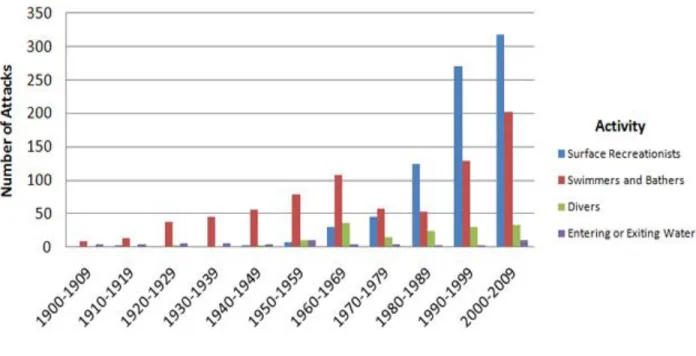
On the other hand, the number of shark-human interactions in Florida, which historically presents the highest shark attack rates in the world, has been decreasing steadily over the last decade, with 2011 exhibiting the lowest number since 1993, a trend which is not observed at a global scale (Fig. 1.2). Possible causes for this reduction include less sharks in US waters due to fishing, less people going in traditional high shark-human contact areas, and better, more efficient behaviors from aquatic recreationists and beach safety personnel in avoiding times, sites, and activities which increase the likelihood of encounters between sharks and humans (ISAF; http://www.flmnh.ufl.edu/fish/sharks/isaf/ 2011summary.html; Accessed May 31st 2012). Indeed, the type of aquatic activity has shown an effect on the number of shark attacks, with surface recreationists surpassing swimmers in the number of victims since 1980 (Fig. 1.3). This could be explained by the outbreak of surf and other similar water sports, which resulted in more people further away from shore producing new, distinct stimuli which were not produced by humans before.
According to ISAF (http://www.flmnh.ufl.edu/fish/sharks/statistics/species2.htm; Accessed May 31st 2012), the three species responsible for most of the unprovoked attacks are the great white, C. carcharias, the tiger, Galeocerdo cuvier, and the bull, C. leucas, sharks (Fig. 1.4), the first one being a lamnid and the last two being carcharhinids. All these species are circumglobal in tropical and warm-temperate waters, are regular visitors of coastal areas, and attain considerable large sizes (Compagno, 2001). The bull shark, which in Africa has been named after the Zambezi river, is even found in lakes and rivers as far as 4,000 km from the ocean (Thorson, 1972) due to an efficient osmoregulatory capacity (Pillans, 2005). The distribution of these species naturally corroborates their importance for the shark attack concern. Nevertheless, a vast number of shark species is known to have attacked humans, with ISAF identifying at least 32 species responsible for inflicting unprovoked attacks (http://www.flmnh.ufl.edu/ fish/sharks/statistics/species2.htm; Accessed May 31st 2012) and even the cookiecutter shark, Isistius sp., which is one of the smallest shark species growing to a maximum size of 40−50 cm, being implicated in such incidents (Honebrink et al., 2011).
28
Figure 1.2. Variation in the yearly number of reported shark attacks worldwide and in Florida only, and the respective proportion of fatalities between 2000 and 2011. Note that the vertical axis represents both counts and percentages (Source: http://www.flmnh.ufl.edu/fish/sharks/statistics/statsw.htm, updated January 30th 2012, accessed May 31st 2012).
Figure 1.3. Decadal variation in the number of shark attacks between 1900−2009 (N = 1,826) categorized by the activity of the victim before the attack. Retrieved from ISAF (http://www.flmnh.ufl.edu/fish/sharks/statistics/Act.htm; Accessed May 20th 2012), with permission.
0 10 20 30 40 50 60 70 80 90 100 2000 2001 2002 2003 2004 2005 2006 2007 2008 2009 2010 2011 A tta c k s ( N) / F ata liti es ( %)
World shark attacks World fatalities (%) Florida shark attaks
29
Figure 1.4. Number of provoked and unprovoked shark attacks worldwide inflicted by the most attacking species (source: ISAF; http://www.flmnh.ufl.edu/fish/sharks/statistics/ species2.htm; Updated January 30th 2012; Accessed May 31st 2012).
1.2.4. Shark attack mitigation programs and strategies
Even though shark attacks on humans are extremely rare events, averaging 64 attacks per year worldwide (Burgess et al., 2010), they may produce severe deleterious impacts on local communities and economy (Bullion, 1976; Dudley, 1997, Wallet, 1983). The psychological impact of a shark attack has been known to outweigh that of other, more frequent forms of danger (Davies, 1961). This is particularly true in regions where the risk of attack is consistently present (Cliff, 1991; Maillaud et al., 2009; McCosker and Lea, 2006; Nacaya, 1993; Rtshiladze et al., 2011; Schultz, 1967). To face such hazard, some local governments have adopted measures aiming at mitigating the risk of shark attack. One of the earliest examples dates back to 1937, off the beaches of Sydney, Australia (Dudley, 1997), when the Shark Menace Advisory Committee of New South Wales was set up to develop methods for reducing shark hazard (Coppleson and Goadby, 1988). The proposed strategy for shark attack mitigation consisted in reducing the numbers of large sharks in the region by installing anchored gillnets permanently in nearshore waters. Contrary to some popular beliefs, these shark-meshing programs do not provide a shark-safe environment but instead they were projected to passively fish for sharks which approach the protected shores, consequently reducing the probability of shark-human encounters. In fact, a considerable proportion (35%) of sharks are caught in the shoreward side of the mesh (Cliff and Dudley, 1992), presumably while moving seaward.
0 100 200 300 400 500
C. carcharias G. cuvier C. leucas C. taurus C. limbatus Sphyrna spp.
Num be r of at tac k s provoked unprovoked
30
There are three major shark meshing programs currently operating in the world, namely in New South Wales and Queensland, Australia, and in KwaZulu-Natal, South Africa (Dudley and Cliff, 2010), which started in 1937, 1962, and 1952, respectively (Dudley, 1997). In addition, some shark meshing has been also conducted off Dunedin, New Zealand, during the summer (Francis, 1998), and there are references to shark meshing off Qingdao, China, in 1982, although it is unknown if that program continues and if there are other places in China using shark nets (Dudley and Gribble, 1999). In Hawaii, shark control was attempted with baited, bottom longlines instead of gillnets. Between 1959 and 1976, six different shark control programs with varying fishing effort were conducted there, leading to the capture of a large number of sharks, but the operations were discontinued as they showed no visible effect on the rate of shark attacks (Wetherbee et al., 1994). In contrast, the three main shark-meshing programs have shown to have a significant effect on the reduction of attacks at protected sites, although at variable rates (Dudley, 1997).
In spite of their effectiveness in mitigating the shark attack problem, shark meshing programs have been associated with high mortalities not only of potentially aggressive sharks but also of harmless taxa including several threatened species such as turtles, dugongs and cetaceans (Gribble et al., 1998a; Krogh and Reid, 1996; Dudley, 2006; Paterson, 1990). Declining catch rates and lengths of some species caught in protective gillnets in Australia (Reid et al., 2011) and South Africa (Dudley and Simpfendorfer, 2006) have raised serious concerns regarding the ecological impact of shark meshing programs (Paterson, 1990; Sumpton et al., 2010), particularly under a scenario of global depletion of marine top predators (Jackson et al., 2001, Myers et al., 2007).
Other methods to reduce the risk of shark attack have been used, each with its own limitations. Shark exclusion devices offer a promising concept since they provide full protection by imposing a physical barrier to sharks, thus creating a shark-free area without capturing the sharks. However, they are only suited to sheltered shores with no or little surf (Dudley and Cliff, 2010). These barriers have been repeatedly installed in several places since the beginning of the 20th century but, unfortunately, they proved to be prohibitively expensive for maintenance as they were generally subjected to continual damage by wave action and so most of them were eventually dismantled (Coppleson and Goadby, 1988). Currently, only a
31
few places have barrier nets installed for shark avoidance, namely the Sidney harbor, Queensland's Gold Coast marinas, and Hong Kong (Dudley and Gribble, 1999). Another strategy for shark avoidance relies on the development of shark deterrents, either chemical or electrical. However, despite the apparent success of an electrical deterrent in reducing the probability of a white shark biting the bait (Smit and Peddemors, 2003), no practical use for protecting bathing beaches with such equipment has yet been achieved (Cliff and Dudley, 1992). Finally, surveillance schemes in which spotters positioned in strategic, high places next to the water monitor the presence of sharks in the area and alert bathers in case of peril have been used in Australia (Whitley,1963) and South Africa (Oelofse and Kamp, 2006). However, their efficacy is greatly dependent on atmospheric conditions and water visibility, which restricts the time and places where they can be employed.
1.3. The Case-Study of Recife
The Metropolitan Region of Recife (MRR), Brazil has been experiencing an
abnormally high shark attack rate during the past 20 years. Since 1992, a total of 55 shark attacks occurred in these waters, resulting in 20 fatalities. Most attacks occurred within a 15 km, densely populated shoreline which comprises the Barra de Jangadas estuary. Hence, the area of higher risk is very small, resulting in Recife exhibiting one of the highest shark attack rates per unit of area in the world. Surprisingly, despite intense recreational use of these beaches since the early 1950s, there had been no records of shark attacks in this region before 1992, except for a few anecdotal reports (Hazin et al., 2008).
Recife is the capital of the State of Pernambuco and one of the biggest urban centers in northeastern Brazil, with a population of about 1.5 million people (nearly 4 million in the whole MRR) (Instituto Brasileiro de Geografia e Estatística; www.ibge.gov.br; Accessed October 10th 2012). The shoreline of Recife comprises a stretch of sandy beaches with warm seawater that fosters year-round use. The tourism industry has historically been an important component of local economy and, as the shark peril off Recife was highly publicized by local, national and international media, this sector suffered severe losses whith negative impacts on
32
social welfare, although the full dimension of the socioeconomic damages caused by shark attacks is always difficult to quantify (Gaiser, 1976).
The shark attack outbreak happened after the construction of a large port complex about 25 km to the south of Recife, the port of Suape, which was built on a wide, pristine estuarine system to which four rivers converged, namely the Massangana, Tatuoca, Ipojuca, and Merepe (Fig. 5). The development required deep modifications to a substantial area of the estuary, including damming, dredging, and the embankment of two rivers which had their courses diverted (Neumann-Leitão and Matsumura-Tundisi, 1998), resulting in significant environmental degradation (Hazin et al., 2008; Koening et al., 2003).
To contain the sudden increase in shark attacks, and given that a large proportion of the victims were surfers, the Government decreed the prohibition of all board-riding activities in the area on January 1st 1995 and reinforced it in May 1999 with a new, stricter decree. This resulted in a higher proportion of bathers being attacked compared to surfers in the following years (Hazin et al., 2008). Also, warning signs with information on shark peril were abundantly installed across the area. In May 2004, the State Government created the State Council for Shark Hazard Monitoring (CEMIT) with the purpose of adopting and coordinating measures to reduce the shark attack rate and the proportion of fatalities associated to it, which equaled about 35%, being thus considerably higher than those of other regions (ISAF, http://www.flmnh.ufl.edu/fish/sharks/isaf/ isaf.htm; Accessed June 3rd 2012). The CEMIT is composed of five permanent members that synergistically intervene on the several components of the shark attack problem: the Firemen Department, responsible for beach surveillance, law enforcement, and rescue; the Legal Medicine Institute, responsible for the coroner examination of fatal victims; the State Agency for the Environment and Aquatic Resources, responsible for the environmental recovery of this region; the Instituto Oceanário de Pernambuco, responsible for providing environmental education and further information to the beach users and general community; and the Universidade Federal Rural de Pernambuco (UFRPE), responsible for developing measures to reduce the risk of shark attack and to increase the scientific knowledge on this situation, since virtually nothing was previously known about the coastal ecosystem off Recife and the species responsible for the attacks.
33
Figure 1.5. Map depicting the littoral of Recife with a tentative projection of the nearshore relief and the location of the port of Suape, to the south. Most shark attacks occurred off the gray area. Retrieved from Hazin et al. (2008), with permission.
34
Hazin et al. (2008) assessed trends in shark attacks off Recife in relation to attack location, day of the week, time of the day, moon phase, and distance from shore. The beaches of Boa Viagem and Piedade exhibited disproportionally higher rates of shark attacks, although the data were not standardized by unit of area. Regarding the day of the week, most attacks occurred between Friday and Tuesday, while no attacks were verified on Wednesdays. The most hazardous times of the day were early in the morning (between 6:00 and 8:00 a.m.) and late in the afternoon (between 16:00 and 18:00), while the full and new moon phases corresponded to the periods in which more attacks occurred (Hazin et al., 2008). The analysis of trends in shark attacks is an important step towards the adequate understanding of subjacent causes and the generation of mitigation measures.
Several causes have been implicated in the shark attack outbreak off Recife. Yet, the construction of the port of Suape and the subsequent increase in maritime traffic are believed to have triggered the situation (Hazin et al., 2008). Sharks are known to be attracted by ships (Baldridge, 1974; Schultz, 1975) and even small boats (McCord and Lamberth, 2009), and frequently enter port areas (Coppleson, 1958). Attraction of sharks by low-frequency sounds (Myrberg, 2001), which are emitted by transiting vessels (Arveson and Vendittis, 2000), could partially explain such behavior. Thus, it is likely that the port of Suape may promote the approximation of sharks to this region. Additionally, habitat degradation during the construction of the port may have driven sharks that use estuarine and fluvial waters for foraging or reproduction, such as the bull shark, away from Suape (Hazin et al., 2008). Since northward coastal currents prevail during most of the year (Lira et al., 2010), those sharks could have moved to the nearest estuary northward from Suape, i.e., the Jaboatão estuary. Moreover, the presence of the Jaboatão estuary within the area of risk raised additional concerns because the local public slaughterhouse was, since 1982, dumping its untreated effluents, including blood and entrails, directly into Jaboatão river at an average volume of 345 cubic meters per day, and untreated liquid waste flowed from the Muribeca Waste Landfill into Jaboatão river at an average of at least 60 liters per minute (Hazin et al., 2008). According to FAO (1991), this type of waste has a great potential for attracting predators and, if discharged into the ocean, it may increase the numbers of sharks in the affected area. Yet, closure of the slaughterhouse in 2005 did not reduce the shark attack rate, thus it alone could not be responsible for the situation. Finally, the existence of a deep channel adjacent to the
35
beach has been also pointed out as a probable cause for high shark-human interaction off Recife as it would facilitate the approach of sharks to the shoreline (Hazin et al., 2008).
1.4. General objectives
Given that i) shark attacks off Recife produce serious damage to local economy and social welfare, ii) the populations of large, coastal sharks are strongly depleted worldwide, iii) knowledge of the dynamics and ecology of large predators in nearshore waters off the northeastern coast of Brazil is still scarce, and iv) shark attack mitigation techniques that have been published so far are either unsuitable to the case-study of Recife or do not provide the desired performance, this study aimed at the following objectives:
1) Description of the inner continental shelf off Recife with regard to some environmental parameters relevant to the ecology and behavior of sharks − Chapter 2.
2) Design and optimization of a fishing methodology with high selectivity for sharks and low fishing mortality − Chapter 3.
3) Characterization of the Shark Monitoring Program of Recife with respect to the fishing operations and catches − Chapter 4.
4) Assessment of spatiotemporal trends in elasmobranch abundance off Recife and investigation of environmental predictors − Chapter 5.
5) Description of some biological aspects of sharks caught off Recife − Chapter 6.
6) Assessment of movement patterns of potentially aggressive sharks caught off Recife − Chapter 7.
Chapter 2. The nearshore environment
off Recife
Aerial view of the beaches of Recife. Photo by Carlos Bayma, available at
39
2.1. Introduction
Recife is located in the northeastern coast of Brazil, around 8º10'S and 34º54'W. According to Peel et al. (2007), Recife is included in a thin littoral fringe with a tropical monsoon climate, corresponding to type Am under the Koppen climate classification, although it has been previously associated to drier weather (Schwerdtfeger, 1976). This region experiences a clear seasonality composed by a rainy season from May to July, with monthly precipitation varying between 100-400 mm, and a dry season from September to March with monthly rainfall below 100 mm (Rolnicc et al., 2011). This seasonality is mostly shaped by the prevailing southeastern trade winds, whose velocities average 4.0 m·s-1 and are higher during winter months but lower during the dry season, eventually getting to a minimum between December-January, when Northeast and East winds may occur (Rolnicc et al., 2011).
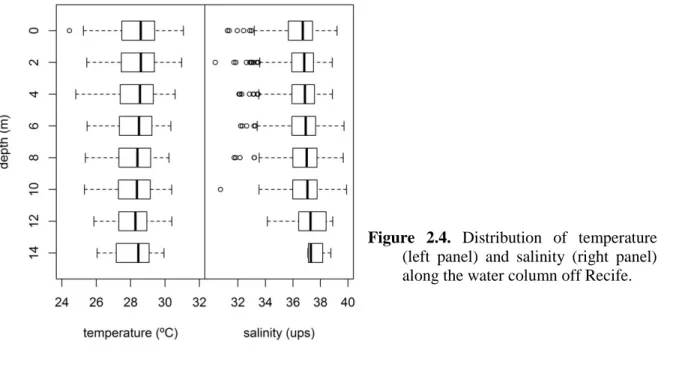
The area off Recife where most attacks occurred (hereafter referred to as the area of risk) is approximately 20 km long and includes five contiguous beaches: Paiva, Candeias, Piedade, Boa Viagem, and Pina (Fig 1.5). The stretch between Candeias and Pina is densely urbanized and has the highest density of beach users in the region (Silva et al., 2008), while Paiva is a comparatively undeveloped area frequented by few people. All these beaches are under the influence of the Barra de Jangadas estuary, formed by the Pirapama and Jaboatão rivers which together drain an area of about 1,000 km2 into the Atlantic Ocean (Carneiro and Coelho, 1960). The local tidal regime is semi-diurnal and exhibits an average amplitude of 1.67 m, with neap tides averaging 0.97 m and spring tides averaging 2.07 m of amplitude (Rollnic, 2002). Sea water temperature shows little variation, ranging from 24ºC during winter to 30ºC during summer (Hazin et al., 2000). Salinity is typically high, oscillating between 36-37 ups in the first 80 m of the water column and further reducing to about 35 ups at deeper water layers (Macêdo et al., 2004). Northward coastal currents driven by the southeastern trade winds predominate almost all year-round (Bittencourt et al., 2005), but southward coastal currents may occur during the dry season (Lira et al., 2010; Rollnic et al., 2011), when the southeast trade winds are weaker and the northeastern winds trades become more frequent.
40
The continental margin off the northeastern Brazil consists of a narrow shelf (63 km average width; Souza, 2007) bordered by one of the longest, consistently steep (4 to 20º) continental slopes in the world (Fainstein and Milliman, 1979). Off Recife, the continental shelf slants smoothly for about 40 km down to the 60 m isobath, where the slope abruptly starts. Such a relatively narrow shelf results in this region being strongly influenced by the South Equatorial Current (SEC), whose oligotrophic waters usually stimulate long trophic webs, while more coastal waters are exposed to nutrient input from estuarine plumes and may exhibit trophic webs with fewer links (Neumann-Leitão et al., 2004). Resurreição et al. (1996) suggested that the influence of estuarine plumes off Recife was visible until the 30 m isobath, whilst Medeiros et al. (1999) measured the concentration of Chlorophyll-a in coastal waters to be 4 times higher than in oceanic waters. Calcareous algae such as Halimeda spp. and Udotea spp. (order Bryiopsidales), and Lithothamnium spp. (order Coralinalles) dominate the substratum and are responsible for the high proportion of biogenic carbonate in the sediment (Coutinho, 1976; Manso et al., 2003). Based on geomorphic and sedimentological aspects, Coutinho (1976) divided the continental shelf off northeastern Brazil in three distinct segments, namely i) the inner platform, extending to the 20 m isobath with a smooth topography and dominated by terrigenous sediments such as silicates and silts, which contain a considerable amount of organic detritus and a percentage of biogenic carbonate generally inferior to 25%; ii) the middle platform, extending between 20-40 m isobaths with a more irregular topography and predominance of biogenic carbonates; and iii) the outer platform, extending from the 40 m isobath until the slope and being dominated by biogenic carbonate in a proportion generally higher than 75%, and by a bluish calcareous mud in a proportion between 10-15%. Another characteristic of this continental shelf is the low abundance of corals compared to algae. Presently, the distribution of corals is generally restricted to the seaward side of beachrocks and reefs which border the shoreline and that represent the only hard substrate available (Manso et al., 2003), except for several ship wrecks (Fischer, 2009).
Beachrocks can play an important role in nearshore waters, particularly when the seafloor is dominated by soft substrate. The mesolittoral of Pina, Boa Viagem, and Piedade exhibits an intermittent line of reefs which form tidal pools during low tide. Further offshore, a second, submerged line of beachrocks disturbs the infralittoral topography and creates a channel-like, alongshore structure about 6.4 m in average depth (Gregório et al., 2010; Hazin
41
et al., 2008). This second line of beachrocks acts as a barrier against hydrodynamic surge and so it provides mechanical protection to local benthic communities. Also, beachrocks add complexity to the nearshore habitat and provide a suitable substrate for incrusting and sessile organisms. Off Recife, beachrocks may additionally be a factor contributing to the high shark attack rate verified in this shore. In fact, the channel-like structure that they generate could restrict the movements of large, potentially aggressive sharks that enter the channel by imposing an obstacle to the seaward motion. As such, sharks may be confined to the area between the beach and the beachrock when foraging through this shore, which would certainly increase the likelihood of a shark-human encounter.
The objective of this chapter is to describe the spatiotemporal variation of some environmental parameters in the study area which could be relevant to the occurrence and distribution of elasmobranchs, and to increase previous knowledge on the environmental dynamics in this region. This chapter also aims at assessing the bathymetry of the area of risk in finer detail and relating it with shark-human encounters off Recife.
2.2. Materials and methods
Local atmospheric data concerning pluviosity (in mm), wind direction (in degrees), wind maximum speed (in knots), and atmospheric pressure (in kPa) for the period between January 2004 and December 2011 were obtained from the Sistema Nacional de Dados Ambientais, managed by the Centro de Previsão de Tempo e Estudos Climáticos (CPTEC) from the Instituto Nacional de Pesquisas Espaciais (INPE) of the Brazilian Ministry of Science and Technology (http://sinda.crn2.inpe.br/PCD/historico/consulta_pcdms.jsp; Accessed January 16th 2012). The environmental monitoring of the study area was conducted in parallel with fishing operations (see chapter 4) at two sampling sites, hereafter referred to as Boa Viagem (BV) and Paiva (PA). Between May 2004 and December 2011, the sea surface temperature (±0.2ºC) was measured at both sites with a FURUNO FCV-5821 echosounder installed in the R/V Sinuelo. In order to assess variations in the water column, the temperature and salinity were sampled at 2 m-depth intervals between the sea surface and the sea floor, thus generating 8 samples at depths 0, 2, 4, 6, 8, 10, 12 and 14 m at each site. Temperature