A±nity, Animosity and Organizational
Design
Luis Almeida Costa and Jo~
ao Amaro de Matos
Faculdade de Economia
Universidade Nova de Lisboa
1December 1999
JEL: L20, M10, M14, M20
1Rua Marqu^es de Fronteira, 20, 1099-038 Lisbon, Portugal. Contact by email:
Abstract
The behavior of the members of an organization is determined, not only by the objective situation facing them, but also by their attitudes. Thus, the objective of aligning collective goals and individual behavior translates into a problem of alignment of attitudes. An important dimension of the problem of organizational design is, therefore, to choose the organization that best contributes to the alignment of attitudes. This paper shows that the existence of animosity, as opposed to a±nity, a®ects the optimal organizational design.
1
Introduction
The problem of aligning individual behavior and collective goals has been extensively studied under a principal-agent framework1. Two main
solu-tions to this problem have been studied in the literature: monitoring and explicit incentive contracts. While these two solutions correspond to changes in the objective situation faced by individuals, behavior is also determined by attitudes2. Attitudes can be de¯ned as summary evaluations of objects
along a dimension ranging from positive to negative. Since attitudes in°uence behavior, the objective of aligning collective goals and individual behavior translates into a problem of alignment of attitudes. Thus, an important di-mension of the problem of organizational design is to choose the organization that best contributes to the alignment of attitudes.
The evolution of attitudes in an organization depends, ¯rst of all, on the organizational structure, de¯ned as the system of formal and informal com-munication channels that characterizes an organization. Two extreme types of organizational structures are considered: the hierarchy and the network. The hierarchy is a system in which the communication channels correspond to the links of authority that characterize the formal structure. The formal structure is composed of the set of positions in the organization, the way these positions are clustered and the way the formal authority °ows among them. In the network, the communication channels corresponding to the formal links of authority are complemented by a complex system of infor-mal relationships between the organization members, so that all of them are linked. We also consider an intermediate case, called the hybrid structure, where there is only one type of informal relationship: direct peer contact, i.e., contact between elements in the same hierarchical level.
The organizational structure de¯nes who communicates with whom and, therefore, who in°uences whom. However, the evolution of attitudes within
1Early contributions include the works of Mirrlees [10], Ross [11] and Spence and
Zeckhauser [12]. See, for instance, Hart and Holmstrom [9] and Gibbons [7] for reviews on this topic.
2An extensive literature in the ¯eld of social psychology studies the relationship between
attitudes and behavior. See, for instance, Ajzen and Fishbein [4], Fishbein and Ajzen [6], Ajzen [2, 3]. See also Brief [5] for a recent survey.
the organization depends, not only on who in°uences whom, but also on the direction of that in°uence. We say that there is a±nity between two individuals who communicate with each other when the fact that one of them has a given attitude induces the other to have the same attitude. In contrast, we say that there is animosity between two individuals when they in°uence each other in the opposite direction. While the a±nity case has been extensively studied in a recent paper [1] in a much more general context, this note considers both the existence of a±nity and animosity between peers. It characterizes the optimal organizational structure in both cases and discusses how the type of relationship between peers a®ects the optimal design.
2
The Model
Consider an organization with three levels of authority, where each individual in the ¯rst two levels has two subordinates3. This organization may be
inter-preted as consisting of one top manager and two multi-agent departments. There are seven elements in this organization: the top manager, labeled as 1, two managers, labeled as 2 and 3, and two elements in each of the two departments, labeled 4; 5; 6 and 7. The numbers have been distributed in such a way that it is possible to refer to the two departments as the odd department (the one including elements 3,5 and 7) and the even department. Each individual has a \positive" or a \negative" attitude, depending on how he/she feels about a certain issue. Let si =§1; i = 1; 2; ¢ ¢ ¢ ; 7, represent
the attitude of each individual.
The initial set of attitudes is not necessarily stable: attitudes evolve in time as individuals are in°uenced by other members of the organization. As mentioned above, the dynamics through which attitudes evolve depends on the organizational structure. Organizational structure is described by a 7£7 matrix J, where each element Jij describes the in°uence of individual i over
individual j. A positive value of Jij means that there is a±nity between
individuals i and j: a given attitude of i tends to in°uence j's attitude in the same direction. Conversely, a negative value of Jij means that there is
3This is the simplest organization that captures the features of organizations with
animosity between the two individuals: a given attitude of i in°uences j's attitude in the opposite direction. The intensity of the in°uence of i over j is given by the absolute value of Jij.
The three organizational structures are characterized as follows. In the hierarchy, the communication channels correspond to the formal links of au-thority. In particular, we de¯ne a matrix of in°uences J given by
J = 2 6 6 6 6 6 6 6 6 6 6 6 4 0 u u 0 0 0 0 d 0 0 u 0 u 0 d 0 0 0 u 0 u 0 d 0 0 0 0 0 0 0 d 0 0 0 0 0 d 0 0 0 0 0 0 0 d 0 0 0 0 3 7 7 7 7 7 7 7 7 7 7 7 5
This matrix assumes that each element in°uences its subordinates equally, with intensity u > 0. For instance, the in°uence of the top manager on man-agers 2 and 3 is expressed by J12 = J13 = u. It is also assumed that the
subordinates in°uence their direct superiors with an intensity d < u. For example, the top manager is in°uenced by the two managers but with less intensity. This is expressed by J21= J31= d, with u > d > 0.
In the network, the communication channels corresponding to the for-mal links of authority are complemented by a complete system of inforfor-mal communication. In these informal channels, individuals bypass the formal authority system in order to communicate directly. In particular, we de¯ne a matrix of in°uences J by J = 2 6 6 6 6 6 6 6 6 6 6 6 4 0 u u u u u u d 0 e u u u u d e 0 u u u u d d d 0 e e e d d d e 0 e e d d d e e 0 e d d d e e e 0 3 7 7 7 7 7 7 7 7 7 7 7 5
This matrix assumes that each element in°uences all the elements in lower levels equally, with intensity u > 0. For instance, the in°uence of the top
manager on both managers 2 and 3 is the same as his/her in°uence on in-dividuals in the lower level. This is expressed by J12 = J13 = J14 = J15 =
J16 = J17 = u. It is also assumed that every element in°uences all
individ-uals in upper levels equally, with intensity d > 0 and d < u. Finally, since all relationships are considered, we include the in°uence among individuals within the same hierarchical level. Whatever level is considered, their recip-rocal in°uence is assumed to be given by e > 0 with e < u.
We also consider a hybrid structure where there is only one type of infor-mal relationship: direct peer contact. More speci¯cally, assume that the two managers communicate directly with each other and that peers working in the same department also communicate with each other. These links may be interpreted as corresponding to the existence of an executive committee, and of interdepartmental in°uence. In particular, we de¯ne a matrix of in°uences J given by J = 2 6 6 6 6 6 6 6 6 6 6 6 4 0 u u 0 0 0 0 d 0 e u 0 u 0 d e 0 0 u 0 u 0 d 0 0 0 e 0 0 0 d 0 0 0 e 0 d 0 e 0 0 0 0 0 d 0 e 0 0 3 7 7 7 7 7 7 7 7 7 7 7 5
The dynamics of attitude change is modeled as follows. For a given set of attitudes at time t, the j-th attitude is updated at time t + 1 based on three factors: the attitudes of the other members at time t, the in°uence of each of them on j, and the strength of j's personal beliefs, values and personality. This last factor is represented by a variable ®j. The sign of this variable gives
the attitude of j in the absence of in°uence from any of the other members. Its magnitude allows us to compare the impact of j's personal beliefs, values and personality with the strength of the in°uence of the others over him/her. The change of j-th attitude is assumed to occur according to the rule4
sj(t + 1) = sign à X i Jijsi(t) + ®j ! :
Notice that sj tends to align with the personal values ®j and with the
attitudes of those who have a positive in°uence over j (Jij > 0). In addition,
it tends to align negatively (or disalign) with the attitudes of those who have a negative in°uence over j (Jij < 0)5.
The dynamics of attitude change in the organization depends, not only on the system of communication channels, but also on the timing of information °ows. We consider both the simultaneous and the sequential dynamics below. Under the simultaneous dynamics, everybody considers the change of atti-tude simultaneously. This corresponds to the case where issues are discussed openly and there is a high level of participation. Under the sequential dy-namics, attitudes are revised sequentially, according to a prespeci¯ed order6.
This corresponds to the case where information °ows slowly from individual to individual. A set of attitudes is said to be in equilibrium when the con¯g-uration attains a ¯xed point under the speci¯ed dynamics.
The evolution of attitudes also depends on the initial con¯guration of attitudes. We consider two extreme initial con¯gurations of attitudes con-sidered in this paper: the isolated leader and the con°icting attitudes case. The isolated leader case corresponds to the situation where the leader has an attitude which is di®erent from that which prevails in the organization. In particular, consider s1 = +1 and si = ¡1 for i 6= 1. This case allows us to
study those situations where an isolated leader tries to change the attitude of the rest of the organization. In the con°icting attitudes case, the leader faces a situation where the organization is split into two signi¯cant factions - one that has the same attitude as the top manager and one that has the opposite attitude. In particular, we assume that one department (the odd department) has the same attitude as the top manager and the other de-partment (the even dede-partment) has the opposite attitude. This means that
5For simplicity of exposition below, it is assumed that ®
j= 0 for all j.
6We consider two prespeci¯ed orders: the top-down (TD) and the bottom-up (BU)
sequential dynamics. In the TD, individuals revise their attitudes in an increasing order, from individual 2 to individual 7, and then restarting from number 1. The process does not start with the top manager because this individual is the change agent whose impact in the organization we want to study. In the BU, the cycle of revision of attitudes starts with individual 7 and follows a decreasing numerical order to 1, restarting until equilibrium is reached.
si = +1 for all odd i and si = ¡1 for i even. In both initial con¯gurations
the objective of the top manager is to choose the organizational structure that favors the alignment of the members' attitudes with his/her own initial attitude.
3
Results
We are now in a position to discuss the impact of a±nity and animosity on the optimal design of the organization.
3.1
A±nity
Structure Dyn 2d¡ e > u 2d > u > 2d ¡ e 2d < u < 2d + e u > 2d + e T-D All (-) All (-) Init. Conf. All (+) Hybrid B-U All (-) All (-) All (+) All (+) Sim. All (-) All (-) All (-) No equil. T-D All (-) All (-) All (+) All (+) Hierarchy B-U All (-) All (-) All (+) All (+) Sim. All (-) All (-) No equil. No equil.
4d¡ e > u 4d¡ e < u < 4d + e u > 4d + e T-D All (-) All (-) All (+) Network B-U All (-) All (-) All (-)
Sim. All (-) All (-) All (-) if u < 3e No eq. if u > 3e Table 1: Comparison of the results for the isolated leader in the presence of
cooperation.
The results for the isolated leader case are summarized in Table 1. It follows from this table that a necessary condition for the leader to be able to change the prevalent attitudes within the organization is that the dynamics be sequential. It is easier for an isolated leader to in°uence ¯rst the individ-uals in one level of the formal structure and then - possibly with the help of those individuals - to in°uence individuals in the other level. This re-sult suggests that the degree of participation is a relevant ingredient in the
process of attitude change. The simultaneous dynamics may be understood as corresponding to a situation in which issues are discussed openly, with a high level of participation, so that everybody gets the same information at the same time and attitudes change simultaneously. In contrast, under a sequential dynamics, issues are discussed within subgroups according to a certain order. This increases the ability of top management to impose its attitude.
It also emerges from Table 1 that the hierarchy is the optimal organiza-tional structure. The reason is that the informal relationships that charac-terize the network and, to a lesser extent, the hybrid organization lead to the mutual reinforcement of the members' negative attitude. Clearly, this does not happen, at least with the same intensity, in the hierarchy.
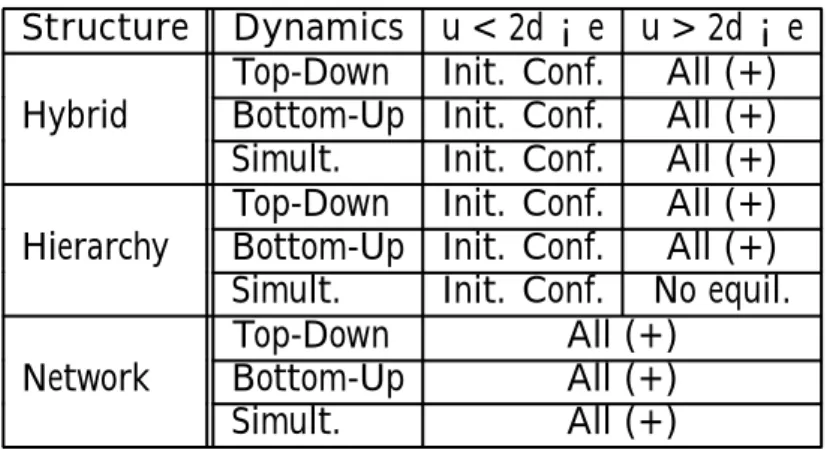
Structure Dynamics u < 2d¡ e u > 2d ¡ e Top-Down Init. Conf. All (+) Hybrid Bottom-Up Init. Conf. All (+) Simult. Init. Conf. All (+) Top-Down Init. Conf. All (+) Hierarchy Bottom-Up Init. Conf. All (+) Simult. Init. Conf. No equil. Top-Down All (+)
Network Bottom-Up All (+) Simult. All (+)
Table 2: Comparison of the results for con°icting attitudes in the presence of cooperation.
The results for the con°icting attitudes case are summarized in Table 2. From this table, it follows that, as in the isolated leader case, it is easier for the top manager to change the prevailing attitudes within the organization under the sequential dynamics than under the simultaneous dynamics. In the hierarchy, in particular, a necessary condition for the top manager's at-titude to prevail is that the dynamics be sequential. The intuition is similar to that presented in the isolated leader case: it is easier for the top manager
to ¯rst in°uence the individuals in one level of the dissident department and then - possibly with the help of those individuals - to in°uence members in the other level.
It is also evident from Table 2 that, in contrast to the isolated leader case, the network is the optimal organizational structure. This is so because both in the hierarchy and in the hybrid organization there are clusters having a given attitude that do not interact with other clusters having the opposite attitude. In other words, there are individuals with a given attitude who interact only with people sharing the same attitude. The informal realtion-ships that characterize the network organization avoid this situation, allowing for interactions betwen people from di®erent departments. This facilitates change.
3.2
Animosity
Structure Dynamics u < 2d¡ e 2d ¡ e < u < 2d + e u > 2d + e Top-Down All (-) Dissid. Dept. All (+) Hybrid Bottom-Up All (-) Dissid. Dept. All (+) Simult. All (-) All (-) No equil.
u < 2d u > 2d Top-Down All (-) All (+) Hierarchy Bottom-Up All (-) All (+) Simult. All (-) No equil.
u < 4d¡ e 4d ¡ e < u < 4d + e u > 4d + e Top-Down Init. Conf. All (+) All (+) Network Bottom-Up All (-) All (+) All (+) Simult. All (-) No equil. No equil. Table 3: Comparison of the results for the isolated leader in the presence of animosity.
The results for the isolated leader case are summarized in Table 3. It follows that, as in the a±nity case, a necessary condition for the leader to be able to change the prevalent attitude within the organization is that the
dynamics be sequential. Again, it is easier for an isolated leader to ¯rst in°u-ence the individuals in one level of the formal structure and then - possibly with the help of those individuals - to in°uence individuals in the other level. It is also apparent from Table 3 that, as opposed to the a±nity case, the network is the optimal organizational structure. The intuition is the follow-ing. Let us ¯rst compare the hierarchy and the hybrid. In contrast to the a±nity case, where the informal links which characterize the hybrid organi-zation lead to the mutual reinforcement of the members' negative attitudes, here the animosity between peers facilitates attitude change. Interestingly, the network ampli¯es this e®ect, because when an attitude becomes positive there is a chain-reaction impact on all the other members of the organization.
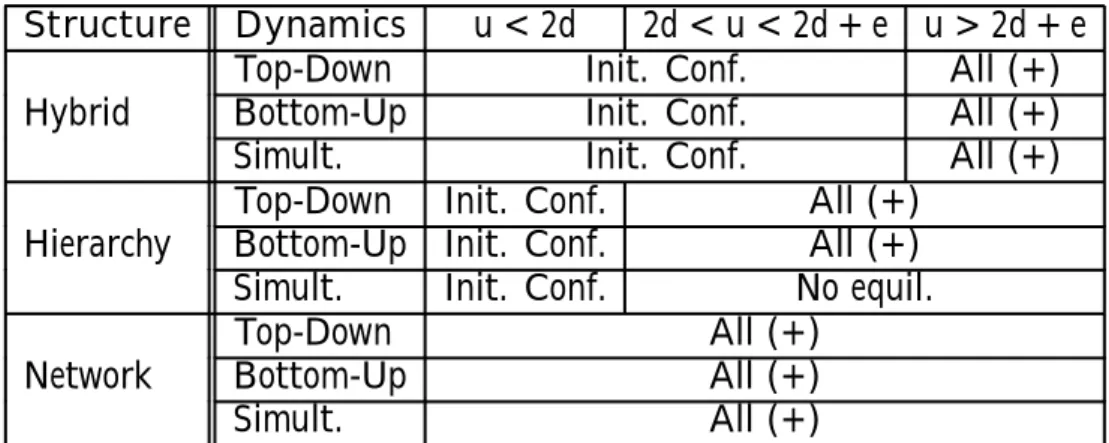
Structure Dynamics u < 2d 2d < u < 2d + e u > 2d + e Top-Down Init. Conf. All (+) Hybrid Bottom-Up Init. Conf. All (+) Simult. Init. Conf. All (+) Top-Down Init. Conf. All (+)
Hierarchy Bottom-Up Init. Conf. All (+) Simult. Init. Conf. No equil. Top-Down All (+)
Network Bottom-Up All (+) Simult. All (+)
Table 4: Comparison of the results for con°icting attitudes in the presence of animosity.
The results for the con¯cting attitudes case are summarized in Table 4. As in the a±nity case, it is easier for the top manager's initial attitude to prevail in the organization under the sequential dynamics than under the simultaneous dynamics. The intuition is the same as above.
In addition, the network is the optimal organizational structure. This is so because, as in the a±nity case, in both the hierarchy and the hybrid organization there are individuals in level 3 who interact only with people
having the same attitude. Since, by assumption, u > e, this makes it more di±cult for the top manager to change the attitude of individuals in level 3 who start with a negative attitude.
4
Conclusion
This note shows that the optimal organizational structure depends on the type of the relationship among organization members. Consider the a±n-ity case. Here, when the leader is isolated, the hierarchy is the optimal structure. Informal relationships lead to the mutual reinforcement of the members' attitudes, making attitude change more di±cult. Furthermore, in the con°icting attitudes case, the network is the optimal structure. The in-formal relationships that characterize the network facilitate attitude change. However, even a small degree of animosity may change these results. In par-ticular, it is shown that when there is some animosity between peers, it is no longer optimal for an isolated leader to choose a hierarchy. Due to animos-ity, the informal relationships that characterize the network may facilitate change. This result has an important implication: one cannot discuss the problem of organizational design without paying attention to the degree of a±nity or animosity that characterizes the organization.
However, our analysis indicates that the presence of animosity does not a®ect two other results presented in [1]. First, the process of attitude change is in°uenced in the same way by the timing of information °ows: the sequen-tial dynamics facilitates attitude change. This means that the top manager may make attitude change easier by decreasing the level of participation, so that issues are discussed within subgroups, in an order corresponding to the formal structure of authority. This is so because it is easier for the top man-ager to ¯rst in°uence a group of individuals and then - possibly with the help of these individuals - to in°uence other individuals. Second, as expected, the ability of the top manager to in°uence the con¯guration of attitudes depends upon the degree of in°uence exercised by superiors over subordinates and, in particular, by the top manager.
References
[1] Almeida Costa, L and J. Amaro de Matos (1999), Organizational Struc-ture, Information Flows and Attitude Change, Working Paper FEUNL 368 (www.fe.unl.pt).
[2] Ajzen, I. Attitudes (1987), Traits and Actions: Dispositional Prediction of Behavior in Personality and Social Psychology. Advances in Experi-mental Social Psychology, 20, 1-63.
[3] Ajzen I. (1988), Attitudes, Personality and Behavior, Open University Press.
[4] Ajzen, I. and M. Fishbein (1977), Attitude-Behavior Relations: A The-oretical Analysis and Review of Empirical Research. Psychological Bul-letin, 84, 888-918.
[5] Brief, A.P. (1998), Attitudes In and Around Organizations, Sage. [6] Fishbein, M. and I. Ajzen (1974), Attitudes Towards Objects as
Predic-tors of Single and Multiple Behavioral Criteria. Psychological Review, 81, 59-74.
[7] Gibbons, R. (1998), Incentives in Organizations, Journal of Economic Perspectives, 12, 115-132.
[8] Hop¯eld, J. (1982), Neural Networks and Physical Systems with Emer-gent Collective Computational Abilities, Proceedings of the National Academy of Sciences USA, 79, 2554-2558.
[9] Hart, O. and B. Holmstrom (1987), The Theory of Contracts in T.F. Be-wley (ed.), Advances in Economic Theory, Cambridge University Press, pages 71-155.
[10] Mirrlees, J. (1971), An Exploration in the Theory of Optimum Income Taxation, Review of Economic Studies, 38, 175-208.
[11] Ross, S. (1973), The Economic Theory of Agency: The Principal's Prob-lem, American Economic Review, 63, 134-139.
[12] Spence, A.M. and R. Zeckhauser (1971), Insurance, Information and Individual Action, American Economic Review, 61, 380-387.