J. res.: fundam. care. online 2014. jul./set. 6(3):1221-1230
1221
REVIEW
A importância dos cuidados paliativos prestados pelo enfermeiro à criança com câncer em estágio terminal
The importance of palliative care provided by the nurse for children with cancer in terminal phase La importancia de los cuidados paliativos prestados por los enfermeros a los niños con cáncer
terminal
Carolina Marinato Bernardo 1 , Debora Marinato Bernardo 2 , Izabele Alves Costa 3 , Lidia Rodrigues Silva 4 , Williana Graciele Pires Araujo 5 , Renê dos Santos Spezani 6
Objective: to reflect on the importance of palliative care provided by nurses to children with terminal cancer. Method: a descriptive-exploratory study conducted in the databases: LILACS, BDENF and SciELO, in the period of 2000 to 2010, where there were selected 10 potential bibliographies. Results: the categories were: "The nurse and the difficulties of acceptance of the terminally ill child", "Communication as a liaison between the nursing staff, children with cancer and their family" and "The importance of nursing care to children with cancer in palliative care". Conclusion: the results of this study validate the importance of nurses' performance, where the closeness of ties will allow a more effective and conscious nursing practice among all stakeholders. Descriptors: palliative care, cancer in child, nursing care.
Objetivo: refletir sobre a importância dos cuidados paliativos prestados pelo enfermeiro à criança com câncer em estágio terminal. Método: estudo de caráter descritivo-exploratória, realizado nas bases de dados: LILACS, BDENF e SCIELO no período de 2000 a 2010, onde selecionou 10 bibliografias potenciais. Resultados: as categorias emergentes foram: “O enfermeiro e as dificuldades de aceitação da criança em fase terminal”, "A comunicação como elo entre a equipe de enfermagem, criança com câncer e sua família" e "A importância da assistência de enfermagem à criança com câncer em cuidados paliativos". Conclusão: os resultados deste estudo ratificam a importância da atuação do enfermeiro, onde a proximidade de vínculos permitirá uma prática de enfermagem mais efetiva e consciente entre todos os envolvidos. Descritores: cuidados paliativos, câncer na criança, assistência de enfermagem.
Objetivo: reflexionar sobre la importancia de los cuidados paliativos prestados por parte del enfermero a niños con cáncer terminal. Método: estudio descriptivo-exploratorio, realizado en las bases de datos: LILACS, BDENF y SCIELO, en el período de 2000 a 2010, donde fue seleccionado 10 bibliografías potenciales. Resultados: las categorías fueron: "La enfermera y las dificultades de la aceptación de los niños con enfermedades terminales", "La comunicación como un enlace entre el personal de enfermería, los niños con cáncer y sus familiares" y "La importancia de los cuidados de enfermería de los niños con cáncer en cuidados paliativos". Conclusión: los resultados de este estudio validan la importancia del desempeño de las enfermeras, donde la cercanía del enlace permitirá la práctica de enfermería más eficaz y consciente de todos los involucrados. Descriptores: cuidados paliativos, cáncer en los niños, cuidados de enfermería.
1Nurse graduated from the University Center Plínio Leite- UNIPLI. E-mail: [email protected]. 2Nurse graduated from
the University Center Plínio Leite-UNIPLI. E-mail: [email protected]. 3Nurse graduated from the University Center
Plínio Leite - UNIPLI. E-mail: [email protected]. 4Nurse graduated from the University Center Plínio Leite - UNIPLI. E-mail:
[email protected]. 5Nurse graduated from the University Center Plínio Leite - UNIPLI. E-mail: [email protected]. 6Master in Nursing (UNIRIO), Professor of the University Center Plínio Leite; and advisor. E-mail: [email protected].
ABSTRACT
RESUMEN RESUMO
J. res.: fundam. care. online 2014. jul./set. 6(3):1221-1230
1222
C
ancer is still a disease that most often leads to death worldwide. Itscauses are varied and can be related to the way we live, habits, customs, culture or genetically pre-determined, linked to the ability of the body has to defend itself against external aggression.1
In the case of pediatric cancer, it is reported that this is the second cause of death between 0 and 14 years old, behind only accidents. While the prospect of cure is high, the mortality rate for childhood cancer is still high and most often arises from unknown causes, when they are not related to the environment and the child. It is therefore an important public health problem in the present.1
It is emphasized that to have different primary sites, clinical behavior and histological origins, childhood cancer should have a differentiated service of various neoplasms exist in other age groups, since the tumor grows rapidly, becoming quite invasive, despite having shorter latency periods and respond better to treatment.1
If indeed the childhood cancer can lead the child to death, even when there are no more chances of cure is necessary to invest in life, applying measures to make this process less painful for families and especially for children.
In this moment of pain, caused by suffering associated with cancer, the only comfort this family is to make sure that palliative care will be provided by a team of skilled nursing and prepared this child, providing you with individualized assistance.
This feature demonstrates that the terminal phase of the disease, the child no longer has the possibility of cure, palliative treatment should be intensified and secured, in order to provide, through the numerous actions that constitute a better quality of life.1
Part of this perspective is to approach the object of this study - the importance of palliative care provided by nurses to children with cancer, considering that, although the stage of the disease is very advanced and the child diagnosed as out of scope for current cure (FPCA), the assistance shall be maintained throughout life, in order to provide well-being and quality assurance of life of patients and their families.
Given this premise, arises as a problem in this research: What is the importance of palliative care provided by nurses for terminally ill child?
In this case, in order to elucidate the question, the research objective is to reflect on the importance of palliative care provided by nurses to children with terminal cancer.
The need for better trained nurses regarding palliative care to children with cancer face a time when we are seeking to consummate in practice to improve the quality of nursing care justifies the completion of this study, as even nursing being so close to the patient and your family, there is still a major barrier when it comes to children in the terminal phase.
J. res.: fundam. care. online 2014. jul./set. 6(3):1221-1230
1223
METHOD
The relevance of this research lies in its ability to contribute to the understanding of palliative care to children with cancer, because the nurse's role is not limited to children with terminal, but extends to all links to which weaves relationships, school, society, friends and especially family.
On the other hand, reference to the character of this research ace their possible contribution to broaden the literature and existing discussions on the subject, so that the nurses can keep themselves updated, providing humanized care, as well as the review of scientific understanding to enable the patient and his family in this process that is so painful.
This is a research of descriptive-exploratory type, elaborated through data collection obtained from a literature review, through articles published between the years 2000-2010 and indexed by the Virtual Health Library (VHL), enjoying only SCIELO, BDENF and LILACS data.
For data collection were employed descriptors: palliative care, cancer in children and nursing care.
Initially the descriptors were surveyed individually, being found 13,696 works, according to Table 1.
Table 1: Quantitative distribution of articles found individually in databases.
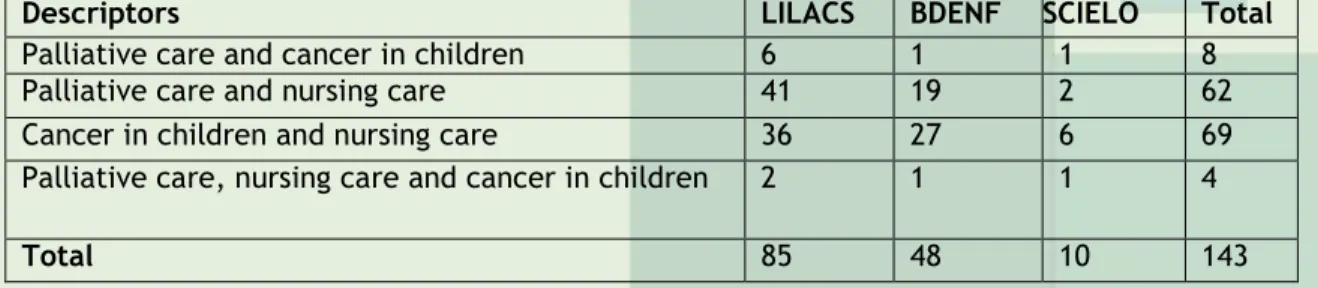
Due to the large quantity of works found there was a need to refine the search, which resulted in a new framework with associated descriptors in dual and trio, in accordance with Table 2.
Table 2: Quantitative distribution of articles found in databases with associated descriptors in dual and trio.
Descriptors LILACS BDENF SCIELO Total
Palliative care and cancer in children 6 1 1 8
Palliative care and nursing care 41 19 2 62
Cancer in children and nursing care 36 27 6 69
Palliative care, nursing care and cancer in children 2 1 1 4
Total 85 48 10 143
In the third stage, there was a pre-reading and selective reading of the complete text, which allowed us to delimit the search 10 jobs that meet the objectives proposed. We excluded studies that did not meet the goals and that were repeated in the databases consulted. The selected works constituted a potential bibliography.
Descriptors Databases
LILACS BDENF SCIELO Total
Palliative care 424 33 113 570
Cancer in children 658 46 28 732
Nursing care 6.556 5.216 622 12.394
J. res.: fundam. care. online 2014. jul./set. 6(3):1221-1230
1224
RESULTS AND DISCUSSION
Later, in possession of the bibliography potential was held on analytical reading, which allowed the organization to build 03 categories of analysis according to the emerging themes: The nurse and the difficulties of acceptance of the child in the terminal phase, as communication link among the nursing staff, a child with cancer and their families and the importance of nursing care of children with cancer in palliative care.
The nurse and the difficulties of acceptance of the child in the terminal phase
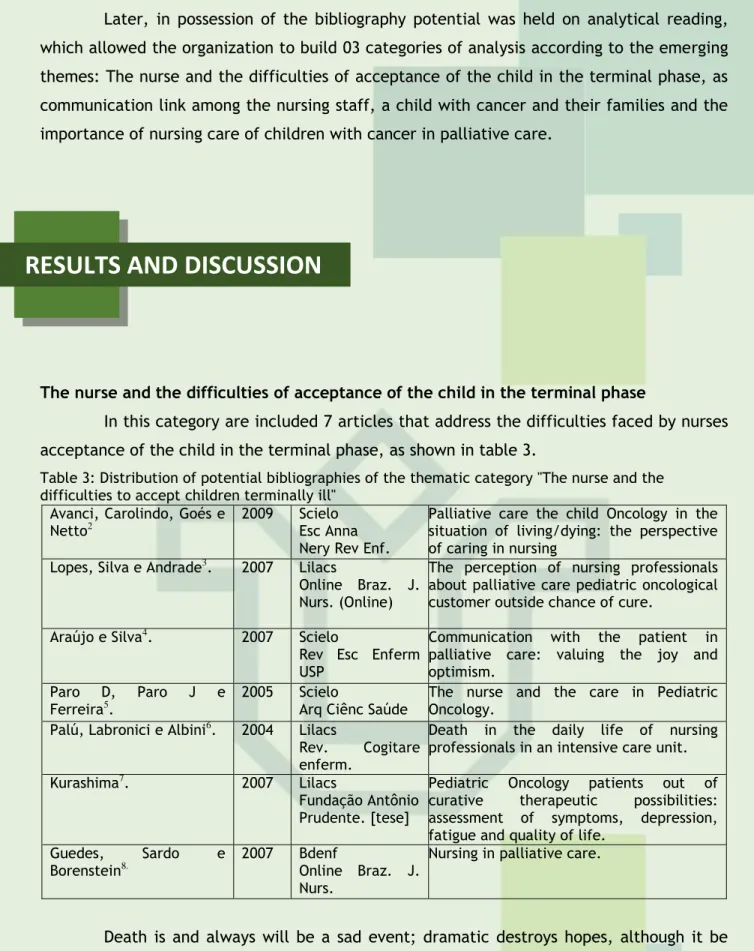
In this category are included 7 articles that address the difficulties faced by nurses acceptance of the child in the terminal phase, as shown in table 3.
Table 3: Distribution of potential bibliographies of the thematic category "The nurse and the difficulties to accept children terminally ill"
Avanci, Carolindo, Goés e
Netto2 2009 Scielo Esc Anna Nery Rev Enf.
Palliative care the child Oncology in the situation of living/dying: the perspective of caring in nursing
Lopes, Silva e Andrade3. 2007 Lilacs
Online Braz. J. Nurs. (Online)
The perception of nursing professionals about palliative care pediatric oncological customer outside chance of cure.
Araújo e Silva4. 2007 Scielo
Rev Esc Enferm USP
Communication with the patient in palliative care: valuing the joy and optimism.
Paro D, Paro J e Ferreira5.
2005 Scielo
Arq Ciênc Saúde The nurse and the care in Pediatric Oncology. Palú, Labronici e Albini6. 2004 Lilacs
Rev. Cogitare enferm.
Death in the daily life of nursing professionals in an intensive care unit. Kurashima7. 2007 Lilacs
Fundação Antônio Prudente. [tese]
Pediatric Oncology patients out of curative therapeutic possibilities: assessment of symptoms, depression, fatigue and quality of life.
Guedes, Sardo e Borenstein8.
2007 Bdenf
Online Braz. J. Nurs.
Nursing in palliative care.
Death is and always will be a sad event; dramatic destroys hopes, although it be undeniable. The death of a child or to make sure this event is even more difficult to accept, whether for your family or for nursing staff that is monitoring all this suffering.
This fact is referenced in the first study2, it reports that nurses, in their majority, have great discomfort in dealing with the death of the child with cancer in palliative care, because individuals during childhood are seen by society as bearers of joy and life, qualities that are opposed to the death.
In a similar vein, the second study3 the authors highlight the difficulty faced by nurses in dealing with death and dying, facts that are inherent in the work of professionals who assist the pediatric client with no chance of cure in oncology.
In turn, the third search4 adds that many professionals seem unaware therapeutic communication techniques, avoiding verbal contact with patients who experience the dying
J. res.: fundam. care. online 2014. jul./set. 6(3):1221-1230
1225
process, moving away, not knowing how to work the feelings that the situation of impending doom them awakens.It is noted from these observations that reality brings important consequences for relations of providing and receiving care, instituting health care barriers that corroborate that many professionals distance themselves from their role cozy, either by lack of professional training, or even fear of involved, especially when they are children who communicate orally, with the ability to express their feelings and their suffering
In the fourth study5 the authors report that contact, the limitations and the need to
deal with death resulting in feelings of powerlessness and inadequacy in nursing, which causes suffering as a result of involvement with the child and his family and impotence towards negative trend disease, which can result in cold and impersonal service.
On the other hand, the fifth research 6 emphasizes the feeling of denial does not prevent practitioners seek to live in a manner acceptable to the dying process of patients and although they showed to see death as a natural fact, they end up developing other feelings, such as impartiality, considered as a form of defense against the suffering that ends in death.
Thus, all these possibilities relate to the thought of the sixth research7, which
emphasize that one of the most difficult and painful in pediatric oncology is to learn to accept and cope with the death of the child terminal. What may prove to be a personal experience of value, for the comfort that can be provided and the feeling of having done their utmost to alleviate the suffering of the patient and family, providing a death with dignity.
On the other hand, the seventh study8 it appears that the same experience can be
characterized as a threat to the psychic professional nurse in performing their functions, highlighting a need to also invest in the care of those who care so that nurses can use psychological counseling; carrying out specialized courses in the field of palliative care in order to develop skills to deal with the terminally ill and their families, with death and grief.
It is noteworthy, however, that only this view does not show enough to solve the issue, which confirms the view that efforts should be made also for the establishment and search for alternatives to encourage communication between the parties involved and facilitate the development assistance.
In fact the child with cancer disrupts a family in many ways and although the nursing professional to experience the whole process of illness and death of that child in palliative care, one cannot fail to be desired, even by fear or lack of involvement. This reality leads to the thought that it is essential that the nurse is better prepared and structured so that it can play an important role before the inevitable possibility of the child to go to death.
In this sense, it is believed that nurses can engage further and, through their knowledge and experience gained throughout his career, to develop methods and adaptive approach that envisage reflections address the needs for assistance made by the child and also your family.
J. res.: fundam. care. online 2014. jul./set. 6(3):1221-1230
1226
Communication as a liaison between the nursing staff, children with cancer and theirfamilies.
Table 4: Distribution of potential bibliographies of thematic category "Communication as a liaison between the nursing staff, children with cancer and their families."
Araújo e Silva4. 2007 Scielo
Rev Esc Enferm USP
Communication with the patient in palliative care: valuing the joy and optimism.
Paro D, Paro J e
Ferreira5. 2005 Scielo Arq Ciênc Saúde The nurse and the care in Pediatric Oncology. Lopes, Silva e Andrade3. 2007 Lilacs
Online Braz. J. Nurs. (Online)
The perception of nursing professionals about palliative care pediatric oncological customer outside chance of cure.
Waterkemper e Reibnitz9. 2010 Lilacs
Rev Gaúcha Enferm.
Palliative care: pain assessment in the perception of nurses.
Communication is a facilitator of health work among staff, the child and family, being the health professional interacting with the child and family giving you the necessary information about the clinical and support which is necessary.
Although encounter difficulties to establish an effective communication process, it is noteworthy that many of the nurses who work with patients without healing prognosis consider communication with the terminally ill patient a feature important therapeutic and effective, the authors point out in the first research.4 On the question, the second search5emphasizes that communication is important in the performance of the nursing staff as a liaison and facilitator humanizing emotional balance between the child and his family face a time when most of the time they are extremely fragile.
The third study3 states that a palliative care team, maintaining open communication, seeking to explain in detail what might happen to the patient until the last moments of life are more empowered to calm fears about death.
The fourth research9 points out that when there is only the instrumental
communication and there is no affective relationship between nurses and patients with cancer, you develop a greater imbalance. This relationship communication effectiveness and facilitates the evaluation of pain passed through security and is careful to be valued
While it is acknowledged that communication between nurses, family and child with cancer is an important part of the care process, there is still a great lack of knowledge of the nursing staff for not knowing how to deal with this situation of death and dying. Much is invested in instrumental communication as has been said, but a key part of that is worth noting is the lack of psychological preparation of nurses to administer this feature as part of their work on this painful process.
Given this perspective, it is worth noting the importance of information and guidance given by the nurse to the family about the evolution of your being, helping to alleviate the suffering and making family and active participant in the care of the child. The importance of nursing care to children with cancer in palliative care.
As stated earlier, the nursing staff's role is to minimize the suffering of terminally ill children and their families, providing all the necessary support at all times to behave palliative care and their contributions are highlighted emphatically the literature.
J. res.: fundam. care. online 2014. jul./set. 6(3):1221-1230
1227
Table 5: Distribution of potential bibliographies of the thematic category "The importance of nursingcare to children with cancer in palliative care." Araújo e Silva4. 2007 Scielo
Rev Esc Enferm USP
Communication with the patient in palliative care: valuing the joy and optimism.
Marsico10. 2008 Lilacs
Esc. Enf. Anna Nery [Tese]
The quality of care/comfort of nursing in perspective of the client/patient hospitalized.
Avanci, Carolindo, Goés e Netto2.
2009 Scielo Esc Anna Nery Rev Enf.
Palliative care the child Oncology in the situation of living/dying: the perspective of caring in nursing
Kurashima7. 2007 Lilacs
Fundação Antônio Prudente. [tese]
Pediatric Oncology patients out of curative therapeutic possibilities: assessment of symptoms, depression, fatigue and quality of life.
Lemos, Lima e Mello11. 2004 Scielo
Rev. Latino-Am. Enf.
Assistance to children and adolescents with cancer: A phase of intrathecal chemotherapy.
Palú, Labronici e Albini6. 2004 Lilacs
Rev. Cogitare enferm.
Death in the daily life of nursing professionals in an intensive care unit.
In the first study4 the authors stress that the role of the nursing staff is paramount
and essential to provide maximum comfort to the patient in palliative care, helping you to experience the process of dying with dignity, to use the best possible way, the time you have left.
The second study 10 reported that the assistance provided by the nurse - the act of caring involving emotions, identifying problems and respecting differences, helps to maintain health standards and maintain quality of life of patients. He adds that the participation of patients and their families is so important for these patients and for caregivers.
Whereas palliative care does not see healing, one of the most important goals of nursing care in the scenario highlighted is to enable the pain relief. Therefore, nurses should be caring and have full knowledge of the clinical child and differentiated therapeutic approaches available for the symptom highlighted and to guide the family on how to proceed, giving them the support they need.
The prerogative of this characteristic, the third study2 says also that for both, the nurse should assume the position of educator, offering support to the family of the patient, teaching what and how the care that must be performed, leaving aside the view that donate basic care.
This type of care allows nurses to exercise their educational potential according to their knowledge and deficiencies observed, so that the production of knowledge can be shared. However, for this to become a reality, we need to know the nurse health education, clearly and objectively, acting with ethical commitment and practical sense in their actions, always seeking the wellbeing of those you care for.
For the fourth study7 commitment of nurses is directly linked to their involvement with the patient and his family and this reflects the care provided, which may influence the quality of life of the patient, recognizing the need for personal involvement and overall scientific knowledge.
As regards the fifth study11, these conceptions induce the thought of what it takes to surpass the goals only medical related to the fight against disease, so that we recognize what is happening with the child and his family, allowing us to understand the real meaning
J. res.: fundam. care. online 2014. jul./set. 6(3):1221-1230
1228
CONCLUSION
and meaning that the disease gets in context of his life, while creating solutions with this new circumstance.
Once the child and its family are not in their natural interaction, the care that characterizes the work of the nurse should be an experience, with the goal of promoting the humanization, health recovery, better quality of life for patients and family and a dignified death, as they claimed on the sixth research6, since these professionals have an important role in providing assistance in the development and continued care for hospitalized children who are weak physically, emotionally, mentally and socially.
It is understood, therefore, that nursing must interact providing symptom control, encouraging children and families to overcome the current situation, minimizing social isolation and providing moments of privacy for the child's emotional relationships with their parents and siblings.
It is of great importance that the nurse takes your profile and develop educational guide, and establish the participation of family members in the care of the child, strengthening the ties that often become distant due to the difficulty of the family to accept the disease.
In this sense it is believed that the nurse can assist the child and family cope with the experience of illness and death in such a way that it promotes growth instead of destroying the entire family and emotional well-being, before a context in confirms that with all the emphasis that in fact, death is the outcome of the life cycle of the human species.
The illness of a child, a fragile, unprotected and in need of care and attention is not easily accepted in society. On the contrary, it causes resistance of their loved ones and many health professionals, especially when the illness of this child no longer has the possibility of developing a cure.
Against this background, it is understood that the nurse has an important role to encourage parents to share the moments of life with the child in the terminal phase, because this phase become extremely anxious for poor prognosis, being the nurse encourage them to experience this process with dignity and respect.
It appears that the emotional and psychological caused by cancer generates feelings of loss, and behaviors often causes frustration for both the family and for those who care, which interferes a lot in the care provided, as if the business cannot handle this process of death and dying child becomes impartial and apathetic avoiding engaging.
Despite the fact that nurses face difficulties in acceptance of childhood cancer, their involvement and communication with the child and his family contributed much to the development of care from the perspective of a comprehensive care. Therefore, a new model of care is needed, focusing on the patient and the service that meets, showing that,
J. res.: fundam. care. online 2014. jul./set. 6(3):1221-1230
1229
REFERENCES
indeed, patients and their families need to be assisted by nurses aware and understand their real needs as human beings.
In this sense, the results of this study confirm the importance of the role of the professional nurse in the context of so many questions, whose close ties allow for a more effective nursing practice and conscious among all stakeholders, thus establishing a relationship of mutual trust, facilitating the relationship and making the patient and family feel valued and that they can enjoy a better quality of life during the days that left them living together.
At the end of this study it is concluded that the primary objectives of the research were achieved and that the bond created by nurses, as well as communication with the patient and his family must be continually discussed and understood as an important strategy to improve healthcare performance nursing scenario highlighted.
1. Brasil. Ministério da Saúde. Instituto Nacional do Câncer (INCA). Brasília: Ministério da
Saúde; 2008 [citado 2010 abr 22]. Disponível em:
<http://www.inca.gov.br/tumores_infantis/pdf/livro_tumores_infantis _0904.pdf>.
2. Avanci BS, Carolindo FM, Goés FGB, Netto NPC. Cuidados paliativos à criança oncológica na situação do viver/morrer: a ótica do cuidar em enfermagem. Esc Anna Nery Rev Enferm 2009 out-dez; 13 (4): 708-16.
3. Lopes VF, Silva JLL, Andrade M. A percepção de Profissionais de enfermagem sobre os cuidados paliativos ao cliente oncológico pediátrico fora de possibilidade de cura. Online Braz. J. Nurs. (periódico Online) 2007 maio [citado 2010 ago 10]; 3 (6).Disponível em:
http://www.objnursing.uff.br/index.php/nursing/article/view/j.16764285.2007.1155/268. 4. Araújo MMT de, Silva MJP da. A comunicação com o paciente em cuidados paliativos: valorizando a alegria e o otimismo. Rev Esc Enferm USP 2007 set; 41(4): 668-674.
5. Paro D, Paro J, Ferreira DLM. O enfermeiro e o cuidar em Oncologia Pediátrica. Arq Ciênc Saúde 2005 jul-set; 12(3): 151-57.
6. Palú LA, Labronici LM, Albini L. A morte no cotidiano dos profissionais de enfermagem de uma unidade de terapia intensiva. Rev. Cogitare enferm 2004 nov; 9(1): 33-41.
7. Kurashima AY. Pacientes pediátricos oncológicos fora de possibilidades terapêuticas curativas: Avaliação de sintomas, depressão, fadiga e qualidade de Vida [Tese]. São Paulo: Fundação Antônio Prudente; 2007.
8. Guedes JAD, Sardo PMG, Borenstein MS. A Enfermagem nos Cuidados Paliativos. Online Braz. J. Nurs. (Periódico Online) 2007 maio [citado 2010 agosto 10]; 6(2). Disponível em: http://www.objnursing.uff.br/index.php/nursing/article/view/j.1676285.2007.740.
9. Waterkemper R, Reibnitz KS. Cuidados paliativos: a avaliação da dor na percepção de enfermeiras. Rev. Gaúcha Enferm 2010 mar; 31(1): 84-91.
J. res.: fundam. care. online 2014. jul./set. 6(3):1221-1230
1230
10. Marsico EFC. A qualidade do cuidado/conforto de enfermagem na perspectiva docliente/paciente hospitalizado [Dissertação]. Rio de Janeiro: Escola de Enfermagem Anna Nery; 2008.
11. Lemos FA, Lima RAG de, Mello DF de. Assistência à criança e ao adolescente com câncer: A fase da quimioterapia intratecal. Rev. Latino-Am. Enfermagem 2004 maio-jun; 12 (3): 485-493.
Received on: 12/07/2011 Required for review: No Approved on: 02/03/2013 Published on: 01/07/2014
Contact of the corresponding author: Williana Graciele Pires Araujo Rua Zeferino Costa Lt 93 Qd 275 Vista Alegre – São Gonçalo- RJ CEP