Palynologic data from Aquitaine (SW France)
Middle Miocene Sables Fauves Formation.
Climatic evolution
Philippe Gardère
1& João Pais
21 Institut des Sciences de la Terre LMTG, 14 Avenue Edouard Belin, 31400 Toulouse, France; [email protected] 2 Departamento de Ciências da Terra, Centro de Investigação em Ciência e Engenharia Geológica CICEGe; Faculdade de Ciências e
Tecnologia/UNL, Campus de Caparica, 2829-516 Caparica, Portugal; [email protected]
Resumo
Palavras-chave:Palinologia, paleoclimas, Langhiano, Serravaliano, Miocénico, Aquitânia, SW França
As reconstituições climáticas baseadas em dados palinológicos de afloramentos da Aquitânia revelam uma importante fase de degradação climática no Serravaliano Inferior. As mudanças climáticas e ambientais podem estar relacionadas com variações do nível do mar (ciclos Bur 5 / Lan 1, Lan 2 / Ser 1 e Ser 2). Condições mais quentes e ambientes mais abertos coincidem com as fases transgressivas enquanto os episódios regressivos estão relacionados com clima mais frio e ambientes florestais.
Do Langhiano ao Serravaliano Médio regista-se um arrefecimento climático com desaparecimento da maioria das formas megatérmicas; regista-se uma transição entre clima quente e seco para outro temperado quente e muito mais húmido. Estes resultados são coerentes com os obtidos em regiões vizinhas da Aquitânia e indicam que a etapa de maior degradação climática terá ocorrido há cerca de 14 Ma.
Os dados palinológicos obtidos permitem completar a reconstituição da evolução climática do Sul de França entre o Miocénico Inferior e o Superior, ambos bem caracterizados. Os resultados apontam para a existência de um gradiente climático latitudinal à escala da Europa entre o Mediterrâneo e o NE Atlântico.
Résumé
Mots-clés: Pollen, paléoclimat, Langhien, Serravallien, Miocène, Aquitaine, SW France
Les reconstitutions climatiques issues des données palynologiques des affleurements aquitains indiquent une importante phase de dégradation au cours du Serravallien Inférieur. Ces changements environnementaux et climatiques sont en relation avec les variations du niveau marin (cycles Bur 5 / Lan1, Lan 2 / Ser 1 et Ser 2). Les phases transgressives témoignent de conditions
plus chaudes et d’environnements plus ouverts, alors que les phases régressives sont marquées par un climat plus frais et une expansion du couvert forestier.
Du Langhien au Serravallien Moyen, un refroidissement général est constaté. Il se manifeste par la disparition de la plupart
des taxons mégathermes ainsi que par le passage d’un climat chaud et sec à un climat tempéré chaud avec une humidité accrue.
Les conclusions de l’étude sont en accord avec les observations effectuées dans les régions attenantes et placent la phase de dégradation majeure autour de 14 Ma.
Ces données viennent combler une lacune dans l’histoire du Sud de la France, documentant l’évolution du climat entre les premiers et les derniers termes du Miocène, beaucoup mieux connus. Les résultats illustrent, à l’échelle de l’Europe occidentale,
la manifestation du gradient latitudinal dans l’hémisphère nord, tout en faisant le lien entre domaine méditerranéen et façade atlantique.
Abstract
Key-words: Palynology, paleoclimate, Langhian, Serravallian, Miocene, Aquitaine, SW France
From Langhian to Middle Serravallian, a general cooling is highlighted, with disappearance of most megathermic taxa and a transition from warm and dry climate to warm-temperate and much more humid conditions. Conclusions are consistent with studies on bordering areas and place the major degradation phase around 14 My.
The palynologic data allow filling a gap in the climatic evolution of Southern France, as a connection between Lower and Upper Miocene, both well recorded. These results document, on Western Europe scale, latitudinal climatic gradient across Northern hemisphere while featuring a transition between Mediterranean area and northeastern Atlantic frontage.
1. Introduction
Climatic reconstructions based on palynologic data are scarce concerning Middle Miocene from Southwest France. Several facts can explain the encountered difficulties, namely the important lack of Serravallian deposits in the major part of the area. Moreover, recent studies on the land mammals site of Sansan (MN6) show the scarceness and the unfavourable taphonomic conditions for the preservation of plant remains.
Main paleoecologic results stem from marine organisms (FOLLIOT & al.,1993; LAURIAT-RAGE & al., 1993; CAHUZAC & POIGNANT, 1996; DUCASSE& CAHUZAC, 1997). It emerges from these studies marine subtropical
conditions evolving towards the decrease – even disappearance – of tropical and subtropical taxa. With regard to studies involving continental deposits (BLANC -LOUVEL, 2000; SALARD-CHEBOLDAEFF & OLLIVIER-PIERRE, 2000; JIMENEZ-MORENO, 2005), the authors deplore scarce and poorly preserved elements and plead in favour of a warm climate, with occurrence of a few subtropical elements. Palynoflora is dominated by Pinaceae (mostly Picea) and by spores of Algae; among the other represented pollen grains, Quercus is rather frequent. Ulmaceae, Myristicaceae, Nympheaceae and Characeae prevail among the macroflora. Warm and relatively dry climatic conditions are documented; a general tendency to the disappearance of tropical megathermic elements during the Langhian is suggested (BLANC-LOUVEL, 2000; SALARD-CHEBOLDAEFF & OLLIVIER --PIERRE, 2000; JIMENEZ-MORENO, 2005). Upper Miocene lignites yield Pteridophytes, Gymnosperms (Pinus dominant, Taxodiaceae) and Angiosperms (Fagus and Quercus dominant), which allows recognizing a warmer and more humid climate when compared to extant conditions (BUGNICOURT & al., 1988). Flora from Lower Pliocene lignites emphasizes humid biotopes (Taxodium) and mesophilous mixed forests with Pinaceae, Taxodiaceae, Fagaceae and Engelhardia (HUARD, 1966; SUC & al., 1986). As a whole, a general cooling is pointed out, generally on comparing palynologic data from Langhian with data from Upper Miocene or Lower Pliocene (the so called
“Monterey Cooling Event” occurring after the Miocene Climatic Optimum during the Upper Burdigalian and the Langhian) (JIMENEZ-MORENO & al., 2005).
This study concerns outcrops located in the central part of the Aquitaine Basin and turns on the palynological content of Langhian and Serravallian nearshore marine deposits, known as Sables Fauves Formation.
2. Chronological and stratigraphic backgrounds
Sables Fauves Formation was raised to a formal lithostratigraphic item (DUBREUILH & al., 1995); fossiliferous levels known as faluns of Manciet or Roquefort are related to these deposits. Its thickness does not exceed 20 meters and, for the most part, is reduced to only a few meters. It consists of yellow and fawn coarse marine sandstones, yielding important amounts of Crassostrea gryphoides and Megacardita jouanneti, featuring shallow marine environments with intercalated lagoon and continental deposits (GARDÈRE, 2002, 2005).
The middle part of the Aquitaine basin corresponds to the easternmost record of Sables Fauves (fig. 1).
Fig. 1 – Location of Sables Fauves Formation and outcrops yielding pollen grains, modified after J. DUBREUILH & al. (1995).
The Praeorbulina group, especially with P. sicana and P. glomerosa, allows correlating the deposits with N8-N9 zones (BLOW, 1969), i.e. in the Langhian. Moreover, the constant absence in these levels of the Orbulina group shows that the period concerned corresponds strictly to zone N8. On the contrary, other levels with O. suturalis and O. universa and the constant absence of the Praeorbulina group allow to place the deposits in question in the N10 and more recent zones, i.e. in the Serravallian (fig. 2). Under a preliminary study (REY & al., 1997), the deposits dated of the Langhian are grouped in the Peyrecrechen Member and those of the Serravallian are grouped in the Matilon Member. Due to a flexural movement, related with halokinetic activity during Langhian-Serravallian transition, marine deposits are in normal stratigraphic succession in the South region whereas Serravallian deposits appear to be embanked in the Northern areas (GARDÈRE, 2002, 2005; GARDÈRE & al., 2002).
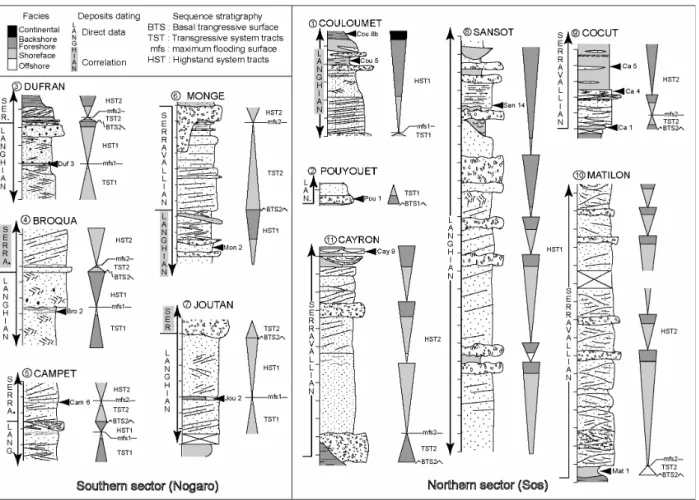
Fig. 2 – Chronostratigraphic location and sequence stratigraphy organization of Sables Fauves Formation. Greyed zones represent
time periods recognized in all outcrops.
The Peyrecrechen (Langhian) and the Matilon Members (Serravallian) include transgressive-regressive
third order cycles; each one taking the form of a transgressive systems tract (TST), corresponding to a relative rise in sea level, and a highstand systems tract (HST), delineating the relative sea level falling and displaying the filling of the platform
(fig. 2). The former member represents a trangressive and a highstand systems tract from a third order depositional sequence recognized as Bur 5 / Lan 1
cycle. The latter, represents mainly the trangressive and highstand systems tracts from the following
sequences, known as Lan 2 / Ser 1 and Ser 2 cycles (VAKARCS & al., 1998).
3. Material and methods
A total of 14 samples were used for palynological
studies – 8 of the Langhian units and 6 of the
Serravallian deposits (fig. 3). The samples were selected from the most suitable deposits for palynomorph preservation, fine sandstones and marls. Marly levels provided the most significant results.
Pollen grains and dinoflagellate cysts are usually scarce and feature poorly diversified associations. The sample from the Serravallian of Cayron is very rich of Polysphaeridium zoharyi (more than 1000 of specimens in one slide). Spores are only represented in small numbers in Couloumet (Langhian), Matilon and Cocut (Serravallian).
The chemical treatment was performed on 20–30 g of sediment. The samples were treated with cold HCl (35%) and HF (70%), removing carbonates and silica. Separation of the palynomorphs from the rest of the residue was carried out using ZnCl2 (density=2). Sieving was done through a 10-µm nylon sieve. From the palynological residue slides were prepared with glycerine jelly. A transmitting light microscope using 250x, 400x, 600x and 1000x (oil immersion)
magnifications were used for pollen classification and counting.
4. Palynologic framework of Aquitaine
Fig. 3 – Synthetic logs and samples location in the studied outcrops.
5. Floristic and vegetation domains
5. 1. Spores and pollens
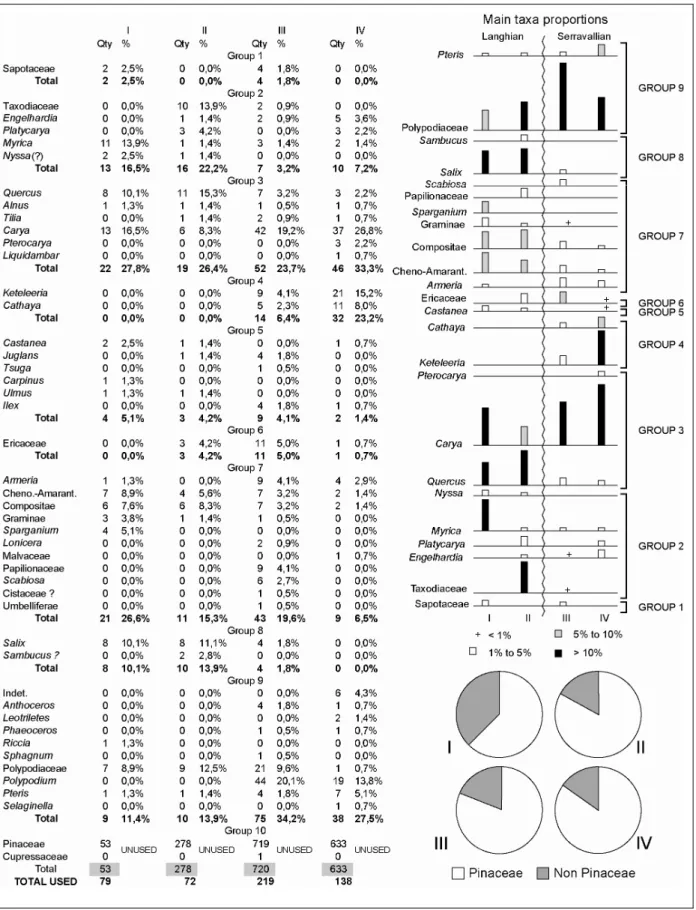
The taxa recognized were grouped taking based on ecological criteria (Tab. I, Plate 1):
Mega-mesothermic and mesothermic elements requiring high moisture: 1. Sapotaceae; 2. Taxodiaceae, Engelhardia, Platycarya,Myrica,Nyssa; 3. Quercus,Carya,Pterocarya, Liquidambar; 4. mid-altitude trees (Cathaya, Keteleeria).
Mesothermic elements: 5. Carpinus, Ulmus, Ilex, Juglans,Castanea, Tilia.
Open and/or halophyte vegetation elements: 6. Ericaceae; 7. herbaceous plants (Compositae,
Graminae, Malvaceae, Umbelliferae,
Chenopodiaceae-Amaranthaceae, Plumbaginaceae…).
Humid biotopes elements: 8. Silix, Sambucus, Alnus; 9. mosses and ferns (Polypodiaceae, Pteris…)
Broadly unused elements: 10. Pinaceae, damaged pollen grains.
The major characteristic is the general high amount of Pinaceae pollen grains. The majority of these elements are not taken into account, because of their usual over-representation in marine sediments, mainly due to their huge productivity, wide wind dissemination and scattering by fluvial activity and transfer to marine currents (SUC& DRIVALIARI, 1991). Nevertheless, this statement must be qualified for the studied area, since the over-representation of Gymnosperms appears to be one of the specificity of pollen spectra in Southwest France (SALARD-CHEBOLDAEFF & OLLIVIER-PIERRE, 2000).
5. 2. Chronostratigraphic distribution
5. 2. 1. Langhian (-16.40 to -14.80 My; BERGREEN, 1995)
Apart from Pinaceae (up to 69%), the pollen spectra feature the predominance of mega-mesothermic (Taxodiaceae, Sapotaceae, Myrica, Nyssa, Carya) and mesothermic elements (Quercus,Carya). The proportions of herbaceous plants suggest open and/or, more often, sea-coastal environments represented by saline-bearing elements (Chenopodiaceae-Amaranthaceae, Armeria, Compositae).
5. 2. 2. Serravallian (-14.80 to -12.70 My; BERGREEN, 1995)
Beside Pinaceae (79%), mesothermic elements (Carya, Cathaya,Keteleeria) are the most abundant while mega-mosothermic elements (Taxodiaceae, Myrica) are poor represented. Water-linked vegetation (Polypodiaceae) prevails; sea-coastal herbaceous plants are also represented (Plumbaginaceae, Chenopodiaceae-Amaranthaceae).
5. 3. Dinoflagellate cysts
Table I– Palynologic content of Sables Fauves Formation. Climatic and environmental discussions base on synthetic results, after regrouping data in four groups (I to IV), accord to sequence stratigraphy and biostratigraphy.
The identified species and their chronostratigraphical ranges match with the time interval (STOVER & al., 1996;
LONDEIX & JAN DU CHÊNE, 1998) as it is established thanks to the planctonic foraminifera. The presence of Spiniferites
Table II – Dynoflagellate cysts content of Sables Fauves Formation.
6. Climatic evolution
There are clear differences between the Langhian and Serravallian pollen spectra despite the poor palynomorph content. The mega-mesothermic plants together with the herbaceous plants decreased whereas mosses, ferns and Cathaya increased. Analyzing the Sables Fauves Formation accordingly to the principles of sequential stratigraphy (VAIL & al., 1984; VAIL & al., 1987; POSAMENTIER &VAIL, 1988), makes possible to
compare climatic changes and sea-level variations (fig. 4). Transgressive phases are characterized by the warmest conditions, according to the abundance of mega-mesothermic plants, and by an opening in the vegetation, depicted by the development of near shore halophyte vegetation. This last event is related to the changes involved in coastal marine environments due to the marine transgression, causing the dismantling of pre-existent continental flora and promoting the settlement of near shore open vegetation. Conversely, high-level and regressive phases highlight cooler episodes, accompanied by a predominance of mesothermic forest elements and by the decreasing of the open environments.
Even if the major part of Gymnosperms pollen grains are not used in paleoclimatic reconstructions, these elements are able to mark the permanence of regional conifer forests, notably in the Pyrenean chain. Considering the vicinity of such high reliefs, it is necessary to keep in mind that the palynological records supplied by the Sables Fauves – and concerning particularly the less thermophilous elements – could reflect an altitudinal distribution of the vegetation and a climatic change.
During the Langhian, the flora suggests a warm and relatively dry climate. The inland vegetation appears to correspond to a warm mixed forest, while the near shore zones show the predominance of open xerophilous vegetation, with local markers of fresh or marshy zones close to the shoreline. During the Serravallian, the appearance of mesothermic mid-altitude gymnosperms involves the setting up of an important forest cover on regional reliefs. Compared to the Langhian, the pollen spectra display a transition
from mega-mesothermic to mesothermic elements. Such event indicates a climatic cooling. Furthermore, high amount of mosses and ferns suggests the extent of humid and shadowy biotopes.
7. Comparisons with bordering areas
7. 1. Mediterranean area (South-eastern France and North-eastern Spain)
A general tendency to disappearance of tropical megathermic elements (Sapotaceae, Palmae, Avicennia…) is noticed in the lower part of Middle Miocene, after Neogene thermic maximum, which takes place during Burdigalian and Lower Langhian (BESSEDIK, 1985; SUC
& al., 1992). Unfortunately, the climatic evolution during the Neogene in the Mediterranean area registers an important gap due to the lack of Middle and Upper Miocene deposits, caused by severe regressive conditions. Therefore, even if pollen spectra display important climatic changes, the implementation and characterization of implied mechanisms are made impossible for the period running from Upper Langhian to Uppermost Tortonian. Xeric conditions prevail in this area until the Upper Pliocene, when the emergence of pre-Mediterranean climate takes place (SUC & al., 1992; SUC & al., 1995a).
7. 2. Eastern Atlantic Ocean
Fig. 4 – Synthetic pollen spectra of Middle Miocene deposits (Sables Fauves) in Aquitaine, based on results presented in Tab. I. Evolution of vegetal assemblages and comparison with sea-level variations.
Possible differences on comparing with bordering areas are related to latitudinal gradient across Northern hemisphere. Continental Portuguese flora marks thus subtropical conditions when Aquitaine pollens display a warm-temperate climate. As an example, first Ericaceae datum occurs during the Lower Tortonian in the Tagus Basin (PAIS, 1986) whereas these elements are present in Aquitaine as Early as Upper Langhian.
In the Atlantic border of Portugal as well as in Aquitaine coral reefs only occur in Aquitanian and Lower Burdigalian, although they are present in Mediterranean area till Middle Miocene (CAHUZAC &
CHAIX, 1993). This suggests warmer conditions allowing the development of impoverished mangrove with Avicennia on the coasts, never recorded in Portugal. In Aquitaine, such occurrence has been recorded from the Lower Burdigalian (JIMENEZ-MORENO, 2005) from Bordeaux area (Pont-Pourquey).
8. Conclusions
were characterized by an opening in the vegetation during transgressive phases, whereas cool episodes were characterized by an increase in the mesothermic forest cover during regressions.
The Aquitaine Langhian climate appears to be warm and dry, with near shore vegetation. During the Lower Serravallian, a transition occurs, from mega-mesothermic to mega-mesothermic elements, which emphasizes a climatic cooling, associated with an extent of humid biotopes. Such a climatic degradation is observed all over the bordering areas, where a broad decrease of tropical and megathermic elements is noted at the Langhian-Serravallian transition. With regard to Aquitaine deposits, this major event seems to take place during the first Serravallian regressive phase (unit III,
Lan 2 – Ser 1 cycle). This datum is coherent with
proposed dating, around 14 Ma (SUC & al., 1992; ANTUNES & al., 1997), corresponding to the Antarctic glaciations (Monterey cooling event) (KENNETT & BRUNNER, 1973;KENNETT & al., 1974).
The palynological analyses from Aquitaine Middle Miocene deposits allow filling a gap in climatic and vegetation evolutions of Southern France, during a phase of major climatic cooling, standing as a milestone and as a connection between data from Lower and Upper Miocene. Moreover, on the western Europe scale, the location of the Aquitaine basin ensures the characterisation of climatic changes implied from the North-South gradient and allows a better understanding of the modalities in the settlement of specific environments, constrained by geographic parameters (orography, seasonality, marine and aerial currents circulation), as a transition from Mediterranean area to southward Pyrenean countries and north eastern Atlantic frontage.
Acknowledgements
The authors kindly thank Gonzalo Jimenez-Moreno for the critical review of the manuscript, and Paulo Legoinha for the english improvements of the text.
References
ANTUNES, M. T., CIVIS, J., GONZÀLEZ-DELGADO, J. A., LEGOINHA, P., NASCIMENTO, A. & PAIS, J. (1997) – Miocene stable
isotopes ( 18O, 13C), biostratigraphy and environments in the southern limb of the Albufeira syncline (Setúbal Peninsula,
Portugal).Geogaceta, Madrid, nº 21, pp. 21-24.
ANTUNES, M. T., LEGOINHA, P., NASCIMENTO, A. & PAIS, J. (1996) – The evolution of the Lower Tagus basin (Lisbon and Setúbal
Peninsula, Portugal) from Lower to early Middle Miocene. Géol. France, Orléans, nº 4, pp. 59-77.
BERGGREN, W. A., KENT, D. V., SWISHER, C. C. & AUBRY, M. P. (1995) – A revised Cenozoic geochronology and chronostratigraphy. In: BERGGREN, W. A.,KENT, D. V., AUBRY, M. P. & HARDENBOL, J. (Eds.), Geochronology, time scales
and global stratigraphic correlations: A unified temporal framework for an historical geology. SEPM Special Publication, Tulsa, vol. 54, 392 p.
BESSEDIK, M. (1985) – Reconstitution des environnements miocènes des régions nord-ouest méditerranéennes à partir de la palynologie. PhD Thesis, Univ. Sc. Techn., Montpellier, 162 p.
BLANC-LOUVEL, C. (2000) – La macroflore du site de Sansan. In: GINSBURG, L. (Ed.), La faune miocène de Sansan et son
environnement.Mém. Mus. Nat. Hist. Nat., Paris, vol. 183, pp. 109-116.
BLOW, W.H. (1969) – Late Middle Miocene to Recent planktonic foraminiferal biostratigraphy. Proc. First Int. Conf. Plankt. Microf. (1967), Genève, vol. 1, pp. 199-422.
BUGNICOURT, D., CLARACQ, P., DUPÉRON, J., PRIVÉ-GILL, C. & SAUVAGE, J. (1988) – Sédimentologie, Bois fossiles et Palynologie
d’une couche à lignite de Capvern (Plateau de Lannemezan, Hautes-Pyrénées). Bull. Cent. Rech. Expl.-Prod. Elf-Aquitaine, Pau, vol. 12, pp. 739-757.
CAHUZAC, B. & CHAIX,C. (1993) – Les faunes de coraux (Anthozoaires Scléractiniaires) de la façade atlantique française au
Chattien et au Miocène. Ciências Terra (UNL),Lisboa, nº 12, pp. 57-69.
CAHUZAC, B. & POIGNANT, A. (1996) – Foraminifères benthiques et Microproblematica du Serravallien d’Aquitaine. Géol. France, Orléans, nº 3, pp. 35-55.
DUBREUILH, J., CAPDEVILLE, J. P., FARJANEL, G.,KARNAY, G., PLATEL, J. P. & SIMON-COINCON,R. (1995) – Dynamique d’un
comblement continental néogène et quaternaire: l’exemple du Bassin d’Aquitaine. Géol. France, Orléans, nº 4, pp. 3-26. DUCASSE, O. & CAHUZAC,B., (1997) – Évolution de la faune d’ostracodes dans un cadre paléogéographique et interprétation des
FOLLIOT, M., PUJOL, C., CAHUZAC, B. & ALVINERIE, J. (1993) – Nouvelles données sur le Miocène moyen marin («Sallomacien»)
de Gironde (Bassin d’Aquitaine, France). Approche des paléoenvironnements.Ciências Terra (UNL), Lisboa, nº 12, pp. 117-131.
GARDÈRE, P.(2002) – Les Sables Fauves: dynamique sédimentaire et évolution morpho-structurale du Bassin d’Aquitaine au
Miocène moyen. Strata, Toulouse, vol. 40, 264 p.
---(2005) – La Formation des Sables Fauves: dynamique sédimentaire au Miocène moyen et évolution morpho-structurale de
l’Aquitaine (SW France) durant le Néogène. Eclogae Geol. Helv., Bâle, nº 97, pp. 201-217.
GARDÈRE, P., REY, J. & DURANTHON,F. (2002) – Les «Sables Fauves», témoins de mouvements tectoniques dans le bassin
d’Aquitaine au Miocène moyen. C. R. Geoscience, Paris, nº 334, pp. 987-994.
HUARD, J.(1966) – Étude anatomique des bois de Conifères des couches à lignites néogènes des Landes. Mém. Soc. Géol. France, Paris, vol. 105, pp. 1-85.
IACCARINO,S. (1985) – Mediterranean Miocene and Pliocene planktic foraminifera. In: BOLLI, H. M.,SAUNDERS, J. B. & PERCH -NIELSEN,K. (Eds.), Plankton Stratigraphy 1.Cambridge Univ. Press, pp. 283-314.
JIMENEZ-MORENO, G. (2005) – Utilización del análisis polínico para reconstrucción de la vegetación, clima y estimación de
paleoaltitudes a lo largo del arco alpino europeo durante el Mioceno (21-8 Ma). Tesis doctoral, Univ. Granada.
JIMENEZ-MORENO,G.,RODRÍGUEZ-TOVAR, F., PARDO-IGÚZQUIZA, E., FAUQUETTE,S., SUC, J. P. & MÜLLER, P. (2005) –
High-resolution palynological analysis in early-middle Miocene core from the Pannonian Basin, Hungary: climatic changes, astronomical forcing and eustatic fluctuations in Central Paratethys. Palaeog., Palaeoc., Palaeoec., Amsterdam, vol. 216,
pp. 73-97.
KENNETT, J. P. & BRUNNER, C.A. (1973) – Antarctic late Cenozoic glaciation: evidence for initiation of ice rafting and inferred
increased bottom-water activity. Geol. Soc. America Bull., Boulder, vol. 84, pp. 2043-2052.
KENNET, J. P., HOUTZ, R. E., ANDREWS, P. B., EDWARDS, A. R.,GOSTIN, V. A., HAJOS, M., HAMPTON, M. A., JENKINS, D.G.,
MARGOLIS,S.V., OVENSHINE, A. T. & PERCH-NIELSEN,K. (1974) – Development of Circum-Antarctic current. Science,
Washington, vol. 186, pp. 144-147.
LAURIAT-RAGE, A., BRÉBION, P., CAHUZAC, B., CHAIX, C., DUCASSE, O.,GINSBURG, L., JANIN, M. C., LOZOUET, P., MARGEREL, J.,
NASCIMENTO, A., PAIS, J., POIGNANT, A., POUYET,S.& ROMAN, J. (1993) – Palaeontological data about the climatic trends
from Chattian to present along the Northeastern Atlantic frontage. Ciências Terra (UNL), Lisboa, nº 12, pp. 167-179. LONDEIX, L. & JAN DU CHÊNE,R. (1998) – Burdigalian dinocyst stratigraphy of the stratotypic area (Bordeaux, France). Geobios,
Lyon, vol. 30, pp. 283-294.
PAIS, J.(1986) – Évolution de la végétation et du climat pendant le Miocène au Portugal. Ciências Terra (UNL), Lisboa, nº 8,
pp. 179-191.
POSAMENTIER, H.W.& VAIL, P. R.(1988) – Eustatic control on clastic deposition II-Sequence and Systems Tracts models. In:
WILGUS, C. K., HASTINGS, B.S.,ROSS, C. A., POSAMENTIER, H.W.,VANWAGONER, J. C. & KENDALL, C.G. (Eds.), Sea level
changes: an integrated approach. SEPM Sp. Publ., Tulsa, nº 42, pp. 125-154.
REY, J., DURANTHON, F., GARDÈRE, P.,GOURINARD, Y., MAGNÉ, J., FEINBERG, H. & MURATET, B. (1997) – Découverte d’un
encaissement entre dépôts de sables fauves dans la région de Sos (Miocène centre-aquitain). Géol. France, Orléans, nº 2, pp.
23-29.
SALARD-CHEBOLDAEFF, M. & OLLIVIER-PIERRE, M. F.(2000) – Palynologie et environnement du site de Sansan. In: GINSBURG, L.
(Ed.), La faune miocène de Sansan et son environnement. Mém. Mus. Nat. Hist. Nat., Paris, vol. 183, pp. 117-127.
STOVER, L. E., BRINKUIS, H., DAMASSA,S.P., DE VERTEUIL, L., HELBY, R. J., MONTEIL, E., PARTRIDGE, A. D., POWELL, A. J.,
RIDING, J. B.,SMELROR, M. &WILLIAMS, G. L. (1996) – Chapter 19. Mesozoic-Tertiary dinoflagellates, acritarchs and
prasinophytes. In: JANSONIUS, J. & MCGREGOR,D. C. (Eds), Palynology: principles and applications. Am. Assoc. Stratig. Palynol. Found., Salt Lake City, nº 2, pp. 641-750.
SUC, J. P., BERTINI, A., COMBOURIEU-NEBOUT, N., DINIZ, F., LEROY,S.,RUSSO-ERMOLLI, E., ZHENG, Z., BESSAIS, E. & FERRIER, J.
(1995a) – Structure of West Mediterranean vegetation and climate since 5.3 ma. Acta Zool. Cracoviense, Krakow, vol. 38,
pp. 3-16.
SUC, J. P., CLAUZON, G.,BESSEDIK, M., LEROY, S., ZHENG, Z., DRIVALIARI, A., ROIRON, P., AMBERT, P., MARTINELL, J., DOMENECH, R., MATIAS, I., JULIA, R. & ANGLADA,R. (1992) – Neogene and Lower Pleistocene in Southern France and
Northeastern Spain. Mediterranean environments and climate. Cahiers Micropal., Paris, nº 7, pp. 165-186.
SUC, J. P., DINIZ, F., LEROY,S.,POUMOT, C., BERTINI, A., DUPONT, L., CLET, M., BESSAIS, E., ZHENG, Z., FAUQUETTE,S.&
FERRIER, J.(1995b) – Zanclean (~ Brunssumian) to early Piacenzian (~ early-middle Reuverian) climate from 4° to 54°
north latitude (West Africa, West Europe and West Mediterranean areas). Meded Rijks Geol. Dienst., Haarlem, vol. 52,
pp. 43-56.
SUC, J. P. & DRIVALIARI, A.(1991) –Transport of bisaccate coniferous fossil pollen grains to coastal sediments: An example from
the earliest Pliocene Orb ria (Languedoc, southern France). Rev. Paleob. Palyn., Amsterdam, vol. 70, pp. 247-253.
VAIL, P. R., COLIN, J. P., JAN DU CHENE, R., KUCHLY, J., MEDIAVILLA, F. & TRIFILIEFF, V.(1987) – La stratigraphie séquentielle et
son application aux corrélations chronostratigraphiques dans le Jurassique du bassin de Paris. Bull. Soc. Géol. France, Paris,
sér. 8, t.III (7), pp. 1301-1321.
VAIL, P. R., HARDENBOL, J. & TODD, R. G. (1984)– Jurassic unconformities, chronostratigraphy, and sea-level changes from
seismic stratigraphy and biostratigraphy. In: SCHLEE, J. S. (Ed.), Interregional Unconformities and Hydrocarbon
Accumulation. Am. Ass. Petr. Geol. Memoir, Tulsa, nº 36, pp. 129-144.
VAKARCS, G., HARDENBOL, J., ABREU,V.-S.,VAIL, P. R. & VARNAITARI,G. (1998) – Oligocene-Middle Miocene depositional
sequences of the central Paratethys and their correlation with regional stages. In: DEGRACIANSKY, P. C., JACQUIN, T., FARLEY, X. & VAIL,P. R. (Eds.), Mesozoic and Cenozoic Sequence Stratigraphy of European Basins. SEPM Sp. Publ.,
Tulsa, nº 60, pp. 209-231.
Plate 1
Fig. 1 – Taxodiaceae x1100 – Couloumet, sample COU5 (sedimentary unit II)
Fig. 2 –Carya sp. x1100 – Cocut, sample CA1 (sedimentary unit III)
Fig. 3 – Polypodiaceae x1100 – Cocut, sample CA1 (sedimentary unit III)
Fig. 4 – Myrica sp. x1100 – Cocut, sample CA1 (sedimentary unit III)
Fig. 5 – Pterocarya sp. x1100 – Cocut, sample CA5 (sedimentary unit IV)
Fig. 6 – Amaranthaceae/Chenopodiaceae x1100 – Cocut, sample CA1 (sedimentary unit III)
Fig. 7 – Engelhardia sp. x1100 – Cocut, sample CA5 (sedimentary unit IV)