Food Science and Technology ISSN 0101-2061
DII:
D httpI://dx.doi.org/10.1590/1678-457X.24817
1 Introduction
Improving storage stability of both fresh and processed meat products consider important economically and nutritionally. However, the antioxidant capacity of fresh meat depends on the activities of endogenous reducing enzymes at early postmortem time (Ahn et al., 2009; Serpen et al., 2012; Kumar et al., 2015). In addition, this capacity will decrease when muscle cells lost their homeostasis, then free radical formation increase causing meat spoilage and deterioration. However, meat storage stability depends on many internal factors such as metal catalysts, free iron, fatty acid profile, pH, and presence of other inhibitors (Xiong, 2000; Min & Ahn, 2005). Lipid and protein oxidation considered first priority issues affecting meat quality characteristics (Ahn et al., 2009; Estévez, 2011; Lund et al., 2011). Color, flavor, odor and other meat quality characteristics are highly affected by the oxidation (Lund et al., 2011; Guyon et al., 2016). In meat industry they have been extensively used synthetic antioxidants (SA) such
as butylatedhydroxyanisole (BHA), and butylatedhydroxytoluene
(BHT) to prevent any oxidative changes (Monahan & Troy, 1997). However, because of the negative impression regarding the use of SA; natural antioxidants (NA) consider the suitable replacement (Velasco & Williams, 2011). Several research studies were reported possible carcinogenic and toxicological effects of the SA used in human foods (Altmann et al., 1986; Kumar et al., 2015). Currently, sodium nitrite (E-250) is the most important preservative and curing ingredients used in the meat industry (Al-Shuibi & Al-Abdullah, 2002). It is also responsible on meat
color formation and their flavor after curing application (Honikel, 2008; Sindelar & Milkowski, 2011).
Recently, in curing application researchers were investigate finding a good combination with sodium nitrite or decrease their residual in finished meat products (Honikel, 2008; Dostindjer et al., 2014). Furthermore, increasing in consumer demands on the natural food products support this approach. For example, natural antioxidant from medical plants such as sage, rosemary, green tea, and oregano were tested previously (Zheng & Wang, 2001; Abdel-Hamied et al., 2009). Rosemary herbs and their extract were used as flavoring and preventing rancidity development in the meat (Yu et al., 2002; Jongberg et al., 2013). In general, there is no limitation on using the rosemary essential oil or their extract in meat products (Jordan Standards and Metrology Drganization, 2016). Rosemary oleoresin, extract, and their essential oils were reported as a potential antioxidant used widely in the food industry (Yu et al., 2002; Balentine et al., 2006; Hussain et al., 2010). In addition, it had been reported that rosemary extract (RE) was effective delaying lipid oxidation in meat (Georgantelis et al., 2007; Keokamnerd et al., 2008; Kahraman et al., 2015). This high antioxidant property of RE associated with their content of phenolic diterpenes such as carnosic acid, carnosol, rosmanol, rosmariquinone and rosmaridiphenol, ursolic acid, and caffeic acid (Aruoma et al., 1992; Basaga et al., 1997; Rašković et al., 2014). However, 90%
Preservative effects of rosemary extract (
Rosmarinus officinalis
L.) on quality and
storage stability of chicken meat patties
M. AL-HIJAZEEN1*, M. AL-RAWASHDEH1
Received 01 Aug., 2017 Accepted 11 Oct., 2017
1 Department of Animal Production, Agriculture Collage, Mu’tah University, Karak, Mu’tah, Jordan
*Corresponding authorI: [email protected], [email protected]
Abstract
The effect of different level of rosemary extract (RE) (Rosmarinus officinalis Linn.) cultivated in Jordan, and other preservative on quality and stability of ground chicken meat was investigated. Treatments, were involved 1) Control (No additive), 2) 300 ppm (RE), 3) 350 ppm RE, 4) 300 ppm L-Ascorbic acid (E-300), 5) 200 ppm Sodium nitrite (E-250), 6) 5 ppm butylatedhydroxyanisole
(BHA) for breast, and 14 ppm for thigh meat were prepared. TBARS, total carbonyl, and color values, were measured and analyzed at 0, 4, and 7 day. Samples of cooked thigh meat were prepared, and sensory evaluation was reported. Cooking loss %, ultimate pH, and total aldehydes were analyzed. Both RE and E-250 were showed the highest significant effect maintaining low values of TBARS and total carbonyl at 7 day. However, no significant differences were found among all treatments measuring ultimate pH values, and their cooking loss %. The RE and E-250 also showed the highest significant effect delaying aldehydes formation, and positively affect meat sensory attributes. In conclusion, RE (350 ppm) was very effective antioxidant and comparable to the other commercial antioxidants. Thus, RE could be a good substitution to many synthetic antioxidants used in meat industry.
Keywords: lipid oxidation; protein oxidation; rosemary extract; ground chicken.
of the antioxidant properties of RE were reported to be from their carnosic acid and carnosol constituents (Aruoma et al., 1992; Erkan et al., 2008). The mechanism of this antioxidant activity is related to its phenolic diterpene structure which works as hydrogen donor and scavenging free radical compounds (Houlihan et al., 1984; Schwarz & Ternes, 1992; Hall et al., 1998; Richhelmer et al., 1999; Birtic et al., 2015).
This study is the first evaluating Jordanian RE effectiveness on storage stability of ground chicken meat. However, different composition of this Jordanian cultivated oil of Rosmarinus officinalis L. (Lamiaceae) by these phenolic compounds may give unique antioxidant activity. The essential oil and RE composition of these phenolic compounds (mono or di-terpenes) has been reported in a variable % which associated with several other factors such as genetic, storage condition, extraction method (Mena et al., 2016). In addition, it was reported in several study that the level of using RE or their essential oil in the food need more investigation (Kahraman et al., 2015). The previous suggested concentration of using RE is ranging between 200-1000 mg/kg in different food and meat products (Stoick et al., 1991; Shahidi et al., 1992; Sebranek et al., 2005; Georgantelis et al., 2007). In addition, ground chicken meat of both raw and cooked is more susceptible for oxidation. So economically, it is important to increase meat storage stability where the consumer found these products more acceptable. The objectives of current study were 1) to investigate the effect of two different level of Rosmarinus officinalis L. extract on storage stability and quality characteristics of ground chicken meat during storage time and 2) to compare the antioxidant effect
of Rosmarinus officinalis L. with the most popular antioxidant
used in the meat industry.
2 Materials and methods
2.1 Meat patties preparation
All broilers (140/6-wk-old) were fed a corn-soybean meal diet and, slaughtered at Mu’tah University (Agriculture Collage / Department of Animal Production-farm facilities). All chicken were checked and veterinary being qualified for health and welfare. The chicken carcass were immersed in ice water for 1 h and drained in a cold room, and then deboned muscles (breast and thigh) were vacuum packaged in oxygen impermeable bags, and stored at -18 °C.
After thawing, the meats were double grounded a through a 8-mm and a 3-mm plates (Moulinex, Type DKA1, France) before use. Six different treatments, including 1) Control (No additive), 2) 300 ppm Rosemary extract (RE), 3) 350 ppm RE, 4) 300 ppm L-Ascorbic acid (E-300), 5) 200 ppm Sodium nitrite (E-250), 6) 5ppm Butylatedhydroxyanisole (BHA) for both breast, and 14ppm thigh meat were prepared. Rosemary pure extract was obtained from a certified company in Jordan (Green Fields Factory for oils, Amman, Jordan) using the most efficient purification, extraction, and steam distillation methods. The HPLC analysis of the RE was measured by the method of Dkamura et al. (1994) at the Royal Scientific Society, Jordan, Amman (RSS) research institution, and RE was containing 26 ± 3% as the average of phenolic diterpenes (carnosol (4%), carnosic acid (6%), rosmanol (8%), and rosmarinic acid (8%)).
L-ascorbic acid (Fisher Scientific, fair Lawn, N.J., USA), and sodium nitrite (Gainland Chemical company-GCC, factory road; UK) powder were dissolved in de-ionized distilled water (DDW) first, then oil emulsion (water in oil) using mineral oil were prepared to make their aqueous solution. BHA and RE were dissolved 100% ethanol, and then mixed with mineral oil to make their stock solutions. The ethanol added was removed using a rotary evaporator (Heidolph, Model Laborota 4001-effecient) at (70 °C, 175 mbar vacuum pressure). Each additive was added to the ground, and then mixed for 3 min in a bowl mixer (Model KM-331; Kenwood Limited, New Lane, Havant, PD9 2NH, UK). Similar amounts of mineral oil and water (oil emulsion) were added for all treatments to provide the same conditions. The prepared meat samples (50 g each) were individually packaged in oxygen-permeable bags (polyethylene, SizeI: 11 × 25 cm, Future for Plastic Industry, Al-Moumtaz bags, Co. L.T.D, Amman, Jordan), stored at 4 °C cooler for up to 7 days, and analyzed for TBARS and total carbonyl, and color at 0, 4, and 7 days. In addition, separate samples of raw meat from each treatment were used to measure their ultimate pH. In cooked meat study, the raw meat samples were packaged in oxygen impermeable vacuum bags (Ehsan & Tahssin Baalbaki Co, Bayader Wadi Al-Seer, Amman, Jordan), and the meats were cooked in-bag in a 90 °C water bath (Memmert, WNB 14; GMbH + Co. KH, D-91107 Schwabach, Germany) until the internal temperature of the meat reached to 75 °C. After cooling, the cooked meat samples (50 g) was transferred to a new oxygen-permeable bag (polyethylene, SizeI: 11 × 25 cm, Future for Plastic Industry, Al-Moumtaz bags, Co. L.T.D, Amman, Jordan), and stored at 4 °C for up to 7 days, and analyzed for TBARS and Total carbonyl at 0, 4, and 7 days of storage. Same preparation method was done for all cooking loss and sensory analysis treatments samples. However, the ground chicken (raw thigh) meat patties stored at 4 °C up to 4 days before cooking and for each evaluation session.
2.2 Thiobarbituric acid-reactive substances (TBARS) measurement
Lipid oxidation in the meat was determined using a TBARS method (Ahn et al., 1998) with minor modification. The amounts of TBARS were expressed as mg of malondialdehyde (MDA) per kg of meat.
2.3 Protein oxidation (Total carbonyl)
Protein oxidation was determined by the general method of total carbonyl value proposed by Lund et al. (2008) with minor modifications. The carbonyl content was calculated as nmol/mg protein using absorption coefficient of 22,000/M/cm as described by Levine et al. (1994).
2.4 Color measurement
avoided when reading the uniform color. An average two colorimeter measurement on each side of sample surface was used for data analysis.
2.5 Sensory evaluation
Trained sensory panels were used to evaluate sensory characteristics of the ground chicken (cooked thigh) meat. Sensory panels evaluated cooked meat samples forI: Cooked meat color, Spice odor (RE odor), oxidation odor, and over all acceptability. Six treatments samples were prepared similar as described in the oxidation analysis part to evaluate the effect of using different level of RE and the other comparable antioxidant.
The meat was refrigerated at 4 °C for four days before cooking and for each evaluation session. Ten trained panelists (Muta’h University, Student and staff), were participated for each session. The evaluations were done twice after cooling cooked meat patties to the room temperature at 25 °C for all treatment samples. For training, 3 one-hour sessions were held using commercial and experimental products to develop descriptive terms for the desired attributes.
All attributes were measured using a line scale without numbers (numerical value 9 units) with graduation from 0 to 9. Evaluation sessions for cooked meat samples were done in a separate days to decrease any variability.
The cooked meat samples (10 g/each) were evaluated by the panelists for each treatment after cooling to the room temperature 25 °C. The panelist was served 1 glass vial, 20 mL volume, of each treatment to evaluate odor of cooked thigh meat samples. All samples vials were labeled by a three digit number selected randomly. After color evaluation, panelists were asked to smell samples in random order and record the intensity of odor or over all acceptability on the scale line.
2.6 pH of raw thigh meat
The Ultimate pH values of the chicken raw meat samples were determined using a pH meter (PL-600, pH/mV/Temp Meter, Taiwan) after homogenizing the 1.0-g samples with 9 mL deionzed distilled water (DDW) (Sebranek et al., 2001).
2.7 Cooking loss %
Chicken thigh meat samples (30g) were weight and packaged in oxygen impermeable vacuum bags. The meat was cooked at a constant temperature using pre-heated water bath (Memmert, WNB 14; GMbH + Co. KH, D-91107 Schwabach, Germany) to the internal temperature of 80 °C for 30 min for the maximum water loss expected (Murphy & Marks, 2000). After cooking meat samples were cooled in water bath using cold water to the internal temperature of 20 °C, then water blotted or purged until sample became dry. The cooking loss percentage was calculated as percent weight reduction of the cooked sample compared to the raw meat sample using the fallowing Equation 1I:
( )
( )
Weight of raw meat – Weight of cooked meat
Cooking loss% 100
= ×
Weight of raw meat (1)
2.8 Total aldehydes
GC-MS (QP2010nc System, Shimadzu Corporation, Japan) connected with purge and trap concentrator (D.I.Analytical, Eclipse; Model 4660) were used to analyze total aldehydes according to the method of Ahn et al. (2001). Total aldehydes of cooked thigh meat samples were reportedI: Sum of Hexanal, Pentanal, Propanal, and Heptanal formation at day 7 of storage time. Volatile analysis was done at RSS (Royal Scientific Society,
Jordan, Amman/ Department of gas laboratory) by highly trained
and qualification specialist. Samples of six treatments were prepared similar as in previous part, then cooked meat samples (3 g/ each) were placed in a small vials and analyzed by GC-MS. The identification of each peak was achieved by Wiley Library, and the area of each peak was integrated. The total peak area (total ion counts× 104) was reported as an indicator of volatiles
generated from meat samples.
2.9 Statistical analysis
Data were analyzed using the procedures of generalized linear model (Proc. GLM, SAS program, version 9.3, SAS Institute, 2012). Mean values and standard error of the means (SEM) were reported. The significance was defined at P < 0.05 and Tukey test or Tukey’s Multiple Range test were used to determine the significant differences between the mean values.
3 Results and discussion
3.1 Lipid oxidation
Meat scientists are focusing on lipid oxidation and their free radicals due to their major effect on meat quality and their freshness (Ladikos & Lougovois, 1990; Ahn et al., 2009). Recently, improvement in antioxidant capacity of the meat by incorporates the suitable and safer antioxidant getting more attention. Rosemary extract was extensively studied, and reported as strong antioxidant decreasing the TBARS values in various meat products (Rohlik & Pipek, 2012; Jongberg et al., 2013; Haile, 2015). The TBARS values were showed no significant differences (P > 0.05) among all treatments samples (cooked and raw) at day 0 of storage time (Table 1).
reported the level 200-1000 mg/kg of RE in different food and meat products (Stoick et al., 1991; Shahidi et al., 1992; Estévez et al., 2005; Kahraman et al., 2015). The effective level of RE to prevent meat deterioration depends on many internal and external factors which may change the previous recommended levels. There were no significant differences (P > 0.05) between all treatments additives using raw meat samples at day 4 of storage time. This may be due to the low malonaldehyde formation in raw meat compared to the cooked ground chicken meat (Al-Hijazeen et al., 2016a, b). In addition, E-250 showed the highest antioxidant effect at day 7 of storage time. Furthermore, L-ascorbic acid (E-300) showed the lowest effect in delaying lipid oxidation. Generally, RE (350 ppm) was equally effective like BHA, and comparable to E-250 maintaining low TBARS values of cooked and raw meat samples.
3.2 Protein oxidation
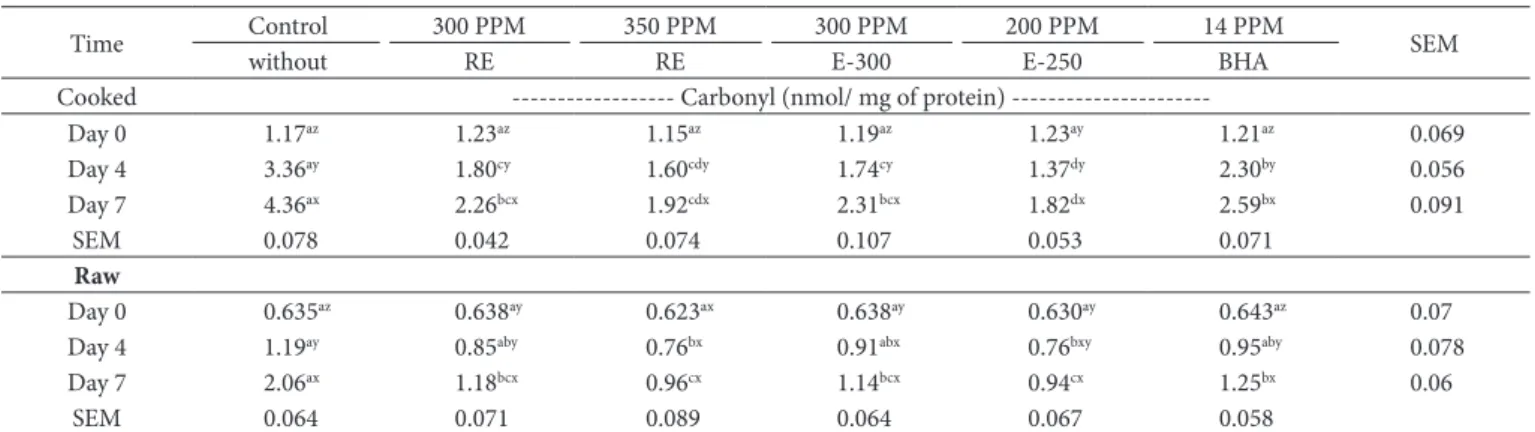
The DNPH (2,4-Dinitrophenylhydrazine) or total carbonyl method showed no significant differences (P > 0.05) among all treatments at day 0 of storage time. All treatments additives were showed significant effect (p > 0.05) on total carbonyl values at day 4 using cooked meat samples compared to the control. Similar with the TBARS results, both E-250 and RE (350 ppm) were showed the highest effect maintaining low total carbonyl values during storage of cooked meat (Table 2). Dn the other
hand, there were no significant differences (P > 0.05) between all treatment additives at day 4 of storage time using raw meat samples. This was in agreement with Xiao et al. (2011) who also reported low total carbonyl value (0.46 to 0.81 nmol/mg protein) using raw ground chicken meat. The total carbonyl values were reported in the range of 2-5 nmol/mg protein using various cooked meat products (Requena et al., 2003; Sun et al., 2010; Estévez, 2011; Al-Hijazeen et al., 2016a, b). However, E-250 showed the lowest total carbonyl values at day 7 compared to the other treatments using the raw meat samples. Both RE and E-250 showed the highest effect decreasing total carbonyl formation during storage time of the raw meat samples. RE was reported to have protection ability against formation of aldehydes and protein carbonyls (Estévez et al., 2005; Jongberg et al., 2013).
3.3 Color measurement
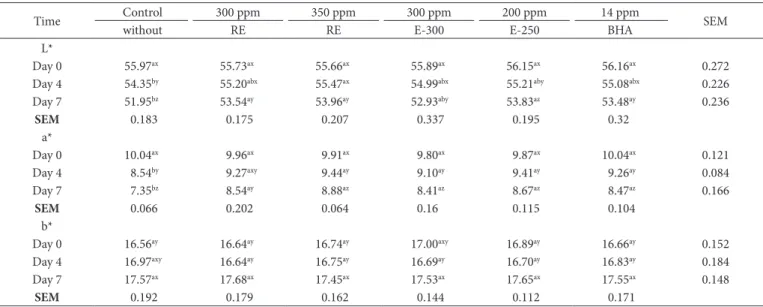
In this study there were no significant differences (P > 0.05) among all treatments when measuring a*, b*, and L* values (thigh meat) at day 0 of storage time (Table 3). So, any significant differences during storage time could happen due to the treatment effect. Rosemary extract (RE) and E-250, BHA treatments additives were showed higher significant (P < 0.05) values of L* values at day 7 compared to the control. The decrease in L* values using chicken meat after day 5 was reported in previous research studies (Chouliara et al., 2007; Al-Hijazeen et al., 2016a, b).
Table 1. *TBARS values of cooked ground chicken meat at different storage time at 4 °C.
Time Control 300 PPM 350 PPM 300 PPM 200 PPM 14 PPM SEM
without RE RE E-300 E-250 BHA
Cooked TBARS (mg/kg)meat
---Day 0 0.94az 0.96az 0.94az 0.95az 0.95az 0.98az 0.071
Day 4 3.38ay 1.96by 1.35cdy 1.84bcy 1.34dy 1.62bcdy 0.109
Day 7 6.26ax 2.94bx 2.23cdx 2.98bx 2.21dx 2.62bcx 0.091
SEM 0.09 0.127 0.075 0.108 0.064 0.073
Raw
Day 0 0.198az 0.177ay 0.192ay 0.183az 0.187ay 0.203ay 0.019
Day 4 1.24ay 0.297by 0.246by 0.318by 0.215by 0.268by 0.032
Day 7 2.15ax 0.87bcx 0.658cdx 1.00bx 0.641dx 0.81bcdx 0.048
SEM 0.047 0.054 0.015 0.062 0.03 0.021
a-c-Value with different letters within a row are significantly different (P < 0.05); x-z-Value with different letters within a column are significantly different (P < 0.05), n= 4; *TBARS value in mg malonaldehyde/kg meat.
Table 2. Effect of adding different level of rosemary extract on protein oxidation in cooked ground chicken thigh meat.
Time Control 300 PPM 350 PPM 300 PPM 200 PPM 14 PPM SEM
without RE RE E-300 E-250 BHA
Cooked --- Carbonyl (nmol/ mg of protein)
---Day 0 1.17az 1.23az 1.15az 1.19az 1.23ay 1.21az 0.069
Day 4 3.36ay 1.80cy 1.60cdy 1.74cy 1.37dy 2.30by 0.056
Day 7 4.36ax 2.26bcx 1.92cdx 2.31bcx 1.82dx 2.59bx 0.091
SEM 0.078 0.042 0.074 0.107 0.053 0.071
Raw
Day 0 0.635az 0.638ay 0.623ax 0.638ay 0.630ay 0.643az 0.07
Day 4 1.19ay 0.85aby 0.76bx 0.91abx 0.76bxy 0.95aby 0.078
Day 7 2.06ax 1.18bcx 0.96cx 1.14bcx 0.94cx 1.25bx 0.06
SEM 0.064 0.071 0.089 0.064 0.067 0.058
Several research study were reported that RE have a potential antioxidant activity which help to maintain meat color stability and especially a* values (Estévez et al., 2005; Rohlik & Pipek, 2012; Kumar et al., 2015). However, the effect of E-300 was very low and not significant (P > 0.05) at day 7 of storage time. Higher discoloration in the redness (a* values) of control sample appeared after day 4 of storage time. Increasing of the total myoglobin oxidized to metmyoglobin (discoloration) was causing this loss.
This was in agreement with Keokamnerd et al. (2008) who study the effect of adding commercial rosemary oleoresin on ground chicken thigh meat quality. All treatments additives were showed significant (P < 0.05) effect maintaining higher a* values compared to the control treatment. However RE showed the highest color stability maintaining a* values compared to the other treatments at day 7. Changing in b* values during storage time were not constant, and no significant differences (P > 0.05) appeared between all treatments additives.
3.4 Sensory evaluation
All treatment additives were showed significant differences (P < 0.05) compared to the control using cooked meat color attribute. The panelist were more likely prefer cooked meat color of E-250, and this due to their curing effect on pink color formation. Furthermore, both RE treatments levels showed highest significant values of spice odor, but with no ability to distinguish between both levels by the panelists (Table 4). The control samples were showed the highest significant scores of oxidation odor attribute compared to the other treatments. This effect due to the antioxidant treatments additives deceasing off-odor and specific volatiles that cause rancidity development.
These volatile such as aldehydes, hydrocarbons, sulfuric compounds usually increase by storage time due to lipid peroxidation and their secondary compounds (Ahn et al., 2009). However, E-250 was showed the highest overall acceptability
scores compared to the other treatments. Dverall, RE of both levels had comparable effect on panelist evaluation with E-250. Finally, E-300 and BHA samples treatment was less acceptable by the panelist compared to the other treatments additives. This effect of RE on the sensory attributes of different meat preparation had been reported in various studies (Thongtan et al., 2005; Estévez et al., 2005; Feng et al., 2016). In addition, RE prevents the alteration in protein functionality caused by oxidation which may affect meat color and their texture characteristics (Estévez et al., 2005).
3.5 Ultimate pH, cooking loss %, and total aldehydes
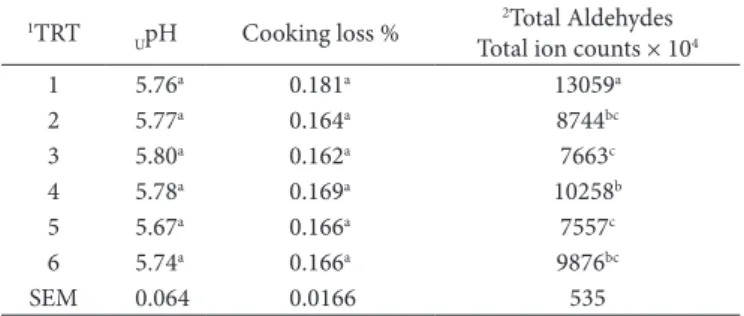
There were no significant differences (P > 0.05) of the ultimate pH values (raw meat samples) among all treatments before storage time at day 0 (Table 5).
So, all treatments samples were having the same pH value, which enhance the univariate analysis between treatments. In addition no significant differences (P > 0.05) were appeared
Table 4. Sensory attributes means of cooked ground thigh chicken
meat patties.
Sensory attributesI
TRT* Cooked Spice Dxidation Dver All
Color Ddor Ddor Acceptability
T1 3.89b 0.95b 7.88a 3.54c
T2 6.94a 5.65a 4.32b 7.15ab
T3 7.32a 6.45a 3.91b 7.94ab
T4 7.14a 0.98b 5.09b 6.96ab
T5 8.21a 0.94b 3.54b 8.31a
T6 6.58a 0.96b 5.11b 6.88b
SEMc 0.394 0.257 0.396 0.339
*TreatmentsI: T1) Control; T2) 300 ppm RE; T3) 350 RE; T4) 300 ppm E-300; T5) 200 ppm E-250; T6) 14 ppm BHA; ISensory attributesI: Samples were evaluated on day 3; SEMcI:
Standard error of the means; a-fMean within same column with different superscripts
are different (P < 0.05); n=10.
Table 3. *CIE Color value of ground chicken patties with different level of RE stored at 4 °C.
Time Control 300 ppm 350 ppm 300 ppm 200 ppm 14 ppm SEM
without RE RE E-300 E-250 BHA
L*
Day 0 55.97ax 55.73ax 55.66ax 55.89ax 56.15ax 56.16ax 0.272
Day 4 54.35by 55.20abx 55.47ax 54.99abx 55.21aby 55.08abx 0.226
Day 7 51.95bz 53.54ay 53.96ay 52.93aby 53.83az 53.48ay 0.236
SEM 0.183 0.175 0.207 0.337 0.195 0.32
a*
Day 0 10.04ax 9.96ax 9.91ax 9.80ax 9.87ax 10.04ax 0.121
Day 4 8.54by 9.27axy 9.44ay 9.10ay 9.41ay 9.26ay 0.084
Day 7 7.35bz 8.54ay 8.88az 8.41az 8.67az 8.47az 0.166
SEM 0.066 0.202 0.064 0.16 0.115 0.104
b*
Day 0 16.56ay 16.64ay 16.74ay 17.00axy 16.89ay 16.66ay 0.152
Day 4 16.97axy 16.64ay 16.75ay 16.69ay 16.70ay 16.83ay 0.184
Day 7 17.57ax 17.68ax 17.45ax 17.53ax 17.65ax 17.55ax 0.148
SEM 0.192 0.179 0.162 0.144 0.112 0.171
a-c-Value with different letters within a row are significantly different (P < 0.05); x-z- Value with different letters within a column are significantly different (P < 0.05); *CIE Color L*, a*, b*-value
when measuring cooking loss % among all treatments. This may be due to the low effect of free radical on protein net charge (amino acids charges) and their functionality. Finally the control sample of cooked thigh meat showed the highest significant (P < 0.05) values of total aldehydes formation at day 7 of storage time. However, both RE and E-250 were showed the highest antioxidant effect maintaining low values of aldehydes formation. The results in total aldehyde had similar trend to the TBARS, and total carbonyl at the end of storage time for both RE and E-250. The RE (350 ppm) antioxidant effect delaying aldehydes formation such as hexanal is due to their composition of phenolic compounds. However, hexanal was reported the major aldehyde correlated with meat deterioration and TBARS values in chicken meat (Du et al., 2003).
4 Conclusions
Rosemary extract (350 ppm), and E-250 treatments were showed the highest significant (P < 0.05) effect maintaining low TBARS and total carbonyl values during storage time. L-Ascorbic acid and BHA also showed significant effect compared to the control treatment at day 7, but lower than E-250 or RE treatments. In term of meat storage stability, both RE and E-250 showed better sensory evaluation scores compared to the other treatments. Lower total aldehydes values were found when using RE (350 ppm) and E-250 compared to the other treatments. Dverall, RE (350 ppm) could be an excellent natural antioxidant substuition or partial replacement to the SA used currently in meat preservation.
Acknowledgements
This study was financially supported by the Deanship of Scientific Research at Mu’tah University, Al-karak, Jordan. Grant numberI: 120/14/118 (2015). The Authors would like to thank Dr. Ghaid Al-Rabadi for his expert advices related chicken and diet formulation.
References
Abdel-Hamied, A. A., Nassar, A. G., & El-Badry, N. (2009). Investigations on antioxidant and antimicrobial activities of some natural extracts.
World Journal of Dairy & Food Science, 4(1), 1-7. Retrieved from
httpsI://www.cabdirect.org/cabdirect/ abstract /20103317582 Ahn, D. U., Nam, K. C., & Lee, E. J. (2009). Lipid oxidation and flavor.
In M. Du & R. J. McCormick (Eds.), Applied muscle biology and meat
science (chap. 12, pp. 227-246). Boca RatonI: CRC Press.
Ahn, D. U., Nam, K. C., Du, M., & Jo, C. (2001). Volatile production in irradiated normal, pale soft exudative (PSE) and dark firm dry
(DFD) pork under different packaging and storage conditions. Meat
Science, 57(4), 419-426. PMidI:22061715. httpI://dx.doi.org/10.1016/
S0309-1740(00)00120-0.
Ahn, D. U., Dlson, D. G., Jo, C., Chen, X., Wu, C., & Lee, J. I. (1998). Effect of muscle type, packaging, and irradiation on lipid oxidation,
volatile production and color in raw pork patties. Meat Science,
49(1), 27-39. PMidI:22063182. httpI://dx.doi.org/10.1016/S0309-1740(97)00101-0.
Al-Hijazeen, M., Lee, E. J., Mendonca, A., & Ahn, D. U. (2016a). Effect of Dregano Essential oil (Driganum vulgare subsp.hirtum) on the storage stability and quality parameters of ground chicken
breast meat. Antioxidant, 5(2), 18. PMidI:27338486. httpI://dx.doi.
org/10.3390/antiox5020018.
Al-Hijazeen, M., Lee, E. J., Mendonca, A., & Ahn, D. U. (2016b). Effects of tannic acid on lipid and protein oxidation, color, and volatiles of
raw and cooked chicken breast meat during storage. Antioxidant,
5(2), 19. PMidI:27304971. httpI://dx.doi.org/10.3390/antiox5020019. Al-Shuibi, A. M., & Al-Abdullah, B. M. (2002). Substitution of nitrite
by sorbate and the effect on properties of mortadella. Meat Science,
62(4), 473-478. PMidI:22061755. httpI://dx.doi.org/10.1016/S0309-1740(02)00041-4.
Altmann, H. J., Grunow, W., Mohr, U., Richter-Reichhelm, H. B., & Wester, P. W. (1986). Effects of BHA and related phenols on the
forestomach of rats. Food and Chemical Toxicology, 24(10-11),
1183-1188. PMidI:3804120. httpI://dx.doi.org/10.1016/0278-6915(86)90306-6.
American Meat Science Association – AMSA. (2012). Meat color
measurement guidelines (pp. 1-117). ChampaignI: AMSA. Retrieved
from httpI://www.meatscience.org/
Aruoma, D. I., Halliwell, B., Aeschbach, R., & Löligers, J. (1992). Antioxidant and pro-oxidant properties of active rosemary
constituentsI: carnosol and carnosic acid. Xenobiotica, 22(2),
257-268. PMidI:1378672. httpI://dx.doi.org/10.3109/00498259209046624. Balentine, C. W., Crandall, P. G., D’Bryan, C. A., Duong, D. Q., & Pohlman, F. W. (2006). The pre-and post-grinding application of rosemary and its effect of lipid oxidation and color during storage of
ground beef. Meat Science, 73(3), 413-421. PMidI:22062478. httpI://
dx.doi.org/10.1016/j.meatsci.2005.12.003.
Basaga, H., Tekkaya, C., & Acikel, F. (1997). Antioxidative and free
radical scavenging properties of rosemary extract.
Lebensmittel-Wissenschaft + Technologie, 30(1), 105-108. httpI://dx.doi.org/10.1006/
fstl.1996.0127.
Birtic, S., Dussort, P., Pierre, F., Bily, A. C., & Roller, M. (2015). Carnosic
acid. Phytochemistry, 115, 9-19. PMidI:25639596. httpI://dx.doi.
org/10.1016/j.phytochem.2014.12.026.
Chouliara, E., Karatapanis, A., Savvaidis, I. N., & Kontominas, M. (2007). Combined effect of oregano essential oil and modified atmosphere packaging on shelf-life extension of fresh chicken breast meat, stored
at 4 °C. Food Microbiology, 24(6), 607-617. PMidI:17418312. httpI://
dx.doi.org/10.1016/j.fm.2006.12.005.
Decker, E. A., Elias, R, J., & McCkements, D.J. (2010). Oxidative in foods
and beverages and antioxidant applications: mangement in different
industry sectors (Vol. 2, pp. 74). CambridgeI: Woodhead Publishing.
Dxidation and protection of poultry and eggs. 2.6.5. Addition of nitrites and nitrates.
Du, M., Nam, K. C., Hur, S. J., Ismail, H., Kim, Y. H., & Ahn, D. U. (2003). Quality characteristics of irradiated chicken breast rolls from
broiler fed different level of conjugated linoleic acid. Meat Science,
63(2), 249-255. PMidI:22062185.
Table 5. Ultimate pH, Cooking loss %, and Total Aldehydes values in
ground thigh meat.
1TRT
UpH Cooking loss %
2Total Aldehydes
Total ion counts × 104
1 5.76a 0.181a 13059a
2 5.77a 0.164a 8744bc
3 5.80a 0.162a 7663c
4 5.78a 0.169a 10258b
5 5.67a 0.166a 7557c
6 5.74a 0.166a 9876bc
Erkan, N., Ayranci, G., & Ayranci, E. (2008). Antioxidant activities
of rosemary (Rosmarinus Officinalis L.) extract, blackseed (Nigella
sativia L.) essential oil, carnosic acid, rosmarinic acid and sesamol.
Food Chemistry, 110(1), 76-82. PMidI:26050168. httpI://dx.doi.
org/10.1016/j.foodchem.2008.01.058.
Estévez, M. (2011). Protein carbonyls in meat systemI: a review. Meat
Science, 89(3), 259-279. PMidI:21621336. httpI://dx.doi.org/10.1016/j.
meatsci.2011.04.025.
Estévez, M., Ventanas, S., & Cava, R. (2005). Protein oxidation in frankfurters with increasing levels of added rosemary essential oilI:
Effect on color and texture deterioration. Journal of Food Science, 70(7),
c427-c432. httpI://dx.doi.org/10.1111/j.1365-2621.2005.tb11464.x. Feng, L., Shi, C., Bei, Z., Li, Y., Yuan, D., Gong, Y., & Han, J. (2016). Rosemary extract in combination with Polylysine enhance the quality
of chicken breast muscle during refrigerated storage. International
Journal of Food Properties, 19(10), 2338-2348. httpI://dx.doi.org/10
.1080/10942912.2015.1130053.
Georgantelis, D., Ambrosiadis, I., Katikou, P., Blekas, G., & Georgakis, S. A. (2007). Effect of rosemary extract, chitosan and α-tocopherol on microbiological parameters and lipid oxidation of fresh pork
sausage stored at 4 °C. Meat Science, 76(1), 172-181. PMidI:22064204.
httpI://dx.doi.org/10.1016/j.meatsci.2006.10.026.
Guyon, C., Meynier, A., & Lamballerie, M. (2016). Protein and lipid oxidation in meatI: a review with emphasis on high-pressure treatments.
Trends in Food Science & Technology, 50, 131-143. httpI://dx.doi.
org/10.1016/j.tifs.2016.01.026.
Haile, D. M. (2015). A comparative study on the effect of rosemary extract and sodium ascorbate on lipid and pigment oxidative stability
of liver pate. Journal of Food Science and Technology, 52(2), 992-999.
PMidI:25694710. httpI://dx.doi.org/10.1007/s13197-013-1087-7. Hall, C. A. 3rd, Cuppett, I. I. I. S. L., & Dussault, P. (1998). Hydrogen
donating mechanism of rosmariquinone, an antioxidant found in
rosemary. Journal of the American Oil Chemists’ Society, 75(12),
1147-1154. httpI://dx.doi.org/10.1007/s11746-998-0304-4. Honikel, K. D. (2008). The use and control of nitrate and nitrite for
the processing of meat products. Meat Science, 78(1-2), 68-76.
PMidI:22062097. httpI://dx.doi.org/10.1016/j.meatsci.2007.05.030. Houlihan, C. M., Ho, C. T., & Chang, S. S. (1984). Elucidation of the
chemical structure of a novel antioxidant rosmaridi-phenol isolated
from rosemary. Journal of the American Oil Chemists’ Society, 61(6),
1036-1039. httpI://dx.doi.org/10.1007/BF02636212.
Hussain, A. I., Anwar, F., Chatha, S. A. S., Jabbar, A., Mahboob,
S., & Nigam, P. S. (2010). Rosmarinus officinalis essential oilI:
antiproliferative, antioxidant and anti bacterial activities. Brazilian
Journal of Microbiology, 41(4), 1070-1078. PMidI:24031588. httpI://
dx.doi.org/10.1590/S1517-83822010000400027.
Jongberg, S., Torngren, M. A., Gunvig, A., Skibsted, L. H., & Lund, M. N. (2013). Effect of green tea or rosemary extract on protein oxidation in Bologna type sausages prepared from oxidatively
stressed pork. Meat Science, 93(3), 538-546. PMidI:23273462. httpI://
dx.doi.org/10.1016/j.meatsci.2012.11.005.
Jordan Standards and Metrology Drganization – JSMD. (2016). List
and publications: list of allowed additives in food products. Codex
Standard nº 192 and European Directives. JordanI: JSMD. Retrieved
from httpI://www.jsmo.gov.jo
Kahraman, T., Issa, G., Bingol, E. B., Kahraman, B. B., & Dumen, E. (2015). Effect of rosemary essential oil and modified-atmosphere packaging (MAP) on meat quality and survival of pathogens in
poultry fillets. Brazilian Journal of Microbiology, 46(2), 591-599.
PMidI:26273279. httpI://dx.doi.org/10.1590/S1517-838246220131201.
Keokamnerd, T., Acton, J. C., Han, I. Y., & Dawson, P. L. (2008). Effect of commercial rosemary oleoresin preparations on ground chicken
thigh meat quality packaged in a high-oxygen atmosphere. Poultry
Science, 87(1), 170-179. PMidI:18079467. httpI://dx.doi.org/10.3382/
ps.2007-00066.
Kumar, Y., Yadav, D. N., Ahmad, T., & Narsaiah, K. (2015). Recent trend in the use of natural antioxidants for meat and meat products.
Comprehensive Reviews in Food Science and Food Safety, 14(6),
796-812. httpI://dx.doi.org/10.1111/1541-4337.12156.
Ladikos, D., & Lougovois, V. (1990). Lipid oxidation in muscle foodsI: a
review. Food Chemistry, 35(4), 295-314.
httpI://dx.doi.org/10.1016/0308-8146(90)90019-Z.
Levine, R. L., Williams, J. A., Stadtman, E. R., & Shacter, E. (1994). Carbonyl assays for determination of oxidatively modified proteins.
Methods in Enzymology, 233, 346-357. PMidI:8015469. httpI://dx.doi.
org/10.1016/S0076-6879(94)33040-9.
Lund, M. N., Heinonen, M., Baron, C. P., & Estévez, M. (2011). Protein
oxidation in muscle foodI: a review. Molecular Nutrition & Food
Research, 55(1), 83-95. PMidI:21207515. httpI://dx.doi.org/10.1002/
mnfr.201000453.
Lund, M. N., Hviid, M. S., Claudi-Magnussen, C., & Skibsted, L. H. (2008). Effects of dietary soybean oil on lipid and protein oxidation
in pork patties during chill storage. Meat Science, 79(4), 727-733.
PMidI:22063036. httpI://dx.doi.org/10.1016/j.meatsci.2007.11.008. Mena, P., Cirlini, M., Tassotti, M., Herrlinger, K., Dall’Asta, C., & Del
Rio, D. (2016). Phytochemical profiling of flavonoids, phenolic
acids, terpenoids, and volatile fraction of a Rosemary (Rosemarinus
officinalis L.) extract. Molecules, 21(11), 1576. PMidI:27869784. httpI://
dx.doi.org/10.3390/molecules21111576.
Min, B., & Ahn, D. U. (2005). Mechanism of lipid peroxidation in meat
and meat productsI: a review. Food Science and Biotechnology, 14(1),
152-163. Retrieved from httpI://www.public.iastate.edu/~duahn/ publication/pdf%20files/125_FSB-14-152.pdf
Monahan, F. J., & Troy, D. J. (1997). Dvercoming sensory problems in low fat and low salt products. In A. M. Pearson & T. R. Dutson (Eds.),
Advances in meat research, production and processing of healthy meat,
poultry and fish products (Vol. 11, pp. 257-281). LondonI: Blackie
Academic and Professional.
Murphy, R. Y., & Marks, B. P. (2000). Effect of meat temperature on proteins, texture and cook loss for ground chicken breast patties.
Poultry Science, 79(1), 99-104. PMidI:10685896. httpI://dx.doi.
org/10.1093/ps/79.1.99.
Dkamura, N., Fujimoto, Y., Kuwabara, S., & Yagi, A. (1994). High performance liquid chromatographic determination of carnosic acid and carnosol in Rosmarinus officinalis and Salvia officinalis.
Journal of Chromotagraphy A, 679, 381-386.
Dostindjer, M., Alexander, J., Amdam, G. V., Andersen, G., Bryan, N. S., Chen, D., Corpet, D. E., De Smet, S., Dragsted, L. D., Haug, A., Karlsson, A. H., Kleter, G., de Kok, T. M., Kulseng, B., Milkowski, A. L., Martin, R. J., Pajari, A. M., Paulsen, J. E., Pickova, J., Rudi, K., Sødring, M., Weed, D. L., & Egelandsdal, B. (2014). The role of red and processed meat in colorectal cancer developmentI: a perspective.
Meat Science, 97(4), 583-596. PMidI:24769880.
Rašković, A., Milanovic, I., Pavlovic, N., Cebovic, T., Vukmirović, S.,
& Mikov, M. (2014). Antioxidant activity of rosemary (Rosmarinus
officinalis L.) essential oil and its hepatoprotective potential. BMC
Complementary and Alternative Medicine, 14(1), 225. PMidI:25002023.
httpI://dx.doi.org/10.1186/1472-6882-14-225.
Requena, J. R., Levine, R. L., & Stadtman, E. R. (2003). Recent advances
in the analysis of oxidized proteins. Amino Acids, 25(3-4), 221-226.
Richhelmer, S. L., Bailey, D. T., Bernart, M. W., Kent, M., Vininski, J. V., & Anderson, L. D. (1999). Antioxidant activity and oxidative degradation of phenolic compounds isolated from rosemary. In
S. G. Pandalai (Ed.), Recent research developments in oil chemistry
(Vol. 3, pp. 45-58). TrivandrumI: Transworld Research Network. Rohlik, B.-A., & Pipek, P. (2012). Rosemary extract and its affect
on meat products’ properties. Fleischwirtschaft International, 2,
70-74. Retrieved from httpsI://web.vscht.cz /~pipekp/Publikace/ FW-rosemary%202012.pdf
SAS Institute. (2012). Base SAS® 9.3 procedures guide. CaryI: SAS Institute.
Schwarz, K., & Ternes, W. (1992). Antioxidative constituents of Rosmarius officinalis and salva officinallis. I. Determination of phenolic diterpenes with antioxidative activity amongst to-cochromanols using HPLC.
Zeitschrift fur Lebensmittel-Untersuchung und -Forschung, 195(2),
95-98. PMidI:1529647. httpI://dx.doi.org/10.1007/BF01201765. Sebranek, J. G., Lonergan, S. M., King-Brink, M., & Larson, E. (2001).
Meat science and processing (3rd ed., 141 p.). ZendaI: Peerage Press.
Sebranek, J. G., Sewalt, V. J. H., Robbins, K. L., & Houser, T. T. A. (2005). Comparison of a natural rosemary extract and BHA/BHT for relative
antioxidant effectiveness in pork sausage. Meat Science, 69(2),
289-296. PMidI:22062821. httpI://dx.doi.org/10.1016/j.meatsci.2004.07.010. Serpen, A., Gokmen, V., & Fogliano, V. (2012). Total antioxidant
capacities of raw and cooked meats. Meat Science, 90(1), 60-65.
PMidI:21684086. httpI://dx.doi.org/10.1016/j.meatsci.2011.05.027. Shahidi, F., & Janitha, P. K., & Wanasundara, P. D. (1992). Phenolic
antioxidants. Critical Reviews in Food Science and Nutrition, 32(1),
67-103. PMidI:1290586. httpI://dx.doi.org/10.1080/10408399209527581.
Sindelar, J. J., & Milkowski, A. L. (2011). Sodium nitrite in processed meat
and poultry meats: a review of curing and examining the risk/benefit
of its use (AMSA White Paper Series, No. 3, pp. 1-14). ChampaignI:
AMSA. Retrieved from httpI://www.meatscience.org/publications-resources/white-papers/docs/default-source/publications-resources/ white-papers/2011-11-amsa-nitrite-white-paper
Stoick, S. M., Gray, J. L., Booren, A. M., & Buckley, D. J. (1991). Dxidative stability of restructured beef steaks processed with
oleoresin rosemary, tertiary butylhydroquinone and sodium
tripolyphosphate. Journal of Food Science, 56(3), 597-600.httpI://
dx.doi.org/10.1111/j.1365-2621.1991.tb05337.x.
Sun, W. Q., Zhang, Y. J., Zhou, G. H., Xu, X. L., & Peng, Z. Q. (2010). Effect of apple polyphenol on oxidative stability of sliced cooked cured
beef and pork hams during chilled storage. Journal of Muscle Foods,
21(4), 722-737. httpI://dx.doi.org/10.1111/j.1745-4573.2010.00215.x.
Thongtan, K., Toma, R. B., Reiboldt, W., & Daoud, A. (2005). Effect of rosemary extract on lipid oxidation and sensory evaluation of
frozen, precooked beef patties. Journal of Foodservice, 16(3-4),
93-104. httpI://dx.doi.org/10.1111/j.1745-4506.2005.00013.x.
Velasco, V., & Williams, P. (2011). Improving meat quality through
natural antioxidants. Chilean Journal of Agricultural Research, 71(2),
313-322. httpI://dx.doi.org/10.4067/S0718-58392011000200017.
Xiao, S., Zhang, W. G., Lee, E. J., Ma, C. W., & Ahn, D. U. (2011). Effect of diet, packaging, and irradiation on protein oxidation, lipid oxidation, and color of raw broiler thigh meat during refrigerated
storage. Poultry Science, 90(6), 1348-1357. PMidI:21597078. httpI://
dx.doi.org/10.3382/ps.2010-01244.
Xiong, Y. L. (2000). Protein oxidation and implications for muscle food quality. In E. A. Decker, C. Faustman & C. J. Lopez-Bote (Eds.),
Antioxidants in muscle foods (pp. 85-111). New YorkI: Wiley.
Yu, L., Scanlin, L., Wilson, J., & Schmidt, G. (2002). Rosemary extracts as Inhibitors of lipid oxidation and color change in cooked turkey
products during refrigerated storage. Journal of Food Science, 67(2),
582-585. httpI://dx.doi.org/10.1111/j.1365-2621.2002.tb10642.x. Zheng, W., & Wang, S. Y. (2001). Antioxidant activity and phenolic
compounds in selected herbs. Journal of Agricultural and Food
Chemistry, 49(11), 5165-5170. PMidI:11714298. httpI://dx.doi.
org/10.1021/jf010697n.
Zubillaga, M. P., Maerker, G., & Foglia, T. A. (1984). Antioxidant activity
of sodium nitrite in meat. Journal of the American Oil Chemists’