ASSESSING IN VITRO SOLUBILIZATION POTENTIAL OF DIFFERENT ZINC SOLUBILIZING BACTERIAL (ZSB) ISOLATES
Venkatakrishnan Sivaraj Saravanan1*; Sudalayandy Rama Subramoniam2and Savariappan Anthoni Raj3
1Centre of Advanced Studies in Agricultural Microbiology Tamil Nadu Agricultural University, Coimbatore, India; 2Centre For
Soil And Crop Management Studies, TNAU, Coimbatore, India; 3Dean, Agricultural College & Research Institute, Trichy, India.
Submitted: March 12, 2003; Returned to authors: July 24, 2003; Approved: February 10, 2004.
ABSTRACT
Zinc solubilizing ability of Bacillus sp. and Pseudomonas sp. was assessed using zinc oxide, zinc sulphide
(sphalerite) and zinc carbonate in both plate and broth assays. ZSB-O-1 (Bacillus sp.) showed highest
dissolution in the zinc sulphide (Sphalerite ore), with 2.80 cm of dissolution zone and 14.50 cm2 of area in the
plate assay and 13.60 mg kg-1 of zinc in the broth assay on the 15th day after inoculation. The ZSB-S-2
(Pseudomonas sp.) showed more solubilizing ability in the zinc oxide, with 3.30 cm clearing zone and 20.43 cm2
area in the plate assay and 16.40 mg kg-1 of zinc in the broth assay over the same inoculation period. The
isolate ZSB-S-4 (Pseudomonas sp.) has highest solubilizing potential in zinc carbonate with 6.20 cm of
dissolution zone and 13.40 cm2area in the plate assay and 13.40 mg kg-1 of zinc in the broth assay. Thus, the
solubilization potential varies among different cultures. The solubilization might be due to production of acids by the culture, since the pH of the culture broth has been shifted form 7.0-7.3 to 4.8-6.5 after 15 days of inoculation. The zinc tolerance limit for two cultures (ZSB-O-1 and ZSB-S-2) was studied and determined to be upto 100 mg kg-1 of zinc in the in vitro broth assay.
Key words: Bacillus sp., Pseudomonas sp., zinc solubilizing bacteria
INTRODUCTION
Microorganisms require various nutrients for their growth and metabolism. Among the nutrients, zinc is an element present in the enzyme system as co factor and metal activator of many enzymes (9). The role of zinc in the nutrition and physiology of both eukaryotic and prokaryotic organisms is widely studied, especially its importance for activity of many enzymes (7). Zinc deficiency in fungi and bacteria is accompanied by impairment of the formation of pigments such as melanin, chrisogenin, prodigiosin, subtilin and others (4). A few fungal genera possess immense potential of solubilizing zinc tolerating a high zinc level
Aspergillus niger was found to grow under 1000 mg Zn and this fungi is used to quantify zinc in soils containing low zinc (2 mg kg-1 available zinc) (2). Lichens and conifers are conspicuous
for their high zinc content and the highest concentration of this element has been found in poisonous mushrooms (12). Zinc
solubilizing potential of few bacterial genera has been studied. Hutchins et al. (8), reported that Thiobacillus thioxidans, T. ferroxidans and facultative thermophilic iron oxidizers solubilized zinc from sulphide ore (sphalerite). Exogenous application of soluble zinc sources, similar to fertilizer application, has been advocated to various crops. This causes transformation of about 96-99 per cent of applied available zinc to various unavailable forms. The zinc thus made unavailable can be reverted back to available form by inoculating a bacterial strain capable of solubilizing it. Since zinc is a limiting factor in crop production, this study on zinc solubilization by bacteria has an immense importance in zinc nutrition to plants.
MATERIALS AND METHODS
Seventeen bacterial isolates were obtained based on the solubilizing zone formation on the modified Bunt and Rovira
media containing 0.1% insoluble ZnO (3). Bacillus sp.
(ZSB-O-1) isolated from zinc ore sphalerite and Pseudomonas sp.
(ZSB-S-2 and ZSB-S-4) isolated from paddy soil were screened as efficient zinc solubilizing isolates (ZSB) and tested on different insoluble zinc compounds. The solubilization potential was
assessed both qualitatively and quantitatively under in vitro
conditions.
Plate assay
The isolates were inoculated into agar medium containing
0.1% insoluble zinc compounds viz ZnO, ZnS and ZnCO3. The
test organisms (ZSB-O-1, ZSB-S-2 and ZSB-S-4) were inoculated on these media and incubated at 30ºC for 48 hours. The diameters of the clearing zones around the colonies were measured.
Broth assay
The bacterial isolates were inoculated separately to basal medium supplemented with 0.1% insoluble zinc compounds.
The solubilization of zinc from laboratory grade ZnO, ZnCO3
and ZnS (Sphalerite ore material) by ZSB was assessed. Basal medium (glucose-10.0 g; ammonium sulphate-1.0 g; potassium chloride-0.2 g; dipotassium hydrogen phosphate-0.1 g; magnesium sulphate-0.2 g; distilled water -1000 ml, pH 7.0) was prepared, splitted in 50 ml aliquots in 100 ml Erlenmeyer flasks and 0.1% of these chemicals were added, steam sterilized for 30 minutes in an autoclave for 3 consecutive days. Then the flasks were inoculated with 1 ml suspension of the test culture with a cell load of 107cells ml-1. Three flasks were maintained with an
uninoculated control for each treatment. Experiments were done in triplicate. The samples were withdrawn at 0, 7, 14 and 20 days intervals, centrifuged to remove the debris and cells. Ten ml of this solution was fed to Atomic Absorption Spectrophotometry (AAS) to determination of the available zinc content.
Determination of pH
The pH of the ZSB culture filtrates and the uninoculated samples was determined at 0, 5, 10 and 15 days after inoculation. The culture was filtered using Whatman No.1 filter paper. The pH was estimated using Elico pH meter.
Zinc tolerance by ZSB isolates
Zinc is a nutrient at low concentration but toxic at higher concentration. The solubilization of zinc might limit the growth of the bacteria at higher level. Unless the cultures tolerate a higher level of zinc its solubilization may not continue. Therefore the ability of selected isolate to tolerate solubilized zinc was
determined under in vitro condition in nutrient broth containing
different concentrations of soluble zinc (ZnSO4). The nutrient
broth was prepared and splitted in 10 ml aliquots in test tubes.
ZnSO4 was incorporated into the broth in such a way that the
final concentration of zinc was 25, 50, 100, 200, 300, 400 and 500 mg kg-1. These solutions were divided in 10 ml quantities in test
tubes, sterilized at 15 psi for 15 min and inoculated with 0.1 ml of ZSB. An uninoculated control was also maintained. The total ZSB population was assessed by plating on nutrient agar media. The growth of bacteria in the zinc containing medium indicated their tolerance to zinc. The highest concentration at which poor growth was observed was taken as tolerance level. The experiments were carried out in a completely randomized design and the data obtained were subjected to statistical analysis of variance (10).
RESULTS AND DISCUSSION
Zinc solubilizing potential varied with each isolate (Table 1).
The ZSB-O-1 (Bacillus sp.) obtained from the zinc ore exhibited
the highest potential in Sphalerite (ZnS) containing medium, producing a clearing zone of 2.80 cm with a zone area of 14.50
cm2. Its performance in zinc carbonate and zinc oxide was 1.50
cm of clearing zone and zone area of 8.50 cm2 with zinc carbonate
and 1.80 cm of clearing zone and zone area of 8.00 cm2 with zinc
oxide, respectively. On the other hand, the ZSB-S-2 (Pseudomonas sp.) produced maximum clearing zone of 3.30 cm
and zone area of 20.43 cm2 with zinc oxide and performed poorly
in zinc carbonate, with a clearing zone of 2.00 cm and zone area
of 7.00 cm2. The ZSB-S-4 (Pseudomonas sp.) showed the highest
potential in zinc carbonate, with a clearing zone of 4.00 cm and 19.60 cm2 zone area.
The findings were confirmed in the broth assay using the same chemicals (Figs. 1, 2 and 3). The results revealed higher
Zn solubilization on 15th day by the isolates ZSB-O-1, ZSB-S-2
and ZSB-S-4 with 13.6 mg kg-1 of zinc in sphalerite, 16.4 mg kg
-1 in the ZnO, and 13.4 mg kg-1 ZnCO
3 respectively.
All cultures showed a shift in pH after growth in the broth (Figs. 4, 5 and 6). After 15 days, the pH of the broth was acidic in all cultures. The pH shifted from 7-7.3 to 4.8-6.5. The
ZSB-S-4 culture showed the lowest pH value (ZSB-S-4.8) on 15th day after
inoculation, indicating a higher acidity due to growth.
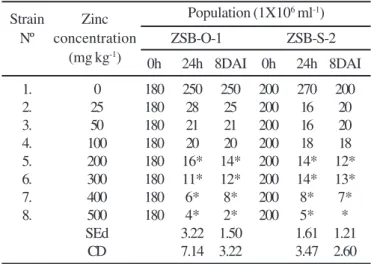
Even at 25 mg kg-1 concentration, there was reduction in
population within 24 hours and afterwards population remained stable up to 8 days (Table 2). At zinc concentration above 100
mg kg-1, a further reduction in population was observed, which
was more pronounced at 200 mg kg-1. The results showed the
inherent capacity of the isolates to tolerate various levels of
zinc. At 500 mg kg-1 level, ZSB-S-2 was completely inhibited at
the 8th day, while ZSB-O-1 recorded 2 x 10⁴ cells ml-1 at the 8th
day after inoculation compared to 180 x 106 cells ml-1 observed
just after inoculation. For both isolates, there were no significant
differences on the 24th h of inoculation, but on 8th day after
inoculation in the ZSB-O-1, the population (2 x 10⁴ cells / ml-1)
recorded at 25 mg kg-1 concentration was found to be superior
Table 1. Zinc solubilizing potential of zinc solubilizing bacterial (ZSB) isolates with different insoluble zinc compounds.
Isolates Zinc oxide Zinc carbonate Sphalerite
Colony Clearing Area Colony Clearing Area Colony Clearing Area
diameter (cm) zone (cm) (cm2) diameter (cm) zone (cm) (cm2) diameter (cm) zone (cm) (cm2)
ZSB-O-1 1.4 1.8 8.0 1.8 1.5 8.5 1.5 2.8 14.5
ZSB-S-2 1.8 3.3 20.43 1.0 2.0 7.0 1.8 2.5 14.5
ZSB-S-4 1.2 2.4 10.18 1.0 4.0 19.6 1.0 1.2 3.8
Figure 1. Available zinc (mg kg-1) in broth containing zinc oxide.
Figure 2. Available zinc (mg kg-1) in broth containing zinc
carbonate.
Figure 3. Available zinc (ppm) in broth containing Sphalerite.
Figure 4. Changes in pH with zinc oxide as zinc source.
other. But, statistical difference existed in populations at 400 and 500 mg kg-1of zinc.
From the results, it is clear that available zinc levels increased with the increase in incubation period. This might be due to the presence of excess zinc even after the absorption by the microbial cells. The bioaccumulation of Cu, Zn Cd and Pb in the
cells of Bacillus sp. Bacillus cereus, Bacillus sphaericus and
gluconic acids produced in the culture broth helped in the solubilization of the zinc salts. Since all the cultures showed a shift in pH towards acidic range, it gives a clue that organic acid might be involved.
The zinc tolerance potential also varied with the organisms.
The ZSB-O-1 cultures is a Bacillus sp.,and had shown a cell
count of 2 x 10⁴ ml-1 on the 8th day after inoculation in a 500 mg
kg-1 concentration of zinc. This might be due to production of
spore cells by the Bacillus sp. which when transferred to a rich
media like nutrient agar were able to retain their growth, whereas
the ZSB-S-2 was completely inhibited at 500 mg kg-1
concentration after 8 days of inoculation since it is a
Pseudomonas sp. It may not be able to survive the adverse condition of higher level of Zn and so a complete inhibition was observed.
Thus, the obtention of an elite culture or a consortium of strains capable of utilizing different unavailable insoluble forms of zinc and tolerant to higher zinc levels may be useful to make zinc available in the soil system. Soils are naturally rich in total zinc but lack available zinc. Application of soluble zinc sulphate to alleviate zinc deficiency in certain soils is a costly practice. Selection and inoculation of zinc solubilizing bacteria either alone in soils inherently rich in native zinc or along with
cheaper insoluble zinc compounds, like ZnO or ZnCO3, will
lead to lot of saving in crop husbandry, besides curtailing the expenditure on agro input. Since zinc in soil system is constantly changing forms and being converted to unavailable forms, this particular study gains momentum for zinc nutrition using microbes.
Figure 6. Changes in pH with Sphalerite as zinc source.
Table 2. Extent of zinc tolerance of zinc solubilizing bacterial (ZSB) isolates.
Strain Zinc Population (1X10⁶ ml-1)
Nº concentration ZSB-O-1 ZSB-S-2
(mg kg-1)
0h 24h 8DAI 0h 24h 8DAI
1. 0 180 250 250 200 270 200
2. 25 180 28 25 200 16 20
3. 50 180 21 21 200 16 20
4. 100 180 20 20 200 18 18
5. 200 180 16* 14* 200 14* 12*
6. 300 180 11* 12* 200 14* 13*
7. 400 180 6* 8* 200 8* 7*
8. 500 180 4* 2* 200 5* *
SEd 3.22 1.50 1.61 1.21
CD 7.14 3.22 3.47 2.60
* Population 104 cells ml-1; h – hours; DAI – Days After Inoculation;
SEd - Standard Error Deviation; CD – Critical Difference.
Figure 5. Changes in pH with zinc carbonate as zinc source.
prevented from being oxidized or reduced and converted to insoluble forms.
A varied solubilization potential was found among the bacterial isolates. This might be related to differences in the location from which they were isolated. The ZSB-O-1 showed higher solubilizing ability in the ZnS (sphalerite) ore containing medium and this may be attributed to the fact that this strain was isolated from the same ore material, presenting a higher potential than other cultures, making their adherence with the ore particles capable of solubilizing ore. Eletron microscopy studies evidenced direct attack of microorganisms to the surface of minerals, and has shown that bacteria attach themselves to surfaces, causing deep pitting and eventually dissolution of the crystal (1). This may be the case also in the present study. Dissolution of the ore and other material may be due to production of organic acids, like gluconic acids (especially 2 keto gluconic acids). The zinc phosphate
solubilization by Pseudomonas fluorescens was investigated
RESUMO
Avaliação In vitro do potencial de solubilização de diferentes bactérias solubilizadoras de zinco (ZSB)
A capacidade de Bacillus sp. e Pseudomonas sp. solubilizar
zinco foi avaliada usando óxido de zinco, sulfeto de zinco e carbonato de zinco, em ensaios em placas e em caldo. A cultura
ZSB-O-1 (Bacillus sp.) apresentou maior dissolução no sulfeto
de zinco, com 2,80 cm de zona de dissolução e 14,50 cm2 de área
no ensaio em placa e 13,60 mg kg-1 de zinco no ensaio em caldo,
no 15o dia de incubação. A cultura ZSB-S-2 (Pseudomonas sp.)
apresentou maior capacidade de dissolução no óxido de zinco,
com 3,30 cm de zona de dissolução e 20,43 cm2 de área no ensaio
em placa e 16,40 mg kg-1 de zinco no ensaio em caldo no mesmo
período de inoculação. A cultura ZSB-S-4 (Pseudomonas sp.)
apresentou maior potencial de solubilização em carbonato de
zinco, com 6,20 cm de zona de dissolução e 13,40 cm2 de área no
ensaio em placa e 13,40 mg kg-1 de zinco no ensaio em caldo.
Assim, o potencial de solubilização variou de acordo com a cultura. A solubilização pode ser devida à produção de ácido, uma vez que o pH do caldo abaixou de 7,0-7,3 para 4,8-6,5 após 15 dias de incubação. O limite de tolerância ao zinco para as duas culturas (ZSB-O-1 and ZSB-S-2) foi mensurada, verificando-se verificando-ser 100 mg kg-1 no ensaio in vitro em caldo.
Palavras-chave: Bacillus sp., Pseudomonas sp., bactérias solubilizadoras de zinco
REFERENCES
1. Bennett, J.C.; Tributsch, H. Bacterial leaching patterns on pyrite crystal surfaces. J. Bacteriol., 134: 310-317, 1978.
2. Bullen, P.; Kemila, A.P.F. Influence of pH on the toxic effect of zinc, cadmium and pentachlorophenol on pure cultures of soil microorganisms. Entl. Toxi. Chemi., 16: 146-153, 1997.
3. Bunt, J.S.; Rovira, A.D. Microbiological studies of some subantartic soils. J. Soil Sci., 6: 119-128, 1955.
4. Chernavina, P. Importance of trace elements in pigment production of microbes. Molekulasnaya Biologiya., 6: 340-355, 1970. 5. Cozzi, D.; Desidevi, P.G.; Lepri, L. The mechanism of ion exchange
with alginic acid. J. Chromatogr., 40: 130-135, 1969.
6. Da Costa, A.C.A.; Duta, F.P. Bioaccumulation of Copper, Zinc, Cadmium and Lead by Bacillus sp., Bacillus cereus, Bacillus sphaericus and Bacillus subtilis. Braz. J. Microbiol., 32: 1-5, 2 0 0 1 .
7. Hughes, M.N.; Poole, R.K. Metals and microorganisms. Chapman and Hall, London. pp.412, 1989.
8. Hutchins, S.R.; Davidson, M.S.; Brierey, J.A.; Brierley, C.L. Microorganisms in reclamation of metals. Ann. Rev. Microbiol., 40: 311-336, 1986.
9. Parisi, B.; Vallee, B.L. Metal enzyme complexes activated by zinc.
J. Biol. Chem., 179: 803-807, 1969.
10. Panse, V.G.; Sukhatme, P.V. Statistical methods for agricultural workers, ICAR Publn., New Delhi. India. 1967
11. Simine, C.D.D.; Sayer, J.A.; Gadd, G.M. Solubilization of zinc phosphate by a strain of Pseudomonas fluorescens isolated form a forest soil. Biol. Fertil. Soils., 28: 87-94, 1998.