J. Duartea, J. Castelo Brancob, M. L. Matosc, J. Santos Baptistad
aLAETA, Faculty of Engineering, University of Porto, PT([email protected]) ORCID: 0000-0002-5856-5317. b LAETA, Faculty of Engineering, University of Porto, PT ([email protected]). CLNEG, PT ([email protected]) ORCID:
0000-0002-1863-1658. d LAETA, Faculty of Engineering, University of Porto, PT ([email protected]) ORCID: 0000-0002-8524-5503
Article History Received 8 February 2018 Accepted 19 March 2018 Published 23 March 2018 Keywords extractive industry occupational vibration whole-body vibration heavy equipment mining vehicles DOI: 10.24840/2184-0954_002.001_0006 ISSN: 2184-0954 Type: Protocol Open Access Peer Reviewed CC BY Abstract
Whole body vibration (WBV) is an emerging issue for the mining industry, occurring from the direct operator’s exposure due to many mining operations. A systematic review is proposed to identify the evidence of whole body vibration occurring in the various mining equipment (including both vehicles and other operating equipment). With regard to it, this systematic review protocol was drawn in order to perform a proper research intending to give answer to the raised issue. Considering that, the main engineering and health databases were selected (i.e. Scopus, Science Direct and PubMed) and a set of keywords was defined to latter combination. The selection process of the papers is also described in an attempt to contribute to the general research on this field. All of the data treatment is detailed, including the risk of bias and attempts to deal with it. This protocol is registered in PROSPERO under the code of CRD42018087629.
1. INTRODUCTION 1.1. Background
Whole body vibration (WBV) is an emerging issue for the mining industry, being the occupational exposure due to many mining operations (Chaudhary, Bhattacherjee, & Patra, 2015). The WBV can be defined as the “vibration transmitted to a person’s entire body via his/her contact with a vibration source” (Derek & Peter, 2005).
The vibration phenomenon is related with the resonant frequency (RF) which is the speed at which a given object naturally vibrates. Although it is intrinsic to each object, the human body does not have a particulate RF, because the different parts of the body varies in terms of density and mass, leading to diverse vibrating frequencies. Nonetheless, the range between 0.5 Hz and 80 Hz has been considered as having significant effects on the human body. Vertical vibration sets the most important RF between 4 and 8 Hz; strong resonances in the neck occur between 3 and 5 Hz, while for the spine is from 4 and 7 Hz (Derek & Peter, 2005).
The vibrating energy transferred to the human body can be divided into two distinct phases: firstly, the energy flowing into the human body via point(s) of contact is stored in the muscle-tendon system; then it flows back into the vibrating source, though with a certain degree of energy dissipation (Derek & Peter, 2005).
Heavy equipment such as dozers, scrapers, shovels, haul trucks, loaders, load haul dump vehicles and most of the earthmoving equipment impacting vibrating sources (Chaudhary et al., 2015), which is due to the engine vibration or due to the operator’s seat, entering the body as a consequence of the contact with the seat backrest or via the feet (Kumar, Kumaraswamidhas, & Murthy, 2016).
Long term exposure to this type of vibration is a well-known recognised risk factor for degenerative changes in the spine and subsequent back pain (Wolfgang & Burgess-Limerick, 2014). Health effects associated with this issue can be divided into two types: acute and chronic. Muscle fatigue, nausea, discomfort, effects on speech, vision and motor performance, and low performance during demanding tasks are included in the first type, low back pain, autonomic nervous system dysfunction, spinal degeneration, disturbed sleep and gastrointestinal tract problems are examples of chronic effects which come from repeated exposure (Bovenzi & Hulshof, 1998; Derek & Peter, 2005; Eger et al., 2014). However several musculoskeletal symptoms have been associated with occupational vibration despite individual characteristics, such as age and smoking, height and weight and mental stress have also been linked with them (Burstrom et al., 2017).
WBV is also dependent on other variables such as the vibration magnitude, direction and frequency, duration and distribution of motion within the body (Derek & Peter, 2005) as well as environmental conditions, and factors associated with the machinery itself such vehicle conditions, maintenance, seat type and material, speed, cab layout, position and design (Kumar et al., 2016).
1.2. Objectives
This protocol outlines the procedures for a systematic review that is intended to answer the question: what mining equipment contributes the most to occupational whole body vibration and under what conditions?
2. METHODS
The Preferred Reporting of Items for Systematic Reviews and Meta-Analyses (PRISMA) guidelines has been used to guide the reporting of this protocol.
2.1. Study eligibility criteria
Type of studies
The Preferred Reporting Items for Systematic Reviews and Meta-Analyses protocols (PRISMA-P) guidelines has been used to guide the reporting of this protocol (Shamseer et al., 2015).
Excluded: Non-research articles (i.e. literature reviews, editorials), studies which present simulation models and studies measuring vibration considering other equipment not used in mining and/or out of the road operations. Also studies which only report prevalence or incidence of symptoms and diseases caused by whole body vibration.
Type of participants
The study does not focus on a specific population: both men and women driving or operating mining equipment are considered, regardless of age, once the main focus is the used equipment.
Target conditions
Studies which perform measurements of whole body vibration due to the usage of different mining equipment in real working conditions.
Reference regulation
All the results will be compared with the Directive 2002/44/EC of the European Parliament (2002) which defines the daily exposure limit values, as well as the exposure action values for an 8 hour exposure and vibration dose value.
Information sources
A search of literature from January 2000 to January 2018 will be performed. The year range is set in order to reflect older equipment that is still in use in the mining industry.
The research includes some of the main engineering databases: Web of Knowledge (Current Contents and Web of Science), Scopus and Academic Search Complete. Scientific journal databases are also going to be screened from: Annual Reviews, Directory of Open Access Journals, Elsevier (Inspec and Science Direct), IEEE Xplore, Emerald and Taylor and Francis. Medline and PubMed are also included, screened to cover the occupational health field.
2.2. Search strategy
The keywords defined to conduct the study are “occupational vibration” and “whole body vibration”, which are going to be sequentially combined with “mining”, “extractive industry”, “mining equipment”, “open cast” and “of the road”, separated by the Boolean operator “AND”, as the as it follows:
(“occupational vibration*” OR “whole body vibration*” OR WBV) AND (mining OR mine* OR “extractive industr*” OR “min* equipment” OR “open cast” OR “open pit” OR “of the road” OR “off road”)
In every data base/journal covered, the main keywords are inserted in the “Title” field and the followed keywords added in the “Topic” field (Academic Search Complete, Current Contents, Inspec, Science Direct, Taylor and Francis, Web of Science) or in a resulting combination between “Title+Abstract+Keywords” (Scopus) or even “Title” and “Abstract” (Annual Reviews, Directory of Open Access Journals, Emerald, Medline and PubMed). Another combination used is “Metadata only” considering “Publication title” or “Document title” in IEEE Xplore.
At the end of this process, the selected articles will be checked for possible identification of new keywords related to the subject. New keywords will be used in new search combinations with the keywords previously used. In the selected articles, the respective references will also be checked in order to find older articles not detected in the initial survey. This procedure will be repeated in the new selected articles until no more relevant information is obtained.
2.3. Study records
Data management
The selected studies are going to be retrieved and managed by Mendeley software for screening and de-duplication. Both title and abstracts are going to be screened by two independent authors. The resultant papers are going to be combined and full-text copies are going to be retrieved and assessed.
Selection process
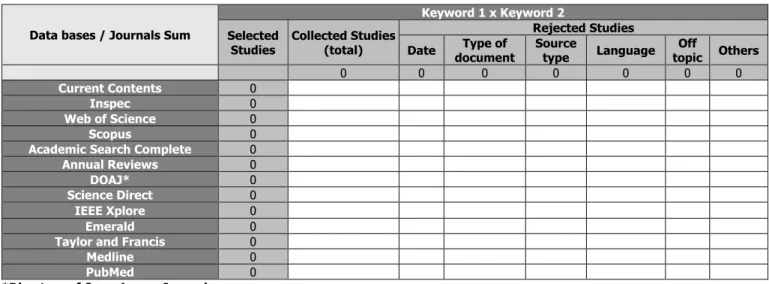
After inserting the combination of the defined keywords (following the described process in “Search Strategy”), exclusion criteria will be applied: date, type of document, source of the document and language. In a first phase of selection, all titles are going to be screened after which, the papers with titles showing relation with the research question will be assessed. In the case which any doubts (concerning the title or abstract) are raised, it will lead to the temporary inclusion of the paper and its full-text will also be retrieved. In Table 1 (see annex) is presented a table which will support this research step.
Full-texts will be collected and fully screened with the objective of extracting the needed data/information, considering the inclusion criteria (whole body vibration measurements caused by mining equipment). The exclusion of any article after the full-text screening will be justified and recorded. After combining the results, any conflict between the two authors will be solved by discussion between them, a third author will resolve any further conflicts.
Data collection process
All of the studies which meet the defined criteria will be screened with regard to collect data of interest. This information will be assembled in a form sheet that will be developed by the research team, gathering all the needed data to answer the research questions and objectives. Two independent authors will collect the data and the team to improve the analysis and solve further disagreements will discuss the results.
Data items
Descriptive tables will be built with data including publication details, instrument details, as well as feasibility: name of the first author, year of publication, objectives, mining equipment, experimental methodology as well as used equipment for the measurements, data retrieved from the experiment, demographic data from the sample, results, limitations and bias.
The main data to be retrieved consists of direct measures of whole-body vibration and it will lead to its direct comparison with the standards. The PRISMA checklist to guide the reporting of systematic reviews will be used (Moher et al., 2009).
Outcomes and prioritization
The primary outcome of this research is to identify the whole-body vibrations produced by the mining equipment used for the different operations, despite age and gender of the operator. As a secondary outcome, those collected vibration values will be compared with the standards in order to determine whether they present themselves as a potential risk as a tool to improve health and safety in this occupational field.
Risk of bias in individual studies
The risk of bias is going to be analysed on study level, considering the categories of greater importance in accordance with the systematic review goals, determined by the review team in two major groups: general categories and study-specific categories. The considered general categories are: equipment calibration, equipment used (different equipment for the same study), seat absorption, seat suitability, time of measurement. With reference to study-specific categories, they are going to be determined after analysing the papers content. Each of the former topic is going to be assessed between low, high or unclear, where “unclear” means that no sufficient information is provided in order to make a judgement. This bias assessment will provide additional information in the systematic review data appraisal. In addition to this, the studies quality will be evaluated using the Cochrane collaboration tool for assessing risk of bias (Higgins et al., 2011).
Data synthesis
In case there is any missing data, the authors of the studies will be contacted to retrieve the wanted information; in case it is not possible, authors will discuss whether to exclude the paper from the study. The data synthesis will be carry through a narrative, based on the assembled data tables (with information from the eligible papers), considering that the outcome is to provide an equipment list with their respective potential risk of vibration exposures. With this perspective, bias will also be taken into consideration when analysing the data.
Meta-biases
This parameter does not apply to the study which will be carried out.
Confidence in cumulative evidence
This parameter does not apply to the study which will be carried out.
Protocol registration
The protocol for the systematic review is registered in PROSPERO under the code CRD42018087629.
AUTHORS’ CONTRIBUTIONS
Study design and development: JD, MLS, JS, JSB Full-text screening: JD, JS
Data extraction: JD, JS
Critical appraisal: JD, MLS, JS, JSB
Data analysis and interpretation: JD, MLS, JS, JSB Draft of the protocol: JD
Support in the draft of the protocol: MLS, JS, JSB All authors read and approved the final version
CONFLICT OF INTEREST
The authors claim no conflict of interest.
ACKOWLEDGMENTS
This publication has been funded with support from the Portuguese entity Autoridade para as Condições do Trabalho in the aim of the project Guião para a Avaliação de Riscos na Indústria Extrativa a Céu Aberto.
REFERENCES
Bovenzi, M., & Hulshof, C. T. J. (1998). an Updated Review of Epidemiologic Studies on the Relationship Between Exposure To Whole Body Vibration. Journal of Sound and Vibration, 215(4), 595–611. http://doi.org/10.1006/jsvi.1998.1598
Burstrom, L., Aminoff, A., Bjor, B., Manttari, S., Nilsson, T., Pettersson, H., Wahlstrom, J. (2017). MUSCULOSKELETAL SYMPTOMS AND EXPOSURE TO WHOLE-BODY VIBRATION AMONG OPEN-PIT MINE WORKERS IN THE ARCTIC. INTERNATIONAL JOURNAL OF OCCUPATIONAL MEDICINE AND ENVIRONMENTAL HEALTH, 30(4), 553–564. article.
http://doi.org/10.13075/ijomeh.1896.00975
Chaudhary, D. K., Bhattacherjee, A., & Patra, A. (2015). Analysis of Whole-Body Vibration Exposure of Drill Machine Operators in Open Pit Iron Ore Mines. Procedia Earth and Planetary Science, 11, 524–530.
http://doi.org/10.1016/j.proeps.2015.06.054
Derek, R., & Peter, A. (2005). Whole-Body Vibration.
Directive 2002/44/EC of the European Parliament and of the Council of 25 June 2002 on the minimum health and safety requirements regarding the exposure of workers to the risks arising from physical agents (vibration). (2002). Official Journal of the European Communities, L 177(10), 13–19. Retrieved from http://www.aqc-cert.com/upload/dokuman/%7B3B9E64EB-3EDB-4889-B363-B71BC4B566DB%7D.pdf
Eger, T., Thompson, A., Leduc, M., Krajnak, K., Goggins, K., Godwin, A., & House, R. (2014). Vibration induced white-feet: Overview and field study of vibration exposure and reported symptoms in workers. Work, 47(1), 101–110.
http://doi.org/10.3233/WOR-131692
Higgins, J. P. T., Altman, D. G., Gøtzsche, P. C., Jüni, P., Moher, D., Oxman, A. D., … Sterne, J. A. C. (2011). The Cochrane Collaboration’s tool for assessing risk of bias in randomised trials. BMJ (Online), 343(7829), 1–9.
http://doi.org/10.1136/bmj.d5928
Kumar, R. ., Kumaraswamidhas, L. A. ., & Murthy, V. M. S. R. . (2016). Whole body vibration control and strategies in open cast coal mines: An overview. International Journal of Control Theory and Applications, 9(10), 4519–4525.
Moher, D., Liberati, A., Tetzlaff, J., Altman, D. G., Altman, D., Antes, G., … Tugwell, P. (2009). Preferred reporting items for systematic reviews and meta-analyses: The PRISMA statement. PLoS Medicine, 6(7).
http://doi.org/10.1371/journal.pmed.1000097
Shamseer, L., Moher, D., Clarke, M., Ghersi, D., Liberati, A., Petticrew, M., … Whitlock, E. (2015). Preferred reporting items for systematic review and meta-analysis protocols (prisma-p) 2015: Elaboration and explanation. BMJ (Online), 349(January), 1–25. http://doi.org/10.1136/bmj.g7647
Wolfgang, R., & Burgess-Limerick, R. (2014). Whole-body vibration exposure of haul truck drivers at a surface coal mine. APPLIED ERGONOMICS, 45(6), 1700–1704. article. http://doi.org/10.1016/j.apergo.2014.05.020
Table 1 – Form sheet summarizing the rejection criteria which will be used to conduct the systematic review
Data bases / Journals Sum
Keyword 1 x Keyword 2 Selected Studies Collected Studies (total) Rejected Studies
Date document Type of Source type Language topic Others Off
0 0 0 0 0 0 0
Current Contents 0
Inspec 0
Web of Science 0
Scopus 0
Academic Search Complete 0
Annual Reviews 0
DOAJ* 0
Science Direct 0
IEEE Xplore 0
Emerald 0
Taylor and Francis 0
Medline 0
PubMed 0