4
Editor
Carla Nunes, FCT, Universidade do Algarve, Faro, Portugal
Editorial Board
Brion Duffy, Agroscope FAW Wadenswil Bacteriology, Switzerland Carla Nunes, FCT, Universidade do Algarve, Portugal
Christian Larrigaudiere, IRTA-Institut de Recerca i Tecnologia Agroalimentàries, Spain Josef Streif, Inst. Sonderkulturen & Produktsphysiologie, Hohenheim, Germany Maribela Pestana, FCT, Universidade do Algarve, Portugal
Maria Graça Barreiro, Instituto Nacional de Investigação Agrária, Portugal Maria Dulce Antunes, FCT, Universidade do Algarve, Portugal
Miguel Salazar, CICAE, Instituto Universitário Dom Afonso III, Portugal Mustafa Erkan, Akdeniz University, Turkey
Paolo Bertolini, Universita de Bologna, Italy Pol Tijskens, Wageningen University, Netherlands Shimshon Ben-Yehoshua, A.R.O. Volcani Centre, Israel Susan Lurie, A.R.O. Volcani Centre, Israel
The papers contained in this book report some of the peer reviewed Proceedings of the International Conference “Environmentally friendly and safe technologies for quality of fruit and vegetables”, but also other papers related with the subject were included. The manuscripts were reviewed by the Editor and Editorial Board, and only those papers judged suitable for publication were accepted. The Editor wish to thank to all the reviewers and authors for their contribution.
Proceedings of the International Conference “Environmentally friendly and safe
technologies for quality of fruit and vegetables”, held in Universidade do Algarve, Faro,
Portugal, on January 14-16, 2009. This Conference was a join activity with COST Action 924.Convener
Carla Nunes, Universidade do Algarve, Portugal
Scientific Committee
Carla Nunes, Universidade do Algarve, Portugal Amílcar Duarte, Universidade do Algarve, Portugal
Angelos Kanellis, Aristotle University of Thessaloniki, Greece Bart Nicolaï, Katholieke Universiteit Leuven, Belgium
Brion Duffy, Agroscope FAW Wadenswil Bacteriology, Switzerland
Christian Larrigaudiere, IRTA-Institut de Recerca i Tecnologia Agroalimentàries, Spain Domingos de Almeida, Universidade do Porto, Portugal
Josef Streif, Inst. Sonderkulturen & Produktsphysiologie Hohenheim, Germany Krzysztof Rutkowski, Research Inst. of Pomology and Floriculture, Poland Maria Dulce Antunes, Universidade do Algarve, Portugal
Maria da Graça Barreiro, Instituto Nacional de Investigações Agrárias, Portugal Mustafa Erkan, Akdeniz University, Turkey
Paolo Bertolini, Universita de Bologna, Italy Pol Tijskens, Wageningen University, Netherland Shimshon Ben-Yehoshua, A.R.O. Volcani Centre, Israel
Organizing Committee
Carla Nunes, Universidade do Algarve, Portugal Amílcar Duarte, Universidade do Algarve, Portugal Bart Nicolaï, Katholieke Universiteit Leuven, Belgium Maria Dulce Antunes, Universidade do Algarve, Portugal Maria Emília Costa, Universidade do Algarve, Portugal Maribela Pestana, Universidade do Algarve, Portugal
Miguel Salazar, Instituto Universitário Dom Afonso III, Portugal
Sponsors
COST, European Cooperation in the field of Scientific and Technical Research
Fundação para a Ciência e a Tecnologia
International Association of Students in Agriculture and Related Sciences, Faro
Serviço Técnico Pós-colheita do IRTA em Portugal Algarve.resorts.net
Câmara Municipal de Faro Câmara Municipal de Albufeira
Câmara Municipal de Aljezur Câmara Municipal de Lagos
Câmara Municipal de S. Brás de Alportel Crédito Agrícola, Caixa do Algarve A Farrobinha 80 g C.N. Kopke & Cª PrimeDrinks, S.A. Uniprofrutal Frutas Mourinho
189 189 Se c ti o n 4 . e n v ir o n m en ta ll y f ri en d ly a n d Sa fe m et h o d S t o c o n tr o l p o Sth a rv eS t l o SS eS
SECTION 5. NEW APPROACHES TO ENHANCE SAFETy
AND QuALITy OF mINImALLy PROCESSED FRuITS AND
VEgETABLES
Se c ti o n 5 . n ew a pp ro a c h eS t o e n h a n c e Sa fe ty a n d q u a li ty o f m in im a ll y p ro c eSS ed f ru it S a n d v eg et a bl eS
32. PHySIOLOgICAL BASES FOR TEXTuRE AND COLOR
CHANgES IN FRESH-CuT ‘ROCHA’ PEAR: ImPLICATIONS
FOR THE DEVELOPmENT OF PRODuCTS AND
PROCESSES
Maria Helena Gomes1, Domingos PF Almeida1,2*
1Escola Superior de Biotecnologia, Universidade Católica Portuguesa, Rua Dr. António Bernardino de Almeida, 4200-072 Porto, Portugal.
2Faculdade de Ciências, Universidade do Porto, R do Campo Alegre, 823, 4150-180 Porto, Portugal *E-mail: [email protected]
abstract
The physiological bases for the effectiveness of technologies used in fresh-cut fruit were examined in an attempt to foster the shift from a market-pull to a science-push innovation model. Respiration rate of fresh-cut ‘Rocha’ pear were measured at various oxygen concentrations. Apparent Km values for oxygen uptake were very close to the fermentation thresholds, indicating that it is physiologically impossible to reduce the respiration rate of fresh-cut pear by more than 50% without inducing fermentation. Based on this information, we hypothesize that optimizing oxygen concentration inside packages is of little or no value in fresh-cut pears. Additionally, additives used to reduce enzymic browning and softening may have pleiotropic effects on quality. It was found that pH significantly affected the rate and intensity of browning of fresh-cut pears. Browning was more intense in pears treated at pH 3.0 and less pronounced at pH 7.0, but the softening rate was lower at the latter pH value. Calcium salts also affected texture and color in a salt-specific manner. Larger color changes were observed with propionate and lactate. Although calcium ascorbate reduced color changes, fruit slices treated with this salt were softer than those treated with calcium propionate, lactate or chloride. Based on the physiological information gathered, we will develop and evaluate an integrated process to maximize the quality of fresh-cut ‘Rocha’ pear throughout the distribution chain.
Keywords: minimally processed, modified atmosphere packaging, pH, Pyrus communis, respiration
Introduction
Fresh-cut produce are one of the fastest growing segments of the fresh food market in developed countries, both at retail level and restaurant outlets. The fresh-cut fruit industry is urged to provide products to the growing number of consumers who seek convenience and will not lower their high expectations regarding the intrinsic quality and food safety of fresh-cut fruit. Fruit processing has physiological consequences that impact negatively on the quality of the final fresh-cut product. Loss of cellular compartmentation caused by cutting deeply affects tissue metabolism. Wounding causes an increase in respiration rate, ethylene synthesis and area-to-volume ratio, favors water loss, and destroys structural barriers to the entry of microorganisms (Watada & Qi 1999). Additionally, the metabolic changes induced by cutting can produce undesirable flavor, loss of vitamins, excessive softening and color changes all of which severely reduce shelf life (Wiley 1994). Enzymatic browning and softening are the major limiting factors for fresh-cut pear (Gorny et al. 2000), when microbiological stability is secured. Anti-browning additives, often combined with calcium, and modified atmosphere packaging are used to extend shelf-life in fresh-cut pear. A number
of studies encompassing packaging films and geometries have assessed O2 concentration versus produce
quality, in order to empirically find the best package (Del Nobile et al. 2007; Soliva-Fortuny et al. 2007). An alternative approach to the trial-and-error, should data be available, is to deduce optimal packaging geometry and film permeability based on the produce respiration rate (Lakakul et al. 1999; Jacxsens et al. 2000), as affected by oxygen concentration and temperature.
206 206 206 En v ir o n m En ta ll y F ri En d ly a n d S a FE tE ch n o lo g iES F o r Q u a li ty o F F ru it S a n d vE g Eta bl ES
This research project aims at evaluating the potential of MAP utilization for fresh-cut ‘Rocha’ pear. The relationship between oxygen concentration and respiration rate was modeled to help design of MAP for fresh-cut pear at temperatures normally found during processing and distribution. The effect of dipping solutions with different pH values and calcium salts in the control of quality loss of pear slices during cold storage has also been studied. The physiological information gathered is useful to develop and evaluate an integrated process to maximize the quality of fresh-cut fruits.
material & methods
Plant material and general Processing
Pears (Pyrus communis L. ‘Rocha’) with a flesh firmness ranging between 38 to 56 N (8-mm probe) were sanitized and hand cut in wedges, without skin removal.
respiratory data
The fresh-cut pear wedges (30 to 26 g) were packed in low-density polyethylene (LDPE) (Dow Chemical Company, Midland, MI) pouches that were hermetically sealed using an impulse heat sealer. A range of
steady-state O2 and CO2 partial pressures was achieved by varying fruit weight (30-260 g), film surface
area (450-800 cm2), and film thickness (27-105 μm) among the pouches. Oxygen and carbon dioxide
were measured daily with a gas analyzer. Rates of O2 uptake and CO2 production were calculated by mass
balance, once steady-state O2 and CO2 partial pressures were achieved inside the packages. Three replicates
of each combination of film thickness, film area, and fruit mass were stored at 0, 5, 10 and 15 ºC.
Respiration rate ( ) was described as a function of O2 partial pressure (pO2) by a Michaelis-Menten
model, as suggested by Lee et al. (1991).
Respiratory quotients (RQ) and ethanol as function of steady-state oxygen partial pressure were used to determine the lower limit for aerobic respiration (Joles et al. 1994). The sudden increase in RQ or headspace
ethanol concentration occurring when pO2 dropped below a certain level is termed ‘fermentation threshold’.
ph treatments
Pear slices were dipped for 1 min in a cold buffer solution (200 mM sodium phosphate and 100 mM citric acid) at pH 3.0, 5.0 and 7.0, packed in clamshells with normal atmosphere and stored at 4 ºC. Six replicated packages for each dipping solution were analyzed at 0, 3, 6, 10 and 13 days (d), for color, firmness, soluble solid content, pH, titratable acidity and mesophilic and psychrophilic bacterial count.
Calcium treatments
Fresh-cut pears were dipped in calcium solutions buffered at pH 3 and pH 7, placed in covered trays and stored at 5 ºC. Four calcium salts – ascorbate, chloride, lactate and propionate – were dissolved in two buffer solutions with pH 3.0 (100 mM citric acid-100 mM sodium citrate and 100 mM citric acid-200 mM sodium phosphate), and two buffers with pH 7.0 (100 mM Mops-NaOH and 100 mM Tris-100 mM HCl) to
give a final concentration of 250 mM (1% Ca2+) of calcium. The experiment was conducted in a randomized
complete block design with 30 pear slices per treatment. The two buffer solutions with the same pH were considered as replicates. Data were subjected to two-way analysis of variance, considering pH and calcium salt as factors.
quality determinations during Storage Period
Color was measured in the CIE L* C* h color space with a Konica-Minolta CR-400 chromameter (Japan)
with a D65 illuminant. Metric hue difference, , where a* and b* are the Cartesian
color coordinates and C* is chroma, was used to express changes in color between day 0 and day 6. Firmness was determined using a texture analyzer (TA-XT2 Plus, Texture Technologies, UK) equipped with a
Se c ti o n 5 . n ew a pp ro a c h eS t o e n h a n c e Sa fe ty a n d q u a li ty o f m in im a ll y p ro c eSS ed f ru it S a n d v eg et a bl eS
flat plate. Microbiological assessment was attained by enumeration of total plate count of mesophilic and psychrophilic microorganisms (ISO 4833:1991). Soluble solids content (digital refractometer Palette PR-32, Atago, Japan), pH (pH meter Ion 510 Series, Oakton, USA) and titratable acidity (titrator Digitrate, Jencons, UK) were determined in pear juice.
results & discussion
respiration and modified atmosphere Packaging
The oxygen uptake rate increased with pO2 pkg in a manner consistent with saturation kinetics (Fig 1).
Michaelis-Menten model was able to explain more than 93% of the total variability of the data and accurately predicted the experimental results (RMSE<0.06). Respiration rates of fresh-cut ‘Rocha’ pear, as
expressed as CO2 production were similar to the range of value reported for other fresh-cut pear varieties at
0 or 10 ºC (Gorny et al. 2000). The respiratory quotient (RQ) for aerobic respiration of fresh-cut ‘Rocha’ pear stored at various temperatures ranged between 1.2 and 1.4 (Table 1), consistent with the usage of organic acids as major respiratory substrates (Fonseca et al. 2002). ‘Fermentation threshold’ ranged between 0.4
and 2.9 kPa (Table 1). At elevated temperatures fermentation occurred at higher pO2 (Lakakul et al. 1999),
as observed for 5 up to 15 ºC (Table 1).
fig 1. Effect of steady-state O2 partial pressure and storage temperature on the rate of O2 uptake of ‘Rocha’ pear slices in sealed LDPE packages at 0 ( ), 5 ( ), 10 ( ) and 15 ºC ( ) fitted with a Michaelis-Menten model.
table 1. Estimated respiratory parameters for fresh-cut ‘Rocha’ pear stored at four temperatures. Temperature
(ºC) RO2
max
(mmol kg-1 h-1) Km,O2(kPa) RQ Fermentation threshold (kPa) atmosphere (kPa)Safe working
0 0.108 0.52 1.4 2.9 None
5 0.224 0.73 1.3 0.4 0.33
10 0.464 1.02 1.2 0.7 0.32
15 0.961 1.43 1.3 0.7 0.73
Respiratory behavior as function of oxygen concentration provides a basis to deduce the potential benefits of using MAP technologies. Low oxygen atmospheres could be useful if a sizeable reduction in respiration rate (e.g. 50%) can be reached without the induction of fermentation (Beaudry 2000). In
cases where (apparent Km - is the pO2 pkg at half of maximal value of , kPa) is much higher than
fermentation threshold, a reduction in pO2 slows down metabolic activities without an increase in the
RQ and fermentative compounds. The range of pO2 between and fermentation threshold is termed
‘safe working atmosphere’ (Beaudry 2000). Fresh-cut ‘Rocha’ pear had narrow (0.3 to 0.7 kPa) safe working atmospheres at the temperatures tested (Table 1). Low oxygen atmospheres did not offer any reduction in
208 208 208 En v ir o n m En ta ll y F ri En d ly a n d S a FE tE ch n o lo g iES F o r Q u a li ty o F F ru it S a n d vE g Eta bl ES
metabolic activity without the danger of inducing anaerobiosis, especially between 0 and 10 ºC, temperatures normally found during storage and marketing. Gorny (2001) also reported a poor efficacy of modified atmosphere for fresh-cut pear at 0-5 ºC.
Given this physiological behavior, the potential for reducing respiration of fresh-cut via MAP is limited. Efforts in packaging design should, therefore, to directed at avoiding microbial contamination and dehydration, and allow aerobic respiration.
Effect of ph
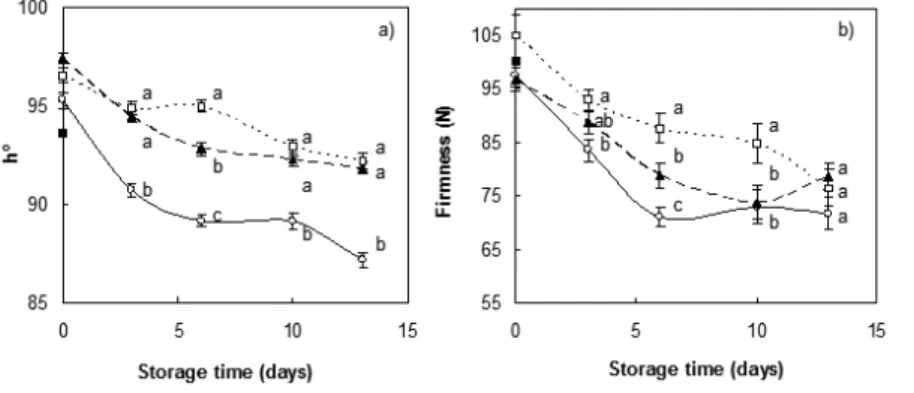
Color of fresh-cut pear slices was significantly affected by pH of the dipping solutions throughout the storage period (Fig 2a, Table 2). Acidic additives (e.g. ascorbate, citrate) are frequently used during processing of fresh-cut fruit to limit microbial growth. However, dipping in an acidic solution increases pear browning (Sapers & Miller 1998). Enzymatic browning is mediated by polyphenoloxidase (PPO) and optimal pH values for pear PPO are cultivar dependent. Catalytic properties of ‘Rocha’ pear PPO are yet to be thoroughly characterized but low enzymatic activity at pH 7 is expected, as observed with PPO of ‘Bosc’ and ‘Red’ cultivars (Siddiq et al. 1994).
A significant effect of pH on firmness was also observed. Higher softening rates were observed at acidic pH, especially during the first 6 to 9 d at 4 ºC (Fig 2b). Similar results observed by Pinheiro & Almeida (2008) in tomato were attributed to enhanced pectin disassembly at lower pH.
Microbial count increased over storage and pears dipped with pH 7.0 solution presented higher counts,
although below 106 cfu g-1 after 10 d in storage (data not shown).
fig 2. Hue angle (a) and firmness (b) values of fresh-cut pear slices untreated ( ) or treated with a solution at pH 3 ( ); 5 ( ) or 7 ( ), during storage at 4 ºC. Points are average of 36 replicates; bars are standard error.Values followed by the same letter are not significantly different.
Effect of Calcium
Ascorbate was the calcium formulation less effective in maintaining firmness but preserved initial color (Table 2). An interaction between the effects of pH and calcium in color and firmness was observed, as previously reported by Pinheiro & Almeida (2008) for tomato. While color of slices treated with calcium ascorbate or calcium chloride did not differ with solution pH, calcium lactate and calcium propionate clearly promoted browning when dissolved in solutions at pH 3 when compared with solutions at pH 7 (data not shown).
Se c ti o n 5 . n ew a pp ro a c h eS t o e n h a n c e Sa fe ty a n d q u a li ty o f m in im a ll y p ro c eSS ed f ru it S a n d v eg et a bl eS
table 2. Effect of calcium salt and buffer pH on firmness and color of fresh cut pear stored 6 days at 5 ºC. Values are means (n=120 for calcium; n= 300 for pH) ± SE. Values followed by the same letter are not significantly different.
Firmness variation (%) Calcium Buffer 133.2 ± 3.7 a 2.50 ± 0.10 c Ascorbate 93.4 ± 3.3 d 0.42 ± 0.03 e Chloride 120.0 ± 3.1 b 1.69 ± 0.08 d Lactate 117.5 ± 3.3 b 3.26 ± 0.14 a Propionate 106.5 ± 3.6 c 3.02 ± 0.23 b pH 3.0 100.8 ± 2.1 b 3.00 ± 0.12 a 7.0 127.9 ± 2.2 a 1.35 ± 0.06 b Significance (P) Calcium <0.001 <0.001 pH <0.001 <0.001 pH*Calcium <0.001 <0.001
acknowledgments
This work was supported by project PTDC/AGR-ALI/66144/2006 and the PhD grant to MH Gomes (SFRH/ BD/22628/2005), funded by Fundação para a Ciência e a Tecnologia, Portugal.
references
Beaudry RM. 2000. Responses of horticultural commodities to low oxygen: limits to the expanded use of modified atmosphere packaging. HortTechnology 10:491-500
Del Nobile MA, Licciardello F, Scrocco C, Muratore G, Zappa M. 2007. Design of plastic packages for minimally processed fruits. J Food Eng 79:217-24
Fonseca SC, Oliveira FAR, Brecht JK. 2002. Modelling respiration rate of fresh fruits and vegetables for modified atmosphere packages: a review. J Food Eng 52:99-119
Gorny JR, Cifuentes RA, Hess-Pierce B, Kader AA. 2000. Quality changes in fresh-cut pear slices as affected by cultivar, ripeness stage, fruit size, and storage regime. J Food Sci 65:541-4
Gorny JR. 2001. A summary of CA and MA requirements and recommendations for fresh-cut (minimally processed) fruits and vegetables, pp:95-145. In: Postharvest Horticulture Series, 22A. University of California, Davis
Jacxsens L, Devlieghere F, Rudder TD, Debevere J. 2000. Designing equilibrium modified atmosphere packages for fresh-cut vegetables subjected to changes in temperature. Lebensm-Wiss Technol 33:178-87 Joles DW, Cameron AC, Shirazi A, Petracek PD. 1994. Modified-atmosphere packaging of ‘Heritage’ red
raspberry fruit: respiratory response to reduced oxygen, enhanced carbon dioxide, and temperature. J Amer Soc Hort Sc. 119:540-5
Lakakul R, Beaudry RM, Hernandez RJ. 1999. Modeling respiration of apple slices in modified-atmosphere packages. J Food Sci 64:105-10
Lee DS, Haggar PE, Lee J, Yam KL. 1991. Model for fresh produce respiration in modified atmospheres based on principles of enzyme kinetics. J Food Sci 56:1580-5
Pinheiro SCF, Almeida DPF. 2008. Modulation of tomato pericarp firmness through pH and calcium: Implications for the texture of fresh-cut fruit. Postharvest Biol Technol 47:119-25
Sapers GM, Miller RL. 1998. Browning inhibition in fresh-cut pears. J Food Science 63:342-6
Siddiq M, Cash JN, Sinha NK, Akhter P. 1994. Characterization and inhibition of polyphenol oxidase from pears (Pyrus communis L. cv. Bosc and Red). J Food Biochemistry 17:327-37
Soliva-Fortuny R, Ricart-Coll M, Elez-Martínez P, Martín-Belloso O. 2007. Internal atmosphere, quality attributes and sensory evaluation of MAP packaged fresh-cut Conference pears. Int J Food Sci Technol 42:208-13
Watada AE, Qi L. 1999. Quality of fresh-cut produce. Postharvest Biol Tec 15:201-5