Faculdade de Engenharia e Recursos Naturais
Penicillin G Acylase Encapsulation Studies in
Polyvinyl Alcohol Based Matrices
Mestrado em Biotecnologia
Filipa Cristiana Duarte Fangueiro Maduro
Acknowledgments
My desire to study biotechnology led me to Universidade do Algarve where I enrolled
in a Master course. This Mestrado em Biotecnologia was lectured in a post working
schedule and, during one year, every Thursday afternoon I drove to Algarve in order to
occupy my weekend studying. It could have been tiring if it hadn´t been for my colleges
and teachers; I thank them for making the school year of 2006/2007 educational as well
as friendly and funny. For the research work I hoped to stay closer to my workplace, in
order to maximize the time spent in the laboratory, so I applied for Institute for
Biotechnology and Bioengineering (IBB) as studying in an institution like Instituto
Superior Técnico was in many ways appealing. Professor Doutor Joaquim Cabral met
me and accepted me to work there for the following year; I would like to thank him for
giving me this opportunity. My Supervisor in IBB was Professor Doutor Luís Fonseca
which I thank, for taking me as a student but especially for being such a pleasant and human person, he made me feel “at home” and I believe that this has positive repercussions in ones work. To Professora Doutora Deborah Power I thank her help
every time I needed, which was always effective. Professor Doutor Pedro Fernandes
was always available for my questions and his suggestions where very helpful in
guiding my work - Thank You. Susana Bernardino is working in the same field as my
research topic and I thank her for her experimental suggestions, her help with the
materials and procedures and also her help in the conclusion of this thesis. Daniel
Guedelha is a graduate student that was with me for one month and I thank him for
making my first experience, in guiding a student, a positive one, which will certainly
make me a better “teacher” in the future. Thanks to all my colleagues in IBB for the
iv support, in my most difficult moments he helped me to look on the bright side. Last but
not least, I thank my parents, for financing these last months that I worked in the
laboratory and all their support that was, and is, always welcome and helpful. Thank
Key-words: penicillin G acylase; β-lacatm antibiotics; cefalexin; immobilization; polyvinyl alcohol; Lentikat® liquid.
Penicillin G Acylase Encapsulation Studies in Polyvinyl Alcohol Based Matrices
Supervisors: Doutor Luís Pina da Fonseca
Doutora Deborah Mary Power
Juri: Doutor José Manuel Peixoto Teixeira Leitão Doutora Deborah Mary Power
Doutor Luís Joaquim Pina da Fonseca
Doutor Pedro Carlos de Barros Fernandes
Abstract
Penicillin G acylase (EC 3.5.1.11) (PGA) hydrolyses penicillin G (PG) producing 6-aminopenicillanic acid (6-APA), an important building block in the synthesis of semi-synthetic antibiotics such as ampicillin and amoxicillin. The synthesis of these antibiotics by PGA is already successfully used in lab and pilot scales and more recently in the synthesis of cefalexin (CEX) at industrial scale. This work characterizes the stability and activity of PGA when immobilized in a polyvinyl alcohol based matrix (Lentikat® liquid), PVA/LL by a new and simple entrapment strategy. The biocatalyst retains from 22 to 66% of its original activity, depending on enzyme load. Hydrolysis and synthesis reactions were tested and the immobilized enzyme can be reused for, at least, 10 consecutive batches without decay of initial activity. The preferential pH and temperature for the hydrolysis of PG are 8 and 37ºC, respectively, it is stable at 4ºC and its half-life, at 25ºC and pH 8 is roughly 8 days. For the synthesis of CEX there was no decay of initial activity for at least 50 hours, at 14ºC and pH 7.2, which indicates a high operational stability. Substrate inhibition by 7-aminodesacetoxicefalosporanic acid (7-ADCA) was observed both for the free and the immobilized enzyme. These forms of enzyme presented synthesis of CEX and hydrolysis of PGM ratio (S/H) of 4.2 and 2.5, respectively. The biocatalyst (PGA_PVA beads) is suitable for the production of cefalexin in industry since it showed a high operational stability, without enzyme leakage during the reaction and between washing steps.vi
Contents:
Introduction ... 1 β-lactam antibiotics ... 1 Penicillin G acylase ... 5 Immobilization of enzymes ... 10Immobilization of Penicillin G acylase ... 19
Materials and Methods ... 26
Materials: ... 26
Methods: ... 26
1) Penicillin Hydrolysis ... 26
1.1. Immobilization Yield ... 26
1.2. Studies of biocatalysts reutilization ... 31
1.3. pH effect on PGA_PVA beads activity ... 31
1.4. Temperature effect on PGA_PVA beads activity ... 32
1.5. Storage stability ... 32
1.6. Kinetics ... 33
2) Cefalexin Synthesis ... 33
2.1. Operational stability ... 36
2.2. Kinetics ... 37
2.2.1. Maintaining a constant ratio between substrates concentrations ... 37
Discussion ... 39
1) Penicillin Hydrolysis ... 39
1.1. Immobilization Yield ... 40
1.2. Studies of biocatalysts reutilization ... 43
1.3. pH effect on PGA_PVA beads activity ... 45
1.4. Temperature effect on PGA_PVA beads activity ... 46
1.5. Storage stability ... 49
1.6. Kinetics ... 52
2) Cefalexin Synthesis ... 55
2.1. Operational stability ... 56
2.2. Kinetics ... 61
2.2.1. Maintaining a constant ratio between substrates concentrations ... 61
2.2.2. Maintaining one of the substrates at a constant concentration ... 63
Concluding remarks and Future work ... 66
Bibliography ... 68
1
Introduction
β-lactam antibiotics
Antibiotics are substances derived from living organisms capable of inhibiting vital
processes for other organisms. In 1928 Alexander Fleming discovered the ability of a
microorganism, Penicillium notatum, to prevent the growth of Staphylococcus (Fleming
1929), ten years passed before the inhibiting factor was successfully isolated by Florey
and Chain (1939). Penicillin G (PG) (Figure 1) was isolated, characterized and rapidly
used for medical purposes (Bentley 2005).
Figure 1 Chemical representation of Penicillin G (Wegman et al. 2001).
In 1945 the Nobel Prize in Physiology or Medicine was attributed to Alexander
Fleming, Ernst Chain and Howard Florey "for the discovery of penicillin and its
curative effect in various infectious diseases" (Raju 1999). The development of the
industrial production of Penicillin occurred during the Second World War and its
demand was very high. This situation led to a widespread use, which saved many lives
of wounded soldiers and later of the general population but this type of use also allowed
started to become ineffective towards infections. Bacteria started producing or
increasing their production of enzymes that are capable of altering the antibiotic
structure and inactivating its biological role.
Figure 2 Chemical representation of the reactions that render penicillin a biologically inactive molecule
and enzymes that catalyze each reaction.
After its isolation penicillin and other antibiotics were thoroughly studied and by the 1960s Beecham Laboratories had found a way to extract the β-lactam nucleus from penicillin, producing 6-aminopenicillanic acid (6-APA), which derives from penicillin,
by the chemical reaction depicted in Figure 3. By using the β-lactam nucleus and
altering the acyl donor the function is maintained but bacteria no longer recognize the
antibiotic, thus increasing effectiveness. These antibiotics are called semi-synthetic
3 of naturally occurring molecules. It is also possible to completely synthesize antibiotics. β-lactam antibiotics are very important in the pharmaceutical industry, with annual sales of ~15bilion, they correspond to 65% of the total antibiotics market (Chandel et al.
2008).
Figure 3 Chemical deacylation of PG into 6-APA (Wegman et al. 2001).
Penicillins and Cephalosporins come from fungi, are derived from amino acids and their
primary action is to inhibit the biosynthesis of the cell wall of Gram-positive bacteria
(penicillins, aminopenicillins, cephalosporins) and Gram-negative bacteria
(cephalosporins), impeding peptidoglycan cross linkage by inhibiting the enzyme
transpeptidase. There is also an indirect activation effect in hydrolases and autolysins,
both these actions contribute to the cell wall destruction, causing the cell to burst when
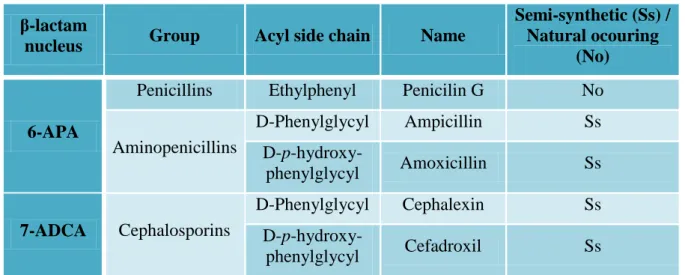
Depending on β-lactam nucleus and the acyl derivative linked to it, β-lactam antibiotics can be divided in groups (Table 1).
Table 1 Example of some β-lactam antibiotics and their structural classification.
β-lactam
nucleus Group Acyl side chain Name
Semi-synthetic (Ss) / Natural ocouring
(No)
6-APA
Penicillins Ethylphenyl Penicilin G No
Aminopenicillins D-Phenylglycyl Ampicillin Ss D-p-hydroxy-phenylglycyl Amoxicillin Ss 7-ADCA Cephalosporins D-Phenylglycyl Cephalexin Ss D-p-hydroxy-phenylglycyl Cefadroxil Ss
The most important chemical method for the production of 6-APA was called the “Delft Cleavage” and was a chemical process (Figure 3) used since the 1960‟s. Very low temperatures are required for this process, spending much energy and hazardous
chemicals are used (Wegman et al. 2001). At this time Penicillin G acylase (PGA) was
known, as well as its capacity to hydrolyze PG, however biotechnology was still in its
first steps and the process wasn‟t economically viable, since the biocatalyst was
discarded after use. The usual requirement for a biocatalyst is to achieve product
concentrations comparable to chemical processes, given that, in nature, enzymes work
at milimolar levels of substrate, it will always be the case that enzymes will be
operating away from their natural conditions (Pollard et al. 2007). Process development, protein engineering solutions and immobilization techniques evolved and the “Delft Cleavage” was abandoned and completely substituted by the enzymatic pathway
5 (Figure 4) which is operationally, economically and environmentally more efficient
(Kallenberg et al. 2005).
Figure 4 Enzymatic deacylation of PG into 6-APA (Wegman et al. 2001).
Nowadays from an industrial point of view, because of bacterial resistance to naturally
occurring antibiotics, the penicillin G hydrolysis is very important since its products are
the basis for the production of semi-synthetic antibiotics.
Penicillin G acylase
Penicillin G acylase (EC 3.5.1.11) (PGA) –
can be found in a variety of microorganisms,
bacteria, actinomycetes, yeasts and fungi.
Researchers privileged the isolation of mutants
with a high constitutive production of this
enzyme, its cloning and its expression in
Figure 5 Penicillin G acylase 3D structure by
different hosts to achieve large scale enzyme production (Arroyo et al. 2003). The
enzyme most studied of the group is Penicillin G acylase cloned in Escherichia coli
(Janssen et al. 2001) and this is the one used for this work.
PGA is responsible for the metabolism of phenylacetic acid (PAA) derivatives that can
be used as a carbon source for the organism (Kallenberg et al. 2005) and for the defense
against antibiotic producing organisms, which gave PGA producing species a clear
advantage, it is also responsible for the acquired resistance of some bacteria to
penicillin.
Penicillin G acylase from Escherichia coli is an oligomeric intracellular enzyme located in the periplasmic space and consists of two different subunits, α and β, with molecular weights of 20.5KDa and 69 KDa, respectively, (Azevedo et al. 1999a). The enzyme has
a compact structure (pyramidal in cross section) in which the two chains are strongly
associated by non-covalent interactions (Brannigan et al. 1995).
7 It has a structural calcium ion and is formed by the processing of a single polypeptide
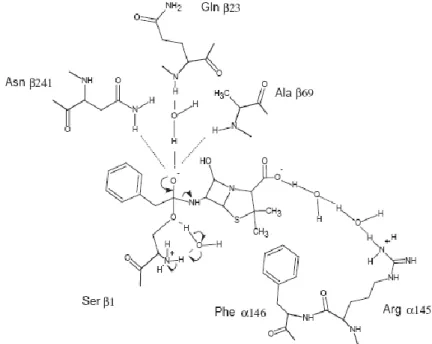
precursor. It‟s an N-terminal nucleophile hydrolase with a serine residue in its active site (Ser β1) (Figure 6) that promotes a nucleophilic attack to the carbonyl carbon of amide or ester bonds (Giordano et al. 2006). Like other N-terminal hydrolases, this
enzyme owns a four-layered catalytically active site with a αββα-core structure formed by two antiparallel β-sheets packed against each other, covered by a layer of α-helices on one side (Arroyo et al. 2003). X-ray studies indicate that the active site has a roughly
conical groove which accommodates the phenylacetyl moiety of the ligands, the
hydrophobic part and the more polar aminic part of the residues locate in the open part
of the groove, surrounded by several polar amino acid residues (Guncheva et al. 2004).
The catalytic site is located in the β-subunit and the binding site, that confers specificity
for the different substrates, is located on the α-subunit. The acyl binding subsite is
highly specific for phenylacetic acid (PAA); only small groups, such as hydroxyl or
amino groups, are allowed at the 2-position and the enantiomer specificity is low. The
penicillin-recognizing subsite, in contrast, is highly specific for L-amino acids but also
discriminates other chiral primary amines (Azevedo et al. 1999a).
PGA hydrolyses penicillins and cephalosporins to produce β-lactam antibiotic
intermediates like 6-APA and 7-aminodesacetoxycephalosporanic acid (7-ADCA),
respectively, with PAA as a common by-product (Chandel et al. 2008). The hydrolysis
reaction is thermodynamically favorable but, like any other catalyst the inverse reaction
- synthesis - is also possible (Figure 7) by the condensation of an acyl donor to a
β-lactam nucleus. Controlling the reaction conditions and the substrates used, since PGA
is not a very specific enzyme due to its large accessible, conical shaped, active site, it
the acyl donor one obtains different penicillins, or cephalosporins if 6-APA is replaced
by 7-ADCA. It can also be used in other potentially valuable reactions such as the
protection of amino and hydroxyl groups in peptide synthesis and in the resolution of
racemic mixtures, it possesses extremely high stereospecificity in hydrolysis of
N-acylated amino compounds (Grinberg et al. 2008).
Figure 7 Scheme representing four of the possible reactions catalysed by PGA (Bruggink et al. 1998).
Were SSP‟s – semi-synthetic penicillins and SSC‟s – semi-synthetic cephalosporins.
To produce β-lactam antibiotics thermodynamically or kinetically controlled enzymatic synthesis can be used via reversal of the hydrolytic reaction or via transacylation,
2
3 4
9 respectively (Wegman et al. 2001). For the thermodynamically controlled synthesis,
which proceeds towards equilibrium, to improve the direct synthesis, acids are used to acylate the β-lactam nucleus at low pH values (undissociated acid) and water-organic solvent mixtures are used (Arroyo et al. 2003). The organic solvents minimize the
activity of water thus minimizing hydrolysis. Recent studies, however, proved that
equilibrium is overwhelmingly on the side of hydrolysis due to the low chemical energy
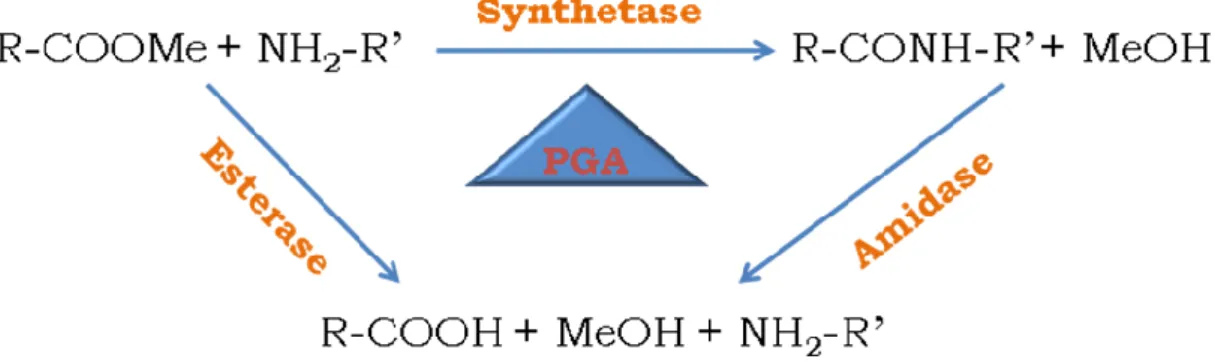
of the zwitterionic phenylglycine. For the kinetically controlled synthesis esters or
amides are used to lower the activation energy (Ea) of the antibiotic synthesis, the
equilibrium overshoots thus favoring the syntethase activity over the hydrolase activity
in the beginning of the reaction (Figure 8). The yield of this type of synthesis depends
on the rate of synthesis over the rate of hydrolysis of the activated acyl donor and the
hydrolysis of the synthesized antibiotic (S/H); the reaction should be stopped when the
synthesis rate becomes equal to the hydrolysis rate of the antibiotic and the product,
when the concentration of SSA passes through a maximum, otherwise kinetic control is
lost and thermodynamic control takes over. S/H ratio generally declines as the reaction
proceeds, due to the transformation of the starting compounds, accumulation of product
and change in ionic strength (Wegman et al. 2001) so, instead of toping the reaction at
maximum conversion it can be stopped at lower conversion values and recycle the
starting compounds and in this way working at maximum (S/H). The starting
compounds have to be stable and even then the downstream process becomes quite
complex. These reactions are performed in water at physiological pH and low
Figure 8 Scheme of the possible functions of PGA when using a kinetically controlled reaction.
Addapted from (Fernández-Lafuente et al. 1998).
As the production of 6-APA and 7-ADCA enables the production of semi synthetic
antibiotics which remain the most widely used group of antibiotics (De Vroom 1999),
for they correspond to 65% of the worldwide production of antibiotics, exceeding 45000
tons in 2000 (Giordano et al. 2006), PGA is an economically important enzyme. Its
demand is being met by a fermentation process that uses genetically manipulated
Escherichia coli and Bacillus megaterium microorganisms (Chandel et al. 2008). Due to the rising interest in sustainable development and environmentally friendly practices,
microbial enzyme transformation processes are generally preferred over the
conventional chemical conversion process and an annual worldwide production of 9000
tons of 6-APA are produced enzymatically from Penicillin G and V.
Immobilization of enzymes
Recently the world gained awareness to the importance of sustainable development and
11 practices, microbial enzyme transformation processes are generally preferred over the
conventional chemical conversion process, replacing classical organic methods by
cleaner catalytic alternatives that minimize the generation of waste and avoid the use of
toxic and hazardous chemicals. Biocatalytic procedures are usually performed in mild
reaction conditions, at neutral pH and temperature close to ambient, they use a
environmentally friendly solvent, water and a biodegradable catalyst (Wegman et al.
2001). In addition to being environment friendly, enzymes also possess high activity,
chemo-, regio- and stereo- selectivity which makes them the best choice to lower the
number of steps in a chemical process by eliminating functional group protection /
activation permitting to greatly simplify the design of the reactor and the control of the
reaction: the simple filtering of the enzyme stops the reaction (Sheldon 2007).
Some factors that adversely affect the usage of enzymes are their high cost, relative
instability under industrial conditions, limited specificity and competition with
established chemical processes carried out in equipment with fully depreciated capital
cost (Zaks et al. 1997). Enzymes are expensive catalysts for their purification is
laborious - the purer the enzyme preparation, the more expensive it becomes. To use
biocatalysts in an economical viable way is important that it is stabilized and that it may
be reused and recovered. Immobilization is the preferred way to use enzymes as
industrial biocatalysts and this is the simplest solution to their solubility problem
(Mateo et al. 2007).
To achieve a robust immobilized enzyme the method has to be suitable (carriers,
conditions, and enzymes) to design a biocatalyst that can meet the catalytic parameters
noncatalytic ones (e.g. separation, control, down-streaming process) of a given
application (Cao 2005).
The idea to immobilize enzymes came to Nelson and Griffin in 1916 when they
observed that artificial carrier-bound invertase on Al(OH)3 and charcoal was still
catalytically active (Nelson et al. 1916). A long time passed before their work was
recognized as an important discovery in chemistry. Nowadays immobilization is a
widely developed field and the most common immobilization methods can be divided in
four major groups: Adsorption-based, Covalent Immobilization, Entrapment and
Encapsulation (Figure 9).
- The first method is based on the physical adsorption of an enzyme on the surface of
water-insoluble carriers. Hence, the method causes little or no conformational
change of the enzyme or destruction of its active site. A major advantage of Figure 9 Representation of four different immobilization techniques: (a) Adsorption-based immobilization; (b)
13 adsorption as a general method of immobilizing enzymes is that usually no reagents
and only a minimum of activation steps are required. The binding is mainly by
hydrogen bonds, multiple salt linkages, and Van der Waal's forces. Regarding this
idea, the method bears the greatest similarity to the situation found in natural
biological membranes and has been used to model such systems, due to the weak
bonds involved, desorption of the protein is often observed. Another disadvantage
is non-specific, further adsorption of other proteins or other substances as the
immobilized enzyme is used.
Ionic binding is a type of adsorption-based immobilization that relies on the ionic
binding of the enzyme to water-insoluble carriers containing ion-exchange residues.
The main difference between ionic binding and physical adsorption is that the
enzyme to carrier linkages are much stronger for ionic binding although weaker
than in covalent binding.
- The covalent binding method is based on the binding of enzymes and
water-insoluble carriers by covalent bonds. The binding reaction must be performed under
conditions that do not cause loss of enzymatic activity and the active site of the
enzyme must be unaffected by the reagents used. Covalent binding may alter the
conformational structure and active site of the enzyme, resulting in major loss of
activity and/or changes of the substrate. However, the binding force between
enzyme and carrier is so strong that no leakage occurs. Immobilization of enzymes
has been achieved by intermolecular cross-linking of the protein, either to other
protein molecules or to functional groups on an insoluble support matrix.
Cross-linking an enzyme to itself is both expensive and insufficient, as some of the
relatively low enzymatic activity. Generally, cross-linking is best used in
conjunction with one of the other methods. It is used mostly as a mean of
stabilizing adsorbed enzymes and also for preventing leakage from polyacrylamide
gels.
- Entrapment methods involve trapping enzymes within the interstitial spaces of a
cross-linked water-insoluble polymer. The entrapped enzyme is not supposed to
attach to the polymer, its free diffusion is impeded by physical restraints caused by
the lattice structure of the gel, thus minimizing loss of activity. Some synthetic
polymers such as polyacrylamide, polyvinylalcohol and natural polymers (starch)
have been used to immobilize enzymes using this technique. The advantage of
using entrapment as an immobilization technique is that this method is fast, cheap,
simple and usually involves the use of mild reaction conditions. The usual
disadvantage of this method is that, due to the reduced size of enzymes, leakage
often happens; itis usually used to immobilize whole cell systems. The porosity of
the matrix can be controlled to prevent leakage, yet at the same time it has to allow
free movement of substrates and products. Depending on the price of the enzyme
and its productivity when immobilized, this method may or may not be
economically viable for industrial application of enzymes.
- Encapsulation involves enclosing the enzymes within semi-permeable polymer
membranes. It is similar to entrapment in the sense that enzymes are free in solution
but restricted in space. They must confine the enzyme whilst allowing free passage
for the reaction products and, in most configurations, the substrates. The
preparation of enzyme micro capsules requires extremely well-controlled
15 most popular nylon and cellulose nitrate but also unconventional methods have
been developed like the use of Erythrocytes (Bickerstaff 1997). Again problems
associated with diffusion occur and the membrane can rupture if products
accumulate rapidly in the interior. An advantage of this procedure is that different
enzymes can be co-immobilized, forming a multienzymatic system and a
chemoenzymatic cascade process.
After the acknowledgment that enzymes can be the answer to the viable application of
green chemistry, and, as they need to be immobilized, for that to happen many different
techniques where developed. Today the variety of immobilization matrices makes it
possible to choose a ready-made immobilization method, considering the enzyme
characteristics. Nevertheless there are still many more methods being developed for
general use and for a specific type of enzyme and reaction. The first possibility is
obviously less desirable, because a ready-made immobilized enzyme is not necessarily
the optimum catalyst for the desired processes, as exemplified by the fact that many
types of carrier-bound immobilized penicillin G acylase, which are regarded as robust
immobilized catalysts for the production of 6-APA, are not necessarily good catalysts
for the kinetically controlled synthesis of semi-synthetic β-lactam antibiotics. This is
largely ascribed to the fact that changing the process conditions often provokes a change
of enzyme performance. It was only in the 70s that such variables as the
microenvironment effect of the carrier, the effect of the spacer or arm, different modes
of binding (chemistry, position and number), enzyme loading, changes in the
conformation of the enzyme, diffusion constraints, orientation of the enzyme, and the
protective effect of substrate or inhibitor during immobilization, where studied in order
end of the 1980s, incentives to design robust immobilized enzymes originated from
their positive potential aspects, another important incentive was the discovery that many
enzymes are catalytically active and stable in organic solvents, thus enabling many
reactions which cannot be performed in aqueous media (Cao 2005). The Immobilization
of enzymes also brings advantages in the process design. The biocatalyst is retained
inside the reactor which allows its reutilization or continuous flow in a packed-bed or
fluidized-bed, if its stability is high enough, and diminishes wash-out problems; high
concentrations of biocatalyst can be used, which accelerates production, increases
productivity and minimizes secondary reactions; the microenvironment can be
controlled and it is easily separated from the product; the enzyme molecules are
protected from aggregation autolysis and proteolysis, they are also protected from
external hydrophobic interfaces such as air bubbles.
Along with the advantages, immobilization characteristics introduce changes and new
limitations to the reaction flow, there is loss of activity:
- during the immobilization steps, due to exposure of variations in pH, temperature or
others necessary for solidification or to distortions of the enzyme shape when the
matrix is solidifying;
- due to the matrix, the lattice arrangement excludes macromolecules, induces local
pH variations, stereochemical hindrances in active site access and mass transfer
limitations;
- during the bioconversion due to leakage of the enzyme, chemical interactions
between the matrix and solutes, pores of different sizes, accumulation of inhibitors,
17 - and the method‟s development is still empirical which demands optimization
studies for each case and makes the modulation and process control more difficult
(Cabral et al. 2003).
If the enzyme is multimeric it may dissociate in its individual subunits and inactivation
may occur, since after immobilization there is no free movement the enzyme can‟t
reassemble (Mateo et al. 2007).
Isolated enzyme processes are simple to implement because they are amenable to rapid
process development and there are few side reactions or other metabolites that require
separation from the reaction product. However the price to be paid for these benefits is
higher upstream costs and enzyme reuse, which is essential to keep these costs
manageable. The aim is to minimize the enzyme purification and operate the process
with the crudest form of the catalyst possible (usually a lysate). It is noteworthy that
many academic enzyme catalysts studies are carried out using pure enzymes and their
results might not always be easily translatable at scale (Pollard et al. 2007).
Immobilized enzymes are already industrially used in different fields such as medicine,
chemistry, food and beverages and waste treatment. An application of immobilized
enzymes, that greatly simplified the chemical pathways, was the separation between
chiral molecules in a racemic mixture. This was the first industrial application of an
immobilized enzyme, aminoacylase immobilized in DEAE-sephadex by Tanabe
Seiyaku Company; Japan was used for the resolution of racemic mixtures of chemically
synthesized amino acids. The conversion of glucose syrups to high fructose syrups is
achieved by glucose isomerase either adsorbed to an insoluble surface or cross-linked,
different companies developed and use different immobilization techniques. Thousands
is the most widely used of all the immobilized enzyme systems. Another viable
industrial application of immobilized enzymes is the use of lactase to hydrolyze lactose
from dairy products, since a large percentage of the world population gradually
becomes lactose intolerant this technique allows milk consumption for longer periods of
time, increasing sales. The first company to apply this method was Centrale del Latte of
Milan, Italy, utilizing the Snamprogetti technology.
In the pharmaceutical industry one of the major applications of immobilized enzymes is
the production of 6-APA by the deacylation of the side chain of Penicillin G or V,
catalyzed by PGA, for the production of semi-synthetic antibiotics. One of the
advantages of the enzymathic pathway is that purer product is obtained, thus
minimizing the purification costs, along with the previously mentioned advantages. In
the 1970s Squibb (USA), Astra (Sweden) and Riga Biochemical Plant (USSR) started
using this setup simultaneously. Currently most of the pharmaceutical giants make use
of this technology. Similar approaches have also been used for the production of
7-ADCA, an intermediate in the production of semis-ynthetic cephalosporins (D'Souza
1998). Immobilized PGA is also used by Chemferm, a subsidiary of DSM, Netherlands, for the production of cefalexin, which is for now the only biochemically synthesized β-lactam antibiotic (Wegman et al. 2001). Eli Lilly, United states, produces a slightly
altered cefalexin molecule (Figure 10), which sells by the trade name Locarbef (Zaks et
19 Figure 10 Synthesis of Locarbef. (Zaks et al. 1997)
Immobilization of Penicillin G acylase
PGA immobilization was thoroughly studied and a number of different systems have
been patented, either isolated enzymes or whole cells are used. Different authors
reviewed the state of the art of biotechnological applications of Penicillin acylases
(Kallenberg et al. 2005), (Arroyo et al. 2003), (Wegman et al. 2001), (Chandel et al.
2008), (Giordano et al. 2006) and bellow is shown a summary of the most important
systems, based mainly on these reviews.
Physical adsorption of PGA is not very used since the enzyme is very expensive and
these applications have the drawback of leakage; nonetheless there is still a couple
worth mentioning. A biopolymer of activated cellulose beads followed by covalent
attachment of Concavalin A (1% wt) absorbed a PGA-mannan conjugate and retained
an activity yield of 74%, however the procedure is complex and the activity of the
resulting biocatalyst modest. Celite® is a trade name for diatomite, a silica material that consists of the skeletons of diatoms (unicellular algae that may live in colonies in the
form of filaments). Up to 300 U of penicillin G acylase were absorbed per g of Celite
R-640. The activity recovery was low, approx. 45 U g-1, which corresponds with an activity yield of 17%. This procedure was one of the first examples of successful use of
penicillin G acylase in an organic solvent; the preparation maintained a useful activity
in toluene, provided that a water activity > 0.4 was maintained.
Covalent attachment of PGA to an insoluble support is the most used method to
immobilize this enzyme. This method diminishes diffusional restrictions to substrate or
product, the rigid enzyme-support linkage provides both kinetic and thermodynamic
stabilization of the three dimensional structure of the active catalytic site and often
improves the enzyme thermal stability. The general problem with covalent binding is
the lack of active sites, low immobilization yield and low final activity. Eupergit® C
immobilized PGA by multipoint covalent attachment, which is considered a major
contributing factor to the high operational stability of enzymes and 85-90% of
immobilization yield was achieved. This is a highly hydrophilic material which can
account for the high yield since PGAs surface is also hydrophilic and the enzyme has a
low stability when in contact with a hydrophobic medium. Amberlite XAD-7 is a
porous poly (methacrylic ester) that physically adsorbs PGA, but this linkage is not
stable, so the resine was activated by aminoalkylation followed by derivatization with a
glutaraldehyde linker, 194 Ug-1 of activity was recovered, which corresponds to a moderate 25%. If the beads are reduced in size the yield increased to 33%, it has been
found in early, related work, that penicillin G acylase had penetrated only a 25 layer below the surface of the XAD-7 beads in 24h which can account for the low
immobilization yield. Aldehyde-agarose, a linear polysaccharide, in which enzymes can
be linked by multipoint covalent attachments, has been extensively studied in the group
of Guisán. In this support PGA retained 80% of its original activity, which is a very
good yield the drawback is that agarose is an expensive polymer (Adriano et al. 2005).
21 (a delaminated zeolite) and stabilized by reduction of the imine bonds to secondary
amines. The activity of the resulting preparation was 2440 Ug-1 that is the highest ever reported for a carrier bound penicillin G acylase which can be ascribed to the highly
accessible structure with a high surface area and large pores. A recent approach to
immobilization of enzymes is the covalent attachment to stimulus-responsive or „smart polymers‟ which undergo dramatic conformational changes in response to small changes in their environment, e.g., temperature, pH and ionic strength (Sheldon 2007).
PGA was immobilized by condensation with a copolymer of NIPAM containing active
ester groups. The resulting enzyme-polymer conjugate exhibited hydrolytic activity
close to that of the free enzyme and was roughly as effective as the free PGA in the
synthesis of cephalexin (Sheldon 2007). There are many other methods to covalently immobilize PGA that aren‟t mentioned by the authors above, like covalent immobilization of PGA on Sepabeads EC-EP carrier, an epoxy activated polymetacrylic
carrier with an immobilization yield of 89.4 % at 0.14 mgenzymeg-1support (Žuža et al.
2007) or covalent immobilization to Poly(vinyl acetate-co-diviyl benzene) beads
(Jianguo et al. 2001).
Entrapment of enzymes may be difficult due to enzyme/pore size relation, for it is
frequent that enzymes leak from the matrix into the reaction medium. The most
common use for this technique is the immobilization of whole cells or the entrapment of
covalently immobilized enzymes in hydrophilic polymers so that side reactions or
inhibition by organic solvents are minimized. Polyvinyl alcohol (PVA) crosslinked with
boric acid was used to immobilize whole cell PGA from Alcaligenes faecalis expressed
in Escherichia coli (Cheng et al. 2006). The conversion yield from PG to 6-APA was
PVA, are suitable matrices for the immobilization of enzymes and whole cells; they are
cheap, non toxic, hydrophilic, have a low coefficient of friction, and high Water
content. PVA based matrices have a considerable chemical and mechanical stability
when comparing to naturally occurring polymers (Fernandes et al. 2008). A mild and
highly efficient method for preparing PVA hydrogels by partial drying at room
temperature afforded lens-shaped hydrogels (Lentikats®) exhibiting good mechanical stability, easy separation and stability towards degradation. Lentikats have been
successfully used for the entrapment of whole cell biocatalysts or cross-linked enzymes
like the encapsulation of cross linked enzyme aggregates (CLEA) of PGA. This method
has been used successfully in organic medium to improve the inadequate mechanical
properties of CLEA (Wilson et al. 2004). There are, however, methods to directly
entrap enzymes. In contrast with covalent immobilization on a silica surface, enzymes
can also be entrapped within a silica matrix. When PGA was immobilized in silica by
entrapment the activity recovery was only 10%. It was reported that penicillin G acylase
is inherently more sensitive to diffusion limitation than, for example, a lipase.
Gelatin-chitosan entraps PGA it is only 30% efficient in the hydrolysis of PG but later, it was
claimed that the pencillin G acylase from E. coli performed much better in the synthesis
of β-lactam antibiotics when immobilized in gelatin-chitosan than with other supports.
This was the basis for the industrial production of Assemblase® which is nowadays used in the enzymatic synthesis of β-lactam antibiotics.
Carrierless enzyme immobilization is potentially advantageous because it saves the
costs of the carrier, which surpass those of the enzyme in some cases, and avoids the
handling of a large mass of inactive material in the course of the reaction. Such
23 reactor. Cross linked enzyme crystals (CLECs) of penicillin G acylase have been
commercially available for some time from Altus Biologics but the production of
biocatalyst CLECs has been discontinued. Alternative to crystallization, the physical
aggregation of protein molecules into super-molecular structures and subsequent
precipitation can be induced by the addition of salts, organic solvents or non-ionic
polymers to protein solutions, without perturbation of the original three-dimensional
structure of the protein. Indeed, precipitation induced by ammonium sulfate,
polyethylene glycol, and some organic solvents such as alcohols, is a commonly used
method of protein purification. When these solid aggregates are rendered permanently
insoluble by chemical cross-linking, cross-linked enzyme aggregates are obtained
(CLEAs). Up to 80% of the original activity was recovered after the formation of PGA
CLEAs. An active site titration study revealed that loss of active sites and loss of
turnover rate contributed equally to the activity loss. (Kallenberg et al. 2005) The first
examples of CLEAs derived from penicillin G amidase. Penicillin G amidase CLEAs,
proved to be effective catalysts for the synthesis of ampicillin. The CLEA exhibited a
synthesis/hydrolysis ratio comparable with that of the commercial catalyst, PGA-450
(penicillin G amidase immobilized on polyacrylamide). The PGA CLEAs also
maintained their high activity in organic solvents. (Sheldon 2007)
Especially for the thermodynamically controlled synthesis of β-lactam antibiotics the
use of organic solvents is important. Thermodynamically controlled synthesis follows
the reaction equilibrium and yields are only determined by the thermodynamic constant
of the process. To circumvent this problem the reaction conditions can be altered in
order to shift the equilibrium in favor of the synthetic pathway. The use of organic
decreasing hydrolysis (Fernández-Lafuente et al. 1998). Immobilization is generally
necessary for optimum performance of enzymes in non-aqueous media, PGA doesn‟t
only need to be immobilized, but also needs an hydrophilic microenvironment to ensure
stability since enzymatic activity is highly dependent on the water content of the system
(wo) (Azevedo et al. 1999b).In non-aqueous media enzymes can also be immobilized in
natural or synthetic hydrogels or cryogels. Polyvinyl alcohol (PVA) cryogels formed by
the freeze-thawing method, for example, have been widely used for immobilization of
whole cells.
The chemical and genetic amination of the surface of some enzymes (e.g., glutaryl
acylase, penicillin G acylase) have permitted to greatly improve the multipoint covalent
attachment of the enzyme, increasing its stability when compared to the native form. In
a similar way, chemical and genetic modification of the protein surface has improved
the reversible adsorption of penicillin G acylase on both, cationic and anionic
exchangers. Penicillin G acylase is an enzyme that suffers a relatively large
conformational change during catalysis, due to an acyl-induced exposition of the
reactive serine. Its properties have been also modulated by immobilization, both in
synthesis of antibiotics and in resolution of racemic mixtures (Mateo et al. 2007).
Relative rates of hydrolysis and synthesis of b-lactam antibiotics may also be modified
by site-directed enzyme mutagenesis. Mutation of the phenylalanine at position 24 in
the β subunit to alanine (βF24A) of penicillin G acylase from E. coli has yielded a
mutant that showed a higher synthesis/hydrolysis ratio, an increased esterase/amidase
activity and reduced inhibition by phenylacetic acid in the synthesis of amoxicillin,
25 In spite of the amount of different immobilization techniques, new techniques are sill
emerging to successfully immobilize PGA, stabilize it and increase hydrolysis of PG or synthesis of β-lactam antibiotics. With the continuous development of immobilization techniques and protein engineering surely big improvements can be expected in the
development of carriers for PGA since it is a versatile enzyme in the production of
increased value substances like antibiotics and chiral compounds. The aim of this work
is exactly this, to study and characterize a new immobilization method that will
contribute to the knowledge of this enzyme and hopefully to the development of new,
industrially applicable, immobilization techniques. A modified GeniaLab methodology
was used for the encapsulation of a commercial inulinase preparation in PVA capsules.
PVA capsules where obtained from LentiKat® liquid upon extrusion into polyethylene glycol (PEG) where gelification occurred instantaneously. The methodology presented
is a reminiscence of the classic protocol for immobilization in Calcium alginate gel
particles (Fernandes et al. 2008). The technique used by Fernandes is a simple and
cheap way to immobilize enzymes without the need of prior treatment, this makes it an
interesting approach to apply to PGA since in industry simplicity is often as much of a
Materials and Methods
Materials:
Penicillin G acylase (EC 3.5.1.11) (PGA) (19 U/mg) and polyethyleneglycol 600 were purchased from Fluka, Penicillin G was obtained fromFersinca Gb (Mexico), 7-aminodesacetoxycephalosporanic acid (7-ADCA) was
purchased from DSM, the substrates 6-nitro-3-phenylacetamide benzoic acid (NIPAB),
acetaminophen 99% (IS) and (R)-(-)-2-phenylglycine methylester hydrochloride 97%
(PGM) were obtained from Sigma and the immobilization matrix, Lentikat® Liquid, was obtained from GeniaLab® GmbH. All other chemicals were either laboratory or analytical grade.
Methods:
1) Penicillin Hydrolysis
1.1. Immobilization Yield
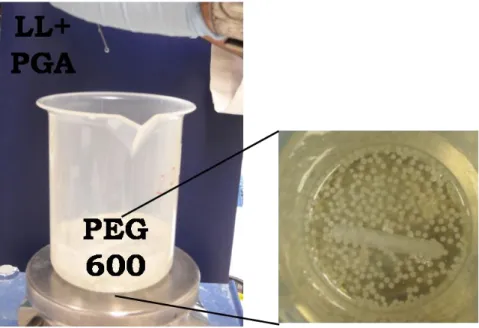
Entrapment technique Six diluted PGA solutions were prepared with 15, 30, 50, 100, 125 and 150l of original PGA solution for a final volume of 500l in sodium phosphate buffer 0.1M, pH8. The Lentikat® Liquid (LL) was heated to reach the liquid state and then cooled by placing in a 37ºC bath. When the LL reaches 40ºC, 5ml were
used to dissolve each diluted PGA solution under strong magnetic stirring. With a
syringe of Injekt – F 1ml Braun and a Neolus (0.9 x 50 mm) Terumo needle the
LL/PGA solution was dropped (Figure 11) into 200 ml of PEG 600, the droplets
immediately formed capsules and then were left in PEG for two hours at room
27 PGA_PVA beads were removed by filtration, washed several times with sodium
phosphate buffer solution 0.02M, pH 8, weighed and stored at 4ºC in sodium phosphate
buffer solution 0.1M, pH 8, just enough to cover the beads. The material that comes in
contact with the LL/PGA solution is weighed before and after this process so that
mechanical losses of enzyme can be determined.
Figure 11 Immobilization technique, dropping the PGA_PVA solution into PEG 600.
Hydrolysis assays To measure the biocatalysts activity the immobilized enzyme beads were suspended in 20ml of sodium phosphate buffer solution 20 mM, pH 8 at 37ºC, in a
temperature controlled, magnetically stirred reactor. When the suspension reached 37ºC,
5 ml of concentrated penicillin G solution, in the same buffer at the same temperature,
was added so that its final concentration in the reaction media was 4% (w/v). Penicillin
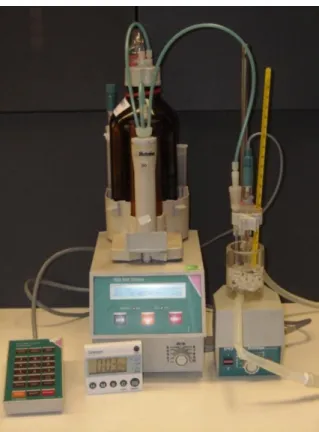
(Figure 12) (Fonseca et al. 1993), using a standard of 0.1M NaOH to automatically
neutralize the phenylacetic acid (PAA), using a Metrohm 702 SM Titrino, generated for
biocatalysts obtained from 150, 125, 100 and 50l of enzyme load and a standard of 0.05M NaOH for 30l and 15l of enzyme load into LL solution. The beads were harvested and washed in buffer for 10 min, the resulting diluted reaction media
supernatant was concentrated by ultrafiltration, using a Cole-Parmer Instrument CO
Stirred cell 43 mm (UHP) 70986 and a Biomax – 5, 44.5 mm, 5 KDa polysulfone
membrane from Millipore Corporation, until the final volume reached ~5ml to control
enzyme leakage at the end of enzyme immobilization process (see supernatant activity).
Each assay was repeated three times and in the end of the assays the beads were dried at
80ºC for 24h and weighed, the dry weight was used to standardize the results.
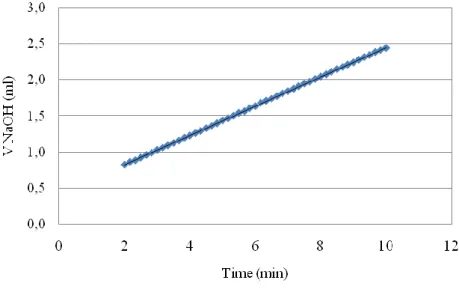
29 Figure 13Volume of NaOH spent versus time, result of a typical PGA activity assay by pH STAT.
The supernatant activity was determined in a Hellma, 119.004 – KS, 10 mm cuvette with magnetic agitation, by following the absorbance at 37ºC, 405 nm in a Hitachi
U-2000 spectrophotometer. Absorbance is proportional to 3-amino-6-nitrobenzoic acid
(NABA) concentration, the product resulting from the hydrolysis of
6-nitro-3-phenylacetamide benzoic acid (NIPAB) by PGA. 50l of NIPAB 6mM and 50 l of the enzyme solution to be analyzed was added, respectively into 900l of sodium phosphate buffer solution 50mM, pH 7 (Azevedo et al. 1999b). The activity of PGA solutions,
using different degrees of dilution, was measured and used to assess the amount of
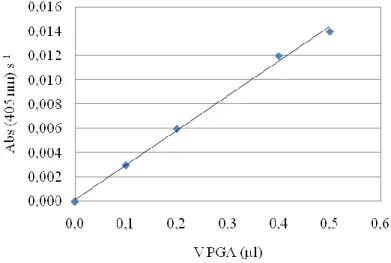
Figure 14 Rate of NIPAB hydrolysis reaction by PGA and according absorbance rate variation at 405 nm
for different volumes of supernatant.
Total enzyme in the supernatant The total amount of protein in the supernatant was determined by its absorbance at 280 nm using a Hitachi U-2000 spectrophotometer. A
calibration curve was built for absorbance at 280 nm using different amounts of diluted
PGA in sodium phosphate buffer solution 50mM, pH 8 (Figure 15). The reaction media
supernatant solution was analyzed without dilutions.
31
1.2. Studies of biocatalysts reutilization
Hydrolysis assays The activity of the PGA_PVA beads, obtained from 100l of original PGA solution for a final volume of 500l in sodium phosphate buffer solution 0.1M, pH 8 (as previously described 1.1), was measured by the pH STAT method in
sodium phosphate buffer solution 20mM, pH 8 at 37ºC, during 10 minutes.
1.3. pH effect on PGA_PVA beads activity
Entrapment technique Four PGA solutions were prepared with 150l of original PGA
solution for a final volume of 500l in sodium phosphate buffer solution 0.1M, pH 8, as previously described 1.1.
Hydrolysis assays To measure the activity, the immobilized enzyme was suspended in 20ml of sodium phosphate buffer solution 20 mM at different pHs and 37ºC, in a
temperature controlled, magnetically stirred reactor. Each batch of PGA_PVA beads
was suspended with different pHs; 6, 7, 8 and 9, respectively. When the suspension
reached 37ºC, 5 ml of concentrated penicillin G solution, in the same buffer, at the same
temperature, was added so that its final concentration became 4% (w/v) and then the
activity of each batch of PGA_PVA beads was evaluated by the pH STAT method. In
the end of the assays the beads are dried at 80ºC for 24h and weighed, the dry weight is
1.4. Temperature effect on PGA_PVA beads activity
Entrapment technique Five PGA_PVA beads batches were prepared with 100l of original PGA solution for a final volume of 500l in sodium phosphate buffer solution 0.1M, pH 8, as previously described 1.1.
Hydrolysis assays To measure the activity, the immobilized enzyme was suspended in 20ml of sodium phosphate buffer solution 20 mM, pH 8, in a temperature controlled
magnetically stirred reactor. Each biocatalyst batch was thermostated at different
temperatures, 25, 37, 45, 50 and 55ºC. When the suspension reached the desired
temperature, 5 ml of concentrated penicillin G solution, in the same buffer, at the same
temperature, was added so that its final concentration became 4% (w/v). The activity of
each PGA_PVA beads batch was evaluated as described 1.1. In the end of the assays the
beads were dried at 80ºC for 24h and weighed, the dry weight was used to standardize
the results.
1.5. Storage stability
Entrapment technique Sixteen PGA_PVA beads batches were prepared with 100l of
original PGA solution for a final volume of 500l in sodium phosphate buffer solution 0.1M, pH 8 as previously described 1.1.
Storage Four batches were stored at each temperature in sodium phosphate buffer solution 0.1M, pH 8 - one batch at 4ºC in a refrigerator and the remaining batches in
stoves at 25, 37 and 45ºC. At 0, 24, 48 and 72 hours one of each batch was removed
33 sodium phosphate buffer solution 20mM, pH 8, 37ºC and a PG concentration of
4%(w/v). The weights were standardized as described 1.1.
1.6. Kinetics
Entrapment technique Four PGA_PVA beads batches were prepared with 100l of original PGA solution for a final volume of 500l in sodium phosphate buffer solution 0.1M, pH 8 as previously described 1.1.
Hydrolysis assays To each PGA_PVA beads batch the activity was evaluated by the pH STAT method at pH 8, 37ºC but for different PG concentrations in the reactor 1, 2, 4
and 8% (w/v). The weights were standardized as described 1.1.
2) Cefalexin Synthesis
HPLC method: 50l of a sample was collected from the synthesis reaction media and
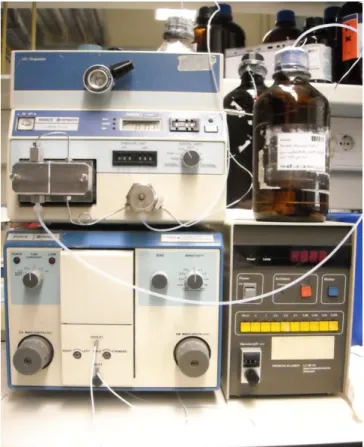
dissolved in 200l of sodium phosphate buffer solution 5mM, pH 7.2. 50l of this solution was dissolved in 950l of the same buffer containing 0.5 g.l-1 of acetaminophen (internal standard - IS) and finally 50l of this solution was dissolved in 450l of HPLC dilution solution (25% acetonitrile in 2mM sodium phosphate buffer solution pH 5). 20l of the previous solution was injected and analyzed by HPLC (Merck Hitachi L-6000 pump, Merck Hitachi D-2500 chromato-integrator,
S250x46Column) at 214 nm in an isocratic method, adapted from De Vroom (De
Vroom 2000) (Figure 16). The HPLCs eluent buffer (40% acetonitrile in 5mM sodium
phosphate buffer solution 5mM, pH 3.1, containing 0.2% (w/v) SDS) ran at the flow
rate of 1ml.min-1. Four calibration curves, using different amounts of solutes and products, in relation to the internal standard (IS), were prepared and used to assess the
concentration of 7-ADCA, PGM, phenylglycine (PheG) and CEX in the synthesis
reaction media (Figure 17 to Figure 20).
35 Figure 17 Calibration curve for HPLC analyses, area ratio from 7-ADCA and IS peaks versus known
concentrations of 7-ADCA.
Figure 18 Calibration curve for HPLC analyses, area ratio from PGM and IS peaks versus known
concentrations of PGM.
Figure 19 Calibration curve for HPLC analyses, area ratio from PheG and IS peaks versus known
Figure 20 Calibration curve for HPLC analyses, area ratio from CEX and IS peaks versus known
concentrations of CEX.
2.1. Operational stability
Entrapment technique A PGA_PVA beads batch was prepared with 100l of original
PGA solution for a final volume of 500l in sodium phosphate buffer 0.1M, pH 8 as previously described 1.1.
Synthesis activity The immobilized enzyme beads were suspended in sodium phosphate buffer solution 5 mM, pH 7.2, in a temperature controlled, magnetically
stirred reactor. The reactions were performed at 14ºC in a 25ml suspension with the
initial concentrations of 30 mM 7-ADCA and 90mM PGM. The reaction ran during 8h
and samples were collected at different intervals of time. The temperature of reaction
was kept constant at 14ºC by cold water that flowed through the reactor jacket, using a
37
2.2. Kinetics
2.2.1. Maintaining a constant ratio between substrates concentrations
Entrapment technique Six PGA_PVA beads batches were prepared with 100l of original PGA solution for a final volume of 500l in sodium phosphate buffer solution 0.1M, pH 8 as previously described 1.1.
Synthesis activity of PGA_PVA beads was evaluated as previously described 2.1. Maintaining a constant ratio between 7-ADCA and PGM concentrations of 3 but
different initial concentrations of substrates according to Table 2 the kinetic parameters
of synthesis were evaluated.
Table 2 Initial concentrations of substrates in the reactor, for kinetic assays.
Assay 1 2 3 4 5 6
[7-ADCA] (mM) 5 20 50 75 100 150
[PGM] (mM) 15 60 150 225 300 450
The reaction carried out for 30 minutes and samples were collected at different intervals
of time to calculate the initial velocity. For assays 1, 2 and 3, 50l of sample were collected and dissolved in 200l of sodium phosphate buffer solution 5mM, pH 7.2, for assays 4 and 5 the same volume of sample was dissolved in 450l of the same buffer and for assay 6 the sample was dissolved in 700l of the buffer, due to increasing concentrations of substrates. These diluted samples were then treated as previously
2.2.2. Maintaining one of the substrates at a constant concentration
Entrapment technique The PGA_PVA beads were prepared with 100l original PGA
solution for a final volume of 500l in sodium phosphate buffer solution 0.1M, pH 8 as previously described 1.1.
Synthesis activity of PGA_PVA beads was evaluated as previously described 2.1. This assay study is divided in two. First, a constant initial 7-ADCA concentration of 150mM
is maintained and PGM concentration varied between 5 and 120mM (5, 15, 30, 60 and
120mM) secondly; a constant initial PGM concentration of 150mM is maintained and
7-ADCA concentration varied between 5 and 120mM (5, 15, 30, 60 and 120mM). The
reaction ran during 30 minutes and samples were collected at different intervals of time,
to calculate the initial reaction rate. The remaining procedure was the same as
39
Discussion
1) Penicillin Hydrolysis
To calculate the penicillin hydrolysis rate, since 1 mol of phenylacetic acid is formed
for each mol of hydrolyzed PG, it is necessary to maintain a constant pH in the reaction
media and for this reason the pH STAT method was used, it neutralizes PAA
automatically by addition of alkaline agent solution. By measuring the volume of
alkaline solution spent to maintain a constant pH in the reaction media it is possible to
obtain the hydrolysis rate using Equation (1).
(1)
The PGA_PVA beads activity can be calculated using the hydrolysis rate since the
hydrolysis of PG by mechanisms other than enzymatic catalysis is negligible in these conditions and the enzyme used is “pure”. The specific activity of immobilized or free enzyme (mol.mgprotein-1.min-1) is obtained by the ratio of hydrolysis rate with the
1.1. Immobilization Yield
After the entrapment of different amounts of PGA in PVA matrix, the immobilization
yield was calculated by Equation (2). The encapsulation efficiency yield decreases as
enzyme loading increases in the matrix (Table 3).
(2)
Table 3 Quantity of immobilized enzyme, respective immobilization yield (compared to the free enzyme)
and respective activity inside the reactor.
Enzyme loading (l) to 5 ml of LL solution 15 30 50 100 125 150 Enzyme loading (mgprotein.g-1support) 0.0893 0.184 0.300 0.608 0.750 0.900 Immobilization yield (%) 68 ±3.4 52 ±0.3 40 ±0.6 30 ±1.6 26 ±0.7 22 ±0.7
Activity U/ml reactor 0.322 0.493 0.638 0.948 1.01 0.702
Enzyme loading (mgprotein.g-1support) was calculated by Equation (3) where V is the
volume of PGA‟s original solution, [protein] is the concentration of that same solution
41 (3)
The decreasing immobilization yield can partly be due to the partition coefficient of
PGA between water and PEG solutions (Marcos et al. 1998), the enzyme may be
dissolving in PEG prior to PVA matrix solidification which consequently led to a loss
of enzyme activity. Also, after several washing steps of the PGA_PVA beads, some
amount of enzyme may have leaked into the washing buffer (sodium phosphate buffer
solution 0.1 M, pH 8), this happens when the PGA_PVA beads are transferred from
PEG to phosphate buffer and swelling occurs, the beads weight increases roughly 6
times, the size of the pores increase and the entrapped enzymes may diffuse into the
new solvent. Furthermore there is the normal deactivation of enzyme when it is mixed
in PVA solution at 40ºC and simply due to entrapment inside the beads, with an
approximate size of 3mm. The size of the beads hinders substrate and product diffusion
consequently increase mass-transfer resistances. All together these factors led to a
decrease of immobilized enzyme activity in relation to the free enzyme. Although the
yield of immobilized enzyme activity is low, it is comparable to the literature values
(Fernandes et al. 2008) where for an enzyme load of 0.13 mgprotein.g-1support, the yield
corresponded to 48% for immobilized inulinase activity. This means that the PVA
matrix, temperature for entrapment of 40ºC and the mass-transfer resistances, due to the
size of the beads, are the main influences on low yield of the PGA_PVA beads activity.
Considering the yields of immobilized penicillin G acylase, from 41% to 119% in
(Kallenberg et al. 2005) the results obtained in this work are in the range of the common
values of immobilization yields obtained for this enzyme.
The values of immobilized enzyme specific activity decrease with increasing enzyme
load but keep almost constant after PGA_PVA beads activity has been tested for at least
three times and independent of the volume of enzyme load in LL solution (Figure 21).
Figure 21 Specific activity of PGA_PVA beads obtained from different volume of diluted enzyme loads
in 5ml of LL.
In order to achieve the best results both immobilization yield (%) and PGA_PVA beads
activity inside the reactor (U.ml-1) should be maximized. Comparing the yield with the activity inside the reactor (Figure 22), we observe that the optimum load appears to be 50 μl of PGA immobilized in 5 ml of LL solution, this value gives the best compromise between the two factors. From an industrial point of view production is usually the most
43 important factor; Figure 22 shows that there is an approximately linear activity increase
inside the reactor until 100 μl of enzyme load, with only 10% yield loss (comparing
with the previously mentioned value). For this reason, in further experiments, 0.6
mgprotein.g-1support was chosen for enzyme immobilization, i.e. 100µl of diluted enzyme
solution added in 5 ml of LL solution.
Figure 22 Comparison between yield and activity inside the reactor, with respective increasing enzyme
load.
1.2. Studies of biocatalysts reutilization
To determine the capability for reutilization of PGA_PVA beads three different enzyme
loads (50, 100 and 150 µl of diluted enzyme solution added in 5 ml of LL solution)
were assayed in 10 consecutive PG hydrolysis reactions (Figure 23). It is clear that there
is no significant loss of activity throughout 10 consecutive batches, which means that the encapsulated enzyme didn‟t deactivate or leak in to the supernatant.
Figure 23 PGA_PVA beads activity in a sequence of 10 batches of PG hydrolysis reaction, comparison
between three enzyme loads (50, 100 and 150 l of diluted enzyme added into 5 ml of LL solution).
To confirm these results, the activity in the supernatants, after the beads were harvested,
was also evaluated. The reaction of PG hydrolysis in real time was monitored by a
NaOH solution consumption with an excellent linearity for the first 10 minutes of
reaction, without consumption after removing the PGA_PVA beads (Figure 24).
Figure 24 Volume of NaOH solution consumption versus hydrolysis reaction time, with immobilized
45 This proves clearly that PGA leakage from the PVA beads didn‟t occur. Even so, the supernatant of each hydrolysis reaction was ultra filtered until its final volume reached
~5ml and the supernatant activity evaluated by the NIPAB method. No PGA activity
was detected in the supernatant by the NIPAB method, which is more sensitive than the
pH STAT method.
1.3. pH effect on PGA_PVA beads activity
The microenvironment surrounding the immobilized enzyme in the interior of a carrier
or support depends on specific properties of the matrix material and can affect slightly
or deeply its activity and stability. The optimum pH for PG hydrolysis by the
immobilized Penicillin G acylase in PVA beads is 8 (with a specific activity of 8.04
µmol.mg-1protein.min-1) (Figure 25), which is consistent with values published in the
literature (Giordano et al. 2006), (Plaskie et al. 1978). However, the plateau of optimum
pH values for immobilized PGA is shorter than the observed for the free enzyme (41.0
µmol.mg-1protein.min-1 for pH 7 and 40,7 µmol.mg-1protein.min-1 for pH 8). The
microenvironment promoted by the PVA matrix, the macro size of the beads and the
diffusion limitation mentioned earlier may be the cause of the lower plateau of optimum
pH for the immobilized enzyme. Additionally, PG hydrolysis produces PAA that is an
acid that can interact with the PVA matrix and the enzymes microenvironment becomes
more acidic than in the bulk of the reaction medium. This may occur not only because
of the intrinsic limitations of diffusion inside the beads but also because the solubility of
PAA in water is very low and it is likely to stay longer inside the bead than other, more