Journal of Physics: Conference Series
Monte Carlo simulation of the Varian Clinac 600C
accelerator dynamic and physical wedges
To cite this article: S Soares et al 2007 J. Phys.: Conf. Ser. 74 021015
View the article online for updates and enhancements.
Related content
Improving wedged field dose distributions
P Keall, S Zavgorodni, L Schmidt et al.
-Filter-free photon beams
S W Stevens, K E Rosser and J L Bedford
-Monte Carlo modelling of a virtual wedge
F Verhaegen and I J Das
Monte Carlo simulation of the Varian Clinac 600C accelerator
dynamic and physical wedges
S Soares1,2,A Chaves3, L Peralta2,4 and MC Lopes3 1
Universidade da Beira Interior , Av. Marquês d’Ávila e Bolama, Covilhã 6201-001, Portugal
2
Laboratório de Instrumentação e Física Experimental de Partículas (LIP), Av. Elias Garcia nº14 1º, Lisboa 1000-149, Portugal
3
Instituto Português de Oncologia Doutor Francisco Gentil (IPO), Av. Bissaya Barreto, Coimbra 3000-075, Portugal
4
Faculdade de Ciências da Universidade de Lisboa, Campo Grande Edifício C5, Lisboa 1149-016, Portugal
Abstract. The present paper describes the study done on the dosimetric characteristics of the Varian Clinac 600C dynamic wedges (DW) and their comparison with the physical wedges (PW) in terms of the differences affecting the dose distributions, beam spectra, energy fluence and angular distributions. The geometry of the 4 MV photon beam and the dose distributions in a water phantom were simulated with GEANT3 and DPM Monte Carlo code systems. The DW was modelled through the constant movement of the upper jaws. The depth dose distributions and lateral profiles for the DW, PW and open fields were measured and compared with the Monte Carlo simulations and the global agreement was found to be within 3%. It was also found that the effects of a DW on beam spectral and angular distributions are much less significant than those produced by a PW. For example, in our study we found out that the 45º PW, when compared with the corresponding open field, can introduce a 30% increase in the mean photon energy due to the beam hardening effect and that it can also introduce a 4.5% dose reduction in the build-up region because of the reduction of the contaminated electrons by the PW. For the DW neither this mean-energy increase nor such dose reduction was found. The PW, when compared to the DW, significantly alters the photon-beam spectrum and these dosimetric differences are significant and further investigation must be performed to quantify the impact in clinical use of these beams.
1. Introduction
Living cells can be killed by ionizing radiation but the dose required to achieve a particular level of cell death is variable. The main problem in radiotherapy is that tumour cells are not treated as a separate entity. The tumour mass is seated on, or within, a tissue whose function must be preserved during treatment and it is surrounded by healthy structures through which it may be necessary to direct the beam. So, it is inevitable that, if the whole tumour is to be eliminated, some healthy tissues will also receive a high amount of dose. To improve dose uniformity in the target volume wedge-shaped dose distributions are commonly used.
First European Workshop on Monte Carlo Treatment Planning IOP Publishing
Typically, most clinical linear accelerators are provided with a set of physical wedges (PW) with four fixed wedge angles of 150, 300, 450 and 600. In addition to the occasional bad alignment of the wedge, the degradation of the beam quality that turns the wedge factor dependent on the energy of the beam, radiation field size, measurement depth and accelerator type, is the main concern with the PW [1]. Also, the miscalculation of the dose distribution introduces consequences in the probability of the patient's cure. In order to obtain dose modulation and compensation, the most recent linear accelerators are equipped with systems of beam distribution that are more autonomous using dynamic jaws. The dynamic wedge was originally proposed by Kijewski et al. [2] and later supported by D. Leavitt [3]. The dynamic wedge (DW), which is accomplished by the movement of the upper jaw, is a very good alternative to the PW, not only in the production of wedged-dose distributions but also because it does not alter the photon spectrum. In Varian linacs, the dose rate and jaw movement for producing a set of DWs, are controlled by the segmented treatment tables. Each of them contains information about the position of the moving jaw versus cumulative weighting of monitor units.
Studies have shown that non-physical wedges do not alter the photon spectrum compared with PW that introduce beam hardening and loss of dose uniformity in the non-wedged direction [4]. Compared with the PW, the DW neither presents reduction nor hardening of the beam. Another advantage of using DW is the reduction of the treatment time because it is not necessary to handle external modules. When measurements with DW are performed, and are compared with open fields or PW, the fundamental difference is the fact that the dose, at the measurement point, has to be integrated during all the irradiation. Special dosimetric tools, such as detectors with linear arrays, termoluminescent dosimeters and dosimetry with thin films, allow the simultaneous measurement of multiple points inside the radiation field [5].
The purpose of this work was the study of the dosimetric characteristics of dynamic wedges using MC simulation techniques. The 4 MV photon beam, generated by a Varian Clinac 600C linac, was studied and a special attention was given to the dosimetric comparison of the physical and dynamic wedges. The characteristics of these two wedge types were analyzed, in terms of their differences in the way they affect the spectral, angular and dose distribution.
2. Methods and materials
The Monte Carlo (MC) code system GEANT3 [6] was used to simulate the treatment head of the linear accelerator Varian Clinac 600C and the dose distribution in a water phantom was simulated with the MC code DPM [7]. The calculations were performed for open fields, physical and dynamic wedges.
For the DW simulations, and using the MC code system GEANT3, the lower jaws are kept in a fixed position while only one of the upper jaws moves with constant speed. The upper jaw movement is simulated with 1 cm discrete steps that are projected at 100 cm SSD. The initial and final jaw positions define the toe and heel positions of the DW. For each of these phase space files, dose distributions are calculated in a water phantom at 100 cm SSD and 50 x 50 x 50 cm3 dimensions and using the MC code system DPM. Using the Van Santvoort formalism [4], each of these dose distribution, which refer to each of the different jaw positions, was weighted by multiplying factors and regrouped in a final dose distribution. With this procedure it is possible to simulate any angle for the dynamic wedge. Simulations were preformed for DWs of wedge angles ranging from 150 to 600, as well as open fields with different sizes.
The simulation results were validated with experimental data obtained with an ionizing chamber with 0.125 cm3 active volume (PTW-31002), for the PW and open field. For the DW, the experimental data were obtained with a diode array.
The depth dose curves along the central radiation axis and the profiles, which were obtained for different depths, were simulated from the phase space files generated for the 4 MV nominal energy. In this paper we only present the profiles obtained at 1cm depth (depth of maximum depth dose) in water for a 45º wedge angle for the DW and PW.
First European Workshop on Monte Carlo Treatment Planning IOP Publishing
Journal of Physics: Conference Series 74 (2007) 012015 doi:10.1088/1742-6596/74/1/012015
3. Results and discussion
The validation of the MC calculation results with experimental data was done for the PW, DW and open fields comparing the obtained depth dose curves (PDD) and profiles. The effects due to the PW or DW were assessed by comparing the photon average energy versus the radius, photon and electron energy spectral distribution and photon polar angle distribution.
3.1. Validation
The depth dose curves calculated with MC simulation techniques were compared with the experimental data. The agreement level, within 3%, between the calculated and measured data is similar for the different field sizes studied.
b) a)
Figure 1. Calculated and measured PDD curve for the: a) 45º DW and b) 45º PW (10 x 10 cm2 field size).
We verified that the depth dose curve for the DW is the same as the one obtained with the open field, which means that there is no beam hardening with this wedge. However, for the 45º PW it is possible to identify the beam hardening effects, as we can see in figure 1.
Figure 2. Calculated and measured profile curve for the: a) 45º DW and b) 45º PW (10 x 10
cm2 field size).
a) b)
First European Workshop on Monte Carlo Treatment Planning IOP Publishing
In figure 2, the profile (calculated and measured) curves are shown for the 45º DW and PW and for the 10 x 10 cm2 field size, at 1 cm depth.
3.2. Characterization
Photons were scored in air at a plane 100 cm away from the source. The photon beam, after traversing the physical and dynamic wedges, is affected in different ways. The photon beam energy fluence is reduced both for the PW as for the DW. However, because of the attenuation of the radiation in the PW, the decrease in fluence is more pronounced for the PW. In the case of the DW, the reduction is caused by the fluence modulation. The photon planar fluence increases along the direction from heel to toe, due to the moving jaw. There were more particles in the toe region as compared to the heel region. It is also possible to verify that the PW attenuate more primary or low energy scattered photons while, simultaneously, producing low energy scattered photons. Additionally, it was also observed that the higher the wedge angle, the higher are the differences between the PW, DW and open field. In figure 3, the photon average energy is shown for the 10 x 10 cm2 field size and for the 45º PW, DW and for the open field.
Figure 3. Photon mean energy for the 45º PW, DW and open field (10 x 10 cm2 field size)
From the figure it is possible to see that the mean energy when using the DW is virtually equal to the one in the open field, showing again that the DW does not alter the beam quality. However, the mean energy when using the PW significantly increases when compared with the mean energy in the open field. For the 4 MV photon beam and using the 45º PW, the average energy increases from 1.3 MeV to 1.8 MeV (i.e. a 38% increase).
The PW beam hardening effect changes along the wedged direction, i.e., the average energy increases from the toe to the heel wedge regions. The greater the wedge angle, the more pronounced this effect is. When using the PW, the mean energy outside the field is increased compared with the one for the DW or in the open field. This effect is due to the fact that the PW attenuate the scattered particles from the treatment head accelerator and generate low energy scattered photons [8]. The global effect of these two processes results in the increase of the beam average energy outside the field.
The presence of the DW and PW affect the spectral distribution of the photons and secondary electrons produced in the treatment head in different ways, as can be seen in figure 4. The observed reduction of the photon energy will imply a decrease in dose in the build-up region.
First European Workshop on Monte Carlo Treatment Planning IOP Publishing
Journal of Physics: Conference Series 74 (2007) 012015 doi:10.1088/1742-6596/74/1/012015
a)
b)
Figure 4. a) Photons and b) secondary electrons spectral distribution
for the 45º PW, DW and open field (10 x 10 cm2 field size).
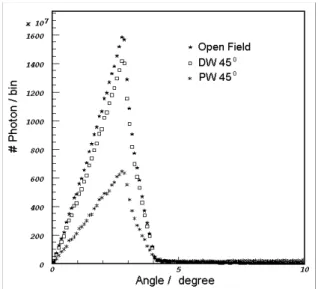
The scattering effect from DW is different from the PW. In this way, the DW and the PW presence affect, in different ways, the particle angular distribution, as we can see in figures 5 and 6. Figure 5 shows the photon angular distribution for the 45º PW and DW and open field while figure 6 shows the ratio of the 45º PW and DW to the open field.
First European Workshop on Monte Carlo Treatment Planning IOP Publishing
Figure 5. Photons angular distribution for the 45º PW,
DW and open field (10 x 10 cm2 field size)
Figure 6. Ratio of the 45º PW and DW to the open field, as a function of angle
This work has demonstrated that well-know [9] dosimetric characteristics of PW and DW, for other accelerators, together with detailed information on the beam characteristics, i.e., the spectral and angular distributions are also valid for the Varian Clinac 600C. The phase space files obtained in this work can be used in order to improve the dose algorithms used for clinical planning. In these algorithms, the spectral differences between PW and DW must be taken into consideration.
4. Conclusions
MC simulation techniques are a very powerful tool in the study of the dosimetric characteristics of the dynamic and physical wedges. A good agreement between the experimental and calculated data was obtained. The GEANT3 calculations showed that the DW effects in the energy and fluence distributions are much less significant than the effects caused by the PW. For the 4 MV photon beam, a 45º PW may produce a 38% increase in the photon average energy due to the beam hardening effect.
First European Workshop on Monte Carlo Treatment Planning IOP Publishing
Journal of Physics: Conference Series 74 (2007) 012015 doi:10.1088/1742-6596/74/1/012015
For the DW, neither an increase in the mean photon energy nor a dose reduction in the build-up region was observed. When comparing the DW with the PW, it is seen that the latter significantly modify the photon beam spectra. The dosimetric differences between the DW and the PW must be recognized when using the physical and dynamic wedges in external radiotherapy with photon beams. The data presented here can be useful for the commissioning of dynamic wedges.
References
[1] Dean E M and Davis J B 1991 Br. J. Radiol. 64 184
[2] Kijewski P K, Chin L M and Bjarngard B E 1978 Med. Phys. 5 426 [3] Leavitt D D, Martin M, Moeller J H and Lee W L 1990 Med. Phys. 17 87 [4] Van Santvoort J 1998 Phys. Med. Biol. 43 2651
[5] Leavitt D D and Klein E 1997 Med. Dosim. 22 171
[6] Gianni S, Ravndal S and Maire M 1994 GEANT – Detector Description and Simulation Tool CERN Program Library Long Writeup W5013
[7] Sempau J, Wilderman S J and Bielajew A F 2000 Phys. Med. Biol. 45 2263 [8] Shih R, Li X A and Hsu W L 2001 Med. Phys. 28 612
[9] Shih R, Li X A and Hsu W L 2001 Phys. Med. Biol. 46 281
First European Workshop on Monte Carlo Treatment Planning IOP Publishing