Original
Received 7/9/2011 Accepted 1/4/2012 (005464)
1 Departamento de Engenharia de Alimentos, Universidade Federal de Santa Catarina – UFSC, CP 476, CEP 88040-900, Florianópolis, SC, Brasil
2 Departamento de Engenharia de Alimentos, Centro de Educação Superior do Oeste, Universidade do Estado de Santa Catarina – UDESC, BR 282, Km 573,7, CEP 89870-000, Pinhalzinho, SC, Brasil, e-mail: [email protected]
*Corresponding author
Synergistic and antimicrobial properties of commercial turmeric
(Curcuma longa)
essential oil against pathogenic bacteria
Propriedades antimicrobianas e sinergísticas de óleo essencial comercial de cúrcuma (Curcuma longa)
contra bactérias patogênicas
Sara Albino ANTUNES1, Weber da Silva ROBAZZA2, Liziane SCHITTLER2, Gilmar de Almeida GOMES2*
1 Introduction
A recent trend in the food industry is the gradual reduction of chemical additives. In order to accomplish this task, industries have been searching for alternative compounds that control the microbial growth and enhance oxidative stability (SOUZA et al., 2005). Turmeric is an herbaceous evergreen plant in the Zingiberaceae family, which can be found in many locations such as China, India, and some countries of South America (SCARTEZZINI; SPERONI, 2000). Several studies have shown the antioxidant and antimicrobial properties of Turmeric essential oils (NEGI et al., 1999; NEGHETINI, 2006; NAZ et al., 2010). In Brazil, turmeric use has increased mainly due to its coloring property and its ability to improve food odor (CHASSAGNEZ; CORRÊA; MEIRELES, 1997; NEGHETINI, 2006). It is mainly found in ready-to-eat soups, ice-creams,
and pasta. The most important compounds responsible for the antioxidant activity of turmeric are phenolic compounds, such as curcuminoid dyes and essential oils (BURKE, 1994; NEGHETINI, 2006). Phenolic compounds exhibit the ability to destroy bacterial cell walls and penetrate into microbial cell affecting its metabolism (MARINO; BERSANI; GIUSEPPE, 2001).
Commercial essential oils have low biological activity due to their extraction and handling processes (HENTZ; SANTIN, 2007; BENELLI, 2010). This behavior is the reason of the growing interest for synergistic compounds that increase the antimicrobial activity of these oils. Accordingly, ascorbic acid is known as the most important natural antioxidant compound present in our daily diet. In addition, it exhibits
Resumo
Vários estudos têm demonstrado as propriedades antimicrobianas e antioxidantes da cúrcuma (Curcuma longa), a qual é amplamente utilizada na indústria de alimentos, entre outras funções, para colorir. O objetivo deste estudo foi determinar as atividades antioxidantes e antimicrobianas do óleo essencial comercial de cúrcuma contra bactérias patogênicas, além de estudar a influência do ácido ascórbico na prevenção da oxidação dos polifenóis. O óleo essencial comercial de cúrcuma não apresentou atividade bactericida contra os micro-organismos estudados, Listeria monocytogenes e Salmonella typhimurium, mas, analisado com o ácido ascórbico, apresentou atividade antibacteriana considerável. A maior atividade antimicrobiana do óleo contra Salmonella typhimurium foi de 15,0 ± 1,41 mm em uma concentração de 2,30 mg.mL–1 de óleo essencial e 2,0 mg.mL–1 de ácido ascórbico. Para Listeria monocytogenes, o maior halo de inibição (13,7 ± 0,58 mm) foi encontrado nas mesmas concentrações. O óleo essencial apresentou atividade antioxidante de EC50 = 2094,172 µg.mL–1, para o método do radical DPPH•, e de 29% na concentração de 1,667 mg.mL–1, pelo método de descoloração do sistema b - caroteno/ácido linoleico.
Palavras-chave: óleo comercial essencial de cúrcuma; ácido ascórbico; sinergismo.
Abstract
Several studies have shown the antimicrobial and antioxidant properties of turmeric (Curcuma longa), widely used in food industry as a colorant, among other functions. The aim of this study was to determine the antioxidant and antimicrobial properties of turmeric essential oil against pathogenic bacteria and to study the influence of the addition of ascorbic acid on the prevention of polyphenols oxidation. The commercial turmeric essential oil alone did not show bactericidal activity against the microorganisms studied, Listeria monocytogenes and
Salmonella typhimurium, but when combined with ascorbic acid, it showed significant antibacterial activity. The highest antimicrobial
activity of turmeric essential oil against Salmonella typhimurium was 15.0 ± 1.41 mm at the concentration of 2.30 mg.mL–1 of essential oil and 2.0 mg.mL–1 of ascorbic acid. With regard to Listeria monocytogenes, the largest zone of inhibition (13.7 ± 0.58 mm) was obtained at the same concentrations. The essential oil showed antioxidant activity of EC50 = 2094.172 µg.mL–1 for the DPPH radical scavenging method and 29% under the concentration of 1.667 mg.mL–1 for the b–carotene bleaching method.
Keywords: turmeric commercial essential oil; ascorbic acid; synergism.
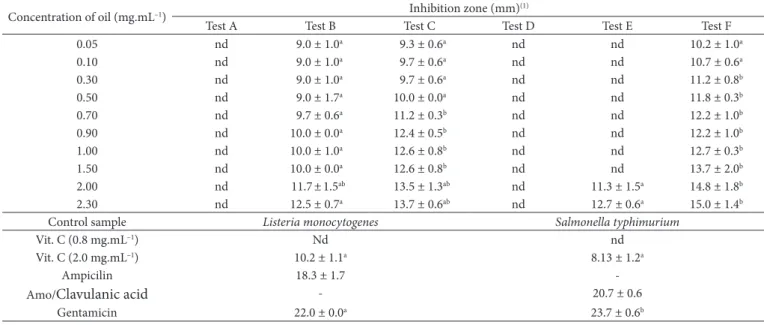
The experiments were performed in triplicate, and the results were expressed in mm as the arithmetic mean of the inhibition zone values obtained. The data (means) were analyzed by ANOVA and Tukey tests (p < 0.05) using the Statistica 7.0 software (Statsoft Inc., USA). Table 1 summarizes the tests used in this study.
2.3 Antioxidant activity
DPPH radical scavenging method
Antioxidant activity was measured in terms of hydrogen donating or radical scavenging ability using the stable radical 2.2 diphenyl-1-picrylhydrazyl (DPPH), as described by Mensor et al. (2001).
The experiment consisted in the incubation of an ethanolic solution of DPPH, 0.3 mM, (Sigma - Aldrich, USA), for 30 minutes, added with essential oil at the concentrations of 5; 10; 25; 50; 125; 250; 500 µ.mL–1 in ethanol analytical grade
(Merck S. A., Brazil), followed by an absorbance measurement at 517 nm using a FEMTO UV-Vis spectrophotometer (800XI - São Paulo, Brazil). The procedures were similar to those of the control sample, which consisted of the ethanolic DPPH solution without antioxidant. The blank sample contained solvent ethanol. The inhibition percentage of the sample tested on the DPPH radicals was estimated by Equation 1:
( ) 100
% 100 sample blank
control
Abs Abs
AA
Abs
− ×
= − (1)
where AA% is the percentage of antioxidant activity, Abssample
is the absorbance of the sample, Abscontrol is the absorbance of the control sample, and Absblank is the absorbance of the blank
sample.
The concentration necessary to scavenge 50% of the free radical DPPH (EC50) was estimated by linear regression.
b–carotene bleaching method
The method is based on measurements of b–carotene bleaching, which is generated by linoleic acid oxidation in an emulsion. The b–carotene loses the yellow color due to its reaction with radicals formed in this oxidation (MATTHÄUS, 2002; KANG et al., 2006). The rate of b–carotene bleaching was evaluated by the difference between the initial absorbance readings at 470 nm and after 120 minutes. The values of the percentage of antioxidant activity (AA %) were estimated by many physiological and anticarcinogenic activities (LEE et al.,
2002; ZAMBUCHINI et al., 2008).
This study aims to estimate the antimicrobial and antioxidant activities of commercial turmeric (Curcuma longa) essential oil and to evaluate the influence of the addition of ascorbic acid on the prevention of polyphenols oxidation.
2 Materials and methods
2.1 Essential oil and physical-chemical analysis
Commercial turmeric essential oil was purchased from an UK industry. The manufacturer description included: plant from India, oil obtained from vapor distillation of the treated rhizome with 100% of purity. The oil was yellow in color and exhibited a strong and characteristic odor.
Specific weight (g) and Refractive index analysis
The weight of a sample of 1 mL of essential oil was measured at 25 °C (Analytical balance AY220, SHIMADZU do Brasil Ltda., São Paulo/SP, Brazil). The specific weight was expressed as g.mL–1 of essential oil, and the refractive index analysis was
determined using a refractometer (Abbé WYA, 2-WAJ) at 20 °C.
2.2 Antimicrobial activity
Disk diffusion method
The antimicrobial activity of the essential oil against
Listeria monocytogenes Scott A and Salmonella typhimurium
ATCC 12228 was tested. The bacteria were cultivated in BHI (brain heart infusion) broth at 36 °C for 24 hours. Bacteria at the concentration of 106 CFU.mL–1 were inoculated in Mueller
Hinton Agar (Merck S.A., Brazil). After inoculation, sterile filter paper disks of 6 mm diameter were placed on the surface of the agar, and solutions at the concentrations of 0.05; 0.10; 0.30; 0.50; 0.70; 0.90; 1.00; 1.50; 2.00; 2.30 mg.mL–1 of essential
oil were slowly inserted into the disks with a micropipette of 25 µL. The same amounts of essential oil were tested with the addition of 0.8 mg.mL–1 and 2.0 mg.mL–1 of L(+) ascorbic acid
analytical grade (Dinâmica, Brazil). Pure vitamin C control tests at the above mentioned concentrations were conducted for comparison purposes.
Amoxicillin/clavulanic acid was used as the control sample for
Salmonella typhimurium; ampicillin for Listeria monocytogenes; and gentamicin for both microorganisms.
Table 1. Description of the tests performed for evaluation of antimicrobial activity of commercial turmeric (Curcuma longa) essential oil using
the disk diffusion method.
Test Description
A Commercial turmeric (Curcuma longa) essential oil against Listeria monocytogenes
B Commercial turmeric (Curcuma longa) essential oil added with 0.8 mg.mL–1 of ascorbic acid against Listeria monocytogenes C Commercial turmeric (Curcuma longa) essential oil added with 2.0 mg.mL–1 of ascorbic acid against Listeria monocytogenes D Commercial turmeric (Curcuma longa) essential oil against Salmonella typhimurium
in these results may be attributed to differences in raw material, maturation of the samples, solvent used, and distillation time (GOVINDARAJAN; STAHL, 1980). The refraction index results found in the literature were 1.5069 at 25 °C (NEGHETINI, 2006), 1.5067 at 30 °C (PÉRET-ALMEIDA, 2006), and 1.5054 at 30 °C (GOVINDARAJAN; STAHL, 1980).
3.2 Antimicrobial activity
Method of disk diffusion
The initial tests conducted with the pure commercial sample of the essential oil did not show antimicrobial activity against
Listeria monocytogenes Scott A and Salmonella typhimurium
ATCC.
However, after the addition of ascorbic acid, the resulting mixture showed antimicrobial activity against the two above mentioned microorganisms, as shown in Table 2. The results agree with those obtained by Nanasombat and Lohasupthawee with ethanolic extract (2005), Franco et al. with essential oil (2007), and Fagbemi et al. (2009) with turmeric aqueous extract (Curcuma longa). Other studies showed that turmeric exhibits antimicrobial activity against fungi and non-pathogenic bacteria (NEGHETINI, 2006; NAZ et al., 2010).
It can be seen that this essential oil at concentrations ranging from 0.05 to 2.30 mg.mL–1 added to ascorbic acid
at concentrations of 0.8 and 2.0 mg.mL–1 (tests B and C),
exhibited inhibition zones between 9.0 ± 1.0 and 13.7 ± 0.58 mm against Listeria monocytogenes. The maximum inhibition of both bacteria was obtained with 2.30 mg.mL–1 of oil added
to 2.0 mg.mL–1 of ascorbic acid. The commercial oil added to
0.8 mg.mL–1 of ascorbic acid presented antimicrobial activity
only against Salmonella typhimurium at the concentration of 2.0 mg.mL–1. This behavior can be attributed to the larger
complexity of the double cell wall of Gram-negative bacteria, Equation 2. Absorbance analysis was measured using a FEMTO
UV-Vis spectrophotometer (800XI - São Paulo, Brazil)
,120 ,0
,120 ,0
% 1 t t 100
controlt controlt
Abs Abs
AA
Abs Abs
−
= − − ×
(2)
where AA% is the percentage of antioxidant activity, Abst,120
is the absorbance of the sample after 120 minutes, Abst,0 is the
absorbance of the sample at t = 0, Abscontrolt,120 is the absorbance of the control sample after 120 minutes, and Abscontrolt,0 is the
absorbance of the control sample at t = 0.
2.4 Analysis of the total content of the phenolic compounds
The analysis of the total content of phenolic compounds was conducted by the Folin-Ciocalteu method (Sigma-Aldrich, USA - SINGLETON; ROSSI JUNIOR, 1965; PESCHEL et al., 2006) with standard curve of galic acid - GAE (Nuclear, CAQ Ind. e Com. Ltda., Brazil). In order to measure the absorbance, a FEMTO UV-Vis spectrophotometer (800XI - São Paulo, Brazil) at 765 nm was used. The results were expressed as milligrams of total phenolic compounds in galic acid per gram of turmeric essential oil (mg GAE.g–1).
3 Results and discussion
3.1 Physicochemical analysis
The specific weight value found was 0.8948 g.mL–1, and
the refraction index of the commercial essential oil was 1.4917. Krishnamurthy et al. (1976) and Govindarajan and Stahl (1980) found close results for the specific weight of Indian Turmeric: 0.929 g.mL–1 at 20 °C and 0.9423 g.mL–1 at 24 °C.
In addition, similar results were obtained for the Brazilian Turmeric: 0.9068 g.mL–1 at 30 °C and 0.906 g.mL–1 at 25 °C
(PÉRET-ALMEIDA, 2006; NEGHETINI, 2006). The differences
Table 2. Antimicrobial activity of commercial turmeric (Curcuma longa) essential oil against pathogenic bacteria with filter paper disk of 6 mm.
Concentration of oil (mg.mL–1) Inhibition zone (mm)
(1)
Test A Test B Test C Test D Test E Test F
0.05 nd 9.0 ± 1.0a 9.3 ± 0.6a nd nd 10.2 ± 1.0a
0.10 nd 9.0 ± 1.0a 9.7 ± 0.6a nd nd 10.7 ± 0.6a
0.30 nd 9.0 ± 1.0a 9.7 ± 0.6a nd nd 11.2 ± 0.8b
0.50 nd 9.0 ± 1.7a 10.0 ± 0.0a nd nd 11.8 ± 0.3b
0.70 nd 9.7 ± 0.6a 11.2 ± 0.3b nd nd 12.2 ± 1.0b
0.90 nd 10.0 ± 0.0a 12.4 ± 0.5b nd nd 12.2 ± 1.0b
1.00 nd 10.0 ± 1.0a 12.6 ± 0.8b nd nd 12.7 ± 0.3b
1.50 nd 10.0 ± 0.0a 12.6 ± 0.8b nd nd 13.7 ± 2.0b
2.00 nd 11.7 ± 1.5ab 13.5 ± 1.3ab nd 11.3 ± 1.5a 14.8 ± 1.8b
2.30 nd 12.5 ± 0.7a 13.7 ± 0.6ab nd 12.7 ± 0.6a 15.0 ± 1.4b
Control sample Listeria monocytogenes Salmonella typhimurium
Vit. C (0.8 mg.mL–1) Nd nd
Vit. C (2.0 mg.mL–1) 10.2 ± 1.1a 8.13 ± 1.2a
Ampicilin 18.3 ± 1.7
-Amo/Clavulanic acid - 20.7 ± 0.6
Gentamicin 22.0 ± 0.0a 23.7 ± 0.6b
oils. Only a few studies containing data on antioxidant capacity of commercial essential oils are available in the literature. Benelli (2010) did not report finding antioxidant activity for commercial essential oil of orange for the concentration of 500 µg.mL–1. In
the same study, turmeric commercial essential oil exhibited 14% of antioxidant activity.
β–carotene bleaching method
The antioxidant activity percentage (AA%) found for curcuma essential oil using the b–carotene bleaching method was 29% for the concentration of 1.667 mg of essential oil per mL of ethylic alcohol. The antioxidant activity obtained by linear regression for the concentration of 1.667 mg.mL–1 using
the DPPH radical scavenging method was about 40%. The two methods furnished discordant results for the antioxidant activity, which can be attributed to the high solubility of flavonoids in polar solvents, such as the ethanol used to solubilize the radical DPPH. Aqueous and lipidic phases, which have low solubility, are used in this method instead of polar solvents (RICE-EVANS; NICHOLAS; PAGANGA, 1996; OLDONI, 2007).
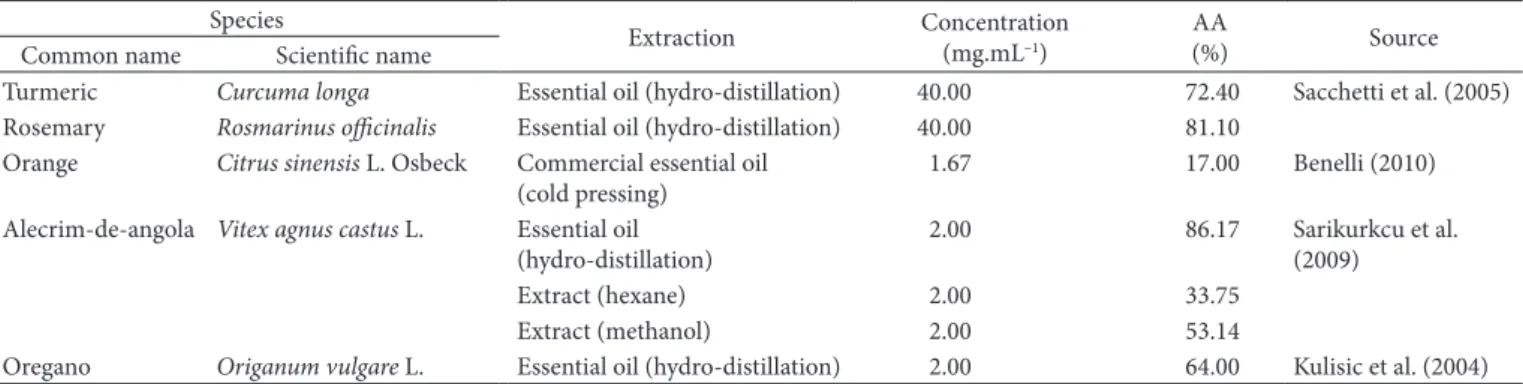
Table 4 shows published results of antioxidant activity using for different species of plants using different extraction methods.
3.4 Analysis of the total content of phenolic compounds
The total content of phenolic compounds found was 56.79 ± 1.37 mg GAE.g–1. Chen et al. (2008)
found 21.4 ± 1.7 mg GAE.g–1 for methanolic extract of
Curcuma longa L., 33.4 ± 5.7 mg GAE.g–1 for Curcuma zedoaria,
and 35.6 ± 5.5 mg GAE.g–1 for Curcuma domestica. Herrero et al.
(2010) obtained values between 70 and 120 mg GAE.g–1 for
Rosemary extract using different solvents. This compound is often used as antioxidant in food formulations.
Commercial turmeric (Curcuma longa) essential oil was more effective considering its total content of phenolic compounds compared to the published results of methanolic extract, aqueous solution, and essential oil obtained in laboratory. In addition, the results obtained were close to those of the Rosemary essential oil.
such as Salmonella typhimurium (HAMMER; CARSON; RILEY, 1999; CANSIAN et al., 2010).
Pure vitamin C control at 0.8 mg.mL–1 did not prevent growth
of both bacteria. On the other hand, the use of 2.0 mg.mL–1 showed
an inhibition zone of 10.2 ± 1.08 mm for Listeria monocytogenes
and of 8.13 ± 1.21 for Salmonella typhimurium. These results indicate a larger resistance of Salmonella typhimurium to the pH ranges used in this study. Therefore, it can be observed a synergism between the essential oil and the ascorbic acid.
Many studies showed that the synergism between ascorbic acid and phenolic compounds is due to the ascorbic acid ability to prevent the oxidation of the phenolic compounds. Since phenolic compounds are the main responsible for the antimicrobial activity of the turmeric oil, ascorbic acid favors this activity (NEGHETINI, 2006; HATANO et al., 2008; ZAMBUCHINI et al., 2008; NAZ et al., 2010). Studies on the interaction between turmeric essential oil and vitamin C were not found in the literature.
3.3 Antioxidant activity
DPPH radical scavenging method
This test measures the hydrogen-atom- or electron-donating ability of the essential oil to convert DPPH into the form DPPH – H (diphenylpicrylhydrazyn) (CANSIAN et al., 2010). The experimental results were expressed as the reduction of the free radical DPPH by 50%. The parameter EC50, which represents the inhibitory concentration necessary for this reduction, was used (QIAN; NIHORIMBERE, 2004; ARBOS et al., 2010).
The linear regression of the antioxidant activity (%) and the oil concentration (g.mL–1) (y=0.0227x+2.462,R2=0.862)
provided a value of 2094.2 µg.mL–1 to EC
50, which has high
magnitude when compared to reference standards such as EC50 = 2.15 µg.mL–1 for ascorbic acid and EC
50 = 5.37 µg.mL –1 for
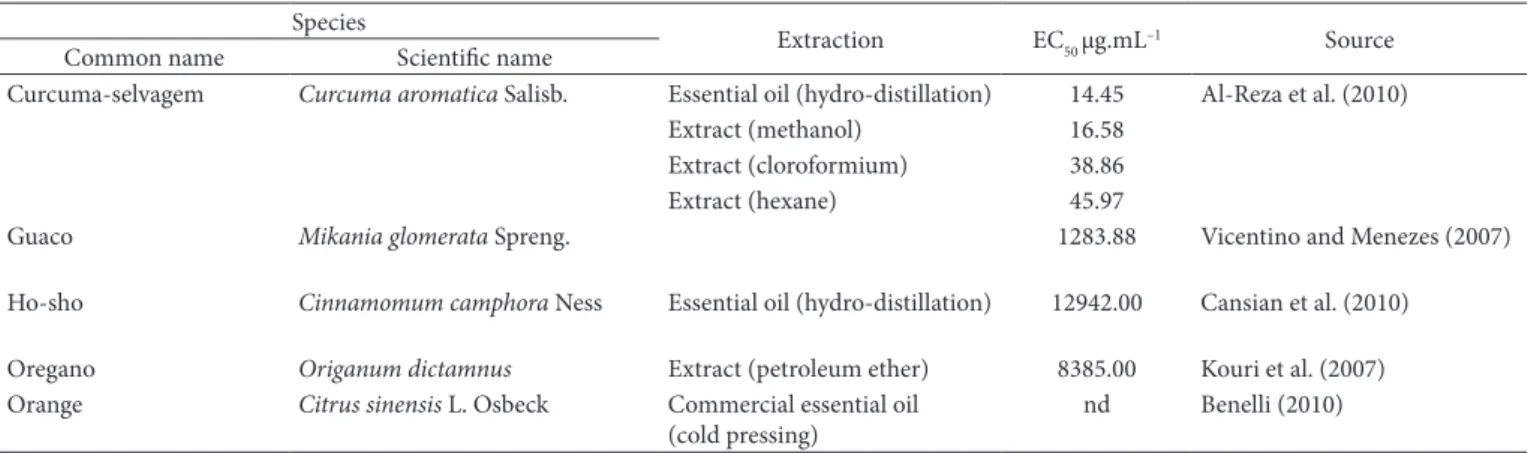
BHT (CANSIAN et al., 2010). Table 3 presents some published results of EC50 obtained using the DPPH method for some species of plants and different solvents used to extract essential
Table 3. Effective concentration at 50% (EC50) for different species of plants and different solvents used to extract the essential oil obtained by
the DPPH radical scavenging method. Species
Extraction EC50 µg.mL–1 Source Common name Scientific name
Curcuma-selvagem Curcuma aromatica Salisb. Essential oil (hydro-distillation) 14.45 Al-Reza et al. (2010)
Extract (methanol) 16.58
Extract (cloroformium) 38.86
Extract (hexane) 45.97
Guaco Mikania glomerata Spreng. 1283.88 Vicentino and Menezes (2007)
Ho-sho Cinnamomum camphora Ness Essential oil (hydro-distillation) 12942.00 Cansian et al. (2010)
Oregano Origanum dictamnus Extract (petroleum ether) 8385.00 Kouri et al. (2007) Orange Citrus sinensis L. Osbeck Commercial essential oil
(cold pressing)
nd Benelli (2010)
CHASSAGNEZ, A. L. M.; CORRÊA, N. C. F.; MEIRELES, M. A. A. Extração de oleoresina de cúrcuma (Curcuma longa) com CO2 supercrítico. Ciência e Tecnologia de Alimentos, v. 17, n. 4, 1997. CHEN, I.-N. et al. Antioxidant and antimicrobial activity of
zingiberaceae plants in Taiwan. Plant Foods and Human Nutrition, v. 63, p. 15-20, 2008. PMid:18157743. http://dx.doi.org/10.1007/ s11130-007-0063-7
FAGBEMI, J. F. et al. Evaluation of the antimicrobial properties of unripe banana (Musa sapientum L.), lemon grass (Cymbopogon citratus S.) and turmeric (Curcuma longa L.) on pathogens. African
Journal of Biotechnology, v. 8, n. 7, p. 1176-1182, 2009.
FRANCO, A. L. P. et al. Avaliação da composição química e atividade antibacteriana dos óleos essenciais de aloysia gratissima (gillies & hook) tronc. (alfazema), ocimum gratissimum L. (alfavaca-cravo) e curcuma longa. (açafrão). Revista Eletrônica de Farmácia, v. 4, n. 2, p. 208-220, 2007.
GOVINDARAJAN, V. S.; STAHL, W. H. Turmeric - chemistry, technology and quality. CRC Critical Reviews in Food Science
and Nutrition, v. 12, n. 3, p. 199-301, 1980. PMid:6993103. http://
dx.doi.org/10.1080/10408398009527278
HAMMER, K. A.; CARSON, C. F.; RILEY, T. V. Antimicrobial activity of essential oils and other plant extracts. Journal of Applied
Microbiology, v. 86, n. 6, p. 985-990, 1999. PMid:10438227. http://
dx.doi.org/10.1046/j.1365-2672.1999.00780.x
HATANO, T. et al. Enhancement of antibacterial effects of epigallocatechin gallate, using ascorbic acid. Phytochemistry, v. 69, p. 3111-3116, 2008. PMid:17889045. http://dx.doi.org/10.1016/j. phytochem.2007.08.013
HENTZ, S. M.; SANTIN, N. C. Avaliação da atividade antimicrobiana do óleo essencial de alecrim (Rosmarinus officinalis l.) contra
Salmonella sp. Evidência, v. 7, n. 2, p. 93-100, 2007.
HERRERO, M. et al. Green processes for the extraction of bioactives from Rosemary: Chemical and functional characterization via ultra-performance liquid chromatography-tandem mass spectrometry and in-vitro assays. Journal of Chromatography A, v. 1217, p. 2512-2520, 2010. PMid:19945706. http://dx.doi. org/10.1016/j.chroma.2009.11.032
KANG, H. J. et al. Studies on the development of functional powder from citrus peel. Bioresource Technology, v. 97, p. 614-620, 2006. PMid:16153824. http://dx.doi.org/10.1016/j.biortech.2005.03.037 KOURI, G. et al. Extraction and analysis of antioxidant components
from Origanum dictamnus. Innovative Food Science and Emerging
4 Conclusions
The results of the specific weight and refraction index of commercial turmeric (Curcuma longa) essential oil indicate that it may contain some impurities due to extraction and handling processes.
Like the turmeric oils and extracts obtained in laboratory, the commercial essential oil did not exhibit antimicrobial activity against Listeria monocytogenes Scott A and
Salmonella typhimurium ATCC. The addition of ascorbic acid to inhibit oxidation of phenolic compounds may be an alternative to increase the antimicrobial activity of the commercial turmeric essential oil. The results of antioxidant activity presented in this study were lower than the results published for both methods employed in this study. Further studies are necessary in order to obtain a better characterization of the antimicrobial and antioxidant properties of commercial Turmeric essential oil and its behavior when added with ascorbic acid.
References
AL-REZA, S. M. et al. Essential oil composition and antioxidant activities of Curcuma aromatica Salisb. Food and Chemical
Toxicology, v. 48, p. 1757-1760, 2010. PMid:20385198. http://dx.doi.
org/10.1016/j.fct.2010.04.008
ARBOS, K. A. et al. Atividade antioxidante e teor de fenólicos totais em hortaliças orgânicas e convencionais. Ciência e Tecnologia de
Alimentos, v. 30, n. 2, p. 501-506, 2010. http://dx.doi.org/10.1590/
S0101-20612010000200031
BENELLI, P. Agregação de valor ao bagaço de laranja (Citrus sinensis
L. Osbeck) mediante obtenção de extratos bioativos através de
diferentes técnicas de extração. 2010. Dissertação (Mestrado em
Engenharia de Alimentos)-Universidade Federal de Santa Catarina, Florianópolis, 2010.
BURKE, M. Curcumins dual defence against disease. Chemistry &
Industry, n. 8, p. 289, 1994. Complemento.
CANSIAN, R. L. et al. Atividade antimicrobiana e antioxidante do óleo essencial de ho-sho (Cinnamomum camphora Ness e Eberm Var. Linaloolifera fujita). Ciência e Tecnologia de Alimentos, v. 30, n. 2, p. 378-384, 2010. http://dx.doi.org/10.1590/S0101-20612010000200014
Table 4. Results of the antioxidative activity (AA%) obtained using the b–carotene bleaching method for different plant species and different
extraction techniques. Species
Extraction Concentration (mg.mL–1)
AA
(%) Source
Common name Scientific name
Turmeric Curcuma longa Essential oil (hydro-distillation) 40.00 72.40 Sacchetti et al. (2005) Rosemary Rosmarinus officinalis Essential oil (hydro-distillation) 40.00 81.10
Orange Citrus sinensis L. Osbeck Commercial essential oil (cold pressing)
1.67 17.00 Benelli (2010)
Alecrim-de-angola Vitex agnus castus L. Essential oil (hydro-distillation)
2.00 86.17 Sarikurkcu et al. (2009)
Extract (hexane) 2.00 33.75
Extract (methanol) 2.00 53.14
PÉRET-ALMEIDA, L. CurcumalongaL. – Separação e caracterização de pigmentos curcuminóides, avaliação da atividade
antimicrobiana, cultivo in vitropara o estabelecimento de gemas,
calos, órgãos (raízes) e produção de metabólitos secundários. 2006.
Tese (Doutorado em Ciência de Alimentos)-Faculdade de Farmácia, Universidade Federal de Minas Gerais, Belo Horizonte, 2006. PESCHEL, W. et al. An industrial approach in the search of natural
antioxidants from vegetable and fruit wastes. Food Chemistry, v. 97, p. 137-150, 2006. http://dx.doi.org/10.1016/j.foodchem.2005.03.033 QIAN, H.; NIHORIMBERE, V. Antioxidant power of phytochemicals from Psidium guajava leaf. Journal of Zhejiang University
Science, v. 5, n. 6, p. 676-683, 2004. PMid:15101101. http://dx.doi.
org/10.1631/jzus.2004.0676
RICE-EVANS, C. A.; NICHOLAS, J. M.; PAGANGA, G. Structure-antioxidant activity relationships of flavonoids and phenolic acids. Free Radical Biology and Medicine, v. 20, n. 7, p. 933-956, 1996. http://dx.doi.org/10.1016/0891-5849(95)02227-9 SACCHETTI, G. et al. Comparative evaluation of 11 essential oils
of different origin as functional antioxidants, antiradicals and antimicrobials in foods. Food Chemistry, v. 91, p. 621-632, 2005. http://dx.doi.org/10.1016/j.foodchem.2004.06.031
SARIKURKCU, C. et al. Studies on the antioxidant activity of essential oil and different solvent extracts of Vitex agnus castus L. fruits from Turkey. Food and Chemical Toxicology, v. 47, p. 2479-2483, 2009. PMid:19595732. http://dx.doi.org/10.1016/j.fct.2009.07.005 SCARTEZZINI, P.; SPERONI, E. Review on some plants of
indian traditional medicine with antioxidant. Journal of
Ethnopharmacology, v. 17, p. 23-43, 2000. http://dx.doi.
org/10.1016/S0378-8741(00)00213-0
SINGLETON, V. L.; ROSSI JUNIOR, J. A. Colorunetry of total phenolics with phosphomolybdic-phosphotungstic acid reagents. American
Journal of Enology and Viticulture, v. 16, p. 144-158, 1965.
SOUZA, E. L. et al. Orégano (Origanum vulgare L., Lamiaceae): uma especiaria como potencial fonte de compostos antimicrobianos.
Higiene Alimentar, v. 19, n. 132, p. 40-45, 2005.
VICENTINO, A. R. R.; MENEZES, F. S. Atividade antioxidante de tinturas vegetais, vendidas em farmácias com manipulação e indicadas para diversos tipos de doenças pela metodologia do DPPH.
Revista Brasileira de Farmacognosia, v. 17, p. 384-387, 2007. http://
dx.doi.org/10.1590/S0102-695X2007000300014
ZAMBUCHINI, B. et al. Inhibition of microbiological activity during sole (Solea solea L.) chilled storage by applying ellagic and ascorbic acids. Lebensmittel-Wissenschaft und Technologie, v. 41, p. 1733-1738, 2008. http://dx.doi.org/10.1016/j.lwt.2007.11.004
Technologies, v. 8, p. 155-162, 2007. http://dx.doi.org/10.1016/j.
ifset.2006.09.003
KRISHNAMURTHY, N. et al. Oil and oleoresin of turmeric. Tropical
Science, v. 18, n. 1, p. 37-45, 1976.
KULISIC, T. et al. Use of different methods for testing antioxidative activity of oregano essential oil. Food Chemistry, v. 85, p. 633-640, 2004. http://dx.doi.org/10.1016/j.foodchem.2003.07.024 LEE, K. W. et al. Preventive effects of vitamin C on carcinogenesis.
The Lancet, v. 359, p. 172, 2002.
http://dx.doi.org/10.1016/S0140-6736(02)07358-0
MARINO, M.; BERSANI, C.; GIUSEPPE, C. Impedance measurements to study the antimicrobial activity of essential oils from Lamiaceae
and Compositae. InternationalJournal of Food Microbiology,
v. 67, p. 187-195, 2001. http://dx.doi.org/10.1016/S0168-1605(01)00447-0
MATTHÄUS, B. Antioxidant activity of extracts obtained from residues of different oilseeds. Journal of Agricultural and Food Chemistry, v. 50, p. 3444-3452, 2002. http://dx.doi.org/10.1021/jf011440s MENSOR, L. L. et al. Screening of Brazilian plant extracts for
antioxidant activity by the use of DPPH free radical method.
Phytotherapy Research, v. 15, p. 127-130, 2001. PMid:11268111.
http://dx.doi.org/10.1002/ptr.687
NANASOMBAT, S.; LOHASUPTHAWEE, P. Antibacterial activity of crude ethanolic extracts and essential oils of spices against salmonellae and other enterobacteria. KMITL Science and
Technology Journal, v. 5, n. 3, 2005.
NAZ, S. et al. Antibacterial activity of Curcuma longa varieties against strains of bacteria. Pakistan Journal of Botany, v. 42, p. 455-462, 2010.
NEGHETINI, C. C. Caracterização físico-química e atividade
antifúngica dos óleos essenciais da cúrcuma. 2006. Dissertação
(Mestrado em Ciência de Alimentos)-Faculdade de Farmácia, Universidade Federal de Minas Gerais, Belo Horizonte, 2006. NEGI, P. S. et al. Antibacterial activity of turmeric oil: a byproduct
from curcumin manufacture. Journal of Agricultural and Food
Chemistry, v. 47, p. 4297-4300, 1999. PMid:10552805. http://dx.doi.
org/10.1021/jf990308d
OLDONI, T. L. C. Isolamento e identificação de compostos com atividade antioxidante de uma nova variedade de própolis
brasileira produzida por abelhas da espécie Apis mellifera. 2007.