INFLUENCE OF TEMPERATURE ON VOLATILE COMPOSITION OF GUACO (M. laevigata and M. glomerata)
UENO, Vanessa A.1*, SAWAYA, Alexandra C. H. F.1 1
Universidade Estadual de Campinas, Departamento de Fisiologia Vegetal *[email protected]
ABSTRACT
Mikania laevigata and Mikania glomerara are popularly known as guaco and are mainly used for respiratory complications. As both are included in the 1st Phytotherapic of Brazilian Pharmacopoeia (2011), apparently being used indiscriminately, they will be studied in parallel. The aim of this study was to evaluate how the volatile compounds vary in different conditions of temperature. Clones of both species were submitted to 15 ° C, 25 ° C and 35 ° C for 3 weeks. Volatile compounds were extracted by solid phase microextraction (SPME) and analyzed by GC-MS. By conducting an exploratory analysis of principal components (PCA), it was observed that the two species have very different chemical composition. Thus, M. laevigata and M. glomerata apparently cannot be used indiscriminately. Regarding the temperature treatment, there was no separation between the tests, indicating that this factor may not influence the volatiles composition of these species.
Keywords:Guaco. GC-MS. Volatiles compounds. Temperature.
RESUMO
Mikania laevigata e Mikania glomerara são popularmente conhecidas como guaco e utilizadas principalmente para complicações do trato respiratório. Como ambas constam no 1º Fitoterápicos da Farmacopéia Brasileira (2011), aparentemente podendo ser usadas indiscriminadamente, elas serão estudadas em paralelo. O objetivo desse trabalho foi avaliar como os compostos voláteis
variam em diferentes condições de cultivo de temperatura. Clones das duas espécies foram submetidas a 15◦C, 25◦C e 35◦C durante 3 semanas. A identificação dos voláteis se deu por microextração em fase sólida (SPME) e as análises por GC-MS. Realizando uma análise exploratória de componentes principais (PCA), observou-se que as duas espécies apresentam composição química bem diferente. Desse modo, M. laevigata e M. glomerata aparentemente não podem ser utilizadas indiscriminadamente. Quanto ao tratamento de temperatura, não houve uma separação entre os testes, indicando que esse fator pode não influenciar na composição dos voláteis dessas espécies.
Palavras-chaves: Guaco. GC-MS. Compostos voláteis. Temperatura.
Mikanialaevigata Schultz Bip. ex Baker and MikaniaglomerataSpreng are Brazilian medicinal plants, also known as guaco (CASTRO, 2003). Both are included in the 1st Brazilian Phytotherapic Pharmacopoeia (ANVISA, 2004), and are indicated for anti-inflammatory diseases (OLIVEIRA; OGA; AKISUE, 1985), anti-allergic (FIERRO, et al., 1999) and for bronchodilator action (LEITE, 1993). These activities are due to coumarin (1,2-benzopiron) (CELEGHINI; VILEGAS; LANÇAS, 2001), considered the chemical marker for this species. However, many studies show that this compound varies greatly between M. laevigataand M. glomerata (ANJOS, 2009; BOLINA; GARCIA; DUARTE, 2009; BERTOLUCCI, 2009). Our study group found high concentration of coumarin only in M. laevigata and much lower in M. glomerata (MELO; SAWAYA, 2015 – in press).
Besides the variation of the marker (coumarin) between the two species, studies indicate that variation occurs when plants are submitted to different treatments (ALMEIDA, 2015; BERTOLUCCI, 2013). Almeida, et al. (2017) compared these same two species and the results indicated that he highest content of coumarin was found in extracts of M. laevigataunder 50% shade, at temperatures of 10 ◦C and/or 22 ◦C, and under lower water availability condition.
Therefore, this work aims to compare the volatile compounds of M. laevigata and M. glomerata under different temperature conditions. Furthermore, there are only few studies about volatile composition and even less about its variation under different environment conditions.
Clones of M. laevigata and M. glomerata were used to minimize genetic variation within the treatments. Vases with the clones were placed in growth chambers with controlled temperatures
at 15°C, 25°C (control) and 35°C. The light intensity of the chamber was maintained at 180 μmols
photons m-2 s-1 using red and blue LED lights. Ten replicate for each species were made for each temperature. The pots were kept for three weeks under treatment.
Volatile compound were extract with solid phase micro-extraction (SPME) and the analysis were carried by gas chromatography with mass spectrometry (GC-MS).All extractions were carried out with a polydimethylsiloxane/divinylbenzene (PDMS/DVB) fiber, 65 µm film thickness (Supelco, Bellefonte, PA). Agilent GC 7890/ MS 5975 with Gerstelinjetor (MPS) (Agilent Technologies, EUA) was used for the analysis.
A quality control (QC) was made to ensure the equipment operation. For that, all samples from all treatments and all replicates were mixed to compose the QC. 20-mL vial with 1g of ground material were kept at 70°C for 5 minutes. Extraction time with the fiber was 10 min. The fiber was kept in the injector for 3 min for the optimal thermal desorption. The injection in 1:5 split mode used helium as carrier gas at a flow rate of 1.0 mL min-1. The injector temperature was 240 ◦C. A fused-silica capillary column (5% phenyl–95% polydimethylsiloxane, 30 m × 0.25 mm,0.25 µm) was employed in the separation of the compounds. The oven temperature was programmed from 100 ◦C to 170 ◦C at a rate of 3,5 ◦C min-1 and 170 ◦C to 250◦C at a rate of 20 ◦C min-1.The mass spectrometer was used with electron ionization (70 eV) and mass scan range from 29 to 289 Da. The temperatures of the ion source and the GC-MS interface were 200 and 250 ◦C, respectively. Compounds were identified by comparing their mass spectra with the GC-MS spectral library (NIST, 2013).
Due to the large volume of data, it was not possible to differentiate the samples only by chromatogram analysis. Therefore, an exploratory data analysis was carried out by principal component analysis (PCA). The PCA was conducted using the autoscaled relative area of the compounds identified in each sample. The PCA routines were performed using the MetaboAnalyst 3.0 (XIA; WISHART, 2016).
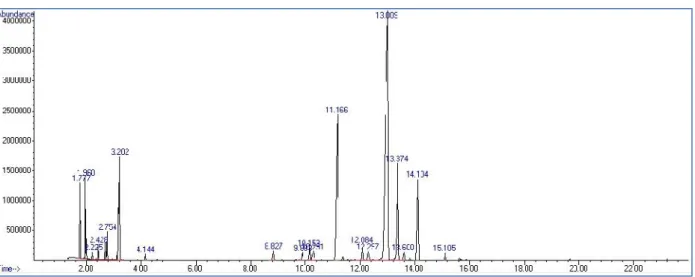
In sample chromatograms it was possible to identify several volatile organic compounds extracted via SPME. The major volatile compound is Germacrene D, representing on average
44,9% of total area. Other mono and sesquiterpenes such as α-pinene, elemene, α- humulene,
δ-cadineno where identified too. Figure 1 shows a typical chromatogram of the guaco samples. All chromatograms from M. laevigata presented high peaks of coumarin, considered the chemical marker from this specie (ANVISA, 2004). On the other hand, none of the samples of M. glomerata showed the peaks of coumarin. Similar results were found by many others authors (MELO; SAWAYA, 2015; ALMEIDA, 2015; BERTOLUCCI, 2013).
Figure 1. Typical chromatogram obtained by SPME-GC/MS from M. laevigata samples
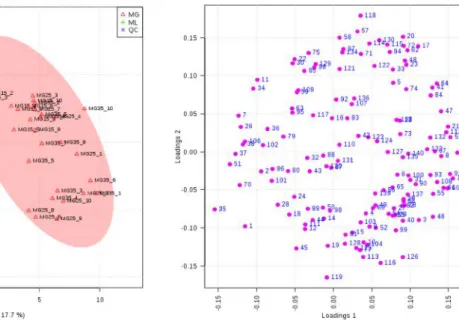
The PCA analysis (Figure 2) showed a good separation between the two species and the QC, indicating that M. laevigata and M. glomerata have different chemical composition. Figure 2a. Represents the scores (samples), in green are the M. laevigata, in red M. glomerata and the QC are colored in blue. In the loading plot (Figure 2b.), it is not clear which variables are responsible for
the samples separation. PC 1 explains 17,7% of variation and PC 2 only 9,5%. The large amount of data could be the reason of this low explanation and for the bad separation of the samples.
Regarding the temperature treatment, there was not a clear separation between the tests, indicating that this factor may not influence the volatiles composition of these species. It was observed that after the treatment, all leaves from all tests were damaged, with different colored areas (red to purple). Perhaps the artificial light used in the growing chamber affected the plant leaves, once the clones were young.
The present study demonstrated that M. laevigata and M. glomerata have differences between the volatile composition. PCA scores plot clearly divided the samples in tree main groups, proving that the species are different and cannot be used without distinction. The temperature
treatment didn’t show good separation between the tests. Maybe this factor does not influence the
volatile composition. Further studies must be done do detect which variables are responsible for the species discrimination.
Figure 2. Principal Components Analysis of the main peak areas found in the GC–MS analysis of the temperature treatment samples (A) Scores plot (samples), M. laevigata colored in green, M. glomerata in red
REFERENCES
ALMEIDA, C. L., Metabólitos secundários de duas espécies de guaco (Mikania glomerata Sprengel e Mikania laevigata Schultz) cultivadas sob condições cariadas. Dissertação (Mestrado em Ciências, na área de Fármacos, Medicamentos e Insumos para Saúde) Universidade Estadual de Campinas. 2015.
ANVISA 2004. Agência Nacional de Vigilância Sanitária. Resolução nº 89, de 16 de março de 2004. Diário Oficial da República Federativa do Brasil, Brasília DOU de 18/03/2004.
BERTOLUCCI, S. K. V. et al., Development and Validation of na RP-HPLC Method for Quantification of Cinnamic Acid Derivatives and Kaurane-Type Diterpenes in Mikania laevigata and Mikania glomerata. Planta Med. v.75 p.280– 285, 2009.
BERTOLUCCI, et al., Seasonal Variation on the Contents of Coumarin and Kaurane-Type Diterpenes in Mikania laevigata and M. glomerata Leaves under Different Shade Levels. Chemistry&Biodiversity. v. 10. 2013.
BOLINA, R. C., GARCIA, E. F., DUARTE, M. G., Estudo comparativo da composição química das espécies vegetais Mikania glomerata e Mikania laevigata. Brazilian Journal of Pharmacognosy. v.19 p.294-298, 2009.
CASTRO, M. C. et al., Crescimento e anatomia foliar de plantas jovens de Mikania glomerata Sprengel (guaco) submetidas a diferentes fotoperíodos. Ciência e Agrotecnologia. v.27 p.1293-1300. 2003.
CELEGHINI, R.M.S.; VILEGAS, J.H.Y.; LANÇAS, F.M. Extraction and quantitative HPLC analysis of coumarin in hydroalcoholic extracts of Mikania glomerata Spreng. (“guaco”) leaves. Journal of the Brazilian Chemical Society, v.12, p.706-709. 2001.
FIERRO, I.M.; SILVA, A.C.; LOPES, C.D.; MOURA, R.S.; BARJA-FIDALGO, C. Studies on the anti-allergic activity of Mikania glomerata. JournalofEthnopharmacology, v.66, p.19-24. 1999. LEITE, M.G.R. et al., Estudo farmacológico comparativo de Mikania glomerata Spreng. (guaco), Justicia pectoralis Jacq (anador) e Torresea cearensis (cumaru). Revista Brasileira de Farmácia, v.74, n.1, p.12-15. 1993.
MELO, L. V. & SAWAYA, A. C. H. F., UHPLC-MS quantification of coumarin and chlorogenic acid in extracts of the medicinal plants known as guaco (Mikania glomerata Spreng. And Mikania laevigata Sch. Bip. ex Baker). Revista Brasileira de Farmacognosia, 2015 - in press
OLIVEIRA, OGA e AKISUE, Parâmetros físicos e químicos e efeito antiedema dos extratos fluidos de guaco (Mikania glomerata Spreng.) e de guaco de mato (Mikania laevigata Schutz Bip. ex Baker). Anais de Farmácia e Química, v.25, n.1(2), p.50-54. 1985.
SANTOS, A. et al., Determinação do rendimento e atividade antimicrobiana do óleo essencial de Cymbopogon citratus(DC.) Brazilian Journal of Pharmacognosy. v. 19. p. 436-441, Abr./Jun. 2009.
XIA, J. and WISHART, D.S. Using MetaboAnalyst3.0 for Comprehensive Metabolomics Data Analysis. Current Protocols in Bioinformatics, 55:14.10.1-14.10.91. (2016).