Final Report
The Municipal Chamber of Anadia
Solomiia Rydzai
Final Report to obtain the Master's Degree in Political Science
(2nd cycle of studies)
VERSÃO DEFINITIVA APÓS DEFESA
Acknowledgements
After finishing of writing this final report I would like to thank the people who were supporting me during all this time.
On the begin I would like to thank to my parents, for their patience, faith in me, and of course support among all the years of studying.
Also, I am very thankful to my coordinator Ângelo Santos from the Municipal Chamber of Anadia, who believed in me and gave to me the opportunity to do an internship and gain important experience for my future career.
To my university coordinator Dr. Bruno Daniel Ferreira da Costa who was always helping and supporting me while I was looking for an internship.
To all the colleagues from the Municipal Chamber, to my boyfriend and all my friends for support, patience and strength that you gave to me at this stage of my life.
Abstract
Municipal Chambers play an important role in life’s of all the citizens. Sometimes people did not notice how some little projects can completely transform the view of their hometown. Understanding and supporting the policy of the local governments is the key to build a great future.
This report shows all the knowledge and experience which I gained during my internship at the Municipal Chamber of Anadia, more precisely at the Division of Human, Cultural and Social Development (Education Service).
The main objectives of this study are to present the institution where I made my internship, to analyze the Administrative System of Portugal, explain the main task and duties of the Municipal Chamber, show their educative initiatives and of course describe the practical part of my work.
Keywords
Contents
Introduction ... 1
Chapter 1 Presentation of the municipality ... 2
1.1 Brief description of the city ... 2
1.2 Geographical Location ... 3
1.3 Description of the population ... 5
Chapter 2 Administrative divisions of Portugal ... 7
2.1 History of administrative divisions... 7
2.2 Current administrative divisions ... 9
2.2.1 Autonomous regions ... 10 2.2.2 Metropolitan areas ... 11 2.2.3 Intermunicipal communities ... 12 2.2.4 Municipalities ... 13 2.2.5 Parishes ... 15 2.2.6 NUTS of Portugal ... 16
Chapter 3 Presentation of the institution where the internship took place ... 19
3.1 Municipal Chamber of Anadia ... 19
3.2 Municipal Assembly of Anadia ... 22
3.3 The Division of Human, Cultural and Social Development... 24
3.4 Education Service ... 26
Chapter 4 Projects of Municipal Chamber ... 29
4.1 The program “SENTIR ANADIA” ... 29
4.2 International Association of Educating Cities ... 30
4.3 UNESCO Global Network of Learning Cities ... 31
Chapter 5 Internship ... 34
5.1 Performed tasks ... 34
5.2 Portugal Wine Trophy 2017 ... 35
5.3 The Medieval Fair (Feira Medieval) ... 36
5.4 The Environment Fair (Feira do Ambiente) ... 38
vii
5.6 The Fair of Vine and Wine (Feira da Vinha e do Vinho) ... 39
5.7 Final of The National Reading Competition (Final Nacional do Concurso Nacional de Leitura) . . 40
5.8 The Sports Recognition Ceremony (Cerimónia de Reconhecimento Desportivo) ... 41
5.9 The Juniors and Under 23 Track European Championships ... 42
Conclusion ... 44
List of Pictures
Picture 1: The map of the Civil Parishes of the Municipality of Anadia ... 3 Picture 2: The map of the Central Region of Portugal ... 4 Picture 3: Maps of the NUTS ... 17
List of Tables
Table 1: List of the subdivisions of Portugal ... 10 Table 2: The list of Intermunicipal Communities ... 13
List of Graphs
Graph 1: Resident population: total and by sex... 5 Graph 2: Resident population: total and by major age groups ... 6
List of Organizational Charts
Organizational Chart 1: Structure of the Municipal Chamber of Anadia... 20
Organizational Chart 2: Hierarchy of the Municipal Chamber of Anadia ... 21
Organizational Chart 3: Structure of the Division of Human, Cultural and Social Development ... 26
List of Acronyms
DOC Denominação de Origem Controlada MA Metropolitan Areas
IC Intermunicipal Communities
NUTS Nomenclature of Territorial Units for Statistics EU European Union
LAU Local Administrative Units MCA Municipal Chamber of Anadia
PAMDC Programa de Apoio Municipal ao Desenvolvimento Cultural IAEC International Association of Educating Cities
UNESCO United Nations Educational, Scientific and Cultural Organization GNLC Global Network of Learning Cities
SGD Sistema de Gestão Documental
OIV International Vine and Wine Organization DWN Deutsche Wein Marketing
Introduction
This report is based on the curricular internship leading to the Master's Degree, it occurred during the second school year at the Master's course of Political Science at the university of Beira Interior.
The internship took place between 15 of May and 15 of August 2017, in Anadia, at the Division of Human, Cultural and Social Development of the Municipal Chamber, with coordination of teacher Ângelo Santos and constant support of Isabel Maia.
This internship helped to me improve my theoretical knowledge gained during the first year of Master's course, I had a possibility from inside the institution see how public policy works, for example by participating at the reunion of the Municipal Chamber, or by doing a research about participatory budgeting and system of local elections.
Though this institution was not my first choice for do an internship, then I weighed the pros and cons and realized that this can be way more interesting than expected, and I was right.
The objective of this work is to make known the place and the activities developed during the internship.
Thus, this report has five chapters.
Chapter 1 is dedicated to the presentation of the city, analyzing of it population and localization. Chapter 2 is more complex and describing the Administration System of Portugal, from the Medieval and to the current days.
Chapter 3 is presenting the place where I made an internship, with the precise explanations and definitions of all the tasks and duties of the Municipal Chamber, Municipal Assembly and the Division of Human, Cultural and Social Development.
Chapter 4 there I pay a lot of attention to the local initiatives and international Associations and Networks where is involved the Municipality of Anadia.
Chapter 5 is dedicated directly to the task, duties and responsibilities which I had during internship. Also, it is showing which exactly experience I gained and my short opinions about it.
Chapter I - Presentation of the municipality
1.1 Brief description of the city
Anadia is a Portuguese city and the center of the same municipality, located in the Beira Litoral area of the Central Region of Portugal, in an area of the Baixo Vouga referred to as the Bairrada, an area traditionally representative of the district of Aveiro. Anadia is approximately halfway between the cities of Aveiro and Coimbra. The city of Anadia is part of Arcos parish with a population of 6148 inhabitants in 2015.
This municipality has one city: Anadia (which is in the parish of Arcos) and one town: Sangalhos. Curia, a village in Tamengos parish is a popular tourist spa with hotels, restaurants and a park with a lagoon.
Anadia is in the heart of Bairrada, a fertile agricultural and viticulture area, which has recently stagnated in terms of population.
Bairrada is a natural subregion located in Beira Litoral, which comprises the municipalities of Mealhada, Anadia, Oliveira do Bairro, most of the municipality of Cantanhede, Águeda (southern part of this municipality), as well as some parishes of the municipalities of Vagos, Coimbra and the parish of Nariz, already in the municipality of Aveiro.
This region is mainly characterized by the strong wine production and has Portugal's highest wine classification as a Denominação de Origem Controlada (DOC), another important characteristic of this subregion is the production of sparkling wine. The principal grapes of the Bairrada region includes Baga, Borrado das Moscas, Castelao Frances, Fernao Pires, Rabo de Ovelha and Tinta Pinheira.
In terms of gastronomy, this region is famous for Bairrada suckling pig (Leitão Assado à Bairrada). An important part of the identification of the municipality is heraldry, which include:
- coat of arms of the municipality; - flag of the municipality;
- seal of the municipality.
Anadia is a municipality that hold relations with twin towns, these have as their main objective to establish economic and social cooperation links capable of managing common interests and strengthening international relations. Usually these towns have common characteristics or references. Thus, twin towns of the municipality of Anadia are: Jūrmala (Latvia), Boa Vista (Cape Verde), São Lourenço dos Órgãos (Cape Verde).
The municipality of Anadia consist of 10 parishes such as:
Union of the Parishes of Amoreira da Gândara,
Union of the Parishes of Arcos and Mogofores,
Parish of Avelãs de Caminho,
Parish of Avelãs de Cima,
Parish of Moita,
Parish of Sangalhos,
Parish of São Lourenço do Bairro,
Union of the Parishes of Tamengos,
Aguim and Óis do Bairro,
Parish of Vila Nova de Monsarros,
Parish of Vilarinho do Bairro.
Pic. 1 The map of the Civil Parishes of the Municipality of Anadia Source: http://www.cm-anadia.pt/dados-estatisticos
1.2 Geographical Location
As mentioned earlier municipality of Anadia is located in the Central Region of Portugal and geographically bordering with such municipalities as Águeda and Oliveira do Bairro (in the north), municipality of Mealhada (in the south) and has a border with the municipality of Cantanhede (in the west) and with the municipality of Mortágua (in the east).
Pic. 2 The map of the Central Region of Portugal
Source: https://www.flickr.com/photos/ccdrc/albums/72157623137382729
Anadia has a very favorable location since it has access to IC2 motorway, it belongs to the complementary network of roads in Portugal and connects two biggest cities of the country such as Porto and Lisbon. In Mealhada which is 9 km far from Anadia, exist an access to the principal highway of Portugal - A1, which also connects Lisbon and Porto, it also serves other important cities like Santarém, Leiria, Coimbra and Aveiro. Among the national routes of Portugal, Anadia has access to N235 and N336 motorways.1
In addition to the road networks, it is important to mention that the municipality is also integrated in the rail transport network since it passes through the north line that connects Aveiro to Coimbra and vice versa. To the train stops of the northern line in the muncicipality belongs: Paraimo- Sangalhos, Mogofores, Curia and Aguim.
1 Regularização dos acessos às estradas nacionais. <http://cm-anadia.pt/index.php/noticias2/905-prazos-a-
It is also worth noting the proximity to the sea coast (40 minutes by car to the beaches of Mira and Costa Nova), to the Serra do Buçaco - a mountain range (20 minutes by car), to the airport of Porto (1 hour by car), to the cities of Aveiro and Coimbra (35 min by car) and to Lisbon (2 hours and 20 minutes by car).
1.3 Description of the population
According to the statistical data published in 2016 by the National Statistical Institute of Portugal (Instituto Nacional de Estatística), the population of the municipality was 27,993 inhabitants (of which 13,350 men and 14,673 women) with a total area of 216.64 km2 and with population density of 129, 2 inhab/km2 (the number of inhabitants per square kilometer).2 Resident population are the people who,
regardless of whether he is present or absent from a particular residential block, lives there for most of the year with a family or holds all or most of his assets there. Graph number 1 is showing the difference between quantity of male and female residents comparing to the total number of citizens.
Graph 1: Resident population: total and by sex Source: https://www.pordata.pt/Home
According to the graph number 2, the most numerous age group of residents include people aged
2 National Statistical Institute of Portugal.
<https://www.ine.pt/xportal/xmain?xpid=INE&xpgid=ine_pesquisa&frm_accao=PESQUISAR&frm_show_page_num= 1&frm_modo_pesquisa=PESQUISA_SIMPLES&frm_modo_texto=MODO_TEXTO_ALL&frm_texto=anadia&frm_imgPesqui sar> (accessed August 1, 2017)
from 15 to 64 years old, with a population of 17.665. In this way, the active population plays a dominant role in the life of the city.
Graph 2: Resident population: total and by major age groups Source: https://www.pordata.pt/Home
According to the figure number 3, the most numerous age group of residents include people aged from 15 to 64 years old, with a population of 17.665. In this way, the active population plays a dominant role in the life of the city.
The second by the amount of citizens age group consists of people with 65+ years old and the total number of 7143 inhabitants.
In the minority is the age group with residents aged from 0 to 14 years old, comprising a total of 3185 inhabitants. If in the coming years the situation with fertility will not improve, then Anadia, like many other European cities, will face the problem of population ageing.3
3 Demographic Statistics – 2016.
<https://www.ine.pt/xportal/xmain?xpid=INE&xpgid=ine_publicacoes&PUBLICACOESpub_boui=307957694&PUBLIC ACOESmodo=2> (accessed August 1, 2017)
Chapter 2 Administrative divisions of Portugal
Administratively, Portugal is a unitary and decentralized State. Nonetheless, operationally, it is highly centralized system with administrative divisions organized into three tiers. The State is organized under the principles of subsidiarity, local government autonomy, and democratic decentralization of the public service.4
After the Carnation Revolution which got occurred, on 25 April 1974, for overthrew the authoritarian dictatorship (the Estado Novo, or "New State") Portugal got a possibility to came back to the democracy way and at the meeting in plenary session on 2 April 1976, the Constituent Assembly decree the new Constitution of the Portuguese Republic.5
According to the 1976 Constitution, Articles 225-234, Azores and Madeira are defined as the autonomous regions (regiões autónomas). Articles 225-262 of the Constitution specifically identifies the three tiers of government: administrative regions (regiões administrativas), civil parishes (freguesias) and municipalities (municípios).6
In law 75/2013 of September 2013 were clarified the powers and duties of the civil parishes, municipalities, metropolitan areas and intermunicipal communities and were defined the two types of administrative regions: metropolitan areas (áreas metropolitanas) and intermunicipal communities (comunidades intermunicipais).7
Portugal also uses a system of statistical regions and subregions known as the Nomenclature of Territorial Units for Statistics, developed by Eurostat and implemented during European integration. NUTS is used for collecting statistical information.8
2.1 History of administrative divisions
Since the 13th century Portugal was clearly divided into six provinces/comarcas9: Entre Douro e 4 Portugal's Constitution of 1976 with Amendments through 2005.
<https://www.constituteproject.org/constitution/Portugal_2005.pdf> (accessed August 5, 2017)
5 BBC Home "1974: Rebels seize control of Portugal".
<http://news.bbc.co.uk/onthisday/hi/dates/stories/april/25/newsid_4754000/4754581.stm> (accessed August 5, 2017)
6 Portugal's Constitution of 1976 with Amendments through 2005.
<https://www.constituteproject.org/constitution/Portugal_2005.pdf> (accessed August 5, 2017)
7 Lei n.º 75/2013 de 12 de setembro. <https://dre.pt/application/dir/pdf1s/2013/09/17600/0568805724.pdf>
(accessed August 5, 2017)
8 PORDATA. O que são NUTS? <https://www.pordata.pt/O+que+sao+NUTS> (accessed August 5, 2017) 9 A comarca is a traditional region or local administrative division found in parts of Spain, Portugal, Panama,
Nicaragua, and Brazil. The term is derived from the term marca, meaning a "march, mark", plus the prefix co - meaning "together, jointly". This term was used until the 16th century.
Minho, Entre Douro e Mondego, Beira, Estremadura, Entre Tejo e Odiana and Algarve. This was facilitated by the fact that those territories were settled by people very early. An important role in shaping this division was played by the policy of the crown, the territories conquered from the Muslims were often sparsely populated and didn’t have any political identity, passed into the ownership of the nobles and churches. Such a division of the provinces was used until the 19th century.10
Times were changing, technologies has evolved, life has improved since Medieval and it influenced to the increase of population so consequently, there was a need to change the administrative division. After the Liberal Revolution of 1820 (Revolução Liberal), several proposals were made for an administrative reorganization of the country. It was proposed a division into districts and later a division into provinces. These proposals ended up not going forward, because of the absolutist counter- revolution.1112
The new administrative reorganization of the country was adopted only in 1832 by the liberal government, which was in exile in the Azores. Under this reform, the country would be divided into provinces, comarcas and municipalities (concelhos). Such a reorganization encompassed not only the mainland of Portugal, but also the surrounding islands and even overseas territories. Only after the Civil War of 1834 this reform began to be applied throughout the country.
However, in 1835 the main division of the country became the district, the provinces of 1832 were maintained, without proper organs, only as groupings of districts for statistical purposes and regional reference. This situation persisted until the 20th century.
The provinces of 1832, on the mainland and islands, were: Minho, Trás-os-Montes, Douro, Beira Alta, Beira Baixa, Estremadura, Alentejo, Algarve, Açores, Madeira.
In 1833 the Province of the Azores was divided into two: the Western Province (Província Ocidental) and the Eastern Province (Província Oriental). In 1836, following the creation of the district of Horta, the Western Province of the Azores, was subdivided into the new Western Province and the Central Province (Província Central).
In Overseas were created the provinces of Cape Verde and Guinea, Angola, Mozambique, India, São Tomé and Príncipe and Macao and Timor, each with its mayor and general meeting, on equal terms with the metropolitan provinces.
After 100 of years, the administrative division of Portugal once again changed. Since its inception, the Estado Novo has adopted a policy of regionalization of the country. This regionalization was foreseen in the Constitution of 1933, through the division of Continental Portugal into regional municipalities that would be denominated "provinces". The provinces were actually created in 1936.
10 Silveira, Luís. Origins and Evolution of the Portuguese Administrative System in Comparative Perspective.
Universidade Nova de Lisboa. <http://www.geog.port.ac.uk/hist-bound/papers/portugese_admin_system.htm> (accessed August 6, 2017)
11 Associação de Professores de História. The Peninsular Wars and the Liberal Revolution.
<http://www.aph.pt/ex_hisPort8.php> (accessed August 6, 2017)
12 The Free Dictionary by Farlex. Portuguese Revolution of 1820.
The studies of the geographer Amorim Girão that divided the continent of Portugal into 13 "natural regions", published between 1927 and 1930, made the base to the reorganization of the country. Eventually 11 provinces were created, each corresponding to the natural regions of Amorim Girão, with two exceptions: the natural regions of Trás-os-Montes and Alto Douro and the natural regions of Beira Alta and Beira Transmontana were gathered, respectively, in the Province of Trás-os-Montes and Alto Douro and the Province of Beira Alta. Parallel to the division in provinces, the division in districts was maintained, whose limits did not coincide with those.
The provinces of 1936 were: Minho, Trás-os-Montes e Alto Douro, Douro Litoral, Beira Litoral, Beira Alta, Beira Baixa, Ribatejo, Estremadura, Alto Alentejo, Baixo Alentejo, Algarve.
In 1959, the functions of regional autarchies passed to the districts, with the provincial boards being vanished and the district boards established. The provinces, however, remained as historical and geographical divisions, only being formally vanished of the State with the Constitution of 1976.13
2.2 Current administrative divisions
According to the Constitution of Portugal of 1976, local authorities are an integral part of the organizational structure of the democratic state. Title VIII of the Constitution explain the divisions of Portuguese territory and main functions of the local governments. Article 235 describe local authorities as "...territorial bodies corporate, shall possess representative bodies and shall seek to pursue the
interests of the local people."
Article 236 is about categories of local authority and administrative division. First of all, there are some differences between Continental Portugal and islands. "On the mainland local authorities shall
comprise parishes, municipalities and administrative regions." While the Azores and Madeira which
belongs to the autonomous regions may have just parishes and municipalities. Also on the islands respectively to the law may be created other forms or local government organization, as well as in large urban areas, depending on the specific conditions.
13 AUDACES. As divisões administrativas de Portugal, ao longo dos tempos.
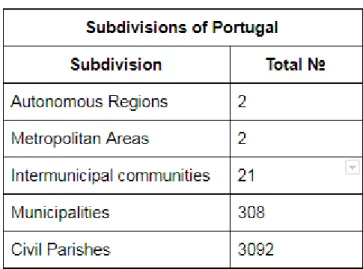
Table 1: List of the subdivisions of Portugal Source: Made by author
2.2.1 Autonomous Regions
The Autonomous Regions of Portugal is the 1st-level administrative division. In total in Portugal are two such regions: Azores and Madeira. They were created based on its geographical, economic, social and cultural characteristics and on the historical aspirations of the island populations. According to the Portuguese constitution, the main task of these regions is to promote and protect regional interests, as well as the consolidation of national unity and solidarity among all Portuguese citizens. Although islands are politico-administrative autonomies due to the Constitution this does not affect the integrity and sovereignty of the State. Together with Continental Portugal they form the whole of the Portuguese Republic.14
Under the law and the constitution, autonomous regions have their own political and administrative statute and government. Regional Government (Governo Regional) is the regional executive body, it includes a Regional Cabinet to where belongs a President (Presidente do Governo Regional) and several Regional Secretaries (Secretários Regionais). To the region legislative body belongs Regional Assembly (Assembleia Regional), the assembly is elected by universal suffrage.
The Azores (Açores) is an archipelago composed of nine volcanic islands in the North Atlantic Ocean scattered along a strip of about 600 km from Santa Maria to Corvo. The distance from there to the Continental Portugal is about 1,360 km, about 1,643 km to Lisbon, about 1,507 km to the African coast,
14 Portugal's Constitution of 1976 with Amendments through 2005
and about 1,925 km to the Newfoundland, Canada. According to the statistical data of 2015, the total population of islands are 245,766 inhabitants.
The islands of the archipelago are divided in three geographic groups: the Eastern Group, composed of Santa Maria and São Miguel, the Central Group integrates the islands Terceira, Graciosa, São Jorge, Pico and Faial, and the Western Group composed by the islands Corvo and Flores. The government and administration of the archipelago is distributed between the three capitals of the former districts of the Azores: the regional parliament is located in the city of Horta (on Faial Island); the most populous city and home to the Regional Presidency and administration is Ponta Delgada (on São Miguel Island); the historical and cultural capital is Angra do Heroísmo (on Terceira Island), it is also the home of the Azorean judiciary and seat of the Diocese of the Azores.15
Madeira is an archipelago located in the African Plate in the Atlantic Ocean about 978 km of Lisbon, about 700 km of the African coast, and about 450 km of the Canary Islands. This archipelago is formed by the Madeira Island, Porto Santo, the Desertas Islands with comprising the three uninhabited islands, and by the Selvagens Islands whose set of 3 islands and sixteen uninhabited islets. Curious fact is that this archipelago is located closer to Africa than Europe. Funchal is the capital of Madeira located on the main island, the government and administration is situated there. According to the statistical data of 2015, the total population of islands are 256,424 inhabitants.16
2.2.2 Metropolitan Areas
A metropolitan area (área metropolitana) is a Portuguese urban area, defined according to the municipal associative laws, namely Law № 75/2013 of 12 September.
Portugal has 2 Metropolitan Areas (MA): - Lisbon Metropolitan Area;
- Porto Metropolitan Area.
The main tasks of MA are:
- to participate in the elaboration of the plans and programs of public investments;
- to promote the planning and the management of the strategy of economic, social and environmental development of the territory covered;
- to participate in the management of regional development support programs;
- to participate in public entities of metropolitan scope, namely in the field of transport, water, energy and treatment of solid waste;
- to plan the performance of public entities of metropolitan character;
15 Visit Azores. O Arquipélago: Geografia. <https://www.visitazores.com/pt/the-azores/the-9-islands/geography>
(accessed August 9, 2017)
- to ensure the articulation of actions between municipalities and central government services and etc. The branches of administration of the MA are the metropolitan council (conselho metropolitano) what is a deliberative body, the metropolitan executive committee (comissão executiva metropolitana) is an executive body and the strategic council for metropolitan development (conselho estratégico para o desenvolvimento metropolitano) is an advisory body.17
The Lisbon Metropolitan Area (Área Metropolitana de Lisboa) consist of 18 municipalities of Grande Lisboa and the Setúbal Peninsula. According to the NUTS III (2015) it is the most populous metropolitan area in the country with 2 812 678 inhabitants and by the NUTS the second most populous region after the Northern Region.18
The Metropolitan Area of Porto (Área Metropolitana do Porto) is located in the North Coast of Portugal and consist of 17 municipalities of Grande Porto and Entre Douro e Vouga. In 2015 according to the NUTS III this MA had 1 723 618 inhabitants.19
2.2.3 Intermunicipal Communities
The intermunicipal community (comunidade intermunicipal) is a type of administrative division in Portugal. Just like metropolitan areas, intermunicipal communities (IC) are defined according to the municipal associative laws, namely Law № 75/2013 of 12 September.
After the local government reform of 2013, were defined 21 intermunicipal community. Intermunicipal community cannot be created with less than 5 municipalities and with total population less than 85 000 inhabitants. The table №3 is showing names of all intermunicipal communities, their total population and number of municipalities that belongs to them.
The main tasks of the IC:
- to promote the planning and management of the economic, social and environmental development strategy of the territory concerned;
- to articulate of municipal investments of intermunicipal interest;
- to participate in the management of programs to support regional development; - to plan the activities of public entities;
- to ensure the articulation of the actions between the municipalities and the services of the central administration in areas of public supply networks, basic sanitation infrastructures, waste water treatment and urban waste, network of health equipment, educational and vocational training network, spatial planning, civil protection and etc.
17 Lei n.º 75/2013 de 12 de setembro. <https://dre.pt/application/dir/pdf1s/2013/09/17600/0568805724.pdf>
(accessed August 11, 2017)
18 Área Metropolitana de Lisboa. <https://www.aml.pt/index.php> (accessed August 11, 2017) 19 Área Metropolitana do Porto. <http://portal.amp.pt/pt/> (accessed August 11, 2017)
The branches of administration of the IC are the intermunicipal assembly (assembleia intermunicipal), the intermunicipal council (conselho intermunicipal), the intermunicipal executive secretariat (secretariado executivo intermunicipal) and the strategic board for intermunicipal development (conselho estratégico para o desenvolvimento intermunicipal).2021
Table 2: The list of Intermunicipal Communities Source: Made by author
2.2.4 Municipalities
20 Lei n.º 75/2013 de 12 de setembro. <https://dre.pt/application/dir/pdf1s/2013/09/17600/0568805724.pdf>
(accessed August 12, 2017)
21 Estudo-Piloto Comunidades Intermunicipais (CIM). Modelos de competências, de financiamento, de governação,
de gestão e de transferência de recursos. <http://www.anmp.pt/files/djur/2014/div/ESTUDOPILOTO_CIM.pdf> (accessed August 12, 2017)
As defined in the Constitution of 1976, the municipality (município or concelho) is the second- level administrative subdivision of Portugal. Since that time, the Portuguese municipalities have been ruled by a system composed by an executive body (the municipal chamber) and a deliberative body (the municipal assembly). The municipal chamber (câmara municipal) is the executive body and is composed of the president of the municipality and a number of councillors proportional to the municipality's population. The municipal assembly (assembleia municipal) is composed of the presidents of all the parishes that compose the municipality, as well as by a number of directly elected deputies, at least equal to the number of parish presidents plus one. Both of this bodies are elected for four years.22
In general, all municipalities are subdivided into civil parishes but of course exist some "exceptions of the rules". For example, exist 6 municipalities that have just one civil parish: Alpiarça, Barrancos, Castanheira de Pera, Porto Santo (Madeira), São Brás de Alportel and São João da Madeira. The municipality of Corvo, by law, the only municipality with no civil parishes. Meanwhile, Barcelos is the municipality with 61 civil parishes (the largest number of parishes in all the State). The municipalities are responsible for promoting and safeguarding the interests of their populations, in articulation with the parishes.
The municipalities have attributions in the following areas: a) Rural and urban equipment;
b) Energy;
c) Transport and communications; d) Education;
e) Heritage, culture and science; f) Free time and sports;
g) Health; h) Social action; i) Housing;
j) Civil protection;
k) Environment and basic sanitation; l) Consumer protection;
m) Promotion of development;
n) Spatial planning and urban planning; o) Municipal police;
p) External cooperation.23
According to the official data, Portugal has 308 municipalities. Autonomous regions of the Azores
22 Portugal's Constitution of 1976 with Amendments through 2005.
<https://www.constituteproject.org/constitution/Portugal_2005.pdf> (accessed August 13, 2017)
23 Lei n.º 75/2013 de 12 de setembro. <https://dre.pt/application/dir/pdf1s/2013/09/17600/0568805724.pdf>
(accessed August 13, 2017)
and Madeira have 30 municipalities while the Continental Portugal has 278. Usually they are named for their biggest or historically most important city or town.
To the most populous municipalitites belongs those which are located near the ocean and around metropolitan areas such as Lisbon, Porto and Braga. Less populous municipalitites are located inside of the country for example, Trás-os-Montes and Alentejo.
2.2.5 Parishes
Parish (freguesia) according to the Portugal's Constitution of 1976 is the third-level administrative subdivision.24 A parish is a subdivision of a município (municipality). Each parish is governed by a Parish
Board (Junta de Freguesia), an executive body that is elected by the members of the respective Parish Assembly (Assembleia de Freguesia), with the exception of the president (the first candidate on the most voted list is automatically appointed President of the Parish Board). The presidents of the parish boards are also members of the municipal assembly (Assembleia Municipal). The Parish Assembly is a body that publicly elected every four years by the citizens registered in the territory of the parish, according to the D'Hondt method25, through party lists and independent candidates.
Most often, a parish takes the name of its seat, which is usually the most important (or the single) human agglomeration within its area, which can be a neighborhood or city district, a group of hamlets, a village, a town or an entire city. In cases where the seat is itself divided into more than one parish, each one takes the name of a landmark within its area or of the patron saint from the usually coterminous Catholic parish (paróquia). Be it a city district or village, the civil parish is often based on an ecclesiastical parish.
According to Law 11-A/2013 of 28 January 201326 which defined the reorganization of the civil
parishes, in Portugal was implemented the reform which reduced the number of parishes from 4,260 to 3,092. The territories of parishes can exceed 100 km² or be only a few hectares, and populations ranging from tens to tens of thousands. It is up to the municipalities to propose the creation of new parishes in their territory, which must comply with a set of criteria fixed by law.
Portuguese authorities established three different types of parishes for the spatial planning purposes:
1) urban parishes - parishes that have a population density exceeding 500 inhab/ km² or that integrate a place with a resident population of 5,000 or more;
24 Portugal's Constitution of 1976 with Amendments through 2005.
<https://www.constituteproject.org/constitution/Portugal_2005.pdf> (accessed August 17, 2017)
25 Gallagher, Michael. Proportionality, Disproportionality and Electoral Systems. Department of Politics, Trinity
College, Dublin. Electoral Studies, 1991.
<https://web.archive.org/web/20131116104818/http:/www.tcd.ie/Political_Science/staff/michael_gallagher/Ele ctoralStudies1991.pdf> (accessed August 17, 2017)
26 Lei n.º 11-A/2013 de 28 de janeiro. <https://dre.pt/application/dir/pdf1sdip/2013/01/01901/0000200147.pdf>
2) semi-urban parishes - non-urban parishes with a population density exceeding 100 inhab/km² and less than or equal to 500 inhab/km², or which comprise a place with a resident population of 2,000 inhabitants or less than 5,000 inhabitants;
3) rural parishes - the remaining ones.27
The main duties of the parish are to promote and protect the interests of its population, in the articulation with the municipality. The responsibilities of the parishes also cover the planning, management and execution of investments in the cases and in the terms established by law.
The parishes have attributions in the following areas: a) Rural and urban equipment;
b) Public supply; c) Education;
d) Culture, leisure and sport; e) Primary health care; f) Social action;
g) Civil protection;
h) Environment and health; i) Development;
j) Urban and rural planning; k) Community protection.28
2.2.6 NUTS of Portugal
NUTS is the Nomenclature of Territorial Units for Statistics, created by Eurostat29 as a coherent
system for dividing up the EU's territory in order to produce regional statistics for the Community. During around thirty years NUTS (since the beginning of 1970s) was implementing and updating data under a series of "gentlemen's agreements" between the Member States and Eurostat. Just on the begin of 2000 the work on the Commission Regulation (EC) № 1059/2003, to give NUTS a legal status started and just in July 2003 it entered into force. The following regulation define stability of the classification for at
27 Enciclopédia Memória Portuguesa. Freguesia. <http://terrasdeportugal.wikidot.com/geo:freguesia> (accessed
August 17, 2017)
28 Lei n.º 75/2013 de 12 de setembro. <https://dre.pt/application/dir/pdf1s/2013/09/17600/0568805724.pdf>
(accessed August 17, 2017)
29 Eurostat is the statistical office of the European Union situated in Luxembourg. Its mission is to provide high
quality statistics for Europe. While fulfilling its mission, Eurostat promotes the following values: respect and trust, fostering excellence, promoting innovation, service orientation, professional independence. Eurostat offers a whole range of important and interesting data that governments, businesses, the education sector, journalists and the public can use for their work and daily life.
least three years. This is crucial for statistics because stability makes sure that data refers to the same. If any country, because of certain circumstances, will need to change the regional breakdown of its territory, the country concerned informs the European Commission about the changes.
The NUTS classification is a hierarchical system for dividing up the economic territory of the EU for the purpose of:
- the collection, development and harmonization of European regional statistics; - socio-economic analyses of the regions;
- framing of EU regional policies.
As a part of EU, Portugal also collect statistical data with NUTS but this system does not have a legal status in law.30
The NUTS system subdivides the nation into three levels: NUTS 1, NUTS 2 and NUTS 3. In the case of Portugal, a complementary hierarchy such as LAU 1 and LAU2 (Local Administrative Units) is employed and this is referred to former NUTS 4 and NUTS 5.
Thus, NUTS 1 define major socio-economic regions, it is the first subdivision of Portugal and it include Continental Portugal, the Azores and Madeira.
NUTS 2 define basic regions for the application of regional policies; in Portugal it is divided into five regions (Norte, Centro, Área Metropolitana de Lisboa, Alentejo and Algarve), administered by the Commissions for Coordination and Regional Development (Comissões de Cooperação e Desenvolvimento Regional) and the two autonomous regions of Madeira and Azores.
NUTS 3 define small regions for specific diagnoses; so, the seven regions of Portugal subdividing into 25 subregions (subregiões) such as: 2 metropolitan areas, 21 intermunicipal communities and the 2 autonomous regions.31
Picture 3: Maps of the NUTS
Source: https://www.pordata.pt/O+que+sao+NUT
30 Eurostat. The current NUTS 2013 classification. <http://ec.europa.eu/eurostat/web/nuts/overview> (accessed
August 20, 2017)
Returning to the topic of LAU (local administrative unit) it should be noted that it is a low level administrative division of a country, ranked below a province, region, or state. In the European Union, LAUs are basic components of Classification of Territorial Units for Statistics (NUTS) regions. However, not all countries describe their locally governed areas this way. Currently in Portugal 308 municipalities are classified as LAU 1 and 3092 civil parishes are classified as LAU 2.32
32 Eurostat. Local Administrative Units (LAU). <http://ec.europa.eu/eurostat/web/nuts/local-administrative-
Chapter 3 Presentation of the institution where the
internship took place
3.1 Municipal Chamber of Anadia
A municipal chamber (câmara municipal) is a type of municipal governing body in Portugal and some other countries (Cape Verde, Guinea Bissau and Timor-Leste), it is an executive body of a municipal, a level higher than a civil parish. The term can also refer to the building where the Municipal Chamber offices are located, for example, the City Hall.
According to the Order № 551/2013, the vision of the Municipal Chamber of Anadia is to guide its action in order to promote the progress and sustainable development of the Municipality, at the environmental, economic and social levels; to create conditions of competitiveness, innovation and modernity, and ensuring an efficient, transparent and rigorous management and allocation of resources; its mission is fundamentally related to the planning, definition and application of strategies and guidelines capable of promoting the development of the municipality, guaranteeing the growth of the indices quality of life, thanks to a reflected application of resources and the implementation of innovative policies.
Strategic objectives of Municipal Chamber of Anadia are also described at the Order № 551/2013, for example:
1. Within the scope of the Organization and Local Government, - to guarantee the rigor and transparency of the autarchic management; - to develop an economic-financial sustainability plan;
- to prevent and manage risks of corruption and related offenses;
- to adopt an administrative modernization procedure with the aim of improving governance; - to promote regular communication between the municipal chamber and civil parishes etc.
2. In the scope of the Development of Human Potential and the Valorization of Patrimony, - to promote the development of the Municipality, centered on people and heritage;
- to promote lifelong education;
- to promote the Educational, Social, Cultural and Sports areas;
- to contribute to improving the conditions of access of citizens to health, safety and justice; - to promote the municipality as a national and international tourist destination.
3. In the scope of Strategic Planning, Development and Territorial Intervention,
- to strengthen territorial competitiveness and its affirmation in the regional, national and international space;
- to promote and support the development of entrepreneurship and innovation;
- to promote national and international partnerships and exchanges, strengthening the relations between twin towns and external cooperation;
- to ensure the improvement of accessibility and mobility for all.
Main principles which regulate the functioning of the Municipal Chamber of Anadia are based on the unity and effectiveness of action, on providing a high-quality services and reducing bureaucracy.
The building of the City Hall (Municipal Chamber) of Anadia is located at the main square of the city, more precisely, at the Praça Visconde Seabra. In addition to this building, the Municipal Chamber of Anadia (MCA) owns the Municipal Library of Anadia, the Bairrada Wine Museum, Municipal Swimming Pools, the High-Performance Center - Anadia (Sangalhos), Municipal Pavilion, Municipal Sports Pavilion and Anadia Sports Complex.
In order to better understand the internal structure of the organization and its powers, below will be listed the organizational chart.
Organizational Chart 1: Structure of the Municipal Chamber of Anadia Source: Made by author from Order № 551/2013
The internal organization of the municipal services of Anadia is governed by the hierarchical structure model, including flexible organic units, which are presented in the form of Municipal Divisions, which has a fixed structure.
These organic units are constituted by the following Municipal Divisions: - Financial Management, Estate Planning and Budgetary Control Division;
- Organizational Development Division;
- Quality, Environment and Fleet Management Division; - Urban Planning Division;
- Equipment, Mobility, Water and Sanitation Division.
Each organic unit is under the direction of a division chief, who occupies the position of intermediate management in the 3rd degree and is responsible for organizing the personnel of the organizational unit he heads and to maintain the order and discipline of the service; also he coordinating the execution of the service that is attributed to third persons, in order to meet deadlines and ensure proper quality; he delivers to the superior of the organization the necessary documents, after all the procedures executed; he provides information requested, when these are not confidential and are related to the organizational unit in which it is inserted and etc.
This organizational chart is showing the hierarchical structure of the top-level functionaries of municipal chamber.
Organizational Chart 2 Hierarchy of the Municipal Chamber of Anadia Source: Made by author
As we can see, the Municipal Chamber of Anadia is represented by the mayor Eng.ª Maria Teresa Belém Correia Cardoso, her duties include:
- coordination of executive activities; - financial management;
- management of human resources and coordination of municipal services; - civil protection and municipal safety;
- strategic planning and economic development; - cooperation and partnerships with the parishes etc.
Usually, the two (serving year-round) aldermen cooperate a lot with the mayor, but they also have their own specific duties, thus Eng.º Jorge Eduardo Ferreira Sampaio is responsible for: sports, culture, tourism and external cooperation with twin towns; while Dr. Lino Jorge Cerveira Pintado is responsible for: environment, public hygiene (solid waste management), youth, heritage (protocol management) and monitoring of legal matters.33
Aldermen (vereadores) are elected by the Hondt method, the mayor (presidente) of a Municipal Chamber is the head of the most-voted list. The number of aldermen determined by the number of registered voters within the municipality.
3.2 Municipal Assembly of Anadia
The municipal assembly is the deliberative body of each of the municipalities of Portugal. The Municipal Assembly aiming at the defense of the common and specific interests of the population of the Municipality of Anadia, under the terms of the Law and the Constitution of the Portuguese Republic. The Municipal Assembly is made up of 31 Municipal Deputies, 21 of whom are elected by direct and secret universal suffrage of the citizens of the Municipality of Anadia and other 10 of deputies are Presidents of Civil Parishes.
Municipal Assembly has it own powers and duties, they can be divided in two groups, to the first one belongs appreciation and inspection powers; and to the second one belongs operating powers.
To the appreciation and inspection powers of Municipal Assembly belongs, 1. Under the proposal of Municipal Chamber:
- to approve the options of the plan and the proposed budget, as well as their revisions; - to resolve on the question of the fiscal powers of the municipality;
- to authorize the contracting of loans;
- to approve the plans and other strategic instruments necessary to carry out the duties of the municipality;
- to approve the creation or reorganization of municipal services and the organic structure of municipal services;
- to approve the norms, delimitations, measures and other acts foreseen in the regimes of the planning of the territory and the urbanism;
- to decide on the creation and the concrete institution of the municipal police force etc.
33 Município de Anadia. Constituição do executivo. <http://www.cm-anadia.pt/camara-municipal/executivo>
2. Other duties:
- to monitor and supervise the activities of the municipal chamber, municipal services, local companies and any other entities that form part of the perimeter of the local administration;
- to approve local referendums;
- to appreciate the refusal to provide any information or refusal of the delivery of documents by the municipality chamber or any of its members that obstruct monitoring and supervision;
- to prepare and approve the regulation of the municipal safety council; - to fix the annual holiday of the municipality;
- to convene the metropolitan executive secretariat or the intermunicipal community, as the case may be, and under the terms of the present law, with the limit of twice a year, to respond to its members for the activities carried out within the metropolitan area or intermunicipal community of the municipality and etc.
To the operating powers of Municipal Assembly belongs: - to prepare and approve its rules of procedure;
- to deliberate on appeals filed to mark unjustified absences of its members;
- to resolve on the constitution of delegations, commissions or working groups for the study of matters related to the attributions of the municipality and without harming the normal functioning and activity of the municipal chamber.34
The meeting board of the Municipal Assembly shall be composed of a chairman (presidente), a first and a second secretary and shall be elected for the term of office of the Assembly. The Chairman of the Municipal Assembly of Anadia is Adriano Martins Aires, first secretary Maria Lúcia Braga Araújo and second secretary Maria Alexandra Ferreira Henriques, all of them belongs to the same political party - MIAP. If the Chairman is absent, he shall be replaced by the first secretary; while in their absences, any of the secretaries may be replaced by a Municipal Deputy appointed by the Chairman of the Assembly.35
The meeting board is elected by secret ballot, and its members may be dismissed by the Municipal Assembly at any time, by a decision taken by an absolute majority of the Municipal Deputies. In the event of dismissal or resignation of any of the members of the meeting board of the Municipal Assembly, or of termination of their respective terms of office, a new election shall be held at the immediate meeting.
The meeting board of Municipal Assembly should: - to prepare the agenda for the sessions and distribute them;
- to verify legal compliance and admit the proposals of the municipal chamber legally subject to the deliberative competence of the municipal assembly;
- to ensure the final drafting of the deliberations;
34 Regimento da Assembleia Municipal de Anadia. <http://www.cm-
anadia.pt/images/assembleia_municipal/regimento/Regimento_assembleia_municipal_anadia.pdf> (accessed September 2, 2017)
- to request from the municipal chamber or its members the documentation and information that it deems necessary for the effectuation of the powers of the municipal assembly, as well as for the performance of its functions, in the terms and with the periodicity deemed convenient;
- to communicate to the municipal assembly the judicial decisions related to the loss of mandate in which any member incurs;
- to perform the other legal powers.
Usually, the sessions of the Municipal Assembly take place in the building of the Seat of Municipality, exceptionally, this session can be in another place if the Meeting Board of the Municipal Assembly sees fit or if the Municipal Assembly so decides. The Municipal Assembly meets in five annual sessions in February, April, June, September and November or December, convened at least eight days in advance by notice and by letter with acknowledgment of receipt or protocol.
The Municipal Assembly meets in extraordinary session on the initiative of its Chairman, Meeting Board or after request:
- of the Mayor of the City Chamber;
- one-third of Municipal Deputies or Municipal Groups with similar representation;
- a number of voters registered in the electoral roll of the municipality, equivalent to 5% of the number of voters up to a maximum of 2500.
The extraordinary session referred to before, shall be held within a minimum of three days and a maximum of ten days after its convocation. Also, special sessions may be solemn and/or commemorative. All sessions of the municipal assembly are public and have a period for public intervention, during which the requested clarifications will be provided.36
3.3 The Division of Human, Cultural and Social Development
As mentioned in the previous section, the Municipal Chamber is divided into flexible organic units in the form of divisions, in this subsection I will concentrate attention at the one specific division where I made my internship, the Division of Human, Cultural and Social Development (Education Service).
This division is responsible for continuing the attributions of the Municipality and the competencies of municipal bodies in the fields of Education, Social Action, Culture and Sport.
The main duties of this division are:
- to collaborate in the planning of the network of municipal educational and sports equipment, in the elaboration of the respective projects and in the accompaniment of the corresponding works;
36 Regimento da Assembleia Municipal de Anadia. <http://www.cm-
anadia.pt/images/assembleia_municipal/regimento/Regimento_assembleia_municipal_anadia.pdf> (accessed September 2, 2017)
- to ensure and propose the conclusion of agreements with educational institutions, public and private, collectivities, youth organizations and other entities considered of interest for the improvement of the education system;
- to carry out the tasks and actions covered by the competences of the municipality in educational matters;
- to keep updated the educational chart of the Municipality of Anadia;
- to elaborate studies, implement and develop sports projects aimed at the generalization and democratization of access to sports by the citizen, with a view to promoting health and improving the quality of life;
- to support physical education campaigns and promotion of healthy lifestyles;
- to plan and monitor the creation of new spaces and sports facilities, as well as to manage the entire network of municipal sports facilities;
- to organize and support projects for regional, national and international sports events; - to ensure the production and dissemination of municipal information;
- to ensure the realization and updating of temporary and permanent exhibitions and to manage the occupation and profitability of the cultural spaces destined to these ends;
- to ensure the development of all actions of a cultural nature to be carried out by the municipality; - to cooperate in information and training programs in the areas of culture and social action; - to coordinate big projects and the budget of the division;
- to ensure the preparation of the specifications for the acquisition of goods and services inherent to the activity of the division for subsequent delivery to the Procurement service etc.
Organizational Chart 3 Structure of the Division of Human, Cultural and Social Development Source: Made by author
As we can see, the Division of Human, Cultural and Social Development is divided into six different services, such as Education Service, Museological Service, Social Action Service, Library Service, Sports Service and Culture and Tourism Service.
3.4 Education Service
As mentioned earlier, all three months of internship I was working in the Education Service of Municipal Chamber of Anadia. This service has it own structure, and the organizational chart №4 showing how it look like.
Organizational Chart 4 Structure of the Education Service Source: Made by author
Thus, the head of division is Teacher (Professor) Ângelo Santos. Matters relating to education, according to the organizational chart, are divided in two offices, one of which is for school social action, which is under the responsibility of an operational assistant and a technical assistant, in charge of managing applications for family support and the program for receiving school subsidies, as well as the ensuing tasks that these responsibilities entail (meals, school textbooks etc.).
The second office, dedicated to education itself, is responsible for ensuring, organizing and managing school transport and food (Law № 75/2013), investing in the construction, equipping and maintenance of pre-school and educational establishments (Decree-Law № 7/2003), to elaborate the educational charter (Decree-Law no. 7/2003), to support activities of a social, cultural, educational, sporting, recreational or other nature that the municipality considers relevant (Law no. 2013).
Despite this division of tasks, the two offices work in constant articulation, supporting each other when necessary, with a policy of constant dialogue.
It is also important to mention that there are educational tasks that are assumed by the civil parishes, such as the supply of cleaning materials and of expedient to the schools of the 1st cycle of the basic education and the establishments of pre-school education, the guarantee of small repairs in pre- school and primary education establishments and the promotion of the maintenance of the surrounding spaces of the establishments mentioned above, according to Decree-Law 75/2013.
The Municipality of Anadia did not sign a delegation of powers agreement, under Decree-Law 30/2015, of February 12, so that the education section does not have responsibilities regarding the 2nd and 3rd cycle of basic education and secondary education, although they often promote activities aimed
Chapter 4 Projects of Municipal Chamber
In today's world, people are paying more and more attention to the public space and environment. With the development of technologies, globalization and cultural exchange, the clear majority of young people who are living in small cities (towns) and villages are looking for opportunities to move to the capitals not only for better job opportunities, but also because there are far more ways for self-development, improved infrastructure, and more. For small cities, like Anadia, it is more important than ever to use public space in the interests of the inhabitants to encourage young people, adults and the elderly to live here, take part in the city life, develop it and develop with it. To accomplish such tasks, at the local level, the Municipal Chamber created the program “SENTIR ANADIA” (Feel Anadia), at the international level, Anadia is a member of the IAEC (International Association of Educating Cities) and the UNESCO Global Network of Learning Cities.
This chapter will describe the main tasks and missions of the previously mentioned program and the Educating Cities and Learning Cities initiatives.
4.1 The program “SENTIR ANADIA”
This program was strategically delineated by the Municipal Chamber of Anadia with the duration of four years (from 2013 to 2017) in order to serve as a guiding element, interlocutor and catalyst of all the municipal activity in the cultural, sport and social domains, and in the youth, entrepreneurship and local development.
This program is based on the premise that local agents should be the main actors in the operationalization of all the dynamization actions in the mentioned domains, and it is the responsibility of the local authority to provide adequate mechanisms and conditions for the associative work to proceed with enthusiasm and quality.
One of the important aspirations of the program "SENTIR ANADIA" is also to foster cooperation and interaction between the different associations, through the articulation of a set of initiatives, consubstantiated in the support of projects. The objective of this program to encourage the emergence of innovative projects, intrinsically linked to the reality and needs of the municipality, whose quality has a disseminating effect inside and outside the Municipality of Anadia.
To the program “SENTIR ANADIA” belongs four tools: a platform for registration of associations, an agenda of events, a publicity platform and a card granting benefits to its bearer, which is embodied in the "Anadia Junior Card" and the "Anadia Senior Card". With this program support another program, such as Municipal Support Program for Cultural Development (Programa de Apoio Municipal ao
Desenvolvimento Cultural - PAMDC) which aims to guide the granting of public benefits by the Municipal Chamber through principles such as equity, proportionality, legality, transparency, universality among others.
In the social sphere, the municipality is investing in cooperation with the 18 Private Institutions of Social Solidarity and other social-level equipment that develop initiatives for different target audiences. objective is to promote the projects and social responses that exist in the municipality.37
4.2 International Association of Educating Cities
The concept of Educating City arises, for the first time, in the decade of the 70s, however, just in 1990 that the concept reaches more relevance, in Barcelona, at the 1st International Congress of Educating Cities.
As stated in the Charter of Educating Cities:
“The educating city is a city with its own personality, forming an integral part of its nation. Therefore, its identity is interdependent with that of the country it belongs to. The educating city is not self-contained; it has an active relationship with its environment, with the other urban centers in the nation and with cities in other countries. The goal of this relationship is to learn, exchange and share experiences and thus enrich the lives of the inhabitants.”38
The International Association of Educating Cities (IAEC) was founded in 1994, at the 3rd International Congress of Educating Cities and constitutes a non-profit association. It emerges as a permanent coordination structure between local governments that have adopted the principles of the Charter of Educating Cities (any local government that accepts this commitment can become an active member of the Association, regardless of its administrative powers). Members of Association should participate in the channels of debate, exchange and collaboration of the IAEC. In addition, the city also needs to disseminate its experiences through the International Documents Bank of Educating Cities and, lastly, pay a predetermined annual quota according to the country and its number of inhabitants. Within the framework of the IAEC, congresses are held every two years, which are held as opportunities for sharing, dissemination of good practices and partnership. At the 2016, the Association has 488 member
37 Município de Anadia. SENTIR ANADIA. <http://www.cm-anadia.pt/sentir-anadia-2> (accessed September 10,
2017)
38 Charter of Educating Cities. <http://www.edcities.org/wp-content/uploads/2013/10/CARTA-CIUDADES-
cities in 36 countries on all continents.3940
The Association is organized through:
- General Assembly is the main body of the Association composed by all member cities;
- Executive Committee has the functions of direction, management, execution and representation of the Association;
- Secretariat is responsible of the day-to-day management of the Association;
- Networks are the decentralized structures made up of Association member cities in a specific territory.41
The main goals of IAEC are:
- to proclaim and champion the importance of education in the city;
- to publicize the educative axes of the political projects of the member cities;
- to promote, inspire, foster, and assure compliance with the principles of the Charter of Educating Cities (Declaration of Barcelona) by the member cities, and provide advice and information to the members on fostering and implementing the same;
- to boost the membership in the Association of the cities of the world;
- to boost the deepening of the Educating City concept and its specific applications to the policies of Cities through exchanges, encounters, shared projects, congresses and all types of activities and initiatives that reinforce the links between the member cities, in the area of the bureaus, territorial networks, thematic networks and other bodies and etc.42
In Portugal exist their own network which connects Educating Cities all over the country, it calls Portuguese Territorial Network of Educating Cities (Rede Territorial Portuguesa das Cidades Educadoras).43 If any city wants to become a member of this network, first of all it should become a
member of the International Association of Educating Cities.44 This network is functioning through the
International Congresses and National Meetings, which allows to enrich projects, stimulate partnerships, make easier access to initiatives of international entities, and also favors the sharing of good practices.
4.3 UNESCO Global Network of Learning Cities
39 International Association of Educating Cities. Who we are? <http://www.edcities.org/en/who-we-are/>
(accessed September 11, 2017)
40 Statutes of the International Association of Educating Cities. <http://www.edcities.org/en/wp-
content/uploads/sites/2/2015/12/Estatuts-definitius-EN.pdf> (accessed September 11, 2017)
41 International Association of Educating Cities. Organisation. <http://www.edcities.org/en/organisation/>
(accessed September 12, 2017)
42 International Association of Educating Cities. Who we are? <http://www.edcities.org/en/who-we-are/>
(accessed September 12, 2017)
43 Rede Territorial Portuguesa das Cidades Educadoras. <http://www.edcities.org/rede-portuguesa/> (accessed
September 12, 2017)
44 International Association of Educating Cities. How to Join? <http://www.edcities.org/en/how-join/> (accessed
The current world dynamism, of constant and rapid changes, where the existing norms are constantly being reformulated, makes "Lifelong Learning" play a preponderant role, since it allows a better adaptation to a great variety of situations, enabling citizens to acquire new knowledge and skills, regardless of age group. Thus, many cities adopt strategies of transformation into "Learning Cities".
According to UNESCO, learning city is a city that:
- effectively mobilizes its resources in every sector to promote inclusive learning from basic to higher education;
- revitalizes learning in families and communities; - facilitates learning for and in the workplace; - extends the use of modern learning technologies; - enhances quality and excellence in learning; and - fosters a culture of learning throughout life.45
The ideology of Learning Cities is born within UNESCO, more specifically the UNESCO Institute for Lifelong Learning, an international non-profit institution that supports and promotes Lifelong Learning practices by the cities of the world.
In the Beijing Declaration on Building Learning Cities, "Learning Cities" are defined as those that effectively mobilize their resources to promote inclusive education, from basic to higher education; revitalize learning in families and communities; facilitate learning at the workplace; extend the use of new information and communication technologies; improving quality and excellence in learning and, last but not least, fostering a culture of lifelong learning.46
The adoption of the "Learning Cities" philosophy aims to strengthen individual capacity building and social cohesion, as well as economic and cultural prosperity and sustainable development. The Learning City focuses on Lifelong Learning and its mission is to support the practice of this type of learning through political dialogue and knowledge sharing among member cities; the establishment of connections; the promotion of partnerships etc.
Although all cities are unique and have their own cultural, social and economic specificities, there are some characteristics of learning that are similar. That is why, as far as Learning Cities are concerned, they can all benefit from sharing ideas at every stage of their development. In order to enable this sharing of ideas and solutions, exist the Global Network of Learning Cities (GNLC), in order to enable
45 UNESCO Global Network of Learning Cities. <http://uil.unesco.org/lifelong-learning/learning-cities> (accessed
September 18, 2017)
46 UNESCO Global Network of Learning Cities. Guiding Documents.
<http://uil.unesco.org/fileadmin/keydocuments/LifelongLearning/learning-cities/en-unesco-global-network-of- learning-cities-guiding-documents.pdf> (accessed September 18, 2017)